We are well past the peak of cycle 25 and the activity has been disappointingly low (at least to me) but it's never a good approach to stop watching the sun for unexpectedly large solar flares, coronal mass ejections or other activity. As if to emphasize that message to us, sunspot # 4366, an active region that has grown rapidly in the last day, has been crackling with activity.
The sun has erupted in a relentless barrage of powerful solar flares over the past 24 hours, firing off at least 18 M-class flares and three X-class flares, including an X8.3 eruption — the strongest solar flare of 2026 so far.
I seriously dislike them saying it's the strongest "solar flare of 2026 so far." Because 2026 is so short that it's like saying, "that was my strongest fart of the year" - pretty much meaningless. It would convey far more information to compare it to the strongest flares of cycle 25. So I went and found this list of the strongest flares of cycle 25, which shows this morning's flare was the third strongest flare of cycle 25 and the strongest in over one year (~16 months), back to October 1, 2024. And note that since the date and time are in UTC, the start of the event at 23:44 UTC means 6:44 PM EST.

Note these are the most powerful dozen flares of Cycle 25, and the page it's found on lists the strongest 50 as the default view
As for impacts, there were some when the things that move the fastest got here but the predictions for the next few days seem pretty minor.
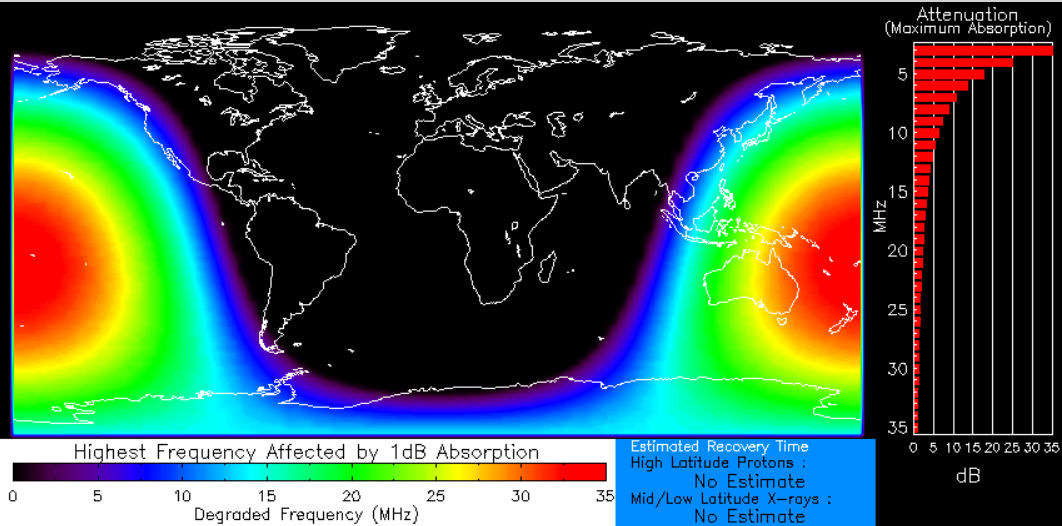
Extreme ultraviolet radiation from the flare ionized the top of Earth's atmosphere. This, in turn, caused a shortwave radio blackout across the South Pacific Ocean: blackout map. Ham radio operators in Australia and New Zealand may have experienced loss of signal below 30 MHz for hours after the flare's peak.
Update: SOHO and NOAA coronagraph images confirm that several CMEs emerged from yesterday's collection of flares. None of them appears to be either potent or squarely Earth-directed. Glancing blows expected on Feb.4-6 could spark G1 (Minor) to G2 (Moderate) geomagnetic storms.


Ye boyz and gur;z... it is not our burning carbon based fuels that is causing these major!! weather riffs... JUST LOOK UP at that orange ball 93,000,000miion miles towards the center of "OUR" universe!!!!!!!!!!!!! skybill
ReplyDeletePretty much every single erg of energy on this rock comes from that ball of fusion reactions.
DeleteThe most important thing, though, is this anti-human scheme comes from comparing current temperatures to what they call the "Little Ice Age." I would hope we're warmer than an ice age!
"Activity has been disappointingly low." Please be careful what you wish for SiG. Mathmatics believes in you and reversion to the mean is still a thing.
ReplyDeleteI see reversion to the mean as a good thing. Cycle 25 is still a weak cycle, so stepping up to the mean of what we've observed is better than this cycle has been. How weak is cycle 25? It's stronger than the previous cycle (24), which was the weakest in a hundred years, but weaker than the one before that (23).
DeleteTo state a mathematically true and dramatic interpretation of that, I personally have caused just as much damage to the power distribution system by farting as cycle 25 has caused. Zero point zero.
The other thing to remember is that we're on the decreasing activity side of the cycle so it'll be 2030 to '31 before it's likely to be getting stronger.