Showing posts with label radio. Show all posts

Sunday, October 25, 2026

So Is It Fixed?

Followers of yesterday's post on the problem I'm having with my station have probably read my description of today's work, but I copy it here for everyone else. 

The most effective thing I did yesterday was to unplug and replug the USB cable into the audio input box on top of the rig. It's one of those square plugs, about 1/4 on a side, so I think those are USB A family. Today, I tried the station the way it was last night and it was doing better. I did about 10 transmit tests before it went into the "audio comb mode". Once I reset everything, I grabbed my can of "Deoxit 5" spray that's always on hand and gave a small spray into the end that plugs into the audio box on top of the rig.

Since then, I worked a couple of stations on 17m, figure about 10 T/R changes (both to and from that box), for them and ran around three dozen "tune" button transmissions. No returns of the "comb". 

So given that connector issues like this are about as common as can be - although I can't say I've seen one with these square USB-B connectors - and since I've done lots of transmissions without seeing the problem again, it might well be "all better." Between working the two new countries on 17m and my roughly "three dozen" transmit tests, that's more than I tend to transmit in most full days of making contacts on any band. 

Let me add some info that I should have included last night but wasn't prepared. 

First is the "red comb" effect, at the top of this screen capture. From the start of continuous lock out of the system until this screen grab is five 15 second intervals, and this was early this afternoon before the Deoxit5.

I've seen the red comb continue after I've turned off the radio that had been transmitting, so it's got to be coming from the audio system. The transmit audio is generated by the WSJT software running on the PC that gave us this plot. The audio from the computer goes over the USB cable that appears to have fixed it. That goes to a SignaLink USB box that controls both the transmit and receive audio levels. 

It has been a tricky problem to work on because it seemed different at different times. On the first day I spent time testing other bands, I found it on 20m and while I'm not 100% sure at the moment, I'd swear I saw it on 15m. I haven't seen it on any other band as much as 17m, and none on 20 and 15 since Thursday. Intermittent or "flaky" problems can suck up a lot of time.

So while I think it might be fixed, I'll be keeping an eye out for milder issues or more cases of this. 


Saturday, October 24, 2026

A day of troubleshooting ...

... a very unusual problem that I've never heard of before in my ham shack, and I'm not sure I have anything to share. If you've been down the road of troubleshooting intermittent problems you're familiar with the idea that you may spend a lot of time deciding if you've fixed the intermittent problem, or just made it more intermittent. 

For one thing, I don't have single picture of the failure when it happens. I've been too distracted by trying to "make it stop!" 

Let me start from the beginning. Back in about 2018, I started running the various modes offered by physicist Joe Taylor, the vast majority of the time on what's called FT8. Yes I've used others, mostly FT4 which is like FT8 but less sensitive (less able to copy very weak signals) by using shorter transmit and receive intervals. The trade-off being you give up some sensitivity for shorter contacts - for those days (like today) when maybe you hear another state for a minute. I've used its meteor scatter mode, moonbounce mode, and more. 

Over the years, I've worked FT8 on all HF bands and 6m. My station has antennas for 80 to 6m except for 60m, a small chunk at around 5.5 MHz. 

A couple of nights ago, with 6 being as dead as it has been, I dropped down to HF, but instead of going to 80/40/30 as I typically go, on a spur of the moment decision, I went to 17m (18.068–18.168 MHz). It's a small band that hams were granted in the '79 World Administrative Radio Conference, or WARC, and the three bands that came out of that are known as the WARC bands. (If you've never heard of 17m, this seems to be a good overview). 

One the things I'm used to doing as last check on my station before I start to operate is hit the tune button, which just transmits a carrier at whatever your rig is set to. The (always there inline) power and VSWR meters looked perfectly normal, but nothing else did. Let me show you a screen capture of FT8 software (tuned to 30m - that's the only thing that's different) to make some points.

There are two windows here, the top one is the audio channel from 100 to 3100 Hz, each of the colored areas at the top are individual stations. In general the orange strands that are the most orange (like around 1700 Hz on the top scale) are the strongest, fading down to the more yellow ones (around 2000 Hz and that green rectangle). The spectrum at the bottom is more like a regular spectrum analyzer and is only showing the very topmost thin line of colors. The taller the spectrum the stronger the signal. 

When the "bad" happened, that topmost line was replaced by what looked like a continuous spectrum of lots of narrow "spikes," all red. Except spikes tend to have points and bases. This was just alternating big signal and nothing. Maybe like a comb, but all the red "teeth" were the same height and width. 

It gets weirder. The needle in the inline power meter that had previously measured the normal roughly 100 W transmit signal was now not showing any power at all. The receiver sounded muted, as it does during transmit. There's a transmit/receive indicator LED on the radio that stayed in transmit (red) instead of receive. 

It took a while to get it to stop; I had to reset everything. Turn the radio off and back on, reboot the computer, and several things. 

Yesterday, I started looking at it in more detail. I found that it did this on 20m but not higher: 15 to 10. This is helpful because 20 and 17 are on the same antenna, my Tennadyne T6 log periodic (LPDA). The other bands I've been tending to operate, 80, 40, 30 and 6m, haven't shown the issue. Then playing around on 17m, I found I could operate CW or SSB with no problems showing up. The frequency sensitivity made me think something in the LPDA's circuitry might be the problem. Looking up from the ground shows nothing, but it's at 25' above ground, so the view isn't that great. An easy next step seemed to be to check the grounds around the antenna. 

So that was today's start. All I could say was that the grounds looked just like the last time I did my routine inspection last spring. Nothing broken, nothing missing, nothing looking like the ground wire was replaced by weeds. They just looked like they've been outdoors and corroded a bit. The next thing to check was connections in the shack and while checking things on 17m again, I noticed the rig control software (Ham Radio Deluxe - HRD) would not always see the radio. So I did the old "unplug it then plug it back in" trick. That's a USB connection from the radio to a little box that sets up the modulation for these WSJT modes. That made a difference. It was easier to recover from the "red comb". 

Late in the day (it was nearly 5PM by this time) I decided to retest the setup on 17 and the problem was gone. I tested a couple of times and it worked. I tested 20m - no problems, and worked my way back up to 10 without seeing the problem again. Then I went back to 17 to "soak in the success" of just unplugging and re-plugging one cable. That's when it failed again. 

What was that thing about making the intermittent problem more intermittent? 

Around the time I sat down to write this I realized, I could use far more pictures than I've got. So I went back to the shack, tuned to 17 and hit the tune button to transmit. No problem. Tried it again - surely it must fail by now? - Nope. I think I transmitted 10 times and it never had the failure. Then I tuned it to a band I've never seen it fail on, 30m, for the picture above. 

What's next? Can't say I really know. More experiments and measurements, but I sure don't know what to go after. It looks like it's in the computer control of the rig. I've tried two different versions of the WSJT software, the latest and a somewhat earlier release. I'm on the latest update of HRD. 


Sunday, September 27, 2026

So what's a "synthetic aperture radar?"

So what’s a synthetic aperture radar (SAR)? I should take a moment to emphasize that this is all based on the mathematics of combining different signals. It’s essentially “Digital Signal Processing” (DSP) but on reflected microwave signals not audio from a microphone or other source. 

Take a look at the antenna in the previous post again. Each one of those dark spots is a cut out slot in sheet metal, like the dual of a wire on a mounting plate that’s not conductive. A properly sized, non-conductive slot, in a conductive sheet becomes the antenna. I talk about this in a post on aircraft antennas (of all things). It's in the portion below the line about 3/4 the way down the post. Especially the links on slot antennas. 

Consider these slots being cut for 10 GHz.  A quarter wave (90 degrees) slot’s length can be found by (antenna length - in feet) = 234/(freq in MHz)

L = 234/10,000 MHz = 0.0234 feet or 0.2808 inch

so a quarter wave is 0.281 inch and each of those slots is positioned on the sheet so that the E- (electric) fields combine to produce the desired radiation pattern. You’ll note that in some parts of the (more or less) circular outline of the plate, particularly along the left and right sides (in the picture), the slots seem aligned so that any four slots look like a square, while closer to the center, they don’t look to be aligned that way. The squares look cattywampus, to use the southern word. 

Remember the radar is on a moving satellite, and since the satellite's pointing the radar down on the weather, it’s moving fast, but not toward or away from the weather – it’s moving at right angles to the ground on Earth. That’s an approximation, but good enough for now.

The motion of the radar source causes a Doppler shift, the change in returned frequencies higher as radar approaches the reflector and lower as the two bodies separate. It’s hard to catch this from all these mentions of speeds and distances involved, but the reflected wave reaches slots on the antenna different from the ones they were transmitted from because of the satellite's speed in orbit and the time for the radar to get to the ground and bounce back up to the antenna. "Radar reflections from discrete objects in a passing radar beam field each [have] a minute Doppler, or speed, shift relative to the antenna"  

Carl Wiley, working at Goodyear, Arizona, (which later became Goodyear Aerospace, and eventually Lockheed Martin Corporation) in 1951, suggested the principle that – because each object in the radar beam has a slightly different speed relative to the antenna – each object will have its own Doppler shift. A precise frequency analysis of the radar reflections will thus allow the construction of a detailed image

Colburn, Robert (10 March 2009). "Your Engineering Heritage: Synthetic Aperture Radar". IEEE USA InSight IEEE.

In order to realise this concept, electromagnetic waves are transmitted sequentially, the echoes are collected and the system electronics digitizes and stores the data for subsequent processing. As transmission and reception occur at different times, they map to different small positions. The well ordered combination of the received signals builds a virtual aperture that is much longer than the physical antenna width. That is the source of the term "synthetic aperture," giving it the property of an imaging radar.[5] The range direction is perpendicular to the flight track and perpendicular to the azimuth direction, which is also known as the along-track direction because it is in line with the position of the object within the antenna's field of view. 

An illustration of the aperture synthesized - each of the long rectangles is depicting one of the antenna slots in the antenna we show. The motion of the antennas is along the X direction, left to right. 


Saturday, September 26, 2026

How About an Intro to Radar?

Back last week, while talking about Rocket Lab launching a Synthetic Aperture Radar for the Japanese, I wrote, 

I used to design radars among other things, and when I thought of the questions being asked, my reaction was, "should I devote some time to things like the basics of what Synthetic Aperture Radars are and how they work?" Comments? 

Comments were in favor of doing that, so I decided to get started. It was starting to look like a long piece, so I started by putting together first a general introduction to radar, primarily to ensure everyone has a common language. 


RADAR 101

To me, it’s always stretching myself to take something as involved as radar can be – the word is applied to many different kinds of systems – and write a generally understood text on it.  At root, radar isn’t new; it was known before WWII. The name itself comes from radio detection and ranging. As the name implies, radars use radio waves to determine the distance and velocity (motion) of the targets they hit. 

Radio is ultra low frequency light – and since wavelength is inversely related to frequency, radio waves are much longer than light waves. There are aspects of the frequency chosen and the intended use for the radar, and those are “beyond the scope” of this. That means a radio frequency (RF) source needs to generate the radio waves to use. How are they detected? With a radio receiver, tuned to the frequency of the source. That’s intentionally vague because the bandwidth required for the receiver depends on what the radar is being used for. 

Finally, how is ranging detected? The easiest thing to envision is radar sending a single pulse on a single frequency, and in this case the range is determined by measuring the time between the pulse being sent and the pulse caused by its reflection off the target arriving back at the receiver. That time difference between being sent and received is divided by two to get the time distance to the target. Divided by two because the pulse has gone from the transmitter to the target and back to the receiver and each trip to or from takes the same amount of time. 

All radio and light waves travel at the same velocity, the speed of light, usually referred to as c in physics books. The speed of light is 300 million meters per second (formally 299,792,458 m/sec, but 3*108 or 300*106 m/sec is close enough for now). Which is the same as 300 meters in one microsecond (millionth of a second). If you’re more comfortable in miles, that’s 186,282 miles per second – or 0.186282 miles per microsecond (millionth of a second) which turns to be 983.664 ft/msec.  

Just bear in mind that if you get your return pulse in 1 µsec, it’s not 300 meters or 984 feet away. It’s half that because the pulse had to go twice that distance – half a µsec out and half a µsec back.

You can probably see from this how timing became very important in radar systems, but you may not see how timing became important in the antenna design. You see, every antenna that’s directional requires phasing differences between the elements of the antenna to establish patterns, whether it’s a simple yagi antenna with “a few” elements or a phased array antenna with dozens of elements, phasing is a mechanical way of establishing a timing difference. 

An easy Rule Of Thumb to remember is the more antenna elements you have the smaller and more concentrated your beamwidth will be. It’s why a yagi with seven elements will perform better than one with five or three. That is, the five element yagi will outperform the three, and the three will outperform a single dipole. Such an antenna will deliver a greater percentage of your transmitter’s output power onto a target and simultaneously deliver less power outside its beamwidth. Since part of the first sentence includes saying the smaller and more concentrated your beamwidth can be, that means the uncertainty in the direction the radar’s antenna is pointing goes down as the number of elements goes up. 

If this is new or puzzling, I've written a lot on this. See my post on, “A Ham Radio Series 31 – Phased Arrays, or A Dish Without A Dish” or “A Ham Radio Series 31 – Very Directional, Very High Gain Antennas”

How do these arrays of small antennas operate and produce patterns of gain that produce more signal in the desired direction? The phase differences between all the antennas combine to produce more gain in some directions and less in other directions. When antenna gain is measured and talked about, the antenna isn’t amplifying the signal; that requires active devices and electrical power. Antenna gain is measured in comparison to a defined antenna, usually a dipole or something more omnidirectional (transmits the same power in all directions). What the antenna is doing is combining the output of all the smaller antennas it's made of into one much higher power in one small angular width.

In optics, a telescope like the (78 year old) Hale telescope on Mount Palomar, the aperture of the single primary mirror, 200 inches, is the telescope’s aperture. In multiple mirror telescopes like the James Webb Space Telescope, combining the image data from several smaller optical instruments to generate an image as it would appear to a much larger mirror is referred to as the size of the combined image generating mirrors. In the case of the Webb (JWST) that aperture is a 6.5-meter-diameter (21 ft) mirror. Aperture for a radio telescope is the width of the antenna beam at a defined distance from the antenna. It's practically never talked about, but sometimes is mentioned in radar systems talk.

Because these high gain radio antennas approach having all of their gain in one direction with no signal transmitted or received from other directions, we’ve achieved the definition of radar.

Remember radar =  radio detection and ranging? The reflected radio pulse tells us something was detected, the time between the transmission and reception of the pulse tells the range, with the bonus of not just knowing “something’s out there” but the position of the antenna tells us the direction of that thing. If that radar is on something that’s moving, ship, car, airplane, or whatever, the motion of the vehicle and its position is constantly changing so that has to be incorporated in the calculations, too.  

Searching with Duck Duck Go for "Boeing 787 Weather Radar" because I've seen those. I found this and wanted to point out that the circular thing behind the nose with straight lines near the edges is the radar antenna array. Each of those small dark lines on the flat surface is an antenna, and the position of each one, along with how the radio signal gets to the antenna determines the antenna's pattern. 

EDIT 09/28/29 1325 EDT to correct a wrong prefix, changing 1msec to 1µsec - millisecond to microsecond. Thanks to commenter Lowell for pointing that out. 


Saturday, September 12, 2026

The VHF Contest is about what I expected

I had to shut down the station for an hour or so to let the daily thunderstorms roll past (it is August 43rd, after all), but I had the station on for a couple of hours before that and since then. 

The short summary is it's pretty much as I expected last Sunday night. Most of what I heard were stations within a 25 mile radius of my place, but I'd get maybe one or two 15 second windows when I'd hear someone farther away. A couple of stations around Atlanta and about that radial distance.  I'll go back when I'm done here and try not to fall asleep from boredom as the night goes on.  

In other places around the country, people will load up a van or car with radios, computers and portable antennas they can set up - like this guy. Not here. At least no one I know of does it. It is August 43rd, after all. Maybe in January.  


Photo from the ARRL.org. This link says the guy in the photo is Ed Parsons, K1TR, but no more details than that. 


Sunday, September 6, 2026

Alright hams, the next big VHF contest is next weekend

I've got to say I've never had much luck in it, but the ARRL September VHF Contest is next weekend. It runs from Saturday Sept. 12 at 1800Z, to 0300Z, on Monday Sept. 14. Here on the East Coast, that's Saturday at 2:00 PM until Sunday night at 11:00 PM. If you've read my ramblings about the other ARRL VHF contests, they all that time format. The first time I ever tried to do anything in that contest was back in early '80s, when I didn't have 6m station at all, and was operating with my HF transceiver driving a 2m transverter I designed and built. I heard absolutely nothing other than the couple of local guys on 2m sideband (voice).

I never tried the June version of this contest until I got on 6m in the early 2000s - I'm not sure what year it was but my first contacts on 6 were in the spring of 2002, so there's a chance that was the first time I worked the June VHF contest. It would have been both CW and phone. After retirement, I started paying more attention to contests like this and made it a point to try the three contests the ARRL puts on: January, June, September. It has always been the case that June is the best and September is the worst.  

Nowadays, I have a radio that has 2m and 70cm (144 and 432 MHz bands) built in, but I don't have an antenna for either of those two bands. (I still have that 2m transverter on a closet shelf, so it may even still work) 

The bigger problem in my eyes is that the Sporadic E season is over. I think my last couple of E skip contacts around the US were almost a month ago; around the 10th of August. While there can be sporadic openings around the winter equinox, and more broadly from around November into January, the northern hemisphere summer E season tends to be better. Back in late January of '24, I worked both New Zealand, and Australia over the course of a couple of days. That propagation, at least the longest hop of "a few" it takes to get there, is more likely to be F layer. A common explanation is that the first and/or last hops of propagation tend to be E layer skip, and after one or two E layer skips, the signal becomes F layer skip. It can be E skip at one or both ends, and move around in the ionosphere.  

Unlike E layer skip, F skip is easier to predict from the Solar Flux Index, sometimes referred to as the 10.7cm solar flux (2.80 GHz). In general, the more the merrier for VHF, and while today's SFI has been around 100 and "quiet sun" levels are in the 70s, F and F2 layer skip are better when it's much higher than 100. A year ago, values around 200 and higher happened a few times.   

An illustration of the ionosphere layers, called the D, E and F layers – in order of height. If solar energy is high enough, the F layer can split into two layers called (imaginatively enough) F1 and F2.


Saturday, August 22, 2026

It appears that someone has stolen the E layer of the ionosphere

Longtime readers, and in particular those who are also hams, may well remember this meme I created and posted in November of '25. At that time, I was concerned about a different layer.  

The F-layer is the highest layer of the ionosphere and when solar flux is highest, it splits into an F and F2 layer that's even higher. In short, when the F-layer is propagating signals around globe, the stations we can work (contact) are the farthest ones we'll ever hear. Pretty much around world. 

So while it's the best for long range contacts, I've worked Japan, Australia, New Zealand, Hawaii and several small island countries in the pacific on 6m, F-layer propagation is actually too long for working around the US. For that we tend to rely on the E-layer, and what's referred to as Sporadic E or Es propagation. Sporadic E is possible for more of the year than just summer, but Es is most dependable as summer mode. It's just not available for as large a part of the day as in the summer. 

The days when the Es first appears tend to be a celebrated surprise, but when it just suddenly stops, it's the ending of some of the best times of the year, depending on what you're pursuing. The last "good" opening in my neck of the woods, west to Montana and Idaho - for example - was on August 10th, so just under two weeks ago. 

I've mentioned before that I'm trying to work what's called The Fred Fish Memorial Award, or FFMA, for working all 488 Maidenhead Grid Squares (which are rectangles because they're two degrees in longitude by one degree in latitude) in the continental US. This ES season I added around 30 grids (I'd have to dig out some notes to be more accurate than saying "around 30"). I'm not quite at 100 left, but I'm close: something like 385 worked instead so 103 left. 

I also mentioned DXCC as a target, which I expect to achieve as opposed to the FFMA which I'll be lucky to be around long enough to get all 488. I have worked over 100 countries on 6m, but I'm at 97 confirmed. I could use the F layer, too. 

So whom do I report the theft of the E layer to? FCC? EPA? It's part of the environment, after all. I bet that Greta kid stole it. Someone convinced her the E layer added to global warmening. 


Sunday, August 9, 2026

Alternatives to the ionosphere

A natural follow up to watching the solar cycle progress, like we did with yesterday's post, is to ask what can we do if the ionosphere just won't cooperate? 

This assumes you want to contact other people or places via ham radio, for some piece of wallpaper or other. I mean, obviously, if you're stuck in a broken down car in the middle of nowhere, you want some sort of phone or high bandwidth connection. 

An answer that's easy to overlook and can work very well on VHF is meteor scatter. Back in April of '24, I put up a post about it, called "When Hobbies Converge or What The Heck is Meteor Scatter?"

Back in the 1950s, hams discovered that the trail created in the upper atmosphere by meteors burning up acted like a radio reflector, as if the ionosphere was enhanced. The effect is most beneficial to VHF stations which typically don't have regular, predictable ionospheric propagation. In the early days, this was done with Morse code, or CW as the hams typically call it (CW for Continuous Wave). Now that we're firmly in the age of computer assisted modulation modes, most people trying to bounce signals off the meteor trails are using a computer assisted mode. The most popular appears to be MSK144 (.pdf alert).

MSK stands for minimum shift keying, a form of continuous-phase frequency-shift keying (FSK) with shift equal to half the baud rate. MSK144 uses message frames of 144 bits and modulation at tone frequencies 1000 and 2000 Hz to transmit channel symbols at keying rate of 2000 baud. The resulting audio waveform can be viewed as a form of offset quadrature phase-shift keying (OQPSK) with individual pulses shaped like the first half-period of a sine wave.

Contacts made via meteor trails in other modes sometimes happen without either end of the contact knowing the connection was caused by a meteor and without using MSK144. Generally, though, your chances of success are better during the named meteor showers that get talked about regularly on sites like Space.com, as well as sites aimed more at amateur astronomers. While the number of meteors per hour varies widely between showers, there's generally one named shower per month, and there's some "sporadic meteor", also called a pebble or something, burning up in the atmosphere even on days when no "shower" is predicted. You'll have more luck looking for contacts in MSK144 mode on the frequencies hams have been using. 

That's why I'm bringing this subject up now. One of the biggest regular annular showers has been ramping up, the Perseid shower, which will (purely coincidentally) peak overnight on Aug. 12-13 under the dark skies of the new moon. It so happens the 12th is the day of the solar eclipse that will be seen to reach totality from a few small areas in east Greenland, western Iceland and northern Spain, so the people who experience totality of the solar eclipse may be treated to a meteor trail or two.  

While sporadic meteors can provide short duration openings, long messages can take excruciatingly long times to send. Meteor scatter also tends to be shorter distances. While multiple hop sporadic E can enable contacts across the US, meteor scatter tends to be more like 1000 miles or less. Occasionally, 1500 miles can happen. That cross-USA kind of multiple hop sporadic E seems to happen less often than meteor scatter, too. 

Still, there have been a handful of grid squares in the SE US that I've worked by meteor scatter easier than waiting for other openings. There's such a thing as the other station being too close, too. 

Perseid meteors streak over Lucerne, Switzerland, during the 2018 shower's peak. The photo was taken with an Olympus E-M1 Mark II camera in Live Composite mode. Scene exposure of 2 seconds; the Perseids exposure was about 30 minutes long. Orest Shvadchak


Saturday, August 8, 2026

Solar Cycle 25 Update - a bit late

I've been forgetting to update the solar cycle and solar-terrestrial indices for a while. I mean I last updated this last December 29 and that update was even later than this.  

A highlight I've posted on solar cycle updates has been the "Last solar cycles comparison" from Space Weather News, and produced by a group called solen.info. NOTE: the plot is at the first link, not the second (solen.info). Here is the current plot:

It's pretty obvious that cycle 25, 2nd from the bottom (that is, 2nd weakest), peaked a little before the 60 months after cycle start line and the current reading is vertically between cycle 24 (weakest in the last hundred years) and cycle 22 (the black curve) which was in 1986-1996. What's not quite as obvious at first glance is the highest Smoothed Sunspot Numbers (SSNs) of cycle 25 are well above cycle 24, the previous cycle, on the bottom everywhere, but what you can't see on this graph is that cycle 24 had the lowest SSNs in the last hundred years, so cycle 25 has been quite a bit more active than 24 but that's just not saying much. "Hey, we're not the worst cycle in a hundred years!" 

Let's look at Cycle 25's raw data, note the first two vertical lines on the left (2018 and 2020) are still cycle 24:

You'll notice that the absolute peak of cycle 25 occurred during 2024. There were some days with very high solar flux in '24: the highest peak was in August as shown here: each black dot is one month. That peak was a highlight in the last post because that was around the time that I got closer to hearing Alaska on 6m as I ever have. Everything I've ever heard about working Alaska from guys around here is it's pretty much a "once in a lifetime" thing. During that "band opening" I never copied a single letter from Alaska, but a friend in Tennessee copied one 15 second transmission from the Alaskan.

Is there a chance of hearing Alaska down here again in what's left of cycle 25? My guess is that if the current trend holds, almost a smaller and mirror image of cycle 21, then no. The only thing that I think would help the chance of getting Alaska is for a second peak of SSN, equal to or stronger than the previous peak forms. A second peak would completely wipe out the right side (prediction) of the SSN for the rest of the cycle. The only hope would be that the SSN in the time I heard Alaska was well after that peak of the cycle in August. The November/December time frame I heard Alaska in is that short little straight line two dots after the August peak.


Sunday, June 28, 2026

It was BIC intensive weekend

I really have very little to write about since I spent a lot of time living up to the observation that there's nothing quite like staying BIC to get the best out of time in front of the radio. 

I spent most of Saturday and today BIC and striving to get "new" things on 6m.  My final total was 

  • New grids contacted for FFMA credit: 4
  • New countries contacted for 6m DXCC credit: 2

While I don't qualify for either, I'm far closer to DXCC than the FFMA. 

The band conditions (propagation) were better from Saturday morning through about 0000 UTC or Saturday evening around 7:30 PM local time, when I came out here to write the "It's Field Day" article.  Sunday morning meant continuing with our search for a new church, but the conditions from lunch through most of the day were pretty poor compared to yesterday.  

Even sitting here now and looking at it, it looks like a lot of BIC time for those amounts of increase, but, there are plenty of times when I spend days in the chair and only get one or two new credits, or nothing new at all. 

Since I've been watching for this, I should update that the SWIFT rescue launch to on the "last" Pegasus rocket has been delayed until Tuesday at 6:23 AM EDT, but it's not from here or Vandenberg. It's from the Marshall Islands.

Northrop Grumman's Pegasus launch vehicle on the belly of their Stargazer heavy lift airplane. Image Credit: Northrop Grumman


Saturday, June 27, 2026

It's Field Day Weekend '26 - Remember your BIC

As I write, it's Saturday evening the 27th, both EDT and UTC. It's the last weekend in June and that marks the weekend of the year when American ham radio operators conduct the biggest operating event of the year that isn't a contest: Field Day. Strictly speaking, Field Day (or FD) is an event organized by the American Radio Relay League, or ARRL, so people who are opposed to the ARRL for whatever reason look down on the event. Saying it's not a contest is one of those things that's technically true, by definition, but people submit scores and their logs for bragging rights. FD runs from 1800 hours UTC on Saturday (2PM EDT) to 2059 Sunday ( 4:59:59 PM EDT). 

But that's not why I'm here. I've written about Field Day before, and this previous paragraph is almost word for word from last year's post.  The only edit I remember is changing the date in first sentence from last year's June 28th and I wrote that one in the afternoon. 

The main point of this post is something I haven't written about before. I've mentioned being a paper chaser, with several pieces of wallpaper earned and others that I'm actively working on today - 6m DXCC and the FFMA. As I said before, one of the first few posts (post #6) on the blog was about what I called my Lifetime Achievement Award in Ham Radio, 5BDXCC, short for Five Band DXCC (5BDXCC), and now that stands at 8BDXCC. I'm closing in on my ninth band, 6m  (50-54 MHz). I've told myself that my chances of achieving the FFMA approach zero simply because of the geography. The FFMA is an award for contacting all 488 of the Maidenhead Grid Squares, (1 degree in latitude by 2 degrees in longitude) in the lower 48 states. I'm far closer to the geographic SE corner of the CONUS than the center. Only one station in Florida has earned the FFMA, and that was someone in the NW-most corner of Florida, around 500 miles from me. 

So how does one work toward this? And what's this BIC I mention? 

I'm not going to insist this is the only way to get there, but the First Law for working countries, states or grid squares you've never worked before is simple.  Listen first. Listen, listen, listen and then listen some more. There are other sources of information. The easy one is something I've mentioned dozens of times, websites that allow hams to report hearing other stations, and present a graphical display like this one from DXMaps. 

It's important to point out how you should use something like this, because I've sat in the station many times with a red blob of reported contacts like that and heard almost nothing. The important thing about this is that every line on it has two ends on it, it's either a contact between the two calls, or one end of it is being reported by their computer on its own because the computer can do that on its own. 

Your best chance of knowing you'll hear someone is if someone near you is either reporting working or hearing the call on the other end of the red line. If you see a call that's near you on the map and they have a better station than you do (they can hear weaker signals than you), you may not hear the same station they do. Look at Florida on this plot an you'll see several red lines going toward the NE, perhaps New York, or Pennsylvania, maybe even New England. You'll also see a smaller couple of red lines headed more northwest into the middle of the blob. Someone in that part of the country might be heard as well. 

None of those red lines going east to west across the middle of the country mean anything to us down here in Florida.

This is where BIC comes in, which is an acronym for Butt In Chair. Sit in the chair and listen. If you're using one of the digital modes implemented in software that displays every call it's demodulating, read that like it's the most important contract you've ever gotten.  

One of the things about 6m that's striking is openings can be really specific. Over the years, I've seen times when I'll get a cross county opening to one grid square; sometimes for one 15 second transmission ( common in FT8) sometimes for a few minutes, then it jumps to another grid square, or disappears for some time, then appears again to a different square.

Let me show you a real example. I modified a map of the US showing all the grid squares to show where my central Florida signal popped into the Pacific NW. 


The red lines are supposed to be showing the first square I contacted was CN84 in Oregon and worked a station there. A few minutes later, it went silent, and then I heard CN86 and worked another station. Again, it went silent after a few minutes, and then opened to CN85, where I heard and worked the third station of that day. The details like "how long was it open? then how long did it close?" and more are long gone, but I think the whole thing lasted around 30 minutes. I've since heard similar things with closer grids, enough for me to think that it's actually not a rare thing.

If I wasn't BIC, I wouldn't have heard any of that. Similarly today, there were two guys in two different grid squares that I've never worked yet, DM86 and 96. If it weren't for monitoring closely I wouldn't have gotten both of them. BIC, watching the signals being copied out of my computer on my desktop instead of reports from places like DXMaps. 

Knowing where and when to transmit is another "listen, listen, listen" thing and it varies with the mode you're operating. On CW and voice, they'll generally tell you something like, "listening up 5" or "up 10 to 15". The important part is not to transmit when they're transmitting, but when they're listening. Saying "up 5" or that sort of thing doesn't happen on the new digital modes because those modes don't give enough bits of information. You have to pay attention to when the station is transmitting and choose to not transmit when they are. On WSJT-X's FT-8, which seems to be the most popular mode, I couldn't tell you how many times I've seen someone calling the DX while the DX is transmitting, not listening. 

All DXers have heard this many, many times.


Saturday, June 6, 2026

OK Hams, you've got a week to get ready

I write about this every year because the best VHF contest of the year is pretty much always the June VHF contest put on by the American Radio Relay League or ARRL. As always, the contest starts on the second Saturday of the month, with the peculiarity that it doesn't start at midnight UTC - as the vast majority of contests do - which would be Friday night, June 12th at 8:00 PM. Instead, it starts Saturday afternoon at 1800 UTC which is 2:00PM EDT and goes until 0300 UTC or 11:00 AM Sunday night, which is Monday morning the 15th in UTC. 

WA7BNM's Contest Calendar shows it this way: 

ARRL June VHF Contest: 1800Z, Jun 13 to 0259Z, Jun 15
  Geographic Focus: United States/Canada
  Participation: Worldwide
  Mode: All
  Bands: 50 MHz and up
  Classes: Single Op All Band (All Modes/Analog Modes)(Low/High)
Single Op Portable (All Modes/Analog Modes)
Single Op 3-Band (All Modes/Analog Modes)
Single Op FM
Rover
Limited Rover
Unlimited Rover
Unlimited Multi-Op
Limited Multi-Op
  Max power: (see rules)
  Exchange: 4-character grid square
  Work stations: Once per band per grid square
  QSO Points: 1 point per 50- or 144-MHz QSO
2 points per 222- or 432-MHz QSO
3 points per 906- or 1296-MHz QSO
4 points per 2.3 GHz (or higher) QSO
  Multipliers: Each grid square once per band
  Score Calculation: Total score = total QSO points x total multipliers
  Submit logs by: 0300Z June 24, 2026
  E-mail logs to: (none)
  Upload log at: http://contest-log-submission.arrl.org
  Mail logs to: June VHF
ARRL
225 Main St.
Newington, CT 06111
USA
  Find rules at: https://www.arrl.org/june-vhf


Almost a month ago, I ran a post called, "Did it just turn into summer?" because suddenly, the VHF bands, in particular 6 meters (50 - 54 MHz) where I do most of my VHF operating these days suddenly came alive like it hadn't been so far this calendar year. Well, the answer was "no" because that 6m opening wasn't long enough lived. As the calendar flipped into June,it started being more like summer, with the sporadic E "red blob" over massive parts of the country happening more like every day. 

I just took another screen copy of the DXMaps site and it's noticeably bigger and wider than the one I posted in May, so let me post the new one and talk a little about what to look for. This plot was grabbed at 0018 UTC on June 7th.   


If you've never seen a plot like this, you might be overwhelmed by the number of contacts shown. Every red, brown or other color line on the map is a contact between two hams. Most, but not all, of those contacts have the call for both ends of the line. That is, if both ends have the call, when you click it will tell you if that station contacted the other or just monitored (heard) the other end.  For example, in the upper left of the USA, there's a station with a white background called N7DNF and it you hover your mouse pointer over the white area, the live DXMaps would display "N7DNF (DN55RS) last reported by" - the call of the station reporting it (so not N7DNF) with the time reported, the frequency it was heard on and modulation mode. The DN55RS is the grid square N7DNF reported being in. If you were doing this "live" on your computer, you'd see somewhere in the blob, another one of those white or yellow rectangles would change its appearance a little to help you find the other end of the QSO.

First important note: you may look at that and think if you turn on your radio, you'll hear all these calls. With luck you'll hear one or two stations that others living near your end of the line will hear. One of the things that still impresses me after decades of observing it on 6m is how "oddly specific" the targeting is. A maidenhead grid square is one degree of latitude by 2 degrees of longitude which is approximately  70 × 100 miles in the continental US. I have seen grid squares open for a contact while the adjacent square north or south is as dead as if it was on another planet; minutes later it would jump over the adjacent square which still wouldn't be audible, and minutes after that it would jump down to the one it had previously jumped over.  

When the map looks like this, I've heard two adjacent - or just "close to each other" - squares and not another station in the country. I've been operating FT8 the majority of the time, which operates in 15 second intervals so that stations alternate which 15 second interval they transmit in: 0 to 15 and 30 to 45 seconds or 15 to 30 and 45 to 60 seconds. I'll hear, for example, two stations in New England on the first (0-15 and 30-45 seconds, called the even intervals) and somewhere in Kansas or Nebraska in the odd intervals.  

There are other sources of maps like this other than DXMaps, and totally different ways of presenting the information. There are other contests besides the ARRL June VHF contest, and July has one I've played around in a couple of times - the CQ magazine contest. And, of course, one of the biggest events of the year is the ARRL's Field Day, the last weekend of June. 


Saturday, May 30, 2026

Those Pico Balloons Again

I can sense the "what are you talking about?" questions in the air. 

Three years ago in February, after the headline Chinese Balloon Incident, I started looking into the responses, starting from the question, "Did The USAF Shoot Down a Ham Radio Balloon?" and first encountered the idea of hobbyists that made small or downright tiny balloons that they'd let ascend into the atmosphere and transmit a low power signal with some information that could be monitored wherever they happened to be. It eventually turned into a fairly long introduction to the topic of hobby balloons that go around the world. 

Again, that was over three years ago, and groups like the Northern Illinois Bottlecap Balloon Brigade are still online, and growing. 

Earlier in the week, I came across an article on one of the forums I read where a guy, working on his own, had found a way to get a very lightweight balloon into the upper atmosphere - above most airline traffic - and it made me want to do a post about what he did. Maybe to encourage you, or maybe to encourage me. Let me show a map he posted showing the travels of his cheap little balloon. 

What I really want to show about this is the information in the upper left hand corner. I'll enlarge it, and add it here. 

While the big picture shows what appears to be around 3 laps, this says 3.821 laps - and much more impressive to me: 68 days and 8 hours floating around the world. Just above the bottom of the summary, it says the last altitude was 13.70 km - which converts to just under 45,000 feet: 44,948.

Now here's the embarrassing part. I dutifully saved this image but I apparently didn't leave myself a link to the source where he shows off the heart of the balloon, a folded piece of paper with a few solar cells to power it, and a few small printed circuit boards. They look professionally done, not hobbyist level, and that's telling me that they're probably among the many professionally designed and produced boards used by hobbyists for many things that the developers never dreamed of people doing. Which means I can't say "just do this" and you can launch your own pico-balloon.

I'll keep looking for that, and hope to be able to round it up soon. 


Sunday, May 10, 2026

Did it just turn into summer?

Not weather-wise, or at least not the weather at the ground level. I'm talking about a difference in how the ionosphere's E layer is behaving. 

I've written about Sporadic E propagation, often referred to as Es, many times and I've talked about how Sporadic E showing up at 50 MHz (the 6 meter ham band) is more common in summer than winter.  This one is probably the most read introduction. Several times, I've shown screen captures from a site called DXMaps and the density of "red blob" tracks of contacts visibly goes up as summer arrives and gets going. Here's one I took several minutes ago:

I've mentioned several times that I'm somewhat of a paper chaser in ham radio, spending most of my radio time on 6m pursuing the FFMA (Fred Fish Memorial Award); this post (from November of '25) has the most info and I'll borrow some of it for here. 

Along the same line, the only accomplishments I’m actively “chasing” on the VHF six meter band are both in the category of “difficult to practically impossible.” The easier one is probably 6m DXCC (100 recognized countries worked and confirmed). I currently have 90 confirmed with another three “waiting for confirmation.” I’m closer to DXCC on 6m than any of the other major awards. Easy or obvious one first, DXCC is more likely than Worked All States - WAS. 

WAS is practically impossible from my location. I’m pretty sure last November (‘24) was the closest I ever came to even hearing Alaska, and that was hearing other stations in the southeast calling the guy in Alaska. I saw him “spotted” on some of the sites online that report that, but never actually heard him. I was hoping for this year, but it hasn’t been good so far.

The hardest one, the FFMA (Fred Fish Memorial Award – the first person to achieve this award) is for working and confirming all 488 Maidenhead grids in the continental US. "Continental" means I don't need Alaska or Hawaii. I have 345 grids confirmed with another five that I’ve worked but can’t get confirmed. To be brutally honest, the FFMA is practically impossible from here, too. Unsurprisingly, when your goal is to reach every place  in the country, you're most likely to get everyone from the center of the country, and it turns out there has been one issued in Florida, in the northwestern most corner of the state. That's about 500 miles away - near Pensacola.

All of that is to set up that, to some degree, I can look at the map of contacts being reported on DXMaps and have a pretty good idea if areas I need to work are being heard and reported. I don't see any on that display map. 

While that's a bit of a downer, the number of Es openings should be going up with the highest numbers showing up in mid-June through mid-July. It's not coincidental that two of the biggest 6m contests of the year are the in this interval. Contests are good ways to get lots of stations on the air for quick, short contacts. 

Summer is a good time of year around here for staying inside the house. At least I have things to chase on the radio.


Sunday, April 12, 2026

A remarkable and old Ham radio accomplishment

This is actually old news, it happened in March of 2009, 17 full years ago but I just learned about it recently and was embarrassed that I didn't know about it. 

A couple of members of the German AMSAT, a club dedicated to working satellites and more difficult modes, such as Earth-Moon-Earth (EME or Moonbounce) successfully bounced signals off the planet Venus and heard their own signals.  For comparison, the moon is many times closer than Venus and if you're listening for your own signals bouncing off the moon, they take around 2.6 seconds (based on one way distance to the moon of 250,000 miles and the speed of light being 186,000 miles) per second or 1.3 seconds each way.  

It took the signals to and from Venus "a round trip delay of about 5 minutes."  Sounds like Venus bounce isn't very practical for conversation, but I think doing Venus bounce will be like Moonbounce with an automated software system the sends a signal report and another small piece of info, maybe taking a minute to reply, we're talking 2-1/2 minutes there, the message time, and 2-1/2 minutes back, maybe a Venus bounce contact (QSO) could take place in under six minutes. 

I'm full of questions about this, and the source article at the American Radio Relay League has almost no technical details. The ARRL reports, "According to an AMSAT-DL press release, the team's transmitter was generating about 6 kW CW on 2.4 GHz," and that's about all.

I've written about moonbounce and trying to hear my own signal reflections from the moon before; several times. So let me play with some numbers. The first hurdle is how far we're trying to send a signal to. At it's closest, Venus is 24 million miles while at its farthest, it's 162 million miles. Both Venus and Earth are in elliptical orbits around the sun and we're both constantly moving around the sun. There are more complications there, but I'll skip them for now and use a number that isn't the closest or farthest. Since it's a nice round number, let's say 100 million miles. 

The big concern is the same as every communications link everywhere else: the amount the signal attenuates - weakens - over that 100,000,000 miles. The term for this is path loss, and many times I've used a handy equation to calculate it that gets you within less than half a dB of the more theoretically-backed equation. We haven't talked about a frequency, so let me use that 2.4 GHz (2,400 MHz) the Germans used. It's a ham band here in the USA as well. 

Path loss in dB = 37 dB + 20log(f) + 20log(d) where,f is the frequency in MHz and d is the distance in miles.

Path loss in dB = 37 dB + 20log(2400) + 20log(108)

Path loss = 264.6 dB

If you're not used to this world, this may shock you, but the impact in path loss isn't terribly big for the return back to you doubling the distance. If you double the 100 million miles in the last term to 200 million (2*108) the increase is 6 dB. Right, 270.6. There's more uncertainties to come than that 6 dB.

The problem with that number is not knowing how much signal you get back because of a big unknown. How much signal is lost in the reflection sending the signal back to you? It seems a safe bet that your signal isn't going to exactly light up the entire earth-facing side of Venus, it'll be wider than the planet out that far, so there will losses I can't guess at - say your signal's diameter at Venus is 10 times the diameter of the planet, yes, you're losing 9/10 of your signal strength in that reflection. The next problem is how much of what hits the planet reflects? Venus is famously clouded over, how much loss is there? Let me PFA some numbers, and I'll say I lose 20 dB in the combination. 

What does it mean to increase the path loss from 271 dB to 291 dB?

The real problem, then, is not knowing how much loss there is in those places. I'll use the 6000 watts that the German guys did.  That's +67.8 dBm (decibels above 1 milliwatt) If I had no antenna gain the signal I'd get back would be +67.8 dBm minus 291 dB or -223.2 dBm. I don't know of any way to detect and use a signal that weak, regardless of modulation and receiver enhancements. 

What if I had an antenna like the one on the right here, with LOTS of gain?

I don't know exactly how big this is or how much gain it would give at 2.4 GHz, but it's a site in New Jersey where a secret military radar project first bounced radar off the moon. Not with that antenna, it's just a nice looking model for a ham radio project. My guess is the AMSAT Germany guys probably had something like that, if not bigger. 

There's a lot of what I consider reasonable guesses here, and (as always) some "hand-wavium" but it doesn't sound easy - more like on border of impossible. Good antennas for 2.4 GHz aren't hard to get and will do nothing but help. I'm not sure about the amplifier to get 6 kW, but I think they're out there. 


Saturday, April 4, 2026

Ham radio and Artemis 2

Before I get to that, a short update on the comet story. While I haven't seen an actual headline comet MAPS appeared to break apart in a video I saw that was made as the comet was getting close to going behind the blocked out visual center of the Lasco camera's center of view. The latest view, time tagged at the same 2306 UTC that previous posts displayed, shows nothing has come out from near the sun. 

This tells me that the comet was ripped apart by something in that environment. Not only is this not unexpected, it's rather common for these Kreutz sungrazers. 

Late in the afternoon, I ran across an interesting story for those of you interested in radio, ham radio, and experiments you can do yourself.  It focuses on how hams are tracking Artemis 2.  It opens with what I find to be an interesting thing I haven't heard yet. Three of the four Artemis 2 crew are hams. Commander Reid Wiseman, is KF5LKT;  Canadian Mission Specialist Jeremy Hansen is KF5LKU, the next call issued, and Pilot Victor Glover is KI5BKC (so he's been licensed longer). You'll note that the only astronaut who isn't a ham is the YL Mission Specialist Christina Koch. 

The story itself is from a Vancouver, British Columbia newspaper called the Vancouver Sun. Vancouver is about as far as one can get from Florida's Kennedy Space Center and still be in North America. The story they present is almost entirely centered on Vancouver native named Scott Tilley who is apparently not a ham, they never say or give a callsign for him but a contractor on a program NASA started. 

This week, he is tracking NASA’s Artemis II rocket as one of 34 individuals and organizations from around the world selected by the American space agency to monitor its first crewed mission to orbit the moon in more than 50 years. 

Here's where the ham community kicks in. QRZ member K6CLS adds: 

The 13cm EME guys are tuning in. Orion xmits downlink on 2216MHz +/- 2.5MHz. easy to see the continuous signal with some gain from a dish and a good preamp.

To look at the spectrum, some folks are using a down converter to an SDR, or an SDR that can work on 2216MHz, or a spectrum analyzer directly!

Can see the chips in the signal, so it looks like QAM something, but I'm sure it's more complex.

Several folks have reported they can see the Doppler shift in the mark tones.

Fun stuff!

As you can see by him specifying the downlink at 2216 +/- 2.5 MHz, is part of S-band (2.0 to 4.0 GHz) communications (the way NASA is using it), the 13cm ham band is close to the 2.4 GHz WiFi band, so some folks online may have some means of tuning in the band - if you're comfortable working with microwave frequencies near that to tack in coax or power splitters, amplifiers and other kinds of modules.  EME is Earth-Moon-Earth communications or Moon Bounce. Wikipedia notes, 

"The first Earth-Venus-Earth contact by amateur radio operators was established on the 13 cm band in 2009."

That's in case that Earth-Moon-Earth stuff is too easy for you. I honestly didn't know anyone anywhere had done Venus Bounce or EVE before.

If you're interested in trying to put something together to listen for Artemis 2, I don't know of any really easy, off the shelf solutions because I haven't looked. A quick look at some broadband SDR companies whose products I've used don't show any that are rated for 2.0GHz to, well, anything. That basically just implies that you need to use a block downconverter from 2216 MHz down to something you have that would allow you to play with the signal. I'll have to play more with this idea. 


Sunday, March 15, 2026

Changes to ham radio that have upended the old hobby

This post is going to be ham radio heavy, especially old ham radio. If you don't care about that, go check out the blogs on the right side of the page, and check back tomorrow to see if I could find any space-related news. 

Back in early January (the 4th), I did a post mentioning that this February was going to be my 50th anniversary of getting my first amateur radio license, my Novice class license. I figured the date based on having a QSL card in an old file box. 

The only thing I could find that I think is useful was in a QSL card box that was full of cards from my early days in radio. I think that card was from my first QSO. It says the date and time of the contact was February 9, 1976 at 4:15 PM, on 3.720 MHz - allocated to Novice licensees in those days. February 9th was a Monday, and the typical way that contests are timed is to start at midnight (UTC) on Saturday morning. Saturday was February 7th and 0000 UTC would have been 7:00 PM in the evening of Friday, February 6th, EST.  For me to be operating Monday, the license would have been received in the mail, before that Monday at 4:15 PM, although it might have come a day or more before that first contact.  

If you've been working toward getting a ham license, you've probably heard of QSL cards. There are a couple of handfuls of Q signals in common use, and QSL has got to be one of the most commonly used Q signals. The precise definition is a little wordy, but a common reference says.  

I am acknowledging receipt. - ("QSL" as a statement) 
Can you acknowledge receipt (of a message or transmission)? ("QSL?" as a question)

It was an old saying 50 years ago that a QSL card is "the final courtesy of making a contact" and you'll still see that saying today. It's not unusual to find that you don't get a card back in reply to every one you send because it's not unusual for one side of the contact to want a card more than the other side. Especially if you work a rare or hard to contact country.

In all the ways that Ham radio hobby has changed over my 50 years, one of the biggest changes has been exchanging QSL cards. As the name implies, for the vast majority of QSLs exchanged in my first couple of years, a QSL card was made out of a postcard-style card with space to write the other guy's address and the details of the contact. I'd write the other guy's address on it, stick a postage stamp on it and drop it in mail. The other end of the contact either did the same thing such that we both got each other's card within a day or two of mailing ours. We can still do that today, but it has been years since I've gotten plain, postcard-style QSL in the mail. 

The next level after the postcard dropped in a mailbox was to go to cards in an envelope and using first class mail. That's still a perfectly reasonable way to send cards to guys in our country, and the next level of caring is to enclose an SASE - a Self Addressed, Stamped Envelope - to pay the postage for the guy on the other end. This goes for virtually all of the "first and second" world countries. 

The first problem with sending a QSL to some countries is how to pay for their postage. There used to be something we could buy at a US Post Office called an International Reply Coupon or IRC that was redeemable for postage in other countries. I'm not sure if they still exist in some places but these days I regularly see other hams saying where they live the postal services won't accept the IRCs. There have been times when the safe way was to buy fresh postage for the country you're mailing to and either put that on your SASE or the other guy could put that postage on the reply envelope.  You could include a couple of bucks in the envelope with your card and the SAE, but that predictably led to mail being stolen from the guy it was intended for so someone could pocket the couple of bucks. The post office employees would learn who the guys were that had the radio towers and regularly got the large, thick envelopes that contained cash.

With the advent of computers and phones everywhere for everything, that has also affected QSLing. There are services that keep a little memory file for every licensee, like QRZ, and licensees can edit their "Biography" page to include info on how to QSL. In the last decade, hams started turning to various online payment services like PayPal, with the end result being you can send an email to them, listing all the contact details (time, signal reports, frequency, mode and all), send them something like $5 and get a bunch of contacts confirmed. 

In a parallel move to using online services for looking up addresses and paying for QSLs, a group of electronic QSL services got started. You upload the details for one or a bunch of QSOs you've had and depending on the service, you can either make your own QSL or use standard cards they have. 

If you're chasing a particular award, check their rules for what an acceptable electronic QSL is. One of the best services is the American Radio Relay League's Logbook Of The World or LOTW. A competitor is just called eQSL.cc and I've used both of those for as long as they're been around. A startup that's sending me a lot of cards these days is QSL World. I haven't yet joined or supported them, but I've replied to the cards I've gotten. While I'm not 100% sure of this, my guess is that LOTW works a lot like the ARRL's DXCC works. You can submit log entries that get security checks when you upload them, or you can send them physical cards, but I don't know how they handle the electronic cards from eQSL, QSL World or others. 


Monday, February 23, 2026

This may be my oddest post ever

But it's still better than last year's.

Last year's post was an awkward one about having forgotten it was this blog's 15th blogiversary, but it was almost a full month late. I posted it on March 15. This one isn't that late, only a little. My 16th anniversary was Saturday the 21st. 

My first post was February 21, 2010, which was a Sunday. Since dates move around, instead of celebrating on February 21, I've just used the last Sunday in February. That would have been yesterday, so I even missed the make believe anniversary. 

So let's do the obligatory thing;

Copyright Adobe Stock, as you can see...

As always, I thank you for stopping by. It's hard to know how many people stop by to read by Blogger's stats, part of that is real differences in people stopping by but my gut feel is that most of the "funny business" isn't real. Check out this plot of traffic for the last 90 days. 

Which is more realistic, the peaks up above 20,000 views per day or the ends mostly under 5000? I'll bet those days with over 10,000 views are some sort of either cyber attacks or something nefarious. At random times, I'll get comments that are obviously spam - not related to the post at all, links to other sites, usually outside the US. Stuff like that. I generally delete those but leave the "deleted" message in hopes that the ones doing it will realize the comment will only be there a few hours. 


So let me pass on something that I think many people will find interesting, especially hams and broader radio hobbyists. We have just gone through at least 1-1/2 days without one visible sunspot. I first saw this yesterday afternoon, and we don't know when or where the next spot will show up. This is the first time without a visible spot in four years. There's a hole in the sun's atmosphere and we've had minor (G1) geomagnetic storms off and on since yesterday, caused by the solar wind getting here both faster and stronger. 

Both of these things are evidence that cycle 25 is decreasing toward solar minimum. That's not to say we're virtually there, that's likely to be four years away (plus or minus something) just to say that it's almost certain that the "good days" of the cycle are going to be less frequent going forward 


Monday, February 2, 2026

Strongest X-Class Solar Flare in months happened this morning

We are well past the peak of cycle 25 and the activity has been disappointingly low (at least to me) but it's never a good approach to stop watching the sun for unexpectedly large solar flares, coronal mass ejections or other activity. As if to emphasize that message to us, sunspot # 4366, an active region that has grown rapidly in the last day, has been crackling with activity.

The sun has erupted in a relentless barrage of powerful solar flares over the past 24 hours, firing off at least 18 M-class flares and three X-class flares, including an X8.3 eruption — the strongest solar flare of 2026 so far. 

I seriously dislike them saying it's the strongest "solar flare of 2026 so far." Because 2026 is so short that it's like saying, "that was my strongest fart of the year" - pretty much meaningless. It would convey far more information to compare it to the strongest flares of cycle 25. So I went and found this list of the strongest flares of cycle 25, which shows this morning's flare was the third strongest flare of cycle 25 and the strongest in over one year (~16 months), back to October 1, 2024. And note that since the date and time are in UTC, the start of the event at 23:44 UTC means 6:44 PM EST.

Note these are the most powerful dozen flares of Cycle 25, and the page it's found on lists the strongest 50 as the default view

As for impacts, there were some when the things that move the fastest got here but the predictions for the next few days seem pretty minor.

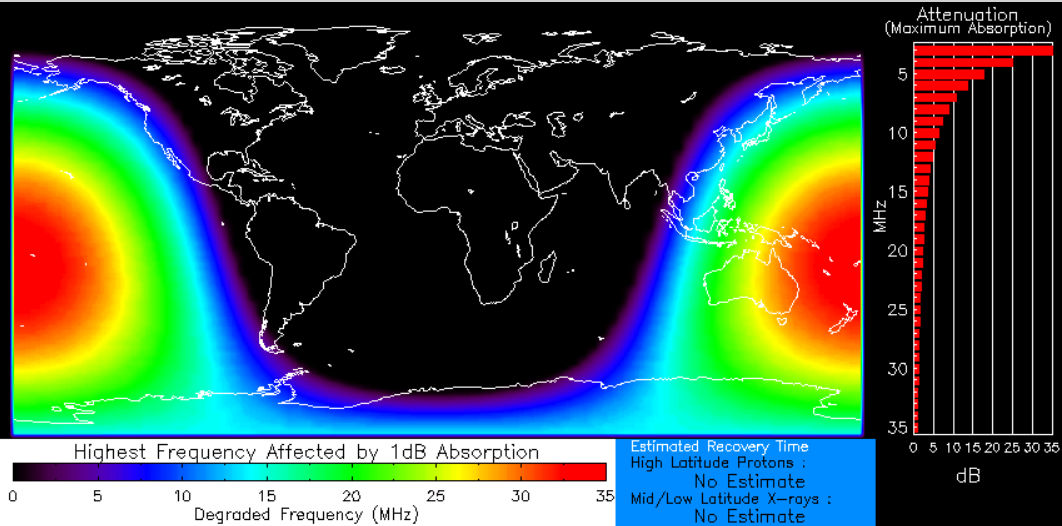
Extreme ultraviolet radiation from the flare ionized the top of Earth's atmosphere. This, in turn, caused a shortwave radio blackout across the South Pacific Ocean: blackout map. Ham radio operators in Australia and New Zealand may have experienced loss of signal below 30 MHz for hours after the flare's peak.

Update: SOHO and NOAA coronagraph images confirm that several CMEs emerged from yesterday's collection of flares. None of them appears to be either potent or squarely Earth-directed. Glancing blows expected on Feb.4-6 could spark G1 (Minor) to G2 (Moderate) geomagnetic storms.