Showing posts with label Sciencey. Show all posts

Sunday, May 10, 2026

Did it just turn into summer?

Not weather-wise, or at least not the weather at the ground level. I'm talking about a difference in how the ionosphere's E layer is behaving. 

I've written about Sporadic E propagation, often referred to as Es, many times and I've talked about how Sporadic E showing up at 50 MHz (the 6 meter ham band) is more common in summer than winter.  This one is probably the most read introduction. Several times, I've shown screen captures from a site called DXMaps and the density of "red blob" tracks of contacts visibly goes up as summer arrives and gets going. Here's one I took several minutes ago:

I've mentioned several times that I'm somewhat of a paper chaser in ham radio, spending most of my radio time on 6m pursuing the FFMA (Fred Fish Memorial Award); this post (from November of '25) has the most info and I'll borrow some of it for here. 

Along the same line, the only accomplishments I’m actively “chasing” on the VHF six meter band are both in the category of “difficult to practically impossible.” The easier one is probably 6m DXCC (100 recognized countries worked and confirmed). I currently have 90 confirmed with another three “waiting for confirmation.” I’m closer to DXCC on 6m than any of the other major awards. Easy or obvious one first, DXCC is more likely than Worked All States - WAS. 

WAS is practically impossible from my location. I’m pretty sure last November (‘24) was the closest I ever came to even hearing Alaska, and that was hearing other stations in the southeast calling the guy in Alaska. I saw him “spotted” on some of the sites online that report that, but never actually heard him. I was hoping for this year, but it hasn’t been good so far.

The hardest one, the FFMA (Fred Fish Memorial Award – the first person to achieve this award) is for working and confirming all 488 Maidenhead grids in the continental US. "Continental" means I don't need Alaska or Hawaii. I have 345 grids confirmed with another five that I’ve worked but can’t get confirmed. To be brutally honest, the FFMA is practically impossible from here, too. Unsurprisingly, when your goal is to reach every place  in the country, you're most likely to get everyone from the center of the country, and it turns out there has been one issued in Florida, in the northwestern most corner of the state. That's about 500 miles away - near Pensacola.

All of that is to set up that, to some degree, I can look at the map of contacts being reported on DXMaps and have a pretty good idea if areas I need to work are being heard and reported. I don't see any on that display map. 

While that's a bit of a downer, the number of Es openings should be going up with the highest numbers showing up in mid-June through mid-July. It's not coincidental that two of the biggest 6m contests of the year are the in this interval. Contests are good ways to get lots of stations on the air for quick, short contacts. 

Summer is a good time of year around here for staying inside the house. At least I have things to chase on the radio.


Thursday, May 7, 2026

A look at the coming hurricane season

Since the usual space news stories are on the small side, I'm going to divert to a different sort of science - atmospheric physics and weather. That was driven by it being the time of year to ensure we're ready for the coming Atlantic hurricane season which starts on June 1. And that's partly motivated because storms before the season officially starts happen often enough that they capture attention in planning.

I think it should be obvious if you've read here before, but I should say that I'm not a meteorologist or a hurricane expert in any sense. I'm just someone who has lived through many hurricanes because of growing up in Florida and being 72 years old. The state of Florida takes hurricane preparation seriously, especially with the numbers of people moving in from the overbearing-to-collapsing blue states, so they publish a variety of websites with information on preparing. Like the Plan & Prepare website here

Whether you follow these storms or not,  you may have heard about a persistent (if not permanent) weather condition that goes back and forth between el Niño and la Niña states, and is called the el Niño/Southern Oscillation or ENSO. This is seen primarily in sea surface temperatures along the equator between South America and Pacific islands. In the el Niño pattern the temperatures in that belt are warmer than "usual" and in the la Niña state they're cooler. (and I'll drop the accent marks over the "n" from here on)

Earlier in the year, we were told to expect a la Nina pattern this season, but that has been reversed to el Nino with some sources warning of a "Super El Nino". In general, in Florida and the SE US, el Nino seasons reduce our chances of a hurricane. The National Weather Service ENSO prediction (April update) doesn't sound like the "Super El Nino" prediction.  

I've mentioned meteorologist Ryan Maue on these pages several times (earliest post? I think) starting when he was a graduate student at Florida State University, one of the major meteorology departments that study hurricanes. Simply, in an era of insanity and blaming everything that happens on CO2 concentrations - followed by perennially making up new things to blame on CO2 - he has remained data-driven and therefore a voice of sanity. Ryan keeps track of a metric they call Accumulated Cyclone Energy or ACE and provides this summary showing it's a far below average year. 

I think when the year to date ACE is 12% of a normal year, that's far below average.

The next thing I like to keep track of is the predictions for the hurricane activity for the season. One of the big names in doing this is Colorado State University, and Dr Phil Klotzbach issues numbers annually. His predictions are for lower activity than average, but spread over the entire Atlantic basin from Africa to the US and the west ends of the ocean, the Gulf of America, and the Caribbean, there are variations to keep track of, too. 

While the photo predicts every line in that chart to be lower than normal, it's important to realize that there's also luck involved and it's better to be more prepared than you need to be. Like everything else in life. 

To borrow some of the notes that appear below that photo:

Primary Drivers: The "El Niño" Factor
The defining feature of the 2026 season is the transition from a weak La Niña to a moderate-to-strong El Niño during the peak months (August–October).

  • Wind Shear: El Niño typically creates high vertical wind shear across the Atlantic's Main Development Region (MDR). This "rips" storms apart before they can organize.
  • Atmospheric Stability: Sinking air (subsidence) over the Caribbean and Atlantic is expected to suppress storm formation further.
  • Atlantic Temperatures: While the Atlantic remains warm, it is not as anomalously hot as in recent record-breaking years, and the shear from El Niño is expected to be the dominant "hurricane slayer" this season.

In my years of observing, I've noticed that el Nino moves the tendency for storms to "re-curve" to a northerly path and then toward the east farther out to the east than in la Nina years. Yeah, I tend to get an early sigh of relief when I see predictions for an el Nino year.

Historical Analogs
CSU identifies years with similar climate setups to help predict 2026’s behavior. The primary analog years are:

  • 2006 and 2009: Very quiet seasons for Florida landfall due to strong El Niño conditions.
  • 2015: An extremely quiet year for the U.S. East Coast.
  • 2023: A high storm count (20) but mostly storms that stayed out to sea, though Florida’s Big Bend was hit by Hurricane Idalia.
  • Quality over Quantity: A below-average forecast does not mean zero risk. Forecasters frequently cite 1992 (Hurricane Andrew) as the ultimate warning: a very quiet, below-average year that produced one of the most devastating Category 5 landfalls in Florida history.
  • Western Formation: Because El Niño suppresses storms in the deep tropics, 2026 may see more "homegrown" development in the Gulf of Mexico or Western Caribbean. These storms often have shorter lead times for us here in Florida.

So that's an overview of what we know about the coming hurricane season. It's always appropriate to keep an eye on the weather patterns and the one week forecasts with probabilities of development. Much like a loonie with a gun and intent to do something violent, it only takes one.


Wednesday, April 22, 2026

The Nancy Grace Roman Space Telescope is complete

Complete and being readied for launch in September

I've been following the progress of the NGRST since first hearing about it in early 2022. It was first referred to as the WFIRST, Wide Field Infra Red Space Telescope, a long but descriptive name for its mission.  It was renamed around that time in '22 the Nancy Grace Roman Space Telescope by NASA; the name pays tribute to the late NASA executive and first Chief Astronomer who was one of the driving forces in getting the Hubble Space Telescope program through its hurdles. 

On Tuesday (April 21), NASA had a reveal of the NGRST at their Goddard Space Flight Center along with talks by Administrator Jared Isaacman and several others.  For this:

Engineers at NASA's Goddard Space Flight Center in Greenbelt, Maryland, complete the final integration of the Nancy Grace Roman Space Telescope's major components on Nov. 25, 2025, joining the spacecraft and telescope assemblies in the facility's largest clean room. (Image credit: NASA/Jolearra Tshiteya)

"I very much hope, and in fact, expect, that the most exciting science from Roman is going to be the things that we didn't expect, that we couldn't predict, but that will set the new deep questions for future missions to address," Julie McEnery, senior project scientist of Roman said during a press conference on Tuesday.

The NGRST is heading for the L2 Lagrange Point, currently the home of the James Webb Space Telescope, the European Union's Euclid infrared space telescope and a place for passing visitors, such as the Escapade mission on the way to Mars (bottom of that post). 

NASA has chosen a Falcon Heavy to get this payload to its destination. There have been 11 Falcon Heavy launches to date, with a 100% success rate for the 230-foot-tall, heavy lift vehicle. Not surprising since it's three different Falcon 9s strapped together (although the upper stage is different) and it's the most reliable vehicle ever. 

Here's where it gets wild. The September launch for the NGRST is eight months ahead of schedule, and under budget. When's the last time you heard something like that? I'm not sure I ever have.

According to NASA, Roman's primary mirror measures about 7.9 feet (2.4 meters) wide, which is similar to Hubble's. However, Roman has the ability to take images that capture a patch of the sky at least 100 times larger than Hubble can.

"Its surveying capabilities are over 1,000 times faster than Hubble, and can chart 200 times more sky in a single image," NASA administrator Jared Isaacman said during the conference. "What would take Hubble 2,000 years to process, Roman can do in a year — the images it captures will be so large there is not a screen in existence large enough to show them."

To put that into context, over its approximately 35 years of service so far, Hubble has gathered about 400 terabytes of data; once fully operational at its workstation in space, Roman should be able to create 500 terabytes of data per year.

The collection of different space telescopes; the Hubble, James Webb, and more, allow ground based astronomers to choose the right instrument for the objects they want to study in the sky.

Compared to the JWST, Roman's images — taken with its aptly named Wide Field Instrument (WFI) — will be 50 times wider but more shallow, because Roman doesn't need to access the deep universe the way the JWST does. As we discussed, it can't see infrared like the JWST can and therefore would be wasted in looking too far back.

More specifically, WFI is composed of a 300-megapixel visible-to-near-infrared imaging camera and slitless spectrometer (a special tool that allows scientists to capture light dispersion of objects in a field of view). But there is something uniquely special about that shallow, panoramic view.

The wide and shallow field will be well suited to surveying space, not getting too much information from things that it can't look closer at. 

They can just survey and hope to find a cool lead to zoom in on. This offers Roman the ability to catch events that transpire very quickly, such as fast radio bursts, and increases the chances that scientists can witness remarkable supernovas, colliding neutron stars and other easy-to-miss phenomena right as they happen.

An illustration of the field of view of Roman Space Telescope vs. the Hubble Space Telescope. From the NASA Roman telescope mission website.


Tuesday, April 21, 2026

It's My Favorite Fake Holiday - It's Earf Day 2026

Yes, it's time for our annual bacchanalia of the made-up holiday they call Earth Day, my very favorite holiday to make fun of. Even more than Kwanzaa. 

As befitting the environmental movement, my tribute to Earth Day is almost entirely recycled, and is almost entirely useless. The only way it could fit the environmental movement better would be if everything I said was factually wrong. Everything here is factually correct. 

I've posted on Earf Day so many times that it's hard not to be repetitive, even if I was trying not to be. So nothing this time about Ira Einhorn murdering his girlfriend or the completely discredited book, The Population Bomb.  No, wait.  I just mentioned them both.  Rats! 

The simple truth is that virtually everything about the holiday and the environmental movement is crap. The modern green movement is simply about rich, privileged people wanting to have places to visit that they think are pretty; and especially unspoiled.  They want pretty, natural, wild-looking places to visit on vacations. If that means the people who are living in or near those places have to live lives that range from austere to practically unsurvivable, the greenies think that's just wonderful.  

When you think of it that way, it's easy to realize that the greenies care only about themselves and their enjoyments of life. Of course we should all protect the wilderness! It's theirs! That was never as clear to me as it was while reading Apocalypse Never by Michael Shellenberger a couple of years ago. He vividly talks about people in the wilds of Africa who desperately need better ways to grow food, get water and most desperately need electricity. Instead they're kept in a life of desperation by the environmentalists.

Probably the worst example is the one that we get beat up about every day: climate change. Notice they don't mention "global warming" any more. It's just "change." As if the worldwide climate has always been the same. Let's start with that simple observation. They scream that the temperature has gone up since 1850! We're all going to die! What they don't tell you is that the temperature in 1850 was among coldest periods in the last 10,000 years. 

That's Indonesia. How about if we reconstruct the temperature half a world away? North Atlantic instead of south Pacific; Greenland instead of Indonesia (the scale is different, but 10,000 years ago is 7975 BC).

Sorry. The temperature has gone up not just from 1850 but from from one of the half-dozen coldest periods in the last half billion years.  


The closer you look, the worse the picture is. Borepatch ran a piece in 2024 about one of the more insidious things they do: they change the historical records to make the older temperatures look cooler and the newer ones look hotter. That's right; they're lying in all the official documents and have been for as long as this Con has been going on. One of the things that convinced me that skepticism was proper was the Surface Stations Project that Watts Up With That? started back in the '00s and was closed a few years ago. Their final product was a report on the official stations that create the weather record and how large percentages of them weren't sited properly; over 62% were incapable of accuracy better than 2 degrees C. Another 6% couldn't measure within 5 degrees C. They're too close to roads, too close to sources of heat like air conditioner outputs, even airport runways, and more problems. Then there was outright fraud in editing records. 

And this isn't even going near things like how bad their models are. They still basically can't handle clouds properly. Virtually none of their predictions ever actually prove to be the case. Instead we get useful idiot celebrities who are too young to understand that both weather and climate change (to be charitable). If a 20 or a 40 year old can't remember similar weather, it doesn't mean anything. 

You know the current fuss about the temperature by 2100 isn't supposed to go up more than 1 degree or "we all gonna die"? (say that like Jasmine Crockett saying "we done pickin' cotton"). In these two plots the one on the left is the prediction they push on us; the one on right is shows the error expected in yellow.  For example, at the right end of the plot on the left, it shows their global temperature as increasing by 3.75 degrees by 2100.   The uncertainty shown on the right is +22.5 / -15 degrees.  That's over 37 degrees uncertainty out of 4?  In the kind of simulations I'm used to that's so bad it's unusable.  The remarkable part is how bad the people who released this plot were at doing this math (read this). They're an embarrassment to people who can do this math, and the ones who can should get listened to far more than they do. 

Maybe if the people pushing this climate change stuff could do this math they wouldn't have their morons burning down cities. If the people burning down cities or ruining their lives by getting upset by this could understand the papers referenced, the world would be safe from them. 


Saturday, April 18, 2026

Got me thinkin

Some time ago, Mike Myles down at 90 Miles from Tyranny posted this meme in one of his many collections. 


Ignoring "who's CT?", the rest of it seems like real truth to me. The first obvious one to me is our weight being determined entirely by Calories In vs. Calories Out or CICO (pronounce that “psycho;” or “sicko” – whichever you prefer), often stated as the way to lose weight is “eat less and move more.” I don't think it's an overstatement to say many millions of people have tried that and found that our bodies are too adaptive, too much "learning systems" for a simple approach like that. A very common scenario is for someone to try caloric reduction, have some quick success losing weight, only to find they gain weight back to close to their starting point. Then the after effect is that once the system learns it can turn down the amount of calories it needs, it can leave that so that to drop weight requires continually reducing intake. 

His emphasis, though, seems to sound more like the crowd that seems to be afraid of chemical names and no familiarity with how chemistry works. If instead of telling them you were giving them water but said it was di-hydrogen monoxide (H2O), they'd run in fear.

Another one of Mike Myles' posts that stuck out to me is the essence of being afraid of chemical names. 

The statement that the source of the Fluoride ion in our water supplies (and toothpaste, dental treatments and ... whatever) is hydrofluorosilicic acid (also known as hexafluorosilicic acid - H
2
SiF
6
) is true, but it's irrelevant. The nature of chemical reagents is that they get used up so there is none of that hydrofluorosilicic acid left in the water supply. The fluoride ions are removed from the acid and attach to sodium ions resulting in sodium fluoride, NaF, a salt like table salt, sodium chloride.  

Since there's no hexafluorosilicic acid remaining in the water we drink, testing it for safety doesn't make much sense. Whether or not Fluoride itself is toxic or "safe" in our water doesn't appear to be anything the makers of this poster care about. 

Well, just some rambling. Weekends tend to be the slowest news days, so I picked up some memes I've been meaning to write about. I'm open to suggestions about other things to write about.


Monday, April 13, 2026

Three years from now...

I suppose it's a fact of life that when we get a string of very busy news days, the next slow news days seem even slower, even harder to adapt to. So here's just an interesting look at April 13, 2029 - three years from now, but a Friday not a Monday, that we will get the closest known flyby of an asteroid in history, and of the biggest body to ever approach Earth. 

A rare naked-eye asteroid will light up the night sky on April 13, 2029, when the near-Earth asteroid 99942 Apophis makes an extraordinarily close flyby of Earth. For skywatchers, it's a once-in-a-lifetime event — and one worth traveling for.  

This will be one of the closest approaches ever recorded for an object of its size. The night sky will tell a story billions of years in the making. 

At its nearest point — 5:45 p.m. EDT (2145 GMT) on April 13, 2029 — it will pass closer than Earth's geosynchronous satellites, at a distance of roughly 20,000 miles (32,000 kilometers). Just over an hour earlier, at 4:30 p.m. EDT (2035 GMT), it will reach peak brightness, with a magnitude of around 3.1. That's bright enough to be seen with the naked eye from dark locations — but only some locations.

For observers in Europe, Africa and western Asia, Apophis will appear for one night only. An asteroid this big, getting this close to Earth, happens only once every few thousand years, making it truly a once-in-a-lifetime opportunity for a celestial encounter both dramatic and deeply humbling.

To be honest, maybe I'm spoiled, but I don't think a magnitude 3.1 object is going to stand out in the sky. I suppose if we sit outside adapting our vision to the dark, it will be better than if we were to just walk outside from well-lit house in the suburbs but magnitude 3 just isn't going to grab your eyes. If its motion is visible, that will help.

If you poke around, you'll find that Apophis gets talked about pretty often. When it was first discovered, early calculations of its trajectory said that it might hit Earth. Interestingly, that's how it got its name. Apophis, was the Ancient Egyptian God of chaos. As observations improved, the calculated trajectory improved and now Apophis is not predicted to hit, but is still classified as a "potentially hazardous asteroid," not because the current predictions show impact, but because of its size (approximately 1230 feet long) and how close it's going to get. At some point, these predictions have to factor in that we don't know 100% of what's out there that could tweak its trajectory and move it slightly. Especially if it hit Apophis.

Remember our OSIRIS-REx satellite? This is the one that took samples of asteroid Bennu, bringing them back to Earth in September of 2023. If you do recall that, you'll probably also remember that OSIRIS-REx was reassigned to rendezvous with Apophis, getting renamed as OSIRIS-APEX (OSIRIS-Apophis Explorer).

The European Space Agency's proposed Ramses mission aims to launch in 2028 to observe the asteroid up close before and during its flyby, while NASA's OSIRIS-APEX is scheduled to orbit Apophis in June 2029 to see how the close encounter with Earth affected it. ... ExLabs also intends to launch a commercial mission, called Apophis EX, to rendezvous with the asteroid.

A rare stargazing spectacle will unfold on Friday, April 13, 2029, as the asteroid Apophis passes closer than satellites over Europe and Africa in a true once-in-a-lifetime event. (Image credit: Apophis: ESA-Science Office, Earth added in Canva Pro.)


Sunday, April 12, 2026

A remarkable and old Ham radio accomplishment

This is actually old news, it happened in March of 2009, 17 full years ago but I just learned about it recently and was embarrassed that I didn't know about it. 

A couple of members of the German AMSAT, a club dedicated to working satellites and more difficult modes, such as Earth-Moon-Earth (EME or Moonbounce) successfully bounced signals off the planet Venus and heard their own signals.  For comparison, the moon is many times closer than Venus and if you're listening for your own signals bouncing off the moon, they take around 2.6 seconds (based on one way distance to the moon of 250,000 miles and the speed of light being 186,000 miles) per second or 1.3 seconds each way.  

It took the signals to and from Venus "a round trip delay of about 5 minutes."  Sounds like Venus bounce isn't very practical for conversation, but I think doing Venus bounce will be like Moonbounce with an automated software system the sends a signal report and another small piece of info, maybe taking a minute to reply, we're talking 2-1/2 minutes there, the message time, and 2-1/2 minutes back, maybe a Venus bounce contact (QSO) could take place in under six minutes. 

I'm full of questions about this, and the source article at the American Radio Relay League has almost no technical details. The ARRL reports, "According to an AMSAT-DL press release, the team's transmitter was generating about 6 kW CW on 2.4 GHz," and that's about all.

I've written about moonbounce and trying to hear my own signal reflections from the moon before; several times. So let me play with some numbers. The first hurdle is how far we're trying to send a signal to. At it's closest, Venus is 24 million miles while at its farthest, it's 162 million miles. Both Venus and Earth are in elliptical orbits around the sun and we're both constantly moving around the sun. There are more complications there, but I'll skip them for now and use a number that isn't the closest or farthest. Since it's a nice round number, let's say 100 million miles. 

The big concern is the same as every communications link everywhere else: the amount the signal attenuates - weakens - over that 100,000,000 miles. The term for this is path loss, and many times I've used a handy equation to calculate it that gets you within less than half a dB of the more theoretically-backed equation. We haven't talked about a frequency, so let me use that 2.4 GHz (2,400 MHz) the Germans used. It's a ham band here in the USA as well. 

Path loss in dB = 37 dB + 20log(f) + 20log(d) where,f is the frequency in MHz and d is the distance in miles.

Path loss in dB = 37 dB + 20log(2400) + 20log(108)

Path loss = 264.6 dB

If you're not used to this world, this may shock you, but the impact in path loss isn't terribly big for the return back to you doubling the distance. If you double the 100 million miles in the last term to 200 million (2*108) the increase is 6 dB. Right, 270.6. There's more uncertainties to come than that 6 dB.

The problem with that number is not knowing how much signal you get back because of a big unknown. How much signal is lost in the reflection sending the signal back to you? It seems a safe bet that your signal isn't going to exactly light up the entire earth-facing side of Venus, it'll be wider than the planet out that far, so there will losses I can't guess at - say your signal's diameter at Venus is 10 times the diameter of the planet, yes, you're losing 9/10 of your signal strength in that reflection. The next problem is how much of what hits the planet reflects? Venus is famously clouded over, how much loss is there? Let me PFA some numbers, and I'll say I lose 20 dB in the combination. 

What does it mean to increase the path loss from 271 dB to 291 dB?

The real problem, then, is not knowing how much loss there is in those places. I'll use the 6000 watts that the German guys did.  That's +67.8 dBm (decibels above 1 milliwatt) If I had no antenna gain the signal I'd get back would be +67.8 dBm minus 291 dB or -223.2 dBm. I don't know of any way to detect and use a signal that weak, regardless of modulation and receiver enhancements. 

What if I had an antenna like the one on the right here, with LOTS of gain?

I don't know exactly how big this is or how much gain it would give at 2.4 GHz, but it's a site in New Jersey where a secret military radar project first bounced radar off the moon. Not with that antenna, it's just a nice looking model for a ham radio project. My guess is the AMSAT Germany guys probably had something like that, if not bigger. 

There's a lot of what I consider reasonable guesses here, and (as always) some "hand-wavium" but it doesn't sound easy - more like on border of impossible. Good antennas for 2.4 GHz aren't hard to get and will do nothing but help. I'm not sure about the amplifier to get 6 kW, but I think they're out there. 


Friday, April 3, 2026

A little bit more of that

The latest MAPS photo, exactly 24 hours from April 2nd: brighter and closer to the sun than yesterday. 


And for your convenience, here's both days in one graphic: 

Tomorrow will be the "do or die" day for Comet MAPS; at around 0800 UTC on the 4th, or about 4:00 AM EDT Saturday morning, the comet will go behind that large dark blue circle for its closest approach to the sun. According to the Central Bureau for Astronomical Telegrams (CBAT) Circular#5675, Comet MAPS will pass within 101,100 miles above the sun's surface (the photosphere) at 10:24 AM EDT (1424 GMT).

If it survives that closest approach, we don't get to know until it comes out from behind that dark circle and I'll SWAG 1900UTC Saturday, or around 3PM EDT. 

I'm not sure how I'm going to try to watch this. I have a solar filter for a telescope but more study is required and life has been throwing lots of interruptions at us. 


Tuesday, March 31, 2026

The other thing to keep an eye out for this weekend

In case you haven't seen this story, here's something to be aware of through the weekend beside Artemis II. There's a comet approaching the sun this weekend, by the name of MAPS. This comet was discovered on January 13th so 11 weeks ago (this is week 14, it was discovered in week 3). Soon after discovery as the orbit was calculated, it was determined that the comet would make a close approach to the sun, with its closest point - its perihelion - this Saturday, April 4th.  

The highlight is that this comet is  going to come very close to the sun, and after its closest approach, if it doesn't get ripped apart by the sun, it will be bright enough to see in the daytime which would make it a naked eye object close to the sun in the daytime sky. 

Let me fill in some details from Space.com.  First off, MAPS seems like an odd name, compared to other comets I've seen. Historical comets like Halley's comet were typically named after the discoverer. That's still pretty typical although more organized than it was in "the old days." 

"MAPS" is an acronym using the first letters of the surnames of the discoverers: Alain Maury, Georges Attard, Daniel Parrott, and Florian Signoret. They found the comet using a remotely operated 11-inch telescope at the AMACS1 observatory in Chile's Atacama Desert. What makes this discovery special is that Comet MAPS belongs to a special class of comets known as Kreutz sungrazers. (Pronounced like KROYTZ)
...
Saturday, April 4, is the day of Comet MAPS perihelion — when it will make its closest approach to the sun. Based on updated orbital elements published on the Central Bureau for Astronomical Telegrams (CBAT) Circular#5675, Comet MAPS will pass within 101,100 miles (162,700 km) above the sun's surface (the photosphere) at 10:24 a.m. EDT (1424 GMT, 7:24 a.m. PDT). The comet will then be in the midst of completing a hairpin-curved path around the sun, racing at a speed of 322 miles (518 km) per second.

I haven't seen anyone predicting confidently whether or not MAPS will survive its close encounter of the potentially destructive kind, and I wouldn't put much faith in that if they did. I think they'd need to have more knowledge of the comet than exists at the moment. Before you try to see it, you would probably do better trying to follow news online about it. I'll get back to that shortly.

Let me show you a projection for the comets path with times marked around the sun. The approach to the sun starts at the lower left hand part of the picture - you'll note the first point is labelled April 2nd at 1200 UTC. The two dots on upper right of that triangle marking its path are both two days later, April 4th, 0600 UT and 2200 UT, 16 hours later. It exits the path in the picture on the 6th at 0500 UT. You'll note in the center of the image, the orbital path goes over a white circle - that's the diameter of the sun, or about 1/2 degree.  The dark circle that image is contained in is the area the telescope has blocked off - to keep the sensor from being burned out. 

It is also possible that the comet may become extremely bright around this time, possibly even bright enough to glimpse in the daytime, though the very close proximity to the sun in the sky makes this an extremely dangerous proposition. Indeed, the sun's infrared rays can burn the retina of the eye and cause irreparable damage, all without causing any pain and neither sunglasses, telescopes, nor binoculars will protect against the type of eye damage that could ultimately result in blindness, when a person — however briefly — accidentally looks directly into the sun's rays.

To get a good (and safe) view of Comet MAPS as it approaches and then sweeps rapidly around the sun, reserve a seat next to your computer and stay tuned to SOHO's LASCO (Large Angle and Spectrometric Coronagraph Experiment) C3 camera, by accessing either its near-live images or videos that span the past 24 hours.

The source article at Space.com goes into some inevitable - but pointless IMO - speculation on what could happen during the roughly four days captured in this image. The comet could disintegrate before or just at perihelion (closest approach to the sun), it could disintegrate after perihelion but still close to the sun, or it survives the perihelion and comes out unscathed. 

That last alternative is the only one that could give us a great show. The unpleasant reality is we have nothing we can do to influence it. The comet is going to do what it's going to do and not only doesn't care what we see, it's a hunk of ice and rock: it can't care what we see. I'm not sure when the last bright daytime comet was; they mention "The Great Comet of 1965," Ikeya-Seki, which was the most brilliant comet of the 20th century. It attained a magnitude of at least -10 (as bright as a half-moon) and was readily visible next to the sun during the daytime. In 1965, I was first getting interested in watching the night sky and I missed that one, getting a typical beginner's refracting telescope with about a 2" objective about a year after the comet. I've just read about Ikeya-Seki since 1965, much like I got my first shortwave receiver after the best solar cycle in recorded history, cycle 19 in the late '50s.


Saturday, March 21, 2026

Now that Spring has sprung

As we went through the spring equinox, I couldn't help but notice that there were some questions about the day and night not being the same exact length, which is the actual meaning of the word equinox, after all. It was a spring "not completely equal night".  Space.com offers some explanations of that. 

The reason is "the usual", if you'll allow that short summary. The world isn't exactly perfect, orbits can be not exactly symmetrical, and imperfections are everywhere. I should note that when you look up the date and time of the equinox, you get a specific time of day - to the minute. 

Saturday (March 20) at 10:46 a.m. Eastern Daylight Time (7:46 a.m. Pacific Daylight Time) the vernal or spring equinox was expected to occur. At that moment, the sun comes to one of two places where its rays shine directly down on the equator. It will then shine equally on both halves of the Earth. More precisely, at that moment, the sun will be shining directly down on the equator at a point over the Atlantic Ocean, roughly 790 miles (1,280 kilometers) east of Macapá, Brazil.

When I was learning these things, I filed away that seasons tended to change on the 21st of month. Spring started on March 21, Summer was June 21, Fall was in September and Winter was December. In all cases, that was the first day of "new season." 

Space.com says that's not right. They say that during the 20th century, March 21 was the exception rather than the rule, with the equinox landing on that day only 36 times out of the 100 years in the 20th century. 

From the years 1980 through 2102, it comes no later than March 20. In 2028, in fact, for the Western Hemisphere, spring will officially begin on March 19. This shift in dates happens because the Earth's elliptical orbit doesn't match our calendar perfectly. The vagaries of our Gregorian calendar, such as the inclusion of a leap day in century years divisible by 400, also help contribute to the seasonal date shift. Had the year 2000 not been a leap year, the equinox would be occurring this year on Saturday (March 21), not Friday. 

The Space.com author goes on to note:

One factor to consider is that when we refer to sunrise and sunset, it refers to when the very top edge of the sun appears on the horizon. Not its center, nor its bottom edge.

This fact alone would make the time of sunrise and sunset a little more than 12 hours apart on the equinox days. The sun's apparent diameter is roughly equal to half a degree.

The main reason for this difference is that our atmosphere refracts (or bends) light above the edge of the horizon. Because of that refraction, we end up seeing the sun for a few minutes before its disk actually rises and for a few minutes after it has actually set.

So . . . when you watch the sun either coming up above the horizon at sunrise or going down below the horizon at sunset, you are looking at an illusion — the sun is not really there but is actually below the horizon!

Earth's seasons diagram. (Image credit: NASA/Space Place)


Wednesday, March 18, 2026

So then, the space company said, "let's grab a small asteroid..."

... and bring it back to a "safe" spot near Earth. 

Really. 

It may sound fanciful, but a Los Angeles-based company says it has conceived of a plan to fly out to a smallish, near-Earth asteroid, throw a large bag around it, and bring the body back to a “safe” gathering point near our planet.

The company, TransAstra, said Wednesday that an unnamed customer has agreed to fund a study of its proposed “New Moon” mission to capture and relocate an asteroid approximately the size of a house, with a mass of about 100 metric tons.

“We envision it becoming a base for robotic research and development on materials processing and manufacturing,” said Joel Sercel, chief executive officer of TransAstra. “Long term, instead of building space hardware on the ground and launching propellant up from the Earth, we could harvest it from raw materials in space.”

When they say, "approximately the size of a house," that isn't a very well-defined number. Do they mean 500 square feet, which at 22 ft 3in on a side might be better described as the size of an apartment in a small city, or 1500 sq. ft.? That's a moderately-sized suburban house.  That dramatically affects what they plan to do with that small asteroid. Like the first small paragraph quoted says, TransAstra envisions a system that flies out to the desired asteroid, capturing it in a large bag, and slowly bringing it to some place like the L2 (Lagrange 2) point of the Moon/Earth system - about 900,000 miles from Earth, and also the home of the James Webb Space Telescope (JWST).

Such asteroids could provide water for use as propellant and minerals for everything from solar panels to radiation shielding. Various asteroids could be targeted for their content, such as C-type asteroids as a source of water or M-types for metals. 

All of this is the domain of a study underway now which will be completed by May, and should further refine a mission plan with its trajectory and the spacecraft needed to fly it. 

If fully funded, the mission could rendezvous with an asteroid by as early as 2028 or 2029. TransAstra is working with the University of Central Florida, Purdue, and NASA’s Jet Propulsion Laboratory/Caltech to complete its analysis. 

This transfer bag has been tested in the International Space Station, flown up to the station on the Northrop Grumman Cygnus cargo drone last fall, then taken into an airlock where the bag was opened and closed while in the vacuum. 

Also last fall, TransAstra won a $2.5 million contract from NASA to scale up the size of its inflatable capture bag system to 10 meters in diameter, the size it says it needs to corral small asteroids. Matched by private funding, the combined funds have allowed TransAstra to be able to accelerate development and testing of its larger capture bag.

The next major step for TransAstra is they need to find a spacecraft maker to contract for a spacecraft capable of traveling into deep space and making a rendezvous with an asteroid. 

An artist's concept of the New Moon facility with aggregated small asteroids. Credit: TransAstra

With the exception of noting the Earth and moon in the upper left hand corner of the artwork, those are about the only things that look familiar to me. I'll SWAG the big things in what appears to be a bag on the left edge of the image are captured asteroids or other raw materials and just say I have no idea what anything else is supposed to be or what they're supposed to do. 

Let me remind everyone of NASA’s OSIRIS-REx mission to asteroid Bennu that returned samples of the asteroid in September of 2023. That mission returned 121.3 grams from the asteroid Bennu and cost more than $1 billion but it's quite different than this concept and I don't think it's fair to divide the billion dollar cost by 121.3 grams, to get $8.2 million per gram. That would include costs that didn't contribute to getting those grams of Bennu down to Earth.

TransAstra is proposing to bring back vastly more material for significantly less. The initial mission, Sercel said, would cost a “few hundred million” dollars. That may sound borderline impossible, but it’s the kind of breakthrough needed if humanity is going to start building a future for itself in the Solar System, with materials from the Solar System beyond Earth.


Monday, March 16, 2026

One hundred year anniversary

Hundred year anniversaries of new technologies don't come up very often, especially in the subject area of space exploration but today is one. 

100 years ago, a liquid-fueled rocket flew into the sky for the very first time. The unlikely contraption was designed by Clark University physics professor Robbert Goddard, and launched from a cabbage field in Auburn, Massachusetts on March 16, 1926. 

Today, Robert H. Goddard (1882-1945), who directed the flight, is widely considered to be one of the founders of modern rocketry, along with Hermann Oberth in Germany and Konstantin Tsiolkovsky in Russia. A tiny rocket by any standards, with a very short flight, his rocket named Nell was fueled by a mixture of gasoline and liquid oxygen. 

A picture you've probably seen before, Robert H. Goddard with his first rocket, Nell. Image from Wikipedia, with a long description including current NASA ownership and its history.

Nell flew for a blistering 2-1/2 seconds and achieved a height of 41 feet. Still, it showed the concepts would work and it even used one of Goddard's design concepts that is still widely used today allowing the super cold liquid oxygen to cool the rocket combustion chamber while the oxygen was leaving the fuel tank.

For his first liquid-fueled rocket flight, Goddard tried putting the engine on top of the fuel and oxidizer tanks in a belief it would create more stability, according to NASA. Following flight tests, Goddard moved the engines underneath the propellant tanks, which "simplified the overall design", and instead for stability added moveable vanes to the engine exhaust and gyroscopes. "He was one of the very first people to take the theoretical ideas around rocketry, and actually turn them into an experiment and really apply the scientific methods and experimentation,"

I'm sure I've read about Goddard and his contributions to developing modern rocketry, but putting this little post together demonstrated that it was mostly lost to memory decay. "If you don't use it, you lose it." The sources I used put together good, readable and short biographies. These were

It's worth noting, and the Space.com article has the details that I looked at, that Goddard died young in 1945, of throat cancer, and his wife Esther was instrumental in conveying his history and advocating for him. She was essential in filing his patents. Often, she was the only person who could read his notes to put the patent applications together. Esther got approval for 131 patents of his 214 overall.

EDIT 3/17 @ 0755 EST: In the last paragraph I inadvertently changed that first sentence from "died young in 1945" to  "died young, 45,"


Tuesday, March 10, 2026

A little addendum ...

The talk about the reentering Van Allen Probe A last night reminded me of things I've posted about several times over the years, the big one that the Chinese have dropped boosters onto populated areas for years

This example is from a post dated November 27, 2019 and the Tweet here is dated the 23rd. 

I hesitate to start with this example because while I believe they still drop boosters with minimal effort to protect the people on the ground, I know that China is working seriously on reusable boosters now. Several recent articles have focused on test flights of reusable boosters. We did stories about them testing reusable boosters just one month ago, a little over a month before that, and so on (second story in a roundup). Still, while there are still US launch companies that don't reuse boosters they don't knowingly drop them on populated areas. 

A big difference is that boosters weigh considerably more than more typical satellites and can cause much more damage. China launched four heavy-lift Long March 5B rockets between 2020 and 2022, and let their approximately 24 ton core stages fall back to Earth. The NASA requirements for public safety from re-entering spacecraft were published in early 1996, and require better than a 1 in 10,000 probability assessment, obviously a smaller chance than the "approximately 1 in 4,200" chance this Probe A was evaluated at. 

“Due to late-stage design changes, the potential risk of uncontrolled reentry increased,” a NASA spokesperson told Ars. “After taking into account the mission’s scientific benefits and the low risk of harm to anyone on Earth, NASA granted a waiver to address the non-compliance with the US Government Orbital Debris Mitigation Standard Practices. Consistent with national policy, NASA notified the US Department of State about the exception.”

Is there anything that screams "big gubmint" more than exempting your own projects (like this NASA satellite) from requirements everyone else is expected to meet? 

All the sources I've read yesterday and today repeat that no one has been injured by reentering satellites. That said, it seems the same can't be said about things falling from the sky. I ran across this photo around 2017, and vividly recalled seeing this picture in a magazine while in the waiting room at my dentist. That would have been somewhere around 1966 to maybe '68. Note that the picture itself is dated 1954. Also, where it says, "Ann Hodges, after she became the only person in history to have been struck by a meteorite,"  that sentence should end with "that we know of."


Monday, February 9, 2026

VLEO?

I couldn't begin to guess how many times we've referred to Low Earth Obit or LEO over the years. I'm sure there's a precise definition somewhere, but I've come to conceptualize LEO as starting at the minimum height that can remain stable for some amount of time, probably more like months than years. This weekend was the first time I've seen the term Very Low Earth Orbit

LEO is getting crowded, but there’s plenty of real estate available closer to home if you can make it work. California-based Viridian Space is aiming to do just that.

The company is developing air breathing electric propulsion (ABEP) technology to fly future satellites in VLEO, and the US government is lending a hand to get the tech off the ground.

Viridian Space CEO Slava Spektor announced that the company has signed a five-year cooperative research and development agreement (CRADA) with the US Air Force to co-develop Viridian’s ABEP tech, and to work together on studies leveraging VLEO. The CRADA will be run out of Albuquerque, New Mexico's, Kirtland Air Force Base. The Air Force will assist Viridian with testing and characterizing the power systems they develop, while Viridian will concentrate on the technology and how it can be used to create new operational concepts for the US military. 

Viridian is expecting to launch their first mission within three years. Among its first priorities will be to collect data on the atmospheric conditions in VLEO, offering the DoD a better understanding of atmospheric drag at different altitudes, and how space weather events impact satellite life spans.  

VLEO has the obvious advantage that being miles closer to the ground than higher orbits, it will offer faster up and downlink speeds, and less optical magnification will be required to image targets, but it goes beyond that. Their air breathing electric proposal isn't just replacing the oxidizer in a chemical engine with oxygen taken out of the air, the air itself is the fuel they'll use. No, the short article on Payload offers no details on that. I'll get back to that in a little while.

Viridian’s aim is not just to get around the growing traffic in LEO, but to create a satellite system that is more capable than chemical prop systems flying in higher orbits. An ABEP sat in VLEO has multiple benefits, according to Spektor: [NOTE: read prop as propellant - SiG]

  • Viridian’s sats are aiming to stay in orbit for up to 10 years. Because the system is designed to use air as fuel, the sat will be able to maneuver without worrying about burning through onboard fuel reserves.
  • Viridian also expects its sats to provide more maneuverability to its customers. The sats are expected to fly at altitudes as low as 150 km, and to dip in and out of the atmosphere to reach multiple orbital altitudes on a single flight.

Viridian's website offers a link to a paper, but there's nothing there. Some searching led me to a more useful site, which links to a pdf version of a paper published in Acta Astronautica in 2022. The top-level introduction says this about the fuel.

The concept is based on the ingestion of rarefied atmospheric particles to be used as propellant for an electric thruster, thereby removing the need for onboard propellant

Viridian offers this diagram of the engine, but no other details. 

Viridian's ABEP engine conceptual diagram. Image credit: Viridian Space

While I'm always suspicious of things that might come across as "something for nothing," the engineers at Viridian have been working on this for years and I think it's worth experimenting to see if it lives up to the experimental results and analysis so far.


Monday, February 2, 2026

Strongest X-Class Solar Flare in months happened this morning

We are well past the peak of cycle 25 and the activity has been disappointingly low (at least to me) but it's never a good approach to stop watching the sun for unexpectedly large solar flares, coronal mass ejections or other activity. As if to emphasize that message to us, sunspot # 4366, an active region that has grown rapidly in the last day, has been crackling with activity.

The sun has erupted in a relentless barrage of powerful solar flares over the past 24 hours, firing off at least 18 M-class flares and three X-class flares, including an X8.3 eruption — the strongest solar flare of 2026 so far. 

I seriously dislike them saying it's the strongest "solar flare of 2026 so far." Because 2026 is so short that it's like saying, "that was my strongest fart of the year" - pretty much meaningless. It would convey far more information to compare it to the strongest flares of cycle 25. So I went and found this list of the strongest flares of cycle 25, which shows this morning's flare was the third strongest flare of cycle 25 and the strongest in over one year (~16 months), back to October 1, 2024. And note that since the date and time are in UTC, the start of the event at 23:44 UTC means 6:44 PM EST.

Note these are the most powerful dozen flares of Cycle 25, and the page it's found on lists the strongest 50 as the default view

As for impacts, there were some when the things that move the fastest got here but the predictions for the next few days seem pretty minor.

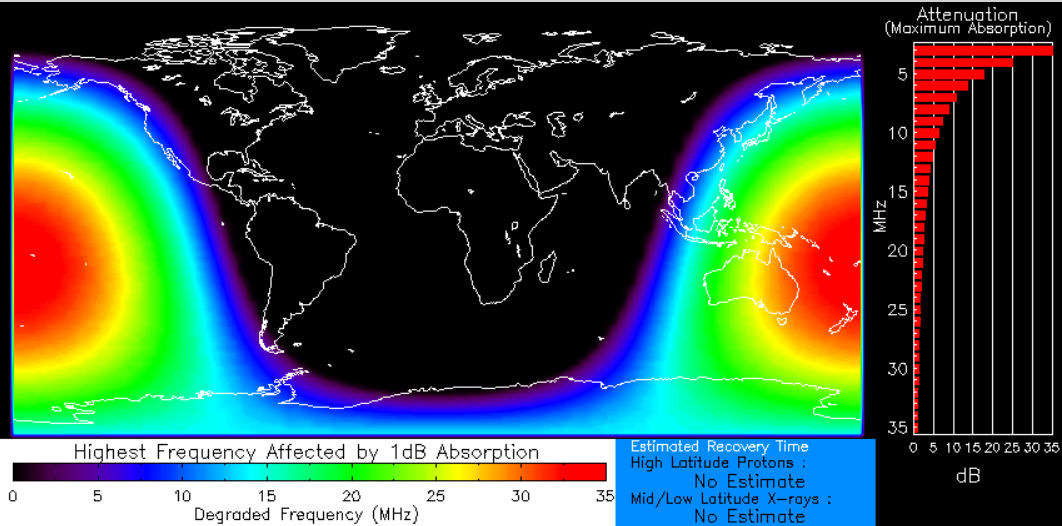
Extreme ultraviolet radiation from the flare ionized the top of Earth's atmosphere. This, in turn, caused a shortwave radio blackout across the South Pacific Ocean: blackout map. Ham radio operators in Australia and New Zealand may have experienced loss of signal below 30 MHz for hours after the flare's peak.

Update: SOHO and NOAA coronagraph images confirm that several CMEs emerged from yesterday's collection of flares. None of them appears to be either potent or squarely Earth-directed. Glancing blows expected on Feb.4-6 could spark G1 (Minor) to G2 (Moderate) geomagnetic storms.


Monday, January 19, 2026

The Geomagnetic Storm has begun

On Sunday afternoon, Jan. 18th, UTC, a moderately strong solar flare and Coronal Mass Ejection erupted on the directly Earth-facing portion of the sun. The flare was an X class (X-ray flare) that sent the CME in our direction, but not a particularly strong flare. Originally predicted to affect Earth well into the day (in UTC) on the 20th, it ended up being rather fast moving and stronger than the typical CME. 

Arriving earlier than expected, a CME struck Earth's magnetic field on Jan. 19th (1930 UT). The impact sparked a severe G4-class geomagnetic storm. The timing of the impact favored Europe, where widespread auroras are now being reported. It remains to be seen whether the storm will persist long enough for a similar display in North America. 

The CME that struck Earth today crossed the sun-Earth divide in only ~25 hours. That's fast. For comparison, most CMEs take 3 or 4 days to get here. The high speed of this CME (~1660 km/s) places it in the top few percent of all CMEs observed in the past 30 years.

The NOAA Space Weather Prediction Center posted this summary of planetary K-index (Kp) values as the last update for Jan. 19:


The two red "towers" Kp at 8.33 and then 8.67 (or 8-1/3 and 8-2/3) are obvious signs of CME impacts. The two yellow boxes at the top right labelled S2 and G2 are Solar Radiation Storm and Geomagnetic storm cautions.

S2 (Moderate) Solar Radiation Storm Impacts
Biological: Passengers and crew in high-flying aircraft at high latitudes may be exposed to elevated radiation risk.
Satellite operations: Infrequent single-event upsets possible.
Other systems: Small effects on HF propagation through the polar regions and navigation at polar cap locations possibly affected.

G2 (Moderate) Geomagnetic Storm Impacts
Power systems: High-latitude power systems may experience voltage alarms, long-duration storms may cause transformer damage.
Spacecraft operations: Corrective actions to orientation may be required by ground control; possible changes in drag affect orbit predictions.
Other systems: HF radio propagation can fade at higher latitudes, and aurora has been seen as low as New York and Idaho (typically 55° geomagnetic lat.).

At the top level of the website with that Planetary K index graphic, lies this one:


Across the top of the graphic under SPACE WEATHER CONDITIONS it shows that earlier today S4 and G4 conditions were observed. I was doing some paperwork in the shack today, closer to 5PM or 2200 UTC, and the G4 condition was displayed. Note that the prediction for the next 24 hours at the right edge of this graphic also includes severe G4 storms. I have to add my usual summary: if you think plain old NOAA weather forecasts for your city are bad, they're generations of progress better than solar-terrestrial storm forecasts.

The usual thing people ask about is if auroras will be visible. The aurora forecasters seem more inclined to be cautious than plain old weather forecasters. They say tonight will be more active than last night and more active than tomorrow night, but they don't say something specific like they'll be visible from northern Illinois but not southern Indiana, for example. This plot, from the NOAA SWPC, was generated 0223 UTC, and I happen to typing at 0226 UTC. It's hard to get a much fresher forecast than that. That thin red line is marked as the view line, meaning that from around that line, the auroras might be visible as color on the horizon. 


Sunday, January 11, 2026

SpaceX offers new rideshare approach

Ride sharing into orbit is one the best ways to come along to "spread the wealth" of the lower costs to orbit that are available to colleges, small businesses, and those who used to have a hard time getting an idea into space to test. SpaceX already had two ride sharing mission profiles, Transporter and Bandwagon, that vary in the specifics of the orbits they're intended for. To date, the company has launched 15 ride sharing flights in its Transporter series and four via Bandwagon.

Today marked the first launch of a third profile, called "Twilight," because it delivers the satellites to a dusk-dawn sun-synchronous orbit, a path that straddles the line between night and day on our planet. The mission launched from Vandenberg Space Force Base in California at 5:44 AM local time. The primary payload of the mission is a NASA satellite called Pandora, intended for a yearlong mission to study planets outside of our solar system, referred to as exoplanets. 

During its yearlong orbital mission, the 716-pound (325 kilograms) Pandora will study at least 20 known exoplanets using a 17-inch-wide (45 centimeters) telescope, which it will train on the worlds as they "transit," or cross the face of, their host stars from the satellite's perspective.

(Unless there's something really unusual about this telescope, astronomers refer to a "17-inch-wide" telescope as 17-inch aperture.) Like virtually all observational studies of exoplanets, the Pandora telescope will image these stars to look for planets passing in front of their star from our viewpoint. Not only do these occultations provide an observable small dimming of the star's light proportional to the diameter of the planet compared to the star's, they also allow astronomers to analyze the exoplanets' atmospheres. Different elements and molecules absorb light at specific wavelengths, so studying the spectrum of the star's light before and during the time when the planet passes in front of the star can reveal a great deal about that atmosphere's composition.

Part of the complexity of the mission is that the star itself contributes data, so they need to analyze that to correct for the star's contribution. A common source of more information is sunspots. 

"Pandora aims to disentangle the star and planet spectra by monitoring the brightness of the exoplanet's host star in visible light while simultaneously collecting infrared data," NASA officials wrote in a mission description. "Together, these multiwavelength observations will provide constraints on the star's spot coverage to separate the star's spectrum from the planet's."

Pandora will focus on planets with atmospheres that are dominated by water or hydrogen, agency officials added.

There were 40 satellites onboard the ride sharing mission, a mixture of 10 of Kepler Communications' Aether spacecraft and two of Capella Space's advanced new Acadia Earth-imaging radar satellites. That still leaves 28 satellites we have no information on.

This booster flew on its fifth mission, and landed back at Vandenberg successfully a bit over eight minutes after launch. 

Artist's concept of the Pandora satellite. Image credit: NASA's Pandora Mission website