Showing posts with label economics. Show all posts

Sunday, September 21, 2025

What's the word for a rerun of a rerun?

Despite the major changes to the Federal Budget that have gone by since President Trump took office, I'm getting the feeling that it's all just "the same old bullshit" we've been going through for decades.  Yes, I'm reading of government shutdowns coming.  As usual, it's going to shutdown "if they can't agree to a budget."  Ars Technica (who are apparently 100% in the crowd that says, "yes cut the budget, but don't you DARE cut what I want!) summarized it this way: "In a win for science, NASA told to use House budget as shutdown looms."

The White House proposed a budget earlier this year with significant cuts for a number of agencies, including NASA. In the months since then, through the appropriations process, both the House and Senate have proposed their own budget templates. However, Congress has not passed a final budget, and the new fiscal year begins on October 1.

As a result of political wrangling over whether to pass a "continuing resolution" to fund the government before a final budget is passed, a government shutdown appears to be increasingly likely. 

While we haven't had an actual government shutdown in a few years, it's just the same old routine used all the time.  As for passing a budget, one of the actual duties assigned to the legislative branch, it still seems to be that the most recent Federal budget to be passed and signed was in 1997.  That's actually a polite and kind way of summing up the situation.  I say it's kind because it implies that congress has only been so bad in doing their jobs since 1997.  A better picture is conveyed by a quote attributed to South Carolina's Nikki Haley (governor at the time), "in the past 40 years, Congress has passed a pathetic four budgets on time."  

What they do that allows them to keep spending at nearly infinite levels is to pass those "continuing resolutions" mentioned in the first quote to legalize the spending.  

My guess is that if the media wasn't so tied up with the story about Charlie Kirk, they'd be blabbering about a looming government shut down, with the usual Gloom and Doom talk.  

Things like this recurring story are one of the reasons I've drastically cut back on the amount of politics and economics writing I used to do.  I'm so bored with writing about this, I'll just get to the essence of why I'm here.  If you want the long story, go to this 2023 post

So why do we go through this crap every time the subject comes up?  Political theater.  Kabuki (overly dramatic) theater.  They drag it out to the last minute so they can look like heroes.  If they shut down the Fed.gov, so what?  Those workers get their time off and their pay, so it's "no harm? no foul."  Feel sorry for them?  I think if one works for fed.gov, one should have a savings buffer of a few weeks to ensure you can buy your groceries in the event of a shutdown.  It's not like nobody knows a shutdown is coming. 

There's a cartoon I've been running for years, almost every reference to the debt ceiling since 2013, that I really think sums up the whole story.  In a way, a Star Wars parody reference.

Yup. They drag it out as long as they want, make it sound as dire as possible, all so that they can look like heroes, as in the last panel.  I went to the website referred to in the lower left of the cartoon and the web site appears to be gone, with a Vietnamese language site there.


Sunday, August 31, 2025

Labor Day 2025

Welcome to Labor day, or as we refer to it this year: August 32nd, the earliest Labor Day there can be. The chances of rain tomorrow are being put at 70% so rather than smoking something, we'll be having a pretty typical meal like we do every day, on our regular keto way of eating.  Since it seems the vast majority of stores are open, I could use to make a run to the nearest Office Supplies store for a printer ink cartridge.  Yeah, I know that's exciting.  

One of the reasons I shifted away from writing about the political/social side of life that so many fellow bloggers talk about all the time is that it's such an odd combination of important, and yet insanely boring to talk about all the time.  I get tired of the same handful of stories all the time, even if "all the time" simply means today or this week.  "Someone somewhere" decides what the story of the week is going to be and we get bombarded with versions and derivatives of that group of stories until the next story of the week gets chosen.  I get bored with seeing them on TV, I get bored with hearing them, and I get bored writing the same things.  

One of the things that's in the pile of stuff that cycles by endlessly are trade unions.  While Florida has been a "right to work" state for my entire working life, both Mrs. Graybeard and I worked in places where union membership might have not been legally required, rather it was more like a necessary evil we had to put up with.  

I know I've written this concept down before and won't bother linking to myself, but I've been involved with specifying components the company I was working for was going to buy long enough to realize that companies don't buy anything without negotiating a price.  You may get an offer for $X dollars and be insulted or you may be grateful, but in things I was involved with, we might buy components that were custom designed for us that both the component sellers and we the buyers would negotiate a price for.  Unions started in negotiating working conditions, classically hours of work versus pay per hour.  It may not seem fully logical at first glance but while I personally don't want to work in a unionized workplace, I can see the argument for having a professional negotiating your pay.  The argument against that is you have to pay the negotiator, too.  

The advent of unions was complicated immediately by violence.  The first blood spilled by union activists apparently goes back to the Haymarket Square massacre in 1886, in which:

... striking union workers threw a bomb at Chicago police, killing eight police officers and countless civilians, after being incited to their lethal rampage by socialist Samuel Fielden (not unlike how Marty Lamb was beaten after the crowd of unionists was inflamed to violence by “progressive” Rep. Capuano) [Note: explanation of the Rep. Capuano reference in that linked article just above - SiG]
Because of their enormous influence in the Democratic Party, unions have specifically gotten themselves exempted from laws the rest of society must follow.  You probably know about the exemptions from the anti-trust laws, and extortion laws, and that they tried to exempt themselves from Obamacare.  This is an exceptionally brief introduction to the history of union violence against anyone they regard as "in their way."  

Unions are progressively more desperate because membership in non-government employee unions has been dropping since the late 1950s.  Only government workers' unions are growing, where no true negotiation takes place because there are no parties at the table risking anything.  Unions like the NEA, AFT and the SEIU are the beneficiaries of fat government contracts.  They get more union dues which they siphon off to contribute to getting Evil Party politicians elected who will negotiate new, fat contracts with them.  Of course an alternate way of saying that is unions only survive where there isn't a free market but the expenses they cause are paid for by the taxpayers or society at large and don't come out of the pockets of the negotiators on the other side of the table.  

Despite the rhetoric, the unions aren't trying to make anyone's lives better except for their own.  If members get some crumbs that make their life better, that's nice.  For the non-unionized workers, who have to pay them their higher wages, too bad.  As the saying goes, FUJIGM.  

Well, this is wandering far off the topic of celebrating Labor Day, so I hope you have an enjoyable day no matter how you celebrate or mark the day.   


Saturday, December 21, 2024

I Hate to be the Bearer of Bad News

... but the Federal Government did not shut down last night.  If you're a Fed.gov employee whose job has been rated “nonessential,” sorry, no paid vacation for you, and if you're considered essential, you already know you weren't getting that paid vacation.  Yes, I know that you don't get paid until the issue is settled so you need to live off savings for the few minutes or days that are shutdown. It never, never, hurts to have some savings you can use for times when things go pear-shaped - or however you like to describe it. 

As usual, talk about that mythical debt ceiling came up and that linked article (Business Insider) brings that up as something that was a problem. 

Republicans denied Trump's request to suspend or even eliminate the debt ceiling, which would have resolved a thorny political issue in advance of a likely GOP effort to extend Trump's 2017 tax law. According to Punchbowl News, Johnson said Republicans have agreed to address the nation's borrowing limit next year when the GOP will retake entire control over Washington.

I call the debt ceiling mythical because not once since it was made a law has the debt ceiling actually decreased or done anything to stop the debt from increasing.  The best it has done was to hold the measured debt constant for a short period while the things being shutdown stopped the debt increasing for a few days. Which has historically often meant the groups keeping track of spending and the debt were lying.  LCS - lie, cheat and steal - gets them through these times.  

Here's a chart I put together using a crude tool (Microsoft Paint) that tries to depict the life of the Debt Ceiling since its inception. There are no stops, no point where the ceiling goes continually down, nothing but constant increase. The place where they meet was labeled $6 trillion on both plots, but the vertical scale is a bit compressed on the right, so the situation is actually worse-looking.

Notice how this plot ends at about $28 trillion in 2022?  The current national debt, according the excellent US Debt Clock site is $36.25 trillion dollars. We have been adding another $1 trillion roughly every 100 days. That's pretty much 3 months or one quarter of the year. These fights and threats to shut the government down are show business of the worst time.  Not only is the outcome known in advance, they spend months writing these Continuing Resolutions or CRs to keep the government running and then drop 12 or 1500 page turds laws on the legislators with about two days to read it and approve it. Clearly proposing any changes is actively discouraged. I've run this cartoon since it first showed up because it sums up the story completely.  They set everything up so that they can look like heroes. It's all a show for people who understand nothing but headlines.

You might want to read the poem at this link: it's one of Rudyard Kipling's best.


Thursday, July 25, 2024

What Do You Say We Start a New Space Race?

Yeah, I'm being facetious.  

An interesting little story surfaced this week that seems to confirm an idea that has recurred in the science fiction world many times.  Imagine some material is discovered in space that is precious and in limited quantities on Earth but is practically free for the taking on some planet, asteroid, or somewhere else in space. All one has to do is get to the supply and take control over it - suddenly, riches beyond imagination. First one to the supply to get ownership of it is "winner takes all."

The story is based on data from NASA's Mercury MESSENGER probe, the first probe ever sent to orbit the small planet. Briefly, the roughly 1.1 metric ton satellite was launched on August 3, 2004, and went into orbit of Mercury just over 6-1/2 years later, March 11, 2011. It orbited Mercury until April 30, 2015. 

Analysis of the data leads to the conclusion that Mercury seems to have a 10 mile thick layer of diamond beneath the crust of the tiny planet

Astronomers have long noted that Mercury is different from other rocky planets they've observed, like Earth or Venus. Differences include its very dark surface, and remarkably dense core. Additionally Mercury's volcanic era seems to have ended fairly quickly in the planet's life. 

Another difference noted is that patches of graphite, a two-dimensional or sheet form of pure carbon, appear to be common on the surface of the planet. These patches have led scientists to suggest that in Mercury's early history, the tiny planet had a carbon-rich magma ocean. This ocean would have floated to the surface, creating graphite patches and the dark-shaded hue of Mercury's surface. 

"True color" image of Mercury taken by MESSENGER - using various filters on the spacecraft's wide angle camera to balance the reflected colors. Image credit: NASA/Johns Hopkins University Applied Physics Laboratory/Carnegie

The same process would have also led to the formation of a carbon-rich mantle beneath the surface. The team behind these findings thinks that this mantle isn't graphene, as previously suspected, but is composed of another much more precious allotrope of carbon: diamond. 

"We calculate that, given the new estimate of the pressure at the mantle-core boundary, and knowing that Mercury is a carbon-rich planet, the carbon-bearing mineral that would form at the interface between mantle and core is diamond and not graphite," team member Olivier Namur, an associate professor at KU Leuven, told Space.com. "Our study uses geophysical data collected by the NASA MESSENGER spacecraft."

Over the years, more than a couple of sci-fi stories have thought about an asteroid or planetoid that was considered insanely valuable; say solid gold or some unobtainium metal. In this case we're faced with a problem that has happened many times on Earth (although an extreme example): suddenly a prospector discovers a never before seen quantity of a valuable gem stone.  A pragmatic, practical answer to what happens in such a case is that price is really determined by "supply and demand" and if an unlimited supply were to suddenly appear, the price would collapse. It's not uncommon to try to keep such finds secret to keep from disturbing the price.

A gemstone is rather harder to SWAG a value on, compared to a pure metal. In the case of diamonds, there are well established standards - the "four Cs" based on the size of the stone (weight in carats - 5 carats to the gram) color and clarity of the stone along with how well it has been cut. While I could SWAG a calculation of how many kilograms of diamonds would be in a 10 mile thick shell the diameter of Mercury full of diamond crystals, think of thousands of cubic miles of diamonds, the real value would depend on things that would just be more cascaded "wild-ass guesses" and would essentially be meaningless. Bringing it to Earth would shift the supply so drastically that there would be no demand left once they got here.


Sunday, October 1, 2023

The Fake Heroes Meme Strikes Again

Having some minor but annoying technical difficulties here today; the UPS for these computers has intermittently given off some sort of warning buzzer.  The display appears to show an "X" through what looks to be a battery.  Battery dead?  Not charging?  Gone to find itself with a tribe of nymphomaniac leprechauns?  Don't know.  An additional puzzle is that it seemed to coincide with an oddity we've had with our dishwasher for a few weeks, where it changes the "normal" 1 hr 52 minute cycle to last closer to 2 hrs 50 minutes, but the dishwasher thing has happened many times and only this one time did it coincide with UPS yelling at us. 

The computer issue makes me want to do a repost of something that's just so pathetic it's a cliche': last night's "eleventh hour" signing of a way to avoid shutting down the government. It just comes across as brinkmanship - delaying the resolution of a short term fix to the last minute to look like heroes.  

The very last line in this cartoon from VirtualShackles.com (which I've used multiple times) sums it up perfectly.  Paraphrasing to fit the situation  "Just sit on the agreement a bit longer so we look like heroes."  (VirtualShackles.com appears to be gone.  I tried to go there years ago and tonight; all I get is a notice that the domain name is for sale.  Well, the cartoon is dated 2011, after all.)

Let's be honest about this.  The other way of saying "government shutdown" is "paid vacation" for the lucky Fed.gov 's nonessential workers.  The longest government shutdown ever was 35 days between December of '18 and January of '19, under President Trump.  True, the essential workers had to work without pay until the deal was made before their pay could be issued and that could have been tough.  The nonessential workers were free to get a replacement job to get some additional income but had to wait for the shutdown to be over to get their back pay, too.

The thing they passed apparently has money for Ukraine and just keeps all the crap flowing.  I just see this cartoon mentally whenever I hear about avoiding a government shutdown, debt ceiling or such stories.  


Saturday, May 13, 2023

I Hate Reruns

Nothing seems to be a bigger waste of time than to go the TV to see something I wanted to watch and then finding out it's rerun.  Especially if I've seen the show more than once and remember enough of the dialog to recite it along with the show. 

When I was starting this blog I tended to cover a lot of politics and a lot of economics - which means a lot commentary about the Federal Reserve and the insane politics of the Obamanoid years.  But covering the same stories and saying the same things over and over seemed like a waste of time.  Over the years, I had done a lot of "Techy Tuesday" posts, as well as a few series on technical topics and the shop.  At least some of those were very well received.  When the space programs visible from my yard started getting very active, I just naturally shifted in the direction of more technical topics and fewer political rants.  I first tagged a post with the label "space" in May of 2019.  I'm fairly sure I'd written on space topics before that, but that idea is harder to find.

So why do I bring this up tonight?  To introduce a rerun, of course!  Not a full column, but the critical ideas I've been writing about for the life of the blog. 

In the last few weeks, there has been almost a constant replay of a topic I've written about almost since the first year of this blog: the recurring disappointment of the "debt ceiling".  This wasn't a topic every  year because the debt ceiling isn't approached every year.  As I pointed out many times,  

The biggest lie, however, is that there's really a debt ceiling at all.  There hasn't been one time since the debt ceiling became law in 1917 that the ceiling has been reduced.  It's either raised, or suspended - which pretty much means raised - every time the limit seems like a hard limit.  If every time the ceiling becomes a restraint the ceiling is raised or ignored, how can they claim to have a ceiling?  Does it create even the smallest amount of restraint of spending in the congress?

In 2015, I added this:

Six times in history, they didn't pass the debt ceiling increase in time, and the country continued to run without going into default.  Either that, or they simply ignore the ceiling and allow the Treasury department to use "extraordinary measures".  If you or I did that, instead of "extraordinary measures" they would say we "lie, cheat and steal".   In July of 2013, I did a story on the Treasury Department's spending clock suddenly stopping from May of '13 until the debt ceiling got raised.  Newsflash: the spending didn't stop; they just lied about it.

The next big lie is "we're going to go into default."  Again: bullshit! 

This week's bullshit is that restraining spending so that our budget remains under the debt limit means the government goes into default.  That is not default - by definition.    Default would be refusing to pay the payments due on our debt - the interest on the debt.  Rather than default, this would be better called "living within their means" or "being responsible".  We will not default unless the administration chooses to. 

The Debt Clock tells me that the Time Of This Writing, the interest due on our national debt is roughly $568 billion.  The Federal Tax Revenue is $4.61 trillion, meaning the interest on the debt is 12.3% of revenue.  Only a fool, or someone deliberately trying to destroy the "full faith and trust" in the dollar would choose to not pay the interest on the debt.  Holding the spending limit where it is would not affect that at all.  I'm not saying they wouldn't do it, I'm saying that only a fool or someone deliberately trying to destroy the dollar would do it.  The more people who know they're trying to destroy us the less likely they are to do it openly.  

Then there's the whole idea of government shutdown.  I think I only heard one mention of that - so far.  When you see those words just cross out government shutdown (did it for ya) and write "paid vacation" for the lucky Fed.gov 's nonessential workers.  That's all it is. 

The longest government shutdown ever was 35 days between December of '18 and January of '19, under President Trump.  The essential workers had to work without pay until the deal was made and their pay could be issued and that must have been tough.  The result, though, was that while they suspended the ceiling, the debt kept going up.

So why do we go through this crap every time the subject comes up?  Political theater.  Kabuki (overly dramatic) theater.  They drag it out to the last minute so they can look like heroes.  If they shut down the Fed.gov, so what?  Those workers get their time off and their pay, so it's "no harm? no foul."  Feel sorry for them?  I think if one works for fed.gov, one should have a savings buffer of a few weeks to ensure you can buy your groceries in the even of shutdown.  It's not like nobody knows a shutdown is coming. 

There's a cartoon I've been running for years, almost every reference to the debt ceiling since 2013, that I really think sums up the whole story.  In a way, a Star Wars parody reference.

Yup.  They drag it out as long as they want, make it sound as dire as possible, all so that they can look like heroes, as in the last panel.  I went to the credit, in the lower left of the cartoon and the web site appears to be gone, with just a place holder there.

Oh, yeah.  I also reference to the Trillion Dollar Coin Scam, too.  Yeah, Divemedic said he saw that in the last couple of weeks.  Can't leave any piece of LCS theater untouched. (Where LCS = lying, cheating, stealing)  We're on Modern Monetary Theory now, and it must be unethical to ask them if that has ever worked anywhere or any time in human history because not one reporter has asked that.  


Thursday, May 4, 2023

Weekly Small Space News Story Roundup 7

Do you remember the other significance of May 4th this year? 

May 4th was the most recent scheduled date for the United Launch Alliance Vulcan Centaur to take its first flight.   Until the test anomaly back on March 31 reset everything (this is probably the best link).  There is currently no published replacement date.  Nextspaceflight says No Earlier Than June.  I think NET August 

The payload for the first mission, the Astrobotic Peregrine lunar lander, had this little quote on their web page, acknowledging that the lander is "all dressed up with nowhere to go." 

Peregrine is assembled and ready for its journey to Florida for integration with our launch vehicle, United Launch Alliance (ULA)’s Vulcan Centaur. While the Astrobotic team is looking forward to launch, we understand ULA is conducting an investigation following a test article anomaly. The ULA team is no longer targeting a May 4, 2023 launch date and will provide a new date once the investigation is complete.

Peregrine lander at the Astrobotic factory.  Astrobotic photo.


Is SpaceX worth investing in?

In the aftermath of the Starship Integrated Flight Test, Elon Musk said they would spend $2 billion on Starship this year.  Moreover, he said he thought the company wouldn't need to do another round of fundraising.  However the financial side of the website Quartz presents an article "How much more money can SpaceX spend on Starship?" and does a dive into the subject.  They report that there has been some weakening in the secondary market for shares of the private company. “We’re starting to see softening in demand from SpaceX. Never seen that before—always more buyers than sellers,” said Greg Martin, a managing director at Rainmaker Securities. "The $137 billion valuation in the last round is causing people to take a little bit of a pause."  Martin goes on to say, "After ByteDance, the company that created TikTok, SpaceX is considered the most valuable venture-backed company." 

It goes without saying that the economy isn't robust and healthy at all now, and high inflation leads to pressures to invest in things with a higher return.  We see a lot of pressures on the smaller launch companies and startups - as well as established companies.  Don't forget the collapse of Virgin Orbit. 

Musk’s ability to pull in huge amounts of capital for SpaceX has never been questioned before, but as more private firms face cost-cutting and lower valuations, can SpaceX continue to defy gravity? The article delves into what is known, and not known, about the company's private finances. Chris Quilty, of Quilty Analytics, points out that SpaceX’s dominant position in the space sector—particularly its current near-monopoly on US human spaceflight and flying national security missions for the US government—make it difficult to bet against Musk pulling in new capital. I agree.

Stating a company's valuation, like that $137 billion valuation for SpaceX mentioned above, always depends on what people expect it to grow into.  SpaceX's future is absolutely tied to the success of Starship.  As is the success of NASA's attempt to return to the moon, and many other things.  They will continue to attract funding if the majority believes their value as a company will grow.

(From the Ars Technica Rocket Report for May 4.  No link is available until the next day, so I'll put that here when it's available)

Edit 5/5/23 at 1940 to add link to the Rocket Report.   


Friday, March 17, 2023

Virgin Orbit pauses all operations

In the wake of their failure to achieve orbit in the mission launched from the UK in January, BBC News reported yesterday that Virgin Orbit has announced a pause in all operations and that it will furlough almost all of their staff.  

In a statement, the company merely said, "Virgin Orbit is initiating a company-wide operational pause, effective March 16, 2023, and anticipates providing an update on go-forward operations in the coming weeks." Shares dropped 18.8 percent to 82 cents (72p) in extended trading in response to the news.

It's no secret that they've been in a financial squeeze for a while; that was reported on before the January mission.  From the January 2nd post, about three weeks before the second stage malfunction that cost the launch vehicle from the UK and its mission.

This has led to concern about Virgin Orbit's financial viability, which was then reinforced by the company itself.  Virgin Orbit announced on the evening before Thanksgiving the "cessation" of a securities offering, saying, "Due to current market conditions, the company has elected not to proceed with an offering. Any future capital-raising transactions will depend upon future market conditions." In the short term, they have enough capital to keep going, but they need to dramatically increase their launch cadence to reach profitability.

Everyone knows that Virgin Orbit is Sir Richard Branson's child; it couldn't have existed without him starting it and providing funding to keep it operational.  

Independent estimates suggest that Virgin Orbit spent as much as $1 billion to develop and test its LauncherOne rocket and air-launch system. The company made its first successful launch in January 2021 and has averaged one mission every six months since then. Virgin Orbit went public in 2021, but it raised just $68 million and had to turn to private investments for an additional $160 million to keep operating.

Most recently, Branson has been propping up the company's finances. He invested $25 million in November 2022 and another $20 million in December 2022. Importantly, this was a secured note, giving Branson priority as a creditor for the company's assets, including "all aircrafts, aircraft engines (including spare aircraft parts), and related assets."

It appears that Virgin Orbit is also being affected by the worldwide, slow motion, economic slowdown, particularly the cost of money (interest rates).  In February, the company announced it had borrowed an additional $10 million from Virgin Investments Limited, owned by Branson.  In the launch business, $10 million isn't a lot of money, and especially not for a business with the payroll and expenses of Virgin.  That's a couple of weeks of funding, and here we are around four weeks later. 

Moreover, the note has an interest rate of 12 percent, which is double the rate of the November and December notes, which had interest rates of 6 percent. And finally, the new filing contains a separate security agreement that explicitly turns the unsecured November Branson note into a secured obligation.

Sir Richard Branson in mission control for January's launch.  Virgin Orbit photo.

What's the long term outlook?  Is there a long term outlook?  I'm not optimistic about that, but all we can do is wait and see.


Wednesday, October 5, 2022

The Silver vs. Dollar Meme

Have you seen this one going around?  I don't recall where I got it.  

It's approximately right, but where it's wrong is embedded right there in the text; it's just hard to see directly. Note that in the left panel, it says a dollar was four 5.7 gram quarters or 22.8 grams of silver. In the last column it compares what 22.8 grams of silver bought in 1964 to what 31.1 grams buys today which seems to imply the dollar was that 31.1 grams of silver.  It's not that it's a nonsensical comparison, it's just that the right column is 36% more silver than the 22.8 grams of silver in the left column, so it's like comparing a 1964 dollar to $1.36.  Note that the increased amount of stuff that 36% more silver buys isn't necessarily 36% more of every item, but none of the handful of things they track actually cost more in silver today than in 1964, so their real prices have gone down.

Some years ago, I weighed four pre-1964 quarters on a reloading powder scale and determined they weighed 25 grams.  90% of that was 22.5 grams -  it could be the scale was wrong and it could be the coins were worn a bit from being in circulation.  After all 3/10 of a gram isn't much, unless you're buying gemstones where it's 1-1/2 carats.  (There's a side trip here into Troy ounces - as silver is weighed in - versus common or avoirdupois ounces and I'm going to studiously avoid this.)  This went into a spreadsheet where I can tell you what today's value for $1 face value of silver works out to be.  With a spot price at the moment of $20.68 per ounce, four of those 90% silver quarters are worth $14.96.  Which, of course, means a 90% silver dime is worth $1.50 ($1.496). 

The point though is that the dollar has lost its value not that things are more expensive.  The dollar buys less because it's worth less - and well on the way to worthless.  If you bought things by weight in silver, most prices have gone down. 

For the life of this blog, I've been saying that the creation of more money, "monetary stimulation" is going to lead to economic collapse.  I've talked about returning to a gold standard many times and I've stressed that it doesn't have to be gold, or silver or the giant stones the people on Yap Island used, but money can't be based on fiat - literally "it's worth something because I say so."  Where "I" is the Federal Reserve.  There are times I think the entire Federal Government is owned and controlled by the Federal Reserve Banks and not the other way around.  

There's an old saying that value of paper money always - always - returns to its intrinsic value, the value of the paper it's printed on.  Pretty much zero.  Toilet paper?  The toilet paper is more valuable, but the fiat bucks will work.  The trap that the Fed finds itself in now is that since they've created trillions of dollars, every additional dollar they create is worth less than the one before it (called the marginal utility function).  That means they need to create even more trillions to really have an effect.  They can raise interest rates to try to crash the economy, but those are words nobody wants to hear.  Eventually - I can't tell you when - it has to collapse and the dollar return to the value of paper it's printed on.  Or the value of the memory cell in a DRAM module where it exists.  It's not actually zero, but it's in the same neighborhood. 


Sunday, August 7, 2022

How The World's Governments Helped Advance the 19th Century's Internet

They thought there was nothing to the idea and didn't try to help it along.  They pretty much left it alone.

“It,” the 19th century's version of the internet, was the telegraph.  Not telegraph by radio, but by long wires stretched across countries and then farther.  Arguably, the telegraph was one of the most important innovations of the 1800s.  Unarguably, the telegraph revolutionized communications.  In an interesting historical article from the Foundation for Economic Education, Lawrence W. Reed provides several interesting notes about the period.

As Tom Standage explained in his splendid book, The Victorian Internet, messages before the telegraph traveled at the speed of horses. From London to New York, a message required weeks of travel by ship. But after the transatlantic cable debuted mid-century, a telegraphed message from London showed up in New York in a matter of minutes. The world over, this was greeted as nothing short of miraculous. 

Given the very obvious advantages of the telegraph it's remarkable how short-sighted the entrenched interests were.  

The first electric telegraph was demonstrated in 1816 by Sir Francis Ronalds of the UK, who then brought his invention to the attention of the British Admiralty.  Francis Ronalds (not knighted until much later in his life) was 28 years old at the time.  The year before, 1815, Ronalds had developed the first electric clock.

[H]e had good reason to expect a positive reception. Quite possibly the world’s first electrical engineer, he had already accomplished the impossible by transmitting a signal across eight miles of wire. It was the world’s first working electric telegraph.

On August 5, 1816, Sir John Barrow delivered the British Admiralty’s stunning verdict. Ronalds’ invention was “wholly unnecessary,” he said. His Majesty’s military would continue to communicate via semaphore (signal flags and the like), as it had for centuries.

In spite of the Admiralty’s judgment, Francis Ronalds saw the value in his invention and worked at developing it.  He became a wealthy man and one of the world’s most respected scientists.  Known even in his lifetime as the “father of electric telegraphy,” he made immense contributions to civil and mechanical engineering, meteorology, and early camera technology.

Of course, I can't just pick on the British Admiralty for being short-sighted and making a stupid decision.  The US government doesn't play second to anyone on Earth at making stupid decisions. 

In America, the first telegraph line was run by the federal government, from 1844 to 1846. As historian Burton Folsom explained,

Cave Johnson, the Postmaster General, argued that the use of the telegraph “so powerful for good or evil, cannot with safety be left in the hands of private individuals uncontrolled.” Only the government, Johnson concluded, could be trusted to operate the telegraph in “the public interest.”

Johnson’s assessment proved dead wrong. After two years, Congress tired of the losses and privatized the line. Entrepreneurs figured out how to make it profitable and quickly turned the telegraph into a national, then international enterprise.

Of course, governments making stupid decisions because they think they know better didn't stop in the 1800s.  It should go without saying that just because someone trying to predict the future is from the private sector doesn't guarantee they won't do something stupid.  They'll just throw away their own money.  Reed lists several examples of more recent government stupidities, just to reinforce his point that the best thing they did for the telegraph was leave it alone; to leave it to the private sector. 

An 1800s-style telegraph key, a style called a straight key today (although no one uses one by tapping it with one finger like that).  Image by iStock, from the FEE article.  


Tuesday, June 7, 2022

The Administration and Their Lies About Inflation

The word "lies" might be a bit harsh sounding because it implies they really know that what they're telling everyone is false and it's entirely possible that the whole lot of them are simply too stupid to know it's a lie.  Does, "... and Their Idiocy About Inflation" sound better?  Seems about the same to me. 

Today's post is a result of one from Ron Paul on the Mises Institute website: "Respect the Fed?  No, End the Fed."  The great Milton Friedman famously said, inflation is “always and everywhere a monetary phenomenon” and thus the responsibility of central banks. and in this case, it's primarily due to the insane monetary creation that has been going on under the Bidenistas and really since the early 2000s.  It accelerated due to the Quantitative Easing (QE) episodes and ZIRP (Zero Interest Rate Policy) under "Helicopter" Ben Bernanke, chairman of the Federal Reserve before Janet Yellen.  

Before I go to Ron Paul's argument, I want to remind everyone of a great quote from Thomas Sowell, one of America's most brilliant economic thinkers.  

“The first lesson of economics is scarcity: There is never enough of anything to satisfy all those who want it. The first lesson of politics is to disregard the first lesson of economics.”

That lesson, that politicians disregard the realities of economics, is visible everywhere.  You don't have to go to the extreme that the ruling class is systematically trying to destroy the country and everyone in it, although I sure won't argue it necessarily isn't that.  It's possible they're not so much malicious and evil as they are incompetent idiots, who are also drunk, stoned, or otherwise impaired.  I mean, have you ever actually listened to what people like AOC or Elizabeth Warren say? 

Within moments of taking office, Biden acted to destroy American energy independence and started spending trillions that was created by fiat - by declaring money to be there to spend.  Those two by themselves would kick off terrible inflation, especially in fuel prices (which add to everything else we buy), but they're just the start.  There are many more idiotic policies that have added to it.  Now they say they're creating policies to counteract inflation, which is to say to counteract their previous policies.  Feel better?

Biden announced a three part plan.  First, the plan has government agencies “fix” the supply chain problems that their policies created, such as shutting down the country for a year.  These have led to real shortages of many things, adding legitimate supply vs. demand pressures to the mix.  

The second point, is spoken of as deficit reduction, but (of course) they're going about it completely wrong.  They're not proposing cutting welfare or warfare spending, they're creating tax increases.  At this point, repeat the mantra that tax rates are not the same as tax revenues - it's called Hauser's Law.  Lots more at that link, but regardless of the tax rates, in postwar America tax revenues have remained at about 16.8% of GDP.  Yes, as a general rule tax rate cuts have increased tax revenues and tax rate increases have cut tax revenues.  Also, as Ron Paul points out, "History shows that tax increases unaccompanied by spending cuts end up increasing the deficit."

Finally, they're calling on the Fed to fix things, saying that the Federal Reserve “has the primary responsibility to control inflation.”  Riiiight.  Unless they do things to reign in monetary creation and cut deficit spending, nothing good will happen.   

I'll leave final words to Ron Paul.

Treasury Secretary and former Fed Chair Janet Yellen and Chairman Powell have both admitted they were wrong to publicly dismiss inflation as “transitory.” The fact that the two most recent Fed chairs made such a huge blunder (or purposely refused to admit what was clear to many people for over a year), shows the folly of relying on a secretive central bank to manage monetary policy. Instead of “respecting the Fed’s independence,” President Biden should work with Congress to audit, then end the Fed.


Tuesday, April 12, 2022

CAFE Standards Are Back - But Hard to Find in the News

Back on April 1st, Transportation Secretary Pete Buttigieg announced new CAFE (Corporate Average Fuel Economy) standards for all vehicles to be sold in America, starting in 2024-2046.  The US Department of Transportation (DOT) has a propaganda an informational page on the new standards which require a CAFE of 49 mpg by '26.  To borrow a quote from the wonderful Mark Steyn, it reads like a refrigerator manual written by someone who really loves refrigerator manuals. 

The new Corporate Average Fuel Economy standards require an industry-wide fleet average of approximately 49 mpg for passenger cars and light trucks in model year 2026, the strongest cost savings and fuel efficiency standards to date. The new standards will increase fuel efficiency 8% annually for model years 2024-2025 and 10% annually for model year 2026. They will also increase the estimated fleetwide average by nearly 10 miles per gallon for model year 2026, relative to model year 2021.

Clarity?  Not much.  

Stepping back a bit, I've been writing on battles and skirmishes over CAFE standards for a long time, starting with the push to create a 54.5 mpg standard from the first Obama term's DOT back in 2012.  CAFE Standards are best thought of as the "A" in the name - the average over the vehicles they sell.  Regulating the average says that every vehicle in the manufacturer's lines doesn't need to get 49 mpg, just that the average mileage of everything they sell needs to hit this magic number.  The rules specifically apply to "cars and light trucks" while heavier trucks are in a different class.  The fact that cars are treated differently than trucks is one of the reasons for the popularity of SUVs versus station wagons.  You don't see many station wagons being made these days.  There is great legal wrangling and fighting over how to classify any given vehicle because not every vehicle has a prayer of hitting that kind of mileage.  If the requirement can't be approached, the companies have to restrict the number of SUVs or other light trucks they can sell to push the average up.  This has to all be calculated out in advance as they're determining how many of which models to make. 

I never worked in the auto industry (but I did stay in a ... sorry) but I'm pretty sure that they're working on the preparations for the '23 model year now.  My guess would be that it's too late to make any substantial changes to the 2024 models and preparation for the '25 models isn't likely to be much better.  The way I read that line that, "The new standards will increase fuel efficiency 8% annually for model years 2024-2025 and 10% annually for model year 2026." may be something lawyers would make a million bucks on, but if 2025's CAFE can be 10% less mileage than 2026, that's 44.1 mpg.  2024 can be 8% lower, or 40.6 mpg and 2023 can be 8% lower than that or 37.3 mpg.  The DOT says the current standard is, "a combined fleet-wide fuel economy of 40.3-41.0 mpg."   

Car makers need to figure out how many of their SUVs or muscle cars they can sell balanced against anything in their fleet that gets over 50 mpg (and the higher the better) to bring their averages up.  

Regular readers know I'm fond of pointing out that physics is a bitch and you don't get something for nothing.  The only places where the laws of physics get broken is in commercials and Looney Tunes.  The internal combustion engine has been optimized as a system for over a hundred years, and you're not going to suddenly make it much more efficient.  Instead, to reach the new standards the cars will get lighter, with more plastics and thinner metal structures.  The shorter way to say that is they'll be less safe.  The new standards will cost more lives.  

Reporting on the new standards, the Center for Automotive Research (CAR, of course) quotes DOT indirectly.  

The NHTSA press release notes that under the new standards, fuel consumption will decrease fuel use by over 250 billion gallons through the year 2050 compared to sustaining the previous Trump-era standards. Less reliance on foreign oil, consumer savings on gas, and reduced emissions were also emphasized in the announcement as an advantage of stronger standards. Officials highlighted that carbon emissions would be reduced by 2.5 billion metric tons and estimated that consumers could save almost $1,400 in fuel expenses over the lifetime of a 2029 model vehicle under new rules. However, it is also estimated that the new regulations will likely drive up the cost of new vehicles by nearly the same amount.

Two reactions: first, saying "almost $1,400" is recognizing that we're currently in a situation with very high fuel costs, and if we had lower fuel prices the savings would go down.  Saving that amount over the life of a car is a pretty trivial savings.  $140/year or $11.67/month for a car kept 10 years.  Second, I don't believe that the cost will be equal to what's saved on fuel.  The last several times this was studied the car costs went up more than the money saved on fuel.  

I'm going to reuse a graphic from my 2012 article on the CAFE standards, which shows the annual cost of gas at three prices per gallon from $1.50 to $5.00 gallon, versus the car's mileage and assuming driving 15,000 miles per year.  The curves display a similar shape, illustrating the diminishing returns for each incremental increase in mileage.  At the top curve, a 10 mpg increase from 20 to 30 mpg saves $1,250 or 33.3% less for 50% higher mileage; a 10 mpg increase from 40 to 50 mpg saves $375, or 20% less for 25% higher mileage.  All of the bigger gains were taken on the left end of that plot.

The problem, as always, is that government has no business regulating this sort of thing.  It's the most common, fatal conceit of our single-minded bureaucrats that they think they know better than the free market.  I've got news for the administration: a real half ton pickup (the most common size) that got twice the current MPG would be snapped up so fast it would set every truck sales record there is.  Nobody's against that.  We're just against being forced to pay more for a flimsier, less safe vehicle than we save by buying it, and we're against getting stuck with one that doesn't do everything we need it to do. 


Saturday, February 5, 2022

Biden Nominates Yet Another Radical Leftie

Another month another couple of leftists nominated for critical jobs. Back in early November when a public rising began against Biden's nominee for Comptroller of the Currency, Saule Omarova, I passed on the word.  

I've started to hear about another couple of nominees and names to pass on.  Biden has nominated two women to the Federal Reserve Bank, each with their own stories, and the corporate media is already laying the tracks to attack anyone who opposes them as sexist, racist and all the usual chatter.  As always. 

The one I want to focus on as possibly being the more radical and more damaging is Dr. Lisa Cook, a professor of international relations and economics at Michigan State University.  Dr. Cook has an extensive history of supporting “race-specific” financial compensation “because the injury was race-specific,” Fox Business reported. Cook was nominated on Jan. 14 to serve on the Board of Governors of the Federal Reserve System.  

In case you missed it, “race-specific financial compensation” is code for reparations.  While there are no numbers that I can trace to her, the estimates for reparations run from half of the US GDP for one year up to our complete GDP for 150 years.  

  • William Darity Jr., an economist at Duke University, estimates that reparations would cost the U.S. government roughly $12 trillion.  (US Debt Clock shows the US GDP at just under $24 trillion). 
  • While the mayors didn't address the cost, one study by a small group of college professors has suggested it could reach $6.2 quadrillion. For those people who aren't familiar with the word: a quadrillion is a thousand trillions or a million billions, so that's $6,200 trillion.
    ...
    It's worth noting that's quite a bit more than "all the money on earth." Wikipedia tells us that the Gross Domestic Product of the world for 2019 was about $88 trillion, making the reparations about 70 years worth of all the money in the world, assuming zero growth in world GDP and 100% of the world GDP going to the American descendants of slaves. Of course, there have been no slaves in the US since the 1860s unlike today's middle east or lots of other countries. The US produces 2/3 of the world's GDP, so since we'd be the only country paying this, it consumes our entire GDP for 105 years.

Dr. Cook, of course, doesn't address how any number would be arrived at, obtained or distributed.  She obviously is historically illiterate enough to believe that only black people were slaves, only in the US and only from the nation's founding until slavery was outlawed. 

My main objection to Cook, surprisingly, isn't this.  It's that she has never published one single paper on any of the critical fiscal policy issues that would constitute her day-to-day job.  She's completely, categorically, unqualified.   She's being criticized in the committee for being a loud-mouthed, liberal loonie, eager to engage in partisan political fights.  I expect that, although maybe she is worse than usual.  I expect her to blame everything in the world on the Stupid Party while supporting "defund the police."  Her lack of a single qualifying skill for the job that she has been appointed to bothers me more.  

If you go searching for "Biden Fed nominees" expect to find less about Dr. Cook than another appointee, Dr. Sarah Bloom Raskin.  Dr. Raskin is a Distinguished Professor of Law at Duke University.   Unlike Dr. Cook, Raskin has actually been on the Board of Governors of the Fed and in the Treasury department, so she is actually qualified.  Her only issue is the loonie left agenda she backs.

If you've heard of financial companies trying to enforce climate change regulation through methods that are outside of written law, though, this is her emphasis.  Called ESG scores for Environmental, Social Justice and Governance categories, it's a way for banks (and the Federal Reserve is nothing if not the biggest private bank in the country) to force companies to do things without having to pass laws.  If mutual funds and other stock-buying companies are required to meet certain ESG scores, they can demand no end of goofy regulations.  This is how Exxon ended up getting people on their board of directors dedicated to getting them out of the petroleum business.  

Raskin is said to be wanting to emphasize this to force oil and natural gas companies to work to the green agenda.  

Raskin's opponents have particularly keyed on to a May 2020 article in which she opposed the Fed's emergency pandemic lending facilities supporting the oil, gas and coal industries.

Until the (very recent) introduction of ESG scores, companies had an incentive to please their customers (and stockholders if they're publicly traded).  Yes, they had to manage their credit and be a good customer to the banks, but customers were first.  With ESG scores, the incentive moves over to pleasing the government and the woke mob because bad ESG scores can  financially cripple a company.  

Dr. Cooke - Screenshot/YouTube/Minneapolis Fed - from the Daily Caller


Wednesday, February 2, 2022

A New National Debt Milestone

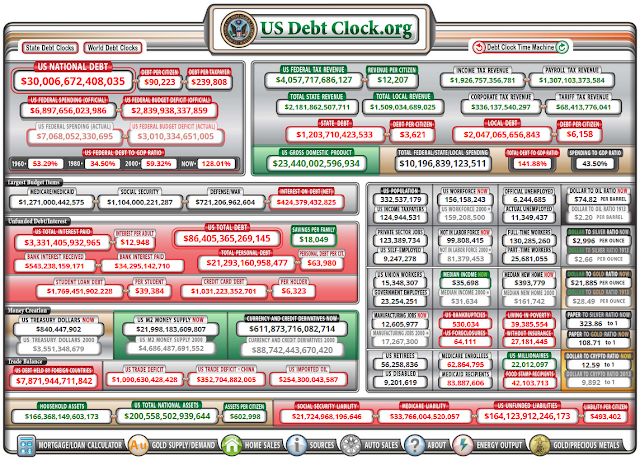
I wasn't watching closely enough to tell you day, hour and minute this happened, but within the last month, the national debt of the US exceeded $30 trillion for the first time.  The number as I write is the upper left box in the biggest font; for those who think seeing all the numbers conveys the size better than just saying "the T word." From our friends at US Debt Clock.

When I saw the headline, I thought, "Gee, didn't I post on the debt going over $20 trillion in the blog?"  Yes, I did and quite a bit more recently than I thought: it was in September of 2017.  That feels recent to me because it's since I retired, on last working day of 2015.  We went from $20 to $30 trillion in around four years and four months.  Another way of looking at that is it took from the founding of the country in 1789 until 2017 - 228 years - to build up $20 trillion in debt and only four years and four months to build up 50% more debt.  

Does that seem overwhelming?  We hit $15 trillion on November 17, 2011, which says the first $15 trillion in debt took 222 years and the second $15 trillion took 11 years.  Yeah, I'm leaving out details on the months here.  I don't know about you but that makes me feel worse, not better. 

Getting back to the current $30 trillion number, The Peter G. Peterson Foundation points out that the total debt is bigger than the economies of China, Japan, Germany and the United Kingdom added together.  When people talk about the Chinese funding our national debt, there's a little bit of truth there; I mean they have some amount of US bonds but no nation can buy more debt than their own entire GDP, they can only buy a few percent of it as bonds.  In fact, China, Japan and the European Union are the biggest holders of our treasury bonds except for one buyer.  

The biggest buyer of the bonds to fund our government is ... us.  More precisely, the Federal Reserve Bank, which creates the money to finance our debt out of (thin air, unicorn farts, whatever words you'd like).  This would be like you writing yourself a check to double your pay and putting it in your checking account every payday.  Except for the part about that one you wrote would bounce to the moon and you'd end up in deep trouble.  And if you listen to the economic geniuses running the country, like AOC or Dr. Stephanie Kelton, it's perfectly fine for a government to print all the money it wants. 

Listen, I've posted on this topic many, many times, and I'm as tired of writing about it as I'm sure most people are of hearing about it.  Let me just put some brief highlights here:

  • Yes, deficits and debts as commitments matter.  We borrowed real money from real people both here and in foreign countries, and we promised to pay it back.  They expect and deserve to be paid back with real money that's worth something.  If the Fed inflates the dollar to worthlessness, don't you think the Chinese, Japanese and the rest of the world would be mad at us?  Perhaps they'll abandon use of the dollar?  Perhaps they'll just never buy another US bond?  What if they demand something of value for their worthless currency, like maybe a national park?
  • The government can't tax their way out of this.  To heck with taxing the "richest 1%", if they confiscated, not taxed, the entire net worth of the 20 richest billionaires in America, they'd get $1.08 trillion.  With spending at $6.9 trillion, the money would be gone in less than two months.  In my opinion, the talk about "taxing the rich" they float is just to inflame class hatred and envy. 
  • Hauser's Law may be a really counter-intuitive thing, but it has been true for a long time.  No matter what tax rates are, the tax revenues are roughly 19% of GDP.  We just can't spend more than that consistently. 
  • No country with a Debt to GDP ratio much beyond ours has ever survived it as anything other than a walking corpse.  Most have undergone economic collapse.  
  • If we truly intend to reduce that national debt, we not only need to cut out deficit spending, we need to run surpluses as far as the eye can see.  Our great-grandchildren can think about deficit spending.
  • No one in government has proposed spending cuts like we really need.  Candidates in primaries have: Ron Paul proposed shutting down whole departments of the fed.gov hydra.  Candidate Rick Perry proposed capping spending at Hauser's Law, which is more definitive about cutting spending.   
  • It truly is the spending. 

Most people don't understand exponentials.  We are in a phase that is exploding toward infinity.  It simply can't continue, that's mathematically impossible.  Worse yet, large segments of society howl like they're being fed into a wood chipper if the fed.gov simply doesn't give them more every year, let alone actually cutting their free sh*t. 

And this is why I think an economic collapse is inescapable. 


Tuesday, January 25, 2022

The News is Focusing on the Wrong Biden Quote

As usual, I suppose.  

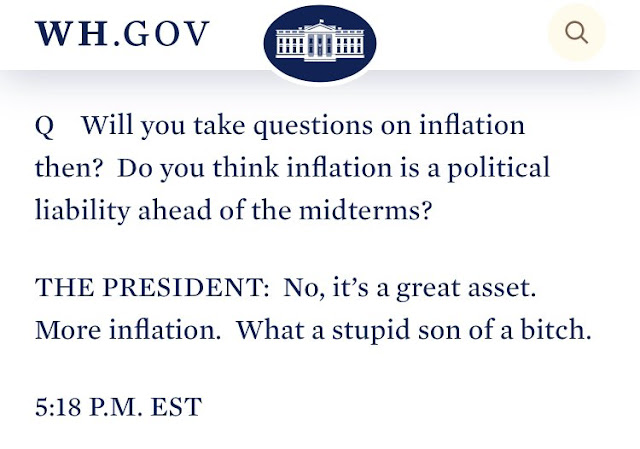
Everyone is fussing over the exchange where Biden called Fox News reporter Peter Doocy a "Stupid son of a bitch."  I wasn't aware until I read that article on a link from Divemedic's Area Ocho of what should really be the story there.   First, from that article linked first here:

After Biden complained that all the press questions were about the military buildup around Ukraine, Doocy shouted, “Will you take questions about inflation? Do you think inflation is a political liability ahead of the midterms?”

Thinking his microphone was turned off, Biden responded sarcastically, “No, that’s a great asset. More inflation.”

He added: “What a stupid son of a bitch.”

A bit later in the day, another link led me to this alleged Tweet from the White House that essentially says the same thing except with trivial word substitutions.

Considering the almost 100% agreement between the two reports, it appears that the deliberate inflation that everyone is suffering through is being maintained not just because of the Central Idiocy that is Central Banking, but because the moron in chief thinks inflation is a good thing for him and his party.  I've heard of (but not directly heard) him saying he'll make the minimum wage $15 without passing a law through congress.  

As is always the case with inflation, nobody "benefiting" from the new pay is a penny wealthier from it and very likely gets hurt by it. 

I've done this analogy many times before, but maybe let's do it again for your friends or others who really think they're doing better because their paycheck is bigger.  

Imagine for the moment that what I'm describing is legal instead of something that could get you put in jail.  Imagine you could take a really "Magic" marker and just by doubling the printed value on the bills in your wallet, you actually made them double the "value."  A $1 bill becomes a $2 bill.  If you had a $2 bill it becomes a $4 bill (I know there is no such thing, but work with me here), a $5 becomes $10 and so on.   

What I've always emphasized was the aspect that everyone else has the same marker and everyone else now has the same wallet, so relative to everyone else in the country your position hasn't changed even the littlest bit since everyone else doubled their income, too. 

The unmentioned part is that every single expense in your life gets the same treatment because everything you buy is affected by the same doubling of costs.  You make twice as much money but your food costs twice as much, your housing costs twice as much, everything has doubled.  Has doubling the dollars you make improved anything in your life?  Nope.

Those of us who were working adults during the crazy inflation of the 1970s know well that it can seem like everything just stays out of your reach as your pay goes up every time you're eligible for a raise.  The last number I saw quoted for inflation over the past year was 7%.  Shadowstats' calculation based on the same rules used in the Jimmy Carter days shows the year over year inflation to be 15% or 2.1 times the official 7%. 

The Federal Reserve has said many times that they're committed to maintaining some inflation, basically because they're terrified of deflation, which they think will severely hinder the economy.  They believe no one will buy anything other than essentials if they think it will be cheaper in the future.  The unspoken corollary to that is nobody will save anything for the future if the money they save will be worthless in the future because of inflation, but they never seem to think that.

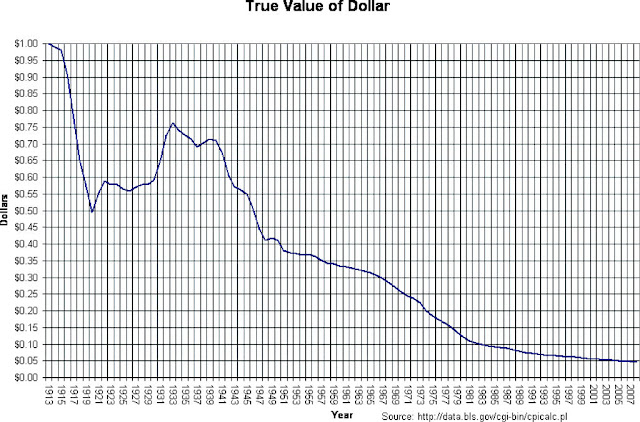
In my little analogy, you've just done conceptually exactly the same thing the Federal Reserve Bank has done; you've doubled the number of dollars everyone has and yet no one or nothing is better than before.  In effect, you've reduced the buying power of the dollar in half.  The Fed hasn't done a simple doubling of dollars, but they've been doing it since the Fed was created in 1913, 108 years.  This chart of the buying power of the dollar is dated from 2007, but the trend downward has continued.  It just needs to either be bigger, or use a logarithmic scale on the Y (vertical axis).  

This says the buying power back in 2007 was less than a 5 cents in 1913 money.  When people talk about gold or silver going up or down, they're thinking backwards.  If gold is the "standard" the dollar is getting more or less valuable just like in that graph - although it has been a long time since the dollar went up in value, even briefly.  I think it goes without saying, but I'll say it anyway, the price of precious metals is set on an open market, which inevitably means the price is a function of how much buyers value it.  I'm not aware of a country in the world that actually uses a gold or precious metal backing for its currency.   

It's worth asking who benefits from inflation?  Let's say you have loans for a fixed amount of dollars, like a mortgage.  If you have more dollars in five years because of inflation, your mortgage takes a smaller bite out of your pay.  To the bank they're not losing money, that's budgeted income and as long as it comes in all is well.  Any effects of inflation tend to be offset by new loans and other things (they sell mortgages to other companies all the time).  The banks, and especially the bigger banks, benefit because they get those freshly created dollars before they have an inflationary effect on the market. 

Finally, the ones who get the most benefit are the Federal Government.  They sell bonds to finance all their expansionist crap and if they pay them back with inflated dollars, those are paid off.  Their tax revenues, in numbers of dollars, go up if the revenue goes up by inflation.  All of those promised payments they say they'll make (social security, medicare) that are tied to rate of inflation incentivize the Fed.gov cheating on the way they define inflation, which is why Shadowstats has calculations using the 1980 method and the 1990 method.  For years, people have said that the only way our national debt will be paid off would be by inflating our currency.  It seems to be a consensus that the debt is too big, and collapse is going to happen.  Is going to be by fire (hyperinflation) or ice (death spiral into depression)?  I've been writing about that since 2013 (second of two pieces by the same name).  The Great Reset seems to play into what's going on, too.


Tuesday, January 18, 2022

The $800 Billion Covid Protection Program Failed Miserably

From the "stop me if you've heard this before" file, but the Federal Government totally screwed up the Paycheck Protection Program started in response to Covid in 2020.  It was part of the CARES Act, or the Coronavirus Aid, Relief, and Economic Security Act to help some select businesses, self-employed workers, sole proprietors, select nonprofit organizations, and tribal businesses continue paying their workers.  

This week, Brad Palumbo at FEE excerpted and summarized a new study (47 page .pdf) from MIT economist David Autor and nine coauthors for the National Bureau of Economic Research.  The researchers tracked where the money went and the results weren't pretty.

The analysis shows that even though 93 percent of small businesses received loans from the program, only between 2-3 million jobs were preserved. The program spent an astounding $170,000-$257,000 for each job it helped preserve! That’s, erm, a lot more than most of those jobs even pay.

Moreover, the study finds that only 23 to 34 percent of the program’s dollars went to workers who would’ve otherwise lost their jobs—meaning the vast majority went to “business owners and shareholders.” (Oh, and a whole bunch was lost to fraud, too).

We've all seen headlines about fraud in the program over the last couple of years, and the study confirms fraud really was going on.  Another clue about fraud was spending about $215,000 to preserve a job for someone who's making $25,000/year, which raises the possibility that money didn't actually go to the person making $25k/year.  The whole thing doesn't seem like a smart use of tax money.

The study also concluded that the benefits were highly regressive; that is, they paid more benefits to higher income people.  The program was intended to provide a temporary paycheck for low income workers affected by the "14 days to flatten the curve lockdowns."  Instead, it paid

...about 75 percent of the benefits flowing to the top 20 percent of earners.

I'm not sure that's as big a problem as they imply.  Consider a mom and pop pizza shop.  The way I read that, it could mean they paid something like the server's wages to the server, but paid something like the owner's portion to them.  If all you record is the number of dollars, of course the higher paid person got more dollars.  That's kind of the definition of being higher paid. 

The plot shows what I'm talking about.  Viewed simply as the total number of dollars, the fifth quintile of incomes has the biggest chunk of PPP benefits - black is PPP compensation and the gray squiggly lined block is PPP capital income while red dots are unemployment compensation and blue Xs are Stimulus checks.  Viewed as a percentage of their annual income, it's  rather different.  The percentage of annual income from the Stimulus checks and Unemployment insurance of the lowest quintile is highest and the goes down for the higher quintiles.  The percentage contribution of the PPP checks and Capital Income is bigger than the lower quintiles but doesn't seem as outsized as the raw number of dollars. 

All of this is secondary to the real questions about whether the lockdowns, the CARES program and PPP were reasonable in any way at all. 


Monday, December 20, 2021

About That Elon Musk/Elizabeth Warren Tift

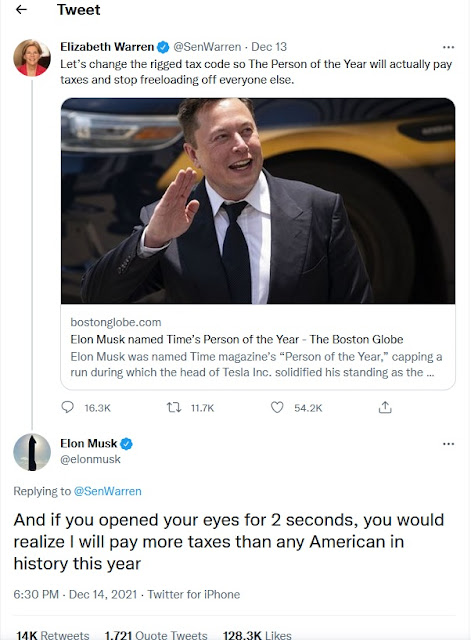
I'm sure you heard the story.  Elizabeth Warren tweeted, “Let’s change the rigged tax code so The Person of the Year will actually pay taxes and stop freeloading off everyone else,” Warren tweeted. 


 Later, Musk famously called her "Senator Karen" and made fun of her. 

What he's talking about is that this transpired at almost at the same moment stories were breaking that he was about to pay more in taxes than anyone in history. We get some numbers from John Miltimore at The Foundation for Economic Education, FEE. 

Is the claim true? Only the IRS knows for certain who the largest taxpayer in US history is, but Forbes says Musk appears to be right.

“The eccentric billionaire (and the world’s richest person) likely owes the federal government at least $8.3 billion for 2021,” Forbes reports.

Business Insider projects Musk’s tax bill is even higher when state taxes are included.

“Taxes on his stock, nearly a billion in Net Investment Income Tax, and the billions he likely owes California could add up to about $12 billion in total,” report Jason Lalljee and Andy Kiersz.

CNBC, meanwhile, figured Musk’s total tax bill was even higher—$15 billion.

The bulk of Musk’s tax bill stems from the nearly $13 billion in Tesla stock sold as of December 13, which is even larger than the record $10.2 billion worth of Amazon stock Jeff Bezos sold last year.

Personally, I think it's everybody's moral duty to pay the legal minimum they owe in taxes and it doesn't bother me how much he pays this year or any year.  Think of the Milton Friedman quote, “If you put the federal government in charge of the Sahara Desert, in 5 years there'd be a shortage of sand.”  Paying more tax than the legally required minimum can be thought of as encouraging that behavior.  Look at those last few paragraphs, though.  If he sold $13 billion in Tesla stock, and is looking at 12 to $15 billion in taxes, they're implying a tax rate that's over 100%. 

But reading Musk's Twitter thread is eye-popping.  It's amazing how many people think they're entitled to other people's money, and his in particular.  The more you read, the more you sense that the problem here isn't someone's taxes, it's envy.  One of the original seven deadly sins identified by Pope Gregory 1 around the year 600 AD, those are commonly listed as pride, greed, wrath, envy, lust, gluttony and sloth although the order seems to vary.  Note the definitive list is not one Bible verse but that these are scattered throughout Proverbs and other books.

Envy is considered one of the Seven Deadly Sins, and for good reason. It’s a corrosive disposition that harms both individuals and societies. The celebrated philosopher Immanuel Kant described envy as,

“…a propensity to view the well-being of others with distress, even though it does not detract from one’s own. [It is] a reluctance to see our own well-being overshadowed by another’s because the standard we use to see how well off we are is not the intrinsic worth of our own well-being but how it compares with that of others. [It] aims, at least in terms of one’s wishes, at destroying others’ good fortune.”

The pre-Socratic philosopher Democritus (c. 460 BC – c. 370 BC)—in a wonderfully libertarian quote—once warned of the danger of envy and purpose of the law.

“[Just] laws would not prevent each man from living according to his inclination, unless individuals harmed each other; for envy creates the beginning of strife,” he wrote.

Being envious of someone is like being angry at them; it gives them control over your emotions.  Envy makes sense for Elizabeth Warren, as a well-established socialist.  After all, to borrow from Winston Churchill, “Socialism is the philosophy of failure, the creed of ignorance, and the gospel of envy.”  Envy is being preached at Warren's church.