This Tuesday, March 10 (yesterday as I write), NASA released a report on their management of the HLS -or Human Landing System - that has been under development contracts to SpaceX and Blue Origin. While NASA originally contracted SpaceX alone, after Blue Origin and Dynetics sued NASA, even though NASA couldn't afford to build more than one model HLS, Blue Origin was contracted to deliver their lander, the Blue Moon MK2.
With two competitors producing lunar landings, an atmosphere of wanting more competition began emerging, and neither company has said much about their landers other than releasing some good computer renderings of their vehicles. That means yesterday's NASA report has made for some interesting reading. To begin with, they admit the fixed price contracts have worked well for the agency.
Overall, the report, signed by Office of Inspector General senior official Robert Steinau, finds that the fixed-price contracting approach has been beneficial for NASA as it seeks to broaden its utilization of the US commercial space industry.
“We found that the Agency’s contract approach has been effective at controlling costs and provided the HLS Program with insight into SpaceX’s and Blue Origin’s development of their lunar landers,” the report states. “The providers have also been able to utilize the Agency’s subject matter expertise and unique capabilities and facilitates to advance their lander development.”
At this point you're probably thinking there's a Big But coming (Nota Bene only one "t" - I'm not Sir Mix-A-Lot).
NASA doesn't like the pilot's controls in the SpaceX HLS.
NASA had similar reactions during the design of the crew dragon, and the reaction seemed like a typical old school vs. new school reaction, or what you'd get if you put someone who had never flown anything newer than maybe 50 years old into new design.
The space agency and SpaceX engaged in a similar back-and-forth during the design process for the Crew Dragon spacecraft a decade ago. SpaceX initially wanted touchscreens only, with limited flight commands available to astronauts. NASA pushed back and wanted what were essentially joysticks for astronauts to fly the vehicles like previous spacecraft. A former NASA astronaut then working at SpaceX, Garret Reisman, helped broker a compromise by which astronauts could manually fly the vehicles using controls on touchscreens.
This is one of those circumstances where I find that both sides make sense to me. In the event of everything going to hell in a handbasket, it's important for the guy flying to work as seamlessly as if he'd been using those controls and flying that vehicle all his life. He could control it without a moment of thinking about it. Totally automatically. You don't want him spending time grabbing the joystick and taking time to do a mental change. On the other hand, these are NASA astronauts we're talking about, "the best of the best" who should be able to learn to fly anything faster, and then fly it smoother and better than non-astronauts. Plus having the flight controls on touchscreens is fine if the touchscreens are working and the astronauts are that smooth with them.
While Crew Dragon has flown many times, the controls in HLS are going to be new.
“Starship will not have the same level of proven flight heritage in the actual operating environment for its crewed lunar missions,” the report states. “Incorporating this system capability is a key element of HLS’s human-rating certification and part of an essential crew survival strategy.”
Now balance that with knowing absolutely nothing about Blue Origin's flight controls. It's not that Blue hasn't released the info on the controls, Blue hasn't designed them.
There is other interesting information in the report, including details on the uncrewed demonstration flights that SpaceX and Blue Origin are both required to fly before human missions can take place. The inspector general notes that these flights will not require life support systems and airlocks, as human missions will. Nor will the tall Starship vehicle be required to test an elevator to bring crew down to the surface.
Maybe it would be better if they did a more thorough flight test.
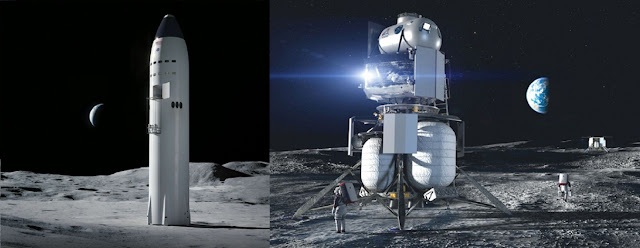
Artists' renderings of SpaceX's Starship HLS (left) and Blue Origin's lander. Image credit to the respective company.


Sounds like some of the people in charge at NASA have had their common sense educated out of them. I've seen this all too many times at large corporations I've worked for.
ReplyDelete"Ah, here's the finest lander in the universe, made with hand-fettled metal, cloth insulation rolled on the thighs of actual virgin girls." "Where's the controls?" "Well, that's coming in next year's model.
ReplyDeleteNASA meet facepalm, facepalm meet NASA.
And, duh, of course the controls on HLS aren't tested and are unlike the controls on Dragon. Because it's friggin HLS, you doofussi. Seriously, NASA is supposedly the smartest-guys agency?
Gahhh!!!!!... urk! Think I'm gonna stroke out over the magnificent display of complete dumbassery.
Check this video out:
Deletehttps://www.youtube.com/watch?v=tj9-FGo_MoI
"How SpaceX's New Spacesuit Solves What NASA's Lunar Suit Impossible! "
The tall, slender shape of that Spacex lander looks really precarious. All our favorite landers in recent years have had trouble remaining upright, so it's hard to visualize that thing working out ok without some long legs. Can't wait to see the first tests.
ReplyDeleteI wonder if some future historian will look back on all of this and document how things that were secondary in nature prevented Man from getting in space sooner. We have a habit of majoring in the minor things sometimes.
ReplyDeleteDoes the pathos that NASA turned into like anything that might be successful (other than cash flow)?
ReplyDeleteSmart money says the Astronaut Office at JSC is driving this.
ReplyDeleteNope, I want actual controls, no punch this button on a screen.
ReplyDelete