Showing posts sorted by date for query cannibal CME. Sort by relevance Show all posts

Tuesday, November 11, 2025

Sun Spits out the strongest flare of '25

Not the strongest X-Class flare of Cycle 25, but the strongest flare of the year 2025.  The strongest X flare of Cycle 25 (so far and probably will stay that way) was in July of last year, '24, and was an X14. Today's flare was an X5.1. The strength of the flare isn't generally the whole picture, although it can be. An X5 strength is approximately 0.5 milliwatt per square meter strength, while an X14 is 1.4 mW/sq.mm The bigger story here is that there have been two other Coronal Mass Ejections (CMEs) in the last 48 hours. 

Spaceweather.com puts it this way:  

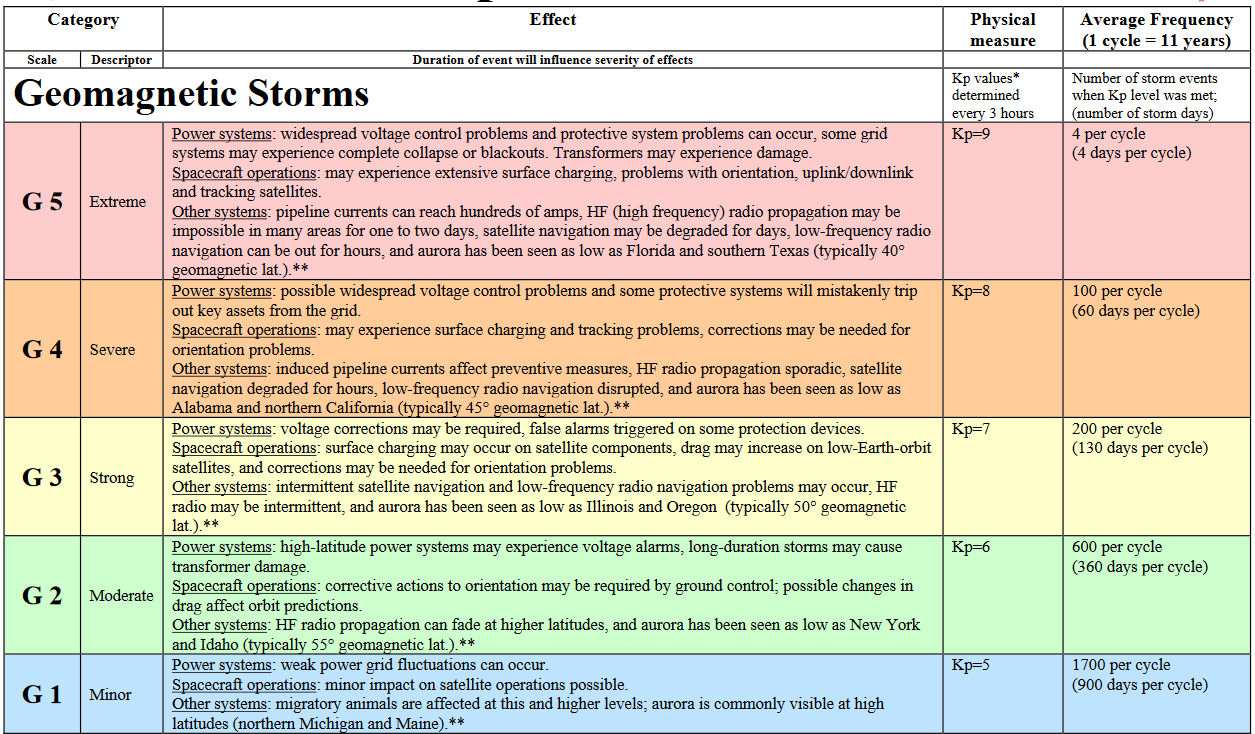
SEVERE GEOMAGNETIC STORM WATCH: Strong (G3) to severe (G4) geomagnetic storms are possible on Nov. 12th and 13th in response to three CMEs now approaching Earth. This includes a potent CME from today's X5-flare, which is moving so fast it might overtake and sweep up the CMEs ahead of it. The arrival of such a "Cannibal CME" could spark auroras in more than half of all US states. 

A 'GROUND LEVEL EVENT' IS UNDERWAY: Today's X5-class solar flare from sunspot 4274 hurled a fusillade of energetic protons toward Earth. Some of the particles are so powerful, they are penetrating the atmosphere all the way to the ground. "This is a very significant event," says Professor Clive Dyer of the Surrey Space Centre. "Neutron monitors around the world are detecting it."

This is called a Ground Level Event (GLE). GLEs of this magnitude are rare; they happen only once or twice every solar cycle. "This one is comparable to the GLE of Dec. 13, 2006," says Dyer. That makes it a ~20-year event.

When a Flare erupts, the electromagnetic effects of the radio/light it emits arrive here quickly. The particles that constitute the CME (a Coronal Mass Ejection is Mass, after all) so it can't move as fast as light. The geomagnetic storms they talk about in that first indented paragraph are forecast to be here either on the 12th or through the 13th (which I read as midnight on the 13th, so pretty much the 14th).  In UTC it's the 12th now here in the Eastern time zone. Note the couple of days of uncertainty in when it will have effects. 

The arrival of the radio energy from the X5 was close to sunrise here on the coast, while it was midday over Europe and the western areas of Africa. There were stronger effects on radio propagation, with HF being pretty much wiped out for several hours over Africa and Western Europe - good graphic over on Space.com. The Space Weather Prediction Center issued this forecast at around 12 hours after the flare erupted.


Sunday, July 28, 2024

More Cannibal Coronal Mass Ejections Incoming

We've talked about cannibal CMEs here on the blog a few times, a term for when a faster moving coronal mass ejection overtakes a slower CME that started before the faster one. The resultant isn't just more material, the overtaking one compresses the original into a denser one capable of more impact on the Earth or wherever it hits. There's an even bigger than typical Cannibal CME coming in according to SpaceWeather.com.

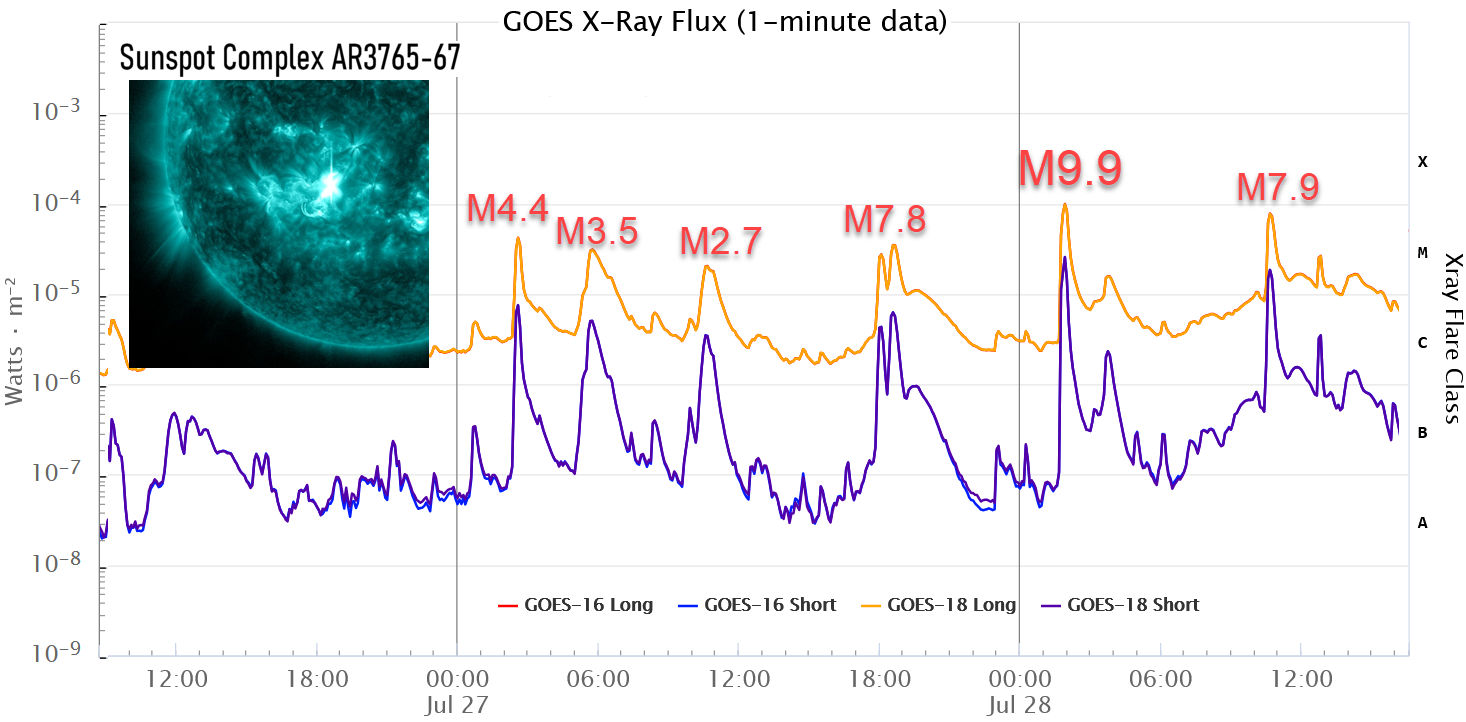
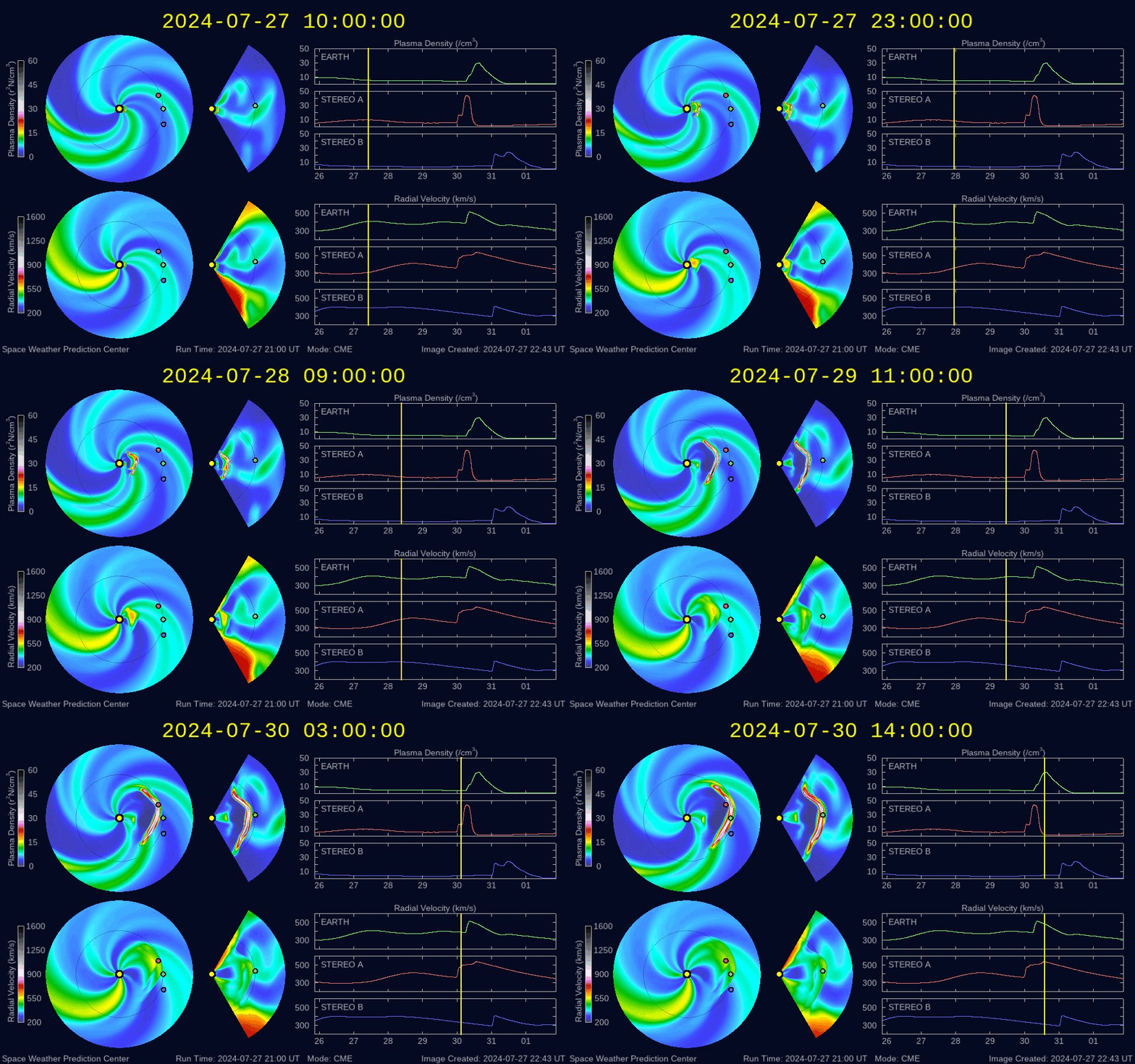
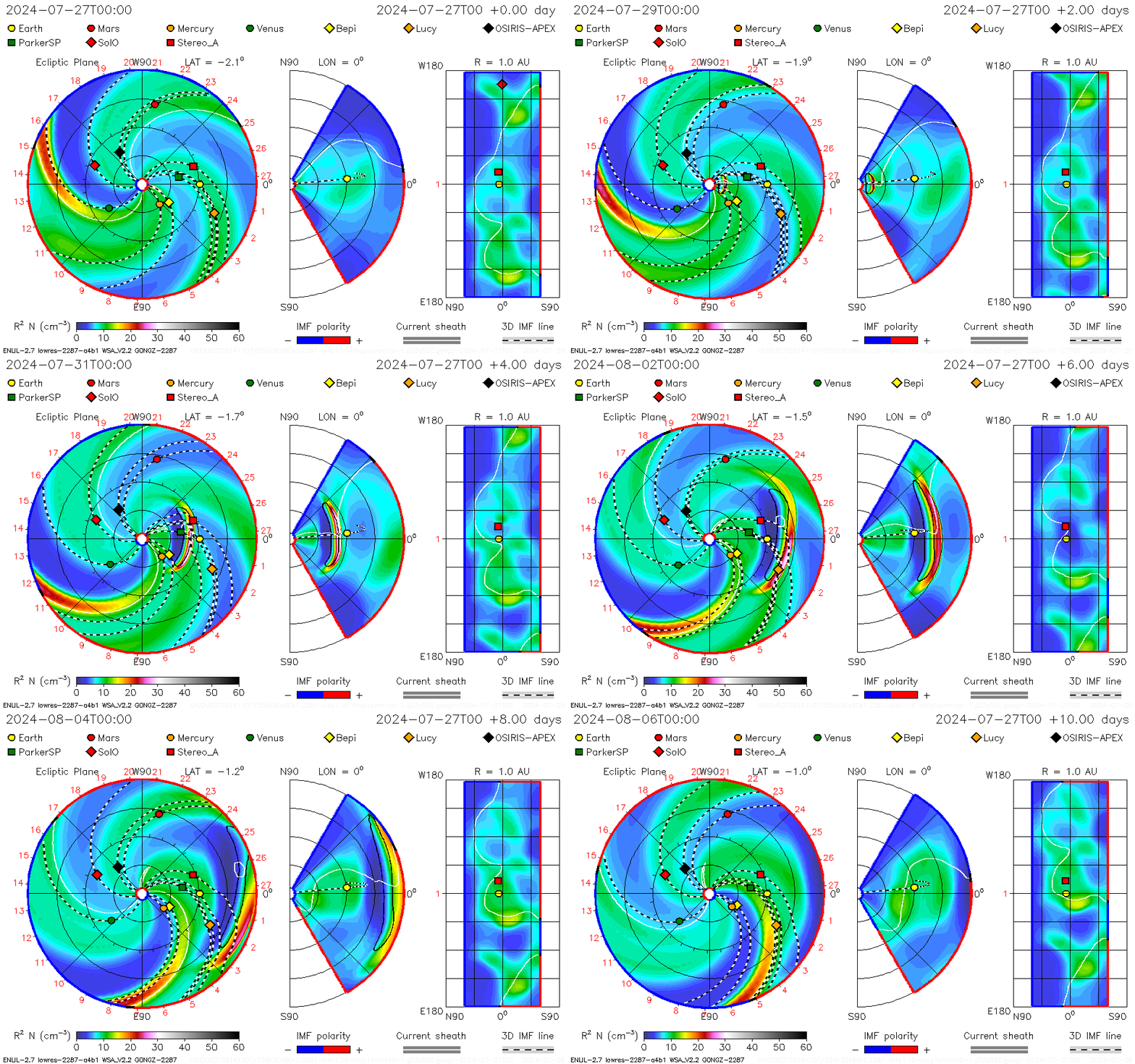
CANNIBAL CME ALERT: A series of M-class flares over the weekend hurled multiple CMEs toward Earth, as many as four or five. According to a NOAA model, the first two CMEs are merging to form a single Cannibal CME. Strong G3-class geomagnetic storms are possible when it reaches Earth on July 30th. Subscribers to our Space Weather Alert Service will receive an instant text message when the CME arrives.

Bonus: Watch NOAA's animated forecast model of the first two CMEs merging to form a Cannibal.

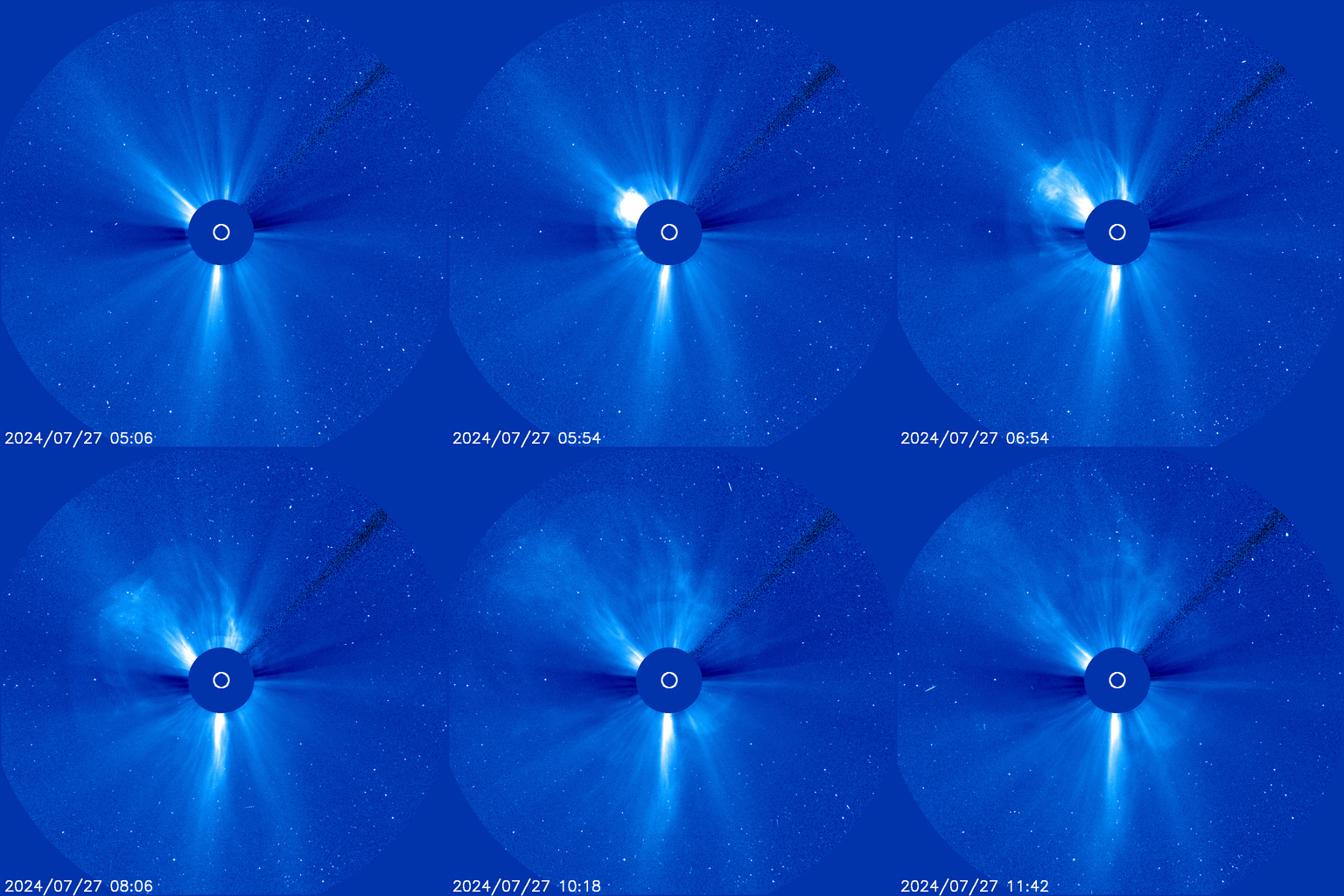
The Cannibal CME is clearing the way for perhaps 2 to 3 more CMEs following behind it. SOHO coronagraphs show a wagon-train of clouds leaving the sun on July 28th:

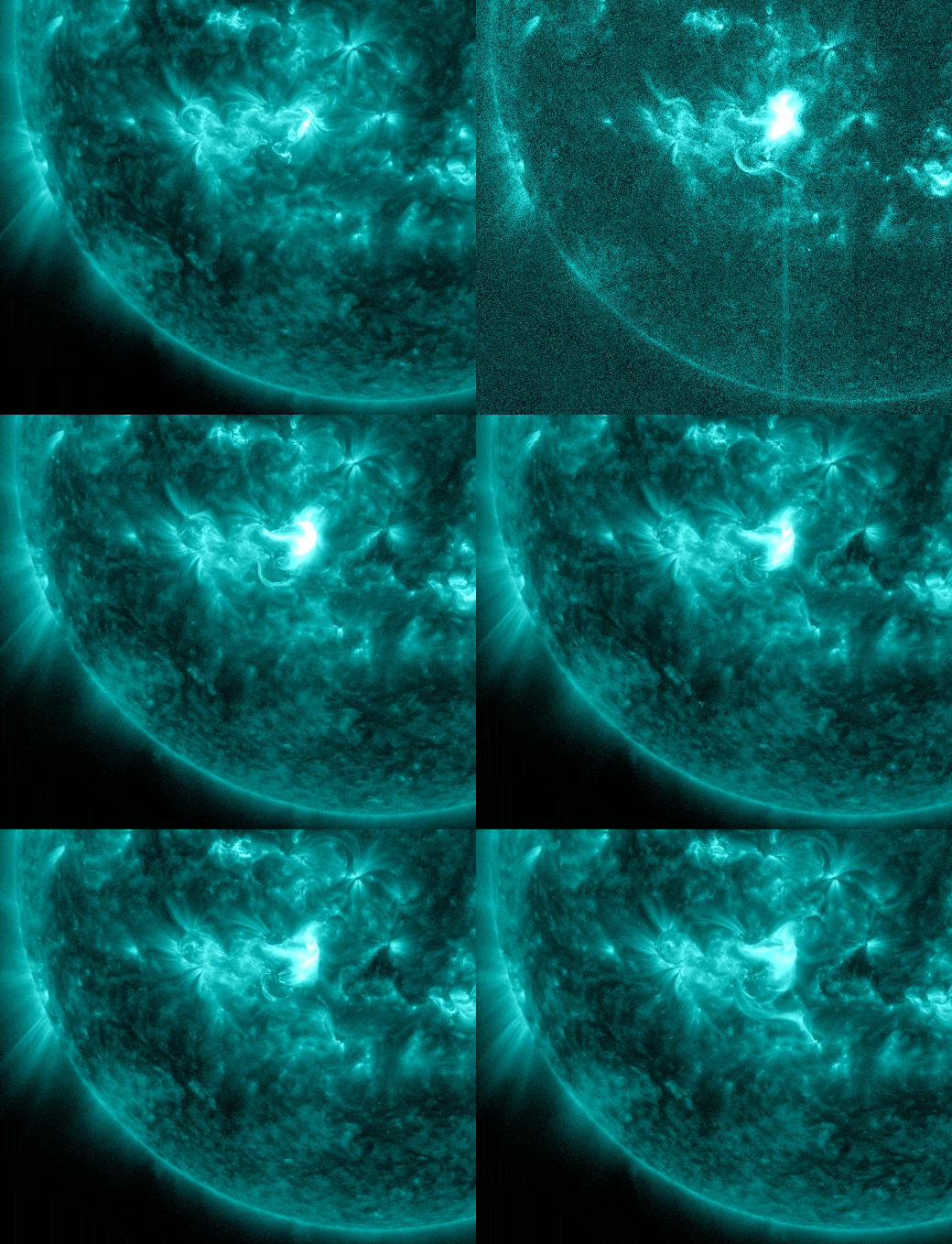
The first and most potent of these CMEs was launched by an M9.9-class solar flare from sunspot complex AR3765-67 on July 28th (0157 UT): movie. The CME will fly into a void created by the earlier Cannibal CME. With little interplanetary material to slow it down, the storm cloud should reach Earth no later than July 31st. A preliminary NASA model supports this forecast.

Even if the Cannibal CME fails to spark a strong geomagnetic storm on July 30th, the arrival of more CMEs on July 31st could push storm levels to category G3 (Strong) or beyond. This would set the stage for mid-latitude auroras visible from Europe and the USA.

You may have heard that on Tuesday, July 23, the sun launched the biggest solar flare of this cycle and going back to the early '00s (cycle 23) at X14. That flare isn't part of this coming potential storm because of the tremendous good luck we had in where the flare erupted from. It erupted from the far side of the sun and was pointed completely away from Earth. For comparison, the X-class flare that started the massive, historic G5 geomagnetic storm of early May wasn't as strong as the X14 from the far side; the flare on May 10 was X5.8. There were a few Earth-directed flares in those few days in May, but the strongest flare in early May was X8.8 and that was the strongest of Cycle 25 - until last Tuesday's X14.  


Plot of the solar flares around July 23rd's X14 flare. Solar Orbiter was over the farside of the sun when the explosion occurred on July 23rd, in perfect position to observe a flare otherwise invisible from Earth.

Geomagnetic storms like those being expected from the incoming CMEs are usually most evident in shutting down high frequency (shortwave) radio propagation. They can introduce paradoxical improvements in HF and VHF propagation, especially during periods when the geomagnetic K-index is dropping. We tend to look at the numbers posted of the planetary K-index (here, for example) and think of them as static or very slow moving, but much like wind gusts during any sort of storm, the K-index can go up and down on shorter time intervals than the three hour averages plotted there. 


Friday, May 10, 2024

Planetary Geomagnetic Storm Has Hit

Borrowing wholesale from Spaceweather.com:  

EXTREME GEOMAGNETIC STORM--NOW! The biggest geomagnetic storm in almost 20 years is underway now. It has reached category G5--an extreme event. Sky watchers with dark skies may be able to see and photograph auroras even at low latitudes. Get away from city lights and look at the sky! Aurora alerts: SMS Text

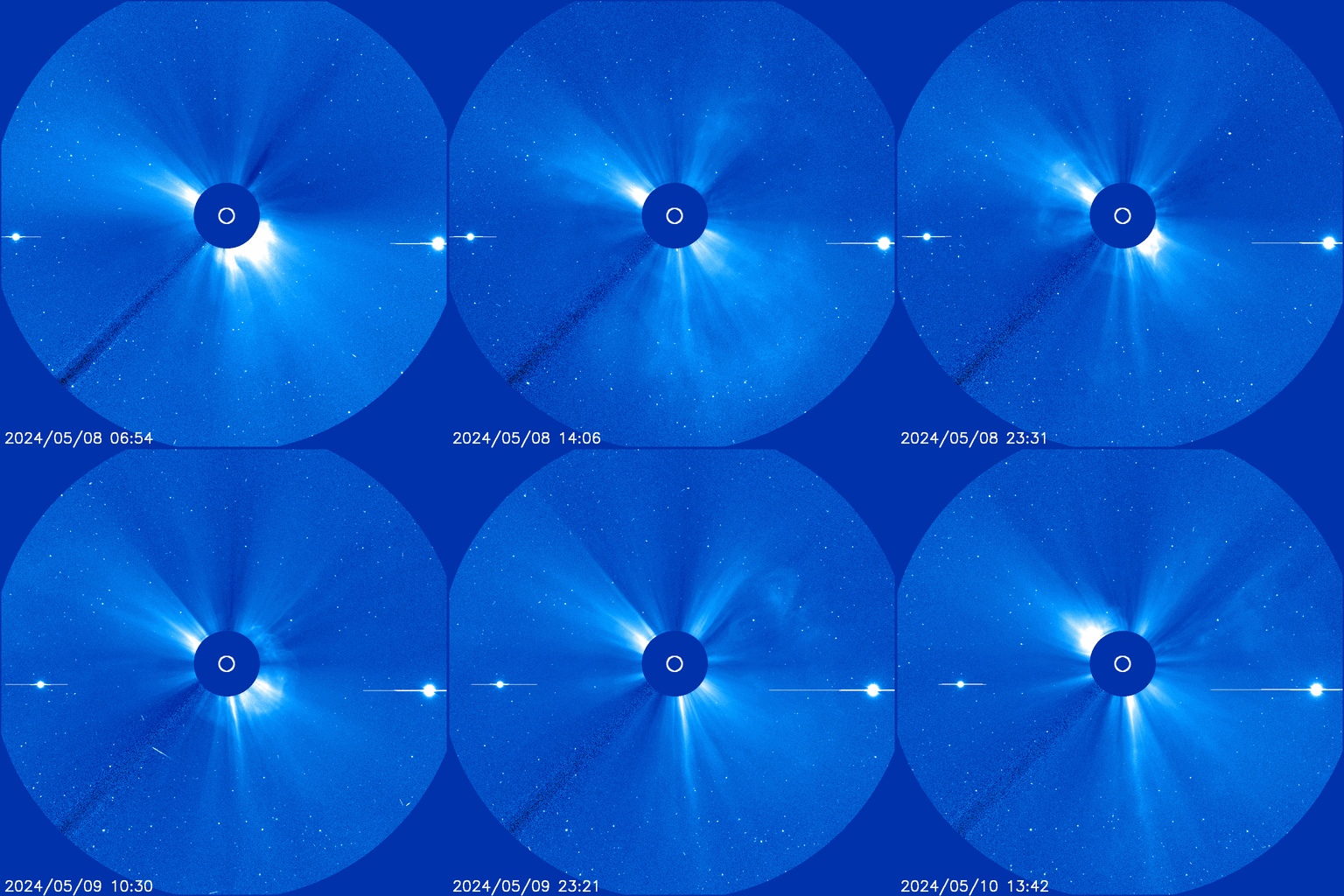
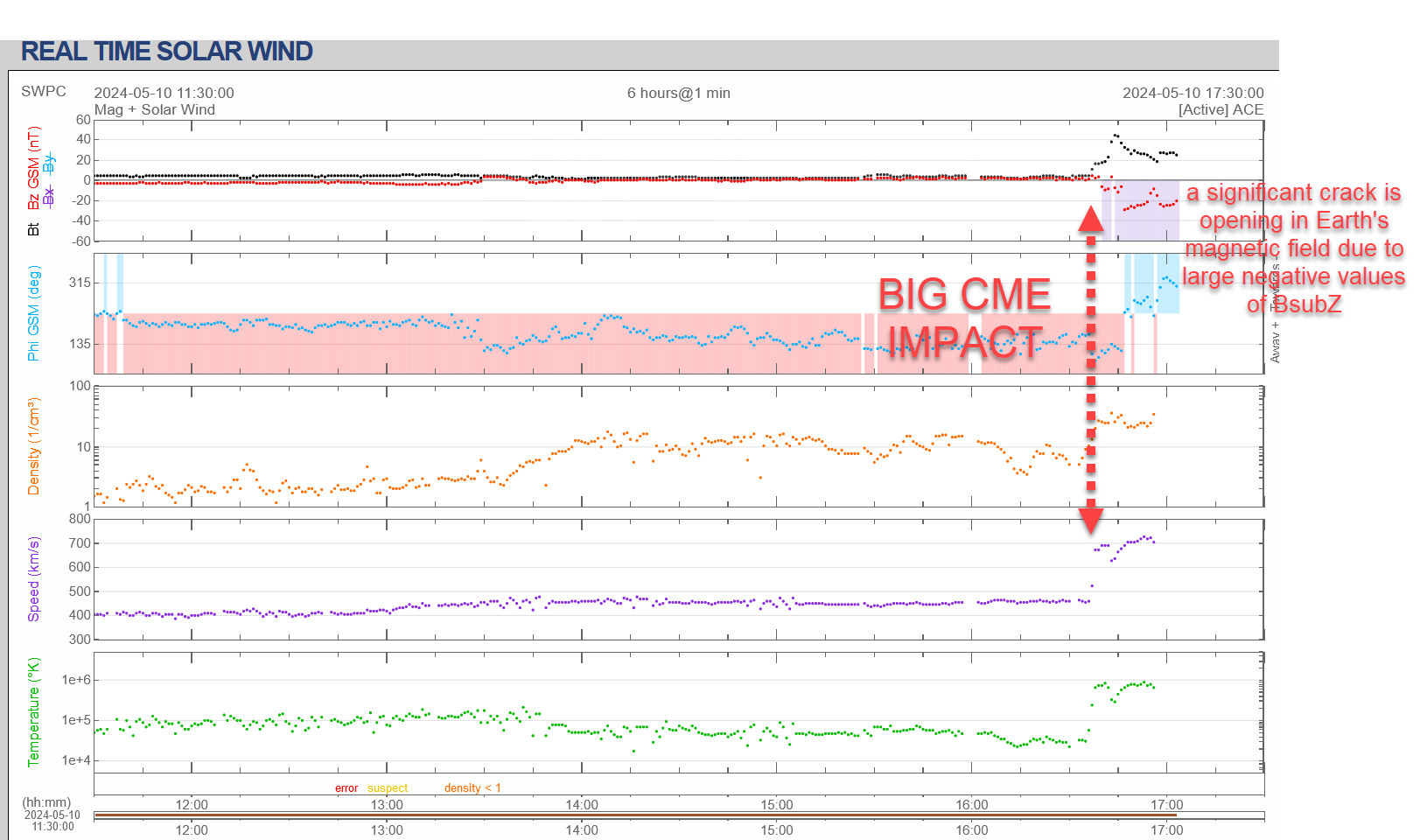
CME STRIKE SPARKS WIDESPREAD AURORAS: The first of six CMEs hurled toward Earth by giant sunspot AR3664 hit our planet's magnetic field today. The impact on May 10th at 1645 UT jolted magnetometers around the world and sparked a geomagnetic storm, which is now extreme. More CMEs are following close behind and their arrival could extend the storm into the weekend. Sign up for Space Weather Alerts to receive instant text messages when the CMEs arrive.

If you're anywhere in the US north of the Gulf of Mexico, it's worth trying to get to a dark location a couple of hours after sunset to see if you can see auroras. They'll be pushing very far south. How far?  In most cases, the K-index has to get to 9 or higher to see them as far south as the Carolinas to Arkansas or so. 

HOWEVER, there's more to it. The first is that the value you see on charts like this are 3 hour averages. Geomagnetic storms also have gusts and peaks that can give shorter term visibility farther south. Next is the direction of Earth's magnetic field, denoted by Bz. South pointing geomagnetic fields produce auroras farther south, into the gulf coast, Texas and even Florida. This site has a plot of Bz, toward the top right of the page, the second row under a place for a video that's always there.  (Bz is currently staying pointing south).

This was the first hit of several CMEs that are coming and there are predictions later impacts will become the so-called cannibal CMEs, in which later, faster Coronal Mass Ejections catch up with and merge with earlier CMEs, giving them a bigger, higher impact. In this view you can see the monster-sized sunspot group 3664. It's the one that has thrown the group of CMEs in the Earth's direction.

Image from Spaceweather.com

As a sidenote, a ham radio group I read regularly had a plot from the same place that had 3664 next to what I think is Carrington's drawing of the spots that gave the famous, all-time world record CME named after him. The implication is that since the group is the same size, the CME could be as bad as the Carrington event. The size of the group is actually relatively low importance in this; what's more important is the magnetic configuration. For example, the caption to that sun picture says, "Giant sunspot AR3664 has a 'beta-gamma-delta' magnetic field that harbors energy for X-class solar flares." I've ranted before about how tired I am of continuous predictions that we're going to have another Carrington event. Something that has happened once in all of human history of observing the sky is suddenly supposed to happen routinely according to these folks. I know "doom sells" but it's kind of ridiculous out there. 


Thursday, November 30, 2023

Are You in the Far North of the US?

If you're in the northern tier of the US, you might want to keep an eye out for possible aurora displays tonight (late on 11/30 into 12/1) and into tomorrow night (12/1 into 12/2).  According to SpaceWeather.com reporting from NOAA, a cannibal CME is going to impact Earth on December 1.  As I write this it's already December 1 by Universal Time (UTC) and there's no sign of anything by the planetary K index, which is currently 0.33.  More on that later. 

A CANNIBAL CME IS COMING: NOAA models confirm that a Cannibal CME will strike our planet on Dec. 1st. Cannibal CMEs form when a fast CME sweeps up a slower CME ahead of it. The combination contains intense, tangled magnetic fields that can do a good job sparking auroras when they reach Earth. If a Cannibal CME strikes Earth on Dec. 1st, as predicted, geomagnetic storm levels could reach category G3 (Strong). Aurora alerts: SMS Text

Space.com described it with a bit more detail.   

The rapid Earth-bound CME left the sun on Nov. 29 during a powerful M9.8-class solar flare eruption. But it isn't alone. The speedy plasma outburst will merge with several slower upstream CMEs that left the sun a day earlier (Nov. 28), creating a "Cannibal CME" that will likely trigger a strong geomagnetic storm akin to a Nov. 5 event that supercharged auroras and STEVE around the world.

Since I've personally farted more energy than an M9.8 class flare, I have hard time thinking of a flare that isn't X-class as "powerful," although M9.8 is only 0.2 units lower than an X1.0 flare.  I don't think of X1 flares as particularly powerful, either.

About the timing, though, NOAA also posts video created by a model that shows the progress of the CME.  I ran the video and hit the stop button at the time when it appears to hit maximum impact to Earth.  It appears to be around 12:00 UTC or 7:00 AM EST tomorrow.  The peak plasma density, though, is earlier: 7:00 UTC or 2:00 AM EST.  The west coast and western states may well be better-placed for this CME impact than farther east.

NOAA is forecasting a geomagnetic storm which could reach G3 category, classified as a "strong" storm, that could cause radio blackouts throughout the HF radio spectrum on the sunlit side of the Earth for hours at a time.  

All sites covering the possible storm point out that we had a G3 storm back on November 5th, accompanied by gorgeous aurora displays.  We don't get to see auroras this far south unless the geomagnetic storm is just below TEOTWAWKI levels, but my memory of that G3 storm will be forever linked to what I wrote about a week later, having radio contact with ("working") Hawaii on the 50 MHz band.  Which is just slightly below what used to be TV VHF channel 2 in the days before digital HDTV.  (Kids, ask your parents or grandparents)

What will this CME impact do?  We have even less data and experience to base forecasts on with space weather that we have everyday rain/sun type weather.  That said, here's the NOAA forecast.  All I can say is the closer you are to the green or red areas you are, the better your chances of seeing something.


Monday, July 17, 2023

Another "Cannibal CME" to Hit Us Tuesday, July 18

In November of 2021, I was introduced to a term I'd never heard before, a "Cannibal CME" (where CME is short for a solar Coronal Mass Ejection).  Naturally, I passed that on to anyone interested.  I attribute the name to that ubiquitous phenomenon of every news story trying to be more terrifying and fear-inducing than the others to get those clicks.  A Cannibal CME is actually two CMEs spaced in time and in speed so that the second one is faster than the first, and overtakes it, "eating" it.  The result is a bigger cloud of plasma moving in (more or less) the same direction. 

With that background out of the way, Space.com is reporting today that we appear to be in the path of a cannibal that will hit us early on the 18th.

On July 14, the sun launched a CME alongside a dark eruption — a solar flare containing unusually cool plasma that makes it look like a dark wave compared to the rest of the sun's fiery surface — from sunspot AR3370, a small dark patch that until then had gone largely unnoticed, according to Spaceweather.com. On July 15, a second, faster CME was launched from the much larger sunspot AR3363.

A simulation from the National Oceanic and Atmospheric Administration (NOAA) Space Weather Prediction Center showed that the second storm will catch up with the first CME and form a cannibalistic cloud, with a strong likelihood of it hitting Earth on July 18.

That NOAA simulation in the previous paragraph shows the large CME hitting Earth at around 0600 UTC, which is 2AM ET.  The prediction calls for a minor storm (G1).  (Just a note that the simulation has changed while I'm watching it).  Both CMEs came from C-class solar flares, the middle band of solar eruption strength (in order: A, B, C, M, X).  I think I've said before that most of us can do as much damage to the grid and infrastructure as those lower rank flares do by farting on the powerlines.  In a measured test, I did more damage than a B class flare by farting on a powerline transformer.  No, that was a joke.

The article on Space.com also includes this interesting animated .gif graphic, showing the first CME followed by the second and finally the impact of the second CME on the first. 

I don't know why they animated the sun rotating in a wrong direction (as if looking down the axis the sun rotates around) and don't show realistic depictions of the sunspots moving across the sun's disk.  But maybe I'm just being too critical.  

We are, of course, moving toward the peak of cycle 25 so the chance of flares and CMEs will be higher for the next four years than the last four years.  Get used to the hype. 


Wednesday, November 3, 2021

We're Having a "Cannibal CME" Solar Storm

I've been aware of and watching solar Coronal Mass Ejections for years, but something I've never heard of, called a "Cannibal CME," arrived late on November 3rd Coordinated Universal Time (UTC) according to SpaceWeather.com.  20:00 hours UTC is 4:00 PM EDT.  It kicked off a geomagnetic storm.

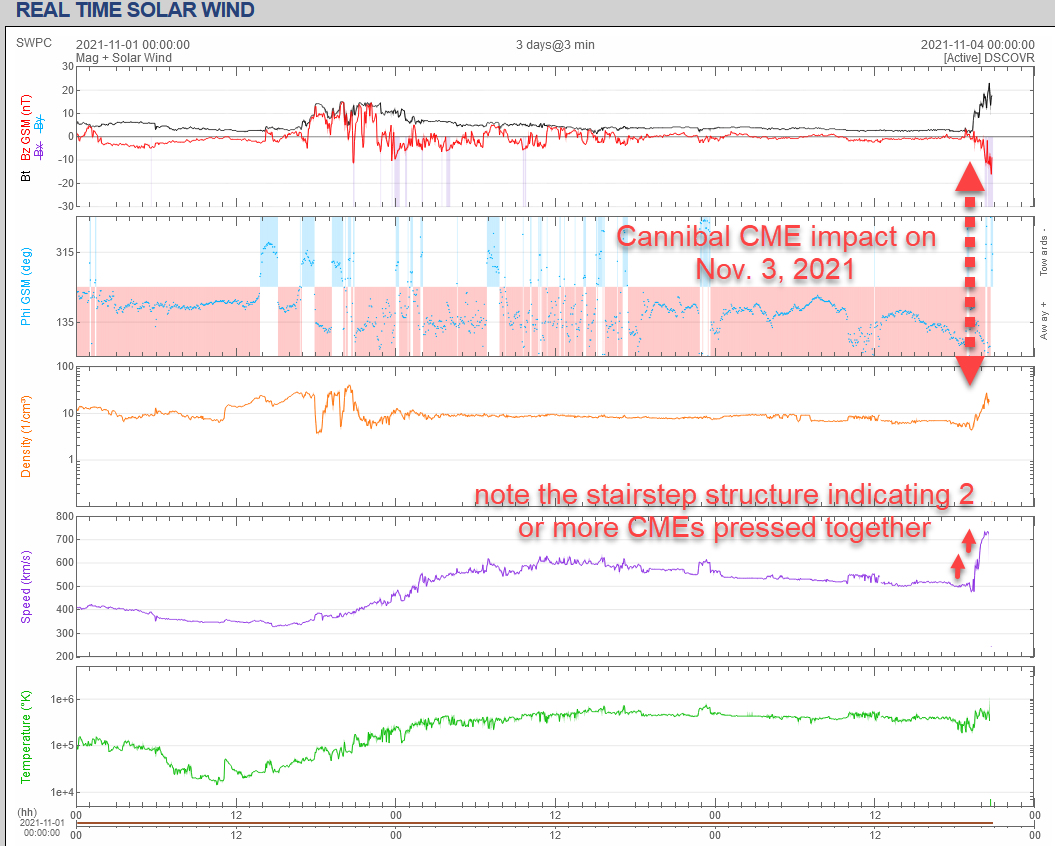
CME IMPACT SPARKS STRONG GEOMAGNETIC STORM: A cannibal CME, described below, hit Earth's magnetic field on Nov. 3rd at approximately 20:00 UT. Solar wind data from the DSCOVR spacecraft show a stairstep structure indicative of two or more CMEs pressed together. A strong G3-class geomagnetic storm is underway now.

The clue to what exactly a cannibal CME is can be found in that line about the DSCOVR spacecraft.  A cannibal CME is the second CME after a first ejection that travels faster than the first and slams into it, enlarging the mass in the ejection.  The resulting mix of CMEs contains tangled magnetic fields and compressed plasmas that can do a good job sparking geomagnetic storms.  The graph they're referring to in that paragraph is this:

Cycle 25 has been off to a faster and stronger start than predicted, and activity is above the predicted levels, which can be seen here

The current (21:00 EDT November 3rd; also called 0100 UTC November 4th) solar-terrestrial indices are Solar Flux Index 94.  A index 21 and K index 7.  The sunspot number is 42.  The A and K indices show that a solar storm is taking place, and it's rated at G3.  That's not a particularly dangerous storm down here on the surface of the planet, although it can affect satellites.  Solar Flares are rated by an alphabetical scale, with the lowest intensity flares rated A1 and the as intensity goes up, they go through A2 to A10 before becoming B1 flares.  The pattern repeats through B, and then C before progressing to M level flares.  Finally, as M is used up, we get to X class flares.  The flare behind this CME was a low M class flare: M1.7. 

These solar flares and mass ejections are not very intense and only people who are playing in the HF radio spectrum (or using it professionally) are likely to notice anything.  The auroral oval hasn't come far south in the country.  Once or twice in a strong solar cycle, a flare might happen that will cause aurora displays as far south as Florida.  To get auroras into the deep south requires X9 flares or stronger and they have to point directly at the planet.  That's a rare combination and I'm aware of only once in my life that auroras were visible into Florida.  

The wild card in that assessment of impact is that Earth's magnetic field is going through some changes.  The magnetic field protects us from some of the energetic particles a mass ejection throws into space.  If the field is weakening, that will affect what gets through.  

The bright spot almost exactly in the middle of the sun is the November 2nd CME that started this.