Friday, November 17, 2023

The Reason Flight Test 2 is so Important

Whether Starship IFT-2 flies on Saturday morning or is held another few days or a week isn't really important.  What's important is that it needs to be a successful test.  The booster needs to burn for the full required time, the hot-staging needs to work, Starship needs to achieve its intended trajectory and it needs to splash down in the Pacific as intended.  

Why?  Simply that for the HLS or Human Landing System version of Starship to work is going to take nearly 20 successful missions and that says launches have to be routine.  

In a presentation at a meeting of the NASA Advisory Council’s human exploration and operations committee Nov. 17, Lakiesha Hawkins, assistant deputy associate administrator in NASA’s Moon to Mars Program Office, said the company will have to perform Starship launches from both its current pad in Texas and one it is constructing at the Kennedy Space Center in order send a lander to the moon for Artemis 3.

SpaceX’s concept of operations for the Starship lunar lander it is developing for the Human Landing System (HLS) program requires multiple launches of the Starship/Super Heavy system. One launch will place a propellant depot into orbit, followed by multiple other launches of tanker versions of Starship, transferring methane and liquid oxygen propellants into the depot. That will be followed by the lander version of Starship, which will rendezvous with the depot and fill its tanks before going to the moon.

Much like Starship itself, there are simulations of what it takes to do the sort of operation this entails but - here's the key point - it has never been done before by anyone.  SpaceX has shown Concept Of Operations documents for the Human Landing System (HLS) program that talk about multiple launches of the Starship/Super Heavy system. One launch will place a propellant depot into orbit.  There have been reports or speculation that was the purpose for Ship 26 which had no thermal tiles or "flings" (control surfaces) - they're not needed if doesn't come back down - but S26 now appears to be obsoleted and in the "rocket garden" at Boca Chica.  Whatever that propellant depot looks like, the launch will require multiple other launches of tanker versions of Starship which transfer methane and liquid oxygen propellants into the depot. That will be followed by the HLS version of Starship, which will rendezvous with the depot and fill its tanks before going to the moon.

Again, while a large number of people can cite concerns about things like fuel evaporation and leakage on orbit, nobody has hard test data they're dropping on NASA.  

Exactly how many launches will be required has been a point of debate since Starship’s selection by NASA for the first HLS award in 2021. Neither NASA nor SpaceX have given firm numbers recently. A paper about the HLS program presented at the 2023 International Astronautical Congress by NASA, for example, mentioned only “a series of reusable tanker Starship variants” that would be launched to fill the depot before the Starship lander is launched, without giving a number.

Assistant deputy associate administrator Hawkins has said, “It’s in the high teens in the number of launches.  In order to be able to meet the schedule that is required, as well as managing boiloff and so forth of the fuel, there’s going to need to be a rapid succession of launches of fuel.” 

For additional perspective, the Government Accountability Office, in its rejection of protests by Blue Origin and Dynetics of the Starship HLS award in 2021, noted that SpaceX required 16 launches overall for a Starship lunar lander mission.  Elon Musk disagreed, calling the need for 16 launches “extremely unlikely” in an August 2021 Twitter (before it was X) post. He said a “max of 8” tanker launches should be needed to fuel the Starship lander, adding it could be as few as four.  

Between four and 20 launches?  They'd better be more like Falcon 9's cadence of one every three days than the seven months between the first flight test and this one.  Seven months delay times 20 launches isn't a nice number.  One month between each of 20 launches isn't that nice, either.

Illustration from the NASA presentation at the 2023 International Astronautical Congress linked above.


Thursday, November 16, 2023

Moving Toward the First Vulcan Centaur Launch

On Monday, the Centaur upper stage for the first flight of United Launch Alliance's Vulcan rocket arrived at Cape Canaveral for integration.   

During a media roundtable on Wednesday afternoon, the chief executive of United Launch Alliance, Tory Bruno, said, “The path to flight one is clear" for Vulcan. The last major piece of hardware for the rocket, the Centaur V upper stage, arrived at Cape Canaveral, Florida, on Monday. All of the qualification testing necessary for the first flight, including for the upper stage, is complete.

In the coming days, Bruno said the Centaur upper stage would be integrated with the Vulcan first stage. Then, the combined vehicle will be rolled to the launch site for a fueling test known as a wet dress rehearsal in December. However, the rocket's main engines, BE-4s provided by Blue Origin, will not be fired. That's because the first stage already completed this hot fire test successfully in June.

Bruno said ULA still had some margin in its schedule leading up to the December 24th launch of the flight they're calling Certification-1.  The launch time is set by the Earth/Moon geometry as No Earlier Than 1:49 am ET on Sunday the 24th.  For half of the country's lower 48 that's still Saturday night, December 23rd.  Bruno went on to say that if the weather is poor, the company also has launch opportunities on December 25 and 26 before the closure of the launch window this year.  The window reopens at the same lunar phases in January for another three days.  

The first stage for flight Certification-1 sits on pad 41 on Cape Canaveral SFS.  Image credit: ULA

Those of you who have been keeping up with the progress of the Vulcan are familiar with the details that Vulcan has been in development for over a decade and was supposed to have flown by 2020.  A large factor in the delay to this point has been the development and delivery of the Blue Origin BE-4 engines.  Going to those engines was primarily because congress mandated that US launch companies were no longer allowed to buy Russian engines.  

The latest delay was caused by the Centaur V upper stage itself when it exploded during a test at the end of March. 

As the delays have mounted, ULA has faced increasing pressure from the US Space Force to begin flying Vulcan, as it is slated to fly about two dozen national security missions in the next five years. Before it can do that, however, Vulcan must complete two certification flights and provide data to the military. The first of these is the Astrobotic flight, and the second mission will launch Sierra Space's Dream Chaser spacecraft. During Wednesday's teleconference, Bruno declined to set a specific target for that flight, mentioning only that it probably will take place during the first half of next year.

Bruno did mention that ULA has booked 70 Vulcan launches, about half military missions and half commercial flights. The primary customer for the commercial launches is Amazon, which is eager to begin putting its Project Kuiper broadband Internet satellites into low-Earth orbit.  To even approach that amount of launches, ULA is focusing on achieving two launches per month by the end of 2025.  This is far more than either half of the ULA alliance, Lockheed Martin or Boeing, has ever launched in their histories. 


Wednesday, November 15, 2023

It's On For Real! - but Not Friday

As hinted at or expected for the last several days, the news broke this afternoon that the Federal Aviation Administration had granted the launch license for Starship Integrated Flight Test 2. SpaceX's "Launches" website shows a two hour launch window opening at 8:00 AM EST (7:00 AM on site or 1300 UTC).  The FAA's TFR (Temporary Flight Restrictions) website shows the launch window ending at 10:39 EST.  This was posted a couple of days ago, and today they posted a TFR for Saturday for the same times.  I have to assume SpaceX knows if they would stretch that launch window from two hours to 2:39. 

Screen capture from SpaceX's launches

The announcement was in the afternoon, EST, and while I didn't see the exact time (I was working in the ham station) by about 4:30 they had begun the process of stacking Ship 25 on Booster 9 and it seemed to go fairly quickly.  It seemed to be stacked by sundown in Boca Chica, so on the order of one to 1-1/2 hours.   

This test is a big deal; not just for SpaceX but for the entire space industry.  Last words to Stephen Clark at Ars Technica:

SpaceX's Starship rocket is a central element for NASA's Artemis program, which aims to return astronauts to the Moon later this decade. NASA has contracts worth more than $4 billion to use a human-rated deep space derivative of the Starship upper stage for crew landings at the Moon's south pole. There's a lot to do before Starship can do this, including in-orbit fuel transfers and the development of life support systems.

US military leaders have also expressed interest in Starship's ability to haul more than 100 tons of payload into orbit, significantly more lift capacity than any other rocket. SpaceX officials told Ars last month the FAA should be encouraged to prioritize missions of national importance.

But the first step is demonstrating Starship can reliably fly to space. That's what SpaceX will attempt to do Friday.

I would have phrased that slightly differently; that's what SpaceX will begin to attempt to do Friday.  It takes more than one good flight to demonstrate flying reliably. 

EDITED Thursday Nov. 16, 5:00 PM ET:  During testing a problem was discovered that required destacking Ship 25 for repairs.  Launch is set for Saturday the 18th, same time (7:00 AM CST)  the post title was also edited.


Tuesday, November 14, 2023

Is the Sale of United Launch Alliance Imminent?

Ultimately a sale isn't imminent because regardless of the management's decisions the sale has to be approved by the Federal Trade Commission and the Department of Justice, which will probably introduce glacial delays, but Eric Berger at Ars Technica has a piece up today that says two sources have told him Boeing and Lockheed Martin are "close to selecting a buyer for United Launch Alliance."  

The jointly owned rocket company, which was founded in 2006 and for a time had a monopoly on US government launch contracts, has been up for sale most of this year.

The sources say three buyers have emerged for the Colorado-based launch company. These include a private equity fund, the Jeff Bezos-owned space company Blue Origin, and a well-capitalized aerospace firm that is interested in increasing its space portfolio.

The possibility of it being a private equity firm isn't surprising, nor is it unprecedented.  The term "private equity" firm doesn't necessarily mean a Black Rock or other big name like that, although Ars doesn't mention the name of the firm.  Typically, they buy the company, help finance the launch company's restructuring, and then resell it.  

The surprise, if there is one, is that Blue Origin is among the three possible buyers. Berger looks at it a bit differently than I do because of having been more closely plugged into the right sources.

Blue Origin is also not a great surprise. The space company owned by Jeff Bezos has been rumored to be among the potential buyers for a while. Although there is some overlap between their launch plans, acquiring United Launch Alliance would give Bezos an orbital rocket and the guaranteed government contracts he covets. It would also benefit Amazon's need to launch its Project Kuiper satellites.

Ars is not naming the third company saying they were unable to verify the information from the inside sources.  ULA themselves deferred any questions about this to the two companies that own the joint venture, Lockheed and Boeing.  Who steadfastly refused to say anything.  

The ULA merger was formed by pushing from US security agencies in 2006, and that was to ensure a steady supply of Delta and Atlas launch vehicles for government payloads.  With guaranteed military launch contracts and large annual subsidies from the US Department of Defense to maintain "launch readiness," essentially subsidies for being there, they've always been a profit maker for both halves of the Alliance.

If any company is the embodiment of "old space" or "Space 1.0," though, it's ULA.  And as anyone who watches the shear number of launches climbing steadily over the last few years will tell you. Space 2.0 is on the verge of "eating their lunch."

In recent years, ULA's launch dominance has first been challenged and then supplanted by the rise of SpaceX and its less expensive and highly reliable Falcon 9 rocket. Bruno, who became ULA's chief executive in 2016, has slashed employee headcount and taken other steps to control costs, such as closing infrequently used launch pads.

However, Bruno's most important initiative has been the development of the large Vulcan rocket, which is intended to be more cost-competitive with the Falcon 9 and Falcon Heavy vehicles while also ending ULA's dependence on Russian-made rocket engines. The Vulcan launcher uses the BE-4 rocket engine manufactured by Blue Origin.

Their approach to reusability echoes the European Space Agencies in essentially saying "why spend that much money to develop a reusable booster?" Instead, they've talked about ejecting the engines out of a booster and recovering those - they're the most expensive part of the booster, after all.  

They think they can recover the engines using their “SMART (Sensible Modular, Autonomous Return Technology) Reuse” approach and get 2/3 of the benefit of landing the booster for much less developmental budget.

Of course, they're not going to do that now.  That's in a few years, after Vulcan is flying reliably and they get around to trying to get engine recovery to work.

Vulcan rolling into the launch complex for testing earlier this year.  Image credit: United Launch Alliance.

As we've talked about a few times, the first launch of Vulcan Centaur is currently set for NET Christmas Eve, now just under six weeks out.  Speculation is that if they agree to a sale, it probably doesn't have to wait until after that flight for ULA to announce it, although such an announcement would put a nice exclamation point on a successful flight.


Monday, November 13, 2023

Why the Cartoon Names for a Serious Mission?

I was reading an otherwise serious story about nuclear power in space missions and was struck by a couple of odd things.  Otherwise serious missions with cartoon names.  

Let me start at the beginning.  The story is that the US Air Force Research Lab has awarded defense contractor Lockheed Martin a $33.7 million contract to develop a space qualified nuclear power source.  More specifically, this is to be part of the Joint Emergent Technology Supplying On-Orbit Nuclear (JETSON) effort to "mature high-power nuclear electric power and propulsion technologies and spacecraft design."

Wait.  JETSON?  As in George Jetson?  OK...

JETSON aims to launch a fission reactor that will be started up once in space. The reactor will generate heat, which is then transferred to Stirling power converters to produce electricity. This can then be used to power spacecraft payloads or electric thrusters for propulsion.

Using a reactor to generate heat... to run Stirling engines, er, power converters to produce electricity?  That sounds like that program called KRUSTY (Kilopower Reactor Using Stirling Technology) that we talked about five years ago?  As in Krusty the Clown?   

Despite the cartoon names, this is a real mission with a serious looking "artist's concept" rendering.

Los Alamos National Laboratory's concept of a space nuclear reactor system to produce high-power electricity. (Image credit: LANL) 

"Nuclear fission development for space applications is key to introducing technologies that could dramatically change how we move and explore in the vastness of space," Barry Miles, JETSON program manager and principal investigator at Lockheed Martin, said in a statement.

"From high-power electrical subsystem and electric propulsion to nuclear thermal propulsion or fission surface power, Lockheed Martin is focused on developing these systems with our important government agencies and industry partners," Miles added.

Lockheed will work with Space Nuclear Power Corp (SpaceNukes) and BWX Technologies, Inc. (BWXT), both of which have expertise in nuclear power and reactor design.  The contract is to get from the preliminary design review (PDR) stage, with the option to go to critical design review (CDR) level.  The source article doesn't describe how this will proceed. 

This contract was apparently part of a trio announced back on September 29 but is just now getting talked about in sources I reference daily.  The three contracts were related to JETSON.  Intuitive Machines received a $9.4 million contract to design a spacecraft concept utilizing a compact radioisotope power system - and yes, that's the same Intuitive Machines that is preparing to launch their lunar lander mission NET January 12.  The other contract was to Westinghouse Government Services, based in South Carolina, to continue research into utilizing high-power nuclear fission systems in spacecraft. 

You might recall Lockheed Martin receiving a contract back in July that's along a similar direction, to build and develop a nuclear thermal rocket (NTR) engine.  

Lockheed Martin and BWX technologies under DARPA’s DRACO (the Demonstration Rocket for Agile Cislunar Operations) program and in partnership with NASA will build the nuclear thermal rocket. NASA and DARPA are committing up to $499 million towards this program.

To editorialize just a little: it's about time.  The future is undoubtedly nuclear and totally different propulsion from the chemical explosions we use now.  As I said back in 2011, go outside on a clear, dark night.  Wait until your eyes are used to the dark and look up.  Everything you see that is shining by its own light is nuclear powered.  Everything you see shining in reflected sunlight (the moon, the planets), all of that is lit by nuclear power.  Now look toward your house or a nearby city.  Everything you see is lit by chemical bonds being broken and re-established.  As someone put it, "everything God powers is nuclear; everything man powers is fire."  Pretty much true.


Sunday, November 12, 2023

The Ham Radio Series 40 - Ham Radio in the Information Age

If you're one of the many who think of ham radio only in terms of communications after a SHTF event, you can skip this.  It has to do with features that aren't likely to be available in those days, but is more for people who "play on the radio" now, to varying degrees.

"Playing" maybe not in the sense of chatting on the local VHF/UHF repeaters on the way to and from work, but more for people who pursue the Summits On The Air (SOTA) or the Parks On The Air (POTA), two of the more active and more popular special event or special operation activities around today.  Or maybe folks operating QRP (low power) or perhaps chasing some operating achievement, like Worked All States (WAS) or the thousands of other pieces of "Wallpaper" one can strive for.  

Among the most popular pieces of wallpaper that people pursue is one from the American Radio Relay League, called the DX Century Club, and the first level of that award is for proof of successful two way contact with 100 of the league's recognized countries.  One of my first few posts in the blog history was about getting one of those pieces of wallpaper that I called my Lifetime Achievement Award in ham radio, proof of contact with (always referred to as "working") at least 100 recognized countries on five ham radio bands - what's called 5BDXCC.  Now, 13 years later, I've added another three bands up to 8BDXCC and I'm more than halfway to my ninth band. 

When you're striving for these awards for a certain number of confirmed contacts, whether SOTA, POTA, WAS, or whatever, you need to be aware of who's on the air and which entities you need.  A classic information problem.  Back in the second half of the 1970s when I was getting started, sometimes a group of guys would put up a 2m repeater and tell each other what they were hearing.  Broadcasting wouldn't be legal, so they wouldn't (usually!) say "Hey everybody, I hear Albania on 7.020 MHz CW, listening up 2;" they'd call each other and act like they were just keeping in touch.  More like, "W4ABC this is W4CDE.  I hear ZA1TTM on 7.020.  Do you hear him?" 

This was before home computers existed, well, maybe in the very earliest days of them, so no BBSes and decades before the Internet.  Now with the vast majority of us carrying a computer with us that would have been unimaginably powerful in the late '70s, it's natural to use them to our advantage.  The old standby that "the three most important things are to listen, listen and listen" is still there, but what if you didn't have do all that listening with your butt in your chair in front of the radio?  What if you could be notified that someone near you was hearing the station you'd like to work without actually having them call you on the phone, but send an alert to your phone?  Or what if you could pipe audio from your receiver to another place in the house?  That way, your butt only needs to be in that chair when you're trying to work that station. To take it a logical step farther, let's say you're trying for some particular state or other identifier that only happens rarely or that you've never heard.  You could turn the radio on but you could just be notified while you're doing some other thing that needs to be done.  Minimize your BIC (Butt In Chair) time in front of the radio.

Let me give an example that happened to me in the last week.  There's an application (also available as a website) called HamAlert.  Totally free to use.  HamAlert allows you to set various triggers that define when the program will send you a notice.  You can set it up to send a text message to your phone or the app itself on your phone.  The latest wallpaper I'm working toward is centered on the six meter ham band and the only trigger I've defined is for the last two states I need for WAS, Alaska and Hawaii.  The way the alert works is their software combs many of websites where this sort of contact gets reported, and you tell it what condition you want to be notified of when it happens.  In my case, I chose to be notified if anyone in Florida reports hearing either state. 

Screen capture of my only working trigger.

A week ago, while reading the Sunday comics online, I heard an unusual tone from my phone and when I looked down, I saw a report from HamAlert about a guy in Miami hearing Hawaii.  I don't have the specifics on the guy who reported it, but Miami is around 175 miles south of me.  It seemed unlikely I'd be able to hear the Hawaiian but I went back to the radio, turned it on and there he was.  He was using FT8 mode, which I use regularly, and while he wasn't the only station I heard on the band, there might have been two or three other stations I could hear, all in Florida.  I got the Hawaiian on my second or third call.  Today, I found that he confirmed by ARRL's online QSL method LOTW (Logbook Of The World).  I had sent him a paper card and Self Addressed Stamped Envelope last week. 

In my roughly 20 years playing on 6m, I've never even heard Hawaii, and I wouldn't have gone into the shack without that alert.  This is a multifaceted topic and far too much for a single blog post, so I plan to do "the next few" posts on quiet days on this subject.  I'm not extremely far down this road myself; I've done more in the last two months than before. 


Saturday, November 11, 2023

Looks Like It's On

Looks like it's on like Donkey Kong for next Friday - as of the latest, best guess. 

Screen capture from Next Spaceflight.

I'm not going to swear up and down that this is going to happen; 24 hours ago the date was Wednesday the 15th, so things can and will move that around.  In particular, a web search to determine if the Fish and Wildlife Service has completed their environmental review doesn't turn up any reports that they have, while some reports say that they haven't.  Which means SpaceX is still waiting for their launch license.  In fact, they destacked the B9S25 combination today.  It's true that the ship can be restacked quickly if need be, but yesterday virtually everyone was thinking they're done with preps and we won't see them unstacked again. 

And now for something completely different

Just because the oddity caught my eye, there were two stories on Space.com in the part of the site dedicated to observing. 

First was that there's a newly discovered comet reaching peak brightness (Nov. 10 - it's just a question of how slowly it dims).  The comet, C/2023 H2 (or Comet Lemmon), is in the summer constellation of Hercules but peak brightness isn't going to knock your socks off.  Hercules is low in the western sky around sundown, depending on where you are, of course.

According to In the Sky from New York City, comet C/2023 H2 (Lemmon) will become visible at around 5:49 p.m. EST (2249 GMT). At this time, the comet will be 50 degrees over the horizon to the west as the sky darkens (the width of your fist at arm's length equals about ten degrees). After this, comet C/2023 H2 (Lemmon) will remain visible until around 10:29 p.m. EST (0339 GMT on Nov. 11), when it sinks to the horizon. 

While at peak brightness, the comet will shine at roughly magnitude 5.5.  The term "naked eye" is used for objects brighter than magnitude 6.0, but 6.0 isn't visible unless you have a rather dark sky.  Which means you're observing miles from the nearest city.  At least an hour away.

The second story was about the tool bag that NASA Astronauts Jasmin Moghbeli and Loral O'Hara lost during their spacewalk back on November 2nd.  The tool bag is orbiting the Earth, passing overhead a little in front of the ISS and should be visible if you look for it.  Sources say it's about one minute ahead of the ISS and that time will stretch out as the atmosphere starts to reduce its altitude.

The tool bag is now orbiting our planet just ahead of the ISS with a visual magnitude of around 6, according to EarthSky.

That makes the tool bag more likely to be a binocular object than naked eye, and binoculars will be needed pretty much anywhere that isn't rural dark sky.  

The strategy is to observe the trajectory of the ISS, and to scan the sky in the area just ahead of the space station.

As the small object gradually loses height, it should appear between two and four minutes ahead of the ISS during the next few days.

What's the connection?  Why did I notice?  Both the comet and the tool bag are virtually the same brightness.  Both will require binoculars unless you're in really dark skies.  One is totally natural while the other is man-made - and woman-dropped.  

Yes, I went there.  Didn't everybody go there 10 days ago when they lost it?  EarthSky points out this isn't the first time a tool bag has been Lost In Space.  That time was a woman as well.  

And this isn’t the first time a NASA astronaut has lost a tool bag. On November 18, 2008, astronaut Heide Stefanyshyn-Piper was performing a similar repair at the International Space Station when she inadvertently lost a tool bag.

Which isn't to say that guys don't drop tools and lose them overboard.  I'd just guess that all I ever read about guys losing is 10mm wrenches or sockets so since it wasn't a guy, the bag probably include one of those.


Friday, November 10, 2023

FAA: You Want Launch Licenses Faster? Pay Our Expenses

In mid-October, starting on the 18th, a series of meetings began between the FAA and the space launch industry because the launch industry maintains that the FAA isn't getting their job done.  This week, one of the top officials at the Department of Transportation suggested that the space industry should help pay for the Federal Aviation Administration’s commercial space office.

Speaking at a virtual meeting of the FAA’s Commercial Space Transportation Advisory Committee (COMSTAC) Nov. 8, Polly Trottenberg, deputy secretary of transportation, all but rejected calls from industry to sharply increase the budget of the FAA’s Office of Commercial Space Transportation, or AST, to deal with growing levels of launch activity. 

At the October 18th hearing, the industry experts testifying in the Senate Commerce Committee's meeting recommended a significant budget increase for the FAA’s Office of Commercial Space Transportation, or AST,  Bill Gerstenmaier of SpaceX, specifically recommended doubling the office’s budget to hire more people to handle launch and reentry licensing.  In FY '23, the AST office received nearly $37.6 million in funding.  

Deputy Secretary Trottenberg, when asked about increasing AST's budget said the agency has "competing priorities" and noted aviation did not receive as much support in last year’s Bipartisan Infrastructure Law as other modes of transportation.  

She proposed that it may be time for industry to contribute some portion of additional revenues needed for enhancing AST. “We’re an agency that has the ability to generate revenue and I think that’s going to be a question for this industry,” she said, adding that she was offering her own opinion and not that of the department itself.

While the FAA does generate revenue from user fees for aviation, it has not generally collected any such fees for launch licensing. She returned to it later in the meeting when another COMSTAC member noted the relatively small size of the AST budget relative to the overall FAA budget. The FAA requested $19.8 billion for fiscal year 2024, of which $42 million would go to AST.

Say what?  $42 million out of $19.8 Billion? That's 0.2%  Isn't that a rounding error?  A mistake in estimating costs?  I know that the various offices, like AST, in the FAA will be fighting over their pennies, but it just seems that if the AST is 0.2% of the budget of the FAA, doubling the AST to 0.4% of the $19.8 billion isn't going to take too much from any one other office or department or whatever they're called.  

To be blunt, in my experience in industry if expenses on a job came out to be off by 0.2% over a year, the manager would be legendary and talked about for years.

I don't believe that any part of the Fed.gov is so tightly managed that they'd even know a 0.2% change was going on.  The FAA sees a way to milk the industry for money.  That's all.  It's no different than that guy from ESA referring to "Rocket-by-billionaire."  In the FAA's case it's "if they want us to be responsive, they can grease our palms."  Do your best Goodfellas mafia-guy voice, "what's it worth to you?"

Falcon 9 launch from Cape Canaveral SFS the night of October 17, 2023, the night before the meeting addressing launch licensing.  SpaceX photo.


Thursday, November 9, 2023

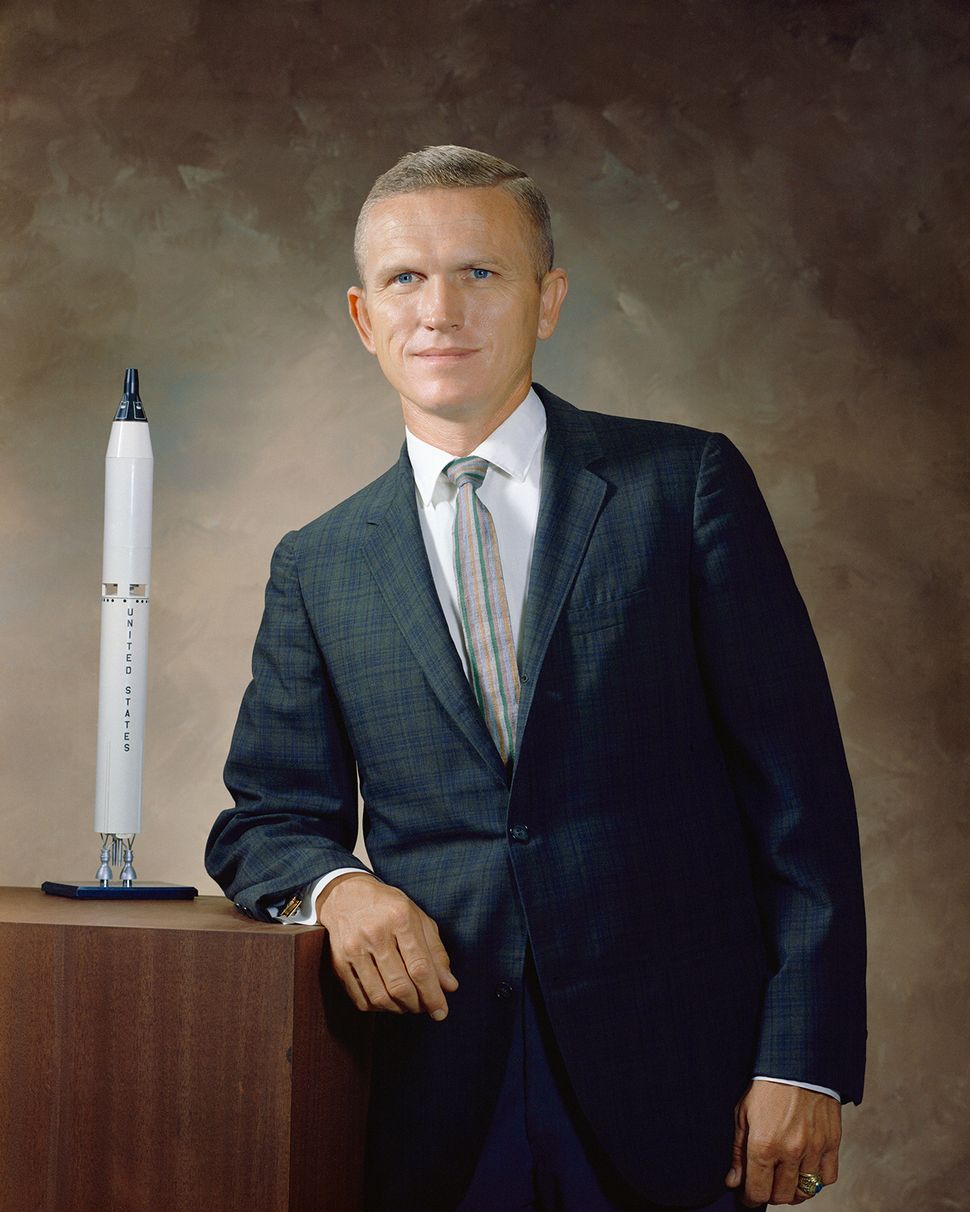
Frank Borman, Apollo 8 Commander Led First Lunar Flyby Dies at 95

Collect Space reports today the Apollo 8 mission commander Frank Borman passed away Tuesday, November 7th at home in Billings, Montana.  His wife of 70 years, Susan, preceded him in 2021. 

If you're of a certain age group, and were not just alive during these missions but rabidly following them, you just might be feeling a little bit of a gut punch.  Apollo 8 was one of the defining moments of the era, the first human flyby of the the moon. Much like Apollo 11, and that other event 60 years ago this month, the assassination of President Kennedy, it's one of a handful of things I'll remember all my life; where I was, what I was doing.

A look through this blog's history looks like I've written about Apollo 8 every year, pretty much only on Christmas Eve.  Christmas Eve was the day they orbited the moon, the day that the crew spoke to us of the "stark and unappetizing" look of the lunar surface and read from the book of Genesis, the first book in the Christian bible.  Here on Earth, 1968 had been a tumultuous year. There had been riots in many places, assassinations and troubles all around the globe. On Christmas eve, in awe of what these men were doing, it seemed like the world held its breath and watched.  Like Apollo 11, seven months later, it seemed to uniquely unite the world and hold everyone's attention. 

Collect Space expands the story into a biography of Frank Borman, as is appropriate. As usual, I present a little of it to whet your appetite to go Read The Whole Thing. 

Launched on Dec. 21, 1968, Borman, Jim Lovell and Bill Anders became the first astronauts to ride atop the Saturn V, which at the time was the United States' most powerful rocket. The booster's third stage accelerated the Apollo 8 crew from 17,000 to 24,000 miles per hour (27,000 to 39,000 kph), the fastest any astronauts had traveled up to that point in history.

"The Saturn V was a unique vehicle," said Borman in a 1999 NASA oral history interview. "It was powerful and noisy and vibrated, and the stagings were really kind of violent. But when you got on the third stage, the S-IVB, it was smooth and quiet."

Borman and his two crewmates arrived at the moon three days after leaving Earth. Apollo 8 entered an elliptical orbit that brought the crew as close as 115 miles (185 kilometers) of the lunar surface. On the first of their 10 revolutions, Borman, Lovell and Anders became the first people to see firsthand the far side of the moon and then, while coming out from behind the moon for the fourth time, the first to see in-person "Earthrise."

The famous Earthrise photo from Apollo 8 in 1968, something no one in the world had ever seen. 

Of course, Apollo 8 wasn't Frank Borman's first mission nor was it the first noteworthy thing he had ever accomplished.  

Borman's first spaceflight, which launched three years before Apollo 8, paired him with Lovell, who was also making his first trip into space. The Gemini 7 mission was designed to test and discover the difficulties with keeping a crew in space for as long as the Apollo landing missions were expected to extend.

For two weeks, Borman and Lovell lived together in the cramped confines of their two-seat capsule. The pair evaluated freeze-dried food options, collected medical data on each other and were the first NASA astronauts to doff their pressure suits in-flight, as later Apollo crews would on the way to and from the moon.

James Lovell would fly with Borman again on Apollo 8 - along with William Anders.  

Borman was offered the command of Apollo 11. He turned it down, having already decided that Apollo 8 was going to be his last flight.  In June of 1970, he retired from NASA and after completing Harvard Business School's advanced management program, he joined Eastern Air Lines as its senior vice president for operations. In May 1975, Borman was elected president and chief operating officer of the company.  In December of '75, he became CEO, became chairman of the board one year later, and stayed there for another 10 years.

Whenever I read stories of the NASA astronauts of that era, I think these were all remarkable giants of men.  Rest well, Colonel Borman.  Thanks for everything.

Frank Borman poses for a portrait with a model of the Gemini-Titan II launch vehicle in 1964. (Image credit: NASA)


Wednesday, November 8, 2023

Why Do So Many Stories Center on SpaceX?

Could it be they're doing far more than everyone else? 

Next CRS mission Go for Thursday night launch 

If you're within a couple of hundred miles of the Kennedy Space Center, cargo resupply mission CRS-29 (CRS stands for "Commercial Resupply Services") is set to liftoff Thursday night from launch complex 39A at the KSC.  The date/time is November 9th at 8:28 PM ET or Friday morning the 10th at 0128 UTC.  Weather is forecast to be excellent over the East Central Florida, with temperature at launch site of 74, winds ESE at 5 mph and a 5% chance of rain.  Melody Lovin, launch weather officer with Cape Canaveral Space Force Station's 45th Weather Squadron, said chances of acceptable weather are 95%.  My guess is that the mission will take off to the SE so should be visible from central and south Florida.

The Cargo Dragon will carry up more than 6,500 pounds of supplies and scientific hardware on this run, stay docked to the International Space Station for about a month, and then come back to Earth with about 3,800 pounds of cargo.  

Dragon is the only cargo vehicle with this return capability. The other two robotic freighters that are operational today — Northop Grumman's Cygnus craft and Russia's Progress vehicle — are designed to burn up in Earth's atmosphere when their orbital missions are over.

This is the second mission for both the Falcon 9 booster and the Cargo Dragon capsule.  The booster's first mission was the Crew 7 mission to the ISS.  Landing will be Return to Launch Site, landing at LZ-1.  The Cargo Dragon previously flew CRS-26 to the space station. 

The Air Force Spaceplane X-37B will ride a Falcon Heavy to orbit.

The launch is scheduled a month away, NET December 7th, so there's a bit of a wait for it, and no launch time is set - rather common for missions a month away.  The spaceplane is operated by the Air Force Rapid Capabilities Office and the U.S. Space Force. The upcoming mission will be Orbital Test Vehicle 7 and the mission is launching as USSF-52. 

This will be the first time SpaceX will launch the spaceplane.  Until now, the launches have been on Atlas V launch vehicles.  SpaceX was awarded the $130 million contract in June 2018 to launch USSF-52, but as has been the case with so many Falcon Heavy missions, was delayed by payload availability.  

The X-37B spaceplane is a derivative of the X-37A designed by NASA in the late 1990s to deploy from the Space Shuttle. The program later was transferred to the Defense Department. There are two X-37B spacecraft, which were originally designed for missions of 270 days, but have greatly exceeded that goal since the spaceplane’s first mission in 2010.

Starship Integrated Flight Test 2 Appears to be Imminent

The long awaited second Starship flight test appears to be imminent, possibly as early as next Monday, November 13.  The FAA signed off on the safety review of April's IFT1 on Halloween, October 31st leaving the ball solely in the US Fish and Wildlife Service's hands.  While they have a lot of time to complete the study, insider rumors are saying that could be completed as soon as this Friday.   

Once that review is complete, which could happen this week, SpaceX will receive its FAA launch license. Technicians will install pyrotechnic charges on the Starship rocket to complete the arming of its flight termination system, the destruct mechanism needed to blow up the vehicle if it veers off course.

Then SpaceX will stack the Starship upper stage on top of the Super Heavy booster to create the fully formed, nearly 400-foot-tall (120-meter) launch vehicle, the largest rocket ever built. On launch morning, SpaceX teams will load more than 10 million pounds of methane and liquid oxygen into the two-stage rocket.

There are numerous changes to the ground infrastructure ("stage zero") as well as the vehicle, but it seems nothing draws as much attention as the introduction of "hot staging" in Starship.  Stephen Clark at Ars Technica goes so far as to say "If the next Starship makes it through staging, you can call that a win."  Personally, considering that SpaceX has been several steps ahead of the regulatory agencies since April, I think they need to make orbit and complete the "one and done" planned orbit.  That was nearly seven months ago!  Starship and Superheavy are extremely important to NASA and the Artemis lunar missions.  Another failure, especially if it's early in the flight bringing another seven months of delays, could very well kill off or at least severely wound NASA's lunar landing plans.  

Booster 9 and Ship 25, stacked recently.  Thanks to the new interstage ring for the hot staging, the vehicle is "a few" feet taller than the IFT1 stack.  Image credit: SpaceX


Tuesday, November 7, 2023

Has the European Space Agency Seen the Reality of Space 2.0?

At a meeting Monday, 22 European countries reached an agreement to change the way they operate.  Rockets will not be developed by the ESA itself, but they will move in the direction of a commercial paradigm, much as NASA and the private sector space companies have revolutionized how it's being done in the US. 

The agreement means the new Ariane 6 rocket, which is running four years late and still hasn't flown, should be the last launch vehicle developed by ESA. Europe's old way of developing rockets just isn't working anymore. The current model, Aschbacher said, has been in place for decades, producing new generations of Ariane rockets since 1979.
...
Josef Aschbacher, a scientist who took over as director general of ESA in 2021, has argued that Europe is in an "acute launcher crisis" now that the continent lacks independent launch capability for most of its space missions.

Does he mean like how the ESA hired SpaceX to put a couple of their Galileo navigation satellites up since they don't have a working vehicle?  

Sorry, ESA, that was harsh.  The truth is more nuanced than that.  We've covered Europe's fledgling launch industry before, and they're progressing, ignoring the ESA.  For example, Norway opened their Andøya spaceport in the arctic this past week.  

The field of startup launch companies in Europe includes German firms like HyImpulse, Rocket Factory Augsburg, and Isar Aerospace; British companies such as Skyrora and Orbex; and Spain's PLD Space, which recently test-launched its first suborbital test vehicle. ArianeGroup has its own small launch startup called MaiaSpace in France, and the Italian company has plans to evolve its already-flying Vega launch vehicle. All these companies, and others across Europe, would be eligible for ESA's new launch challenge.

Andøya Spaceport's Launch Pad A, built to specifications from Germany's Isar Aerospace, and dedicated to their use. The launch complex includes the launch pad, payload integration facilities and a mission control center. Credit: Andøya Spaceport

Isar Aerospace, for example, is working on their two-stage Spectrum launch vehicle, designed to deliver up to 700 kilograms to sun-synchronous orbit (SSO) and up to one metric ton (1,000 kg) to low Earth orbit. It seems reasonable to project a first launch of the Spectrum in early 2025.

There are other European spaceports in the works and one other that has officially opened - Sweden's Esrange Spaceport - but has not hosted any missions. 

A graphic of the various rockets in process by EU companies, from the website European Spaceflight in July of '22. 

While I see this as positive step, we have to recognize that this doesn't get them out of the hole of having no launch capability.  It will be some time, more likely measured in years than months before the small companies create a way to space; realistically they either get the Ariane 6 flying or they have nothing.

The Ariane 6 rocket is more expensive than officials thought when they greenlit the program in 2014. The Ariane 6 will come closer than the recently retired Ariane 5 launcher to matching SpaceX's Falcon 9 rocket on cost, but Europe runs the risk of falling even further behind as SpaceX brings its next-generation Starship rocket online.

Nevertheless, after nearly a decade of work, ESA, the European Union, and commercial customers—primarily Amazon—need the Ariane 6 soon to launch dozens of missions already on contract. It's a widely held view among many European officials that it is imperative to have a sovereign launch capability.

One of the things I read about the ESA's reaction to reusability that got etched into my brain was that they laughed at it and openly said their reason to be there was make-work programs.  

Truthfully, if Europe ever did develop a reusable rocket, one that could fly all the missions in a year, this would be unhelpful politically. What would the engine and booster factories sprinkled across Europe do if they built one rocket and then had 11 months off? The member states value the jobs too much. This is one difference between rocket-by-government and rocket-by-billionaire programs. [Bold added - SiG]

Rocket-by-billionaire?  Is that Musk Derangement Syndrome?  Bezos Derangement Synderome?  Or just plain "projection?"

The old article is an interesting read, if nothing else for the arrogance displayed by the ESA folks like that last quote. It seems they've learned a lesson here.  Reusability changes everything. 


Monday, November 6, 2023

Tuesday is Prime Time for Euclid

Tuesday morning Eastern Time, we get to see through the European space telescope Euclid's "eyes" for the first time.

Euclid mission scientists are gathering in Darmstadt, Germany, to discuss the telescope's first five full-color images of the distant cosmos, and you can watch Tuesday's reveal live at 8:15 a.m. EST (1315 GMT) here on Space.com, courtesy of ESA. In addition to holding scientific value, the images are also expected to be great cosmic eye candy.

Euclid launched on July 1st at 11:11 AM EDT, enroute to the L2 Lagrange point nearly a million miles from Earth and coincidentally the home of NASA's (much) larger James Webb Space Telescope. Euclid teased us with its first alignment and commissioning test images one month later, and then caused at least a little concern just over one month after that when the satellite temporarily lost track of its guide stars.  Every indication is that the telescope is working fine and ready to download some fine examples of eye candy. 

Two images taken by Euclid's instruments from that August image release. The left was taken by VIS, the VIsible light Sensor and the right by NISP,  the Near-Infrared Spectrometer and Photometer.  (Image credit: ESA/Euclid/Euclid Consortium/NASA) 

Euclid has been tasked with building an innovative 3D map of the dark universe by charting out shapes and distributions of billions of galaxies and star clusters up to 10 billion light-years away, primarily in search of clues about elusive dark matter and dark energy.

To achieve that goal, the telescope is primed to take enough sharp images of large swaths of the sky in visible and infrared wavelengths to fill a million DVDs. To investigate the dark universe, Euclid will observe weak gravitational lensing, a cosmic phenomena which occurs due to the chance alignment of galaxies or conglomerations of matter, which allows foreground galaxies to behave like a giant magnifying lens of objects behind them. Light from background sources is distorted, even multiplied on its way to Earth, such that we see their twisted, surreal illusions around lensing galaxies.

Since visible matter comprises just 10% or so of the total mass of most galaxy clusters, scientists suspect invisible dark matter particles are responsible for much of this lensing. So, studying galaxy clusters could shed light on the behavior and nature of dark matter — but those images need to be super-sharp to bring fuzzy lensed images around galaxies into focus.

Bear in mind that while that last paragraph sums up the conventional view of dark matter and dark energy, "just across the way" out at L2, the JWST is sending down images that are calling several details in the conventional model into question. That's a good thing because it means we're learning.

EDIT TO ADD, Nov. 7, 2023:  The link to Space.com has no video of the Euclid presentation.  Currently the ESA is streaming, ready to go live, HERE.


Sunday, November 5, 2023

Are Tractor Beams on the verge of becoming real?

They keep saying these two words, but I don't think those words mean what they think they mean.  A messy sentence if ever there was one, but the phrase the authors keep tossing around is a "Tractor Beam" and the article is about real work being done in universities to develop one.  

Everyone who has watched sci-fi movies or TV shows is probably familiar with the term tractor beam.  They are energy beams that one ship uses to hold onto another ship and keep it from doing what the second ship's crew wants it to do.  Like here, where a Borg cube ship holds the Enterprise (from Star Trek:TNG) and keeps it from fleeing - or keeps it from doing what Captain Picard wants. 


There have been scenes in these shows where one ship tows another, as if connected by physical ropes and chains.  Same idea. 

Instead what the researchers are working on developing is an electrostatic field generator.  Their goal is to use this electrostatic field to pull (or push) satellites out of the Geostationary Orbit when they reach End of Life.  Space junk and getting rid of it is becoming a big name field, with the Senate recently working on bills telling NASA to manage it better. 

What's the difference?  Well, the tractor beam imagined in the picture above, holds the Enterprise motionless.  If the Enterprise tries to leave, the force gets stronger to keep it from leaving.  I've seen shows use a tractor beam as some sort of landing assistance to get a ship into a large space station or other dock. 

The system I see described is going to impart a charge on the satellite and on itself; if those charges are opposite (which they will be unless they have some fancy tricks) they will be attracted to each other.  If the charges are the same, they'll repel each other.  Slowly, barely perceptibly at first, but accelerating with time, unless those charges are bled off to reduce the attraction.  Further, they aren't going to do this with one satellite in low Earth orbit and the other in the GEO, the satellites will be close to each other.  

The electrostatic tractor would use a servicer spacecraft equipped with an electron gun that would fire negatively charged electrons at a dead target satellite, Champion told Live Science. The electrons would give the target a negative charge while leaving the servicer with a positive charge. The electrostatic attraction between the two would keep them locked together despite being separated by 65 to 100 feet (20 to 30 meters) of empty space, she said.

Once the servicer and target are "stuck together," the servicer would be able to pull the target out of orbit without touching it. Ideally, the defunct satellite would be pulled into a "graveyard orbit" more distant from Earth, where it could safely drift forever, Champion said. 

The person referred to by the name Champion is project researcher Kaylee Champion, a doctoral student in the Department of Aerospace Engineering Sciences at the University of Colorado Boulder (CU Boulder).

I can't get past some gigantic holes I see in what they're saying.  Maybe they think they're keeping their ideas confidential, but I don't see how they keep the target satellite from closing the distance to the servicer.  They go on to say that the field would have to be weak and work over long periods of time, but eventually, there's nothing to stop the target from hitting the servicer.  This is zero gravity and zero friction, after all, and there's nothing to slow or stop that target once it's moving. If they suddenly reduced the charge differential between the two, the target may stop accelerating, but it doesn't slow or stop moving unless they change it to being repelled.  Perhaps they need to modulate the charge periodically back and forth between attraction and repulsion?  

The electrostatic attraction between the two spacecraft would be extremely weak, due to limitations in electron gun technology and the distance by which the two would need to be separated to prevent collisions, project researcher Julian Hammerl, a doctoral student at CU Boulder, told Live Science. So the servicer would have to move very slowly, and it could take more than a month to fully move a single satellite out of GEO, he added.


Saturday, November 4, 2023

All Hail B1058!

Did you happen to hear about the Chinese rocket company that flew a test of booster that can land last week?  My YouTube feed suddenly erupted in stories that this was competition for SpaceX and China was going to be awesome.  So I watched the video.  The booster's flight reminded me most of the flights of the test article we called Hoppy (more properly called Starhopper).  It took off vertically but didn't really hover at height, just slowed down and then started descending.  It finally hovered briefly before landing.  

It didn't look like Hoppy; if anything, it resembles Blue Origin's New Shepard, except not quite as phallic looking.  Hoppy's flight was in August of 2019 and did more than this test article did in its test flight.  

The simple fact is that there is no competition now or coming in the next couple of years for the Falcon 9.  As I mentioned last night, we had the weather to allow a good look at the latest SpaceX Starlink satellite launch, called 6-26, so we got to watch booster B1058 step up in the record books to its 18th successful mission.  Stephen Clark, the recent addition to space reporting at Ars Technica, did an article on the mission and B1058 itself.  

...For its maiden launch on May 30, 2020, the rocket propelled NASA astronauts Doug Hurley and Bob Behnken into the history books on SpaceX's first mission to send people into orbit.

This ended a nine-year gap in America's capability to launch astronauts into low-Earth orbit and was the first time a commercial spacecraft achieved this feat. At that time, the rocket was fresh from SpaceX's factory in Southern California, glistening white in color, with a bright red NASA "worm" logo emblazoned on the side.

Over the course of its flights to space and back, that white paint has darkened to a charcoal color. Soot from the rocket's exhaust has accumulated, bit by bit, on the 15-story-tall cylinder-shaped booster. The red NASA worm logo is now barely visible.

In its 18 flights, B1058 has lifted far more than just that first manned flight, officially called the Demo 2 mission of the Crew Dragon capsule.  Clark mentions specifically that B1058 has put 846 satellites into orbit, most of which have been Starlinks. SpaceX's few words on the mission include that B1058, "previously launched Crew Demo-2, ANASIS-11, CRS-21, Transporter-1, Transporter-3, and now 13 Starlink missions."  (Transporter missions are SpaceX's ride sharing missions to orbit, each carrying many satellites).

B1058 before her first flight, the Demo 2 mission in May of 2020.  Brand new, gleaming white.  Image credit: SpaceX.

SpaceX engineers emphasize that even with 278 launches of Falcon 9 or Falcon Heavy rockets, they still learn something with every flight.  It helps that they recover most of the vehicle; the whole booster and the payload fairings. That gives them a lot to study.  They have the evidence they're doing things right in the 249 consecutive successful missions since the 2016 pre-flight explosion of a Falcon 9 on its launch pad at Cape Canaveral.

"I see the fight rate can only occur if I can increase reliability, so that they're not competing entities," a SpaceX official recently told Ars. The official also said SpaceX might extend the limit on Falcon 9 booster flights beyond 20, the number at which Falcon 9s are currently certified for Starlink missions. The limits are lower for flights with customer payloads.

All that said, SpaceX eventually plans to discontinue the Falcon 9 in favor of the completely reusable Starship.  That's just not happening until Starship is completely proven out, taking both satellites and astronauts up.  I read that as No Earlier Than the end of the decade.  

There are 8 weeks or 56 days left in the year as of Sunday.  This was the 79th Falcon launch of the year, or 1.8 (79/44) launches per week.  That looks to be about 15 launches left this year, for a total of 94.  Next year's goal is 144 launches. 


Friday, November 3, 2023

Small Space News Story Roundup 24

Astrobotic's Peregrine Lunar Lander Arrives in Florida

With last week's notice that Intuitive Machines has slipped the launch date for their Nova-C lunar lander from November until January, the focus on the "private moon race" switched to Astrobotic's Peregrine lander, scheduled to fly on Christmas Eve's first launch of the Vulcan Centaur.  On Tuesday, Halloween, Astrobotic announced the lander had arrived at Cape Canaveral for final testing and integrating with the Vulcan launch vehicle.  

“It’s incredible to realize that we are just a short time away from our Peregrine spacecraft beginning its journey to the Moon,” says John Thornton, Astrobotic CEO, “After years of dedication and hard work, we are so close to having our moonshot. We invite you to follow along as Peregrine, with seven countries represented aboard, launches to the Moon and attempts one of the first successful landings of an American spacecraft since Apollo.”   

Peregrine is carrying 21 payloads from governments, companies, universities, and NASA’s Commercial Lunar Payload Services (CLPS) program. Peregrine’s full manifest can be found at www.astrobotic.com/lunar-delivery/manifest/.

Photo credit: United Launch Alliance 

Speaking of ULA and Vulcan 

This week, US Space Force awarded a round of contracts to two companies to carry its national security satellites and other payloads into orbit over the next several years - so says the lead-in to the story.   In the first two launch contract phases, the selected launch companies were ULA and SpaceX.  It started out as ULA 60% to SpaceX 40%, but as Vulcan continued to slip out, that morphed into a 50/50 split.  In the launches awarded today, 10 were to SpaceX with 11 to ULA  or 52/48 ULA to SpaceX.  All 11 of ULA's launches are to be on the Vulcan Centaur, which has never flown and isn't likely to be certified for those missions for about another year. 

That naturally led to talk among industry watchers centered on how badly this was hurting ULA.  

When satellites are ready to fly, they need to fly ... And based on the latest data, this appears to have happened, Ars reports. Instead of receiving an anticipated 60 percent of launch orders from 2019 to 2023, ULA has only received 54 percent from the military. This amounts to three fewer launches, or a lost value of about $350 million. "It is imperative to rapidly deliver critical space capabilities to the Joint Warfighter as soon as they are ready to be launched—we cannot leave capability sitting on the ground," Col. Doug Pentecost, of Space Systems Command, said.

Over a year ago, there was report that USSF was looking to announce a Phase 3 of national security launches, covering launches in the late 2020s and early 2030s. Those contracts haven't been announced yet.

We got to watch another SpaceX Record Tonight

We just came back inside from watching tonight's SpaceX Starlink launch 6-26.  This was the 18th flight of fleet leader, booster B1058 earning the designation -18.  B1058-18 regains its position as the sole fleet leader, as the run to 20 flights continues. There have been other boosters holding the fleet leader position alongside B1058, but it has been at the top the longest.


Thursday, November 2, 2023

Lucy's Flyby of Asteroid "Dinky" Already Showing Surprises

Asteroid mission Lucy successfully flew by asteroid Dinkinesh yesterday, as detailed Tuesday, and I posted a late edit to Tuesday's post last night quoting the NASA blog for Lucy. 

The word from NASA's Lucy mission blog is that "Lucy spacecraft has phoned home after its encounter with the small main belt asteroid, Dinkinesh. Based on the information received, the team has determined that the spacecraft is in good health and the team has commanded the spacecraft to start downlinking the data collected during the encounter."  They estimate it will take "up to a week" to download all the data.

The data on the small asteroid, now becoming affectionately known as Dinky,  has started pouring down and showing up on various news sources.  Here you can still be among the first in the world to see the first image of Dinky.   

Image credit: NASA/Goddard/SwRI/Johns Hopkins APL/NOAO

That also means you're among the first in the world to see that Dinky is part of a binary system.  

Yes, binary system means the smaller body, looking for all the world like a small fish with its mouth open in the small image above, is an entirely separate little body as this smaller, lower-res, animated .gif shows. 

Wednesday's flyby was an important test for the mission, verifying Lucy's terminal tracking system designed to allow the probe to autonomously track an asteroid during a high-speed flyby. (Lucy zoomed past Dinkinesh at a relative speed of about 10,000 mph on Wednesday.) 

"This is an awesome series of images. They indicate that the terminal tracking system worked as intended, even when the universe presented us with a more difficult target than we expected," Tom Kennedy, a mission guidance and navigation engineer at Lockheed Martin in Littleton, Colorado, said in the same statement. "It's one thing to simulate, test and practice. It's another thing entirely to see it actually happen."

Though the encounter was primarily a test, Lucy did gather some interesting data about Dinkinesh. For example, the probe helped nail down the size of the two asteroids. The larger rock is likely about 0.5 miles (790 meters) across at its widest point, for example, while the smaller one is about 0.15 miles (220 m) wide, NASA officials said.

Consider those sizes to be preliminary estimates, likely to change as the data processing continues. Remember, they said they'd be downlinking data from Lucy for about a week. I honestly didn't expect any images yet. Expect more data to be coming for perhaps a couple of weeks; one to download and one to process a bit better.  

In the mean time, Lucy continues on a looping trajectory that now has the satellite heading back toward Earth for another gravity assist and loop back out toward the asteroid belt.  The next target is a main belt space rock named 52246 Donaldjohanson . (Donald Johanson is the co-discoverer of the famous human-ancestor fossil Lucy, after which the NASA mission is named.)  Tuesday's flyby was just over two years after Lucy's launch. The next flyby is expected in 2025, two years from now, after which Lucy will fly on to Jupiter's Trojan asteroids. That's expected in another two years, 2027.


Wednesday, November 1, 2023

Sierra Space's Dream Chaser Checks off a Major Milestone

The first Dream Chaser spacecraft slated to go into orbit has completed its assembly and is being readied for shipment to NASA in Ohio for a series of tests.   

Within a few weeks, the Dream Chaser spaceplane, named "Tenacity" and carrying the serial number DC-101, will be out the door on the way to a NASA facility in Ohio for a battery of tests to prove it can survive the rigors of spaceflight.

When I say "completed" you might want to consider that it doesn't necessarily mean "flight ready."  For the series of tests it's going to go through, access to some points that are covered for flight is necessary, so some covers and tiles are missing 

A collage of four photos of Tenacity in Sierra Space's Colorado factory.  Image credit: Stephen Clark/Ars Technica

“We’re almost done with everything," said Angie Wise, Sierra Space's chief safety officer. "We’re finishing all the closeout panels. We’re essentially getting it ready for shipping. We’ve checked out the landing gear. We’re going to put everything back in, stow it, and then move it onto the (transport) fixture and get it out of here.”

While very reminiscent of the Space Shuttles, it isn't a copy of the STS platform.

Dream Chaser is about a quarter of the size of a space shuttle orbiter, with roughly half of the shuttle's habitable volume. It's about 30 feet (9 meters) long, with a wingspan of 23 feet (7 meters). Those wings fold up, like the wings of a fighter jet on an aircraft carrier, to fit inside the payload envelope of its rocket. The first Dream Chaser missions will lift off on United Launch Alliance Vulcan rockets from Cape Canaveral, Florida, but Sierra Space says its spaceplane can fly on different launch vehicles.

At this point, with Vulcan's first flight scheduled for this Christmas Eve, it seems the launch of Tenacity might be in the December of '24 time frame. 

Sierra Space's vision is to change the way we go to orbit and especially how we come back.  Like the Shuttles, Dream Chasers will land on a runway.  A design feature is that reentry should be easy on the people or payloads taking the ride.  The flight plan is to limit deceleration to no more than 1.5 Gs.  

Unlike the shuttles, SpaceX's Cargo Dragon or Northrup Grumman's Cygnus, Dream Chasers are neither fully reusable or fully disposable. The Dream Chaser itself is designed for 15 flights, but they will fly with a detachable cargo module that's disposable. 

This pressurized cargo pod, named "Shooting Star," has solar arrays that will unfurl in orbit to generate power. It's attached to the rear of Dream Chaser and will be the connecting point between the spaceplane and the International Space Station.

With the Shooting Star attached, Tenacity can carry 12,000 pounds to the space station; giving up Shooting Star for the return drops the payload that can be brought back down to about 4,000 pounds.  The Shooting Star will be used to dispose of garbage from the ISS, incinerating during reentry.  

Originally intended to fly in 2019, Sierra Space is very late.  The problem started out due to "supply chain" issues, which gave Sierra a strong incentive to do as much of their own parts manufacturing as possible.  One of the interesting impacts of that is that Dream Chaser has a unique propulsion system. 

The spacecraft has 26 small rocket engines, each capable of operating at three discrete levels of thrust for fine control or more significant orbit adjustments. Uniquely in the space industry, these thrusters consume a mix of kerosene and hydrogen peroxide propellants rather than toxic hypergolic propellants that ignite on contact with one another.

"We wanted to have a fuel system that was green instead of using hypergolics, so we could land it on a runway and we could walk up to the vehicle without being in hazmat suits," Vice said. "That was hard, I have to say."

On October 24, Sierra Space moved the Shooting Star cargo module into position behind the Dream Chaser spaceplane for checkouts before shipment to Ohio for environmental testing. Image credit: Shay Saldana/Sierra Space.

Dream Chaser's next stop after leaving Sierra Space's factory will be NASA's Neil Armstrong Test Facility in Ohio, formerly known as Plum Brook Station. The spacecraft will travel by road from Colorado, but Sierra Space is keeping its route and shipment date secret for security reasons. Wise said the spacecraft will stay at the Ohio test facility for one to three months, depending on how the testing goes.

The disposable cargo module for the first Dream Chaser flight to the space station has already departed Sierra Space's factory for Ohio. Once the Tenacity spaceplane arrives there, ground teams will connect the two segments of the Dream Chaser cargo freighter and run them through integrated tests. Those will include vibration and acoustic tests to check that the spacecraft can withstand the shaking and sound of a rocket launch. Sierra Space will also place the spacecraft inside a giant thermal vacuum chamber.

Thermal testing will be part of the process with the vibration and acoustic tests, too - what we used to call, "shake and bake" back in my days doing that. 

This summary just barely touches on a lot of the interesting details in the piece on Ars Technica.  Worth a read if you find the Dream Chaser interesting.