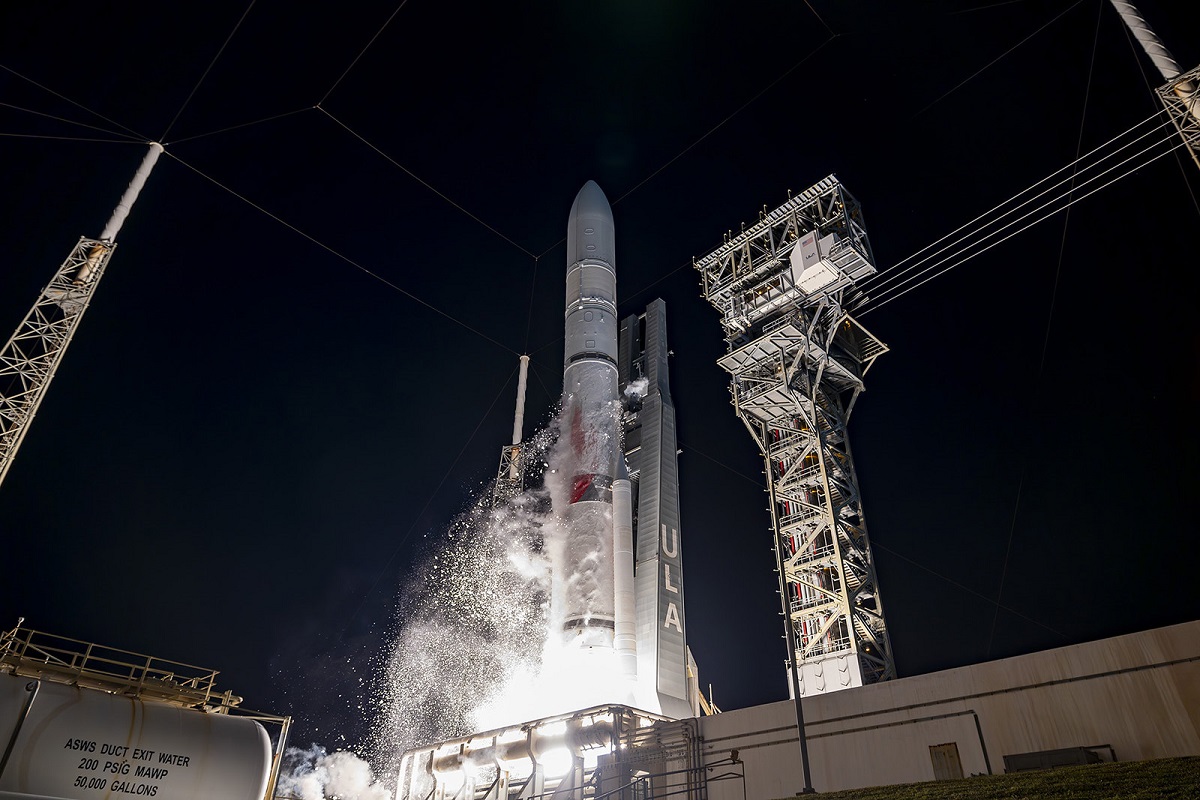
Thursday, April 11, 2024

Space Force Set to Modernize US Launch Ranges

Although it has been needed for quite some time, it appears that the US Space Force has decided to commit to upgrading the major US launch ranges, according to a report today on SpaceNews.com. 

After years of kicking the can down the road on modernization, the U.S. Space Force is now embarking on a comprehensive overhaul of the IT infrastructure used at mission control centers at Cape Canaveral Space Force Station in Florida, and Vandenberg Space Force Base in California.

The launch centers are the places where the mission controllers monitor the space mission’s progress and manage meeting the mission’s objectives. As such, communications and information flow are essential to their function.

The launch ranges’ supporting IT architecture is crucial to the success of space missions and meeting the growing demand for access to space, but the technology is in desperate need of an overhaul, said retired U.S. Air Force Col. Chad Davis, former director of the National Reconnaissance Office’s Office of Space Launch.

Davis, now an executive at Stellar Solutions, directed 12 national security space missions on the East and West coasts.

“At Vandenberg, a lot of the infrastructure that’s there was put in place for the Space Shuttle. That’s how old it is,” Davis told SpaceNews. “They’ve been Band-Aiding it through the years but have never really done any significant overhaul.”

Probably the most succinct summary is that both systems were built around single digits of launches per year and they're looking at meeting three digits worth of launches. Not just doubling or tripling but multiplying the "single digits per year" by 30, 50 or perhaps as much as a hundred in the coming years. Maj. Jason Lowry, deputy director of technology and innovation at the Space Systems Command’s Assured Access to Space program office said this was long overdue, as the private sector has pushed into hundreds of launches per year.

“Imagine a future when the U.S. is launching a rocket every day,” Lowry said.

That means moving away from analog stovepipes to a digital environment where data flows seamlessly and experts can be virtually integrated, he added. “Clearly, we’re going to need to digitize and automate a lot of what we do to support that type of launch cadence.”

SpaceX alone is targeting close to 150 launches this year and while a one per year or one every other year launch like last week's Delta IV Heavy are essentially zero impact, Lowry said they're expecting over 100 launches from the cape, “and we’re also projecting a 30% year over year increase in both the Eastern and Western launch range manifests.” United Launch Alliance is targeting a Vulcan Centaur launch every other week starting next year.

Lots more details at the original source. 


A shuttle mission control center photo from late in the program. This isn't an early '80s version, but this is like what they're planning to upgrade. To include the stuff you can't see like data links in and out.


Wednesday, April 10, 2024

Two Small Unrelated Stories

So Why Did the Delta IV Heavy Set Itself on Fire at Every Launch?

Even Tory Bruno, CEO of ULA, referred to the Delta IV as "the most metal of all rockets, setting itself on fire before it goes to space." Setting itself on fire was because of a design choice, but what was it? And why was it?

A shot of a Delta IV Heavy launch in 2014, found with a web search for "delta iv sets itself on fire." Image Credit: United Launch Alliance

The answer is in the engines used on all three core boosters, the massive RS-68 rocket engines, were developed during the 1990s by Rocketdyne, the same company that developed the Space Shuttle's (and now Artemis') RS-25 engines. These expendable engines were designed to be cheaper and more powerful than the reusable RS-25 engines while running on the same fuel mix of liquid hydrogen and liquid oxygen. 

The fireball phenomenon manifests because of design differences between the RS-68 and the Shuttle main engines and because the RS-68 propellant valve is open longer before the oxidizer starts flowing. Essentially, at engine startup, only liquid hydrogen is running through the engine because it is less chemically active than oxygen.

This hydrogen flows out of the engine, and because hydrogen is very light compared to ambient air, it rises up the outside of the rocket. When the liquid oxygen flow begins, the excess hydrogen is ignited into a fireball. This occurs within the last five seconds of the countdown. This design trade was intentional, and the exterior of the rocket is configured to withstand the fireball.

An imposing fireball during the first moments of flight? I remember people talking like they expected the rocket to explode on its own. That fire is a design feature, not a bug.

A Giant of Theoretical Physics Passed Away This Week

On April 8th, British theoretical physicist Peter Ware Higgs passed away at the age of 94. It was three months short of 12 years ago, on July 4, 2012, when Higgs achieved the practical immortality in theoretical physics. 

That was the day it was announced that collisions between particles at the Large Hadron Collider (LHC) facility — arguably the most ambitious and audacious science experiment ever — revealed the existence of the Higgs Boson.

The discovery of the Higgs boson, named for Higgs himself, has been vital for the field of particle physics. It was the last occupant of the particle zoo that's needed to complete what's known as the "Standard Model of particle physics," the best description we have of the universe on the smallest of scales.

The Higgs Boson, also called the God particle, is generally credited as having been derived in work Higgs was doing in the 1960s. The Higgs field is what gives mass to the other subatomic particles.

I'm going to go out on a limb and say more people who read here regularly will be familiar with the Higgs Boson than a similarly sized readership at the vast majority of other blogs. Not that there's anything wrong with them.

EDIT 4-11-24 0930 EDT: Forgot the link to the source at the top of the second section - on the notice of Higgs' passing.


Tuesday, April 9, 2024

And the Delta Rocket Family is Done

We watched the final Delta IV Heavy launch early this afternoon, watching the coverage on Spaceflight Now, and going outside to watch at about a minute to go in the count. The trajectory was said to be going East and that appeared to be close if not exactly right. It was definitely more visible than flights to the northeast while not as visible as the ones going south into a polar orbit. The rumble from the three large boosters was very notable and got better as the rocket continued down its trajectory. 

The Delta IV Heavy, one of the world's most powerful rockets, launched for the 16th and final time Tuesday. It was the 45th and last flight of a Delta IV launcher and the final rocket named Delta to ever launch, ending a string of 389 missions dating back to 1960.

At this point it appears the Delta family now belongs to history and we'll never see another Delta launch. The payload niche that Delta IV family has carried for those 45 missions will transfer over to the Vulcan Centaur. United Launch Alliance still has Atlas missions left to fly, but no Atlas Vs have been built for years and once the remaining Atlas Vs fly, their payloads will also switch to Vulcan. As of the start of this year 17 more Atlas V missions were scheduled. It appears the next one will be the Crewed Flight Test of Boeing's Starliner capsule, NET May 6.

Screen capture of today's video, 20 seconds after launch.

Today's payload, NROL-70, was classified. Practically that means that coverage of the mission from onboard cameras is restricted and little is said publicly about the success of the mission. The estimates were that by six hours after launch, they'd have a pretty good idea of the orbit and whether it had gone as designed. That time would have been by 7:00 PM EDT, but nothing solid has been seen online yet. 

While the payload is classified, experts can glean a few insights from the circumstances of its launch. Only the largest NRO spy satellites require a launch on a Delta IV Heavy, and the payload on this mission is "almost certainly" a type of satellite known publicly as an "Advanced Orion" or "Mentor" spacecraft, according to Marco Langbroek, an expert Dutch satellite tracker.

...  In 2010, Bruce Carlson, then-director of the NRO, referred to the Advanced Orion platform as the "largest satellite in the world."
...

When viewed from Earth, these satellites shine with the brightness of an eighth-magnitude star, making them easily visible with small binoculars despite their distant orbits, according to Ted Molczan, a skywatcher who tracks satellite activity.

"The satellites feature a very large parabolic unfoldable mesh antenna, with estimates of the size of this antenna ranging from 20 to 100 (!) meters," Langbroek writes on his website, citing information leaked by Edward Snowden.

Today's launch, though, is more about the launcher than the payload. I've seen this picture in a couple of places but without a key, so I'll try to SWAG one.

Left to right, an early Delta, Delta II, Delta III, Delta IV and Delta IV Heavy.  

Final words to ULA:

"Everything that Delta has done ... is being done better on Vulcan, so this is a great evolutionary step," said Bill Cullen, ULA's launch systems director. "It is bittersweet to see the last one, but there are great things ahead."


Changing gears rapidly, here's something different for anyone who might want to collect a piece of space program history.


Monday, April 8, 2024

Not One Thing Happened Today Besides the Eclipse

As fur as I can tell, not one single thing happened in the world of space, the businesses, or even all of science. Just the eclipse. 

Which is not to say nothing happened to billions of people, going through their everyday lives. People went to work, went shopping, and did lots of different things, it's just that in the array of places I go to look for space-related news the story was the eclipse. Along with the stories I ran over the weekend.

I worked on troubleshooting parts of my sprinkler system that aren't working quite right. Got some household business taken care of. Stuff like that. Sure, I took a picture of the eclipse. We had about 50% coverage, so not very photogenic. Go look at McThag's picture. His is better. Mine had too much cloud in the area when I grabbed the shot.

This picture graced the top of the article on Ars Technica about how members of their staff traveled to see it.

Baily's Beads are visible in this shot taken in Athens, Texas. Image credit to Stephen Clark.


Sunday, April 7, 2024

SpaceX Premiers a New Rideshare Mission

This evening near sunset SpaceX flew the first mission of their new rideshare platform called Bandwagon from the Kennedy Space Center, Pad 39A. 

SpaceX isn't new to the ridesharing market, having launched 10 previous rideshare missions with their Transporter platform, the most recent of which lifted off last month. The first and most memorable Transporter mission launched in January 2021 and delivered 143 satellites to orbit, a single-flight record that still stands today. I found that 2021 date surprising. It doesn't seem like three years ago.

The Transporter platform provides launches to sun-synchronous orbits, which are polar orbits that go over the same places on Earth at the same time every day so that the angle of sun and lighting is the same every day - but not every customer wants to launch to an SSO. It should be mentioned that the term polar orbit doesn't require the satellite go precisely over the north and south poles; deviations to 20 or 30 degrees are acceptable.  Enter bandwagon, which flies to the second most requested orbit, at inclinations of up to approximately 45 degrees and satellites at altitudes of 550 to 605 kilometers. 

The major customer on this mission was the government of South Korea, which launched its Project 425 SAR synthetic aperture radar satellite on the mission, according to Spaceflight Now, and requested SpaceX not show their satellites during the launch coverage.

"On board this mission are 11 spacecraft including KOREA's 425Sat, HawkEye 360's Clusters 8 & 9, Tyvak International’s CENTAURI-6, iQPS's QPS-SAR-7 TSUKUYOMI-II, Capella Space's Capella-14, and Tata Advanced Systems Limited’s TSAT-1A," SpaceX wrote in a mission description.

Transporter missions aren't going away, this just adds another option to get to space. SpaceX's rideshare website shows the two platforms alternating from this point on. 

The only prices to obit I could find mentioned Transporter, so I don't know if Bandwagon launches will cost the same. That number is $5500/kg (= $2500/lb), but said to be going up $500/kg per year - 9% - which is less than everything else is going up due to Bidenflation.  

Liftoff at 7:16PM EDT. SpaceX video screen capture.


Saturday, April 6, 2024

SpaceX, Musk Outline Plans to Increase Starship Cadence

SpaceX is continually trying to increase their cadence at everything they do, it's not surprising they're focused this time on Starship. Cadence won't improve until Starship's performance allows it, making that the main target. 

Today, April 6, SpaceX posted a video to X that appears to be like other "all hands meetings" we've seen before. This one, dated April 4, focused on making life multiplanetary with Starship. Early in the video, Musk states that "Starship is the first design of a rocket that's actually capable of making life multiplanetary." It's right around the 1:00 minute mark in the roughly 44 minute video. To do that, Starship has to be improved to meet its design performance limits.

There's a short teaser on YouTube that doesn't include that important statement. 

SpaceX could attempt to land a Starship booster as soon as the vehicle’s fifth flight as Elon Musk outlined plans to increase both the flight rate and the performance of the launch vehicle.
...

Musk said that the fourth Starship/Super Heavy launch is planned “in about a month or so.” That is consistent with comments by SpaceX President Gwynne Shotwell at the Satellite 2024 conference March 19, where she said that flight was scheduled for early May, pending an updated Federal Aviation Administration launch license. If the company holds to that schedule, the launch would take place less than two months after the vehicle’s third flight.

The goal of the fourth flight is for the Starship upper stage to get through the “high heating regime” of reentry and make a “controlled splat” into the ocean, he said. On the third flight, Starship broke up during reentry.

Musk mentioned that they also want to bring the Super Heavy booster back intact on the next flight, having it land “on essentially a virtual tower” in the Gulf of Mexico - which I interpret to mean it will slow to essentially zero speed above the water and then be lowered into the Gulf.

“If the landing on the virtual tower works, then we will actually try on Flight 5 to come back and land on the tower,” he said. “That is very much a success-oriented schedule, but it is in the realm of possibility.”

The booster for that next flight, B11, was static fired Friday the 5th.

April 5th static firing.  Image credit: SpaceX 

To support a higher cadence naturally requires more hardware. Before the March IFT-3,the company said they had four pairs of ships and boosters at Starbase. Musk said in the presentation the company would build “roughly six” more vehicles this year.

While the emphasis on building hardware naturally has to focus on Starship, Super Heavy boosters, and Raptor engines, don't forget the ground infrastructure - the things Musk refers to as "Stage Zero." You've probably heard that they're building a second launch mount in Starbase Boca Chica; they're also modifying and updating the launch mount at the Kennedy Space Center, next to pad 39A. They expect the KSC launch mount to be operational by the middle of next year.

“What we should probably expect is that we do the development launches here, test anything new here, build the rockets,” he said at Starbase, “and then probably most of the operational launches would be from the Cape.”

You might remember seeing the Raptor 2 engine next to the Raptor 1. There's a Raptor 3 that has been prototyped that's even simpler (fewer parts) than the Raptor 2. 

With the increased production rate will come increased payload capacity. Musk outlined improvements to the Raptor engine that will increase its thrust from 230 to 280 metric tons-force, and “ultimately” to more than 330 metric tons-force of thrust.

Perhaps the most astounding thing I heard about their plans was how drastically the cost per unit of mass was going to be decreased. All of that mostly due to reusability and getting lots of life out of one build.

The engine improvements would support a “Starship 2” that also features a slightly longer booster and ship. That will be able to place more than 100 metric tons into orbit in a fully reusable configuration, Musk said. A future “Starship 3,” about 25 meters taller than Starship 2, would be able to place more than 200 metric tons into orbit in a fully reusable mode. He did not disclose when either Starship version would enter service.

Musk claimed that the future Starship 3 would cost less to launch than SpaceX’s original rocket, the Falcon 1 small launch vehicle, which had a price of about $10 million, because of full reusability. He estimated the Starship cost per launch could fall to as low as $2 million to $3 million.

“These are sort of unthinkable numbers,” he said. “Nobody ever thought this was possible. But we’re not breaking any physics to achieve this.”

200 metric tons - 440,000 pounds - to orbit for $3 million, which is a small fraction of what a Falcon 9 launch costs (I've heard their actual costs are around 20 to $30 million). Launching 440,000 pounds for $3 million works out to $6.80 per pound to orbit. 


Friday, April 5, 2024

Small Space News Story Roundup 33

As always, small stories I found interesting. 

Biden Admin proposes SpaceX Tax Commercial Launch Tax  

They call it a commercial launch tax, but in reality it is a SpaceX tax because they do the vast majority of commercial launches in this country. The vast majority of those are for Starlink, which are SpaceX launching for themselves.

The New York Times reports this as "cost-sharing," saying that commercial airlines pay for the Air Traffic Control network in the US through user fees - passed through to their customers as a tax on launches surely would be passed on to those customers. Commercial space companies are exempt from the aviation excise taxes which fill the Airport and Airway Trust Fund, and in turn pays for the FAA’s work. That fund will get roughly $18 billion in tax revenues for the current fiscal year.

There's one major difference between the aviation excise tax and applying it to commercial launches. Air traffic controllers handle an average of 45,000 daily airplane flights or 16.4 million per year. There were 117 commercial launches last year, which isn't even a tiny fraction of the least significant digit in the 16.4 million. Yes, the launches do involve air traffic control routing around the launch sites for a few hours in the very few places (three? four?) where rockets fly.

Divide that $18 billion tax revenue by the number of flights to get around $1095 tax revenue per flight. Adding that to every rocket flight and assuming 150 launches per year turns that $18 billion to an astounding $18.000164250. $164,250 from 150 launches isn't even one least significant digit in the nice, round $18 billion estimate.

Playing with numbers (while purely for laughs) is hamstrung by not knowing how big the tax proposal is. It's also good to recall that SpaceX already talked about providing funds for the FAA to hire more staff to work on launch licensing.  That said, a commercial launch industry spokesperson had this comment.

Members of the commercial space industry argue it is still at a nascent stage, and taxing the industry is “not appropriate at this time,” said Karina Drees, president of the Commercial Spaceflight Federation.

Some Launch Updates and News 

  • The final Delta IV Heavy, NROL-70 is currently set for Tuesday, April 9 12:53 PM EDT.
  • Starliner Crew Flight Test (CFT) has moved from May 1 to May 6 10:34 PM EDT. While night launches are pretty from here, it will be toward the NE. If the launch is delayed a day or two, the liftoff time will move earlier by about 23 minutes per day (due to the Space Station's orbit).

Polaris Dawn is Getting Closer

While there is no proposed date, the Polaris Dawn mission we've been awaiting is being talked about as "early summer"which could be as soon as late June.

In a series of posts on the social media platform X this week, SpaceX said the Crew Dragon spacecraft assigned to the all-private Polaris Dawn mission is heading into thermal vacuum testing. The thermal vacuum test will expose the capsule to the airless environment it will see in orbit, both inside and outside the spacecraft, when it is depressurized for the first fully commercial spacewalk in history. This capability required modifications to the spacecraft, which last flew in 2021. Billionaire Jared Isaacman will command the mission. He'll be joined by former Air Force test pilot Scott "Kidd" Poteet and SpaceX engineers Sarah Gillis and Anna Menon. [BOLD added - SiG]

No Dragon capsule has been exposed to total vacuum as the mission requires, and modifications include big enough oxygen/air supplies to allow the vehicle to be refilled "a few" times. 

In parallel with modifications to the Crew Dragon spacecraft, SpaceX has designed an upgraded spacesuit to protect the four Polaris Dawn crew members in the vacuum of space. SpaceX hasn't yet revealed the new spacesuit, but Isaacman posted last month that the Polaris Dawn crew completed most of the suit's "acceptance test" procedure, which involved actually putting on the final assembled suits. Upcoming milestones include a test run with the crew members inside the actual Crew Dragon spacecraft, vacuum chamber testing, and mission simulations. Other objectives for Polaris Dawn include flying to a higher orbit around Earth than any human has reached since Apollo, testing Starlink internet connectivity in space, and conducting more than 35 research experiments. Launch is scheduled for early summer.

At the SpaceX facility in Hawthorne, CA, the Polaris Dawn capsule (far back in the middle of the aisle), SpaceX workers and Polaris Dawn crew pose for a picture.  Crew (L-R) Anna Menon, Scott "Kidd" Poteet, Jared "Rook" Isaacman, and Sarah Gillis are in the middle front, without their arms up.

There are no photos of the new SpaceX EVA suits.


Thursday, April 4, 2024

The Time is Zero Hours Zero Minutes Coordinated Lunar Time

The headline here might really be the White House has actually ordered something that makes sense. 

On Tuesday, April 2nd, the White House’s Office of Science and Technology Policy released a document that directs NASA to develop a strategy by the end of 2026 to create Coordinated Lunar Time (LTC), a new time standard based on Coordinated Universal Time (UTC) on Earth but adapted to operations on the moon. 

“As NASA, private companies and space agencies around the world launch missions to the Moon, Mars and beyond, it’s important that we establish celestial time standards for safety and accuracy,” Steve Welby, OSTP deputy director for national security, said in a statement.

UTC is a very useful standard here on Earth, but relativistic effects start to show up in cislunar missions. One of the seemingly bizarre conclusions of special relativity is that clocks change the rate they run as the distance from the center of a gravitational field changes.  Clocks on mountaintops run faster than clocks in valleys, and clocks in cislunar space will run faster than clocks on Earth. To an observer on the Moon, an Earth-based clock will appear to lose an average of 58.7 microseconds per Earth-day with additional periodic variations. If you're used to working in microseconds, that seems like a large number, but it would take around 50 years for it to approach a 1 second difference.

Standard time on Earth is inextricably linked to the day/night interval and the Earth's rotation in 24 hours (approximately, "with additional periodic variations"). The traditions of how the day was divided into hours, time zones and everything else don't seem transferable to the moon. If you pick one point near the lunar equator and define the time the sun rises as zero, the time of sunrise one lunar day later will be close to 28 complete Earth days. Instead of 24 hours, the lunar day is more like 28*24 or 672 Earth hours. The lunar day doesn't need to be exactly 672 hours, but crews working together need to be able to communicate and work with the required accuracy; whether Earth to moon or elsewhere. 

“As NASA, private companies and space agencies around the world launch missions to the Moon, Mars and beyond, it’s important that we establish celestial time standards for safety and accuracy,” Steve Welby, OSTP deputy director for national security, said in a statement.
...
“A consistent definition of time among operators in space is critical to successful space situational awareness capabilities, navigation and communications, all of which are foundational to enable interoperability across the U.S. government and with international partners,” Welby said.

The policy sets four major features for LTC: traceability to UTC, accuracy sufficient for precision navigation and science, resilience to loss of contact with Earth and scalability to environments beyond cislunar space. All of those could be achieved with a similar network of atomic clocks, and times could be based on the SI standard for a second, the unperturbed ground-state hyperfine transition frequency of the cesium 133 atom, to be 9,192,631,770 Hz or 9.192631770 GHz. 

NASA has been working on a concept called LunaNet to provide communications and navigation services at the moon using an interoperable network that could include commercial and international contributions. NASA and the European Space Agency have produced several versions of a LunaNet Interoperability Specification that mentions the creation of a Lunar Time System Standard, although documentation for that has not been developed.

In May 2023, the National Geospatial-Intelligence Agency (NGA) announced it was working with NASA to develop a positioning and navigation system for the moon. The goal, NGA officials said then, was to create a system for users on the moon that works “as accurately and as safely as GPS does on Earth.” That announcement did not go into details about creating a lunar time standard.

Here's a thought. On the equinox we just went through here on Earth, the sun moved from rise to set, roughly 180 degrees in 12 hours. That works out to 15 degrees per hour. Here's a map showing the time zones. Along the top of the frame, the numbers in light blue are each 15 degrees in longitude - one hour in sun position. In the continents, time zones get adjusted too much and look all wonky.

On the moon, what's the practical width for a time zone? Not an hour; the sun goes 180 degrees in 14 days or 336 hours. Much too narrow; an Earth hour is 0.536 degrees. What should time zones be like on the moon?


Wednesday, April 3, 2024

ULA Vulcan's Cert-2 Flight Looks to be Slipping

While Vulcan's Cert-1 flight back in January went successfully, checking off lots of accomplishment boxes, the plan we've known United Launch Alliance wanted to follow was two certification flights and hoping to have their certification from the US Space Force to launch National Security payloads granted by the end of 2024. 

The payload for the Cert-2 flight has long been said to be Sierra Space's Dream Chaser spacecraft - the one that looks like a miniature Space Shuttle. The only problem is that it's increasingly looking like the payload won't be ready for the mission ULA is planning. While a real date isn't announced, we know they've been targeting June - the early talk after January's Cert-1 flight was "April-ish." Ars Technica reports that it's looking to be slipping out, probably into the fall, which makes having everything completed for certification by the end of the year less likely. Delaying input to the process by three months seems likely to delay the output by that much, too.

As usual, this is a complex story with lots of places where conflict can arise. Dream Chaser is scheduled to deliver cargo to the Space Station (ISS) in an unmanned, autonomous flight like the other vehicles. NASA's internal scheduling had the craft penciled in for September, but that can be moved by NASA as desired based on other concerns. 

In fact, there is skepticism within the space agency about a fall launch. According to one source, during a recent meeting to integrate planning for space station activities, there were significant inconsistencies in the schedule that Sierra Space officials laid out for NASA.

At all times, the ISS team has to coordinate arriving crew and cargo vehicles from SpaceX, Northrop Grumman, Boeing, and Russia as well as the Dream Chaser cargo mission. They're expected to operate in the best interest of the ISS at all times, and if the station needs something that one's carrying which is different from the previous plans, they change the order of flights. 

While ULA has always stressed the first two missions are their cert flights, it is possible to certify with one flight, and conversely, with more than two flights.

Previously, Col. Douglas Pentecost of the Space Force said United Launch Alliance had chosen the Vulcan certification path requiring the least amount of launches: two. By contrast, Blue Origin has agreed to a three-flight certification process, which requires less paperwork. There is also a six-flight option and even a 14-flight option for certification. The latter option essentially means that if your rocket flies 14 times, it earns certification.

Nevertheless, there is a precedent for a single-flight certification. In 2018, the Air Force agreed to certify SpaceX's Falcon Heavy rocket after its debut launch in February of that year. That decision was controversial enough that it generated a review by the Department of Defense Inspector General, which found that the military had "generally complied" with its procurement rules.

It's worth noting that Falcon Heavy didn't launch a military payload on its next two flights. Which makes it appear that the initial certification was conditional on the success of the next two commercial missions and it was really a three flight certification. 

Yet another wild card that might be on the table is to launch Cert-2 carrying a different payload than Dream Chaser. 

Two sources said United Launch Alliance had asked Space Systems Command, the Los Angeles-based unit responsible for military access to space, for at least a partial certification of Vulcan based on data from its initial launch. This would potentially allow Vulcan to carry national security payloads on its second flight or perhaps Defense Innovation Unit payloads such as Blue Origin's DarkSky-1 mission.

Vulcan Centaur's Cert-1 flight lifts off on January 8, 2024 from SLC-40 at Cape Canaveral Space Force Station. Image credit: United Launch Alliance.

I think the only thing I conclude out of this is "Stay Tuned."


Tuesday, April 2, 2024

This Guy Is Either Incredibly Lucky or ...

Alejandro Otero of Naples, Florida, would probably say he's incredibly unlucky. I'm thinking incredibly lucky to have observed something so improbable it has only happened a handful of times in human history. 

A few weeks ago, something from the heavens came crashing through the roof of Alejandro Otero's home, and NASA is on the case.

In all likelihood, this nearly 2-pound object came from the International Space Station. Otero said it tore through the roof and both floors of his two-story house in Naples, Florida.

Otero wasn't home but his son was. His Nest home security camera captured the sound of the crash at 2:34 pm local time (19:34 UTC) on March 8. 

That's an important piece of information because it is a close match for the time—2:29 pm EST (19:29 UTC)—that US Space Command recorded the reentry of a piece of space debris from the space station. At that time, the object was on a path over the Gulf of Mexico, heading toward southwest Florida. 

Now think of a simple way of visualizing the problem. Think of it this way: the surface area of the Earth is just under 197 million square miles. A lot of that is discarded because it doesn't lie in the latitude bands that something being tossed out of the International Space Station could come down in - and it will follow the orbit it's in until it starts re-entry. There's complete uncertainty of when it's going to re-enter until observation shows that it's very close to starting. At that point, the possible area it could land in collapses to a much smaller area. 

This cylindrical object, a few inches in size, fell through the roof of Alejandro Otero's home on March 8th.

Image by Otero, published on X.

It's a pretty safe bet that you and your house aren't remotely near a square mile in area so multiply the area the satellite could come hit in square miles by 27.878 million to convert it to square feet. For example, let's say the agencies tracking it said it might hit within 100 square miles. That's 2.878 Billion square feet. A random 2 square foot person is a 1 in 1.394 billion chance of getting hit by that. Makes the Lotto seem like a pretty safe bet.

That's how lucky you have to be to get that little cylinder after all the heat and chaos of re-entry. 

I rush to add that I understand and sympathize with the fact that Otero has to have a lot of expensive work done to his house and he wants someone else to pay for that. I would, too. Otero turned the object over to NASA to analyze it and determine if it really is part of suspected parcel of junk that was released to re-enter the atmosphere and (presumably) burn up. It's kind a messy situation, and while I can see NASA or any other agency would want to turn it over to labs for the kind of detailed analysis it needs, I also think that's a pretty valuable artifact to have. Otero might well be able to sell it to some collector for a sum that would repair or even replace his house.

It's an interesting story far too involved to get into much more here, so if you think this is remarkable, check out the story on Ars Technica. There's a bunch of pretty amazing things in that story. An easy one to point out is that piece is most likely part of a pallet full of nickel-hydrogen batteries. Which was let go from the ISS in March of 2021, almost exactly three years before this hit, its orbit decaying a little at a time until the atmosphere finally won.


Monday, April 1, 2024

Catching Up

A few things changed over the weekend since Saturday night's post. 

The biggest was that the trio of SpaceX launches in four hours 38 minutes wasn't completed. When that was posted, the first launch had happened and I was waiting for the rest. The second one was delayed but went off and was better visually here than the first. The third, the Starlink 7-18 group from Vandenberg was delayed a couple of times, and when the fourth delay moved it from Saturday night after 11 PM (my time) out past midnight, I decided it didn't sound like it was going to go and went to bed. It didn't go.

That launch was originally rescheduled for Sunday night but as the day went on, it was moved to Monday night at 10:30 PM my time. 

It's not the only one delayed. 

The final Delta IV Heavy launch had originally been moved from last Thursday to Friday, March 29, but quickly got pushed out to today, Monday April 1st. That schedule only held up for a few trillion nanoseconds before it was changed again. The currently scheduled time is for next Monday, April 8 at 12:57 PM Eastern here from CCSFS SLC-37. 

Commenter Igor remarked after the reschedule to today, "Put off until Monday the 1st. Probably didn't have the necessary part on hand." That's most likely the case because after the computer called the count abort on Thursday, ULA CEO Tory Bruno Tweeted that a "Pump failed again." It sounds entirely possible that the part needed to get the pump working wasn't on hand at the Cape and couldn't be shipped overnight here.

ULA's site dedicated to the NROL-70 flight added further details:

(Cape Canaveral Space Force Station, Fla., March 28, 2024) – The launch of a United Launch Alliance Delta IV Heavy carrying the NROL-70 mission for the National Reconnaissance Office was scrubbed today due to an issue with a liquid pump failure on the gaseous nitrogen pipeline which provides pneumatic pressure to the launch vehicle systems.

The team continues to troubleshoot the pipeline and more time is needed to instill confidence in the system. We will continue to work with our customer to confirm our next launch attempt and a new date will be provided upon resolution.

I should add that the ULA site just linked to above the indented (copied) text does NOT list the April 8 date and time for launch. That date was from Next Spaceflight. 

The final Delta IV Heavy on the pad at Cape Canaveral.  ULA Photo

And now for something completely different, completely unrelated to anything I've written about in years.  

We went to the noon showing of Dune 2 at our usual 10-plex movie theater today. The crowd was unusually small for our movie visits, the two of us and another couple. The crowd is often six to 10. This is a movie that has been out a full month, long enough that I was concerned that if we didn't get to see it, it would end up on some streaming service we don't subscribe to. 

Thinking I might have written about watching the first of the Denis Villenueve Dune movies in 2021, I did a search and found it easily. 

I could lift much of the review of that one wholesale without changing the review. I was more impressed by nearly everyone in this movie than the first. Both Timothée Chalamet, who plays the lead in the movie, Paul Atreides, and Zendaya, who plays the Fremen girl that befriends Paul, leads him into their culture and eventually becomes a lover, impressed me far more than they did in the first movie. I was very impressed with a new character in this movie, Stilgar, played by Javier Bardem. Stilgar is a major character in the books, leader of the Fremen tribe Paul stays with, and Bardem was excellent. Rebecca Ferguson, who plays Paul's mother Jessica and Bene Gesserit member also impressed me more than in the first movie.

I was simply blown away by the visual magnificence of the production, special effects, CGI, scenery and more. As I said back in '21, because of how long it has been since I've read the books, I can't say much about how faithfully this new version follows the story arc; all I can tell you is I recognized virtually every scene in the movie from the books and understood unspoken things about the scenes. Like the first one, it's a long movie at 2h 46m. Don't get the theater's 55 gallon drum of Coke. 


Sunday, March 31, 2024

Happy Easter!!

It's Easter, Resurrection Sunday, and as I do regularly, I look at what I've posted for the major holidays in the past, and often modify them quite a bit.  Not wholesale tear it up and start over, but some extensive additions and deletions.  

Looking for the Living One in a Cemetery

Luke 24: 1-12 New Living Translation

24 But very early on Sunday morning[a] the women went to the tomb, taking the spices they had prepared. 2 They found that the stone had been rolled away from the entrance. 3 So they went in, but they didn’t find the body of the Lord Jesus. 4 As they stood there puzzled, two men suddenly appeared to them, clothed in dazzling robes.

5 The women were terrified and bowed with their faces to the ground. Then the men asked, “Why are you looking among the dead for someone who is alive? 6 He isn’t here! He is risen from the dead! Remember what he told you back in Galilee, 7 that the Son of Man[b] must be betrayed into the hands of sinful men and be crucified, and that he would rise again on the third day.”

8 Then they remembered that he had said this. 9 So they rushed back from the tomb to tell his eleven disciples—and everyone else—what had happened. 10 It was Mary Magdalene, Joanna, Mary the mother of James, and several other women who told the apostles what had happened. 11 But the story sounded like nonsense to the men, so they didn’t believe it. 12 However, Peter jumped up and ran to the tomb to look. Stooping, he peered in and saw the empty linen wrappings; then he went home again, wondering what had happened.


Coming from my background, becoming an evangelical Christian was a large change.  I had studied biochemistry and microbiology in college through my third year before life imposed some detours, eventually getting my degree and starting my career as an engineer late in life (over 30).  I had been an amateur astronomer, so between them I was deeply marinated in the standard model of Cosmology as well as conventional biological evolutionary theory.  Frankly, I wasn't giving it much thought any longer, but my wife had re-affirmed her faith (she had first accepted Christ as child) and I was having all of my mental models disrupted.  She had started a subscription to Bibical Archaeology Review and the constant refrain from archaeologists, not religiously motivated, along the lines of "we thought this was old Jewish folklore, but here it is" got me thinking "if that's true, maybe there's more that's true."  Strobel's The Case for Christ, played a role in filling in the gaps in my historical knowledge. 

I went forward for Baptism in an evangelical church and an important part of that change was because the pastor had a similar background to mine, at least in the biochemistry/microbiology. He was a pharmacist and director of the pharmacy department in one of the local hospitals. He quickly became one of our closest friends in the worst time of our lives - Mrs. Graybeard's cancer in 1997. It's a long story, but in the last couple of years that church's elders dumped him. As the story came out, we found a new church - a nearby Southern Baptist church. Our pastor started going to another similar church, but closer to his home. He passed away a couple of weeks ago.

Easter is the most important day in Christianity and far more important than Christmas because of the resurrection.  Everyone has a birthday, but history only records one resurrection.  The resurrection is essential to Christianity; without it there simply is no reason for Christianity to exist.  Since virtually everyone, including honest atheists, agrees Jesus was a real man in history (I've always found it amazing that Jesus' existence is better attested in ancient sources than that of Julius Caesar - but no one claims Julius Caesar was not a real person) and died on the cross, the question becomes whether or not it can be verified that Christ was seen after the resurrection by someone other than the closest circle of disciples. Strobel says:

Did anyone see Jesus alive again? I have identified at least eight ancient sources, both inside and outside the New Testament, that in my view confirm the apostles’ conviction that they encountered the resurrected Christ. Repeatedly, these sources stood strong when I tried to discredit them. 

Could these encounters have been hallucinations? No way, experts told me. Hallucinations occur in individual brains, like dreams, yet, according to the Bible, Jesus appeared to groups of people on three different occasions – including 500 at once!

In the end, after I had thoroughly investigated the matter, I reached an unexpected conclusion: it would actually take more faith to maintain my atheism than to become a follower of Jesus.

I still think a great summary is "Five Confounding Facts About Jesus' Resurrection" a 2016 post at Donald Sensing's Sense of Events (who doesn't seem to have posted since April of '22 but has left his archives up).  He has done several excellent posts on the subject, including Jesus and History and links to articles put together by working scientists, "On what basis would a scientist accept the Resurrection?" and "Is Belief in the Resurrection Unscientific?" 

Enjoy your day.  Enjoy your families. As usual there's a pork butt going in to the smoker, this time after starting cooking in the 3AM timeframe.  Pulled pork tonight. 


Saturday, March 30, 2024

We're Having an Ambitious SpaceX Saturday

If things go as scheduled, we should get three Falcon 9 missions tonight, spread over just a few hours. 

As I write, we've already had the first launch, the European Eutelsat 36D, a communications satellite bound for a geostationary orbit. That was at 5:52 PM local time. There were thin high clouds but as the Falcon 9 got behind those clouds it was going into the final moments of the first stage's burn and the thin clouds were enough to mask our view of MECO and stage separation.

Eutelsat 36D, built by Airbus, will be replacing Eutelsat 36B at 36° East where it will provide over 1100 broadcast channels and other connectivity across Africa, Russia, and Europe. The satellite features 70 Ku-band transponders to enable constant data flow to the ground. The satellite is expected to have an operational lifetime of 15 years.

The schedule lists two more launches for the day (Eastern US time), making three launches this evening. A second mission from SLC-40 of Starlink group 6-45 was originally scheduled for 9:02 but has been moved to 9:30 PM ET, or 3 hours 38 minutes after that first launch. Finally, the last launch of the day is another group of Starlink satellites, Group 7-18, this time from Vandenberg SFB at 10:30 PM ET, 7:30 Pacific. Three launches in 4 hours 38 minutes. Each of those launches has schedule slop of at least an hour, so while this focuses on the scheduled time, we won't know until all three are launched. 

An interesting aside to this schedule is that today is the anniversary of the first time SpaceX launched and landed a used Falcon 9 booster. March 30, 2017; seven years ago.

I watched the first launch on NASASpaceflight.com's YouTube feed, and one of the guys there voiced the thought I regularly have: we're saying things that a few years ago no one would have thought would be said. For example, that booster was flying its 12th mission (I think - can't find a real reference) and it seemed sooty for a rocket with only 11 previous flights. Even a couple of years ago, when 10 flights was the announced goal, did you ever think you'd say something like that? Did you think you'd ever see a rocket with 5 or 6 missions and say, "look at how clean that is; it looks like a new rocket?"


Friday, March 29, 2024

A Commercial Space Story I Haven't Been Covering

I've been remiss in providing details on the Varda orbital experiments that recently concluded with a successful recovery of their payload that - much like OSIRIS-REx's samples - parachuted into the Utah desert in February. It's an important milestone and mission.

This story has been going on, quietly and in the background, for years. Varda Space launched their small satellite on the Falcon 9 Transporter-8 rideshare mission on June 12, 2023. They had actually thought they could return their payload by mid July of '23, but had to wait for government approval - which is what delayed them until this past February. 

Considering the time it takes to design a mission, design and build the satellite and acquire a ride into space, you'd think the FAA had time to think about this mission and clear the reentry, but they were apparently afraid. You see, the Varda W-1 capsule was autonomously manufacturing complex pharmaceutical molecules that are hard to create on Earth because of gravity. Doing the manufacturing in space should allow chemicals like this to be manufactured efficiently and at lower costs than on the ground.

In a July 24 interview, Delian Asparouhov, co-founder of Varda, said the company was still working with the Federal Aviation Administration’s Office of Commercial Space Transportation for a reentry license for the spacecraft. That office, best known for licensing commercial launches, is also responsible for overseeing reentries by commercial spacecraft.

A key issue, he said, is that Varda is the first to seek a reentry license under new FAA regulations known as Part 450. Those regulations were enacted by the FAA more than two years ago to streamline the launch and reentry licensing process.

“I think a lot of the collaborations that we’ve had with the FAA have been trailblazing, and we recognize that, given we’re the first, we set the standard for what future Part 450 reentry looks like,” he said. Varda started discussions with the FAA in early 2021, shortly after the company’s founding.

They received the license in early February and performed the re-entry and recovery on February 21. By March 20, the company revealed that everything worked and released a preprint paper (pdf alert) of their results.

The W-1 mission sought to test the feasibility of making therapeutics in space, testing Varda's hardware off Earth for the first time. During its time in orbit, the W-1 capsule successfully crystalized the metastable Form III of the antiviral drug ritonavir, which then survived its return to Earth. The space-processed ritonavir has since been analyzed, and per an X post by Varda Space cofounder Delian Asparouhov, "[t]hem space drugs cooked real good."

While pharmaceuticals have been processed in microgravity on parabolic flights and the International Space Station, Varda Space's method aims to be more efficient and cost-effective, using uncrewed capsules that serve dual purposes as a mini-factory and a reentry vehicle.

I bet when more Fed Bois read that line starting with, "Them space drugs..." they might want to have Varda followed a little more closely. Wish I was kidding.

Varda Space's manufacturing capsule is examined by recovery personnel as it sits on the desert floor of the Utah Test and Training Range on Feb. 21, 2024. (Image credit: Varda Space/John Kraus)


Thursday, March 28, 2024

Small Space News Story Roundup 32

As always, small stories I found interesting. 

Japan's SLIM Lunar Lander Wakes Up Again 

For the second time, Japan's first lunar lander SLIM (Smart Lander for Investigating Moon) has awakened from the cold lunar night and "phoned home."  

Mission team members announced the news via X on Wednesday (March 27), in a post that also featured a photo newly snapped by the lander's navigation camera.

Yes, that's the first photo after SLIM contacted ground controllers and was shot when they established contact, not weeks ago. While I'm not sure of this I think the time tag of 11:28 PM on March 27 is the time in Japan of the Tweet, since that's the time tag I got at X, and it's the same one as shown at the Space.com original story (link above). I don't think we're in the same time zone but Space.com has a similar screen capture from X and they posted hours before I did. 

JAXA scientists added that most of the functions that survived the first lunar night survived this one as well.

Today's Delta IV Heavy launch was scrubbed, rescheduled for Friday

ULA scrubbed today's launch attempt after a couple of delays moved the 1:40 PM EDT liftoff until well after 2:00 PM. The final scrub occurred just after t-4:00 minutes "... due to an issue with a liquid pump failure on the gaseous nitrogen pipeline which provides pneumatic pressure to the launch vehicle systems..." 

The current liftoff time is set for 1:37 PM Friday, March 28. The chance of acceptable weather goes up from today's 30% to 60%.

 JPL Team optimistic they can get Voyager 1 working again

Speaking at a March 20 meeting of the National Academies’ Committee on Solar and Space Physics, Joseph Westlake, director of NASA’s heliophysics division, said it appeared possible to fix the computer problem on the nearly 50-year-old spacecraft that has disrupted operations since last November.

Westlake went on to say:

“It’s a part failure on one of the memories and they’re looking for a way to move a couple hundred words of software from one region to another in the flight computer.”

In the 8 bit computer that was built from discrete circuits that Voyager 1 is running, a word is 2 bytes or 16 bits. While the Intel 8008, the first single-chip 8-bit microprocessor was available at the time Voyager was being built and readied for launch, I'm going to assume that it wouldn't have met the environmental requirements for launch into deep space.  That, or the designers weren't convinced the 8008 was as good as "the way we've always built processors." Out of Earth's magnetic shield, Voyager's components are subjected to around the clock bombardment with all sorts of radiation out there.  This is one of the places where higher levels of integration and smaller transistor sizes have drawbacks. In this case, the drawback is making modern parts more susceptible to having a logic state changed by things like a single neutron going through the chip.


Wednesday, March 27, 2024

Thursday - the Last Delta IV Heavy Leaves the CCSFS

As we reported last week, Thursday is planned to be the last Delta IV Heavy flight, the NROL-70 mission of the Delta IV Heavy version of the old Delta family. Liftoff is set for 1:40 PM EDT, the start of a four hour launch window. The 45th Weather Squadron of the US Space force gives a 30% chance of acceptable weather (pdf alert) as a cold front clears the Space Coast tomorrow earlier in the day. The specific weather concerns are the launch pad winds and clouds. It goes on to say that if there's a 24 hour hold, that climbs to a 60% chance of acceptable weather.  

The last Delta IV Heavy launch from Vandenberg Space Force Base in 2022, NROL-91.  Image credit ULA.

The Delta IV Heavy got famous for setting itself on fire as it lifts off, earning the title of the Heavy Metal Rocket or Most Metal Rocket. You can see the charred colors on the three boosters in the picture above; the main core and liquid-fueled strap on boosters on either side. More importantly, the Delta IV Heavy was America's most powerful launch vehicle for almost a decade, and a cornerstone for the US military's space program for more than twice that time. This is the last flight of a legend.

"This is such an amazing piece of technology, 23 stories tall, a half-million gallons of propellant and a quarter-million pounds of thrust, and the most metal of all rockets, setting itself on fire before it goes to space," said Tory Bruno, ULA's president and CEO. "Retiring it is (key to) the future, moving to Vulcan, a less expensive higher-performance rocket. But it’s still sad.”

This isn't just the last launch of the Delta IV Heavy configuration, it's the final flight for the entire, historic Delta rocket family—the 389th rocket with the Delta name—since 1960. But those earlier rockets share virtually nothing in common with the Delta IV, which debuted in 2002. Until the Delta IV, the Deltas all had a history going back to the Thor Intermediate Range Ballistic Missiles of the Cold War era. The Delta IV was was a clean-sheet design, initially conceived by McDonnell Douglas, and acquired by Boeing when they bought the competitor in 1997. When Boeing merged with Lockheed Martin to create United Launch Alliance, Delta IV and Atlas V became the ULA vehicles.

The problem with the Delta IV family has nothing to do with its capabilities or reliability; it's the cost. At one time, launches on the D IV Heavy were $400M. The high prices kind of opened the door to SpaceX - the only real competitor to ULA - and drove ULA to develop the Vulcan which will replace both the Delta IV and Atlas V families; another name with a history back to the Cold War. 

"Delta IV Heavy is three rockets bolted together," Bruno said. "With a single core Vulcan, we’re able to collapse that cost (of Delta IV Heavy) by 70 percent and make that mission a lot more practical."

Everything about the mission profile that can be deduced points to NROL-70 being a radio reconnaissance satellite, according to the Ars Technica profile on this mission. The obvious question to the author was if being the last mission before the move to a vehicle that costs 70% less was a problem. 

When asked why not wait for a cheaper ride on Vulcan, Scolese said, "We had the spacecraft ready to go, and we had a rocket that we trust, so it made sense to continue on with this. Something has to be last and we’re proud to be on that vehicle, and we have a lot of confidence in the system."


Tuesday, March 26, 2024

Like NASA's CLPS, But For Asteroid Apophis

That's a side note to an interesting story on SpaceNews.com about the company ExLabs that's planning a mission to Apophis in 2028, before it's closest approach to Earth in April, 2029.   

ExLabs (which might be the worst name for a company because of this reference) isn't really their name. Their formal name is Exploration Labs. What I don't know is if they call themselves ExLabs or if it's something the SpaceNews author came up with. 

During the mission, ExLabs intends to deposit three cubesats in Apophis’ orbit. The flight also is designed to validate systems and software for future campaigns to capture and move near-Earth asteroids into stable orbits for resource acquisition.

“We’re creating a unique partnership to enable a new style of lower-cost missions in collaboration with government and commercial partners,” ExLabs CEO Matthew Schmidgall told SpaceNews.

The company is developing vehicles to host payloads from partner companies, plus robotics to capture and transport space objects - things like Apophis or smaller bodies -  to new locations. The first one is called the Space Exploration and Resource Vehicle, or SERV, and it's ExLabs’ spacecraft to host payloads with a mass as high as 30 metric tons in its fully stacked configuration. Their Arachne Platform is designed to capture and transport noncooperative objects, like orbital debris removal. 

All interesting but burying the lede, which is that NASA hosted a workshop last month to start discussions about options for low-cost missions to Apophis, much like the CLPS program.  Find startups and other innovative companies, give them some seed money for fixed price contracts to come up with missions and the hardware to achieve the mission.  

All of that is puzzling given that they've been saying for years that once OSIRIS-REx completed its mission to asteroid Bennu, it would be sent on to Apophis, and that's exactly how it happened back last September when the samples were dropped off on Earth, changing the mission's name to OSIRIS-APEX. The article about the NASA workshop talks about a NASA mission called Janus that would have sent the spacecraft on flybys of binary asteroids. Janus, part of the agency’s Small Innovative Missions for Planetary Exploration (SIMPLEx) program, was to launch as a secondary payload on the Psyche asteroid mission in 2022, but when that mission was delayed a year that second mission couldn't be flown. As a result, a couple of small satellites built for the Janus mission are just sitting around. Perhaps they could be modified for an Apophis mission. 

Render of Exploration Labs' Arachne, a spacecraft designed for large debris capture. On the left end of Arachne, under the American flag, it says EX - perhaps that's what they call themselves.  Credit: Exploration Labs


Monday, March 25, 2024

Intuitive Machines Says Goodbye to Odie

I guess we can call it official now.  Intuitive Machines has announced that their lander Odysseus - which they quickly nicknamed Odie - has failed to awaken after the frigid lunar night and declared an end to the mission.  

"Intuitive Machines started listening for Odie's wake-up signal on March 20, when we projected enough sunlight would potentially charge the lander's power system and turn on its radio," the Houston-based company said in a post on X on Saturday (March 23).

"As of March 23rd at 1030 A.M. Central Standard Time, flight controllers decided their projections were correct, and Odie's power system would not complete another call home. This confirms that Odie has permanently faded after cementing its legacy into history as the first commercial lunar lander to land on the moon," Intuitive Machines added in another Saturday post.

The probe landed on the moon February 22nd, and it was obvious from the start that things weren't ideal but it took another couple of days before it was understood what happened.  As Ars Technica put it, "that moment when you land on the Moon, break a leg, and are about to topple over."   

Odysseus took this selfie while passing over the near side of the Moon, after lunar orbit insertion on February 21.  Image credit: Intuitive Machines  

As an aside, I can't tell you how many naysayers I've read saying that since Odie tipped over, we shouldn't consider it a successful landing on the moon. Since virtually every payload that could radio back to Earth did, which means every paying customer was satisfied, I think it's making a bigger deal out of falling over than it deserves to be.

The Payload news site has an interesting story about an aspect of this mission that hasn't been talked about much.  Intuitive Machines' value has jumped dramatically.  

Intuitive Machines reported $4.5M of cash on hand at the end of 2023, but that balance ballooned to $54.6M by March 1 when an institutional investor exercised their stock warrants after the company’s soft-but-toppled-over lunar landing in February.

The company’s current cash balance is its largest since SPAC’ing last year, providing much-needed short-term breathing room.

They go on to report that the company reported their annual revenue of $79.5M in 2023 as it ticked off milestones for its three NASA Commercial Lunar Payload Services (CLPS) lander contracts and began recognizing revenue from its OMES III NASA engineering contract. The company’s Q1 sales will be bolstered by a near-total IM-1 lunar landing success, as it was able to transmit data from almost all payloads aboard. 

It was desperately needed as they burned through $75M of cash last year.

IM has two more of its NASA CLPS contracts (Commercial Lunar Payload Services) ahead of it.  The second lander mission, IM-2, has been penciled in toward the end of this year, and another for next year.  The CLPS contracts are generally fixed price and small amounts compared to NASA's own programs, which ends up being good for NASA but tough on the contractors. The contractor bears all the risk. We can probably expect them to do a bunch of changes to IM-2, both design and procedures, because of the "lessons learned" during IM-1 and the mission may slip out later because of that.