Monday, May 13, 2024

Sierra's Dream Chaser On the way to KSC

It has been a while since we've heard anything about the acceptance and qualification testing of Sierra Space's Dream Chaser vehicle. That was in early February when Sierra Space did a public showing of the "mini space shuttle" at NASA's Neil Armstrong Test Facility in Sandusky, Ohio.

We learned today that testing has wrapped up in Ohio and the ship is bring moved to the Kennedy Space Center on Cape Canaveral where it will undergo its final tests before being mated to the Vulcan Centaur it's scheduled to ride to orbit. While no expected date is given, United Launch Alliance wants to get this launch accomplished before the end of '24 to complete certification of their Vulcan Centaur for DOD payloads. 

There has been speculation that Dream Chaser wouldn't be ready this year and that ULA has been considering either another payload or just lifting a dummy weight into orbit.

The first test saw the space plane, along with its additional cargo attachment ‘Shooting Star’, connected to the Vulcan Centaur stage separation mechanism for a shock test, followed by being placed on the most powerful spacecraft shaker table in the world. This testing took place over 5 weeks as teams replicated the conditions the space plane would see during launch on Vulcan. They also conducted the same testing but replicated the separation of the cargo attachment from Dream Chaser before de-orbiting.

After that round of testing, the space plane was moved into a thermal vacuum chamber which can cycle temperatures from -150F to +250F (-101C to +121C), the same temperatures it would see while in space.

Photo during testing on April 3 of the orbiter Tenacity and its cargo module Shooting Star inside the thermal vacuum testing chamber at NASA’s Armstrong Test Facility. Image from Sierra Space on X

Sierra also posted a video summarizing their time at the Armstrong Test Facility and their journey to this point. 


Sunday, May 12, 2024

Happy Mother's Day

I bet I'm the last person to put up a mother's day post. Most of you will see this Monday - or late Sunday night at best.  

In this time of incessant attacks on the family structure; this time of abandoning the idea of motherhood and calling mothers "birthing persons," simple truths like this meme are a refreshing shelter. 


 I keep waiting for someone to try telling me "men can have babies, too" so I can say "name one."  "How did they do that?  Did they get a full uterus transplant?  Did they get ovary transplants, too, so it was their egg, or did they have an already fertilized egg implanted in their implanted uterus?"  Did they have birth canal created or transplanted in?  Sure wouldn't want to pass a baby through a penis.  It's a medical miracle.

Mother's Day and Father's Day both tend to be kind of low key around here as both of us lost our parents quite some time ago.  My mom passed around the first of December in 2013, so around 10-1/2 years ago and she was the most recent of the four.  My dad passed away in 1982, or 31 years before mom.  My mother-in-law was ahead of my mother, passing on in '99, while my father-in-law passed away after my father, but around 10 years ahead of his wife.    

All of my best to all you moms who drop by and read here.  If you still have your mom, I hope you at least called her.


Saturday, May 11, 2024

Two Little, Unrelated Stories

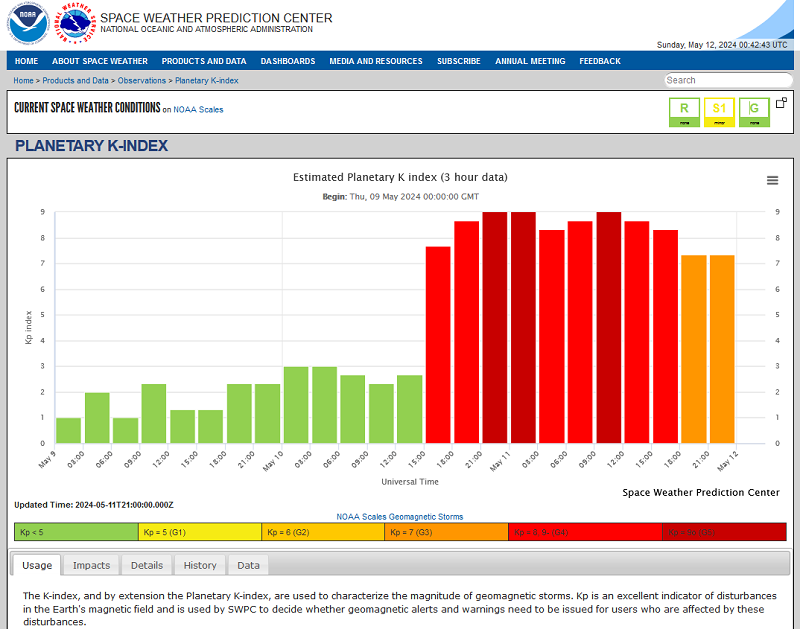
First is the obvious one: the Planetary K-index remains at very high levels. See the plot just below. Note it has come down from its high of 9.0 in three different three hour periods in the last 24 hours (this plot is up to 0000 UTC on May 12 - or 8:00 PM EDT on the 11th). The bigger story is in those three letters in colored boxes at the upper right. That box was red and said G5 - major geomagnetic storm - last night but tonight indicates no storm is in progress. When you click on that green box, it opens a text window to say, "No G-Scale Geomagnetic Storming." This chart can be found here, and I look at it often.

An observation I've made many times is that when a high K-index starts to return to normal ranges, VHF propagation on the ham bands can get very, very good. That hasn't happened. The difference might be that my experience is K index dropping from much lower starting points, like K=4 down to K=3 or K=2, not the 8.33 down to 7.33 seen at the right edge of this bar graph. 

The predictions today have leaned toward the storm conditions continuing through the night in the US and possibly into Sunday night. The only way to reconcile that and the current "No G-Scale Geomagnetic Storming" is to say this might be "the calm before the (next) storm."  The NOAA site that predicts the extents of any aurora displays is looking just like last night.

All things considered, this was a pretty mild storm with only minor effects noted.  

According to NOAA, there have been some irregularities in power grid transmissions, and degraded satellite communications and GPS services. Users of SpaceX's Starlink satellite internet constellation have reported slower download speeds.

This is the most intense Solar storm recorded in more than two decades. The last G5 event—the most extreme category of such storms—occurred in October 2003 when there were electricity issues reported in Sweden and South Africa.

Two decades ago was cycle 23, and the intervening cycle 24 was the weakest cycle in 100 years. We got used to not having things like this happening; and nobody under 25 is likely to remember cycle 23 anyway, or any cycle before it.

You'll Never Guess What Boeing Proposed to Lower Mars Sample Return (MSR) Costs

Except you won't be surprised when I tell you their proposal was to "simplify the mission" by using the SLS. It reduces the mission to one flight of one (heavy lift) rocket, and you can argue that might be a good way to reduce risk. The problem is that SLS is the most expensive rocket flying in the world and NASA is trying to cut the cost of the MSR mission.

What's that saying about "when you only have a hammer every problem looks like a nail?" When you only have an SLS, everything looks like a mission for your SLS. 

Or something like that.


Friday, May 10, 2024

Planetary Geomagnetic Storm Has Hit

Borrowing wholesale from Spaceweather.com:  

EXTREME GEOMAGNETIC STORM--NOW! The biggest geomagnetic storm in almost 20 years is underway now. It has reached category G5--an extreme event. Sky watchers with dark skies may be able to see and photograph auroras even at low latitudes. Get away from city lights and look at the sky! Aurora alerts: SMS Text

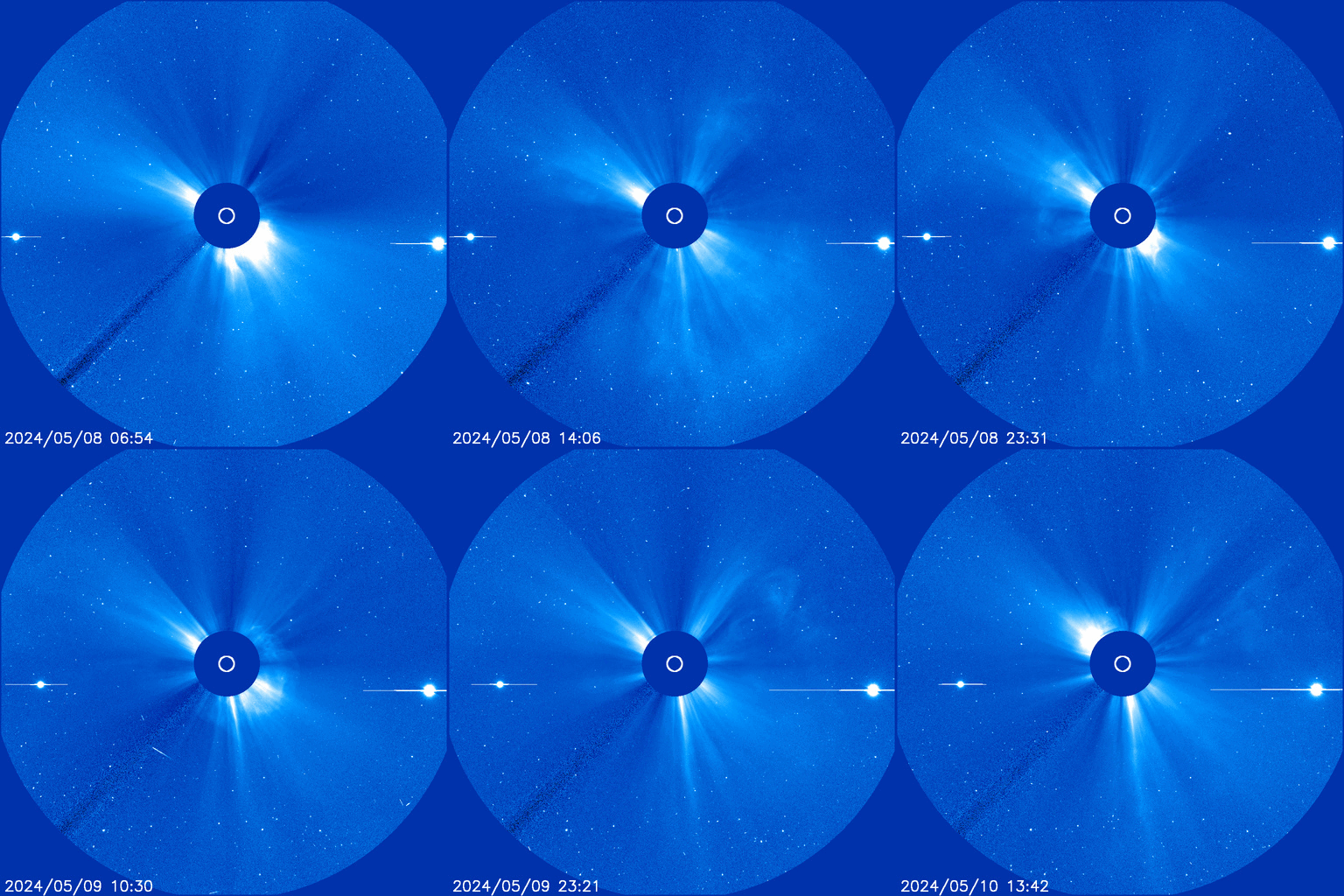
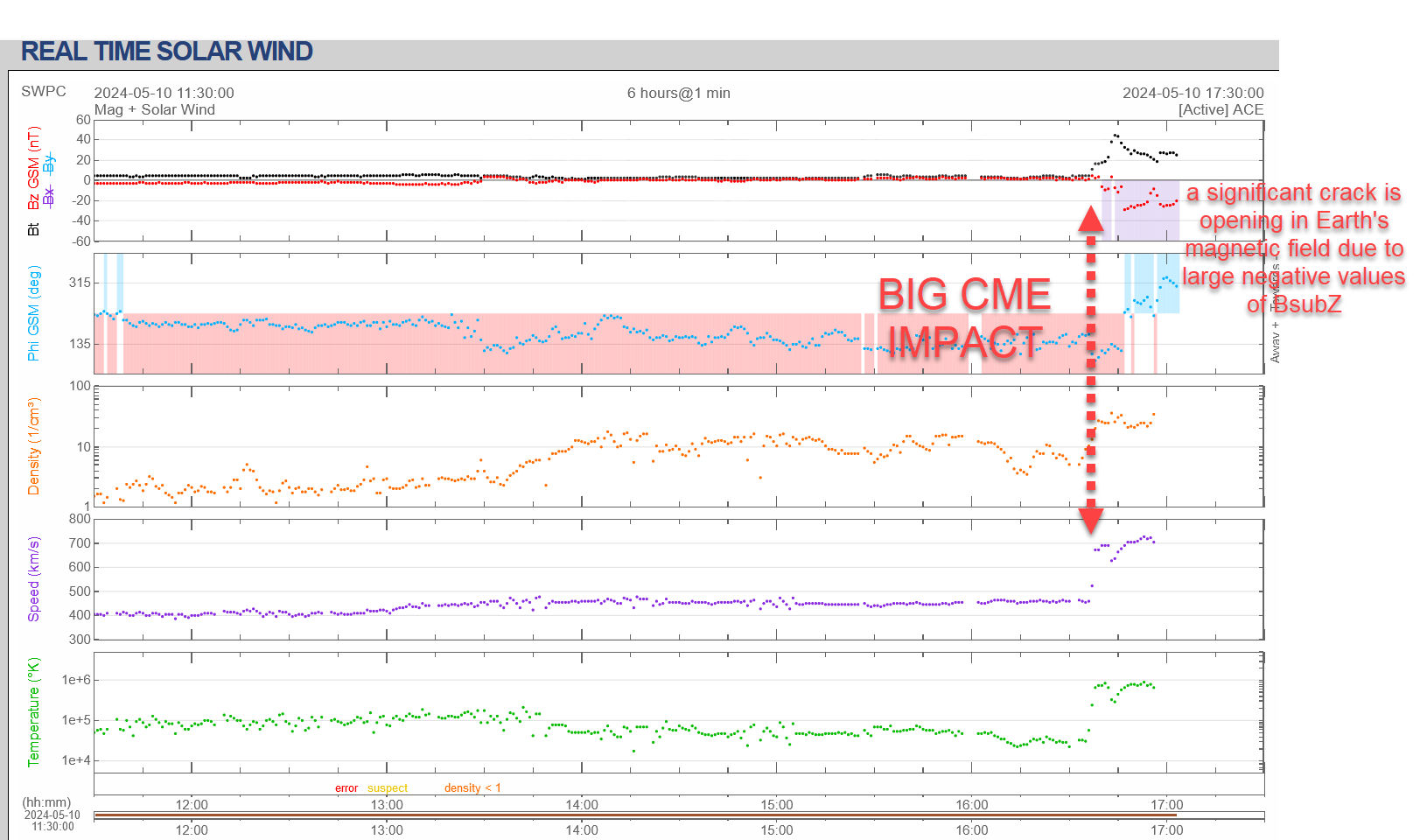
CME STRIKE SPARKS WIDESPREAD AURORAS: The first of six CMEs hurled toward Earth by giant sunspot AR3664 hit our planet's magnetic field today. The impact on May 10th at 1645 UT jolted magnetometers around the world and sparked a geomagnetic storm, which is now extreme. More CMEs are following close behind and their arrival could extend the storm into the weekend. Sign up for Space Weather Alerts to receive instant text messages when the CMEs arrive.

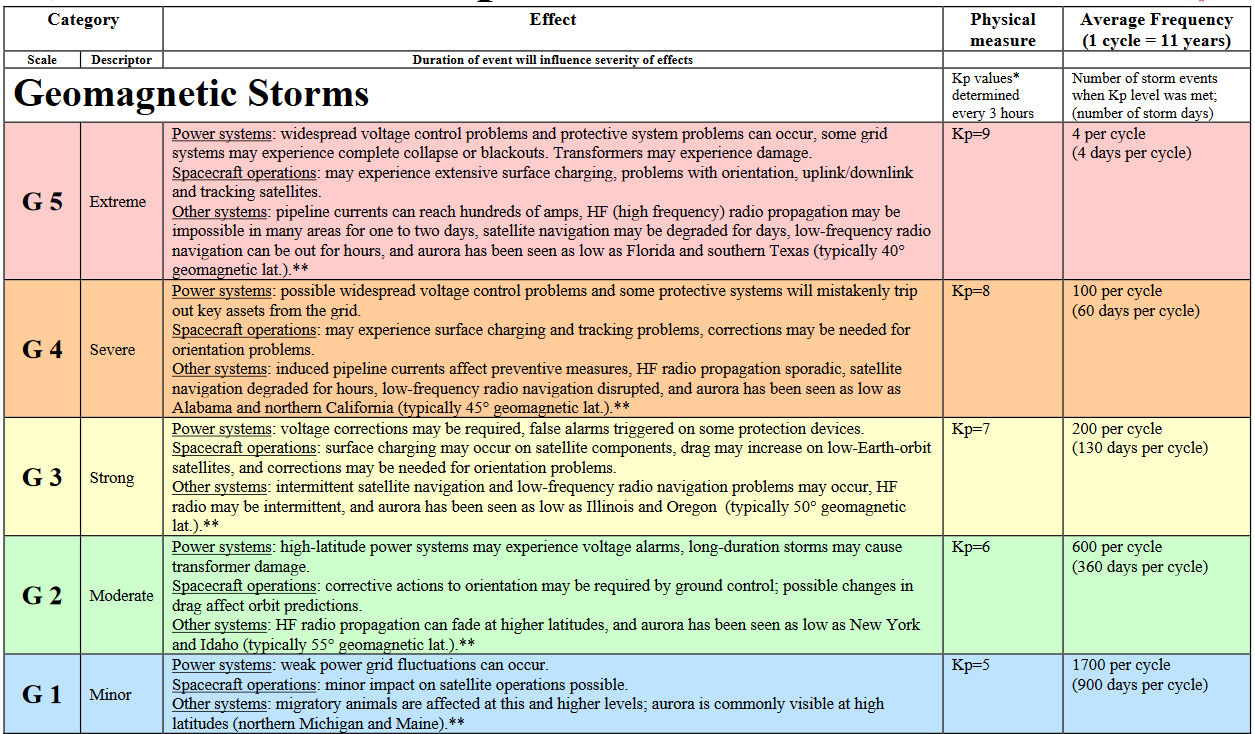
If you're anywhere in the US north of the Gulf of Mexico, it's worth trying to get to a dark location a couple of hours after sunset to see if you can see auroras. They'll be pushing very far south. How far?  In most cases, the K-index has to get to 9 or higher to see them as far south as the Carolinas to Arkansas or so. 

HOWEVER, there's more to it. The first is that the value you see on charts like this are 3 hour averages. Geomagnetic storms also have gusts and peaks that can give shorter term visibility farther south. Next is the direction of Earth's magnetic field, denoted by Bz. South pointing geomagnetic fields produce auroras farther south, into the gulf coast, Texas and even Florida. This site has a plot of Bz, toward the top right of the page, the second row under a place for a video that's always there.  (Bz is currently staying pointing south).

This was the first hit of several CMEs that are coming and there are predictions later impacts will become the so-called cannibal CMEs, in which later, faster Coronal Mass Ejections catch up with and merge with earlier CMEs, giving them a bigger, higher impact. In this view you can see the monster-sized sunspot group 3664. It's the one that has thrown the group of CMEs in the Earth's direction.

Image from Spaceweather.com

As a sidenote, a ham radio group I read regularly had a plot from the same place that had 3664 next to what I think is Carrington's drawing of the spots that gave the famous, all-time world record CME named after him. The implication is that since the group is the same size, the CME could be as bad as the Carrington event. The size of the group is actually relatively low importance in this; what's more important is the magnetic configuration. For example, the caption to that sun picture says, "Giant sunspot AR3664 has a 'beta-gamma-delta' magnetic field that harbors energy for X-class solar flares." I've ranted before about how tired I am of continuous predictions that we're going to have another Carrington event. Something that has happened once in all of human history of observing the sky is suddenly supposed to happen routinely according to these folks. I know "doom sells" but it's kind of ridiculous out there. 


Thursday, May 9, 2024

NASA Going With External Resources on Orion Heat Shield

Last week, I posted an introduction to the heat shield issues on the Orion capsule used during the Artemis I mission at the end of 2022 as I'm trying to gather as much info as I can. Today, Ars Technica's Stephen Clark posted a followup article on the topic, emphasizing that NASA has asked a panel of outside experts to review their investigation. 

As should be obvious, this is potentially a very serious issue. 

Since the Artemis I mission, engineers conducted sub-scale tests of the Orion heat shield in wind tunnels and high-temperature arcjet facilities. NASA has recreated the phenomenon observed on Artemis I in these ground tests, according to Rachel Kraft, an agency spokesperson.

One of the things that caught my eye was a statement by made by Victor Glover, pilot for the Artemis II mission, in a recent interview with Ars. “More than any picture or report, I've seen that heat shield, and that really set the bit for how interested I was in the details.” His summary of the analysis and testing so far was more pointed. “There's no guarantee that changing the trajectory is the answer.” That has been the standard answer so far. Change the trajectory to reduce the demands on the heat shield. 

"In late April, NASA chartered an independent review team which includes experts outside the agency to conduct an independent evaluation of the investigation results," Kraft said in a statement to Ars. "That review, scheduled to be complete this summer, ensures NASA properly understands this condition and has corrective actions in place for Artemis II and future missions."

For his part, Glover thinks they have a good team and they'll eventually find the answer. “We’ve got the right people. If there is a solution, we’ll figure it out.” 

But settling on a solution will only come after NASA determines what caused the Orion spacecraft's heat shield to perform the way it did. And there's no guarantee NASA will find a definitive root cause. While engineers have recreated the char loss on sections of Orion's heat shield in ground tests, they can't test the full 16.5-foot-diameter (5-meter) heat shield on the ground or replicate the exact material response or flight environment experienced on Artemis I.

"We have a lot of extrapolation for scale that we have to do," said Jeremy Vander Kam, deputy manager for Orion's heat shield at NASA's Ames Research Center, shortly after the Artemis I mission in 2022. "Similarly, our test facilities can't reach the combination of heat flux, pressure, shear stresses, etc., that an actual reentering spacecraft does. We're always having to wait for the flight test to get the final certification that our system is good to go."

I know some of you have worked in fluid dynamics, which is what we're talking about here. The Artemis capsule reenters at 25,000 mph, turning the atmosphere into superheated plasma that makes those plasma photos from Starship look like someone was just shining a pink light on it. The interaction of that plasma with the heat shield is what they're trying to model and understand. This isn't laminar flow like a barely flowing river, this is more like full-tilt, raging whitewater. 

"This is a very, very complicated thing," Glover said. "The heat flow alone is really complicated to understand—the physical dynamic forces of all that wind and plasma swirling around. Imagine looking at a raging river, a whitewater river, and trying to analyze just one spot. What's happening at that spot? Recreate it. Draw it. It's really complicated."

The other issue is that the capsule for Artemis II is already built and undergoing tests at the KSC. To modify the heat shield now would require disassembling the Orion crew module from its European service module, and returning it to a place where that work could be done. That would delay the Artemis II launch, probably by a year or more beyond its current target schedule in September 2025. 

A view through the window of the Orion spacecraft during the Artemis I reentry. All those streaks in the bottom of half of the frame, white or yellowish to orange or peach-like are small pieces of material coming off the heat shield. Image Credit to NASA. I edited the photo slightly to enhance the contrast.

Again, the approach to reducing this problem being talked about is to modify the reentry. The problem there is that there are only a handful of possibilities and the whole approach is based on the thought that a different reentry reduces the stresses on the shield. But according to Glover, they saw chunks flying off the heat shield (their euphemism is "liberation") very early in the reentry when those stresses were lower. "If the damaging pieces start very early, there's no guarantee that changing the trajectory is the answer. It will change something, but it won't necessarily fix it. So we need to understand the root cause, if it's knowable."


Wednesday, May 8, 2024

While We Wait

It was another day that got away from me today. On top of that, there's very little of what I consider meaningful news today. 

To clear the desk a little, I missed a couple of pretty big things in last night's post about Starliner being scrubbed and delayed.  I'll list them here in no particular order:

  • When I said the mission, "...has been rescheduled for this Friday at 6:16 PM EDT" that was a terrible misreading of the information. It's not this Friday, May 10; it's next Friday, May 17. The time, at least, is the right set of numbers but that doesn't mean anything if you're looking for it on the wrong day. 

From NextSpaceflight.com's list of all coming launches. 

  • Next was talking about relays and not valves (as what was buzzing). While I'd swear someplace I was reading said it was a relay, I don't remember where that was. I have to assume it's my fault and I always take responsibility for my screw-ups. 
  • Finally, I used the headlines that blamed the scrub on the Atlas V, but the issue was in the Centaur upper stage. 

The issue was with an oxygen relief valve on the rocket’s Centaur upper stage. “The team is just not comfortable with the signatures that they’re seeing, the response out of that valve, so out of an abundance of caution, we are not going to continue with our launch operations today,” said Dillon Rice, ULA launch commentator, on NASA TV.

Which actually is worse than if was the Atlas V.  As commenter Beans pointed out, " First launched (for Atlas V) in 2001 and they're having this issue?" It's part of the launch vehicle for sure, but the Centaur upper stage has been flying since the 1960s, not 2001. Yeah, it's likely they've modified the design in the 70 years the design has been around, but hardware isn't changed without reason in a certified system like that. 


Tuesday, May 7, 2024

Atlas V Booster Issue Delays Starliner CFT-1

The first Crewed Test Flight was scrubbed last night around two hours before the scheduled launch and has been rescheduled for this Friday at 6:16 PM EDT. 

... But mission teams called the attempt off about two hours before Monday's planned liftoff, after identifying a faulty "oxygen relief valve" on the upper stage of Starliner's rocket ride, a United Launch Alliance (ULA) Atlas V. The valve was "buzzing," opening and closing rapidly, during the launch countdown, forcing the delay, ULA officials said.

Admittedly, I didn't work with relays very much in my design years; they're just not used very often in the kind of work I did (radio frequency (RF) applications). The only times I've seen relays buzzing it was caused by the voltage driving the relay's coils being too low, which implies that the issue here isn't the relay but the circuit driving it - possibly including the wiring. 

Originally, everyone involved was saying they should be able to try to launch again tonight. That lasted until some time this morning when they gave the date of the next try as Friday evening. Since it's a fairly good rule of thumb that, "in Space 1.0 nothing happens quickly - and manned flight isn't even that fast" I'll just keep an eye on it. Should they need to roll the Atlas V and Starliner stack back to their assembly area, that probably adds a couple of days on to the delay.

The CFT-1 Starliner Capsule on top of its Atlas V ride at the SLC-41 launch pad. Image Credit: ULA on Flickr


Monday, May 6, 2024

Guess We Wait Another Day for Starliner

Word got out around 8:30 PM that the Crewed Flight Test of Boeing's Starliner has been scrubbed for at least 24 hours, apparently due to an out of bounds reading from the Atlas V booster.  The exact problem wasn't talked about while I was watching/listening to the video coverage on NASA Spaceflight.com.

As of now, 9 PM as I write, the scrub has been called a 24 hour scrub, but that can change as the fault is looked into in more detail. 

Payload has provided a good summary of the story behind Starliner and how it got to this point. A more pointed story comes form Eric Berger at Ars Technica, who says, “The surprise is not that Boeing lost commercial crew but that it finished at all.” 

From where we sit today, knowing the story along the way, it's easy to lose sight of important details. Ten years ago when the private crewed spacecraft contracts were first being debated and discussed, pretty much everyone thought Boeing would be the easy winner. 

Boeing was the easy favorite. The majority of engineers and other participants in the meeting argued that Boeing alone should win a contract worth billions of dollars to develop a crew capsule. Only toward the end did a few voices speak up in favor of a second contender, SpaceX. At the meeting's conclusion, NASA's chief of human spaceflight at the time, William Gerstenmaier, decided to hold off on making a final decision.

A few months later, NASA publicly announced its choice. Boeing would receive $4.2 billion to develop a "commercial crew" transportation system, and SpaceX would get $2.6 billion. It was not a total victory for Boeing, which had lobbied hard to win all of the funding. But the company still walked away with nearly two-thirds of the money and the widespread presumption that it would easily beat SpaceX to the space station.

In addition to that $4.2 billion fixed price contract that they blew through, they've spent more money out their own pockets - an additional loss of $1.5 billion. In addition to that $1.5 billion loss, there are costs from lost opportunities. Dragon first carried people to the space station nearly four years ago. In that span, the Crew Dragon vehicle has flown thirteen public and private missions to orbit. Because of this success, Dragon will end up flying 14 operational missions to the station for NASA, earning a tidy fee each time, compared to just six for Starliner. 

The problems Boeing had were all self-created, all a result of their corporate culture not knowing how to manage a fixed price contract, instead of the cost-plus contracts behind everything else the spacecraft division of Boeing worked on. There are stories of different software groups essentially refusing to work with each other, managers creating "milestones" on their schedule that would get a payday when NASA approved but that meant little or nothing. There are stories that some Boeing managers have said, "we're never doing that again" when questioned about fixed price contracts and others say they will. In a time when the private sector is practically bursting with small, hungry, hardworking companies, if Boeing can't figure out how to live with fixed price contracts, those small companies will eat their lunch. Or buy the space division from Boeing and put them out of the business.

Boeing’s CST-100 Starliner being installed on its Atlas 5 rocket last week. Credit: NASA/Kim Shiflett


Sunday, May 5, 2024

NASA & SpaceX Moving Toward Refueling Demos

As SpaceX prepares for the coming Integrated Flight Test, IFT-4, they're still working toward their important role in the Artemis program, the version of Starship that will land on the moon, called the Human Landing System or HLS. While the target for orbital simulations is "next year", they've already begun some tests during IFT-3 to try to capture data on various aspects of the problem. 

NASA contracted first SpaceX and later Blue Origin to develop manned lunar landers. Both ships have been designed for refueling on orbit and the way Artemis has been created to establish a larger presence on the moon than the Apollo missions makes it essential they achieve refueling. 

Amit Kshatriya, who leads the "Moon to Mars" program within NASA's exploration division, outlined SpaceX's plan to do this in a meeting with a committee of the NASA Advisory Council on Friday. He said the Starship test program is gaining momentum, with the next test flight from SpaceX's Starbase launch site in South Texas expected by the end of May.

"Production is not the issue," Kshatriya said. "They're rolling cores out. The engines are flowing into the factory. That is not the issue. The issue is it is a significant development challenge to do what they’re trying to do ... We have to get on top of this propellant transfer problem. It is the right problem to try and solve. We're trying to build a blueprint for deep space exploration."

During IFT-3, it was said they were doing testing involving transferring liquid oxygen (LOX) inside the Starship; part of a demonstration funded by NASA. Kshatriya said that while engineers are still analyzing the results of the LOX transfer, the test on the March Starship flight "was successful by all accounts."

"That milestone is behind them," he said Friday. Now, SpaceX will move out with more Starship test flights. The next launch will try to check off a few more capabilities SpaceX didn't demonstrate on the March test flight.

SpaceX has released conceptual drawings that depict two Starships docked and connected belly to belly for refueling.  Image credit: SpaceX

Before Starship's first landing on the Moon with astronauts, NASA's $2.9 billion Human Landing System (HLS) contract with SpaceX includes ship-to-ship propellant transfer testing and an unpiloted landing of a full-scale Starship on the lunar surface.

But each Starship test flight builds on the prior mission. This means pretty much every Starship test flight over the next couple of years will have goals that feed into the first Artemis lunar landing. During these upcoming Starship test flights, engineers will measure the slosh of propellants inside the ship, along with tank pressures, and observe how the fluids respond to impulses from small thrusters. In microgravity, these small rocket jets provide "settling thrust" to guide the ship's liquid toward the outflow needed for refueling.

Engineers will also monitor the boil-off rates of the methane and liquid oxygen in space. Over time, cryogenic liquids transition to a gaseous state without insulation or other measures to prevent boil-off. SpaceX and NASA officials want to know how much of the propellant will be lost from boil-off to know how many refueling tankers they need to launch for a Starship lunar landing mission.

Refueling is something that everyone involved in long term planning about spaceflight and making the entire solar system more accessible has said is the big engineering problem that needs to be solved. NASA's Kshatriya is comfortable that SpaceX is making good progress with the engineering analysis. 

One of the reasons SpaceX is working hard to build a second launch pad in Boca Chica is to support multiple launches closely spaced in time. For the first full-scale refueling demonstration, still looking to be in '25, SpaceX has to launch two Starships within three or four weeks of one another. The first Starship will serve as the target vehicle in low-Earth orbit and will have an augmented power system with more battery capacity to survive in space long enough for the launch of the second Starship that will be the refueling tanker. In addition, both ships will also have thermal insulation and vacuum jacketing around their internal plumbing to limit boil-off. "Otherwise, the demo itself will not be achieved," Kshatriya said.

This is hard, but it's doable. Various engineering groups have been working on this big task in the background over the years. Computer models and flight data from numerous rockets show it is possible to control cryogenic boil-off, tank pressures, and propellant settling in space. It's just the big step, getting the cryogenic propellants from one spacecraft to another in orbit has never been attempted. 

"In my mind, all the technical issues associated with cryo transfer in space are solved," said George Sowers, former chief scientist at SpaceX rival United Launch Alliance and a longtime proponent of depoting propellants in space. "It’s just a matter of demonstrating it and fine-tuning the technology and the procedures. So, I think we’re on the cusp. I’m happy to see SpaceX taking the steps to make it work."

This chart from a NASA Artemis meeting outlines plans for SpaceX's ship-to-ship cryogenic transfer demonstration planned for 2025. Image credit NASA: Amit Kshatriya

My belief is that there will be lots of learning going on here, in the usual SpaceX mode of try - and if you fail, figure out what went wrong and fix it. Not by '25, but maybe by 2030 this will be as routine as a Falcon 9 booster landing - and you remember how insane that was thought to be just about a decade ago.


Saturday, May 4, 2024

It's a Good Thing It's Star Wars Day

It's a good thing because otherwise, I've got pretty much nothing worth mentioning.

As some of the recent Star Wars movies are playing in the next room, a thought occurs to me that has infected the world before. The Evil guy in last movies was Kylo Ren and the existence of Kylo Ren implies the existence of a Kylo Stimpy. 

Image source: Imgflip


Friday, May 3, 2024

Small Space News Story Roundup 35

Well... You know...

Ariane 6 is on the Launch Pad

Over the course of April, the first Ariane 6 vehicle has been assembled on the launch pad in French Guiana. First, they raised the core of the first new version of the rocket on its launch pad, replacing a full-scale ground model used for testing last year. Then, on April 30, the ESA gave us this update.  

The first Ariane 6 rocket to take flight is being pieced together at Europe's spaceport in Kourou, French Guiana. The two solid rocket fuel P120C boosters have now been connected to the central core. For this, the core was raised with a lifting beam and the boosters were moved the last few centimeters into their final positions.

With that, the core is supported by the boosters and the teams on the ground could complete the mechanical and electrical connections, followed by a series of functional controls.

Ariane 6 in with the strap-on P120C boosters. Image credit: ESA/ArianeGroup/Arianespace/CNES

There's still much to be done before we can expect a launch, with fueling tests, and all of the things done to verify it has been assembled correctly and can launch. There's a projected first mission and launch window.

The small satellites that will ride the first Ariane 6 rocket into orbit are scheduled to arrive at the French Guiana launch site later this month. The satellites will be encapsulated inside the Ariane 6 payload fairing and then raised on top of the rocket ahead of the first launch attempt, which could happen in a window between June 15 and July 31.

Ariane 6 is capable of essentially the same payloads and orbits of the Falcon 9 but isn't reusable. The European Space Agency just had to hire SpaceX to launch a pair of their Galileo satellites, and have a second launch booked as well. All because the EU currently has no rockets that are flying and have paid SpaceX 180 million euros ($193 million) for the two Falcon 9 launches. The Falcon 9 booster was dumped earlier this week because the orbit required every bit of fuel a Falcon 9 can carry, and stories are that the next Galileo launch will sacrifice the booster as well. The last Falcon 9 to be dumped was 146 missions ago. 

The ESA needs to get Ariane 6 flightworthy.

China Launches Lunar Sample Return Mission

Eric Berger at Ars Technica puts it this way: 

NASA hasn’t landed on the Moon in decades—China just sent its third in six years

Stings a bit but it's the honest truth. 

On Friday the country launched its largest rocket, the Long March 5, carrying an orbiter, lander, ascent vehicle, and a return spacecraft. The combined mass of the Chang'e-6 spacecraft is about 8 metric tons, and it will attempt to return rocks and soil from the far side of the Moon—something scientists have never been able to study before in-depth.

One of the difficulties in a mission to the far side of the moon (note to Bill Nelson - NOT the DARK side) is that with no atmosphere, and especially without an ionosphere to provide a natural way to get radio signals around the moon, there's no radio contact with the lander. To address that, China launched the Queqiao-2 relay satellite in March, which will serve as a radio relay between the Moon and operators back in China.

The Chang'e-6 spacecraft is intended to return something like 2 kg (4.4 lbs) of rocks to Earth in about a month.  Such a small quantity makes it seem like it may be a "proof of concept" mission before they try to bring back lots more.


Thursday, May 2, 2024

About Orion's Heatshield Issues

Thanks to a tip from SpaceNews.com, I learned that NASA's office of the Inspector General released a report on May 1 covering the aspects of the Artemis 1 mission that are behind the reschedule of Artemis 3 from the end of this year until NET September of '25. In particular, they cover the heat shield issues with photographs that I haven't seen yet. Seeing them shines a whole new light on the investigation. 

The report reviewed problems with the Orion spacecraft, as well as ground equipment and the Deep Space Network, from the uncrewed Artemis 1 mission launched in November 16, 2022. The entire report, 43 pages, is here at the OIG's site. It can be downloaded directly as a pdf. 

The problem that's discussed the most is the heat shield, as mentioned as recently as last Saturday. 

NASA disclosed months after the flight that more of the ablative heat shield material had been lost during reentry than expected, but added that it has not posed a safety risk to the spacecraft.
...
According to the OIG report, NASA found more than 100 locations on the heat shield where material “chipped away unexpectedly” during the Artemis 1 reentry. The report included images showing pockmarked portions of the heat shield that had not previously been released by the agency.

"More than 100 locations" isn't a safety risk? They include one photograph. 


To me, that looks terrible, but I'll be the first to admit that I'm radio designer, and know next to nothing about heat shields.

The heat shield material, known as Avcoat, “wore away differently than NASA engineers predicted, cracking and breaking off the spacecraft in fragments that created a trail of debris rather than melting away as designed,” the report stated. “The unexpected behavior of the Avcoat creates a risk that the heat shield may not sufficiently protect the capsule’s systems and crew from the extreme heat of reentry on future missions.”

NASA has yet to find a root cause for the behavior of the heat shield material. In a response accompanying the report, Cathy Koerner, NASA associate administrator of exploration systems development, stated that ground testing “successfully recreated char loss” and that that the material in those tests “has the same features as observed on the Artemis I heat shield.” But the OIG report noted that while NASA was able to recreate the char loss, “they could not reproduce the exact material response or flight environment experienced during Artemis I.”

NASA has yet to identify a root cause of the behavior seen on Artemis I, and they consider that the biggest risk for the next Artemis mission. Amit Kshatriya, deputy associate administrator for the Moon to Mars Program, said their emphasis was to understand the physics going on here. 

“We’re getting close to the final answer in terms of that cause,” he said, while others analyze potential changes in the reentry trajectory to alter the heat load on the capsule.

“When we stitch it all together, we either will have flight rationale or we won’t,” he concluded. He didn’t estimate when that would be done, although NASA’s response to the OIG report offered a planned completion date of June 30. 

In addition to this big problem, there was another one in the same heat shield area. Three of four separation bolts on the base of the heat shield, used to separate the service module before reentry, experienced “unexpected melting and erosion” that post-flight analysis blamed on a “thermal model discrepancy.”

The bottom right picture looks more like corrosion on top of the molten bolt than just being melted, perhaps corrosion from being in saltwater. The answer is they'll design that area differently for use after Artemis II, but for the next mission, they've made some minor design changes to the bolt and will add some more heat resistant stuff around the bolt.


Wednesday, May 1, 2024

NASA Looking for Funding to De-Orbit Space Station

On one hand, de-orbiting the ISS isn't going to be hard. Get everyone and everything that's valued in any way out of it and stop those periodic missions to lift its orbit. It'll come down eventually. As the song says, "what goes up, must come down."  

Oh, wait. You want a controlled de-orbiting? Not like the way China does these things, but controlled so we can have a pretty good chance of not killing people or breaking valuable things on the ground? Well, that's gonna cost you. 

A roundabout and satirical way of introducing the story that NASA Administrator Bill Nelson is lobbying congress for more money to de-orbit the ISS.  The real problem is that some congress critters with some common sense are trying cut spending and Nelson can't see a way to do all of what NASA wants with the spending caps he has been faced with. 

The caps, in place for the 2024 and 2025 fiscal years, limit non-defense discretionary spending and were part of a deal enacted nearly a year ago in the Fiscal Responsibility Act to raise the debt ceiling. “These two years, ’24 and ’25, NASA has been cut between the two years $4.7 billion from our original request,” he said. “That’s going to have an effect on some of the contracts at all NASA centers.”

NASA, in its fiscal year 2024 budget request, sought $27.185 billion for the agency and projected requesting $27.729 billion in 2025. NASA received $24.875 billion in the final 2024 appropriations bill enacted in March and is requesting $25.384 billion in 2025, a difference of nearly $4.7 billion from the original projections last year.

In particular, this circles around a project called the United States Deorbit Vehicle (USDV), a spacecraft NASA plans to develop to handle the final deorbiting of the International Space Station at the end of the station’s life. That's been talked about as being 2030. 

NASA had requested $180 million for USDV in its fiscal 2024 budget request and $109 million for it in the 2025 request. Nelson, though, told members NASA wanted to get full funding for the vehicle as part of a domestic emergency supplemental spending bill proposed by the White House last fall for disaster relief and other purposes, but yet to be considered by Congress.

First thought: Bill, don't let the SLS folks near this. You want $289 million over two years? I know that can't be anything but a study, so don't let the SLS team touch those studies. Their version of the USDV will cost billions more than they bid and left to themselves it wouldn't be ready until 30 years after the station comes down randomly on its own. 

Second thought: don't go with the argument that we need this to protect us from Putin. It's a pretty sad line that reeks of a lack of imagination.

“Why is it an emergency?” he said. “Because we don’t know what Vladimir Putin is going to do.”

He suggested Russia might terminate its role on the ISS early or decide not to participate in the controlled deorbiting of the station. “We don’t know what the president of Russia is going to do, and we could be in an emergency situation that we have to get this structure that is as big as a football stadium down, and down safely, in 2031.”

NASA Administrator Bill Nelson, April 30, in congressional meetings. Image Credit: NASA/Bill Ingalls

For those who don't know, Bill Nelson used to be our local US representative and lived somewhere not too far from here on "the Space Coast." The first place we ever saw him was in a church in the northern part of Melbourne. He's a schmoozer, a politician. Don't depend on him to make difficult decisions. He can, however, put together a team of bright, accomplished people and let them make the decisions he can't.


Tuesday, April 30, 2024

New Space Startup Aiming to Solve Changing Orbits

For the entire space age, going back to the late 1950s, the vast majority of satellites have been launched into space with virtually no propellants. The extent of their ability to move has been small movements with small thrusters - primarily station keeping, that is maintaining their position and orientation. 

It has often been said that once a satellite achieves its desired orbit, it's not going anywhere. That's because the energy needed to make significant changes to one's orbit is very high.

In space today, the current choices of on-orbit maneuverability are not optimal. There are conventional rocket-powered thrusters that require an extraordinary amount of propellant to move around. There are ion thrusters, which are significantly more fuel-efficient, but cannot make changes quickly. And that's really about it.

You've long heard the saying, "space is hard" and this is a shining example of that. Changing velocity, usually referred to by the more or less mathematical shorthand "delta-v," is the way orbits get changed. More than that, it's how one can get around the solar system, or from Earth orbit to a different Solar orbit.

But a new company, Portal Space Systems, emerged from stealth on Tuesday with an alternative: solar-thermal propulsion. The company's founder, Jeff Thornburg, said Portal Space will focus on mobility in orbit.

"All propulsion has historically been designed for station keeping for satellites, not maneuverability," he said in an interview. "And too many commercial and military customers are struggling with how to spend the very little delta-v they have before they end the life of their asset."

"Delta-v" is how the space industry measures the change in velocity that a spacecraft is capable of—more precisely, it is a measure of the impulse per unit of spacecraft mass. So if your spacecraft has a delta-v capability of 500 meters per second (1,120 mph), and starts at a velocity of zero, then after it burns all of its propellant it would be traveling at 500 m/s.

You know the saying that the first step is the hardest and it applies in extreme to getting around in space. 

It requires an extraordinary amount of delta-v to go from the surface of our planet into low-Earth orbit (LEO)—very nearly 10,000 m/s. This is why powerful rockets are needed to launch satellites. After reaching LEO, the relative delta-v costs to go places from there are lower, but still high. For example, it costs another 6,000 m/s to reach the surface of the Moon from LEO.

Note that most satellites are capable of 500 m/s delta-v, or less, compared to that 6,000 to get to the moon.

This is where Portal Space believes it has a solution. Thornburg says the company is developing a spacecraft built around the concept of solar thermal propulsion, which uses solar energy to heat propellant and produce thrust. Such engines have been studied for decades, but have never been developed for practical purposes. The company has not disclosed its propellant of choice, but Thornburg said it is storable on orbit, and not toxic like hydrazine. (It might be something like ammonia.)

For most of the three years since the company was founded in 2021, the small crew of just Thornburg and his cofounders Ian Vorbach and Prashaanth Ravindran, has been working on the engineering of the engines they envision. Turning the vision into hardware.  There are ~25 employees supporting Portal now, per Thornburg, and the company’s plans for growth over the next year are aggressive. 

He envisions a fleet of refuelable Supernova vehicles at medium-Earth and geostationary orbit capable of swooping down to various orbits and providing services such as propellant delivery, mobility, and observation for commercial and military satellites. His vision is to provide real-time, responsive capability for existing satellites. If one needs to make an emergency maneuver, a Supernova vehicle could be there within a couple of hours.

"If we’re going to have a true space economy, that means logistics and supply services," he said.

Developing a spacecraft with a novel propulsion system and an enormous amount of delta-v capability may sound ambitious, especially for a small startup. However, Thornburg has some credible experience, having worked in the military, for NASA, and at various space companies, including SpaceX, where he was a vice president of propulsion and a lead designer of the Raptor rocket engine.

To Thornburg's statement that a true space economy means logistics and supply services, I would add the ability to repair satellites on orbit and refuel the ones that are exhausting their maneuvering fuel. A long way of saying maintenance. 

Concept drawing of a possible Supernova spacecraft design. Image credit: Portal Space Systems

Portal Space announced Thursday that it has received $3 million in funding from the US Space Force to support development of the Supernova satellite bus. Thornburg said the company plans to launch its first satellite toward the end of 2025 or in early 2026. It will likely go to medium-Earth orbit and, at a minimum, demonstrate its large delta-v capability.
...
“Our DoD customers have said they have real needs that really need to get met by 2026,” Thornburg said. “So…how can we accelerate this capability that the warfighter says they want as fast as possible to meet some of the needs that they’re looking at here in the next couple of years?”


Monday, April 29, 2024

One Week From Tonight, Monday, May 6

Just a reminder that Monday May 6 at 10:34 PM Eastern, the Starliner Crew Flight Test, CFT, is scheduled. All information we can get suggests things are moving smoothly toward that test. 

The last major review was held last Thursday, April 25, and the mission passed the review. 

“I can say with confidence that the teams have absolutely done their due diligence,” said NASA Associate Administrator Jim Free. “There’s still a little bit of closeout work to do, but we are on track for a launch.”

That remaining work is what Steve Stich, NASA commercial crew program manager, described as “a couple standard things” for pre-launch preparations. They include replacing a valve in a liquid oxygen replenishment system at SLC-41 and performing additional analysis on a part of the parachute system that releases a cover called the forward heat shield so that the drogue and main parachutes can deploy. That additional analysis is being done “out of an abundance of caution,” he said.

A major milestone that had to happen was that Cargo Dragon CRS-30 had to undock from the ISS to return to Earth. That was originally scheduled for Friday but delayed due to weather in the areas SpaceX recovers them. Word today is that the undocking occurred Sunday. In typical ISS traffic juggling, members of the Crew-8 mission would then board their Crew Dragon spacecraft and move it from the forward port to the zenith port on the Harmony module. That movement is to free up the forward port for Starliner, which is only approved for docking to that port.

Boeing’s CST-100 Starliner commercial crew vehicle being installed on its Atlas 5 rocket for the Crew Flight Test mission. Credit: NASA/Kim Shiflett 

NASA astronauts Butch Wilmore and Suni Williams will be the crew in the Starliner, and they project a good combination of not expecting everything to go flawlessly, but seeing their role as to see just how far they can push to the edges of the envelope. At one of the interviews along the way, Butch Wilmore was quoted as saying, “It’s a test pilot’s dream, if you will, everything that we’re doing from start to finish.”


Sunday, April 28, 2024

Weekend Odds and Ends

A project that has been going on for at least half of April has been my semi-annual testing of various batteries around the house. Primarily, not the stuff I use regularly, but stand by batteries for after a hurricane or other extended power outage. As usual, some of them were fine and a couple others weren't. It's a topic I've written on many times.  

The "problem child" this time around was pictured in a post from December 2015, and the battery has a label on it with the date 1/5/14 so it was nearly 2 years old in '15. That battery has been getting lower and lower in capacity for years and it's finally time to say good bye and send it off to the recycling center. A year ago that 35 Amp*Hour battery delivered 10 AH. Clearly not good, but a thought that has to be addressed is "how good does it have to be?" If I'm running things that don't take much current, and that can be used longer with the 10AH battery, why not keep it? Even or especially if it's a "backup to a backup." 

This time around, that battery hasn't been able to deliver more than 3 AH. That's approaching practically worthless. It's also just over 10 years old now, so that's yet another sign that it's past time to set it out to pasture. 

My battery farm contains three Lithium-Ion car jump starting batteries (like this but not this one) that were chosen because they have USB outputs that can charge a phone or run anything that uses USB power, and they also have 12V outputs. Next, I have that dead AGM battery, and two more sealed lead-acid batteries I recovered from my old UPS that died last October. Then there are a few Ryobi "One +" 18 V batteries primarily for the tools that take down (and put up) hurricane shutters and all, and finally a few 18650 cells that were bought as an experiment, for no particular application. 

In the decade since I bought that AGM battery, a "new hotness" has made tremendous inroads in home use, coming down steeply in price and becoming more widely available. These are Lithium Iron Phosphate batteries, usually designated LiFePO4 (or LiFePO4) and called by a handful of other names. I've had tendency to call these Life-po, with the first syllable being the word "life" and the last is pronounced "po" with a long "o". I maybe the only person on Earth using that. 

As class of batteries, LiFePO4 batteries have a substantial number of advantages over lead acid and AGM (really just another type of lead acid - adsorbed glass mat). This illustration taken from a product listing on Amazon is a good summary. The only thing lead-acid batteries might be better at is a lower starting price.

Let me be go all disclaimer. This isn't any sort of endorsement of Eco-Worthy batteries or this specific one, but it's correct to the best of my knowledge and convenient to post here. I haven't bought this or any other LiFePO4 battery. Somewhere in the last year or two, I think I heard they were a good brand, but I have nothing to base that on. 

An important point is that specification second from the bottom: Depth of Discharge (DOD). The exact number for what a lead-acid battery can discharge to depends on what kind it is; starting batteries are different from deep cycle batteries, which are different from sealed lead-acid (SLA) or AGM. Still, the best they do is to around 60% DOD - which says that 40% of the capacity is unusable. That says that if my 35AH AGM battery was really delivering 35AH, I could discharge it to 14AH (40%) using 21AH, or perhaps 17.5 AH (50%) using the same. That 30AH LiFePO4 battery would give me much more - even if I stopped using it at 90% discharged, that's 27AH. Instead of this pictured 30AH battery, I'd get the same amount of usable AH as the AGM gives with a LiFePO4 half that size.

Most (if not all) of the Life-PO batteries have a battery management system built in which I believe means none of my lead acid battery chargers will work with one. The cars still have lead acid starting batteries, so I'll keep one of those chargers around. Switching over to the new battery chemistry brings up all sorts of questions, so I'm digging for information. With pretty much 30 days to the start of what looks to be an active hurricane season, I need to get moving fast. 

Thoughts, recommendations or sick jokes are welcome from those of you familiar with these things.


Saturday, April 27, 2024

NASA Still Doesn't Understand the Orion Capsule's Heat Shield Issues

Can the Artemis SLS booster and its Orion capsule fly again. More than likely. It's just as we're approaching a year and a half after the first Artemis lunar flyby mission, NASA still doesn't understand why the heat shield on the Orion capsule had damages that the models didn't predict. 

This topic first showed up as soon as the recovered Orion capsule was inspected and was made public around March of '23. Like the Apollo capsules and really most everything except for the Shuttles and the few other vehicles using ceramic tiles, the Orion capsule uses ablative heat shielding.

"During inspections there were more variations across the heat shield than we expected," said Howard Hu, the Orion program manager for NASA. "Some of the charred material ablated away differently than what our computer models, and what our ground testing, predicted. More of this charred material was liberated during reentry than we had expected."

When an ablative shield burns away differently than the models say, that investigation is about as serious as it gets.  The Orion capsule was never in any danger, and a crew onboard would have been safe, but that's no excuse to stick with a model that may be lying.  That's too much like saying your Russian Roulette game with a revolver hadn't killed you the first time so it must be safe. Like the Russian Roulette, what happens the next time it reenters?

Amit Kshatriya, who oversees development for the Artemis missions in NASA's exploration division, said Friday that the agency is still looking for the root cause of the heat shield issue. 

Engineers have performed sub-scale heat shield tests in wind tunnels and arc jet facilities to better understand what led to the uneven charring on Artemis I. "We’re getting close to the final answer in terms of that cause," Kshatriya said.

NASA officials previously said it is unlikely they will need to make changes to the heat shield already installed on the Orion spacecraft for Artemis II, but haven't ruled it out. A redesign or modifications to the Orion heat shield on Artemis II would probably delay the mission by at least a year.

One of the possible approaches to resolving this problem is to determine if small modifications to the flight's path - how the reentry happens - could be instituted. 

On Artemis I, Orion flew a skip reentry profile, where it dipped into the atmosphere, skipped back into space, and then made a final descent into the atmosphere, sort of like a rock skipping across a pond. This profile allows Orion to make more precise splashdowns near recovery teams in the Pacific Ocean and reduces g-forces on the spacecraft and the crew riding inside. It also splits up the heat load on the spacecraft into two phases.

The Apollo capsules didn't do that. They just plunged into the atmosphere and reentered directly. There are other approaches to reentering and NASA wants to understand how the Orion heat shield would perform during all of the possible reentry trajectories for Artemis II.

There are other issues from the Artemis I mission that need to be addressed before it flies its next mission.

After its Artemis 1 flight, technicians inspect the heat shield anomalies on the Orion capsule. Image credit: NASA/Skip Williams 


Friday, April 26, 2024

Mark Your Calendars - New Glenn First Flight to be September 29

The reports have been coming in since the start of this year that this will be the year that Blue Origin's New Glenn Launches. We now have a date.  

In a presentation at a meeting of a planetary protection committee of the Committee on Space Research (COSPAR) in London April 24, Nick Benardini, NASA’s planetary protection officer, listed a Sept. 29 date for the launch of Escape and Plasma Acceleration and Dynamics Explorers (ESCAPADE) mission, a pair of smallsats that will go into orbit around Mars to measure the interaction of the planet’s magnetosphere with the solar wind.

NASA selected Blue Origin’s New Glenn rocket to launch ESCAPADE, awarding the company a $20 million task order through the agency’s Venture-Class Acquisition of Dedicated and Rideshare contract in February 2023 for the mission. The award at the time mentioned only a late 2024 launch, with the expectation that ESCAPADE would be on one of the first, if not the first, flight of the rocket.

To say this is a much anticipated and ballyhooed launch is a bit of an understatement. I've lost count of the real estimate for how far behind schedule this is, but I have a pretty good idea they were late when I first started blogging on space stories. (A quick search found a 2017 post saying New Glenn might launch by 2020)

That said, I should point out that the estimate isn't from Blue themselves, but from NASA. 

Among the pacing items for this mission are seven BE-4 engines, which will power New Glenn's first stage. A handful of sources inside Blue Origin believe the company is making credible progress toward a launch attempt this year.

You'll recall that Blue Origin rolled out a "Pathfinder" vehicle out to SLC-36 on Cape Canaveral SFS for testing back in February.

“Everything on the pad is real New Glenn hardware,” the company said in a Feb. 21 statement about the pathfinder vehicle. That vehicle, though, lacked BE-4 engines in its first stage, and some components of the pathfinder were not flight hardware.

The New Glenn Pathfinder, photographed in February. Image credit: Blue Origin

What do you think? I don't think I'd schedule a big trip to see it, but it's worth keeping an eye on the status. If those seven BE-4 engines run into trouble, New Glenn's not going anywhere, so especially look for news on that.


Thursday, April 25, 2024

With No Fanfare SpaceX Lands Booster #300 April 23

It just seemed to be a matter of time, considering how routine they've apparently made landing Falcon 9 first stages, but mark down that on Tuesday evening, April 23, 2024, SpaceX landed their 300th booster. As always when talking about counts of Falcon 9 boosters flown, this number includes Falcon Heavy launches, which use three of the boosters. Note the 300 does NOT include two boosters that landed successfully but were lost at sea. A Falcon Heavy center core and a Falcon 9 tipped over at sea after successful landings.

Now think about this observation: at the pace SpaceX is operating, it's entirely possible they will recover their 400th booster before the end of this year.  

The Tuesday evening mission was Starlink 6-53. It flew from SLC-40 (Space Launch Complex 40) at Cape Canaveral Space Force Station at 6:17 pm ET and delivered the satellites to a 43-degree orbital inclination. Just under two weeks ago, the new fleet leader of SpaceX boosters, B1062, flew its 20th mission. The booster for this mission isn't even halfway there. 

The Falcon 9 that made the 300th overall landing was Booster 1078, which flew for its 9th time. B1078 made a smooth landing on the droneship ‘Just Read the Instructions,’ and is now on the way back to Port Canaveral. B1078 last flew just 29 days prior to this mission.

B1078 has now launched 4 Humans, 2 telecommunication satellites (on 1 flight), 1 classified payload, and now 6 Starlink missions.

Original X post here. You can click on the video over on X and make it full screen, just not longer duration. This 24 second video is from the landing burn through a quick look at B1078 landed and standing on JRTI


Wednesday, April 24, 2024

Small Space News Story Roundup 34

As always, small stories that caught my eye

JAXA's SLIM Lander Continues to Surprise 

It was a surprise when JAXA's SLIM lunar lander (Smart Lander for Investigating Moon) survived its first lunar night, considering it was never designed to survive the extreme cold of the two week lunar night. Temperatures can reach minus 274 F (minus 170C).

It was also surprise when it survived its second night in mid-March, and probably a bigger surprise.

SLIM has done it again, surviving its third night and responding the night of April 23 in Japan.   

On its X feed, JAXA shared an image captured by SLIM as it was coming out of its third lunar night spent on the moon.

In the translated tweet, the Japanese space agency wrote: "Last night (the night of April 23rd), we were able to successfully communicate with #SLIM, which had started up again, and confirmed that SLIM had survived for the third time. 

"Here is a photo of the surface of the moon taken last night with the navigation camera. As this photo was taken at the earliest age of the moon so far after the overnight awakening, the moon is bright overall and the shadows are very short."


Interestingly, India's Chandrayaan 2 was used to photograph SLIM on the moon. 

While SLIM was sending back images of the lunar surface, independent researcher in India Chandra Tungathurthi was using the Chandrayaan-2 orbiter to check up on the Japanese lunar lander. He shared some of the images he captured on his X feed.

Tungathurthi wrote: "I found SLIM using the Orbital high-resolution camera onboard Chandrayaan-2. The below picture was captured on 2024.03.16 at a pixel resolution of 16cm per pixel! Because of the low elevation of the sun, you see long-drawn shadows."

NASA Confirms Dragonfly Mission to Saturn's Moon Titan 

Remember the discussion about Mars Sample Return mission essentially being on hold due to skyrocketing costs and schedule delays? 

Last October, I ran a story about a very different mission to Titan, with a vehicle inspired by the Ingenuity helicopter on Mars, but massively different. "Massively" in a couple of meanings of the word. First, instead of a small helicopter, they're talking about a nuclear-powered, car-sized, eight propeller drone. Much, much larger and much heavier as well.

(Image credit: NASA/Johns Hopkins APL/Steve Gribben)

NASA announced April 16 that the Dragonfly mission had passed its confirmation review. Passing the review allows Dragonfly to move into full-scale development. 

The confirmation review sets a formal commitment by NASA to the cost and schedule for a mission. NASA said that it confirmed a July 2028 launch for Dragonfly and a total mission cost of $3.35 billion.

If Dragonfly launches in 2028, it should arrive at Titan in 2034. NASA is saying they'll choose the Heavy Lift vehicle to allow that six year travel time. Being a one-way trip, it makes sense the overall mission cost should be a bit lower, but that Dragonfly copter will be an obvious place where costs could grow. 

As a reminder, the Mars Sample Return mission's cost was estimated at $8 to $11 billion, with the samples being returned to Earth in the late 2030s to 2040. Given the life of other projects, Dragonfly should still be returning data in the 2040s but the first returns will come well before that.