Showing posts sorted by relevance for query OSIRIS-REx. Sort by date Show all posts

Monday, July 31, 2023

The Strange Story of the Greatest Guitarist of All Time and Asteroid Bennu

In what may be the most unexpected story I've ever written, start with Brian May, guitarist most famous for his years with the world-famous group Queen and voted the greatest guitarist of all time by the readers of Total Guitar magazine earlier this year.  Then add NASA's asteroid-sampling OSIRIS-REx mission and their chief scientist Dante Lauretta.  Mix well, and the two have collaborated on a book about the target of the mission, collecting rock samples from asteroid Bennu, in October 2020.

If I mix in a fact that I'm sure some of you know: Brian May is Dr. Brian May, Ph. D. in astronomy, it's quite a bit less shocking but it's still the Story of the Day/Week/Month.  

May, who holds a PhD in astronomy, had previously collaborated with the science teams behind Europe's comet-chasing Rosetta probe and NASA's Pluto explorer New Horizons. He joined the OSIRIS-REx team in January 2019, a few months after the probe reached its destination, after striking up a friendship with Lauretta over shared interests. But Lauretta, although a lifelong Queen fan, said he wasn't interested in having a free-loading celebrity on board just for publicity and expected the rock star to earn his keep.

It turns out May was perfect choice for the mission because of his interest is stereoscopic imaging of things like asteroid Bennu.  Ordinarily, stereoscopic imaging is done with stereoscopic cameras; two cameras spaced apart so that their output could be combined into a single 3D image - when viewed with 3D glasses.  The problem was that OSIRIS-REx wasn't equipped with a stereoscopic camera.  This is where May comes in.  

May, however, knew a way around this limitation, as he had previously produced 3D images of Comet 67P, the target of the Rosetta mission, and of Pluto as seen by New Horizons, by carefully selecting and aligning images taken by a single camera from different angles. 

OSIRIS-REx, was the first probe designed to take samples of an asteroid and the predominant model for smallish asteroids like Bennu was that they were chunks of some bigger body broken apart by collisions over the vastness of time.  It didn't take long after the first images started coming back to realize this was very, very wrong, and not what the mission was designed for.  Instead of mostly smooth, beach-like plains of sand occasionally strewn with smatterings of bigger rocks, they found a body covered in boulders that sometimes rose against the asteroid's barely existent gravity in formations tens of feet tall.   

The van-sized spacecraft had been designed to land in a smooth area at least 25 m wide, but the images quickly revealed that there was no such open space on the spinning-top-shaped Bennu, and the team faced the very real possibility that the mission might not accomplish its main goal. May and his collaborator Claudia Manzoni sat down and went through photos of tens of shallow craters that pockmark the face of Bennu in an effort to find one large enough and boulder-free enough to allow the sampling.  

But the effort paid off. Two craters were eventually deemed good enough to host a landing attempt. The first of the two, called Osprey, was the site of choice of the spacecraft engineers, as there were fewer potentially dangerous rocks scattered around its rim, Lauretta said at Thursday's event. The other, Nightingale Crater, was the scientists' favorite, as its color indicated an abundance of ancient regolith, which, the researchers hoped, held a record of the space rock's past — and that of the entire solar system.

The immediate problem was that neither of the two sites was the 25m width the probe was designed for.  Osprey is 6 m wide, and Nightingale is 8 m.

Eventually, science won, and Nightingale was selected despite a massive boulder nicknamed Mount Doom looming at its edge. After careful preparations, in October 2020, engineers were finally confident enough to command OSIRIS-REx to perform the landing maneuver. And then Bennu delivered yet another surprise. 

"We expected the surface to be pretty rigid, kind of like if you touch down on a gravel pile: a little bit of dust flying away and a few particles jumping up," Lauretta told Space.com last year.

"But as we were bringing back the images after the event, we were stunned. We saw a giant wall of debris flying away from the sample site. For spacecraft operators, it was really frightening."

In the wake of other missions to small asteroids like Bennu by Japan's Hayabusa missions to the asteroids Itokawa and Ryugu, along with last year's DART mission to asteroid Didymos and its "moon" Dimorphos, the view of these asteroids has shifted to being that they're piles of rubble; conglomerates of fragments from past collisions held together by the very weak gravity of all of the fragments for each other.  How weak?  In the images taken after OSIRIS-REx collected its sample, Brian May said, "You could see boulders rolling uphill on Bennu."


A stereoscopic image of asteroid Bennu that allows viewers to see the surface in three vivid dimensions when viewed through  3D glasses. Without 3D glasses, I can see this in 3D by crossing my eyes until the images fuse into one.  I concentrate on that big rock in the middle.  If you remember the brief fad for random dot stereograms in the late 1980s, I picked up that trick back then.


Sunday, September 24, 2023

Samples from Asteroid Bennu Brought to Earth Today

NASA's OSIRIS-REx probe's samples taken from the asteroid Bennu arrived in Utah today and are in the process of being transported to a lab in Texas for the detailed analysis the sample is intended to get. 

NASA's OSIRIS-REx mission brought back the largest unspoiled sample of material ever returned to Earth from beyond the Moon, probably on the order of about 250 grams, or roughly 8 ounces, according to estimates. The spacecraft collected the samples from asteroid Bennu, a loosely-bound rocky world about the size of a small mountain, during a touch-and-go landing in October 2020.

This is the first asteroid return mission for the US and the third in world history after two missions carried out by Japan, returning in 2010 and 2020.  

I've done a few blog posts on this mission as the last couple of months have passed by, the first post on the last of July, talking about the involvement of astrophysicist Brian May, better known as the virtuoso guitarist for the British rock group Queen and the next article posted on the fifth of September talking about preparations for today's recovery.  While it's tempting to consider this the height of the mission, it's more like the midway point. 

At the end of its 4-billion-mile celestial journey, the OSIRIS-REx mothership spacecraft released a 32-inch-wide (81-centimeter) sample return capsule early Sunday as it darted toward Earth. More than four hours later, the capsule landed at the US Air Force's Utah Test and Training Range southwest of Salt Lake City at 8:52 am local time (10:52 am EDT or 14:52 UTC).

Scientists working on NASA's $1 billion OSIRIS-REx mission watched anxiously as the capsule came back to Earth, braving temperatures of more than 5,000 degrees Fahrenheit after slamming into the atmosphere at 27,650 mph (12.3 kilometers per second). 

The recovered capsule on the ground in Utah this morning - Utah time.  Photo credit: NASA/Keegan Barber

You see, the spacecraft was passing Earth on its way to the asteroid Apophis.  After releasing the landing capsule, the OSIRIS-REx mothership fired thrusters to steer away from its collision course with Earth. The spacecraft then soared a few hundred miles above the planet, as it flew by.  

This next target, named Apophis, is an elongated asteroid with an average diameter of about 1,100 feet (340 meters). It became one of the Solar System's most famous—infamous?—asteroids soon after its discovery in 2004. At that time, preliminary tracking of the asteroid indicated there was a small chance it could impact Earth on April 13, 2029. Since then, more refined data on the orbit of Apophis have eliminated any chance it will strike Earth for at least the next 100 years.

The next phase of the mission, called OSIRIS-Apophis Explorer (OSIRIS-APEX), will take the spacecraft on several more loops around the Sun. Soon after Apophis passes less than 20,000 miles (32,000 kilometers) from Earth in 2029, the OSIRIS-APEX spacecraft will enter orbit around the asteroid for more than a year of close-up observations. 

In the immediate future, though, we have this:

The recovery team delivered the sample return capsule to a temporary clean room at the US Army's Dugway Proving Ground, where scientists will prepare it for shipment to a permanent curation facility in Houston. Image Credit: NASA TV

The clean room facility is vital for handling the samples and preventing contamination of the samples by Earth life forms. 

“We’ve been studying meteorites that we think look like Bennu, so I fully expect to find amino acids, the building blocks of proteins, sugars, an energy source for life, nucleobases, parts of the genetic code," said Danny Glavin, a senior scientist for sample return at NASA. "So we’ll see what Bennu tells us. One thing I’ve learned from this mission is (there have been) so many surprises. Sample analysis, probably, won’t be an exception. We're going to be surprised.

“One of the challenges with all meteorites is they get contaminated," Glavin said. "You’re looking for the building blocks of life, and the contamination really makes it hard to tease out what formed in space. That’s why this is so special, these Bennu samples (with) pristine materials. We’re going to be able to trust the organic results from these samples.”

If you grew up watching sci-fi movies where some thing collected in space starts killing everybody and everything around it, you may be thinking of contamination from the other direction - outward from the capsule not contaminating what's in the capsule.  Elsewhere in the article, one of the mission scientists states that Bennu has been in its current state longer than Earth has been here.  In the hostile environment of space, it seems unlikely a dangerous organism could survive that long.


Wednesday, January 24, 2024

NASA Finally Opens the OSIRIS-REx Sample Container

Remember this?  I almost didn't.   Back on September 24, the return capsule from the OSIRIS-REx satellite landed in the Utah desert, carrying samples from Asteroid Bennu.  As soon as four days later, they announced they had opened the satellite and started recovering the samples.

Except that they didn't.  The story emerged later that there was more material in the sample container, but they couldn't get to it because there were a two screws that were stuck and couldn't be removed.  The samples they obtained were from the outside of that sample container.  Two fasteners out of 35.

Pause for a moment so everyone who has ever tried to take literally anything apart to work on can silently think, "there's always at least one fastener that gives you hell."  It's always the last the one because you end up leaving it for last.  

On January 10, NASA technicians finally got those fasteners out.  

NASA’s OSIRIS-REx curation engineer, Neftali Hernandez, attaches one of the tools developed to help remove two final fasteners that prohibited complete disassembly of the TAGSAM (Touch-and-Go Sample Acquisition Mechanism) head that holds the remainder of material collected from asteroid Bennu. (Image credit: NASA with the warning that I ran it in my photo editor to make it bigger than the image on Space.com and it improved the exposure)

With the fasteners finally removed, the astromaterials curation team at NASA's Johnson Space Center in Houston will proceed with disassembling the TAGSAM head to access the remaining asteroid material. This material includes dust and rocks of up to about 0.4 inches (one cm) in size. The final mass of the sample will be determined in the coming weeks.

NASA plans to release a catalog of all the Bennu samples later this year, which will enable scientists and institutions worldwide to submit requests for research or display, opening up new avenues of scientific exploration.

Looks like a custom tool produced for this job.  Again, it's not like fasteners being stuck is an unusual problem. 

The probe formerly known as OSIRIS-REx continued its mission after jettisoning the TAGSAM container.  We've covered this before, but the satellite changed its course to embark on a five-year journey to study the asteroid Apophis as it approaches our planet for a close flyby April 13,2029.  OSIRIS-REx has been renamed OSIRIS-APEX for that mission.  

Apophis is named after the ancient Egyptian god of chaos, and for those not familiar with the story, there's a very healthy mythology that has grown up around the idea that Apophis is going to hit Earth in 2029.  NASA says that after very high resolution observations of the asteroid on its last pass by Earth in 2021, the confidence is very high that it won't hit Earth.  Apophis’ orbit will bring it within 20,000 miles of Earth’s surface.  That's closer to Earth than the satellites in the geosynchronous orbit but above everything in lower orbits, which is the majority.  Appropriately for an asteroid named after the god of chaos, true believers say, "of course, that's what they would want you to believe."   


Wednesday, October 11, 2023

NASA Presents First Look at Asteroid Bennu Samples

As scheduled when the OSIRIS-REx sample return was opened, NASA had a presentation today to give a summary of the preliminary analysis results on the makeup of the samples they flew back from Bennu.   

"Boy, did we really nail it," said Dante Lauretta, a scientist from the University of Arizona who is the principal investigator of the OSIRIS-REx mission.

They haven't opened the main container, yet.  That process will unfold - slowly and meticulously - over the course of the next several weeks.  

Before the launch of this mission, scientists said the recovery of 60 grams of material would be considered a success. While the effort to determine the overall mass is ongoing, Lauretta said early estimates are that the asteroid capture mission collected about 250 grams of pebbles and dust from the surface of Bennu.

As you can see, that 250 gram number isn't measured, and it was calculated while the spacecraft was still far out there.  That will be very carefully weighed and some of it distributed to 230 scientists across 35 countries who are members of the OSIRIS-REx team.  

So what did they find that got that enthusiastic reaction from Dante Lauretta?  Lots of carbon and lots of water; both of these essential to the development of life.

In a preliminary analysis of some of the dust, Lauretta said scientists hit the jackpot with a sample that is nearly 5 percent carbon by mass and has abundant water in the form of hydrated clay minerals. It is highly plausible that asteroids like this delivered the vast majority of the water now found in Earth's oceans, lakes, and rivers billions of years ago.
...
"This is incredible material," said Daniel Glavin, a co-investigator on the mission. "It’s loaded with organics. If we're looking for biologically essential organic molecules, we picked the right asteroid, and we brought back the right sample. This is an astrobiologist's dream."

OSIRIS-REx Asteroid Sample Return lid opening at Building 31 Astromaterials Curation Facility at Johnson Space Center. Image credit: Robert Markowitz/NASA

As we've mentioned before, these aren't the first samples from an asteroid returned to Earth.  

The Japanese space agency JAXA has led in this area. Its small Hayabusa 1 spacecraft returned 1,500 tiny asteroid grains to Earth in 2010, and a decade later, the Hayabusa 2 spacecraft returned more, about 5 grams, to Earth. 

With that estimated 250 grams from OSIRIS-REx, many more researchers will be able to work on samples from Bennu than those two Hayabusa missions, multiplying the knowledge that we can obtain from a mission like this.


Tuesday, September 5, 2023

Small Space News Story Roundup 19

B9/S25 - Stacked

SpaceX today stacked Ship 25 on top of Booster 9 as preparations for Integrated Flight Test #2 proceed.  This the first stacking with the new vented interstage for hot staging and it seemed like they were being a bit slower than the last time I watched one.  SpaceX pretty much said months ago that Booster 9 and Ship 25 take the next orbital test flight and while it's not going to be this week, the possibility remains that it could be this month.  As has been the case for a while, that depends on how fast the FAA and other bureaucrats move. 

Screen capture from Lab Padre's Rover 2.0 Camera

I expect they'll start verifying that nothing was messed up in moving by cryo testing, then do a full fueling load and drain, followed by either a full wet dress rehearsal or an actual static firing test. 

NASA Prepares for Meteor Sample to Arrive at Earth

I can't say the return to Earth of the sample because it has never been here (unless something really weird is going on), but the meteor sample return mission OSIRIS-REx is due to return to Earth on September 24.  

The mission, Origins, Spectral Interpretation, Resource Identification, Security-Regolith Explorer, launched back in September 2016 atop a United Launch Alliance Atlas V to begin its journey to the near-Earth asteroid and after a 2-year trip through space arrived in orbit around Bennu in December 2018.

The orbiter proceeded to study the asteroid for nearly 2 more years, searching for a proper site to conduct its touch-and-go landing in order to collect a viable sample of the asteroid. After a thorough scan of the celestial body, sometimes orbiting less than a mile above the surface, NASA selected its location and commanded the orbiter to lower itself to the surface for the sample. 

It seems like just the other day we were talking about the mission to Bennu and the involvement of astrophysicist Brian May, better known as the virtuoso guitarist of British rock group Queen, as well as designer of a line of electric guitars bearing his name. 

More details at the first link in this section, but the mission had a goal of collecting a roughly 2 ounce sample of the meteor to bring to Earth, but after measurements, they determined they had at least 8 ounces of regolith from Bennu, according to Dante Lauretta, OSIRIS-REx principal investigator on the mission, whom we met at the second link.  Something we didn't talk about is that this is not the end of the OSIRIS-REx mission.  It will pass by earth, and literally drop off the sample return payload before heading off to its next target.

Teams will conduct a go/no go poll prior to the Sample Return Capsules release from the orbiter, and if for some reason a no is given, they won’t have a chance to recover the sample until 2025 after a risky trip near the Sun.

Once a go is given, the capsule will be released from the orbiter 4 hours before the scheduled re-entry. The capsule will hit the atmosphere at 27,000 miles per hour, followed by a parachute being deployed and a soft touchdown at 10 miles per hour. The orbiter will perform a maneuver after release so it doesn’t enter the atmosphere and will undertake a brand new mission to study the asteroid Apophis.

Ground teams in Utah have been training intensively for their recovery mission.  

And, seriously, how long does it take and how much does it cost to come up with an acronym/mission name like OSIRIS-REx?


Wednesday, January 29, 2025

NASA Unveils Bennu Asteroid Sample Results

Today, Jan. 29, NASA released more details on the analysis of the samples of asteroid Bennu, returned in September 2023.  Bottom line up front: of the 20 amino acids known to create the proteins required for life on our planet, Bennu scientists have now found 14 of them. 

Bennu was the target of the mission called OSIRIS-REx that launched in 2016.  The ambitious mission was to get to the asteroid, get close enough to retrieve some samples of its surface by slapping into it and capturing the dust and pebbles that crash kicked up, then return that debris to Earth. 

In other words, OSIRIS-REx was meant to deliver untouched asteroid chunks home to be analyzed in a lab. This brilliant plan worked. The samples landed in the Utah desert in 2023, and scientists have been wringing those priceless pieces of Bennu for data ever since.

When the first results of looking at the 250 grams of returned pebbles and dust were released in October of '23, Mission Scientist Dante Lauretta, principal investigator from the University of Arizona, said scientists hit the jackpot with a sample that is nearly 5 percent carbon by mass and has abundant water in the form of hydrated clay minerals.

However, that was more or less expected (or at least actively hoped for as corroborative evidence of scientists' Bennu theories). The team's latest discoveries, which NASA unveiled on Wednesday (Jan. 29), come as a bit of a surprise, and pose many exciting questions. The most notable parts are probably that researchers found those aforementioned 14 amino acids, a high concentration of ammonia, and the five nucleobases life on Earth uses to transmit genetic instructions within DNA and RNA.

"Their findings do not show evidence of life itself, but they do suggest that the conditions necessary for the emergence of life were likely widespread across the early solar system," Nicky Fox, associate administrator, Science Mission Directorate, NASA Headquarters, Washington, told reporters during a Jan. 29 press conference. "This, of course, increases the odds that life could have formed on other planets."

Nicky Fox later added: "For me, the question is: Why didn't life form on Bennu?" A question that needs more work - probably more space missions to come close to answering.  Not that there's anything wrong with that. 

There's a lot interesting content in that Space.com article, including a great example of science as it should be done, but doesn't seem to be done anymore.  It's a little long to copy in its entirety, six paragraphs, but it concerns the chirality of the chemicals found on Bennu - a bit on the Chemistry geek side. Chirality is also known as optical isomers - most all of these compounds will rotate polarized light in a left or right handed direction: levo- or dextro- rotary in that order.  To drag in one quote:

A molecule is considered "chiral" if it can't be superimposed on a mirror image of itself no matter what you try to do. This means that there must be two versions of that molecule, a left-handed version and a right-handed version. (Think about your own left and right hands. If your palms are facing upward, they follow this principle, too).

One of the puzzles that biochemists face is that all life on Earth seems to be based on left handed molecules, and nobody has a good explanation for why that is. Furthermore, when pieces of meteors that have made it to the surface are examined, they're also left handed molecules.  One of the Bennu scientists has been working on the theory that the early solar system was biased to left handed isomers.  The results from Bennu completely invalidated his work.  

"I have to admit, I was a little disillusioned or disappointed," Glavin said. "I felt like this had invalidated 20 years of research in our lab and my career. But I mean, here's the thing: This is exactly why we explore. This is why we do these missions, right? If we knew everything in advance, we wouldn't need to do an OSIRIS REx to bring these samples back."

I'd like to think that's the way all science is, but I've seen enough to convince me he's more like an exception to the rule.   

OSIRIS-REx touching down on asteroid Bennu. (Image credit: NASA)


Thursday, December 7, 2023

How Close We Came to Losing the OSIRIS-Rex Return Samples

Back on September 24, we all talked about the return of material from Asteroid Bennu as the sample return capsule parachuted to a landing in the Utah desert.  What we didn't know at the time (or, at least, I didn't know) was that the return capsule came perilously close to smashing into the desert floor and possibly ruining the mission.  

This was the moment Dante Lauretta had waited for nearly 20 years to see. A small robotic capsule was on the way back to Earth with rocks scooped from an asteroid, and Lauretta was eager to get his hands on the samples.
...

For those watching NASA's live video coverage of the OSIRIS-REx mission's return to Earth, there were hints that something was amiss. Video imagery from a NASA tracking airplane showed the capsule tumbling toward the ground at high speed, well after the point when the drogue parachute should have been visible.

Inside a nearby helicopter, Lauretta was waiting for verbal updates on the status of the capsule.

"I heard the 100,000-foot crossing, and no drogue, and the drogue chute is supposed to come out at 100,000 feet," he recalled during a presentation last month to the National Academies' Space Studies Board. "Sixty-thousand feet, no drogue. I’m like, 'Ugh, this isn’t good.'"
...

"We’re tumbling. We are in a subsonic regime, and we are not stabilized," Lauretta said. "There’s no drogue chute deployed here. Problem! So I was like trying to mentally prepare myself, because we’re on live TV, to get off this helicopter and deal with a crashed capsule in the desert."

Then, Lauretta heard confirmation from the Air Force that the OSIRIS-REx return capsule had unfurled its main parachute.

"I was like, 'What? How is that possible?'" he said. "So the main chute deployed. The drogue chute, as we’ve been able to reconstruct, went one second before the main. So it came out. It had to come out. It was in front of the main parachute in the canister, and it looks like there was a circuit issue."

On Tuesday, NASA provided the results of an investigation into what happened; an investigation carried out by engineers from NASA and Lockheed Martin, which built the OSIRIS-REx spacecraft and sample-return vehicle.  

When the capsule passed through 100,000 feet, the system was supposed to send a command to deploy the drogue chute.  This would trigger the start of a five minute timer before the main chute would deploy.  Instead, the signal triggered the system to cut the drogue free.  Nothing deployed. All it did was cut the drogue parachute's cords attaching it to the capsule.  

At 9,000 feet, it sent the command to release the drogue chute, but with its cord already cut, the drogue went flying and the main chute deployed.  Lauretta explained:

"The first signal was supposed to fire the mortar and release the drogue," Lauretta said. "The second signal was supposed to cut the cable to release the main... It looks like the first signal cut the (cable), and then the second signal fired the mortar, so it went backwards. But it worked. We had lots of margin on that main chute. It landed safely—a beautiful pinpoint landing in the Utah desert.”

The capsule on the ground in Utah after it's incorrect parachute sequence.  Photo credit: NASA/Keegan Barber 

The investigation concluded that the mistake was created because instructions for how to connect everything used the word "main" in two different ways.  "On the signal side, 'main' meant the main parachute. In contrast, on the receiver side 'main' was used as a reference to a pyrotechnic that fires to release the parachute canister cover and deploy the drogue.  "Engineers connected the two mains, causing the parachute deployment actions to occur out of order," NASA said. 

Those of you who have been through the seemingly endless design reviews for such things, resulting in a pile of papers that outweighs the launch vehicle, know that this little detail had to have been reviewed multiple times and nobody ever thought there was anything wrong.  You were probably shaking your heads in wonder as you read this, as was I.  


Thursday, September 28, 2023

NASA Opens the OSIRIS-REx Sample Container

While not releasing much information, NASA Johnson Spaceflight Center in Texas said that on Tuesday, Sept. 26, they opened OSIRIS-REx's asteroid-sample canister for the first time in seven years, two days after the capsule containing it landed in the Utah desert.  

The NASA Astromaterials account on X tweeted:

“A scientific treasure box.”

Scientists gasped as the lid was lifted from the #OSIRISREx asteroid sample return canister, showing dark powder and sand-sized particles on the inside of the lid and base. 

Photo of the capsule inside the glove box/sterile container where it's currently contained.  The "dark powder" is visible facing the camera on the base in front of and all along the right side of the container where the cover closes.  Image credit: NASA, from the JSC's new facility for this mission.

NASA blogs: 

Johnson houses the world’s largest collection of astromaterials, and curation experts there will perform the intricate disassembly of the Touch and Go Sample Acquisition Mechanism (TAGSAM) to get down to the bulk sample within. These operations are happening in a new laboratory designed specifically for the OSIRIS-REx mission. The aluminum lid was removed inside a glovebox designed to enable working with the large piece of hardware.

When the TAGSAM is separated from the canister, it will be inserted in a sealed transfer container to preserve a nitrogen environment for up to about two hours. This container allows enough time for the team to insert the TAGSAM into another unique glovebox. Ultimately, this speeds up the disassembly process. There is a very high level of focus from the team — the sample will be revealed with an amazing amount of precision to accommodate delicate hardware removal so as not to come into contact with the sample inside.

Ultimately, researchers will be studying this sample for years, if not decades, and the portions not being analyzed will be kept in the dry nitrogen atmosphere.  NASA will unveil the Bennu sample to the public on Oct. 11 at 11 a.m. EDT (1500 GMT), 17 days after the capsule returned, during a webcast event at NASA.gov/live.


Monday, April 13, 2026

Three years from now...

I suppose it's a fact of life that when we get a string of very busy news days, the next slow news days seem even slower, even harder to adapt to. So here's just an interesting look at April 13, 2029 - three years from now, but a Friday not a Monday, that we will get the closest known flyby of an asteroid in history, and of the biggest body to ever approach Earth. 

A rare naked-eye asteroid will light up the night sky on April 13, 2029, when the near-Earth asteroid 99942 Apophis makes an extraordinarily close flyby of Earth. For skywatchers, it's a once-in-a-lifetime event — and one worth traveling for.  

This will be one of the closest approaches ever recorded for an object of its size. The night sky will tell a story billions of years in the making. 

At its nearest point — 5:45 p.m. EDT (2145 GMT) on April 13, 2029 — it will pass closer than Earth's geosynchronous satellites, at a distance of roughly 20,000 miles (32,000 kilometers). Just over an hour earlier, at 4:30 p.m. EDT (2035 GMT), it will reach peak brightness, with a magnitude of around 3.1. That's bright enough to be seen with the naked eye from dark locations — but only some locations.

For observers in Europe, Africa and western Asia, Apophis will appear for one night only. An asteroid this big, getting this close to Earth, happens only once every few thousand years, making it truly a once-in-a-lifetime opportunity for a celestial encounter both dramatic and deeply humbling.

To be honest, maybe I'm spoiled, but I don't think a magnitude 3.1 object is going to stand out in the sky. I suppose if we sit outside adapting our vision to the dark, it will be better than if we were to just walk outside from well-lit house in the suburbs but magnitude 3 just isn't going to grab your eyes. If its motion is visible, that will help.

If you poke around, you'll find that Apophis gets talked about pretty often. When it was first discovered, early calculations of its trajectory said that it might hit Earth. Interestingly, that's how it got its name. Apophis, was the Ancient Egyptian God of chaos. As observations improved, the calculated trajectory improved and now Apophis is not predicted to hit, but is still classified as a "potentially hazardous asteroid," not because the current predictions show impact, but because of its size (approximately 1230 feet long) and how close it's going to get. At some point, these predictions have to factor in that we don't know 100% of what's out there that could tweak its trajectory and move it slightly. Especially if it hit Apophis.

Remember our OSIRIS-REx satellite? This is the one that took samples of asteroid Bennu, bringing them back to Earth in September of 2023. If you do recall that, you'll probably also remember that OSIRIS-REx was reassigned to rendezvous with Apophis, getting renamed as OSIRIS-APEX (OSIRIS-Apophis Explorer).

The European Space Agency's proposed Ramses mission aims to launch in 2028 to observe the asteroid up close before and during its flyby, while NASA's OSIRIS-APEX is scheduled to orbit Apophis in June 2029 to see how the close encounter with Earth affected it. ... ExLabs also intends to launch a commercial mission, called Apophis EX, to rendezvous with the asteroid.

A rare stargazing spectacle will unfold on Friday, April 13, 2029, as the asteroid Apophis passes closer than satellites over Europe and Africa in a true once-in-a-lifetime event. (Image credit: Apophis: ESA-Science Office, Earth added in Canva Pro.)


Friday, June 27, 2025

Small Space News Story Roundup 60

It has been a while since I've done one of these.

Mexico looking at ways to interfere with SpaceX's Texas operations. 

Mexican President Claudia Sheinbaum is looking for ways to hamper or slow SpaceX operations at Starbase Boca Chica after SpaceX's Starship 36 disintegrated in a giant fireball earlier this month as it was being fueled for a test-firing of its engines, The New York Times reports (warning for extreme subscription nagging).  No one was injured in the accident which rained debris on the beaches of the northern Mexican state of Tamaulipas.  

Collision course ..."We are reviewing everything related to the launching of rockets that are very close to our border," Sheinbaum said at a news conference Wednesday. If SpaceX violated any international laws, she added, "we will file any necessary claims." Sheinbaum's leftist party holds enormous sway around Mexico, and the Times reports she was responding to calls to take action against SpaceX amid a growing outcry among scientists, regional officials, and environmental activists over the impact that the company's operations are having on Mexican ecosystems. SpaceX, on the other hand, said its efforts to recover debris from the Starship explosion have been "hindered by unauthorized parties trespassing on private property." SpaceX said it requested assistance from the government of Mexico in the recovery and added that it offered its own resources to help with the cleanup.

You picked a fine time to swing by Apophis 

(Sung to the tune of "Lucille" by Kenny Rogers - yeah the extra syllable in Apophis is awkward) 

Chances are readers here are among the people most aware of the approaching close fly-by of Earth by the asteroid Apophis in a bit under four years (April of 2029).  Once the Osiris-REx probe completed the mission that brought samples of asteroid Bennu back to Earth, it was re-purposed to be called OSIRIS-Apophis Explorer (OSIRIS-APEX), which will take the spacecraft on several more loops around the Sun.  Soon after Apophis passes less than 20,000 miles (32,000 kilometers) from Earth in 2029, the OSIRIS-APEX spacecraft will enter orbit around the asteroid for more than a year of close-up observations.  

An aspect of this mission that's suddenly getting some attention is to use a satellite to measure properties of Apophis, creating a detailed model of the asteroid's interior.   

"This is a remarkable opportunity," said Bobby Braun, who leads space exploration for the Johns Hopkins Applied Physics Laboratory, in an interview. "From a probability standpoint, there’s not going to be another chance to study a killer asteroid like this for thousands of years. Sooner or later, we’re going to need this knowledge." 

What about OSIRIS-APEX?  Ars Technica is reporting that the mission has been flagged to be dropped in NASA's 2026 budget.  One wonders if anyone who wants a mission to study Apophis has ever talked with anyone who knows the budget.  I would guess that a custom designed probe could be made to outperform OSIRIS-APEX, but that using the one that's currently on a planned trajectory to rendezvous with Apophis seems like it has to be cheaper and easier than creating a new probe from scratch. 

Conceptual rendering of OSIRIS-Apex on asteroid Apophis. Image credi: NASA.

As usual, more info at the source article on this subject.


Tuesday, March 26, 2024

Like NASA's CLPS, But For Asteroid Apophis

That's a side note to an interesting story on SpaceNews.com about the company ExLabs that's planning a mission to Apophis in 2028, before it's closest approach to Earth in April, 2029.   

ExLabs (which might be the worst name for a company because of this reference) isn't really their name. Their formal name is Exploration Labs. What I don't know is if they call themselves ExLabs or if it's something the SpaceNews author came up with. 

During the mission, ExLabs intends to deposit three cubesats in Apophis’ orbit. The flight also is designed to validate systems and software for future campaigns to capture and move near-Earth asteroids into stable orbits for resource acquisition.

“We’re creating a unique partnership to enable a new style of lower-cost missions in collaboration with government and commercial partners,” ExLabs CEO Matthew Schmidgall told SpaceNews.

The company is developing vehicles to host payloads from partner companies, plus robotics to capture and transport space objects - things like Apophis or smaller bodies -  to new locations. The first one is called the Space Exploration and Resource Vehicle, or SERV, and it's ExLabs’ spacecraft to host payloads with a mass as high as 30 metric tons in its fully stacked configuration. Their Arachne Platform is designed to capture and transport noncooperative objects, like orbital debris removal. 

All interesting but burying the lede, which is that NASA hosted a workshop last month to start discussions about options for low-cost missions to Apophis, much like the CLPS program.  Find startups and other innovative companies, give them some seed money for fixed price contracts to come up with missions and the hardware to achieve the mission.  

All of that is puzzling given that they've been saying for years that once OSIRIS-REx completed its mission to asteroid Bennu, it would be sent on to Apophis, and that's exactly how it happened back last September when the samples were dropped off on Earth, changing the mission's name to OSIRIS-APEX. The article about the NASA workshop talks about a NASA mission called Janus that would have sent the spacecraft on flybys of binary asteroids. Janus, part of the agency’s Small Innovative Missions for Planetary Exploration (SIMPLEx) program, was to launch as a secondary payload on the Psyche asteroid mission in 2022, but when that mission was delayed a year that second mission couldn't be flown. As a result, a couple of small satellites built for the Janus mission are just sitting around. Perhaps they could be modified for an Apophis mission. 

Render of Exploration Labs' Arachne, a spacecraft designed for large debris capture. On the left end of Arachne, under the American flag, it says EX - perhaps that's what they call themselves.  Credit: Exploration Labs


Friday, March 29, 2024

A Commercial Space Story I Haven't Been Covering

I've been remiss in providing details on the Varda orbital experiments that recently concluded with a successful recovery of their payload that - much like OSIRIS-REx's samples - parachuted into the Utah desert in February. It's an important milestone and mission.

This story has been going on, quietly and in the background, for years. Varda Space launched their small satellite on the Falcon 9 Transporter-8 rideshare mission on June 12, 2023. They had actually thought they could return their payload by mid July of '23, but had to wait for government approval - which is what delayed them until this past February. 

Considering the time it takes to design a mission, design and build the satellite and acquire a ride into space, you'd think the FAA had time to think about this mission and clear the reentry, but they were apparently afraid. You see, the Varda W-1 capsule was autonomously manufacturing complex pharmaceutical molecules that are hard to create on Earth because of gravity. Doing the manufacturing in space should allow chemicals like this to be manufactured efficiently and at lower costs than on the ground.

In a July 24 interview, Delian Asparouhov, co-founder of Varda, said the company was still working with the Federal Aviation Administration’s Office of Commercial Space Transportation for a reentry license for the spacecraft. That office, best known for licensing commercial launches, is also responsible for overseeing reentries by commercial spacecraft.

A key issue, he said, is that Varda is the first to seek a reentry license under new FAA regulations known as Part 450. Those regulations were enacted by the FAA more than two years ago to streamline the launch and reentry licensing process.

“I think a lot of the collaborations that we’ve had with the FAA have been trailblazing, and we recognize that, given we’re the first, we set the standard for what future Part 450 reentry looks like,” he said. Varda started discussions with the FAA in early 2021, shortly after the company’s founding.

They received the license in early February and performed the re-entry and recovery on February 21. By March 20, the company revealed that everything worked and released a preprint paper (pdf alert) of their results.

The W-1 mission sought to test the feasibility of making therapeutics in space, testing Varda's hardware off Earth for the first time. During its time in orbit, the W-1 capsule successfully crystalized the metastable Form III of the antiviral drug ritonavir, which then survived its return to Earth. The space-processed ritonavir has since been analyzed, and per an X post by Varda Space cofounder Delian Asparouhov, "[t]hem space drugs cooked real good."

While pharmaceuticals have been processed in microgravity on parabolic flights and the International Space Station, Varda Space's method aims to be more efficient and cost-effective, using uncrewed capsules that serve dual purposes as a mini-factory and a reentry vehicle.

I bet when more Fed Bois read that line starting with, "Them space drugs..." they might want to have Varda followed a little more closely. Wish I was kidding.

Varda Space's manufacturing capsule is examined by recovery personnel as it sits on the desert floor of the Utah Test and Training Range on Feb. 21, 2024. (Image credit: Varda Space/John Kraus)


Wednesday, March 18, 2026

So then, the space company said, "let's grab a small asteroid..."

... and bring it back to a "safe" spot near Earth. 

Really. 

It may sound fanciful, but a Los Angeles-based company says it has conceived of a plan to fly out to a smallish, near-Earth asteroid, throw a large bag around it, and bring the body back to a “safe” gathering point near our planet.

The company, TransAstra, said Wednesday that an unnamed customer has agreed to fund a study of its proposed “New Moon” mission to capture and relocate an asteroid approximately the size of a house, with a mass of about 100 metric tons.

“We envision it becoming a base for robotic research and development on materials processing and manufacturing,” said Joel Sercel, chief executive officer of TransAstra. “Long term, instead of building space hardware on the ground and launching propellant up from the Earth, we could harvest it from raw materials in space.”

When they say, "approximately the size of a house," that isn't a very well-defined number. Do they mean 500 square feet, which at 22 ft 3in on a side might be better described as the size of an apartment in a small city, or 1500 sq. ft.? That's a moderately-sized suburban house.  That dramatically affects what they plan to do with that small asteroid. Like the first small paragraph quoted says, TransAstra envisions a system that flies out to the desired asteroid, capturing it in a large bag, and slowly bringing it to some place like the L2 (Lagrange 2) point of the Moon/Earth system - about 900,000 miles from Earth, and also the home of the James Webb Space Telescope (JWST).

Such asteroids could provide water for use as propellant and minerals for everything from solar panels to radiation shielding. Various asteroids could be targeted for their content, such as C-type asteroids as a source of water or M-types for metals. 

All of this is the domain of a study underway now which will be completed by May, and should further refine a mission plan with its trajectory and the spacecraft needed to fly it. 

If fully funded, the mission could rendezvous with an asteroid by as early as 2028 or 2029. TransAstra is working with the University of Central Florida, Purdue, and NASA’s Jet Propulsion Laboratory/Caltech to complete its analysis. 

This transfer bag has been tested in the International Space Station, flown up to the station on the Northrop Grumman Cygnus cargo drone last fall, then taken into an airlock where the bag was opened and closed while in the vacuum. 

Also last fall, TransAstra won a $2.5 million contract from NASA to scale up the size of its inflatable capture bag system to 10 meters in diameter, the size it says it needs to corral small asteroids. Matched by private funding, the combined funds have allowed TransAstra to be able to accelerate development and testing of its larger capture bag.

The next major step for TransAstra is they need to find a spacecraft maker to contract for a spacecraft capable of traveling into deep space and making a rendezvous with an asteroid. 

An artist's concept of the New Moon facility with aggregated small asteroids. Credit: TransAstra

With the exception of noting the Earth and moon in the upper left hand corner of the artwork, those are about the only things that look familiar to me. I'll SWAG the big things in what appears to be a bag on the left edge of the image are captured asteroids or other raw materials and just say I have no idea what anything else is supposed to be or what they're supposed to do. 

Let me remind everyone of NASA’s OSIRIS-REx mission to asteroid Bennu that returned samples of the asteroid in September of 2023. That mission returned 121.3 grams from the asteroid Bennu and cost more than $1 billion but it's quite different than this concept and I don't think it's fair to divide the billion dollar cost by 121.3 grams, to get $8.2 million per gram. That would include costs that didn't contribute to getting those grams of Bennu down to Earth.

TransAstra is proposing to bring back vastly more material for significantly less. The initial mission, Sercel said, would cost a “few hundred million” dollars. That may sound borderline impossible, but it’s the kind of breakthrough needed if humanity is going to start building a future for itself in the Solar System, with materials from the Solar System beyond Earth.


Wednesday, November 24, 2021

Falcon 9 Aces First Interplanetary Launch Overnight

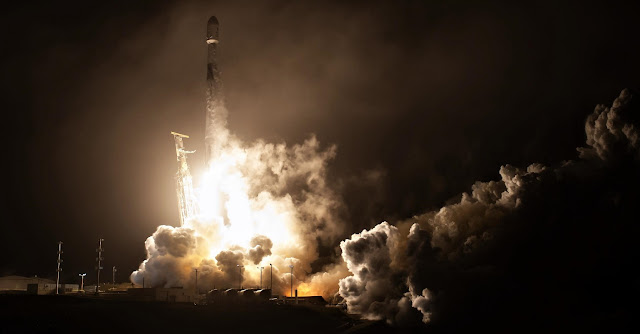
In the overnight hours last night/this morning, SpaceX successfully launched NASA's Dual Asteroid Redirection Test (DART) spacecraft on its trajectory out of the Earth-Moon system into a solar orbit and headed toward the dual asteroid system.  DART is the world’s first planetary defense test mission.  Right on time at 0621 UTC (10:21 PST or 1:21 AM EST on the 24th over here), Falcon 9 B1063 lifted off from Vandenberg Space Force Base's SLC-4E on its third mission, reaching orbit about eight minutes later.  

A few seconds after that, B1063 successfully landed on drone recovery ship Of Course I Still Love You.  DART was the first interplanetary NASA mission launched on a flight-proven commercial rocket and the Falcon 9 vehicle’s first interplanetary launch.  Falcon Heavy launched Elon Musk's Tesla to Mars, and while the two strap on boosters and the core stage are essentially Falcon 9s, those were not considered to have been the same as this one.  Whatever they like. 

Around 28 minutes after liftoff, Falcon 9’s orbital second stage fired up for the second and final time. In just 53 seconds, Falcon 9’s upper stage accelerated from a stable velocity (relative to Earth’s surface) of 7.5 kilometers per second (4.7 mi/s) to almost 11.1 km/s (6.9 mi/s), sending DART (and itself) from low Earth orbit (LEO) to an Earth escape trajectory that will ultimately leave them in orbit around the sun. 

SpaceX provided their usual video coverage, but it started a few minutes longer before liftoff to include a few minutes of presentations on DART. 

DART (NASA's mission page) is the first time people have attempted to change the orbit of an asteroid.  The key is in the name Dual Asteroid Redirection Test: DART is headed for a dual asteroid, and is intended to smack into the smaller asteroid (Dimorphos) orbiting a larger one (Didymos) under power.  

“If DART succeeds, NASA anticipates it will be able to observe a slight 1.5% change in Dimorphos’ orbital period (how long it takes to orbit Didymos) with Earth-based telescopes. Perhaps one day – building upon DART, follow-up reconnaissance mission HERA, and other asteroid missions like Hayabusa2 and OSIRIS-REx – NASA and other space agencies will team up to develop a fleet of planetary defense spacecraft that can intentionally redirect asteroids that threaten Earth, preventing catastrophic impacts like the one that likely wiped out 75% of species and virtually all nonavian dinosaurs around 66 million years ago.”

Teslarati.com — November 23rd, 2021

Basically, it's the movie Armageddon turning into reality, except for the mission being unmanned, so no Bruce Willis equivalent and no live video as it's going on.  Well, it's a test of the concept; Dimorphos and Didymos are no threat to Earth. 

The Dimorphos/Didymos system is in solar orbit relatively close to Earth, and the mission is going to complete between September 26 and October 1, 2022; under one year from launch.  

Final words to Teslarati's Eric Ralph:

Given that CEO Elon Musk’s entire motivation for founding the company and pursuing spaceflight was to help make humanity multiplanetary and protect against mass-extinction events like those that befell the dinosaurs, it’s only fitting that SpaceX ultimately won NASA’s DART launch competition and sent the DART spacecraft on its way to Dimorphos as part of the first true planetary defense test in history.


As is usually the case, I'll be taking off tomorrow for our annual family gathering in South Florida with my brother and his extended family.  Friday we'll be back, and I'll be smoking a turkey for us. That ordinarily doesn't affect my ability to look up something interesting.

In the meantime, a happy and healthy Thanksgiving to you and yours!


Tuesday, February 18, 2025

How is NASA Facing the DOGE Days?

Eric Berger at Ars Technica has a headline today that caught my eye: "By the end of today, NASA’s workforce will be about 10 percent smaller" - subtitled "A dark and painful day at a space agency that brings so much light and joy to the world."  As is generally the case, Berger presents the facts in a balanced view of the situation.  

For openers, he quotes a number from NASA itself that between the headquarters its 10 field centers, the agency employs "nearly 18,000 civil servants."  Then he goes on to say:

However, by the end of today, that number will have shrunk by about 10 percent since the beginning of the second Trump administration four weeks ago. And the world's preeminent space agency may still face significant additional cuts.

There's no update to the source article on ARS, which they often do, nor do I see any news about this on a few of the NASA sites I visit regularly or NASASpaceflight dot com, so I assume there were no announcements about a layoff or Reduction In Force today.  Still, all that means is that maybe instead of "by the end of today..." it could have been "by the end of this week."

Berger addresses what seems to be a natural question: how many people leave NASA in a typical year, and says that number is around one thousand.  He says his sources tell him 750 people have taken the eight month severance pay layoff, which is a sizeable chunk of that 1,000.  A 10% RIF of 18,000 people, or 1800, is only slightly bigger than that 750 added to the 1000 per year, but I don't assume those are two different groups and that there might be sizeable overlap between the 750 the typical 1000 resignations per year.  

The culling of "probationary" employees will be more impactful. As it has done at other federal agencies, the Trump administration is generally firing federal employees who are in the "probationary" period of their employment, which includes new hires within the last one or two years or long-time employees who have moved into or been promoted into a new position. About 1,000 or slightly more employees at NASA were impacted by these cuts.
...
However, the cuts may not stop there. Two sources told Ars that directors at the agency's field centers have been told to prepare options for a "significant" reduction in force in the coming months. The scope of these cuts has not been defined, and it's possible they may not even happen, given that the White House must negotiate budgets for NASA and other agencies with the US Congress. But this directive for further reductions in force casts more uncertainty on an already demoralized workforce and signals that the Trump administration would like to make further cuts.

I think all of us who have worked in industry have been through layoffs, widespread (like in the 1980s) or just in a company that got into troubles of their own doing.  Layoffs suck.  Are the cuts necessary? 

It is also clear that, as within other federal agencies, there is significant "bloat" in NASA's budget. In some areas, this is plain to see, with the space agency having spent in excess of $3 billion a year over the last decade "developing" a heavy lift rocket, the Space Launch System, which used components from the Space Shuttle and costs an extraordinary amount of money to fly. In the meantime, the private launch industry has been running circles around NASA. Similarly, consider the Orion spacecraft. This program is now two decades old, at a cost of $1 billion a year, and the vehicle has never flown humans into space.

One could go on. Much of the space community has been puzzled as to why NASA has been spending on the order of half a billion dollars to develop a Lunar Gateway in an odd orbit around the Moon. It remains years away from launching, and if it ever does fly, it would increase the energy needed to reach the surface of the Moon. The reason, according to multiple sources at the agency when the Gateway was conceived, is that the lunar space station would offer jobs to the current flight controllers operating the International Space Station, which is due to retire in 2030.

Part of what DOGE has been all about is looking at things that seem to only exist to funnel money between politicians and contractors. "Create jobs" with cost-plus contracts, like the SLS he talks about. An even worse example is the Lunar Gateway Berger mentions.  Created to keep the jobs for the current ISS flight controllers it becomes obsolete the minute Starship's Human Landing System version becomes operational.  It’s not entirely clear, but NASA reportedly wanted to land just 400 lb of cargo, while the crewed Starship is probably capable of landing tons of cargo in addition to several astronauts. Why do they need the Gateway to stage people and cargo if the HLS can carry it all?

In recent years, NASA has been in the midst of a difficult transition. The agency deserves a lot of credit for nurturing a commercial space industry that now is the envy of the world. But as part of this, NASA has been moving away from owning and operating its rockets, spacecraft, and other hardware and buying services from this commercial space industry. This transition from traditional space to commercial space marks an important step for NASA to remain on the cutting edge of exploration and science rather than trying to compete with US industry.

What was a bit shocking to me - although it shouldn't have been - was reading some of the comments.  I didn't read many, maybe only a dozen out of the nearly 400 a little while ago, but the TDS and the Elon Derangement Syndrome were stunning.  The comments were either hatred of those two in particular, hatred of "rich people" in general, pro-union or pro-communist. 

The old saying about every comment taking away an IQ point sure seemed to be applicable there.

NASA’s OSIRIS-REx spacecraft collects a sample from the asteroid Bennu. NASA's superpower is its capacity to dazzle us. Credit: NASA/Goddard/University of Arizona