Wednesday, July 12, 2023

The 'Methalox' Race is Over - China Won Today

For the past several years, there has been talk about a race to put the first methane/oxygen - fueled rocket payload into orbit.  The talk has largely been about SpaceX's Starship, ULA's Vulcan, Blue Origin's New Glenn and the outlier, Relativity Space's Terran-1.  None of those companies has made orbit although Relativity's contender came the closest.  It had to; it was the only one that launched and staged. 

No matter.  The race is over.  China's Zhuque-2 rocket successfully achieved orbit after launching from the Jiuquan Satellite Launch Center in the Gobi Desert on Tuesday (July 11) at 9 p.m. EDT (0100 GMT or 9 a.m. local time on July 12).  The Zhugue-2 was developed by a company as "commercial" as a Chinese company can get, called Landspace.  The US Space Force confirmed Chinese reports that the methane-fueled rocket made it to orbit, according to a Twitter report by astrophysicist and satellite tracker Jonathan McDowell. 

It was a milestone effort for Zhuque-2, which suffered an anomaly during its debut flight on Dec. 14, 2022. Beijing-based Landspace issued a statement [note: it's in Chinese - SiG] shortly thereafter confirming that the second stage of the rocket was lost (along with a clutch of satellites) and that an investigation would ensue to find the cause, which has not yet been released.

There are different reasons for pushing toward methane/LOX fueling.  As is always the case in engineering, there are tradeoffs of methane vs other fuels, all of them using liquid oxygen (LOX) as the oxidizer.  In terms of specific impulse, methane isn't as high (good) as hydrogen, but it's easier to handle because it's liquid at much warmer temperatures ("warmer" here is relative - the boiling point is -260 F, hydrogen's is -423 F).  The difference is enormous in practice; methane can be passively cooled while hydrogen requires active cooling and still tends to get out of the tank.  In addition, hydrogen can embrittle many metals and cause cracks to form.  It also leaves less residue than kerosene (rocket propellant 1, or RP-1) that the Falcon 9 uses.  While methane is considered a "greenhouse gas" (see the hubbub over cattle farts), it's cleaner than RP-1, which is what turns flight proven Falcon 9s look black.

Finally, methane is easier to produce on Mars than the other common fuels, and the purpose of Starship is first and foremost to allow flights to Mars making it the slam dunk choice for the Raptor engines.


 Zhuque-2 lifts off from the Jiuquan Satellite Launch Center.  CNSA Watchers on Twitter 


Tuesday, July 11, 2023

Blue Origin BE-4 Engine Exploded During Test June 30

It came to light today, by a report on CNBC, that a BE-4 engine under final Acceptance Testing before delivery to United Launch Alliance exploded during the engine's test.   

During a firing on June 30 at a West Texas facility of Jeff Bezos’ space company, a BE-4 engine detonated about 10 seconds into the test, according to several people familiar with the matter. Those people described having seen video of a dramatic explosion that destroyed the engine and heavily damaged the test stand infrastructure.

The people spoke to CNBC on the condition of anonymity to discuss nonpublic matters.

The engine that failed was scheduled to complete test this month and then be shipped to ULA for use on the second Vulcan Centaur being assembled for launch, currently estimated to be in second quarter of '24. 

“No personnel were injured and we are currently assessing root cause,” Blue Origin said, adding “we already have proximate cause and are working on remedial actions.”

The company noted it “immediately” made its customer ULA aware of the incident.

ULA's President and CEO, Tory Bruno issued a statement via Twitter implying that he wasn't particularly concerned about the failure, saying that there's a progression of tests that are done during development with the final qualification test being the final word on the design.  The BE-4 is already qualified so this is regarded as a failure of an assembly during production test which could happen to any manufactured item.  This is why production acceptance testing is done.  That's not unreasonable.

Blue's statement with the term proximate cause seems to be saying they know the cause of this explosion and adds they have not completed a root cause analysis.  That's important.  The difference could be saying, for example, that the proximate cause is that some particular valve malfunctioned, and the root cause might be that a previous test step wasn't adequate to find the failed valve or that in some engines, the operating conditions extend beyond the specifications for the valve.  In the first case, the solution might be to redesign the previous tests; in the second, the solution could be to re-specify the valve.  Either one could impact the cost of the engines or the amount of time required to build and test a BE-4. 

The BE-4 engines, of course, are to be used on Blue Origin's own New Glenn heavy lift rocket and neither ULA's Vulcan Centaur or the New Glenn have flown yet.  Bruno is scheduled to talk to reporters about Vulcan Centaur on Thursday (July 13).  Blue Origin has recently declined to provide a new target launch date for New Glenn. 


Monday, July 10, 2023

And the New Record Has Been Set

As expected the latest SpaceX record, for the 16th successful flight and landing of booster B1058 (the 206th landing) was achieved this morning in their usual gloriously routine and boring way from liftoff through parking orbit with the landing included.  Every step called exactly as expected and when expected.  Full video here.

Screen capture from the end of the video.  

The launch time moved around after Saturday night's post.  Originally, it had been set for 4:36 AM ET on Sunday the 9th (0836 UTC).  While I was writing that post, it moved to 8:36 PM ET on the 9th or 0036 UTC on the 10th.  Yesterday, while waiting for the coverage to start it moved again, to 11:58 PM on the 9th, 0358 UTC on the 10th.  This was reported to be in response to weather in the area. 

The launch went on time at 11:58 last night.  The trajectory was to the southeast, 43 degree inclination angle, and the 22 V2-Mini satellites were deployed a little over an hour after launch, raising the total number of Starlink satellites launched to 4768 - note that is not the number of operational satellites in the constellation, although it's close.  Satellites that don't pass their first tests on orbit are re-entered and destroyed, plus there was a group of 40 lost due to a solar storm in February of '22.

While only 22 of the V2 mini-satellites were launched, these are able to provide up to 4x more capacity than the older versions of the satellite. The Starlink network now has over 1.5 million users, so the increased capacity is needed while they bring the Starship program up to speed which will eventually launch the larger full-size V2 Starlink satellites.

Finally, in Saturday's post, I identified this booster as 1049 based on some previous posts.  Teslarati calls it 1058 and cross-checking that number against my posts seems to agree.  There seems to be more reason to call it 1058 than 1049.  I'm going to assume I was wrong and it really is 1058.  


Sunday, July 9, 2023

In The Words of the Old Song

"People say believe half of what you see,
son and none of what you hear."  
Heard it Through the Grapevine - Marvin Gaye
and covered by many others (my fave)  

I don’t know about you, but I grew up with that saying, and hearing things that might or might not be true “through the grapevine” or rumor mill was an everyday experience in public schools before the age of smartphones and social media.  Considering the need for that caution has exploded with the rise of both, I feel strange for saying this but that common sense statement seems to have fallen out of general knowledge.  How many times have you heard that some “Tik Tok challenge” is killing people or otherwise causing problems?  I heard about another one this morning – jump out of a moving boat into the water, feet first.  Gee, going 40 mph in a boat is easy to jump out of, but doing 40 in a car on the road isn’t?  The root problem is people believing what they see, instead of thinking that the Tik Tok “influencer” pushing the challenge is faking the whole thing for clicks.   

Another great example was embedded in a meme a week ago in the wake of the historic supreme court decision against affirmative action.

This person had attracted a lot of attention for absolutely insane tweets like that one; it’s so stereotypical of the perception of a brain dead liberal that some readers just have to respond to it.  Some real investigative reporters (by which I mean not like me) started looking into the account and were pretty quickly threatened with a lawsuit.  Not by “Erica Marsh”, but by a guy named Michael Zachrau associated with a company in Belgium.  A Search Engine Optimization company whose business is “Social Selling.”  The story showing the evidence that Erica Marsh doesn’t exist and was a made-up person, created solely for the purpose of getting attention; re-tweets, replies, and creating controversy was posted on Townhall by Monday.  

By the end of the week, Matt Vespa and the guys involved in investigating the troll bot account had compiled a lot more information.

It turns out that this isn’t the only bot account that they have.  On Thursday, Irish posted this meme of two completely made-up bot accounts, as you can tell by comparing the text they tweeted.  

Entirely fabricated to create rage and get mad people to engage with the bot. 

There’s much more information in the two Townhall articles, but the main points are what I started with: “believe half of what you see and none of what you hear.”  Maybe, for social media, we ought to go with “believe none of what you see, and even less of what you hear.”  Or that other old saying, “if something seems too good to be true, it probably isn’t.”  Or too bad to be true, as in these cases.  Make sure kids know the saying and get the idea.

Which brings to mind another meme going around this week.

I understand that people have come to hate Bill Gates, but when I first heard of malaria in the states I thought of the millions of illegal immigrants that have been flooding into the country.  Importing mosquitoes is pretty damned easy, and the immigrants themselves have to be considered a source.  Most of them are from countries where malaria is more common than the US.  They all were bussed or otherwise trafficked through areas where malaria is more common than in the US.  It seems to me to be the first place to look.  Mosquitoes don’t cause malaria, they carry it from one place to another.  This tweet implies that the mosquitoes are creating the organism that causes malaria, a plasmodium (sorta like an amoeba but not one), which is a heck of a genetic modification.  Disclaimer: I had the undergrad classes about this damn-near 50 years ago.  There was no genetic engineering then.

I can’t prove it either way, but it sure seems easier to me to believe the millions of illegal immigrants brought the disease. 


Saturday, July 8, 2023

SpaceX to try for New Record Sunday

Stop me if you've heard this before, but SpaceX is looking to set another record tomorrow (Sunday) evening.  Since pretty much every launch is a new record for consecutive flights, I need to add the record will be flying booster 1049 for its 16th mission.  As far as I can tell from my previous posts, B1049 is their fleet leader that first flew back on the Crew-2 demo flight that flew Bob Behnken and Doug Hurley to the ISS.  That was SpaceX's first manned flight.  There is one other booster that made it to 15 flights, and a few that have launched 14 times, but this is the first attempt to go for a 16th flight.  Considering they had a goal of 10 flights, it might be they inspected the boosters as completely as they can and said, "let's go for 20."

The mission is to lift another group of Starlink satellites into orbit.  In the progression of Starlink missions we see various numbers of satellites, depending on which version of the Starlink satellites are being lifted.  This mission is carrying 22 and by that number we know they're not the same hardware as when the number is 52. 

The 22 satellites are apparently "V2 Minis," a newer and more powerful version of SpaceX's broadband craft. They're actually bigger than the previous Starlink iteration, about 50 of which can fit on a Falcon 9. But they're "mini" compared to the final V2 satellites, 1.25-ton (1.1 metric tons) spacecraft that will launch aboard SpaceX's giant, next-gen Starship vehicle.

"V2 minis include key technologies — such as more powerful phased array antennas and the use of E-band for backhaul — which will allow Starlink to provide ~4x more capacity per satellite than earlier iterations," SpaceX said via Twitter in February.

Also back in February, I added this explanation:  E-band is an imprecise designation; it covers 60 to 90 GHz.  Atmospheric attenuation (loss of signal strength) is worst at 60 GHz and drops quite a bit by 80 GHz (see chart here, for example), which ordinarily means it's a good frequency band to use for satellite-to-satellite in space (what they mean by backhaul), not so much for downlink to the ground.  That also means it's much harder for someone on the ground to intercept that E-band link.  There's lots more information on the V2 Minis in that February post link.  

For the last several days, Next Spaceflight has listed the launch time in the early morning; the Space.com link has that at 4:36 a.m. ET (0836 GMT).  While looking up a link for live coverage of the launch, I was rather surprised to see it has been moved to 8:36 p.m. ET (0036 UTC on July 10).  The video link can be accessed at SpaceX's missions page here, via SpaceX's channel on YouTube, or embedded at Space.com.  

A night launch of a Falcon 9.  It's from Vandenberg SFB, not CCSFS but it's a pretty picture. SpaceX photo.


Friday, July 7, 2023

Turning a Metaphorical Corner

We're on the good side now.  Two astronomical events happened this week that give us signs the summer is going away.  I know there are some of you in the more northern reaches of the world who respond with the opposite reaction to mine, but we're on the good side of the analemma.  I've been saying for years that here in Florida, we're almost completely out of phase with the rest of the US; this time of year, those of you in Minnesota, and most northern places are getting out and enjoying the warmer weather.  For me, we're staying inside more.  The sun wants to kill us; staying inside under the air conditioning is better.  That's the thing about fourth of July barbecues, and I've done my share.  I think the best barbecue season is around January through April.  

Getting back to the astronomical events, the easy one to document is that yesterday, Thursday (July 6) at 4:06 p.m. Eastern Daylight Time (2006 GMT), the Earth went through aphelion - the farthest distance from the sun that it will be all year.  The sun at that moment was 94,506,364 miles from our Earth (measured from center to center), or 3,103,330 miles farther than when the Earth is closest to it (called the perihelion) on Jan. 4.

There are some people who reflexively will be saying, "wait... it's the hottest days of the year.  The press is saying it has been the hottest days EVAH, and we're the farthest away from the sun?  Shouldn't it be the coolest?  Well, no.  Bear in mind it's winter in the southern hemisphere now and what makes the biggest difference in the seasonal temperature isn't the distance from the sun, but the 23.5 degree inclination of the Earth's rotational axis to the plane of our orbit.  During our summer, the sun is farther north in both hemispheres.  It's higher in the sky in the northern hemisphere and lower in the sky for the southern hemisphere.  The relative size of the land masses in the northern versus southern hemispheres make our summers hotter and winters cooler, too.    

The other event is that, as measured just to the minute, the week of the latest sunset of the year also ended  yesterday, July 6.  The week of the latest sunset, 8:23 PM here, started on June 29.  Yesterday it clicked back to 8:22.  The days are getting shorter.  Slowly at first, then faster as we approach the equinox in September, but nevertheless, the good trend has started.  I'm under no delusions that the weather is going to get nicer tomorrow, next week, or next month.  Typically, next month is the roughest month of the year, but we're headed there.  

BTW, I can't provide a reference for this because I get the sunrise/sunset times from an app on my phone.  The exact time of those two is going to depend on exactly where you are, down to far decimal places in both latitude and longitude.  Your days for the start and end of the latest sunsets and their times will vary from mine.  From what I see, the app agrees with the numbers my local NWS forecasts provide but I don't know of a site that provides a calendar of the year or the month with sunrise/sunset times on it.   

How the inclination of Earth's axis causes the seasons. - By Tauʻolunga - Wikipedia


Thursday, July 6, 2023

A Follow On

Yesterday's post talked briefly (since it had just happened) about the final flight of the European Space Agency's Ariane 5.  There's a larger story lurking there that I didn't get to, which is that the ESA is, at best only temporarily, unable to launch anything.  

Their own development programs are stalled and won't be available until 2024 at best.  They're unable to go to Russia's Roscosmos, and apparently have no agreements with China.  Consequently, they're depending on SpaceX for the foreseeable future. 

The Ariane 5’s successor, Ariane 6, is still in development and appears increasingly unlikely to be ready for its inaugural launch before 2024. The Soyuz is no longer available in Europe after Russia’s invasion of Ukraine in February 2022. The Vega C remains grounded after a December 2022 launch failure, and its return to flight, previously planned for late this year, is facing delays after an anomaly during a static-fire test June 28 of that rocket’s Zefiro 40 motor

A partial workaround exists for the Vega C launches; a portion of the Vega C manifest could be launched on the less-powerful predecessor than the troubled C version, and they're arranging to build more of the older Vegas and resume launches in September, but for the bigger payloads there simply are no other options than SpaceX.  The ESA has talked about a reusable rocket called Themis, clearly patterned after the Falcon 9, but the first launches aren't even talked about as before 2028.

A year ago (to the day), I did a background story on what appears to be a developing European Rocket Industry, but while startups such as Isar Aerospace and Rocket Factory Augsburg are working on small launch vehicles whose first flights could take place before the end of the year, none of them are flying yet, let alone flying regularly.  

In October of '22, the ESA announced it was moving two missions to Falcon 9; last week's launch of the Euclid space telescope and the Hera mission to the same asteroid pair (Didymos and Dimorphos) that the DART mission crashed a probe into last September.  The launch window for Hera is a short period in October of '24.  I'm taking the bet that more missions will be moving to Falcon 9.  

At a June 29 briefing after a meeting of the ESA Council, the agency announced that the Earth Clouds, Aerosols and Radiation Explorer, or EarthCARE, mission that has been moved from Soyuz to Vega C last October would instead likely fly on Falcon 9 in the second quarter of 2024. 

There are more moves in process.  The ESA has a fleet of navigation satellites, like the US's GPS, called Galileo.

At the same briefing, ESA officials said they were also in discussions with SpaceX for the launch of up to four Galileo satellites on Falcon 9 vehicles. “We are moving ahead with negotiations to conclude hopefully soon with SpaceX,” said Javier Benedicto, ESA’s director of navigation. That is contingent on concluding the negotiations with SpaceX as well as securing approvals from the European Union and its security agreement with SpaceX.

The Falcon 9 payload fairing with the logos of ESA and the Euclid spacecraft, in the days before last Saturday's launch from SLC-40 at the CCSFS.  Credit: SpaceNews/Jeff Foust.

When you consider the versatility and the reliability of the Falcon 9, coupled with the twice-a-week launch cadence that SpaceX is striving for, there really is no alternative in the world.  As someone commented recently, "when it absolutely, positively has to be in orbit ASAP." 


Wednesday, July 5, 2023

Small Space News Story Roundup 12

The flight of the last Ariane 5

The powerful Ariane 5, the heavy-lift workhorse of the European Space Agency, lifted off today at 6:00 PM Eastern, or 2200 UTC from French Guiana for its final flight ever.  Overly long mission video here (will start about 37 minutes into the video at t-10 seconds - WARNING: a lot of French is spoken - there is commentary in English as well). 

The mission carried two communications satellites, the Syracuse 4B, a communications satellite for the French military, and the Heinrich Hertz for Germany, aimed at experimenting with some new technologies for satellite in space to individual users on the ground.  

Both satellites were said to deployed nominally.  

The Ariane 5 has an impressive history dating back to 1997, including some version upgrades along the way (and excluding the first two missions which "had issues").  Its replacement, Ariane 6 has been having some issues getting started as well. 

Rocket Lab's next launch will include booster recovery

After the HASTE mission from Virginia, Rocket Lab announced the next mission from their Launch Complex 1 in New Zealand.  Carrying seven satellites for three different customers, the launch is No Earlier Than July 14th (no time specified, yet).  This will be the seventh mission of this year and their 39th overall.  In commemoration of the attempt at recovering the first stage, the mission is called, "Baby Come Back" - you can stop singing that any time now. 

You can see that they're building up to the launch after this one, their 40th Electron launch.  They're apparently seeking help in coming up with a name for that, with the Twitter hashtag, #WhatShouldWeCallNumber40.

NASA will fly four CubeSats dubbed the Starling mission and will test technologies for future multiple spacecraft missions. This small swarm of satellites will test in-space communications, navigation, and maneuvers between the spacecraft. Proving out this technology will allow NASA to apply these capabilities to future swarm satellite constellations on future missions.

Spire has two 3U CubeSats on board which will carry Global Navigation Satellite System Radio Occultation (GNSS-RO) payloads. These two satellites will be used to replenish the fully deployed constellation of more than 100 multipurpose satellites. The satellites provide global weather intelligence that is used to improve the accuracy of forecasts. Spire is the largest producer of GNSS-RO data.

The final satellite payload on this mission is the Telesat LEO 3 demonstration satellite. Built by Space Flight Laboratory. the LEO 3 satellite will replace the decommissioned LEO 1 satellite and allow Telesat to continue its test campaign of the Telesat Lightspeed constellation.

(I did a double take on Starling instead of Starlink)

Rocket Lab uses a rather different approach to recovering their Electron than SpaceX perfected with the Falcon 9.  After stage separation, the booster will use reaction control thrusters to keep it oriented properly and pointed in the right direction - not grid fins.  There are no additional engine burns like the F9, so no 20 second (-ish) entry burn and no engine burn until touchdown.  Instead, they rely on those thrusters to keep it oriented optimally and then deploy a parachute.  Instead of landing on a drone ship, it will splash into the Pacific and then be retrieved by a ship. 


Tuesday, July 4, 2023

Happy Independence Day - 2023

I've run this post almost every July 4th in the 13 years I've been blogging.  There were only two years I didn't and both of those posts were about problems that must have seemed really big but that are still here (20122014).  My lesson is that while they were important, the big picture is to remind ourselves of the history, and enjoy the day with family and friends.  The problems will still be here on the fifth. 

IN CONGRESS, JULY 4, 1776

The Unanimous Declaration of the Thirteen United States of America 

When, in the course of human events, it becomes necessary for one people to dissolve the political bands which have connected them with another, and to assume among the powers of the earth, the separate and equal station to which the laws of nature and of nature's God entitle them, a decent respect to the opinions of mankind requires that they should declare the causes which impel them to the separation.

We hold these truths to be self-evident, that all men are created equal, that they are endowed by their Creator with certain unalienable rights, that among these are life, liberty and the pursuit of happiness. That to secure these rights, governments are instituted among men, deriving their just powers from the consent of the governed. That whenever any form of government becomes destructive to these ends, it is the right of the people to alter or to abolish it, and to institute new government, laying its foundation on such principles and organizing its powers in such form, as to them shall seem most likely to effect their safety and happiness. Prudence, indeed, will dictate that governments long established should not be changed for light and transient causes; and accordingly all experience hath shown that mankind are more disposed to suffer, while evils are sufferable, than to right themselves by abolishing the forms to which they are accustomed. But when a long train of abuses and usurpations, pursuing invariably the same object evinces a design to reduce them under absolute despotism, it is their right, it is their duty, to throw off such government, and to provide new guards for their future security. --Such has been the patient sufferance of these colonies; and such is now the necessity which constrains them to alter their former systems of government. The history of the present King of Great Britain is a history of repeated injuries and usurpations, all having in direct object the establishment of an absolute tyranny over these states. To prove this, let facts be submitted to a candid world.

He has refused his assent to laws, the most wholesome and necessary for the public good.

He has forbidden his governors to pass laws of immediate and pressing importance, unless suspended in their operation till his assent should be obtained; and when so suspended, he has utterly neglected to attend to them. 

He has refused to pass other laws for the accommodation of large districts of people, unless those people would relinquish the right of representation in the legislature, a right inestimable to them and formidable to tyrants only. 

He has called together legislative bodies at places unusual, uncomfortable, and distant from the depository of their public records, for the sole purpose of fatiguing them into compliance with his measures. 

He has dissolved representative houses repeatedly, for opposing with manly firmness his invasions on the rights of the people. 

He has refused for a long time, after such dissolutions, to cause others to be elected; whereby the legislative powers, incapable of annihilation, have returned to the people at large for their exercise; the state remaining in the meantime exposed to all the dangers of invasion from without, and convulsions within. 

He has endeavored to prevent the population of these states; for that purpose obstructing the laws for naturalization of foreigners; refusing to pass others to encourage their migration hither, and raising the conditions of new appropriations of lands. 

He has obstructed the administration of justice, by refusing his assent to laws for establishing judiciary powers. 

He has made judges dependent on his will alone, for the tenure of their offices, and the amount and payment of their salaries. 

He has erected a multitude of new offices, and sent hither swarms of officers to harass our people, and eat out their substance. 

He has kept among us, in times of peace, standing armies without the consent of our legislature. 

He has affected to render the military independent of and superior to civil power. 

He has combined with others to subject us to a jurisdiction foreign to our constitution, and unacknowledged by our laws; giving his assent to their acts of pretended legislation: 

For quartering large bodies of armed troops among us: 

For protecting them, by mock trial, from punishment for any murders which they should commit on the inhabitants of these states: 

For cutting off our trade with all parts of the world: 

For imposing taxes on us without our consent: 

For depriving us in many cases, of the benefits of trial by jury: 

For transporting us beyond seas to be tried for pretended offenses: 

For abolishing the free system of English laws in a neighboring province, establishing therein an arbitrary government, and enlarging its boundaries so as to render it at once an example and fit instrument for introducing the same absolute rule in these colonies: 

For taking away our charters, abolishing our most valuable laws, and altering fundamentally the forms of our governments: 

For suspending our own legislatures, and declaring themselves invested with power to legislate for us in all cases whatsoever. 

He has abdicated government here, by declaring us out of his protection and waging war against us. 

He has plundered our seas, ravaged our coasts, burned our towns, and destroyed the lives of our people. 

He is at this time transporting large armies of foreign mercenaries to complete the works of death, desolation and tyranny, already begun with circumstances of cruelty and perfidy scarcely paralleled in the most barbarous ages, and totally unworthy the head of a civilized nation. 

He has constrained our fellow citizens taken captive on the high seas to bear arms against their country, to become the executioners of their friends and brethren, or to fall themselves by their hands. 

He has excited domestic insurrections amongst us, and has endeavored to bring on the inhabitants of our frontiers, the merciless Indian savages, whose known rule of warfare, is undistinguished destruction of all ages, sexes and conditions. 

In every stage of these oppressions we have petitioned for redress in the most humble terms: our repeated petitions have been answered only by repeated injury. A prince, whose character is thus marked by every act which may define a tyrant, is unfit to be the ruler of a free people. 

Nor have we been wanting in attention to our British brethren. We have warned them from time to time of attempts by their legislature to extend an unwarrantable jurisdiction over us. We have reminded them of the circumstances of our emigration and settlement here. We have appealed to their native justice and magnanimity, and we have conjured them by the ties of our common kindred to disavow these usurpations, which, would inevitably interrupt our connections and correspondence. They too have been deaf to the voice of justice and of consanguinity. We must, therefore, acquiesce in the necessity, which denounces our separation, and hold them, as we hold the rest of mankind, enemies in war, in peace friends. 

We, therefore, the representatives of the United States of America, in General Congress, assembled, appealing to the Supreme Judge of the world for the rectitude of our intentions, do, in the name, and by the authority of the good people of these colonies, solemnly publish and declare, that these united colonies are, and of right ought to be free and independent states; that they are absolved from all allegiance to the British Crown, and that all political connection between them and the state of Great Britain, is and ought to be totally dissolved; and that as free and independent states, they have full power to levy war, conclude peace, contract alliances, establish commerce, and to do all other acts and things which independent states may of right do. And for the support of this declaration, with a firm reliance on the protection of Divine Providence, we mutually pledge to each other our lives, our fortunes and our sacred honor.

~~~~~~~~~~~~~~~~~~~~~~~~~~~~~~~~~~~~~~~~~~~~~~~~~~~~~~~~~~~~~~~~~~~

I would have highlighted portions that I think are particularly apt today, but the whole thing would be highlighted.  

Enjoy your day.  To those who serve - and have served - to provide this gift of liberty for us:  Thank You from the bottom of my heart.


Monday, July 3, 2023

Peripatetic Monday

Wandering around*, trying to find something space-related that's interesting enough to devote a post to, I stumbled across some interesting stuff.  Not the usual space news, but "close enough."  

It started with a headline on Space.com that we had a solar X-Ray flare over the weekend.  “Sun blasts out powerful X-class solar flare causing radio blackouts on Earth (video)”  I'm kind of automatically interested in things from the sun that might affect radio propagation (in either a bad or good way) and, in fact, had spent Saturday afternoon in the VHF spectrum trying to hear something new.  While my corner of the country was pretty dead, there were enough reports from scattered around the US showing the whole thing wasn't completely shut down.  

So off I went to try to find out about this radio blackout.  My first stop was the NOAA Planetary K-index website because the K-index measures the Earth's magnetic field and will show storms at a glance.  Instead, I found this:

This was puzzling.  There's no indication here of any sort of geomagnetic storm at all.  It was pretty much dead quiet.  That doesn't sound like a major storm that could cause radio blackouts.  How big was this X-class flare and when was it?  Off to SpaceweatherNews.com.

Ah ha!  The flare was just before midnight UTC on July 3 (8PM on the 2nd ET), and looks like it just barely exceeded X1.0 (in that red oval) - which is undeniably an X-class flare, but not a "serious" flare.  To get auroras visible down to Texas, say (most of which is quite a bit north of me), takes a flare of X8 to X10.  Re-reading the original source from Space.com (first link) called it X1.07.  

Still, this doesn't sound like much of a flare, so finally to the website that has offered the most information on solar activity continuously, SpaceWeather.  They provide details that fill in the picture. 

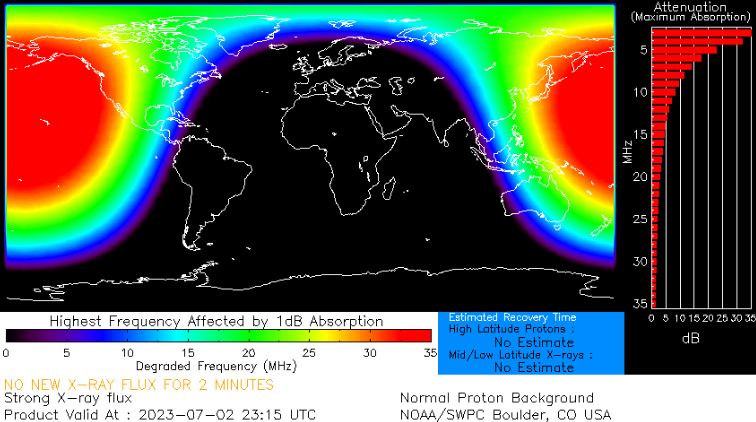
'Tis the season for fireworks. On July 2nd (2314 UT), giant sunspot AR3354 exploded, producing a long duration X1-class solar flare. NASA's Solar Dynamics Observatory (SDO) recorded the extreme ultraviolet flash:

Radiation from the flare ionized the top of Earth's atmosphere. This caused a deep shortwave radio blackout over western parts of USA and the Pacific Ocean: map. Mariners and ham radio operators may have noticed loss of signal and other propagation effects for 30+ minutes after the flare.

Those shortwave blackouts they describe are generally much more intense at lower frequencies, below 10 MHz and often not detectable without tuning below 5 MHz.  

An interesting side note to this is that while this flare lasted long enough to cause a Coronal Mass Ejection, it didn't produce one.  The SOHO satellite coronagraph images show no sign of a significant CME.  The flare's position out toward the limb would have most likely ensured that if there had been a CME, it would have missed us.  

Finally, while at SpaceWeather I noticed an interesting graphic and article that say the month of June, 2023 has posted the highest smoothed sunspot number since cycle 23 in 2002.  The highest number in 21 years.

Solar Cycle 25 wasn't expected to be this strong. When it began in Dec. 2019, forecasters believed it would be a weak cycle akin to its immediate predecessor Solar Cycle 24. If that forecast had panned out, Solar Cycle 25 would be one of the weakest solar cycles in a century.

Instead, Solar Cycle 25 has shot past Solar Cycle 24 and may be on pace to rival some of the stronger cycles of the 20th century. The last time sunspot numbers were this high, the sun was on the verge of launching the Great Halloween Storms of 2003, which included the strongest X-ray solar flare ever recorded (X45), auroras as far south as Texas, and a CME so powerful it was ultimately detected by the Voyager spacecraft at the edge of the solar system.

I've posted about this many times: the predictions of Dr. Scott McIntosh at the National Center for Atmospheric Research (NCAR) and his research partner Bob Leamon of the U. Maryland-Baltimore County started out completely opposite of the mainstream predictions for cycle 25.  While some were predicting a solar minimum and the mainstream forecast it as weak as cycle 24 (which was the weakest cycle in 100 years), McIntosh and Leamon predicted it would be stronger.  They were scoffed at and derided by colleagues but the reality of cycle 25 is much closer to McIntosh and Leamon's predictions than the others.  

Dr. McIntosh has done a presentation on the cycle progression for a ham radio group that I'm in every six months or so.  His next update within a few weeks and I should be able to post an update right after that.


*Not quite "wandering around behind the little animals" as the famous old song said, but still just web-wandering.


Sunday, July 2, 2023

A Repost - My Favorite Junk Science Post

Full explanation: I subscribe to the substack "Unsettled Science" by author Nina Teicholz, and today got an email that a new post was up called, "Canceling the Science on Saturated Fats."  The point of the post was a reference to an article in the Washington Post by columnist Tamar Haspel who wrote, “Don’t Believe the Backlash: Saturated Fat Actually is Bad for You.”  Nina is particularly familiar with this because of her research that lead up to her 2014 book, "The Big Fat Surprise" which dove into how this argument just doesn't hold up the closer we look at it. 

But that's not where I'm going here.  The email got me thinking about junk science in general, which I have written tons about.  Which led to me going through old posts and reminding myself of what I consider one of, or perhaps my single most favorite junk science article.  Hey, it's a slow news day and the middle of a four day weekend for lots of folks. So here's the favorite post from August of 2019 - with a word or two changed here and there to help it read better.

The Secret of the People Living Past 100 

Full disclosure: I make fun of junk science for a bunch of reasons, but one of the reasons is I'm one of the people who has been harmed by junk science.  In a nutshell, I follow the same sort of ketogenic lifestyle that Karl Denninger talks about, except I rarely talk about it, but it's not worth the column space to get into my story since that's not the point.  

Doubtless, though, if you pay attention to the "he-who" junk science health studies that we're bombarded with in the media, you've heard of the Mediterranean Diet.  You've heard the mythical stories of how people from that area live longer, have less heart disease and, well, the whole story.  Have you ever asked if there really is such a thing as one Mediterranean diet?  After all, the countries on the Mediterranean stretch from the ones you've probably read about - rural French, Italian and Greek - to Spain, Albania, Turkey, Slovenia, Israel, Egypt, Syria, Libya, Algeria and more, a stretch of coastlines that must go over 8,000 miles.  Are their diets really identical or even all that similar?  How much do they have in common?  Are they really that much healthier and live that much longer?

One of the terms that gets buzz is Blue Zones.  There's a handful of these zones which produce the most per-capita supercentenarians—the oldest of the old, the longest lived of the longest lived—in the world.  A few are in the Mediterranean like Sardinia and Ikaria, but Okinawa also gets a lot of press.  They get celebrated for their diet and lifestyle, and used as examples for what we should all be doing. 

An interesting paper that is out in preview took a look at what the longest lived populations have in common.  I get the inline quotes here not from the study, but from a weekly email I get from a guy named Mark Sisson.  Mark is 64 these days but was formerly a very high level competitive athlete.  He devoted his second career to repairing the damage he did to his body trying to compete and is now best known as the owner of business that makes so-called paleo diet products. 

Red wine consumption didn't predict supercentenarianism.

Legume consumption didn't predict it.

The presence of hills didn't predict it.

It turns out that a strong predictor of super-longevity is the absence of detailed birth records.

That's right - the best predictor of super-longevity is living someplace where there's no records of when people were born!

Wait - it gets better.

In the United States, whenever a state introduced birth certificates, supercentenarianism miraculously dropped by 69-82%. A full 82% of all supercentenarians on record in the U.S. were "born" before birth certificates were used. Only 18% have birth certificates; only 18% of American supercentenarians can actually be verified. Oops.

In Okinawa, Sardinia, and Ikaria, the strongest predictor for regions with high reported supercentenarianism was high crime, low income, and low life expectancy relative to the national average. Ninety-nine percent of male Italian centenarians smoke. Hundreds of thousands of Japanese centenarians are actually dead or missing. These aren't what you'd expect. Oops again.

Gee, the strongest predictor of longevity is living in high crime, low income and low life expectancy areas compared to the rest of the nation?  That seems completely backwards from everything we know about poverty being a substantial health risk.  And that's not even touching the report that 99% of Italian centenarians are smokers.  Something very strange is going on here. 

The conclusion of the paper is that the primary causes of reported supercentenarianism in these countries are pension fraud and reporting error.

Sorry, but this literally made me laugh out loud.  They're not measuring longevity, they're measuring fraud.  This is the quality of science we get out the medical junk science world.  This is what diet advice is being based on.    

(Verified Italian supercentenarian Maria Giuseppa Robucci (20 March 1903-18 June 2019)) 


Saturday, July 1, 2023

Euclid Starts Its Trip - and Gives Us the QoTD

As we talked about on Monday, the European Space Agency's Euclid telescope was launched this morning at 11:11 AM ET, right on time, on a Falcon 9 flying only its second mission.  

Euclid is an infrared telescope like the Webb, but since it's smaller than Webb (and smaller than Hubble), it can't have the resolution (ability to optically separate sources that are close to each other) or the sensitivity that the "big brothers" provide.  Still the telescope will observe billions of galaxies during its six-year survey of the sky, measuring their shapes and positions going back 10 billion years, more than 70 percent of cosmic history.  

Led by the European Space Agency, the Euclid mission has the ambitious goal of helping astronomers and cosmologists learn about the properties and influence of dark matter and dark energy, which are thought to make up about 95 percent of the Universe. The rest of the cosmos is made of regular atoms and molecules that we can see and touch.

From Henk Hoekstra, a professor and cosmologist at Leiden Observatory in the Netherlands anxiously waiting for the data from Euclid to start pouring in, we get the quote of the day, “It’s very difficult to find a black cat in a dark room, especially if there’s no cat.” 

The current "standard model" of cosmology postulates the existence of "dark matter" we can't see and an even more obscure "dark energy" that's filling space.  The ideas for dark matter and energy came from observations of galaxies; how they rotate and how the stars are distributed.  Astronomers eventually concluded that there had to be far more stars in galaxies than could be seen, to provide the gravitational attraction to hold everything together the way the stars are distributed. 

All the atoms in the universe only make up about 5% of its total contents. The rest is dark matter and dark energy. Dark matter, which is about 27% of the contents of the universe, provides the gravitational foundation for building galaxies and galaxy clusters. The large-scale structure of the universe is produced by dark matter, but we still don’t know what it’s made of. Dark energy, making up the remaining 68% of the universe’s contents, causes the expansion of the universe to accelerate. The push-pull of dark matter and energy are what makes the universe look the way it does, so understanding exactly what these mysterious substances are and how they work is a major challenge of modern cosmology. 

Together, dark matter and energy as currently envisioned say that 95% of our Universe is something that's totally invisible to us.  The stars, planets, and everything else we can see are the other 5%.  Together, dark matter and energy have been called, “[the] biggest embarrassment that we have currently in cosmology.”

Data pouring in?  

Euclid is expected to downlink about 100 gigabytes of compressed data every day, and over the course of its mission, will produce more than 100 petabytes of information after automated processing at nine ground-based data centers, said Gaitee Hussain, head of the science division at the European Space Agency. 

That's from a 600-megapixel visible light camera, a 64-megapixel near-infrared camera and a spectrometer. 

Euclid will take about a month to reach its L2 orbit and another few months for equipment checkouts after that. 

The regions Euclid will survey during its six-year mission, totaling about 36% of the sky.  ESA Graphic

Scientists say it would take Hubble hundreds of years to complete the same extra-galactic survey as Euclid, which will cover in a week the same area of sky that Hubble has observed in its 33-year mission.

Think of Euclid versus Webb or Hubble as a wide angle lens versus a telephoto.  As is often the case in photography, knowing which lens to grab for a picture makes all the difference.   


Friday, June 30, 2023

Mars Ingenuity Helicopter Phones Home

NASA's JPL team controlling the Perseverance rover and Ingenuity helicopter reported today that they successfully received an update from the rover on June 28; 63 days from the last contact.  I'd imagine it was somewhat nerve-wracking that the last contact was before the 52nd flight of the little helicopter, so no one on Earth knew if the flight was successful.  It's pretty clear that loss of contact was expected and the controllers knew they would be out of contact with Ingenuity for a while.

The 52nd flight of NASA’s Ingenuity Mars Helicopter is now in the official mission logbook as a success. The flight took place back on April 26, but mission controllers at NASA’s Jet Propulsion Laboratory in Southern California lost contact with the helicopter as it descended toward the surface for landing.

The Ingenuity team expected the communications dropout because a hill stood between the helicopter’s landing location and the Perseverance rover’s position, blocking communication between the two. The rover acts as a radio relay between the helicopter and mission controllers at JPL. In anticipation of this loss of communications, the Ingenuity team had already developed re-contact plans for when the rover would drive back within range. Contact was re-established June 28 when Perseverance crested the hill and could see Ingenuity again.

The goal of that 52nd flight was to reposition Ingenuity in a place that Perseverance was driving toward with the expectation that once the rover established radio contact with the helicopter, communications would become more routine.  It was a trip to a spot about 1200 feet away, taking 139 seconds to fly that far.

Back when I last talked about Ingenuity being out of contact for six days, I was under the impression that the little helicopter was expected to not be out of contact much longer and absolutely not to be out of contact 10 times longer than that six days.  I'll take the blame for not understanding that was going to be the norm for the expedition.  

“The portion of Jezero Crater the rover and helicopter are currently exploring has a lot of rugged terrain, which makes communications dropouts more likely,” said JPL’s Josh Anderson, the Ingenuity team lead. “The team’s goal is to keep Ingenuity ahead of Perseverance, which occasionally involves temporarily pushing beyond communication limits. We’re excited to be back in communications range with Ingenuity and receive confirmation of Flight 52.”

They're so excited to be back in communication with Ingenuity that the first thing they mention is that Flight 53 might be within days.  The target is what appears to be a good place to land to the west of the current location.  The team plans to perform another westward flight from that interim location to a different base of operations near a rocky outcrop the Perseverance team is interested in exploring. 

NASA’s Ingenuity Mars Helicopter was captured by the Perseverance rover’s Mastcam-Z on April 16, not long after the rotorcraft’s 50th flight. The helicopter would soon fall silent for 63 days due to hilly terrain that interrupted communications between the rover and aircraft. Credit: NASA/JPL-Caltech/ASU/MSSS


Thursday, June 29, 2023

Virgin Galactic Aces First Commercial Flight

Virgin Galactic's first commercial launch lifted off from New Mexico's Spaceport America at 10:30 a.m. ET (1430 GMT) this morning.  As a reminder, the mission is in an air-dropped space plane, VMS Unity, that flies to suborbital space after being dropped by the airplane carrying it, VMS Eve.  Unlike the Virgin Orbit carrier, a Boeing 747, VMS Eve is a Burt Rutan-designed airplane built by Scaled Composites, with a dual fuselage that carries the Unity under the center wing.

Virgin Galactic’s SpaceShipTwo vehicle VSS Unity, separated from its VMS Eve mothership aircraft at about 11:29 a.m. Eastern above cloudy skies in southern New Mexico. The vehicles took off from Spaceport America at 10:30 a.m. Eastern.

Unity, flying a mission designated Galactic 01, fired its hybrid rocket motor for approximately 60 seconds. It reached a peak altitude of 85.1 kilometers before gliding to a runway landing at the spaceport at 11:43 a.m. Eastern. [52.9 km - SiG]

The Galactic 01 mission was a research flight for the Italian Air Force and Italy’s National Research Council.  The Italian Air Force called the mission Virtute 1, so you may see that name for the flight as well.  

[The mission] carried Col. Walter Villadei and Lt. Col. Angelo Landolfi of the Italian Air Force and Pantaleone Carlucci of Italy’s National Research Council. The three planned to conduct 13 experiments during the mission, ranging from biomedical data collection to microgravity studies of fluid mechanics and combustion.

In a press conference after the flight, the three Italians said they were pleased with the flight. “It was much better than expected,” Villadei, who commanded Virtute 1, said. He noted the crew was able to carry out all their planned experiments.
...

VSS Unity was flown by Mike Masucci, making his fourth spaceflight, along with Nicola Pecile, a former Italian Air Force pilot who now works for Virgin and was on his first spaceflight.

As the infomercials say, "but wait!  There's more!"  In addition to those five, there was a sixth person on board.  Colin Bennett, a Virgin Galactic astronaut trainer who had previously flown on VSS Unity in 2021, was also on board.  His role was to monitor the research environment during the flight and “do a holistic evaluation of the research mission so that we can continually improve on the experience,” according to Sirisha Bandla, VP of government affairs and research operations at Virgin Galactic, in a preflight interview yesterday.

Italian Air Force Col. Walter Villadei (with microphone) speaks at Spaceport America after his Galactic 01 suborbital spaceflight. Image Credit: SpaceNews/Jeff Foust 

This is expected to be just the beginning.  The next mission is scheduled for NET August, a time interval largely dedicating to inspecting Unity at a very fine level of detail.  Virgin Galactic says that hundreds of people have booked a ride aboard the ship at a price (most recently) of $450,000 per seat.  They expect to conduct flights once per month after August and are developing a next generation "Delta Class" vehicle that will be able to fly weekly.  

After the Delta vehicles come online, which is slated to begin happening in 2026, Virgin Galactic could potentially carry customers to space every day, from a variety of sites around the globe. 


Wednesday, June 28, 2023

Centaur Has to Go Back to the Shop

When I was a kid, almost everyone knew that when the TV wasn't working the bad news was when the repair tech couldn't fix it and would have to say, "the set has to go back to shop."  Just like that, the TV was going away and no one knew when it would be back.  No TV!   

Today we learned the Centaur upper stage for the first Vulcan Centaur test flight has to go back to the shop.  In the last update on the Vulcan's failure investigation two weeks ago, it wasn't clear that they were going to do this, but they made the decision to do the same fix to this Centaur as they're doing to newly made ones.  I honestly don't know why they didn't just say this would be the case two weeks ago.  

In a statement, ULA described the work needed on the Centaur V upper stage as “minor reinforcement at the top of the forward dome,” or the uppermost section of the liquid hydrogen tank. The changes will add strength to the tank, which contains super-flammable fuel chilled to minus 423° Fahrenheit (minus 253° Celsius).

Since it's impossible to tell by looking at a picture whether that Centaur stage on the right is going up or down, I should tell you the pic was taken back in February when it was on the way up.   ULA Photo

The failure analysis after the March explosion of the Centaur test article showed that was ultimately caused by a liquid hydrogen leak on the forward bulkhead of the Centaur V upper stage.  That hydrogen found an ignition source and that's all it took. 

“The super thin, high performance steel skin needs to be a little thicker near the top of the dome,” tweeted Tory Bruno, ULA’s chief executive. The steel walls of the Centaur upper stage’s pressure-stabilized propellant tanks are as thin as 0.02 inches, or half a millimeter, in some places.

It's not impossible that this Cert-1 flight could take place before the end of this year, but the two flights required to certify Vulcan Centaur for US Military National Security payloads will extend well into '24.  The Vulcan booster or first stage has passed all of its qualification tests, with the successful Flight Readiness Firing earlier in the month.  The payloads for this flight, Astrobotic's Peregrine lunar lander and a pair of test satellites for Amazon's Kuiper constellation are also ready and waiting for launch.  Ironically, the Centaur that's getting modified here is the oldest part of the design, or at least has the longest history.  This Centaur V is a larger, updated, twin-engine version of the Centaurs that have flown on 268 missions since 1962. 


Tuesday, June 27, 2023

SpaceX Moves One Step Closer to IFT2

Granted, I don't know how many steps there are before the second Integrated Flight Test, after the April 20th 1st test, but five days after last Wednesday's cryo testing, yesterday was an important milestone: a six engine, six second static firing of Ship 25.  Endless video loop here.  What appears to be moments before the start is here. (Six seconds is a SWAG - SiG)

Today, Ars Technica gave a bit of rundown on a few of the “well over a thousand” changes Elon Musk claims have been made to the Starship and Super Heavy itself as well as the Orbital Launch Mount or OLM.  We talked about one of the biggest changes, staging differently last week as well.  

SpaceX is adding an extension to the top of the Super Heavy booster with vents to allow super-hot gas from the upper stage engines to safely flow out of the rocket’s structure “and not just blow itself up,” Musk said. “This is the most risky thing, I think, for the next flight.”

Probably the next big change in this area is changing from the mechanical thrust vector control (TVC) of the older Raptors on the IFT1 to all of the Raptors on Booster 9 having the electrically driven TVC.  They've also added stronger shielding around each of B9’s 33 Raptor engines to protect them from explosions of nearby engines, a measure intended to reduce the chance of cascading failures. 

For the Starship’s second test flight, SpaceX teams are modifying manifolds on the Raptor engines that direct hot methane-rich gas toward each engine’s combustion chamber for mixing with oxygen-rich gas. The previous design was susceptible to leaks, where the hot gas could seep through bolt holes used to attach the manifold to the engine. Engineers will introduce an improved manifold design and add more torque to bolts to address the concern about leakage of super-heated gas.

Then there's the ground infrastructure, what Musk calls Stage Zero.  If you've watched any of the update videos, you've seen them adding many rebar cages for poured concreted deep under the OLM.  In addition, they've poured nearly 1,000 cubic meters of concrete underneath the launch pad’s pedestal, and over the steel-reinforcing cages.  

SpaceX will install two thick steel plates on top of the new layer of reinforced concrete, with channels routed through them to allow water to flow through and shoot out the top.

“Think of it like a gigantic upside-down shower head,” Musk said. “It’s basically going to blast water upwards while the rocket is over the pad to counteract the massive amount of heat from the booster.”

These few changes clearly aren't even 10% of the changes to the system if it's really over a thousand of them.  The big ones concern really understanding the rocket; “resolve the unknowns” that remain, many of which can’t be fixed until engineers gather data from an actual launch.  Reality brings that nagging reminder that they need to go through the process of getting FAA approval of their Flight Termination System again, since it took longer than expected to destroy the vehicle during the first IFT. The "longer than expected" time to work wasn't an issue since the vehicle was 24 miles above the Gulf of Mexico  and nowhere near a populated area.  That might not matter to the FAA at all. 

Musk acknowledged Saturday that it may not be up to SpaceX when the next Starship test launch happens. “There are a lot of variables here that are outside of our control.”


Monday, June 26, 2023

ESA's Euclid Telescope to Launch Saturday

This Saturday morning, July 1, at 11:11 ET or 1511 UTC, the European Space Agency's Euclid space telescope will take a ride to orbit on a SpaceX Falcon 9 from SLC-40 at Cape Canaveral SFS.  

I've only just barely touched on the Euclid telescope, once back in October of '22.  Euclid is headed for the L2 LaGrange Point (graphic of the LaGrange points), where the James Webb Space Telescope is deployed and a growing number of satellites seem to use.  It was originally scheduled to ride a Soyuz 2.1 rocket, until the Russian invasion of Ukraine when the ESA cancelled the contract.  The selection of SpaceX over the ESA's own Ariane 6 is due to the issues they're having with that booster. 

On October 20th, European Space Agency (ESA) director Josef Aschbacher announced that the ESA will contract with SpaceX to launch two important science probes, the Euclid telescope and Hera, a multi-spacecraft mission to a near-Earth asteroid, after all domestic alternatives fell through. The move was due to delays in qualifying the Ariane 6 booster.  

Euclid is a small near-infrared space telescope that has been in development since the early 20-teens.  It is to be launched to the same Earth-Sun Lagrange point as the James Webb Space Telescope, L2.  The Webb is a much broader spectrum instrument from near infrared out to far infrared wavelengths, so they're not competitors; more like extra capability out at L2 for the near-infrared spectrum.  

The other mission, Hera, is considerably more ambitious.  Hera’s mission is to orbit around the near-Earth asteroid Didymos and study the impact crater on its smaller partner, Dimorphos, created by the DART mission. Hera has a short, 17-day launch window in October of 2024.

This will be the 2nd furthest mission SpaceX has initially launched, behind only the DART mission back in November of '21, which was sent 11 million km to intercept the asteroid moon Dimorphos.  By the launch of Hera in another 16 months, we'll find out how that distance compares.

The ESA's mission website offers this, that I'll use for the closing words. 

Euclid is designed to explore the evolution of the dark Universe. It will make a 3D-map of the Universe (with time as the third dimension) by observing billions of galaxies out to 10 billion light-years, across more than a third of the sky.


Sunday, June 25, 2023

Again, I Got Nothing

Let the day get away from me and don't even see any news to go with, so some filler as I usually do.  

Judging by the car, this isn't very old.  Maybe late 60s. 

And this one is widely quoted as true and real.


Saturday, June 24, 2023

SpaceX Changing the way Starship Stages

In a rare Saturday news item, Elon Musk today confirmed that the next test flight of the Starship/Super Heavy combination would use a different staging method than they've been designing for.  

In an online discussion with Bloomberg journalist Ashlee Vance on Twitter, the social media company Musk owns, he said that SpaceX had recently decided to switch to a “hot-staging” approach where the Starship upper stage will ignite its engines while still attached to the Super Heavy booster.

“We made sort of a late-breaking change that’s really quite significant to the way that stage separation works,” Musk said, describing the switch to hot staging. “There’s a meaningful payload-to-orbit advantage with hot-staging that is conservatively about a 10% increase.”

While I can't think of a launch vehicle I've watched that uses the technique, Space News points out that Russian launch vehicles have been using this approach "for decades."  I'll take that to mean that it might be in use on other vehicles around the world as well.  Instead of the way we see it done routinely: cut off booster engines, drop the booster, start the upper stage, this will start the second stage while the first stage is still attached.  They can save a few seconds of flying without having thrust, but I've never timed one. 

That makes me wonder how that can be done and still keep the first stage reusable. 

Musk said that, for Starship, most of the 33 Raptor engines on the Super Heavy booster would be turned off, but a few still firing, when the engines on the Starship upper stage are ignited. Doing so, he said, avoids the loss of thrust during traditional stage separation, where the lower stage shuts down first.

Doing so requires some modifications to the Super Heavy booster. Musk said SpaceX is working on an extension to the top of the booster “that is almost all vents” to allow the exhaust from the upper stage to escape while still attached to the booster. SpaceX will also add shielding to the top of the booster to protect it from the exhaust. 

Musk also acknowledged this might be the riskiest change for the next launch - now generally referred to as around the start of August (Elon Standard Time).  We've seen Booster 9 (B9) before but the top of the booster didn't look any different than other boosters seen so far.

Besides the stage separation, Musk said they've made a “tremendous number” of other changes to the vehicle, “well over a thousand.”  We've heard of many changes to the Orbital Launch Mount itself, the water deluge system and its "steel sandwich" construction, as well as actual tons of concrete.  He pointed out that the engines are different but not in the kind of detail I'd like to see; which would have something like a count of how many of which version are flying, and the more descriptive the better.  He referred to the booster flown in April as using a “hodgepodge” of engines, but there's no more detail on the engines on B9.   

Starship on the first Integrated Flight Test, April 20th.  SpaceX photo.