In the World of the High Tech Redneck, the Graybeard is the old guy who earned his gray by making all the mistakes, and tries to keep the young 'uns from repeating them. Silicon Graybeard is my term for an old hardware engineer; a circuit designer. The focus of this blog is on doing things, from radio to home machine shops and making all kinds of things, along with comments from a retired radio engineer, that run from tech, science or space news to economics; from firearms to world events.
Sunday, March 16, 2014
A Change of Perspective
Like any other topic that touches on politics, people argue about who's really responsible, but Nixon was the idiot in the White House who actually took the US off the gold standard. But Nixon was backed into a corner and had almost no choice. He might have stayed on the gold standard and had to weather a financial storm, but remember this was just a few years after the country was erupting in riots and cities were burning over the war, or anything. The dollar was being squeezed by other countries concerned that US deficit spending was out of control, that LBJ's "guns and butter" policies had caused a surge in US borrowing and since the dollar was redeemable for gold, France and other countries started to demand payment in gold bars. LBJ is remembered for his profligate spending on the Great Society programs, but also for stepping up the war in Vietnam. So much for those who say deficit spending can't happen on a gold standard. It can. It just usually doesn't get to the levels we see today because nobody will buy the bonds. Our recent governments make LBJ and his congress look like rank amateurs.
OK, that's a done deal. We've been without a standard for over 42 years. At that moment, gold was $35/ounce. Today's price was $1382/ounce. What does that mean? It simply means that people with gold were willing to accept 1382 slips of paper and ink for it. Tomorrow, they could decide there is no number of slips of paper they'd trade an ounce of gold for; or they could decide to accept a $20 bill for a one ounce "$20" coin. Very probably neither one of those will happen. Right now, the world is clinging to stability. Financial talking heads will say "but gold doesn't pay dividends" and "gold doesn't grow". The problem is that the dollar isn't growing in value, either. The value of the dollar is shrinking. This inflation effects everything. Everything. Let's start with gold itself. This chart, from 2011, shows the price of gold corrected to 1971 dollars. Gold was around $1600 when this chart was made, but corrected for the persistent inflation the Federal Reserve cranks into the economy, you can see it's nowhere near its all time high from the 1980s (and I believe that's somewhat an artifact of the whole post-gold world starting so close to 1980).
The trick here is to turn your thinking upside down. If this is a standard, what's really happening is that gold is worth what it's worth, and that people who hold gold are willing to accept a certain number of slips of paper for it. Today, people are accepting paper that's worth a tiny fraction of what that paper was worth in 1971, so they want a lot more of those slips of toilet paper.
Real growth is unusual; at least in large amounts. Even without knowing your personal situation, it's a safe claim that virtually everything you have that you think has grown in value is just seeing the effect of inflation. And without getting too personal, I'll show some examples from my life. When I bought this house in 1984, gold was $350/oz. (this chart says that's about average for the year) so the house cost about 157 ounces of gold. Today, 157 ounces are worth $217,000. While I don't know what the house's market value is today, it sure isn't that. I'd guess it's about 60% of that, meaning it has lost 40% of its value compared to gold. If you talk in terms of dollar prices, though, it has more than doubled. As another example, as I showed on that post Wednesday, a share of the DJIA was 43 ounces of gold in 2000 but only 11.9 ounces this week. If you think your Indexed Stock Fund is worth more than what it was 14 years ago, you're mistaken; it's down about 72% (43-11.9 or 31.1/43). If you haven't made more than 72%, not counting anything you've contributed, you've lost money! How do you prepare for retirement in the face of the DJIA losing that much of its value? Other than saying that's not the place to put your money, I don't know.
Has my pay grown? Using gold as the standard, my first job as an engineer was typical new-grad pay, and in those days it was about 66 ounces of gold per year. In the intervening 30-some years, my pay has gone up in terms of gold; but, regrettably, I'm not paid in terms of my weight in gold.
In my mind, these two facts make sense. In real terms, although we've done work on the house and improved it considerably, it is a 33 year old house. Compared to a new house, more is likely to go wrong with it. And in my mind (at least) I've become more valuable to my employers due to an increase in knowledge, and a tendency to make fewer mistakes. That's what economists used to call "increased productivity".
It has always puzzled me that people expect their houses to automatically be more valuable every year. Remember the great fuss about the numbers of people who are "underwater" on their loans - as if that somehow absolves them from a contract they signed? I think everyone, even the greenest kid, knows when they buy a new car it's worth less than the loan the minute they drive off the lot; why is a house more valuable the minute you sign the contract? It's what I alluded to in Wednesday's post: we've become so accustomed to the "persistent, benign" inflation that the central banks strive for that we think it's the order of the universe. But it hasn't been for almost all of history. Look at this plot of inflation through the last century before the Federal Reserve:
Sure there were periods of inflation and deflation in that 113 years, but the important thing is that it's centered around zero. The expenditures for the civil war were obviously rough, but after the war we took our lumps to pay off war bonds essentially until the end of the century. As a result of that, the Consumer Price Index was relatively constant until the birth of the Federal Reserve. The dollar is now worth about 4% of what it was during the time this chart shows.
The "price" for going on a commodity standard, be it gold, silver, palladium or big stone rings, is that money can't be made up out of nothing. Politicians don't like it because it reduces their ability to get involved in foreign adventures and it reduces their ability to buy votes. Banks don't like it because it makes them need to be more careful. Their profitability isn't guaranteed. You wouldn't have tricks like the Federal Reserve giving banks the money to pay the Fed back the money that they borrowed from the Fed. (yes, I'm afraid you read that correctly). It very likely means that your wages won't necessarily go up every year - but neither will food or energy prices. Prices will more likely effect real market forces, like shortages or surpluses, and that goes for the price of labor. Since your pay really isn't going up in dollar amounts, if your mortgage is a tight payment now, it's likely to stay one, unless you get paid more for being worth more, or get more experience, or somehow become more valuable. And you're probably not going to be able to get a second mortgage to buy more stuff anyway, unless your house truly does become more valuable. (Maybe you live near an oil boom, or your location becomes popular for some reason.) It's a different life.
In other words, the powerful and politically connected won't like it. They have to be more honest and ethical. They love the power to mess with something as critically important as money. So what if those dollar bills are worth less than they should be, as long as they end up with more than other people?
I've said many times, there's nothing inherent in a fiat currency that means it can't work, it just never does. Politicians have to be mature adults, they have to spend within their means, and they have to not debase the currency. They have to treat it with the same deference they'd treat gold or silver or anything else that's valued and limited in availability. That's why it never works. To be fair, though, rulers have messed with commodity standards down through history, too, and made them fail. Neither is unbreakable. Neither is without disadvantage.
Why is this important? When you hear about the loss of the middle class standard of living, this is one of the central causes. The manipulations created by the central banks, the decrease in the value of the dollar to a few percent of what it was in 1913; this is the root cause. It would be a very different world without the central banks, but their role has morphed from protecting the monetary supply to corrupting it in the service of the governments and fellow bankers. Small inflation is good for them, but a "persistent benign deflation" would destroy them. In contrast, I think I'd like the possibility of paying a bit less for energy, food or other necessities every year. That possibility used to exist before the central banks.
A world with a gold standard would require a very different perspective. Could you get used to not making more every year, if everything you bought cost the same, or less? To some degree, people value the illusion of wealth they get from seeing their home price go up in dollars, and they feel wealthy when they see their 401k worth 50% more than it was in 2000. They've never even asked if they've really made money or lost money. But if everything inflated at the same rate: consumer prices, wages and stock prices, no one would have made or lost a cent. Everyone would be exactly as well off as they started. It would be like everyone in the country re-marking every bill in their wallets with a new value twice what it used to be. Everyone would have twice as much money but since everything costs twice as much they'd have exactly the same wealth. Nobody ever asks these questions.
Wednesday, October 5, 2022
The Silver vs. Dollar Meme
Have you seen this one going around? I don't recall where I got it.
It's approximately right, but where it's wrong is embedded right there in the
text; it's just hard to see directly. Note that in the left panel, it says a dollar was four 5.7 gram quarters or 22.8 grams of silver. In the last column it compares what 22.8 grams of silver bought in 1964 to what 31.1 grams buys today which seems to imply the dollar was that 31.1 grams of silver. It's not that it's a nonsensical comparison, it's just that the right column is 36% more silver than the 22.8 grams of silver in the left column, so it's like comparing a 1964 dollar to $1.36. Note that the increased amount of stuff that 36% more silver buys isn't necessarily 36% more of every item, but none of the handful of things they track actually cost more in silver today than in 1964, so their real prices have gone down.
Some years ago, I weighed four pre-1964 quarters on a reloading powder scale and determined they weighed 25 grams. 90% of that was 22.5 grams - it could be the scale was wrong and it could be the coins were worn a bit from being in circulation. After all 3/10 of a gram isn't much, unless you're buying gemstones where it's 1-1/2 carats. (There's a side trip here into Troy ounces - as silver is weighed in - versus common or avoirdupois ounces and I'm going to studiously avoid this.) This went into a spreadsheet where I can tell you what today's value for $1 face value of silver works out to be. With a spot price at the moment of $20.68 per ounce, four of those 90% silver quarters are worth $14.96. Which, of course, means a 90% silver dime is worth $1.50 ($1.496).
The point though is that the dollar has lost its value not that things are more expensive. The dollar buys less because it's worth less - and well on the way to worthless. If you bought things by weight in silver, most prices have gone down.
For the life of this blog, I've been saying that the creation of more money, "monetary stimulation" is going to lead to economic collapse. I've talked about returning to a gold standard many times and I've stressed that it doesn't have to be gold, or silver or the giant stones the people on Yap Island used, but money can't be based on fiat - literally "it's worth something because I say so." Where "I" is the Federal Reserve. There are times I think the entire Federal Government is owned and controlled by the Federal Reserve Banks and not the other way around.
There's an old saying that value of paper money always - always - returns to its intrinsic value, the value of the paper it's printed on. Pretty much zero. Toilet paper? The toilet paper is more valuable, but the fiat bucks will work. The trap that the Fed finds itself in now is that since they've created trillions of dollars, every additional dollar they create is worth less than the one before it (called the marginal utility function). That means they need to create even more trillions to really have an effect. They can raise interest rates to try to crash the economy, but those are words nobody wants to hear. Eventually - I can't tell you when - it has to collapse and the dollar return to the value of paper it's printed on. Or the value of the memory cell in a DRAM module where it exists. It's not actually zero, but it's in the same neighborhood.
Sunday, November 18, 2012
Economics As a Con Game
The complicating thing that makes it hard to predict is that Keynesian economics is a "con game". If other governments lose confidence in the dollar, it's over. On the other hand, if they keep believing in the dollar long after it's reasonable to, I think the global house of cards can stand quite a while. Some debtors will be happy to get the X dollars they're owed - even if those dollars are worth 10% of what they were worth when they signed the deal. They can do that by just digitizing a decimal place or two. Anyone living off savings will be ruined, but - hey! - omelet, eggs, you know the story. Sucks to be the egg.This is an idea that popped into my head fully formed about 35 years ago, during the nasty inflation roller coaster of the 70s. The example that occurred to me was to imagine every talking head getting on TV and saying a recession is coming; if enough people stopped spending because they thought they were going to lose their jobs, that slow down could start a recession. I believe the media and democrats (redundant, I know) tried to do this to Bush 43 - remember "the worst economy since Hoover" campaign? Likewise, if everyone thought inflation was coming and spent ahead, thinking whatever they need won't get any cheaper, they could cause some economic growth. I think some of the growth in the economy today is exactly that: preppers. People buying food and other supplies because they see really bad times coming. How ironic would it be if their preparing for disaster forestalled it! It's one reason Ben Bernanke will look you in the eye and swear things are working to plan and everything is getting better: if people lose confidence in the dollar, it could collapse in minutes.
Disclaimer: I'm probably not being strictly correct in saying "Keynesian economics is a con game" - it's economies that don't depend on a commodity standard, be it gold, silver or the stone rings from Yap Island.
It's a question I've talked about many times before: what's a dollar worth? Exactly what you'll give in exchange for one. No country in the world, certainly, no major economy, is on a gold standard (that "barbaric relic" as Keynes called it). So why does it take about $1.28 to buy a Euro today? The market believes that the Euro, even with the ongoing collapse of several EU economies, is worth more than a dollar. If anything, it shows just how little they think of us. The market doesn't include the devaluation of any currency over long periods of time, it's just "what will you take for that dollar today?". The dollar appreciated in value over the course of the 19th century. Since the Federal Reserve was created, it has declined in value by 95%.
This interdependency of countries and complex dependency on individuals is why it's hard to predict how things will work out in the next few months to few years. Do the collapsing currencies prop each other up, or pull each other down? Does it fail as a cascade? Sort of a giant set of falling dominoes? It's pretty hard for me to believe they'll hold each other up.
As an aside, today was the final gun show before Christmas here in the Silicon Swamp. We didn't need anything in particular, but we dropped by, partly curious to see how busy it would be. The crowd seemed bigger than it did before the election, but it wasn't a turn away crowd. I heard one vendor telling his booth partner it was the busiest hour he has ever had at a show and simply had to sit down. I heard more talk in the aisles about getting ready for trouble. Everyday people who think something bad is coming. And I spent an hour chatting with an engineer I used to work with a decade ago, who was talking about how to store enough food, water and supplies to not have to even open the door and go out for a few months.
Saturday, January 8, 2011
The Conflict of Visions Extends To Your Wallet
Call me Pollyanna.
A little musical interlude might help.
Edit: 1/8/11 2340 The typo monster added one in my equation.
Thursday, November 11, 2010
A Few More Notes on Inflation, and All That
First, when I said that "...one thin dime of junk silver is worth essentially $2", that's saying it wrong. I think most of you know it's more correct to say that the silver has kept its value and the dollar has sunk. That means, of course, that a dollar is worth 5% of what it was when we issued those silver coins. Pure inflation.
It's instructive to look at prices, and your salary, accounting for inflation. There are a lot of web sites which will help you, the trick is getting one that doesn't use the (lying) CPI numbers from the government. I think this method (comparing a dollar in silver coins to today's prices) is a pretty good approach. I did this back in June in Luncheon Counters of the Third Kind. Unfortunately, this method won't do you much good when comparing today's prices to a period well after we went off the gold standard, like the mid-'80s.
The only argument for holding onto silver and gold is that they have historically been valued by people. Their value has never gone to zero. My guess is that they will probably be a medium of trade again. Don't forget that copper pennies from pre-1984 are still in circulation (they're worth about 2 1/2 cents), and nickles are worth about 6 cents in melt value, so they are likely to be devalued soon, too. This website gives you the melt value of coins, up to the minute. These things may also be trade items.
As Brigid says in her comment yesterday, "Think practical. Think barterable. Think provisions." In the novel Patriots, Rawles depicts a flea market that happens several months after their collapse. One character has a Corvette, a ferociously expensive car that has been rendered worthless by events and can't be traded for anything. Not practical.
John Embry, chief investment strategist at Sprott Asset Management and the Sprott Gold and Precious Minerals Fund was interviewed in "The Au Report" this week. His opinion is that the results of the election are unimportant and that the die has been cast for the collapse of the dollar. It will largely be due to the Federal Reserve's QE actions.
TGR: Is it a foregone conclusion that inflation or hyperinflation would lead back into a depression? Will we end up in the same place regardless?
JE: I think we do end up in the same place. There's no example in history that unbridled money creation works to solve any problems; in fact, it usually exacerbates them. I'm not sure it's going to be any different this time because I believe today's financial structure is probably more vulnerable than it's ever been in history. I don't want to get into derivatives and all these various collateralized debt vehicles, but the fact is we've never seen anything like this before. If you try to deflate, that would come to the fore immediately; if you inflate, that just creates a bigger problem later.
So, I'm kind of stuck; I can't see a more positive outcome. I am a great believer in the Austrian School of Economics, and with a hugely excessive debt buildup in the economic system, there's no escaping the consequences. We've had the biggest debt buildup in history, and here we are in consequence time.
TGR: I think everybody agrees about consequence time; it's a matter of the degree of pain.
JE: If you went the tough route initially, you'd go through a lot of pain but you'd probably come out the other end sooner and save your currency. Now, if you go the unlimited QE route—or, as my friend Jim Sinclair puts it, "quantitative easing to infinity"—the currency will be destroyed. When that happens, you unleash an immense amount of inflation in your system; and, in that situation, people lose all their rudders. There's nothing to hang onto when your money's value is destroyed. I worry about social unrest; but in the end, you've got to clean the system out anyway.
JE: That's why I am extraordinarily bullish on gold. Either way, gold will be all right because it's a tangible asset—a hard asset that's existed through centuries. The hardest point to get across is that gold isn't what's changing. Gold is gold. It's been around for thousands of years, recognized as money by most societies. What's changing is the current paper-money experiment.It's pretty straightforward. If you stay in the paper assets: stocks, bonds, dollars, your money will be de-valued away. The way to preserve your worth is in things people value or must have. Food, survival items, probably precious metals. Brass, copper, and lead. This is a pretty old story. It's a sad story, because it didn't have to be this way.
Without exception, paper money is always devalued in the end and always ends up worthless. We've got a long way to go, but we're definitely en route to that ultimate conclusion. So, it's not gold that's changing; it's the value of the paper money in which gold is valued; that's why the price of gold is going up.
Tuesday, December 27, 2011
Could the US Return to a Gold Standard?
“That if any of the gold or silver coins which shall be struck or coined at the said mint shall be debased or made worse as to the proportion of fine gold or fine silver therein contained, or shall be of less weight or value than the same ought to be pursuant to the directions of this act, through the default or with the connivance of any of the officers or persons who shall be employed at the said mint, for the purpose of profit or gain, or otherwise with a fraudulent intent, and if any of the said officers or persons shall embezzle any of the metals which shall at any time be committed to their charge for the purpose of being coined, or any of the coins which shall be struck or coined at the said mint, every such officer or person who shall commit any or either of the said offences, shall be deemed guilty of felony, and shall suffer death.” –Chap. 16 , Section 19 of the Coinage Act of 1792, passed by the United States Congress on April 2, 1792. (source)While driving home the other day, I heard Dick Morris talking about presidential politics. Nothing new there; this is the guy who helped get Bill Clinton elected, then had "an awakening" and became a conservative. He was talking about Ron Paul in this instance, calling him an "appalling <blank>hole", then ripping Dr. Paul a new one for advocating a return to the gold standard. His rip was classic "barbaric relic" rhetoric, about how we got off the gold standard because it "held our economy back", and "the US economy shouldn't depend on some miner in South Africa" succeeding in a gold mine. Just look at the increase in wealth since we got off the gold standard!
Then he went on to add a disclaimer that, sure, Bernanke has printed too much money and the Fed was troublesome, but "there's a big gap between abstention and alcoholism" and we simply need to be somewhere between those two limits. (That's his actual quote, as best as I can recall).
For a little necessary background, the term "barbaric relic" for gold is from John Maynard Keynes himself, and has been widely parroted by those opposed to a "real money" standard. "Seriously, Muffy, no civilized, advanced society need be bound by having actual, physical, gold, must they? Why, gold is what caused the Spanish to rape and pillage South America, the pursuit of El Dorado, after all!" To keep this down under a million words, I won't get into Ron Paul or any of the other candidates' politics: that's not the point of this.
The point of this is "could we go back on a gold standard"? (and when I say gold standard, understand it could be any commodity that people value; anything but fiat paper that can be printed in infinite amounts). Perhaps the place to start is the converse, why did the world go off the gold standard? From where I sit, they did that so that government spending, and therefore government, could grow essentially without limit. Is that a good thing? As one of my heroes, the (now-retired) Mogambo Guru once put it,
Whether or not this theory is true, I don’t know, but I don’t think so, as I have never read anything like, “From the moment that the government started creating and spending large amounts of money, everything got better and better, and the more money that was created for the government to spend, the better things got, until they reached Utopia and everybody lived happily ever after.”If we were on a gold standard, we would need to spend less - but we wouldn't necessarily have to balance the budget. Some debt - my rough guess: 20% of GDP - would be possible, as long as other nations and people felt that the interest we paid was reasonable and they were confident they'd get it back. The free market would have to set interest rates, not Helicopter Ben (or his ilk). You can bet your butt our interest rates would be much higher and the monetary shenanigans the Fed creates wouldn't be possible. In turn, that means it would be harder for the government to fund wars or an ever-growing entitlement state; the quantity of gold would have to expand to increase the money supply. Increasing our money supply – the thing that Morris thinks has improved the economy – has (IMO) led to the gradual decline of the middle class.
Buried in Morris' assumptions is that if we go back to the gold standard, we go back to the 1972 dollar, but why would that be? We could declare a dollar to be worth any amount of gold we wanted between 1972's $35/ounce and today's number of dollars divided by the amount of gold we have. In other words, 1972's $35/oz - meant each dollar bill was backed by 1/35 oz of gold. According to Wikipedia, the US claims 147.2 million ounces of gold in Ft. Knox. The amount of dollars in circulation is harder to know, but there are some available estimates of that, called the M1 money supply. If we simply divided the 2.2 trillion dollars in the M1 money supply by the amount of gold in Ft. Knox, that would bring the price of gold to $14,900 per ounce, so each dollar would be backed by 1/14,900 of an ounce (around 2 milligrams). I have seen writers suggest that the M1 supply is drastically under reported; that would increase that $14,900 price. Likewise, if there is less gold in US hands, that also acts to increase the price - which reduces the amount of gold behind each dollar. I'm sure you've heard the people who speculate that there is no gold in Ft. Knox and the Fed took it all. That would make gold almost unobtainable in dollars.
Gold at about $15,000/oz. would shake the jewelry business to its core, making gold only practical for plating, if that, and making platinum, palladium and silver the jewelry metals. (I'm sure you've seen rhodium plated items, often considered cheap jewelry, but rhodium costs about as much as platinum). Platinum is currently cheaper than gold; they crossed this past summer (IIRC) for the first time I can recall. The market for scrap gold, the rings and things that people have and just keep for no particular reason, would probably drop well below that price as the supply would spike like crazy - as would theft of gold jewelry. There are still many industrial uses for gold; it's used in electronics for plating contacts of many kinds, in optics, and dental work, of course. Electronics would either increase in price, or alternatives would be found - probably less reliable alternatives. I believe the price of gold would cascade into the other metals, too, but can't predict how much they'd go up.
Backing the dollar with $15,000/oz gold wouldn't affect today's prices in fiat dollars, like going to $35/oz gold would. It wouldn't scale prices to 1971 levels; your $250,000 house wouldn't suddenly be priced at $583 (the same ratio as 35/15000). I think that sort of disruption is what people opposed to the gold standard are thinking of. If we said dollars had to be backed at $35/oz of gold, we'd either have to drastically multiply our supply of gold (not bloody likely) or drastically decrease the number of dollars. That would be quite a disruption. But any move in the direction of a new standard would cause disruptions world wide - and guess what? they're happening already.
Note that we haven't devalued the dollar with respect to 1972, we just pegged it in place to the current supply of gold we have. Devaluing the dollar from being backed by about 900 milligrams of gold to 2 milligrams is what the Fed has been doing since we got off the gold standard, and ultimately since their formation in 1913. The dollar has about 3% of the value it had when the Federal Reserve started. While it's true (as Morris said) that Bernanke has been printing too much money, the majority of that decrease in value, percentage-wise, was long ago and was handed to Bernanke by Alan Greenspan. When the full series is plotted, you see that the dollar is worth about 5 cents in 1913. When you look at this plot, you can see that Bernanke has decreased the value of the dollar, but most of the damage was done by his predecessors. This is one of the arguments against what Dick Morris said.
So when Dick Morris or anyone says our economy has grown since 1972, has it really grown, or is it just inflation - the same as devaluing the dollar? Another aspect of the Fed's action and the way the government reports statistics is that it's harder to tease this information out. Inflation has the effect of making the economy look better and the country look richer, while it's actually robbing the people. You have more dollars, but more are required to buy what you need. This appearance of a growing economy is what the government wants, though – the better to fool you with. Most people don't think of this: they see their house price is up, or the Dow is hovering around 12,000 and never think that without the last year's inflation alone, the Dow would be about 11,000.
One way to measure whether or not wealth is actually increasing or if you're just seeing inflation is to divide GDP by the population: normalize GDP per capita. Porter Stansberry's research group produced this chart of an inflation adjusted GDP per capita. It shows that the per capita GDP went down drastically during the 70s (Nixon and Carter) with a strange, but short, reversal in about 1977 and slowly increased until around 9/11/01 (through Reagan, Bush 1 and Clinton). Since the middle of Bush 2's term, wealth has been in a nose dive and is now the lowest it has ever been.
Stansberry's graph only extends back to about 10 years before the final death of the gold standard, not to the start of the Federal Reserve Bank. Nevertheless, it completely disproves Morris' statement that getting off a gold standard has led to increased wealth.
This plot is an example of one of the most important ideas in economics, the marginal utility function. The simple idea here is that if you have one dollar, another dollar is very useful; but if you have a billion dollars, the next dollar doesn't have much utility – and that's the hole that Bernanke finds himself in now. He has flooded the world with dollars, and there simply isn't much more utility in the next dollar being created. The next round of QE – whatever they call it – can't be as useful as the first one. Which wasn't very useful.
It has been said that an ounce of gold buys today about what it did at any point in the past. Stephen Harmston, former economist at Bannock Consulting, wrote that “across 2,500 years, gold has retained its purchasing power, relative to bread at least” which is seemingly proved when one considers that “It is said that an ounce of gold bought 350 loaves of bread in the time of Nebuchadnezzar, king of Babylon, who died in 562 BC” which is roughly what it buys today, a stretch of 2,500 years. With some judicious selection of the exact brand of bread, you get remarkably close to 350 loaves (and I'm sure there was some variation in what a loaf of bread cost even in King N's day). Likewise, you'll hear that an ounce of gold would buy a good toga and sandals in pre-Christian Rome, and buys a well-tailored suit and shoes today, or you'll hear that a $20 gold piece bought an 1851 Colt Single Action Army revolver, and today buys a good grade 1911. The point of all of these is that the price of gold is a standard by which other things can be measured. Sure, technology marches along and brings down the cost of some things, but most things that increase in price over the long term do so because the currency inflates.
It is not true that a gold standard removes inflation and deflation, and it's not true that depressions are impossible with a standard. The 1800s had a few periods of inflation over 5%, including a big jump for the civil war, to over 25%; but after those inflation periods, the government took their medicine and dialed back the spending to reign things back in. In 1895 during a bad depression, J.P. Morgan personally bailed out the US; in 1907, Morgan and John Rockefeller bailed out the country together (ref). In those cases, the Federal government was small enough that individuals, although millionaires, could bail it out. So even though the gold standard could not prevent inflation and deflation, the standard kept inflation and recession under more control, so that they weren't as bad as they could have been. In 1900, the “cost of living” was actually lower than it was in 1800, a reflection of improved productivity in farming and other aspects of life.
Wednesday, November 10, 2010
What Can We Do About Inflation?
In the comments to last night's post on food prices projected by the NIA, reader LeverAction commented,
The only thing I can't figure out is why, after predicting the collapse of society, they then recommend preserving wealth in gold. I would think that if society really collapsed then things of more practical value would be better to have than gold.I envision a multi-layered response. Gold and silver are part of it. So are food stores, brass, copper, lead, and a host of other things. The one common theme is that the response has very little paper; it's all tangible stuff. Commodities.
Holding gold is a good way to ride out a storm of finite duration, but it carries the assumption that things will return to some semblance of "normal" sooner or later. But if it doesn't, in the case of real 'societal collapse' or 'infrastructure failure', your gold is just a bunch of really dense, heavy metal that you can't eat, can't plant, can't hunt with, and has no value as a tool. If you already have everything else you need the gold might be a good way to preserve the excess wealth, but for goodness sakes concentrate on the practical stuff first.
You are right that gold has no inherent worth here. You can't eat it, you can't plant it, hunt with it, or hammer with it. It's also so dense in value that you can easily hold $15,000 in one hand. You're not going to buy a loaf of bread with it. For that, I think silver coins are going to be well accepted. I can see both the current silver eagles and the old pure silver, pre-1965, coins commonly sold as "junk silver". You need to know what they're worth, and the key is that one dollar in face value of the old 90% silver coins held 0.71 troy ounce of silver (silver spot prices are always in Troy oz, not the common avoirdupois oz). I made a little Excel sheet a while back to do the repetitive calculations for me. As of right now (spot silver is $27.33) a 1965 face value dollar is worth $19.42 in today's money. That means one thin dime of junk silver is worth essentially $2. A silver eagle is going to cost you about $3.50 over spot (you might find a better deal somewhere), so a single one ounce silver "dollar" is about $31 in today's money. You can find the daily spot price here, fluctuating by the minute.
If the dollar is collapsing in value, the nightly news is going to be talking about what the closing price for gold and silver are. The US Silver Eagle will be widely recognized. Other perfectly good coins, like the Austrian Philharmonic, might not be so widely known. There's thousands of collectors bars of silver around. I can imagine them being hit or miss as something you can trade.
I expect a lot more barter as things get rougher. We had some major kitchen work done over the summer (a flood/mold issue) so we've worked with several smaller businesses lately. Most like checks made out to them personally. Or cash. I have not broached the subject of "what would you charge me in silver coins?", but I bet that day is coming. I expect to need to ask my doctor or dentist, someday.
This website shows projections of how much silver (troy oz) or gold (grams) would be needed by a "typical" family to meet their expenses.
As barter gets going, depending on how bad the economic mess becomes, then other items of value come forward. It has been suggested that a round of .22LR will be the quarter or dime of the new millennium. Consider other common calibers; 9mm, .223 (AR), 7.62x39 (AK), perhaps 12ga, .45 - who knows? I am concerned about arming people who might want to use it against me, so maybe that won't be my first barter item. People with addictions to cigarettes will have a hard time and want to trade for them. Same goes for whiskey, chocolates, and other "traditional" black market trade items (hey - I saw it in a movie, it must be true!). You might trade a loaf of home-baked bread for a can of chili or beef stew or something. Trade works when each party needs what the other has.
The nice thing about this system is that you can start from anywhere. If you're barely able to afford food, get some extra when they have 2 for 1 sales, or other discounts. You can live on rice and beans in soup for a while if you need to. If you can afford more, get more. Junk silver used to be sold only by the $1000 face value bag - which is almost $20,000 today. Now, you can get $100 face value bag from a major dealer, or buy a few coins at a time from sellers on eBay or other places. Likewise with Silver Eagles.
| 90% silver dimes, Roosevelt and Mercury face |
Tuesday, October 12, 2021
The Trillion Dollar Coin Scam
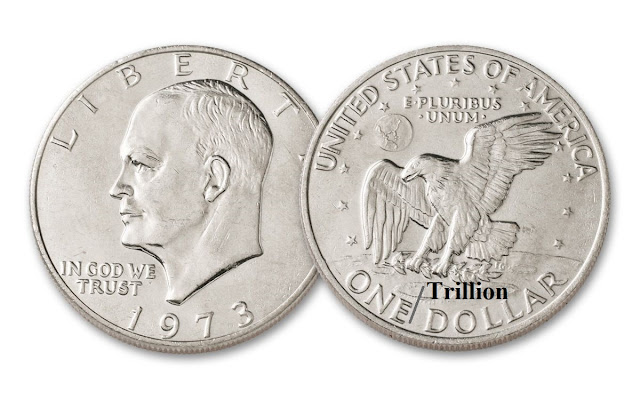
By now, I'm sure everyone has heard the story about the way to fund the growing federal debt. Some one said simply mint a coin in platinum and declare it to be worth $1 Trillion dollars, then deposit the coin with the Federal Reserve. Then the Fed could add the stated value of the coin to their balance sheet and buy the trillion dollars worth of bonds. Since a trillion is nothing in the face of the current debt levels, they'll have to mint a lot of them. The recognized national debt is closing in on $29 trillion with other payments due in the future (most places call those unfunded liabilities) of nearly $158 trillion. They'd have to mint 187 of them.
Since there's nothing backing it and nothing to distinguish the value other than "the coin is worth what we say it's worth," I suggest they go buy some silver dollars, some paint, and create something like this.
Maybe get some first graders to do the lettering. Give it more personality than my edit in "Paint". And add that pesky "s" that needs to go on the end of "dollar."
Saying the coin is worth a trillion dollars is the essence of Modern Monetary Theory. The fact that someone would seriously consider minting such a coin shows economic ignorance of epic levels, but the whole country is running on MMT now, which is nothing but ignorance of economic history. Nobody stops to think how other countries would react to us doing that, and how it would affect their confidence in our bonds or anything else. (Much like their confidence in our leadership after Afghanistan). Nobody stops to ask the question that if we can create trillions like that, why do we tax anybody in the country anyway. It's a nonstop train to no longer being the world's reserve currency. Honestly, though, that train left the station long ago and the death of the dollar in that role is a matter of when, not if. I wouldn't be surprised to see it happen almost any day, now.
It's kind of fun in a macabre sort of way to watch MMT failing all around them yet they seem incapable of seeing that's why things are falling apart now. A common failing in all sorts of endeavors is to be so in love with your theories that you can't see that other ideas might work better.
Treasury Secretary and long term Deep State Hack Janet Yellen is still saying the inflation is only transitory, and oh by the way, let's get rid of that pesky debt ceiling so we can just create and spend whatever we want whenever we want. Money is just medium of exchange, right, peons? What's that about store of value? Don't be silly. We want a constant 2% inflation so that the prices of everything will double at least twice in your wretched lives. That's not storing value, it's planned destruction of value.
Even John Maynard Keynes didn't envision his Keynesian brand of economics creating money perpetually; he thought it would be done in times of crisis, and then stopped. The excess dollars could be wrung out of circulation.
Saturday, May 22, 2010
What’s All This Gold and Weiner Stuff, Anyway?
As mature adults, we are beyond making fun of the name “weiner”.Heh heh, heh heh. He said "weiner".
In the summer of 2000, Mrs. Graybeard and I took a course in lost wax casting - the process by which most jewelry and many small, fine-detailed mechanical parts, are made. We cast several pieces in silver and for my final project, I wanted to work in gold. I noticed gold was around $250/oz., and that seemed cheap. I didn't follow the price of gold, but remembered prices in the $700 - $800 range in the early '80s. As it turns out, that $250/oz was just about the dead bottom of a multi-year bear market in gold.
Why is gold around $1200/oz now when it was $250/oz in the summer of Y2K? Why is oil high when demand is low from the big consumers? Is it those "ebil, debil speculators?" From watching the cable TV channels talk about stocks and other investment vehicles, and from other observations, I'm convinced most people - even people who advise on stock and other financial instruments - don't understand inflation.Most people don't even really understand our financial system.
Around that time in Y2K, it was occurring to me that my 401k had not grown as fast as I'd like and maybe I should do more than just follow the standard recommendations. So I started reading about gold along with other investment opportunities. Remember, this is late 2000; the tech bubble had just burst. I lost money in that like everyone. The real estate bubble had not started. I found that in the '70s it was standard advice to have about 20 to 30% of your IRA in gold as a safe haven, "just in case". As my research moved on, I started to read the commentators on Kitco.com.
I quickly encountered a group of people called "gold bugs" who seemed like a lunatic fringe. They vocally say "gold is money" and "all fiat currencies (like the dollar) eventually collapse", "inflation is going to get worse" and so on. I thought they were lunatics. I was more interested in the technical analysts who pointed out demand was getting ahead of supply for gold and the time needed to get a mine deposit found, developed, and producing gold (about 10 years) means that the demand will exceed supply for a long time. Can you say increasing prices? So I found some ways to include gold in my retirement plans, and have happily watched it do well as everything else is having troubles.
Then a funny thing happened. Some of the "lunatic" gold bugs' predictions started coming true. About 2005 (I think), I started reading predictions of problems related to something called "sub-prime mortgages" that I had never heard of, and they warned that it had the potential to take down the entire world's economy.
For you people who still think this just isn't mainstream enough for you, would you listen to Robert Kiyosaki, whose "Rich Dad/Poor Dad" series has become a wealth building franchise and a staple of fund-raising events on Public Television? One of his guys has a book called, "Guide to Investing in Gold and Silver".
If that's too staid, the "Angriest Guy in Economics", the Mogambo Guru, might be more your speed. A little tough to "get" the first time I read him, I eventually thought if you took a classic Robin Williams full-tilt-bozo comedy bit from the late 70s and made it about economics, it might sound like the Mogambo.
In the 70's, a guy named Howard Ruff wrote a book on how to survive the inflation of that decade. He's still around, and following one little piece of advice from his book has made me thousands.
Inflation is always a result of monetary policy. Always. How does inflation occur?
Imagine you had a printer that could make perfect copies of any dollar denomination you wanted. Because it's technically, you know, highly illegal to do this, you want to be disciplined about how you use it and reserve it for emergencies. You need to buy a car and get into a bidding war at an auction. You win because you can always pay a higher bid, just by printing a little more money, and you always get away with it. Can you imagine that after a while, you would use this power more often? Now imagine everyone had such a printer. Can you imagine that the prices of everything would be bid up by the larger supply of dollars? This is the essence of price inflation: an increase in the number of dollars available to bid pushes up price.
And that's what the Federal Reserve is doing. By flooding the markets with "liquidity", they really mean currency. They used to release data on the size of the money supply, but stopped some years ago. I assume it was because they thought it was too scary for us hicks to look at. Too much negative feedback from economics writers. Ben Bernanke, who was just a member of the Federal Reserve board at the time, famously said (in response to questions about deflation, in 2002), "The U.S. government has a technology, called a printing press (or, today, its electronic equivalent), that allows it to produce as many U.S. dollars as it wishes at essentially no cost," What would you think if you had a big pile of dollars, like OPEC or China or the various countries that we buy from? You would think, "If there's much more of them, mine will be worth much less; I'd better store my wealth in something else". Exactly that happened, and the price of gold spiked immediately after his statement. The image of the Federal Reserve dumping baskets of currency out of a helicopter was coined by economist Milton Friedman. Bernanke's remark about the printing press earned him the nickname "Helicopter Ben" (don't remember where I stole this picture - if it's yours and you don't want me to use it, just comment).
Bernanke also said, "people know that inflation erodes the real value of the government's debt and, therefore, that it is in the interest of the government to create some inflation." Maybe, but it's not in the population's interest. The problem is that if you're a saver, your money is going to be devalued by that inflation. If you are living on a retirement pension, social security or some other similar benefit, you are screwed. The government horribly understates the cost of living because they don't include food or energy costs. Your social security cost of living adjustment will never keep up with the real cost of living.
And that's largely why oil is expensive today, despite low demand. Oil costs more dollars because each dollar is worth less. Thinking oil seems very expensive is like everyone on the Titanic thinking the water seems awfully high, not that they're sinking. Think the stock market is doing well - or was? Have you seen the DJIA or S&P 500 corrected for inflation? Corrected for inflation, you are loaning companies money for about 1.6% per year return. Some periods are less, others are more. The $1200/oz price of gold includes inflation and increased demand due to the widespread concern that the worldwide currency system is failing.
We call our dollar a fiat currency because it's worth is declared by fiat. It's worth exactly what someone is willing to give you in exchange for one. We do not promise any amount of gold, silver, wheat, rice, pebbles or manure in exchange for one. Inherently, it's only worth the paper and ink used to make it.
Money is different from currency: currency is the paper and base metal coins you have in your pockets while money is something that has value and is used as a medium of exchange. For much of history, money was gold or silver. People on Yap Island used large stone rings. Paper money was invented as a way around carrying large amounts of coins. I've heard it argued that there is nothing special about gold or silver and that's true. They are simply something that has a universal history as valuable. People want them. You could theoretically have a fiat dollar like we do and have it be stable. It requires politicians, bankers and everyone involved to be honest, and responsible. It requires politicians not create vast amounts of currency so they can deficit spend, go to war, hand out food, healthcare or any of the other things governments do with this made-up money. In other words, fiat currency will never work in the long term.
The basis of money only has to be agreed upon, relatively portable, and dividable (diamonds are out: you can't cut one to give change). Gold and silver fit the bill. If the fiat currency system collapses, they will be accepted. There will be barter and other primitive ways of dealing with each other. Realize that if there is widespread collapse, your gold ETF will be an abstract, almost worthless thing. If there is enough gold to fill all their orders, you will still need a functioning world to get it out. If you buy coins or bullion, you don't have that concern.
The world currency system collapsing? There are writers who think we are seeing the death throes of fiat currency. Historical writers are fond of pointing out that fiat currencies always collapse because politicians and bankers just can't resist screwing with them. It might also be the death throes of Keynesian economics that essentially asserts governments should spend more when they're out of money (in a depression, tax revenues are down just when Keynes says we should spend more). While that will be painful, it might be like getting an antibiotic shot for a bad infection: pain now for complete cure in the long run.
Saturday, May 1, 2010
Greece is Circling the Bowl - Who Goes Down With Them?
HT to Denninger
Two problems:
Raising taxes means that private spending decreases. It must, because every dollar that comes from the taxpayer to fund government has to come out of private consumption or investment. It cannot be otherwise.
The Greek labor unions have made clear they will not accept the current austerity measures (read: cutbacks in pay and benefits), say much less more of them. We've already seen riots, which in point of fact are never that far away from a general conflagration, otherwise known as "civil war" (which is anything but civil.)There's a lesson in here in that the Greek deficit as a percentage of GDP is just over 10%.So is ours.So is Britain's.So is Spain's.The destruction they are witnessing "over there" will come here eventually.
Go read it, it's short.
This is a time like no other I've ever come across. I'll be the first to admit, I'm relatively new at reading any history, but the whole civilized world is in a bad economic mess. It really comes down to handful of common reasons.
1) You can't spend money you don't have forever. Yes, you can incur some debt. It's not a problem if it's at healthy levels, but when you half of what you make is going to pay the interest on the debt (US in a year or two), you will never pay it off. You will go bankrupt.
2) No nation has a currency backed in any tangible commodity. The world went off the gold standard for good in the early 1970s, with every nation's currency floating with respect to every other. What's a dollar worth? Whatever any two parties agree it's worth. It's fine while everyone's happy and times are good; but what happens when everyone is on the verge of collapse? Do they pull each other down or prop each other up? The lack of a commodity standard has led to bubble after bubble after bubble - here and around the world. The dollar is down to a few percent of its value from the 1930s when we started getting off the gold standard.
3) There is an appalling lack of understanding of basic math and economics in the world at large. People that can vote, tend to vote in those who promise them money or who start unsustainable financial systems. The rioting socialists in Greece are a shining example. "A government that robs Peter to pay Paul, can always count on the support of Paul" -George Bernard Shaw
4) With the great interconnectedness of our financial systems, troubles in one area can multiply across the world faster than ever. In the old days, we really transferred money around; today the central banks can just increase balances on computers somewhere. Billions of dollars can be created or destroyed in seconds.
We could avoid financial collapse with sober spending, and intelligent regulations. In other words, we're screwed. A group of former sailors say they object to the phrase "spending like drunken sailors", because they stopped spending when they ran out of money, no matter how drunk they were. The proposed financial regulation bill in congress is the usual Washington crap. It addresses the wrong problems, ignores the real problems, and creates new problems to go with them.
I think it looks increasingly likely that a second downturn will occur sometime soon. I think the predictions of tax riots and civil unrest here in the US by 2011 from Gerald Celente seem right on.
My advice is the timeless classic: beans, bullets and band-aids. Precious metals, like lead, copper and brass:
and pray....