Showing posts sorted by relevance for query carrington. Sort by date Show all posts

Sunday, August 4, 2013

A New Low in Solar Flare Alarmism

If you're a regular reader here, you know I have little tolerance for the too-frequent "solar-geddon" articles that keep cropping up, predicting another massive solar CME like the Carrington Event is going to destroy us.  Like here.  Or here.  Or here.  We happen to be in the lowest solar activity cycle in the last century and it's likely to get lower next cycle.  While flares and CMEs are always possible, the probability of a Carrington type event, has to be lower now than it has been for the last century.  Considering that it was once in recorded history - the chances already seem rather low.  

So when the Mail (UK) ran a story last week saying we just missed a Carrington level event destroying life as we know it, it was a new low in alarmism.  It's one thing to exaggerate and another to fabricate; this is making up a story entirely out of thin air.  But it isn't the Mail's story, at least not exclusively. 

The mail, in turn, is quoting the Washington Examiner, who quoted some dood named Peter Vincent Pry:
"There had been a near miss about two weeks ago, a Carrington-class coronal mass ejection crossed the orbit of the Earth and basically just missed us," said Peter Vincent Pry, who served on the Congressional EMP Threat Commission from 2001-2008. He was referring to the 1859 EMP named after astronomer Richard Carrington that melted telegraph lines in Europe and North America.
The folks at Watts Up With That, though, reviewed the Space Weather in the period two weeks prior, and as NASA's Dr. Tony Phillips said,
Many readers are asking about a report in the Washington Examiner, which states that a Carrington-class solar storm narrowly missed Earth two weeks ago. There was no Carrington-class solar storm two weeks ago. On the contrary, solar activity was low throughout the month of July.
Mr. Pry is probably lying like this for one of two reasons: either to get funding for a program to protect the grid (not a bad idea at all) or to soften the battlespace so that if bad forces shut down the power grid and millions die, it can look natural.  In other words, he's either deceitful or completely evil.  Not a good introduction, Mr. Pry.

It seems every few months someone is trying to warn us another bad flare is imminent and we're all going to die because of it.  The ironic thing is I'm sympathetic to the cause, although more from an EMP standpoint than the solar flare/CME side.  I just can't stand the exaggeration or outright lying.  If I owned a power company, I'd invest in protecting my infrastructure and serving my customers, but I don't think we should drop everything else to do it.  Do it in with the regular maintenance.  Order replacements for vulnerable equipment.  Spares.  "Two is one, one is none".  To quote myself from one of those prior posts:
So what do you think the chances of another one are? [edited to add: another Carrington level event] According to someone quoted by Reason, the chances of another one between now and 2020 are 12% - 1 in 8.  So something that hasn't happened since 1859, through all those solar cycles, including the strongest cycles on record, has a 1 in 8 chance of happening now?  In this weak, erratic solar peak - in the next 8 years?  Really, dude, you don't have to say between now and 2020.  The next 2 or 3 years should locate the peak pretty well.

I don't buy it.


Saturday, March 25, 2023

A Mild Rant: Not Everything is a Carrington Event

Larry Lambert over Virtual Mirage, one of the more eclectic minds you'll come across in the blogosphere, led us to a post on American Thinker called, "Dodging the Apocalypse" about the recent geomagnetic storms and the apparently truly Epic Coronal Mass Ejection that led to the storm.  Credit where due, the first person I saw writing about this event was the Come and Make It blog.  

The article is by a regular writer there, J.R. Dunn, and while I'm going to do my best to cut him slack, he really triggered me.  The biggest thing is tying this CME to the Carrington Event in 1859, which I've written about a half dozen times before.  For the uninitiated, the Carrington Event was a massive solar geomagnetic storm that happened around the start of the widespread use of electricity.  Widespread electric power was still a half-century away, but the telegraph had led to long wires being used to communicate by what we now call On Off Keying or OOK.  The disruptions to the geomagnetic field around Earth caused open telegraph keys to spark, insulators on poles to arc over, started fires and more. 

The event was witnessed in real time by British astronomer Richard Christopher Carrington.

"Two patches of intensely bright and white light broke out," he later wrote. Carrington puzzled over the flashes. "My first impression was that by some chance a ray of light had penetrated a hole in the screen attached to the object-glass," he explained, given that "the brilliancy was fully equal to that of direct sun-light."

Note that these flashes were so much brighter than the projected image of the sun in his dark room that he thought daylight was somehow getting into the room.  The story itself is amazing.  That evening, when the Coronal Mass Ejection hit, telegraph operators were able to run without batteries; the flare-induced voltages on their wires working better than batteries.  The aurora display was global, even in the deep tropics. 

The American Thinker article quotes "experts" saying the March 13th CME was "was ten to a hundred times more powerful than the one of 1859."  My immediate problem with that is how do we know that number?  The 1859 event happened only one time in human history and it happened in a time when instruments today's experts would use didn't exist.  There are other things that have been attributed to massive Carrington-like storm but the problem of no measurement is compounded by no observers, and the most remote-sounding observations imaginable.  To quote from this blog in 2012 about an increase in Carbon 14 levels being attributed to a Carrington-like storm in the year 774 AD, 

There are a couple of known mechanisms for creating C14 in the atmosphere, one is a massive solar flare.  774 AD was 600 years or so before the first telescopes were used, so there was no Carrington to be watching.

So when a college student from UC-SD found a record of a “red crucifix” in the skies over Britain in that year, Nature published his note.

I've never heard of anyone saying there was a crucifix of any color in the skies back in 1859.  

We've seen this kind of hype more recently.  Back in November of  2003, toward the end of cycle 23, there was a super flare that was genuinely scary and the kind of flare to worry about.  The biggest flare seen since the satellite age started, it was classed as X28 in retrospect - only because it saturated the X-ray detectors on the satellites and they couldn't measure it properly.  Why didn't it harm us? Because it was on the limb of the sun and the CME went 90 degrees to our direction.  So not only does this extremely rare event need to happen, but it has to be pointed at Earth - basically perfectly centered on the sun from where we view.  It's important to remember that during the peak days of cycle 23 we were getting X-class flares a few times every month, and the grid was fine, wasn't it?

I haven't seen anyone say that last week's CME came with an X-class flare or put a number like that X28 on it, but that would be interesting to find out. 

Probably the most obviously wrong thing he said was “We do know that we have two more years before the current solar cycle tops out, and so far, this has been one of the most intense on record.” The best answer to show just how wrong that is to show this plot of just the five most current solar cycles from Solen.info.

The current cycle, 25, is at the bottom left in kind of a brown or olive drab color and ending at 32 "Months after cycle start."  It can be seen that it's higher than the previous cycle (in pink) at pretty much every point and it's currently stronger than cycle 24 was at this point.  It's just that being better than cycle 24 isn't really saying anything impressive.  Cycle 24 was the weakest cycle in the last hundred years.  Cycle 25 is predicted to be stronger than 24 but might not even equal the next stronger cycle, 23.  It obviously isn't cycle 23 level yet (23 is red).  Where he says, “...so far, this has been one of the most intense on record,” it has actually been one of the weakest on record.

This chart, by the way, doesn't include the strongest cycle since the 1780s, cycle 19 from the late 1950s.

It's almost guaranteed that someday there will be something like a Carrington Event again, we just don't and can't know when.  When something has happened once in recorded history, it's hard to assign a periodicity to it.  If that observation about the 774 AD CME is correct, does the 1085 years between them mean anything to predictions?  I don't think we can just say it's a thousand year cycle.  To say a massive CME has something to do with solar cycles isn't much of a reach, given what we know from observing hundreds or thousands of solar flares and CMEs and knowing those track with solar cycles.  

I know alarmism sells but I find it exhausting.  I try to bound problems to give me some feel for how likely some problem is.  In the case of the CME it's not just that probability there's also the probability of it being optimally placed on the sun to do the most damage.  Is that two degrees of solar longitude?  Five degrees?  The probability of independent things like this get multiplied.  If the chance of a big enough CME to cause a disaster is 1 in 100 years and the probability of it being in the right place on the sun is 1 in 180 (two degrees longitude), the probability of both is 1/100 * 1/180, or .0000555 (55.5*10-6). 


Wednesday, December 19, 2012

Space - It's Genuinely Scary Out There

On many of the sites aimed at those trying to be more self reliant and self sufficient, people talk about solar flares causing global catastrophes.  It's a topic I've written about several times, because I believe that while the danger is real - in the sense that flares are real and really big ones are capable of causing damage here on the Earth - the media and (strangely)  NASA itself over hypes them. 

The granddaddy solar flare of all time has, until very recently, been regarded as the Carrington Event in 1859, the dawn of the telegraph age. The event was witnessed in real time by British astronomer Richard Christopher Carrington.
"Two patches of intensely bright and white light broke out," he later wrote. Carrington puzzled over the flashes. "My first impression was that by some chance a ray of light had penetrated a hole in the screen attached to the object-glass," he explained, given that "the brilliancy was fully equal to that of direct sun-light."
Note that these flashes were so much brighter than the projected image of the sun in his dark room that he thought daylight was somehow getting into the room.  The story itself is amazing.  That evening, when the Coronal Mass Ejection hit, telegraph operators were able to run without batteries; the flare-induced voltages on their wires working better than batteries.  The aurora display was global, even in the deep tropics.

If such a flare were to happen today, I believe it would take out the power grid on at least the hemisphere facing the sun when the CME hit.  What we have in our favor is that our modern monitoring systems would allow grid operators to shut down some to all of their gear: force the world into a black out, so that the equipment could be reconnected when the storm was over. 

Now comes a story that there appears to have been a flare that could have been 20 times stronger than the Carrington event. 
Everybody loves a good “whodunit?” How else could you explain the number of television shows with the prefix “CSI”? So when a study in Nature identified a previously unknown (and very large) spike in carbon-14 around the year 774 AD, it raised a lot of eyebrows. This radioactive isotope of carbon is created when energetic particles from beyond the Earth transform atmospheric nitrogen to a form of carbon with two neutrons more than the most common isotope.
There are a couple of known mechanisms for creating C14 in the atmosphere, one is a massive solar flare.  774 AD was 600 years or so before the first telescopes were used, so there was no Carrington to be watching.
So when a college student from UC-SD found a record of a “red crucifix” in the skies over Britain in that year, Nature published his note.
The story diverges a bit here, because the original group who tried to calculate how big a flare would have to be to cause the measured amount of carbon-14 in tree rings made a mistake and ended up with a preposterous result, 1000 times bigger than Carrington's granddaddy flare. 
A pair of researchers from Washburn University and the University of Kansas published a comment in Nature pointing out that the solar flare calculations included a rather fundamental error. Working backwards from the intensity required to produce the right amount of carbon-14 in Earth’s atmosphere, they mistakenly calculated the total size of the event as if the flare was emitted in all directions from the Sun, forming an expanding bubble of charged particles.
CMEs, are fairly localized, so the amount of spread would be much less than calculated and a powerful enough flare much smaller than the original calculations.  These researchers derive a number closer to 20x the size of Carrington's flare. 

A flare this size is genuinely scary; I don't know how much bigger it would be than the one pictured here, from November 2003, the largest flare observed since the space age began, but it would fry an entire hemisphere's grids, and if the grids are connected better than I think, would plunge the entire world into darkness.  I don't know if anyone on the Space Station could survive that. 
You can put together an entire catalog of potential TEOTWAKI disasters: a flare like this, a super volcano like Toba or Yellowstone, a nearby supernova, and more.   Something like any of those things or these mega flares is highly unlikely (yeah, I disagree strongly with this and briefly explained why here). 

But you know how a bunch of those UN Agenda 21 freaks want to kill off 95% of the humans on earth?   This just might do it.


Thursday, May 22, 2025

Are you regularly watching for the next Carrington event?

Long time readers will know that I think the clickbait pushers talk about a really big solar flare / coronal mass ejection (CME) far more often than the subject deserves.  The Carrington event in 1859 was truly remarkable and if an equivalent thing were to happen now, it could do pretty substantial damage.  What that statement doesn't address, though, is that while solar flares and CMEs are common there hasn't been one that had the same effects on Earth since then (1859) despite far more reliance on distributed electricity, the power grid and so on.  As we get more susceptible, the damage from solar eruptions goes down?

There's a handful of reasons for that.  One is that the solar activity patterns have to be conducive to producing the strong flares, and solar activity has been decreasing every cycle since the strongest cycle recorded since 1750 (see bottom plot here), cycle 19 in the late 1950s.  For a graph showing as far back as the mid-1970s, see the plot I put in my regular cycle updates - the bottom plot in the last update at the end of April, for example.  You'll see that the current cycle (25) is stronger than the previous cycle but 24 was the weakest cycle in a hundred years.  It's just now close to the same levels as 23 (1996 - 2008) but has not surpassed it in any monthly measurement.

The other is that even if there is a strong flare it has to be Earth-directed.  During the peak days of cycle 23 we were getting X-class flares a few times every month, and no damage was done.  There was a super flare in November of 2003 that was genuinely scary and the kind of flare to worry about.  The biggest flare seen since the satellite age started, it was classed as X28 but only in retrospect - because it saturated the X-ray detectors on the satellites and they couldn't measure it properly.  Why didn't it harm us? Because it was on the limb of the sun and the CME went 90 degrees to our direction.  The summary is not only does this extremely strong (and rare) CME or flare need to happen, but it has to be pointed at Earth - basically perfectly centered on the sun from where we view.  

With something like the Carrington event that happened once in recorded history it's pretty futile to try to calculate the odds of the next one.  I mean, the solar cycles pretty much occur every 11 years and we have a hard time predicting exactly when they start, when they peak and other routine events like that.

It's important to know that bigger impacts than the Carrington have happened in history.  One of the first big ones I read about has been calculated to have occurred in 774 AD - and that was discovered almost accidentally when a college student from UC-SD found a record of a “red crucifix” in the skies over Britain in that year: 

 A.D. 774. This year the Northumbrians banished their king, Alred, from York at Easter-tide; and chose Ethelred, the son of Mull, for their lord, who reigned four winters. This year also appeared in the heavens a red crucifix, after sunset; the Mercians and the men of Kent fought at Otford; and wonderful serpents were seen in the land of the South-Saxons.

All of which is to setup a story of a "Carrington-like" event that was recently discovered and calculated to have occurred in 12,350 BC.  If 1859's Carrington Event was a "big, major" event, this one was a "humongous, insanely, obscenely strong" solar blast.  

More than 14 thousand years ago, there was a solar storm so big, trees still remember it. Dwarfing modern solar storms, the event would devastate technology if it happened again today. Spoiler alert: It could.

I would modify that "spoiler alert," or have deleted it altogether, but I leave it because it's a direct quote.  "Could" is irrelevant.  Does it happen once a year or once in a billion years?  I also don't like saying "trees still remember it" because trees don't have memory - they're not even still living.  These are nearly fossilized trees that have unusual amounts of carbon 14 caused by the flare/CME. 

Subfossil trees along the banks of the Drouzet river in France.

The record-strong storm is described by a paper in the upcoming July 2025 edition of the peer-reviewed journal Earth and Planetary Science Letters. It occurred in 12,350 BC and is classified as a "Miyake Event."

Miyake Events are solar storms that make the Carrington Event of 1859 look puny. Trees "remember" them in their rings, which store the carbon-14 created by gargantuan storms. At least six Miyake Events have been discovered and confirmed since Fusa Miyake found the first one in 2012. The list so far includes 664-663 BC, 774 AD, 993 AD, 5259 BC, 7176 BC, and 12,350 BC.

The Miyake Event of 12,350 BC is especially intriguing. It appears as a carbon-14 spike in Scots Pine trees along the banks of the Drouzet river in France, with a matching beryllium-10 spike in Greenland ice cores. The event was global and, based on the size of the spikes, very big.

In the effort to pinpoint exactly when this happened, the conventional ways of dating the Carbon 14 inducing event had to be revised. 

When a solar storm creates carbon-14 in the upper atmosphere, the radioisotope doesn't immediately appear in the woody flesh of trees. Getting there involves months to years of atmospheric circulation influenced by climate and geography, and even then the carbon-14 has to arrive during the tree's growing season, otherwise it won't be "taken up." High-altitude trees are favored because they encounter the carbon-14 first, while different species each have their own sensitivity. 
...
To solve this problem, Kseniia Golubenko and Ilya Usoskin from the University of Oulu in Finland developed a chemistry-climate model (SOCOL:14C-Ex) specifically for Ice Age solar storms. It takes into account ice sheet boundaries, sea levels, and geomagnetic fields that existed during the Pleistocene's Late Glacial period. Using this model, they were able to interpret tree ring data for 12,350 BC.

My "Graybeard who has been burned too many times" persona said, "how do we know this new method is any good?"  They present calculated dates that agree with those predicted the old way. 

According to their paper, 12,350 BC is the biggest Miyake Event yet. It produced a hailstorm of solar particles 500 times greater than the most intense solar particle storm recorded by modern satellites in 2005. During the 2005 event, an airline passenger flying over the poles might have received a year's worth of sea-level cosmic radiation in just one hour. During the 12350 BC event, the same dose would have been received in a mere eight seconds.

It's an interesting story and the paper is online to read.  Does this change your life?  I can say confidently the only thing it's likely to change for me is to make me more resistant to the "everything is the next Carrington event" stuff we have to live with.  If you're spending your life watching for the next Carrington event, chances are there are more productive things you can do with your time, money and life. 


Friday, May 10, 2024

Planetary Geomagnetic Storm Has Hit

Borrowing wholesale from Spaceweather.com:  

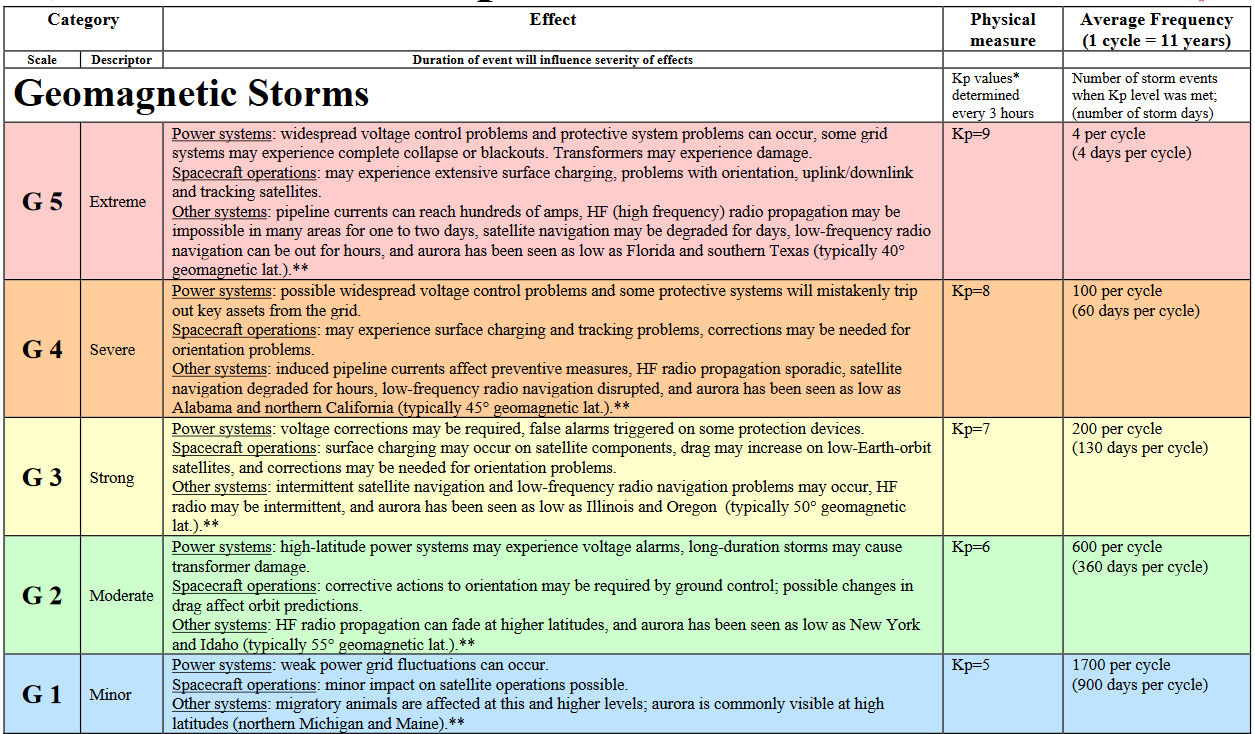
EXTREME GEOMAGNETIC STORM--NOW! The biggest geomagnetic storm in almost 20 years is underway now. It has reached category G5--an extreme event. Sky watchers with dark skies may be able to see and photograph auroras even at low latitudes. Get away from city lights and look at the sky! Aurora alerts: SMS Text

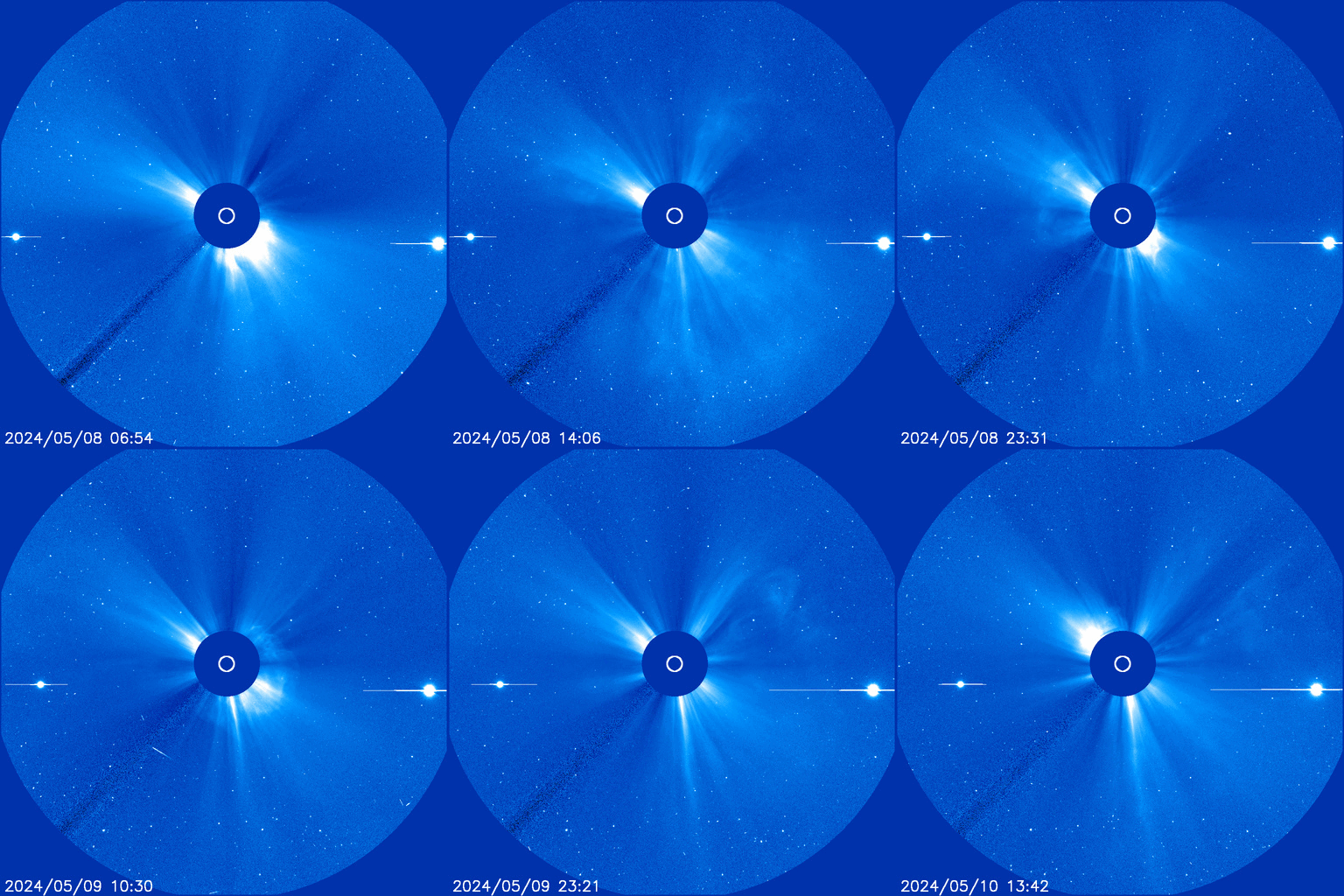
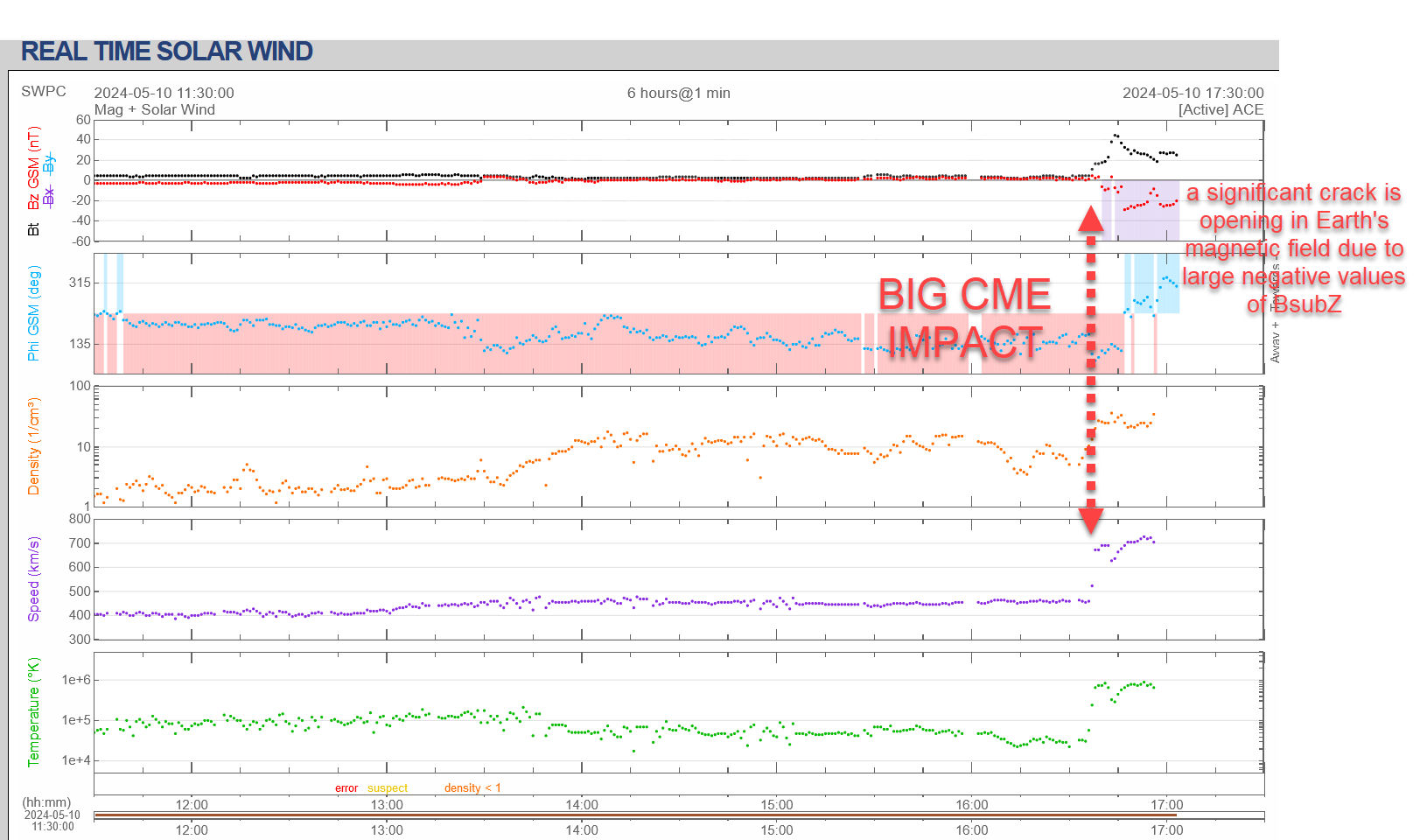
CME STRIKE SPARKS WIDESPREAD AURORAS: The first of six CMEs hurled toward Earth by giant sunspot AR3664 hit our planet's magnetic field today. The impact on May 10th at 1645 UT jolted magnetometers around the world and sparked a geomagnetic storm, which is now extreme. More CMEs are following close behind and their arrival could extend the storm into the weekend. Sign up for Space Weather Alerts to receive instant text messages when the CMEs arrive.

If you're anywhere in the US north of the Gulf of Mexico, it's worth trying to get to a dark location a couple of hours after sunset to see if you can see auroras. They'll be pushing very far south. How far?  In most cases, the K-index has to get to 9 or higher to see them as far south as the Carolinas to Arkansas or so. 

HOWEVER, there's more to it. The first is that the value you see on charts like this are 3 hour averages. Geomagnetic storms also have gusts and peaks that can give shorter term visibility farther south. Next is the direction of Earth's magnetic field, denoted by Bz. South pointing geomagnetic fields produce auroras farther south, into the gulf coast, Texas and even Florida. This site has a plot of Bz, toward the top right of the page, the second row under a place for a video that's always there.  (Bz is currently staying pointing south).

This was the first hit of several CMEs that are coming and there are predictions later impacts will become the so-called cannibal CMEs, in which later, faster Coronal Mass Ejections catch up with and merge with earlier CMEs, giving them a bigger, higher impact. In this view you can see the monster-sized sunspot group 3664. It's the one that has thrown the group of CMEs in the Earth's direction.

Image from Spaceweather.com

As a sidenote, a ham radio group I read regularly had a plot from the same place that had 3664 next to what I think is Carrington's drawing of the spots that gave the famous, all-time world record CME named after him. The implication is that since the group is the same size, the CME could be as bad as the Carrington event. The size of the group is actually relatively low importance in this; what's more important is the magnetic configuration. For example, the caption to that sun picture says, "Giant sunspot AR3664 has a 'beta-gamma-delta' magnetic field that harbors energy for X-class solar flares." I've ranted before about how tired I am of continuous predictions that we're going to have another Carrington event. Something that has happened once in all of human history of observing the sky is suddenly supposed to happen routinely according to these folks. I know "doom sells" but it's kind of ridiculous out there. 


Saturday, May 18, 2024

Odds, Ends, Small Stories, and Miscellaneous

Blue Origin is set to return to its suborbital tourist flights Sunday morning, for the first flight since the aborted flight of September 12, 2022. Call it just about 3 months, one quarter of a year, short of two years since they've flown.

Historic flight ... This will be the 25th flight of Blue Origin's New Shepard rocket, and the seventh human spaceflight mission on New Shepard. Before Blue Origin's rocket failure in 2022, the company was reaching a flight cadence of about one launch every two months, on average. The flight rate has diminished since then. Sunday's flight is important not only because it marks the resumption of launches for Blue Origin's suborbital human spaceflight business, but also because its six-person crew includes an aviation pioneer. Ed Dwight, 90, almost became the first Black astronaut in 1963. Dwight, a retired Air Force captain, piloted military fighter jets and graduated test pilot school, following a familiar career track as many of the early astronauts. He was on a short list of astronaut candidates the Air Force provided NASA, but the space agency didn't include him. Dwight will become the oldest person to ever fly in space. 

This reference to Ed Dwight becoming the oldest person ever to fly to space comes from Ars Technica's weekly Rocket Report. I was taken aback because I recall that during William Shatner's flight, also on a Blue Origin New Shepard suborbital flight, in October of '21 that he was said to be the oldest person ever to fly into space. I thought he was older but the source says he was also 90. Do they compare ages to the day?  


It's being said that last week's geomagnetic storm was among the 20 strongest on record (second story down).  The article opens with a photo of auroras taken from New Caledonia in the south Pacific, at a latitude of -26.4 degrees, by Frédéric Desmoulins, who photographed the display from Boulouparis in the island's south province. "I could see the red color of the auroras with my naked eye. According to the New Caledonian Astronomy Society, these photos are the first for this territory." 

The Auroras visible from New Caledonia by Frédéric Desmoulins 

"The auroral visibility from New Caledonia is really unique and extremely valuable," says Hisashi Hayakawa, a space weather researcher at Japan's Nagoya University. "As far as we know, the last time sky watchers saw auroras in the area was during the Carrington Event of Sept. 1859, when auroras were sighted from a ship in the Coral Sea."

Hayakawa specializes in historical studies of great auroral storms. He tries to go back in time as far as possible. The problem is, magnetometers and modern sensors didn't exist hundreds or thousands of years ago. Instead, he looks for records of aurora sightings in old newspapers, diaries, ships logs, even cuneiform tablets. Great Storms are identified by their low latitude--anything with naked-eye auroras below 30° MLAT (magnetic latitude).

"May 10th was definitely a Great Storm," declares Hayakawa. "Naked-eye auroras sightings in New Caledonia (MLAT = -26.4°) and Puerto Rico (MLAT = 27.2°) confirm this in both hemispheres."

The sunspot that produced that flare is on the far side of the sun now, but another magnetically complex sunspot group, AR3685, emitted an X3 flare on the 15th and a slightly weaker M7 flare yesterday (17th). The spot isn't really Earth facing, and NOAA is predicting a chance of minor geomagnetic storm "early on the 19th" - which it currently is in UTC as I write. If there has been an impact, it hasn't made news, yet. 

It's worth paying attention to because this spot is just starting it's transit across the Earth-facing hemisphere of the sun, meaning we have about two weeks for this one to fling more Coronal Mass at us. This happens at the cycle max every cycle and while the actual max may be hard to declare except in retrospect, we're close to the peak of this cycle (25). While 25 is stronger than the previous cycle 24, that one was the weakest in 100 years, and this one isn't as strong as cycle 23 - making it the second weakest in at least the last 50 years (visual plot of all those cycles here - bottom plot on that page). We can expect flares, CMEs and this sort of stuff from the sun for another two to three years.


I've been slow in updating my blog reading list to link to Western Rifle Shooters' blog at Cold Fury. I thought that might end up being redirected from the old site I still linked to, but eventually concluded I should just link to it. A verbose way of saying WRSA's link in my right sidebar now takes you to the active web site.


Monday, December 19, 2016

Solar Study Shows Best Predictions for The Next Maunder Minimum

Probably the best argument I've seen for the view that our next Maunder or Dalton Minimum is coming soon comes from Nature Science Reports in October of 2015.   Researchers Simon J. Shepherd, Sergei I. Zharkov, and Valentina V. Zharkova (who are not strangers to these pages)  performed a new type of analysis of solar data.

In the abstract of the paper, the authors say they obtained full disk magnetograms of the sun and derived ways of describing the Principal Components (PCs) of two main, time-varying magnetic waves found in the magnetogram data.  They observed that these magnetic waves in the Solar Background Magnetic Fields have opposite polarity, i.e., originating in the northern and southern hemispheres, respectively.  Over a duration of one solar cycle, both waves are found to travel with an increasing phase shift toward the northern hemisphere in odd cycles (21 and 23) and to the southern hemisphere in an even cycle (22).  They were able to derive equations that described those waves, and see that at times the waves coincide well and the sun is more active, while at other times the waves partially cancel each other out producing a quieter sun.  Taking these equations they then extrapolate the PCs backward and find two 350 year long cycles superimposed on the 22 year sunspot cycles we're all familiar with.  The results show a remarkable resemblance to sunspot activity reported in the past including the Maunder and Dalton minima.  Cutting to the chase here, when they run these predictions into the future, they find the next grand minimum is coming soon in cycles 26-27 (we're currently in the end years of cycle 24).   That's around 2028 or 2030 and go forward 22 years. 
The fit of the Eureqa-distilled law (the solid curve) to the summary component in cycles 21–23 (dotted curve) and its expansion to cycles 24–26.  Dashed curves show the predicted summary curve compared to the real PCs derived from the SBMF in the cycle 24 with an accuracy better than 98%.

My standard disclaimer goes here:  I'm wary of predictions for another Maunder minimum, or another Carrington Event on general principles.  In the case of the Maunder minimum, it was severe and we simply don't have detailed data records of what the preceding cycles were like, to the level of detail we could produce in the last hundred years.  There was nothing like the solar instrumentation we had even 50 years ago, let alone now.  This study's predictions are based on analysis of only three cycles worth of data.  I don't know how long magnetograms have been available that show lines of magnetic force going back to the sun, but with 24 cycles, I'd like to see more than three.  Still, even a prolonged minimum that isn't as severe as the real Maunder minimum seems like it could be really bad.  It seems any deep sunspot minimum correlates with colder temperatures.  Despite what the alarmists say about Global Warmening,  mankind has done better in warm periods than in the cold periods in our history (huge pdf alert - but fascinating reading).  Of course the cool kids (or the kids who consider themselves cool) say not to be concerned about the Maunder Minimum because the warmening will wipe out any cooling and you skeptics are silly to trust these predictions - and a few other things that are demonstrably wrong, too.  

On the positive side, these researchers' main approach is similar to a signal processing approach I've seen used successfully many times.  The agreement of their predictions with measured data given their small study sample is impressive.  In fact, I think it's the most persuasive study I've seen that says a deep minimum is coming.  By this prediction curve, it will be much shorter than the Maunder minimum, and the next grand minimum, in about 2300 to 2400 looks more like the Maunder. 
Letting their prediction run 2000 years: from AD 1200 to 3200.  Text on the plot explains the markings.  From Nature. 


Wednesday, April 22, 2020

Solar Cycle Update - We Seem to Have Begun Cycle 25

Long time readers will recall that I used to do a “Solar Update” roughly every six months, but it seems my last regular update was in April of '18.  I kind of got out of the habit when the news every month was roughly the same: we're in an extended minimum.  I did a post on keeping an eye on the solar minimum last December when we were about to set a record for the longest stretch of days without a sunspot - and did a couple of days after that post.
UPDATE: Dec 16 1630 EST:  The record was broken Sunday.  From Spaceweather.com
SUNSPOTS BREAK A SPACE AGE RECORD: Solar Minimum is becoming very deep indeed. Over the weekend, the sun set a Space Age record for spotlessness. So far in 2019, the sun has been without sunspots for more than 270 days, including the last 33 days in a row. Since the Space Age began, no other year has had this many blank suns.
In the last few months, there has been talk among the ham radio propagation watchers that the majority of sunspots since then - around Christmas of '19 - have been new solar cycle spots and that the week around Christmas to New Year's of '20 might end up marking the start of cycle 25.  (New cycle spots are instantly recognizable because they're closer to poles than the solar equator and they have reversed magnetic polarity from those closer to the equator.)

Today we find an article posted on Watts Up With That saying Cycle 25 has just started.  In saying so, the rely on an arcane measurement called the heliospheric current sheet tilt angle, and show that the angle has flattened recently, and they mark the similar points in the previous cycles.


They state that much like “it ain't over until the fat lady sings” ...
The solar cycle isn’t over until the heliospheric current sheet has flattened. The data is provided by the Wilcox Solar Observatory at Stanford University. There were no observations from about 19 December to 5 February; so the values in between have been interpolated from the rotations before and after.
By two measurements; the number of rotations of the sun, (a Carrington rotation or solar day is 27.23 earth days) and by measurements of the 10.7 cm solar flux, they conclude the length of cycle 24 was 11.1 years, which is the average solar cycle length.  Cycle 23 was an outlier with a very extended minimum but this one was average. 

I find it interesting that the planetary A index, a measurement of geomagnetic activity, for cycle 24 continues the trend of being lower than the 20th century “modern warm period.”  This plot shows that from 1932 until 2009 this geomagnetic index never went below values that were on the high side for cycle 24.  I think anyone older than about four could look at this plot and play “one of these things is not like the others.”


A coincidence in timing to be sure, but the ARRL reports that NOAA released their predictions for Cycle 25 and stick with their previous predictions of another cycle like the last one.  
“While this is SWPC’s official Cycle 25 prediction, it’s important to note there is still divergence among various forecasting methods and members of the space weather forecasting community,” Donovan said. “Most forecasts and forecasters agree that the Cycle 25 is likely to be within ±20% of Cycle 24 and is likely to occur between 2024 and 2027.”
To the best of my knowledge, Dr. Valentina Zharkova is still predicting that Cycle 25 will be weaker than the last and that there may be an extended minimum lasting until potentially as late as 2053.  Ish.


Monday, March 12, 2012

Solar Flares - Can We Get A Grip?

I assume that everyone saw last weeks' dire warnings about a pair of X-class flares and the hand wringing about all the damage they could do?  One of those two flares was a respectable X5.4, and while the chances of Really Bad Things from an X5.4 are slightly above zero, there was still way too much hand wringing over it.  The really bad part was that they made a fuss over an M-8 class flare over the weekend.

Guys, I don't quite know the best way to put this in perspective, but most of us can damage the grid more with a fart than a M-8 flare ever could. 

In a way, I've covered this before, with my August 2010 post, "Yo, NASA! Can We Knock Off the Solar Storm Scare Tactics?" but it's worth talking about again.  Solar flares are (obviously) a real phenomenon, and the Coronal Mass Ejections (CMEs) that accompany the big ones are a real concern for satellite operators.  A really big CME could damage the power grid.  But "a flare" is not the same as "a really big CME" .  Back in that August, '10 post, I noted;
See, solar flares vary over orders of magnitude in size.  The smallest go from C1 to C10.  Next up, M class flares also go from a 1 to a 10.  Finally, the biggest flares are X class or X-ray flares.  There's no top to that scale, but in the peak of the last solar cycle, back around 2003, X class flares were hitting every month.  An X10 flare hitting directly can make auroras visible in the southern US.  A monumental flare in 2003 made them visible in north central Florida.  I have heard a big flare in the previous cycle (1990s) caused an aurora visible in the Caribbean.
The strengths of these solar events vary like all natural processes, with weaker ones much more common than strong ones.  A flare strong enough to do the damage people worry about is a very rare event .  Let me quote from that 2010 post:
Is it possible for a solar CME to do the things they talk about? Absolutely. How likely? There has been one CME since 1900 that damaged parts of the grid (it shut down power in Quebec) and that was in the last peak of the 1990s (1996?).  It's not precise to say expect it to happen once in a hundred years, but probably close enough for discussion.  If you own a satellite, you can shut it down when a big CME is coming because you see the flare and ejection when they happen (ignoring that the light takes 8 minutes to get here from the sun) while the particles from the CME take a couple of days to get here.   
Again, during the peak days of the last cycle, in 2003, we were getting X-class flares a few times every month, and the grid was fine, wasn't it?  There was a super flare in November of 2003 that was genuinely scary and the kind of flare to worry about.  The biggest flare seen since the satellite age started, it was classed as X28 in retrospect - only because it saturated the X-ray detectors on the satellites and they couldn't measure it properly.  Why didn't it harm us? Because it was on the limb of the sun and the CME went 90 degrees to our direction.  So not only does this extremely rare event need to happen, but it has to be pointed at Earth - basically perfectly centered on the sun from where we view.
The mother of all CMEs (that we know of) is called the Carrington Event, and occurred in 1859.  It was such a bright flash that legend says people noticed the daylight get brighter.  Auroras were reported in Cuba and Hawaii.  This was in the early days of wired telegraphy and the "grid", such as it was, was damaged.  There were reports of telegraph keys arc'ing and even fires being set.  I remember reading an unlucky telegrapher was electrocuted by his key.   While we can estimate the strength of that flare/CME by other means, it's fair to call it the strongest CME to hit Earth in the last 150 years.  So what do you think the chances of another one are?  According to someone quoted by Reason, the chances of another one between now and 2020 are 12% - 1 in 8.  So something that hasn't happened since 1859, through all those solar cycles, including the strongest cycle on record, has a 1 in 8 chance of happening now?  In this weak, erratic solar peak - in the next 8 years?  Really, dude, you don't have to say between now and 2020.  The next 2 or 3 years should locate the peak pretty well.

I don't buy it.

Wake me up when an X10 flare and CME is on the way.  I wanna see the auroras.  Until then, keep your hype to yourself. 


Monday, March 11, 2024

An Essential For Deep Space Manned Missions

An essential need to for deep space missions, like Mars or long term habitats on the moon, is protection from the radiation environment.  For travel, a possible alternative is a much faster way to get there, a different essential need.  For habitats there's more freedom - perhaps burying the colony could be an alternative if the planet doesn't have a good magnetic field. 

Ars Technica has a long, deep article on the radiation issue, far too involved for me to get into here, so I really want to recommend anyone interested read or at least skim the piece.  

The radiation problems start with the sun, and with the current tendency to blame everything from the AT&T update issue a couple of weeks ago to an unexpected pimple on solar flares, I think everyone's aware that can be a problem.  Ars author Jacek Krywko starts off with some interesting background.

On October 19, 1989, at 12:29 UT, a monstrous X13 class solar flare triggered a geomagnetic storm so strong that auroras lit up the skies in Japan, America, Australia, and even Germany the following day. Had you been flying around the Moon at that time, you would have absorbed well over 6 Sieverts of radiation—a dose that would most likely kill you within a month or so.

X13 is not the biggest flare observed since satellites started monitoring the sun, and is still considerably weaker than the Carrington event of the 1850s. Back in November of  2003, toward the end of cycle 23, there was a super flare that was genuinely scary and the kind of flare to worry about.  It was classed as X28 afterwards - only because it saturated the X-ray detectors on the satellites and they couldn't measure it properly. 

This is why the Orion spacecraft, which will be in space for longer times than the Apollo missions, has a built in, heavily shielded, storm shelter for the crew.  Something important to remember about radiation doses is that they're cumulative.  The Orion shielded retreat is cramped and uncomfortable if they need to use it, and only rated for 30 days. 

Radiation problems start with the sun, but don't end there by far.  Deep space is also the domain of cosmic radiation from faraway sources.  The majority of solar particle events flux is between 30 Million electron Volts to 100 MeV which is what the Orion shelter is designed for.  Cosmic rays and energetic particles from other star systems are relatively rare but some are coming at you all the time from all directions. They also can have higher energies, starting at 200 MeV and going to several Billion electron Volts (they use Giga here; GeV), which makes them extremely penetrating.  The most extreme cosmic rays have an energy measured in exa-electron volt (EeV), or 1 billion billion (1018) electron volts of energy, which is around a million times more energetic than the fastest particles from human-made particle accelerators. They are rare, but energetic. The most energetic particle ever detected had an energy of 320 EeV and traveled at more than 99.9% the speed of light.

On Earth, we're protected by the earth's magnetic field, which is weak but huge so it operates over long distances.

Anything that makes it through the magnetic field runs into the atmosphere, which, when it comes to shielding, is the equivalent of an aluminum wall that's 3 meters thick. Finally, there is the planet itself, which essentially cuts the radiation in half since you always have 6.5 billion trillion tons of rock shielding you from the bottom.

To put that in perspective, the Apollo crew module had on average 5 grams of mass per square centimeter standing between the crew and radiation. A typical ISS module has twice that, about 10 g/cm2. The Orion shelter has 35–45 g/cm2, depending on where you sit exactly, and it weighs 36 tons. On Earth, the atmosphere alone gives you 810 g/cm2—roughly 20 times more than our best shielded spaceships.  

How can a craft be shielded better?  These are charged particles and that points to three possible implementations of electromagnetic protection:  

In the 1960s, NASA funded multiple studies looking into three active shielding concepts: plasma shields (PDF), electrostatic shields, and magnetic shields (PDF). In 1967, Richard H. Levy and Francis W. French delivered a report saying that plasma and electrostatic shields were promising, but they both needed 60 million volts to work—even by today’s standards, that number is ridiculous.

Magnetic shields looked more enticing. The 1950s brought the discovery of type II superconductors—materials that had virtually no electrical resistance at very low temperatures and could be used to build extremely strong magnetic coils. In 1966, P.F. McDonald and T.J. Buntyn of Research Laboratories Brown Engineering Company reported that there were no magnets strong enough to shield a spacecraft, but “rapid advances in superconducting magnets technology indicate that it will soon be possible to produce necessary high fields with very modest power consumption.”

And that's where I'll refer you to the long article on Ars Technica.  As is the usual routine in the 21st century, I've told people interested in exploring deep space that you have a problem and now I leave it to you to solve your problem.  

Artist's conceptual drawing of NASA's CREW HaT.  CREW HaT stands for Cosmic Radiation Extended Warding Halbach Torus, a way of creating a toroidal magnetic shield around a vehicle to protect it without wrapping it in miles of wire (a solenoid).   Image credit: Aurich Lawson | Getty Images | NASA

Final words to Ars Author Jacek Krywko:

ESA’s career radiation dose limit for astronauts is 1,000 mSv [milliSieverts - SiG]. Reference Mars mission scenarios estimate a total dose at a bit below 1,200 mSv. That’s not that much of a difference—nothing you couldn’t fix by throwing a little more mass here and there in your spaceship. NASA had career limits dependent on sex and age, but you could probably get away with just picking old men for the job.

But then, on January 5, 2022, NASA revised Section 4.8.2 of the Spaceflight Human-System Standard and set the astronauts’ career radiation dose limit to a flat 600 mSv. Active shields offer a roughly 50 percent dose reduction at a cost of huge mass penalty and development efforts. They have always ended up shelved because they were overkill. We just didn’t need that much protection. With NASA’s new standards, we ultimately might.


Thursday, August 13, 2020

New Solar Cycle 25 Forecasts and Revision of an Older One

The last month has had a couple of interesting items related to the new solar cycle.  One is the forced retraction of a paper by a researcher whom I've covered; the other is a new forecast from a group I haven't seen, using a new technique.  This technique predicts a better cycle 25 than virtually everyone I've seen, but it has its problems, too.  

To begin with, Watts Up With That reports the recent retraction of a Nature publication on solar cycles, predicting a ‘modern Maunder Minimum’ before 2050.  The paper, by a team including Dr. Valentina Zharkova was published in June 2019 and retracted by the journal March 4, 2020.   I've quoted Dr. Zharkova in these pages several times; perhaps the most detailed description of her work is in November of '18.  

Dr. Zharkova's work is on the solar dynamo, the magnetic fields that create virtually everything we see on the sun.  It began by observing the sun and attempting to come up with a model to explain the patterns we see.  Reviewing this work and trying to see the differences between this and some of her publications which I've talked about in the past, it's very similar to the research published in Nature.  That 2015 prediction was based on two Principal Components measured over perhaps three cycles (~33 years). 

In the current work, she includes more terms of the Principal Components, four terms instead of two.  Adding more terms should produce a better model fit.

The article on WUWT goes into why the paper was retracted by Nature. 

Post publication, a number of astrophysicists pointed out that a key calculation assumption—Earth/Sol barycenter fluctuations are random—was just wrong. Nature editors therefore had no choice but to retract the faulty paper when this was easily verified. (See the linked retraction notice footnotes.)

The WUWT author goes into some detail of what he considers a problem that I also expressed doubt over: they found their four principal components in a 33 year sample of the solar cycles.  My problem with that is the unstated assumption that everything that's visible in the solar dynamo now has always been there, will always be there, and nothing else has ever been in the dynamo.  They extrapolate their 33 years over thousands of years and while I understand constancy is a common assumption in science, I always wonder how well a rare event can be predicted. 

The author invokes Nyquist's sampling theory, but pretty badly.  Some of the commenters did a better job of it.

The other big story was mentioned in the ARRL Letter, their weekly news bulletin, on July 9th.  Just as Dr. Zharkova's technique was newly discovered and applied to the problem of solar activity forecasting, the authors of this paper (pdf) "Overlapping Magnetic Activity Cycles and the Sunspot Number: Forecasting Sunspot Cycle 25 Amplitude," applied a new technique.  

The paper notes that recent studies have illustrated a relationship between the sun's 22-year Hale magnetic cycle and the production of sunspot cycle landmarks and patterns, but not the amplitude of the cycle.

"Using discrete Hilbert transforms on 270 years of monthly sunspot numbers to robustly identify the so-called 'termination' events -- landmarks marking the start and end of sunspot and magnetic activity cycles -- we extract a relationship between the temporal spacing of terminators and the magnitude of sunspot cycles," the abstract explains. "Given this relationship and our prediction of a terminator event in 2020, we deduce that Sunspot Cycle 25 will have a magnitude that rivals the top few since records began. This outcome would be in stark contrast to the community consensus estimate of Sunspot Cycle 25 magnitude."

That sounds pretty spectacular, but my skeptical take comes forward.  Cycle 19 is the strongest cycle on record.  Granted that we didn't have the radio technology much before the 30s to determine that, but I'm always skeptical when someone predicts we'll have a repeat of something we know happened once in human history.  It sometimes seems as if every few months someone predicts another Carrington Event.  I'm highly skeptical of those predictions.

The prediction that "Cycle 25 will have a magnitude that rivals the top few since records began" sounds nice, but we get predictions like this almost every cycle.  The last cycle (24) is the only cycle I can't recall reading predictions that it would equal cycle 19.  What they don't say in that extract is that their prediction band is so big that the cycle could approach the strongest cycle on record, but it could also approach the weakest cycle on record.  Look at the plot on the left.  The low end is around Sunspot Number (SSN) of 80.  The consensus predictions for this cycle seem to have it as a duplicate of the previous cycle.  That's stronger than the bottom of the light blue band.  Their high confidence predictions, in the darker blue background, show 25 being markedly better than 24 (circled). 


Where does that leave us?  I'm afraid I get nothing out of that new paper making predictions of termination events.  With Dr. Zharkova's paper being retracted, we're left with a consensus like that last link, right above the graphs.  If this newest paper is right, it should be apparent in the next year or two.