Sunday, February 23, 2014

"Time and Tide Wait for No Man"

I had an interesting time trying to find out who first said that.  Answers.com attributes it to Chaucer in 1390, although I think it's a bit of a reach:
For thogh we slepe or wake, or rome, or ryde, Ay fleeth the tyme; it nil no [will no] man abyde.
[c 1390 Chaucer Clerk's Tale l. 118]
I think it's more like this quote from 1592
Tyde nor time tarrieth no man.
[1592 R. Greene Disputation between He Cony-catcher & She Cony-catcher X. 241]
Which is all a roundabout way of saying that we spent the morning fishing the outgoing tide at Sebastian Inlet, a state park on the East Coast of Florida, not too far from the Silicon Swamp.  (Occasionally really nice pictures here.)  We were up before 5 this morning to be on the water at sunrise because time and tide...  Possibly.  By the clock we were, but you couldn't prove it looking for the sun.  Today was one of those rare days around here with really dense fog - so dense it was hard to tell if the sun was up; so dense it was hard to find markers and stay in safe water until we got into the channel.  Sebastian is a rough inlet, and I definitely don't have a boat safe enough to run it when it's nasty - and it's nastiest on the outgoing tide when the winds are strong out of the east or when big swells from far away storms are bucking the tide.  When these things happen, the inlet gets large standing waves; a set of breakers that stay in the same place for a couple of hours.  I've seen 25 to 30' foot boats almost roll in there.   But it's pretty safe on the inside, and well sheltered from the winds.   
 

By the time I grabbed this picture, the fog had mostly lifted and it was possible to see around.  The sun eventually burned off the fog and turned it into a normal day.  What we were doing there was drifting the inlet channel casting artificials: jigs and plugs. There's always a small fleet of boats in the inlet drifting in the strong current and doing the same thing.  The current runs several knots so we drift from the west end almost to the bridge (a few hundred yards from the mouth of the inlet) then run back inside and start over.  It wasn't much of a fishing trip, we each caught one jack crevalle of about one pound.  As the day wore on, we switched from rain jackets to shirt sleeves and it ended up about 80 by the time we left.  Just a little sunburned. 

The trip to the inlet adds about an hour and a half getting there and back, with around another hour or so cleaning up, but today added even more time.  It was time to change the oil in the outboard, and a bit more oil hit the garage floor than should have leading to more time in cleanup.  Pretty much shot the day. 

Saturday, February 22, 2014

Today I Am Four

Today is this blog's fourth birthday.  It seems to me that in blog years, that's about 100.
With the exception of a "hello world" post to make sure I knew how do anything, this was my first rant.  There's very little I'd like to change about it.  (note for those even more anal retentive than I - my actual blogiversary was yesterday, but I always celebrate on the closest weekend).  Blogger tells me this is my 1356th post and I've had over 809,000 page views.  I know there are bloggers who do that in their first year, but they usually do more than my (attempted) one thoughtful post per day.  

Thanks to all of you who stop by.  I hope to be worth the time you spend here, and provide information or perspectives that are useful.  Or, at least, worth more than you pay!  


Friday, February 21, 2014

The FCC: Board It Up, Send Them Home, They're Done

By now, everyone has heard the story that the geniuses at the FCC thought they had the power and the right to put monitors in newsrooms around the country.  The latest update today is that the FCC is apparently backing off from this plan,  which anyone who watches the Obamanoids knows is an utter bullshit statement.  They'll back off until they think no one is watching, or they find another insidious way to implement their plan.  As I've said before, the current FCC is heavily influenced by self-described Marxist Robert McChesney and his organization Free Press.  Like most Marxist organizations, Free Press is dedicated to the exact opposite of what its name implies; they want government owned press.  Think Pravda and Izvestia of the old Soviet Union and you're right there. 

To bring everyone up to date, the announced purpose was to “to identify and understand the critical information needs (CINs) of the American public (with special emphasis on vulnerable/disadvantaged populations).”  They planned to do this with an intricate, voluntary (ha!), study (78 page pdf) that was leaked to the press by one of the commissioners, Ajit Pai, in the Wall Street Journal.  They had a list of things they wanted to ask which are clearly beyond the legal basis of their formation:
• What is the news philosophy of the station?
• Who is your target audience?
• How do you define critical information that the community needs?
• How do you ensure the community gets this critical information?
• How much does community input influence news coverage decisions?
• What are the demographics of the news management staff (HR)?
• What are the demographics of the on air staff (HR)?
• What are the demographics of the news production staff (HR)?
For any supporters of this nonsense who drop by, pardon us if we don't wait for you while you go look up the Communications Act of 1934 that established the FCC (and its updates) so you can come back and tell us just what section says they have anything to say about station demographics.

Ajit Pai noted that it gets more intrusive than this:
The FCC also wants to wade into office politics. One question for reporters is: "Have you ever suggested coverage of what you consider a story with critical information for your customers that was rejected by management?" Follow-up questions ask for specifics about how editorial discretion is exercised, as well as the reasoning behind the decisions.
Now it's clear from the recent history of the FCC that their real goal is to redistribute the broadcast spectrum to these "vulnerable/disadvantaged populations" that they're asking about so a key question is: what can this survey possibly do to further that goal?  The answer is to disqualify the current owners of those stations so that the FCC and pull their license and reallocate it to the politically favorable groups; "my people" as Eric Holder said.

As that September 2010 link above shows, I've been ragging on the FCC for almost as long as this blog has been here, and a simple search shows that in June of '11 I was explaining why I think they're a useless agency.  Let me put it plain and simple:  I'm a radio engineer.  I work with the FCC requirements.  I know what the FCC certification tests are and I know the FCC rules.  The FCC hasn't done anything worthwhile technically in so long I can't remember.  You might suggest the introduction of digital TV, but that was a pretty royal fustercluck.  The technically sharp minds at the FCC get run over by the political apparatchiks all the time.  The result is the agency is useless.  Shut them down.  Board it up.  Send them all home. 

Except that you can't; at least, not completely.  Not without tearing up tons of international and US laws.  See, the radio spectrum is allocated so that specific services get bands of frequencies allocated to them.  Here's a simplified version of one - you'd need the wall-sized version to read it.
Historically, as new communications systems developed, the FCC and equivalent groups in other countries would coordinate where in the frequency spectrum these systems went, so they could operate with each other.  It would make life difficult for a pilot or boater who needed totally different radio systems for every country they visited.  The regulatory bodies would put compatible services near each other; for example the taxi radios would be near the police radios because both were local communications, intended to not travel very far, and used similar modulation types at similar powers.  Marine radios got placed in the same general part of the spectrum.  High power services, like FM or TV broadcasters, were separated from services subject to damaging interference from them.  Likewise, weak-signal satellite services like GPS receivers were kept far from the strong broadcasters (the ill-fated Lightsquared service threatened to disrupt every GPS receiver in the US by putting a stronger local signal where it could interfere with the much weaker GPS). 

While we could change this approach with modern technologies, to disrupt these allocations would require every radio owner in the country to get new radios compatible with however the spectrum was reallocated, and that is such an economic disaster we couldn't possibly change over to such a system.  (A disaster for everyone except for whoever sells the radios ... and the government officials who order the change).  So we need an FCC enforcement force to monitor interference issues and enforce spectrum rules.  The enforcement arm of the FCC, which simply mails out citations, collects fines, and negotiates settlements (example) is a substantial part of the commission's budget, but there's much money to be saved by shutting everything else down, too.

As long as people get apoplectic from a wardrobe malfunction, de-funding the FCC is going to be an uphill battle.  Maybe this tyrannical power grab by the FCC might make that fight a little easier.


Wednesday, February 19, 2014

How Big A Lathe Do You Need?

That's easy:  about one inch in diameter and two inches longer than whatever you have.  (Yeah, it's an old joke ... sorry, but if you don't know it, someone has to be the first to tell you). 

I've posted before about having a Sherline lathe, smaller than the ubiquitous 7x10 or 12 mini-lathes that everyone sells, and more often called a Micro lathe.  The 3.5 x 17" description on their web site is typical of the way lathes are described: 3.5" is the diameter of the biggest piece that will turn over the lathe bed (not the cross slide), and 17" is the long length of the bed.  Sherline, an American made tool, is famously accurate out of the box.  Those "7 by" and "8 by" lathes imported from the Chicoms usually require more work, more futzing around to get good results - although I'll be the first to say I hear they get better every year.  At machine tool shows, a standard trick is for (a very experienced) Sherline representative to pull a new one out of the box, chuck up a small length of half inch steel bar, and in a few cuts turn it down to a .010" diameter nub about 1/10" long.  Then he'll take a home made drill bit and bore a .005" hold down the center of that .010" nub.  The main drawback of the lathe is that out of the box it doesn't handle large diameters.  Sherline responded by making riser block systems that add 2.5" diameter, making it a 6x17 lathe.
For example, here's my lathe at some stage in the past, showing the riser block under the head stock (black block with metallic ends at left).  The riser changes everything.  By raising the centerline, it forces risers under everything - or taller tool posts, etc..  It also makes the lathe a bit less rigid, and rigidity isn't its strongest point to start with.  (Yeah, it's quite the mess.  Bonus props for anyone who can tell what the large roundish thing is at upper right, that roundish thing with squares of darker brown in a lighter brown field.)

The real answer to how big a lathe one needs is what you intend to do with it.  If you want to do large things regularly, get a larger lathe.  If you only need to do them rarely, a small one may work well for you.  Let's look at some specific things:

Barrel work:  this is going to require a large lathe, and you're going to want to look for one sold as a gunsmith's lathe or a tool room lathe.  In any lathe, working on things more than one diameter out of the chuck and unsupported leads to loss of accuracy so most work on barrels; like reaming them with a chamber reamer, squaring the breech face or crowning the end, is done by chucking the barrel with just the little bit you need access to sticking out of the chuck.  The barrel would extend to the left in this view, through the head stock and sticking out for the rest of its length, which means the headstock had better have at least as big a bore as the barrel diameter!  Somewhere around 1 1/4 to 1 1/2" is needed. 

Something a lot of folks might be interested in is making an AR lower receiver from a blank forging, or "0% lower".  (Ooh! A ghost gun!)  This guy used the big lathe at his disposal, along with his big milling machine and metal shaper.  The only reason not to use those tools if you have them is for the challenge.  I can't say I've sat around for a long time and pondered how to do it on a Sherline, but the basic problem is drilling and tapping a large hole in a large chunk of metal.  I've cut holes that big in metal, just not metal shaped like that - which means it's all about fixturing and lining up the cutting before you tool touches metal.  It might be possible to fixture the receiver on the cross slide and advance it into the chuck, boring the hole to size ... and it might be possible to do it on the mill. 

You may want to turn a large flywheel or large cylinder for something, but if you have only one or a few operations, you may be able to carefully plan out some ways to exceed the rated size of your lathe.  I've seen some pretty wild tricks to do that on the smaller lathes where the headstock is rotated 90 degrees from its regular orientation (pointing off the bench in that photo).  Be careful!  Take light cuts, and remember the adage of "measure twice cut once" should start with "think it through three times".  I think the important part of that trick is that a large flywheel doesn't need to be turned to the accuracy of a rifle chamber.  Always remember that a milling machine can do much of what a lathe can do, if you think of the cuts differently. 

For most of the rest of life, cutting screw threads on rods, fixing standoffs, turning most objects (how many tubes bigger than 6" do you work with, anyway?), and most repairs that you'll do in gunsmithing, the Sherline or any of the "7 or 8 by" lathes will do just fine. 

Another old saying in the world of tools is that "a horse can do the work of a pony, but a pony can't do the work of a horse".  If you have the room and money for a big tool room lathe, do it.  Take some classes in it, get any training you can.  Any machine that can cut steel isn't going be slowed down in the slightest taking off a finger.  But the most common mistake is to start a lathe with the chuck key in place (or Tommy bars in the case of the Sherline) and throw it at anything/anyone in line.  They can put a serious hurt on you. 


Tuesday, February 18, 2014

Techy Tuesday - Build Your Own Airplane

There's a rather large and healthy experimental aircraft hobby group in America, and while it may be I work with an unusual sample of folks, I know a half dozen guys who have built their own airplane.

One of the more interesting things I've come across is a open source airplane group called MakerPlane which lists their vision as:
“We want more people to safely and quickly build and fly their own airplanes.”
...
Basically we are designing an aircraft that can be built on a computer controlled mill at home, or at a makerspace which is easy to assemble and quick to build. The plans and instructions will be available for free to anyone that wants them!
The emphasis on MakerPlane is an airplane that can be built with small tools, like using a CNC router to cut foam or plastic pieces and laying them up with fiberglass.  From my vantage point, it seems the majority of homebuilt airplanes are made of fiberglass and foam (like these kits).  Behind that are riveted aluminum planes, and there are certainly some made of wood and fabric.  I have different friends that have built each kind. 

There's just one big problem.  It's a hobby project and the design isn't done yet.  This is a rendering of the tentative design.
I started out by saying there's a large a vibrant community of homebuilders out there.  There's a large  national organization, the Experimental Aircraft Association, the EAA.   See their Hints for Homebuilders video page and the general homebuilding channel.  There are chapters of the EAA around the country, and a lot of homebuilders out there.  The EAA also runs classes and workshops around the country to teach folks the techniques required to build their dream plane.  There's a fire hose of information out there.  Enjoy!

Don't forget there are helicopters out there, too.  (H/T to Kerodin)

Sunday, February 16, 2014

Central Bankers: All Your Money Are Belong to Us

Thomas Sowell, one of the great minds in economics, once said, "I have never understood why it is "greed" to want to keep the money you have earned but not greed to want to take somebody else's money."  If you're like me, the clarity and sheer obviousness of that statement is like a slap to the face, or a cold water splash.

Socialists, of course, believe that no individual earns money.  Everything belongs to the state and is collective.  "You didn't build that" because your company couldn't exist without what government supplies.  As Elizabeth (Princess Fauxcohontas) Warren put it:
"You built a factory out there? Good for you," she said last year. "But I want to be clear: You moved your goods to market on the roads the rest of us paid for; you hired workers the rest of us paid to educate; you were safe in your factory because of police forces and fire forces that the rest of us paid for. You didn't have to worry that marauding bands would come and seize everything at your factory, and hire someone to protect against this, because of the work the rest of us did."
Of course, this wasn't her idea, nor Obama's, and while Legal Insurrection Blog credits the main idea to progressive professor George Lakoff, I'll bet the belief goes back at least as far as Karl Marx.

The world today is abuzz with claims being shot around that are paving the way for confiscation of savings.  It's coming, folks.

The European Union's "Competition Forum" is "investigating" whether nations having lower business tax rates amounts to giving businesses subsidies.  In other words, allowing them to keep some of what they earn is subsidizing them.  In our country, aspects of the tax code that give any break in taxes are being renamed "spending in the tax code". If you're not under double-taxation, you're cheating. 

One of their favorite examples to eliminate such "spending" is the IRA.  A conventional (non-Roth) IRA allows you to save pre-tax money, under the arrangement that you'll be taxed at regular rates when you withdraw it.  Presumably, your tax bracket will be lower, so you'll pay less tax at that time than if you paid taxes on it now.  To liberals like Fred Hiatt in the Washington Post, you're getting a benefit they're paying for, not using your own money.  It's society's money, not yours.  Furthermore, you're greedy if you don't agree with what he says.  Writing about Obama's plan to restrict the amount that can be saved for retirement, Hiatt writes:
This spring Obama proposed a cap of about $3.4 million on how much people can save in their tax-advantaged IRAs and 401(k) plans — enough to generate an annual retirement income of about $205,000.

The response to that modest proposal, which would raise about $9 billion in tax revenue over 10 years, says a lot about what — and who — is wrong with Washington these days.
...
But Obama isn’t keeping people from saving as much money as they can or want. The question is how much the rest of us should have to chip in. Obama is suggesting that at some point retirement accounts, invented to encourage working people to set aside enough for their sunset years, no longer need a helping hand from taxpayers.
So if you don't think that's a reasonable law, you're who's wrong with Washington!  But wait, that's not all!  In his twisted little mind, because someone is not paying some extra tax - today; they'll pay it eventually - on their earned income, he is somehow paying their way, giving them a helping hand!  

For the record, his attempt to gather $9 billion over 10 years - $900 million/year - is a rounding error compared to our spending.  With a projected deficit this year of $744 Billion, or $2 billion deficit per day his tax revenue doesn't even pay for 11 hours worth of spending.  Obama's plan is nothing but punishment for people who can afford to put more than that into a 401k (and equally for the record, my two chances of being taxed under his law are slim and none - but I still think it's bad law).

That's clearly not enough money to make a difference, and central bankers/planners around the world are looking at direct confiscation of savings.  Of course, they can't say that in so many words, so they refer to "haircuts" or "negative interest rates", and while that article is about the EU, our own Janet Yellen has advocated negative interest rates in the past.  Marc Faber has said that Yellen will make Bernanke look like a restrained-spending kind of guy; a fiscal hawk...
In 2010 she said if she could vote for negative interest rate, in other words you have a deposit with the bank at $100,000 at the beginning of the year and in the end you would only get $95,000 back, that she would be voting for that.
As if the inflation they're trying to create isn't a bad enough tax on savings, she wants to actually take money out of your account.  It's not like they don't realize this is going to hurt savings, they want to discourage savings, because in their models, money being spent is better than money being saved or invested. 

While I find that every coworker I've spoken with this sees this coming, there's some differences in how we think we should respond.  A while back, Ann Barnhardt said to simply get out of the game.  Take the tax penalty and get out of your 401k.  Regular savings or other places you can put your money are less likely to be targeted.  While I can't fault that, I stay in my 401k because my company gives me 6% more pay in matching funds while I'm in it.  I'm not ready to turn down "free" money. Of course, I think the timeless advice about "beans, bullets, bullion and band-aids" is golden; there's wisdom in the view that if it's not in your possession or some place you can defend it, you don't own it.  I have friends who are talking about buying real estate or second places to live, or adding on to their houses.  I may be naive, but I think your primary residence is safer than a second home if confiscation starts.  A move to start taking everyone's primary residence would absolutely start the next civil war. 


Saturday, February 15, 2014

That 1929 Stock Market Parallel Chart

By now, most people have seen the chart by market analyst Tom DeMark:
You can probably guess that the people whose livelihood depends on churning the markets have all dismissed this as silly speculation, "Woooo..  a line resembles another line ... woooo" - that sort of reaction.  A few minutes of search finds article dismissing it in MarketWatch ... Wall Street Journal ... Business Insider ... CNN Money ... need I go on?  They point out, for example, that the scales of the two curves are so disparate that it's only the number crunching that makes them look similar.  Obviously, their self-interest would tend to make them think this way.  The question remains of whether it's a valid comparison. 

My all-time favorite quote about prediction is from physicist Neils Bohr, who said, "Prediction is very difficult, especially about the future."  Yet every trading firm in country (world?) has someone on staff who studies charts of the market just for this sort of pattern - maybe several people.  It's also possible that Technical Analysis works (to the extent that it does) simply because of the fact that all the major brokerage houses have technical analysts and they all see the same signs.  Self-fulfilling prophecy. 

Another favorite quote of mine that applies to this sort of analysis is, "If you torture numbers long enough they'll confess to anything".

But I'm not answering the question.  Is it valid?  Is it real?  By this chart, the market crashes by the end of March.   Of course, I can't answer the question because I can't see the future either.  The fact that everyone knows about this chart hinders its ability to predict.  If everyone changes their position to protect themselves from a bad collapse, or to take advantage of some opportunity (if it showed that) that mass behavior shift changes the shape of the curve.  Is it reasonable to suggest the market is really overvalued now?  Sure, but it has been overvalued for some time.  Is it reasonable to say there will be a correction?  You bet.  The questions are when? and how big? 

Tom DeMark, whose chart started this whole thing, gave an interesting interview on Glenn Beck's radio program.  Tom is a guy who says he's been doing this sort of work for 45 years, and claims to have been called too Pollyanna-ish for being too optimistic in his forecasts - up to a five or six years ago.
“We try the measure supply and demand because that’s what drives prices. There’s a major component, which is sentiment, and extremes are met at highs and lows. There’s extreme optimism or pessimism. So we try to measure those and incorporate them into fundamentals,” Tom said. “But what’s happened in the last five years has been really troubling. What had worked in the past and seems to work globally – it works very well in the Far East, Middle East and our analysis there – but the domestic market here in the States is troubling.”

“It seems like there’s an influence that seems to incite fear every time we approach what appears to be a top in the market,” he continued. “At bottoms, it works very well, but at top, there seems to be interference, and we don’t know where it’s coming from… It became common knowledge that it was the Central Banks… It’s tough to adjust at the tops. With the bottoms, we are able to identify bottoms.”
And there you find the same thing I've said here over and over and over again: the market is not being shaped by normal buying and selling, it's being shaped by the Fed and the Central Banks.  They own it all now.  I recommended getting out of the stock market years ago - and did so with my own money, with the exception of two things that I can't get out of the market.  You may argue that I've lost money by not riding the flood of QE into the market.  In paper terms, at least, I have lost money.  My perspective is that one only makes or loses money when they sell.  If stock that I had in my account went up and down 1000%, if I didn't sell it when it was worth more than I paid, I haven't made anything.  And I think going up and down is all that's going on now. 


Thursday, February 13, 2014

The Day It Snowed in Miami

The company I went to visit in Canada twice last year sent some folks down to do some work at our place yesterday, and naturally talk turned to weather.  When I went to the lobby to pick them up, one of the two was standing outside feeling the sun on her face and reveling in it being above freezing.

Comparing notes on what each other's weathers are like over lunch, I remembered the day it snowed in South Florida.  Coincidentally, tonight I run across this link to the Miami Herald, "Jan. 19. 1977: The day it snowed in Miami". 
Thirty years ago today, snowflakes briefly dusted palm trees, windshields and people from Miami to West Palm Beach -- a freak but brief winter wonderland and the only South Florida snowfall on record in the 20th century.
Like all Floridians here at the time, I remember it very clearly.  I was working as tester/technician for a company that made transformers, and was waiting to go into work at 7:00 or 7:30 in the morning.  The place was outside Deerfield Beach, about 40 miles north of downtown Miami, and 10 or so from my home in Ft. Lauderdale.   My car: a '72 Ford Pinto with minimal creature comforts.  It was cold and I was waiting in the car rather than standing outside by the door.  All of a sudden motion caught my eye and I noticed something white blowing around (it was windy as well as unusually cold).  It didn't take long to realize it was snow flurries. I was wearing a lightweight, navy blue, nylon jacket, and I vividly recall the snow bouncing off the dark jacket.  

Mrs. Graybeard, whom I wouldn't meet for another two years, tells me that she called the day care center where her son was and asked if they would take them out to see the snow.   The person on the phone, undoubtedly fielding the same call 40 or 50 times, said, "do you think we could have kept them in?"
Miami's snow fall during the Blizzard of 1977 was caused by a combination of two artic cold fronts -- one passed the region on Jan. 16 followed by a second faster-moving one in the middle of the night the day it snowed.

That second front chilled the region and moved so quickly that moisture -- usually ahead of such fronts -- instead lagged behind, setting the stage for the snow.

"Basically, what happened is that the precipitation formed in the clouds did not have enough time to melt before it reached the ground, " Molleda said.
This picture from Tampa, midway up the state on the west coast, where they had measurable accumulation. 
I live close to 200 miles from Miami, now, near the Kennedy Space Center on the east coast.  We've had brief flurries here twice since then.  Once in the late 1980s and once in 2010.  On that day in 2010, we were supposed to be taking a tactical pistol class outside in the weather all day.  High for the day was 34 and class was postponed.  We didn't get snow at our place, but we did have some sleet and snow was reported around the area, and I saw pictures of it. 


Wednesday, February 12, 2014

Hate To Say I Told You So

But I said this would happen last Monday. 

I keep saying we really don't have a debt ceiling because it gets raised every time we get to it. Last Monday.  Others.

It's not the debt ceiling in particular, but when you combine it with the other economic trends that Peter and I have written on, (and both of us could supply dozens of links) only one thing comes to mind:

The Gods of the Copy Book Headings - Rudyard Kipling

AS I PASS through my incarnations in every age and race,
I make my proper prostrations to the Gods of the Market Place.
Peering through reverent fingers I watch them flourish and fall,
And the Gods of the Copybook Headings, I notice, outlast them all.

We were living in trees when they met us. They showed us each in turn
That Water would certainly wet us, as Fire would certainly burn:
But we found them lacking in Uplift, Vision and Breadth of Mind,
So we left them to teach the Gorillas while we followed the March of Mankind.

We moved as the Spirit listed. They never altered their pace,
Being neither cloud nor wind-borne like the Gods of the Market Place,
But they always caught up with our progress, and presently word would come
That a tribe had been wiped off its icefield, or the lights had gone out in Rome.

With the Hopes that our World is built on they were utterly out of touch,
They denied that the Moon was Stilton; they denied she was even Dutch;
They denied that Wishes were Horses; they denied that a Pig had Wings;
So we worshipped the Gods of the Market Who promised these beautiful things.

When the Cambrian measures were forming, They promised perpetual peace.
They swore, if we gave them our weapons, that the wars of the tribes would cease.
But when we disarmed They sold us and delivered us bound to our foe,
And the Gods of the Copybook Headings said: "Stick to the Devil you know."

On the first Feminian Sandstones we were promised the Fuller Life
(Which started by loving our neighbour and ended by loving his wife)
Till our women had no more children and the men lost reason and faith,
And the Gods of the Copybook Headings said: "The Wages of Sin is Death."

In the Carboniferous Epoch we were promised abundance for all,
By robbing selected Peter to pay for collective Paul;
But, though we had plenty of money, there was nothing our money could buy,
And the Gods of the Copybook Headings said: "If you don't work you die."

Then the Gods of the Market tumbled, and their smooth-tongued wizards withdrew
And the hearts of the meanest were humbled and began to believe it was true
That All is not Gold that Glitters, and Two and Two make Four
And the Gods of the Copybook Headings limped up to explain it once more.

As it will be in the future, it was at the birth of Man
There are only four things certain since Social Progress began.
That the Dog returns to his Vomit and the Sow returns to her Mire,
And the burnt Fool's bandaged finger goes wabbling back to the Fire;

And that after this is accomplished, and the brave new world begins
When all men are paid for existing and no man must pay for his sins,
As surely as Water will wet us, as surely as Fire will burn,
The Gods of the Copybook Headings with terror and slaughter return!
 

Tuesday, February 11, 2014

Techy Tuesday - 100 Years Ago

100 years ago on January 30th, 1914, Edwin Howard Armstrong first demonstrated his regenerative radio receiver.  Although the people present at the time didn't realize it, they were at an inflection point in history.  The world was about to change and never be the same again. 
On the night of 30 January 1914, Edwin Howard Armstrong, accompanied by Professor Morecroft from Columbia University, demonstrated his regenerative receiver to David Sarnoff and Roy Weagant of The American Marconi Company at the Belmar receiving station then under construction.
Regenerative detectors, the part of a radio that actually removes the audio or other intelligence (modulation) from the radio waves, are one of the oldest circuits invented; Armstrong patented the regenerative detector in 1913.  A modern fan offers this version of the schematic:
In 1913, the three-element (triode) vacuum tube (V1 in this schematic) was new and high tech, having been invented in 1906 but not really understood.  One of the first discoveries made about vacuum tubes was when Thomas Edison noticed that current would flow in a wire on the outside of the glass envelopes of the two-element (diode) tubes of the day.  In what strikes me as strange for the man, Edison was not the first one to take advantage of the The "Edison effect".  The man who first tried putting the wire inside the tube was Lee DeForest, who found applying a negative voltage to this screen controlled the flow of current in the tube.  It was named the control grid and the "DeForest electron valve" became the first electronic device capable of amplification.  By adjusting the distance (and coupling) between L3 and L1/L2, the gain of the amplifier could be adjusted until just before it broke out into oscillation, so that any increase in signal made it start to oscillate.  At this point, it had maximum gain, and the Armstrong's detector was more sensitive than any existing receiver. 

Suddenly mankind had a way to communicate instantly over long distances without running wires - or running on foot!

Edwin Armstrong and David Sarnoff began a very complex relationship here.  Armstrong was the epitome of the genius inventor.  Essentially all of modern radio communications came out of Armstrong's mind.  Within a few years, 1918 - at the end of WWI, he invented the superheterodyne technique for receivers, and that basic approach is still used in the vast majority of radios in the world.   The invention he is probably best known for, though, is Frequency Modulation in 1933. 

Sarnoff, on the other hand, was an "inspector" for the American Marconi Company in 1914, but by the 1930s was the head of the Radio Corporation of America, RCA.  If anything, he was the epitome of the "hard-driving sonofabitch".  His patent fights against Armstrong consumed the inventor's life and it is widely thought that his frustrations with his legal patent fights with Sarnoff ultimately led Armstrong to his suicide in 1954. Ironically, his death was January 31st, 40 years after the demonstration of the regenerative receiver - almost to the day.  The story of these two men has been told in the book "Empire of the Air: The Men Who Made Radio", which also led to a PBS documentary based on the book.  It's a captivating, fascinating story, which I can't do justice to here.


Monday, February 10, 2014

Blog Administrivia

Fellow gun blogger Guffaw posted the other day that he has problems leaving comments here and a few other places.  I've checked on my end and don't see a single reason why that might be.

If anyone else has tried to lave a comment and had it bounce, would you drop me an email?  Contact info has always been far down the right sidebar, just below the "Fight Terror, Support Israel" badge and the list of books from Library Thing.  Just email SiGraybeard at gmail dot com.

I have the blog set to moderate comments to posts over 14 days old.  It does two things for me: it helps me know they've been left, and it helps in Spam rejection since the older posts gather the robots that search on key words to leave spam.   I always approve real comments, but two or three sentences on how wonderful I am accompanied by a link to an Asian web site is too transparently spam, even for me.

I'll be honest.  I enjoy getting the feedback from comments but never really know how to handle it.  If it's a question or seems to invite an answer I do; if it's just a good statement, I usually just leave it. 


Well That Was Predictable

Living in the tropics with a monsoon season as I do, I often say "that was as predictable as the afternoon rain".  It applies to a study out of Columbia that fatal car accidents due to marijuana have tripled in the last decade as the acceptance of marijuana use has spread, leading first to legalization for medical uses and then to full legalization.   
"Currently, one of nine drivers involved in fatal crashes would test positive for marijuana," said co-author Dr. Guohua Li, director of the Center for Injury Epidemiology and Prevention at Columbia.
...
Alcohol contributed to about the same percentage of traffic fatalities throughout the decade, about 40 percent, Li said.
...
"If a driver is under the influence of alcohol, their risk of a fatal crash is 13 times higher than the risk of the driver who is not under the influence of alcohol," Li said. "But if the driver is under the influence of both alcohol and marijuana, their risk increases to 24 times that of a sober person.
Anyone surprised?  Bueller?  
Have we learned nothing from Cheech and Chong? 

Thinking about watching the Beatles on Ed Sullivan 50 years ago got me thinking about how parts of life have completely reversed as I've aged:
I'm so old I remember when smoking tobacco was fine, but smoking pot was evil. 
I'm so old I remember when Michael Jackson was normal and Prince was the weird one. 


Sunday, February 9, 2014

50 Years Ago Tonight

You can't do too much wandering around the net without encountering that it was 50 years ago tonight that the Beatles first appeared on the Ed Sullivan show, landing the opening salvo in what became called the British Invasion.  You might have to be living under a rock to not hear it. 
(CBS photo)

Yes, I'm actually old enough to remember watching the show that night.  A few months earlier, my older brother, then in 7th grade, and I had started mowing lawns to make money and had bought our first transistor radios (10 and 13 year olds mowing lawns for money?  Child labor! Call the authorities! - Yes, as the saying goes: I come from the past; it's a different country).  We had discovered this new thing called "rock and roll music" on our pocket radios - certainly not on mom and dad's Silvertone.  Among the first things we heard was the Beatles' first songs for American radio: "Please Please Me" and "I Want to Hold Your Hand".  Cue the scene in Steve Martin's the Jerk where he discovers music that speaks to him. 
At 8 o’clock on February 9th 1964, America tuned in to CBS and The Ed Sullivan Show. But this night was different. 73 million people gathered in front their TV sets to see The Beatles’ first live performance on U.S. soil. The television rating was a record-setting 45.3, meaning that 45.3% of households with televisions were watching. That figure reflected a total of 23,240,000 American homes. The show garnered a 60 share, meaning 60% of the television’s turned on were tuned in to Ed Sullivan and The Beatles. 

Derek Hall, a millennial-generation writer for Town Hall penned a column I couldn't possibly write, simply because of his age, "It Was 50 Years Ago Today - and It Had to Be the Beatles".  I don't want to steal his article, but it does a great job of summarizing the times and the event.  You should read the whole thing.
One question I’ve often pondered about this pivotal moment in pop culture history: Could any other British band have led the invasion, or did it have to be the Beatles?

This past Friday I did a special show on The Beatles and the Ed Sullivan Show and posed that question to music journalist David Wild, British invader Peter Noone of Herman’s Hermits, and Fox News Channel’s and Paul McCartney jam band member (you’ll have to listen to the clip for that story) James Rosen and the decision was unanimous – it absolutely had to have been the Beatles.

Say what you will about the Rolling Stones, Led Zeppelin, The Who, or any of the bands that came after, The Beatles had to be the tip of that talent-rich spear for a reason. They were special not only for what they did together, but who they were individually.
I started to play guitar a few years later, and like so many of our generation, cut my teeth learning to play Beatles tunes.  There are scores of musicians who have said hearing that music that night started them on the road to working in music for a living.  Rock legend Joe Walsh tells of learning the same way, and says it's still a good way to learn.  Millions of words have been written about the band and their music.  It has created careers for cover bands and at least one parody band.  Musical tastes vary, of course.  A variety of factors can make any band appealing (or not!) to lots of people.  Add in that every generation tends to express their differences by rejecting what their older siblings, or parents, listened to, and the Beatles have become reviled by many.  I personally was never impressed by Pink Floyd, U2, Nirvana or a host of other bands that have been big sellers since then.  That's fine: we have enough room for all of our tastes. 


Saturday, February 8, 2014

An Annual Pilgrimage

Today was the busy day of the Orlando Hamcation, a yearly gathering of radio hams held (of course) in Orlando.  With one or two exceptions for illness on one of our parts, Mrs. Graybeard and I have been going to these hamfests for over 30 years.  It's one of the largest amateur radio shows in the southeast, drawing a large crowd from around the southeast US and Latin America.

The weather today was the worst we've had in easy memory.  It was cool and drizzly all day, sort of a Seattle rain rather than a Florida downpour.  I don't think the temperature varied 10 degrees all day, with the lowest I saw being 58 and 65 the highest for the day.  I wore a long sleeve tee shirt and felt cool a few times, while Mrs. Graybeard wore a nice rain jacket and was toasty comfortable. 

Since I'm sure most of my readers aren't hams, what's to do and see at a hamfest?  While they vary, with some being more dedicated to conferences and technical talks, most of them involve some amount of swapfest for people in the hobby and new equipment sales.  Most also offer amateur radio exams, and other services hams in the area might want.  The Orlando fest has one room with new equipment vendors in it, where the major manufacturers show off their lines of radios, and hand out the occasional swag.  Still more manufacturers display their antennas, radios, software, books and accessories.  Other buildings house swap tables where clubs and individuals bring their own stuff to sell.  Most years there's a healthy outdoor tailgate selling area with a hundred sellers or more; the rain kept us from going outside, and I heard most of them had left. 
This photo, of unknown date from the Hamcation's website, shows the view in one aisle of the front building where the major manufacturers are displayed, along with some major sellers.

These days I find I mostly look for odds and ends that are hard to find around town; power cables for specific radios, rechargeable batteries like NiMH AA batteries, sometimes wires, small parts.  You never know what you're going to find: hams tend to have other hobbies too, and over the years at various hamfests I've found all sorts of interesting books, an antique 6" refractor telescope (hand made), and I think among Mrs. Graybeard's most treasured possessions are some 100 year old Electrical Experimenter magazines (edited by Hugo Gernsback!) she bought there when they were only 90 years old.      

Friday, February 7, 2014

The Welfare Cliff Visualized

This blog has addressed the concept of the welfare cliff a couple of times in the past.  I think I first addressed the concept in 2011 in the ironically entitled "Scraping By on $250,000 Per Year", when I wrote about how as income goes up and the welfare benefits are reduced, families trying to get ahead in life actually experience a decrease in their total income as their gross pay goes up.  I referred to a study that Zero Hedge linked to, showing "a one-parent family of three making $14,500 a year (minimum wage) has more disposable income than a family making $60,000 a year."
This underscores the most serious problem with reforming welfare laws.  Note that more than doubling pretax income from $14,500 to $30,000 results in a loss of 28% of their net income.  It would take an exceptionally rare person to go through a drastic drop in quality of life for the possibility of getting really high income and better standard of life some day way in the future.
The welfare cliff is back in the news again this week with the CBO's study that showed Obamacare will cause 2 million workers to reduce their hours or leave the workforce.  The previous link, on Townhall.com, links to this 2012 article by the American Enterprise Institute, "Julia's Mother: Why a single mom is better off with a $29,000 job and welfare than taking a $69,000 job". It includes this graph illustrating the welfare cliff:
The graph is credited to Gary D. Alexander, Secretary of Public Welfare for the State of Pennsylvania.  $29,000/year is not quite $14/hour ($13.95), well above minimum wage, but $69k is over twice that wage: $33.17.  I'm going to suspect that someone making $14/hr is going to have to put in some serious effort to get some marketable skills by going to school at night, or some other form of training to double their current pay.   So they can end up with a worse lifestyle? 

That graph is showing that the situation is really worse.  The welfare cliff drops off when income exceeds that $29,000 and the combined benefits and pay stays below that level until income exceeds $69,000.  Combined pay/benefits climbs from $30k to $43 and then drops off even more when income goes from $43 to $44k.  Going from $43 to 44 is a 2.3% raise in pay, but that leads to a roughly 23% decrease in total pay & benefits.  Would you turn down a 2.3% raise if led to 23% less take home pay?   If that single mother stayed sober and didn't put every dime she received up her nose,  $29,000/year is the peak lifestyle on this chart until work pay reaches over $70,000/year. 

While the details vary - the exact totals of pay and benefits and the exact placement of the cliffs - due to the state by state variation in these benefits, the big picture is the same.  Kevin Glass, in the original Town Hall article, implies that governments have been aware of the problem for a long time and do their best to minimize the problem.  Perhaps some do, but I don't believe for a moment that they all do. 


Wednesday, February 5, 2014

A Lesson From Hong Kong

Simon Black at Sovereign Man writes of how he enjoys reading and especially historically accurate fiction - that is, history with more fiction than the school books usually include:
One of my all-time favorite books is a novel by James Clavell, Tai-pan. It’s the second book in his series of six novels known as The Asian Saga—a fictional account of historical facts.

Tai-Pan tells the story of Western, and especially British, traders at the time of the Opium Wars with China. The story starts right after the British have defeated the Chinese Empire in the First Opium War and claimed a barren island in the Pearl River delta as a British possession—Hong Kong.
He tells the story of a wealthy merchant receiving a letter from his banker back in Scotland.
“We regret to inform you that, inadvertently and momentarily, credit was overextended and there was a run on the bank, started by malicious rivals. Therefore we can no longer keep our doors open. The board of directors has advised we can pay sixpence on the pound. I have the honor to be, sir, your most obedient servant…”

And we hold close to a million sterling of their paper. Twenty-five thousand sterling for a million, and our debts close to a million pounds. We’re bankrupt.

Great God, I warned Robb not to put all the money in one bank. Na with all the speculating that was going on in England, na when a bank could issue paper in any amount that it liked.”
There are people who say great timeless truths can't be learned from fiction like James Clavell's, calling them exaggerations and romanticized.  It sounds like that's where you find most of the truths that you can learn without losing blood.   (H/T Zero Hedge)

"Paper money eventually returns to its intrinsic value -- zero."  -- Voltaire, 1729


Tuesday, February 4, 2014

Techy Tuesday - Something Old, Something New

In the days before today's ubiquitous seven-segment LEDs, there were ways of doing electronic digital displays.  One of the most common displays were Nixie tubes, developed in 1955 by a small vacuum tube manufacturer and still popular to this day.  In a scenario that will be repeated thousands of times in the history of high tech industries, the innovative small company developed the tube, then computer giant Burroughs Corporation (now Unisys) bought them and introduced the innovation to the market. 
The name Nixie was derived by Burroughs from "NIX I", an abbreviation of "Numeric Indicator eXperimental No. 1."[7] Hundreds of variations of this design were manufactured by many firms, from the 1950s until the 1990s.
Nixie tubes ruled the display world from the late 1950s until the 1970s when LED displays took over the market space, but they are surprisingly popular with a part of the techy population today.  Some folks just love that retro look.  Just search the term "Nixie tube clock" with your favorite search engine or on eBay and see how many come up!

An email at work today led to this Kickstarter project, called the Smart Nixie Tube, that combines the retro look of the Nixie tube with today's hot experimenters' toy, the Arduino microprocessor experimenters' boards.  The modular concept allows you string a number of these together to make displays with a large number of tubes. 

The multiple colors used as base lighting are created by programming the balance of a multicolor (RGB) LED in the base.   

Personally, this is a bit too "artsy" for me, and "vintage" stuff that's just there to be vintage doesn't really appeal to me, but ... they are nice looking and I can see the sense in learning to program them.  Go read the Kickstarter page and watch the video.  It's cool - and the whole idea behind Techy Tuesday is to show things that strike me as cool or even educational.


Monday, February 3, 2014

Captain's Log - I'm Tired, So Tired

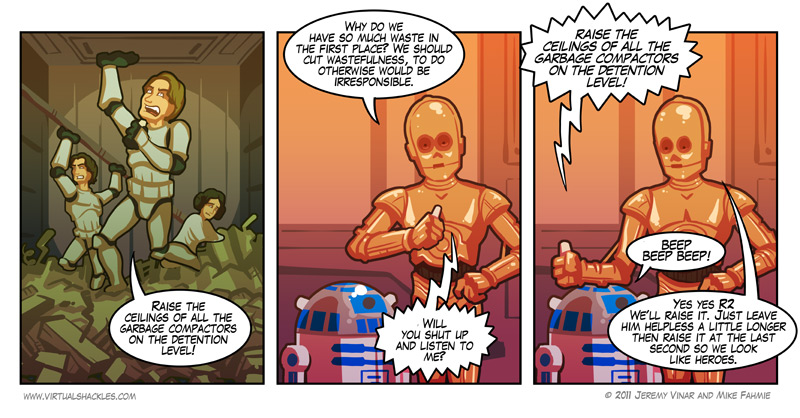
So we're getting ready to hit the debt ceiling again?  I'm so tired of the talk that hitting the debt ceiling is default.  IT IS NOT.  I say this every few months, but default would be not being able to meet interest payments, and we have enough tax income to pay interest.  It's not default, it's just not spending like a drug addict.  Like I said last summer, the whole debt ceiling debacle is just theater.  You know they're going to raise it because we don't have  a debt ceiling in any real sense.  They may delay for a few weeks, but it always gets raised.  And if they make it nice and dramatic, they get to claim to be heroes. 
(source is clearly VirtualShackles.com)

The other thing I'm tired of is the "raise the minimum wage" argument.  I'm tired of that subject, and I'll bet that you are, too, but the WSJ ran an article last week that "Almost Everything You Have Been Told About the Minimum Wage is Wrong".  Elizabeth Warren (Princess Fauxcahontas) has argued that to keep up with worker productivity increases, minimum wage should be $22/hour.  There's a few problems with that, but the biggest is that she's lying.  Let's be charitable a minute: she's as wrong as first grader doing fractions.  She's comparing the productivity of other workers, not workers on minimum wage.
Taking a longer view, from 1987 to 2012 the same BLS data show that worker productivity in the food service sector rose by an average of 0.6 percent per year. In limited service restaurants, the gains were slightly lower, only averaging 0.5 percent per year. Meanwhile, unit labor costs have risen by an average of 3.6 percent. Over this period the minimum wage has risen from $3.35 to $7.25 per hour which is an average annual increase of 3.1 percent. In other words, at least in food service, the minimum wage has risen at a rate five or six times as fast as justified by the gains in worker productivity. [Emphasis added - SiG]
That says the fast food worker on minimum wage is overpaid now.  Or, as the WSJ says,
These numbers reveal not just the selective statistics employed by the proponents of raising the minimum wage, but also that the debate has little to do with helping the poor. Instead, this is really a debate about income redistribution. Raising the minimum wage is actually just an attempt by liberals to punish a subset of business owners by redistributing a share of their supposed wealth to their employees. It is just another attempt at class warfare.
Wait... it's not about helping the workers, it's about income redistribution?  And the people who eat at fast food restaurants and are therefore going to be hurt by the inevitable price increases are frequently the people who work at minimum wage jobs?  It's just about political power and agendas?

What's next?  You going to tell me to expect the sun to rise tomorrow?


Sunday, February 2, 2014

Gibson Salutes Fed.Gov - Middle Finger Style

Courtesy of Robb at Sharp as a Marble, we find that Gibson has raised a middle finger to the fed.gov in memory of the politically motivated raid on the company.  That rant on the initial raid remains one of my most-read posts.  More background and the resolution. 

Introducing the Gibson Government Series Les Paul:
From the ad copy:
Great Gibson electric guitars have long been a means of fighting the establishment, so when the powers that be confiscated stocks of tonewoods from the Gibson factory in Nashville—only to return them once there was a resolution and the investigation ended—it was an event worth celebrating. Introducing the Government Series II Les Paul, a striking new guitar from Gibson USA for 2014 that suitably marks this infamous time in Gibson’s history.

From its solid mahogany body with modern weight relief for enhance resonance and playing comfort, to its carved maple top, the Government Series II Les Paul follows the tradition of the great Les Paul Standards—but also makes a superb statement with its unique appointments. A distinctive vintage-gloss Government Tan finish, complemented by black-chrome hardware and black plastics and trim, is topped by a pickguard that’s hot-stamped in gold with the Government Series graphic—a bald eagle hoisting a Gibson guitar neck. Each Government Series II Les Paul also includes a genuine piece of Gibson USA history in its solid rosewood fingerboard, which is made from wood returned to Gibson by the US government after the resolution. [emphasis added - SiG]
Note that while Gibson refers to it as "Government Tan", I think that most of us would call that "desert tan".  Or coyote.  But probably not flat dark earth.  It would be easier if they posed it with a selection of guns so we could compare - it's not like those colors are well defined.

I checked the big online dealers and none list it, so while I'm sure that the price is likely going to be less than that MSRP, I couldn't tell you how much.  It appears to be a lower-end Les Paul, though, and based on others in the series, I'd expect it to be about a $600-ish guitar. 

The truth is that I just bought a Les Paul back before Christmas, and a far prettier one, or I'd get one of these.  Our year end bonuses at work were generous, and I'd been tempted by one of those Min-eTune system guitars since last summer.  Sort of my way of sticking a finger in Eric Holder's eye.  So I treated myself to a made-in-Nashville Gibson.  This is a catalog picture, but it looks a lot like this one:


Friday, January 31, 2014

"May You Live in Interesting Times"

For all my life I've heard that saying is a Chinese curse.  Not knowing any Chinese, I couldn't tell you for sure, but we sure live in interesting times, don't we?

The DJIA is down about 5 1/2% from the start of the year, but bear in mind there was a real run up to the end of the year, as you can see in this chart.  The DJIA is really about where it was in mid November, around two and a half months ago.  In terms of purchasing power, it's where it was around 1996. 
The question, as always, is where do we go now?  Was this just a mild correction, blowing off some steam from the holiday run up, or is it the start of something much bigger and deeper?

I subscribe to two economics/finance newsletters, Bill Bonner's free newsletter and the Stocktiming.com letter.  Stocktiming is essentially pure technical analysis: plots of dozens of things, updated on a regular basis, and comes out weekdays.  The letter doesn't push any particular agenda - other than getting you to subscribe to their paid version - and is a Dragnet-style "just the facts" approach.  Bill Bonner's "Diary of A Rogue Economist" has more of a philosophical air to it and he's more like a Peter Schiff/Ron Paul and other "sound money" economist.  His comes out on most weekdays, but will skip some.

The point of the previous paragraph is to point out how two authors in the financial realm can approach the analysis from decidedly different view points, yet they both have been singing the same tune.  Get Out of the Stock Market.  Bad Things Are Coming.

Yesterday's stocktiming newsletter was completely unique.  I've been getting it for a lot of years, maybe since the mid '00s, and he has never said what he said this time (copied in red to make it look as much like his email as I can):
ALERT, ALERT, ALERT ... We had 3 SELLS at the close yesterday.
The Risk levels are very high and the market is sitting on the edge, and I am not sure the Fed can pull off a save.   If you weren't around in 1987, this is about as close as you can come to a possible crashing environment ... a spectacular crash is even possible ... IF the Fed. doesn't get this one right. This is the WRONG time for them to pull back on money injections. The BIG IF here centers around what the Fed can do, and actually does ... and nobody knows what that will be.  
(The remark about 3 sells is from a setup of three complex decision matrices he maintains).  This alert is from the staid, quiet, technical analyst.  Bonner, for his part, has been saying the market run up is entirely fueled by the Fed's QE to infinity, and it's going to correct.  That's not unique to Bonner, dozens of honest commentators are saying this and if you come here regularly, you'll know I've been saying this, too.  Bonner says the Fed is going to continue with the taper for a while but ultimately will have to resume QE.  The test will be as the market continues to contract.
The Fed will continue attending its Counterfeiters Anonymous meetings – until the market really cracks. Then it will roll up its sleeves and get out the paper and ink. Janet Yellen will not want to preside over a crashing market any more than Ben Bernanke did.

Yes, the Fed has broken the US economy and its markets. Now, it owns them. It can no longer permit the stock market (and bond market, for that matter) to do what comes naturally to them – correct their mistakes.

And that means the mistakes will get worse.
Analyst Toby Connor of GoldScents says the scariest chart in the world is the S&P 500.  When this bubble goes, it's going to make 2008 look good, and it's coming soon.  He presents this chart going back to 1996; that means it shows the bubbles in the late '90s and the mid '00s. Note how much higher the price is than both of the previous bubbles.  It has been said the current bubble, which he describes as the "currencies and sovereign debt bubble" is going to be the final bubble.  After this, no one will ever trust a central bank again. 
Yesterday, Bayou Renaissance Man ran a piece summing up conditions and wondering if we have reached the tipping point.  With the recent problems in emerging markets, the banks limiting cash withdrawals, the major international financial groups (IMF, World Bank...) arguing for confiscating portions of taxing your savings and other goings on, I'd say to prepare for a rough year.  To use the sailing analogy, batten down the hatches and prepare for rough weather.  Prepare for water breaking over the deck.  Put on your PFD and prepare to end up in the water. 


Thursday, January 30, 2014

The Cause of the Problem

Gunslinger's Journal links to one of the most profound things I've read in a while, an article called "The Destruction of the People" in a journal called Theden, devoted to reconnecting with our tribes.

The article is dated December 26, 2013, and is the text of an address given by Manfred Kleine-Hartage, a sociologist, on the occasion of what appears to be a German Memorial Day; People's Mourning Day.  Kleine-Hartage is credited as the author of The Jihad System: How Islam Functions, Defend Europe, Why I am No Longer a Leftist, and The Liberal Society and Its End—On the Suicide of a System.  It centers on the multicultural immigration problems Germany faces and the death of nations; the deaths of groups of peoples, and the rise of the super states, like the EU. 
The 7500 Germans since 1990 who have become victims of immigrant violence are victims of a policy daring enough to destroy society: out of ideological blindness; out of greed for cheap, easily exploitable labor, whose situation is precarious at the same time, for the welfare state will collapse at the point of exhaustion (this one also a quite desirable result of mass immigration for certain circles); out of hatred for his own people, those damn Germans they want nothing to do with; and—not the least—out of lust for power. There is a reason why there are elites in all Western countries who carry out the destruction of peoples and their transformation into mere splintered “populations”: peoples are in fact solidarities that can also kick their rulers out. The battle cry with which the rule of the SED [the Soviet-installed Socialist ruling party of East Germany] was overthrown 23 years ago did not read “We are the population.” It read: “We are the people!” A mere population, consisting of dozens of warring ethnicities, will never overthrow the ruler. They cannot. A democracy needs its demos. A despotism on the other hand, a dictatorship, a totalitarian regime—yes, such a thing needs a population.

The destruction of the people is one side of the same coin, to which the other side is the transfer of their rights to supranational institutions: to the EU, the WTO, the IWF, the NATO, the UN and dozens else—all institutions that cannot be controlled from below, but that determine our lives: that dictate to us the rules by which we live, and dictate to us which foods we should eat, which people we have to live together with in our country, against whom we must go to war, and into what inscrutable bank-conglomerate our tax dollars disappear.
He displays a few rhetorical flourishes, "Are the enemy young immigrants, who lead their private jihad against the people?" and "Might the enemy sit in the Muslim Brotherhood, or in the Turkish Government, or in the Millî Görüş?", before concluding. 
The war which has taken the victims we mourn today is a war of those in power, a tiny elite, against the rest; it is a war of the rulers against the people.

This parliament, this political class, so concerned with the political affairs of the rich and powerful, this political class has no right to grieve German dead—because they are not their dead! They have not the right to host a People’s Mourning Day, because they have broken away from their people, cheated them, betrayed them, sold them out, and now are working on their destruction!
The root of the problem should be apparent to anyone who thinks about it a bit: big, socialistic governments coupled with the meager birth rates of Western societies, virtually all of which would be below self-replacement rates without immigration.  "Demographics are destiny", and countries with massive social programs need growing populations with increasing tax revenues to keep the candy flowing (they need infinitely growing populations, which is obviously impossible, but work with me a minute).   Germany and most of the Eurozone has imported Muslims from North Africa.  The US imports Mexicans and Asians.  The other elephant in the room is abortion: countries that abort a significant portion of the next generation need to import even more immigrants.  

I've written on this before.  The solution to a socialist state that is collapsing due to inability to make the payments it promised is to import immigrants to tax in order to pay for the payments it has promised, except that the immigrants will tear the country apart and destroy it as surely as the economic collapse they seek to prevent.

Go read.   And if you don't "got tribe", for God's sake, go get tribe! My tribe...
(Reference)


Wednesday, January 29, 2014

SoTU: Lies and Grand Larceny

The Bamster's SoTU last night was so hideous I couldn't watch.  Call me a chicken.  Besides, you know it's going to be autopsied a million ways by the morning anyway. 

Being the leader of a Banana Republic who does things by decree executive order instead of by actual, you know, legislation, he has taken the first giant step in the process of confiscation of our 401k accounts, at least according to commentators who have been watching this story over the last several years, like Simon Black.  The MyRA program has been birthed.  Much as Godzilla doesn't look very terrifying the moment he breaks out of his egg, the program doesn't look like much.  The new plans
...will be structured like Roth IRAs; they’ll rely on a new kind of Treasury savings bond that guarantees them against losses; and they’ll have a $15,000 maximum account balance, according to details disclosed by the administration today.
In my first post to this blog in 2010 (after a "Hello World" test post), I talked about this possibility coming, even describing the way they might do it. 
The stock market crash of ’08, with the concomitant collapse of many 401k plans, has given the .gov an excuse. There is talk of nationalizing our 401k plans – in not so few words – so that we can replace those “risky” plans with a gubmint guaranteed (but teeny tiny) yield. ... There's a good reason to think this is coming; our unsustainable debt has to be financed by selling bonds. Now that the sales of bonds are failing internationally, the .gov can sell them by forcing them into our 401k accounts!
In another 2010 post, I suggested they'd do something like the Treasury TIPS bonds.  The MyRA is "A new kind of savings bond" with a "return [that] isn’t exactly world-beating ... 1.47% in 2012, with an average annual return of 3.61% from 2003 through 2012. But the value of the account would never go down."  These sound like the kind of program I've been describing.

The big difference is that getting into the MyRA program isn't mandatory.  Let me just say "not mandatory yet".  This has been discussed in the "halls of power" since before the '08 collapse.  The spending addicts in congress can't resist that pile of money that has been saved. As one commenter over at WRSA said, "but if you think the govt wont take everything you own to keep itself running; you were born last night."

The lies about growing income inequality - as if he was some sort of space alien visiting in DC and not responsible for the crony capitalism that feeds into that - make me gag.  The lie that women make less than men is so common that I scarcely hear it any more.  It's like saying that day care workers don't make as much as oil field roughnecks, so it's due to their sex and not the particular job they're doing.  That idea will never work. 

The pay differences between men and women is studied every year in the trade magazines.  In technical fields, for one area I'm very familiar with, women with comparable experience and seniority earn virtually the same pay as men with the same job title.  The only thing that makes it look like women earn less is that women in engineering tend to be younger, and have less experience in their job title.  In some amount of time - 20 years? - that won't be true any longer.  As of now, there aren't many women in the field comparable in age and experience to us old graybeards and none where I work.