Friday, April 22, 2022

A Few Small Space News Items - A Week of Delays

The first delay is that the Ax-1 mission crew visiting on the ISS has been unable to leave the station due to unfavorable landing zone weather across the SE.  It's crowded up there, with the docking ports taken up by the Crew Dragons for Ax-1 and Crew-3.  It turns out there's a shortage of docking ports on the ISS. 

In a twist of fate that can be partially blamed on SpaceX, the ISS only has two docking ports (parking spots) capable of receiving Crew Dragon. NASA technically contracted Boeing to build three such ports but the first was destroyed when Falcon 9 failed catastrophically while attempting to launch Cargo Dragon’s CRS-7 space station resupply mission in June 2015. For unknown reasons, close to seven years later, NASA still hasn’t so much as attempted to build or launch a replacement docking adapter. As a result, most NASA cargo or crew missions have become more sensitive to the delays of other spacecraft and missions as NASA and its providers attempt to juggle a packed manifest with just two parking spots.

Because the Ax-1 mission can't leave, SpaceX can't launch the Crew-4 mission and because Crew-4 isn't there, Crew-3 can't return.   Currently, SpaceX, Axiom Space, and NASA are targeting no earlier than (NET) Saturday, April 23 at 6:30 p.m. ET (22:30 UTC) for Dragon and the Ax-1 astronauts to depart from the International Space Station.  Splashdown is likely to be 1:46 p.m. ET on Sunday, April 24.  Crew-4, which had been scheduled for today, has been reassigned to NET Tuesday April 26 at 0815 GMT (4:15 a.m. EDT).  I see no preliminary date for Crew-3 to leave the station, but the ordinary way of doing these switches is that both crews overlap for "a few days or a week" to ensure all the loose ends are transferred. 


It's getting to seem pretty routine, but another Falcon 9 booster had its 12th successful flight yesterday, landing on drone ship Just Read The Instructions after the launch experienced a roughly two hour weather delay.  Booster 1060 joined fleet leader B1051 less than two years after its June 30th, 2020 launch debut.  

With its 12th mission complete, B1060 has launched an average of once every 55 days over the last 22 months. B1060 also set SpaceX’s current Falcon 9 booster turnaround record of 27 days between launches – fully halving the far more complex Space Shuttle orbiter’s 54-day record. Altogether, out of a total of 21 total flight-proven Falcon 9 Block 5 stages, SpaceX’s four most productive Block 5 boosters have completed 45 orbital-class launches in the last three and a half years – more than half of all Falcon 9 launches conducted in the same period.


Another delay has been Rocket Lab's first attempt to snatch one of their Electron boosters out of mid-air with a helicopter, as we covered back on April 7.  Their mission “There And Back Again” originally scheduled for this past Tuesday, April 19, was delayed for unknown reasons.  They currently have a launch window of 2235-0040 GMT on 27th/28th (6:35-8:40 p.m. EDT on Wednesday the 27th).  

And because I'm still at the stage where a rocket landing on its tail on a metaphorical postage stamp hundreds of miles out into the Atlantic hasn't gotten old...
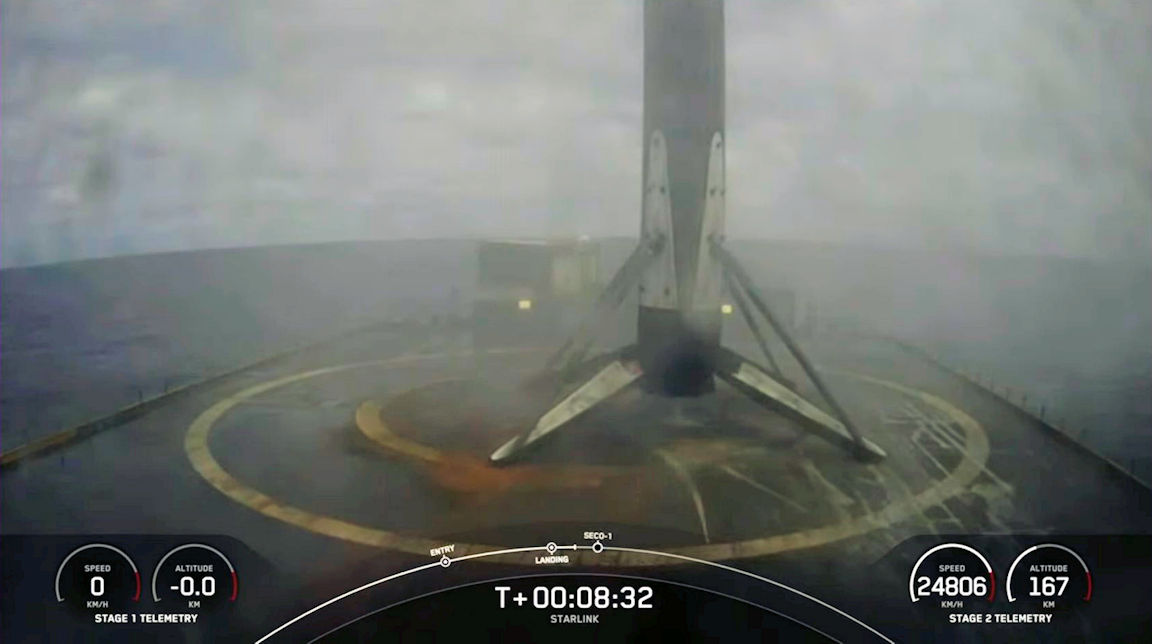

B1060 just as the single landing engine shut off. 


Thursday, April 21, 2022

It's Earth Day 2022

It's time for our annual bacchanalia of the made-up holiday they call Earth Day, my very favorite holiday to make fun of.   

As befitting the environmental movement, my tribute to Earth Day is over 90% recycled.  The only way it could fit the environmental movement better would be if everything I said was factually wrong.  Sorry.  No can do.  It wouldn't be me. 

Earth Day, as most of you know, is a holiday made up in the late 1960s at the start of the national environmental movement, inspired by the almost entirely discredited book Silent Spring.  Ira Einhorn is one of the main founders of Earth Day, if not the guy who started it.  Ira practiced what he preached: he murdered his girlfriend (less stress on the planet) and composted her body in his closet.  (Reduce, re-use, recycle!)

You won't find Ira Einhorn's name listed in any of the Earth Day promotional literature, as the organizers have taken great pains to distance themselves from this man, at least since he became better known for composting his girlfriend in a trunk in his closet for a couple of years in the late 1970s.

Ira Einhorn died in prison April 3, 2020 as commemorated in the New York Times.

I was a science geek in high school in 1970, the first Earth Day, and indoctrinated into the liberal crap of the day.  Who can forget the commercial with the crying Indian ("Iron Eyes Cody", who - BTW - was Italian, not Native American) looking at the spoiled earth?  Caught up in the spirit of the day, we went looking for pollution, and tested a local canal for coliform bacteria.  

The movement led to the creation of the Environmental Protection Agency, probably the best example of an agency that has outlived its usefulness (unlike the Federal Department of Education which was never useful).  Unlike government agencies, manufacturing companies are seriously interested in solving problems.  Quality Engineers, Manufacturing Engineers and many others have settled on the Pareto Principle.

Vilfredo Pareto was an Italian engineer who turned his mathematical skills to economic problems.  What he is best known for is the "80-20 Rule", the observation that 20% of the efforts produces 80% of the results.  Although 80% and 20% is an approximation, the rule is more or less right far more often than it is wrong.  Often called Pareto efficiency or Pareto Optimality, it has appeared in quality control, industrial engineering, and popular books.   

How does this relate to the environment?  Pareto (and most of today's Quality Engineers) would say to first measure your problems.  Find the 20% of problems that cause 80% of the trouble and work to get rid of those few problems while you let the others sit.  Then you "Lather. Rinse. Repeat."  What tends to happen is that you eliminate, or (at least) reduce the biggest problems and then have different set.  You eventually end up with much fewer problems and production running much smoother.  

If you're a government agency, the last thing you want is to solve problems, though.  Not only will you have nothing to do, you won't get offered "incentives" to rule in certain ways.  This is how you get things like the EPA ruling that Ozone concentrations found naturally in unspoiled national parks are higher than should be allowed.  Which makes it impossible to measure if emissions are below the new limits because the natural background is higher than what they're trying to measure.  Or how they regulate puddles on farms miles from a river under the Clean Water Act, meant to apply only to "navigable waters of the US."

As you know, the Green New Deal acolytes directing President Xo have a goal of cutting CO2 emissions by 50% by 2030 - a mere eight years.  Even more laughable was the talk by Climate Czar John Kerry in which he said even when we get there, "We still have to suck carbon dioxide out of the atmosphere."  One would hope he doesn't mean suck all the carbon dioxide out of the atmosphere.  Yeah, it's a trace gas but even third graders know that it feeds all the plants Earth that feed all the animals on Earth.  That's assuming they haven't been talking about made up gender nonsense instead of real science.  On top of that, sucking all the CO2 out of the atmosphere is impossible.  Every living creature on the planet will add back CO2 one breath later.  Plants inhale CO2 and exhale O2 all day.  At night they inhale O2 and exhale CO2 just like us. 

The 50% goal, though, doesn't mean compared to today, it means compared to 2005.  In my world, when a politician picks a date like that, I automatically think "they're cherry picking that date; I'll bet it's the worst possible date," and sure enough this plot from Statista shows that 2005 was about the peak year of CO2 production in the US, pretty much 6000 mmt (million metric tons) of CO2. 

The last point on the plot is 2020, and at 4,571 mmt, it was already down to 76% of the 2005 levels.  

I honestly don't think it's possible to reduce it to 50% of that peak at any reasonable cost.  The EPA says the transportation sector of the economy generates 29% of the so-called greenhouse gasses, so shutting down all transportation wouldn't be enough.  That includes not just cars and planes, the typical examples of pollution, but includes shipping goods around the country.  Replacing gasoline or diesel cars with electric just moves the CO2 production to the "electricity" sector - not counting the massive CO2 production in the "commercial" pie slice to manufacture the electric cars.  It would take reductions in all the sectors on this pie chart, and I just don't think it's there to save without invoking "and then something magical happens" - as Kerry pretty much did.


Chart from the US EPA.

In celebration of Earth Day, just remember "nature wants you dead" (a close to home reminder).  Turn on the air conditioner (if you're in my part of the world, it has been on) or the heater.  Burn some charcoal and a hunk of cow or pig.  Turn on all the lights in your house.  Start a big bonfire in your back yard.

“Remember, it doesn't count unless the lights can be seen from Proxima Centauri.” 

This column was written entirely from recycled electrons.  No electrons were wasted, disposed of or inconvenienced.  


Wednesday, April 20, 2022

A Little on NASA's Commercial Lunar Payload Services Program

I have to say that Eric Berger at Ars Technica came up with a story headline that hooked me immediately.  I had to read it.  The attention grabber was, "NASA is supporting some seriously risky missions to the Moon—it’s about time."  

He begins by referring to the big program everyone has heard about: Artemis.  NASA supports this program to the tune of nearly $7.5 billion per year, and for that the program's whole purpose is twofold.  The first purpose is probably the one that keeps the funding coming; its identity politics-style mission to land "the first woman and the next man" on the moon.  The second, more important reason is to start to establish a sustainable presence in deep space.  

Buried relatively deep in NASA's itemized budget, though, we find that they're funding a much smaller program called the Commercial Lunar Payload Services Program or CLPS, at about 3% of the level of Artemis funding.  Practically, a rounding error in the Artemis budget.  The purpose of the CLPS program is to use private companies to send small- and medium-size landers to the Moon's surface for primarily science-based missions.  

Like the Artemis program, the origin of CLPS can be traced to the middle of the Trump administration, when White House officials sought to refocus NASA's exploration programs on the Moon in 2018 after a long period of heavy focus on Mars. This shift resonated with the associate administrator in charge of NASA's science programs, Thomas Zurbuchen, who came into office in late 2016.

Since the end of the Apollo program in the 1970s, NASA had sent a handful of orbiters to the Moon but had not made a soft landing there in more than four decades. In the meantime, the space agency had landed half a dozen times on Mars and explored the rest of the Solar System.

It was a good time.  The agency had started the commercial cargo contracts a couple of years before that, so that our burgeoning private sector space companies could carry cargo to the Space Station and those missions were starting to run smoothly.  It would still be a couple of years before SpaceX would launch American astronauts from Florida, but the commercial crew program that resulted in that capability had been running successfully for years.  Meanwhile, water had been confirmed in ices around the moon's south pole leading to the thought that it might be a good place to plant a colony.  Ice meant water and water also meant rocket fuel as well its role in life support.  The commercial space industry, spurred in part by the Google Lunar XPrize, had also started working on innovative moon landers. 

After selecting a pool of a dozen US companies eligible to bid, NASA started to competitively award contracts valued at between $80 million and $100 million in May 2019 for lunar delivery missions. These costs were far less than NASA would have paid as part of a traditional procurement process.

Associate administrator Zurbuchen, consistently told policymakers there was a 50-50 chance of success for early CLPS missions.  

“You have to buy in on the risk,” Zurbuchen said. “If the chance of success needs to be 80 percent, I need to put a safety and mission assurance program onto it. And I don’t want to do that because then I’m squeezing some of the entrepreneurial energy. I just really believe that the entrepreneurial ecosystem is one of the core strengths of the United States. We’re second to none. And if we’re not using that as part of our leadership paradigm, we’re missing out.”

And then came VIPER.  

The accepted 50/50 risk of throwing the money away, and small budget probes starts to look different if the probe is bigger budget, and more important.  Then VIPER, the Volatiles Investigating Polar Exploration Rover came to the top of the list of missions NASA really wanted, and Zurbuchen oversaw rewarding a start-up company called Astrobotic a $200 million dollar contract to design, build, and launch the probe to the south pole by 2023.  In a lunar lander they still haven't flown.  

This is an important scientific mission tasked with searching for ice at the south pole and using a one-meter drill to prospect for subsurface samples. The total value of the mission is $660 million, and it matters to scientists and NASA's human exploration division, which hopes to send astronauts to the south pole in the 2020s.


You might expect that with an important mission like this that pressure would be put on Zurbuchen and his office to give the job to someone else.  Have JPL build the probe and have one of the "old space" contractors build the lander instead of a startup from Pennsylvania.  After all the meetings and other interventions, Zurbuchen realized that if he did it the old way, he'd have to kill off all the other jobs under the CLPS. 

He was not willing to accept this. And after receiving buy-in from NASA Deputy Administrator Pam Melroy and Associate Administrator Bob Cabana, Zurbuchen made the decision to keep VIPER on Astrobotic's Griffin lander. As part of this move, Astrobotic agreed to subject Griffin's propulsion system to more rigorous testing. Additionally, NASA decided to build a second set of instruments as a backup plan.

So far, NASA has awarded seven CLPS missions and more might be announced this year.  Zurbuchen has said that he's OK with the 50-50 odds on smaller, cheaper missions, but wants better from programs like VIPER.  What happens if all the CLPS missions go a year producing nothing but some new, small craters on the moon?   I expect there would be some attempts to cut CLPS off, but like the others in favor of CLPS, I think that would be short term thinking.  That road is the way to worsening the arthritic bureaucracy that NASA has become, barely able to accomplish anything and only then with epic cost overruns. 

Among the most successful of the private space companies, both SpaceX and Rocket Lab have adopted a "Silicon Valley-style" iterative design methodology; fly sooner, fail sooner, learn from those mistakes, correct them and fly again.  Each test improves upon the earlier design and has a higher chance of success.  When you think about it, this was the way the early days of the space program worked and it's part of the reason there were so many important milestones during the '60s.  We're not talking about risking lives here.   


Tuesday, April 19, 2022

NASA Drops an Interesting RFI

NASA dropped an interesting Request For Information, a step in the bidding and contract process, back on April 1st, of all days.  What an RFI typically does is talk about some goal that the agency has and ask companies with expertise (real or imagined) in the area to comment on it.  It's almost an open conversation with the goal of defining something that a Request for Proposal can be issued on.  Teslarati did an article on the RFI yesterday, but I just skimmed it while looking for more interesting or more important topics and missed an interesting aspect or two.  

To begin with, this RFI is about a program bid that SpaceX won almost two years to the day earlier; March 27, 2020.

Known as Dragon XL, that spacecraft would weigh around 15 to 16 tons (~33,000-35,000 lb) at liftoff and likely require a fully or partially expendable Falcon Heavy launch for each mission to the Moon. At the time, it was a fairly balanced and reasonable choice on NASA’s part, leveraging existing investments and experience with SpaceX and Dragon and erecting no major technical hurdles. 

So it's a strange little fact in my mind that NASA still hasn’t started work on the contract two years later, and actually has delayed work on the contract.  I think this RFI might well contain the reason.  

That’s why the new April 1st RFI is so intriguing. NASA begins by referencing fine print in the original 2018 Gateway Logistics Services (GLS) Request For Proposals (RFP) that allows the agency to continue receiving and considering new proposals from new and existing providers throughout the program’s planned 17-year lifespan. The agency says its primary motivations are for “information and planning purposes, to request feedback, to promote competition,” and to “[determine] whether to conduct an on-ramp in 2022.” NASA doesn’t specify what exactly that means, but in the context of the rest of the text, it appears that the agency wants to use this RFI to help determine whether or not to finally “on-ramp” its existing Dragon XL contract with SpaceX.

The real meat of the RFI and what I missed is that as you read down in the document, NASA repeatedly hints at a desire to substantially expand the scope of GLS.  In the last of eight things to comment on, NASA asks if, to help “create a vibrant supply chain in deep space,” respondents would be able to deliver additional cargo to “cislunar orbits [and] the lunar surface” or offer a “dedicated delivery tug capability” or “rapid response delivery service.”

NASA also asks for information on ways prospective GLS providers could “[minimize] the cost impact of…requirement changes,” “reduce operating costs,” and “minimize upfront costs.” In questions #2 and #3, NASA requests details about “new and/or innovative capabilities” that could “significantly increase…cargo delivery capacity” within “the next five years” and states that “offerors exceeding the minimum [cargo] capabilities may be viewed more favorably.”

In what seems to be written specifically to SpaceX, question #1 says, “Is your company interested in on-ramping to the GLS contract to provide Logistics Services as described in the original solicitation?”  The reality here is that SpaceX is very likely to be the only company in the world that could begin work on the job. 

Editor's note: turning nouns like “on-ramp” into verbs like “on-ramping” is one of the seven deadly warning signs of becoming what is referred to as “overhead” which all companies strive to reduce or eliminate.  

There are several interesting little hints that author Eric Ralph leaves in the last few paragraphs, but concludes with 

Put simply, while it does open the door for just about any US company to inform NASA about new GLS options, it’s hard not to conclude that this new RFI is at least partially designed to give SpaceX an opportunity to propose Dragon XL alternatives or upgrades.

If you're like me, you probably thought about Starship around the start of the article.  Ralph points out that Starship is actually far too big for this mission.  The Lunar Gateway, another payload going into space on a Falcon Heavy, has a visiting vehicle mass limit of 14 tons.  At that point, Starship will very likely weigh over 100 tons; perhaps far over 100 tons.

The Gateway’s first two modules are tentatively working towards a launch on a SpaceX Falcon Heavy rocket no earlier than late 2024. (NASA)

NASA is planning to hold an industry day on April 20th to better explain the RFI’s goals and wants responses to the RFI by May 31st, 2022, after which the agency will decide whether or not to follow up with a solicitation or on-ramp Dragon XL.


Monday, April 18, 2022

Artemis to Roll Back to VAB

On Friday, we covered that the Artemis Wet Dress Rehearsal never completed and the next step  was uncertain.  On Saturday, the agency held a teleconference to discuss the progress and announced they will roll the vehicle back to the VAB.  

The decision comes after three tries during the last two weeks. Each fueling attempt was scuttled by one or more technical issues with the rocket, its mobile launch tower, or ground systems that supply propellants and gases. During the most recent attempt, on Thursday April 14, NASA succeeded in loading 49 percent of the core-stage liquid oxygen fuel tank and 5 percent of the liquid hydrogen tank.

While this represents progress, it did not include the most dynamic portion of the test, during which the rocket is fully fueled and pressurized; and it, the ground systems, and computer systems are put into a terminal countdown when every variable is closely monitored. NASA had hoped to complete this wet dress rehearsal test to work out the kinks in the complicated launch system so that, when the rocket is rolled out later this year for its actual launch, the countdown will proceed fairly smoothly.

NASA said that they and their contractors will use the next several weeks to address the problems found during the test.  Something I hadn't read before was that some issues were found with nitrogen system contractor Air Liquide's hardware, which will have to upgrade its capabilities.  Technicians will replace the faulty check valve on the upper stage of the rocket, as well as fix a leak on the mobile launch tower's "tail service mast umbilical," a 10-meter-tall structure that provides propellant and electricity lines to the rocket on the pad.  

Under the "nothing happens quickly" rule of thumb, it seems like a reasonable guess to say it will take them a week to prepare and roll the mobile launch tower and Artemis back to the VAB.  Under the same assumption, I expect the work to take the month of May.  

At some point, NASA has to decide if they roll Artemis back out to the pad and complete the WDR successfully, roll it back to the VAB for some tasks typically done between WDR and then roll it to the pad for the third time to launch, or if they take a riskier approach and roll it to the pad essentially ready to fly.  If they do that, once the WDR passes, they could conceivably launch within days.  

There's a gotcha here.  The "tasks typically done" in the VAB between WDR and launch include arming the flight termination system or FTS.  All vehicles are required to carry such a system to destroy the vehicle if it threatens other people or places, and everyone who has listened to launch coverage of Falcon 9s or other launches have heard call-outs about the FTS being armed or being made safe.  

During a teleconference on Friday, Artemis Launch Director Charlie Blackwell-Thompson confirmed that there is a 20-day timeline once the flight safety system is armed. (This is a range safety mechanism used by all orbital rockets that destroys the booster in case it veers off course.) After the system is activated, it will take about a week to make final preparations in the Vehicle Assembly Building and a week to roll to the launch pad and make preparations there. That would leave just a single week for a fueling test, recycling of commodities, and perhaps one or two launch attempts before the 20-day window closes.

With a 20-day window, the system would have to be virtually flawless and it seems like a large bet they could approach flawless.  Which implies the earliest they could possibly launch the unmanned test flight would be around the start of July, but from August into the fall might be more realistic.  


Artemis SLS rollout on March 17th.  You can just mentally move the stack left (back into the VAB) or right (back out to pad 39B) and use the same image for the next few months. 


Sunday, April 17, 2022

Happy Easter!

To my reader friends and those who drop by on occasion.  I know the modern thing is to refer to this as Resurrection Sunday - it's the reason for the season after all - but the old fashioned greeting is still OK by this old guy.

Enjoy your day.  Enjoy your families. Instead of the usual pork butt (hey, it's kinda like ham) I'm in the midst of smoking a turkey.  However you celebrate, enjoy your day.


Saturday, April 16, 2022

Correction to Wednesday' Post

In talking about the ability for space coverage reporters to overfly the cape, I had said, "I think it's a bit more difficult for independent journalists here than in south Texas; over there they can set up remotely controlled cameras and run them all day, as Lab Padre does.  While the KSC isn't a no-fly zone, small plane flyovers are more expensive and can't provide the continuous coverage that ground-mounted cameras can." 

I have a good friend who's a pilot and he let me in on the real situation, letting me know I was too optimistic and lenient.   While it technically isn't completely a no-fly zone, it essentially is.  There's no such thing as flying over the bulk of the Kennedy Space Center without previous approval to do so. It used to be possible, but those days are long gone.  My friend was thoughtful enough to include a clip of the Sectional chart for the area; in fact, two such clips: one showing a wider look and one showing a more zoomed in area.  Pilots will understand this better than lay people, but I wouldn't be surprised if some of it wasn't clear without good familiarity with the area.  First, the wider area, from around Daytona well north of the area, south to the city of Rockledge, just south of Cocoa. 

The wide circular sector offshore the area is the area that is most likely to get shut down both for aircraft and boats.  Rocket parts are known to fall in the area, sometimes even intentionally.  This is the keep out zone that we hear of launches being delayed because of boats or aircraft were in the area, such as this story not even three full months ago.  Every one of the cryptic alphanumeric messages (R-2932, R-2933, W-137G, etc.) is a reference to a document to read and comply with.  

Air traffic flying to and from South Florida (the big, blue cities) tend to go well off the east coast or a few miles inland in this area, depending on destination so they're unaffected by all this.  While difficult to see, the coast of mainland Florida and most of the air space over the western side of the Indian River lagoon tend to be available to small planes.  It's best not to consider flying over the eastern shore of the Indian River because there are sections of the shore in the blue keep out area over the Merritt Island portion of the KSC.  Here's where the zoomed in clip is more helpful.

Along the coast stretching from just above the bottom right (SE) of the clip toward the NE, and then to the west of north, you'll see little black squares; those mark launch pads.  Never expect to be allowed to fly over launch pads.  The inverted triangles near the black squares seem to indicate the towers used for lightning protection, or other towers on the property.  There are two elongated dark blue rectangles, much longer than wide; those mark the two principal runways on the base: lower right belongs to Cape Canaveral Air Force Station while the longer one at the middle top is the former Shuttle Landing Facility, which is now in general use by NASA. 

One of my questions concerned the Roberts Road SpaceX expansion.  Videos of that area (and Blue Origin's facility) tend to look as if they were shot from a more vertical perspective, if not nearly straight down during a fly over, while views of the pads are clearly shot from farther west at a more acute angle.  My friend says that the area west and south of of the shuttle landing strip, which we think includes the Blue Origin facility and possibly the Roberts Road facility, is more lightly controlled.  Casual pop-up requests to the air traffic controller on duty might be possible there, but you still need permission to enter.  

The farther east you venture, the more prior permission and clearances are needed.  Complicating things further is that the south end of Cape Canaveral borders the property of Port Canaveral, which hosts (among other things) a submarine basin that the Navy wants to keep you from flying over.  There are controlled, Class B air spaces around major airports in the Orlando area, Tampa/St.Petersburg, Daytona and Melbourne.  There are heights above which certain avionics boxes are required to fly legally, and the general appearance of those is that of an upside down layer cake; smaller diameters at the bottom, larger at the top.  It's a difficult place to fly for the smaller, general aviation aircraft's pilot new to the area.  The last time I heard someone talking about this they said it's not possible to fly across the state, say from Melbourne to Tampa for instance, on a straight compass heading for the whole trip without steering around "keep out areas."

Just for comparison, take a look at the sectional air chart around Starbase Boca Chica.  Practically no restrictions at all. 


Friday, April 15, 2022

Artemis Wet Dress Rehearsal Flops Again - SpaceX Booster 7 Pressure Tested

The WDR for Artemis ran into another issue yesterday and the test was halted late in the day.  

Teams concluded today’s wet dress rehearsal test at approximately 5:10 p.m. EDT after observing a liquid hydrogen (LH2) leak on the tail service mast umbilical, which is located at the base of the mobile launcher and connects to the rocket’s core stage. The leak was discovered during liquid hydrogen loading operations and prevented the team from completing the test.

There is no further update on the web site.  A roughly 50 minute long press conference was held, but I haven't listened to it yet.  It's a YouTube link that seems to be audio only.  The first nine minutes is just a blue screen with text and background music.  In the "Heavy Rockets" section of this week's Ars Technica's Rocket Report newsletter, Author Eric Berger relays reports that the Artemis team reported they weren't going to fill more than 5% of the liquid hydrogen tank.   The LOX tank was brought up to 50% full. 

The question is whether they're going to try to do more on the pad or roll back to the Vehicle Assembly Building.  Delays with new ground systems and a new rocket are probably inevitable, but NASA has to be disappointed that we are now on day 14 of a two-day test.  My opinion is that while this test accomplished things, it was a failure.  When it comes time to launch cargo or people, it's a pass/fail test without the slightest tolerance for failure.  "Mostly working" doesn't cut it.  

We're in day 14 of a two day test on a booster that was supposed to fly six years ago.  And the problem they're having is with the most basic requirement there is.  They can't even fuel the stupid thing.


Meanwhile out a Boca Chica, stress testing of Booster 7 has begun.   

Known as Super Heavy Booster 7 or B7, the prototype is the first of its kind designed to support up to 33 new Raptor V2 engines – each potentially capable of producing up to 230 tons (~510,000 lbf) of thrust at liftoff. Even with just 20 such engines installed, Super Heavy – measuring around 69 meters (~225 ft) tall and nine meters (~30 ft) wide – will be the largest and most powerful rocket stage ever tested. That potentially unprecedented power is why SpaceX has custom-built a complex structural test stand to explore Super Heavy’s true performance envelope in a slightly less risky manner.

The tests had a few impressive looking moments but viewers mostly wouldn't know what's going on without pressure gauges to watch.  This video brief starts right before some impressive venting during the test.  

Increasing the central engine count from 9 to 13 was already certain to up the amount of stress future Super Heavy thrust pucks would need to survive by almost 45%. But combined with Raptor V2’s thrust increases, Super Heavy Booster 7’s thrust puck could actually be subjected to at least 80% more thrust at liftoff. Altogether, Super Heavy B7’s 33 engines should be able to produce ~7600 tons (~16.8M lbf) of thrust compared to Super Heavy B4’s ~5400 tons (~11.9M lbf). As a result, though it’s odd that SpaceX never did significantly test Booster 4, it’s no surprise that the company chose to give Booster 7 priority as soon it was ready.
...
After a few false starts and at least one ‘pneumatic proof test’ that likely saw Booster 7 pressurized with benign nitrogen gas, SpaceX began stress-testing the upgraded Super Heavy in earnest on April 14th. First, the booster was filled about a third of the way with roughly 1000 tons (~2.2M lb) of liquid nitrogen (LN2) or a combination of liquid oxygen (LOx) and LN2. Once the rocket was fully chilled, there were clear signs of some kind of added stress as large sheets of ice that had formed on the side of B7’s skin broke apart and fell off.


Screen capture from the above-linked video.  NASASpaceflight.com credit.


Thursday, April 14, 2022

My Favorite Story in the Last Month

Long time readers will know I have special contempt for junk science.  Maybe even hatred.  I've written many pieces on it (quite possibly the first).  Consider that background when I say my favorite story in the last month is about junk science. 

A quiet little story that got very little coverage broke on Reason.com on March 31.  It was about just how junky the science of gun control is.  The title was, "Do Studies Show Gun Control Works? No." The subtitle is an even better gotcha: "Out of 27,900 research publications on gun laws, only 123 tested their effects rigorously."  

Only 123 out of 27,900 - 0.4% - applied proper statistical testing of their results?  Yup.  Only it's not even really that good.  

First, let me grab their quote describing the study.

There has been a massive research effort going back decades to determine whether gun control measures work. A 2020 analysis by the RAND Corporation, a nonprofit research organization, parsed the results of 27,900 research publications on the effectiveness of gun control laws. From this vast body of work, the RAND authors found only 123 studies, or 0.4 percent, that tested the effects rigorously. Some of the other 27,777 studies may have been useful for non-empirical discussions, but many others were deeply flawed.

and then the conclusion about those 123 studies. 

We took a look at the significance of the 123 rigorous empirical studies and what they actually say about the efficacy of gun control laws. 

The answer: nothing. The 123 studies that met RAND's criteria may have been the best of the 27,900 that were analyzed, but they still had serious statistical defects, such as a lack of controls, too many parameters or hypotheses for the data, undisclosed data, erroneous data, misspecified models, and other problems. 

And these glaring methodological flaws are not specific to gun control research; they are typical of how the academic publishing industry responds to demands from political partisans for scientific evidence that does not exist.

Let me rephrase that a bit: out of 27,900 studies on gun control, not one study conclusively showed that gun control laws change anything for the better.  Oh, and by the way, the same is likely to be true for studies on climate change, dietary recommendations, Covid, or anything else with a pronounced political component. 

It's a worthwhile read, especially as the drumbeat of more gun control gets louder and louder.  Over and over, you'll hear the same arguments about how much the studies prove, when the deep and long review of their studies show none of them prove anything.  Plus, it includes a pretty good 16 minute video if you look at the Reason article and say TL:DR. 


Wednesday, April 13, 2022

Update on Starbase on Kennedy Space Center

I've been trying to find updates on the progress of SpaceX's effort to duplicate Starbase Boca Chica on the Kennedy Space Center, but have been having trouble.  I think it's a bit more difficult for independent journalists here than in south Texas; over there they can set up remotely controlled cameras and run them all day, as Lab Padre does.  While the KSC isn't a no-fly zone, small plane flyovers are more expensive and can't provide the continuous coverage that ground-mounted cameras can.  

NASASpaceflight.com covers their work at KSC, apparently roughly monthly, and while airborne, they also cover other activities on the Cape, especially Blue Origin's build out.  This video was posted yesterday.  

Teslarati has a brief story today on the work at KSC but while they have this video embedded, the most recent photos they post and Tweets they link to are from mid-March.  

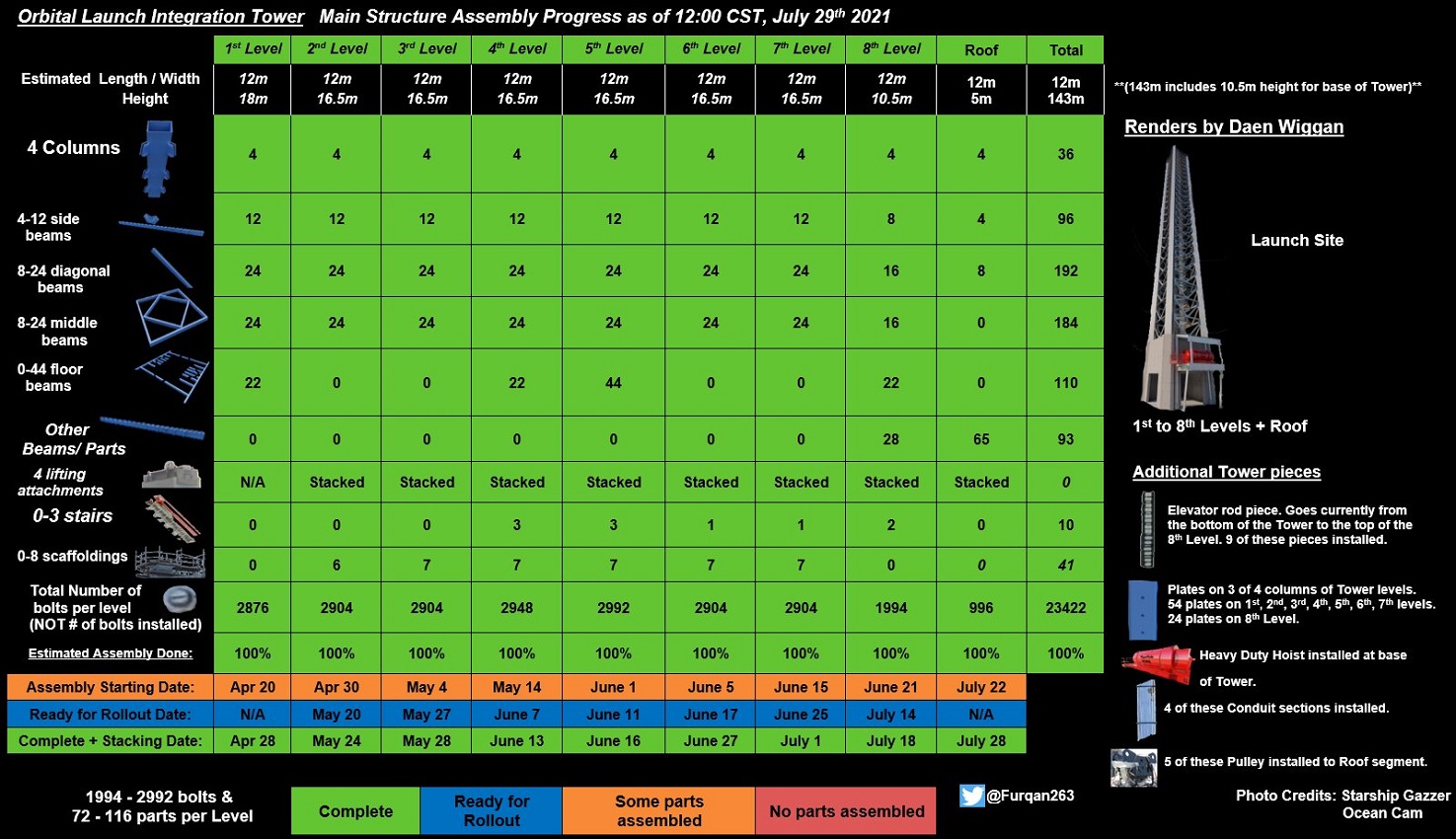
The Orbital Launch Integration Tower (OLIT) appears to be very similar to the one at Boca Chica, with more differences in its build and assembly than the design.  The OLIT has eight segments plus a concrete building those segments mount on top of; you can see in the video that three segments are complete, a fourth has been started, and the base has been started out near Pad 39A.  Twitter user @Furqan263 compiled a chart of the status of all of the major components of the OLIT back during the build in Texas.  This is his chart at the completion of the OLIT in Texas; you can ignore the bottom lines about when the various sections were started, ready to rollout to the pad and when they were stacked.  It gives a good overview of the assemblies and steps involved.

The main difference between the Texas and Florida towers is that on the first one, they would build one or two segments and transport them to the launch complex, while on the second, they're apparently building all of them and transporting to the Pad 39A complex at once, saving on road closures and probably interfering less with launch operations as well. 

This work is going to take a while.  Nobody has seriously suggested anything could launch from the new Starship pad before 2023, I just get impatient with wanting to see progress.

In this screen capture of the Pad 39A area during last Friday's Ax-1 mission, the orbital tower base can be seen left of the existing launch tower, and behind it - toward the ocean in this view.  The angle of the shot makes it impossible to see that the Orbital Launch Mount - the new pad - has begun construction as well.


Tuesday, April 12, 2022

CAFE Standards Are Back - But Hard to Find in the News

Back on April 1st, Transportation Secretary Pete Buttigieg announced new CAFE (Corporate Average Fuel Economy) standards for all vehicles to be sold in America, starting in 2024-2046.  The US Department of Transportation (DOT) has a propaganda an informational page on the new standards which require a CAFE of 49 mpg by '26.  To borrow a quote from the wonderful Mark Steyn, it reads like a refrigerator manual written by someone who really loves refrigerator manuals. 

The new Corporate Average Fuel Economy standards require an industry-wide fleet average of approximately 49 mpg for passenger cars and light trucks in model year 2026, the strongest cost savings and fuel efficiency standards to date. The new standards will increase fuel efficiency 8% annually for model years 2024-2025 and 10% annually for model year 2026. They will also increase the estimated fleetwide average by nearly 10 miles per gallon for model year 2026, relative to model year 2021.

Clarity?  Not much.  

Stepping back a bit, I've been writing on battles and skirmishes over CAFE standards for a long time, starting with the push to create a 54.5 mpg standard from the first Obama term's DOT back in 2012.  CAFE Standards are best thought of as the "A" in the name - the average over the vehicles they sell.  Regulating the average says that every vehicle in the manufacturer's lines doesn't need to get 49 mpg, just that the average mileage of everything they sell needs to hit this magic number.  The rules specifically apply to "cars and light trucks" while heavier trucks are in a different class.  The fact that cars are treated differently than trucks is one of the reasons for the popularity of SUVs versus station wagons.  You don't see many station wagons being made these days.  There is great legal wrangling and fighting over how to classify any given vehicle because not every vehicle has a prayer of hitting that kind of mileage.  If the requirement can't be approached, the companies have to restrict the number of SUVs or other light trucks they can sell to push the average up.  This has to all be calculated out in advance as they're determining how many of which models to make. 

I never worked in the auto industry (but I did stay in a ... sorry) but I'm pretty sure that they're working on the preparations for the '23 model year now.  My guess would be that it's too late to make any substantial changes to the 2024 models and preparation for the '25 models isn't likely to be much better.  The way I read that line that, "The new standards will increase fuel efficiency 8% annually for model years 2024-2025 and 10% annually for model year 2026." may be something lawyers would make a million bucks on, but if 2025's CAFE can be 10% less mileage than 2026, that's 44.1 mpg.  2024 can be 8% lower, or 40.6 mpg and 2023 can be 8% lower than that or 37.3 mpg.  The DOT says the current standard is, "a combined fleet-wide fuel economy of 40.3-41.0 mpg."   

Car makers need to figure out how many of their SUVs or muscle cars they can sell balanced against anything in their fleet that gets over 50 mpg (and the higher the better) to bring their averages up.  

Regular readers know I'm fond of pointing out that physics is a bitch and you don't get something for nothing.  The only places where the laws of physics get broken is in commercials and Looney Tunes.  The internal combustion engine has been optimized as a system for over a hundred years, and you're not going to suddenly make it much more efficient.  Instead, to reach the new standards the cars will get lighter, with more plastics and thinner metal structures.  The shorter way to say that is they'll be less safe.  The new standards will cost more lives.  

Reporting on the new standards, the Center for Automotive Research (CAR, of course) quotes DOT indirectly.  

The NHTSA press release notes that under the new standards, fuel consumption will decrease fuel use by over 250 billion gallons through the year 2050 compared to sustaining the previous Trump-era standards. Less reliance on foreign oil, consumer savings on gas, and reduced emissions were also emphasized in the announcement as an advantage of stronger standards. Officials highlighted that carbon emissions would be reduced by 2.5 billion metric tons and estimated that consumers could save almost $1,400 in fuel expenses over the lifetime of a 2029 model vehicle under new rules. However, it is also estimated that the new regulations will likely drive up the cost of new vehicles by nearly the same amount.

Two reactions: first, saying "almost $1,400" is recognizing that we're currently in a situation with very high fuel costs, and if we had lower fuel prices the savings would go down.  Saving that amount over the life of a car is a pretty trivial savings.  $140/year or $11.67/month for a car kept 10 years.  Second, I don't believe that the cost will be equal to what's saved on fuel.  The last several times this was studied the car costs went up more than the money saved on fuel.  

I'm going to reuse a graphic from my 2012 article on the CAFE standards, which shows the annual cost of gas at three prices per gallon from $1.50 to $5.00 gallon, versus the car's mileage and assuming driving 15,000 miles per year.  The curves display a similar shape, illustrating the diminishing returns for each incremental increase in mileage.  At the top curve, a 10 mpg increase from 20 to 30 mpg saves $1,250 or 33.3% less for 50% higher mileage; a 10 mpg increase from 40 to 50 mpg saves $375, or 20% less for 25% higher mileage.  All of the bigger gains were taken on the left end of that plot.

The problem, as always, is that government has no business regulating this sort of thing.  It's the most common, fatal conceit of our single-minded bureaucrats that they think they know better than the free market.  I've got news for the administration: a real half ton pickup (the most common size) that got twice the current MPG would be snapped up so fast it would set every truck sales record there is.  Nobody's against that.  We're just against being forced to pay more for a flimsier, less safe vehicle than we save by buying it, and we're against getting stuck with one that doesn't do everything we need it to do. 


Monday, April 11, 2022

When We Talk About Space Being Hard

...what we're really saying is there's a very small margin of error.  The people trying to design orbital rockets are not perfect - obviously nobody is - so they're going to make mistakes.  Just like you can ruin a crane or trailer winch by not being sure that it's stronger than the load you're going to lift, you can make up for that with design margin.  If you're going to lift a thousand pound load, you can make sure every part involved in lifting that load is going to be stronger by a defined safety factor.  In something common like lifting a known load, you can buy however much safety factor you want.  

Getting rockets into orbit is different.  The thrust vs. weight costs are a critical design trade.  If you make the rocket stronger, it will weigh more, meaning more fuel is required to lift it, and reducing the payload that can be lifted.  If a part on an engine is going to handle some sort of operating temperature extremes, or a valve has to spin at some number of thousands of revolutions/minute, margin might get very difficult to achieve.  There simply isn't much margin available in the percentage of liftoff weight a rocket can carry.  If the designers don't consider some characteristic or don't even know they need to consider it, the rocket could blow up on the pad or at any point of its mission.  

In my years of design, I referred to margin of error as margin of stupid.  When I screwed up, I owned it.  In some fields with a wide margin of stupid, designers can make lots of mistakes or big mistakes and get away with it.  Things with a wide margin of stupid don't explode in huge fireballs killing everyone and everything around. 

Prior knowledge from lots of research or hiring people who have done it before are the two big ways to get that reduction in stupid mistakes.    

Why am I talking about this?  Meet a small California startup in the rocket design business named Pythom (yes, that's an "m" on the end, not like the snake - or programming language).  Their aim is to beat SpaceX to Mars.  From quite literally nothing they aim to launch for Mars by 2024 - the next closest approach.  If not, definitely by 2026.  Pythom was founded by a married couple who are explorers and adventurers: Tina and Tom Sjögren who think of going to Mars as an analogy to sailing to the New World after Columbus.  Tina Sjögren put it like this:

"When Columbus sailed to America, there were both better boats and sailors. But no one else did it. He did. All it took was three weeks. It was not difficult; it was fear that held everyone back. It was believed that one would fall over the edge of the earth. Or be eaten by sea monsters. He showed... that was wrong."

Over at Ars Technica (first link) Space Correspondent Eric Berger notes:

This seems naïve, of course. Even SpaceX, which from the beginning was well-funded and able to hire excellent early employees, is still years away from sending humans to Mars after its founding in 2002. But the Sjögrens are undaunted. "You have to work hard, but you do not have to be very smart," Tina Sjögren added.

Do you see the huge warning flags in that statement.  Yeah, it is a cliche to talk about it being rocket science, but the saying, "it's not rocket science" didn't invent itself.  There is hard stuff there.  With a goal of launching a lander to Mars in 2024, they're working on developing engines and a small payload rocket called Eiger, which will be capable of launching 150 kg (330 lb.s) to LEO.  Somewhere around developing engines and a rocket, they're also working on developing a Mars lander called Olympus.  

Their philosophy is simple.  Since they claim 90 percent of a rocket's cost in the traditional space industry is related to personnel, their website says, "Pythom runs small teams and tight facilities, building in the spirit of early explorers such as Lewis & Clark and Roald Amundsen."  Having been through 40 years of manufacturing companies always striving to do more with less, my reaction isn't to find fault with that, but that it needs to be done intelligently.  My first department to target for cost reduction might not be the safety and mission assurance department.  Just sayin' because based on a video of a recent test they ran, it might be that they assume the design guys will know everything about safety and mission assurance so they never hired anyone for those jobs.

Personally, the colors in that exhaust/desert dust cloud kind of alarm me.  They kind of scream Toxic Nitrogen Compounds.  The part of the video where a couple of staff members find themselves downwind and run at 90 degrees to the cloud is a highlight, and over on Ars Technica, Berger talks about the initial video being on Vimeo, but he saved it and uploaded it to YouTube (where this is linked from).  After some questions to Pythom, they took down the video and uploaded a more sanitized version to Vimeo.  

Jordan Noone, co-founder of Relativity Space, tweeted in response to the video, "We knew better as untrained college students."  For their part, Pythom responded with a long post on their website, explaining a lot of details that aren't evident in that video.

I don't really know what to make of these guys.  They really do seem to need some adults in the room, but the engine does fire and the rocket doesn't explode - nor does it lift off (so at least they got weight greater than thrust).  Apparently nobody was injured here, but it sure looks more like luck than skill.  That said, I've always observed that "all the knowledge and skills in the world have never beaten pure, dumb, luck."  To go back to my original point, they displayed a lot of stupid, but apparently had enough margin of stupid to handle all of it.

The articles on Warp News are rather flattering and admiring in tone.  Warp News also implies that the flight they're aiming for in '24 will carry Tom and Tina, not the Olympus mars lander. 


Sunday, April 10, 2022

NASA's Artemis WDR To Resume Tuesday

The folks at the Artemis program left us hanging last week when they aborted their Wet Dress Rehearsal due to a problem with a hydrogen valve on the Mobile Launch Tower (which was quickly repaired).  They didn't offer an update until last Thursday, explaining that a different problem was then found with a Helium check valve on the Centaur upper stage's RL10 engine.  At that point, they said, 

The countdown for the two-day test is currently slated to begin with call to stations beginning at 5 pm EDT on Saturday, April 9 with T-0 planned for 2:40 pm on Monday, April 11.

That never happened.  Instead of the call to stations on Saturday, they issued another update moving the date back another three days.  

NASA is planning to proceed with a modified wet dress rehearsal, primarily focused on tanking the core stage, and minimal propellant operations on the interim cryogenic propulsion stage (ICPS) with the ground systems at Kennedy. Due to the changes in loading procedures required for the modified test, wet dress rehearsal testing is slated to resume with call to stations on Tuesday, April 12 and tanking on Thursday, April 14.

NASA's Exploration Group's Twitter page noted that when this test is completed, the vehicle will be returned to the VAB.   

I would have to say that (IMO, of course) troubles like this are unfortunate but are not unexpected.  

SLS on Pad 39B at the start of preparations for the Wet Dress Rehearsal tests.  NASA photo. 


Saturday, April 9, 2022

Weekly Update on the 1 by 1 - Part 23

I really shouldn't call this a Weekly update because my last update was far from a week ago.  Part 22 was January 30th, so over two months ago!  At the time, I was talking about preparing my piston's connecting rod to be cut out via CNC.  Since then, lots of complicating factors got in the way; big and small interruptions to life, ranging from one of our senior cats having a bad annual physical leading to several tests, lots of things to do and angst to go with it, to a one week house repair project resisting completion for a month, to my not being happy with either my CAD or CAM of the design and then finding an interesting new way to do it.  I do have a bunch of other hobbies, too, after all.

I've been back to it, but haven't started machining the part yet.  Let me pull up the drawing as it's provided with the plans, and shown here in January.  

One of the complications with this part is that I can't just import this into my CAD program, create a solid model of the finished part and then make it.  That big hole on the right end of the crankshaft is 3/8" and needs to be 0.375" exactly.  That means a 3/8 drill bit isn't accurate enough, and what you might think to do is to drill it undersized and then ream to final size.  The problem is that if you then cut the right end off it, you now have something that's neither circular or 0.375" diameter.  It's missing the width of the cutter.  

If you read the that big (four line) note at the bottom in that figure, you'll see the designer says to drill and tap the two holes for #5-40 socket head cap screws that you can see in outline above and below the big hole, then cut off the bottom cap.  Once it's cut off, attach it with the screws you just tapped for, and then drill and ream the big hole.  

That changes everything.  A slight complication is that's assuming the saw cut is .030" wide.  My saw cuts .047 wide.  All this led to re-drawing the part to revise the solid model to make it look like what I need to machine, moving that cap on the right enough for my saw blade.  It's tough to see but that raised area on the right isn't circular.  In CAD, once the two pieces were separated by the width of the saw kerf, I filled in the gaps with solid material, so the .047 segment is straight in those areas.

This is a two sided part, completely symmetrical top to bottom (in and out of the screen in this view).  A brilliant modeler on a forum I read regularly came up with an approach I'd never heard of for machining two sided parts like this.  He machines the part halfway in thickness, fills the space around the part with epoxy, turns the blank hunk of metal over and repeats the machining on the second side (after verifying the machine is still zeroed properly). This operation ends with the parts fully machined and suspended in the epoxy.  A short stay in a toaster oven causes the epoxy to break down and the part can be popped out.  There's fewer steps here than a lot of machining operations.  

I've lifted three pictures of his machining four connecting rods at once for a model of a Ford 300 six cylinder engine. 

Once the top side is machined, the missing aluminum is replaced by Devcon epoxy. 

Then the work is flipped over and re-fixtured on the mill to machine off the aluminum on the back of the connecting rods. Once that's done the parts are ready for the heat treatment to break down the epoxy.

He still has some machining steps to do before they're usable, but easy stuff for him.  

My approach to this part is to learn as much as I can and try some techniques I haven't done before.  For one thing, I'm going to do a roughing pass and a finish pass.  Both will use 1/4" diameter cutters and I'll use finer steps between passes on the finish pass.  My mill's spindle (driving the cutter) is slow for most work in aluminum and especially for a 1/4" diameter cutter. 


Friday, April 8, 2022

AX-1 On Orbit, Heading for ISS

Right on schedule at 11:17 this morning, the Axiom-1 mission to the International Space Station launched into space atop a Falcon 9 under bright blue spring skies from pad 39A on the Kennedy Space Center.  At 12 minutes into the flight, the Dragon spacecraft Endeavour separated from the Falcon 9 rocket's second stage and began its in-space journey toward the International Space Station. It is expected to dock with the station on Saturday morning.  

About 9-1/2 minutes after launch, Booster 1062 landed on drone ship A Shortfall Of Gravitas.  A video loop caught it in better than usual coverage today and is on SpaceX's feed on Twitter.  Of note for this mission is that this is the fifth flight of B1062 and the third flight of Crew Dragon Endeavour (capsule C206). 

Eric Berger at Ars Technica points out a statistic that I found mind blowing.  It hasn't taken SpaceX two full years to launch more astronauts than China has in 19 years.

Overall, this was SpaceX's sixth human spaceflight with the Crew Dragon vehicle. The company has transported 22 people into low Earth orbit across those missions in just under two years. To illustrate the rapidity of Dragon's rise, consider that China, widely regarded as having the second-most capable civil space program in the world, has launched 20 astronauts since 2003.

This mission is the first of many that Axiom has planned.  It truly is an historic mission; it's the first completely private mission to the ISS; a private citizen crew launched on private corporation's rocket and capsule.  Commander Michael López-Alegría of Spain and the United States, Pilot Larry Connor of the United States, and Mission Specialists Eytan Stibbe of Israel and Mark Pathy of Canada will spend about 10 days in space and a little more than a week on the station. Their time will be their own, and they will conduct a bit of research and also enjoy the experience of living in space.  

By late 2024, Axiom plans to launch its own spacious module to the station, where its customers will be able to come and go more freely. Before the end of the 2020s, this module and others subsequently launched by Axiom would break off and become an independent, private space station.  Assuming the ISS lasts as long as the end of the 2020s and doesn't need to be decommissioned before then.  

Richard Angle photo for Teslarati.

The mission is hard to sum up in one cute observation.  Yes, the Axiom crew is going to do some experiments, but from everything I can see they're not big new things that have never been done before.  As everyone seems to want to point out, these are wealthy old white men, the most despised demographic in Woke Western Civilization.  They are privileged.  But this isn't a Blue Origin New Shepard flight to just above the Karman line so they can say they've been to space.  Instead of the few hours that Space Tourists on a Blue flight get, these four have been in training for a year, working at Johnson Space Flight Center in Houston, at SpaceX in Hawthorne, and other places.  They can fly the Crew Dragon and they know their way around the ISS.   

Final words to Eric Berger at Ars:

The reality is that the crew of Ax-1 is something new: an important part of the transition from spaceflight as primarily a government-led activity to one led by commercial space companies like SpaceX. For example, this will be the fifth flight of this Falcon 9 rocket's first stage, making it a far more experienced booster than has previously been used for human spaceflight. No one really knows where this is all headed, whether it is sustainable, or how weird things might get. But with today's launch, the Ax-1 crew is among the first pioneers to explore this new commercial frontier.


Thursday, April 7, 2022

Rocket Lab Ready to Try For Helicopter Recovery

Back in August of 2019, Rocket Lab - one of the most successful small satellite launch providers - announced that they intend to recover the booster stage of their Electron booster for reuse.  Their intent is to both reduce the costs they charge and increase their launch cadence.  At the time, they were saying they needed to quadruple the number of launches they could do per year to meet demand.    

Unlike SpaceX's Falcon 9, though, Electron wasn't designed for reuse from the blank sheet of paper (or blank screen) stage.  Redesign of the Electron adding the mass of hardware like deployable legs, would undoubtedly lead to either redesign of the rocket or only launching smaller payloads.  The Electron's payloads are already fairly small at 220 kg (485 lb.) so there's basically very little margin there.  

Given that, they opted for a technology the military has used for decades, recovery by putting a parachute on the booster and snatching the stage out of the air with a helicopter.  

As expressed in that August '19 post, they started on a program of capturing data on what the stage went through during descent, and then later recovered some stages that splashed into the Pacific, the first of which was in November of  '20, so 15 months after the announcement they were going to start working toward the goal.  To the best of my knowledge, none of those were actually reused. 

This week's Rocket Report from Ars Technica reports their next mission will be the first attempt to catch a booster.

The company will make this attempt during its next flight, with a launch window that opens on April 19 for the "There and Back Again" mission to deploy 34 small satellites. After the first stage completes its boost phase, at 2 minutes and 30 seconds, it will separate and begin descending at speeds up to 8,300 km per hour.

Falling, spinning, catching? ... Nominally, a drogue parachute should deploy at 13 km altitude, followed by the rocket's main parachute at around 6 km altitude to dramatically slow the stage to 10 meters per second. As the stage enters the capture zone, Rocket Lab’s Sikorsky S-92 helicopter will attempt to rendezvous with the returning stage and capture the parachute line via a hook. If this is successful, Rocket Lab engineers and technicians will conduct a thorough analysis of the stage and assess its suitability for re-flight.

Rocket Lab's website news page has more details.  

Back in August of '19, when asked about how many reuses they wanted for each Electron Booster, CEO Peter Beck replied, "If we could reuse it once we've effectively doubled production. Once would be wonderful. Anything more would be really fantastic."  As we can see from SpaceX now having reused a booster 12 times, that lifetime might well be beyond two.  The disclaimer here is that Falcon 9 was designed for reuse from the get-go while it's an add on feature for Electron.  The first thing that comes to mine is that Falcon 9 is a welded metal booster while the Electron is a carbon fiber composite.  Design details like that might matter.

The launch time hasn't been announced yet, but I'll be trying to watch it that Tuesday.  I can only wish them tons of luck.   Happy hunting, Rocket Lab!


Wednesday, April 6, 2022

SpaceX & Axiom Space Team Up For Friday Launch

If all goes according to plan, SpaceX will launch their second private manned mission Friday, April 8 at 11:17 AM EDT for Axiom Space.  This will be a one week mission to the International Space Station for Axiom, where the crew of four will be conducting a variety of experiments primarily using equipment already on the ISS.  There have been space tourist missions to the ISS before, but this is more corporate R&D for Axiom, a contender in the development of a private space station.  In this case, the term “private manned mission” means Axiom is paying NASA for access and anything they consume in doing their experiments.  In turn, three of the four-man crew will pay Axiom to work for them in space, which will help defray Axiom's costs.   

Axiom put up an hour long video (55 minutes) of Q&A with the four man crew, one of the company founders and another principal officer, talking about their goals for the mission, but with very little depth about any actual experiments they're doing.  As a company, they're dedicated to opening up space for commerce and the unique things that can be done in microgravity.  

SpaceX Image

Teslarati reports:

The focus of Axiom-1’s crew is three ultrawealthy customers:

  • Larry Connor: Ax-1’s pilot and an entrepreneur who accrued his wealth through real estate
  • Eytan Stibbe: a venture capitalist and former fighter pilot who could become the second Israeli astronaut ever
  • Mark Pathy: CEO of Canadian investment and shipping companies

Each paying $55 million for the ten-day journey and eight-day stay at the International Space Station (ISS), Connor, Stibbe, and Pathy are bankrolling the mission. Crew Dragon’s fourth Ax-1 passenger, however, is Michael López-Alegría, a retired four-time NASA astronaut turned private (space) pilot who now works for Axiom Space.

Last fall's Inspiration4 mission, while also a private space mission, was different in lots of details.  It orbited for a shorter period, didn't go to the ISS, and was funded almost entirely by one person (Jared Isaacman).  The mission was primarily intended as a fundraiser for St. Jude Children's Research Hospital raising over a quarter of a billion dollars for pediatric cancer research.  The crew of four also conducted other scientific experiments on orbit.    

Crew Dragon is expected to dock with the ISS about 20 hours after liftoff, giving the Ax-1 crew a little over eight full days at the ISS before they’ll need to board Dragon and return to Earth.  If the weather forecast for landing zones looks particularly bad or good leading up to undocking, SpaceX and NASA reserve the right move the departure earlier or later.