Saturday, December 6, 2014

Inside the FDA

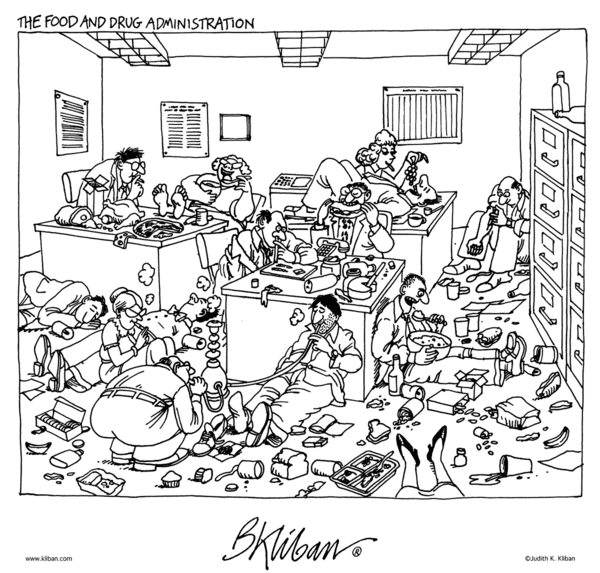
Secret illustration drawn from a photo of an office at the Food and Drug Administration


Not really.  The work of B. Kliban, a cartoonist who sometimes created funny material, and who died way too young (55).  His catalog of cartoons, both his regular work and his cat cartoons, appears on GoComics.com.  Obviously, the collection isn't expanding, although with an almost 30 year career, there's a lot of material.

Friday, December 5, 2014

Orion and Beyond

I find that I have an attitude that seems odd compared to many folks I run across.  It's rather common to hear people talk about wishing they were young again.  I wouldn't want to go back to college age, or farther (shudder).  I don't even particularly want to go back to the best years of young adulthood, when we were established and even starting to get ahead.  I'm pretty OK where I am.  If I had H.G. Wells Time Machine, though, I'd push that lever forward, not backward. 

But there are disadvantages to being an old guy, one of which is the possibility of not being around to see this come to fruition.
A friend of a friend took time off from work to witness today's test flight of the new Orion capsule.  As a bonus, the capsule was mounted on a Delta IV Heavy, the most powerful rocket in the US these days, and those are always cool to watch.  The launch time of 7:05 was right around the time I leave for work, but I was planning on going in a little later and watching it. As the count resumed at 7:01, we heard rain starting to hit the roof.  While it was clear at the KSC, it was raining here and we didn't try going out to look.

Orion is the first component to fly in the Space Launch System, the SLS, that ultimately is planned to take a crew to Mars.  There's a sequence of launch vehicles being planned; the smaller one of which has more liftoff thrust and payload than a Saturn V.
The smaller vehicle will be used for missions closer to Earth than a few million miles.  Not just moon missions, but LaGrange point missions.  The larger vehicle is intended for Mars trips.  The smaller vehicle is well into conceptual design and modeling.  It uses upgraded shuttle Solid Rocket Boosters, and the liquid fueled main engines from the shuttle for its core. 

When?  Well, the advertised times have the 70 Metric Ton launch vehicle flying by 2021 and the 130 Metric Ton vehicle by the 2030s.  Needless to say, those are subject to slipping out, especially as the US financial situations worsens (as it seems it eventually must).  Of course, if there's a total collapse, all of this is moot. 

I've written before about my sense of loss at seeing the US lose manned access to space.  The country that put men on the moon now has to buy access from the Russians, who are flying a ship first designed at the dawn of the space age.  In one of his videos, Bill Whittle points out the frightening fact that no one born after 1935 has ever walked on the moon.  Not before 1935, after.  They are all old men, and are leaving us.  In a few years, I expect dear granddaughter to ask me something like, "Grandpa, is it true men went to the moon when you were a boy?"  And that will break my heart.

I've also written about the bigger picture of whether or not NASA should be doing space flight at all:
Should NASA be involved in this sort of program?  Frankly, I don't know.  I believe a project like the International Space Station isn't something NASA should be doing: it's too routine, too commercial.  The truth of the ISS appears to be NASA needed a mission for its shuttle, and the ISS is a natural fit.  NASA should be leading edge; developing new technologies, like hypersonic transports, cheaper ways to orbit, Warp engines and things with long payback periods, things that companies probably would not invest in.  NASA is now institutionally risk-averse.  They've gone from "The Right Stuff" to arthritic bureaucracy, but that's natural for a government organization that's hung out to dry when something goes wrong (see Hubble Space Telescope, Challenger, Columbia...).  There may not be a commercial reason to go to Mars, so NASA should do that.  There are certainly commercial and scientific reasons to go to the moon and set up a permanent base for many things: science research (the far side of the moon is an ideal place for giant telescopes, radio and optical) and mining (Helium 3 can be mined on the moon and may be the next great fuel). This seems like a place for an industry/NASA team to figure out how to do such things.  
Of course, we never get to know the future.  Anyone of us could die tonight.  If the SLS and Orion proceed as planned, I'll be in my 80s when we get to Mars.  Maybe well into my 80s.  Sure would like to see it, though. 


Thursday, December 4, 2014

I Know the Feeling

Of towing the FSA around. 
Every penny in those bags came from someone saying, "just this little bit more won't hurt". 

From Glenn McCoy at Townhall.com.


Wednesday, December 3, 2014

Open Source Robotics and iCub

iCub is a humanoid robot developed by Italian researchers working in Genoa, Italy, at the Instituto Italiano di Tecnologia (IIT) as part of an EU project.  ST Microelectronics had a major part in the project; the robot is full of ST's sensors and microcontrollers.
Julien Jenvrin, the doctor responsible for robotics, brain & cognitive sciences at IIT, told EE Times, "The beauty of the iCub is that it's an open-source robot." He said, Think of the iCub as a smartphone. Researchers and developers from all over the world download a simulator, and keep developing new apps -- helping the iCub learn new skills." The iCub has now been adopted by more than 20 laboratories worldwide.
The Japanese are notoriously fond of humanoid robots, and while the iCub is only slightly human looking, it went over very well at the 2014 Embedded Technology 2014 show.  Predictably, Japanese attendees were gushing over this little Italian -- about as big as a four-year-old child (roughly 3'4", 55 pounds) -- which they praise as smart, sophisticated, and gentle.  I watched several short videos of this robot and I have to say that I'm impressed.  Still has a long way to go to keep up with the Honda Asimo, but as an open source research project looks pretty cool to me.  This video is bilingual.  The girl is speaking Japanese; the guy and the robot are speaking English.  No Italian can be heard.  


The stated price is 250,000 euros, plus VAT and more.  Not for the home hobbyist, but technically it's open source.


Tuesday, December 2, 2014

Techy Tuesday - Transparent Armor

It caught my eye a few months ago when I saw mention that Navy had announced a new form of transparent armor based on synthetic Spinel but with a new processing method called nanocrystals.  These Nanocrystalline spinel windows could be used on the Navy’s new Zumwalt Class of destroyers
The new nanocrystalline spinel is made of the same materials, magnesium aluminate (MgAl2O4), but the grain size has been reduced to 28 nm.
Apparently the Army has also been experimenting with Spinel, stating that they're getting good results with the material and there are many advantages to it. (pdf warning)

  • Light weight transparent armor in sizes up to 16” x 40”
  • Weight savings and thickness reductions of 50-60% over current systems
  • Reduce cost per square foot by 20-50% for Spinel ceramic plates for armor
  • Superior resistance to scratching, sand erosion and fracture due to rock strikes will provide major replacement cost avoidance payoffs
  • Operations and Support (O&S) cost savings will be achieved as a result of reduced vehicle maintenance and increased window service life
  • Reduce Spinel manufacturing costs by up to 50%
  • As recovering rockhound and lapidary hobbyist, synthetic gemstones are something I've had interest in for a couple of decades, so I immediately noticed the materials and the way they're processed.  One of the intended uses of this armor is to replace synthetic sapphire.  Sapphire is one of the first gemstones to be synthesized, and harder* than spinel.  The approach they use to synthesize this spinel is radically different from any way I know of to synthesize gem crystals and makes me wonder if new ways of creating synthetic gemstones will hit the market.  Not quite beating swords into plowshares, but perhaps a dividend.   

    *On the geologist's, or Mho's hardness scale, Spinel has a hardness of 8, while sapphire is hardness 9 - second only to diamond at 10.  The watch crystal on my everyday watch is a clear synthetic sapphire and two years of wearing it hasn't left a single scratch on it.  Hardness is a poor indicator of how tough a mineral is; it's only what stone can scratch another.  Some relatively soft stones, like jade, are phenomenally tough to break. 


    Monday, December 1, 2014

    More on the Thanksgiving Eve Regulatory Dump

    On Friday night, I wrote about the EPA's regulatory dump on ozone, and how the administration loves to dump new laws and regulations the night holiday weekends begin because no one is paying attention; something that always struck me as a Banana Republic tactic.  

    Turns out I missed the real regulatory dump. 

    On Wednesday, the Obamanoids, fresh from taking over education with their Common Core agenda, released 3415 new education regulations, including things that can easily be interpreted as moves to outlaw home schooling
    But what many parents and educators are focusing on in the Obama administration’s regulatory roadmap — known as the federal Unified Agenda, with its 3,415 regulations that will be finalized in the months to come — are particularly concerned about are the new rules that push the Common Core. These include: 1) federal attempts to control teachers via new teacher training; 2) the use of federal “waivers” limiting state educational authority and; 3) the federal “phasing out” of state authority over special education.
    New federal attempts to take over teacher training is just one regulation away from saying teachers must be certified by the Federal training, and that home schooling is illegal unless the teachers are Federally certified.   As Bill Clinton's aide Paul Begala put it, "Stroke of the pen, law of the land. Kinda cool!"  The Home School Legal Defense Association pointed out that parents across the nation with children in the public schools should be very cautious about the latest swarm of restrictions designed to carry out the United States Department of Education’s (USDE) regulatory agenda.
    “Although there is nothing in this agenda to indicate that the proposed regulations would threaten homeschool freedom, they point to a disturbing trend of the federal government attempting to control our nation’s education system,” HSLDA Director of Federal Relations William A. Estrada, Esq. warns. “As we have seen with the battle over the Common Core, even though the Common Core only applies to public schools, it is a long-term threat to every student, including homeschool and private school students.”
    My kids are long out of the school system, and my grandkid is not quite in it yet, so while the state of education and its socialist indoctrination bothers me, I don't actually have a dog in this fight.  From what I see of Common Core in my limited research, while it may be reasonable in limited areas, others are not.  It's cronyism of the highest order, full of handouts to companies like Microsoft and others who want to data mine our kids.  Even ignoring those problems, anyone should recognize that the home schooled kids are outscoring their publicly schooled counterparts the vast majority of the time.  It's almost a cliche' that when you see a bright, articulate kid on TV or somewhere it always turns out that they're home schooled.  Of course, that really frosts the public teachers' unions.
     
    More to the point, education is not enumerated as a Federal power.  The Federal government has absolutely no authority to dictate teacher training requirements and they have no authority to regulate handicapped or special education.  Regarding the first:
    “Teacher Preparation: On April 25, 2014, the President directed the Department to propose a plan to strengthen America’s teacher preparation programs for public comment and to publish a final rule within the next year,” the document states. “The Administration seeks to encourage and support States in developing systems that recognize excellence and provide all programs with information to help them improve, while holding them accountable for how well they prepare teachers to succeed in today’s classrooms and throughout their careers …”
    and regarding the second:
    “The Secretary will amend the regulations governing title I, part A of the Elementary and Secondary Education Act of 1965, as amended (ESEA), to phase out the authority of States to define modified academic achievement standards and develop alternate assessments based on those modified academic achievement standards in order to satisfy ESEA accountability requirements,” the document reads.
    The states are under no obligation to swallow this.  This is a 10th amendment issue: the Federal Government is pushing in to take over things they have no constitutional authority over.  The only authority they have is what the states have given up to them.  Of course, they hammered Oklahoma for having the nerve to refuse Common Core and you can be sure they'll do the same in your home state.  We need to help our state governments stand up to the tyranny from DC.
    (Common Core civics lesson from New Hampshire.  Note how it says government creates jobs, with no mention of private businesses or entrepreneur start-ups.)


    Video of the Day

    I should say Video of the Day So Far.


    I have no idea what they're saying, but it appears to be a fantastic commercial.  NTT Docomo.

    Just because I've watched it a few times and still get a smile from it.


    Sunday, November 30, 2014

    Hurricane Season 2014 Wrap Up

    Folks who live away from the East or Gulf coasts may not care about this, but I keep track of the hurricane season activity.  Today is the last day of the season, and while I could have really written this at the end of October when Tropical Storm Hanna dissipated, it's best to get the whole season.  Although the predictions vary, NOAA's last prediction before the season (5/22) was eight to 13 tropical storms, including three to six hurricanes, only one or two of them major (with winds over 110 MPH).  There were eight tropical storms, six made it to hurricane status and two became major hurricanes.  One of those, Edouard, was Major for a few hours, while Gonzalo stayed a Major storm for days.  All things considered, their predictions were rather good. Those predictions have often tended to be good for a laugh after the season.
    I've been a fan of Ryan Maue's Accumulated Cyclone Energy model since I ran across it a few years ago because I think by integrating both the intensity and the duration you get a better measure of a storm's impact, or potential impact.  Consider Edouard, which was a tropical storm for several days before becoming a hurricane and was a Major storm for one forecast period vs. Gonzalo which was a tropical storm for less time but a Major storm for a 3 1/2 days.  Both storms lasted about the same amount of time and both are counted as Major Hurricanes, but Edouard had an ACE of 15.35 while Gonzalo was the "worse" storm at an ACE of 25.365.  The ACE for the North Atlantic Basin for the year to date is 63% of climatological normal, another mild year.  (Last year was 30%).

    One storm hit the US; Hurricane Arthur hit the outer banks of North Carolina on the July 4th weekend.  Florida has not had a hurricane since Wilma in 2005, a record for longest time since a hurricane made landfall in the state.

    As I reported in October, it's beginning to look like the era of 'high spin cycle' tropical cyclone activity in the Atlantic basin that started in 1995 has run its course.  If this is indeed the case, hurricanes in the North Atlantic will be less of a concern for next 20 years, allowing a lot more building along the coast, which will result in more damage in 30 years when the next Sandy hits and no one remembers what a hurricane was like. 

    Hurricanes are good disasters for the lazy man, so I like them. There's no need to go get in line for plywood for your shutters, canned food or bottled water or any of that. All of it is stuff you can prepare for months or years in advance. Yeah, you have to go put up the shutters and do some stuff in advance of the storm, but you sure don't need to be in line at stores. Or in line at a FEMA tractor trailer afterwards.

    Saturday, November 29, 2014

    What's Up With the Precious Metals?

    Heck if I know!

    Unless you don't pay any attention to precious metal prices at all (in which case you're kinda out of place around here) you know that prices have been in the tank lately.  Gold closed at $1168/oz Friday and has been struggling to clear $1200/oz since mid-October.  It hasn't seriously challenged $1400 in the last year.  What's significant about that?  Just that analysts conclude that the
    "all-in costs of gold producers are now above $1,150/oz, even after big cost reductions and a focus on higher-grade mining. If the price drops to $1,000/oz, there will be many shutdowns. The industry needs a price of at least $1,400/oz to support sustainable production, and that number will rise, as early as 2015 or 2016."  It's progressively harder for gold miners to mine profitably at today's prices, and that gets worse as the world's central bankers create more and more inflationary pressures on the dollar. 
    Silver is just as bad.  The number of ounces of silver it takes to buy an ounce of gold (or the number of silver ounces 1 oz of gold will buy) is 75.4.  Historically, that's on the high end of where it ranges, but not an all time high.  Here's your kicker: the average silver to gold ratio from 1687 until now was 27.28, just about a third of what it is now.  The ratio went above 40 in 1984 and has only rarely gone below 40 since then.  A high ratio represents either historically cheap silver or expensive gold - but the preceding paragraph explains that gold is almost selling too cheaply to mine.  To me that implies gold is cheap, and silver is full-tilt-bozo, ridiculously, crazy cheap. 
    (Note this is from 11/27 - Thanksgiving - when all the other world markets were open.  My value of 75.4 is from 11/28's closing prices.)

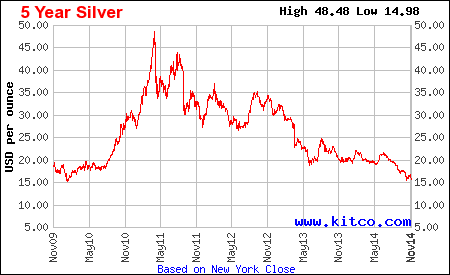
    Silver has been in a down trend since mid 2011, although a couple of those vertical price drops came from the commodity markets changing the their rules.  It was almost net zero movement since May of '13, but the last couple of months have been brutal.  With "above ground" supplies of almost a billion ounces (978 million), more than last year, and the economic forecast for slowing growth worldwide (if not outright global recession) the price of silver seems to be caught between the strangely resurgent dollar strength and the investors eying the white metal more as an alternative currency than as an industrial investment.  Silver's price correlation to gold is 0.82 (1.0 being perfect... and never seen); its correlation coefficient to industrial metals is 0.27. 

    So if there's so much silver around that you can get all you want, spot prices are in downward spiral and the price of silver is prices last seen in 2009, you might think this is a good time to go buy some.  I know that a year or so ago, 90% junk silver coins (90% silver US coins from 1964 and before) sold for about a 6 or 7% premium over spot price.  Tonight, checking the cheapest junk silver coins, I find the premium is closer to 17%!  I thought supplies were so high we were tripping over silver. 

    It's widely thought that the spot price is set by paper traders who have nothing to do with producing, or really buying actual metal.  Keith Neumeyer, the CEO of First Majestic Silver took the bold move of holding back 35% of his company's silver production rather than sell it at the paper trader's price. 
    Now, Mr. Neumeyer has taken things a step further by suggesting that silver miners should form a semi-cartel and hold back sales of their production in order to break the backs of the paper manipulators. He encourages all miners to hold back silver, pick a month, get together and hold back silver for 30 days, putting out a news release collectively. The goal is to call the bluff of the paper markets, which trade over the entire year of global production in a day. First Majestic itself is a small fish, but imagine the impact if a few of the top producers joined in the effort and physical supplies tightened.
    Attempts to manipulate market prices are widespread, and metals investors in particular are very loud about it.   The current extremely low price of oil (closed at $65.99 Friday) is said to be an attempt by the Saudis and the Russians to collapse the US shale oil resurgence.  Both Saudi Arabia and especially Russia need the price to be closer to $100, but the combination of the US energy production improvements and forecast for lower demand have helped pressure prices lower.  The point is, anyone who can try to influence commodity prices will.  Still, it's widely reported that despite the large number of above ground ounces, the important part is that demand for that above ground silver exceeds supply, which should imply the price can't be held down too much longer.

    As always, the real question is what the future holds (and long time readers know my answer usually starts with Bohr's quote).  As I said before, 90% silver coins have jumped a lot in price compared to the spot metal price.  The US Mint regularly sells out of silver eagles.  Combine that with silver producers trying to raise prices.  My view is that the separation of price for physical metal vs. the paper price means that sellers are just plain refusing to sell at that paper price.  If you really want the silver, you'll pay more.  That tells me there's a fundamental stress in the market that will only be relieved by silver going up in price.  I expect next year to be better than this year for the metals. 

    Standard disclaimers apply: I'm just some dood with a blog on the vast Sargasso sea of the net.  YMMV.  Under penalty of law, do not remove mattress tag.  Professional drivers on closed course.  No animals were harmed during the writing of this blog (although one white cat was annoyed that I wasn't paying enough attention to him). 


    Friday, November 28, 2014

    A Little Normalcy Bias Feels Pretty Good - But, EPA!

    I've spent the last couple of days with family, enjoying the holiday together, eating together, joking together.  It has been a nice break.  But if you've been here before, you know that while I may occasionally look away or pretend things are normal, it's not a steady diet.  Even troops on guard duty "take five" now and then.

    This being a holiday weekend, the administration announced choking new rules on ozone pollution.  They always announce (or pass) the most strangling, odious rules on a holiday weekend or a Friday before a long weekend because they think the fewest people will be watching.  Calling the ruling about "smog regulation", the EPA said
    “It empowers the American people with updated air quality information to protect our loved ones – because whether we work or play outdoors – we deserve to know the air we breathe is safe.”
    Implying, of course, that the air currently isn't safe and they have been struggling mightily to improve our lives in the face of awful opposition from ... I don't know... someone or other. 

    Bull.  Crap.

    Of course, no one mentions that they've been in charge since 2009, three complete election cycles, and didn't think this needed to be done.  Which obviously means they waited until they thought it would do the least damage to Evil party incumbents.  They were afraid if they announced these rules earlier, it would affect the elections.  Since it's hard to lose much worse than they did, this is a really good time to drop this turd in the punch bowl.  With any luck, the people will forget it by the next elections.

    Two big problems come to mind.  The first is that reducing legal ozone levels because it's a component of pollution is like reducing legal oxygen levels because it's a component in seawater and we don't want to breathe seawater.  The second is that the current limit is already just about at the  natural background level of ozone.  In most of the country, it's physically impossible to measure the new limits because the natural background is higher than the level they're imposing!  

    The reduction, from the current 75 ppb (parts per billion) to 70 or 60 is low numerically, but ozone limits now are already trace levels.  The new levels would put the ozone emissions from completely non-industrial areas out of range!
    That's down from the 75 ppb limit set in 2008. While that might seem like a small drop, it would push vast numbers of sparsely populated areas of states like Idaho, South Dakota, Maine, New Hampshire, Kansas, Iowa, Oklahoma, Minnesota and West Virginia — where no counties violate today's standard — into the red zone.

    Even Colorado's La Plata County — almost half of which is inside the San Juan National Forest — would violate the new standard.
    EPA says it's doing this because "...we deserve to know the air we breathe is safe", right?  They claim they'll reduce asthma rates, but the data from the Centers for Disease Control say that as ozone levels have fallen over the decades, asthma rates have gone up.  Clearly, it's not directly linked to ozone.
    To further muddy the EPA claims, asthma rates have risen even as ozone has steadily declined. From 2003 to 2010, EPA data show that ozone levels nationwide fell 11%. But the number of people suffering asthma attacks climbed 26%, according to the Centers for Disease Control.
    Furthermore, the rates they're going to mandate are below normal background levels in places like Yellowstone National Park.  Don't know if you've been there, but aside from the smell of sulfur in a few places, it has absolutely pristine air.  Howard Feldman of the American Petroleum Institute said last spring in a study of possible coming regulations:
    “… we don’t know how to get to these levels. These levels are levels that are at or below peak background. Background levels at Yellowstone National Park are 66 parts per billion, background. … Background at pristine locations is 65, 66, 67 (ppb). It means we have very little ability for our society to operate the way it normally does. … Our society does have some emissions, but that is the cost and benefit of our modern society, where we’re able to have the amenities and the social life that we like. So there is some impact on the environment. We’re talking about reducing that (head)room to almost zero.”
    Many industrial processes produce ozone, just as many natural processes do.  It's easy to think they're trying to shut down every power generation plant and every factory in the country.  They're just evil enough to think that's the thing to do.
    The API provides this map of the impacts of the new regulation.  Areas in red will fail a 60 ppb standard now.  Areas in gold are anticipated to fail a 60 ppb standard based on interpolation of measurements made nearby.  I'm unable to find if the few areas in white are thought to be low enough in ozone to pass - or if there are simply no data from those areas.


    Wednesday, November 26, 2014

    Early Black Friday Special Edition

    I burned a vacation day today, because why not??, and as I'm wandering around the house I'll stop and take a look at my emails.  All Day Long, ad after ad of Black Friday Specials. 

    So in that spirit, I steal an article from Design News and pass on "12 Black Friday Gadgets for Someone You Hate". Number 1 is:
    The Chicken Burger USB Hub.  The Chicken Burger USB Hub has been discontinued, but we had to include it in our slideshow because, well, it's a chicken burger USB hub!  Click here to go through the 12 of them. 

    It's a collection of real WTF ideas made into a product (or at least a prototype).

    Everyone have a wonderful and blessed Thanksgiving.  Not "turkey day".  Thanks Giving.  


    Tuesday, November 25, 2014

    The Face of Ferguson

    Hat tip to Sense of Events for this heartbreaking photograph from Ferguson.
    Natalie DuBose, the single mom and single proprietor of "Natalie's Cakes and More" worked long and hard to open a store of her own, and a rioter broke in her front window, destroying other property as well.  If the profiles are any indication, probably someone who isn't from Ferguson.  Probably someone hired to be there by any number of rent a goon agencies there trying to implement the final Cloward-Piven push that destroys society.  Despite the setback, Natalie isn't giving up.
     "I'm baking today," Dubose told CNNMoney, as the sound of broken glass being swept up can be heard over the phone. "We have orders to go out for Thanksgiving. I can't tell the people -- I won't tell the people -- that I'm canceling."

    The shop's main window is "busted out completely. They threw a chair in it to bust it out ... It's a big mess," said Dubose, who opened Natalie's Cakes as recently as June.

    Despite the mess, however, Dubose says she will continue to bake. She can't afford to give up now, having invested all she had into a business that was funded through bake sales at flea markets.

    "I am a single mom, a mother of two," she said. "This is everything that I own. I can't walk away from it. I just got to start up and start baking again."
    Poverty doesn't cause crime just like poverty doesn't cause riots.  Crime causes poverty and riots.  Only the hardiest will stay in a place where they have to rebuild their business or recovery from robberies and other crimes.  New businesses will think long and hard before going into a neighborhood like that.  Over time that ensures the poverty of an area. 


    Monday, November 24, 2014

    Pocket Sized Automotive Jump Starter

    (Yeah, I have a thing for batteries.  And a flashlight thing.  And a few more odd little fetishes.  What's it to ya?) :D

    A few weeks ago, the lovely and has-as-bad-a-flashlight-and-battery-thing-as-I-do Mrs. Graybeard got an email ad for a remarkable thing: a packaged battery appliance that will not only charge your iPhone/iPad/Android/probably anything that uses a USB charger, it will also jump start your car.  It's an 11 Amp Hour battery in a package that will fit in my cargo pants pocket and maybe the jumper cable, too, which is short but has large clips.  It's 155x76x29 mm (LxWxH) or just about 6 1/8" x 3" x 1 1/8".   It comes in a zippered cloth case with elastic straps for the battery and some accessories.  It charges with an AC adapter, or a lighter plug in your car.  There are two USB ports on it to charge two devices at once.  One is marked 5V/1A while the other is marked 5V/2.1A. 
    NewEgg sold out of these almost immediately, but I see the same thing on Amazon for a few bucks more.  A little looking around, and I find there are many similar things on the market (including a video demo) and I feel embarrassed to have not been on top of the tech.  But they're cool.  One reviewer we read somewhere said he jump started cars 11 times on one charge; others say they've jump started V8s and other big engines.  These batteries are rated to deliver a 400A peak in a jump start; if I read this right, it's a short peak of 400A and then a sustained 200A.  A little mind boggling. 

    I find this a bit amazing, but I've had the little jump starters that include an air compressor, lights, and all stuff quite some time.  When you open one of those up, you'll find a sealed lead acid gel cell battery that's about 4x the size of these.  The reduced size is probably from the better battery chemistry.   


    Sunday, November 23, 2014

    Busy Day...

    There's a wise old saying I encountered in test engineering back in the '80s: there is nothing more frustrating for a technician than to realize the problem he has been troubleshooting is in the equipment he's troubleshooting with and not what he's working on.  I have a drawer full of those Tee shirts, and I think I got another one today. 

    That was a few hours out of the day. I have a 12V 35AH battery, a sealed AGM lead acid, that I keep around for general backup use.  My plan is to use it with my small solar panel to keep it charged, but mostly it just sits around.  Friday night I decided it was time to put it on a charger to keep it topped off.  To my surprise, it timed out the little charger I was using at 300 minutes (5 hours) without saying it was full.  That made me think it needed to be cycled down and back up, so on Saturday I hooked it up to a load: an AC inverter and 100W bulb.  100 W at 12V is about a 8 1/3 amps, so with inefficiencies and all, it should discharge for 3 to 4 hours.  The inverter cut off in no more than 2 hours.  This time the smart charger said it was done after putting in just a few hundred mA, which was way too little.  So today I thought I'd give it a load which I could measure current through and rigged up a combination of some stuff (including a spool of wire which drew an amp itself) and drew 2 amps for three hours.  6AH - should put a dent in the battery, but not deplete it.  To my surprise, it was measuring 11.3 V at that point, just about stone dead.  Again, back on the little charger and it put about 3 AH into the battery and said it was done - but a voltmeter read 11.88 V, which is about 30% charged.  This time I switched over to a better charger, and this one said 30% charged and started working on it.

    So I've probably been troubleshooting the charger (one of these under a different brand name).  Most likely.  The behavior of the battery was still suspicious, but sometimes you need to discharge them deeply and recharge.  Since I was believing the little charger until the last bit of troubleshooting, maybe that's the only problem.  

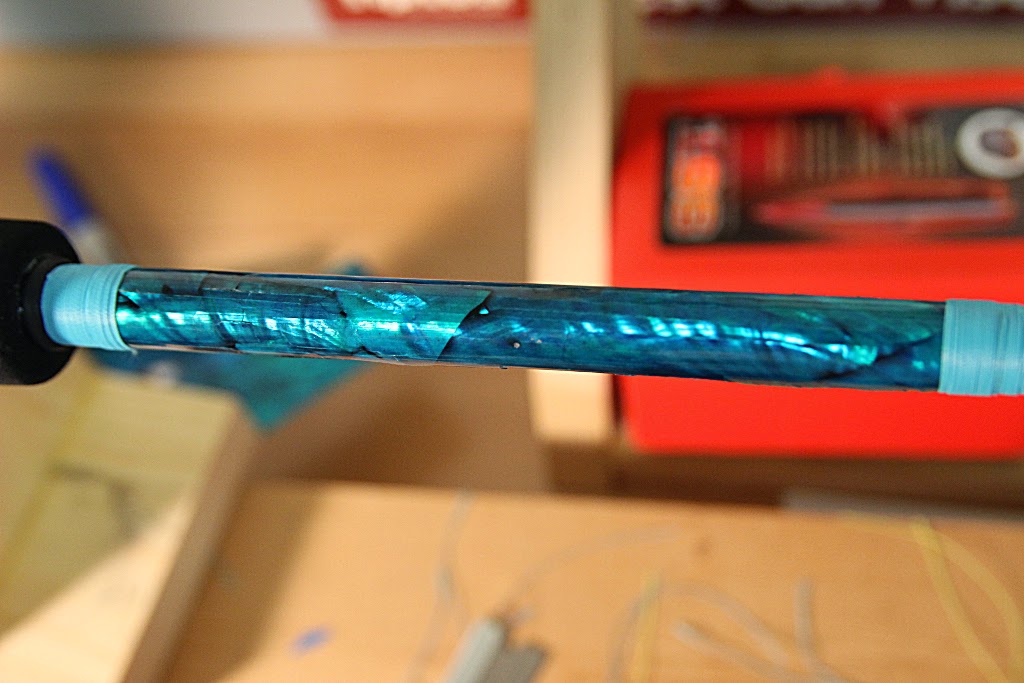
    While waiting for the battery to discharge or charge, I was working on another little project, a new spinning rod.  This was prompted by noticing the one I had been using was rusting in places (a saltwater rod should never rust).  I get the regular catalogs from Mudhole (no affiliation, just a customer, YMMV, best if used before...), and picked up an MHX graphite blank, along with the parts to make it to my taste.  I finished all the wrapping and trim (probably...) and now just have the epoxy finish to apply.
    The blank is black, and I decided to finish it primarily in a bright neon green, like MHX's logo, but with a little light turquoise trim.  Here it is on my little rod winding setup.  The unusual thing about this rod (for me) is that I found this 3M sheet abalone to do some fancy looking trim work with.  So I got a couple of pieces of this stuff in a color called "angel wing teal" and tried it for the first time.  This is a rod with an EVA foam handle that leaves a few inches of bare blank between the grip and an end cap I'll probably stick in my gut to fight fish.  It got a piece of this, as did the area where I ordinarily put a decorative thread wrap.  It's nice looking stuff.  Fragile, and cracks easily, but I understand there are actually thin layers of abalone shell in there, and I don't think that's flexible.
    Add in some time wasted looking at football on the tube and BAM! back to work in a few hours.  Thankfully, I get a short week this week. 


    Saturday, November 22, 2014

    Shock: Google Research Team Says "Renewable Energy Just Won't Work"

    Most of you know that Google has a very left-leaning board, especially for a company founded by entrepreneurial engineers.  At least in their public pronouncements, they wholeheartedly accepted the idea of climate Thermogeddon, complete with swallowing the dire models produced by James Hanson of NASA.  Four years ago, they make a very big and public statement about going over to renewable energy sources.
    Thanks to Watts Up With That, we get a link to IEEE Spectrum, the closest thing to a general interest publication that the IEEE has (IEEE is the Institute for Electrical and Electronic Engineers).
    “At the start of RE<C, we had shared the attitude of many stalwart environmentalists: We felt that with steady improvements to today’s renewable energy technologies, our society could stave off catastrophic climate change. We now know that to be a false hope …
    Renewable energy technologies simply won’t work; we need a fundamentally different approach.”
    The basic problem is that all known and predictable renewable energy technologies require more energy input in their implementation than can be paid back.
    The key problem appears to be that the cost of manufacturing the components of the renewable power facilities is far too close to the total recoverable energy – the facilities never, or just barely, produce enough energy to balance the budget of what was consumed in their construction. This leads to a runaway cycle of constructing more and more renewable plants simply to produce the energy required to manufacture and maintain renewable energy plants – an obvious practical absurdity. [emphasis added: SiG]
    A key paragraph in the IEEE article says:
    “Even if one were to electrify all of transport, industry, heating and so on, so much renewable generation and balancing/storage equipment would be needed to power it that astronomical new requirements for steel, concrete, copper, glass, carbon fibre, neodymium, shipping and haulage etc etc would appear. All these things are made using mammoth amounts of energy: far from achieving massive energy savings, which most plans for a renewables future rely on implicitly, we would wind up needing far more energy, which would mean even more vast renewables farms – and even more materials and energy to make and maintain them and so on. The scale of the building would be like nothing ever attempted by the human race.”  [emphasis added: SiG]
    I'm not surprised at the conclusion, I'm surprised they admitted it.  While I'm not dumb naive enough to think there's such a thing as Moore's law of batteries, I have been encouraged by the declining prices of solar cells and was thinking that since those are silicon, maybe some of the fabrications enhancements from the silicon microprocessors, memories and such would carry over to solar cells and reduce the price per watt like Moore's law; if not halving the price every two years, a 25 or 33% reduction.  But not only do solar cells have to become cheaper, batteries and the other infrastructure has to as well - you have to respect the duck curve.  

    Unlike the people who earnestly believe those magic unicorn farts will someday power everything, a group of engineers tasked with finding a way to produce a billion watts of renewable power at a cheaper price point than a coal-fired plant has to face reality.  Reality is a tough taskmaster. 

    Friday, November 21, 2014

    Taylor Swift and The Music Distribution Channel

    Or, to borrow a phrase from Bob Dylan, "The Times They Are A Changin' ".

    I have to admit, I've never found Taylor Swift terribly interesting as a musician (but I haven't really listened in a while).  I first heard a few songs of hers back in '07 or '08 when she burst on the scene.  I think I recall her saying at the CMAs that the award would make her senior year of high school the best year of her life and got a smile out of such a kid's world view.   

    Earlier this year, I happened to catch a news story where she seemed to go out of her way to help a sick young girl.  Then another.  And another.  And more.   Suffice it to say, she visits children's hospitals all the time, using her celebrity in the best possible way: to help bring a few moments of joy to people going through the horrible ordeals of a being treated for a deadly disease.  My opinion of Taylor as a person skyrocketed. 

    Taylor made some news in the music industry lately by "breaking up" with Spotify and pulling her entire collection from the streaming service.  This move worked for her and her latest album, 1989, sold a million copies in its first week, making her the only artist ever to have three albums with million-selling first weeks.  To put this in context, a few weeks before 1989 was released, it was widely thought that no one would sell a platinum CD (million unit sales) in 2014, and some were saying the days of platinum sellers were ending.  

    In an online article in the Wall Street Journal, Taylor said she considered Spotify along with piracy and file swapping.  But Spotify is a subscription service.  The tech-head newsletter MakeUseOf goes into a long discussion of Spotify, and her decision to get off the service. 
    She said, “In my opinion, the value of an album is, and will continue to be, based on the amount of heart and soul an artist has bled into a body of work, and the financial value that artists (and their labels) place on their music when it goes out into the marketplace. Piracy, file sharing and streaming have shrunk the numbers of paid album sales drastically, and every artist has handled this blow differently.”
    Spotify has a free membership service, sponsored by commercials like your local radio station, but a continually growing number of people go to the $10/month membership level.  Since they started in '08, they've grown to over 50 million subscribers around the world; that could be $500 million per month of income, but only about 20% of their subscribers pay the $10/month, choosing the commercials instead.  

    Their business model is that they pay a royalty based on the number of plays a song gets.  They pay between 0.6 and 0.8 cents per listener per song. They get their revenue to pay the record companies from either subscribers or advertisers, and they do pay.  As Spotify's CEO shot back:
    “Taylor Swift is absolutely right: music is art, art has real value, and artists deserve to be paid for it” writes Ek; he continues, “Piracy doesn’t pay artists a penny [while] Spotify has paid more than two billion dollars”.
    From the record company's perspective, if a Spotify user listens to a song more than 150 times (at the lowest royalty price), they get more payment than if the user bought the song on iTunes. For a popular song, the record companies can make more with Spotify than from straight sales. 

    There are two things going on here.  First: Taylor Swift is a megastar.  Again, she's the only act ever to have three albums sell over one million copies in their first week.  She can ignore Spotify and stay with the "old-fashioned" music industry model.  Spotify estimates that if she had stayed with them, she would have made more than $6 Million from them alone, and they estimate twice that amount next year.  But plays on Spotify don't count toward that platinum selling week, and making history like she did, and if she wants that fame, she needs to stay off Spotify.  Or the music industry needs to change to recognize streaming services.   

    The second thing is more subtle: how about the acts that aren't megastars?  How does an indie (independent) group get noticed?  How do they build an income?  I think most people know that the music industry has some mega-rich stars like Taylor Swift, but the vast majority of the professional musicians are "working class" like the rest of us who get up and go to work every day.  I work with an engineer who is a great saxophonist, and who has been a studio musician on a few jazz albums.  One of his favorite jokes is, "what's the first thing the saxophonist does when gets up every day?  He goes to his day job".  MakeUseOf points to an article explaining that many of the "huge" bands in the UK have day jobs.  Spotify pays those small Indie albums, too, along with royalties on old 1960s albums.   
    With a service like Spotify, you might hear groups you otherwise wouldn't know of and grow their royalties.  While I admit to not knowing enough about their service, I know with Pandora and I Heart Radio, you can create custom profiles and their software finds songs that it thinks you'll like based on your feedback to what you're hearing. 

    I understand that streaming is growing rapidly and sales of conventional distribution methods, like buying a CD or buying a song from a service like iTunes, are decreasing.  In Europe, artists get an average of 13% more from Spotify payouts than they do from iTunes royalties. There are performers on the road who got started by putting up videos on YouTube and attracting a following (the case with Pomplamoose - as far as I can tell).  Things like that tend to take power away from the record companies.  I don't know if Spotify can or will pay "rights holders" who aren't record companies, but they should.   

    De-centralizing power is one of the things the Internet does best.  Which explains net neutrality in one sentence. 


    Thursday, November 20, 2014

    Srsly, Obama?

    So Organizing for America, the perpetual campaign organization, posted this picture about tonight's amnesty speech to the Twitter:
    Srsly?  Strengthen our economy?  By bringing in a large supply of workers to compete for what few jobs there are and hold wages down? 

    How large a supply?  Reporters at the Daily Caller say the number will equal all of the jobs created since 2009.  Which means those new immigrants will probably go directly on the public dole. 

    Sense of Events posted a link to this IJR piece on who pays for everything in this country, and who will pay for the new immigrants being on the dole.  
    I'm thinking this action will make the top quintile's bar go up and the lower quintiles' bars go down. 

    To the extent our immigration system is "broken" as he always says, it's because they don't enforce the laws.  Our tax system is truly broken; it's a system Stalin would be proud of. 


    Wednesday, November 19, 2014

    Me Me Me Me

    No, not warming up for an opera.  Just some things I feel like writing about. 

    From time to time, I've mentioned that I've been studying guitar since around the end of 2010.  I picked it up after a long hiatus from playing as a teen and 20-something.  Basically, it was longer since I played than I played and I started over with DVD based courses from Learn and Master.  I finished the second one around last March and since then have been playing around with various books of music trying to occasionally make inoffensive sounds.  I have not yet crossed the home recording studio threshold that Robb at Sharp As A Marble has, but I'm thinking of it.  Still, with more hobbies than I can keep track of, I wonder if it's worthwhile to even start down that road.  

    Funny thing but it turns out that I don't find the goal of "trying to occasionally make inoffensive sounds" very rewarding in the long term.  Running the basic pentatonic scales in major and minor key variations gets rather boring, but on the other hand not playing those scales seems to lead to a decay in my ability to play things.  Playing some sort of chord based rhythm guitar produces a fuller sound around the house than just playing a melody one note at a time which can sound pretty thin.  Going down the recording road gets around that by allowing you to play multiple parts of a song yourself and play along with what you played before. Add a drum track and you're a one man band without walking around with a bass drum strapped on. 

    Being of that certain age group who got their first transistor radio around the same time the Beatles crossed the Atlantic, I have a soft spot for their music.  One of the books I've been playing from is a Beatles songbook with written melody for voice and chords.  Last week, I got an ad from a music shop for a book with note by note transcriptions of every Beatles song.  It's an 1136 page hardback book.  Every part is transcribed in both standard notation (treble and bass clefs) and "tab" for guitar and bass.  Tablature, or tab, has the advantage for a guitar of showing the exact voicing the player used.  On a guitar, a given note from the staff is available in several places on the neck, and a given chord (arrangement of multiple notes on different strings) is usually available with different fingerings in three or more places on the neck.  A properly transcribed tab version makes you sound more like the original, if that's your goal.
    I've been playing with a couple of songs from the White Album; Revolution 1 and the Savoy Truffle.  I'm getting more out of them, playing along to the recording which I listen to on the iPhone.  All in all, it's a bit more fun and interesting than what I've been doing.  One thing I've concluded, though, is that as a musician I make a pretty good engineer. 

    On  the other hand, I played with that goofy personality , er, #Brainchild test Borepatch linked to a couple of days ago, and find that it fits.  I don't seem to be descended from anyone with a musical background. 
    No... I don't particularly take that seriously like I didn't take the political leanings test seriously.  Sounds too much like a horoscope.  BTW, Mrs. Graybeard tested as Isaac of Arc.  Isaac Newton and Jean D'Arc. 


    Tuesday, November 18, 2014

    Techy Tuesday - Printed Optics

    Optics run the gamut from cheap plastic toys you get for kids to play with (and destroy), through eyeglass lenses and on to the most precise surfaces mankind knows how to make.  There's a world of difference in quality between small magnifiers and imaging optics from a camera or telescope.  In light of that range, you need to narrow down the range when someone tells you 3D printed optics are really here. 

    Most eyeglasses and a large percentage of the low to mid-end optics on the market are injection molded.  Injection molding is process that forces heated plastic under pressure into a lens mold that forms the shape.  Molds are custom made and expensive, though, so it's really hard to tweak a mold if you need to improve your design.  This is a niche where quick-turnaround prototypes of printed optics might well grab some market. 

    The Dutch manufacturing company LUXeXcel has announced a proprietary solution for 3D printing optics intended to compete with injection molding. They claim:
    • No investments in tooling or molds
    • Uncomparable manufacturing and delivery speed
    • Digital process, online ordering on demand
    • No inventory needed, so no obsolete's
    • Complete shape freedom
    • Customization for any specific optical solution
    If you've seen anything that came off a 3D printer, you've probably noticed it's usually very easy to see the layers the printer laid down; that would destroy any image and probably any optical use.  So how does LUXeXcel get around that?  By printing a clear, UV-cured plastic.  Transparent droplets of the polymer are jetted and cured by powerful ultraviolet (UV) lamps integrated into the print head, according to a description on the company's blog. The 1,440 dpi print head is controlled by piezoelectricity.  Delaying the time elapsed between when the polymer droplets are jetted and when the UV light is applied gives the droplets enough time to lose their shape and flow together, resulting in a smooth surface.
    You can see the smoothness in this sample of a total internal reflection lens.  It almost looks like polished glass in this picture. 

    LUXeXceL has used their "Printopical" technology for making Fresnel lenses, window treatments and foils, digital art, and advertising graphics and even some eyeglasses. Its main focus has been making rapid prototypes, small batches, and some higher volumes of LED optical components, structures, and diffusers, mostly for the lighting industry.  All of these things are typically made by injection molding. 


    Monday, November 17, 2014

    Washington's I-594: War on the Gun Culture?

    Thanks to No Lawyers - Only Guns and Money, I get a link to a good discussion about Washington's I-594 initiative I wrote about the day after the midterm elections.
    Thus, when I read this post from Hyperion 1144 on Reddit, a light went off. The goal of Bloomberg wasn't universal background checks. It was to kill the gun culture in America by strangling its ability to bring new adults into it. We always say that taking someone shooting is a great way to inoculate them from the claims of the gun prohibitionists. If that is made too hard by the restrictions on transfers in I-594, then we can't achieve this inoculation.
    Over the top?  Commenters on the post go from agreement to a cheery optimist whose argument seems to reduce to "these bad things haven't happened yet, so stop being alarmist" - which might make sense if the law wasn't passed under two weeks ago and still isn't even in effect.

    The original link John pointed to on Reddit thinks of I-594 in ways I've not seen anyone else express:
    I-594 is a not a tactical move by gun confiscationists, it is a strategic move.

    ... Washington has passed Initiative 594, a law marketed as requiring background checks on all sales, but which in reality has criminalized the act of touching any gun you do not own. This means that if you don’t own a gun in Washington State, it is now illegal for you to touch a gun.

    ... I-594 is literally a legislative vaccine against the spread of gun culture.

    How is someone curious about guns in Washington state supposed to learn about them about now? They won’t be able to go shooting with friends, they won’t be able to go to friends house to be shown how to field strip a 9mm. Gun classes have likely been outlawed. Gun rentals are likely gone now, too.

    The only way to learn, now, is to buy a gun and learn by yourself, completely on your own. No one can help you, since they can’t touch your gun and you can’t touch any of theirs. This law is intended to isolate us, to prevent us from spreading ideas, knowledge, information, culture. This law, played out of over years and decades, means that gun owners are now likely limited to two pools of people in the future:

    1) The children of gun owning families.
    2) The rare, entirely self-motivated individual who is willing to trek into an unknown world completely alone.

    Played over years and decades, this is how you slowly disarm a population without getting substantial complaints from that population.

    ...

    Now, virtually all non-familial acts of teaching and culture-sharing are illegal. In the long-term cultural sense, I-594 is the single most dangerous piece of gun control legislation ever conceived.

    It makes the NFA and the Clinton Assault Weapon Ban look childishly simplistic by comparison. This time, they didn’t ban certain mechanical or cosmetic features. They didn’t ban full-auto or select fire or short-barrel rifles.

    This time, they banned a culture, our culture.

    If this stands or spreads, we are done for.
    Insidious is the description that comes to mind.  It may be an exaggeration to say it's illegal for a non-gun owner to touch a gun, or for an owner to touch another person's guns, but I'm frankly not sure.  Likewise, it may be an exaggeration to say gun classes and rentals have been outlawed, but I think there's more of a case for that than for the first.  You get into trying to parse exactly what the Lawmakers intended when they wrote it.  For example, the new laws on transfers don't apply to:
    (f) The temporary transfer of a firearm (i) between spouses or domestic partners; (ii) if the temporary transfer occurs, and the firearm is kept at all times, at an established shooting range authorized by the governing body of the jurisdiction in which such range is located; (iii) if the temporary transfer occurs and the transferee's possession of the firearm is exclusively at a lawful organized competition involving the use of a firearm, or while participating in or practicing for a performance by an organized group that uses firearms as a part of the performance; (iv) to a person who is under eighteen years of age for lawful hunting, sporting, or educational purposes while under the direct supervision and control of a responsible adult who is not prohibited from possessing firearms; or (v) while hunting if the hunting is legal in all places where the person to whom the firearm is transferred possesses the firearm and the person to whom the firearm is transferred has completed all training and holds all licenses or permits required for such hunting, provided that any temporary transfer allowed by this subsection is permitted only if the person to whom the firearm is transferred is not prohibited from possessing firearms under state or federal law;
    If you're putting on a pistol class, can your students fire your guns?  It seems they can if you're at "an established shooting range authorized by the governing body of the jurisdiction in which such range is located", but if you're in a class room that's not part of that shooting range for discussion before shooting, I don't think they can legally touch your guns.  Now look at that paragraph and tell me if it's legal to loan a gun to your 19 year old daughter for a few months, when you're not on an established, authorized range the whole time.  I'd say, no. 

    I know there are lots of armchair internets lawyerz who say don't worry, it will be shot down by the courts but that raises two immediate and significant problems.  First: it's going to be expensive.  How would you like to spend $10 or $20,000 of your own money fighting the interpretation of some clause?  Do these people think going to state courts and state supreme courts is cheap and easy?  All you need is some zealous state prosecutor who thinks they can up their winning percentage by shafting you and you're going to be spending that kind of money, unless some national organization gets behind you.  Second, how did that whole "the courts will declare it unconstitutional" work out for you on Obamacare at the Supreme Court?  You can't count on judges to do the right thing.

    John does a follow up piece on places likely to face something like I-594 in the next couple of years.  It's already happening in Nevada; who else is going to be in Bloomberg's crosshairs?  (Image thanks to Miguel)