Showing posts with label dumb_lawyer_stuff. Show all posts

Sunday, December 17, 2023

Activists Step Up Suit to Shut Down Starship Launches

You will recall that soon after Starship's Flight Test 1, several environmental groups filed a lawsuit against the Federal Aviation Administration, arguing that the FAA improperly carried out the environmental review of SpaceX Starship launches from Boca Chica, Texas.  SpaceX was not listed as a defendant, nor did the suit demand that any future launches be halted. 

Word came out on Friday that the original complainants had filed a supplemental legal claim against the agencies in Federal court.  

In the supplemental complaint, the groups — Center for Biological Diversity, American Bird Conservancy, Carrizo/Comecrudo Nation of Texas, Inc., Save RGV and Surfrider Foundation — allege the FAA failed to properly analyze the environmental impacts of the first Starship launch before issuing a revised license for the second launch that took place Nov. 18.
...
The environmental groups argue that both FAA and FWS fell short of what was required under the National Environmental Policy Act (NEPA) to review the environmental impacts of Starship launches. The FAA, it stated in the complaint, “once again failed to take the requisite ‘hard look’ at the impacts of the Starship/Superheavy launch program through a supplemental NEPA analysis.”

The Fish and Wildlife Service emphasized the new water deluge system installed under the Orbital Launch Mount and intended to prevent the damage to the OLM that the first test caused.  FWS concluded that the deluge system wouldn't produce significant environmental changes and it appears they got that correct, based on what we've seen of the repairs since the second flight test.

The supplemental complaint alleged that the FAA, “once again failed to take the requisite ‘hard look’ at the impacts of the Starship/Superheavy launch program through a supplemental NEPA analysis.”

“Failing to do an in-depth environmental review and letting SpaceX keep launching the world’s largest rockets that repeatedly explode shows a shocking disregard for wildlife and communities,” Jared Margolis, a senior attorney at the Center for Biological Diversity, said in a statement about the new complaint. “SpaceX should not be given free rein to use this amazing area as a sacrifice zone.”

Such inflammatory language hides the fact that they're not presenting any solid data showing that "this amazing area" was damaged at all.  It seems hard to say that the booster explosion miles offshore of the launch site and miles up over open water or the Starship explosion hundreds of miles farther down range and miles higher could have damaged anything there in Texas.  It's frankly hard to imagine it could cause damage anywhere along the vehicle's track unless a large chunk of debris landed on a boat.

As with Flight Test 1, the FAA is overseeing a SpaceX-led investigation into the second Starship launch Nov. 18.

Both the Super Heavy booster and Starship upper stage were destroyed during the flight, with Super Heavy exploding shortly after stage separation and the flight termination system on Starship triggered near the end of the powered phase of flight. Neither SpaceX nor the FAA have provided technical updates on the status of that investigation, including what caused the destruction of both vehicles. 

An FAA spokesman didn't provide details but said “we’re moving ahead pretty well” on the investigation.  Completion of this investigation is a necessary step toward the license required for the next flight test.  

Starship and SuperHeavy lifting of for IFT 2 on November 18th.  Credit: Trevor Mahlmann for SpaceNews


Monday, May 1, 2023

And the Starship-Spawned Lawsuits Begin

It was announced today that several environmental groups filed a lawsuit against the Federal Aviation Administration, arguing that the FAA improperly carried out the environmental review of SpaceX Starship launches from Boca Chica, Texas.  SpaceX was not listed as a defendant, nor did the suit demand that any future launches be halted. 

The lead plaintiff in the suit is the Center for Biological Diversity, joined by the American Bird Conservancy, Surfrider Foundation, Save RGV and the Carrizo/Comecrudo Nation of Texas, Inc., an organization which represents local Native American groups.  The FAA and its acting administrator, Billy Nolen, are listed as defendants.  

The suit argues that the FAA failed to fully assess the impacts on the environment from launches, as well as launch failures, by the Starship/Super Heavy vehicle, clearly motivated by the April 20 integrated flight test.  The suit adds that the FAA also did not take into account extended closures of the highway that leads to both the Starbase site and the neighboring public beach, which the groups argue is counter to Texas state laws that guarantees free access to such beaches.  Since SpaceX avoids road closures on weekends, when traffic is most likely, and seemingly does their best to only close the highway when needed, this seems spurious to me.   

It also argues that the agency did not adequately examine alternatives to launching from Boca Chica, such as launching from the Kennedy Space Center.  That sounds to me like the classic NIMBY argument, to which they added:

“Federal officials should defend vulnerable wildlife and frontline communities, not give a pass to corporate interests that want to use treasured coastal landscapes as a dumping ground for space waste,” said Jared Margolis, senior attorney at the Center for Biological Diversity, the lead plaintiff in the suit.

As I've come to expect in these things, the plaintiffs exaggerate in their claims.  For example, they said the April 20th launch ended in “a fiery explosion of the rocket just after liftoff.” In reality, the self-destruct was carried out over four minutes after liftoff, and four minutes matters with a vehicle going, well, as fast as a rocket.  The vehicle was at an altitude of more than 18 miles above the Gulf of Mexico and 25 miles east of the launch complex.  There were no reports of rocket debris falling back on land, and as mentioned last Thursday (4/27), initial surveys by the US Fish and Wildlife service reported there was no evidence that the launch or its debris harmed wildlife. “At this time, no dead birds or wildlife have been found on refuge-owned or managed lands,” the agency said.

Since there was no evidence of wildlife being harmed the complaint focused on the launch hardware. 

The April 20 launch did cause damage to the launch site itself, “spewing chunks of concrete and metal, as well as ash and sand, over a large area,” the complaint stated, including nearby habitats used by protected migratory bird species.
...
A photo included in an American Bird Conservancy statement about the lawsuit showed a nest of eggs that appeared to have been burned, but the organization did not state when the photo was taken or what species of bird the eggs belonged to.

I notice that while they point out the area is used by "protected migratory bird species" they don't say that those birds are there now and therefore susceptible to being injured. 

Since my knowledge of legal process is so small as to approach being negative, while it seems to be a good thing that SpaceX isn't being sued, we know that the courts have a way of tying things up and expanding their control.  It's part of the saying, "the process is the punishment."  As reported yesterday, Musk says the company could be ready to fly again within a couple of months.  The potential holdup is that the FAA will need to sign off on those plans. The license it awarded SpaceX was originally valid for a single launch and would have to be amended by the agency before SpaceX could launch again.

Conceivably, the whole process of going through the courts could start and unfold while SpaceX repairs and rebuilds their "stage zero" hardware, improving it greatly.  Remember, the plaintiffs haven't filed to prevent future launches - although the by withholding the license, the FAA is doing it by default.  

It wouldn't be a Greenie lawsuit without invoking gloom and doom, though.

“At what point do we say ‘Space exploration is great, but we need to save habitats here on Earth as a top priority?’” said Mike Parr, president of the American Bird Conservancy, in the statement announcing the suit. “For the sake of future generations, let’s protect the healthy habitats we have left instead of treating them as wasteplaces for pollution and fuselage.”

Gee, Mr. Parr, the Fish and Wildlife Service's and SpaceX's own reports from the area say the habitat is pretty much unaffected.  All we know that happened was some sand got moved from an original spot to a different spot.  Oh, yeah; it had some concrete dust mixed in.  Is that a big deal?  

A golden moment during liftoff of the Starship flight test, captured by Trevor Mahlmann.  Yes, he says those colors are real.

Special Note: In that last paragraph from Mike Parr of the American Bird Conservatory, he has a sentence that means nothing to me.  “For the sake of future generations, let’s protect the healthy habitats we have left instead of treating them as wasteplaces for pollution and fuselage.”  First, I've never seen the word wasteplaces but I can make that into two words and have it make sense: maybe a waste place is a garbage dump.  Second, I can find no definition for fuselage that makes any sense here.  They all are pretty much the body of an aircraft (rarely, a submarine), derived from the word for "spindle-shaped".  Does that sentence make sense to anybody?  Is he saying a garbage dump for pollution and rocket bodies? 


Saturday, May 14, 2022

I Underestimated Just How Stupid the BATF Can Be

Last August, when I wrote my comments to the BATF NPRM 2021-R05 on frames and receivers, I emphasized that they said they were going to clear up the definition of "readily converted" but did nothing remotely of the sort. In every single place where they could have clarified it, they refused to do so.  I told them they could substitute the word convenient and it would seem to cover what they were trying to do.  Of course, they didn't define convenient, either.  

The whole NPRM, at least as related to Privately Made Firearms, could be summed up in a cliche'.  I concluded my comment to the rule with:

In a now famous 1964 Supreme court ruling, Justice Potter Stewart declared, “I can’t define pornography, but I know it when I see it” (Jacobellis v. Ohio 378 US 184).  The Bureau has moved the definition of pornography into Privately Made Firearms.

You have to do better.

In my comments here on the blog, I was a little more prosaic, spending more time on the ruling being aimed at making the whole process less convenient.  I said.

This turns the question into how inconvenient does ATF want the process to be?  Is it acceptable to order the frame from Polymer80 and the parts to complete it from Midway USA?  Do we need to order the internal parts as one part per vendor; buying from 10 or 20 vendors instead of just one?  How about if between every step we have to go run around the block?  What's that, ATF?  Between every step we need to crawl across Death Valley on our hands and knees? 

Conveniently packaged is just as nebulous a concept as readily converted.  We should get precise, repeatable definitions.  Instead, for everything we get the crutch of tyrants everywhere: we'll know it when we see it, because we're the experts. 

Like the headline says, I underestimated just how stupid they could or would be.  In a story that didn't get much coverage, the BATF this week served a Cease and Desist order on a supplier of uncompleted frames called JSD Supply in the Philadelphia area.  Reality came up between my hypothetical examples of ordering the frame from Polymer80 and the parts to complete from Midway USA or requiring us to buy parts from 10 or 20 different suppliers.  

The order originated from the ATF’s Philadelphia field office. It stated that JSD Supply could not sell both unfinished frames and firearms parts to the same person no matter if they were purchased at different times. If JSD Supply sold a frame to someone, then the customer comes back to the site and buys a gun part; then, according to the ATF, the company sold the customer a complete firearm without a federal firearms license (FFL) in violation of the Gun Control Act (GCA).  [Bold Added:  SiG]

They're saying we can buy all of the parts to complete a frame from one supplier as long as we didn't buy the frame from the same company, but in no case can a company that sells a frame EVER, AT ANY TIME sell that person the rest of the parts.  While the article doesn't use those words, the ATF doesn't say in anything they've said about this case that there's a waiting period after which the company can sell both the frame and the parts.

Furthermore, the ATF maintains this has nothing to do with NPRM 2021-R05.  

The ATF claims this action is independent of the new rule change that was unveiled last month during a White House Rose Garden ceremony and is due to go into effect this August. The order claimed it has always been Illegal under the GCA to sell parts and frames to the same person even if the transactions were separate. 

It has always been illegal, but just now, in May of '22 have we decided to enforce this law?  Yeah, right.  Made up, pulled out of the depths of their asses.  They have the Fed.gov's infinite checkbook.  A small business like JSD Supply has a budget they need to stay within.  They have the entire Fed.gov military to call for backup.  JSD has exactly none.      

Like me, you might have heard of JSD Supply as the target of an NBC TV attack. A New York-based reporter named Vaughn Hillyard went to a gun show outside of Philadelphia and purchased two unfinished kits.  After he bought the two kits from the JSD Supply booth, he ambushed JSD Supply owner Jordan Vinroe in the parking lot for an interview. As is virtually always the case, the interview was selectively edited to smear Vinroe.

This is where the story turns to whether NBC News committed felonies.  After the interview, Hillyard took the two kits to the PA AG’s Office, where employees finished the kits for him.  If a frame and parts kit isn't a firearm, but a buyer has someone else complete it (turn it into a firearm) for them, that's illegal.  If the frame and parts kits are firearms, then Hillyard transferred a gun to the Attorney General to complete it for him.  Plus, it appears Hillyard broke the law as a New York State resident buying a firearm in Pennsylvania without transferring it back to New York through an FFL on both ends.   

Of course, you know the chances of a mainstream media agency or their reporter being charged with a crime they committed are pretty much "zero point zero" - to quote Dean Vernon Wormer.  

One of the arguments over whether they were going to clarify their positions on what constitutes being readily converted was that they can't tell us where the line is because in replacement for today's 80% frames would instantly be "79% frames" - or 70, 60 or whatever.  They don't want people to know what's illegal because they want to redefine "illegal" to fit the whims of whomever is in charge.  Which is what's happening now. 

It looks to me like the Defense Distributed idea of a way to make functional receivers out of square aluminum bars - "Zero Percent Lowers" - won't be affected.  They aren't selling frames, they're selling CNC milling machines which you can use to make lowers or anything else in its work envelope.  Put in a square bar of aluminum and make a frame.  If they sell you a parts kit (I haven't even looked to see if they do that), they're like a business that just sells parts kits.  The impact will be bigger on the companies that sell both frames and parts.  Those places will need to track who bought what, and when they bought it.

Yeah, it's Homer with a drill!  OK, he's working on a camera and not an AR Lower, but last August I referred to the difference between a skilled machinist and Homer with a cordless drill, and found this picture. Even though the drill has a cord.


Wednesday, December 8, 2021

Rashida Tlaib Accidentally Told the Truth

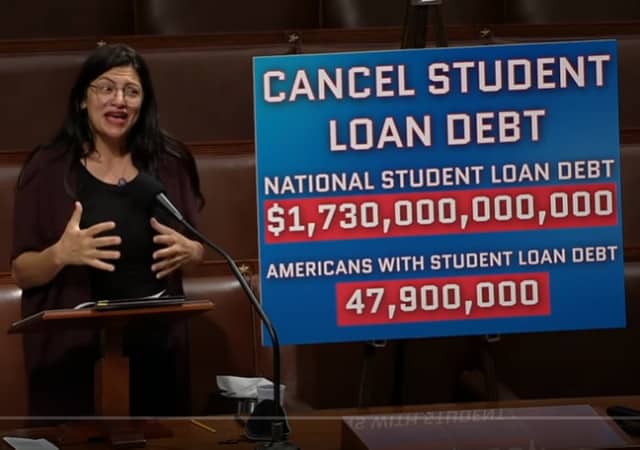
Congress Critter Rashida Tlaib (D - Uranus) accidentally told the truth and provided the best argument against what she was supposed to be arguing for.  Legal Insurrection blog carries the story that Tlaib was trying to advocate that taxpayers should pay off the student loans of everyone in America and demonstrated it's going to be a wealth transfer from middle class working people to the richest workers in America.   

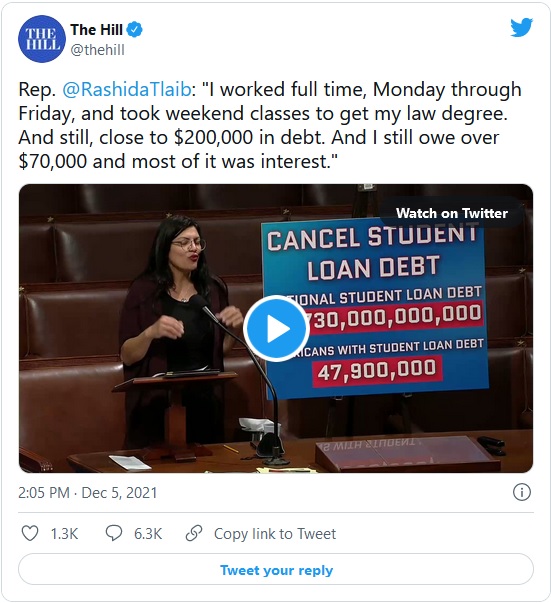
Ms. Tlaib, a member of The Squad, those young, aggressively socialist women who seem to actually be running Washington DC, told her own sob story of still paying off her loans to attend law school and get that job as one our "betters" in Mordor on the Potomac.  The Hill Tweeted this summary.

The response was instant and epic.  First off, Alec Schemmel of KOMO News quoted the rest of her sob story and pointed out how she inadvertently showed the case against the fed.gov taking responsibility for all student loans (don't buy the widespread lie that this is student loan "forgiveness".  The banks aren't going to forgive anything, they're going to get bailed out on your tax bill.) 

“I worked full time, Monday through Friday, and took weekend classes to get my law degree. And still, close to $200,000 in debt. And I still owe over $70,000 and most of it was interest,” Tlaib said during oral arguments on the House floor. “And guess what? I didn’t go to the for-profit entities, I went to legal aid, I worked at the nonprofit organization fighting for the right to breathe clean air, to fight for the worker that was getting their wage taken and stolen from their employer. I went and worked on immigrant rights and so much more,” she continued.

Notice how she didn't point out that as a member of congress she's now making $174,000 a year and she's no longer working for those nonprofits organizations she wants you to think of.  A salary of $174k/year puts her well into the "richest 10%" (someone in the article quotes that as being "in the middle of the top 8%") and yet she wants people making a third of what she does (or less) to pay off her student loans.  

I thought she hates the rich and wants them to pay for everything, but she's one of them.  I'm sure she doesn't think of herself as rich.  She's a working woman, right?  Jazz Shaw of Hot Air added some much needed perspective to her sob story.

Further, Tlaib sought to glorify herself for having gone to work in lower-paying jobs for non-profit organizations after graduating. But when a person who is that far in debt chooses such a career path, that’s their own individual choice. She had a law degree from a well-regarded university and law school. She should have easily been able to find better-paying work in the private sector so she could take care of her obligations and then move on to more altruistic fields once she was financially stable.

There's a lot of stupidity in the idea of having taxpayers pay off everyone's student loans, but the most concentrated stupidity is probably exactly what she very clearly shows here.  The average student with a four year degree has student loans much less than her debt.  The average debt of the entire population with a student loan is $37k.  The majority of student loan payoff money is going to go to people with professional and other graduate degrees: doctors, lawyers, dentists, MS and Ph.D. engineers and others who are in the top 10% of salaries. 

It's upper class welfare.  Perhaps she's trying to appeal to the donor class.  If those professionals who will benefit from this have gratitude to her party, perhaps they'll donate more.  And perhaps she's just another pig at the trough, looking for more slop like all the other pigs.


Thursday, November 4, 2021

Federal Court Agrees With NASA, Tosses Blue Origin Suit

Word got out today that the US Court of Federal Claims backed NASA's previous judgement that they violated no laws or requirements by awarding the Human Landing System (HLS) contract to SpaceX and only choosing one contractor instead of two.  

The decision wording is rather terse and Eric Ralph at Teslarati voices the opinion that it will probably be a few weeks before more details come out, but Jeff Foust (first link, above) posts the document as of this morning. 

Ralph adds:

The ruling ends almost seven months of delays explicitly caused by protests and lawsuits filed by competitors Dynetics and Blue Origin. Protests were first filed with the US Government Accountability Office (GAO) about a week after NASA announced in April 2021 that SpaceX would build the Human Landing System. Both protests were denied in July but Blue Origin ultimately chose to double down and filed a lawsuit against NASA and SpaceX in August, kicking off a process guaranteed to cause several more months of delays.

Not just “guaranteed to cause several more months,” it already had stopped work on the HLS system for the Artemis program.  They responded today on twitter that they're going to resume as soon as possible

The biggest surprise in this whole episode is that Jeff Bezos tweeted a couple of hours later:

Not the decision we wanted, but we respect the court’s judgment, and wish full success for NASA and SpaceX on the contract.

There's an implication there that the lawsuits are ending and maybe NASA and SpaceX can get on with their spacecraft development.  The Artemis program's mission statement (my name, not theirs), “With #Artemis, @NASA will land the first woman and first person of color on the Moon.”  makes me cringe, but it's time to cut the bullshit and get back to designing and testing vehicles. 


Wednesday, August 18, 2021

ATF NPRM on Redefining Everything - Comments Close 19th

I'm falling down on the job in not reminding everyone who might want to comment on the ATF's Notice of Proposed Rule Making 2021-R05 that the deadline is August 19th - today for most of you who will read this on Thursday.  

This is the one that claims it's going to clarify the definitions of receivers, frames, and firearms, as well as the definitions used with incomplete guns finished at home; the so-called "80% guns."  That number is PFA and has nothing to do with the number of operations left to do as opposed to how many there are starting from chunks of metal.  

My emphasis from the start back in May has been on the Personally Made Firearms (PMFs) or 80% guns.  The introduction to the NPRM promises to clarify what "readily converted" means in their allowing these to be sold as long as they can't be "readily converted to fire a projectile."  

It clarifies nothing.  It simply provides us a matrix of things that go into determining what the word means but with no specific numbers for what constitutes “readily.”  They include a long footnote including different rulings from courts on guns that were "readily converted" that ranged from taking less than an hour for a person with no specialized knowledge up to "eight hours in a properly equipped machine shop."  I can agree that if someone who can barely handle a battery powered drill can do it in less than an hour, that's readily converted, but the other extreme is light years from "readily" to me.  

Exactly where the line should be between the number of minutes it takes Homer Simpson with a cordless drill and an eight hour day in a well-equipped machine shop is what they should be telling us, but they don't. 

The only legal case they mention that was not ruled as not readily converted was done by a Master gunsmith with $65,000 worth of tools.  I'm not sure what qualifies one as a Master, but does five years sound reasonable?  Full time (40 hour weeks) for a year is 2080 hours so round five years to 10,000 hours of experience, plus maybe another 2000 hours of training, and a commercial investment in tools.  I can agree that's not readily converted, but if the tools get cheaper, where's the line?  $50k?  $35k?  Again, they don't say.  

In last December's action against Polymer80 for selling a "Buy Build Shoot Kit," it seems that ATF used "convenient" as the working definition for "readily converted."  According to the Wall Street Journal:

The probe focuses on Polymer80’s “Buy Build Shoot Kit,” which includes the parts to build a “ghost” handgun. The kit, which Polymer80 sells online, meets the definition of a firearm, ATF investigators determined according to the warrant application. That means it would have to be stamped with a serial number and couldn’t be sold to consumers who haven’t first passed a background check.

This turns the question into how inconvenient does ATF want the process to be?  Is it acceptable to order the frame from Polymer80 and the parts to complete it from Midway USA?  Do we need to order the internal parts as one part per vendor; buying from 10 or 20 vendors instead of just one?  How about if between every step we have to go run around the block?  What's that, ATF?  Between every step we need to crawl across Death Valley on our hands and knees? 

Conveniently packaged is just as nebulous a concept as readily converted.  We should get precise, repeatable definitions.  Instead, for everything we get the crutch of tyrants everywhere: we'll know it when we see it, because we're the experts. 

The rest of the NPRM is just as bad.  The Gun Owners of America puts up a video arguing that a strict interpretation says that a plain old, stock, Glock 40 can be interpreted to contain 16 ATF regulated firearms.  That means that in the event you need to replace a part in any one of those subassemblies that you'll need to fill out a form 4473 and pay for a background check.  It sounds to me that means that if you need to replace a $1 part, you will be paying around 30 to perhaps $50 to get the part shipped to an FFL and your background check. 

Which, of course, is the point: to make gun buying and ownership so onerous that many people will just refuse to take part.  That's been the trend since at least the 1968 Gun Control Act, if not the 1934 NFA.

Commenting is easy.  Go to Regulations.gov and enter the NPRM number (NPRM 2021R-05) in the search bar at the top.  I think there were two items returned but one wasn't the actual NPRM.  Once you click on the NPRM, you get a form where you can either enter a comment or attach a document you've written already.  It's said that polite, original comments matter more than things that they've seen copied a hundred times, but that option is also available at a GOA Comment Site, too. 

Hey, it's Homer with a drill!  OK, he's working on a camera and not an AR Lower, but I worked my reference to him into the picture. 


Saturday, May 22, 2021

Looking at BATFE's "Ghost Guns" Rules

Back on May 8th, when I posted about a rule drop from BATFE on the proposed rule changes, it seems that was an unofficial drop from them.  80% Lowers notified everyone by email yesterday that the NPRM (Notice of Proposed Rulemaking) was just released yesterday, so I downloaded that one and compared it to what I have.  I didn't go page by page, but everything I've been looking at hasn't changed.  If you missed it, the NPRM can be found here.

I'm going to excerpt a small portion of the alleged purposes of the regulation and the section that I'm most concerned about, which is just what constitutes "readily converted," which they specifically say they want to clarify.  Excerpt from page 1 of 115.  

SUMMARY:
The Department of Justice (“Department”) proposes amending Bureau of Alcohol, Tobacco, Firearms, and Explosives (“ATF”) regulations to provide new regulatory definitions of “firearm frame or receiver” and “frame or receiver” because the current regulations fail to capture the full meaning of those terms. The Department also proposes amending ATF’s definitions of “firearm” and “gunsmith” to clarify the meaning of those terms, and to provide definitions of terms such as “complete weapon,” “complete muffler or silencer device,” “privately made firearm,” and “readily” for purposes of clarity given advancements in firearms technology. Further, the Department proposes amendments to ATF’s regulations on marking and recordkeeping that are necessary to implement these new or amended definitions. [Bold added: SiG]

And here's where they clarify the meaning of “readily.”

Readily. A process that is fairly or reasonably efficient, quick, and easy, but not necessarily the most efficient, speedy, or easy process. Factors relevant in making this determination, with no single one controlling, include the following:
(a) Time, i.e., how long it takes to finish the process;
(b) Ease, i.e., how difficult it is to do so;
(c) Expertise, i.e., what knowledge and skills are required;
(d) Equipment, i.e., what tools are required;
(e) Availability, i.e., whether additional parts are required, and how easily they can be obtained;
(f) Expense, i.e., how much it costs;
(g) Scope, i.e., the extent to which the subject of the process must be changed to finish it; and
(h) Feasibility, i.e., whether the process would damage or destroy the subject of the process, or cause it to malfunction.

That isn't clarifying the definition, it's a list of factors they'll use to decide “readily” without giving any quantifiable definition of the word.  There is no guidance there whatsoever.  As always, their answer is "because we say it is."  Take listing (a) Time.  Is five minutes readily?  An hour?  A day?   There's a combination of time, ease, equipment and expertise that I can see as scales, such that the more of those the builder has the more readily the conversion can be completed.   

I suppose they don't want to give numbers for time because they're afraid if they say something specific people will simply avoid their limits.  Let's say the ATF defines that finishing a firearm in under eight hours of work is too little time, they see that as telling hobbyists to work slowly completing their firearm and if they were going to finish in six hours, people would know to slow down and take more time.    

There's a massive footnote spread between pages 36 and 37 that gives some hints at how various courts have interpreted “readily.”  These range from five minutes (pretty obvious) to “a two-hour restoration process using ordinary tools, including a stick weld, is within the ordinary meaning of 'readily restored'” (from the 9th Circus).  There's the famous ruling that a “machine gun that would take around an eight-hour working day in a properly equipped machine shop was readily restored to shoot” which sounds to me nothing like “readily restored.”  There's also the opposite “weapons could not be “readily restored to fire” when restoration required master gunsmith in a gun shop and $65,000 worth of equipment and tools.”

I think it's worth pointing out in any comments you make how insignificant this whole thing is.  They say (note that PMF means Privately Made Firearms, the proper term for what the zealot gun controllers call ghost guns):

In recent years, the number of PMFs recovered from crime scenes throughout the country has increased.17 From January 1, 2016, through December 31, 2020, there were approximately 23,906 suspected PMFs reported to ATF as having been recovered by law enforcement from potential crime scenes, including 325 homicides or attempted homicides, and that were attempted to be traced by ATF, broken down by year as follows: 

2016:  1,750
2017:  2,507
2018:  3,776
2019:  7,161
2020:  8,712

According to Gun Facts, in 2019 those 7,161 PMFs recovered turn out to be 1.3% of the guns used in crimes.  Perhaps 2% at most, if "outlier agencies" are included.  As always, those guns are most likely from gangs fighting each other. 

With a 115 page bill, it would take a team of experts to respond to every point.  Based on how popular my little series on my AR-15 from an 80% lower is, I thought some of you might find this worth reading. 


Saturday, May 8, 2021

BATFE Does Friday Drop on Proposed “Ghost Gun” Rules

In keeping with the longstanding tradition of releasing heinous laws late on Friday, when the press has gone home (as if they'd report it anymore), the BATFE announced NPRM 2021R-05, called "Definition of a "Frame and Receiver" and Identification of Firearms."  Except the NSSF Ammoland News did report on the rule drop.  BATFE says the rules
  • Provide new definitions of “firearm frame or receiver” and “frame or receiver”
  • Amend the definition of:
    • “firearm” to clarify when a firearm parts kit is considered a “firearm,” and
    • “gunsmith” to clarify the meaning of that term and to explain that gunsmiths may be licensed solely to mark firearms for unlicensed persons.
  • Provide definitions for:
    • “complete weapon,”
    • “complete muffler or silencer device,”
    • “privately made firearm (PMF),” and
    • “readily” for purposes of clarity given advancements in firearms technology.
  • Provide a definition of “importer’s or manufacturer’s serial number”
  • Provide a deadline for marking firearms manufactured.
  • Clarify marking requirements for firearm mufflers and silencers.
  • Amend the format for records of manufacture/acquisition and disposition by manufacturers and importers.
  • Amend the time period records must be retained at the licensed premises.
I can give you the short answer to any bullet point that refers to definitions: it's whatever we say it is. 

More seriously, I think the rules are arbitrary and don't really define the things they claim to define.  They clarify nothing.  They're saying, more than ever, "whatever we say is a firearm is" and "whatever we say is readily converted is." 
“More than one externally visible part may house or hold a fire control component on a particular firearm, such as with a split or modular frame or receiver. Under these circumstances, ATF may determine whether a specific part or parts of the weapon is the frame or receiver, which may include an internal frame or chassis at least partially exposed to the exterior to allow identification.”
Got that? Any and all parts visible from the outside of the gun which may "house or hold" a fire control component is a gun.  ATF alone may determine whether any part or parts of the weapon may be frame or receiver, and the only thing they seem to say is not a frame or receiver is something only visible by disassembling the gun.  The direct reference to a "split or modular frame or receiver" is apparently trying to fix the problem that their definition of a receiver has been ruled by judges as not applying to an AR-15.  This opens the door to them declaring that AR upper receivers are guns and require a background check.  Which further opens the door to one upper and one lower being associated with each other and You Shall Not swap different uppers onto your lower receiver.  You must buy both. 

Note that in the webpage description on the ATF web page, there is no definition provided for the statement above: “readily” for purposes of clarity given advancements in firearms technology.  The previously discussed version of "readily" included eight hours work in a well-equipped machine shop, which is beyond absurd.  That means blocks of aluminum bar stock are readily converted guns.  I can't see how that could stand a challenge.  In searching the text of the regulations (pdf here), I see no definition of "readily be converted" or "readily be completed."  It's all just jargon that reduces to "when we say it is."  On page 108 of 115 there is a list of eight things that go into consideration of "readily" but offers no clues to what they consider readily or not readily.  

I understand that they want it to be loosely worded enough that they have the ultimate power of life or death over anyone who wants to make their own guns, but being that loose - just creating the term without defining it precisely - is just wrong.  This is the way it has always been, and their line about clarifying the term is bullshit.


The fine folks at 80% arms list this 0% AR-15 lower receiver - I'm guessing that's done as a joke.  That said, at $28.99 (today) they're cheaper than Online Metals, who sells to us low quantity buyers. 


Wednesday, April 21, 2021

ATF Proposed Rulemaking on 80% Firearms Leaked

The Federal Administrative Procedure Act of 1946, require agencies changing Federal laws to go through a process.  That process requires the agency present a Notice of Proposed Rulemaking (NPRM) to anyone interested in the change, allowing 60-90 days for comments.  After some period of reviewing the comments and typically allowing some period for commenters to respond, the agency then announces the ruling and any changes made in a Report and Order.  In today's NSSF Ammoland News, they report on a leaked copy of the draft NPRM for the BATFE's rules for so-called Ghost Guns. The document is on Scribd, can be read from the article or downloaded.

The Ammoland article summarizes it this way:
According to the report, any random part that the user could “readily” convert into a firearm would be subject to ATF regulations. As in the past, the document doesn’t define what the term “readily convertible” means. This term could be that any block of metal could be “readily convertible” into a firearm. In fact, the document shows that the ATF used a court case where it took the user eight hours to covert a kit into a gun. The document does highlight the need for a complete machine shop, and qualified workers to complete a firearm would not fall under the proposed rules.
That last sentence leaves out home hobbyists with a reasonably good shop but with no "qualified workers" working for us, leaving us in limbo.  Many of us could make an AR-15 lower from a hunk of raw aluminum bar, but using metal that's already part way toward a finished receiver, like say, an 80% lower, next year's 50% lower, or a "0%" forging simply means our shops can generate fewer ounces of metal chips and finish faster.  

Inadvertently, the BATFE shows just how small this problem is. 
The document makes claims that in the past four years that so-called “ghost guns” have been used in 325 homicides. Their definition of homicide includes justified killings as in self-defense. It does not separate out murders from the total homicides. Even if all 325 homicides included in the report were murders, this number is incredibly small. There are approximately 17,000 murders per year in the United States and that averages out to 46 murders per day. The reported small number they are trying to tie to so-called “ghost guns” highlights that there is not a problem.
Note that they're claiming 325 homicides in four years.  Out of the 17,000 murders per year, they're worried about 41? 

A website new to me, called The Reload, offers an interesting take that Ammoland doesn't go near.
The document also proposes the creation of a definition for “privately made firearms,” which would apply to any gun without a serial number made by somebody who doesn’t have a federal gun-making license. Making guns at home for personal use with devices like 3D printers will not be affected by the definition. However, any privately made firearm sold to a licensed gun dealer would be required to be permanently marked with a serial number by the dealer before it could be sold.
When I made my AR-15 from an 80% lower, I added a serial number that meant essentially nothing; I just figured it was easier to engrave a number than to explain to a potential Officer Friendly in a traffic stop why my gun didn't have a serial number.

I've downloaded the draft NPRM.  It's likely to change before it's released, and it's 107 pages long so I haven't had the time to read the whole thing yet.  One thing I noticed in the few pages I've read is that they seem to be trying to address that nasty little problem they have that an AR-15 lower doesn't match the legal definition of a receiver they're working to, and has made the BATFE drop cases they've been involved in.  Back to The Reload:
The document also lays out plans to broaden and update the federal definition of firearms receiver to correct a problem with the ATF’s interpretation of the current definition. Courts have begun questioning the ATF’s long-running determination that an AR-15 lower is a receiver despite not including several of the parts required in the current definition. Prosecutors have been forced to drop cases involving the ATF’s determination in recent years.

The ATF admitted in the document that “neither the upper nor the lower portion of a split/multi-piece receiver firearm alone falls within the precise wording of the regulatory definition” but lashed out in the document at the “erroneous district court decisions” that employ a “narrow interpretation” of the definition.
I've got to admit that seeing ATF incensed at courts for reading definitions as they're written brings a little bit of schadenfreude here.


The first video I ever put up on YouTube, one pass around the fire control group pocket in my 80% lower, back in 2010.

The columns are saying that DOJ has until May 8 to publish the NPRM, and then the comment period starts.  It's hard to know just where this is going, but I think that at the very least that building a gun will be made harder.  What they seemed to object to in all their actions against Polymer80 is the convenience factor of the company selling the kit of parts to complete the gun alongside the 80% frame.  Fixtures that help you drill the holes for the trigger and safety, like the one in my video, might be made harder to come by because they add convenience. 


Thursday, December 17, 2020

A Little More on the BATFE Attack on Polymer80

Hey, at least no kittens were stomped to death.  That's an improvement for the BATFE.

I regularly listen to Michael Bane's weekly podcast (currently Michael Bane TV on the Radio) and this week's final podcast of 2020, episode 50, found Michael going into the topic of the ATF going after gun parts.  He has been on this bandwagon for months and has a few "I told ya so" lines in there but it's worth it.  He also covers it in his blog and uses legal input I was unfamiliar with. 
I’m thinking that the thugs at ATF are going to hang their hats on the concept of “constructive possession.” Read NFA lawyer Joshua Price’s (who I turn to for legal information on NFA issues) piece on the issue here: https://blog.princelaw.com/…/florida-man-arrested-for…/

“As I stated before, one must be very careful when entering into the NFA realm, even where an individual does not assemble the firearm into a NFA configuration because of the legal implications under the doctrine of constructive possession. Constructive Possession exists when a person knowingly has the power and intention at a given time to exercise dominion and control over an object, either directly or through others. US v. Turnbough, 1997 U.S. App. LEXIS 11886, *6. The government may establish constructive possession by demonstrating that the defendant exercised ownership, dominion or control over the premises in which the contraband is concealed.”

This would represent a huge expansion of how constructive possession has been construed. It was, I believe, originally aimed at drugs (natch) and illegal weapons possession in the sense that a forbidden person was in the presence of a firearm. ATF expanded that to include possession of the parts to complete an NFA weapon.
This goes a long way toward explaining the next phase of the war on guns.  Don't get hung up on the reference to the NFA; it's bigger than that.  The reference to the NFA is more applicable to the pistol brace front in the battles that are starting.  The reference is a court case in which ATF argued that if someone had all of the parts to make an NFA item, the only reason they had those parts was to make it.  That view was rejected in a 1992 case against Thompson/Center Arms in which the court ruled that the “rule of lenity” applied (i.e., any ambiguities in criminal statutes should be resolved in favor of the defendant).

A way of thinking about that NFA reference might be helpful.  Imagine you have no AR platform guns except a single carbine you've bought.  You decide you would really like to build an AR pistol and you buy a nice 8 inch barrel as the first part.  Totally innocent, right?  The BATFE could argue that since you have only one lower receiver, which is a rifle, the only thing you could want to do with that barrel is build the NFA short barreled rifle (SBR).  A better approach would be to get the lower receiver first.  It doesn't have to be a receiver for a pistol, as long as it isn't paired as a rifle.  (There's that odd old rule that if a receiver is considered for a rifle, you can't make it a pistol and vice versa)  Constructive possession says that if you have the 8" barrel in a storage place you rent and the carbine in a safe in your home, they're still yours so your intent is to make the NFA firearm.

Where this gets odious is the anti-gun side absolutely hates the idea of being able to put together a gun from parts.  Being able to build you own gun has been US law (and custom) for as long as the country has existed.  In the early days of gun control, more people thought buying parts to repair, or build their guns was a normal thing, and the ATF took a relatively light touch.  They defined a particular part of the gun to be the gun.  In more restrictive countries, there's no such thing as buying a part from a place like Midway or Brownells to improve your gun.  Every single part is regulated and gets the buyer the equivalent of the rectal exam they'd get for a complete gun.  The anti-gun left wants that for the US.  No 80% receivers and certainly no kits of parts to complete one prepackaged with an 80% receiver. 

John Richardson over at No Lawyers - Only Guns and Money put up a leaked version of the BATFE's "Guidance on Pistol Braces" today.   It's 16 pages of legalese and John includes a summary from the Firearms Policy Coalition.  The key finding I see, because it's the kind of thing that "triggers" me is:
2) The draft document instead purports to be intended to inform the public on how brace-equipped firearms will be examined in the future. Based on the criteria set forth in the draft document, it appears that the ATF would take something of a ‘totality of the circumstances’ approach in determining whether a specific brace-equipped pistol is a ‘short-barreled’ firearm regulated under the NFA. These criteria include: the firearm’s type, caliber, weight, and length, the design of the brace itself, whether the firearm can be properly aimed when using the attachment as a brace, and whether an optic that cannot properly be used one-handed is present (i.e., something that suggests intent). The agency also indicates that it will observe the marketing of firearms and accessories, as well as other more subjective factors.
“Totality of the circumstances” reminds me of the old, “I can’t define pornography but I’ll know it when I see it” definition.  There's nothing specific, so people can never know how they will be viewed.  That allows the agency to make arbitrary rules, and sets up judges to always have the last word.  The rulemakers make it impossible for individuals to decipher what's acceptable and what isn't.  More importantly, there doesn't have to be the slightest bit of consistency in their rulings.  This is why every company that wants to market an 80% receiver has to submit them to the BATFE to get approval to sell them.  There are no objective standards.  Tyrants and other control freaks want it that way.  

The "Totality of Circumstances" approach combined with constructive possession is how they can rule that a Polymer80 plastic “Mock Glock” can’t fire and isn’t a firearm, but their Buy Build Fire kit which puts the parts needed to make it work in the same box with that plastic chunk makes it a firearm. It still can't fire anything because nobody has done the machine work to transform the chunk of plastic into something those parts can be put into.  Someone less determined to stop people from working on guns could look at the same circumstances and reach the opposite conclusion. 

If anything constructive possession means that if you don't buy the kit with the parts to complete it in one purchase, but buy them separately from another seller, they can still argue that there's nothing else you would do with that other than build a gun.  One step closer to getting rid of gun part sales completely.  Which would make working on your own guns a federal crime.

If anything, Michael Bane thinks it's part of a big picture attack by the big names in the anti-gun world.
One of the Left’s key goals has been not just the passage of antigun laws, but the elimination of the Gun Culture. As we have discussed at great length here and on the podcast, the “Bloomberg Model” laws adopted by so many states, including Colorado, were primarily focused on making illegal common practices within the culture, such as loaning a firearm to a friend for a hunting trip or competition, or passing guns down to children and other relatives. The laws themselves were far less consequential than their intent…making minor interactions between firearms owners harder and harder, thus weakening the bonds that weaves together what we call the Gun Culture.

Completed Polymer80 guns; photo from Michael Bane.


Friday, December 11, 2020

BATFE Going After 80% Receivers Again - Revised

The BATFE has apparently decided to start going into regulatory expansionism again, with a perceived change in administration coming to someone who's more likely to grow the Bureau's budgets again.  Back in October they started going after pistol braces in an apparent attempt to outlaw AR pistols - or start down that road.  According to TTAG (The Truth About Guns), on Thursday the 10th the BATFE raided Polymer80, one of the largest makers of 80% lowers and pistol frames.

According to the Wall Street Journal:
The raid target, Nevada-based Polymer80, is suspected of illegally manufacturing and distributing firearms, failing to pay taxes, shipping guns across state lines and failing to conduct background investigations, according to an application for a search warrant unsealed Thursday after the raid took place.

The probe focuses on Polymer80’s “Buy Build Shoot Kit,” which includes the parts to build a “ghost” handgun. The kit, which Polymer80 sells online, meets the definition of a firearm, ATF investigators determined according to the warrant application. That means it would have to be stamped with a serial number and couldn’t be sold to consumers who haven’t first passed a background check.
TTAG supplied this product photo of a “Buy Build Shoot Kit.” From what I know there isn't one gun in this photograph.  Nothing that requires a serial number or a background check.  It's no different than if you bought a bar of metal and some hunks of plastic.


Like everyone who sells these so-called 80% receivers (the percentage, though widely used, has no correspondence to reality), Polymer80 submitted their designs and products to the BATFE for a ruling on whether they met the criteria for not being a gun.  The Feds ruled that they're not guns, yet somehow the BATFE is saying when they sell a hunk of plastic that's not a gun with handful of small parts that aren't a gun in a common package, it becomes a gun.  Non-gun + non-gun = gun  
But the Buy Build Shoot Kits, which are advertised as having “all the necessary components to build a complete…pistol” weren’t submitted to the agency for approval, according to the application for the search warrant. These kits can be “assembled into fully functional firearms in a matter of minutes,” the warrant application says.
There was no reason to submit it to the agency for approval.  Nothing was a gun and nothing about what they were selling was new except being in one package.  Convenience makes it a gun?  This reminds me of the BATFE vs. Ares Armor case in 2014 in which the BATFE argued Ares Armor was illegally manufacturing guns.  What they were doing was making a plastic lower with a different color plastic in the fire control pocket, which would be removed when making it into a gun.  BATFE said the second plastic had to be added to a complete receiver which was turning a gun into "not a gun" and during the brief existence of the gun, it needed to be serialized and treated as a gun thereafter.  Ares Armor said their process documents proved that it was made all at once and a finished receiver was never present. 


As an aside, the absolute coolest trick in the world, and I've never heard anyone else ever talk about doing it, would be to mold this out of two grades of plastic. Wouldn't it just be the coolest thing you've ever seen if the body of the lower melted at say, 400 degrees, and the part that needed to be removed melted at 200? So that all you'd have to do to turn this 80% lower into a finished one would be to soak it in boiling water? I wonder if that could be done.

Of course, the BATFE is not a group to be all sophisticated about "dat legal shit."  They're much more interested in the "control" part of gun control.  I'm just surprised that they seem more than happy to open a can of worms that just a year ago they didn't want to get near.  Last October, the BATFE dropped charges of manufacturing guns against a guy who had set up a gun club so that any member could pay their $25 dues to join, put their lower receiver in a fixture he had designed, press "GO" on the CNC controller and let it turn an aluminum lower into a gun for them.  Considering that the BATFE had previously said if someone so much as marked where to drill a hole on an 80% lower that they had manufactured a gun, that seems like a pretty open and shut legal case, so why did they drop the case and let the guy go?

The judge in the case had given an opinion that completing a lower receiver still didn't turn it into a gun!  BATFE's laws don't do what they're intended to do, and if BATFE lost the case firearms law would collapse into a black hole of nothingness.  BATFE is terrified that they created a situation where there is no definition for which part of the AR-15 is the gun.  Their definition of a receiver is spread across both the upper and lower receiver in an AR-15. 

As I like to say, "don't worry; it's not that bad. It's worse." That ruling last October isn't the first. There was another case in 2016 in which BATFE dropped the case because the Judge read the law and said the guy wasn't manufacturing guns because a completed lower isn't a gun. To borrow a quote, BATFE is muy FUBAR.

As I said in my conclusion last October:
What the rulings seem to be saying is that the AR platform with its regulated lower and unregulated upper is inconsistent with Federal law. Since it's impossible to redesign the platform with millions of them already in peoples' hands, the solution is for congress to come up with a definition for the lower receiver that's workable. That's going to be a giant ball of fail; congress never writes laws that require technical details because none of them are qualified. On the other hand, if someone was to do things that the BATFE frowned on with some lower receivers, we have two cases that say they're going to quit before they get ruled against for all the marbles. In the words of Dirty Harry, "do you feel lucky?"
In this case, the polymer pistol isn't an AR, so I wonder if Polymer80 can argue the precedent set in 2016 and 2019, that nothing they're selling meets the federal legal definition of a gun? 

EDITED 12/12 1200 EST to add:

Today's Ammoland Shooting Sports News adds some context to this story.  This is wider than just a raid on Polymer80. 
This week ATF has shown up at multiple shooting-sports-related companies and retailer's door to demanded customer information about those American citizens who legally purchased 80% pistol frames.
They make the point that BATFE has demanded that Polymer80 turn over lists of buyers of the BATFE's targeted Buy Build Shoot kits, to do background checks on buyers to find prohibited persons.  Again, the problem with the kits appears to be convenience, and BATFE is essentially saying that anything a company sells that is based on the incomplete receiver concept needs to be submitted for their review.  Just as anything using the pistol brace concept needs to be submitted for their review. 

Rob Pincus of the Personal Defense Network has a worthwhile video here - there are two, the top one is nearly six minutes long, but worth the time.

Ammoland also points out that the BATE also "paid a visit" to Brownells to ensure they were not selling the convenient Buy Build Shoot kits, and found they were not (which they could have determined by visiting their online store and searching for them). 
“The ATF did visit our facility on Thursday, December 10, 2020,” said Ryan Repp, Brownells VP of Marketing. “It’s my understanding they inquired about our sales of the Polymer 80 ‘Buy, Build, Shoot’ kit. Brownells has not and does not sell that kit. Polymer 80 continues to be a great partner for Brownells. We proudly sell their 80% products and other parts.”

The ATF did raid or show up at other companies that sell other kits that include 80% part kits, barrels, and slides that are not Polymer80. AmmoLand News sources inside the ATF say that the agency is now considering 80% kits with all the parts needed to finish a pistol as a firearm. None of the companies had any warning on the change to ATF’s regulations before actual agents showed up making attempts to retrieve customer information.

The ATF is interested in the customer records, and this seems to be a nationwide crackdown. The agency’s intent on acquiring customer's personal records and run criminal background against the list to see if any felons have purchased the 80% frame. The ATF is making a de facto 80% gun registration. [I would add bold for emphasis, but it would take up the entire second two paragraphs: SiG]
This is a fast-developing situation.  I'll try to keep updates coming as I read about them.


Thursday, November 19, 2020

Bottom-Feeder Lawyer Frenzy Over Roundup Seems to be Ending

Every now and then, I surprise myself by searching for something I'm absolutely sure I've written about before and don't find it.  Sometimes it has shown up when searching for totally off-the-wall search terms (can't think of an example) but ordinarily I search for the topic and find something I'm sure I've written. 

Not this time. I can find no evidence of having written about the bottom-feeding lawyer race to the bottom that has been going on over the weed killer Roundup.

Yesterday at Townhall, occasional columnist Angela Logomasini passed on the news that the bottom feeders seem to be moving on to something else to sue over.  It's an interesting story, if you know the background that no carefully controlled study has ever concluded that Roundup (glyphosate) causes cancer, nor has any country declared it a carcinogen.  Even the EPA hasn't ruled Roundup to be dangerous and you've got to know the EPA would love to regulate as much as they possibly can.  Ms. Logomasini put it this way:
All these cases are built on a single, discredited hazard assessment produced by a United Nations outfit known as the International Agency for Research on Cancer or IARC. IARC classified Roundup’s active ingredient—glyphosate—as a known carcinogen despite contrary findings by most governmental and nongovernmental entities around the world.

Yet IARC does not even attempt to determine if real-world exposures pose risks, they just consider the theoretical possibility of risk at some unspecified level.
I'm sure you know what's referred to as the First Law of Toxicology, which is "the dose makes the poison," right?  IARC totally ignores that.  If you look into IARC rulings, it's even more bizarre.  IARC places plutonium in their Group 1, the same cancer category as Chinese-style salty fish, leather and wood dusts.  I think everyone considers plutonium a carcinogen; the salty fish and sawdust, not so much.  They're hard to take seriously. 

The reason there's a feeding frenzy over suing Bayer AgroSciences, parent company of Monsanto, is that in some jury case a suit was successful and thus became a legal precedent.  In an attempt at self-preservation, Bayer established a policy of just paying out on these claims, but that sent the message to the lawyers that the gravy train had arrived. All they had to do was file and Bayer would pay out.

As the money has been paying out and the number of new cases is going down, the sharks are looking for a new place to feed.  They've found one.  Again, to Ms. Logomasini:
As Roundup cases hopefully winds down, there are a growing number of lawsuits focused on ethylene oxide (EO) on the horizon. EO is a chemical used to sterilize more than 50 percent of the nation’s medical supplies—including masks, bandages, ventilators, and more. The U.S. Environmental Protection Agency aided and abetted the trial lawyers on this one in 2016 by producing an absurd assessment on the chemical’s risk.
I've long considered the EPA to be the High Priests of Junk Science, and this time it's Junk Science in the extreme.  The EPA has a program called the Integrated Risk Information System or (IRIS) (pdf warning on the link), and IRIS assigned a safe exposure limit of 0.1 parts per trillion for EO.  For perspective, the American Chemistry Council (ACC) says this is the equivalent of taking one drop of water and spreading it into 200 Olympic-sized swimming pools.  Must be powerful stuff, right? 

Here's where the EPA really screwed the pooch on this subject.  See, your body produces EO at levels 19,000 times greater than the EPA's 0.1 ppt.  All day, everyday.  Further, since this is part of the intricately regulated biochemistry of our bodies, the body clears EO quickly, with a half life (that is, levels falling by 50%) of 42 minutes.  If the EPA was right, people would be dropping like flies from the EO in their own bodies, inhaling it in the air, and more. 

Since the EPA declared it such a ridiculously potent poison, the lawyers have followed. 
Despite these realities, EPA’s air quality office used the IRIS number in a 2018 report that suggested people in communities near medical sterilization plants might face elevated cancer risks. Sensationalist news headlines followed, whipping up panic in several communities leading local and state governments to shut down several plants during 2019 and into 2020.

These closures exacerbated medical supply shortages  (pdf warning) just when the novel corona virus crisis started. Fortunately, in March and April of 2020, the Food and Drug Administration was able to get states and localities to open all but one of the facilities to help address shortages, but this issue is far from over.
The problem, I'm sure you can see, is that if the EPA doesn't reclassify EO, the lawyers may get lucky and get into a court with a dumb enough jury to award money, which will trigger a Roundup-like feeding frenzy that could shut down all the medical production that relies on it.  Instead of hurting one corporation (and the millions that depend on Bayer), they'll hurt everyone dependent on the medical facilities that sterilize with EO.  Which hurts everyone, especially in the days of the Rona. 


Typical lawyer attempt at trolling. 


Saturday, February 22, 2020

My First Post That Went “Viral”

As part of this 10th year, I'm going to take a clue from one of my role models, Borepatch, who has posted a few of his memorable posts from his first 10 years (for example). 

From September of 2010, On Germs, Weeds, Companies, Governments and Skunks.  This was the first post I can recall getting a great deal of attention, and it was a heady experience to get linked to by Doug Ross @ Journal.  I got links from more places than I recall and for years this was my most read post. 

At seven months short of 10 years old, I re-read it to see if I still thought it was worth standing by and I think it has held up well.  I still like it.  I find the wording a little awkward in places, but that happens with things I wrote 24 hours before.  Most of the links are broken and some of the references might seem obscure.


On Germs, Weeds, Companies, Governments and Skunks

Has it ever seemed like we, as a country, can't do anything anymore?  The country that built the Empire State building in a blink has a gaping hole where the World Trade Center used to be for 9 years?  The country that went to the moon from nothing in 10 years now takes 20 years just to decide if we want to?  There's a reason for that national arthritis that keeps us from moving: regulation and its bastard sibling litigation.  

Credit Borepatch with this long post.  This post last week got me thinking along these lines.

When I was but a newly hatched larval engineer at a major defense electronics contractor, a mentor systems engineer gave me a reprint of an article from Defense Electronics magazine for August 1979, by Norman Augustine, the CEO of Martin Marietta (now part of Lockheed - most of us call them Lock-Mart these days, your one-stop defense supermarket - watch for the flashing blue light special on cruise missiles…).  The article covered what's now called Augustine's Laws.  I see they are out in book form:  and some of them have been excerpted by Political Calculations blog, but the version I have has a mere 15 laws.

There's a lot of wisdom in here and it's worthwhile to see if the ensuing years have changed things much.  I don't have the space to go into everything, but a few of these are worth looking at.  The first law is "By the time of the tri-centennial, there will be more government workers in the United States than there are workers" based on the growth rate at that time.  I think he's a bit long on this; it'll be before 2076.  He goes on to say that the government will control all of the money in the US economy.  "This raises the interesting question of whether the last person employed in the private sector will have to support the entire nation's work force, or whether he or she will individually enjoy the full benefit of those residual funds not yet controlled by the government".  This raises the guardedly optimistic second law, "People working in the private sector should try to save money if at all feasible.  There remains a possibility it may someday be valuable again".  What a silly optimist: the Fed has had crosshairs and laser sights on the backs of savers for almost a hundred years!  He presents a wonderful comparison of a contract for muskets for the continental army in 1798 that was delivered in 1/3 more time than contracted, and a survey of military contracts from 1978 that were delivered, on average, in 1/3 more time than contracted.  Some things never change!

His most memorable law, and where I'm going with this, was "Systems of Regulations created as a management surrogate take on a life of their own and exhibit a growth history which closely parallels other living entities observed in nature".  He went on to show the number of pages in armed forces procurement regulation vs. time along with a curve of weed growth (from the journal "Weed Science"), and produced a graph any biology student will instantly recognize as the sigmoid growth curve of populations, also called the logistic function. 

A usual example is the common bacteria E. coli.  This species can divide and produce a new generation every 20 minutes; if conditions could remain optimum it would undergo geometric growth and produce a colony the size of the planet in 24 hours.  Because conditions can't remain optimum, it has a logistic growth curve, producing much smaller colonies.
The normalized logistic function.  Credit

In regulations, there is a price for this.  Although the legislators and regulators never consider this, every regulation consumes some amount of time and money to comply with.  The new Finance Reform bill has been estimated to required the development of 250-300 new regulations.  Every regulation slows down, hinders and costs every honest business real money.  Despite the widespread talk of corrupt CEOs and general lack of corporate ethics, I've been working in the manufacturing industry since the mid 1970s, and every company has had an active, if not aggressive, ethics compliance program with requirements for training and seminars every year.  There are exceptions but most companies do their best to be honest and law-abiding.  Government seems to think it's mere coincidence that countries with lower tax rates and lower regulation attract business, and they demonize companies for moving to countries where the environment is better. 

A simple way of determining if someone you talk to has any economic sense is to ask them about corporate taxes.  The economically ignorant (I'll be polite) will scream to tax the corporations.  Those with sense will tell you corporations are fictitious and can't pay tax.  Tax is part of the cost of doing business and therefore passed on to the buyer (the people calling for them to be taxed).  Corporations can collect taxes for the government (for which they are punished with more costs, not paid) but cannot generate them.  Every penny a company has comes from its customers.  In a global market where they compete with companies in cheaper environments, they are at a disadvantage. 

At least in our society, regulation often leads to litigation, and companies are sued regularly for offenses (real or imagined) against the environment or against people; possibly employees, possibly customers, possibly people in the communities they work in.  When special interest groups, like environmentalist or animal rights for example, don't get the laws they want passed, they litigate to prevent companies from doing their business.  For example, some of the most verdant farm land in the country, the central valley of California, is currently not being farmed because a group got the courts to stop the irrigation on the basis that it harms a minnow, despite considerable scientific disagreement that irrigation has anything at all to do with the minnow's population.  (Summary here)  The human impact in terms of unemployment and lack of food production, however, is undeniable. 

Regulation and litigation are sand in the gears of society.  Big, sharp, 40 grain silicon carbide abrasive particles that grind the gears and shafts away.   

They have the awful side effect of discouraging companies to grow and innovate.  Industries can die off because of the threat of litigation, or because the regulations make it simply too expensive for the industry to survive.  Sometimes this is deliberate: we just survived the EPA banning lead ammunition, something that could well kill off hunting and recreational shooting in the country.  The requested regulation was a back-door attempt to do something that can't be passed as a law.   

Sometimes killing an industry is an unforeseen side effect.  The woodworking tool industry is in crisis right now.  A few months ago, a lawsuit was won against Ryobi tools' parent company, for producing a "defective" table saw.  The plaintiff was awarded $1.5 million when he sued for $250,000.  The defect?  It did not include an expensive safety option that was invented around year 2000; (the modern tilt-arbor table saw was invented in 1939; the basic idea goes back to 1813).  In 2000, an inventor produced a technology called a Saw Stop that senses when flesh touches the blade and stops the blade in milliseconds.  In the process of stopping the saw as fast as it does, it destroys the saw blade, and possibly other parts of the saw.  The user still gets cut, but typically will require stitches instead of having a body part cut off.  He shopped this invention to the major tool makers and none of them agreed to license his invention.  Their major concern was that the idea was untested; they had no idea how durable it would be (contractors' tools live a rough life); they had no idea if it could be added to existing products (were they rugged enough to survive the abrupt energy dump that destroys the blade?), or how to roll it out across their product lines.  The inventor started his own company, and sells table saws with this feature.  

This suit will end the production of low-priced and bench top table saws, seriously impacting hobbyist woodworkers as well as the tool industry.  Professionals will buy the more expensive saws and raise their prices to you and me.  
 
I'm most familiar with the electronics industry, so let me give you a story from my world.  Most people have heard about Silicon Valley, which certainly was, and may even still be, the innovation capital of the world.  A typical scenario might be like this.  In satellite communications, there is a couple, of large companies who dominate the industry.  Like all large companies, they have a large set of policy and procedure manuals that show everything that must be done for any situation that comes up.  Perhaps a new market is perceived; the company must conduct a study to see if there's enough money to be made to pursue the market.  They must do a developmental budget, have decision agreement ("buy-in") from many levels of management, and so on.  Perhaps a previous customer had sued them over delivery of a product that they thought didn't meet the contract promises, for example, so they may require marketing surveys to understand just what the market wants. 

Somewhere in that company is an experienced engineer; typically someone with 5-15 years of experience.  They see the opportunity and realize their company is so slow that someone else is going to beat them to it, and decides to be that "someone".  Perhaps doing the design on their kitchen table, or over lunch breaks, they come up with a concept that they believe will create a sellable product, if not the "killer app" product.  At this point, he quits the company, often with a few friends, and they form a start-up company that gets to market first, wins a lot of market share, and completely skunks the former employer.  All of this by being free to make decisions, do what they think needs to be done, and usually by working 60 hours a week for a while. 

The big companies have those manuals of policies and procedures for a reason.  To borrow a saying, good decisions come from experience and experience comes from bad decisions.  The big company is so afraid of someone doing something wrong, they try to write procedures that will eliminate all chances of errors, which means they eliminate all independent thought from the day to day running of the company. 

Smart companies, however, are aware of this conflict between carrying out procedures and try to remain nimble enough to be competitive.  Fads such as the 1980's Japanese Management techniques (e.g., Quality Circles), and this decade's Lean Manufacturing (also out of Japan) sweep the industrial world regularly as managers strive to understand how to walk this balance. 

As another example, a large company might want to try and compete with a lower cost company that is trying to edge into their marketplace; for example, a Defense contractor making a GPS receiver might fear a commercial competitor's cost advantages.  They might want to change their entire approach to design of a product, taking more risk, instead of exceeding their requirements by large margins, they may try to just meet them.  Instead of a receiver that will work from deep winter in Antarctica to the worst of the Sahara, they decide to make one that would work for a day-hiker.  When they try to do it, the company's process manuals haunt them, and internal organizations, desperate to prove they are adding value, force the "low cost" program to adopt the same high-cost approaches they use in all of their products.  This destroys the attempt to lower the cost and ensures the failure of the program. 

Smart companies have addressed these problems by spinning off what are called "skunkworks".  The original skunk works (note it's two words, not one) was an offshoot of Lockheed, and their most proud achievement (at least, that they could speak about) was the SR-71 Blackbird.  A group of talented engineers went off in isolation from the rest of the company and created the fastest aircraft in the world, in record time, in the 1950s.  Skunkworks as a single word is the term used for such a group set aside by any company for a similar purpose.  This has been shown to be a successful technique, but note that the original company is still there, still working as an arthritic bureaucracy. 

SR-71 Production line at the Skunk Works

This is where we find ourselves as a nation.  

We are strangling in a bureaucracy with a Code of Federal Regulations that has grown like a bacterial culture.  A nation that was founded by a constitution that fills about 14 printed pages in today's technologies, passes financial reform bills that go over 2000 pages, health care bills that go almost 3000 pages, and more.   Each bill creates hundreds of new regulations, which are so poorly written they have to be refined by hundreds of court cases.  The court cases effectively create new law and new regulations.  Since congress is in session every year and passes at least one new law every year, the total number of laws and regulations increases without limit and everything eventually becomes illegal. 

What can we do?  We can't form a "skunkworks country" that can get around our laws and create a more mobile, productive society.  We only have one option: we have to create a national process, like industries do, to become more "lean, mean and low to the ground".  Get rid of superfluous laws.  We simply must reduce the size of the CFR and reduce the destruction caused by the regulation and litigation in our society.  To me, Tort Reform is absolutely essential.  A big part of the industrial lean activities is to study what policies need to be gotten rid of because "we've always done it that way".  The same should be done with the CFR. 

To be honest, there's more than one option.  The second option will result in blood in the streets, the deaths of thousands or even millions, and suffering on a colossal scale.  When companies don't handle their tendencies to be become too arthritic they go out of business.  The equivalent for the country is collapse, civil war and chaos.  Something to be avoided if at all possible.  Without reform, and without throwing out large chunks of regulations,  we are headed there.