Showing posts with label music. Show all posts

Saturday, April 25, 2026

My other, other stuff going on

I occasionally mention other things I'm working on or that are going on. Life is the simplest word and I think it was Beatle John Lennon who said, "life is what happens while you're busy making other plans." That's what this little post will be about.

Let's start with something I haven't talked about in a long time: guitars. I've got a small batch of guitars, like pretty much all players who can get more than one instrument tend to. Unlike the vast majority of home players, I built two of those guitars; an electric guitar from a kit back around 2015, and an acoustic that was more like a very extended repair job. It was a sales demo model from some guitar store and before sending it around to show what their guitars looked like inside, the manufacturer, Breedlove, sliced most of the left side of the guitar off. 

The long story is I started playing in junior high school, around 1967 or '68, and like most others, I learned what was referred to as rhythm guitar. Playing chords. I played in a couple of garage bands, and at a couple of parties, but I never really fantasized about being a musician. It was enough to make some sounds that didn't hurt people's ears or they even actually enjoyed. 

In my "young adult" years, through my 20s, I hardly played at all and didn't get involved with guitars again until maybe 1988 or later. I picked it up with intentions to practice more often a few years ago. Those plans would get derailed every now and then by either an injury or osteoarthritis. Over roughly the last year, that second one had me unable to play for a year or more. The effect of the arthritis was limited entirely to one finger, my left hand's middle finger. The very last segment of that finger, the one that you press onto a string to change the note you're playing, rotated left or toward my pinky finger. 

How much did it tilt? I don't really know how to measure that with what I have, but I'll estimate 10 degrees. The rotation wasn't the issue so much as the insane pain it caused. I'm gonna bet you've heard someone say, "it hurts to look at it?" Exactly.

About a month ago, I realized that I had bumped that finger on something and it didn't hurt. After some time trying to figure out if it was really gone, I started thinking what I could do to test it. I picked up one of the guitars I'd regularly practice with and found I could play without the insane pain.  The problems now are the same ones everybody picking up a guitar and starting to practice faces. Building up calluses on my finger tips so the strings don't hurt as much, strengthening the muscles involved so when I go to play some chord that makes all six strings sound, I can apply even pressure and put all the strings on the neck. Most importantly though is agility of those fingers, and knowing what to play. As in re-learning a few songs. 

My tendency in here is to put up some picture that's relevant or related to the topic, but tonight, I was going to link a video from Woodstock that I've run before. The problem with that is YouTube has decided we're not allowed to embed it, but I think I can run a link to it HERE. And here's a picture:

A photo of my repair job on the Breedlove guitar. The guitar is on my workbench but just for posing, in the final post on this job.  

The finger has better and worse days, so it's not entirely being back to normal and I have no way to know if that's even possible.


Sunday, December 15, 2024

My Annual Favorite Christmas Song Post

Well, pretty much annual. It's that time of year again. The tree is up, the house is decorated, at least as much as we do, and we get some music trickling through.  

Regulars here know that I'm somewhat of a blues fan.  I've introduced the outrageously talented Joanne Shaw Taylor, and the late country blues master (and songwriting partner to Eric Clapton) JJ Cale.  More appropriate to Christmas, every year around this time I comment on my favorite bluesy Christmas song, “Have Yourself A Merry Little Christmas.” 

The song dates from 1944, is credited to Hugh Martin and Ralph Blaine for Judy Garland's 1944 movie, Meet Me in St. Louis, but it's generally acknowledged to be Hugh Martin's writing.  The somber tone is understandable; Christmas of 1944 was three years into World War II, and many people had undergone the hardship of long separations from or the loss of family members. The war was wearing on the national psyche; the death toll was the highest seen since the Civil War.  They were dark days.  It's interesting, then, that Martin has said he wasn’t consciously writing about wartime separations.


You'll note that at the end of the song, the line isn't “hang a shining star upon the highest bough,” it's the more subdued “until then, we'll have to muddle through somehow.” Much more fitting to a more somber song written during WWII. The change to “...highest bough” (which seems to be the last) was prompted by Frank Sinatra in 1957. According to Entertainment Weekly in 2006:
Then, in 1957, Frank Sinatra — who'd already cut a lovely version with the movie's bittersweet lyrics in 1947 — came to Martin with a request for yet another pick-me-up. “He called to ask if I would rewrite the 'muddle through somehow' line,” says the songwriter. “He said, 'The name of my album is A Jolly Christmas. Do you think you could jolly up that line for me?' ”
That request led to the line we hear most often, although Martin says he thinks the original line is more “down-to-earth.”  “Have Yourself a Merry Little Christmas” has become one of the most popular songs year after year.  EW says it's second only to the song Nat King Cole popularized: “The Christmas Song (Chestnuts Roasting on an Open Fire).”  It has been covered by a gamut of artists from Sinatra to Connie Stephens, to James Taylor (who sings something closer to the '40s, Judy Garland version) to '80s metal band Twisted Sister, and many, many more.

I'm not so one-dimensional that this is the only song I can live with for the month, though.  When I play them myself, I tend to start by playing “O Holy Night” although I can't hope to get within a light year of the ability or the vocal range of Kerrie Roberts under any circumstances.

Still, a fingerstyle guitar can approach the sound of the piano in the mix here.  I can't really link to a video that sounds like what I attempt to play because I sit with a piano song book and work from that sheet music. 

And there are more.  If asked to pick my one most favorite Christmas song, as if I could, I'd probably pick one of these two.   There are lots that are fun to listen to once or twice a year, even the cliche' “Jingle Bell Rock” is fun a few times. There are fewer that I could listen to over and over throughout this month.


Saturday, February 25, 2023

Totally Unrelated and Completely Different

Totally unrelated to and completely different from the usual fare that I fill these columns with, that is, but well within the things I fill my time with.  

I was offered this video the other day, and unlike 99.99% of the videos that YouTube offers me, I watched with interest.  A top-ranking manufacturer of 3D printers, Prusa, put out a video on how they printed an electric guitar body and made a playable guitar.  More impressive than that, they spent over a year on the project ensuring the guitar would survive the forces it lives under, and hold its shape.  They went into the choice of components, showed where they got the ones they used and an economical way of getting the parts to make it.

Now you may be saying, "are you going to make a one of these Fender Telescaster-clone guitars?"  While I don't want to rule it out completely, chances are I'm not going to.  It's the marginal utility function - to borrow the idea from economics.  Another guitar in the collection doesn't make my family of guitars that much more useful.  If you have one guitar, another one can bring a lot of useful differences.  Adding an acoustic guitar to an electric, or vice versa, opens a wider array of kinds of music you can make.  If you have one of both kinds, a different brand and model might still add different sounds to your repertoire  When you have a few of each kind, an additional guitar of either major type just doesn't return much for the investment.

When I went shopping for my 3D printer, I wasn't quite sure I wanted one around the house. While it seemed like an obvious thing to have when you think that a large portion of all the plastic things in our houses could be printed, there's that aspect of printers that they seem to be used for trivial things.  Can you even make useful things like they sell?  Because of that, I went with a cheaper, entry-level printer although I might look for a better one now.  Dear daughter-in-law, a research biochemist, knows they exist and has friends that own printers, but when we mentioned having one was taken aback.  All of her friends print the trinkets and little decorative things that are so widespread; nothing that was a usable tool or even something as simple as a box.  She asked about things we've done and was surprised that they were all practical things, like my 2" vacuum hose adapter or my battery connector.  I told her about the Thingiverse and the thing I use the most at a couple of times every day is the electric toothbrush holder that I printed last fall.  Not a trinket or decorative thing in the mix.


Wednesday, December 15, 2021

A Christmas Repost

It has been a busier than normal day - 'tis the season to be busy, after all - so I'm going to invoke some privilege and repost something I do regularly around this time of year.  

Regulars here know that I'm somewhat of a blues fan.  I've introduced the outrageously talented Joanne Shaw Taylor (coming to my corner of the world in the near future), and the late country blues master (and songwriting partner to Eric Clapton) JJ Cale.  More appropriate to Christmas, every year around this time I comment on my favorite bluesy Christmas song, “Have Yourself A Merry Little Christmas.”

The song dates from 1944, is credited to Hugh Martin and Ralph Blaine for Judy Garland's 1944 movie, Meet Me in St. Louis, but it's generally acknowledged to be Hugh Martin's writing.  The somber tone is understandable; Christmas of 1944 was three years into World War II, and many people had undergone the hardship of long separations from or the loss of family members. The war was wearing on the national psyche; the death toll was the highest seen since the Civil War.  They were dark days.  It's interesting, then, that Martin has said he wasn’t consciously writing about wartime separations.


You'll note that at the end of the song, the line isn't “hang a shining star upon the highest bough,” it's the more subdued “until then, we'll have to muddle through somehow.” Much more fitting to a more somber song written during WWII. The change to “...highest bough” (which seems to be the last) was prompted by Frank Sinatra in 1957. According to Entertainment Weekly in 2007:
Then, in 1957, Frank Sinatra — who'd already cut a lovely version with the movie's bittersweet lyrics in 1947 — came to Martin with a request for yet another pick-me-up. “He called to ask if I would rewrite the 'muddle through somehow' line,” says the songwriter. “He said, 'The name of my album is A Jolly Christmas. Do you think you could jolly up that line for me?' ”

That request led to the line we hear most often, although Martin says he thinks the original line is more “down-to-earth.”  “Have Yourself a Merry Little Christmas” has become one of the most popular songs year after year.  EW says it's second only to the song Nat King Cole popularized: “The Christmas Song (Chestnuts Roasting on an Open Fire).”  It has been covered by a gamut of artists from Sinatra to Connie Stephens, to James Taylor (who sings something closer to the '40s, Judy Garland version) to '80s metal band Twisted Sister, and many, many more. 

I'm not so one-dimensional that this is the only song I can live with for the month, though.  When I play them myself, I tend to start by playing “O Holy Night” although I can't hope to get within a light year of the ability or the vocal range of Kerrie Roberts under any circumstances.

I prefer to play this as a fingerstyle guitar piece, playing arpeggios of the various chords on the song.  A guitar played that way can approach the sound of the piano in the mix here.  I can't really link to a video that sounds like what I attempt to play because I sit with a piano song book and work from that sheet music.  

The problem is that after my finger injury back in September, fingerstyle playing is no longer an option.  At least I haven't figured out a way to achieve that, yet.  The finger is full-sized, and mostly (90%?) functional (some things still hurt too much).  I have somewhere around half to 3/4 of a fingernail on that finger, I just can't quite find a way to use that finger to play the strings.  Other players will understand that when transcribing fingerstyle songs, the notation PIMA is used for thumb, index, middle and ring fingers; nobody just uses PMA.

And there are more.  If asked to pick my one most favorite Christmas song, as if I could, I'd probably pick one of these two.   There are lots that are fun to listen to once or twice a year, even the cliche' “Jingle Bell Rock” is fun a few times. There are fewer that I could listen to over and over throughout this month.

What are yours?


Wednesday, October 13, 2021

On The Big Story of the Day

Today singer/songwriter Paul Simon, Rhymin' Simon his self, is 80 years old.  Happy Birthday, Paul!  

Accredited as one of the best singer/songwriters of his generation, Simon might be best known as half of the iconic duo of Simon & Garfunkel formed in 1965, although his solo career was longer and arguably more productive.  His popular songs are too numerous to list.  The guy has 12 Grammy Awards, a Grammy Lifetime Achievement Award, a Songwriters Hall of Fame induction, a Johnny Mercer Award, and not one but two Rock ‘n’ Roll Hall of fame inductions, one for Simon and Garfunkel and one as a solo artist.

Just kidding.  Well, I mean it really is his birthday and all of that is true, but to most of the news of the world the big story of the day is William Shatner's trip to space on Blue Origin's New Shepard rocket.  

There's a 39 second video from their time in weightlessness in a couple of places.  This screen capture is from the C/Net Highlights channel at about the 23 second mark, where you can see Shatner visibly saying "oh, wow!"  

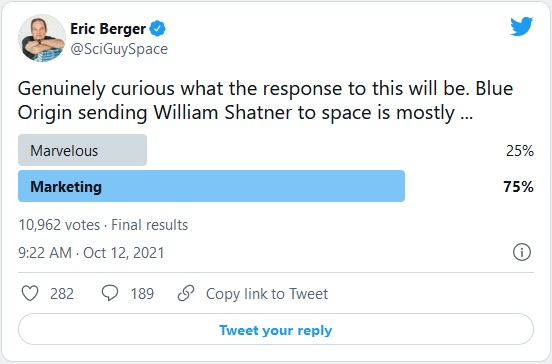
Eric Berger at Ars Technica (and @SciSpaceGuy on Twitter) pointed out: 

Finally, there can be no question that inviting Shatner to fly as a guest on just the second human flight of New Shepard is a marketing ploy. This mission lacks the novelty of the first crewed flight—carrying Bezos—and interest would otherwise have been low for sending two millionaires (Chris Boshuizen and Glen de Vries) and Blue Origin employee Audrey Powers into space for a few minutes.

I asked Twitter followers on Tuesday whether they thought the spectacle of flying Shatner to space was more "marketing" or more "marvelous," and by a three-to-one margin they voted for "marketing."


As someone who has written about space for decades and watched most episodes of most Star Trek series, I would say that flying Shatner into space is marvelous marketing. This flight does not solve any of the problems at Blue Origin, which are substantial. Due to poor management, the company has under-delivered. But Captain Kirk is finally going to space, and it's thanks to Blue Origin and Jeff Bezos.

There are a lot of things to be upset about in the world today, but sending Shatner to space, after he's delivered so much joy to so many for so many years, is not one of them.

Note that Berger said Shatner flew "as a guest" today; I take that to mean that he didn't pay but was given the flight by Blue.  I've read that Jeff Bezos is a big fan of the Star Trek worlds and especially Captain Kirk.  

On the scale from utter contempt to unrequited love for William Shatner, I come down kind of neutral.  He's clearly no Lawrence Olivier, but he played fun roles and was entertaining.  The only thing I want from the dancing monkeys I hire is to dance better than I can.  It's not a high bar to get over.  I'm happy for Bill.  Qapla', Kirk!  chay' jura'?


Wednesday, July 28, 2021

RIP Dusty Hill of ZZ Top

The news broke late today that Dusty Hill, bassist for ZZ Tip passed away in his sleep last night.  He was 72.  

ZZ Top: L-R Dusty Hill, bass, Billy Gibbons on guitar and Frank Beard on the drums (which I remember because the guy without a beard is named Beard).   Photo credit: R. Diamond / WireImage 

The band released statements today that sound like they were really written by a PR Person.  That article link above (NY Post) includes the statement.

“We are saddened by the news today that our compadre, Dusty Hill, has passed away in his sleep at home in Houston, Texas,” wrote ZZ Top drummer Frank Beard and lead vocalist Billy Gibbons in a joint statement Wednesday, Rolling Stone reported. “We, along with legions of ZZ Top fans around the world, will miss your steadfast presence, your good nature, and enduring commitment to providing that monumental bottom to the ‘Top.’ We will forever be connected to that ‘Blues Shuffle in C.’ You will be missed greatly, amigo.”

Everyone knows the show business axiom that "the show must go on," and there has been talk already about resuming their tour (they cancelled tonight's show), and possibly another bassist, since Dusty had been having some health issues.  (He had left the tour recently because of hip issues.)  On The Other Hand.  These same three guys have been playing together since the late '60s.  After releasing their first record and playing professionally, they played their high school prom in 1970.  

(L-R this time) Dusty, Frank, Billy.  Photo source.

Why does it matter?  After a while, musicians get to know what their band mates are going to do.  They complete each other's sentences.  Billy is going to be expecting the new bass player to do something specific (both note and timing) and sometimes it's not going to be there.  

I've been fond of these guys for a long time.  I started noticing the lyrics to some of their songs and thinking these guys couldn't possibly take themselves too seriously; they were in it for the fun.  Then I saw the fur-covered guitar and bass during the 80s and it was easy to like them.  

Rest well, Dusty.  We'll miss you.


Saturday, July 24, 2021

Something Rare for me, a TV Recommendation

This post is going to places that I've never gone before, and say things I've never said before.  I know this isn't going to appeal to all my readers, but I thought it was worth posting. 

About a year ago, we switched our streaming TV service to Hulu's offering, called "Hulu + Live TV".  The base Hulu subscription includes their own produced content and lots of things to watch, but while the "Plus Live TV" add-on is much more expensive, it's the only way to get live channels if you want to see things that aren't on the streaming service version.  I'd say over 90% of Hulu's productions don't appeal to me in the slightest, but we've watched a few of their things.  I couldn't care less about their interpretation of The Handmaid's Tale, or anything about young adult angst.  On the other hand, we watched their re-introduction of Spielberg's Animanics and we're awaiting the next season of that.  Plus, there are consistent reports they'll be carrying The Orville later in the year or in '22.  

This week, we watched a show that I didn't expect to enjoy as much as I did.  It's a 6 part (six half-hour shows with no commercials) called McCartney 3, 2, 1, a three hour visit with Paul McCartney to talk about the Beatles, Wings and his solo career after the Beatles.  All six episodes are in black and white, and all simply feature Paul McCartney and music producer Rick Rubin talking.  Many times, Rick or Paul will use the mixing soundboard they have to isolate tracks and point out things about the songs that I've never heard.  Other times, Paul goes to a handy piano or guitar to demonstrate something.  They talk mostly about how many of the songs we've all heard many times came to be.  To borrow a little from the McCartney project link earlier in the paragraph:

“Never before have fans had the opportunity to hear Paul McCartney share, in such expansive, celebratory detail, the experience of creating his life’s work – more than 50 years of culture-defining music,” said Craig Erwich, president, Hulu Originals and ABC Entertainment. “To be an observer as Paul and Rick Rubin deconstruct how some of the biggest hits in music history came to be is truly enlightening. It is an honor that Paul chose to return to Hulu to share this one-of-a-kind series.” 

In the series, Paul McCartney sits down for a rare in-depth one-on-one with legendary music producer Rick Rubin to discuss his groundbreaking work with The Beatles, the emblematic 1970s arena rock of Wings and his 50-plus years as a solo artist. In this six-episode series that explores music and creativity in a unique and revelatory manner, the documentary gives a front-row seat to Paul and Rick in an intimate conversation about the songwriting, influences, and personal relationships that informed the iconic songs that have served as the soundtracks of our lives.

The Beatles were the first band that appealed to me way back when I was a little kid.  When I first learned to play guitar maybe three years later, some of their songs were in the first things I tried to play.  Within a year of starting guitar, I was playing in a garage band that mostly did Beatles songs.  I thought I knew a lot of the stories, but I was continuously surprised by things Paul was revealing about the band, their relationships and how songs came to be. Paul talks about being a school boy of middle school age, riding the school bus and meeting George Harrison on the bus.  Both of them played guitar while neither knew the other one did; it led to not just working together but a lifetime friendship, with George dying 20 years ago.

Paul talks about when the group broke up and getting depressed about it; moving away from his old life, starting a farm, and discovering he still had the urge to create music in him.  He talks about John Lennon going from being one of his closest friends in life, to being so estranged that he didn't even know John had called him one of the best and most influential bass players in the world.  He talks about going from the Beatles being his job to being a band he's now a fan of, something that only happened after years of not being sure, and going from John being a guy he was extremely close with and worked with to thinking, "I got to work with one of the best songwriters and musicians in history."

If you're a Beatles fan or a Paul McCartney fan, definitely watch this.  If you're just curious about how some of these things came to be, watch this.  AFAIK, no other service is carrying this besides Hulu, but keep an eye out.  It could well get more widely available after some time exclusively on Hulu. 


Sunday, May 30, 2021

Followup

This is the finished Version 3 of the Epiphone jack plate I talked about yesterday.  


I tried the version I mentioned at the end of last night's post and while the jacks fit better, it was still too high in the middle.  After playing with it a while, I thought that must mean the corner mounting holes were too far apart and putting the screws in place was pushing the plastic toward the center, making the plate buckle.  I made some measurements of the hole spacing but wasn't confident that measuring on the (roughly) 6" radius of curvature gave me anything I could count on.  I decided to make the screw holes into slots.  It now mounts flat onto the body.  All of the screws are closer to the ends of the slots where the original holes were than the newer end.

I'm not happy with the lettering, and that's after switching to a different font that seemed like it was bolder and wider.  I might make another one with no lettering and engrave it on the mill, but I'm not sure.  I could extend that to not being wild about the finish, either.  There are videos about acetone smoothing of PLA; I should look into that, too.


Saturday, May 29, 2021

In the Midst of Another Useful Printer Job

Much like the first time, I'm not saying you should buy a 3D printer for a task like this, it's just that if you have one, it changes the way you approach problems like this. 

You don't have to be very long term reader to know that I play guitar and work on them.  Sometimes I make things for working on them, one time I built a kit guitar, and then I had my "side project", building a side onto an absurd guitar.  As a musician, I think I make a good engineer, which is to say that real musicians will have no threat from me, but I enjoy playing.  

One of my guitars is an Epiphone Les Paul Ultra 2 guitar.  I'm hazy on when I bought it, but a couple of stock photos of the model that I have are dated in September 2011, so that's my best clue.  It has a unique feature, a magnetic pickup at the very end of the neck called a NanoMag pickup.  It was sold to provide acoustic-like guitar tones, coupled with two Les Paul-type Alnico humbucker pickups.  I've used the NanoMag a few times but stick with the two conventional pickups on the body.  Like other Les Paul (also called LP-style) guitars, it has a plastic piece on the side that the jacks to connect to your amplifier mount to, and which is mounted to the body.  That jack plate has looked like this as long as I can remember. 


I don't remember when it broke, but I can't remember that plate not being broken.  One time I called Epiphone factory service about buying a replacement and they said, "nope."  "Find a guitar tech." Several times I thought about buying some 1/16" thick brass and making a replacement on the mill, but that always led to ridiculous prices for brass and I never made myself do it.  Someone that makes engraved plastic badges like they sell at hamfests could probably copy that.

Last week, the background processor in my head came up with the relatively obvious answer, "you have a plastic printer; you can use that."  The one thing I didn't want to do was take the guitar apart to try to measure every important dimension on the body.  The hardest one to get is the radius of the part of the body the plate mounts to, which looks like this.  (this is an Epiphone stock photo, not my guitar)  The jack plate is facing you, bottom right.

The original plate didn't have a radius; it's lying flat on the wood in the first picture, so I figured I'd copy that approach and figured there might be a few prototypes of this to get one that works.  Getting dimensions with a pair of calipers without taking the plate off was relatively painless.  The first prototype is on the guitar right now and a corrected Version 2.0 is ready to mount when I'm done here.  The design: 


Not visible in this display is that I'm making the plate .050 thick, a bit thinner than the .062 thickness of the original.  If the cause of the Epiphone jack plate breaking was stress from being bent to the radius of the body, this should take care of that.  Mine is noticeably more flexible than the original. 

Making a couple of versions is pretty tolerable.  According to my Slicer program, it costs about 6 cents worth of filament and takes about 25 minutes to print.  I'll let you know what I end up with.  


Monday, December 21, 2020

My Annual Christmas Song Post - Expanded

Regulars here know that I'm somewhat of a blues fan.  I've introduced the outrageously talented Joanne Shaw Taylor, and the late country blues master (and songwriting partner to Eric Clapton) JJ Cale.  More appropriate to Christmas, every year around this time I comment on my favorite bluesy Christmas song, “Have Yourself A Merry Little Christmas.”

The song dates from 1944, is credited to Hugh Martin and Ralph Blaine for Judy Garland's 1944 movie, Meet Me in St. Louis, but it's generally acknowledged to be Hugh Martin's writing.  The somber tone is understandable; Christmas of 1944 was three years into World War II, and many people had undergone the hardship of long separations from or the loss of family members. The war was wearing on the national psyche; the death toll was the highest seen since the Civil War.  They were dark days.  It's interesting, then, that Martin has said he wasn’t consciously writing about wartime separations.


You'll note that at the end of the song, the line isn't “hang a shining star upon the highest bough,” it's the more subdued “until then, we'll have to muddle through somehow.” Much more fitting to a more somber song written during WWII. The change to “...highest bough” (which seems to be the last) was prompted by Frank Sinatra in 1957. According to Entertainment Weekly in 2007:
Then, in 1957, Frank Sinatra — who'd already cut a lovely version with the movie's bittersweet lyrics in 1947 — came to Martin with a request for yet another pick-me-up. “He called to ask if I would rewrite the 'muddle through somehow' line,” says the songwriter. “He said, 'The name of my album is A Jolly Christmas. Do you think you could jolly up that line for me?' ”
That request led to the line we hear most often, although Martin says he thinks the original line is more “down-to-earth.”  “Have Yourself a Merry Little Christmas” has become one of the most popular songs year after year.  EW says it's second only to the song Nat King Cole popularized: “The Christmas Song (Chestnuts Roasting on an Open Fire).”  It has been covered by a gamut of artists from Sinatra to Connie Stephens, to James Taylor (who sings something closer to the '40s, Judy Garland version) to '80s metal band Twisted Sister, and many, many more.

I'm not so one-dimensional that this is the only song I can live with for the month, though.  When I play them myself, I tend to start by playing “O Holy Night” although I can't hope to get within a light year of the ability or the vocal range of Kerrie Roberts under any circumstances.


Still, a fingerstyle guitar can approach the sound of the piano in the mix here.  I can't really link to a video that sounds like what I attempt to play because I sit with a piano song book and work from that sheet music. 

And there are more.  If asked to pick my one most favorite Christmas song, as if I could, I'd probably pick one of these two.   There are lots that are fun to listen to once or twice a year, even the cliche' “Jingle Bell Rock” is fun a few times. There are fewer that I could listen to over and over throughout this month.

What are yours?


Sunday, December 22, 2019

Christmas Music Post Expanded

Regulars here know that I'm somewhat of a blues fan.  I've introduced the outrageously talented Joanne Shaw Taylor, and the late country blues master (and songwriting partner to Eric Clapton) JJ Cale; more appropriate to the day, every year around this time, I comment on my favorite bluesy Christmas song, “Have Yourself A Merry Little Christmas.”

The song dates from 1944, is credited to Hugh Martin and Ralph Blaine for Judy Garland's 1944 movie, Meet Me in St. Louis, but it's generally acknowledged to be Hugh Martin's writing.  The somber tone is understandable; Christmas of 1944 was three years into World War II, and many people had undergone the hardship of long separations from or the loss of family members. The war was wearing on the national psyche; the death toll was the highest seen since the Civil War.  They were dark days.  It's interesting, then, that Martin has said he wasn’t consciously writing about wartime separations.


You'll note that at the end of the song, the line isn't “hang a shining star upon the highest bough”, it's the more subdued “until then, we'll have to muddle through somehow.” Much more fitting to a more somber song written during WWII. The change to “...highest bough” (which seems to be the last) was prompted by Frank Sinatra in 1957. According to Entertainment Weekly in 2007,
Then, in 1957, Frank Sinatra — who'd already cut a lovely version with the movie's bittersweet lyrics in 1947 — came to Martin with a request for yet another pick-me-up. “He called to ask if I would rewrite the 'muddle through somehow' line,” says the songwriter. “He said, 'The name of my album is A Jolly Christmas. Do you think you could jolly up that line for me?' ”
That request led to the line we hear most often, although Martin says he thinks the original line is more “down-to-earth.”  “Have Yourself a Merry Little Christmas” has become one of the most popular songs year after year.  EW says it's second only to the Nat King Cole-popularized “The Christmas Song (Chestnuts Roasting on an Open Fire).”  It has been covered by a gamut of artists from Sinatra to Connie Stephens, to James Taylor (who sings something closer to the '40s, Judy Garland version) to '80s metal band Twisted Sister, and many, many more.

I'm not so one-dimensional that this is the only song I can live with for the month, though.  When I play them myself, I tend to start by playing “O Holy Night” although I can't hope to get within a light year of this order of ability - or hit that vocal range under any circumstances.


Still, a fingerstyle guitar can approach the sound of the piano in the mix here.  I can't really link to a video that sounds like what I attempt to play because I sit with a piano song book and work from that sheet music. 

And there are more.  If asked to pick my one most favorite Christmas song, as if I could, I'd probably pick one of these two.   There are lots that are fun to listen to once or twice a year, even the cliche' “Jingle Bell Rock” is fun a few times. There are fewer that I could listen to lots throughout this month.

What are yours?


Monday, September 30, 2019

Another 50 Year Anniversary

Depending on which source you go to, 50 years ago this weekend (within plus or minus about five days) The Beatles last studio album, Abbey Road, was released.  The band would break up in 1970, and while another album (“Let it Be”) would be released, that would be based on some tapes that the band had recorded before Abbey Road.  The studio session for John Lennon’s “I Want You (She’s So Heavy)” was the last time that all four members were in the studio together.

Need I say it was one of my favorite albums?

The album was released to mixed reviews (isn't that always the case), but it was big seller.
The Guardian found the record “a slight matter”, although Rolling Stone remarked that it showed that the band was “still unsurpassed”. Commercially, there was no question. It entered the UK charts at number one, where it spent a total of 17 weeks, with similar performance internationally.
...
Their recording swansong followed fragmentary, disparate work on 1968’s White Album and the fractious Get Back sessions in the early months of 1969. That was an attempt to rekindle their early, live energy first in Twickenham film studios and latterly their Apple building on Saville Row although it collapsed into discord, leaving hours of tape that would eventually surface as the 1970 album Let It Be, with Phil Spector tasked with finishing the job.

Work on Abbey Road in summer 1969 wasn’t free of discord but, unlike the preceding Twickenham sessions, it didn’t result in sloppy and incomplete recordings. This was due in no small part to the reinstatement of George Martin as producer and the band’s return to EMI studios. Martin instilled a sense of discipline. His involvement came with the condition that the band “let me produce it the way we used to”.

The band, unable to face returning to the Get Back tapes – “none of us would go near them”, remarked Lennon – concurred. As Harrison would recall: “We decided, ‘Let’s make a good album again’.”

It’s plausible that, sensing the end was near, they wanted to go out on a high. The extent to which Abbey Road was planned as a finale is debatable. As with much of the Beatles’ final days, matters are shrouded in contradiction. The mix of schoolboy friendships, working relationships, a strained legal partnership and creative inspiration meant that the months of recording were unlikely to be either unremitting contention or unbroken harmony. It’s also almost impossible to discount hindsight and the tendency to read their final moments as a band into the music – “The End” ’s elegiac conclusion to the medley on side two in particular.
As I got older, I came to think of that “side two” as one continuous song, rather than the nine separate titles listed on the jacket and prefer to listen to it that way.  Some of the reissues of the album appear to treat it that way.

The iconic cover photo of the group outside the studio has been copied and parodied an incredible number of times.


I actually have this one as a framed 8x10 on the wall, not the real one.


Naturally, there are 50th Anniversary Special Editions out at your favorite streaming service or however you buy music these days.  I haven't bought any of them and probably won't.  I have the CD version of the album that was remastered in the 90s (I think!) and having a new group of producers recreate the music is like asking someone to recreate the Mona Lisa or Michelangelo's Pieta.  They're more likely to screw the pooch than produce a masterpiece from the old tapes. 
...and in the end,
the love you take
is equal to the love you make


Friday, August 16, 2019

Woodstock 50th Anniversary

As I mentioned in the start of my posts on Apollo 11, during virtually all of the mission I was with my parents on a trip to New York City on what would end up being our last major vacation together and their last trip to the city they grew up in.  Along some of the streets in the City, we saw signs for something called the Woodstock Music and Art Fair coming in mid-August.  I was 15, so of course I was interested, but I also wasn't old enough to drive alone let alone travel by myself between Miami and upstate New York.  Needless to say, I went home with my parents when their week with family was up and didn't know anything until a few weeks after the concert when stories started getting around.


It started 50 years ago yesterday.  As most of you know, I'm a student of guitar.  It has mostly been acoustic guitar lately, and I get a newsletter from a magazine I subscribed to for a while by that name: Acoustic Guitar.  In celebration of the anniversary, they put together an article on attempts to run down the acoustic guitar acts from Woodstock.
So many of the most indelible images from the quaintly named Woodstock Music and Art Fair, held 50 years ago this August, come from the epic concert film that came out in 1970 and featured electric guitars being wielded at full throttle: Alvin Lee of Ten Years After boogieing with his red Gibson ES-335, Pete Townshend alternately mauling and windmilling his Gibson SG Special, Carlos Santana squeezing out sparks from his SG Special, and of course Jimi Hendrix coaxing interplanetary magic from his gleaming white Fender Strat.

But there were also many important acoustic guitar moments in the film, and no doubt some of those are burned into your mind, as well: Richie Havens playing so hard it looks like his guitar might blow apart, Country Joe McDonald strumming a singalong, John Sebastian’s delightfully stoned-out solo reverie, and Crosby, Stills, Nash & Young, in just their second performance, introducing their unique sound to 400,000 people sitting in the mud.
Author Blair Jackson then goes into the story about the surprising difficulty of finding out about those guitars in those specific performances, turning up an interesting history.  It's a story of real investigative work.
What I found, though, is that there are relatively few shots in the film or bonus footage that show acoustic guitars clearly—the performances are overwhelmingly dominated by close-ups on faces—and just about all of the night footage is fairly indistinct, even in the close-ups. I consulted colleagues to join me in trying to see if the headstock of this or that guitar in the film or photos suggested a specific brand; occasionally it did, mostly it didn’t. I went down dozens of rabbit holes trying to suss out the guitars played by the principals in the Incredible String Band, for example, until I found some folks in Europe via Facebook who could help me in my quest. I lucked out when I learned that the guitar Tim Hardin played was also used by John Sebastian. And, not surprisingly, Martin had an index of the artists who had played their guitars at Woodstock.
From there, Jackson goes day by day act by act, starting with Richie Havens:
Richie Havens was already a pretty big deal in 1969, though the Woodstock album and film are what truly launched his long career into the stratosphere. ... Havens was not scheduled to open the festival but did so after the producers begged him to—so many performers were having trouble getting to the concert site (including Havens’ bass player, who arrived right as he started his set), he reluctantly but graciously agreed to go on first. “I just saw color to the top of the hill and beyond,” he recalled in Joel Makower’s excellent 1989 book, Woodstock: The Oral History.
Richie Havens played a Guild D-40, a large body (Dreadnought) model still available today (example), opening the show with Freedom. Richie Havens was the first guitarist I ever saw who wrapped his thumb around the neck and would fret bass notes with it.  He passed away in 2013.

Jackson proceeds as the acts did, some names you'll know others you likely won't, unless you were very into folk or acoustic music then.  I listened to most.  Liked some a bit and some a bit less.  Some highlights were Melanie, with a different-sounding take on Bob Dylan's Mr. Tambourine Man.  Melanie was playing a Goya guitar and ended up as a celebrity endorser for the brand.  Goya guitars are still out there, but the company was bought by Martin in the '70s and doesn't appear to be selling new guitars under that name.
Melanie (Safka), another product of New York’s 1960s folk scene, was a virtual unknown with one album to her name when she was booked as a solo performer at Woodstock at the age of 22. ...  Melanie said she was “terrified out of my mind” to be playing at the massive event, and was actually happy when it started raining hard during the set that preceded hers: “Ravi Shankar went on and it started to rain and I thought, that’s it, I’ll be saved because people are gonna go home now, because it’s raining. Of course, they’re going to go home! I mean, they’re not gonna sit there in the rain.”

As if! She went on, armed just with her Goya nylon-string guitar, and she was ecstatically received for her seven-song set. One of the songs she played, “Beautiful People,” brought her considerable notice at the end of 1969, and then a song inspired by her Woodstock experience, “Lay Down (Candles in the Rain)” became a worldwide smash hit in 1970.
Melanie is still with us, at 72.

I enjoyed Country Joe McDonald from Country Joe and the Fish  and John Sebastian, probably best known from the Lovin’ Spoonful.  The Band was there, playing probably their best known song, The Weight.  Robbie Robertson played his Martin D-28 which is beyond "still currently available" to more like "still considered one of the standards".  Country Joe, Barry "the Fish" Melton, and John Sebastian are still with us, presumably happily retired.  Finally, the concluding acoustic performance was from a new band that was already becoming a big attraction, Crosby Stills and Nash - before Neil Young joined the group!
The final and probably most significant acoustic performance of the Woodstock festival, this was just the supergroup’s second-ever gig. No wonder Stephen Stills told the crowd, “We’re scared shitless!” Crosby Stills & Nash’s eponymous debut album had just come out and was a national sensation—it would be one of the most influential albums of the late ’60s, with its exquisite harmonies, shimmering guitars, and accessible confessional songwriting. Neil Young, Stills’ bandmate from the earlier Buffalo Springfield, had recently launched his solo career, and became a sort of adjunct member of the group as the trio (augmented by bassist Greg Reeves and drummer Dallas Taylor) began working on their Déjà Vu album that summer.
But when is all is said and done, my favorite performance and favorite video from all of Woodstock is still this masterpiece of comedy based on Joe Cocker.  It's not acoustic.  You have to watch the whole thing.  I first posted this in 2015, and I still find it funny. 


Saturday, February 9, 2019

The Passing of Another Rock Music Giant You Never Knew

I learned today that one of the giants of rock music died on Thursday the 7th: Jim Dunlop, founder of Dunlop Manufacturing.  Jim was 82.

If you grew up with electric guitar-driven rock music, you know Jim's inventions, you just don't know his story.  Jim invented the Wah pedal.  Their most generic product is called the Cry Baby, but they have customized and refined the design many times over the years, tagging them for musicians from Jimi Hendrix to Joe Bonamassa and dozens of more models that are sold by (arguably) small variations in tone.  Hendrix's Voodoo Child is unrecognizable without the Wah pedal, as is the guitar solo in Chicago's 25 or 6 to 4 and hundreds or thousands of more songs.  (BTW, I'd recommend you just listen to the sound track on Voodoo Child and not watch the random, disconnected video).

Dunlop's corporate page dedicated to Jim opens this way
Born in Scotland in 1936, Jim traveled to Canada as a young man looking for new opportunities. There he met his bride and mother of his children, Bernice, and the two of them headed to California for warmer weather. By the 1960s, he had started a family and was working as a machinist and then mechanical engineer in the San Francisco Bay Area. Off-hours, he turned his lifelong interest in music to creating accessories for guitar players.

Jim’s fearless, innovative spirit led him to turn his hobby into a livelihood, and in 1965, he founded Dunlop Manufacturing, Inc. Finding local success with handmade capos, he made the life-changing decision to become a maker of guitar picks when his obsession for precision drove him to design guitar picks gauged by their true thickness.
The big problem that guitarists thought they were facing at that time was that the preferred material for guitar picks, sea turtle shells, was disappearing as the harvest was starting to be restricted.  Jim invented a nylon pick he called Tortex.  It's still a very popular product.

It has been said that the sound of modern rock was invented by a handful of guys.
  • Les Paul for inventing the iconic guitar bearing his name.  It has almost become a class of guitars with kit makers referring to the body shape as an LP guitar
  • Leo Fender for inventing the Telescaster and Stratocaster guitars as well as vacuum tube amplifiers that are still sought after for their tone
  • Jim Marshall The Father of Loud, for his amplifiers.  Often informally called a Marshall Stack.
  • Seth Lover for inventing the "humbucker" pickup that overcame the horrible line frequency audio hums that haunted early electric stage performances.  
I find it easy to accept the argument that Jim Dunlop should be added for the Wah pedal.  With his passing, all five of these greats are no longer with us. 

I also acknowledge that whenever you see a list of the five most important people in any field, it says at least as much about the person who made the list as the people in the list. 


Tuesday, December 11, 2018

An Annual Christmas Post - My Favorite Christmas Song

While I strive to provide fresh content every day and make it worth more than you pay for it, today my email program (Thunderbird) found it appropriate to delete 15 or 20 years worth of filters I've been using when it did an update, so I have to go wrestle with that.  In place of newer content, something little more dear to my heart.  

Regulars here know that I'm somewhat of a blues fan.  I've introduced the outrageously talented Joanne Shaw Taylor,  the late country blues master (and songwriting partner to Eric Clapton) JJ Cale, and even mentioned my own meager study of the art.

So it might not come as a surprise that my favorite Christmas song is the bluesy, melancholy, "Have Yourself A Merry Little Christmas".  The song dates from 1944, is credited to Hugh Martin and Ralph Blaine for Judy Garland's 1944 movie, Meet Me in St. Louis, but it's generally acknowledged to be Martin's writing.  The somber tone is understandable; Christmas of 1944 was three years into World War II, and many people had undergone the hardship of long separations from or the loss of family members. The war was wearing on the national psyche; the death toll was the highest seen since the Civil War.  They were dark days. 

It's interesting, then, that Martin has said he wasn’t consciously writing about wartime separations.

In a 1989 NPR program, the authors spoke of having written the first drafts of the song and Judy Garland objected to the lyrics, saying they were too sad.  According to Hugh Martin's book:
Some of the original lyrics ... were rejected before filming began. They were: "Have yourself a merry little Christmas / It may be your last/ Next year we may all be living in the past / Have yourself a merry little Christmas / Pop that champagne cork / Next year we may all be living in New York."
Martin revised the lyrics, getting approvals from Judy and the rest of the production staff.  Eventually, Judy Garland made this recording:


You'll note that at the end of the song, the line isn't "hang a shining star upon the highest bough", it's the more subdued "until then, we'll have to muddle through somehow". Much more fitting to a sadder song written during WWII. That change (which seems to be the last) was prompted by Frank Sinatra in 1957. According to Entertainment Weekly,
Among the never-recorded couplets — which he [Martin] now describes as ''hysterically lugubrious'' — were lines like: ''Have yourself a merry little Christmas/It may be your last.... Faithful friends who were dear to us/Will be near to us no more.''
...
Then, in 1957, Frank Sinatra — who'd already cut a lovely version with the movie's bittersweet lyrics in 1947 — came to Martin with a request for yet another pick-me-up. ''He called to ask if I would rewrite the 'muddle through somehow' line,'' says the songwriter. ''He said, 'The name of my album is A Jolly Christmas. Do you think you could jolly up that line for me?'''
That request led to the line we hear most often, although Martin says he thinks the original line is more "down-to-earth".  "Have Yourself a Merry Little Christmas" has become one of the most popular songs year after year.  EW says it's second only to the Nat King Cole-popularized "The Christmas Song (Chestnuts Roasting on an Open Fire)".  It has been covered by a gamut of artists from Sinatra to Connie Stephens, to James Taylor (who sings something closer to the '40s, Judy Garland version) to '80s metal band Twisted Sister", and many, many more.


Tuesday, May 1, 2018

A Momentary Pause for the Rock Music Fans in the Audience

Gibson, the maker of many iconic guitars in rock music, announced they have filed for Chapter 11 Bankruptcy reorganization today.
The Chapter 11 filing on Tuesday in Delaware keeps Gibson in business but gives ownership to noteholders, replacing stockholders that include Chief Executive Officer Henry Juszkiewicz, the company’s leader for more than three decades. According to court filings, current noteholders include Silver Point Capital, Melody Capital Partners and funds affiliated with KKR Credit Advisors.

The restructuring will allow the instrument business to "unburden" itself of a consumer-electronics unit that Gibson blamed for its financial woes. Gibson owes as much as $500 million, and lenders will provide a new loan of up to $135 million to keep the company in business, according to court papers.
The main reason for the reorganization (IMO, of course) is that Gibson took advantage of free money during the last decade and expanded into that "consumer-electronics unit".  To use the business jargon, they went well beyond their core competency, made some bad decisions, and overextended themselves.  There's no secret here; people have been talking about Gibson's problems with looming debt in several online forums (like one I belong to); debt that had to be paid back any day now.  One of those dates when notes came due was yesterday, and Gibson pulled the ripcord. 
Gibson, founded in 1894, sells over 170,000 guitars annually in 80 countries. Its guitars are U.S.-made, with factories in Nashville and Memphis, Tennessee, and Bozeman, Montana. It also sells studio monitors, headphones, turntables and other musical instruments. Units also include the company’s Baldwin Piano business. All told, the music instruments business employs at least 875 people, according to court papers.
In addition to the Baldwin Piano business, Gibson owns Epiphone and their family of brands.  

While chapter 11 is going to mean big changes, it's nice to see Gibson intending to emphasize making instruments again.  CEO Henry Juszkiewicz is pretty much out; he has a one year contract to "help with the transition".  Juskiewicz is the guy who led them through the Obama-era attack alleging CITES treaty violations, which appeared to be all about violation of the laws of India as interpreted by the US DOJ!!  Or an entirely politically motivated attack.  He's also the guy who made most of the bad decisions that led to chapter 11.  Henry was at the helm of Gibson from 1986 until now (well, next year), so that's just one episode from his career. 

There's a bigger question here, though.  It's being reported that both Gibson and Fender's electric guitar sales are sliding down, year after year.  A year ago, online magazine Quartz published an article saying rock and roll is dead and that, "Nobody wants an electric guitar anymore".
Electric guitar makers are seeing their sales steadily plummet. Leading guitar companies Fender and Gibson are both in debt; Fender was forced to abandon a public offering in 2012, and Gibson’s annual revenue fell from $2.1 billion to $1.7 billion over just the last three years. Guitar Center, the largest chain of its kind, is $1.6 billion in the red.
One can philosophize all they'd like about the facts, but the numbers are undeniable.  Fender has improved its fortunes, primarily via sales of their amplifiers and lately with a subscription-based guitar lesson business called Fender Play, but the trend in guitar sales can't be ignored. 
Acoustic models began to outsell electric guitars in 2010, and that trend has only continued with every new soft-crooning Ed Sheeran- and John Mayer-like doppelgänger climbing the music charts. And even then, unplugged guitar music has to compete on the charts with the more synthetic sounds of pop and rap.
I get a weekly Fender email and they are regularly promoting their acoustics.  Gibson has some excellent acoustic guitars as well. 

A year after that Quartz article was published, they added a followup email from Fender CEO Andy Mooney:
“Sales of fretted instruments are in great shape and Fender’s electric guitar and amp revenues have been steadily rising for several years,” he said, adding that electric sales are holding steady, acoustic sales are on the rise, and “ukelele sales are exploding.”
I own only one Gibson-branded, made in America guitar, a Les Paul pictured in the right column, a few pictures above the list of books from Library Thing.  I don't have skin in the game, but they're a company with a big history and I hope to see them get back to health. 


(a "golden oldie" image when Gibson raised the middle finger to the Fed.gov)


Thursday, February 15, 2018

A Little Interlude

After 3 hours in the dentist's chair, and the area being a lot more sore since the local anesthetic wore off, it's a good night for a short, light posting. 
Don't know where I got this; it was in the file I keep for nights like this.  If it's yours, I'll gladly credit you.


Thursday, December 21, 2017

My Favorite Christmas Song

Regulars here know that I'm somewhat of a blues fan.  I've introduced the outrageously talented Joanne Shaw Taylor,  the late country blues master (and songwriting partner to Eric Clapton) JJ Cale, and even mentioned my own meager study of the art.

So it might not come as a surprise that my favorite Christmas song is the bluesy, melancholy, "Have Yourself A Merry Little Christmas".  The song dates from 1944, is credited to Hugh Martin and Ralph Blaine for Judy Garland's 1944 movie, Meet Me in St. Louis, but it's generally acknowledged to be Martin's writing.  The somber tone is understandable; Christmas of 1944 was three years into World War II, and many people had undergone the hardship of long separations from or the loss of family members. The war was wearing on the national psyche; the death toll was the highest seen since the Civil War.  They were dark days. 

It's interesting, then, that Martin has said he wasn’t consciously writing about wartime separations. 

In a 1989 NPR program, the authors spoke of having written the first drafts of the song and Judy Garland objected to the lyrics, saying they were too sad.  According to Hugh Martin's book:
Some of the original lyrics ... were rejected before filming began. They were: "Have yourself a merry little Christmas / It may be your last/ Next year we may all be living in the past / Have yourself a merry little Christmas / Pop that champagne cork / Next year we may all be living in New York."
Martin revised the lyrics, getting approvals from Judy and the rest of the production staff.  Eventually, Judy Garland made this recording:


You'll note that at the end of the song, the line isn't "hang a shining star upon the highest bough", it's the more subdued "until then, we'll have to muddle through somehow".  Much more fitting to a sadder song written during WWII.   That change (which seems to be the last) was prompted by Frank Sinatra in 1957.  According to Entertainment Weekly,
Among the never-recorded couplets — which he [Martin] now describes as ''hysterically lugubrious'' — were lines like: ''Have yourself a merry little Christmas/It may be your last.... Faithful friends who were dear to us/Will be near to us no more.''
...
Then, in 1957, Frank Sinatra — who'd already cut a lovely version with the movie's bittersweet lyrics in 1947 — came to Martin with a request for yet another pick-me-up. ''He called to ask if I would rewrite the 'muddle through somehow' line,'' says the songwriter. ''He said, 'The name of my album is A Jolly Christmas. Do you think you could jolly up that line for me?'''
That request led to the line we hear most often, although Martin says he thinks the original line is more "down-to-earth".  "Have Yourself a Merry Little Christmas" has become one of the most popular songs year after year.  EW says it's second only to the Nat King Cole-popularized "The Christmas Song (Chestnuts Roasting on an Open Fire)".  It has been covered by a gamut of artists from Sinatra to Connie Stephens, to James Taylor (who sings something closer to the '40s, Judy Garland version) to '80s metal band Twisted Sister", and many, many more.


Wednesday, December 13, 2017

Done Done

It has been a long time getting here, but the guitar project I've been calling "Son of Side Project" is done.  (You know, I don't have the slightest memory of why I came up with that name).  Since the last update, there have been hours spent in "fiddly bits" of the job, trying to come up with a match for the abalone inlay, three coats of stain, 15 coats of varnish, and today's visit to my friend to use his really large polishing system designed for guitar polishing.

Here's a look at some of the fiddly stuff.  All of those white and black strips get glued up separately, some are first glued to each other then into place.  This is before some light sanding, staining and varnishing.


A little detail in the corner that I'll see the most, after the staining and polyurethane.


Finished on the bench today.


This has been an interesting and very challenging project.  Machining is typically letting the machine do the work, with the occasional hand file work; most of this it was meticulous hand work.  Obviously, this isn't a normal guitar, and there's really no way I could have made it one without spending more money, time, and effort than it would take to buy all the same woods and make a guitar from bare wood.  This seems like a good compromise. 

I told the luthier who helped me out on the project that it had dampened my interest in making an acoustic guitar from scratch for myself.  He laughed and said this was nothing at all like building a guitar.  It's like a repair project that no sane guitar tech would ever do.  Building a guitar from flat pieces of wood would be easy in comparison. 

I'm still not looking to jump into doing one soon. 

Thanks again to Raven, who donated the wood for the side, and practice pieces.  From his own tree, no less!  The quilted figuring in maple is said to occur only in Western Big Leaf Maples and is truly beautiful.  It's really reminiscent of the look of the gemstone called tiger's eye (or tiger eye). 


Sunday, October 22, 2017

Son Of Side Project

Back in June, four months ago to the day, I gave an update on my side project, my Breedlove guitar.  At that time, I had put some kerfing strips in the side pieces in the gaping 14" hole in the side of the guitar allowing me to cap the missing side with a plexiglass piece and called it done.
Such projects are never "Done" done,  and it was mere hours before reader Raven prompted me in the comments to consider replacing that plexiglass with wood, and offered me a piece of scrap from his bin.  Son of Side Project was born.

Let me just say right out front that I don't know what I'm doing, OK?  I figure I'll make a few mistakes and eventually get there, but this is such a radical repair job that chances are pretty high that nobody has done a repair like this.  It's a training piece that I hope to learn a lot of things from.  Even more, I hope the things I learn will be useful on some future projects.  I have four or five books and I have a friend in town who is guitar technician/repairman.  He has been willing to share all the tools and techniques I can ask for.

Strangely enough, he found a useful video that contains ideas to emulate on my guitar, and I started down this road.  It took a while to get to this point, but by early August I had the side glued where my plastic side used to be and I was looking forward to trying to get that finished.  That's when I found the problem in the upper left hand corner of the side in this view.  At some point, the backing piece of wood I had in this corner broke out, falling into the body, and the wood had a little give to it. 
The rest of it felt solid, but that little piece is important because other things need to be glued to it.  My friend said, "pull it off and start over".  Gulp.

I had glued the side on with TitebondIII wood glue.  That's removable, although it takes a lot of managed heat and the proper mixture of delicate but strong touch.  The majority of luthiers prefer to use hide glues because they're removable with steam and joints are reworkable.  A little steam generator will loosen the glue and make removal easy.  I had to head back down to the friend, hat in hand, to use a heating pad he has for this sort of task. 

With the side removed, I came home, expecting to spend hours chiseling out the old kerfing strips to replace with new ones I ordered.  Thankfully, they removed easily with a combination of a very fine-toothed saw to cut open the glue-filled saw kerfs, wood chisels and a cabinet scraper.  (True story: I bumped the chisel into my finger and when I looked at it and realized it hadn't cut me down to the bone, said, "I need to sharpen these chisels").

Finally, with the back and sound board cut back to clean wood, it's time to glue in the new kerfing boards.  This is the top.  
That's when I found some damage in the guitar's body, in the lower bout.  From time to time, the guitar has fallen over, or taken a small beating on my workbench, and one time, a worse fall.  It probably happened then.  Not a big deal; if I have the glue out and clamps ready, what's a few more joints?   

I'm notoriously bad at estimating how long it will take me to do things, but it looks to me like I could have the new kerfing in place along with the replacement side by the middle of this week.  There's still a lot of work, because I have to duplicate this trim on the top edges.
The center, faux abalone shell, has the thin black border on it from the factory.  The two other black strips, the white spacers, and the two other white strips are all separate pieces of plastic. 

For this work, I'm switching to fish glue.  The main difference between fish glue and hide glue is that it has a longer shelf life, especially if you keep it in the refrigerator.   Like the hide glues, it's reworkable with steam, or even water.  This is where the products out of "primitive cultures" frankly amaze me.  Who thought, "you know, I bet if we put the left overs from the horse - hooves; ligaments, whatever - into some boiling water we could make some really handy glue"?  How much refinement was required to get today's hide glues?  Likewise fish glues.  This artists' site says fish glue is made from the swim bladders of sturgeons. Who guts a fish, looks at the swim bladder and says, "I bet I can make some glue out of that"?  I'm betting the answer is "no one".  I'm betting someone that was starving gathered up the fish entrails, heads and whatever they could and tried to boil it into a soup.  I can hear them saying, "this is the worst fish stew I've ever had! And look, the spoon is sticking to the bowl like it's been glued."  Yeah, I know; necessity is a real mother.