There are many places in this nation where folks look forward to summer;
it's time to go outside - maybe for the first time in months, enjoy
warm, glorious days; garden, bike, picnic; maybe enjoy a book while
lounging on the beach. Songs like Nat King Cole's classic "Lazy, Hazy, Crazy
Days of Summer" come to mind.
That's not here. Here, summer is something to be a bit more reserved
about. If you live here, you can keep up with your regular life. If
you were from a moderate place, not used to our heat and humidity,
running or other outdoors activity could conceivably kill you. August
marks the Dog Days of Summer; everything outdoors slows. Fishing slows -
sure the fish have to eat, but they become more active after dark.
Animals are more sluggish. Ordinarily, it can be nasty here from about
mid-July to almost the middle of September. The worst stretch is August.
When we first got an HDTV in '05, Mrs. Graybeard and I
naturally spent most of our TV time searching out HD programming. One
of the first movies we watched was "The Chronicles of Riddick".
You have to understand this is not even particularly good scifi. It's
a fun movie to watch, it's a visual treat, it's a fantastic display of
special effects perfect for HD, but don't pay too much attention to
the story. To quote a review,
"Furyans, Necromongers, Elementals, The Underverse, the Threshold...it
so clearly wants to be epic that it forgets to tie all of these
disparate worlds, universes and civilizations into a coherent story.
(Director) Twohy clearly makes the mistake of not realizing that there
is a huge difference between being grand and being simply confusing and
the more ideas that are introduced, the more lumbering it becomes…"
A large portion of the movie, and one of the longest action sequences,
takes place on the planet Crematoria (yes, all the names in the movie
are that cheesy) . Crematoria is a planet that has a tremendous
temperature variation with daytime temperatures of 700C and night time temperatures far
below zero. When the sunrise terminator sweeps through, the force of
the heat gales that come with it is literally enough to blow you apart,
disintegrating flesh and blowing pieces off until you die. There's a
scene where a character (Purifier) destroys himself by walking into the
sunrise terminator and self-immolating. That's him trying to stand up
to the gales while being set afire and having pieces of burning flesh
blown off him.
The first time I saw that scene, I said, "I've been out on days like
that". Mrs. Graybeard said, "Oh, yeah. We've been out on our bikes
when it's like that".
And that's what life here in Central Florida is like in the summer, for
August plus or minus a week or two. Sometimes, like last week, we get a few cloudy days that block the sun, but usually you just need to stay out of the it.
Do your outdoor activities near sunrise or sunset. Don't expose bare
skin
to the sun any longer than necessary, and even then use sunscreen if
you need to be out when the sun is intense, say from 9 AM to 5 PM. SPF
3 million is adequate. Without air conditioning and mosquito control,
a technological civilization could not exist here.
In the World of the High Tech Redneck, the Graybeard is the old guy who earned his gray by making all the mistakes, and tries to keep the young 'uns from repeating them. Silicon Graybeard is my term for an old hardware engineer; a circuit designer. The focus of this blog is on doing things, from radio to home machine shops and making all kinds of things, along with comments from a retired radio engineer, that run from tech, science or space news to economics; from firearms to world events.
Thursday, August 11, 2016
Wednesday, August 10, 2016
Interesting, But I'm Not Sure What It Means
Although I'm sure there will be lots of folks who want to declare a coming TEOTWAKI over it.
While reading an historical piece on Watts Up With That about how a solar storm in 1968 almost convinced SAC that the Russians were jamming our radars, someone posted that the earth's magnetic poles have started moving at a much higher rate than seen before. The North Magnetic Pole is now north of Canada and the South Magnetic Pole is north of Antarctica. A comment included this factoid, which no one challenged:
and the south magnetic pole (the South Pole appears to be above the upper left of this map):
When I took my first class that included navigation by compass, the magnetic variance here on the East Coast of Florida was around 2 degrees (east). Today it's around 7 degrees (still East). With the precision that a compass can be read, and the distances offshore I typically boated, I could ignore 2 degrees. I don't think 7 is small enough to ignore.
All of our lives, most of us have heard that the Earth is "due" for a North-South magnetic pole reversal with the experts saying the poles have flipped many times and it has been too long since the last flip. The story I recall hearing was that it took a long time to happen; more like centuries than decades, and certainly outside typical lifespans. Nowadays, there seems to be some belief that it could happen very quickly; on human timescales.
Where it gets really hard to predict is whether the reversal happens very quickly, say within a year, or if the period of chaos is measured in decades. No one alive has ever seen this happen, so everything they think they know comes from looking at old rocks and computer models. Whether the TEOTWAKI situations that you'll read about would really happen or not is just as hard to say. There don't appear to be mass extinctions associated with previous reversals, so it appears life muddled on through somehow.
I'm hoping that with a weakened geomagnetic field, auroras may become visible farther south. I seriously want to see auroras some day.
While reading an historical piece on Watts Up With That about how a solar storm in 1968 almost convinced SAC that the Russians were jamming our radars, someone posted that the earth's magnetic poles have started moving at a much higher rate than seen before. The North Magnetic Pole is now north of Canada and the South Magnetic Pole is north of Antarctica. A comment included this factoid, which no one challenged:
The Earth’s magnetic field is weakening 10 times faster than previously thought, decreasing in strength about 5 percent a decade rather than 5 percent a century.Another comment included this:
The north magnetic pole has left Canada and is moving north by north-west at 55km per year. The south magnetic pole is no longer in Antarctica, and is moving in a north-westerly direction, but my quick search found no reference to its rate of movement.The magnetic north pole is now approaching, but southwest of, the geographic north pole. NOAA charts both poles. First the north magnetic pole (North is actually toward the right in this map):
and the south magnetic pole (the South Pole appears to be above the upper left of this map):
When I took my first class that included navigation by compass, the magnetic variance here on the East Coast of Florida was around 2 degrees (east). Today it's around 7 degrees (still East). With the precision that a compass can be read, and the distances offshore I typically boated, I could ignore 2 degrees. I don't think 7 is small enough to ignore.
All of our lives, most of us have heard that the Earth is "due" for a North-South magnetic pole reversal with the experts saying the poles have flipped many times and it has been too long since the last flip. The story I recall hearing was that it took a long time to happen; more like centuries than decades, and certainly outside typical lifespans. Nowadays, there seems to be some belief that it could happen very quickly; on human timescales.
This summer, the European Space Agency published data that suggested that the Earth’s magnetic field could flip — as in, the magnetic north pole becomes the magnetic south pole — in “a few thousand years.” At the time, I figured there was no rush to write it up — after all, we might not even be living on Earth in a few thousand years. Now, however, new research published this week shows that the magnetic field might flip within our lifetime — so it’s probably something that we ought to talk about."within our lifetime" is such a relative term... One of our running jokes is that at our age, any subscription could be a lifetime subscription. Still, it could well be that the process has already started, and might even have been going on for our entire lifetimes. Earth will probably go through a period of magnetic chaos before the poles reach their (more or less) permanent positions and that could well be within the life of people reading this blog. It's possible there could be more than one of each pole for some time so that a compass would point to two different "norths", making navigation by compass impossible. Birds and other critters that use magnetic particles in their bodies for navigation will have a hard time, and migratory patterns would be seriously disrupted.
Where it gets really hard to predict is whether the reversal happens very quickly, say within a year, or if the period of chaos is measured in decades. No one alive has ever seen this happen, so everything they think they know comes from looking at old rocks and computer models. Whether the TEOTWAKI situations that you'll read about would really happen or not is just as hard to say. There don't appear to be mass extinctions associated with previous reversals, so it appears life muddled on through somehow.
I'm hoping that with a weakened geomagnetic field, auroras may become visible farther south. I seriously want to see auroras some day.
Tuesday, August 9, 2016
Techy Tuesday - US Air Force Wants to Plasma Bomb Ionosphere
The US Air Force has opened bids for a contract to figure out a way to set off a fleet of miniature, CubeSat, bombs, to inject plasma into the ionosphere, New Scientist reports.
The New Scientist story describes the ionosphere pretty poorly, so let me try to improve it.
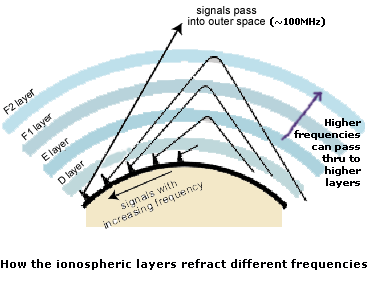
The ionosphere is a section of the earth's atmosphere that's thin enough (from the altitude) that individual atoms are ionized by incoming solar energy and can exist for long periods as separate ions without recombining into neutral atoms. It's generally considered to start about 50 miles up. The ionosphere has multiple layers, generally named D for the lowest, E for the next highest and an F layer. The F layer is capable of splitting under conditions of sufficient energy input into a lower F1 and higher F2. Depending on conditions, the higher layers may not exist, or their density may be too low to be useful.
(From KE9NS.com)
The way that radio signals interact with the ionosphere depends on the density of the layer, and the frequency of the radio waves. During the day, the density of the D layer increases and lower frequency signals can't get through it. Higher frequencies will go through the D layer and will be reflected back to earth by higher layers. Something this illustration shows is that the highest frequencies that get reflected back to earth go to the highest levels of the atmosphere, the F1 and F2 layers, and result in reliable communications over the longest paths. The problem is that if the solar activity is low (as it is now and will be for the foreseeable future), the F1 layer may not ionize sufficiently to reflect signals back at all. Regardless of solar activity it's always the case that above some frequency, the ionization is too weak to reflect the signal back to earth, and the radio wave just continues into space. At night, with the solar energy input removed, the F1 and F2 layers will essentially dissipate if the solar activity is low enough, and the ionization of all the layers will decrease. The D layer becomes low enough density that lower frequencies can be reflected, and go longer distances. You know this if you've ever listened to AM radio; at night, propagation changes and stations from a thousand miles away are readily heard while in the daytime, it's essentially local area only. To new hams: this is why 80 and 40 meters (3.5 and 7.0 MHz) are considered night time bands and only good for local contacts during the day.
What the AF is proposing to do is to directly create these ions to create the higher layers in the ionosphere, by injecting plasma from small CubeSat satellites.
Plasma, of course, is an exotic state of matter. Certainly not liquid or solid, and not exactly a gas due to its electrical properties. It's ionized. The three contractors have different proposals for how they'd generate the plasma, but nobody knows if any of the three would work, or if the Air Force's larger experiment would work. Which is why we do experiments, after all.
Clearly, this is in the early days of the work and we're a long way from even figuring out if it can be tried, but it certainly is an ambitious idea. It's just the sort of over-the-top idea that can be associated with greatness, or could be a flaming, disastrous, waste of time and money. It will be interesting to keep an eye on this one.
The New Scientist story describes the ionosphere pretty poorly, so let me try to improve it.
The ionosphere is a section of the earth's atmosphere that's thin enough (from the altitude) that individual atoms are ionized by incoming solar energy and can exist for long periods as separate ions without recombining into neutral atoms. It's generally considered to start about 50 miles up. The ionosphere has multiple layers, generally named D for the lowest, E for the next highest and an F layer. The F layer is capable of splitting under conditions of sufficient energy input into a lower F1 and higher F2. Depending on conditions, the higher layers may not exist, or their density may be too low to be useful.
(From KE9NS.com)
The way that radio signals interact with the ionosphere depends on the density of the layer, and the frequency of the radio waves. During the day, the density of the D layer increases and lower frequency signals can't get through it. Higher frequencies will go through the D layer and will be reflected back to earth by higher layers. Something this illustration shows is that the highest frequencies that get reflected back to earth go to the highest levels of the atmosphere, the F1 and F2 layers, and result in reliable communications over the longest paths. The problem is that if the solar activity is low (as it is now and will be for the foreseeable future), the F1 layer may not ionize sufficiently to reflect signals back at all. Regardless of solar activity it's always the case that above some frequency, the ionization is too weak to reflect the signal back to earth, and the radio wave just continues into space. At night, with the solar energy input removed, the F1 and F2 layers will essentially dissipate if the solar activity is low enough, and the ionization of all the layers will decrease. The D layer becomes low enough density that lower frequencies can be reflected, and go longer distances. You know this if you've ever listened to AM radio; at night, propagation changes and stations from a thousand miles away are readily heard while in the daytime, it's essentially local area only. To new hams: this is why 80 and 40 meters (3.5 and 7.0 MHz) are considered night time bands and only good for local contacts during the day.
What the AF is proposing to do is to directly create these ions to create the higher layers in the ionosphere, by injecting plasma from small CubeSat satellites.
As well as increasing the range of radio signals, the USAF says it wants to smooth out the effects of solar winds, which can knock out GPS, and also investigate the possibility of blocking communication from enemy satellites.Sample CubeSat, the smallest standard size, 10 x 10 x 11.35cm (Wikipedia)
There are at least two major challenges. One is building a plasma generator small enough to fit on a cubesat – roughly 10 centimetres cubed. Then there’s the problem of controlling exactly how the plasma will disperse once it is released.
The USAF has awarded three contracts to teams who are sketching out ways to tackle the approach. The best proposal will be selected for a second phase in which plasma generators will be tested in vacuum chambers and exploratory space flights.
Plasma, of course, is an exotic state of matter. Certainly not liquid or solid, and not exactly a gas due to its electrical properties. It's ionized. The three contractors have different proposals for how they'd generate the plasma, but nobody knows if any of the three would work, or if the Air Force's larger experiment would work. Which is why we do experiments, after all.
Clearly, this is in the early days of the work and we're a long way from even figuring out if it can be tried, but it certainly is an ambitious idea. It's just the sort of over-the-top idea that can be associated with greatness, or could be a flaming, disastrous, waste of time and money. It will be interesting to keep an eye on this one.
Monday, August 8, 2016
Suddenly Woodworking
I'm pretty sure that every piece I've talked about working on for my G0704 CNC conversion project has been metal. For at least a little while, that has to change. Before I take the mill apart and rebuild it with the pieces I've been making, I've got a lot of stuff to do.
Even if you're not familiar with power tools, it really shouldn't be mysterious that if you start with a block of metal and make it into something smaller, the stuff you cut away has to go somewhere, right? If you cut a cubic inch of metal away, it becomes a cubic inch of waste that needs to be swept or vacuumed up! You may not realize that cutting can throw chips long distances. When I cut the central bores in my motor mounts, I went up to a 3/4" end mill from a 1/2" diameter cutter, and it would throw thick, long, curly strings of metal a few feet across the room. It became a habit to make a pass or two with the mill, then vacuum like crazy. Long stringy chips tend to catch in the shop vac hose and make a plug, so I sweep them up. Still, I regularly find small chips and slivers that should be in the vacuum 10' away from the mill - whether they were thrown or stuck to my shoes, I can't say.
An enclosure for the mill will help with clean up and help keep the rest of the shop clean, so I've been studying mill enclosures on YouTube, and a couple of machinist forums since Saturday. A bonus of the enclosure is that it makes flood cooling possible. I've used the Grizzly at low enough cut rates that things haven't gotten too hot - and I've backed off when they have. With the system open to the world, I can use a little oil or some sort of cutting fluid, but only a drop at a time, or very light spray, otherwise the walls, other machines, papers, and yours truly get splattered (DAMHIK, as they say). With an enclosure, it's possible to put a sink drain in a low spot, with some filtering, so that you can flood cool the part and wash the chips into your bucket, filtering out the cooling solution to recirculate. If you buy a commercial CNC system, they offer enclosures as either standard equipment or an option. Take this Tormach PCNC 1100, something a small business would buy. Or a hobbyist wanting to get started making parts and not making his machine.
I've been studying ways to do this since Saturday, and there are some pretty impressive home made systems out there (a collection of photos). I've settled on an approach like the seller of the DVD plans I'm working from has done. It's different than the system on the DVD, but he's posted the new version to one of machinist forums, along with lots of videos. I've spent a couple of hours drawing it in the CAD program, bought some wood, and I'm ready to start cutting the pieces. Painting and sealing is mandatory - and has to be completed by the time I'm taking the mill apart and rebuilding it, so it's a high priority project.
In addition to doing this, I've got to build up my CNC controller box. I have the stepper motor controllers, steppers, and I think I have everything I need, although I may be short of simple stuff like Cat 5 cable. I even think I sketched a schematic at some point, or glommed together a few different pieces of schematic that I found. The controller box needs to be running before I assemble the mill. How can I tell if one my axes binds if I can't drive the motor to make sure? Being a largely electrical job, this is going to be more like working on my home turf. Then there's a computer. I need to build, fix or completely resurrect a computer to run the motion control software.
While the mill is apart, I'll be adding a system to pump a little oil into a handful of places: ballscrews, and where metals slide over each other. I have the oil fittings, or at least some of them, but there are parts I need to get on order for that task. Yeah, I've been trying to read up on how people do that, too. When the mill is being reassembled, there's stuff to be added and wired into place besides the stepper motors: limit switches, power to the cooling and oiling systems. And probably things I'm forgetting.
That's actually all that I have planned now. When these things are done, sometime in the next few months, I'll have a CNC'ed, 1HP mill. It should make finishing an AR lower an afternoon job, instead of a couple of weeks like my first one. I hope it ends up having all been worth it. There are other popular mods for the system: ways to run the spindle faster, including a higher power motor for the spindle, and automatic tool changers. I can't say I'm really going to do any of those, but having a tool changer is a BIG step up from doing everything one tool at a time. Higher power is a like a bigger machine. You always want higher power, just like you always seem to need a machine a couple of inches bigger in some dimension than what you have. At some point you have to live with it.
This is how I spend my weekend afternoons and evenings. Studying these questions. How about you?
Even if you're not familiar with power tools, it really shouldn't be mysterious that if you start with a block of metal and make it into something smaller, the stuff you cut away has to go somewhere, right? If you cut a cubic inch of metal away, it becomes a cubic inch of waste that needs to be swept or vacuumed up! You may not realize that cutting can throw chips long distances. When I cut the central bores in my motor mounts, I went up to a 3/4" end mill from a 1/2" diameter cutter, and it would throw thick, long, curly strings of metal a few feet across the room. It became a habit to make a pass or two with the mill, then vacuum like crazy. Long stringy chips tend to catch in the shop vac hose and make a plug, so I sweep them up. Still, I regularly find small chips and slivers that should be in the vacuum 10' away from the mill - whether they were thrown or stuck to my shoes, I can't say.
An enclosure for the mill will help with clean up and help keep the rest of the shop clean, so I've been studying mill enclosures on YouTube, and a couple of machinist forums since Saturday. A bonus of the enclosure is that it makes flood cooling possible. I've used the Grizzly at low enough cut rates that things haven't gotten too hot - and I've backed off when they have. With the system open to the world, I can use a little oil or some sort of cutting fluid, but only a drop at a time, or very light spray, otherwise the walls, other machines, papers, and yours truly get splattered (DAMHIK, as they say). With an enclosure, it's possible to put a sink drain in a low spot, with some filtering, so that you can flood cool the part and wash the chips into your bucket, filtering out the cooling solution to recirculate. If you buy a commercial CNC system, they offer enclosures as either standard equipment or an option. Take this Tormach PCNC 1100, something a small business would buy. Or a hobbyist wanting to get started making parts and not making his machine.
I've been studying ways to do this since Saturday, and there are some pretty impressive home made systems out there (a collection of photos). I've settled on an approach like the seller of the DVD plans I'm working from has done. It's different than the system on the DVD, but he's posted the new version to one of machinist forums, along with lots of videos. I've spent a couple of hours drawing it in the CAD program, bought some wood, and I'm ready to start cutting the pieces. Painting and sealing is mandatory - and has to be completed by the time I'm taking the mill apart and rebuilding it, so it's a high priority project.
In addition to doing this, I've got to build up my CNC controller box. I have the stepper motor controllers, steppers, and I think I have everything I need, although I may be short of simple stuff like Cat 5 cable. I even think I sketched a schematic at some point, or glommed together a few different pieces of schematic that I found. The controller box needs to be running before I assemble the mill. How can I tell if one my axes binds if I can't drive the motor to make sure? Being a largely electrical job, this is going to be more like working on my home turf. Then there's a computer. I need to build, fix or completely resurrect a computer to run the motion control software.
While the mill is apart, I'll be adding a system to pump a little oil into a handful of places: ballscrews, and where metals slide over each other. I have the oil fittings, or at least some of them, but there are parts I need to get on order for that task. Yeah, I've been trying to read up on how people do that, too. When the mill is being reassembled, there's stuff to be added and wired into place besides the stepper motors: limit switches, power to the cooling and oiling systems. And probably things I'm forgetting.
That's actually all that I have planned now. When these things are done, sometime in the next few months, I'll have a CNC'ed, 1HP mill. It should make finishing an AR lower an afternoon job, instead of a couple of weeks like my first one. I hope it ends up having all been worth it. There are other popular mods for the system: ways to run the spindle faster, including a higher power motor for the spindle, and automatic tool changers. I can't say I'm really going to do any of those, but having a tool changer is a BIG step up from doing everything one tool at a time. Higher power is a like a bigger machine. You always want higher power, just like you always seem to need a machine a couple of inches bigger in some dimension than what you have. At some point you have to live with it.
This is how I spend my weekend afternoons and evenings. Studying these questions. How about you?
Sunday, August 7, 2016
It Doesn't Matter If We Call It a $400 Million Ransom
It doesn't matter what president golf shorts calls it. It doesn't matter what Donald Trump calls it. It doesn't matter what Hillary Rotten Clinton calls it. It doesn't matter what the punditry class from the extreme left NY Times to the only moderately left Fox News calls it. It certainly doesn't matter what you or I call it.
It only matters what hostage takers, in this case Iran, call it and they call it a ransom. If kidnappers think it's a ransom, you can bet there will be more kidnappings.
TV Screen capture of Iranian TV showing off their payment.
It only matters what hostage takers, in this case Iran, call it and they call it a ransom. If kidnappers think it's a ransom, you can bet there will be more kidnappings.
Iranian leaders claimed in January that the payment was indeed a ransom.If you're an American working overseas, for God's sake watch yourself. I'll just echo the standard advise to step up your situational awareness, and try to stay in groups where you can watch each others' backs. The obvious potential is for Iran themselves, but any of their sycophants like Hezbollah or even "lone wolves" (I'm getting to hate the phrase) could start grabbing Americans for dollars.
“This money was returned for the freedom of the U.S. spy and it was not related to the [nuclear] negotiations,” Iranian Brig. Gen. Reza Naqdi told Fars News, a mouthpiece of the Islamic Revolutionary Guard Corps, in January.
TV Screen capture of Iranian TV showing off their payment.
Another Hillary-Related Death
The news broke this weekend that Iran had executed a nuclear scientist on charges of being a US spy. The Blaze carries this AP story:
Shahram Amiri (AP Photo/ ATN1 DKTV)
The official IRNA news agency quoted a spokesman for Iran’s judiciary, Gholamhosein Mohseni Ejehi, confirming the execution of Shahram Amiri, an Iranian nuclear scientist caught up in a real-life U.S. spy mystery who later returned to his home country and disappeared. He did [not] say where or when the execution took place, but said Amiri’s initial death sentence had been reviewed by an appeal court and that he had access to a lawyer. [the word "not" added - SiG - seems to have been what the AP writer meant]According to the Washington Examiner, it appears he was mentioned in Hillary's emails, which we have all assumed have likely been grabbed from her private server by "foreign interests".
"I'm not going to comment on what he may or may not have done for the United States government, but in the emails that were on Hillary Clinton's private server, there were conversations among her senior advisors about this gentleman," he said on "Face the Nation." Cotton was speaking about Shahram Amiri, who gave information to the U.S. about Iran's nuclear program.where "Cotton" is senator Tom Cotton, R-Ark.,
Iran confirmed on Sunday that Amiri had been hanged for treason. He was convicted of spying charges in a death sentence case that was upheld on appeal, according to the Associated Press.Personally, I wouldn't doubt there's a long trail of blood related to those emails. It's what you expect when "sources and methods" are revealed. Iran appears remarkably straightforward about this, showing their legal process and that it was a fully legal execution; in the sense that it was court-ordered and after having gone through the full legal rights of Iranian citizens. I'd be less than surprised if certain other people whose names were in those emails just became missing persons, or mysteriously fell out of windows, or off buildings. Like reporters in Russia.
"This person who had access to the country's secret and classified information had been linked to our hostile and No. 1 enemy, America, the Great Satan" a spokesman for the Iranian judiciary said. "He provided the enemy with vital and secret information of the country."
Shahram Amiri (AP Photo/ ATN1 DKTV)
Friday, August 5, 2016
The Unkindest Cut of All
Well, that's too Shakespearean. It's not like it was "unkindest", but it was the hardest material I've had to cut. Something ordinary machine tools won't touch.
In the G0704 CNC conversion I'm doing, I encountered something I wasn't comfortable doing. A picture is worth a thousand words, so one view from the conversion DVD.
This is the Y axis ballscrew. The flange of the ballnut is visible just above the centerline, on the ballscrew. You can see that there's a vertical cut there, just left of the text box, cutting into the flange and cutting open one of the mounting holes. Although not shown here, this gets attached to a mount that I machined a while back, and the whole thing sits in the base of the mill replacing the current hardware. There's just one minor problem. Across its widest points in this orientation, the width of that ballnut is 1.88". The slot it moves in is 1.84". I need to take off 50 or 60 thousandths - half on each side.
The "instructions" (as voice on included video) are to just take an angle grinder to it and take off a little. Nothing critical. Doesn't have to be pretty. The only problem is I've never used one. I need to cross that line at some point, but right now, I'd need to take that outside and do it on the porch, and that's easier said than done. It needs to be held in something, some sort of vise, and that vise needs to be held by something. Unlike the powder coat toaster oven, I can't just stick the vise on a shelf; it needs to be secure. In case you're thinking this, I can't cut it on the milling machine itself, either. The steel is so hard that a file just slides on it, not cutting at all. Too hard to cut with a carbide cutter.
After puzzling over this cut for a few days (instead of just building a back porch workbench), I came up with a way to use things I already have. In particular, I have some lapidary (rock cutting and polishing) equipment that includes a coarse diamond grinder. This seemed to have a lot of advantages: it not only would grind away the steel, but lapidary equipment is water cooled, which keeps the dust from building up in places you don't want it, and keeps the work cool. Plus, it's a diamond abrasive, which is much harder than the cutters in angle grinders or the carbide cutting tools. It worked like a champ.
This is cut way deeper than it probably needs to be. I made it look like the piece in the picture above. Instead of being close to the 1.84 of the slot, it's more like 1.55. Since it's based on the master version, it should work fine.
One more little obstacle out of the way. Not only is every piece a puzzle, pretty much every cut can be a puzzle.
In the G0704 CNC conversion I'm doing, I encountered something I wasn't comfortable doing. A picture is worth a thousand words, so one view from the conversion DVD.
This is the Y axis ballscrew. The flange of the ballnut is visible just above the centerline, on the ballscrew. You can see that there's a vertical cut there, just left of the text box, cutting into the flange and cutting open one of the mounting holes. Although not shown here, this gets attached to a mount that I machined a while back, and the whole thing sits in the base of the mill replacing the current hardware. There's just one minor problem. Across its widest points in this orientation, the width of that ballnut is 1.88". The slot it moves in is 1.84". I need to take off 50 or 60 thousandths - half on each side.
The "instructions" (as voice on included video) are to just take an angle grinder to it and take off a little. Nothing critical. Doesn't have to be pretty. The only problem is I've never used one. I need to cross that line at some point, but right now, I'd need to take that outside and do it on the porch, and that's easier said than done. It needs to be held in something, some sort of vise, and that vise needs to be held by something. Unlike the powder coat toaster oven, I can't just stick the vise on a shelf; it needs to be secure. In case you're thinking this, I can't cut it on the milling machine itself, either. The steel is so hard that a file just slides on it, not cutting at all. Too hard to cut with a carbide cutter.
After puzzling over this cut for a few days (instead of just building a back porch workbench), I came up with a way to use things I already have. In particular, I have some lapidary (rock cutting and polishing) equipment that includes a coarse diamond grinder. This seemed to have a lot of advantages: it not only would grind away the steel, but lapidary equipment is water cooled, which keeps the dust from building up in places you don't want it, and keeps the work cool. Plus, it's a diamond abrasive, which is much harder than the cutters in angle grinders or the carbide cutting tools. It worked like a champ.
This is cut way deeper than it probably needs to be. I made it look like the piece in the picture above. Instead of being close to the 1.84 of the slot, it's more like 1.55. Since it's based on the master version, it should work fine.
One more little obstacle out of the way. Not only is every piece a puzzle, pretty much every cut can be a puzzle.
Thursday, August 4, 2016
The Biggest Story That Didn't Make the News
Long time readers will know that I retired in December from a company that I called Major Avionics Corporation - for the same reason I don't use my real name. I didn't want anyone thinking anything I said was official policy, or opinion of my employer. Most people are unaware of what avionics is, the dictionary definition is "electronics applied to aviation" and that's a good summary of what we did. Everything from communications radios, to collision avoidance systems (also radios), weather radars (ditto), navigation radios and more; but also things like the pilot to cockpit intercoms, with their characteristic "bing bong" tones, to inflight entertainment systems (Cable TV on a plane) to, well, anything electronic that got put on an airplane. Given that list, you might see why it was a good place to be a radio designer for 20 years.
That means that for 20 years, I worked in the aviation industry, and I think that like most of us, I'm proud of the industry. That's why I think this aviation story that didn't make the news much, if at all, needs to be highlighted. Yesterday, an Emirates Air Boeing 777 apparently landed in Dubai with landing gear problems, or its gear wasn't deployed at all. The aircraft burst into flames and quickly burned halfway to the ground.
So how does an airplane the size of a 777-300, nearly 250' long and probably weighing a half million pounds, carrying 300 people (passengers and crew) essentially crash on the runway, slide hundreds or thousands of feet, dragging one of its huge Rolls-Royce engines behind it, then erupt in a fireball, and not one soul on board dies? Two words: engineering and training. Engineering for all the changes made to aircraft design to make crashes more survivable; training for the crews who train relentlessly to get everyone off the plane.
The thing is, yeah, this is a remarkable incident with 100% survival, but remember the Asiana flight 591, also a 777, that landed before the runway's landing zone at San Francisco in 2013? That plane clipped a seawall, flipped and then burned nearly to the ground. Only three of the 291 passengers on that flight died—a 99 percent survival rate—while the jet was destroyed. I don't want to sound like I'm making light of the terrible tragedy for those families, but when you consider the magnitudes of the forces involved, and the mechanical chaos going on, that's still pretty darned good odds for survivability.
It's not just the overall strength of the airframe, and designing the attachments of seats to the airframe to take up to 16 G loads. The seats on aircraft used to release toxic fumes when they burned. Airplanes built after 1990 must also meet standards on how much heat is released from materials in a fire and the density of smoke the fire produces.
Lastly, the professionalism of the flight crews can not be ignored. Too often, we think of flight attendants as "waitresses at 35,000 feet". During quiet times they may be, but they also train hard to be able to get everyone off the plane in under 90 seconds.
Emirates Flight EK521, "after".
Civil aviation isn't one technology; it's many. Perhaps the most taken for granted technology there is (Louis CK has a famous comedy bit about this). People expect to get into their pressurized aluminum tube, fly in an environment that would kill them if they were exposed to it for a brief time, and then get off the plane later without a nanosecond of inconvenience or discomfort. With incredibly few exceptions, they do. A flight not ending up where it was supposed to go is so unusual it always makes the news; either a lost plane or a lost pilot landing at the wrong airport. The system just works, the vast majority of the time. I'd like to claim the avionics industry added something to surviving this sort of accident, but this is entirely on the airframe makers. They're the heroes.
That means that for 20 years, I worked in the aviation industry, and I think that like most of us, I'm proud of the industry. That's why I think this aviation story that didn't make the news much, if at all, needs to be highlighted. Yesterday, an Emirates Air Boeing 777 apparently landed in Dubai with landing gear problems, or its gear wasn't deployed at all. The aircraft burst into flames and quickly burned halfway to the ground.
Despite this tremendous mechanical violence, all 300 people aboard escaped with their lives.Unfortunately, there was one fatality: one of the firefighters dousing the plane was killed. There were no reports of serious injuries, such as broken limbs or serious burns. I'll bet that's why this story barely got picked up at all.
So how does an airplane the size of a 777-300, nearly 250' long and probably weighing a half million pounds, carrying 300 people (passengers and crew) essentially crash on the runway, slide hundreds or thousands of feet, dragging one of its huge Rolls-Royce engines behind it, then erupt in a fireball, and not one soul on board dies? Two words: engineering and training. Engineering for all the changes made to aircraft design to make crashes more survivable; training for the crews who train relentlessly to get everyone off the plane.
Airplanes must be evacuated within 90 seconds, a feat flight attendants are rigorously trained to achieve. That means passengers have a fighting chance to flee an airplane before fire and smoke can engulf it. In addition, the Federal Aviation Administration has invested enormous resources into studying emergency airplane “egress,” including an Oklahoma City laboratory specializing in such flight-safety issues.The placement and size of exits to get everyone off an airplane in under 90 seconds is a subject of engineering effort. Think of the Airbus monster double decker A380. During their evacuation test, 853 volunteer "passengers" and 20 crew members left the aircraft within 78 seconds. (No, they can't use trained "evacuation test takers")
The thing is, yeah, this is a remarkable incident with 100% survival, but remember the Asiana flight 591, also a 777, that landed before the runway's landing zone at San Francisco in 2013? That plane clipped a seawall, flipped and then burned nearly to the ground. Only three of the 291 passengers on that flight died—a 99 percent survival rate—while the jet was destroyed. I don't want to sound like I'm making light of the terrible tragedy for those families, but when you consider the magnitudes of the forces involved, and the mechanical chaos going on, that's still pretty darned good odds for survivability.
It's not just the overall strength of the airframe, and designing the attachments of seats to the airframe to take up to 16 G loads. The seats on aircraft used to release toxic fumes when they burned. Airplanes built after 1990 must also meet standards on how much heat is released from materials in a fire and the density of smoke the fire produces.
Lastly, the professionalism of the flight crews can not be ignored. Too often, we think of flight attendants as "waitresses at 35,000 feet". During quiet times they may be, but they also train hard to be able to get everyone off the plane in under 90 seconds.
Emirates Flight EK521, "after".
Civil aviation isn't one technology; it's many. Perhaps the most taken for granted technology there is (Louis CK has a famous comedy bit about this). People expect to get into their pressurized aluminum tube, fly in an environment that would kill them if they were exposed to it for a brief time, and then get off the plane later without a nanosecond of inconvenience or discomfort. With incredibly few exceptions, they do. A flight not ending up where it was supposed to go is so unusual it always makes the news; either a lost plane or a lost pilot landing at the wrong airport. The system just works, the vast majority of the time. I'd like to claim the avionics industry added something to surviving this sort of accident, but this is entirely on the airframe makers. They're the heroes.
Wednesday, August 3, 2016
Tales From the Over Regulated State # 21 - Wild Animals Take Part in Interstate Commerce?
Watts Up With That is one of my regular reads because it's not just a great place to catch up on the latest summary of the climate insanity, it's a great place to read a variety of topics that show up from time to time, and the comments are relatively sane compared to most places (where the topic usually becomes a stupid political attack within the first five comments).
This week, there was an article on Gray Wolves, and the main point of the article is that we may tend to think that there's a rather crisp, definition for what a biological species is; a definition that is broadly agreed-upon, but that isn't the case. Along the way (actually in the comments) I ran into the story for this episode of TFORS. While this is episode 21 of the series (which I didn't number until recently) it fits closely with #19 from last December, about how your property isn't your own if an endangered or protected species is involved.
To begin with, they point to an article in the NY Times that says according to an in-depth study of their DNA,
At this point, it's pretty healthy to be saying "so what?". The so-what is that the Federal Government, through the actions of the Usual Suspect agencies has been working on a program to protect the red wolf and conducting a Red Wolf Recovery Program. In my mind, it's hard to declare a species to be endangered when it isn't actually a species. In the same NY Times, two months prior, there was piece saying,
Let's go back to the '70s and the captive breeding program to rescue the red wolves. The wolf population was burgeoning and the US Fish and Wildlife Service (FWS) proposed introducing their pen-raised mongrels in Kentucky and Tennessee. State officials, ranchers, and others in those states met them at the gate and told them hell no; they didn’t want the wolves. Faced with local opposition, the FWS did what any fed agency does, they looked for a wayto impose their will around the problem, deciding to release the red wolves on federal lands in the Kentucky/Tennessee/North Carolina area.
I'm sure you're guessing at this point that wolves don't read signs very well and didn't stay in the parks. Exactly. While the original population had radio collars (so "if they go out of the federal land, we'll just round them up") , but they quickly bred new generations of collarless wolves that began scouring private land for livestock meals – some more than 100 miles away. Just like real wolves do in Idaho, Oregon, Montana and pretty much everywhere. A landowner who shot one threatening his livestock was fined and required to feed captive red wolves for a year as his penance for not being environmentally sensitive enough.
Now it turns into a Federal case; more specifically states rights vs. the feds. A lawsuit — Gibbs vs. Babbitt — was filed challenging the FWS’s authority to prevent landowners from killing wolves that were killing their livestock. This suit was filed in federal district court for the eastern portion of North Carolina; arguing citizens had the right under state law to protect their property from marauding wolves, the Endangered Species Act notwithstanding. Once this got into court, the FWS lawyers argued straight-faced that ranchers and farmers killing wolves that killed livestock and wildlife on their property were “ . . . interfering with interstate commerce, and thus violating the Commerce Clause.”
Wait... A homeowner killing a wolf on their private property to protect the life of their private property violates the Interstate Commerce Clause? How does a wild animal create interstate commerce? Contract lawyers for FWS argued that tourists generated commerce when they came from places like New York to North Carolina to “hear the ‘wolves’ howl.” The problem they faced was that no one could prove that anyone actually had come to North Carolina to hear the wolves' howl. But critical facts like that aren't going to affect a Federal Judge! Of course the Federal District Court for the eastern portion of North Carolina ruled in the FWS' favor! The inevitable appeal to the 4th U.S. Circuit Court of Appeals resulted in a split decision, which agreed with the lower court. Wolves are now agents of interstate commerce.
Two red wolf mutts being all interstate commerce-y. I'll just close this with a quote from the first comment to this piece on WUWT:
This week, there was an article on Gray Wolves, and the main point of the article is that we may tend to think that there's a rather crisp, definition for what a biological species is; a definition that is broadly agreed-upon, but that isn't the case. Along the way (actually in the comments) I ran into the story for this episode of TFORS. While this is episode 21 of the series (which I didn't number until recently) it fits closely with #19 from last December, about how your property isn't your own if an endangered or protected species is involved.
To begin with, they point to an article in the NY Times that says according to an in-depth study of their DNA,
“The first large study of North American wolf genomes has found that there is only one species on the continent: the gray wolf. Two other purported species, the Eastern wolf and the red wolf, are mixes of gray wolf and coyote DNA, the scientists behind the study concluded.”Bridgett M. vonHoldt of Princeton University, a DNA specialist who studies the genome of the canids (mammals of the dog family – Canidae): that is domestic and wild dogs, wolves, foxes, jackals and dingoes, is the lead author behind this study.
At this point, it's pretty healthy to be saying "so what?". The so-what is that the Federal Government, through the actions of the Usual Suspect agencies has been working on a program to protect the red wolf and conducting a Red Wolf Recovery Program. In my mind, it's hard to declare a species to be endangered when it isn't actually a species. In the same NY Times, two months prior, there was piece saying,
“Conservation groups submitted an emergency petition last week requesting that the United States Fish and Wildlife Service increase protection for the only wild population of red wolves left in the world.”Dr. vanHoldt’s study not only identified the three canids (Grey, Eastern and Red wolves) as a single species (albeit, the latter two are wolf-coyote hybrids - in domesticated dogs we call this a breed), but her paper states bluntly:
…
“It also seeks an upgrading of the status of red wolves, which are endangered, from “nonessential” to “essential.” The change in status would grant reserved habitat to the species and require consultations with biologists over how changes to land use would affect the wolves.”
“The red wolf was listed as an endangered species in 1973, initiating a captive breeding program by the USFWS. The program began with 12 of 14 founding individuals that reproduced, selected from a panel of several hundred captured individuals that were thought to represent the ancestry spectrum ranging from coyote to pure red wolf and various admixtures of the two forms. These 12 founders were considered to be pure red wolves based on phenotypic characteristics and the lack of segregation of “coyote-like” traits in their offspring. The descendants of these founders defined the ancestry of the several hundred red wolves produced by the captive breeding program and have been the source for a single reintroduced population in eastern North Carolina.”Since those members of a small population of wild red wolves were captured in the '70s and used to breed a new population, the reality is that the red wolf is not just a wolf-coyote cross, it's a man-made breed at this point. So would the fact that the species the conservationists wants to protect is really a "mutt" of two (or more) other species cause them to say, "oh... well, that's clearly not what the Endangered Species Act is for, so we'll go home now"? Of course not! Here's where the story gets a bit longer, and switches over to the comment by Watts Up With That reader wrusssr.
Let's go back to the '70s and the captive breeding program to rescue the red wolves. The wolf population was burgeoning and the US Fish and Wildlife Service (FWS) proposed introducing their pen-raised mongrels in Kentucky and Tennessee. State officials, ranchers, and others in those states met them at the gate and told them hell no; they didn’t want the wolves. Faced with local opposition, the FWS did what any fed agency does, they looked for a way
I'm sure you're guessing at this point that wolves don't read signs very well and didn't stay in the parks. Exactly. While the original population had radio collars (so "if they go out of the federal land, we'll just round them up") , but they quickly bred new generations of collarless wolves that began scouring private land for livestock meals – some more than 100 miles away. Just like real wolves do in Idaho, Oregon, Montana and pretty much everywhere. A landowner who shot one threatening his livestock was fined and required to feed captive red wolves for a year as his penance for not being environmentally sensitive enough.
Now it turns into a Federal case; more specifically states rights vs. the feds. A lawsuit — Gibbs vs. Babbitt — was filed challenging the FWS’s authority to prevent landowners from killing wolves that were killing their livestock. This suit was filed in federal district court for the eastern portion of North Carolina; arguing citizens had the right under state law to protect their property from marauding wolves, the Endangered Species Act notwithstanding. Once this got into court, the FWS lawyers argued straight-faced that ranchers and farmers killing wolves that killed livestock and wildlife on their property were “ . . . interfering with interstate commerce, and thus violating the Commerce Clause.”
Wait... A homeowner killing a wolf on their private property to protect the life of their private property violates the Interstate Commerce Clause? How does a wild animal create interstate commerce? Contract lawyers for FWS argued that tourists generated commerce when they came from places like New York to North Carolina to “hear the ‘wolves’ howl.” The problem they faced was that no one could prove that anyone actually had come to North Carolina to hear the wolves' howl. But critical facts like that aren't going to affect a Federal Judge! Of course the Federal District Court for the eastern portion of North Carolina ruled in the FWS' favor! The inevitable appeal to the 4th U.S. Circuit Court of Appeals resulted in a split decision, which agreed with the lower court. Wolves are now agents of interstate commerce.
Two red wolf mutts being all interstate commerce-y. I'll just close this with a quote from the first comment to this piece on WUWT:
There will be no peace, no justice, and no economic growth until the last lawyer is strangled with the entrails of the last environmentalist.
Tuesday, August 2, 2016
Techy Tuesday - Another 3D Printing Breakthrough
This piece is a couple of weeks old, but interesting and noteworthy. German precious metals expert Heraeus and Swedish startup Exmet have successfully 3D printed amorphous metals.
Amorphous metals? Most people are aware that metals have a crystalline structure. If you take a piece of wire like a paperclip and bend it back and forth, you increase the size of these crystals through a process called cold-working and it will soon break along these crystal boundaries. Given a large enough piece being bent until it breaks, these crystals can be easy to see. Amorphous metals are sometimes called metal glasses because they show the same sort of non-crystalline structures that glass shows. (amorphous means "without shape")
When I studied Materials Science in college, these were exotic materials. The only way known to be able to create metal glasses to study was to cool molten metals at extreme rates. The first experiments chilled the metals at a trillion degrees Kelvin per second. That's a hard number to grasp, so for example this would be equivalent to cooling molten Nickel at 2913C (3186K) to liquid nitrogen temperatures of 70K in 3.1 nanoseconds. Only very thin layers (< 50 µm) could possibly transfer heat that fast. Work since then has focused on coming up with alloys that can be cooled at lower rates, by using metals with extremely different atomic sizes and current numbers for cooling rates are in the range of 1000 K/s and under. Rates down to 1 K/s have been shown. This allows much more useful sizes.
OK, cooling something at a trillion degrees per second is a pretty outrageous achievement, but even 1000 degrees K/sec in a 3D printer sounds extremely difficult. Why do it? Heraeus sums it up in this statement:
They did, however, grace us with this concept artwork. Exactly what "concept" is being portrayed (other than some random shape coming out of the printer) is a bit beyond me.
Amorphous metals? Most people are aware that metals have a crystalline structure. If you take a piece of wire like a paperclip and bend it back and forth, you increase the size of these crystals through a process called cold-working and it will soon break along these crystal boundaries. Given a large enough piece being bent until it breaks, these crystals can be easy to see. Amorphous metals are sometimes called metal glasses because they show the same sort of non-crystalline structures that glass shows. (amorphous means "without shape")
When I studied Materials Science in college, these were exotic materials. The only way known to be able to create metal glasses to study was to cool molten metals at extreme rates. The first experiments chilled the metals at a trillion degrees Kelvin per second. That's a hard number to grasp, so for example this would be equivalent to cooling molten Nickel at 2913C (3186K) to liquid nitrogen temperatures of 70K in 3.1 nanoseconds. Only very thin layers (< 50 µm) could possibly transfer heat that fast. Work since then has focused on coming up with alloys that can be cooled at lower rates, by using metals with extremely different atomic sizes and current numbers for cooling rates are in the range of 1000 K/s and under. Rates down to 1 K/s have been shown. This allows much more useful sizes.
OK, cooling something at a trillion degrees per second is a pretty outrageous achievement, but even 1000 degrees K/sec in a 3D printer sounds extremely difficult. Why do it? Heraeus sums it up in this statement:
“Amorphous metals will change our future. They possess a wide variety of previously incompatible characteristics: They are very strong and yet malleable, as well as harder and more corrosion-resistant than conventional metals...”Continuing from their press release announcement:
Amorphous metals are suitable for an exceptional number of high-tech applications. They are energy-absorbing and scratch-proof while still having very good spring characteristics – interesting for injection nozzle diaphragms, casing for consumer electronics, or as dome tweeters for speakers. “For fifty years the commercial success of amorphous metals has been held back by inadequate manufacturing methods. Now that changes. Exmet looks forward to cooperating with Heraeus as a competent partner with a worldwide network to help bring this disruptive new technology to the market,” says Mattias Unosson, Exmet co-founder and CEO.While this was exotic technology when I was in school, today, metal glasses are manufactured in quantity for some specialized applications. Still, a way to produce them using additive manufacturing appears to be able to open up new applications and new markets for amorphous metals. It's a shame Heraeus doesn't feel fit to give us even a clue how they do it. Their release describes what sounds like conventional laser or electron beam sintering of metal powders. I know it's proprietary, but it would be fun if they mentioned they sintered a spot and then sprayed a drop of liquid nitrogen on it!
They did, however, grace us with this concept artwork. Exactly what "concept" is being portrayed (other than some random shape coming out of the printer) is a bit beyond me.
Monday, August 1, 2016
Cardio May Be Killing You - Part 2
Part 1 was way back, one month short of five years ago. First, a short refresh. The main thrust of the article concerned data from a radiology study, that was written for popular press by Kurt Harris, M.D.. In brief, when distance runners who did three marathons a year were compared to sedentary people, which even included some smokers, the runners showed more evidence of so-called "silent" heart attacks and had more damage to their hearts than the other groups. The runners were slimmer and (of course) fitter, but their hearts were in worse shape than sedentary people. From a heart health standpoint, they were less healthy than the ones who sat around - and how often have you heard or been told by a doctor not to be sedentary?
Given that as background, and as I said at the time my tendency to listen to "alternative" nutrition/health podcasts, I ran into some data on one of them that I've researched somewhat, and I think it's real enough to add a Part 2 to the previous post. The interviewee I was listening to was Mark Sisson, one of the founders of the paleo diet and exercise movement. Sisson was a world-class marathoner and triathlete before he quit. He long decried what he called "chronic cardio" - getting on a bike or running until heart rate is 80% of maximum and sticking it there for hours.
One of the most common heart arrhythmias is atrial fibrillation, or afib. Afib can be very uncomfortable, but most importantly it raises the risk of stroke. One source I saw said it's the leading cause of stroke in America. It turns out that doing extensive cardio exercise not only can cause the silent heart attacks mentioned in '11, it can damage the heart in ways that cause afib. In this 2013 article, on a peer-reviewed medical practitioner's page, they say that afib is 5 times more common in endurance athletes than the general population. That may be a low estimate. The risk is greatest for people who start their vigorous exercise programs (defined as >5 hours/week) when they're over 30. Sisson said he has afib, many of his contemporaries have it and went so far as to say it's endemic in over-50 ex-athletes. I spent most of my exercise time for a decade or more doing exactly that, from the mid-90s to the mid 2000s. Typically 5 or 6 days a week, I'd nail my heart rate high and just crank out the miles. A few years ago, after some weird chest sensations, I was told I have afib, and an older friend who was a runner for his entire adult life has it. (I've never had symptoms as bad as my friend).
In this article from a cardiac electrophysiologist and bike racer, he talks about the bitter truth about this situation. Once the heart is damaged, it's damaged irreversibly. There are two main treatments for afib: anti-arrhythmia drugs and a surgical intervention that either "spot welds" areas of the heart together, to break up the problems causing the afib, or cryoablation that freezes and "burns off" that heart tissue. Either one of these is a Big Deal, and while they don't crack your chest open as in the case of bypass surgery, they feed a catheter carrying instruments and a camera up the femoral artery into the heart. It's done under general anesthesia. The drugs bring bad side effects to some people, but work for others. The ablation treatments sometimes fail and need to be redone. My friend had cryoablation twice, and it seems to be holding up.
Don't make the mistake of suddenly stopping your exercise program. In a study at the Karolinska University Hospital, in Stockholm, Sweden, they collected information about physical activity from 44,410 Swedish men from the ages of 45-79 who did not have atrial fibrillation. They found a U-shaped curve of exercise vs. risk of afib. The lowest risk was at 2-3 hours per week. The risk was highest in those that started >5 hours of vigorous exercise after the age of 30.
I don't like closing an article like this with no signs of hope, so let me reiterate that leisurely walking or cycling was associated with a reduction in afib. It appears that a leisurely walk around the block/neighborhood, a few times a week, or every day, is the best thing you can do - at least as far as afib is concerned!
(with all due respect to the folks I got this image from, the most important thing to know before attending a spinning class is DON'T!!!)
Dr. Harris said that the evidence was strong enough to convince him to change his behavior. He switched to running a 5k (~3 miles) a few times a week just for fun, and abandoned the "more is better" belief about cardio that is absolutely pervasive in our society.
Given that as background, and as I said at the time my tendency to listen to "alternative" nutrition/health podcasts, I ran into some data on one of them that I've researched somewhat, and I think it's real enough to add a Part 2 to the previous post. The interviewee I was listening to was Mark Sisson, one of the founders of the paleo diet and exercise movement. Sisson was a world-class marathoner and triathlete before he quit. He long decried what he called "chronic cardio" - getting on a bike or running until heart rate is 80% of maximum and sticking it there for hours.
One of the most common heart arrhythmias is atrial fibrillation, or afib. Afib can be very uncomfortable, but most importantly it raises the risk of stroke. One source I saw said it's the leading cause of stroke in America. It turns out that doing extensive cardio exercise not only can cause the silent heart attacks mentioned in '11, it can damage the heart in ways that cause afib. In this 2013 article, on a peer-reviewed medical practitioner's page, they say that afib is 5 times more common in endurance athletes than the general population. That may be a low estimate. The risk is greatest for people who start their vigorous exercise programs (defined as >5 hours/week) when they're over 30. Sisson said he has afib, many of his contemporaries have it and went so far as to say it's endemic in over-50 ex-athletes. I spent most of my exercise time for a decade or more doing exactly that, from the mid-90s to the mid 2000s. Typically 5 or 6 days a week, I'd nail my heart rate high and just crank out the miles. A few years ago, after some weird chest sensations, I was told I have afib, and an older friend who was a runner for his entire adult life has it. (I've never had symptoms as bad as my friend).
In this article from a cardiac electrophysiologist and bike racer, he talks about the bitter truth about this situation. Once the heart is damaged, it's damaged irreversibly. There are two main treatments for afib: anti-arrhythmia drugs and a surgical intervention that either "spot welds" areas of the heart together, to break up the problems causing the afib, or cryoablation that freezes and "burns off" that heart tissue. Either one of these is a Big Deal, and while they don't crack your chest open as in the case of bypass surgery, they feed a catheter carrying instruments and a camera up the femoral artery into the heart. It's done under general anesthesia. The drugs bring bad side effects to some people, but work for others. The ablation treatments sometimes fail and need to be redone. My friend had cryoablation twice, and it seems to be holding up.
Don't make the mistake of suddenly stopping your exercise program. In a study at the Karolinska University Hospital, in Stockholm, Sweden, they collected information about physical activity from 44,410 Swedish men from the ages of 45-79 who did not have atrial fibrillation. They found a U-shaped curve of exercise vs. risk of afib. The lowest risk was at 2-3 hours per week. The risk was highest in those that started >5 hours of vigorous exercise after the age of 30.
In men who exercised >5 hours per week at age 30 and quit exercising later in life or regressed to <1 hour per week, the atrial fibrillation risk increased further to 49 percent. The increased risks remained even when accounting for all types of heart disease and heart disease risk factors; diabetes, high blood pressure, and being a smoker.The thing about this that bothers me the most is that this research goes back at least as far as 1993, and I don't see any messaging anywhere saying there are negative risks associated with doing this sort of cardio workout, and to be especially careful if you're over 30 and start running (or riding). Likewise I've never seen the advisories about running marathons I talked about five years ago. Personally, when someone tells me "irreversible heart damage", I don't like those words. I suppose some group or other thinks it sends mixed messages when they believe they can't get the majority of people to exercise at all.
These authors made a second important observation. They found that leisure activity of walking or cycling did not increase risk, even if it was over 60 minutes a day. In fact, walking over 1 hour per day was associated with a 13 percent decrease in atrial fibrillation. This lower risk of atrial fibrillation was seen in almost all of the groups and was independent of what age the activity was started. In fact, becoming more active with low-moderate intensity exercise helped lower all traditional risk factors of heart disease as well as atrial fibrillation.
I don't like closing an article like this with no signs of hope, so let me reiterate that leisurely walking or cycling was associated with a reduction in afib. It appears that a leisurely walk around the block/neighborhood, a few times a week, or every day, is the best thing you can do - at least as far as afib is concerned!
(with all due respect to the folks I got this image from, the most important thing to know before attending a spinning class is DON'T!!!)
Fellow Bloggers - Go Check Your Stats
Last week, McThag was saying he noticed a surge in visits to his blog from Russia. Yesterday, Sense of Events posted the same thing.
Between reading those two, curiosity got the better of me and I checked my stats. Same thing. These are my stats for the last week.
For the previous month, the US and Russia swap.
Since it's for four weeks, take off the 9623 visits last week and it says that in the 3 prior weeks there were ~4100 visits, or 1370-ish a week. Last week had 7 times more visits from Russia than that average.
We swapped emails and Donald Sensing says he has other blogs, and they show the same pattern. I run a specialty page on blogger that has very low readership - 8 or 10 a day. I looked there and it had 90 visits from Russia last week.
I wonder what they're searching for? While McThag, Sense of Events and I may have some things in common, throw in the other blogs and the similarity goes away. It looks like they're visiting everybody.
So go check your stats page. Are the Russians really checking all of us? I've got to assume it's automated (bots), but it's still a terrible waste of resources to look at everyone on blogspot.com.
Between reading those two, curiosity got the better of me and I checked my stats. Same thing. These are my stats for the last week.
For the previous month, the US and Russia swap.
US 27592(Sidenote: Mauritius? Really?)
Russia 13655
Since it's for four weeks, take off the 9623 visits last week and it says that in the 3 prior weeks there were ~4100 visits, or 1370-ish a week. Last week had 7 times more visits from Russia than that average.
We swapped emails and Donald Sensing says he has other blogs, and they show the same pattern. I run a specialty page on blogger that has very low readership - 8 or 10 a day. I looked there and it had 90 visits from Russia last week.
I wonder what they're searching for? While McThag, Sense of Events and I may have some things in common, throw in the other blogs and the similarity goes away. It looks like they're visiting everybody.
So go check your stats page. Are the Russians really checking all of us? I've got to assume it's automated (bots), but it's still a terrible waste of resources to look at everyone on blogspot.com.
Sunday, July 31, 2016
I Just Want to Point Out
Today's the end of July.
In this month, I've done "Techy" posts on an AI system for running air to air combat that runs on a Raspberry Pi and never loses to a human fighter pilot instructor; wearable gesture sensor interfaces to a computer, a camera lens based on mimicry of an obscure Nigerian fish's eye; a look at the code used on the Apollo Guidance computer; genetically engineered silkworms producing a spider silk that may become the next generation of bullet resistant vests, and Smartbolts for high end, critical uses.
I've done several posts on machine shop work: how I designed a new part for my CNC conversion project when it seemed highly impractical to make the design I had bought; showed it after it was built; and the steps it took to finish the part. From there I transitioned to how I powder coat painted, described the difficulties I encountered and how I got around them to paint everything. Finally, I showed a new method of cheating in bike racing using a motor that can fit in the seat tube of a bike.
The shop and general techy posts were the majority of what I talked about, but I also talked about FBI director Comey's abandonment of the rule of law; the Philando Castile case and some things that were turning up that didn't fit the narrative; added a couple of pieces on the effects the central banks are having on everything; made fun of Bernie Sanders supporters for not being able to see that they're not only protesting the wrong thing but that the solution they propose is the cause of what they're protesting; and pointed out a particularly stupid scumbag in the DNC power structure.
Oh, and I included a piece on Fast Radio Bursts in radio astronomy and their implications, the strange Mandela effect and stinkin' thinkin' that entails, the coup in Turkey, a storm chaser's weather video, the stupidity and logical problems with Obama's constant harping on gun control at the most unfortunate times.
Not to mention a photograph of Colonel Sanders and Alice Cooper.
I try to be a full service blog, and I don't see that wide a range of subjects in any other blog I know of. Hope y'all enjoy it.
In this month, I've done "Techy" posts on an AI system for running air to air combat that runs on a Raspberry Pi and never loses to a human fighter pilot instructor; wearable gesture sensor interfaces to a computer, a camera lens based on mimicry of an obscure Nigerian fish's eye; a look at the code used on the Apollo Guidance computer; genetically engineered silkworms producing a spider silk that may become the next generation of bullet resistant vests, and Smartbolts for high end, critical uses.
I've done several posts on machine shop work: how I designed a new part for my CNC conversion project when it seemed highly impractical to make the design I had bought; showed it after it was built; and the steps it took to finish the part. From there I transitioned to how I powder coat painted, described the difficulties I encountered and how I got around them to paint everything. Finally, I showed a new method of cheating in bike racing using a motor that can fit in the seat tube of a bike.
The shop and general techy posts were the majority of what I talked about, but I also talked about FBI director Comey's abandonment of the rule of law; the Philando Castile case and some things that were turning up that didn't fit the narrative; added a couple of pieces on the effects the central banks are having on everything; made fun of Bernie Sanders supporters for not being able to see that they're not only protesting the wrong thing but that the solution they propose is the cause of what they're protesting; and pointed out a particularly stupid scumbag in the DNC power structure.
Oh, and I included a piece on Fast Radio Bursts in radio astronomy and their implications, the strange Mandela effect and stinkin' thinkin' that entails, the coup in Turkey, a storm chaser's weather video, the stupidity and logical problems with Obama's constant harping on gun control at the most unfortunate times.
Not to mention a photograph of Colonel Sanders and Alice Cooper.
I try to be a full service blog, and I don't see that wide a range of subjects in any other blog I know of. Hope y'all enjoy it.
Saturday, July 30, 2016
Finished With the Paint Booth
Except there is no actual "paint booth", just open air. I bring my powder coat gun, and oven out onto the back porch, set them on a little aluminum platform along with a handy shower seat to make using the oven way more comfortable. I do the spraying standing up alongside the platform, to minimize overspray of powder onto the platform.
Today, I finished the last parts, the standoffs for the Z-axis. Here's everything in the "family portrait", standoffs in front on the right.
User Malatrope commented last time
Getting to be time to start taking the Grizzly G0704 apart and rebuilding with all these parts in place. I need to look over all the things left to do. I'd hate to take the mill apart and need it for something I have to make later.
Today, I finished the last parts, the standoffs for the Z-axis. Here's everything in the "family portrait", standoffs in front on the right.
User Malatrope commented last time
You know, I don't see any problem at all with leaving the holes open and then just running a tap back through them after the coating. Am I missing something?I answered that the sources I was reading said to use a special "chasing tap" and not the one I used to cut the threads. As is often the case online, that's sort of the Extremely Anal Retentive Person's way of doing it. Since some of these parts have so many holes, I didn't have any way to mask them other than screws, so I used screws. If the screw didn't go all the way through (deliberate experiment), a few threads filled with paint. That paint was easily removed by running the screw through the hole again. Didn't need a tap at all, just a screw to chase the threads.
Getting to be time to start taking the Grizzly G0704 apart and rebuilding with all these parts in place. I need to look over all the things left to do. I'd hate to take the mill apart and need it for something I have to make later.
Internet, You Disappoint Me
It has been two full days since Hildebeest did her big speech at the D&C DNC in a white pantsuit and NOT ONE IMAGE can be found showing her as the Stay Puft Marshmallow man from Ghostbusters.
Only one other blogger in the universe seems to even see the resemblance.
Sheesh.
(I'd do it, but I'd have to sit with photo editing software and look at her long enough to try and put something together. I'm not that tough).
EDIT 7/30 2100 EDT I swapped email with the great Zoomie and he has done it. Warning: may induce nausea.
Only one other blogger in the universe seems to even see the resemblance.
Sheesh.
(I'd do it, but I'd have to sit with photo editing software and look at her long enough to try and put something together. I'm not that tough).
EDIT 7/30 2100 EDT I swapped email with the great Zoomie and he has done it. Warning: may induce nausea.
Friday, July 29, 2016
Science Story of the Year So Far
It hasn't gotten much press, but there's a very interesting little story going around in the radio astronomy world. Radio astronomers have identified a set of signals that are either some completely new objects; new physics we don't have theoretical understanding of. You will notice I said 'either' but didn't give an 'or'". There is some chance that they're being generated by an intelligent source. The signals share a mathematical basis that nothing known can produce other than a deliberately modulated transmitter. (To modulate a signal is to add information to it; you're familiar with AM, amplitude modulation, and FM, frequency modulation. Same idea.)
The entire purpose of that paragraph was to explain that by using the FFT, we can determine the frequencies which define the pulse. Wavelength and frequency are simply related (frequency times the wavelength is the speed of light), and radio astronomers conventionally speak of wavelength. The ratio of the longest wavelength to the shortest is called the dispersion.
Here's the part that's not fitting into any known physics. Everyone of these Fast Radio Bursts have had a dispersion that's an integer multiple of 187.5. Most have been the fourth multiple of 187.5 (most radio people will call that the fourth harmonic).
Now I find it necessary to point a couple of things about this that I see as problems. The first is that there are only 10 of these FRBs that are on that chart. That's all that has been observed. Sometimes weird stuff shows up in small samples. If the next ten come in with dispersions that aren't multiples of 187.5, the story breaks down. The second thing is that statement that source power is one month's of the output of our sun. That's based on them thinking they know where it's coming from. Since these are short lived and there isn't tons of time to try to be more precise, I see these as sloppy numbers. If the FRBs are substantially closer, their output is substantially lower. Conversely, if they're much farther out, they're putting out even more power.
When nature throws an unexpected surprise at you, the most useful thing to do is consult with the theoreticians who have models that explain just about everything else. Astronomers have come up with some scenarios that they think could explain the short pulses with extremely high energy. There is currently no way to verify any of those as correct. While everyone has to take pains to say there's just as much evidence it's contact binary stars as aliens (none, to be precise), intelligence can't be ruled out. The "Mother Nature News" website posts something to ponder.
While the possibility that the answer could be radio beacons designed to attract technological civilizations is appealing to us sci-fi geeks, we have to admit that the energy requirements are so great that it's likely an astronomical phenomenon. A wild card is the possibility that a satellite the researchers don't know about (a classified satellite) is producing these signals, and they just appear to be coming from deep space. That would make them much, much lower power and easier to explain. A couple of times in the past, signals that generated great interest turned out to be satellites no one was supposed to know about. I recall one in the early 1990s, and search engines appear to show others. Another possibility is unintended interference between different satellites or a satellite and a transmitter on earth - such as intermodulation distortion products. The team at the Parkes Telescope in Australia discovered that what they thought was a deep space source was actually the microwave oven in their break room.
Folks who have paid attention to this subject will probably recall hearing about the "Wow!" signal, detected in the Search for Extraterrestrial Intelligence efforts in 1977. It occurred once, and never repeated itself, so it's pretty much disregarded. Lately, a theoretician has found a possible way to explain it using nothing but comets outgassing hydrogen. They're attempting to observe some comets to see if they can confirm his theory.
I think of this as a total win-win. If we find out it's the Federation looking for societies that have gotten advanced enough to build radio telescopes to join them, that's pretty hard to beat as news goes. If we find it's totally new physics no one has thought of before, and the universe is a more amazing place than we thought before, that's pretty darned cool, too.
Telescopes have been picking up so-called fast radio bursts (FRBs) since 2001. They last just a few milliseconds and erupt with about as much energy as the sun releases in a month. Ten have been detected so far, most recently in 2014, when the Parkes Telescope in New South Wales, Australia, caught a burst in action for the first time. The others were found by sifting through data after the bursts had arrived at Earth. No one knows what causes them, but the brevity of the bursts means their source has to be small – hundreds of kilometres across at most – so they can’t be from ordinary stars. And they seem to come from far outside the galaxy.Start with the idea that they emit a pulse that lasts a few milliseconds. The great mathematician Joseph Fourier showed that any waveform can be generated by a series of different sine and cosine waves. Today, virtually all signal processing involves calculating the Fourier transform of the signal. This can be really time consuming to calculate, and in 1965 a couple of scientists developed a method of calculating this called the Fast Fourier Transform or FFT. The FFT is so important it used in millions of pieces of hardware and software every day.
The weird part is that they all fit a pattern that doesn’t match what we know about cosmic physics. [Bold added: SiG]
The entire purpose of that paragraph was to explain that by using the FFT, we can determine the frequencies which define the pulse. Wavelength and frequency are simply related (frequency times the wavelength is the speed of light), and radio astronomers conventionally speak of wavelength. The ratio of the longest wavelength to the shortest is called the dispersion.
Here's the part that's not fitting into any known physics. Everyone of these Fast Radio Bursts have had a dispersion that's an integer multiple of 187.5. Most have been the fourth multiple of 187.5 (most radio people will call that the fourth harmonic).
Now I find it necessary to point a couple of things about this that I see as problems. The first is that there are only 10 of these FRBs that are on that chart. That's all that has been observed. Sometimes weird stuff shows up in small samples. If the next ten come in with dispersions that aren't multiples of 187.5, the story breaks down. The second thing is that statement that source power is one month's of the output of our sun. That's based on them thinking they know where it's coming from. Since these are short lived and there isn't tons of time to try to be more precise, I see these as sloppy numbers. If the FRBs are substantially closer, their output is substantially lower. Conversely, if they're much farther out, they're putting out even more power.
When nature throws an unexpected surprise at you, the most useful thing to do is consult with the theoreticians who have models that explain just about everything else. Astronomers have come up with some scenarios that they think could explain the short pulses with extremely high energy. There is currently no way to verify any of those as correct. While everyone has to take pains to say there's just as much evidence it's contact binary stars as aliens (none, to be precise), intelligence can't be ruled out. The "Mother Nature News" website posts something to ponder.
If the radio bursts do turn out to be beacons from extraterrestrials, which is a possibility that can't be ruled out, then there are some exciting but scary scenarios to consider. FRBs would not be easy messages to send. The amount of energy required to send such powerful bursts from another galaxy is hard to fathom. Such alien technology would be far more advanced than anything we can imagine, with the ability to harness power equivalent to the sun.Unless that along with developing the ability to put out the energy of an entire month's worth of the sun's output in five milliseconds they also developed some way around the speed of light speed limit in the universe, there's little worry that we'd ever come face to face. Still, without trying to do numbers, it sounds like a society with bows and arrows coming in contact with one that has nuclear weapons.
In other words, any face-to-face encounter with such a civilization may not end well for us, if they turn out to be hostile.
While the possibility that the answer could be radio beacons designed to attract technological civilizations is appealing to us sci-fi geeks, we have to admit that the energy requirements are so great that it's likely an astronomical phenomenon. A wild card is the possibility that a satellite the researchers don't know about (a classified satellite) is producing these signals, and they just appear to be coming from deep space. That would make them much, much lower power and easier to explain. A couple of times in the past, signals that generated great interest turned out to be satellites no one was supposed to know about. I recall one in the early 1990s, and search engines appear to show others. Another possibility is unintended interference between different satellites or a satellite and a transmitter on earth - such as intermodulation distortion products. The team at the Parkes Telescope in Australia discovered that what they thought was a deep space source was actually the microwave oven in their break room.
Folks who have paid attention to this subject will probably recall hearing about the "Wow!" signal, detected in the Search for Extraterrestrial Intelligence efforts in 1977. It occurred once, and never repeated itself, so it's pretty much disregarded. Lately, a theoretician has found a possible way to explain it using nothing but comets outgassing hydrogen. They're attempting to observe some comets to see if they can confirm his theory.
I think of this as a total win-win. If we find out it's the Federation looking for societies that have gotten advanced enough to build radio telescopes to join them, that's pretty hard to beat as news goes. If we find it's totally new physics no one has thought of before, and the universe is a more amazing place than we thought before, that's pretty darned cool, too.
Thursday, July 28, 2016
Raging Against the Wrong Machine
I have to admit to not having the stomach to watch the DNC coverage - much as I didn't watch the RNC coverage. In the case of the Evil party this week, I just had my gall bladder taken out; my system just isn't used to that much bile. Besides, as I've said many times, I hate day to day politics. Paying attention to politicians is like cleaning the cat box. It's a disgusting, revolting task that exposes you to all sorts of
dirty, filthy things you'd rather never see, but if you don't do it,
the job just gets even more disgusting and revolting.
I have seen or heard bits and pieces; I've heard the crowd in the convention chanting "Lock Her Up" about the Hildebeest, which was the chant heard during the RNC that instantly and automagically became hate speech. I've seen the idealistic communist Bernie supporters, and I'm going to rant against them for a minute.
There's a quote attributed to Friedrich Hayek that goes, "if socialists understood economics, they wouldn't be socialists", and it's obvious how right he was when you read what those kids are saying. They show complete ignorance of what they really want and what socialism really means. Take these two signs: “End Capitalism Before It Ends Us (And the Planet),” and “Human Needs Over Corporate Greed.” These are dirt-common democratic beliefs; homilies for the spiritual brothers if you will. To quote from The Scandal of Money.
The kids don't know what they're protesting nor do they understand what they want to replace it with. Take this quote from a protester named Michaela Bennett:
When they rage against the "top 1/10 of 1%", they've got it all backwards. They're raging against the wrong machine. They're raging against people who are generally not doing anything illegal. Sure, they're beneficiaries of a rigged system and a few probably helped set it up, but not all of them. Why not try to fix the system so that it really can't benefit one segment of society, if the goal is really to "end injustice". If they don't want to fix the system, their argument comes down to, "let me benefit from corruption". The bad system is our phony money from the central banks. If we had real money and not the central banks' imaginary numbers, there would be nothing to take advantage of.
When they talk about money as being wealth, they have it backwards. Dollars aren't wealth, they're only a yardstick to measure wealth by. By analogy, a clock measures time, but it isn't time itself. And wealth can't be created by creating more dollars any more than you can create more time by painting more numbers on your clock. It's a good analogy because if you repainted your clock to 36 hours, you'd decrease the "worth" of each hour - from 1/24th of a day down to 1/36th of a day but a day would still be a day just as the value of each dollar goes down in proportion to the number they create. You'd have more hours but the same amount of time just as every time the Fed creates more money, you have more dollars but the same amount of wealth (if any) thanks to the fetid central banks.
So when they rage about the top 1/10 of 1% having gained so many more dollars, it's meaningless. The real effect of the central banks is that everyone has more dollars compared to 10 or 20 years ago, but the buying power of those dollars has been diluted by the numbers of dollars they've created. Adjusted for inflation, using numbers more like measured data in The Chapwood Index or the 1980s method used at Shadowstats than official CPI numbers, the majority of people haven't had an increase in buying power since all power was given to the central banks and the "gold window" closed in 1971, destroying real money. The only things that allow most of us to survive are the improvements technology has brought us (including farming technologies) and the work of wealth creation, such as the price decrease that comes with every doubling of quantities manufactured. The incredible price decreases in electronics have increased the standard of living for billions of people. Did you know that the cost of lighting an area; your home or whatever, has decreased one hundred-thousandfold if you go back to the middle ages? That's in terms of the hours of labor per lumen-hour of light. (See Gilder, The Scandal of Money, Kindle location 445) Stretched out over long periods of time, that's the improvement that markets and technology have given us. It's the main reason anyone feels like we're not sliding backwards in buying power. As we slide backwards in buying power.
But Bernie supporters will probably never argue to get rid of the Fed and restore real money. The Fed, while technically not a government agency, is Big Government personified. It's complete central control on a par with the old Soviet Politburo. Bernie supporters seem to long for an all-protective Big Brother (to borrow a phrase) to provide for them, rather than to face the world. Although some of them might go with BitCoin over the Fed if we didn't tell them it wasn't government controlled...
Bernie supporters, if your argument is "let me benefit from corruption" instead of fixing the system, you're part of the problem. If you want a surrogate parent, who really doesn't care the slightest bit about your best interest and will crush you with the slightest wrong move, push for a bigger government. Go ahead and get that pepper spray in your face. If you really want justice, try getting on board with the moves to get rid of central control of money, so that it's fair again. Real money depends on justice above all else. Your enemy isn't the "richest 1%", it's the Federal Reserve Bank.
I have seen or heard bits and pieces; I've heard the crowd in the convention chanting "Lock Her Up" about the Hildebeest, which was the chant heard during the RNC that instantly and automagically became hate speech. I've seen the idealistic communist Bernie supporters, and I'm going to rant against them for a minute.
There's a quote attributed to Friedrich Hayek that goes, "if socialists understood economics, they wouldn't be socialists", and it's obvious how right he was when you read what those kids are saying. They show complete ignorance of what they really want and what socialism really means. Take these two signs: “End Capitalism Before It Ends Us (And the Planet),” and “Human Needs Over Corporate Greed.” These are dirt-common democratic beliefs; homilies for the spiritual brothers if you will. To quote from The Scandal of Money.
Most Democrats see robotics and other advancing computer technologies as job killers rather than job creators, as if more workers would be employed if they were less productive. They see energy production as chiefly a source of pollution, to be suppressed by the Environmental Protection Agency (EPA). They are transforming the Internet into a sterile and litigious public utility regulated by the Federal Communications Commission. They are making the banks into a protectorate of the Federal Reserve Board, which they are turning into a fourth branch of government. All these Democratic extensions of government thwart entrepreneurial job creation. They are the chief threats to the middle-class family’s economic well-being.In the case of the first slogan, it has been shown time and again, that when a company makes more of something, it costs less: 20 to 30% less for every doubling of quantity sold. Pay attention Bernie lovers: that means the more they make, the more efficient they are, which means less waste and less harm. In the second, case, capitalism isn't about greed, it's about filling people's needs. If a company doesn't fill their customers' needs, they go out of business regardless of how greedy the owner is or isn't. Furthermore, no system in history has lifted more people out of poverty than free markets have. Free market principles have lifted almost 3/4 billion people out of extreme poverty in China alone, since the introduction of market reforms in the early 1980s.
Between 1981 and 2010 it lifted a stunning 680m people out poverty—more than the entire current population of Latin America. This cut its poverty rate from 84% in 1980 to about 10% now. China alone accounts for around three quarters of the world’s total decline in extreme poverty over the past 30 years.The situation has improved so much since free market reforms in India that they have the same upward mobility as Americans do. Comparing the year intervals of 2004-05 and 2009-10, about 40% of poor households moved above the poverty line between the intervals. Similarly about 11% of poor and vulnerable moved into the middle class during the same period.
The kids don't know what they're protesting nor do they understand what they want to replace it with. Take this quote from a protester named Michaela Bennett:
Bennett, who was a history major, noted that in countries such as Russia and China it hadn’t worked “when they’re tried to implement communist or socialist policies.”This is the classic argument! It has never worked before, they killed over 100 million of their own citizens, it has always ended in misery and suffering, but This Time It Will Be Different because they just didn't have the Right People in charge. No thought to the fact that those previous times, those people thought they had the Right People in charge. One wonders just how there could be advocates for such a system in 2016, despite well over a hundred years of experience with it. They misunderstand the system completely! It's not going to work no matter who's in charge. The same person, asked if her beliefs were socialist, says
“The idea of the community working together and supporting each other, that idea I do support,” Bennett, who lives in Bend, Oregon, remarked. “So if that’s socialism, I guess so.”No. No, it's not. Not the way you put it. What you describe is being a community and being a good neighbor. At the most, it's contributing to local charities. Socialism is when you get the government to train guns on everyone, take their money and use it to help communities they're not part of.
When they rage against the "top 1/10 of 1%", they've got it all backwards. They're raging against the wrong machine. They're raging against people who are generally not doing anything illegal. Sure, they're beneficiaries of a rigged system and a few probably helped set it up, but not all of them. Why not try to fix the system so that it really can't benefit one segment of society, if the goal is really to "end injustice". If they don't want to fix the system, their argument comes down to, "let me benefit from corruption". The bad system is our phony money from the central banks. If we had real money and not the central banks' imaginary numbers, there would be nothing to take advantage of.
When they talk about money as being wealth, they have it backwards. Dollars aren't wealth, they're only a yardstick to measure wealth by. By analogy, a clock measures time, but it isn't time itself. And wealth can't be created by creating more dollars any more than you can create more time by painting more numbers on your clock. It's a good analogy because if you repainted your clock to 36 hours, you'd decrease the "worth" of each hour - from 1/24th of a day down to 1/36th of a day but a day would still be a day just as the value of each dollar goes down in proportion to the number they create. You'd have more hours but the same amount of time just as every time the Fed creates more money, you have more dollars but the same amount of wealth (if any) thanks to the fetid central banks.
So when they rage about the top 1/10 of 1% having gained so many more dollars, it's meaningless. The real effect of the central banks is that everyone has more dollars compared to 10 or 20 years ago, but the buying power of those dollars has been diluted by the numbers of dollars they've created. Adjusted for inflation, using numbers more like measured data in The Chapwood Index or the 1980s method used at Shadowstats than official CPI numbers, the majority of people haven't had an increase in buying power since all power was given to the central banks and the "gold window" closed in 1971, destroying real money. The only things that allow most of us to survive are the improvements technology has brought us (including farming technologies) and the work of wealth creation, such as the price decrease that comes with every doubling of quantities manufactured. The incredible price decreases in electronics have increased the standard of living for billions of people. Did you know that the cost of lighting an area; your home or whatever, has decreased one hundred-thousandfold if you go back to the middle ages? That's in terms of the hours of labor per lumen-hour of light. (See Gilder, The Scandal of Money, Kindle location 445) Stretched out over long periods of time, that's the improvement that markets and technology have given us. It's the main reason anyone feels like we're not sliding backwards in buying power. As we slide backwards in buying power.
But Bernie supporters will probably never argue to get rid of the Fed and restore real money. The Fed, while technically not a government agency, is Big Government personified. It's complete central control on a par with the old Soviet Politburo. Bernie supporters seem to long for an all-protective Big Brother (to borrow a phrase) to provide for them, rather than to face the world. Although some of them might go with BitCoin over the Fed if we didn't tell them it wasn't government controlled...
Bernie supporters, if your argument is "let me benefit from corruption" instead of fixing the system, you're part of the problem. If you want a surrogate parent, who really doesn't care the slightest bit about your best interest and will crush you with the slightest wrong move, push for a bigger government. Go ahead and get that pepper spray in your face. If you really want justice, try getting on board with the moves to get rid of central control of money, so that it's fair again. Real money depends on justice above all else. Your enemy isn't the "richest 1%", it's the Federal Reserve Bank.
Wednesday, July 27, 2016
First Pieces Done
It has been a day of powder coating and learning lessons. Learning a work flow and how to do everything I've only set up in my mind. My 10 or 12 year old Sears powder seems to work as if it's new and everything is turning out well. My only mistake was putting too light a coat on my first pieces. I'm doing this all on the back porch because of the issues about fumes I mentioned last time. It's only 90-ish outside, and the sea breeze that starts up mid morning keeps it feeling reasonably comfortable in the shade. When I work on the metal, I use vinyl gloves to keep skin oil off them. When I spray the powder, I use a 3M dust mask - and keep the wind at my back.
First, I decided to do the right angle motor brackets, because these seemed easy with the exception of having six holes that I didn't want filled with paint. The powder coat kit came with silicone plugs (like these, in a smaller range of sizes) for screw holes, but only four; not enough to fill all of the holes of one bracket. One bracket got the silicon and two screws, the other got screws in all the holes, wrapped with heat resistant tape (like this) which also came with the gun. Both of them had a piece of copper wire clamped under a screw to get that metal-to-metal contact with the rack. I grounded one of them to the gun, but used a test lead jumper wire to connect to the other. Here's what they looked like after the 20 minute bake at 400F to cure the paint.
You can see the one on the left has the white silicone plugs while the other has 8-32 screws (SHCS) wrapped with the heatproof tape.
As these were the first parts, I gave them a good look over and while they're certainly usable, the paint on one came out a bit too thin. Look at the piece on the left. Too light on its left.
So with that lesson learned, I decided to do the Z-axis motor mount - which is a pretty simple piece. The center of the bore needed to be kept paint free (actually, I'm not 100% sure of that), so I used the heat resistant tape to mask that. Made a deliberate effort to put on more powder, and this one came out better.
It's resting on the roll of heat resistant tape.
So far, so good. I have five big pieces to do - you've seen them all so I won't bore you - and four threaded standoffs that will probably just get the screws with heatproof tape. I'm not sure how many of these things I can get in the oven at once, and I'm sure my cycle time will go down, so maybe a couple of days of doing this left. After all that setup work I've done. That's the nature of doing stuff like this.
First, I decided to do the right angle motor brackets, because these seemed easy with the exception of having six holes that I didn't want filled with paint. The powder coat kit came with silicone plugs (like these, in a smaller range of sizes) for screw holes, but only four; not enough to fill all of the holes of one bracket. One bracket got the silicon and two screws, the other got screws in all the holes, wrapped with heat resistant tape (like this) which also came with the gun. Both of them had a piece of copper wire clamped under a screw to get that metal-to-metal contact with the rack. I grounded one of them to the gun, but used a test lead jumper wire to connect to the other. Here's what they looked like after the 20 minute bake at 400F to cure the paint.
You can see the one on the left has the white silicone plugs while the other has 8-32 screws (SHCS) wrapped with the heatproof tape.
As these were the first parts, I gave them a good look over and while they're certainly usable, the paint on one came out a bit too thin. Look at the piece on the left. Too light on its left.
So with that lesson learned, I decided to do the Z-axis motor mount - which is a pretty simple piece. The center of the bore needed to be kept paint free (actually, I'm not 100% sure of that), so I used the heat resistant tape to mask that. Made a deliberate effort to put on more powder, and this one came out better.
It's resting on the roll of heat resistant tape.
So far, so good. I have five big pieces to do - you've seen them all so I won't bore you - and four threaded standoffs that will probably just get the screws with heatproof tape. I'm not sure how many of these things I can get in the oven at once, and I'm sure my cycle time will go down, so maybe a couple of days of doing this left. After all that setup work I've done. That's the nature of doing stuff like this.
Tuesday, July 26, 2016
Techy Tuesday - SmartBolts?
It's hard to estimate how many bolts are sold in a year, but suffice it to say there's a lot. Bolts are so ubiquitous that no one questions their history and where they came from; they've just always been there. Bolts as fasteners that allow assembly of complicated assemblies were around before the Industrial Revolution, perhaps as far as 400 years ago, although development sped up as the Industrial Revolution unfolded.
A torque wrench can be misleading, but direct measurement of the stretch is difficult to impossible in many situations. How does anyone know they got it right? A company called SmartBolts has developed a product intended for verifying that the preload on a bolt is correct at a glance. There's an indicator in the head of the bolt that changes color from a red when the bolt is completely loose to black when properly tightened (stretched). I don't see how it could indicate the bolt was stretched too far, but understretched appears to be what it was designed to overcome.
Seems like a nifty little idea. When you look at their website, there's more information. As you might expect, due to the size of the components that need to go into the bolt, this is for larger sizes only. The smallest they list is 7/16" diameter, so you're not going to see this on any 1/4-20 or 10-32 hardware for a while (if ever).
The “History of the Nut and Bolt Industry in America” by W.R. Wilbur in 1905 acknowledges that the first machine for making bolts and screws was made by Besson in France in 1568, who later introduced a screw-cutting gauge or plate to be used on lathes. In 1641, the English firm, Hindley of York, improved this device and it became widely used.In critical applications where the reliability of the bolted joint becomes important, bolts are pretensioned; that is they're stressed until they stretch a desired amount. The restoring force of the bolt trying to return to its un-stretched length keeps the hardware tight and doing its job. The most common way of prestressing a bolt is to torque it to some specification. From a purist's standpoint, and one I recall hearing in classes, using a torque wrench to apply a known amount of torque is not the same as applying a known amount of stretch to pre-load the bolt. When the torque is applied, the user is counting on that torque turning into the exact amount of stretch the system should experience, but that depends on everything else being perfect. All the torque wrench can really tell you is how hard it is to turn the bolt, and anything from a badly threaded nut (or bolt) to a misaligned bolt/nut combo to something as simple as dirt under the bolt head can affect that.
A torque wrench can be misleading, but direct measurement of the stretch is difficult to impossible in many situations. How does anyone know they got it right? A company called SmartBolts has developed a product intended for verifying that the preload on a bolt is correct at a glance. There's an indicator in the head of the bolt that changes color from a red when the bolt is completely loose to black when properly tightened (stretched). I don't see how it could indicate the bolt was stretched too far, but understretched appears to be what it was designed to overcome.
Seems like a nifty little idea. When you look at their website, there's more information. As you might expect, due to the size of the components that need to go into the bolt, this is for larger sizes only. The smallest they list is 7/16" diameter, so you're not going to see this on any 1/4-20 or 10-32 hardware for a while (if ever).
Most of us don't work with bolts larger than 1/2", if that, and the added complexity from the indicator is going to price this out of the reach of all but the most critical applications. As a guess, things like aircraft, possibly bridges and buildings, large trucks and other heavy equipment, especially equipment that's life-critical. Still, I can see how this might simplify life on the assembly line and make the assembly operations simpler, faster, safer.
Fastener Types Hex Flange Socket Stud Other Diameter (Minimum) 7/16” (M10) ½” (M12) 1” (M24) ¾” (M20) – Diameter (Maximum) 2 ½” (M64) 2 ½” (M64) 2 ½” (M64) 2 ½” (M64) – Length (Minimum) 1 ¼” (30mm) 1 ¼” (30mm) 3” (75mm) 3” (75mm) –
Subscribe to:
Posts (Atom)