Tuesday, April 5, 2022

Amazon to Launch Via ULA, Blue Origin and Ariane

Amazon has become a late player in the world of internet by satellite, having just run a small number of experiments.  This morning, word broke that Amazon had chosen "everybody except SpaceX" to launch "the majority" of their 3,236-satellite Project Kuiper constellation.  Twitter link: to Thomas Burghardt of NASASpaceflight.com.  

This is in addition to nine ULA Atlas V and two RS1 launches from startup ABL that have already been contracted for.  

The thing about that announcement that jumps out at me is that four out of the five launch vehicles named there don't exist yet.  The only one that has actual history is the Atlas V - and is being discontinued.  The Vulcan Centaur won't fly until Blue Origin delivers the BE-4 engines that ULA needs for it, and Blue Origin's New Glenn needs the same engines.  I can find nothing on the status of ABL's RS1 other than being in development.  Strictly by what the companies are saying, Ariane 6 and Vulcan Centaur could fly before the end of '22, although next year is more likely.  New Glenn is unlikely to fly before 2024.  Eric Ralph at Teslarati doesn't see how even the first tiny, ineffective pieces of the Kuiper constellation will launch this year. 

Per Amazon’s Project Kuiper FCC constellation license, the company will need to launch half of its constellation – 1618 satellites – by July 2026. It’s not actually clear if Arianespace, ULA, and Blue Origin will be able to collectively complete the roughly 36 launches that will require over the next four years. In the last four years, Arianespace’s Ariane 5 and ULA’s Atlas and Delta rockets have collectively launched 38 times. The first Kuiper satellite prototype is scheduled to launch no earlier than late 2022, meaning that operational launches are unlikely to begin before Q1 2023.

If there's one thing the Internet age has taught us (IMO, of course), the company that's "firstest with the mostest" wins.  Amazon is looking to be behind OneWeb, so firmly in third place.  It seems hard to imagine that with a constellation of 3,236 satellites that performance could be on a par with the 12,000 satellites that Starlink has authorization for.  The pace of launches required to put up those satellites and the availability of the launch vehicles paints a discouraging picture of how quickly they'll be able to get their service online.  

Image from Teslarati, not credited there.


Monday, April 4, 2022

A Testing Day

For the two biggest rockets on Earth.  

After yesterday's setback due to the lightning strike, the Artemis Wet Dress Rehearsal was back on this morning.  They made it until a bit after 4PM EDT, partially filled the Liquid Oxygen (LOX) tank to prechill it, then began pre-chilling the Liquid Hydrogen tank.  That's when they found a valve that wouldn't work properly on the mobile launch tower.  Today's test was called off by 5PM. From the Artemis blog page:

The Artemis I team has ended today’s attempt at the wet dress rehearsal test at 5 p.m. The countdown ended after partially loading liquid oxygen into the Space Launch System core stage tank. This provided the teams a valuable opportunity for training and to make sure modeled loading procedures were accurate. This was the first time using new systems at NASA’s Kennedy Space Center Launch Complex 39B. The team was able to monitor the Artemis I core stage as it was exposed to cryogenic liquids and gather data that will inform updates to propellant loading procedures.
...
During chilldown of the lines in preparation for loading the liquid hydrogen, the teams encountered an issue with a panel on the mobile launcher that controls the core stage vent valve. The purpose of the vent valve is to relieve pressure from the core stage during tanking. Given the time to resolve the issue as teams were nearing the end of their shifts, the launch director made the call to stop the test for the day. A crew will investigate the issue at the pad, and the team will review range availability and the time needed to turn systems around before making a determination on the path forward.

There is a video feed for the test on a channel called KSC Newsroom, but I saw nothing happening on it, just the rocket stack standing there.  It doesn't figure to be a dramatic test to look at, though.  The news updates are on Twitter, and apparently open to all since I'm not a Twitter member.


Meanwhile, over at Boca Chica, SpaceX wasted no time over the weekend by mounting Booster 7 directly on the Orbital Launch Mount.  They arranged for a road closure today and ran cryogenic tests of the infrastructure all the way to B7 and filling the booster itself. 

This screen capture is after the test had completed but you can see the top section of B7, behind and above the chopsticks, is coated with ice that has been frozen out of the moist Gulf air.  Below the chopsticks, there's a gap in the ice on the left side of the booster, while the rest of it is well coated in ice as well. 

It might be tempting to compare these tests, but SpaceX wasn't doing a WDR.  Both of them were doing necessary tests; NASA's Artemis test is a bit more focused on ground infrastructure like the launcher tower and the pad connections.  Remember, this SLS booster went through a full eight plus minute static firing last March, so barely over a year ago.  Because of that, we know that the SLS booster is capable of doing everything it's supposed to do, making this primarily a test of the ground-based hardware and software.  SpaceX has been testing their equivalent ground-based infrastructure for the last few weeks so problems like Artemis program had today shouldn't be happening at Boca Chica. 


Sunday, April 3, 2022

Russian Space Agency Says It Will End Space Station Support

This has been coming for a while but Saturday, Dmitry Rogozin announced via Twitter that Russia would suspend cooperation with NASA and other space agencies in maintaining the International Space Station (ISS). 

Rogozin said that the “restoration of normal relations between partners” on the ISS would only be possible with the “complete and unconditional lifting of illegal sanctions.”

I open by saying this has been coming both because of what has already been reported here, as well as just learning that Rogozin set a deadline of March 31 for the West to drop sanctions against Russia or Roscosmos would abandon support of the ISS.  He announced his response via Twitter on April 2nd.  That Twitter thread seems to be largely in Russian, except for letters he included from NASA Administrator Bill Nelson, The Canadian Space Agency's Lisa Campbell, and The Director General of the European Space Agency (whose name I can't read).  

Nelson's response was pledging his ongoing support for the space station but reiterating that the sanctions will not end.  Nelson presumably already knows, as we've covered here, that NASA would most likely not be at risk of losing the space station and could keep it flying even if Russia abruptly pulls out.  In any sort of critical design, like all manned spaceflight, redundant, independent backups dominate the design approach. 

His letter also includes this interesting little statement:  “New and existing U.S. export control measures continue to allow cooperation between the U.S. and Russia to ensure continued safe operations of the ISS.”  The European Space Agency and the Canadian Space Agency have similar sanctions carve-outs for Russia when it comes to supplying and maintaining the ISS.  Rogozin’s threats are more related to Russia’s psychological war against the West than a reaction to the sanctions.

Unlike Rogozin's, Nelson's letter holds no bluster or threats, but instead offers an olive branch. While the US will not lift its sanctions, Nelson writes, if the Russian space industry needs Western components to support the flights of Russian Soyuz or Progress vehicles to the space station, NASA will work to facilitate such technology transfers. "Sustaining safe and successful ISS operations remains a priority for the United States," Nelson writes.

While the news echoes the mistaken conclusion that we have no way of correcting the ISS's orbit without Russia, (including the PJ Media piece), the really important thing to bear in mind is that nothing has happened yet.  Rogozin and the thousands of employees at Roscosmos have taken precisely zero concrete actions that would actually initiate pulling the plug on ISS.  Remember the allegations that they were going to abandon astronaut Mark Vande Hei on the ISS?   I've seen nobody mention that he returned from orbit on a Soyuz capsule to Kazakhstan, exactly as usual, with American and Russian workers and officials on site, exactly as usual. 

Dmitry Rogozin - AP file photo by Pavel Golovkin 


Saturday, April 2, 2022

Some Small Space News Items

Slow news days lately...

NASA's SLS Wet Dress Rehearsal is proceeding although the weekend has had some nasty weather move through the area.  Earlier this evening, one of the three 600 foot tall towers surrounding the launch pad and vehicle was struck by lightning (which is their designed purpose in life), and as of this evening, there has been no word on whether or not anything was damaged.  Until the storms came, the hope was to have the test completed by Sunday afternoon at 5PM.  Eric Berger at Ars Technica has this reminder. 

NASA officials have said they will update the media on Monday about the results of the test. Of course, this assumes that the wet dress rehearsal test is completed in two days. There are no guarantees of that, as NASA will be working with a complicated rocket and intricate ground equipment and handling 700,000 gallons of extremely cold liquids. It will be a major test for all of these systems. When NASA conducted a similar "countdown demonstration test" of its Saturn V rocket for the first time in 1967, with the Apollo 4 mission, there were all sorts of issues, and the test stretched out to 17 days.

1967 was clearly a long time ago, both in calendar years and in the advancement of engineering of vehicles like the SLS, which is a descendant of the Saturn V and the much more recent Space Shuttle systems.  I would hope we don't see this extending 17 days, but stretching out another one or two days seems very realistic.  FWIW, there's a massive line of storms over the area now, but once this clears the area (after midnight, perhaps even till dawn), the next few days look much better.  


April is looking to be SpaceX's busiest April yet with six Falcon 9 launches scheduled for the month.  Friday afternoon's Transporter 4 launch was under the same cloud deck we've been under since last Thursday, so we didn't see it from the yard, but could hear it when the rumble reached us.  They're planning to launch all but one of the month's six missions in the first 19 days of the month.  

SpaceX has two Crew Dragon missions – Axiom-1 with four private astronauts and Crew-4 with four government astronauts – scheduled to launch from Kennedy Space Center Pad 39A on April 6th and April 19th. In the middle, SpaceX intends to launch Starlink 4-14 – the month’s only planned Starlink mission – on April 14th. On April 15th, SpaceX is scheduled to launch the National Reconnaissance Office’s (NRO) NROL-85 spy satellite out of California’s Vandenberg Space Force Base. Finally, SpaceX could launch Egypt’s Nilesat 301 geostationary communications satellite on April 30th.

The CSG-2 mission, back on Jan. 31.  Richard Angle photo.  Just a beautiful shot. 


I rarely talk much about the business side of the space industry but we all have to know it's very important.  I just don't have much of an "inner CPA" or "inner financial analyst."  This week's Rocket Report had a couple of interesting little items on the business side of a couple of names we all know that are kind of stuck in my head, so I'll share a little. 

Virgin Orbit loses $157 million in 2021. In its first financial results since going public in December after a merger with a special purpose acquisition corporation, Virgin Orbit announced Tuesday a net loss of $157.3 million for 2021 on $7.4 million in revenue. That is compared to a net loss of $121.6 million on $3.8 million in revenue in 2020, SpaceNews reports. Despite the significant loss, the launch company emphasized in an earnings call the increase in revenue, primarily from two LauncherOne missions conducted in 2021.

They lost $157 million, $35 million more than the year before, and that's a good thing?  They had some more revenue, sure, but they still lost $157m after counting that.  All I can say is, "Yikes!" 

The second item is a story I only briefly touched on once, Aerojet Rocketdyne is in the midst of some sort of internal power struggle between the board of directors and a second, self-declared "independent" board of directors that seems to want to take over the company.  The company's future seems to be on the line.  Aerojet is the company behind the RS-25 Space Shuttle Main Engines that are currently on the SLS out at pad 39B and one of the only dedicated engine producers in America.  My reference to them was when the FTC said they were going to sue to block their acquisition by Lockheed-Martin, after which Lock-Mart withdrew their offer to buy.  

If I were to try to update this story, it would sound like a Kamala Harris-style word salad, so I'll just refer readers who are interested to Breaking Defense, a news site dedicated to the defense industry.  That article is dated mid-February, so consider it a backgrounder.  The update is the very last piece in this week's Rocket Report from Ars Technica.  I don't think much has changed since February.


Friday, April 1, 2022

First Virtual Reality Headset to Include Smells Coming

Human Factors engineers have been working since the onset of the Covid-19 lockdowns, and remote working via Zoom (and other software), to understand why productivity from home has not kept track with productivity at the office.  Maybe their explanation didn't surprise them or won't surprise you, but it sure surprised me; what's missing is the smells of the office.  They don't have detailed lists of the smells, but it could include the mix of perfumes with different coffees, or maybe the mix of lunches in the break room microwave oven (we used to call that "mullet in the microwave" back in the old days).  

It turns out that the virtue reality/augmented reality and metaverse industry was already pursuing the idea of digitally synthesized odors (DSOs) to bring a new dimension of realism.  Imagine playing a video game in which you can smell an attacker sneaking up behind you; or adding odors to a completely virtual world like that in Avatar.  You can almost smell the gaming software industry money flowing in. Now consider it in a virtual office sense.  Maybe two years ago you flew into Mumbai and smelled that... aroma... that starts as soon as the aircraft air system starts to take in external air.  Maybe next year you can smell Mumbai at home. 

Scratch that.  Bad idea.  From what I've heard from co-workers, Mumbai is pretty excruciating.  If going on trips to places like Mumbai makes you feel important and you like that, you'll probably get good feelings when you smell the Mumbai air.

At least one manufacturer, YoYo Dyne Entertainment, in Grover's Mill N.J., is aiming to bring a first-generation olfactory-enhanced (OE) headset to market in time for the 2022 holiday season, despite setbacks caused by two competing DSO technologies competing to dominate this emerging market.  

As with most technologies that show up overnight, the history of the tech behind this "Smell-o-Vision" headset goes back years and is actually a product of the Defense Advanced Research Projects Agency (DARPA). 

Digital odor synthesis was invented in the mid-1990s as part of a DARPA research program and has proven its value in several generations of the U.S. Army's battle training simulators. As reported in the April 1, 1995 issue of Electronic Design, the original DSO system, developed by Dr. Apri L'Fuhl, was based on a recently discovered class of organic compounds, known as "Primary Odorants (POs)." 

While each PO has its own distinctive smell, they can be combined in precise ratios with one or more other POs to create a wide range of completely different scents. Modern DSO systems typically use a small cartridge, containing an array of capsules each containing a different PO compound. Each capsule is equipped with a small heating element and a MEMS-based valve that can precisely meter the compound into a vortex mixing plenum where the desired scent is created.

Thanks to the POs’ unique properties, it takes only takes 32 different compounds to produce tens of thousands of unique odors. When Dr. L'Fuhl's team sought to commercialize the technology in the early 2000s, they introduced a new collection of 64 POs that could produce what they referred to as high-definition digitally synthesized odors (HD-DSOs).

The problem with this sort of research is that individual perceptions of odors is very individual.  What's needed is a standard way of measuring and rating the DSOs, as well as standard ways of evaluating and reporting the results.  Enter the Microsoft Nose.  Our noses are connected to the brain over massively parallel neural pathways from the roof of the nose into the brain.  That information needs to be conveyed to the processors in the gamer's headset.  Literally, they needed a nasal network. 

Image credit: Microsoft

YoYoDyne was the first company to license the technology, designed into the OE-VR headset seen in the top picture.  The headset will be entering production early this summer in a repurposed automotive accessory plant, located just outside Flint, Mich.

Branded as the Overthruster-Full Impact, the OE-VR headset will take its place as the flagship product in YoYo Dyne's 2023 collection of its iconic Overthruster series of gaming gear. With a retail price of $799.42, it will come with a basic 32-odorant cartridge, suitable for general-purpose use. The company also will be introducing a series of specialized cartridges that can be used to further enhance specific applications.

“We'd anticipated that there would be a big demand for a high-def cartridge that could create exotic odors to complement the alien landscapes that players encounter in many science-fiction-based VR games” said John Bigbooty, YoYo Dyne's VP of marketing. “We also expect our 'Smell the World' cartridge to be very popular, especially, if Heaven forbid, another nasty COVID variant forces us back into lockdown.”

VP Bigbooty is ahead of the crowd.  He's already introduced a product that he expects to be a Big Thing for the working-at-home set, after consultations with Human Factors Engineering consultants where he found a large percentage of former office workers who now work remotely who expressed a deep nostalgia for the smells of their old workplace.

“To meet this demand, we developed the Daily Grind odor cartridge. When combined with a small software app, it can take a remote worker through a full week of the routine and random smells they miss.”

“We worked hard to faithfully reproduce the environment that office workers call their comfort zone” continued Bigbooty. “When you log in to work, your Full Impact VR headset will greet you with the smell of fresh-brewed coffee that will become increasingly stale as the day goes on. Your day will also be punctuated by occasional bursts of ozone and toner from a virtual copying machine as well as random whiffs of body odors from your virtual co-workers.”

Main source for this article is electronics trade journal, Microwaves & RF, in an overview article on the technology.  


Thursday, March 31, 2022

A New Player Arrives at Starbase Boca Chica

Early this morning before sunrise, SpaceX transported Booster 7 to their orbital launch facility, at least temporarily being placed where we get a unique view of the facility.  The booster was in place by 7:40AM CDT as the sun was leaving the frame on the Nerdle Cam.  (This screen capture is clearly much later)

That's Booster 4 on the left (with an apparently damaged grid fin or fin rotating mechanism) and B7 in line (visually) with SN20 in the middle of the frame. 

The first order of tests is going to be an attempt to torture the booster with the type of loads that it's going to see in use and verify it survives and can work.  The emphasis here is a massive mechanical device affectionately known as the ‘can crusher.’ Made up of two large steel structures, that structural test stand’s primary purpose is, to some degree, to attempt to crush Starship test tanks and Super Heavy prototypes. The bottom half of the can crusher was transported to the pad area a week ago Wednesday, March 23.  

The Can Crusher bottom on the way to the orbital launch pad area.  Photo by BocaChicaGal for NASASpaceflight.com 

The major reason for the switch from B4 to B7 is that the Raptor V1.5 engines on B4 have been obsoleted, and the new Raptor V2 engines require a rebuild of the bottom third of the booster.  B7 is the first booster designed to use the new engines – and will carry 33 of them, instead of the 29 older Raptors B4 accommodated.  

On top of major design simplifications that should slash the cost of manufacturing, Raptor V2’s maximum thrust was boosted from about 185 tons to 230+ tons (~410,000-510,000 lbf). Combined with more engines, Super Heavy Booster 7 could theoretically produce around 7600 tons (~16.7M lbf) of thrust at liftoff, while Booster 4 – which never fired even one of its 29 Raptor V1.5 engines – could have produced about 5400 tons (~11.9M lbf). That 40% increase in max thrust likely necessitated a similarly strengthened thrust section, involving a large number of mostly invisible design changes.

Those changes now need to be qualified and it appears that SpaceX may use B7 – an entire Super Heavy booster that could one day fly – to verify their performance instead of a cheaper, more disposable test tank. The first part of that testing will likely involve simulating the thrust of at least 13 of Booster 7’s engines. The test stand’s ‘cap’ could also be installed on top of Booster 7 once it arrives at the pad, possibly allowing SpaceX to simulate both the thrust of all 33 engines and the stress caused by acceleration during launch, reentry, and landing. Finally, SpaceX has begun installing a custom fixture and plumbing that will allow all of that structural testing to occur while Super Heavy is loaded with liquid nitrogen (LN2) or oxygen (LOx), adding another layer of stress.

Starship Super Heavy will have ~16.7 Million pounds of thrust?  More than twice that of the Apollo Saturn V's 7.5 million lb.s?  I want to see that.

There are road closures scheduled for tomorrow with secondary days of Monday and Tuesday.  I don't know the status of Ship 24 which has been rumored to be paired with B7, even perhaps for the first orbital flight, but S24 will be using Raptor V2 engines as well and needs to begin testing, too.  We don't know if they intend to move other things or start testing B7, but these are becoming interesting times at Boca Chica again.


Wednesday, March 30, 2022

SpaceX Announced End of Production of Crew Dragon Capsules

In Reuters piece dated Monday, reporter Joey Roulette reported that in an interview with SpaceX CEO Gwynne Shotwell, she told him that they are completing the manufacturing of a fleet of four Crew Dragon capsules, which will fill their known needs.

"We are finishing our final (capsule), but we still are manufacturing components, because we'll be refurbishing," SpaceX President Gwynne Shotwell told Reuters, confirming the plan to end Crew Dragon manufacturing.

She added that SpaceX would retain the capability to build more capsules if a need arises in the future, but contended that "fleet management is key."

Since Crew Dragon is reusable and NASA agrees to flying reused capsules for their missions, it's believed that a fleet of four is enough.  Their ultimate goal is to use Starship in place of the Crew Dragon. 

Left to right, Crew Dragon, Cargo Dragon CRS-21, and Crew Dragon from the Demo-2 mission.  SpaceX photos.

Crew Dragon has flown five manned missions since the first operational flight in May of 2020, when it flew its first pair of NASA astronauts and became the U.S.'s primary ride for getting humans to and from the International Space Station in place of the Russian Soyuz.  Since the disruptions caused by the Russian invasion of Ukraine, Crew Dragon has jumped from primary ride, to only ride to and from ISS, until Boeing Starliner gets certified to fly, and that doesn't appear close to happening. 

After each flight, the capsules undergo refurbishment at SpaceX facilities in Florida, which the company calls "Dragonland."

"There's lifetime cycle issues, where once you start using it the third, fourth, fifth time, you start finding different things," said retired NASA astronaut and former SpaceX executive Garrett Reisman, who now consults for the company on human spaceflight matters.

"SpaceX is really good about identifying these issues quickly and then acting quickly to fix them," Reisman added, pointing to an investigation in 2021 in which SpaceX discovered and fixed within months a toilet leak aboard a Crew Dragon capsule that had flown humans twice.

Shotwell didn't specifically address Cargo Dragon 2 production.  Eric Ralph at Teslarati picks up that loose end. 

As of today, SpaceX only has two operational Cargo Dragon 2 capsules in its uncrewed fleet – both of which have already flown twice. Following a recent contract extension, SpaceX is scheduled to complete at least 11 more ISS cargo deliveries and recoveries by 2027 and while it’s possible that the company is confident enough to gamble that two Dragon 2 capsules can complete all 15 CRS2 resupply missions, a SpaceX engineer confirmed that at least one more Cargo Dragon is scheduled to debut in 2022. With three Dragons, that would at least give SpaceX the ability to confidently fulfill its CRS2 obligations even if one capsule is damaged or lost.

Stopping and restarting production can be a difficult proposition, but Gwynne Shotwell says they'll take on that burden if needed.  They'll need to be in continuous production of some set of parts, I'm sure.  Whatever wears out faster or needs replacement more frequently will keep some production line going. 

More than anything, the move to halt the production of Crew Dragon capsules seems to mean SpaceX is anxious to get as much of their talent working on Starship as they can.  Starship has the potential to revolutionize everything about space travel.  I ran a couple of stories based on Casey Handmer's blog post on how Starship is a really big thing that not everybody understands yet.  Even so, Eric Ralph blew my mind with this paragraph.

Crew Dragon is currently used to launch four astronauts at a time. A single crewed Starship could have a habitable volume greater than the entire International Space Station and carry 40 astronauts into orbit inside it in a single launch. Cargo Dragon typically delivers about three tons (~6600 lb) of cargo to the ISS. A Cargo Starship could deliver dozens of tons in one go – more cargo space than NASA would know what to do with after decades sent under the tyranny of razor-thin mass margins.

A Starship docking to the ISS would almost be backwards.  More cargo capability and more crew on the resupply ship than on the ship being serviced.  


Tuesday, March 29, 2022

NASA Releases Artemis Schedule - Less Than One Mission Per Year

In an article on Teslarati explaining that new HLS contract award we talked about last Wednesday, space correspondent Eric Ralph links to Loren Grush, space correspondent at The Verge on Twitter.  Ms. Grush said, "NASA's going to give us at least a year off between some flights" and presented this graphic of the Artemis program schedule. 

While the footnote at the lower left says the images of launches in 2025 and 2027 don't mean they occur in those calendar years, the first crewed lunar landing, Artemis III, would need to slip in the wrong direction and Artemis IV move forward for there not to be a one year gap between those missions.  

This shows eight Artemis missions to the moon, including the unmanned Artemis I scheduled for this summer, all spread into nine years.  The first Saturn V launch isn't a 1:1 comparison to the Artemis I mission, but that was in 1966.  The last Apollo mission, 17, was in  1972, six years later.  There were Earth orbiting, lunar orbiting and lunar landing Apollo missions.  The landing missions: 11, 12, and 14-17, or six lunar landing missions, were all between July 1969 and December 1972 or 3-1/2 years.  In addition to those six lunar landing missions, there were five others (I'm including Apollo 13 here, since it didn't land) for a total of 11 missions carrying three astronauts.  The first manned Apollo mission, Apollo 7, was in October of 1968 while the last was December 1972.  Four years.  Artemis is looking at six missions in seven years. 

Eric Ralph notices something a little different in that NASA graphic.  Take a look at 2027. Notice there's no reference to a lander, SpaceX or other, just a hab (habitat?) delivered to the Gateway?  After the 2025 SpaceX HLS landing on the moon, the next reference to a lander is 2028: three years.   That would be like Apollo landing Apollo 11 in July 1969 but waiting for Apollo 12 until 1972.  The graphic doesn't specifically say there will be a SpaceX lander in 2028, but that's the most rational place to put the new contract's landing system.

The question of why the launch cadence is so low gets back to something we talked about years ago: the SLS Exploration Upper Stage or EUS.  It's needed for the heavier things that NASA wants to put in lunar orbit, like the lunar gateway and that just-mentioned hab, but it isn't going to be ready to fly until 2027.  In 2018, the SLS version with the EUS, Block 1B, was expected to debut as early as 2024.  NASA now says Block 1B will debut no earlier than 2027.  Put another way, four years after the last "expected to debut date", the date has slipped three years.  I suppose that's progress of some sort.  After four years, they're still not saying "we'll be done in four years" - they're saying "we'll be done in three." 

The current NASA graphic of SLS versions.  The Block 1 SLS currently on the pad doesn't have the Exploration Upper Stage. 

Eric Ralph's article on Teslarati has some interesting perspectives in it.  The wild card; in fact, the wildest card in space exploration is Starship and Super Heavy.  If they meet even most of their goals for that system, I wouldn't be even a tiny bit surprised for SpaceX to be putting their own missions on the moon at rates that put Artemis to shame.  I could certainly see Jared Isaacman buying a trip to the moon like this year's Polaris Dawn.


Monday, March 28, 2022

Biden Budget Proposes Big Boost for Artemis and SLS

The White House released the budget requests for FY 2023 and it includes an 8% increase for NASA, with a major emphasis on funding the Artemis moon-landing program. 

President Joe Biden on Monday released his budget request for the coming fiscal year, and NASA is a big winner. The administration is asking Congress to fund $25.9 billion for the space agency in 2023, an increase of nearly $2 billion over the $24 billion the agency received for fiscal year 2022.

The budget request for NASA includes a healthy increase for the Artemis Program, which seeks to carry out a series of human landings on the Moon later this decade. Notably, funding for a "Human Landing System" would increase from $1.2 billion for the current fiscal year to $1.5 billion, allowing for a second provider to begin work. Additionally, funding for lunar spacesuits would increase from $100 million to $276 million. NASA would also receive substantial funding—$48 million—to begin developing human exploration campaigns for the Moon and beyond.

All of this new funding in the proposed budget comes in addition to the billions that NASA has been spending annually to develop the Space Launch System rocket and Orion spacecraft. Overall funding for Artemis, therefore, would increase from $6.8 billion in fiscal year 2022 to $7.5 billion in the coming fiscal year, which begins October 1, 2022.

That last citation ($6.8 to $7.5 billion) is a healthy 10% increase for the program.  Last year, in their first budget submission, the Biden White House announced their support for Artemis with a special message by Jen "Chucky" Psaki, but no real details.  Most importantly, they didn't announce new dates for the significant milestones of the program, although it was clear they couldn't make the announced dates when they limited NASA's budget to 1/4 of what they said they needed to make those dates.  

The current schedule for the first three Artemis missions calls for the launch of Artemis 1, an unmanned lunar flyby, this summer; Artemis 2, a crewed lunar flyby, in 2024; and Artemis 3, the landing of two astronauts on the Moon, in 2025.  Last year, that manned landing was listed as '24, not '25. 

With NASA getting the budget they asked for, should congress be holding them to producing results, or are results always out of their hands?  SLS would seem to be an argument that NASA can't be held responsible for results.  

Jim Free, NASA's associate administrator for the Exploration Systems Development Mission Directorate, was asked about Congress and whether NASA could commit to landing humans on the Moon by 2025 if the agency received the full budget request this year and in follow-on years.

Free gave an ideal bureaucrat's answer; he didn't answer it at all, simply saying, "we're working on it,"

"I can tell you that every day we are working to get Artemis 1 off, Artemis 2 in 2024, and Artemis 3 in 2025," Free responded. "I'm not sure what commitment looks like to you, but I can tell you that a lot of people come to work every day that are working to get to 2025."

SLS on Pad 39B being prepared for Friday's Wet Dress Rehearsal.  NASA photo.

There are other interesting aspects to this budget.  Briefly, the Europa Clipper has gone over budget and is being funded through the overrun, at the cost of cutting funding to other programs.  The manned side is funding a search for another provider of the Human Landing System, as we talked about last week.  Plus, NASA requested more than twice the current funding level for their program to encourage private space stations like these.  The space agency is currently working with four different contractors on various proposals to have these private space stations either ready to go or already in orbit by the late 2020s.


Sunday, March 27, 2022

Resolving Some Technical Difficulties

I have some computer issues to deal with, so I've got nothing else. 

This is a Windows 10 computer and I'm perpetually annoyed enough with 10 that I've felt no urges to upgrade to 11.  Pay them to torture me?  Is it gambling that 11 will annoy me more, or is it a mortal lock certainty it's going to annoy me more?

I try to remember to backup the drives on this computer weekly onto a local backup hard drive, a Western Digital "My Cloud" Network Attached Storage (NAS) which is within arm's reach, not to somebody else's computer (AKA - 'the cloud').  Windows 10 kept the completely serviceable Windows 7 backup and restore utility, so I've been running that for around five years.  It doesn't take long, and today it barfed for the first time ever.  It gave me an error message, "Backup encountered a problem while backing up file D:\Misc\. Error:(STATUS_WAIT_2 (0x80070002))," which told me absolutely nothing except that something went wrong.  Where I'd expect it to tell me which file failed, I see no filename, just a period (dot).  When I went to look at the D:\Misc directory to see if I could figure out what file it had trouble with, the entire directory was gone off this computer. 

The longer version of that story is that there are actually two backups on the My Cloud drive, one that I did by just copying every directory and every file from this computer to the network backup drive, and a totally different backup that Windoze creates on the backup drive.  The ones I copied are completely readable, while the Windows backup is compressed in some way into one giant file to save space.  The drawback to Windows' backup is that the backup isn't readable by humans.  That meant I couldn't check it to see if the D:\Misc directory was there in today's backup at all.  I looked at the backup I created and the D:\Misc directory was there, but the most recent files on there were from December of 2020. 

I could copy that directory from the My Cloud over to this computer, but it wouldn't be up to date.  How different was the one in the Windows backup?  For the first time ever, I tried to use the restore part of the Backup and Restore tools.  I was able to use the backup that Windows created last weekend to restore that directory.  The files are pretty much the same dates as my old backup except for the latest ten, which are dated from January of  '21 up to last weekend and not 12/20.  I typically run the backup routine weekly on Sunday, but it moves a day or so either way.

Why did Windoze Backup screw up my hard drive and how can I keep it from doing it again?  I have no idea.  So now I'm trying to understand it.

From the Podcast Macabre.


Saturday, March 26, 2022

A Ham Radio Series 32 - Some Antenna News and Rambling

The big thing I want to mention is something that I think some people will want to take advantage of.  I've written about antenna analysis programs before, including posting some data I've derived with the one I use, EZNEC by Roy Lewallen, W7EL.  Last year, Roy announced he was going to retire this year and that he was going to do one, last, big update to EZNEC and post it on the web site as a free download.  

He didn't quite make the first of the year, which (ISTRC) was his goal, but it's there for the free download, along with a lot of his collected wisdom from over the years.  There are manuals and other links there - everything except actual customer support.  The nice thing about a program like EZNEC that has been around for a long time is that there are tons of experienced people out there and using your favorite search engine to look for specific questions can help.  I'm by no means an expert but I can usually get reasonably believable results.  

While I have several plots of EZNEC outputs linked to in that first paragraph, I thought I'd show you the essentials of working with it.  These are all separate live windows on your screen and I grabbed three I'd use among the most.  The antenna is a design for a 5 element, loop fed yagi for six meters that I had been thinking of building until I decided to buy a different design that I talked about around the first week of the year.

The design of the antenna is the lower left window called "Wires" - although they don't have to be wires.  Look at the fifth column from the right edge, called diameter, where you can see all of these are big enough to be tubes.  You simply enter the locations of the start and end of the wire.  The upper right window is the model that has been entered and if you look at the middle option of the bottom box on that window, you'll see an "Add Conn Wires" option.  This allows you to draw the wires onto the diagram with your mouse, left button to start a wire, right to end it.  You'll see two short wires connecting the ends of elements 2 and 3, pointed perpendicular to every other wire - I added those this way.  I haven't tried drawing an antenna from scratch that way.  

There are tons of antenna files that can be downloaded to start with from various places online, and it comes with some samples, too.  Say you want to put up a dipole.  All you need to do is find a file of a dipole and change the dimensions to suit what you're putting up.  I think it came with some dipole files.

As I've said many times, all of my antenna projects begin with the phrase, "when it cools off," because I just don't want to work outside all day for at least half the year.  We have maybe a month left, possibly as much as two months, and I'm working to complete things I wanted to try.  I can work on some projects year 'round because they're entirely indoors.  I tend to think of them as winter projects, too, in case they make me to do a lot of work outside.  

To that end, I've been playing with another version of what I've done to my vertical antenna before, which is to add a matching circuit that will allow it to be used on the 160m ham band.  To accomplish that, I need to get the antenna under 3:1 SWR across the band and then the radio's built-in tuner will match that.  

The vertical itself is sold as an 80/40 dual band antenna and I currently use it on those and 30m.  The trick I did in that old post worked, but it only had a bandwidth of about 50 kHz, on a band that's 200 kHz wide and it wasn't really tunable.  I've been playing with analyzing alternate ways to match the impedance of the antenna and while I have improved on that performance, it's not there, yet.  I haven't built the circuit to compare reality to theory but the analysis shows it should be under 3:1 for around 150 or 160 kHz.   

As I said last year, I know if I called this post “Putting the Cushcraft MA8040V on 160 Meters,” I'd get a whole different bunch of readers.  Maybe five or ten new readers.    


Friday, March 25, 2022

Firefly Ready To Try Again

Last September, when Firefly last appeared here, it was after their first attempt at making orbit ended in a Flight Termination Event - loss of the vehicle and failure of the mission.  Thanks to a heads up from Ars Technica's Rocket Report, we learn that Firefly will make its second attempt to reach orbit with its Alpha rocket in May, having received government approval to resume launch operations.  The company recently completed a $75 million round of fundraising along with some reorganization, all of which resulted in approval from the Fed.gov to resume operations. 

The government halted Firefly's launch operations at Vandenberg in late 2021, saying Ukrainian software entrepreneur Max Polyakov's venture must sell his 50 percent stake in Firefly. The divestiture came late last month, soon after Russia invaded Ukraine. Separately, Firefly also closed a $75 million fundraising round led by AE Industrial Partners, which Markusic said means that the company's broader growth plan is "fully funded." This is good news for Firefly as it seeks to get Alpha flying regularly and to develop its Blue Ghost lunar lander.

Their first attempt at orbit was from Vandenberg Space Force Base and they will resume operations there.  CEO Tom Markusic says the company “worked methodically and cooperatively with the government” to both complete the divestment, as well as to add “security protocols” at the company.  After these changes, Markusic said the company now has “full access to our facilities to go back and launch” from Vandenberg Space Force Base in California.

Firefly will next transport its second Alpha rocket from its headquarters near Austin, Texas, to California, and aims to launch as soon as it can.

They feel that they understand and addressed the issue that cost the first mission, so they're ready to go try again.  

The first Firefly Alpha, first stage, prior to shipment to Vandenberg in '21.  Firefly Aerospace photo.  


Wednesday, March 23, 2022

A Couple of Space News Items

News to keep an eye on while waiting to find out if the FAA issues their environmental approvals for Starbase Boca Chica.  At least they haven't already delayed it.  It seems like a lot of milestones need to be completed by Monday, the 28th, but we'll see. 

I need to remind you all of something.  The Human Landing System contract that SpaceX won went through an arduous bidding process in which a group of companies were downselected into four to provide a deeper proposal, which SpaceX won.  Which somehow led Blue Origin to sue NASA.  Twice.  

Today brought a story down that trail.  Late this afternoon, 4:41PM EDT (I think Twitter puts things in our time zone) SpaceX's corporate account Tweeted this, with an embedded NASA Artemis program message with a link to a press release. 

The press release talks about restarting a contract to produce more lunar landers, not necessarily Starships built by other contractors (which is common in the defense industry).

To bring a second entrant to market for the development of a lunar lander in parallel with SpaceX, NASA will issue a draft solicitation in the coming weeks. This upcoming activity will lay out requirements for a future development and demonstration lunar landing capability to take astronauts between orbit and the surface of the Moon. This effort is meant to maximize NASA’s support for competition and provides redundancy in services to help ensure NASA’s ability to transport astronauts to the lunar surface.  

Did you notice the mention in NASA's tweet about Artemis III?  I'm reading that to mean that NASA is committed to the Starship HLS (Human Landing System) through Artemis II, today's contract is to get SpaceX through Artemis III and the new "draft solicitation" for what they want is for more of the Artemis program and follow-on work on the moon.  


And "oh, by the way," after the successful roll out to pad 39B, the SLS mission appointed to launch the first unmanned Artemis test mission has been proceeding smoothly toward the Wet Dress Rehearsal.  The Artemis blog says:

... teams have connected numerous ground support equipment elements to the rocket and spacecraft, including electrical, fuel environmental control system ducts, and cryogenic propellant lines. Teams successfully powered up all elements of the integrated system at the pad for the first time on March 21 in preparation for the wet dress rehearsal test planned for April 1-3.

April first is one week from Friday, so blink twice and it will be here. 


On Monday, Elon Musk tweeted an important message for people watching Starbase operations.  

First Starship orbital flight will be with Raptor 2 engines, as they are much more capable & reliable. 230 ton or ~500k lb thrust at sea level.

We’ll have 39 flightworthy engines built by next month, then another month to integrate, so hopefully May for orbital flight test.

Because of the differences between the connections to Raptor 2 engines vs. the Raptor 1 that Starship SN20 and Booster 4 were built to handle, this means they will not be doing an orbital mission.  It probably means their service life is either over already or close to it.  B4 and S20 have been used for an uncounted number of tests, were stacked yet again last weekend for some more ground support equipment tests, and de-stacked again.  They will be on display at the "museum" where other prototypes rest, or maybe a "real" museum.

Musk also explicitly confirmed that they would be replaced with a new ship/booster pair in a later tweet.  For weeks now, the chatter on the Lab Padre channels have been that the first orbital flight will be Booster 7 and Ship 24.  

Unfortunately, I'm forced to think that a May launch is "Elon Standard Time" and that probably means June or July. 


Tuesday, March 22, 2022

ULA's Vulcan Schedule Slips Out - “Late '22?”

This afternoon, the news broke that as Blue Origin goes through the "last mile" of delivering the first two flight-ready BE-4 Methalox (Methane-Oxygen) engines for ULA's new Vulcan booster, the VP of Blue Origin's Engines group announced he's leaving the company.   Blue Origin CEO Bob Smith told employees of the departure of John Vilja, the senior vice president of Blue Engines in a Corporate email.  

ULA CEO Tory Bruno (l) and Blue Origin's Jeff Bezos pose with a miniature model of the BE-4.  Win McNamee/Getty Images from 2014.  

The last "will deliver by" date that I have for these engines is "by the end of 2021."  Eric Berger from Ars Technica re-Tweeted this bit of humor for interpreting the dates they talk about for those of us following.  As the dates get more specific, the truth is closer to the announced date, but none of them should be taken literally.


Sources familiar with Vilja's work confirmed that he was a good manager and engineer who helped get the BE-4 rocket engine program back on track. As Ars reported last August, before Vilja's arrival, the numerous challenges faced by the engineers and technicians working to build and test BE-4 development engines included being "hardware poor."

During his tenure, Vilja hired Linda Cova to serve as his deputy. She will now lead, at least on an interim basis, the Engines team at Blue Origin. Cova came to the company in 2021 after working on various propulsion programs at Aerojet Rocketdyne for 35 years. Among her duties, she led the development of the AR1 engine, which lost out to the BE-4 engine in a competition held by United Launch Alliance for its new Vulcan rocket.

I won't bore you with a dissertation on the promised engine delivery dates.  I'll side with Michel van Baal here and say the chances Vulcan will fly in late 2022 strike me as "slim and none" but that's only based on their track record of not making promised deliveries.  The current guesstimated dates are first two engines are shipped to acceptance testing in May, two more in "reasonably short order" (I love that precision), and the first two flight engines to ULA in "June or July."  According to van Baal, that should mean August or September.

ULA really needs those engines to fly their Vulcan; not using them would probably mean massive redesign of the system.  The same issues with Roscosmos that are affecting everyone else should be dumping missions in ULA's laps, too.  The US prohibits the Russian-made engines that Atlas V flew on, limiting the life of that booster and eliminating the ability to take on an urgent task like OneWeb's.  The US military is eager to move its missions to vehicles made in the United States.  At present, the only game in town that the US Space Force has for medium- and heavy-lift is the Falcon 9 and Falcon Heavy rockets built by SpaceX, with their American-made Merlin engines.


Monday, March 21, 2022

OneWeb Has a Ride Into Space

Not even three weeks ago, March 4, we heard that Russia's Roscosmos had halted launches for hire, stranding satellite Internet provider OneWeb with a Soyuz load of satellites in Russia and no reliable way to launch them.  

This morning, OneWeb announced a contract with SpaceX  to launch their satellites, stepping into the gap lefty by Roscosmos.  Terms of the contract haven't been released, but those probably aren't the details we want.  I may be speaking for myself, but I want to know how many launches and where they're launching from.  They say the first launch will be this year, so it's all about how fast they can prepare a payload of satellites and how fast SpaceX can respond.  

Relating to this, although I don't know if the announcement is the reason, there's this Twitter exchange that Elon Musk was part of:

With one company lifting 65 to 70% of the world's payloads into orbit, it's pretty safe to say that's the only company in the world that's likely to have some spare capacity to dedicate to an emergency like this one.  There was talk back at the start of the month that OneWeb would probably have to arrange a deal with SpaceX so the deal isn't completely out of nowhere, but remember that the two companies are competitors in the satellite ISP world.  SpaceX Starlink launches are on the company's dime, and while it's one of the ways they test their most heavily flown boosters, a little extra revenue never hurt anyone.  They're still on pace for one launch per week this year, and I'll speculate that SpaceX might add some launches for OneWeb, or replace some Starlink launches with OneWeb, or both. 

OneWeb, though, still isn't out of the woods.  The relationship between Russian and Western spaceflight programs has effectively been cut off.  That means all 6 or 7 of OneWeb’s remaining Soyuz launch contracts, each of which the company had already paid more than $50 million for, are gone.  Though the company's technicians were able to leave the country, Russia effectively seized OneWeb’s remaining Soyuz rockets and its 13th batch of operational satellites.  

That left OneWeb in an unsurprisingly precarious situation. Having already gone bankrupt once, a major delay could be financially catastrophic for the company. Normally, procuring half a dozen near-term launch contracts at the last second would be virtually impossible. Indeed, ignoring a certain US company, no other launch provider on Earth could even theoretically find or build enough capacity to launch the last third of OneWeb’s constellation without at least a one or two-year delay. Luckily for OneWeb, SpaceX does exist.

It bears mentioning that OneWeb isn't alone in being left hanging by Roscosmos.  There are satellites for the European Union as well.  The EU is in a bind because there are no more Ariane 5 cores and Ariane 6 isn't really up to production numbers, yet.  That means some of those programs may be coming to SpaceX as well.  Eric Berger from Ars Technica and on Twitter as @SciSpaceGuy notes:

Notable: Important space officials in Germany say the best course for Europe, in the near term, would be to move six stranded Galileo satellites, which had been due to fly on Soyuz, to three Falcon 9 rockets.

You can almost hear the French complaining to Germany about those missions going to SpaceX but not having anything to launch them on is a pretty hard limit. 


Sunday, March 20, 2022

Some Words About Last Night

I ended last night's post on SpaceX achieving yet another reuse record with a photo that caught a Falcon 9 seconds after lift off, while the booster from the mission a week before was being moved from the recovery drone onto the truck for transport to where it will be inspected and prepared for it's next flight.  I said, "in my mind, the way it ought to be."  This is not so much about the launch cadence of once a week, which is the only place in the world trying for that.  It's about the reuse of the hardware. 

I've only worked on the design of a few satellites, and really only one I can talk about by name and mission, back between about 1990 and 1996.  As a receiver and PLL synthesizer designer, I worked on those parts of satellites.  I believe the things I'm going to talk about apply to rockets and their hardware, both electronic and mechanical, but I never worked on a launch vehicle.  

Those who aren't familiar with the design world probably don't know this, but the price of the parts you buy depends on the conditions the parts are rated to work under.  The cheapest electronic parts are the plain commercial grade parts; they're rated for a narrow temperature range, from 0 to 50C, or 32 to 122F.  These are what are used in consumer devices of all kinds including inside the passenger compartments of cars.  There are three more stringent selection grades and each grade is more expensive than the one before: industrial (often -40 to +80C), Military (-55 to 125C) and then Space rated, or Class S.  There are others for really severe environments, but these are the main ranges.

Everyone who works on space hardware knows that the requirements always specify the most expensive parts made.  Class S parts are generally screened and tested to the same temperatures as military, unless there are requirements for that specific mission that go beyond those, and are also rated for their ability to survive radiation in space.  
 
It's important to say that there could be no difference between the silicon that makes up two parts, one commercial and one class S.  They can be made side by side on a wafer and one gets more tests and documentation than the other.  It's the difference in testing to guarantee the performance that raises the price.  That's why I think it's fair to lump things like engine turbopumps and processors; they're both the best parts because of the things done to guarantee they are.

To me, a very reasonable question goes something like "these are the best parts in the world and we throw them out after one use?"  We invoke these requirements to ensure that these very expensive satellites (or manned capsules), being lifted into orbit by even more expensive boosters, all perform their mission.  Most transistors or more complex circuits will run virtually forever, if you run them a bit below their absolute maximum ratings, but we throw these out after a few minutes of use?  Remember, Voyager has been running since 1977 - and those are probably 1973 vintage parts which ran for hundreds of hours in ground testing.   

We throw these out because "old space" never seriously asked the question of how much more work they would have to do in order to recover a booster, or how much capability they throw away on every mission.  They never really seriously contemplated "how can we do this?" because they never seriously thought there was a need to reuse boosters.  Congress was apparently happy to keep paying them whatever they billed for any launch vehicle - look no farther than SLS.  A week ago, I opined,
I've long thought that the way SpaceX developed the technology was brilliant.  I could see from the way ULA CEO Tory Bruno talked that he thought it would cost way too much money to develop and he just saw the costs entirely differently.  SpaceX seemed to think that they sent up a Falcon 9 for hire and when the booster separated, it had just been thrown out.  It's now "free" as if they picked it out of a trash pile to experiment on.  They can tell the engines to turn on for a very minimal amount of extra cost, and guide it to where it could land.  As long as the primary mission of launching a customer's satellite was accomplished, and every launch coverage has stressed that was their crucial part, everything after MECO was teaching them more than if they dropped the booster in the ocean.  True, the recovery drones were an expense and there were others, but those costs get amortized out over many recoveries - well over 100 at this time.
There's a Netflix documentary coming on the return of manned spaceflight to the US through SpaceX Crew Dragon and the story of getting there. There's a line in the trailer about how SpaceX changed the industry.  I would say they didn't simply change the industry; they changed everything.  The rest of the industry just hasn't learned that, yet.

Which raises the real question that if they can do 12 launches on one booster, how many more before it becomes too expensive to refurbish for reuse?  20?  Who knows?  Don Rumsfeld's quote about having known unknowns and unknown unknowns comes to mind. Last summer, Elon Musk was openly talking about boosters being launched 20 or 30 times, maybe up to 100 times, with periodic maintenance like commercial airliners get.  It's the dawn of a new age - the one promised to us 60 years ago.

B1051 after her 10th flight and arrival at Port Canaveral, two flights ago.  Richard Angle photo for Teslarati.


Saturday, March 19, 2022

Falcon 9 Sets New Reuse Record

As mentioned in the lead up to last night's launch, the Starlink mission appeared completely routine like every other Starlink launch except for one thing.  The booster, numbered B1051, was flying its 12th flight.  It was only last May, 10 months ago, that the same booster recorded its 10th flight and became the first orbital-class rocket in history to be reused 10 times.  You will probably recall that for the first few years they were successfully landing and reusing boosters that 10 flights was a goal.  Only a few months earlier in March, Hans Koenigsmann, SpaceX's VP of Build and Flight Reliability, said that they'd continue to inspect and keep an eye on the boosters after the 10th flight, adding, "don't think 10 is a magic number."  

The other thing worth noting is that this is the 11th Falcon 9 launch of the year in the 11th week of the year.  To my surprise, they report Starlink 4-12 was also the heaviest payload ever launched by a Falcon 9, weighing in around 16.25 metric tons or ~35,800 pounds.  I thought this load of Starlink satellites would weigh what the others weigh.  

The mission went without any announced hitches and B1051 successfully landed on Just Read The Instructions about 8-1/2 minutes after launch.  Unfortunately, they apparently lost a flood light on the deck of JRTI making it impossible to see the booster standing there.  It was the night of the full moon, though and the approach to landing offered a very bright and useful view of the drone ship seconds before landing. 

SpaceX's convention is to add a dashed number onto the booster number indicating its next flight.  That makes this B1051-13.  

Since no other company offering orbital launch services is reusing their boosters, the record of 12 successful missions will stand until the other experienced vehicles in their fleet achieve it.  Boosters B1058 and B1060 each have 11 flights and are presumably going to be going for #12 soon. 

I missed watching the launch.  It had rained with nearby lightning for a while last night, and I took the bet they wouldn't be able to complete preparations for last night's Falcon 9 launch in time and went to bed early.  Plus, if they had completed preparations, I'd bet we wouldn't have seen it due to clouds.  This morning, my YouTube feed said that they had launched and everything went well - except the launch was at 12:48 instead of 11:24, so I probably would have gone to bed before the launch anyway.

In my mind, the way it ought to be; a Falcon 9 launch in the distance while in the foreground, the booster from the launch a few days before is being transferred to the transporter truck to bring it back for refurbishment.  Although the image has a website name on it, I'm unable to find the image there.  I got it from the Twitter account of Michael Seeley taken and posted on March 3.


Friday, March 18, 2022

The JWST is Working, "Performed Better Than the Models Said it Should"

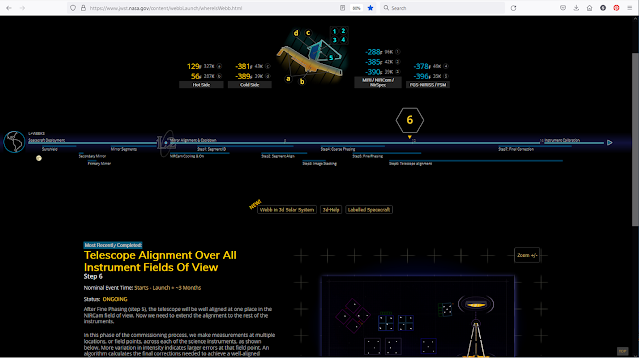
The James Webb Space Telescope continues to go through it's process of getting readied to start its mission, and the good news continues to roll in.  According to the "Where is Webb?" NASA site, they're still weeks away from going operational, but are well into turning the 18 different reflecting telescopes into one telescope that adds the apertures of all 18 of those mirrors together for all of the instruments aboard.  Right now, that's only true for the one camera they're using.

Screen capture from Where is Webb earlier this evening.

In the last couple of days, the Webb team gave the results of the first fine phasing adjustment of the instrument.  The quote in the title is from one of the project leaders.  I previewed a few videos of the results, but I like the official one best.

On Wednesday, as part of the news release on this milestone, NASA provided a photograph from the JWST.  At  one point in the preparations for launch, someone said there were 344 single-point failures between launch, deployment to the L2 point, and being ready for operation.  It's looking good but we don't know how many, if any, of those 344 are left. 

This is the end result after all of their alignments and is said to have the best resolution and lowest diffraction ever in a telescope this far into the infrared.   They refer to it as a Deep Field photo, similar to the Hubble Deep Field photo, one of the most famous photographs the space telescope ever captured.  As you look around the field of the photo, like near the diffraction spike at around 10 o'clock, or just above the faint 3 o'clock spike most of the way to the right edge, all of those elongated streaks you see are galaxies.  Probably the fuzzy blobs are galaxies as well, although some could be double stars.  This field is all in infrared light, far beyond the reddest reds people can see, but the intensities were put through a red filter because someone liked the look.