Friday, March 10, 2023

Weekly Small Space News Story Roundup 3

Arianespace chief plans on rapid Ariane 6 ramp-up

Arianespace had a rough time in 2022. Among the issues they dealt with were the sudden loss of cooperation with Russia for launches via the Soyuz vehicle, the December Vega C launch failure when the second stage failed, dooming the mission, and further delays in readying the Ariane 6 rocket for launch. In a paywalled op-ed published in the French publication Les Echos, Arianespace President Stéphane Israël defended the European launch company saying it would be wrong to criticize them. 

That's a lot to ask ... Rather, he argues that better times are coming for the European launch industry, noting in particular that the Ariane 6 vehicle had won a "historic" contract for 18 of Amazon's Project Kuiper satellite launches. To meet this demand, he says, Arianespace plans to be launching a dozen Ariane 6 rockets a year by 2025. This ramp-up is "essential" Israël said. It may indeed be essential, but launching an Ariane 6 rocket a month in 2025, with the booster unlikely to make its debut before early 2024, seems almost like magical thinking.

What's all this NSSL Phase 3 stuff, anyway?

A gold rush.  

The US military recently released a rather mundane-sounding document titled "National Security Space Launch Phase 3 DRAFT Request for Proposals #1." That may be a mouthful of jargon, but it's still a rather consequential document. Effectively, its release is the starting gun for the next round of launch contracts for US spy satellites, secure communications satellites, and more.

The US military issues these requests for proposals from time to time.  Proposals for launch contracts worth billions of dollars—substantially more than $10 billion—as the military seeks to secure launch deals for the late 2020s and early 2030s.  

The bottom line could be that they're finally getting serious about commercial space.  

In 2012, after SpaceX had already successfully flown the Falcon 9 four times, the military nonetheless awarded a block-buy contract exclusively to United Launch Alliance. Commercial launch startup be damned, the Department of Defense stuck with its monopoly.

As the Falcon 9 continued to fly, with prices substantially undercutting United Launch Alliance, this decision came to look pretty silly. So a few years later, the program was modified to allow SpaceX to win a few of these military contracts.

 Blue Origin and Northrup Grumman were told "thanks for playing; try again later." 

The Phase 3 contract is subdivided into subcategories such as Lanes 1, 2 and more.  Lane 1 is for smaller, less critical payloads.

... about 30 "Lane 1" missions will be awarded during a five-year period from fiscal year 2025 to 2029. These satellites will mostly fly into low-Earth orbit, and the missions are more "risk tolerant," meaning that if the rocket blows up and the satellite is lost, it will not have a hugely adverse effect on the military's operations.
...

The goal is to provide an opportunity for companies developing new medium-lift rockets to enter the competition. This includes Rocket Lab (with its Neutron rocket), Relativity Space (with its Terran R vehicle), and ABL Space (which has not named or announced a vehicle), Pentecost said. Companies with larger launch vehicles, like United Launch Alliance, SpaceX, and Blue Origin, are also eligible to compete in Lane 1. There likely will be many potential providers. Pentecost said 27 companies signed up for an "industry day" on February 28 to discuss this opportunity.

Lane 2 is the more traditional procurement strategy. About 40 missions will be awarded during a five-year period beginning in 2025. These are payloads that require the greatest capabilities from launch providers: the ability to deal with difficult orbits, secure rooms for pre-launch processing, and heavier lift capabilities.  Space Systems Command will select only two companies for this lane, which will split the mission awards in a 60-40 ratio; the way the current split between ULA (60) and SpaceX is currently built.  

There are lots of interesting side aspects to this and anyone interested should read the whole thing.  For one, the launch systems don't have to actually have been certified to any required "reference orbits" or not even actually flying.  They simply need to have agreed to complete the certification processes before they're eligible to fly those national security payloads.  That leaves room for companies like Blue Origin.  Space Systems Command expects to issue a "final" request for proposals in the third quarter of 2023 and then announce its two "Lane 2" awardees during the summer of 2024. It's entirely possible, even likely, that New Glenn will not have flown yet when this decision is made.

Perhaps the most interesting little bit is a report that Boeing will propose to use the Space Launch System - SLS.  

No, wait, they're serious ... "We believe the proven SLS capabilities can be an asset for the ... [NSSL] Phase 3 contract," the company told Klotz. While I applaud Boeing's ambition, it is difficult to see the SLS rocket being seriously considered in an open competition. Its price (probably above $2 billion) will easily be five times, or even 10 times that of the rockets it is competing against, and, with a low flight rate, it is unlikely to answer the military's priorities for schedule and reliability.

A Falcon Heavy rocket launches the USSF-67 mission for the US Space Force this past January (2023).  SpaceX photo.


Thursday, March 9, 2023

A Little Feedback on the Artemis Mission Performance

It's almost exactly three months since the first Artemis test mission splashed down in the Pacific on December 11.  Three months ago, they were almost giddy about how well the mission went, saying Artemis I had successfully met its goals and paved the way for humans to follow suit.

This week, after carefully reviewing data from that Artemis I mission since splashdown, space agency officials reiterated that although there were a few minor issues with the flight, overall it bolstered confidence.

About that, “although there were a few minor issues” phrase, one minor issue sticks out; the performance of the ablative heat shield on the Orion capsule.  Anything having to do with the heat shield needs to be tested in space because the conditions a capsule goes through coming back from deep space are well beyond what a capsule in Low Earth Orbit (LEO) experiences.  Capsules returning from the Moon do so at about 40,000 km/hour, or about 30 percent higher than a typical return from LEO.  

"During inspections there were more variations across the heat shield than we expected," said Howard Hu, the Orion program manager for NASA. "Some of the charred material ablated away differently than what our computer models, and what our ground testing, predicted. More of this charred material was liberated during reentry than we had expected."

Readers who started following the space programs during the 30 years of the Space Shuttle program may not recognize the term "ablative heat shield" because the shuttle used those white and black thermal tiles it was covered with to handle it's relatively gentle reentry heating.  Before the Shuttles, everything that ventured into space used ablative heat shields that literally burn away, the process of ablation, during reentry.  The SpaceX Crew and Cargo Dragon craft use ablative heat shields, and while the Starship prototypes we've seen all use a ceramic heat shield tiling, the two Dragon spacecraft apparently are still using ablative shields.  There have been tests to see if a ceramic tile like the Starship uses can be used on the Dragons, but it appears they haven't switched on any regular missions. 

Back to the original point, when an ablative shield burns away differently than the models say, investigation is about as serious as it gets.  The Orion capsule was never in any danger, and a crew onboard would have been safe, but that's no excuse to stick with a model that may be lying.  That's too much like saying your Russian Roulette game with a revolver hadn't killed you the first time so it must be safe.  It appears the Orion management is treating the issue seriously. 

"When we have unexpected behavior, we're going to drive to find a root cause," Hu said. "I would say that we're going to be very cautious and make sure we do our due diligence. Vigilance is very important for us as we fly crew going forward."

The Artemis 1 Orion capsule shortly before splashdown in the Pacific west of Mexico's Baja Peninsula.  NASA photo.

At this point, it looks like the next Artemis mission won't be until '24, with a crew to be named later this spring.  This will be a manned flyby of the moon reminiscent of Apollo 8 in 1968 and (assuming someone else doesn't beat them) the first manned flyby of the moon since Apollo 17, 50 years ago in December of 1972.  The first Artemis landing is currently estimated to be '27 or '28.


Wednesday, March 8, 2023

Relativity's First Terran Launch Scrubbed

Rather less surprising than yesterday's loss of the JAXA H3, this afternoon's attempt to launch Relativity Space's first Terran -1 test flight was scrubbed almost at the end of their three hour test window.  I started paying attention to the video feed around a half hour before the 1:00 PM (1800 UTC) start of the launch window, and several times during the window they'd count down to 20 minutes or so and then hold over a problem with "fuel conditioning."   

They were counting down to launch in the 2:30 time frame when the system went into a hold with 70 seconds left before launch.  Very little was said for the next 20 minutes, but earlier in the countdown, they had said that after they reached T-1:00 any abort would automatically carry out a group of changes which would require a big enough reset that the day's attempt would be scrubbed.  They held at T-1:10 until around 3:00 PM and then announced a final launch time of 3:45 PM.  Not long after they resumed counting, they went into a hold and within a few minutes cancelled for the day.  The company site Tweeted this at 3:45 PM.

The #GLHF hashtag is for the mission's name, "Good Luck Have Fun." 

The propellant conditioning explanation given for the holds all afternoon including the final scrub appear to have been associated with Stage 2.  A few hours after the above tweet, they added:

When using liquid natural gas, the methane needs time to get to the right concentration. This is why our next attempt will be a few days from now. More to come soon! 

Exactly why this was a problem today and not in other fueled tests, such as this upper stage being fired for full duration at NASA's Stennis Space Center, is the heart of what they're investigating.  I interpret what they're saying is that they have instruments that measure the liquid methane temperature and the holds were related to out of range numbers.  This could be a sensor on the vehicle, in the Ground Support Equipment, or something unrelated to sensors.

All that out of the way, Relativity might have gotten off easy with not launching today.  Remember, this launch vehicle is mostly 3D printed, 85% by mass.  Nobody has successfully launched a 3D printed rocket.  It could well be that the biggest test here is the 3D printed structure of the vehicle and engines around the time it passes through maximum dynamic pressure (Max Q).  

Plus, remember that just making orbit on a first try is a remarkable achievement.  No private company has ever launched its first independently developed, liquid-fueled rocket and had it reach orbit on the first try.  

Add in that this is a methane-oxygen fueled rocket.  Nobody has gotten one of those into orbit, either.  Starship could try this month, Vulcan says they'll try in May.  These guys may try in a few days, although they haven't announced it yet.  They could be the first. 

The Terran-1 at Launch Complex 16 on Cape Canaveral.  Relativity Space/Trevor Mahlmann photo


Tuesday, March 7, 2023

Japan's New H3 Rocket Fails First Launch

Two weeks and four days after the first attempt to launch their new heavier lift booster, the H3 was scheduled for Monday night, US East Coast time, Tuesday Japan time.  The first attempt aborted before launch on February 17th (1:37 UTC - the same time as this test) shortly after main engine ignition but before liftoff.  The liquid-fueled main engines ignited but the strap-on solid rocket boosters did not, so the control software shut down the main engines.  Last night's launch cleared that hurdle smoothly but the second stage failed to ignite. 

In a terse statement on the failure, Japanese space agency JAXA said, "A destruct command has been transmitted to H3 around 10:52 am (Japan Standard Time), because there was no possibility of achieving the mission. We are confirming the situation."

The background of the H3 is that it's an improvement to a line of rockets going back decades, and is a joint task of the JAXA, the Japanese equivalent of NASA, and Mitsubishi Heavy Industries (MHI).  Mitsubishi is best known in the US today as the manufacturer of a line of cars and light trucks sold under that brand in the US.  They were the manufacturer of the warplanes for Japan dating back to WWII; the famous Japanese Zero was their product.  I think comparison to NASA and Boeing or any of the early "space 1.0" rocket makers is apt. 

JAXA/MHI has spent about $1.5 billion developing the H3 rocket over the last decade. Much of that was spent in development of their new LE-9 engine, a liquid hydrogen/liquid oxygen engine, for the first stage. The first stage appeared to perform flawlessly. The second-stage (that failed) was powered by the LE-5B, a more established engine.  It hasn't been stated at this point that the failure was in the engine, its controlling hardware, software or something else. 

The major problem with the H3, though, appears to be that it's a design out of time.  This isn't surprising for a design begun 10 years ago, before the regular demonstration of reusability that has led to a complete reordering of the launch services market.  JAXA sought to increase its share of the commercial launch market by building a lower-cost alternative to its current H2-A vehicle to more effectively compete with SpaceX.  Mitsubishi's goal was to sell the H3 at $51 million per launch in its base configuration. This would allow the company to supplement its launches of institutional missions for the Japanese government with commercial satellites.  

You may have seen talk linking the H3 to our Artemis program.  In addition to commercial satellite launches, it's also intended to carry a new unmanned cargo transporter that will deliver supplies and materials to both the International Space Station and the lunar Gateway, the lunar-orbiting first and last stop planned for Artemis.

Frankly, H3 seems to be in trouble just looking at it in this overview.  As the source article at Ars Technica notes:

A fundamental problem with the booster is that, even if it were to fly safely, the H3 rocket has no clear advantages over the Falcon 9, which now has a streak of more than 170 consecutive successful launches. The new H3 rocket is also fully expendable, unlike the Falcon 9 and many newer boosters in development in the United States and China.


The H3 within the first minute after launch.  JAXA photo.


Monday, March 6, 2023

The Small Launch Industry - Even More Brutal Than You Thought

That's the provocative title that Eric Berger at Ars Technica used to summarize a pre-publication review of a new book.  Well, not exactly the title he used but the gist of it.  It opens with a summary quote from the book, When the Heavens Went on Sale, by Ashlee Vance scheduled to be released on May 9th by Harper Collins.  

Vance is the author of an insightful biography of Elon Musk that was published in 2015. Since then, the Silicon Valley journalist has traveled around the world, embedded with other would-be space entrepreneurs. In this book, he profiled four companies: Planet, Rocket Lab, Astra, and Firefly. And when I say "profiled," I mean he spent weeks—and in some cases months—living and visiting with the founders and their employees, with unparalleled access to their operations. He's got the goods.

Eric Berger himself is the author of another book focused on SpaceX called, "Liftoff:  Elon Musk and the Desperate Early Days That Launched SpaceX" so, to me, he has some credibility summarizing other authors in the same field.  

The book is loosely framed around a basic idea: About 15 years ago, Musk and SpaceX proved that a private company could develop its own liquid-fueled rocket, setting off a wave of new investment in the industry. Venture capitalists were chasing the next Musk and SpaceX as the company's valuation soared above $100 billion. Satellite company Planet, along with launch startups Rocket Lab, Astra, and Firefly, are some of these companies seeking to woo investors. Vance adds another layer by telling the story of Pete Worden, a maverick scientist and long-time leader of NASA's Ames Research Center in California, who is a godfather of sorts for some of these companies.

The majority of the article is peeks at the book, either direct quotes or distillations from it.  The opening of the article quotes two men who were working for Astra in 2018.  They talk honestly about how they don't understand why the great interest, except that venture capital investors think space is cool and could be the "next big thing" so they don't want to miss it.  At the time, Astra was working on their platform called Rocket 3.0, and while they were years away from making a successful test flight, the company talked about launching daily.  One them says, “Even with us, the whole goal is for us to launch daily. I'm either going to be dead in the ground before that happens or I'll be walking down the street with money falling out of my pockets and won't care that they're launching daily.”  

As Berger says, spoiler alert.  They not only aren't launching daily, they haven't made orbit in years.  They made orbit twice out of seven attempts and in August of '22 decided to toss the Rocket 3.3 platform and focus on a different platform.  Rocket 4.0.

Peter Beck, the chief executive of Rocket Lab, comes off tremendously well.  To start a rocket company in a country that has no aerospace industry to speak of takes an exceptional person, and he clearly comes across as a genius.  Beck has a reputation for being a demanding and exacting boss, but to get to the top from nowhere, this could be seen as a necessary trait. 

By contrast, if Rocket Lab is the tightest ship in the shipping business, Astra might be the loosest.  Perhaps unsurprisingly, Astra's CEO, Chris Kemp, doesn't come across as well as Peter Beck.  Kemp is clearly a smart guy with a talent for raising money, but he has a reputation for playing fast and loose with facts, putting the best possible spin on things.  More PR agent than CEO, although CEOs are part of the PR face of the company.  The book details what seems to be a genuine rivalry between the two CEOs.  

Perhaps the most peculiar part of the story is Firefly, a company that went bankrupt but was then saved by Ukrainian businessman Max Polyakov (the company was founded by aerospace engineer Tom Markusic).

Neither man liked one another, but both needed the other. Markusic needed Polyakov's money to keep his rocket dreams alive, and Polyakov needed Firefly to enact his dreams of becoming a space billionaire. The pairing ultimately blew up like a rocket, and Vance was on hand for some of these dramatic fireworks. One of them occurred in August 2020 on a drunken private jet flight from California to Austin, Texas:

The two men were telling each other what they really thought. Polyakov complained about all the money he'd lost. Markusic complained about what a pain in the ass Polyakov was. Polyakov accused Markusic of stringing him along with an endless series of false promises. "I'm good at promising things," Markusic said as the Oban washed away all deference.

(Oban is a brand of single malt scotch.  I'd give a link but they annoyed me with too many things to fill in before I could get to their home page.)

Astra's "World's Most Interesting Rocket Launch Abort" in August of '21, with the Rocket going sideways several seconds.

An idea I came across at some point that left an impression is that in a photo like that one, where the rocket is lifting on pillars of fire, just think of that as money being burned.


Sunday, March 5, 2023

The Ham Radio Series 36 - What Are S-Parameters and Why Should I Care?

I mentioned in February of ‘22 that I had bought a NanoVNA.  If you’re unfamiliar with the term, VNA is short for a Vector Network Analyzer, a test instrument that can measure the complex impedance of something, and a handful of different NanoVNA models have hit the amateur market in the last few years.  In particular, I bought the H4 model for a couple of reasons; the fact that it has a larger LCD than most of the other models and that I’ve heard good things about its ability to work to 1.5 GHz out of the box.  

It’s hard to convey just how big a deal these things are to people who are new to the game, but through some clever tricks in digital design, they’ve absolutely crushed the price of test equipment.  The first 1.5 GHz vector network analyzer I ever touched, back in about ‘84, was an exquisite piece of lab equipment from HP – who was just the test equipment giant in those days – that cost over $100,000.  The NanoVNA H4 today is under $100, or right around there.  That’s far less than 1/1000 of the cost of that HP, partly because of the constant depreciation of the dollar by the Federal Reserve.  Sure, the $100 Chinesium (almost always) NanoVNA doesn’t have as good specifications as the HP did, but a close approximation to the value is better than a guess or assuming “it should be good.” 

The default display that my NanoVNA starts up with is might be unique to this software, but from reading a NanoVNA users’ group for a few years, I think it’s pretty common.  It overlays four channels of information: three different rectangular plots of one S-parameter per plot and a Smith chart of one those S-parameters.  Since I’ve been working almost exclusively with S-parameters since the early 1980s, I’m at home with them, but questions about what those things mean are rather common. 

You can see a four trace display on this sample NanoVNA; I couldn't begin to guess what kind of thing it's sweeping from 50 kHz to 900 MHz.  (Image clearly from DX Zone; they don't sell these (or anything that I know of) but are an information aggregator.)

So what’s an S-parameter?  The S stands for scattering, but what does that mean?  Ever seen the “one way glass” that’s used for security (or used to be)?  The light is scattered in the favored direction to get it to work the way they want.  If you look at the glass from the outside, you see your reflection; the security guy inside sees you plainly but doesn’t see his reflection as clearly as you see yours.  If there’s a poorly placed light on his side of the glass, you may be able to see him as well.

In RF circuits, when you input a signal into an amplifier, filter or really anything, a (hopefully) tiny amount is reflected back.  Most goes through the network, exactly how the input changes to the output is what’s being measured.  Some of the output maybe reflected back to the input because the Device Under Test’s output impedance doesn’t match the circuit it’s connected to. 

While S-parameters can be measured and calculated for three, four, or any number of ports, the most widely used are for two port networks.  The four parameters are S11, S21, S12 and S22; you’ll see those written that way or as subscripts: S11, S21, S12 and S22.  If you want to be published, subscripts are probably the way to go; since it’s a bunch of extra work to use subscripts in Blogger’s editor, please forgive me for using plain script.  In real life, you’ll see both formats used.  In all cases the format is S (port measured at, port measured with respect to); in other words, S11 is the signal measured at port 1 with respect to port 1; S21 is the signal at port 2 with respect to port 1.  

Direction is all important;  S21 is the signal at port 2 with respect to the input at port 1; if it’s bigger than the input, the thing being tested has gain.  S12 is the signal at port 1 with respect to port 2; usually called reverse isolation.  While a passive network, like an attenuator, will have S12 = -S21, an amplifier won’t resemble the inverse of the gain (unless it was designed to be, amplifiers don’t work like that).  For example, the typical one or two transistor amplifier ICs you’ll buy might have an S21 of 10 or 15 db, but an S12 of 6 dB.  

In the case of S11, the input impedance, a signal from the VNA is applied to port 1 and the amount reflected to port 1 is used to calculate Return Loss – a single number for the input impedance in dB; the direction separates the signal going to the input and the (expected to be) much smaller signal returning to the VNA port 1 determines the value of S11.  It’s the same basic description for the output Return Loss; the VNA measures the signals going both directions on the output pin.  Return loss is expressed in decibels by the VNA, but since it’s a measurement of reflected signal, it’s conceptually the same as the Standing Wave Ratio, or Voltage Standing Wave Ratio (SWR or VSWR) you’ve seen before.  

When measuring S11, port 2 is grounded and for S22, port 1 is grounded.  Mathematically:

The value the VNA displays it 20*log of these calculated values. 

So what are these S-parameters and the NanoVNAs good for?  To begin with, they’re entirely a tool for people who build things, whether antennas, passive circuits like filters or RF switching networks, and active circuits like amplifiers. They’ll test a length of coax for loss and other things you’ll want to know.  If you’re not a “home brewer” no test equipment is useful.  Exactly how useful depends on what you’re measuring.  If you’re working on something like a lowpass or bandpass filter, they’ll tell you everything there is to know.  If you’re working on an amplifier, they’ll tell you gain, and input and output matches.  Those are the big characteristics for an RF amplifier but they won’t tell you noise figure, linearity, intercept points or other things you need to know – depending on the application for the amplifier.

One thing that I’ve used the NanoVNA for several times, as well as my first, one port, VNA, my antenna analyzer, was to export a file of S-parameters of an antenna scan into a Smith chart to design a matching network.  Coming soon will be an introduction to the Smith Chart. 


Saturday, March 4, 2023

I'm There

Saw this cartoon at Townhall.com and I'm more in line with this character than I would have thought. 


Cartoonist Steven Kelly, also available at GoComics.  

I have so little trust in the FBI these days that if they told me the sun was going to rise in the east, I'd look west.  I used to think of them completely differently; I'm told that was hopelessly naive.  


Friday, March 3, 2023

Weekly Small Space News Story Roundup 2

Except the first one by this name was two weeks ago; otherwise it's a pretty regular thing.  

Rocket Lab may be abandoning plans for helicopter recovery of boosters.   

During an earnings teleconference on Feb. 28th, Rocket Lab CEO Peter Beck said the company was considering recovering boosters from the ocean and refurbishing them for launch rather than catching a stage with a helicopter.  The company has only tried to capture the stages with a helicopter twice last year and failed both times.  This is almost like that PBS painter dude, Bob Ross, and his "happy little accidents" when he makes a tree out of a blotch of paint.

“This turned out to be quite a happy turn of events,” he said on the call. “Electron survived an ocean recovery in remarkably good condition, and in a lot of cases its components actually pass requalification for flight.” 

They're planning an ocean recovery after an upcoming flight with a booster that has been given some extra waterproofing.  He went on to say, “Pending this outcome of testing and analysis of the stage, the mission may move us towards sticking with marine recovery altogether and introduce significant savings to the whole operation.” 

Then he went on to say the part that surprised me; the cost of recovering a booster with the helicopter is pretty much the same as recovering by dropping it in the water and pulling it back out.  The difference is they think there are more missions that lend themselves to water recovery than the helicopter recovery, so in overview, they'll recover more boosters saving more money.

SpaceX Launches Crew 6

The three launches I expected on Monday have all been successfully completed, it's just that none of them went on Monday.  Crew 6 launched early Thursday morning after the delay to fix a clogged filter in the ground systems that support the rocket up until the moment of launch. Due to this problematic filter, the proper amount of TEA-TEB, a fluid used to ignite the rocket's Merlin 1D engines, was not reaching the first stage of the vehicle.  Strangely the last one of these weekly news roundups, two weeks ago, said the failure of the Virgin Orbit flight from the UK was due to a clogged filter.  Coincidence?  

The Crew 6 flight only had one experienced astronaut on board, Commander Stephen Bowen.  Pilot Warren “Woody” Hoburg had the quote of the mission, so far, on achieving orbit. 

"As a rookie flier, that was one heck of a ride, thank you," he radioed back to SpaceX's flight control center. "I would say this is an absolute miracle of engineering and I just feel so lucky that I get to fly on this amazing machine."

Don't make us jealous Woody.  I bet just about everybody reading this blog would like to take a ride in that "miracle of engineering and amazing machine." 

ESA's Juice Mission to Jupiter Approaching

The European Space Agency's mission to Jupiter's Icy Moons, named Juice, is currently approaching its launch date of NET April 13th.  In preparation, the Ariane 5 that will lift Juice to the Jovian system is being stacked in Kourou, French Guiana.  This is the second to last Ariane 5 launch, but the first ESA probe to the outer planets.  The mission will feature 35 flybys of Jupiter's moons believed to contain oceans: Ganymede, Callisto and Europa.  One highlight is that near the end of its mission, Juice will enter orbit around Ganymede.

ESA’s Jupiter Icy Moons Explorer, Juice, will make detailed observations of the giant gas planet and its three large ocean-bearing moons – Ganymede, Callisto and Europa – with a suite of remote sensing, geophysical and in situ instruments. The mission will characterize these moons as both planetary objects and possible habitats, explore Jupiter’s complex environment in depth, and study the wider Jupiter system as an archetype for gas giants across the Universe.  

In about a month, the Juice spacecraft will be placed on top of the Ariane 5. The whole system will be rolled out onto the launch pad on April 11. 

2023 ESA-CNES-ARIANESPACE / Optique video du CSG - P BAUDON 


Thursday, March 2, 2023

Mars Ingenuity Continues to Exceed Expectations

Back in May, as winter was closing in on the Perseverance rover and Ingenuity helicopter, there were concerns that the components on the little helicopter wouldn't survive the cold Martian winter.  Six months later, on November 22nd we learned that the little helicopter survived the coldest part of winter unscathed, is flying again, and NASA had done a major software upgrade to improve its usefulness.  That upgrade was tested by taking the shortest test flight it had ever flown.  

Ingenuity took its 46th flight on February 25th, although NASA only released the flight data yesterday, on March 1st.  The original plans for the helicopter were to fly five flights to test out various concepts.  The little helicopter is virtually at 10x that planned number of flights.  It sounds like the concept has been demonstrated well beyond the original modest goals. 

Ingenuity hopped a third of a mile on the Red Planet as it shifted between airfields.

The goal of the flight was to "reposition of the helicopter and [to] scout future airfields," agency officials wrote in a pre-flight briefing.

According to its flight log, the helicopter flew for about 1,460 feet on the Martian surface between airfields "Eta" and "Theta."  Ingenuity flew at 39-feet above the sands and achieved a top speed of 11.9 mph during the flight.

Ingenuity, of course, arrived at Jezero Crater on Mars in February of '22, attached to the belly of the Perseverance rover, now widely nicknamed Percy.  Now that it has proven itself without a doubt to be fully operational, Ingenuity's mandate has expanded to assisting Percy with the search for ancient life in the crater, the site of an ancient river delta.  How about the mission to collect and return samples to Earth for study going from no use of a helicopter to two of them?

As talked about back in July, Ingenuity's successes are leading to changes of follow on missions. 

NASA now plans to include two sample helicopters on a joint mission with the European Space Agency to return samples from Mars. Percy is supposed to bring samples to the lander itself, but if it is unable to, the two backup helicopters will pick up identical lightsaber-shaped sample tubes Percy has been caching on the surface.

A conceptual sketch from NASA/JPL-CalTech, showing a helicopter, Perseverance, and the ESA Mars lander on the bottom row, and the ESA's Earth Return orbiter, left, and NASA's Mars Ascent Vehicle top right.  The upper left corner picture appears to be a gibbous Earth, but Earth couldn't possibly appear that big from Mars.  I'll write that off to someone at JPL-CalTech being overly artistic.


Wednesday, March 1, 2023

Rumor: United Launch Alliance is for Sale

Granted it's only a "sources say" rumor, but it's an interesting report that surfaced today on Ars Technica.  

The potential sale has not been disclosed publicly, but three sources confirmed to Ars that potential buyers have been contacted about the opportunity. These sources said a deal is expected to be closed before the end of this year and that investment firm Morgan Stanley and consulting firm Bain & Company are managing the transaction.

ULA is a nearly two decade long merger of Lockheed Martin and Boeing formed in 2005 and driven by the US Fed.gov.  The purpose of the deal was to ensure that NASA, US DOD and intelligence services had continuous access to Delta and Atlas launch vehicles.  The merger was profitable for both companies; ULA had zero competition and literally had access to the government's infinite checkbook if they just didn't lose too many payloads. 

In return for 100 percent mission success, ULA received large launch contracts and an approximately $1 billion annual subsidy from the US Department of Defense to maintain "launch readiness."

Both companies issued statements essentially refusing the confirm or deny the story - which is bog standard in this sort of situation.   

And then came SpaceX. 

The emergence of SpaceX in the early 2010s with the increasingly reliable Falcon 9 rocket started to disrupt this profitable arrangement. SpaceX sold the Falcon 9 rocket at a substantial discount to ULA's Atlas V and Delta IV rockets. The company also successfully sued the US government to allow the Falcon 9 rocket to compete for national security missions, and SpaceX launched its first one in 2017.

The Falcon 9 is the world's most reliable rocket and the one with more launches to its name than anything flying, but its payload isn't in the class of ULA's Atlas V or Delta IV.  That changed when Falcon Heavy made its debut in 2018, famously sending Elon Musk's personal Tesla to fly by Mars.  The two Falcon Heavy launches in the last few months, January '23 and November '22, were national security missions.  

In terms of launch cadence, there's really no comparison.  

In recent years, SpaceX has come to dominate United Launch Alliance in terms of cadence. By the end of 2022, the upstart was launching as many rockets each month as ULA launched during a calendar year. During the last four years, in fact, SpaceX has landed more rockets than ULA has launched during its existence. [Italics added: SiG]

While I find it interesting to speculate, it's probably meaningless to try to place bets on who ends up taking over ULA (unless you plan to buy stock).  Either Boeing or Lockheed Martin could buy out the other partner and make it sole ownership on their own parts, but it's possible that another launch company could buy them.   Since Amazon has contracted with ULA to launch its constellation of Kuiper internet satellites, they could be interested in acquiring full control of getting their satellites into orbit.  Blue Origin also won a share of Kuiper launches on New Glenn, which (of course) still hasn't flown, yet.  A point they might consider an advantage is selling themselves the BE-4 engines for the Vulcan rockets at cost, potentially reducing the price to orbit they would charge customers.  Don't forget companies like Northrup Grumman whose Cygnus cargo capsules complement SpaceX's Cargo Dragons in supplying the Space Station.  They're needing to find a new way to get Cygnus to orbit since their Antares booster needs to be updated (same reason as the Atlas V: Antares uses Russian engines).

ULA CEO Tory Bruno (l) and Blue Origin's Jeff Bezos pose with a miniature model of the BE-4.  Win McNamee/Getty Images from 2014.  


Tuesday, February 28, 2023

Random Space News Odds and Ends

Emphasis on SpaceX. 

Yesterday's launch of the Mini-V2 satellites from Cape Canaveral SFS ended up being interesting in a way I hadn't known beforehand.  As a species we seem to like to notice/pay attention to Big Round Numbers.  When booster B1076 landed on A Shortfall of Gravitas, it was their 100th consecutive landing of a booster.  That turns out to be not just a Big Round Number, as this Twitter user noted, they have recovered in consecutive flights as many boosters as the justifiably famous Delta II rockets ever flew.

Launch-wise, Falcon 9 and the Falcon family have already become the most statistically reliable rockets in history. Very few rockets in history have managed 100 consecutively successful launches, let alone landings. For example, according to spaceflight reporter Alejandro Romera, the next most reliable American rocket – the McDonnell Douglas Delta II – narrowly achieved 100 consecutively successful launches before its retirement in 2018. The landing reliability of SpaceX’s Falcon rockets is thus tied with the launch reliability of the most reliable American rocket not built by SpaceX.

That's just landings.  The flagship of United Launch Alliance is arguably the Atlas V - now retired and serving out its last 19 missions.  To date, the Atlas V has had 97 successful launches, meaning successful SpaceX landings are more common than Atlas V flights.  

If you watched the SpaceX feed during the launch or the YouTube video, you may have noticed that among the very last things the announcer said was that this was their 174th landing of an orbital class booster.  Since it was the 100th consecutive, clearly they lost some between their first landing and the string of 100.  The string of 100 began almost two years ago to the day on March 4th 2021; the landing before that one (three weeks before in early February) was lost due to a previously unknown failure mode.  There was a hole in a flexible ‘skirt’ meant to keep the superheated gases out of the flight-proven booster’s engine section.   

The amount of information that SpaceX engineers have gathered about how to recover boosters, and the amount they've improved over the years is a solid case that they are so far ahead of the competition that it will take five or more years for another company to catch up.   

And just because it's pretty:

Sunset launch last night.  SpaceX photo.


Not related to any of the above.  As of Tuesday night at nearly 9PM, the next launch of the three talked about Sunday, the Starlink Group 2-7 from Vandenberg SFB looks to be Wednesday, March 1 at 11:06 AM PST, or 2:06 PM here on EST.  

The first launch in Monday's post will be the last launch of the three.  The Crew 6 mission will be Wednesday night/Thursday morning at 12:34 AM EST.  That makes the date and time run together as 3/2 1234.  Coincidence? 


Monday, February 27, 2023

NASA's SWOT Satellite is in Trouble

In a blog post last Thursday, the team checking out the joint NASA and French space agency CNES mission called SWOT, or the Surface Water and Ocean Topography satellite, ran into a serious problem with perhaps the most important instrument on the satellite. 

The Surface Water and Ocean Topography (SWOT) satellite's main science instrument, called KARIN (Ka-band Radar Interferometer), "unexpectedly shut down" due to a problem with the high-power amplifier subsystem...

...

KARIN includes twin antennas working roughly 33 feet (10 meters) apart, or half the length of a tennis court. When functional, one of the antennas generates a radar pulse that reflects off the Earth, then both antennas pick up the signal.

"Once the KARIN instrument is up and running again, the mission will continue with its commissioning and calibration activities—planned March through June—to ensure data accuracy in preparation for the beginning of science operations in July 2023," NASA officials wrote.

This strikes a nerve with me as I may not have been a Master power amplifier designer (there are no ranks like that), but I have designed a few and spent pretty much my entire working life around PA designs and designers.  Almost without exception, the most expensive piece of radio hardware on a satellite radar is the transmitter.  On more than one satellite I've seen, there wasn't a redundant backup which means if the PA fails the mission is over.  It was deemed so expensive they couldn't afford a backup and would say "buh-bye" to the mission.

The SWOT satellite.  Knowing almost nothing about the satellite design, I would think those two gold-colored bars on gold-colored beams sticking out of the body of the satellite are the two radar antennas.  Image by CNES.  (I also know they have the solar panels pointed in a useless direction, but I'll give them the "they know not what they do" pass.)

Assuming this isn't a fatal error and they can find a way to restore operation to the power amplifier system, SWOT is supposed to examine 1.3 million miles (2.1 million km) of rivers, along with coastlines and millions of lakes.  Calibration and checkout is supposed to be March through June so operations haven't been slowed or stopped at this point.  

You may recall that SpaceX launched the SWOT satellite from SLC-4E at Vandenberg Space Force Base, California last Dec. 16.  Measuring water levels is key to determining if there are effects from "global warming" and how big those effects might be.  


Sunday, February 26, 2023

SpaceX Schedules Three Launches in 13 Hours Monday

Three launches in 13 hours spread between all three operational Falcon 9 pads in the US.  

The mission getting the headlines is the first one, the Crew 6 mission at 1:45 AM Monday morning from LC-39A on the Kennedy Space center.  The manned launch is followed by Starlink Group 6-1 seven minutes short of 12 hours later at 1:38 PM from SLC-40, a few miles SSE of 39A.  The final launch of the day is another group of Starlink satellites, group 2-7, just short of an hour after group 6-1 at 2:31 PM - all of these times in EST.  That last launch is from Vandenberg Space Force Base in California, SLC-4 East. 

A new aspect of the Starlink launches is the headline of the second launch at 1:38 PM.  SpaceX has posted pictures and information saying this will be the first batch of "next version" Starlink satellites, called the V2 Mini.  Their Twitter posts add, “V2 minis include key technologies—such as more powerful phased array antennas and the use of E-band for backhaul—which will allow Starlink to provide ~4x more capacity per satellite than earlier iterations.”  E-band is an imprecise designation; it covers 60 to 90 GHz.  Atmospheric attenuation (loss of signal strength) is worst at 60 GHz and drops quite a bit by 80 GHz (see chart here, for example), which ordinarily means it's a good frequency band to use for satellite-to-satellite in space, not so much for downlink to the ground.  


There's a lot of interesting details about these satellites in the source article compiled by Teslarati from SpaceX and others.   

The satellites will operate under SpaceX’s Starlink Gen2 FCC license, which currently allows the company to launch up to 7,500 of a nominal 29,998 satellites. At the same time as it continues to fill out its smaller 4,408-satellite Starlink Gen1 constellation with smaller V1.5 satellites, SpaceX has already begun launching the same smaller V1.5 satellites under the Gen2 license.

Eventually, those smaller and less capable satellites will likely be replaced with larger V2 satellites, but SpaceX appears to have decided that quickly adding suboptimal capacity is better than waiting for an optimal solution. In theory, that optimal solution is larger Starlink V2 satellites. As discussed in a previous FCC filing, SpaceX intends to operate up to three different types of Starlink satellites in its Starlink Gen2 constellation. The first variant is likely identical to the roughly 305-kilogram (~673 lb) Starlink V1.5 satellites that make up most of its Starlink Gen1 constellation.

Meanwhile, SpaceX has already built and delivered dozens of full-size Starlink V2 satellites to Starbase, Texas. Those more optimal spacecraft reportedly weigh anywhere from 1.25-2 tons (2750-4400 lb) each, offer almost 10 times more bandwidth than V1.5 satellites, and are so large and ungainly that they can only be launched by SpaceX’s next-generation Starship rocket. Starship is substantially delayed, however, so SpaceX chose to develop a third Starlink satellite variant combining many of the full-size V2 benefits into a package that can be launched by SpaceX’s existing Falcon 9 rocket.

I think the bottom line is that while these heavier V2 Mini satellites reduce the number that a Falcon 9 can lift from the 57 of the version 1.5 satellites, down to 21 of the V2 Mini satellites, those V2 Minis will add ~50% more bandwidth than the V1.5 satellites it would have otherwise launched.

Another interesting upgrade is to the Hall thrusters for maneuvering on orbit.  SpaceX has announced they're switching from krypton gas in the thrusters to argon gas.  The savings from this small change appear to be enormous.

As a result, even if every Starlink V2 satellite needs an excessive 200 kilograms of argon, fueling its next constellation of almost 30,000 V2 satellites could cost SpaceX less than fueling 4000 V1 satellites.


EDIT 2/27/23 at 9:30 AM EST TO ADD:  The milestone of three launches fell apart early Monday morning, when the countdown to launch Crew-6 went into a hold at about T-2:30 before launch.  The issue was later said to be a ground system issue, not with the Falcon 9 itself.  The mission is currently scheduled for early Thursday morning, 12:34 AM EST, about an hour earlier than this morning's attempt.


Saturday, February 25, 2023

Totally Unrelated and Completely Different

Totally unrelated to and completely different from the usual fare that I fill these columns with, that is, but well within the things I fill my time with.  

I was offered this video the other day, and unlike 99.99% of the videos that YouTube offers me, I watched with interest.  A top-ranking manufacturer of 3D printers, Prusa, put out a video on how they printed an electric guitar body and made a playable guitar.  More impressive than that, they spent over a year on the project ensuring the guitar would survive the forces it lives under, and hold its shape.  They went into the choice of components, showed where they got the ones they used and an economical way of getting the parts to make it.

Now you may be saying, "are you going to make a one of these Fender Telescaster-clone guitars?"  While I don't want to rule it out completely, chances are I'm not going to.  It's the marginal utility function - to borrow the idea from economics.  Another guitar in the collection doesn't make my family of guitars that much more useful.  If you have one guitar, another one can bring a lot of useful differences.  Adding an acoustic guitar to an electric, or vice versa, opens a wider array of kinds of music you can make.  If you have one of both kinds, a different brand and model might still add different sounds to your repertoire  When you have a few of each kind, an additional guitar of either major type just doesn't return much for the investment.

When I went shopping for my 3D printer, I wasn't quite sure I wanted one around the house. While it seemed like an obvious thing to have when you think that a large portion of all the plastic things in our houses could be printed, there's that aspect of printers that they seem to be used for trivial things.  Can you even make useful things like they sell?  Because of that, I went with a cheaper, entry-level printer although I might look for a better one now.  Dear daughter-in-law, a research biochemist, knows they exist and has friends that own printers, but when we mentioned having one was taken aback.  All of her friends print the trinkets and little decorative things that are so widespread; nothing that was a usable tool or even something as simple as a box.  She asked about things we've done and was surprised that they were all practical things, like my 2" vacuum hose adapter or my battery connector.  I told her about the Thingiverse and the thing I use the most at a couple of times every day is the electric toothbrush holder that I printed last fall.  Not a trinket or decorative thing in the mix.


Friday, February 24, 2023

ULA Announces a Launch Date for Vulcan Cert Flight

United Launch Alliance CEO Tory Bruno announced Thursday night their planned No Earlier Than date for the first flight of Vulcan Centaur, while acknowledging that additional delays are always possible, Tory Bruno announced the date as... 

May the 4th - usually said in Blog space along with the phrase, "be with you."

Bruno said the rocket's current "pacing item" for the debut launch is some final work qualifying the BE-4 rocket engines for flight. Blue Origin delivered two flight engines to ULA last fall, however, each of these machines had only undergone a fairly brief round of tests, known as acceptance testing. After this, two virtually identical BE-4 engines were sent from Blue Origin's factory in Washington to Texas. These "qual" engines have been undergoing a much more rigorous series of tests known as qualification testing.

The idea was to push the qualification engines through their paces, and beyond their expected flight environment, to find any flaws. During this series of tests, Bruno said, the oxygen pump on one of these engines has consistently produced about 5 percent more oxygen into the engine than expected. This fell outside the bounds of nominal performance but had only been observed in this engine.

Bruno said that after considerable investigation that they've concluded it's unit to unit variation, although it has only been seen in this one engine. None of the four BE-4 engines currently on Vulcan have shown this, nor have the other engines in the qual. test process. Bruno doesn't say how many man hours went into diagnosing that, how many other pumps have been tested, or any other details, but one out of a handful being an outlier in one metric compared to the others makes me wonder how different that 5% increase is.  Are the others all closer to within 1% or closer to that 5%?  How many standard deviations?  Not that my question matters - it's their data.  They expect to resume testing soon and expect the rest of the testing to consume six weeks.

With six weeks more testing in mind, it's conceivable that the launch date for the Certification-1 mission could be moved up to into mid-April, but the NET May 4 date seems good.  The last piece I posted on the first flight for the Vulcan said an apparent "long pole for the tent" appeared to be the Astrobotic Peregrine lunar lander which has apparently still not had its engines installed.  Bruno said he always has "backup plans for his backup plans" in case the payloads won't be ready by May, but he doesn't expect to need them. 

Following this Cert.-1 mission, ULA has a Cert.-2 mission tentatively set for later this year which will lift the Sierra Space Dream Chaser spacecraft on a test flight.  It's not certain at this point that Dream Chaser will be ready, either, but Bruno wants to fly a second mission by this fall so he can complete the military's certification process.  One would assume his "backup plans for his backup plans" cover an alternative to Dream Chaser, although that isn't stated.  

If they get that military certification, they can conduct Vulcan's first national defense mission for the US Space Force before the end of '23.  ULA won the 2020 National Security Space Launch Phase 2 launch services procurement contract, specifying they would  launch 60 percent of the US Space Force's payloads in the next few years while SpaceX would launch 40%.  That 60% won't go anywhere until they achieve that military certification.  Between those Space Force launches, Amazon's Kuiper Internet satellite constellation and using up the last of their Atlas Vs, ULA plans to be getting very busy. 

"We have to ramp up," Bruno said. "Before the end of 2025 we expect to be really at a tempo, which is flying a couple of times a month, every two weeks."

25 launches/year would be unprecedented for ULA, even going back to its heydays of flying Atlas and Delta rocket variants. 

As for ULA's talk about recovering its BE-4 engines for re-use, Bruno implied that was pretty low on his priority list and not being considered for years.  

"In terms of our engine recovery, that is going to happen within a handful of years," Bruno said. "I don't want to say exactly when because it's part of the contract we have with one of our customers at this time, and we're not releasing the details of that. But it will take a couple of years to actually be reusing the engine."

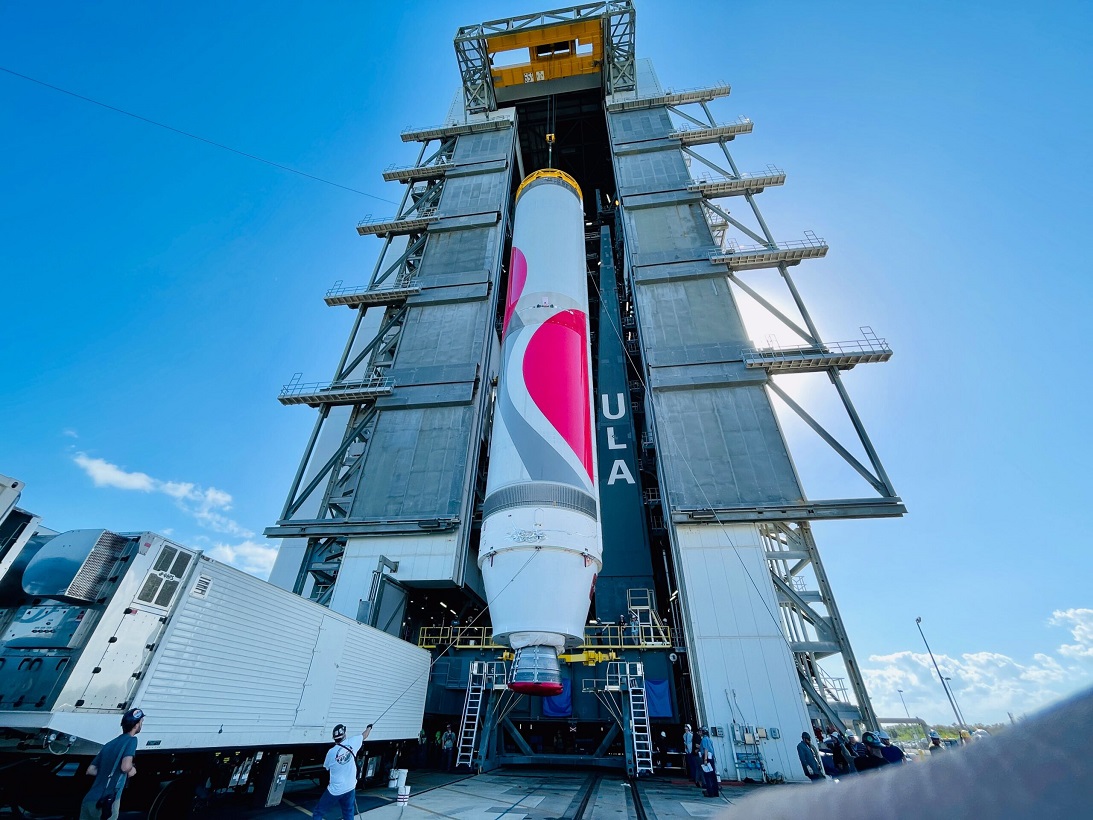
Vulcan's core stage for the Cert.-1 mission being lifted into a processing facility at Cape Canaveral Space Force Station in January.  Image credit United Launch Alliance. 


Thursday, February 23, 2023

Polaris Dawn Slipping to Summer

Since I heard of the SpaceX/Polaris Dawn mission, the date has slipped from the fourth quarter of  '22 to NET (No Earlier Than) March of '23.  Today, we learn via their Twitter account they've slipped to NET "summer" (and H/T to Space.com).  That obviously isn't very specific, but worth noting and keeping track of.  

If you've forgotten, or never heard of it, it's an ambitious mission that's very far out of the envelope that SpaceX has ever conducted a manned mission in, which makes delays seem less objectionable.  In fact, it's out of the envelope of anything NASA has flown in close to 60 years.  

First,

The mission will try to reach the highest Earth orbit ever flown, with its furthest point, or apogee, at around 870 miles (1,400 kilometers) over the planet. The previous record of 850 miles (1,368 kilometers) was set by Gemini 11 in 1966. 

Second

In addition to aiming for a record-breaking orbit, the Polaris Dawn crew will undertake several other groundbreaking objectives. These include performing the first extravehicular activity (EVA) for a commercial mission in which a civilian astronaut spacewalks outside a craft. This will see the first use of SpaceX's EVA spacesuit.

Does that line about a SpaceX EVA spacesuit make you go, "wha...?"  I remembered reading about SpaceX saying they'd do alternate spacesuits in the summer of '21, but I didn't remember the money quote.  

NASA had been working to develop a new EVA suit since 2007 and "With $420M spent and another $625M expected, suits won't be "ready for flight until April 2025 at the earliest." 

2007 to 2025?  Eighteen years and over a billion dollars to develop a suit? Meanwhile, SpaceX's EVA suits are said to be available now, less than two years since that August of  '21 note.  Less than a year after that, NASA awarded a new contract to a couple of different companies to create new space suits for Artemis lunar missions.  Granted a moonwalker suit isn't exactly the same as the EVA suit, but well under two years to develop the EVA suit is nothing like the 18 years to develop the lunar suit.

Getting back to Polaris Dawn, there are more scientific investigations planned.  In addition to that NASA and SpaceX signed an Agreement to study the feasibility of a SpaceX and Polaris Program idea to boost the agency’s Hubble Space Telescope into a higher orbit with the Dragon spacecraft, at no cost to the government. 

As with Leader Jared Isaacman's previous Inspiration 4 mission, it's also intending to fund raise for St. Jude's Children's Hospital. 

Polaris Dawn crew during an EVA training mission.  From top right, clockwise, Jared “Rook” Isaacman, Scott “Kidd” Poteet, Sarah Gillis, and Anna Menon. Note that Isaccman and Poteet are both executives at Shift4 as well as extremely qualified pilots; Gillis and Menon are both engineers with SpaceX on the manned spaceflight side, so probably not cool enough to have nicknames like Rook or Kidd.  (Inside joke for other engineer geeks).


Wednesday, February 22, 2023

Relativity Space Sets Launch Date for First Terran 1 Launch

Relativity Space today announced the first launch of their Terran 1 orbital launch vehicle, as March 8th, two weeks from the announcement.  

ORLANDO — Relativity Space announced Feb. 22 it will attempt the first launch of its Terran 1 rocket as soon as March 8 after securing a launch license and skipping a planned final test.

The company announced it received a Federal Aviation Administration launch license for its first Terran 1 mission. With the license in hand, the company says it is targeting a launch of the rocket March 8 between 1 and 4 p.m. Eastern from Launch Complex 16 at Cape Canaveral Space Force Station in Florida.

The mission has been named, "Good Luck, Have Fun," and is the first orbital test launch of the vehicle.  The Terran 1 is rated to carry 1,250 kg to Low Earth Orbit, but will not be carrying any customer payloads into orbit.  I assume that to properly test the vehicle, it will carry some sort of inert weight; possibly water.

Regular readers will recall that I've mentioned Relativity Space many times before, often in the context of the race to be the leader of the one metric ton (1000 kg) to orbit race.  The other race they're a contender in is to be the first liquid methane/liquid oxygen rocket to achieve orbit.  Methane-oxygen (or methalox) engines are widely considered to be The Next Big Thing in rocketry, but while a few of the big names have methalox engines (Starship, Vulcan and New Glenn), nobody has flown one into orbit yet.  

Tim Ellis, chief executive and co-founder of Relativity, tweeted Feb. 22 that he recalled that his mentor when starting up the company, technology entrepreneur Sam Altman, “told us we were absolutely crazy for trying to simultaneously invent a brand new manufacturing technology and an orbital rocket, which is already super hard.”

“Now we are on the launch pad almost ready to go with the world’s first 3D printed rocket,” he continued. “It’s been a truly wild ride to get to this point, and certainly way harder than I ever imagined going into it – but all the feels from me and our team as we embark on this historic launch.”

The Terran 1 has been in various levels and kinds of testing at SLC-16 since last summer, and has been back and forth between the launch pad and their assembly building several times.  The original application for their FAA launch license included a “stage one hotfire” as part of the pre-launch operations.  A spokesman told Space News that they feel they've “burned down risk” to a point where they don't believe there's anything else to learn from another hot firing of the first stage.  It's time to light those engines and let her fly.

The Terran 1 on the launch pad at LC-16.   Photo credit:  Relativity Space/Trevor Mahlmann 


Tuesday, February 21, 2023

SpaceX Teases First Orbital Starship Launch

Lifting the money quote from Teslarati:

A senior SpaceX director expects the United States Federal Aviation Administration (FAA) to grant a license for the first orbital launch of its next-generation Starship rocket in the “very near future.”

Speaking at the 2023 Space Mobility Conference, SpaceX Senior Director of National Security Space Solutions Gary Henry also indicated that Starship remains on track to launch as early as March 2023. Six weeks ago, CEO Elon Musk tweeted that SpaceX had “a real shot at [a] late February” Starship launch, adding that a “March launch attempt [appeared] highly likely.” February is now out of reach. But March may still be a viable target, according to Henry.

You've got to love the "expect some must see TV" teaser in there!

We know that the biggest hurdles to preparing for this launch have been crossed already: the Wet Dress Rehearsal (WDR) and the 31 Engine static firing that should have been 33 engines, but was "close enough."  We've since learned that the static firing was run at about 50% thrust, and since we calculated that the thrust produced to break the current record for highest thrust ever generated by a booster would have been 64% of max, that record still stands.  

We learned today from Gary Henry that the Orbital Launch Mount (OLM) wasn't damaged by that static firing, and while they're installing some additional shielding on the OLM now, and will install the water deluge system we've talked about, that'll be after the first test flight.  Adding that deluge system will take months and delay the orbital test longer than they're willing to accept.   

Check out these pictures of the OLM updates from Starship Gazer on Twitter.


The surest sign that we're getting closer to launch will be when they transport Ship 24 back to the test area and stack it on top of B7 again.  There are lots of things going on but it looks to me like they should be ready to fly by around the middle of March. 

While not part of the flow of material for the first launch, the expendable Starship prototype, SN26, was cryo tested today.  As usual, there's no specific, "we passed!" posting anywhere, but it looked pretty routine.  Nothing popped that I could determine.  That said, I didn't watch the whole several hour test.  I expect that Ship 26 will be rolled back to the Shipyard soon. FWIW, there are videos on YouTube claiming that 26 is going to be an on-orbit tanker and will not re-enter for re-use. 


Monday, February 20, 2023

“Space Tug” Launched Jan. 3 Never Worked

Back on January 3rd, SpaceX launched their first mission of the year and the sixth launch in their Transporter series of ride-sharing launches.  Carrying 114 payloads for dozens of paying customers, perhaps the most interesting aspect was that they were carrying a handful of ‘space tugs’ developed by five separate companies.  These are being developed specifically to take small satellites launched into the same orbit on this sort of ride share mission and get them to the desired orbit.

One of these was the first flight of the tug called Orbiter from a company called Launcher.  In a Feb. 16 statement, Launcher said its Orbiter SN1 vehicle malfunctioned shortly after deployment from the Falcon 9 rocket on the Transporter-6 rideshare mission Jan. 3 when it could not properly orient itself so that its solar cells could generate power.

The vehicle communicated with a ground station on its first scheduled pass after deployment while on battery power. “We also communicated with the vehicle for the duration of expected battery life,” the company said.

However, the Hawthorne, California-based company said the spacecraft could not get into the proper attitude so that its solar cells could generate power, which it blamed on “an orientation control issue caused by a fault in our GPS antenna system.” That, in turn, kept Orbiter from deploying its satellite payloads.

There were payloads from eight different customers, four that would deploy satellites, two that would remain on the Orbiter SN1 platform and two that aren't specified. 

I think that the idea of a space tug fits really well into the lower end of the launch business; smaller satellites from smaller operations that want to put something in space.  Think college students, and small businesses.  Putting a tug like Launcher's Orbiter on a low cost launch provider like the Transporter missions seems to be another way of opening up space to a wider array of users.  Sure it's going to cost more than accepting whatever orbit the Transporter mission puts the customer's satellite, because they have to pay to launch the Orbiter tug as well, but it's going to allow them to get to an orbit they otherwise couldn't. 

Launcher seems to think they fully understand what went wrong and how to ensure it doesn't go wrong next time.  They say they're updating their guidance, navigation and control software for Orbiter vehicles with a “robust” safe mode feature and incorporating an improved battery with double the capacity.  They will also add a backup spacecraft separation system.  

The company says they still plan to fly two Orbiter vehicles later this year on the SpaceX Transporter-8 and -9 missions, currently scheduled to launch in June and October.  

Orbiter SN1 completely assembled before shipment to SpaceX to integrate for the mission. Many more views of the satellite in the video linked above (second link in second paragraph). Launcher photo.


Sunday, February 19, 2023

Today This Blog is 13 Years Old

Ackshually ... my very first day of blogging was February 21, 2010, which happened to be the third Sunday of the month.  Since weekends are more quiet days, and the 21st doesn't usually work out to be a Sunday, I've always marked the anniversary as the third Sunday of the month. 

(Gratuitous celebratory "no royalties required" image from DepositPhotos (dot com!))

As always, I thank you for stopping by.  This year, I've noticed that my high readership days are sometimes going over 3000 per day, and have gotten close to 5000 a couple of times.  For the last 30 days, eyeballing the numbers says between 1275 and 2425 views/day.  Blogger tells me this is post #4,461 and all time total of views is a bit over 6,383,000.

Between yesterday's post and this one, the amount of "me me me meeeee" is overwhelming, so I'm pretty confident nobody is reading down this far.  If you are, my pick for this afternoon's Daytona 500 is - no wait.  It'll be over by the time most of you see this.