Friday, December 19, 2014

It's Past Time We Talk About the C-Word

We're only six days away from Christmas!  Ordinarily, I put up this holiday post early in the season, close to Thanksgiving.   To be honest, I was bit bored with it.  As the day approaches, though, it started sounding and feeling more like the truth.  

You see, I love Christmas.  I mean, I've run across people in my life who decorate for Christmas way more than I do, and I've known people who plan their Christmas six months in advance, way before I do.  I know a guy whose house decorations for Christmas put the local shopping centers to shame, and focused his whole year around Christmas.  Maybe if you saw me, or saw my barely decorated little house, you wouldn't think so, but I love Christmas.

Christmas is unique among holidays in America.  It has a very strong Christian tradition (well, duh!) as well as very strong secular traditions, and I love them both.  I love giving gifts to loved ones - and even total strangers.  I love the old favorite songs and the whole feeling of this time.  People in retail will tell you that Christmas often determines whether or not they stay in business.  I'm sure you've noticed that news outlets report sales from the Friday after Thanksgiving (Black Friday) as if they're reporting scores from a bowl game.  Another part of the holiday is the annual struggle to "keep Christ in Christmas" and not overlook the spiritual side of the holiday.  Did you know there is actually a court ruling that tells you how many reindeer (three) a holiday display must have to remain "sufficiently secular" to be legal to display on public property?  If I have three reindeer on display, it's secular, but if it's only two and package of reindeer sausage, I'm obviously trying to convert you!
A 2006 Zogby poll showed that 95 percent of folks are NOT offended when they hear the words “Merry Christmas.”  The real kicker is that 1 in 3 are actually very offended when the words “Happy Holidays” push out the phrase “Merry Christmas.”  This should not come as a big surprise because another poll by Fox News/Opinion Dynamics showed that 95 percent of Americans celebrate Christmas
Every year you hear about overzealous administrators in some municipality or some place deciding that the most innocuous secular symbols are too Christian.   Take this notice from the University of Maine (emphasis in the original - as well as the two spelling errors in one sentence):
“Just wanted to remind everyone that Aux Services is not to decorate any public areas with Christmas or any other religious themed decorations,” the email states. “Winter holiday decorations are fine but we need to not display any decoration that could be perceived as religious.”

“This includes xmas trees, wreaths, xmas presents, menorahs, candy canes, etc.,” the email says. “What is allowed our [sic] winter themes, snowmen, plain trees without presents underneath, decorative lights, but not on trees, snow flakes, [sic] etc.”

“[T]he university makes every effort to ensure that all members – students, employees, alumni and the public–feel included and welcome on campus. Decorations on the UMaine campus are therefore reflective of the diversity found in our community,”
Hate to break it to them, but candy canes are nowhere to be found in Christian scriptures; nor are wreaths, trees, or decorative lights on those trees.  They are not religious symbols.  And even if they were, the absence of religious symbols isn't a diversity of views; it's presenting only the atheistic view.  Diversity would be to allow other faiths to participate in the displays.  

As we plunge further into the Christmas season, take time to enjoy it and your loved ones.  If you feel a need to get some perfunctory gift for someone you'd really rather not give to, I say don't.  That's some sort of bizarre social ritual, not Christmas.  Don't put yourself in debt for Christmas; even if it means the kids get a "meager" holiday.  It won't hurt them and may just help them.  If you're one of the 45% who recently said they'd just as soon skip the whole thing - I say skip it.  It's still a federal holiday, so you have that going for you. 

(Glenn McCoy)  And just because, here's the cutest ad I've seen this year.

Thursday, December 18, 2014

The Great Cuban Communist Christmas Gifting of 2014

As a guy who grew up in south Miami around the time of the first mass exodus of anyone who could get out of Cuba, as well as many other escapes, I have a different perspective on the administration opening diplomatic relations with the tin horn dictator than I'm seeing in a lot of places.  I've personally known people who risked their lives and came across the Florida Straits to get away from that "socialist paradise".  In my opinion we give up everything and the Cuban people get nothing. 

The most laughable idea of all is that we'll allow Cubans to see what life is like outside their island prison.  As if there's no flow of information into Cuba at all.  Even back in the '60s, friends would mail care packages back to Cuba with supplies they couldn't get there: everything from over the counter, common drugs to clothes like Levis.  Yes, lots of it was stolen by regime officials, but some got through.  Lots of Cubans heard what life was like in this country from family.  But there's an even more direct avenue that I haven't heard anyone say one a word of:  in Cuba, Florida AM broadcast radio pounds into their radios - especially at night.  In the 60s, WGBS, ABC radio on 710 kHz was a clear channel 50,000 Watt blowtorch audible for over a thousand miles.  Today that station is WAQI, (roughly Spanish for Aqui, or "here") broadcasting in Spanish, to south Florida and south over Cuba.  And it's not just them.  On any evening, but especially winter when the daily thunderstorms become less frequent, AM broadcasters from all over the US, Central and South America can be heard there.  How do you think Sears, Walmart, or drug store ads sound to someone in an impoverished nation?  A little tempting?

The next most laughable idea is that "Castro is old.  He'll die soon and it will liberalize".  What makes you think that the power struggles to determine the next dictator haven't already happened?  What makes you think that someone else doesn't want to be "Glorious Leader" over the country so that they can be the ones to skim all the revenue for themselves, and exert total power over the long-suffering Cubans?   Do you honestly think that Castro's going to kick the bucket and the reincarnation of Thomas Jefferson is going to show up and make the island a free market paradise? 

That tourism will bring economic boom to the Cubans?  If by that you mean the communist government, then yes, but not the hotel workers and other tourist industry jobs.  They'll get 8% of what the foreign companies spend on the island.  The Cubans will release political prisoners?  True, Raul Castro promised that yesterday, but he promised the same 53 prisoners would be released four years ago.  I wonder how many more times their release will be promised?  Say, I wonder if Cuba will release that cop killer - you know, former Black Panther and Black Liberation Army member Assata Shakur, also known as Joanne Chesimard - who fled to the island to escape the US? 

It's interesting that both Obama and Castro referred to Colonialism, as if the US has ever had any interest in colonizing the island.  (Here's a hint: if we had wanted to, it would be a colony now).  No, this is just a hideous deal.  The Cuban government is giving up nothing.  We're giving up everything.  In the name of "change", changing a 53 year old policy for the sake of changing it, the Cuban people get no promises of free speech, no promises of due process, nothing except 8% of what they might get paid to work in a foreign run hotel. 
Today, injustice has been rewarded and tyranny has been rewarded. Today, the United States has placed a true embargo on the hope, the rights, and the liberties of a nation by rewarding the executioners and condemning their victims. It is amazing that the embargo the United States placed on a tyranny in 1961, is today, December 17, 2014, lifting it off that tyranny and placing it upon that tyranny's victims.
As written by former Cuban political prisoner Juan Amador and translated by Alberto de la Cruz at Babalu blog.
Freed US hostage Alan Gross with his lawyer.  Note the photograph on the wall of Che' Guevara

It may well be that the often-stated premise is true; that our embargo hasn't done anything to bring freedom to the Cuban people.  Neither will this. You can bet on it.


Tuesday, December 16, 2014

Fighting Off A Cold


Sorry, no content tonight, so enjoy a good cartoon. 

Michael Ramirez illustrates the mental chasm that says annoying a prisoner is bad, but using a drone strike is just peachy. 

Excellent Kahlid Sheik Mohammed, too. 


Monday, December 15, 2014

About That MHX Spinning Rod I Built

I wrote about a spinning rod I was building a few weeks ago and finished it by Thanksgiving weekend.  With the weather we tend to have in December, it was going to take a while before I could get out to try it, and finally did so this weekend.

I wish I thought to keep exact numbers, but I think it lasted less than 15 minutes.  When we got the boat out yesterday, checking that rod out was one of my reasons for going (as if I need a reason to go fishing).  We were fishing in rocky water about 15' deep.  On one cast, I thought I felt a soft pickup, and struck hard.  Very quickly, the line stopped moving.  This is either a snag on bottom, or the fish diving under a rock.  I leaned back hard on the rod, and within a few seconds, the rod snapped, taking the 10 pound monofilament with it.  There are really no feelings I can compare to that.  It's one thing to loose a fish: that happens.  Imagine the finality of not only loosing the fish but the rod you just spent every spare hour for a month working on.  It's quite a jolt. 
The rod wasn't overloaded.  It's rated for 8-15 pound line, and I was fishing 10 pound.  MHX has a warranty, so I've contacted them to start the process of getting it replaced.  Nothing will replace the rest of the parts on the rod or the time spent building it, so pardon me if I'm not feeling really good about MHX at this point. 

That chartreuse thread I used never photographed well, but that was a really pretty rod.  


Sunday, December 14, 2014

I'm Told the Frogs Say... (And an Oily Ramble)

I'm told frogs say, "time's fun when you're having flies." 

It has been a bit of a whirlwind couple of days since my last post, but the tree is in place, the shopping is essentially completed, we're completely ready for the holiday break, and even got the boat out this morning for a few hours of fishing (you will note I said "fishing", not "catching"; or as the French say, cherchez le poissons).  It was around 45 degrees or so when we put the boat in the water, but warmed up to about 65 by the time we came back in.  Winds were almost dead calm; the sky was cloudless and a fantastic shade of blue. 

So while burning some fuel in the outboard, it gave me some time to think about the price of oil.  Naturally, regular gas at under $2.50/gallon, as I paid yesterday, makes it a lot easier to live with a boat than when it was around $4/gallon, but what is going on with oil?  Is this going to suddenly reverse?  Is it going lower than $50?  Brent Crude oil from Stockcharts.com:
Since July, crude oil has been falling in price from just under $100/bbl down to a close of $61.85 on Friday.  For most of us, the falling oil prices are a Good Thing; we spend less on running our cars, and boats, along with the more important things like heating houses.  It should show up in reduced prices for things that get shipped across country (short version: everything).  The falling prices, though are having negative effects around the country - especially in the new US oil production fields.  Perhaps more importantly, it's pinching the other oil producing nations.  The BBC presented this graph of the break even oil price for a sample of countries.   The graph omits Russia, which is stated elsewhere to need $100/bbl to break even.
(I hasten to add there are a few quoted oil prices: Brent crude is one price, light sweet crude is another and so on.  I used the Brent crude price to make these two charts consistent with each other.  The exact price to the penny isn't as important as the trend).

While it's impossible for us to truly know what's going on, there has been reporting that Russia is driving this effort along with their proxies in the Mideast.   Others have said it's being led mainly by Saudi Arabia.  Either way, the theory goes that the goal is to get America out of the oil market, so that they can get prices back up.  This idea is supported by some of the things Russia is doing where they can to shut down energy production.  With oil at close to half of what Russia and Saudia Arabia need, that's quite the game of chicken.  "Let's you and me bleed ourselves to death, and I bet I'll stay in the game longer than you do". 

I think there can be a bigger game going on here, though.  The principal power in OPEC is the Saudis.  The Saudis have no use for the Iranians and are frankly terrified of a nuclear Iran.  You can bet your butt that if Iran goes nuclear, the Saudis will go nuclear as well.  For a country that nominally hates Israel, they've quietly agreed to allow Israel to over fly Saudi territory if needed to attack Iran ("the enemy of my enemy is my friend" in action?).  They also want Assad out of Syria and Russia is propping up both Iran and Syria.  I think it's entirely possible that Saudi Arabia could be playing the game to get Putin out of the area, and try to collapse the governments of both Iran and Syria.  Russia's economy is already showing signs of trouble.  If they collapse Putin himself, get him ousted by ballot, by revolt or worse, I think the Kingdom would view that as a good thing.  I also can't imagine the Saudis would be too upset if they found a price for oil that shut down American shale oil production. 

So I think the falling price of oil could well be the result of the Saudis pressing it down all by themselves. I can see Russia and Saudi Arabia working together to hurt us, but I think the Saudis have a stronger interest in collapsing the Iranian government and if it hurts Russia, well, that's just a bonus. 


Thursday, December 11, 2014

Outfitting the Small Shop - Part 3

When I last updated this, I had upgraded my mill and was able to start taking chips off a steel rod with it.

With the mill in place I started looking into lathes.  Like the milling machines, most of the lower cost lathes you can buy new these days are made in a couple of factories in China, and Seig is again the big name.  Quick sidestep: lathes are usually described by two numbers, the first number is the swing or largest diameter object that can turn over the bed or ways of the lathe, and the second number the distance between the chuck and the tailstock (see below), or between tools called centers mounted in those places, which gives an indication of how long a piece of work that can be held.  A common example is a 7x 12 or 14", which turns an object 7" in diameter over the bed of the lathe and 12 or 14".  Exactly what constitutes a given size can be up to the company selling it.  For example, one seller might sell a 7x14 that another would sell as a 7x12 because it would never hold a piece of work 14" long; they refer to the bed length and not the length with the tailstock in place.  It's best to think of these numbers as rough indicators of the overall size and then compare dimensions between the different brands.  

I had been leaning toward a large tool room lathe, a name typically in the range of a 12 to 13 by 36 to 40" lathe.  These can be rather large machines with large, heavy motors that produce more than two horsepower (a practical limit for a 115 V circuit). 

After weeks of poring over specifications and really pondering what I'm likely to be doing, I decided to look into lathes in the 9x20 class, which fits my expected work envelope with some room for comfort.  I don't really anticipate working on things as large as turning brake drums, but cutting the chamber for a rifle barrel is a real possibility.  To do that, most writers recommend a lathe with a bore through the headstock of 1 1/2" or more.  (The barrel would stick out the left end of the headstock and the chamber area held in the chuck - a very stable position). 

Also bear in mind the big truism/cliche', "How big a lathe do you need?  Invariably about 1" bigger than you have".

I eventually narrowed it down to a choice between a few and then a choice between two, the Little Machine Shop 8.5 x 20, a Seig SC4 and a Precision Matthews PM1127VF-LB . At first glance, they appear wildly different in size, and the PM1127 is certainly a bigger, more powerful, more capable machine.  The LMS 8.5x20 is virtually the same work envelope as what most dealers sell as a 9x20 but with a more powerful motor and power cross feed as well as feed along the axis of the part.  

I set up an Excel comparison matching the accessories (dealers never spec out their machines with the same accessories) to find the final price to put it in my shop.  The PM1127 ends up costing 20% more at $3182 vs. $2638 total (including delivery).  In my case it came down to concluding the PM1127 is certainly more lathe but I'm not sure I'd ever take advantage of it.  I've decided to go with LMS 8.5x20.


Wednesday, December 10, 2014

Why Jonathon Gruber Doesn't Bother Me

Jonathon Gruber is having his 15 minutes of ... I'll say infamy instead of fame.  Gruber, of course is that MIT economist caught on video a half dozen times calling the American public "stupid" and bragging that underhanded techniques, outright deception, or simple non-transparency were essential to pass Obamacare.

Gruber's crime, if there is one, is honesty, or as it's called in politics, a Kinsley gaffe.  The ruling class clearly thinks that the public is stupid, and to be honest, the way many people vote supports that.  In the case of Obamacare, the only people who actually voted it for it were legislators, and since not one "stupid" party member voted for it, that means the stupid voters were ... 
 
Gruber's honesty doesn't bother me, it's the utter and complete dishonesty of the politicians who hired him: Obama and his staff.  Gruber's just a hired gun doing what he was hired to do.  Nobody is ever going to be shocked to hear that politicians lie, right?  That implies that the outrage flowing around now is just for show; the usual, "it's alright if our people _______, it's unforgivable if their people do the exact same thing."  I don't approve of any politicians lying and the absolute worst case is the "we had to lie to pass it because we know what's best for you better than you do".  After all, they're the philosopher kings that are our betters in every way.
Just like, people… lack of transparency is a huge political advantage. And basically — you know, call it the stupidity of the American voter or whatever — but basically that was really, really critical to getting the thing to pass. And you know, it’s the second best argument. Look, I wish Mark was right, we could make it all transparent, but I’d rather have this law than not.  - Jonathon Gruber, Ph. D. [Bold added - SiG]
Dishonesty is required of liberal politicians.  As Rich Lowry of National Review Online put it:
Complexity is a staple of liberal policy making. It is a product of its scale and reach, but also of the imperative to hide the ball. Taxing and spending and redistributive schemes tend to be unpopular, so clever ways have to be found to deny that they are happening. This is what Gruber was getting at. One reason Obamacare was so convoluted is that its supporters didn’t want to straightforwardly admit how much the law was raising taxes and using the young and healthy to subsidize everyone else.
Gruber, though, is the gift that keeps on giving.  His latest gaffe is to honestly say that he believes in eugenics as Margaret Sanger did.  Much as Sanger wanted to eliminate inferior races, he believes that abortion is a public good because it eliminates "marginal children".  The economic link in the book Freakonomics that seemed the most tenuous to me was the assertion that abortion was responsible for a decrease in crime in the '90s.  It seems that Gruber is the originator of that idea and it was just picked up by Steven Levitt, one of the authors of Freakonomics

CNS News reports that apparently Gruber only doesn't like American minority babies, because of a strong link tying Gruber to the current effort to provide ACA health benefits to illegal immigrants.  If you're an American minority baby, off to the suction machine with you, but if you're from Central America, come right in! 

There is the American academic liberal left in all its glory.  Lie to your face to get social engineering bills passed.  Kill off American babies from undesirable backgrounds.  Invite matching populations from other countries in.  Gruber isn't the problem.  He's the rare idiot who will tell you that he lied to you.  The problem is the people who hire him to lie.


Tuesday, December 9, 2014

Techy Tuesday - Engineered and Printed Liver Tissue Becomes a Commercial Product

In a headline that sounds like the science fiction of 10 years ago, it was reported last week that biotech company Organovo has started selling 3D printed liver tissue.  They are the first company known to be commercially selling 3D printed tissues.
SAN DIEGO, Nov. 18, 2014 /PRNewswire/ -- Organovo Holdings, Inc. (NYSE MKT: ONVO) ("Organovo"), a three-dimensional biology company focused on delivering breakthrough 3D bioprinting technology, today announced the full commercial release of the exVive3DTM Human Liver Tissue for preclinical drug discovery testing.  Initially, clients will be able to access the technology through Organovo's contract research services program. This model is intended to provide human-specific data to aid in the prediction of liver tissue toxicity or ADME outcomes (note: absorption, distribution, metabolism and excretion - SiG) in later stage preclinical drug discovery programs.

“The liver tissue is constructed from three human liver cell types; hepatocytes, hepatic stellate, and endothelial cells in an organized structure with the cell density and tight junctions of that found in native tissue. Our tissue is designed to replicate the composition and architecture of human liver tissue using these major cell types.”
This is an interesting landmark in the advancement of tissue engineering.  The product itself is a 3D structure of liver tissue, intended for drug testing and other testing uses outside the body, such as for chemical toxicity.  Historically, testing like this is referred to as "in vitro", or in glass testing, named for the glass labware tissue cultures were grown in; contrasted with "in vivo",  or in a living organism.  Rather than test in a way that can harm someone (which is unethical), or extrapolate from a monocellular layer in a Petri dish, this is a liver that is going to give more direct answers with no ethical issues. 
The image above shows bioprinted human liver with CD31+ microvessels (green) forming within the tissue.
Years ago, a surgeon explained to me that liver tissue wasn't very highly structured inside, and that a liver transplant can be done by taking a portion of one person's liver and implanting it in the recipient.  If the vascularization takes place, the portion of liver can grow and take over the rest of available space.  In contrast, something like a kidney is considerably more complex with distinct layers and structures with different functions.  Organovo is aiming at the more complex organs.  While this is a 3D printed tissue, don't make the mistake of thinking that this is anything but a real human liver, "architecturally correct", as they call it.  In this photo, they show the common structure of (left to right) liver, blood vessel, and breast.
While this is intended for testing toxicity, I have to think the Holy Grail here is to print histologically compatible, real human tissue for transplantation.  The Liver Foundation says that over 1500 people die every year while waiting for a transplant; around 200,000 heart bypass surgeries are done every year, a market for commercially produced blood vessels; and approximately 100,000 breast reconstructions are done every year after removal due to cancer.   All of these are candidates for a 3D printed replacement.  I couldn't begin to guess how far out in the future that application might be.


Monday, December 8, 2014

Yeah. It's Kinda Like This

SNL (who seem to be off to a good start this season) roasts the Star Wars Trailer to a crisp.  Go watch.

I especially like Luke's use of the Force.


Sunday, December 7, 2014

Taking The Environmentalists and Greenies At Their Word

Watts Up With That posts a "Friday Funny: Over a Century’s Worth of Failed Eco-Climate Quotes and Disinformation".  The article contains all the usual bloopers that many have read, alternating regularly back and forth, between thermageddon and ice age, since the earliest quote in 1922 about warming:
The Arctic ocean is warming up, icebergs are growing scarcer and in some places the seals are finding the water too hot…. Reports from fishermen, seal hunters and explorers, he declared, all point to a radical change in climate conditions and hitherto unheard-of temperatures in the Arctic zone… Great masses of ice have been replaced by moraines of earth and stones, the report continued, while at many points well known glaciers have entirely disappeared. Very few seals and no white fish are found in the eastern Arctic, while vast shoals of herring and smelts, which have never before ventured so far north, are being encountered in the old seal fishing grounds. -Washington Post 11/2/1922
Barely 10 months later, the Chicago Tribune was warning of a coming Ice Age:
Scientist says Arctic ice will wipe out Canada, Professor Gregory of Yale University stated that “another world ice-epoch is due.” He was the American representative to the Pan-Pacific Science Congress and warned that North America would disappear as far south as the Great Lakes, and huge parts of Asia and Europe would be “wiped out.” –Chicago Tribune August 9, 1923
And so it goes, predictions of fire and ice, until today.  Before that, though, Anthony lists some quotes from the stalwarts of the environmental movement.  You can see much of their true agenda in these.  I believe I've printed all of these before. 
Now, lets look into the motivational background of a few typical players in the green climate movement.

On their love for the human race:

Paul Ehrlich, professor, Stanford University: “A cancer is an uncontrolled multiplication of cells; the population explosion is an uncontrolled multiplication of people. We must shift our efforts from the treatment of the symptoms to the cutting out of the cancer.” John Holdren, now President Obama’s science czar made this statement before taking on that role: “There exists ample authority under which population growth could be regulated…It has been concluded that compulsory population-control laws, even including laws requiring compulsory abortion, could be sustained under the existing Constitution if the population crisis became sufficiently severe to endanger the society.”

Ted Turner, billionaire, founder of CNN and major UN donor: “A total population of 250-300 million people, a 95% decline from present levels, would be ideal.”

David Foreman, co-founder of Earth First!: “My three main goals would be to reduce human population to about 100 million worldwide, destroy the industrial infrastructure and see wilderness, with it’s full complement of species, returning throughout the world.”

David Brower, a founder of the Sierra Club: “Childbearing should be a punishable crime against society, unless the parents hold a government license. All potential parents should be required to use contraceptive chemicals, the government issuing antidotes to citizens chosen for childbearing.”
As I've noted before, the guy who wants to kill of 95% of humanity, Ted Turner, is the moderate in this discussion!
Thoughts on cheap power
Cheap power is the ultimate lever for multiplying human effort and productivity. The end of worldwide slavery can be directly tied to the advent of steam power, and the availability of cheap electrical power was a key enabler for the creation of a large middle class and the advancement of women’s rights, among many other profoundly positive sociological changes. What do key green players think about cheap power?

Paul Ehrlich, professor, Stanford University: “Giving society cheap, abundant energy would be the equivalent of giving an idiot child a machine gun.”

Jeremy Rifkin, Greenhouse Crisis Foundation: “The prospect of cheap fusion energy is the worst thing that could happen to the planet.”

“Under my plan of a cap-and-trade system, electricity rates would necessarily skyrocket. Coal powered plants, you know, natural gas, you name it, whatever the plants were, whatever the industry was, they would have to retrofit their operations. That will cost money. They will pass that money on to consumers.”

-Of course, that last quote was from Presidential candidate Barack Obama, January 2008.  The guy in the White House has essentially nothing in common with that candidate.  
The human brain is fantastic at finding patterns and correlations - even where none exist.  Do you know a sports fan, perhaps, who always wears the same shirt for a game?  A racer who always goes through the same ritual before every race?   This superstition, that a shirt he's wearing will influence a game hundreds of miles away, is the same thinking that influences these predictions.  Sure they're phrased in words of science, but they're all based on the same thinking primitive tribes go through; the volcano is angry or happy, it must be something we did.  Then they go off and find, or manufacture, some "science" to back it up.   Certainly with the vagaries of weather there's bound to be a few years with an upward trend in temperature or a few years with a downward trend.  The primitives declare it to be "our fault" and we must do something to change to avert the runaway warming or the impending ice age.  The malicious manipulators create models that demonstrate it's our fault and we must give them our money, or sacrifice our lifestyle, or in the really extreme cases of Rifkin, Turner, Foreman, Brower, Ehrlich, and Holdren, we must give our very lives to appease the daemon.  It's like sacrificing a virgin to the volcano. 


Saturday, December 6, 2014

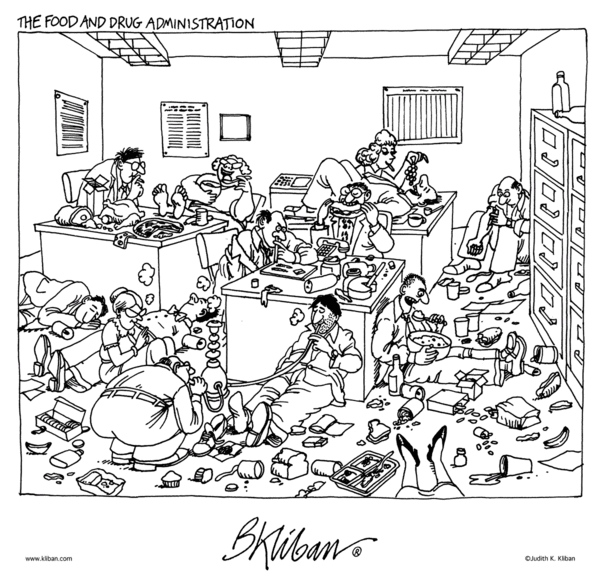
Inside the FDA

Secret illustration drawn from a photo of an office at the Food and Drug Administration


Not really.  The work of B. Kliban, a cartoonist who sometimes created funny material, and who died way too young (55).  His catalog of cartoons, both his regular work and his cat cartoons, appears on GoComics.com.  Obviously, the collection isn't expanding, although with an almost 30 year career, there's a lot of material.

Friday, December 5, 2014

Orion and Beyond

I find that I have an attitude that seems odd compared to many folks I run across.  It's rather common to hear people talk about wishing they were young again.  I wouldn't want to go back to college age, or farther (shudder).  I don't even particularly want to go back to the best years of young adulthood, when we were established and even starting to get ahead.  I'm pretty OK where I am.  If I had H.G. Wells Time Machine, though, I'd push that lever forward, not backward. 

But there are disadvantages to being an old guy, one of which is the possibility of not being around to see this come to fruition.
A friend of a friend took time off from work to witness today's test flight of the new Orion capsule.  As a bonus, the capsule was mounted on a Delta IV Heavy, the most powerful rocket in the US these days, and those are always cool to watch.  The launch time of 7:05 was right around the time I leave for work, but I was planning on going in a little later and watching it. As the count resumed at 7:01, we heard rain starting to hit the roof.  While it was clear at the KSC, it was raining here and we didn't try going out to look.

Orion is the first component to fly in the Space Launch System, the SLS, that ultimately is planned to take a crew to Mars.  There's a sequence of launch vehicles being planned; the smaller one of which has more liftoff thrust and payload than a Saturn V.
The smaller vehicle will be used for missions closer to Earth than a few million miles.  Not just moon missions, but LaGrange point missions.  The larger vehicle is intended for Mars trips.  The smaller vehicle is well into conceptual design and modeling.  It uses upgraded shuttle Solid Rocket Boosters, and the liquid fueled main engines from the shuttle for its core. 

When?  Well, the advertised times have the 70 Metric Ton launch vehicle flying by 2021 and the 130 Metric Ton vehicle by the 2030s.  Needless to say, those are subject to slipping out, especially as the US financial situations worsens (as it seems it eventually must).  Of course, if there's a total collapse, all of this is moot. 

I've written before about my sense of loss at seeing the US lose manned access to space.  The country that put men on the moon now has to buy access from the Russians, who are flying a ship first designed at the dawn of the space age.  In one of his videos, Bill Whittle points out the frightening fact that no one born after 1935 has ever walked on the moon.  Not before 1935, after.  They are all old men, and are leaving us.  In a few years, I expect dear granddaughter to ask me something like, "Grandpa, is it true men went to the moon when you were a boy?"  And that will break my heart.

I've also written about the bigger picture of whether or not NASA should be doing space flight at all:
Should NASA be involved in this sort of program?  Frankly, I don't know.  I believe a project like the International Space Station isn't something NASA should be doing: it's too routine, too commercial.  The truth of the ISS appears to be NASA needed a mission for its shuttle, and the ISS is a natural fit.  NASA should be leading edge; developing new technologies, like hypersonic transports, cheaper ways to orbit, Warp engines and things with long payback periods, things that companies probably would not invest in.  NASA is now institutionally risk-averse.  They've gone from "The Right Stuff" to arthritic bureaucracy, but that's natural for a government organization that's hung out to dry when something goes wrong (see Hubble Space Telescope, Challenger, Columbia...).  There may not be a commercial reason to go to Mars, so NASA should do that.  There are certainly commercial and scientific reasons to go to the moon and set up a permanent base for many things: science research (the far side of the moon is an ideal place for giant telescopes, radio and optical) and mining (Helium 3 can be mined on the moon and may be the next great fuel). This seems like a place for an industry/NASA team to figure out how to do such things.  
Of course, we never get to know the future.  Anyone of us could die tonight.  If the SLS and Orion proceed as planned, I'll be in my 80s when we get to Mars.  Maybe well into my 80s.  Sure would like to see it, though. 


Thursday, December 4, 2014

I Know the Feeling

Of towing the FSA around. 
Every penny in those bags came from someone saying, "just this little bit more won't hurt". 

From Glenn McCoy at Townhall.com.


Wednesday, December 3, 2014

Open Source Robotics and iCub

iCub is a humanoid robot developed by Italian researchers working in Genoa, Italy, at the Instituto Italiano di Tecnologia (IIT) as part of an EU project.  ST Microelectronics had a major part in the project; the robot is full of ST's sensors and microcontrollers.
Julien Jenvrin, the doctor responsible for robotics, brain & cognitive sciences at IIT, told EE Times, "The beauty of the iCub is that it's an open-source robot." He said, Think of the iCub as a smartphone. Researchers and developers from all over the world download a simulator, and keep developing new apps -- helping the iCub learn new skills." The iCub has now been adopted by more than 20 laboratories worldwide.
The Japanese are notoriously fond of humanoid robots, and while the iCub is only slightly human looking, it went over very well at the 2014 Embedded Technology 2014 show.  Predictably, Japanese attendees were gushing over this little Italian -- about as big as a four-year-old child (roughly 3'4", 55 pounds) -- which they praise as smart, sophisticated, and gentle.  I watched several short videos of this robot and I have to say that I'm impressed.  Still has a long way to go to keep up with the Honda Asimo, but as an open source research project looks pretty cool to me.  This video is bilingual.  The girl is speaking Japanese; the guy and the robot are speaking English.  No Italian can be heard.  


The stated price is 250,000 euros, plus VAT and more.  Not for the home hobbyist, but technically it's open source.


Tuesday, December 2, 2014

Techy Tuesday - Transparent Armor

It caught my eye a few months ago when I saw mention that Navy had announced a new form of transparent armor based on synthetic Spinel but with a new processing method called nanocrystals.  These Nanocrystalline spinel windows could be used on the Navy’s new Zumwalt Class of destroyers
The new nanocrystalline spinel is made of the same materials, magnesium aluminate (MgAl2O4), but the grain size has been reduced to 28 nm.
Apparently the Army has also been experimenting with Spinel, stating that they're getting good results with the material and there are many advantages to it. (pdf warning)

  • Light weight transparent armor in sizes up to 16” x 40”
  • Weight savings and thickness reductions of 50-60% over current systems
  • Reduce cost per square foot by 20-50% for Spinel ceramic plates for armor
  • Superior resistance to scratching, sand erosion and fracture due to rock strikes will provide major replacement cost avoidance payoffs
  • Operations and Support (O&S) cost savings will be achieved as a result of reduced vehicle maintenance and increased window service life
  • Reduce Spinel manufacturing costs by up to 50%
  • As recovering rockhound and lapidary hobbyist, synthetic gemstones are something I've had interest in for a couple of decades, so I immediately noticed the materials and the way they're processed.  One of the intended uses of this armor is to replace synthetic sapphire.  Sapphire is one of the first gemstones to be synthesized, and harder* than spinel.  The approach they use to synthesize this spinel is radically different from any way I know of to synthesize gem crystals and makes me wonder if new ways of creating synthetic gemstones will hit the market.  Not quite beating swords into plowshares, but perhaps a dividend.   

    *On the geologist's, or Mho's hardness scale, Spinel has a hardness of 8, while sapphire is hardness 9 - second only to diamond at 10.  The watch crystal on my everyday watch is a clear synthetic sapphire and two years of wearing it hasn't left a single scratch on it.  Hardness is a poor indicator of how tough a mineral is; it's only what stone can scratch another.  Some relatively soft stones, like jade, are phenomenally tough to break. 


    Monday, December 1, 2014

    More on the Thanksgiving Eve Regulatory Dump

    On Friday night, I wrote about the EPA's regulatory dump on ozone, and how the administration loves to dump new laws and regulations the night holiday weekends begin because no one is paying attention; something that always struck me as a Banana Republic tactic.  

    Turns out I missed the real regulatory dump. 

    On Wednesday, the Obamanoids, fresh from taking over education with their Common Core agenda, released 3415 new education regulations, including things that can easily be interpreted as moves to outlaw home schooling
    But what many parents and educators are focusing on in the Obama administration’s regulatory roadmap — known as the federal Unified Agenda, with its 3,415 regulations that will be finalized in the months to come — are particularly concerned about are the new rules that push the Common Core. These include: 1) federal attempts to control teachers via new teacher training; 2) the use of federal “waivers” limiting state educational authority and; 3) the federal “phasing out” of state authority over special education.
    New federal attempts to take over teacher training is just one regulation away from saying teachers must be certified by the Federal training, and that home schooling is illegal unless the teachers are Federally certified.   As Bill Clinton's aide Paul Begala put it, "Stroke of the pen, law of the land. Kinda cool!"  The Home School Legal Defense Association pointed out that parents across the nation with children in the public schools should be very cautious about the latest swarm of restrictions designed to carry out the United States Department of Education’s (USDE) regulatory agenda.
    “Although there is nothing in this agenda to indicate that the proposed regulations would threaten homeschool freedom, they point to a disturbing trend of the federal government attempting to control our nation’s education system,” HSLDA Director of Federal Relations William A. Estrada, Esq. warns. “As we have seen with the battle over the Common Core, even though the Common Core only applies to public schools, it is a long-term threat to every student, including homeschool and private school students.”
    My kids are long out of the school system, and my grandkid is not quite in it yet, so while the state of education and its socialist indoctrination bothers me, I don't actually have a dog in this fight.  From what I see of Common Core in my limited research, while it may be reasonable in limited areas, others are not.  It's cronyism of the highest order, full of handouts to companies like Microsoft and others who want to data mine our kids.  Even ignoring those problems, anyone should recognize that the home schooled kids are outscoring their publicly schooled counterparts the vast majority of the time.  It's almost a cliche' that when you see a bright, articulate kid on TV or somewhere it always turns out that they're home schooled.  Of course, that really frosts the public teachers' unions.
     
    More to the point, education is not enumerated as a Federal power.  The Federal government has absolutely no authority to dictate teacher training requirements and they have no authority to regulate handicapped or special education.  Regarding the first:
    “Teacher Preparation: On April 25, 2014, the President directed the Department to propose a plan to strengthen America’s teacher preparation programs for public comment and to publish a final rule within the next year,” the document states. “The Administration seeks to encourage and support States in developing systems that recognize excellence and provide all programs with information to help them improve, while holding them accountable for how well they prepare teachers to succeed in today’s classrooms and throughout their careers …”
    and regarding the second:
    “The Secretary will amend the regulations governing title I, part A of the Elementary and Secondary Education Act of 1965, as amended (ESEA), to phase out the authority of States to define modified academic achievement standards and develop alternate assessments based on those modified academic achievement standards in order to satisfy ESEA accountability requirements,” the document reads.
    The states are under no obligation to swallow this.  This is a 10th amendment issue: the Federal Government is pushing in to take over things they have no constitutional authority over.  The only authority they have is what the states have given up to them.  Of course, they hammered Oklahoma for having the nerve to refuse Common Core and you can be sure they'll do the same in your home state.  We need to help our state governments stand up to the tyranny from DC.
    (Common Core civics lesson from New Hampshire.  Note how it says government creates jobs, with no mention of private businesses or entrepreneur start-ups.)


    Video of the Day

    I should say Video of the Day So Far.


    I have no idea what they're saying, but it appears to be a fantastic commercial.  NTT Docomo.

    Just because I've watched it a few times and still get a smile from it.


    Sunday, November 30, 2014

    Hurricane Season 2014 Wrap Up

    Folks who live away from the East or Gulf coasts may not care about this, but I keep track of the hurricane season activity.  Today is the last day of the season, and while I could have really written this at the end of October when Tropical Storm Hanna dissipated, it's best to get the whole season.  Although the predictions vary, NOAA's last prediction before the season (5/22) was eight to 13 tropical storms, including three to six hurricanes, only one or two of them major (with winds over 110 MPH).  There were eight tropical storms, six made it to hurricane status and two became major hurricanes.  One of those, Edouard, was Major for a few hours, while Gonzalo stayed a Major storm for days.  All things considered, their predictions were rather good. Those predictions have often tended to be good for a laugh after the season.
    I've been a fan of Ryan Maue's Accumulated Cyclone Energy model since I ran across it a few years ago because I think by integrating both the intensity and the duration you get a better measure of a storm's impact, or potential impact.  Consider Edouard, which was a tropical storm for several days before becoming a hurricane and was a Major storm for one forecast period vs. Gonzalo which was a tropical storm for less time but a Major storm for a 3 1/2 days.  Both storms lasted about the same amount of time and both are counted as Major Hurricanes, but Edouard had an ACE of 15.35 while Gonzalo was the "worse" storm at an ACE of 25.365.  The ACE for the North Atlantic Basin for the year to date is 63% of climatological normal, another mild year.  (Last year was 30%).

    One storm hit the US; Hurricane Arthur hit the outer banks of North Carolina on the July 4th weekend.  Florida has not had a hurricane since Wilma in 2005, a record for longest time since a hurricane made landfall in the state.

    As I reported in October, it's beginning to look like the era of 'high spin cycle' tropical cyclone activity in the Atlantic basin that started in 1995 has run its course.  If this is indeed the case, hurricanes in the North Atlantic will be less of a concern for next 20 years, allowing a lot more building along the coast, which will result in more damage in 30 years when the next Sandy hits and no one remembers what a hurricane was like. 

    Hurricanes are good disasters for the lazy man, so I like them. There's no need to go get in line for plywood for your shutters, canned food or bottled water or any of that. All of it is stuff you can prepare for months or years in advance. Yeah, you have to go put up the shutters and do some stuff in advance of the storm, but you sure don't need to be in line at stores. Or in line at a FEMA tractor trailer afterwards.

    Saturday, November 29, 2014

    What's Up With the Precious Metals?

    Heck if I know!

    Unless you don't pay any attention to precious metal prices at all (in which case you're kinda out of place around here) you know that prices have been in the tank lately.  Gold closed at $1168/oz Friday and has been struggling to clear $1200/oz since mid-October.  It hasn't seriously challenged $1400 in the last year.  What's significant about that?  Just that analysts conclude that the
    "all-in costs of gold producers are now above $1,150/oz, even after big cost reductions and a focus on higher-grade mining. If the price drops to $1,000/oz, there will be many shutdowns. The industry needs a price of at least $1,400/oz to support sustainable production, and that number will rise, as early as 2015 or 2016."  It's progressively harder for gold miners to mine profitably at today's prices, and that gets worse as the world's central bankers create more and more inflationary pressures on the dollar. 
    Silver is just as bad.  The number of ounces of silver it takes to buy an ounce of gold (or the number of silver ounces 1 oz of gold will buy) is 75.4.  Historically, that's on the high end of where it ranges, but not an all time high.  Here's your kicker: the average silver to gold ratio from 1687 until now was 27.28, just about a third of what it is now.  The ratio went above 40 in 1984 and has only rarely gone below 40 since then.  A high ratio represents either historically cheap silver or expensive gold - but the preceding paragraph explains that gold is almost selling too cheaply to mine.  To me that implies gold is cheap, and silver is full-tilt-bozo, ridiculously, crazy cheap. 
    (Note this is from 11/27 - Thanksgiving - when all the other world markets were open.  My value of 75.4 is from 11/28's closing prices.)

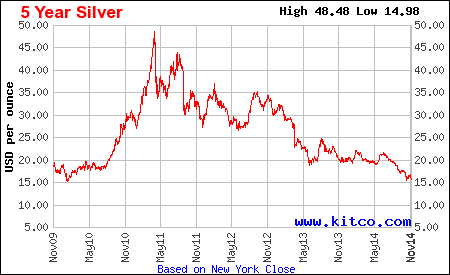
    Silver has been in a down trend since mid 2011, although a couple of those vertical price drops came from the commodity markets changing the their rules.  It was almost net zero movement since May of '13, but the last couple of months have been brutal.  With "above ground" supplies of almost a billion ounces (978 million), more than last year, and the economic forecast for slowing growth worldwide (if not outright global recession) the price of silver seems to be caught between the strangely resurgent dollar strength and the investors eying the white metal more as an alternative currency than as an industrial investment.  Silver's price correlation to gold is 0.82 (1.0 being perfect... and never seen); its correlation coefficient to industrial metals is 0.27. 

    So if there's so much silver around that you can get all you want, spot prices are in downward spiral and the price of silver is prices last seen in 2009, you might think this is a good time to go buy some.  I know that a year or so ago, 90% junk silver coins (90% silver US coins from 1964 and before) sold for about a 6 or 7% premium over spot price.  Tonight, checking the cheapest junk silver coins, I find the premium is closer to 17%!  I thought supplies were so high we were tripping over silver. 

    It's widely thought that the spot price is set by paper traders who have nothing to do with producing, or really buying actual metal.  Keith Neumeyer, the CEO of First Majestic Silver took the bold move of holding back 35% of his company's silver production rather than sell it at the paper trader's price. 
    Now, Mr. Neumeyer has taken things a step further by suggesting that silver miners should form a semi-cartel and hold back sales of their production in order to break the backs of the paper manipulators. He encourages all miners to hold back silver, pick a month, get together and hold back silver for 30 days, putting out a news release collectively. The goal is to call the bluff of the paper markets, which trade over the entire year of global production in a day. First Majestic itself is a small fish, but imagine the impact if a few of the top producers joined in the effort and physical supplies tightened.
    Attempts to manipulate market prices are widespread, and metals investors in particular are very loud about it.   The current extremely low price of oil (closed at $65.99 Friday) is said to be an attempt by the Saudis and the Russians to collapse the US shale oil resurgence.  Both Saudi Arabia and especially Russia need the price to be closer to $100, but the combination of the US energy production improvements and forecast for lower demand have helped pressure prices lower.  The point is, anyone who can try to influence commodity prices will.  Still, it's widely reported that despite the large number of above ground ounces, the important part is that demand for that above ground silver exceeds supply, which should imply the price can't be held down too much longer.

    As always, the real question is what the future holds (and long time readers know my answer usually starts with Bohr's quote).  As I said before, 90% silver coins have jumped a lot in price compared to the spot metal price.  The US Mint regularly sells out of silver eagles.  Combine that with silver producers trying to raise prices.  My view is that the separation of price for physical metal vs. the paper price means that sellers are just plain refusing to sell at that paper price.  If you really want the silver, you'll pay more.  That tells me there's a fundamental stress in the market that will only be relieved by silver going up in price.  I expect next year to be better than this year for the metals. 

    Standard disclaimers apply: I'm just some dood with a blog on the vast Sargasso sea of the net.  YMMV.  Under penalty of law, do not remove mattress tag.  Professional drivers on closed course.  No animals were harmed during the writing of this blog (although one white cat was annoyed that I wasn't paying enough attention to him). 


    Friday, November 28, 2014

    A Little Normalcy Bias Feels Pretty Good - But, EPA!

    I've spent the last couple of days with family, enjoying the holiday together, eating together, joking together.  It has been a nice break.  But if you've been here before, you know that while I may occasionally look away or pretend things are normal, it's not a steady diet.  Even troops on guard duty "take five" now and then.

    This being a holiday weekend, the administration announced choking new rules on ozone pollution.  They always announce (or pass) the most strangling, odious rules on a holiday weekend or a Friday before a long weekend because they think the fewest people will be watching.  Calling the ruling about "smog regulation", the EPA said
    “It empowers the American people with updated air quality information to protect our loved ones – because whether we work or play outdoors – we deserve to know the air we breathe is safe.”
    Implying, of course, that the air currently isn't safe and they have been struggling mightily to improve our lives in the face of awful opposition from ... I don't know... someone or other. 

    Bull.  Crap.

    Of course, no one mentions that they've been in charge since 2009, three complete election cycles, and didn't think this needed to be done.  Which obviously means they waited until they thought it would do the least damage to Evil party incumbents.  They were afraid if they announced these rules earlier, it would affect the elections.  Since it's hard to lose much worse than they did, this is a really good time to drop this turd in the punch bowl.  With any luck, the people will forget it by the next elections.

    Two big problems come to mind.  The first is that reducing legal ozone levels because it's a component of pollution is like reducing legal oxygen levels because it's a component in seawater and we don't want to breathe seawater.  The second is that the current limit is already just about at the  natural background level of ozone.  In most of the country, it's physically impossible to measure the new limits because the natural background is higher than the level they're imposing!  

    The reduction, from the current 75 ppb (parts per billion) to 70 or 60 is low numerically, but ozone limits now are already trace levels.  The new levels would put the ozone emissions from completely non-industrial areas out of range!
    That's down from the 75 ppb limit set in 2008. While that might seem like a small drop, it would push vast numbers of sparsely populated areas of states like Idaho, South Dakota, Maine, New Hampshire, Kansas, Iowa, Oklahoma, Minnesota and West Virginia — where no counties violate today's standard — into the red zone.

    Even Colorado's La Plata County — almost half of which is inside the San Juan National Forest — would violate the new standard.
    EPA says it's doing this because "...we deserve to know the air we breathe is safe", right?  They claim they'll reduce asthma rates, but the data from the Centers for Disease Control say that as ozone levels have fallen over the decades, asthma rates have gone up.  Clearly, it's not directly linked to ozone.
    To further muddy the EPA claims, asthma rates have risen even as ozone has steadily declined. From 2003 to 2010, EPA data show that ozone levels nationwide fell 11%. But the number of people suffering asthma attacks climbed 26%, according to the Centers for Disease Control.
    Furthermore, the rates they're going to mandate are below normal background levels in places like Yellowstone National Park.  Don't know if you've been there, but aside from the smell of sulfur in a few places, it has absolutely pristine air.  Howard Feldman of the American Petroleum Institute said last spring in a study of possible coming regulations:
    “… we don’t know how to get to these levels. These levels are levels that are at or below peak background. Background levels at Yellowstone National Park are 66 parts per billion, background. … Background at pristine locations is 65, 66, 67 (ppb). It means we have very little ability for our society to operate the way it normally does. … Our society does have some emissions, but that is the cost and benefit of our modern society, where we’re able to have the amenities and the social life that we like. So there is some impact on the environment. We’re talking about reducing that (head)room to almost zero.”
    Many industrial processes produce ozone, just as many natural processes do.  It's easy to think they're trying to shut down every power generation plant and every factory in the country.  They're just evil enough to think that's the thing to do.
    The API provides this map of the impacts of the new regulation.  Areas in red will fail a 60 ppb standard now.  Areas in gold are anticipated to fail a 60 ppb standard based on interpolation of measurements made nearby.  I'm unable to find if the few areas in white are thought to be low enough in ozone to pass - or if there are simply no data from those areas.