Monday, August 12, 2024

Is The Starliner Decision This Week?

Ars Technica opened into the week with this eye-catching headline: "NASA is about to make its most important safety decision in nearly a generation" and followed with the make-you-gotta-read subtitle: "Three Starliner mission managers had key roles on Columbia's ill-fated final flight." To borrow a well-worn phrase, "oh shit, oh dear" or OSOD. 

Three of the managers at the center of the pending decision, Ken Bowersox and Steve Stich from NASA and Boeing's LeRoy Cain, either had key roles in the ill-fated final flight of Space Shuttle Columbia in 2003 or felt the consequences of the accident.

At that time, officials misjudged the risk. Seven astronauts died, and the Space Shuttle Columbia was destroyed as it reentered the atmosphere over Texas. Bowersox, Stich, and Cain weren't the people making the call on the health of Columbia's heat shield in 2003, but they had front-row seats to the consequences.

Bowersox was an astronaut on the Space Station at the time. Of course, they were scheduled to come back on another Shuttle later in the year, but Columbia's destruction halted the program, causing them to return on a Russian Soyuz. It was, after all, the only alternative. After retiring from the astronaut corps, Bowersox worked at SpaceX and is now the head of NASA's spaceflight operations directorate.

Stich and Cain were NASA flight directors in 2003. I've mentioned Steve Stich after pretty much every meeting about Starliner. LeRoy Cain moved from NASA to Boeing and is now their Starliner mission director. 

All three joined NASA in the late 1980s, soon after the Challenger accident. They have seen NASA attempt to reshape its safety culture after both of NASA's fatal Space Shuttle tragedies. After Challenger, NASA's astronaut office had a more central role in safety decisions, and the agency made efforts to listen to dissent from engineers. Still, human flaws are inescapable, and NASA's culture was unable to alleviate them during Columbia's last flight in 2003.

NASA knew launching a Space Shuttle in cold weather reduced the safety margin on its solid rocket boosters, which led to the Challenger accident. And shuttle managers knew foam routinely fell off the external fuel tank. In a near-miss, one of these foam fragments hit a shuttle booster but didn't damage it, just two flights prior to Columbia's STS-107 mission.

At some point reading about both of these missions, I remember thinking that they got lucky a couple of times on each type of failure before the disaster, but acted like it wasn't luck. They acted like the concerns about the problem were overblown. It struck me that they were acting like they'd played Russian Roulette a few times and were still alive so the odds of getting shot were wrong. Granted that both Shuttle failure cases were less obvious risks than actual Russian Roulette. Pulling the trigger on a revolver at your head giving a 1 in 6 chance of dying, is different odds than what happened on either Challenger or Columbia. The idea seemed not to be, "we've just been lucky;" it seemed they thought the odds must be wrong. Or that "nothing bad will happen to us because we have all these smart people studying the problem." 

There are many quotes surrounding both Challenger and Columbia that essentially say, "we've seen this on other missions so it's not that bad." Completely without any mention of the idea that it really was dangerous, maybe even more dangerous than they thought, they just got some lucky breaks.

Their problem here is what it has always been. Should the Starliner crew return to Earth from the ISS in Boeing's Starliner, with its history of thruster failures and helium leaks, or should they come home on a SpaceX Dragon capsule? Also simply, the first choice is what everyone involved would prefer - if they knew it would be safe.  

The alternative has lots of impacts to other people, other companies, the ISS program itself and more; that alternative is using the Crew 9 mission's Dragon Capsule to bring only two people up to the ISS at the end of September, so that Butch and Suni become the other half of Crew 9 instead of Starliner's crew. It turns their 8 day mission to an eight month mission, keeps them on the ISS until February and other rough aspects, but is clearly far, far better than the worst case of being incinerated in a capsule the can't be steered due to malfunctioning thrusters.

LeRoy Cain, now at Boeing, was the flight director on console in mission control at NASA's Johnson Space Center during Columbia's reentry on February 1, 2003. In real-time, over the course of about 10 minutes, Cain received updates from his team suggesting a cascading series of sensor failures on the shuttle, all clustered in Columbia's left wing. Then, mission control lost contact with the shuttle and its crew.

In an interview with Ars earlier this year, before the launch of the Starliner spacecraft, Cain said he would not hesitate to voice concerns about Starliner's safety. He is the top Boeing official in charge of day-to-day Starliner mission operations. "I would stand up and say we're not ready, and here's why," Cain said.

I wonder. 

Ken Bowersox, head of NASA's spaceflight operations directorate, chairs a flight-readiness review before a SpaceX crew launch to the International Space Station in August 2023. Image credit: NASA/Kim Shiflett.


Sunday, August 11, 2024

Solar Cycle 25 Gave Us A Wild Week

Solar cycle 25 set some new 20 year high points again this week, and some that go back quite a way. Depending on how you look at it.

Let me do a small preliminary review because there's a lot of details here that matter. There are a few main ways solar activity is summarized and different ways of stating all of them. The most direct (and some judgement is still required) is the sunspot number. Sunspot numbers are never one digit; if there was one little spot visible on the entire side facing us, the sunspot number would 11. The number isn't obtained by taking an image of the sun and counting all the dark spots.  It's a two digit number where the first is ten times the number of spot groups and the second is the number of spots in all of those groups.  That's why the single dark spot gets a sunspot number of 11: one group, one spot.  In general the number is k*(10*G+S). (where k is a coefficient for each observatory that helps adjust for differences in their capabilities). 

Once those numbers are taken, they're combined in plain, numerical averages and a Smoothed Sunspot Number or SSN. That's also covered in that previous link. 

The next main way solar activity is measured is the amount of energy the sun radiates in the radio spectrum. The most common of these is the 10.7 cm (radio wavelength) solar flux, usually referred to as the SFI. The wavelength is a frequency of 2800 MHz, and it's a direct measurement of the amount of power received by tuning an antenna and radio to 2800 MHz and measuring the energy received. Because that varies a lot, there are different adjustments to and averages used for it, as well.

Another of the ways the sun is monitored is the amount of disturbance of the Earth's magnetic field - the Geomagnetic Indices. There two frequently cited numbers, the A and K indices, that often look quite different because they measure different effects. Of the two, the most commonly used value of the K index, is the Planetary K Index and written KP. I've used the KP much more often than the A index and KP appears to be the most widely used index. 

The big deal is that the solar flux on Thursday and Friday went to and past 300.  This is a level that the solar flux hasn't reached since 1991.

Date           Time         Julian day      Observed Flux
2024-08-08     17:00:00     2460531.197     300.1     
2024-08-08     20:00:00     2460531.322     336.0     
2024-08-08     23:00:00     2460531.447     304.7     
2024-08-09     17:00:00     2460532.197     305.1     
2024-08-09     20:00:00     2460532.322     305.5     
2024-08-09     23:00:00     2460532.447     316.1

Two days in 1991 - 34 years ago - were the last time the SFI went over 300 (different source so different format data, of course):

Feb 22, 1991 302.6
Feb 22, 1991 313.1
Feb 23, 1991 311.5

On Friday (August 9), the SpaceWeather Prediction Center of NOAA noted the milestone in a different way - Sunspot Number instead of Solar Flux. In the top left, they say the "The estimated sunspot number (SSN) for August 8th..." which might be a little confusing or misleading. SSN is not an acronym for Sun Spot Number; it's for Smoothed Sunspot Number - a smoothing math operation, which I've assumed is averaging.  


While the SFI was up to 336, the KP was low, and the HF bands were better than VHF.  The buzz lately on some of the VHF groups I hang out around is that this fall might be the best year for F layer (highest layer, so the longest propagation distances) in the same kind of time frame. Best in 35 years? Better than 35 years ago? A lot of guys are looking at their stations and saying, "what can I do to make it better for that?"  

Temper any excitement about wonderful propagation on the ham bands with the fact that it is, after all, solar maximum, and that means the sun spits out flares regularly. Right now, for example, the widely used sources are saying SFI is 282 (still outrageously good) and K index is over 4.5. We're having a G2 (Moderate) class geomagnetic storm. 


Saturday, August 10, 2024

The Way the Chinese Treat Their Megaconstellations

Remember how the Chinese launch rockets from well inland and just let the boosters fall where they may? Be it in lightly inhabited spaces or on elementary schools, well, who cares? Just let them fall. They apparently treat their megaconstellations the same way.

They've begun launching a megaconstellation that seems to be aimed at competing with SpaceX's Starlink (or replacing it in their country). The first launch was at 0642 UTC on August 6. Apparently the Long March 6A booster has blown apart in orbit, generating "more than 50 pieces" big enough to track from the ground

The Long March 6A launched Aug. 6, from a specifically constructed launch pad at Taiyuan spaceport. The rocket’s upper stage, modified for restarts and deploying numerous satellites, deployed 18 flat panel Qianfan (“Thousand Sails”), or G60, satellites into roughly 800-kilometer-altitude polar orbit for Shanghai Spacecom Satellite Technology (SSST). 

The satellites are the first of a planned megaconstellation of more than 14,000 low Earth orbit (LEO) communications satellites. However the mission appears to have created a string of debris along its orbital path, according to observations from Slingshot Aerospace, a space-tracking and data analytics firm.

“Composite images from Slingshot’s LEO-focused Horus optical fences show a series of bright, unexpected objects moving along the same orbital path as the rocket body and the G60 satellites it deployed,” Slingshot Aerospace noted in a statement.

Composite image from Slingshot’s LEO-focused Horus optical fences, showing debris from the Aug. 6 Long March 6A launch. Credit: Slingshot Aerospace

According to Slingshot, everything below an orbital altitude of 800km or 500 miles is now at increased risk of collision because of this debris. A LOT of what's in LEO is less than 500 miles up. 

The US Space Force issued a statement verifying the report.

U.S. Space Forces – Space (S4S) tracking confirmed the breakup of the Long March 6A rocket stage. “The breakup likely occurred Aug. 7, at 1548 UTC. The tracked pieces are being incorporated into routine conjunction assessment to support spaceflight safety. There are currently no threats to human spaceflight. Analysis is ongoing,” the statement read.

At around 500 miles altitude, debris can survive in space a long time; like decades.  Which underscores the deeper problem here. This is not the first launch that had a problem with the Long March 6A. 

The debris incident is the latest of several events affecting the upper stage of the Long March 6A. An early July saw numerous pieces of debris created, detected by Swiss firm S2a systems and reported by SpaceNews.
...
A Long March 6A upper stage breakup event (pdf alert) in November 2022 meanwhile created hundreds of pieces of debris.

Like most things launched from the Peoples' Republic, it's a state-owned and state-produced design. The Shanghai Academy of Spaceflight Technology (SAST) has yet to respond to a request for comment on the earlier incidents.

With multiple debris fields, the worst case scenario gets more probable and there are no indications they plan to stop launching these rockets, which very likely will add more debris fields. That scenario is the chain reaction kind of collisions depicted in the movie Gravity, where a couple of things moving at high relative velocities collide creating many pieces moving at the high orbital speeds of the junk, which then collide with other pieces of junk and then even more. The potential to shut off access to space suddenly needs to be thought about.

The state-owned Shanghai Spacecom Satellite Technology (SSST) plans to launch 90 more satellites this year; assuming the same 18 satellites per launch as this one carried, that's five more Long March 6A launches this year. That's just getting started. 

Documentation filed with the International Telecommunication Union (ITU) sets out plans for a first phase using 36 polar orbital planes, each filled with 36 satellites, totaling 1,296 spacecraft. The overall plan is for more than 14,000 satellites. It is unknown what launchers the satellites will fly on. The potential frequent use of the Long March 6A, however, raises concerns.

“If even a fraction of the launches required to field this Chinese megaconstellation generate as much debris as this first launch, the result would be an untenable addition to the space debris population in LEO,” Audrey Schaffer, Vice President of Strategy and Policy, said in a statement to SpaceNews

And they're just getting started. 

[This constellation] G60 or Thousand Sails is just one of the megaconstellations planned by China in response to Starlink. Launches for the national Guowang (“national net”) 13,000-satellite project are also expected in the future.

There's an unexpected bright spot here. China is also pushing next generation launch vehicles including reusable medium and large launch vehicles. Added launch capacity from commercial reusable launch vehicles will be necessary for China to be able to build its planned megaconstellations. I expect reusable vehicles will be built better simply because there's pretty much no such thing as reuse of a rocket that comes apart.


Friday, August 9, 2024

I'll Just Put This Video Here

For those who like parody songs with the same music but parody lyrics. Also for those who are into solar conditions, solar terrestial indices, radio propagation and all. 

In other words, there's around a dozen people who will like this. 

Officially "My Corona" by COSMOrama of the High Altitude Observatory (HAO) of the National Center for Atmospheric Research (NCAR). On YouTube for one year and I learned about because a friend sent a link by email. 

Enjoy!


Thursday, August 8, 2024

Boeing's Space Launch System - There's Nothing Like It

There's nothing quite like it; so thank God in whatever way you can. 

There's nothing like it because there's nothing as bad as it is. Every report on every aspect of the Space Launch System (SLS) is worse than the one before it.  Every milestone is late. Every cost target is over budget. 

The latest is a report on the Exploration Upper Stage (EUS) and is the first I've seen on the EUS. We can be thankful that the Europa Clipper probe to that named moon of Jupiter was moved to a Falcon Heavy and is set for launch Oct 10, 2024. Part of the reason was the EUS was going to be delayed too long, but the White House, in the closing weeks of the Trump administration, had to get Congress to cancel the law they passed mandating Europa Clipper fly on the SLS

The NASA program to develop a new upper stage for the Space Launch System rocket is seven years behind schedule and significantly over budget, a new report from the space agency's inspector general finds. However, beyond these headline numbers, there is also some eye-opening information about the project's prime contractor, Boeing, and its poor quality control practices.

The new Exploration Upper Stage, a more powerful second stage for the SLS rocket that made its debut in late 2022, is viewed by NASA as a key piece of its Artemis program to return humans to the Moon. The current plan calls for the use of this new upper stage beginning with the second lunar landing, the Artemis IV mission, currently scheduled for 2028. In NASA parlance, the upgraded version of the SLS rocket is known as Block 1B.

Poor quality control? That new report focuses on Boeing's quality control practices at the Michoud Assembly Facility in southern Louisiana, where the Exploration Upper Stage is being manufactured. Federal observers have issued a striking number of "Corrective Action Requests" to Boeing. The report points out the root cause of these issues is that “Boeing’s quality control issues are largely caused by its workforce having insufficient aerospace production experience. The lack of a trained and qualified workforce increases the risk that the contractor will continue to manufacture parts and components that do not adhere to NASA requirements and industry standards.”

Not surprisingly, the "lack of a trained and qualified workforce" has resulted in more parts being rejected, causing more time wasted and more cost incurred. Based on readers who have commented here, I think this statement isn't going to surprise a single person:

According to the new report, "unsatisfactory" welding operations resulted in propellant tanks that did not meet specifications, which directly led to a seven-month delay in the program.

And I think nobody who has read much about SLS will be surprised by this follow-on.

NASA's inspector general was concerned enough with quality control to recommend that the space agency institute financial penalties for Boeing’s noncompliance. However, in a response to the report, NASA's deputy associate administrator, Catherine Koerner, declined to do so. "NASA interprets this recommendation to be directing NASA to institute penalties outside the bounds of the contract," she replied. "There are already authorities in the contract, such as award fee provisions, which enable financial ramifications for noncompliance with quality control standards."

The lack of enthusiasm by NASA to penalize Boeing for these issues will not help the perception that the agency treats some of its contractors with kid gloves.

The report estimates that the entire development of this Exploration Upper Stage will be over budget by $5.7 billion before it ultimately launches. The last time they revised their cost estimate was last December. Here we are just eight months after that estimate and they're already $700 million over that. 

In refusing to penalize Boeing for these quality issues, NASA and Deputy Associate Catherine Koerner are actually rewarding Boeing for these quality issues. This is a "cost plus" contract. It pays for all of Boeing's expenses, plus a fee. That style contract is incentivizing things like hiring the untrained and unqualified workforce. Need some welders? Go find some winos that have never been within 10 feet of a welding setup. If it takes more time and the stage needs to be scrapped and rebuilt - you make money on it instead of paying for it. 

NASA's Inspector General's report included this graphic showing the expected delivery date of the EUS from 2016 until last October. Notice that in October of 2016, the expected delivery was February of 2021. In March of '21, already late, the new expected delivery was October of '23. Every update of the chart moves the expected delivery out. 14 months later, in May of '22, the delivery had slipped 15 months to January of '25. Another 13 months later, June of '23, moved the delivery 14 months to March of '26. The last one is Even Worse. 

This is almost funny it's so incompetently bad. Almost. When I think about it, the humor leaves and anger takes its place.


Wednesday, August 7, 2024

Sliding Launch Schedules Around - Polaris Dawn Up Next

On the day of the NASA teleconference that didn't say much, there was some good news. 

With the Crew 9 flight moved to late September, SpaceX has announced a launch date for the Polaris Dawn mission. NET August 26 - they didn't announce a time. This reverses the previous order. 

I've been aware of the Polaris Dawn mission since I came across a news item talking about it in February of '22 and have been trying to track it since then. It's an interesting mission with rather ambitious goals, and really a joint effort between Jared Isaacman's charitable organization and SpaceX. The short version is it aims to be the reach the highest Earth orbit ever flown, intentionally attempting to fly through the Van Allen Radiation Belts. Once there, they plan to do the first ever commercial space walk or extravehicular activity (EVA). To do this, they'll wear the SpaceX EVA suits shown here August 1st. Of course there's much more. This is a screen capture from the mission web site.


Polaris Dawn is the first of three planned crewed missions in the Polaris Program, all of which will use SpaceX hardware. Isaacman will command and fund all three flights, as he did with Inspiration4, a groundbreaking SpaceX mission to Earth orbit in September 2021.

Inspiration4 was the first Polaris private mission, Polaris Dawn in about three weeks will be the second. There is talk of a third mission after Dawn that will be flown on the Dragon capsule just like the first two, but there are no details about it on the Polaris website. It simply says: 

Building upon Polaris Dawn, this mission will continue to expand the boundaries of future human spaceflight missions, in-space communications, and scientific research.

Interesting, but content-free. 

Finally there is to be a fourth mission from Polaris, which is to be the first crewed flight of Starship. Even before any NASA Human Landing System missions. There is no announced date or other details. 

I've run this picture a couple of times, so to remind anyone who needs it and for the new readers this time, this is the Polaris Dawn crew during an EVA training mission in '22.  From top right, clockwise, Jared “Rook” Isaacman, Scott “Kidd” Poteet, Sarah Gillis, Anna Menon. Note that Isaccman and Poteet are both executives at Shift4 as well as extremely qualified pilots; both Gillis and Menon are engineers with SpaceX on the manned spaceflight side, so probably not cool enough to have nicknames like Rook or Kidd.  (Inside joke for other engineer geeks).


Tuesday, August 6, 2024

NASA Confims the Crew 9 Delay to Sept. 24

It turns out those "Well-Sourced Rumors" about the Starliner decisions got a really big, important thing right. NASA announced today that the Crew 9 launch has been pushed back to No Earlier Than September 24.  

The agency quotes a few major reasons for this delay. Let me start out with what I think everyone knows.  We know about the engine testing going on both on the Starliner in orbit and on the engines from another Starliner capsule being tested at White Sands Missile Range. The engines failing on the way to the ISS and the helium leaks they had before launch are the big problems. 

They also note what I think of as second order effects: they're not as big a deal as those two, but they add arguments for one option or another.

The Crew-9 launch adjustment also deconflicts the next SpaceX rotation with the upcoming Soyuz handover targeted for no earlier than mid-September. Teams are working to prepare the Crew-9 mission to be ready to launch from Space Launch Complex 40 at Cape Canaveral Space Force Station in Florida to deconflict with pad preparations for NASA’s Europa Clipper mission beginning this September at nearby Launch Complex 39A at the agency’s Kennedy Space Center. NASA also will adjust the launch of SpaceX’s 31st commercial resupply services mission to no earlier than mid-October.

They're saying Crew-9 will be the first crewed launch from the newly upgraded SLC-40, which I think we've been saying all year. Other launches have taken place, but the new crew access arm to board the Crew Dragon capsule and all that other new hardware hasn't done a real launch, yet.  

It's possible that the big news in that NASA blog is buried in this little blurb.

The agency will host a media teleconference at 12:30 p.m. EDT, Wednesday, Aug. 7, with agency leadership to discuss ongoing operations, including NASA’s Crew-9, Crew-8, and Crew Flight Test missions.

Eric Berger at Ars Technica contacted NASA to get Administrator Bill Nelson's input.  

Ars had the opportunity to speak with NASA Administrator Bill Nelson on Tuesday afternoon as the space agency put out its news release. Asked if he had confidence in the decision-making process at NASA surrounding whether to return Wilmore and Williams on Starliner, Nelson replied, "Yes, I do. I especially have confidence since I have the final decision."

It's worth emphasizing that Nelson didn't say he'd made a decision that he'll make public tomorrow nor did he say he didn't or wouldn't make it public.  They're definitely getting all the pieces in place that they've discussed needing to make the decision, so it sounds like it will be worthwhile to take the time to tune in for that conference Wednesday at 12:30 PM EDT. 

Skeptical dog is skeptical.


Monday, August 5, 2024

Nothing But "Well-Sourced Rumors" on Starliner

On Saturday we noted there were stories that NASA would be deciding what to do about Starliner "next week." Even though today is part of "next week," it's probably being too optimistic to think they might say something today. But I still thought they might.

They didn't, but people looking to be authoritative sources still talked and it still got reported, which is how we know one possibility is putting off the Crew 9 launch for perhaps a month.

While the space agency has not said anything publicly, sources say NASA should announce the decision this week. Officials are contemplating moving the Crew-9 mission from its current date of August 18 to September 24, a significant slip.

Nominally, this Crew Dragon mission will carry NASA astronauts Zena Cardman, spacecraft commander; Nick Hague, pilot; and Stephanie Wilson, mission specialist; as well as Roscosmos cosmonaut Alexander Gorbunov, for a six-month journey to the space station. However, NASA has been considering alternatives to the crew lineup—possibly launching with two astronauts instead of four—due to ongoing discussions about the viability of Starliner to safely return astronauts Butch Wilmore and Suni Williams to Earth.

I don't want to go into this rabbit hole too far since we have no idea how relevant any of it is, but there's an interesting little side aspect to this story. 

Remember the unmanned, second Orbital Flight Test of a different Starliner capsule back in May of  '22? That was a completely automated flight. The capsule maneuvered to ISS, docked, then undocked and navigated back to Earth itself. Unlike OFT-1, it was a rather successful test flight.

Apparently one of their tripping points now is that Boeing removed the software that undocked OFT-2 and got it back to Earth. It can't fly autonomously. In that Saturday post, I recommended they fly Butch and Suni home on a Dragon and let Starliner come back on its own. That option doesn't exist. They apparently can't even undock it from the ISS.

Three separate, well-placed sources have confirmed to Ars that the current flight software on board Starliner cannot perform an automated undocking from the space station and entry into Earth’s atmosphere.
...
It is not clear what change Boeing officials made to the vehicle or its software in the two years prior to the launch of Wilmore and Williams. It is possible that the crew has to manually press an undock button in the spacecraft, or the purely autonomous software was removed from coding on board Starliner to simplify its software package. Regardless, sources described the process to update the software on Starliner as "non-trivial" and "significant," and that it could take up to four weeks. This is what is driving the delay to launch Crew 9 later next month.

Partial justification for thinking that the software is the issue goes back to NASA's Commercial Crew Program Manager Steve Stich, who is thought to have referenced this during his most recent press availability on July 25. Stich was asked whether NASA would certify Starliner for operational missions if the vehicle returned to Earth autonomously but ultimately safely. He replied, "Starliner was designed as a spacecraft to have the crew in the cockpit. The crew is integral to the spacecraft." Is saying it was designed to have a crew equivalent to saying, "we removed the capability of Starliner flying without a crew"?

It sort of adds up.

Crew-9: L-R: Stephanie Wilson, mission specialist; Roscosmos cosmonaut Alexander Gorbunov; Nick Hague, pilot; and Zena Cardman, spacecraft commander. One wonders which two would be left on the ground if they go that route. Image credit: NASA


EDIT 0930 8/7/24: Thanks to commenters HMS Defiant and Anonymous at 2005 on 8/6 for pointing out I swapped the names and roles of the two women. And missed correcting this yesterday due to my medical procedure and after effects.  It doesn't help to say I have a download of this picture which is exceptionally easy to read because it would probably print out to an 8 by 10... feet on a side, not inches.


Sunday, August 4, 2024

Another Highest Sunspot Number Since Cycle 23

Many may not have noticed (or remember) this, but in a post in early July of 2023, I passed on that the month of June '23 had posted the highest monthly average sunspot number since cycle 23 in 2002, or 21 years. 

We just had another one with this July's average sunspot number the highest since 2001.  Also from SpaceWeather.com 

The sun is partying like it's 2001. That's the last time sunspot counts were as high as they are now. The monthly average sunspot number for July 2024 was 196.5, according to the Royal Observatory of Belgium's Solar Influences Data Analysis Center. This eclipses every month since Dec. 2001:

It practically goes without saying, because we've said it so often, but when Cycle 25 started, the experts were predicting a cycle about as weak as Cycle 24 before it, which was the weakest cycle in a century. In this plot from the Data Analysis Center, the gray band on the right is the predicted range - which was already raised from the predictions made in 2020. The dark blue line is the average monthly sunspot numbers and how much higher that has been for the whole cycle compared to the predicted average (red curve) is pretty obvious. 

Instead, Solar Cycle 25 has shot past Solar Cycle 24 and may be on pace to rival some of the stronger cycles of the 20th century. Already in May 2024 we have experienced a century-class geomagnetic storm with auroras sighted in the South Pacific, central America and south Africa.

We're comparing current activity to 2001 back in Cycle 23, which is close to two of the most historic events ever seen. There was a flare in November of 2003 that was the biggest one seen since the satellite age started, it was classed as X28 in retrospect - because it saturated the X-ray detectors on the satellites and they couldn't measure it properly. Now, SpaceWeather.com is reporting that it has been re-classified from X28 to X45.  The kicker is that 45 is based on a completely different way of determining strength than that always used so I'm not sure I buy that the numbers mean the same thing. They also report there was “a CME so powerful” (cool animation) it was ultimately detected by the Voyager spacecraft at the edge of the solar system.

While it's hard to know except by looking back in time, we're close to the peak of Cycle 25. The conventional timing plots confirm we're definitely near the peak and it looks like it will be some time in the next 2 to 3 years, but much like the blue curve in the plot above, it can be tricky to know where the curve really is going. I showed a plot of the progress of the cycle back in May,  and the latest update is just two lines on the chart to the right along the "Months After Start" axis. Yeah, they're higher, but there's very little new information there - which is why I tend to do my cycle updates twice a year.

Another thing I've repeated just about every time I've talked about this is that, yes, Cycle 25 is stronger than predicted and it's definitely stronger than the previous cycle, but that's not saying much. Cycle 24 was the weakest cycle in a hundred years. A bigger challenge is for it to be stronger than cycle 23, which this data shows has happened in two different months, now. Still, that plot I showed back in May shows that 25 has a long way to go to be stronger than 23 in terms of monthly Smoothed Sunspot Number. Probably an impossibly long way. Further, Cycle 23 was weaker than 22 and 22 was weaker than 21.


Saturday, August 3, 2024

Small Space News Story Roundup 39

A few short stories that caught my eye. 

Looks like NASA may be giving up on Starliner 

This is a story that merits a hat tip to Larry at Virtual Mirage who posted a link to a story from Ars Technica called  “NASA says it is “evaluating all options” for the Safe Return of Starliner crew.” I missed it yesterday due to watching the storm prep for the weekend I posted about. 

Short version: it's not guaranteed it's going to be a SpaceX Crew Dragon rescue, but doesn't seem smart to bet against that. The article is just full of clues.  Here's a few quotes trimmed back to what seems to be the meat:

One informed source said it was greater than a 50-50 chance that the crew would come back on Dragon. Another source said it was significantly more likely than not they would. To be clear, NASA has not made a final decision. This probably will not happen until at least next week. It is likely that Jim Free, NASA's associate administrator, will make the call.
...
A Flight Readiness Review meeting had been scheduled for today, August 1, several days in advance. However, it was canceled. Instead, NASA put out a vague blog update on Thursday...
...
NASA issued a $266,678 task award to SpaceX on July 14 for a "special study for emergency response." NASA said this study was not directly related to Starliner's problems, but two sources told Ars it really was.
...
SpaceX has been actively working on a scenario in which two or four astronauts launch on board Crew 9. (A normal crew is four) This mission has a nominal launch date of August 18, but it could well be delayed. SpaceX has already identified flight suits that would fit Wilmore and Williams, allowing them to fly home on the Crew-8 spacecraft (presently docked to the space station) or the Crew-9 vehicle.

I've had this picture since I grabbed it back in mid-June to demonstrate how I'll watch Starliner returning. 


I'll be looking just like this. With the exception of this being a young woman who's over 40 years younger and a billion times better looking than I am. Because I care about you readers in my "old man" demographic.

I commented to LL over at his blog (after reiterating some things talked about here in the last month):

I know a pair of test pilots would never say this, but the best thing to do with that Starliner is let it re-enter unmanned. If it burns up in the atmosphere, hopefully, they’ll get data. If it doesn’t burn up, the chances of getting important data go up.

A couple of European companies pushing reusable rockets are facing delays

From this week's Rocket Report, also from Ars Technica

The French space agency, the CNES, has been working toward a test flight of a reusable rocket called Callisto. That was supposed to be "by the end of '24" but now looks to be by the end of '25. Or early '26.  

The Callisto rocket is designed to test techniques and technologies required for reusable rockets, such as vertical takeoff and vertical landing, with suborbital flights from the Guiana Space Center in South America.

Callisto, which stands for Cooperative Action Leading to Launcher Innovation in Stage Toss-back Operations, is a joint project between CNES, German space agency DLR, and JAXA, the Japanese space agency. It will stand 14 meters (46 feet) tall and weigh about 4 metric tons (8,800 pounds), with an engine supplied by Japan. Callisto is one of several test projects in Europe aiming to pave the way for a future reusable rocket.

The Themis project, funded by the European Space Agency - the "big guys" in European rockets - is similar in purpose to the Callisto testbed and I've been seeing stories about Themis since 2019. At that time, talk was that first flights wouldn't be until '28. 

This week, the German aerospace manufacturing company MT Aerospace announced it has begun testing a demonstrator of the landing legs that will be used aboard the Themis reusable booster, European Spaceflight reports. The landing legs for Themis are made of carbon fiber-reinforced plastic composites, and the initial test demonstrated good deployment and showed it would withstand the impact energy of landing.

Also delayed ... Like Callisto, Themis is facing delays in getting to the launch pad. ArianeGroup, the ESA-selected Themis prime contractor, had been expected to conduct an initial hop test of the demonstrator before the end of 2024. However, officials have announced the initial hop tests won't happen until sometime next year. The Themis booster is intended to eventually become the first stage booster for an orbital-class partially reusable rocket being developed by MaiaSpace, a subsidiary of ArianeGroup.

The early news on Themis was pretty remarkable from my standpoint because it looked pretty much like a copy of a Falcon 9. To be fair, the Europeans weren't shy about saying they're copying SpaceX.  Everybody's doing it.  

During a presentation last year, the head of the French space agency's launch vehicle program, Jean Marc-Astorg, was asked about the similarities. As part of its development program, Ariane and CNES are also planning a "Callisto" hopper vehicle that is similar the Grasshopper test vehicle SpaceX flew in 2012 and 2013 to demonstrate vertical landing capabilities.

"Callisto is Grasshopper," Astorg said at the time. "The Chinese are also building a similar prototype, I have no problem saying we didn’t invent anything."

Imagine taking a major airliner, like an A380 or a B747, flying it once and throwing it out. Can you imagine wasting that much money?  There would be no air travel.  Not doing reusability smacks of being the kind of thing only a government would do. Maybe do it for the first few steps into space, but 60 years later? It was as recently as 2018 when an ESA representative openly said, 

Truthfully, if Europe ever did develop a reusable rocket, one that could fly all the missions in a year, this would be unhelpful politically. What would the engine and booster factories sprinkled across Europe do if they built one rocket and then had 11 months off? The member states value the jobs too much. This is one difference between rocket-by-government and rocket-by-billionaire programs.

Instead of his "rocket by government," it's helpful to substitute the phrase "morons with money" for the word government.


Friday, August 2, 2024

Well... It's August. Looks Like a Yucky Weekend Coming

August. I've almost waxed poetical about how much I dislike this month. The very first August I was blogging, 2010, I did a post evoking the movie "The Chronicles of Riddick" and the planet Crematoria, where a big chunk of the movie plays out. I've reposted chunks of that, links to it and referenced the ill-named planet rather often. 

Similarly, since about 2014, I've been running a short piece based on a graphic NOAA publishes (or used to; can't get to my old bookmark tonight!) of the statistical day of the warmest temperature of the year. The way I read this, July 26 - 31 are our warmest of the year. Not even in August, but hard to tell apart without instrumentation.

Whether that's the hottest week of the year or not, the conclusion I've used for years still holds:

And that's what life here is like for August plus or minus a week or two.  Stay out of the sun.  Do your outdoor activities near sunrise or sunset.  Don't expose bare skin to the sun any longer than necessary - and even then, use sunscreen if you need to be out when the sun is intense, say from 10 AM to 4 PM.  SPF 3 million is adequate.  Without air conditioning and mosquito control, a technological civilization could not exist here.

The next five days are looking to be worse than usual.  

Why? Two main reasons.  The first one is this, "potential tropical cyclone four" which has been gathering headlines and attention for about a week, and is now transiting over Cuba. 

By this National Hurricane Center prediction, we won't be getting a tropical storm. That will stay off the west coast of the state. While I don't know exactly where any of them are, I think Borepatch, Divemedic and McThag, are all inside the white part of the cone Sunday. I'm sure they all should be fine. All of us been through this many times before. 

The predictions up to this point have done some weird things and a storm that close bears watching closely for weird things. At this point my local NWS forecast office is showing us getting winds at 20 with gusts to 30 on Sunday. (I'm just south of Cape Canaveral, that bump on the east coast). I'll be watching this tomorrow because the last time I could take my tower and antennas down will be in the late afternoon when the storm is over Key West. The only thing worse than taking that down Saturday afternoon is not taking it down if I really should.

Oh, yeah. I mentioned the next five days will be bad for two reasons and that's just one.

The other is that back in May, I got a reminder from "the system" that I'm due for a routine colonoscopy.  The appointment, made well in advance, is for Tuesday.  Those of you who have been through this know that the worst part of it is the night before, which is Monday night. With luck, the storm will stay on that track and be centered somewhere near the Georgia/South Carolina border. With bad luck, I'll be having to be working outside while the storm is clearing out - or stalled too close for comfort. Bad luck could mean not being able to put the tower back up for days.

The last time I went through this, I found that some car seat belts would prevent "liftoff" off the toilet seat and the troublesome, messy aspects of uncontrolled flight around the bathroom. The hardware is still bolted to the floor in the bathroom, I just need to remove a nut, put down the belt, and tighten the nut back down. One on each side of the toilet. It's a five minute job but can save hours of cleaning. 


Thursday, August 1, 2024

Old News - But With An Interesting Twist

I have to admit to missing this story at the end of June when it first broke, but one of the two companies NASA awarded a contract to develop their next generation space suits has given up on the job.  

The story dates back almost exactly two years to the start of June of 2022

...NASA chose a pair of private companies to design and develop new spacesuits. These were to be new spacesuits that would allow astronauts to both perform spacewalks outside the International Space Station as well as walk on the Moon as part of the Artemis program.

The two companies were Axiom Space, whom we've talked about several times here, and Collins Aerospace. I recall remarking at the time that Collins Aerospace was a surprise to me.  They're a descendant of an early radio company that hams will have heard of, Collins Radio (I have an early '60s vintage Collins KWM-2 in my ham shack).  Over the years, they became a subsidiary of Rockwell International as Rockwell Collins and then were acquired in rapid succession by United Technologies Corporation and then Raytheon before becoming Collins Aerospace. At no time that I'm aware of were they involved with space suits.

Less than one year later, in March of '23, Axiom showed prototypes of their suits. At the end of June '24, Collins Aerospace backed out of the contract. 

The development was first reported by Reuters on Wednesday (June 26). "Collins' role in the program has been bumpy and development has fallen behind schedule, and the company has been in talks with NASA officials on how to wind down its role in the program," Reuters reported, citing two people familiar with the discussions.

The agency provided an update on Wednesday. "After a thorough evaluation, NASA and Collins Aerospace have mutually agreed to descope the existing task orders on the Collins Exploration Extravehicular Activity Services contract," NASA said in a statement.

It's unclear what NASA will do in response. One alternative is to keep going with Axiom as their only supplier, but NASA seems to really want a vibrant, wide-reaching, private space industry to draw on. Add to that, Axiom isn't going flawlessly smooth, either.  Axiom has yet to complete the critical design review (CDR) process, which can be demanding. They're also battling a difficult supply chain environment, which is especially problematic given that NASA hasn't built new suits for a long time - some since the 1980s.  

Another alternative is to open the bidding process again. A wildcard that wasn't available two years ago is SpaceX, who has designed an extravehicular activity suit for the upcoming Polaris Dawn mission. This suit is so radically different from the Axiom suit that it must be designed to be used differently.  

The Polaris Dawn crew wearing their EVA suits. All four will need to be protected from the vacuum during the space walk as the Dragon capsule will be opened to space for the duration. Image credit: ShaneMielke.com the developer of the Heads Up Display (HUD) inside the suit. 


Wednesday, July 31, 2024

Companies Describe Mars Sample Return Studies

Since I first heard of it in 2021, I've been trying to keep on top of the Mars Sample Return (MSR) mission originally conceived as an add-on to the Perseverance Rover (and the Ingenuity helicopter) currently on Mars. The idea has been that Perseverance would save particularly noteworthy samples of rocks or other things it comes across on Mars, stored inside the rover. At some time later, the MSR mission would rendezvous with the rover, they'd transfer the samples and MSR would return the samples to Earth.

The problem is that the mission is exceptionally expensive and NASA has been concerned it's essentially not doable. The numbers being talked about to do the mission were up to $11 billion. Briefly, in September of '23, NASA received a report from an independent review board saying that the MSR Mission was unworkable in its current form and wasn't feasible on the schedule and costs they were working under.  They recommended the issues be studied. The studies were disclosed on April 15th, and the agency said everything but that nasty word “cancelled,” ending instead with saying they will seek “out of the box” ideas in a bid to reduce the costs and shorten the schedule for returning samples from Mars.

On June 7, NASA selected seven companies to provide 90 day studies, valued at up to $1.5 million each, to examine different concepts that could reduce the cost or improve the schedule for MSR. Those companies are Aerojet Rocketdyne, Blue Origin, Lockheed Martin, Northrop Grumman, Quantum Space, SpaceX and Whittinghill Aerospace. 

Since 90 days - three months - from June 7 is approximately September 7 is when the studies are to be submitted, and they've probably barely started, it's not surprising that nothing has been formally released as ready “for prime time” and to be talked about. Fortuitously, this week is the AIAA ASCEND Conference, being held in Las Vegas. (That's the American Institute of Aeronautics and Astronautics Conference dedicated to making humanity interplanetary)  Some of  those seven companies are present for the conference and released some information. Jim Green, former NASA chief scientist, spent some time in the conference on July 30 that featured three of the companies selected for those awards. Neither the companies nor NASA had released details about their studies beyond the titles of their proposals selected by the agency in June. 

Some are looking at ways to revise the Mars Ascent Vehicle (MAV), the rocket that will be delivered to the surface of Mars by a lander that will then launch the samples collected by Perseverance into orbit. NASA, in its request for proposals, highlighted the MAV as a specific area of interest to the agency.

The MAV, as currently designed, is a two-stage rocket using solid motors that is about three meters tall. “We’re going to study how to best optimize going smaller,” said David McGrath, senior fellow at Northrop Grumman, about his company’s study.
...
Quantum Space, a startup developing spacecraft that can operate in cislunar space, is focused on another element of MSR, the final return of samples to Earth. Ben Reed, co-founder and chief innovation officer of the company, said their study is looking at ways to simplify the Earth Return Orbiter (ERO), the ESA-developed spacecraft that will pick up the sample canister, known as the OS, placed in Mars orbit by the MAV and carry it back to Earth.

The study, he said, is “leveraging the investments we have made in cislunar capabilities to allow ERO to only have to bring the OS, the sample canister, back to lunar orbit.” That canister would then be picked up by a version of his company’s Ranger spacecraft for an “anchor leg” back to Earth.
...
Other studies are looking more broadly at the overall MSR architecture. That is what Lockheed Martin is doing, said Beau Bierhaus, principal research scientist at Lockheed Martin Space, making use of the company’s decades of experience developing Mars and other solar system missions and previous studies of MSR that date back to the 1970s.

One focus will be reducing complexity, he said. Past NASA flagship planetary missions typically have had no more than two elements, an orbiter and lander. MSR, he noted, has up to nine, depending on how an element is defined. “Complexity doesn’t scale linearly by the number of elements,” he said. “Each of these things is co-dependent, co-mingled, and there are ripple effects between them, so the complexity scales non-linearly.”

I'd like to leave it there, but I kinda just can't. I'm going to re-post the only other thing I've heard about proposed changes to the MSR mission; this time, from Boeing. You might have noticed that they weren't one of the companies chosen to provide their input in the paragraph up top. They just had to speak up. 

You'll Never Guess What Boeing Proposed to Lower Mars Sample Return (MSR) Costs

Except you won't be surprised when I tell you their proposal was to "simplify the mission" by using the SLS. It reduces the mission to one flight of one (heavy lift) rocket, and you can argue that might be a good way to reduce risk. The problem is that SLS is the most expensive rocket flying in the world and NASA is trying to cut the cost of the MSR mission. Doesn't quite seem like the road to be going down.

What's that saying about "when you only have a hammer every problem looks like a nail?" When you only have an SLS ... 

A conceptual sketch from NASA/JPL-CalTech, showing a helicopter, Perseverance, and the ESA Mars lander on the bottom row, with the ESA's Earth Return orbiter, top row left of center, and NASA's Mars Ascent Vehicle (MAV) top row right.  The upper left corner picture appears to be a gibbous Earth, but Earth couldn't possibly appear that big from Mars. I'll write that off to someone at JPL-CalTech being overly artistic.  


Tuesday, July 30, 2024

SpaceX to Move Dragon Splashdowns to West Coast

In a July 26 statement, SpaceX has announced that they plan to move Dragon capsule splashdowns from off the Gulf or East coasts of Florida to the west coast of the US starting in 2025. The move is intended to reduce risks from reentering debris from the spacecraft’s trunk section, as in the incident I covered at the end of May

In that May incident, there were reports coming in saying junk from a Dragon capsule ended up on a hiking trail in North Carolina.  This left me confused because "everyone knows" that Dragons are reusable and the same handful of Cargo and Crew dragons have been flying for years, with refurbishment between missions. Then I remembered that they have the equivalent of the Service Modules that Apollo and earlier capsules had, renamed as the trunk, and that those were jettisoned before reentry. 

Since the introduction of the Crew Dragon spacecraft and its cargo variant, the trunk section has been released before the deorbit burn, reentering passively weeks to months later. SpaceX said it chose this option after the company, working with NASA, used “industry-standard models” that predicted that the trunk would break up completely on reentry, with no debris surviving.

That has not been the case. On several occasions sizable pieces of debris from Dragon trunks have survived reentry and landed in Australia, Saskatchewan and North Carolina, among other places. The debris falls caused no damage or injuries but illustrated the risk they posed.

The piece of debris found in North Carolina near Canton, just outside of the city of Asheville at the head of the trail on which it was found. It was later verified to be part of a Dragon trunk. Image credit: Future/Brett Tingley 

Earlier this year, Steve Stich, NASA commercial crew program manager, said the agency was working with SpaceX on ways to better control the debris created by reentering trunks. One option being studied, he said then, would be to jettison the trunk after Dragon performs its deorbit burn, which would allow the trunk to reenter around the same time along the reentry corridor for the capsule.

SpaceX said that is the approach that the company is taking. “SpaceX will implement a software change that will have Dragon execute its deorbit burn before jettisoning the trunk, similar to our first 21 Dragon recoveries,” it stated. It ruled out alternatives that included a complete redesign of the trunk or addition of a propulsion system to it for a controlled reentry.

Sarah Walker, director of Dragon mission management at SpaceX, said in the July 26 statement that SpaceX would have to move a recovery vessel currently based in Florida out to the Port of Long Beach in California and that the changes would likely be first seen on the Crew 9 mission currently set for launch NET Sunday August 18 at 5:39 AM EDT. Return of Crew rotation missions is typically six months after launch, so around the second half of February of 2025.

While the change will mitigate the debris risk, it does pose new problems for Dragon recovery operations. “NASA gave us new requirements, starting with CRS-21, for even tighter return timelines and enhanced science capability,” she said, which was factored into plans for Dragon recovery operations in Florida.

“That’s the new challenge ahead of us now and what we’ve been working through here this year, is how do we come back to the West Coast but still maintain all of what we’ve learned and stood up to support crews, not just cargo,” she said, in terms of quick handover of science payloads after splashdown. “We’re working through all of the details of that, but it will be a better capability than we had with Dragon 1 by design.”

Walker adds that one positive out of the changes is that the weather tends to be better off California than off the East coast splashdown locations they've been using. That adds flexibility in mission planning.


Monday, July 29, 2024

The Final Atlas V National Security Mission July 30

What's set to be the final Atlas V missions dedicated to a national security payload is scheduled for Tuesday morning, July 30, at 6:45 AM EDT

The mission, for the US Space Force, is known as USSF-51 and is a landmark mission by virtue of being the last US national security mission to fly on an Atlas family rocket. The Atlas rocket family has been flying since 1957. United Launch Alliance has only been around for a small portion of that 67 years, having been formed in 2006. ULA itself says this will be their 100th national security mission. 

USSF-51 rolls from their vertical integration facility toward the launch pad - visible in the distance - on July 27. Image credit: ULA

The Atlas V, the final version of the storied family, first flew in 2002 and has flown 100 missions to date. The 100th mission was the launch of Starliner Crewed Flight Test in early June. Out of those 100 missions, 50 have been National Security missions. 

The Atlas V vehicle is in the process of flying its last missions as the engines it relies on, the Russian RD-180, have been unavailable since about 2014. ULA had stock on hand and bought more to fill their Atlas launch manifest. Atlas V still has 15 more launches on its docket, most of which will loft either Boeing's Starliner or satellites for Amazon's planned Project Kuiper broadband constellation. Current Atlas V payloads will eventually be switched over to ULA's new Vulcan rocket as the remaining Atlas Vs are used up.


Sunday, July 28, 2024

More Cannibal Coronal Mass Ejections Incoming

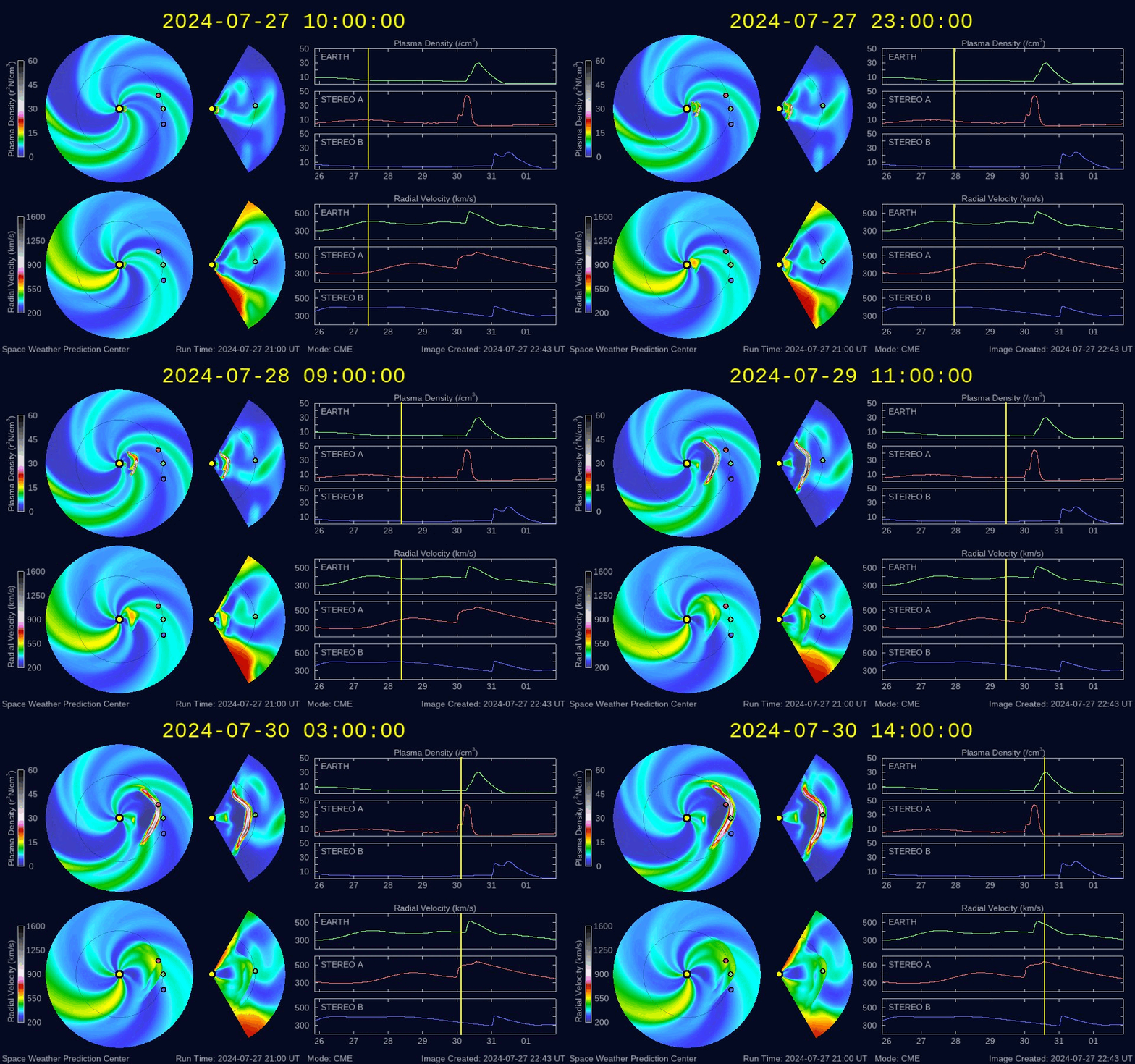
We've talked about cannibal CMEs here on the blog a few times, a term for when a faster moving coronal mass ejection overtakes a slower CME that started before the faster one. The resultant isn't just more material, the overtaking one compresses the original into a denser one capable of more impact on the Earth or wherever it hits. There's an even bigger than typical Cannibal CME coming in according to SpaceWeather.com.

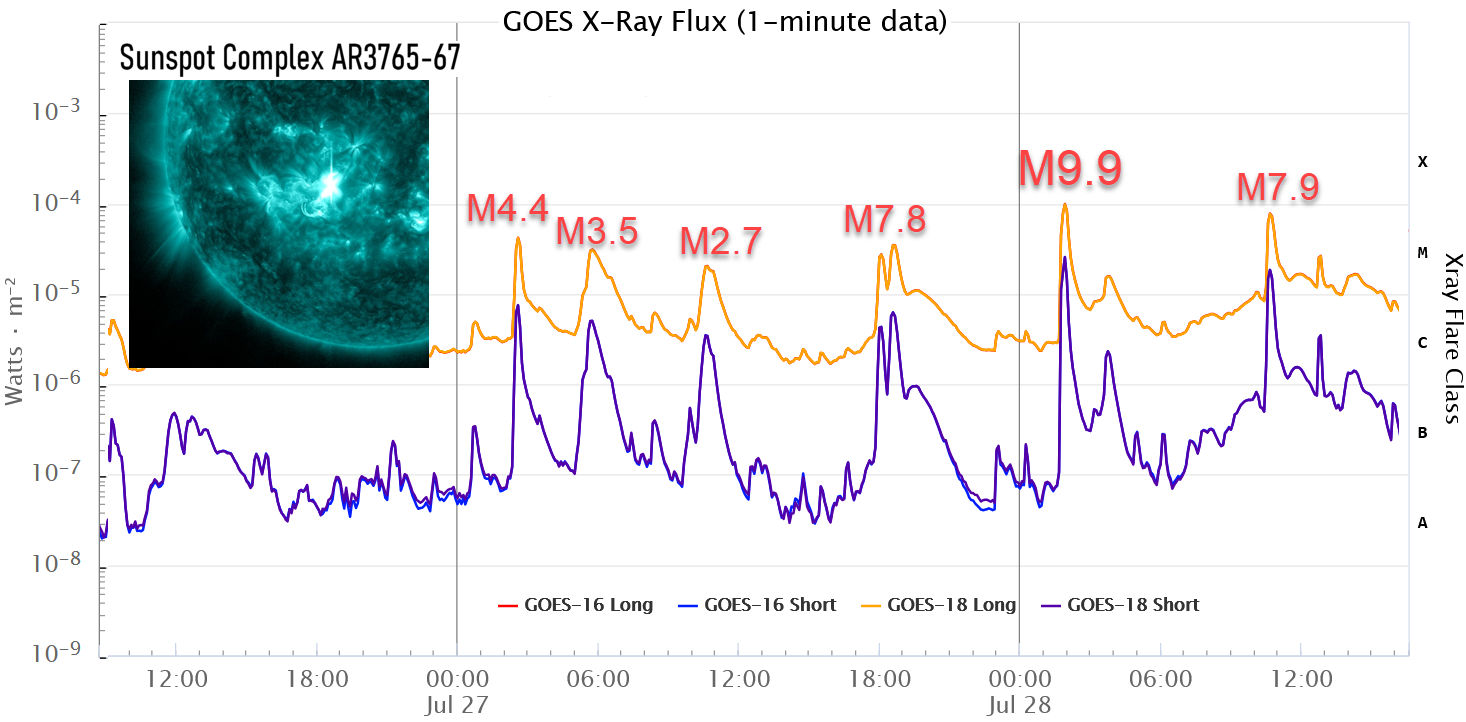
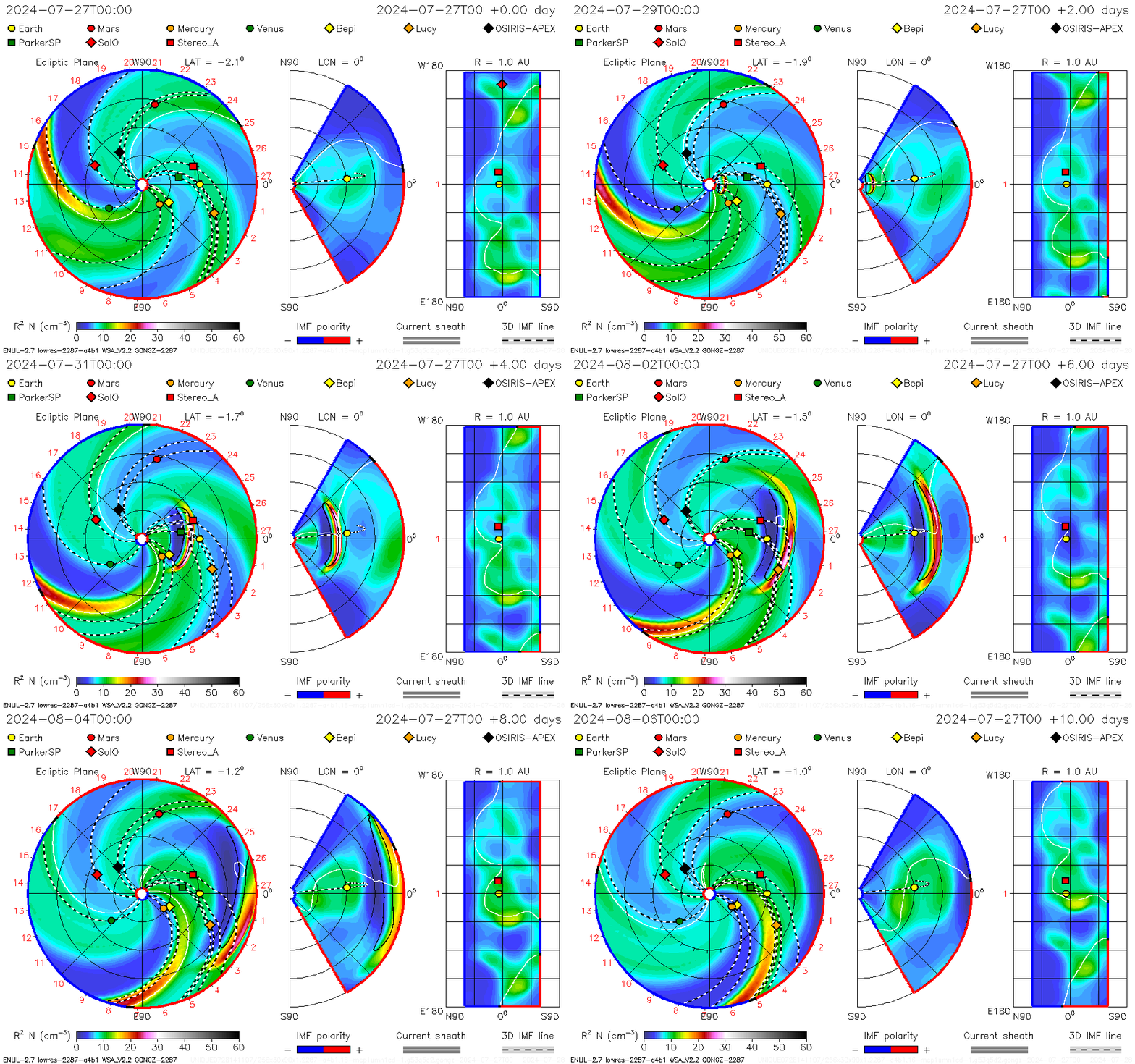
CANNIBAL CME ALERT: A series of M-class flares over the weekend hurled multiple CMEs toward Earth, as many as four or five. According to a NOAA model, the first two CMEs are merging to form a single Cannibal CME. Strong G3-class geomagnetic storms are possible when it reaches Earth on July 30th. Subscribers to our Space Weather Alert Service will receive an instant text message when the CME arrives.

Bonus: Watch NOAA's animated forecast model of the first two CMEs merging to form a Cannibal.

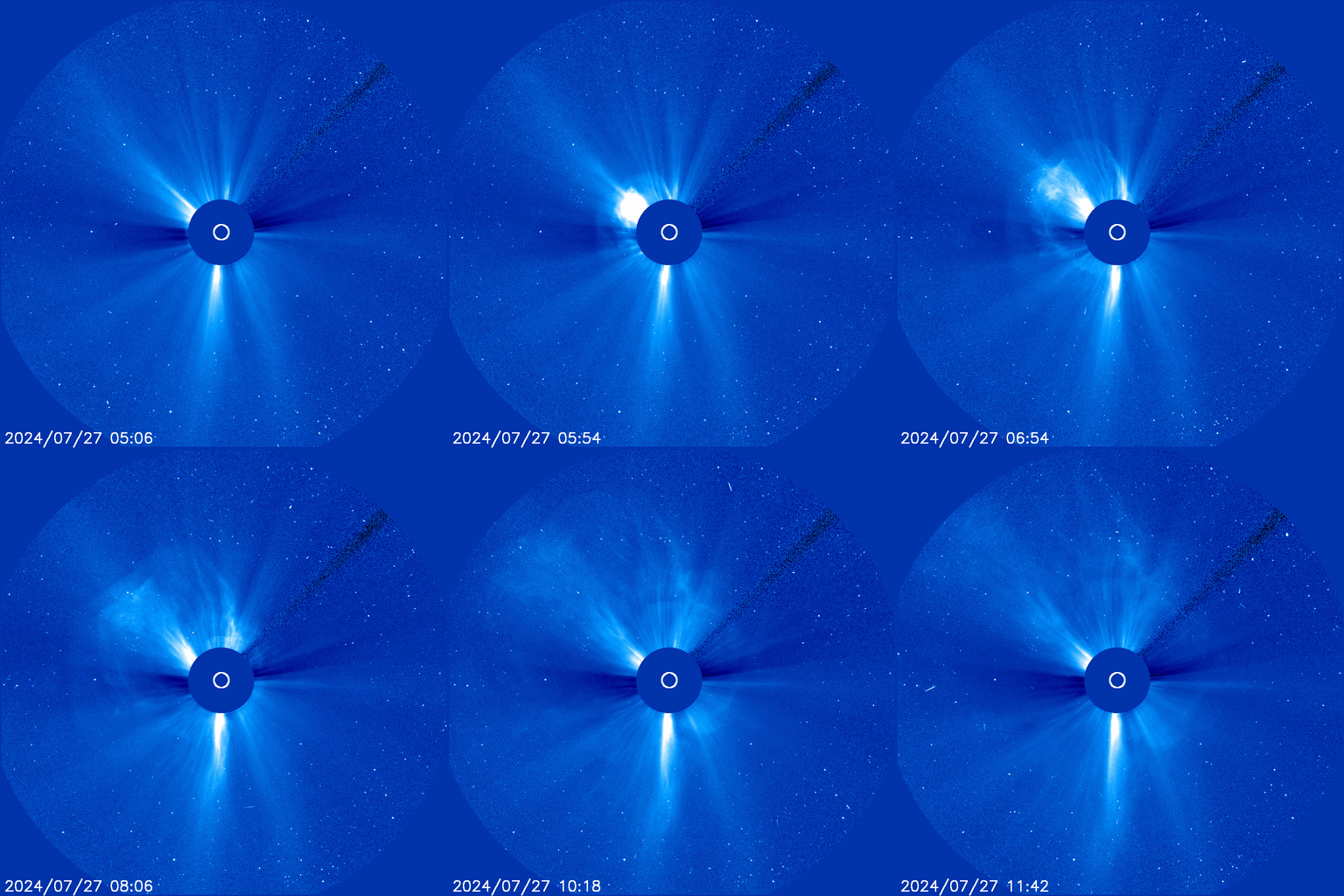
The Cannibal CME is clearing the way for perhaps 2 to 3 more CMEs following behind it. SOHO coronagraphs show a wagon-train of clouds leaving the sun on July 28th:

The first and most potent of these CMEs was launched by an M9.9-class solar flare from sunspot complex AR3765-67 on July 28th (0157 UT): movie. The CME will fly into a void created by the earlier Cannibal CME. With little interplanetary material to slow it down, the storm cloud should reach Earth no later than July 31st. A preliminary NASA model supports this forecast.

Even if the Cannibal CME fails to spark a strong geomagnetic storm on July 30th, the arrival of more CMEs on July 31st could push storm levels to category G3 (Strong) or beyond. This would set the stage for mid-latitude auroras visible from Europe and the USA.

You may have heard that on Tuesday, July 23, the sun launched the biggest solar flare of this cycle and going back to the early '00s (cycle 23) at X14. That flare isn't part of this coming potential storm because of the tremendous good luck we had in where the flare erupted from. It erupted from the far side of the sun and was pointed completely away from Earth. For comparison, the X-class flare that started the massive, historic G5 geomagnetic storm of early May wasn't as strong as the X14 from the far side; the flare on May 10 was X5.8. There were a few Earth-directed flares in those few days in May, but the strongest flare in early May was X8.8 and that was the strongest of Cycle 25 - until last Tuesday's X14.  


Plot of the solar flares around July 23rd's X14 flare. Solar Orbiter was over the farside of the sun when the explosion occurred on July 23rd, in perfect position to observe a flare otherwise invisible from Earth.

Geomagnetic storms like those being expected from the incoming CMEs are usually most evident in shutting down high frequency (shortwave) radio propagation. They can introduce paradoxical improvements in HF and VHF propagation, especially during periods when the geomagnetic K-index is dropping. We tend to look at the numbers posted of the planetary K-index (here, for example) and think of them as static or very slow moving, but much like wind gusts during any sort of storm, the K-index can go up and down on shorter time intervals than the three hour averages plotted there. 


Saturday, July 27, 2024

Falcon 9 Returned to Flight

As reported on Tuesday and updated Thursday, SpaceX had applied for permission to restart flying Falcon 9 missions, which was granted Thursday evening.

The launch was this morning, later than originally scheduled, 1:41 AM EDT launch as opposed to its originally scheduled 12:21 AM EDT launch time. This was the 17th flight for first stage booster B-1069, briefly orbital altitudes before returning and landing on Just Read the Instructions (JRTI) drone ship in the Atlantic Ocean about 8:15 later. A little more than an hour after liftoff, the rocket's second stage released its payload into a good orbit, confirmed by SpaceX on X, from which the Starlink spacecraft use their on-board thrusters to reach operational altitudes in the coming weeks. The second stage's second burn was the cause of the failure of the previous Starlink mission that caused the launch pause. 

Video of the launch through booster landing here.  

In Tuesday's post, I somewhat facetiously suggested that compared to "old space" instead of taking months to figure out what went wrong and how to fix it, that SpaceX would take, "How about twenty minutes? A half hour?" The official report is that "within hours of the anomaly" the issue and fix were announced and decided upon.

Engineers and technicians were quickly able to pinpoint the cause of the leak, a crack in a "sense line" for a pressure sensor attached to the vehicle’s liquid oxygen system. "This line cracked due to fatigue caused by high loading from engine vibration and looseness in the clamp that normally constrains the line," the company said in an update published prior to Saturday morning's launch. [Note: the update is dated July 25, second one down at that link. SiG]

This leak excessively cooled the engine, and caused a lower amount of igniter fluid to be available prior to re-lighting the Merlin for its second burn to circularize the rocket's orbit before releasing the Starlink satellites. This caused a hard start of the Merlin engine. Ultimately the satellites were released into a lower orbit, where they burnt up in Earth's atmosphere within days.

The sense line that failed is redundant, SpaceX said. It is not used by the flight safety system, and can be covered by alternate sensors already present on the engine. In the near term, the sense line will be removed from the second stage engine for Falcon 9 launches.

During a news briefing Thursday, SpaceX director Sarah Walker said this sense line was installed based on a customer requirement for another mission. The only difference between this component and other commonly flown sense lines is that it has two connections rather than one, she said. This may have made it a bit more susceptible to vibration, leading to a small crack.

While I feel somewhat chagrined at saying it might take SpaceX as much as a half hour to understand what went wrong and how to fix it, I wouldn't be surprised if saying it took "hours" might be an overstatement. It's easy to focus on the simple contrast between Falcon 9 and Starliner. SpaceX went into their period of launches being forbidden on July 11, when Starliner had been docked to the ISS for five days (July 11). Two weeks later, Falcon 9 is flying while Starliner is in exactly the same place. I think a slightly different way of looking at that is the overall numbers. That was SpaceX's 73rd launch of this calendar year. Just the familiarity of seeing everything a Falcon 9 does during a mission given the shear number of launches they do gives SpaceX an incredible advantage in spotting unusual things.

Before the failure on the night of July 11th, SpaceX had not experienced a mission failure in the previous 297 launches of the Falcon 9 rocket, dating back to the Amos-6 launch pad explosion in September 2016. The short interval between the failure earlier this month, and Saturday's return to flight, appears to be unprecedented in spaceflight history.

Screen capture from this morning's launch on SpaceX's launches page. Image credit: SpaceX 

To borrow a phrase, the weekend is young and SpaceX intends to do two more Falcon 9 launches tonight through tomorrow morning. The first will be at 12:17 AM EDT Sunday morning from SLC-40 at Cape Canaveral SFS. The second will be just over three hours later, at 3:24 AM EDT Sunday from SLC-4E, at Vandenberg SFB, California. Note that SFS is an abbreviation for Space Force Station while SFB is for Space Force Base. To grossly simplify, "Bases" have more facilities and resources than "Stations" have.


Friday, July 26, 2024

As We Teeter into August Where's Starliner?

As we collect ourselves to stumble into August, Starliner Crewed Flight Test 1 with Butch Wilmore and Suni Williams goes into day #51 of its 8 day mission to the ISS. Yesterday, NASA and Boeing representatives held a press conference to bring everyone up to date on the mission status, but it honestly didn't offer much new content.  

As a short refresher, there are two main problems; possibly related, possibly just coincidental. The spacecraft's reaction control thrusters overheated, and some of them shut off as Starliner approached the space station back on June 6. The other problem involves helium leaks in the craft's propulsion system that have been known about since before launch. 

We're not supposed to say that Starliner is stuck at the ISS or that the crew is marooned in space with no way home. Stephen Green, the Vodkapundit at PJ Media, openly wonders when it becomes acceptable to say these things

On Thursday, NASA and Boeing managers said they still plan to bring Wilmore and Williams home on the Starliner spacecraft. In the last few weeks, ground teams completed testing of a thruster on a test stand at White Sands, New Mexico. This weekend, Boeing and NASA plan to fire the spacecraft's thrusters in orbit to check their performance while docked at the space station.

“I think we’re starting to close in on those final pieces of flight rationale to make sure that we can come home safely, and that’s our primary focus right now," Stich said.

Stich acknowledges there is talk about bringing the crew home on a Crew Dragon, since there's one on the station at the moment (Crew 8) and another that will going up to the ISS in the next couple of weeks (Crew 9) but still says their goal is to complete the mission as intended, bringing Wilmore and Williams home on Starliner. 

They just don't know when that will be. You'll recall that the original 45 day rating the mission had was based on some degree of battery recharging, which was then allowed to double to being a 90 day mission. That means this mission can keep going to around the end of August.  

The most important of these tests was a series of test-firings of a Starliner thruster on the ground. This thruster was taken from a set of hardware slated to fly on a future Starlink mission, and engineers put it through a stress test, firing it numerous times to replicate the sequence of pulses it would see in flight. The testing simulated two sequences of flying up to the space station, and five sequences the thruster would execute during undocking and a deorbit burn for return to Earth.

"This thruster has seen quite a bit of pulses, maybe even more than what we would anticipate we would see during a flight, and more aggressive in terms of two uphills and five downhills," Stich said. “What we did see in the thruster is the same kind of thrust degradation that we're seeing on orbit. In a number of the thrusters (on Starliner), we're seeing reduced thrust, which is important.”

The thruster tested on the ground at White Sands Missile Range showed a similar degradation to that seen while trying to dock with the ISS - that's progress. The thruster that showed degraded thrust displayed bulging in a Teflon seal in an oxidizer's poppet valve when it was inspected.  The bulging was considered able to restrict the flow of nitrogen tetroxide propellant. 

"That poppet has a Teflon seal at the end of it," Nappi said. "Through the heating and natural vacuum that occurs with the thruster firing, that poppet seal was deformed and actually bulged out a little bit."

Stich said engineers are evaluating the integrity of the Teflon seal to determine if it could remain intact through the undocking and deorbit burn of the Starliner spacecraft. The thrusters aren't needed while Starliner is attached to the space station. 

More hot-fire testing is being set up for this weekend with the Starliner docked to the space station. 

"It’s a very important set of tests over the weekend that we’ll do," Stich said. "The hot-fire test this weekend will give us confidence in all the thrusters," Stich said.

Assuming good results this weekend, NASA managers could convene a flight readiness review at the end of next week to discuss the health of the Starliner spacecraft. If NASA's leadership signs off on the plan, Starliner could be cleared to return to Earth with Wilmore and Williams as soon as early August. NASA would like to have the spacecraft back on the ground before the launch of SpaceX's next Crew Dragon mission, currently slated for no earlier than August 18.

Time exposure of Starliner on orbit while docked to the Space Station. NASA photo

Unsurprisingly, this extension of the mission and these difficult problems will impact missions further out in the schedule. NASA had hoped the next Starliner flight, would be the Crew 10 mission carrying four astronauts on a six-month expedition at the space station, and would be ready for liftoff in February. Stich ruled that out in a press conference on Friday. The Crew 10 mission has been bumped onto a Crew Dragon, leaving the earliest possible crewed mission for Starliner looking to be six months later, or one year from now.