Showing posts sorted by relevance for query spending limit. Sort by date Show all posts

Saturday, May 13, 2023

I Hate Reruns

Nothing seems to be a bigger waste of time than to go the TV to see something I wanted to watch and then finding out it's rerun.  Especially if I've seen the show more than once and remember enough of the dialog to recite it along with the show. 

When I was starting this blog I tended to cover a lot of politics and a lot of economics - which means a lot commentary about the Federal Reserve and the insane politics of the Obamanoid years.  But covering the same stories and saying the same things over and over seemed like a waste of time.  Over the years, I had done a lot of "Techy Tuesday" posts, as well as a few series on technical topics and the shop.  At least some of those were very well received.  When the space programs visible from my yard started getting very active, I just naturally shifted in the direction of more technical topics and fewer political rants.  I first tagged a post with the label "space" in May of 2019.  I'm fairly sure I'd written on space topics before that, but that idea is harder to find.

So why do I bring this up tonight?  To introduce a rerun, of course!  Not a full column, but the critical ideas I've been writing about for the life of the blog. 

In the last few weeks, there has been almost a constant replay of a topic I've written about almost since the first year of this blog: the recurring disappointment of the "debt ceiling".  This wasn't a topic every  year because the debt ceiling isn't approached every year.  As I pointed out many times,  

The biggest lie, however, is that there's really a debt ceiling at all.  There hasn't been one time since the debt ceiling became law in 1917 that the ceiling has been reduced.  It's either raised, or suspended - which pretty much means raised - every time the limit seems like a hard limit.  If every time the ceiling becomes a restraint the ceiling is raised or ignored, how can they claim to have a ceiling?  Does it create even the smallest amount of restraint of spending in the congress?

In 2015, I added this:

Six times in history, they didn't pass the debt ceiling increase in time, and the country continued to run without going into default.  Either that, or they simply ignore the ceiling and allow the Treasury department to use "extraordinary measures".  If you or I did that, instead of "extraordinary measures" they would say we "lie, cheat and steal".   In July of 2013, I did a story on the Treasury Department's spending clock suddenly stopping from May of '13 until the debt ceiling got raised.  Newsflash: the spending didn't stop; they just lied about it.

The next big lie is "we're going to go into default."  Again: bullshit! 

This week's bullshit is that restraining spending so that our budget remains under the debt limit means the government goes into default.  That is not default - by definition.    Default would be refusing to pay the payments due on our debt - the interest on the debt.  Rather than default, this would be better called "living within their means" or "being responsible".  We will not default unless the administration chooses to. 

The Debt Clock tells me that the Time Of This Writing, the interest due on our national debt is roughly $568 billion.  The Federal Tax Revenue is $4.61 trillion, meaning the interest on the debt is 12.3% of revenue.  Only a fool, or someone deliberately trying to destroy the "full faith and trust" in the dollar would choose to not pay the interest on the debt.  Holding the spending limit where it is would not affect that at all.  I'm not saying they wouldn't do it, I'm saying that only a fool or someone deliberately trying to destroy the dollar would do it.  The more people who know they're trying to destroy us the less likely they are to do it openly.  

Then there's the whole idea of government shutdown.  I think I only heard one mention of that - so far.  When you see those words just cross out government shutdown (did it for ya) and write "paid vacation" for the lucky Fed.gov 's nonessential workers.  That's all it is. 

The longest government shutdown ever was 35 days between December of '18 and January of '19, under President Trump.  The essential workers had to work without pay until the deal was made and their pay could be issued and that must have been tough.  The result, though, was that while they suspended the ceiling, the debt kept going up.

So why do we go through this crap every time the subject comes up?  Political theater.  Kabuki (overly dramatic) theater.  They drag it out to the last minute so they can look like heroes.  If they shut down the Fed.gov, so what?  Those workers get their time off and their pay, so it's "no harm? no foul."  Feel sorry for them?  I think if one works for fed.gov, one should have a savings buffer of a few weeks to ensure you can buy your groceries in the even of shutdown.  It's not like nobody knows a shutdown is coming. 

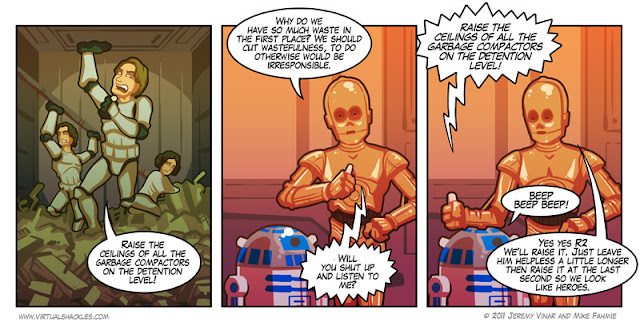
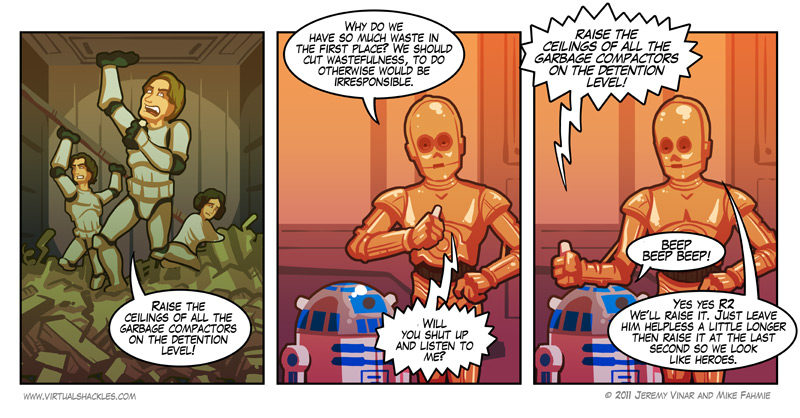
There's a cartoon I've been running for years, almost every reference to the debt ceiling since 2013, that I really think sums up the whole story.  In a way, a Star Wars parody reference.

Yup.  They drag it out as long as they want, make it sound as dire as possible, all so that they can look like heroes, as in the last panel.  I went to the credit, in the lower left of the cartoon and the web site appears to be gone, with just a place holder there.

Oh, yeah.  I also reference to the Trillion Dollar Coin Scam, too.  Yeah, Divemedic said he saw that in the last couple of weeks.  Can't leave any piece of LCS theater untouched. (Where LCS = lying, cheating, stealing)  We're on Modern Monetary Theory now, and it must be unethical to ask them if that has ever worked anywhere or any time in human history because not one reporter has asked that.  


Friday, June 14, 2019

The Days of Trillion Dollar Deficits Are Returning

During the Obama years, deficits of a trillion dollars were not uncommon (example).  You may think that the economy is fundamentally different today, and that annual deficits are shrinking.  Despite that fact that Trump's tax cuts led to record tax revenues, it looks like we'll be close to a $1Trillion deficit for this fiscal year.  Maybe over that.  We'll hit the trillion dollar limit if the next four months of 2019 transpire along the same average spending per month as the first eight months did.
The gap between the amount the government takes in and spends came in at $207.8 billion last month, the Treasury Department said (pdf) Wednesday, nearly 42% higher than a year earlier. The increase happened in part because of June 1 falling on a Saturday, a non-business day, meaning some benefit payments were made earlier than usual.

Lawmakers typically try to reduce the deficit when the economy is strong, but recent legislation has taken it in the opposite direction. In the first eight months of the fiscal year, the deficit increased about 39% from a year earlier to $738.6 billion.
Let me show my work.   Eight months is 8/12 or 2/3 of the year.  Multiply the deficit through eight months by the reciprocal of 2/3 (3/2) to extrapolate the same spending rate to the year and your calculator tells you $1.1 Trillion deficit this year.  It's not a great way to determine the deficit for the year because each month doesn't necessarily have the same spending as every other month - but it gets you "close enough".

As a matter of interest, while looking for some background information on this topic, I ran into a piece I posted in February of '18, "Ron Paul Was Right" that offered a prediction for this year's deficit that's remarkably close to what I just derived.  The article started with a quote from Senator Paul saying that the government spends closer to $2 Million/minute.
The Committee for a Responsible Federal Budget (CRFB), an independent think tank, projects that the deficit for FY '19 will balloon to $1.2 trillion in FY 2019, or $2.3 million per minute.
I don't know exactly whom to pin this deficit spending on.  The House starts spending, and they're all Nancy's little babbling numb nuts.  The Senate is in Stupid Party control, where spending bills can be modified, and President Tariff keeps talking about adding a trillion dollars of spending on infrastructure - although there are no real details to relay to you. 

In the end, it probably doesn't matter who did it because the pattern over the years is that the party out of power complains about deficits and spending until they get power, and then the roles switch.  Now the party out of power has economists telling them it doesn't matter and they can spend whatever they want.  They can't run out of dollars like the football stadium can't run out of points.  When they eventually get power back, it's going to be a fun experiment to watch.  From another planet. 

I tend to believe that things that can't go on forever won't go on forever and that all bubbles pop.  Eventually "political reality" collides with real reality.  There is a real world, with real consequences.  It's not all in our minds.  Economic collapses happen around the world all the time.  I've been predicting one for nine years, now.  So don't look at me. 

One thing is certain.  With record tax revenues, that's a vivid demonstration that it's not that we don't tax enough -- "It's the spending, stupid!!"

(I have to admit the way I report on economics isn't as ... interesting to read as John Wilder, who puts his economic plots on pictures of girls in bikinis)


Friday, December 13, 2013

The Budget Deal

Conclusion: crap sandwich.  It doesn't do anything to correct the unsustainable, financially destructive course we're on.  Continue to prepare for the coming economic collapse or dark ages or whatever you want to call it. 

You've got to know that the chances of a responsible budget deal getting done in DC are about the same as freezing to death in a Florida August, and this bill proves it.  The tiny cuts of sequestration are reversed and spending increases discretionary spending by $26 Billion next year.  It cuts the sequester reductions by $63 B over the next two years.  There is a promised spending reduction out in in the future.  They always promise to do things after they're out of office, or "in 10 years".  Very few details are available.  Some are here. 

Most importantly, it doesn't go after entitlements or any of the real problems.  It essentially raises spending by fees (a tax by any other name...)  I'm sure you've heard about the TSA fees more than doubling; it also raises Customs and Border Patrol users' fees.  It cuts benefits to military retirees who are still "working age".  The modern definition of working age: alive.  Not really.  They mean under 62.

The ugly truth is that with the evil party in strong control of over 2/3 of the fed.gov, you're lucky to limit the damage to small increases in spending.

The cure for our economic problems is economic growth, and the way to get that is cut government spending and regulations drastically.  Send the Fed.Gov home.  There is no information I can find on the income side of the equation, but with discretionary spending of $1012 billion, that means the total spending when you include the nondiscretionary side is going to have to approach $4300 Billion ($4.3T) and with the kind of revenues we've had lately, we're still deficit spending at least half of that. 
(source)

I guess I can count on not getting a Christmas card from John Boehner.

Good.  I hate sniveling.


Thursday, August 11, 2011

A Conversation With My Senator

I received an email from one of my US Senators today, Bill Nelson, D, in which he posts his “Common Sense” ideas on how to get out of our financial mess as published in Politico.  For a member in good standing of what many refer to as the Evil party, not what we call the Stupid party, he sure dispenses plenty of stupid.  As anything I say would never be read by the Gentleman from Florida (as they say up there),  I thought I'd fisk this here for tonight's amusement.  I will leave his pearls of wisdom in black text, and add my comments in blue. 

Close the tax loopholes
By: Sen. Bill Nelson,

"There’s no mystery about what we have to do. It’s just common sense. In addition to the spending cuts Congress just made, we need tax reform. And by tax reform, I mean closing loopholes, special interest tax breaks and corporate subsidies. It’s just plain wrong to be protecting tax breaks for oil companies and to be rewarding businesses that ship jobs overseas." - Sen. Bill Nelson

After watching Standard & Poor’s performance in the Enron and housing debacles, it’s hard to stomach their decision to downgrade America’s credit.

Meh.  Complaining about S&P's performance is like TV producers complaining about Neilsen ratings.  You may complain all you like, but it's what the industry uses.  In truth, we've been degraded by other agencies, almost a year ago by the Chinese equivalent of S&P, and nobody over here said a word.  Frankly, I think S&P was right. 

But even coming from S&P, there is a message we should hear: The finger pointing and hyper-partisanship has to stop. If it doesn’t, we really will be on the road to ruin.

Democrats need to see tea partiers as something other than debt-limit hostage-taking Republicans. And Republicans need to see President Barack Obama and Democrats as something other than big-spending socialists.

We’ve got to stop this attack madness. We have to bring civility back to the public square. We have to put the country back on the path to fiscal sanity.

To do that, we need to cut some $4 trillion to $5 trillion. We made a down payment on this with the $2 trillion dollars we cut just last week. Now we need to go further.

I believe you're suffering from what the doctors call “premature congratulations”.  Your vaunted plan will not affect the big picture because that $2 trillion is in a 10 year plan and doesn't start for another three years (2014).  We need to cut much more than that. Here's a before/after graph with and without your cuts:

To understand what we have to do, though, we first need to look at how we got here.

We went from a $236 billion budget surplus in 2000 to a $1.3 trillion deficit last year — and a record $14 trillion debt. A huge chunk of the debt comes from the wars in Iraq and Afghanistan. We’re bringing the troops home.

It's been reported that the total cost of those wars is about $1 Trillion.  Too low?  Let's triple that and say we spent $3T.  3/14, or 21%, is not a “huge chunk” in my book; huge starts at around 2/3 or 3/4.  “It's the spending, stupid”, and stupid spending at that.  But I tell you what: if you went back to the spending levels of 2000 the problem would go away!  Don't want to do that?  Didn't think so. 

The implication here is the old “it's all Bush's fault”, which is a fantasy.  Bush was no fiscal conservative, and had many bad policies (which, strangely, have all been retained by Mr. Obama) but the deficit for this February was more than the entire year of 2007!  There is simply no equal in history for the deficit spending of this administration. 
Another significant piece stems from the Bush-era tax cuts. Warren Buffett, chairman and chief executive officer of Berkshire Hathaway, says the tax cuts for the wealthy should be left to expire. They’re set to do so at the end of next year. We should let that happen.

First off, I hate to break your bubble, but Buffett is a has-been. I have done quite well with my meager 401k by doing the opposite of whatever he suggests. 

There is a persistent confusion of tax revenues with tax rates, which you seem to fall into, Mr. Nelson. The two are not directly related in the mathematical sense. If you raise rates, people can be relied upon to change their behaviors and revenues can fall – or, at a minimum, don't go up as much as you expect.

The historical limit on tax revenues as a percent of GDP is around 18-19%, regardless of tax rates.  Revenues are currently lower than that for a simple reason: the economic downturn is reducing the national income just as it has reduced the income of so many citizens. The emphasis should be on trying to create conditions that lead to job creation to push that revenue up, and raising taxes just isn't one of those. Never has been, never will be. 

See Hauser's Law in your favorite economics textbook.
(Hauser's Law from the Peter G Peterson Foundation)
Or, as a converse, when rates are low, the “rich” can pay more revenue, as in the fact that currently, the top 1% pays more than the bottom 95% combined.  Which leads to the very simple question: since the top 1% of incomes pays more than the bottom 95% of incomes, what is their “fair share”? You don't have much to choose from. 96%? 97%? Should the top 1% pay for everything? If so, I don't want to live in your world.

Agree or not, don’t you think most Americans were better off before the tax cuts than they are now?

Nope.  They were better off before the housing bubble burst, blown quite deliberately by the Federal Reserve, aided and abetted by the Congress. 

Much of the rest of the debt comes from the economic downturn since 2008. That brings us to today. And there’s no mystery about what we have to do. It’s just common sense. In addition to the spending cuts Congress just made, we need tax reform. And by tax reform, I mean closing loopholes, special interest tax breaks and corporate subsidies. It’s just plain wrong to be protecting tax breaks for oil companies and to be rewarding businesses that ship jobs overseas.

The other word for “loophole” is “law”; a loophole is a law that someone whom you don't like is obeying.  You guys write the laws, so those “loopholes” wouldn't be there if you hadn't put them there.  Oil companies get fewer tax breaks than any other industry and are being punished as it is. And the reason companies move jobs overseas is that our tax system is the worst in the world. Maybe if congress grew up and realized that businesses don't pay tax, they simply collect it from their customers (that is, from you and me), and drastically reduced our corporate tax structure, you'd attract companies here from all over the world. 

As chairman of the Senate Finance Committee’s Fiscal Responsibility and Economic Growth Subcommittee, I’ve scheduled a hearing for early September to investigate closing many of these loopholes. Doing so will likely generate $2 trillion over the next decade. Add that to the $2 trillion in spending cuts we’ve made — and we’re in the $4 trillion range that we need to hit. It’s time to stop the shouting and bickering and political attacks. It’s time to show the world that America can take care of business.

Here's a few ideas for your consideration: we've deficit spent over 2.2 Trillion in failed stimulus, TARP and other ineffective programs. What if we said there was to be no income tax at all next year? The cost would be about the same as what we've spent.  We'd borrow 100% of spending instead of 43% of it, but with some discipline, perhaps we could just get it down to doubling what we now borrow. 

Do you think that would stimulate things, if everyone kept their taxes and spent it on whatever they want? Or do you think people would rebel when they had to pay taxes the following year? 

No good? How about if we eliminated corporate taxes, since they don't pay tax anyway. If that's too radical, how about if instead of having the highest corporate taxes in the world, we had the lowest? Do you think that might give some foreign companies a desire to move here? Do you think some American companies might want to “in-source” more into our country? 

It's a law of economics that if you want less of something, you tax it, and if you want more of it, you reduce taxes (or give other incentives). If we want more jobs, we should cut corporate fees, and taxes. 

And if you really want to increase tax revenues (not rates!), have you looked at the Fair Tax people? Of course, you and I both know, that the purpose of the tax code isn't to raise revenue.  One purpose is to punish behavior you don't approve of and reward behavior you do approve of. Social engineering. The other purpose is to reward the people you like with loopholes that they can use.  The tax code hasn't been about revenue in a long time - if ever.


Cordially,
SiliconGraybeard

Sunday, February 26, 2012

Econo-Matrix Update

Today, Ann Barnhardt linked to an excellent video by Karl Denninger (link to the video on YouTube) and another frequent stop on my visits along the inter-toobs, Bayou Renaissance Man had an excellent summary of much of the economic situation which is well complemented by that video. 

My new header specifically talks about living after the collapse - which obviously means I'm certain a collapse of some kind is coming.  BRM quotes analyst John Mauldin who believes "the government will rein in spending, either rapidly or over time, but in such a way that it begins to reduce the debt. This will mean years, perhaps decades, of real economic pain, but will restore the budget and the public purse to a healthier state."

I wish I could be that optimistic about it.  Look around - do you see any statesman-like leaders who will be willing to be unpopular, one-term leaders to get us out of trouble?  Do you see any evidence we can get compromise?  Look no farther than last fall's "super committee".  Here's a group tasked with cutting an absolutely trivial amount - 3% - out of our spending and they couldn't do it.  They were tasked with cutting 1.2 Trillion dollars over 10 years: that's 120 billion in this year if you just divide by 10 (and I bet they don't: I bet it was stacked toward the end of that 10 years).  Our revenue is about 2.2 Trillion so it's 5.5% of the revenue; but less than 3% of spending!  Most people could handle a 3% cut in their spending if they had to, by tightening their belts enough, and they probably have in the last year.  The fed.gov probably looses that much without even noticing it, like a toddler dribbling turds out of Pampers. 

The fact is, we need to cut more like that $1.2 trillion this year, not over 10 years, and even that won't balance the budget.  The recently submitted Obama budget - which will never see the light of day because Harry Reid in the senate refuses to pass a budget - had a $1.33T deficit this year.  We need to run surpluses as far as the eye can see to pay off our deficit.  We need a government that is structurally fundamentally different. 

The fact is, we may not have 10 years; I don't believe we have more than a couple.  As was pointed out earlier this week, our per capita debt is 114% of Greece's as well as that of all of the PIIGS.  BRM's post shows a chart from Zerohedge showing the Chinese have been getting out of US debt since last summer, but really slowed their buying in the last quarter.  I've pointed out many times before that China is using their mountains of dollars to buy mines, commodities, everything they think they need.  Russia has dropped their amount of US debt by 50% since October 2010.  In the last year, the buyer with the biggest increase in their buying of US debt has been the Federal Reserve Bank.  Simply put, we are writing checks to ourselves to deposit so that we can write bigger checks. 

(source)
How can this go on?  How is this different from the old joke T-shirts that said, "what do you mean I'm broke - I still have checks?"  Or the belief that as long as our credit cards haven't been revoked we're still fine?  Now, it's possible that if we started acting like world leaders instead of pigs (note the missing "I"), and cut our budget by the $1T Ron Paul says he'd cut, these countries might decide that we're safe to invest in, and would be willing to buy bonds again.  Analogies to alcoholics or druggies swearing to be better if we'd give them "just one more chance" come to mind.

Earlier in the week, I heard an NPR program that, as always, confuses tax rates with tax revenues as if they're the same thing and raising rates automatically raises revenues.  Almost as a bonus, today on TownHall.com, the Political Calculations blog posted a cool analysis of Hauser's law and put it all on one nice graph. 
With a few short-lived exceptions, it's obviously true that tax revenues are essentially constant (as % of GDP), regardless of tax rates.  That can only mean that when taxes are higher, the GDP contracts.  The government doesn't collect any more money because there's less to take a portion of.  When taxes are lower, they take a smaller percentage of a bigger pie, giving the same percent of GDP as tax.  Empirically true based on measured data.  Given that, why would one choose higher rates over lower rates?  Higher rates are punishing, if not outright confiscatory, so if the Evil party really wants to jerk up rates on taxpayers (and they are doing it January 2013, unless it's revoked) it can only mean "I want to punish those rich people so badly, I'm willing to hurt myself to hurt them".  That's only makes sense if your aim is to grow government no matter how many people you hurt. Frankly, it's psychotic.

Hauser's Law presents a natural limit to the size of the Fed.gov hydra.  Maybe it would be 18% of GDP in the long run, but for the foreseeable future, spending should be limited to 15% of GDP, so that a surplus could start to work its magic.  Note that's bigger cuts than a balanced budget requires - and you know how even talking about not increasing payouts, let alone cutting them, causes the Free Sh*t Army to howl like they're being fed into a chipper/shredder.  Seen any pol with the guts to do that?

I don't hear a popular call for this sort of spending reduction.  The TEA parties did, for a while, but I think they've been cowed into not gathering and expressing their views anymore, letting the media's howling about how racist and terrible they are win the argument.  Seen any TEA party demonstrations lately?  For every one of us who says, "I always thought social security would not be there for me and I saved for my own retirement", I hear a larger number saying, "that's my money!  I paid that and you said it would be there!"  I hear some talk about it among stupid party voters, but the fact that Romney still appears to be in the catbird seat for the nomination tells me it's not serious, yet. 

As a country, we don't seem to be willing to face our problems.  As I've said before, here's what I think is coming. 
A marriage of convenience between zero-government anarchists and total-government socialists, [occupy] seems to go back to a talk by an SEIU vice-president last spring, but was not predicted.  Occupy got enough good will from the Evil party - and even some III patriots - that you can expect them back when the weather warms a little.  The potential I see is for them to act up so badly that the (bankrupt) cities can't handle the expenses.  Perhaps they assassinate a politician they don't like, or duplicate the Chicago 1968 DNC riots (they call for it here).  The (bankrupt) cities beg the (bankrupt) feds for help, and the National Guard is called up.  Martial law is enacted, giving the fascists the chance to surround the white house with tanks and address the (right wing) domestic terrorism problem.  This could make the last presidential election The Last Presidential Election. 
A self-identified occupy protester is already writing publicly about shooting up Wall Street.  Goes with the above, doesn't it?  A recipe for blood in the streets and the collapse by next Fall?  I report, you decide.  

Sunday, January 27, 2019

The New Economic Theory Behind the Entire Democrat Left Wing

There's a new theory behind the rantings of Bernie Sanders, Alexandria Occasional Cortex and the leftward running Democratic presidential candidates.  Well, actually, it's not new.  And it kind of dignifies it to call it a "theory".  It's a particularly stupid idea, which is to say it's to do what they always do: just keep spending what you don't have.  They just gave it a name they can hide behind.

Hat tip to 357 Magnum for the link to an article on Modern Monetary Theory (MMT).  "The Worst Economic Idea Since Socialism - Explained Using Bikini Girl Graphics" at Wilder, Wealthy and Wise. I hope it's obvious that you don't do an article on economics explained by graphs printed over pictures of girls in bikinis without the required amount of goofing around and lots of snark. 
The main idea of MMT is that since government creates money there are exactly no limits to how much money government can create.  Back when money was backed by gold (say, with one ounce of gold being worth $20) there was a physical limit – by definition you couldn’t have more $20 gold coins than you had ounces of gold.  MMT says, “Hey, since Nixon took the world off of the gold standard, we’ve been making up this money stuff anyway.  So let’s go all in.”  This is not exactly like a drunken 21 year old with Mom and Dad’s credit card in Las Vegas.  Not exactly.  The credit card has a credit limit.

So, under MMT, there is no limit to how much money government can print.  The genius idea (from Bill Mitchell, an Australian economist who came up with the name “Modern Monetary Theory”, and whose dog’s name is “Dog” and daughter’s name is “Girl”, and whose pet name for his wife is “That Woman On The Couch”) is that there is also no limit to the amount of money that government can spend.  This is Alexandria Ocasio-Cortez’s high school prom fantasy where Justin Bieber picks her up in a pink helicopter and makes her all warm in her special place.  Oh, and by special place I mean other people’s wallets:  this is a family-friendly blog, get your mind out of the gutter.  The implications are stunning.  “Why not just pay for everything?  The government can just print the money, right?”

We're not making this up.  She actually said this - and then she said the world was going to end in 12 years and we "just pay for" whatever it costs to meet the "Green New Deal" dream costs, too.

Getting back to the Modern Monetary Theorists, this is deep thought, folks.  Mitchell actually uses an example to try to correlate money created by QE to the number of points football teams can score in a game.
An analogy used on a website that promotes MMT is that football referees don’t have a limit to the number of points that can be awarded during a football game.  There’s no requirement that they come from somewhere, and giving someone else a point doesn’t take a point away from you.  Therefore points are infinite and don’t change the way the game is played.
How does this relate to money?  What?  Are you some kind of hater?  It's some sort of tortured, brain-dead, logic.

People don't have enough money?   Just add a zero to every printed bill and instantly people have ten times as much money!  Never mind consequences, there won't be any because they say there won't!  Dr. Mitchell thinks we can have all of this infinite money and low interest rates.  We just need high taxes to take the excess money out of circulation... so government can buy something or other.
You see, Marx’s theory (as well as MMT) both incorporate a fascinating idea – that the value of an item is based on the inputs that it takes to make the item.  So, from that standpoint, our armpit-hair artisan should be able to charge the cost of her Xir schooling (plus that summer in Europe with Marco!) and her Xir apartment and food cost for that armpit hair sculpture.  It is that valuable.

Real world economics that don’t result in economic collapse and the starvation of millions of people would disagree.  An armpit hair sculpture is worth only what someone is willing to pay for it, and not a penny more.  It’s a market, and it’s based on free exchange.  It’s that simple idea of the market setting the price that makes capitalist economies work.  And it’s the brutality of the market that ensures that armpit-hair artists have to have a real job actually producing things that people want.  Like coffee.
There has to be a balance between mocking this and emphasizing that people trying to run the entire country really believe this.  Don't think it's not popular to run on the idea of "infinite free stuff for everyone"?  Have you been watching lately?  As Wilder, Wealthy and Wise put it.
Ideas like MMT seem to be too good to be true because they are too good to be true.  They always end in failure, poverty, and human suffering.  Thankfully they can use that taxation sponge to soak up all the blood after the revolution.

(Another link from 357 Magnum - this time to CNSNews.com)


Saturday, October 24, 2015

Bad Memes Are Like Zombies

They keep coming back.  This week's bullshit is that restraining spending so that our budget remains under the debt limit means the government goes into default.  That is not default - by definition.    Default would be refusing to pay the payments due on our debt - the interest on the debt.  Rather than default, this would be better called "living within their means" or "being responsible".  We will not default unless the administration chooses to.  The Fed.gov will get approximately nine times more tax revenue than the interest due, so we don't default unless congress chooses to spend the tax money on the equivalent of hookers and blow instead of paying the debt.  According to the Fed.gov themselves, this fiscal year our interest on debt is $402,435,356,075.49 or to put it more conveniently, $402 Billion.  Estimating the federal income tax collected through the end of the year based on the Debt Clock shows tax revenues will be $3637 Billion, almost exactly nine times the amount needed to avoid default.  

I know I've written about this endlessly in the five years I've been blogging, but I'm pretty sure I have a lot of new readers and I have to assume they haven't read the many posts I've done on this.   (Example from four years ago)   Let me recap a little.

First, although they're going to make a big deal about the debt ceiling, I believe that the US effectively doesn't have a ceiling at all.  I say that because there isn't one time in history that we've  held the debt ceiling in place.  Whenever it comes up, our "representatives" sainted leaders vote to raise the debt limit.  Six times in history, they didn't pass the debt ceiling increase in time, and the country continued to run without going into default.  Either that, or they simply ignore the ceiling and allow the Treasury department to use "extraordinary measures".  If you or I did that, instead of "extraordinary measures" they would say we "lie, cheat and steal".   In July of 2013, I did a story on the Treasury Department's spending clock suddenly stopping from May of '13 until the debt ceiling got raised.  Newsflash: the spending didn't stop; they just lied about it.
Second, I believe that since they go into these times knowing with 99.9% certainty that they will raise the ceiling, this is all theater so that each side of the two-headed ruling class monster can claim to be heroes to their supporters. 
So what's the big picture:
  • This is all theater
  • They're going to raise the ceiling because they don't have the restraint of a drunken sailor, who, after all, stops drinking when he's broke.  
  • The government is not really going to shut down and it absolutely isn't going to get smaller in any meaningful sense because to do that would hurt the ruling class.  
  • Corollary: the only way the government shuts down is if one side or other believes they get a lot of political points by doing so.  I actually think the president wants a shutdown so that he can shame and blame the Stupid party.  The Stupid party is actually so stupid they think they can make points in the press that it's the president shutting it down.  
  • The president says that these discussions may lead to another 2008 economic crisis: find me someone who says debt ceiling discussions had anything to do with it.  As you can see from the above graph, the debt ceiling ratcheted up without interruption throughout that time period.
  • This only ends when the world decides to stop putting up with our stupidity and stops using dollars.  This is not just theoretically possible, all the major players are moving in that direction now.  That could happen this year or not for a few years to come.
As I say, I've written an acre of posts on this.  I just felt obligated to pass on a few points for new readers and new liberty-minded people. 


Wednesday, May 1, 2024

NASA Looking for Funding to De-Orbit Space Station

On one hand, de-orbiting the ISS isn't going to be hard. Get everyone and everything that's valued in any way out of it and stop those periodic missions to lift its orbit. It'll come down eventually. As the song says, "what goes up, must come down."  

Oh, wait. You want a controlled de-orbiting? Not like the way China does these things, but controlled so we can have a pretty good chance of not killing people or breaking valuable things on the ground? Well, that's gonna cost you. 

A roundabout and satirical way of introducing the story that NASA Administrator Bill Nelson is lobbying congress for more money to de-orbit the ISS.  The real problem is that some congress critters with some common sense are trying cut spending and Nelson can't see a way to do all of what NASA wants with the spending caps he has been faced with. 

The caps, in place for the 2024 and 2025 fiscal years, limit non-defense discretionary spending and were part of a deal enacted nearly a year ago in the Fiscal Responsibility Act to raise the debt ceiling. “These two years, ’24 and ’25, NASA has been cut between the two years $4.7 billion from our original request,” he said. “That’s going to have an effect on some of the contracts at all NASA centers.”

NASA, in its fiscal year 2024 budget request, sought $27.185 billion for the agency and projected requesting $27.729 billion in 2025. NASA received $24.875 billion in the final 2024 appropriations bill enacted in March and is requesting $25.384 billion in 2025, a difference of nearly $4.7 billion from the original projections last year.

In particular, this circles around a project called the United States Deorbit Vehicle (USDV), a spacecraft NASA plans to develop to handle the final deorbiting of the International Space Station at the end of the station’s life. That's been talked about as being 2030. 

NASA had requested $180 million for USDV in its fiscal 2024 budget request and $109 million for it in the 2025 request. Nelson, though, told members NASA wanted to get full funding for the vehicle as part of a domestic emergency supplemental spending bill proposed by the White House last fall for disaster relief and other purposes, but yet to be considered by Congress.

First thought: Bill, don't let the SLS folks near this. You want $289 million over two years? I know that can't be anything but a study, so don't let the SLS team touch those studies. Their version of the USDV will cost billions more than they bid and left to themselves it wouldn't be ready until 30 years after the station comes down randomly on its own. 

Second thought: don't go with the argument that we need this to protect us from Putin. It's a pretty sad line that reeks of a lack of imagination.

“Why is it an emergency?” he said. “Because we don’t know what Vladimir Putin is going to do.”

He suggested Russia might terminate its role on the ISS early or decide not to participate in the controlled deorbiting of the station. “We don’t know what the president of Russia is going to do, and we could be in an emergency situation that we have to get this structure that is as big as a football stadium down, and down safely, in 2031.”

NASA Administrator Bill Nelson, April 30, in congressional meetings. Image Credit: NASA/Bill Ingalls

For those who don't know, Bill Nelson used to be our local US representative and lived somewhere not too far from here on "the Space Coast." The first place we ever saw him was in a church in the northern part of Melbourne. He's a schmoozer, a politician. Don't depend on him to make difficult decisions. He can, however, put together a team of bright, accomplished people and let them make the decisions he can't.


Monday, July 18, 2011

Nice To Have Backing

Hat tip to Bayou Renaissance Man for a link to Mark Steyn's Article on National Review Online, and a sobering paper by a couple of economists named Kitchen and Chinn.  Kitchen is from the US Department of the Treasury and Chinn is from the School of Public Affairs; and Department of Economics, at the University of Wisconsin.

Steyn begins:
There is something surreal and unnerving about the so-called “debt ceiling” negotiations staggering on in Washington. In the real world, negotiations on an increase in one’s debt limit are conducted between the borrower and the lender. Only in Washington is a debt increase negotiated between two groups of borrowers.

Actually, it’s more accurate to call them two groups of spenders. On the one side are Obama and the Democrats, who in a negotiation supposedly intended to reduce American indebtedness are (surprise!) proposing massive increasing in spending (an extra $33 billion for Pell Grants, for example). The Democrat position is: You guys always complain that we spend spend spend like there’s (what’s the phrase again?) no tomorrow, so be grateful that we’re now proposing to spend spend spend spend like there’s no this evening.

On the other side are the Republicans, who are the closest anybody gets to representing, albeit somewhat tentatively and less than fullthroatedly, the actual borrowers — that’s to say, you and your children and grandchildren. But in essence the spenders are negotiating among themselves how much debt they’re going to burden you with. It’s like you and your missus announcing you’ve set your new credit limit at $1.3 million, and then telling the bank to send demands for repayment to Mr. and Mrs. Smith’s kindergartner next door.

Nothing good is going to come from these ludicrously protracted negotiations over laughably meaningless accounting sleights-of-hand scheduled to kick in circa 2020. All the charade does is confirm to prudent analysts around the world that the depraved ruling class of the United States cannot self-correct, and, indeed, has no desire to.
Kitchen and Chinn's paper (pdf) is called "Financing U.S. Debt: Is There Enough Money in the World – and At What Cost?".  This is a topic I've written about here many times, and they unsurprisingly conclude, sure there's enough money in the world.  We just need to borrow one fifth of the world's GDP.  To quote them directly, the warning is:
...unprecedented levels and growth of foreign official holdings of U.S. Treasuries will be required to keep longer-term Treasury security interest rates from rising substantially above current consensus projections.
But other than that, no problem!  No one in another country would ever hesitate at that!  I say when we need to borrow about $4.5 billion per day, there's not many places to borrow that.  It's more than the GDP of all but about 10 countries, and of those, there's really only three that are likely: the EU, Japan and China.  Guess what?  They all have their own problems (remember Greece, Italy, Spain and so on?  The quake and tsunami?  Seen the Shanghai stock market index?).  Chances are there won't be as many bonds sold as we need. 

Steyn again:
The authors’ answer is yes, technically, there is enough money in the world — in the sense that, on current projections, by 2020 all it will take to finance the government of the United States is for the rest of the planet to be willing to sink 19 percent of its GDP into U.S. Treasury debt. Which Kitchen and Chinn say is technically doable. Yeah. In the same sense that me dating Scarlett Johansson is technically doable.

Unfortunately, neither Scarlett nor the rest of the planet is willing to do it. It’s not 2020 and we’re not yet asking the rest of the planet for a fifth of its GDP. But already the world is imposing its own debt ceiling. Most of the debt issued by the Treasury so far this year has been borrowed from the Federal Reserve. That adds another absurd wrinkle to the D.C. charade: Washington is negotiating with itself over how much money to lend itself.
and finally,
Meanwhile, the World’s Greatest Orator bemoans the “intransigence” of Republicans. Okay, what’s your plan? Give us one actual program you’re willing to cut, right now. Oh, don’t worry, says Barack Obluffer. To demonstrate how serious he is, he’s offered to put on the table for fiscal year 2012 spending cuts of (stand well back now) $2 billion. That would be a lot in, say, Iceland or even Australia. Once upon a time it would have been a lot even in Washington. But today $2 billion is what the Brokest Nation in History borrows every ten hours. In other words, in less time than he spends sitting across the table negotiating his $2 billion cut, he’s already borrowed it all back. A negotiation with Obama is literally not worth the time.
Ready for the kicker?  The Kitchen and Chinn paper doesn't include the full debt of the US - just the "on-budget" amounts!  It doesn't include social security or medicare, which taken together raise our current debt from 98% of GDP at 14.5 Trillion to $115 Trillion.  

As I've said a bunch of times: don't worry, it's not that bad.  It's much, much worse. 

Monday, April 21, 2014

I Always Feel Like Somebody's Watching Me

With apologies to the singer Rockwell who sang that refrain in an '80s chart topper...(what I always referred to as "The Cocaine-Induced Paranoia Song")

While everybody is justifiably talking about the NSA monitoring programs, maybe it doesn't occur to you that imaging satellites are big business.  Google Earth anyone?  A lot of those images, especially the really high resolution ones, are taken by hiring small planes to survey areas, but many are taken by satellites. Currently, the US limits satellite images sold to private consumers to half meter resolution.  Companies like DigitalGlobe provide images at this scale for sale to private customers.  They're also rumored to have higher resolutions that are only sold to the US government. 

Another change slipped by without notice last week: DNI Clapper (Director of National Intelligence) recommended that the limit be reduced to half that - quarter meter resolution.  The idea is to make US companies more competitive in the global satellite imagery business.  DigitalGlobe doesn't compete with the NRO, they compete with French, Chinese, and other companies - just listen to the news chatter about the missing MH370 and the constant refrain of "French Satellites images show"... When the half meter, 50 cm, resolution limit was imposed, it was considered a dream goal; that the commercial budgets would never get there.  Today, there is a privately owned platform that achieves 41 cm resolution, and DigitalGlobe is said to be preparing to launch a satellite that will get them to 31 cm resolution. 
DigitalGlobe’s newest satellite, WorldView 3, is scheduled to launch this August. The new satellite will fly at an altitude of 617 km, and provides 31 centimeter panchromatic resolution, 1.24 meter multispectral resolution, and 3.7 meter short-wave infrared resolution. That lower, official, resolution is why DigitalGlobe wants the White House to move as quickly as possible.
It's worth spending a moment on just what this means.  The limit they're talking about is cm is over 9 3/4 inches, and that means two adjacent objects must be that far apart to be resolved as different.  "Resolved" has a rather specific meaning in optics and in this case it doesn't mean you could read, say, 10" tall numbers, or see a 10" long object that wasn't also 10" inches wide.  A 10 x 10" black number on a white background would show a single dark pixel with lighter ones around it.  If you had a 20" AR, for example, on a bench that was three or four feet long and wide, at best it would simply show two pixels as being slightly darker than an adjacent one.  My gut feel is it wouldn't be visible, though, because the 10" applies to length and width.  A 10" long black rod on a white background wouldn't show up.  While a carbine length AR is longer than that new satellite resolution, I still don't think it shows up because it's too skinny.  All your life, you've probably heard "they can read license plates from space".  This doesn't get you there.  You need about 1" resolution for that. 

A friend who saw this story said, "just look up and wave".  A satellite with 25 cm resolution might know there's something there, but wouldn't be able to tell it's a person and wouldn't know you were waving.  That's still some years in the future.
DigitalGlobe's new WorldView3 satellite.


Friday, January 4, 2013

About That Paycheck of Yours...

Yeah... about that paycheck.  See, it's going to be smaller, no matter who you are.  You know how Obama sold the idea that only the "other guy", those "rich bastids", were going to pay more?  Not so much.

First off, do you remember that Social Security withholding has been artificially low for a few years, and it's going back up to it's regular rate, so you'll be putting 2% more into your FICA deductions.  No, not 2% of the 4.2% you've been putting in - you'll be paying 6.2% of your gross instead of 4.2%.  Now, personally I don't think they should have ever done this, it is phenomenally stupid to reduce the intake of money into the social security system with the program teetering on the verge of bankruptcy.  SocSec ran a $47.8 Billion deficit this year, and frankly looks like it will never not run a deficit again - unless something changes.  

Second, and bigger, Obamacare adds a bunch of new taxes and expenses this year.  You may recall that when it was being fought out in the Congress, they talked about collecting extra taxes for 4 years and then starting the "full tilt" system up: it was the only way they could make it not look like it was going to bankrupt the country within 10 years.  Here's a brief summary of the new taxes.  Some of these will be felt by everyone, and some only by certain people.  Courtesy of Americans for Tax Reform.
Higher payroll tax: $86.8 billion. The Medicare payroll tax is currently 2.9% on all wages and self-employment profits. Under this tax hike, wages and profits exceeding $200,000 ($250,000 for a couple) will face a 3.8% rate instead. This is a direct tax hike for small business owners, who are liable for self-employment taxes in most cases.
Flexible Spending Account (FSA) limits: $13 billion. Roughly 35 million Americans use FSA accounts to pay medical expenses not paid by the employer's health insurance with pre-tax dollars. These accounts are especially important to chronic patients with substantial out-of-pocket drug expenses.  While there used to be no (Federal) limit to how much may be put into these accounts, that went away January 1, and contributions are now limited to $2,500.  If you have an FSA, your benefit from it has been reduced.
Obamacare Surtax on investment income: $123 billion.  This increase has nothing to do with those fecal cliff negotiations we heard (entirely too much) about.  ObamaCare adds 3.8 percentage points to tax rates bringing the highest marginal tax rate up to 43.4% for individuals making more than $200,000 and couples earning above $250,000.  The new tax hits dividends, capital gains and other investment income.
Capital Gains Dividends Other*
2012 15% 15% 35%
2013+ (current law) 23.8% 43.4% 43.4%
The table above also incorporates the scheduled hike in the capital gains rate from 15 to 20 percent, and the scheduled hike in dividends rate from 15 to 39.6 percent.
Limits on itemized medical expense deductions: $15.2 billion. Currently, people can deduct medical expenses in excess of 7.5% of income if they itemize. Next year, that threshold will rise to 10%. This means a higher tax burden for those who have the misfortune to have large medical bills. It is literally a tax on the sickest Americans.
Medical device tax: $20 billion. This 2.3% tax on gross sales could amount to a very large percent of after tax profit thus encouraging an industry that is providing very good domestic jobs to relocate overseas. Meanwhile, the burden of the tax will be reflected in higher prices for anyone who needs an artificial knee or hip or a pacemaker.
If you're like me, you're also likely to find that either your insurance has become more expensive, or your doctor may be restricting services in some ways.  As the rules set in, we're seeing companies with one or two employees over the 50 employee ObamaCare limit getting rid of employees, and we see employers reacting to the 30 hour limit of full time employment by restricting the number of hours employees can work to 28 hours. If you're the 51st employee that gets let go, I'd say that's a smaller paycheck!  Same if your 35 hours at the Dead Lobster are reduced to 28. 
(Kaiser Family Foundation - H/T to the Bartelists)

Gonna be a lot misery in the next couple of weeks as everyone gets a look at their new, smaller paychecks.


Tuesday, August 6, 2019

All the Things are Free!

The mantra of the democratic debates.  In the last debate, former Maryland congressman John Delaney, apparently trying to appeal to the legendary (if mythical) moderate Democrats, criticized the pitching of free Medicare for All and Free College as being “fairytale economics.” When asked for her reaction, Elizabeth Warren said,
“I don’t understand why anybody goes to all the trouble of running for president of the United States just to talk about what we really can’t do and shouldn’t fight for. I don’t get it.”
That reaction itself is not what this is about.  What it's about is the fundamental disconnect between the world of politics and the real world, as studied by economists, embedded in that response. 

Thomas Sowell, one of the great economists of our times, once wrote:
The first lesson of economics is scarcity: there is never enough of anything to fully satisfy all those who want it. The first lesson of politics is to disregard the first lesson of economics.
The second lesson of politics is that voters apparently rarely hold politicians responsible for not delivering on their promises.  As a result, scarcity may limit what politicians can deliver, but it doesn’t limit what they can offer.  In the case of the debates, if they're serious about getting to be president there doesn't appear to be much risk in offering lots of things they can't deliver.  Remember, blame is never scarce; the politician can always blame their failure to provide scarce resources on other people.

Let me start by saying it's a fundamental tenet of personal liberty (well, it's one of mine) that it's immoral to force someone else to provide anything which depends on the time and talents of that person.  Nothing that someone else does is a right.  People may want to provide something due to their own altruistic leanings, but other people have no right to expect or demand that.  The provider has the right to ask compensation for their time and effort. 

Generally something can only be “free” when it is not scarce.  There must be so much of it that Group A can use as much as they want without diminishing Group B’s ability to do the same. Economists call that “superabundance.”  For example, as long as we're not sealed into a confined space, air is “free.” My intake of oxygen doesn’t meaningfully deprive anyone else of their intake of oxygen.  Thinking about that in a supply vs. demand sense, superabundance means there's so much of a thing that the price is zero. 

By that definition, health care and education can never be “free”.  First and foremost, providing either medical care or an educational lecture depends on the sum total of knowledge and experience of the provider - and it's hard to get a better definition than the essence of a person than their “sum total of knowledge and experience”.  In a more straightforward sense, pills and surgeries or lectures and teaching are scarce. The same pill can’t be swallowed by two people. The material and labor that go into producing those things are also scarce. Resources cannot be endlessly lavished on one area without making other uses of those resources impossible.

When scarcity is involved, we naturally need to ask how we can afford more of something.  Sometimes, the answer is we can't.  

The opposite of a politician is entrepreneur.  While politicians ignore scarcity, entrepreneurs are in a continuous dance with scarcity; they face it and deal with it all the time.  Because of that, they do a much better job of innovating ways to deal with scarcity.  The same people who don't hold politicians accountable for promising more than they can deliver will take their business elsewhere if an entrepreneur's product doesn't do what it was promised to do.
Because customers hold them accountable, entrepreneurs also do a much better job than politicians at alleviating scarcity through efficient, value-creating production. Entrepreneurial projects do fail, but then they go away when their customers do, clearing the stage for something better. Since government projects are financed by involuntary “customers” (taxpayers), they are ultimately unaccountable and “free” to fail indefinitely.
Naturally, with a stage full of clowns ignoring scarcity, promising free everything, and ignoring the harsh reality of having to reign in spending, there was no mention of the national debt. 
 

John Delaney - who seemed to understand the resources aren't infinite.

Friday, April 13, 2018

Ding Dong the CAFE Standard's Dead

I've been reporting on the EPA's proposed 54.5 MPG CAFE standard since it was proposed in 2012 (to take effect in 2025).  So it only seems appropriate that I should cover the demise of that mileage standard that has occurred this month.

So while I've been watching this subject whenever it pops up in the news, I don't expect readers to know the important things off the top of their heads.  Allow me to summarize for you. 
  • First and foremost is a rule that I think all engineers know: TANSTAAFL - as Robert A Heinlein put it.  There Ain't No Such Thing As A Free Lunch.  You're going to spend money to redesign the cars to meet this average fuel economy number and car buyers are going to spend more money for the cars.  
  • The early estimate from the Obama NHTSA was that a car owner would save $8000 over the life of their car with the increased fuel mileage.  Naturally, most people with an engineer's or manager's perspective then wondered "how much do I have to spend to save $8000?"
  • Estimates of how much a typical car would increase in cost vary widely.  The according to the National Auto Dealers Association estimates $3,000 more.  The Center for Automotive Research (CAR, of course), says it could hit $11,000 to save that $8000.  Another research group, Scenaria, said the price would likely increase by $5000 to $8,000.  While spending $5000 to save $8000 doesn't sound like a good idea, spending $11,000 to save $8,000 sounds quite a bit worse.  Of course, as a buyer, your choice would likely be spend the money or don't have a car.  
  • A former CAR chairman pointed out that the savings on fuel costs turn into a diminishing returns curve. "When you reach 35, 40, and 50 miles per gallon, the cost to achieve it gets too high," chairman emeritus David Cole said in an interview. "And the value returned to the customer gets to be less and less. The risk is that people will say, 'Why should I buy a new car? I'll just keep the old one. It's a better business decision.' "  
The fundamental problem is that the world didn't comply with the 2012 EPA predictions.  Gas prices aren't over $5/gal and climbing.
The problem is that the projected fleet makeup for 2025 was based on the oil prices in 2010 to 2012, which were before fracking revolutionized US energy production and drove oil prices down.  Low gas prices have precipitated a strong consumer shift from cars to light-duty trucks and SUVs; American consumers love their larger, more capable vehicles. The shift to more trucks makes it more difficult for the industry to meet the government’s 2025 gas mileage target.
When the 54.5 mpg limit was proposed, the regulators assumed the public would buy 65% cars and 35% trucks.  In reality, the mix being sold is the exact opposite of that.  The math says that if they're selling 65% trucks to 35% cars, the fewer cars have to be very far above 54.5 MPG to bring the fleet average up to that number.  (The trucks need to be as good as they can be made, too).  I think most people are aware that the top three selling vehicles in the United States are all pickups: the Ford F-150, Chevy Silverado, and Dodge Ram. 

Of course, that's often a problem with these big government programs: the world doesn't unfold as they assumed, at least partly because they based their predictions on improper samples of the country.  Not everybody lives in a big city and drives a small car.  A pickup or SUV can simply do more than a sedan, and some people want that capacity.  Timothy Benson at the Daily Caller has a lot of choice observations on the insularity of the people forcing decisions like this on us.

The overwhelming problem with achieving the CAFE 54.5 mpg average, though, is that the real world doesn't take orders.  The only place the laws of physics can be broken is in TV commercials and cartoons.  A bureaucrat can't just say, "you must make every vehicle twice as fuel efficient" and have thermodynamics suddenly change - as much as they might think they can do that.  The internal combustion engine has been optimized as a system for a hundred years, and nobody is suddenly going to make it 70% more efficient (the difference in CAFE standards from now to 2025).  To deliver the power needed to move big things requires long piston strokes and large pistons, which means large engines.  Instead, to reach the new standard the small cars averaged in the car maker's fleet will get lighter, with more plastics and thinner metal structures. They'd be less safe. The new standard would cost more lives. 

A real half ton pickup, like the big three mentioned above, that got twice the current MPG for the same price would be snapped up so fast it would set every truck sales record imaginable.  Nobody's against that.  We're just against being forced to pay more for a flimsier, less safe vehicle than we save by buying it, and we're against getting stuck with a vehicle that doesn't do everything we need it to do.


Things you won't do with your Prius, courtesy Truck Trend Network.


Thursday, October 7, 2021

All The Same Old Lies and BS

As we go through the kabuki theater of another "debt ceiling crisis" the same old tropes are showing up all over again.  Same old lies.  Same old bullshit.  Same old charade, drama-llama, attention-grabbing, media whore-fest as always.

I've been hearing them saying that not raising the debt ceiling means the US is going into default.  Check your favorite corporate media outlet (CNN?  NY Times?).  Pick one; all of them are running stories about looming default.  It's an old lie.  Some cursory searching shows the first time I blogged this was in July of 2011, about a 1-1/2 years into the life of the blog. 

No it's not default.  By definition, the debt ceiling means they're not allowed to borrow more money.  They're not allowed to issue bonds and spend more than the insane amounts they've made up already.  Read that again: it's not even a balanced budget, it just can't be more unbalanced than it is now.  Not being able to borrow is not default   Default is to not pay their mandatory payments and among the most important of those obligations is the interest on the debt they already have.  That interest, estimated as $300 billion, is a small percentage of Federal revenues, on the order of 10%.  

Only a government can be stupid enough to think that not being able to borrow means ignoring their obligations.  Rather than default, this would be better called "living within their means" or "being responsible."  We won't default unless the administration chooses to.   

You'll also hear them talking about a tough, temporary deal to put off facing the debt ceiling and (gasp!) shutting down the government.  There's a cartoon I've been running for years, almost every reference to the debt ceiling, that I really think sums up the whole story.  

Yup.  They drag it out as long as they want, make it sound as dire as possible, all so that they can look like heroes, as in the last panel.  I went to the credit, in the lower left of the cartoon and the web site appears to be gone, with just a place holder there.  

Let's be honest about this.  The other way of saying "government shutdown" is "paid vacation" for the lucky Fed.gov 's nonessential workers.  The longest government shutdown ever was 35 days between December of '18 and January of '19, under President Trump.  The essential workers had to work without pay until the deal was made and their pay could be issued and that must have been tough.  The result, though, was that while they suspended the ceiling, the debt kept going up (see below).

The biggest lie, however, is that there's really a debt ceiling at all.  There hasn't been one time since the debt ceiling became law in 1917 that the ceiling has been reduced.  It's either raised, or suspended - which pretty much means ignored - every time the limit seems like a hard limit.  If every time the ceiling becomes a restraint the ceiling is raised or ignored, how can they claim to have a ceiling?  Does it create even the smallest amount of restraint of spending in the congress?  

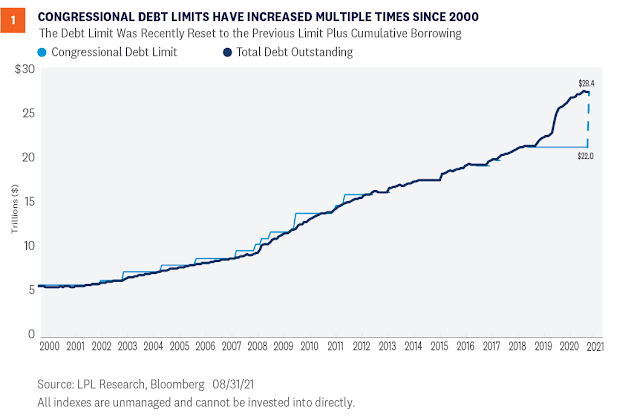
It took me an unusually long time to find a plot of the debt ceiling this time. 

I was only able to find two graphs of the debt vs time.  This one (from Sherman research) goes farther back and does a better job of showing the congressional debt ceilings as blue steps.  That difference at the right, where the blue line stays at $22 trillion while debt goes up to $28.4 trillion is the deal from the end of the second Trump shutdown until this year.  


Tuesday, December 27, 2011

Could the US Return to a Gold Standard?

“That if any of the gold or silver coins which shall be struck or coined at the said mint shall be debased or made worse as to the proportion of fine gold or fine silver therein contained, or shall be of less weight or value than the same ought to be pursuant to the directions of this act, through the default or with the connivance of any of the officers or persons who shall be employed at the said mint, for the purpose of profit or gain, or otherwise with a fraudulent intent, and if any of the said officers or persons shall embezzle any of the metals which shall at any time be committed to their charge for the purpose of being coined, or any of the coins which shall be struck or coined at the said mint, every such officer or person who shall commit any or either of the said offences, shall be deemed guilty of felony, and shall suffer death.” –Chap. 16 , Section 19 of the Coinage Act of 1792, passed by the United States Congress on April 2, 1792.  (source)
While driving home the other day, I heard Dick Morris talking about presidential politics.  Nothing new there; this is the guy who helped get Bill Clinton elected, then had "an awakening" and became a conservative.  He was talking about Ron Paul in this instance, calling him an "appalling <blank>hole", then ripping Dr. Paul a new one for advocating a return to the gold standard.  His rip was classic "barbaric relic" rhetoric, about how we got off the gold standard because it "held our economy back", and "the US economy shouldn't depend on some miner in South Africa" succeeding in a gold mine.  Just look at the increase in wealth since we got off the gold standard!

Then he went on to add a disclaimer that, sure, Bernanke has printed too much money and the Fed was troublesome, but "there's a big gap between abstention and alcoholism" and we simply need to be somewhere between those two limits.  (That's his actual quote, as best as I can recall).

For a little necessary background, the term "barbaric relic" for gold is from John Maynard Keynes himself, and has been widely parroted by those opposed to a "real money" standard.  "Seriously, Muffy, no civilized, advanced society need be bound by having actual, physical, gold, must they?  Why, gold is what caused the Spanish to rape and pillage South America, the pursuit of El Dorado, after all!" To keep this down under a million words, I won't get into Ron Paul or any of the other candidates' politics: that's not the point of this. 

The point of this is "could we go back on a gold standard"? (and when I say gold standard, understand it could be any commodity that people value; anything but fiat paper that can be printed in infinite amounts).  Perhaps the place to start is the converse, why did the world go off the gold standard?  From where I sit, they did that so that government spending, and therefore government, could grow essentially without limit.  Is that a good thing?  As one of my heroes, the (now-retired) Mogambo Guru once put it,
Whether or not this theory is true, I don’t know, but I don’t think so, as I have never read anything like, “From the moment that the government started creating and spending large amounts of money, everything got better and better, and the more money that was created for the government to spend, the better things got, until they reached Utopia and everybody lived happily ever after.”
If we were on a gold standard, we would need to spend less - but we wouldn't necessarily have to balance the budget.  Some debt - my rough guess: 20% of GDP - would be possible, as long as other nations and people felt that the interest we paid was reasonable and they were confident they'd get it back.  The free market would have to set interest rates, not Helicopter Ben (or his ilk).  You can bet your butt our interest rates would be much higher and the monetary shenanigans the Fed creates wouldn't be possible.  In turn, that means it would be harder for the government to fund wars or an ever-growing entitlement state; the quantity of gold would have to expand to increase the money supply. Increasing our money supply – the thing that Morris thinks has improved the economy – has (IMO) led to the gradual decline of the middle class.

Buried in Morris' assumptions is that if we go back to the gold standard, we go back to the 1972 dollar, but why would that be?  We could declare a dollar to be worth any amount of gold we wanted between 1972's $35/ounce and today's number of dollars divided by the amount of gold we have.  In other words, 1972's $35/oz - meant each dollar bill was backed by 1/35 oz of gold. According to Wikipedia, the US claims 147.2 million ounces of gold in Ft. Knox.  The amount of dollars in circulation is harder to know, but there are some available estimates of that, called the M1 money supply.  If we simply divided the 2.2 trillion dollars in the M1 money supply by the amount of gold in Ft. Knox, that would bring the price of gold to $14,900 per ounce, so each dollar would be backed by 1/14,900 of an ounce (around 2 milligrams).  I have seen writers suggest that the M1 supply is drastically under reported; that would increase that $14,900 price.  Likewise, if there is less gold in US hands, that also acts to increase the price - which reduces the amount of gold behind each dollar. I'm sure you've heard the people who speculate that there is no gold in Ft. Knox and the Fed took it all.  That would make gold almost unobtainable in dollars. 

Gold at about $15,000/oz. would shake the jewelry business to its core, making gold only practical for plating, if that, and making platinum, palladium and silver the jewelry metals.  (I'm sure you've seen rhodium plated items, often considered cheap jewelry, but rhodium costs about as much as platinum).  Platinum is currently cheaper than gold; they crossed this past summer (IIRC) for the first time I can recall.  The market for scrap gold, the rings and things that people have and just keep for no particular reason, would probably drop well below that price as the supply would spike like crazy - as would theft of gold jewelry.  There are still many industrial uses for gold; it's used in electronics for plating contacts of many kinds, in optics, and dental work, of course.  Electronics would either increase in price, or alternatives would be found - probably less reliable alternatives.  I believe the price of gold would cascade into the other metals, too, but can't predict how much they'd go up. 

Backing the dollar with $15,000/oz gold wouldn't affect today's prices in fiat dollars, like going to $35/oz gold would.  It wouldn't scale prices to 1971 levels; your $250,000 house wouldn't suddenly be priced at $583 (the same ratio as 35/15000).  I think that sort of disruption is what people opposed to the gold standard are thinking of.  If we said dollars had to be backed at $35/oz of gold, we'd either have to drastically multiply our supply of gold (not bloody likely) or drastically decrease the number of dollars.  That would be quite a disruption. But any move in the direction of a new standard would cause disruptions world wide - and guess what? they're happening already. 

Note that we haven't devalued the dollar with respect to 1972, we just pegged it in place to the current supply of gold we have.  Devaluing the dollar from being backed by about 900 milligrams of gold to 2 milligrams is what the Fed has been doing since we got off the gold standard, and ultimately since their formation in 1913. The dollar has about 3% of the value it had when the Federal Reserve started. While it's true (as Morris said) that Bernanke has been printing too much money, the majority of that decrease in value, percentage-wise, was long ago and was handed to Bernanke by Alan Greenspan.  When the full series is plotted, you see that the dollar is worth about 5 cents in 1913.  When you look at this plot, you can see that Bernanke has decreased the value of the dollar, but most of the damage was done by his predecessors.  This is one of the arguments against what Dick Morris said.
So when Dick Morris or anyone says our economy has grown since 1972, has it really grown, or is it just inflation - the same as devaluing the dollar?  Another aspect of the Fed's action and the way the government reports statistics is that it's harder to tease this information out.  Inflation has the effect of making the economy look better and the country look richer, while it's actually robbing the people.  You have more dollars, but more are required to buy what you need.  This appearance of a growing economy is what the government wants, though – the better to fool you with.  Most people don't think of this: they see their house price is up, or the Dow is hovering around 12,000 and never think that without the last year's inflation alone, the Dow would be about 11,000.

One way to measure whether or not wealth is actually increasing or if you're just seeing inflation is to divide GDP by the population: normalize GDP per capita.  Porter Stansberry's research group produced this chart of an inflation adjusted GDP per capita.  It shows that the per capita GDP went down drastically during the 70s (Nixon and Carter) with a strange, but short, reversal in about 1977 and slowly increased until around 9/11/01 (through Reagan, Bush 1 and Clinton).  Since the middle of Bush 2's term, wealth has been in a nose dive and is now the lowest it has ever been. 
Stansberry's graph only extends back to about 10 years before the final death of the gold standard, not to the start of the Federal Reserve Bank.  Nevertheless, it completely disproves Morris' statement that getting off a gold standard has led to increased wealth.  

This plot is an example of one of the most important ideas in economics, the marginal utility function.  The simple idea here is that if you have one dollar, another dollar is very useful; but if you have a billion dollars, the next dollar doesn't have much utility – and that's the hole that Bernanke finds himself in now.  He has flooded the world with dollars, and there simply isn't much more utility in the next dollar being created.  The next round of QE – whatever they call it – can't be as useful as the first one.  Which wasn't very useful.

It has been said that an ounce of gold buys today about what it did at any point in the past.  Stephen Harmston, former economist at Bannock Consulting, wrote that “across 2,500 years, gold has retained its purchasing power, relative to bread at least” which is seemingly proved when one considers that “It is said that an ounce of gold bought 350 loaves of bread in the time of Nebuchadnezzar, king of Babylon, who died in 562 BC” which is roughly what it buys today, a stretch of 2,500 years.  With some judicious selection of the exact brand of bread, you get remarkably close to 350 loaves (and I'm sure there was some variation in what a loaf of bread cost even in King N's day).  Likewise, you'll hear that an ounce of gold would buy a good toga and sandals in pre-Christian Rome, and buys a well-tailored suit and shoes today, or you'll hear that a $20 gold piece bought an 1851 Colt Single Action Army revolver, and today buys a good grade 1911.  The point of all of these is that the price of gold is a standard by which other things can be measured.  Sure, technology marches along and brings down the cost of some things, but most things that increase in price over the long term do so because the currency inflates.  

It is not true that a gold standard removes inflation and deflation, and it's not true that depressions are impossible with a standard.  The 1800s had a few periods of inflation over 5%, including a big jump for the civil war, to over 25%; but after those inflation periods, the government took their medicine and dialed back the spending to reign things back in.  In 1895 during a bad depression, J.P. Morgan personally bailed out the US; in 1907, Morgan and John Rockefeller bailed out the country together (ref).  In those cases, the Federal government was small enough that individuals, although millionaires, could bail it out.  So even though the gold standard could not prevent inflation and deflation, the standard kept inflation and recession under more control, so that they weren't as bad as they could have been.  In 1900, the “cost of living” was actually lower than it was in 1800, a reflection of improved productivity in farming and other aspects of life.


It's hard to actually get numbers because the way the statistics were kept over the years has varied.  The Federal Reserve Bank of Minneapolis has calculated a time series and posted it.  I take this with a grain of salt because I can't help but believe they do things to make themselves look better.  For last year, for example, they use an inflation value of 1.7%, which certainly uses the BLS statistics, not the way it was calculated before.  Shadowstats, using the 1980s algorithm, says the rate was closer to 10% which would make these plots look even worse for the Fed.  That said, I think these plots don't make them look good at all, so just look at these and say “it's really worse than that”.    
The increase in the "CPI since 1800" plot shows the compound interest effect of that "Inflation Since the Birth of the Fed" graph almost always being centered above zero, and especially since the final decoupling of the gold standard in 1971.  Note how in the 1800-1912 period, the inflation graph stayed centered around zero more of the time.  

The Keynesians are right about one thing: there is nothing inherent to gold that makes it a standard.  Nothing besides the fact that people have always valued gold, wanted gold, and very probably always will.  A currency does not need to be based on a gold standard.  As I've said before, we could have a fiat dollar and just not debase it.  Our leaders and central bankers would have to not play politics with the dollar, not use the printing press to buy votes, not try to change the dollar's value to tweak other countries (cough - China - cough) and they would have to live within a constrained budget.  They should not be allowed to print money to fund foreign wars or the welfare state.  All they would have to be would be grown up, mature leaders.  

In other words, we're screwed.  We could and should return to a gold standard. The details will be messy and need to be watched like a hawk.  But these are messy times, and they're fixin' to get messier.