Showing posts sorted by relevance for query tax. Sort by date Show all posts

Saturday, September 24, 2011

Shining Some Truth On Taxes

The class warfare rhetoric has stepped up to front and center this week, with the president saying, "if asking the rich to pay their fair share is class warfare, I accept that".  Since the call for the Buffet Rule when the "American Jobs Act" was released (ever notice how bills are always named the exact opposite of what they do?) tax "fairness" has been bandied about in a virtually 100% fact free tone. 

Mr. President, if the secretary and Warren Buffet pay the same tax, that's a flat tax.  I really doubt that's what you want, but if you do, I could be on your side (assuming you don't want a flat 100% rate).  As Kerodin and others say (I agree), if it's wrong that Buffet pays 15% on capital gains while his secretary pays 35% on ordinary income, let's drop her tax rate to 15%, too.  Of course, in reality and as you readers know, Buffet is paying tax on income from money that was already taxed at around 35%, so he's paying closer to 50% tax.  But let's not let facts get in the way of good story, shall we? 

It was reported this summer  that we have crossed an economic Rubicon: more than half the population pays no tax (federal income tax, that is).
"But right now, the fact (is) that according to the Committee on Joint Taxation, 51 percent -- that is, a majority of American households -- paid no income tax in 2009. Zero. Zip. Nada. … Actually, to show how out of whack things have gotten, 30 percent of American households actually made money from the tax system by way of refundable tax credits -- the Earned Income Tax Credit, among others. So 51 percent of American households paid no income tax in 2009, but 30 percent actually made money under the current system." (emphasis added - GB)
Mind-bogglingly, Zerohedge wrote last March (and I covered with more details) about these 30 percent who make a profit off the tax system that "a one-parent family of three making $14,500 a year (minimum wage) has more disposable income than a family making $60,000 a year.  And if that wasn't enough, here is one that will blow your mind:
"If the family provider works only one week a month at minimum wage, he or she makes 92 percent as much as a provider grossing $60,000 a year."
The fate of the country is sealed, assuming the 51% of the population who pay no taxes shows up for every election, the percentage of people paying income tax will go down until the country collapses.  If it hasn't already, anyway.

It is fundamental evil party talking point, parroted in this BS Footprint link by Elizabeth Warren, that the Bush tax cuts for the rich cost us trillions of dollars.  A few minutes of internet research will show that on a percentage basis, the lowest income brackets benefited more from those tax cuts than the rich.  We'll surely fix things by letting them expire in 2013, right?
The current six rate brackets of 10%, 15%, 25%, 28%, 33% and 35% will be replaced by five new brackets with the higher rates of 15%, 28%, 31%, 36% and 39.6% 

Note that the lowest bracket tax rate goes from 10% to 15%, or a 50% increase in their taxes.  The highest bracket goes from 35 to 36.9%, or 5.4%.  The lowest income people will be hit the hardest.  In this analysis from the Tax Foundation, you can see how the share of tax liability went up for the top quintile, and down for all of the others under the Bush cuts.

Note that the top quintile pays 81.0% of the entire tax burden of the country. 
Economist Michael Stroup, of Stephen F. Austin State University, has analyzed tax rates and the amount of "progressivity" (that is, the rich pay "progressively" more) of the tax system (pdf here).  The Tax Foundation reports the US has the most progressive system in the world, even more than those European social democracies which the president wants to make us more like.  Stroup presents this interesting plot: 
Here's how the plot works:  Increases in the size of the area between a 45-degree line and the curve (Area A) indicate greater income inequality.  Greater distance between the red and blue curves (Area B) indicate the difference between income and taxation.  The more the red curve is below the blue, the more progressive the tax system:
If everyone paid the same proportion of his income in taxes, the tax curve would lie perfectly on top of the income curve.

If the poor paid a larger share of their income in taxes than the rich, the tax system would be regressive and the tax curve would lie above the income curve.

However, since the rich pay a larger share of their income in taxes than the poor, the tax curve lies below the income curve.
While this is a snapshot for 2004, Stroup writes:
Over time, the share of taxes paid by the rich has grown more than their share of income. For example, between 1986 and 2004:

The income share of the top 1 percent of taxpayers rose 7.7 percentage points, from 11.30 percent to 19 percent of total income.

The share of income taxes paid by the top 1 percent rose even more, by 11 percentage points, from 26 percent to 37 percent of total income taxes paid.
In the years since this was written the percentage of the tax burden paid by the top 1% of earners has increased, to approximately 40%; 42% according to some sources.  The Tax Foundation provides this data:

The simple fact is that every single tax policy change by both parties has led to a more progressive tax, where the rich pay a larger percentage of the tax burden than before.  This has been particularly true for Republican laws like Bush's "Tax Cuts for the Rich" - or Reagan's before him.
The most important reason for the increasing progressivity of income taxes is that virtually every Republican tax bill over the past 25 years has taken more and more people off the tax rolls. Democratic opponents inevitably point to the lowering of the highest tax rates as a “giveaway to the rich.” They conveniently ignore the fact that in lowering the rates, these same tax bills also widened the base. By allowing fewer deductions, exemptions and loop holes, the bills exposed more income to taxation. More importantly, if people at the bottom of the income ladder are completely taken off the tax rolls, the burden of the tax system will shift to those at the top, no matter what rates they pay or what deductions they take.
Getting into discussions with the evil party is a waste of time; they will never tell you what the "fair share" of their income folks should pay.  A couple of weeks ago, congresscritter Jan Schakowsky famously told an interviewer "you don’t deserve to keep all" of what you earn, yet refused to specify how much was fair.  In her world, and all of the evil party, what you earn belongs to society first and they will decide how much you're allowed to keep.

This idea needs to be eradicated. 

Monday, October 22, 2018

Federal Income Tax at an All Time High - Why is Anyone Surprised?

There was a headline last week that caught a bit of a buzz.  Business Insider reported it as, "Go Figure: Federal Revenues Hit All-Time Highs Under Trump Tax Cuts".  "Go figure"?  This is a business magazine writer?  I bet you regular readers figured revenues would go up last year, while that tax income was still being paid, just on economic principles.
The Treasury Department reported this week that individual income tax collections for FY 2018 totaled $1.7 trillion. That's up $14 billion from fiscal 2017, and an all-time high. And that's despite the fact that individual income tax rates got a significant cut this year as part of President Donald Trump's tax reform plan.
There's an important point left out of that paragraph.  The Trump tax cuts didn't start until the second quarter of fiscal 2018, when calendar 2018 started.  That means the increased revenues aren't the full effect of the tax cuts. 
 But if you limit the accounting to this calendar year, individual income tax revenues are up by 5% through September.

Other major sources of revenue climbed as well, as the overall economy revived. FICA tax collections rose by more than 3%. Excise taxes jumped 13%.

The only category that was down? Corporate income taxes, which dropped by 31%.
That corporate income tax burden moved partially to the personal income taxes because (say it with me) corporations don't pay tax, they collect tax from their customers.  To the extent those corporations sold to Americans, I'd guess over 80%, their tax burdens were paid in US income tax.  

One of the drums I beat all the time is that tax rates and tax revenues are not the same thing.  The classic example is Hauser's Law, after Stanford University professor Kurt Hauser, and as reported on these pages a bunch of times.  Here's a graph I've been using since 2012 (don't worry, it goes back to 1945, so it's not a big modification to leave out the last six years - here's a nice explanation from 2009)

With a few short-lived exceptions, it's obviously true that tax revenues are essentially constant (as % of GDP), regardless of tax rates.  That can only mean that when taxes are higher, the GDP contracts.  The government doesn't collect any more money because there's less to take a portion of.  When taxes are lower, GDP expands and taxes take a smaller percentage of a bigger pie, giving the same percent of GDP as tax revenue.
It's election season (much like allergy season or painful rectal itch season) so you'll hear a lot of talk about various Republicans having passed "tax cuts for their rich buddies" or their "corporate benefactors"; just like (often times) the same idiots saying the solution to our problems is to raise the minimum wage, you just can't get through to people like this. 

A few weeks ago, I swapped emails with a friend who was adamant about this.  As a fellow retired engineer, I thought he was better at math than his argument.  I said that I thought last years' tax cut was a pretty good attempt to try to target tax cuts for the middle class.  Since the upper incomes pay all the tax, giving even a tiny percentage cut to the rich will be bigger numbers than the amount given to middle or lower incomes - that's simple arithmetic.  I pointed out things like the lowest 50% of incomes pay 3% of all tax revenue, and the top 3% of U.S. taxpayers paid practically 90% of all taxes.  The top 1 percent paid a greater share of individual income taxes (37.3 percent) than the bottom 90 percent combined (30.5 percent).  The numbers of taxpayers paying most of the income tax become shockingly small. The top 0.1% of income tax payers, who paid more than the bottom 70% of the population combined, is just 1409 taxpayers.  Those 1409 people paid more than 98.7 million other taxpayers. 

I posted this quote back in June of '17, but it really stuck with me and became one of those quotes I can't forget.  It really fits here.  It's from David Stockman, Reagan's budget chief, who said,
The income tax has been slashed so many times since 1981 that it’s no longer a broad based societal tax; it’s a kind of luxury tax on upper income salary earners and the small share of households which garner most of the capital income from dividends, interest payments and capital gains…
By the way, that "fellow retired engineer" I sent some of these facts to never replied to me again.  I told him I could find these facts online within a few minutes while typing the email and I'm sure he could, too. 

Friday, December 29, 2017

I Wonder How The New Tax Law Affects This?

Interstate population migration.  A while back, I found this graphic from Business Insider:
While other factors are involved, it's pretty clear that states with high tax rates like New York, Illinois, and New Jersey for instance were subject to a lot of movement into states with lower tax rates like Florida (no income tax, at least), Tennessee, Arizona and South Carolina, but there's other stuff going on here as well.  The entire Midwest had net outward migration, but so did New Mexico and the old deep south: Louisiana, Mississippi, and Alabama.  California only losing 2.8 people per thousand residents (PPT) surprised me. 

This map was only for the period of July 1, '15 to July 1, '16, though.  Virginia lost 3 PPT but after Virginia (and the DC suburbs) already had become one of the richest areas in the country and before the Trumpening so probably not related to government.  North Dakota lost 8.27 PPT, which is a lot, but late 2015 was the time of the North Dakota oil bust.  In the broader sense the pattern of tracking highest tax rate states holds, though.  Between July 1, 2016, and July 1, 2017, nearly 450,000 people moved out of New York, Illinois and California.  That said, Oregon, Nevada, Colorado and and a few others surprise me.  Perhaps it's Californians moving someplace more like home than others, but

Hearing talk about the new Trump Tax Plan has gotten me thinking if we're likely to see more movement between states to reflect capping the tax deduction for state and local taxes at $10,000.  The lower cap will have the effect of making it mean more to middle income than high income taxpayers.  Obviously, if a family's SALT (State And Local Taxes) are under that limit, they have less incentive to move to escape the burden than a family that might owe quite a bit more than $20,000 in SALT.

Of course, something you'll never hear Chuckie Schumer, Nancy Peloski, Andrew Cujo or any other politician from a high tax state is that the rest of the country's taxpayers are subsidizing their spending by paying for the SALT deductions.  Florida and Texas taxpayers are paying for the mortgage interest deductions of people living in $750,000 dollar homes in California counties where that's the median house price.  We're all paying each other's taxes and not just our own.  There's no better argument for a flat tax/fair tax approach.

I have yet to come across anything of sufficient detail on the new Tax Cuts and Jobs Act that I feel comfortable commenting on it.  I've seen several apparently-trustworthy pieces that list "typical families' tax situations", but those are hard to digest.   See the Tax Foundation's analysis and another version from the Heritage Foundation.  It seems to me that cutting taxes while not creating "tax cuts for the rich", which is going to be the cry no matter the reality, is a tough needle to thread.  It seems like they did a pretty decent job of threading that needle.  Let's face it, the lowest 50% of incomes pay about 3% of federal income tax.  The rich pay the lion’s share of the tax burden, so they will see the largest dollar value in benefits.   I think the Heritage Foundation has a pretty good look at the truth in a piece on 5 Myths About Tax Reform and Why They're Wrong:
Myth 1: This is just a tax cut for the rich, and it will actually raise taxes for everyone else.

The truth is in fact the opposite. The Senate tax bill increases the amount of taxes paid by the rich and, according to the liberal Tax Policy Center, 93 percent of taxpayers would see a tax cut or no change in 2019. They found similar results for the House bill.

Both tax bills would actually increase the progressivity of the U.S. tax code. That means fewer people at the bottom will pay income taxes, and people at the top will see their share of taxes paid increase.

The Cato Institute’s Chris Edwards notes that the Senate tax bill cuts income taxes for people making $40,000 to $75,000 a year by about 37 percent. People making over a million dollars see a cut of only 6 percent.

In two recent Daily Signal pieces, we calculated how 12 different taxpayers would fare under each of the tax plans. The results show that almost everyone will see a tax cut, and only the wealthiest families are at risk of their taxes going up.

Under the current tax code, the top 10 percent of income earners earn about 45 percent of all income and pay 70 percent of all federal income taxes. The U.S. tax code is already highly progressive, and these tax reforms will only increase the trend of the wealthy paying more than their share of income earned.
It seems to me this will lead to some movement across state lines, but it's hard to know if it will have the effect of making mass movements.  There could be an uptick in housing sales because of this law, though.


Tuesday, November 2, 2021

From Better Than Average to the Worst Tax Rate - Thanks, Brandon

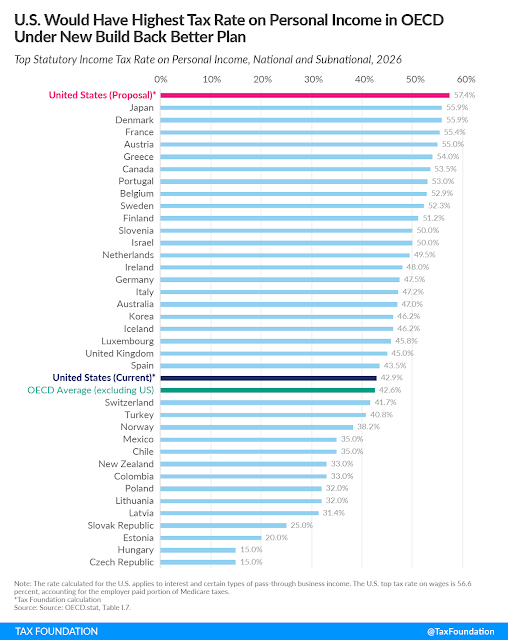
Yesterday, the Tax Foundation published an analysis of personal tax rates under the latest Democratic plan.  The US goes from the low-middle of the group, better than average, to the worst income tax rate in the world. 

Under the latest iteration of the House Build Back Better Act (BBBA), the average top tax rate on personal income would reach 57.4 percent, giving the U.S. the highest rate in the Organisation for Economic Co-operation and Development (OECD). All 50 states plus the District of Colombia would have top tax rates on personal income exceeding 50 percent.

They publish this list of maximum income tax rates in OECD.  The US would go from 16th lowest (best) to the worst income tax rate. 


They explain:

High-income taxpayers would face a surcharge on modified adjusted gross income (MAGI), defined as adjusted gross income less investment interest expense. The surcharge would equal 5 percent on MAGI in excess of $10 million plus 3 percent on MAGI above $25 million, for a total surcharge of 8 percent. The plan would also redefine the tax base to which the 3.8 percent net investment income tax (NIIT) applies to include the “active” part of pass-through income—all taxable income above $400,000 (single filer) or $500,000 (joint filer) would be subject to tax of 3.8 percent due to the combination of NIIT and Medicare taxes. Under current law, the top marginal tax rate on ordinary income is scheduled to increase from 37 percent to 39.6 percent starting in 2026. Overall, the top marginal tax rate on personal income at the federal level would rise to 51.4 percent.

Their cited top tax rate of 57.4% includes Federal, State and Local income taxes.  In the states that have income taxes, the average top marginal state-local tax rate is 6.0 %.  That 6% is added to 51.4% they quote in the above paragraph giving that 57.4 % percent.  There are eight states that don't have an income tax, and the top income tax in our states would be that 51.4%.  Feel good if you want, but it's still higher than all but the 10 worst tax rates in the civilized world.

This assumes the deduction for state and local taxes remains capped.  If that cap were to be removed, the top income tax rate would fall to 54%. 


You might have heard about the US pushing on the rest of the world to establish a minimum tax on businesses.  The reason for that move is that they intend to push those taxes in the US and they don't want US businesses to move to other countries for the lower tax rates.  I can hardly think of an easier sell than telling a bunch of other countries, "let's all raise taxes."  If another country wants to lure American businesses there, I'm sure there are plenty of other incentives they can dangle. 

Further, this analysis doesn't include the worst tax I've heard of, the "wealth tax" that would charge taxes on income that hasn't been paid.  Since we don't have text of a passed bill, I'm not going to look up the details that might change.  Plus, since it's not actually income and hasn't been earned or paid, it's doubtful that such a tax is constitutional.  That said, the idea is that most of the on-paper wealth of the billionaires they detest so much (but whose money they want so much) is in stocks they own.  The tax will be based on their stock shares having gone up in value, even if the owner hasn't sold any shares and made no income.  Details like how the value of those unsold stocks is to be determined - or (most likely, IMO) on what date the stock value will be assessed - aren't available.  Nor has anyone said if the stocks go down in value if those billionaires will be reimbursed. 

This last one reeks of the absurdly childish view the Stupid Party voices all the time that billionaires are Scrooge McDuck, swimming and playing in vast piles of gold coins, gems, and other material wealth.


Thursday, September 28, 2017

Since Tax Reform is in the News

I posted this back in June, but it really stuck with me and became one of those quotes I can't forget.  It's from David Stockman, Reagan's budget chief, who said,
The income tax has been slashed so many times since 1981 that it’s no longer a broad based societal tax; it’s a kind of luxury tax on upper income salary earners and the small share of households which garner most of the capital income from dividends, interest payments and capital gains…
Stockman went on to point out that 60% of tax filers accounted for 5% of tax revenue.  In addition, 35% of tax filers – more than 52 million filers at the bottom and middle of the income ladder – didn’t pay a single dime of taxes after deductions, exemptions and credits.  I think Stockman was sloppy with his wording in saying, "the income tax has been slashed so many times".  Tax rates go up and down regularly.  I think he means the number of people paying income tax has been slashed. 

Look at what he's saying.  The top 40% of incomes pay 95% of tax revenues, and the bottom 35% don't pay a dime once all of the deductions, and all other systemic ways to avoid paying tax.  The top 1% of earners pay 39.5% of all collected taxes.

From what I'm able to see, this isn't really a conservative plan it's more a populist plan.  From a populist president and party that aren't conservative, so what a surprise, right?   I hear the president insisted on leaving the highest tax bracket for the highest income earners where it is, at 39.6% so there's no "trickle down" aspect to this.  Supposedly Trump said that people in the highest bracket can afford that 39.6% rate, and he insisted it stay there.  Maybe that's his way of fighting the Evil party screaming that it's a "tax cut for the rich!!"  Maybe he honestly thinks a 39.6% rate is a good thing.

So if the lowest half of the income range doesn't pay taxes, and the top rate stays the same, who's getting what changes?  That's what the arguments are about.  From what I hear, the big proposal is a return to three brackets, 12%, 28%, and that 39.6%.  Exactly where those three brackets change will make all the difference in "who pays what".  The simplification part of the plan (they still keep using the "fill out your taxes on a postcard" meme) raises the standard deductions so the lowest income people are expected to pay even less than now, while the highest grade may benefit a little.

The big deal is dropping the corporate tax rate from 35% to 20%.  That will make investing in the US look much better to companies looking to build new facilities.  Lower corporate taxes help everyone but this will have its greatest impact on small businesses and business start ups.  Since it uses the word "corporate", you can be sure the core Evil party hates that part.  Since they can't argue it's a tax cut for the richest, they'll fight that corporations are getting a break.  Corporations pass on their taxes to their customers, so their customers pay them.  Before this all started, Paul Ryan actually said something intelligent, when he said,
"We are actually unique in the world in the way we discourage capital from coming back to America and how we incentivize off-shoring jobs," ... "This is not the kind of exceptionalism we should aspire to ..." 
The overall progressive structure of the tax code doesn't change.  We still penalize success.  We have "sin taxes" on booze and tobacco to discourage their use.  And we have our highest tax rate on our highest earners to discourage success. 
Income and federal income tax, by standing in the income distribution, 2014 bar chart.  The leftmost pair of bars is the bottom 50% of wages.  The blue indicates 11.27% of total adjusted gross income (AGI) was paid to this group and they paid 2.75% of income tax.  The % of AGI is always greater than the percent of the tax burden until you reach the rightmost two.  The uppermost 5% to 1% of incomes group is the first one where the red bar is taller than the blue.  This group earned 15.38% of AGI and paid 20.48% of income taxes.  The top 1% earned 20.58% of AGI but paid 39.48% of income tax. 


Monday, November 18, 2019

The Strange Reality of Hauser's Law

While writing last night's piece on Elizabeth Warren's tax plan, my natural inclination was to reference Hauser's Law, because I've referred to it at least a dozen times over the years.  I initially looked up some of my old pieces but didn't want to just go to those, but I really preferred a reference site in case the idea is new to some of you.  I found that most of my old links didn't work.  One thing led to another and I eventually searched for the topic at one of those old links and found a fresh article, from the beginning of this year.  Even better! 

To begin with, economic laws are different from physical laws.  Physical laws simply can't be broken despite what car commercials may say to try to convince us otherwise.  Social science laws are broken all the time; I've said before the only so-called law I've come across that comes close to the character of physical law is Supply and Demand.  “Ironman” at Political Calculations calls Hauser's law "one of the stranger phenomenons in economic data".  When first noted by W. Kurt Hauser in 1993, he observed:
No matter what the tax rates have been, in postwar America tax revenues have remained at about 19.5% of GDP.
It's hard to see how this could flow from quantum physics or electro-weak unification theory, so we're left to take it as simply an observation rather than as rigorous as physical law.  It's more puzzling because of how much the top tax rates have varied.  Political Calculations provides this analysis of the data, with an explanation. 
In 2009, we found total tax collections the U.S. government averaged 16.8% of GDP in the years from 1946 through 2008, with a standard deviation of 1.2% of GDP. Hauser's Law had held up to scrutiny in principal, although the average was less than what Hauser originally documented in 1993 due to the nation's historic GDP having been revised higher during the intervening years. [Bold added: SiG.  Also: note that the original text reads 17.8% in the first sentence.  Every other reference in the article says 16.8, so I changed this one to agree with the rest of his post.]
Since the publication of Hauser's Law in 1993, the only thing that changed the results of Hauser's Law wasn't a change in the tax rate, it was a change in the way Gross Domestic Product was calculated.  That reduced tax revenues to 16.8% of GDP from the original 19.5%. 


The red line indicates the highest tax rate, which you can see peaked at 92% in the early '50s and has been as low as 28%.  The blue curve, embedded in a gray band at the bottom shows the tax revenue as percentage of GDP.  The gray band is familiar to any of you who have worked with statistical quality assurance techniques: it's the + 3 standard deviations band, which ranges from 13.2 to 20.5%

A little diversion on these tax rates is in order, but space is at a premium.  A long description is here; a short version is that while we have seven tax brackets, when the top bracket was 92% there were 24 brackets.  The highest rates were only paid on income over $3.2 Million - adjusted for inflation.  Today, the top tax rate has dropped to an income under $500,000.  The top tax rate dropped from 90% to 40%, a factor of 2.25 while the income that required paying that rate dropped by a factor of 6.4.  That means many more people are paying the top rate than in the '50s. 

It's interesting to see that individual tax collections have only been about half of that revenue.  The mean of individual income tax collection is 7.6% of GDP with a standard deviation of 0.8%. 


What does all this mean?  It means quite a lot.  The first thing is something I harp on all the time: tax rates are not tax revenues - the money collected.  They're different things.  They may be correlated mathematically but if rates go up, revenues don't automatically go up as much.  People change their lives to save paying tax.  (I know, right?  What a surprise!)  It means that the Dems' wealth tax is not going to make much of a difference in collected revenues.  Simple-minded people like Warren, Sanders, or  Pistachio Kotex will believe that tax revenues will go up enormously with a wealth tax.  Data says that if they raised the top rate even to 90% that revenues wouldn't go up as much as they think - they'd stay in the historical range.  


Saturday, December 29, 2018

Ooooohhh - Talk Tax Rates To Me, Baby

In an academic, partially removed-from-reality sense.

I found an interesting article this week from Daniel J Mitchell's blog International Liberty.  The article, posted December 18th, concerns the damages that increased marginal tax rates cause.  The article, World Bank Study Confirms the Ever-Increasing Damage of Ever-Increasing Tax Rates, begins by discussing the concept of deadweight loss, which shows the portion of the market for a product that gets lost because of taxes.  There's an excellent video here that explains this chart (it's a graphic they develop).


The thing to bear in mind is that the deadweight loss from the tax removes the entire area in gray.  That economic activity never happens.  The government tries to just skim some tax revenue off transactions going on, but instead government reduces the economic activity.  How many times have you heard that the revenue from a new tax is less than what was predicted?  On transactions that happen, they're a guaranteed winner, but they get nothing from the economic activity that they cut off. 

Now mentally reduce the tax rate.  That makes the purple box shorter from top to bottom.  That, in turn allows the right end of the box to extend farther to the right before it simultaneously intersects the supply and demand curves, reducing the deadweight loss.  Conclusion: Lower taxes allow more economic activity.  Now mentally increase the tax rate, making the box taller and bringing the intersection back to the left.  Conclusion: higher taxes allow less economic activity.

Less obvious is that the curves don't move linearly.  That is, if you double the tax rate, you don't necessarily double the revenue.  You increase the amount of deadweight loss which could cut off sales completely, or more than likely create black market ways to avoid the taxes.  As Mitchell says:
Simply stated, if a tax of X does Y amount of damage, then a tax of 2X will do a lot more damage than 2Y.

This is the core economic reason why even left-leaning international bureaucracies agree that class-warfare taxes are so destructive. When you take a high tax rate and make it even higher, the damage grows exponentially.
Given this, it's interesting to see supporting evidence from the World Bank (of all places) published this month.
…studies have used the narrative approach for individual or multi-country analyses (in all cases, focusing solely on industrial economies, and mostly on industrial European countries). These studies find large negative tax multipliers, ranging between 2 and 5. This recent consensus pointing to large negative tax multipliers, especially in industrial European countries, naturally entails important policy prescriptions. For example, as part of a more comprehensive series of papers focusing on spending and tax multipliers, Alesina, Favero, and Giavazzi (2015) point that policies based upon spending cuts are much less costly in terms of short run output losses than tax based adjustments.

A natural question is whether large negative tax multipliers are a robust empirical regularity… In order to answer this highly relevant academic and policy question, one would ideally need to conduct a study using a more global sample including industrial and, particularly, developing countries. …This paper takes on this challenge by focusing on 51 countries (21 industrial and 30 developing) for the period 1970-2014. …we focus our efforts on building a new series for quarterly standard value-added tax rates (henceforth VAT rates). …We identify a total of 96 VAT rate changes in 35 countries (18 industrial and 17 developing).
The World Bank study showed that VAT taxes were more destructive to developing economies than to established economies, BUT that the deadweight loss was greater in the established countries because the initial tax burden was higher; in other words, "they already had big gray boxes".  The World Bank authors include this pair of data plots from trying to determine how much raising VAT rates affect the incentives to work (left) and incentives to invest.  It shouldn't be a surprise the raising taxes reduced both the incentives to work and to invest.


Final words to Daniel J Mitchell:
The moral of the story is that all tax increases are misguided, but class-warfare taxes wreak the most economic havoc.

P.S. Not everyone understands this common-sense observation. For instance, the bureaucrats at the Congressional Budget Office basically argued back in 2010 that a 100 percent tax rate was the way to maximize growth.


Friday, February 1, 2019

Watching the Dems Lurch Farther Left

As the Democratic field for the 2020 presidential race gets a little more crowded every day, the Democratic Socialists push a little harder and the whole party gets a little farther left with time.  Not so much a constant drift; more like an earthquake fault slipping.  Some friction keeps the fault from moving for a while, but when the stress gets high enough the fault slips and the platform lurches a bit farther left.

So it is that Minnesota representative Ilhan Omar, who has been almost a constant fountain of misinformation whenever she's in the press, said we should look at 90% income tax rates.

Of course, New York City crazy party representative Alopecia Pistachio Kotex advocated for a 70% income tax rate on "the tippy top" of the income levels.
Weeks after Rep. Alexandria Ocasio-Cortez, D-N.Y., made headlines by calling for a top marginal income tax rate of 70 percent in an interview with “60 Minutes,” her fellow freshman congresswoman, Rep. Ilhan Omar, D-Minn., suggested that the rich could pay even more.

“There are a few things that we can do,” Rep. Omar said in an interview with “Through Her Eyes.” “One of them, is that we can increase the taxes that people are paying who are the extremely wealthy in our communities. So, 70 percent, 80 percent, we’ve had it as high as 90 percent. So, that’s a place we can start.”
The reason this caught my attention is that 90% income tax is an internet meme that started back during the 2016 race.  As far as I can tell, it was started by either Bernie Sanders, Paul Krugman or perhaps Michael Moore.  Perhaps all of them got together, in which case I would assume a bong the size of King Kong's toilet bowl was involved, but that's speculation on my part. 

The meme is the fact that America was doing its best in the post WWII period when the top marginal tax rate was 90% wasn't a coincidence; America was doing great because of the 90% tax rate.  It had nothing to do with the fact that most of the industrialized world outside of the US had been bombed back to the stone age, and not only did we not have remotely as much competition for exports, we were helping to rebuild both our allies and our former enemies, Germany and Japan. 

Andrew Syrios at the Mises Institute does an extensive analysis of this.  He starts out by noting how different the tax structure was when the top rate was 90%.  Today, there are seven tax brackets. In 1989, there were only two. In 1955, there were an utterly ridiculous twenty-four different tax brackets.  In this chart, read the tax rate on the red curve and right scale, and the income it taxes to qualify for that rate on the left, in blue.  The year is on the bottom.  An effort was made to make this constant dollars (account for official inflation).


Picking 1959,  the top rate was 90%, but that was only paid on income over $3.2 Million.  Today, the top rate is indeed much lower (this chart stops at 2013 and I'll pretend it's the same today):  the top rate is 39.6%, but the threshold to pay that has dropped precipitously down to under $500,000.  The top tax rate dropped from 90% to 40%, a factor of 2.25 while the income that required paying that rate dropped by a factor of 6.4.  Many more people are paying it. 

It's also important to note that the top rate is just the rate on that last dollar earned.  A study from the Congressional Research Service concluded that the effective tax rate for the top 0.01 percent of income earners during the period of 91-percent income taxes was actually 45 percent.  (The effective rate is your total tax divided by your taxable income.  For example, if I make $20,000, I owe 10 percent under today’s tax code, but only on any income over $18,450 (filing jointly). So I only owe 10 percent of $1550, or $155. Yes, my marginal tax rate may be 10 percent, but my effective tax rate is 0.78 percent.)

Longtime readers around here will recall mention of Hauser's Law.  I'm still a little uncomfortable calling it a law because it's not a "law" in the sense of the laws of nature, but it's the handy observation that since the early 20th century, the tax revenue collected has remained rather constant despite those wild differences in tax rate shown above.  Simply, people adjust their lives to pay less tax.  Syrios shows another chart that very clearly demonstrates Hauser's Law:


Simple-minded people like Pistachio Kotex or Ilhan Omar Abdullah will believe that tax revenues will go up enormously in this change.  Data says that if they did raise the top rate to 90% that revenues wouldn't go up as much as they think.  Revenues can go down after tax rate hikes.  It has happened.

Regardless of all that, the fact remains that the rich never paid 90 percent of their income in taxes or anything even remotely close to that.  The idea that we'll punish the rich to pay for everything is simply hatred and class envy.  Unfortunately though, some memes die hard.

Friday, April 12, 2019

Use By Date Approaching

Ran into this cartoon Tuesday and better use it before its "Use By" date gets here.


(Steven Breen)

Read those as Dr. Seuss prose, it works better. Unfortunately, I was unable to find a referenced story, but the list of ideas California's state legislature is contemplating was discussed in a few places as recently as last weekend, IIRC.

I did find a couple of interesting stories that illustrate the problem.  At Town Hall, Austin Hill writes about a proposal to implement a "third income tax" to pay for education.  The existing two are their California state income tax and the Federal Income tax. 
But now California, with an average statewide unemployment rate of over 12% (in some regions the rate is over 20%) and a budget deficit of somewhere between $10 and $15 billion, is considering the imposition of a third income tax. The additional income tax rate would vary, according to which region of the state one lives in, and would be imposed directly by school districts and county governments.
See, back in 1978, California voters passed a thing called "Proposition 13" which capped the amount that property tax could be raised year over year.  That means California school districts are broke just like the state.  They can't do what many other school districts in America do, and just raise property taxes by leaps and bounds every year.  Under the proposal, school districts will gain the right to decide on their own income tax levels to charge people living in their district. 

Do you find it surprising that they're getting legislative support for this idea?  If so, are you considering the government employee unions, long since joined at the hip with the Democrat party would like some of that sweet taxpayer money, too?

To add a little more context, Victor Davis Hansen, writing in the Daily Signal points out a couple of things to note.
For over six years, California has had a top marginal income tax rate of 13.3%, the highest in the nation.

About 150,000 households in a state of 40 million people now pay nearly half of the total annual state income tax.
That last one is astounding.  That means 0.375% of tax payers pay half of the state's income tax revenue.  No wonder ordinary Californians keep electing the people they do.  Everything they vote for comes with the fact that someone else is paying for it.  It's OPM - Other People's Money - the most addictive substance in the world.  In addition:
  • California recently raised gas taxes by 40% and now has the second-highest gas taxes in the United States.
  • The state has the ninth-highest combined state and local sales taxes in the country, but its state sales tax of 7.3% is America’s highest.  As of April 1st, that sales tax is applied to any purchases from out of state merchants.  
  • Scott Wiener, a Democratic state senator from San Francisco, has introduced a bill that would create a new state estate tax. Wiener outlined a death tax of 40% on estates worth more than $3.5 million for single Californians or more than $7 million for married couples.  Since $3.5 million will essentially buy a cardboard box to live in in San Francisco, that will impact families who have passed a home down generation to generation.  The current owners will lose those houses.
  • In January, new governor Gavin Newsome proposed a tax on drinking water.  I'm sure that's an additional tax on water because I can't imagine people aren't already paying at least one tax on their water, if not several.   
It's no surprise that middle class Californians are moving out of the state.  I found it surprising that the rich are moving to California.  They're moving to the expensive cities and driving up housing prices which help force the lower income Californians out of state. 

I think California is working toward the Venezuela model of having a few rich people, mostly people living on handouts, and no middle class. 


Sunday, June 25, 2017

Now That Healthcare is "Fixed" (hah!)


As that fiasco plays out this week, the emphasis has turned to "now that we have health care fixed, let's move on to tax reform".  Paul Ryan went so far as to say,
"Transformational tax reform can be done, and we are moving forward,"
Now, personally, I never met a tax cut I didn't like.  The tax system is horribly broken in this country and broad cuts and reductions across the board sound great.   As Ryan also said,
"We are actually unique in the world in the way we discourage capital from coming back to America and how we incentivize off-shoring jobs," ... "This is not the kind of exceptionalism we should aspire to ..." 
There is a genuine problem in America: most people are getting poorer.  Wages have been in stagnation for nearly 50 years while prices have continued to climb.  The statistics the government reports to tell us how wonderful everything is in the country consistently lie about the cost of living.  Their hedonic adjustments tell you that even though the car you want to buy says $33,000 on the sales papers, it really is the same cost as the $19,000 car you bought in 1997.  The new car is technically superior to the 1997 car, so it's really cheaper.  If all you have is the money to pay for the $19,000 car, well then, the government says "sucks to be you".  Not really.  They don't acknowledge your problem at all.

Idiots like Bernie Sanders and Elizabeth Warren look at this rampant screwing of the people by the big government and central bankers and think the answer is to make the government bigger and never, ever mention the role of the trillions of dollars of assets the Federal Reserve created.  

The unfortunate reality is that there is no tax reform on the horizon that will make them richer.   Most people aren't poor because the feds take too much of their money; they're poor because the feds have gummed up and distorted the economy so badly.  Hobbled by regulations, fake money from the putrid, execrable central banks, and the crony deals that enrich the few insiders, the Fed.gov can’t deliver the jobs and incomes people need.

Earlier this year, House Stupid Party members said they were going to strive for a tax return you could do in the space of postcard - then they overcomplicated that by keeping popular deductions.  That's not how you do it.

You want "transformational change"?  Throw out every page of the tax code.  Everyone pays a flat percentage.  I don't like throwing around numbers for what it should be because (1) I don't know, and (2) things will change so much, so fast, that any number you start out with will need to be changed.  I've heard 17%.  I've heard 10%.  So let's pretend 15% is the answer.  Maybe three or four questions on a tax return.  

A simple flat tax will never happen.  It would shutter the entire tax preparation industry - there's about a $12 Billion industry there just for the franchises.  No more H&R Block, no more tax lawyers, or accountants.  Everybody pays the same percentage.  The rich will pay the vast lion's share, like they do now, and the poor will pay a pittance, like they do now.   David Stockman, who of course was Reagan's budget chief, said,
The income tax has been slashed so many times since 1981 that it’s no longer a broad based societal tax; it’s a kind of luxury tax on upper income salary earners and the small share of households which garner most of the capital income from dividends, interest payments and capital gains…
Stockman went on to point out that 60% of tax filers accounted for 5% of tax revenue.  In addition, 35% of tax filers – more than 52 million filers at the bottom and middle of the income ladder – didn’t pay a single dime of taxes after deductions, exemptions and credits.

And that kind of reform just ain't gonna happen.  The "Deep State" loves a complex tax code.  The insiders hide little treats for themselves and their friends in it.  They use it to control the "little people".  The stupid politicians who call themselves "voice for the poor" would scream that the rich aren't paying enough.  Perhaps worst of all, there's no public outcry calling for that kind of reform.

If you want to dream of REAL reform, Make the Dollar Great Again.  Or, at least, Make the Dollar Real Again. Tie the dollar to gold again, fire everyone at the Fed and fire all the dictators central economic planners.  Do we legally need to have a Federal Reserve?  Reduce it to one guy running the "gold window" that Nixon closed in 1971: selling gold coins for dollars.  Or maybe that becomes the Treasury office that sells gold coins now.  


Thursday, August 11, 2011

A Conversation With My Senator

I received an email from one of my US Senators today, Bill Nelson, D, in which he posts his “Common Sense” ideas on how to get out of our financial mess as published in Politico.  For a member in good standing of what many refer to as the Evil party, not what we call the Stupid party, he sure dispenses plenty of stupid.  As anything I say would never be read by the Gentleman from Florida (as they say up there),  I thought I'd fisk this here for tonight's amusement.  I will leave his pearls of wisdom in black text, and add my comments in blue. 

Close the tax loopholes
By: Sen. Bill Nelson,

"There’s no mystery about what we have to do. It’s just common sense. In addition to the spending cuts Congress just made, we need tax reform. And by tax reform, I mean closing loopholes, special interest tax breaks and corporate subsidies. It’s just plain wrong to be protecting tax breaks for oil companies and to be rewarding businesses that ship jobs overseas." - Sen. Bill Nelson

After watching Standard & Poor’s performance in the Enron and housing debacles, it’s hard to stomach their decision to downgrade America’s credit.

Meh.  Complaining about S&P's performance is like TV producers complaining about Neilsen ratings.  You may complain all you like, but it's what the industry uses.  In truth, we've been degraded by other agencies, almost a year ago by the Chinese equivalent of S&P, and nobody over here said a word.  Frankly, I think S&P was right. 

But even coming from S&P, there is a message we should hear: The finger pointing and hyper-partisanship has to stop. If it doesn’t, we really will be on the road to ruin.

Democrats need to see tea partiers as something other than debt-limit hostage-taking Republicans. And Republicans need to see President Barack Obama and Democrats as something other than big-spending socialists.

We’ve got to stop this attack madness. We have to bring civility back to the public square. We have to put the country back on the path to fiscal sanity.

To do that, we need to cut some $4 trillion to $5 trillion. We made a down payment on this with the $2 trillion dollars we cut just last week. Now we need to go further.

I believe you're suffering from what the doctors call “premature congratulations”.  Your vaunted plan will not affect the big picture because that $2 trillion is in a 10 year plan and doesn't start for another three years (2014).  We need to cut much more than that. Here's a before/after graph with and without your cuts:

To understand what we have to do, though, we first need to look at how we got here.

We went from a $236 billion budget surplus in 2000 to a $1.3 trillion deficit last year — and a record $14 trillion debt. A huge chunk of the debt comes from the wars in Iraq and Afghanistan. We’re bringing the troops home.

It's been reported that the total cost of those wars is about $1 Trillion.  Too low?  Let's triple that and say we spent $3T.  3/14, or 21%, is not a “huge chunk” in my book; huge starts at around 2/3 or 3/4.  “It's the spending, stupid”, and stupid spending at that.  But I tell you what: if you went back to the spending levels of 2000 the problem would go away!  Don't want to do that?  Didn't think so. 

The implication here is the old “it's all Bush's fault”, which is a fantasy.  Bush was no fiscal conservative, and had many bad policies (which, strangely, have all been retained by Mr. Obama) but the deficit for this February was more than the entire year of 2007!  There is simply no equal in history for the deficit spending of this administration. 
Another significant piece stems from the Bush-era tax cuts. Warren Buffett, chairman and chief executive officer of Berkshire Hathaway, says the tax cuts for the wealthy should be left to expire. They’re set to do so at the end of next year. We should let that happen.

First off, I hate to break your bubble, but Buffett is a has-been. I have done quite well with my meager 401k by doing the opposite of whatever he suggests. 

There is a persistent confusion of tax revenues with tax rates, which you seem to fall into, Mr. Nelson. The two are not directly related in the mathematical sense. If you raise rates, people can be relied upon to change their behaviors and revenues can fall – or, at a minimum, don't go up as much as you expect.

The historical limit on tax revenues as a percent of GDP is around 18-19%, regardless of tax rates.  Revenues are currently lower than that for a simple reason: the economic downturn is reducing the national income just as it has reduced the income of so many citizens. The emphasis should be on trying to create conditions that lead to job creation to push that revenue up, and raising taxes just isn't one of those. Never has been, never will be. 

See Hauser's Law in your favorite economics textbook.
(Hauser's Law from the Peter G Peterson Foundation)
Or, as a converse, when rates are low, the “rich” can pay more revenue, as in the fact that currently, the top 1% pays more than the bottom 95% combined.  Which leads to the very simple question: since the top 1% of incomes pays more than the bottom 95% of incomes, what is their “fair share”? You don't have much to choose from. 96%? 97%? Should the top 1% pay for everything? If so, I don't want to live in your world.

Agree or not, don’t you think most Americans were better off before the tax cuts than they are now?

Nope.  They were better off before the housing bubble burst, blown quite deliberately by the Federal Reserve, aided and abetted by the Congress. 

Much of the rest of the debt comes from the economic downturn since 2008. That brings us to today. And there’s no mystery about what we have to do. It’s just common sense. In addition to the spending cuts Congress just made, we need tax reform. And by tax reform, I mean closing loopholes, special interest tax breaks and corporate subsidies. It’s just plain wrong to be protecting tax breaks for oil companies and to be rewarding businesses that ship jobs overseas.

The other word for “loophole” is “law”; a loophole is a law that someone whom you don't like is obeying.  You guys write the laws, so those “loopholes” wouldn't be there if you hadn't put them there.  Oil companies get fewer tax breaks than any other industry and are being punished as it is. And the reason companies move jobs overseas is that our tax system is the worst in the world. Maybe if congress grew up and realized that businesses don't pay tax, they simply collect it from their customers (that is, from you and me), and drastically reduced our corporate tax structure, you'd attract companies here from all over the world. 

As chairman of the Senate Finance Committee’s Fiscal Responsibility and Economic Growth Subcommittee, I’ve scheduled a hearing for early September to investigate closing many of these loopholes. Doing so will likely generate $2 trillion over the next decade. Add that to the $2 trillion in spending cuts we’ve made — and we’re in the $4 trillion range that we need to hit. It’s time to stop the shouting and bickering and political attacks. It’s time to show the world that America can take care of business.

Here's a few ideas for your consideration: we've deficit spent over 2.2 Trillion in failed stimulus, TARP and other ineffective programs. What if we said there was to be no income tax at all next year? The cost would be about the same as what we've spent.  We'd borrow 100% of spending instead of 43% of it, but with some discipline, perhaps we could just get it down to doubling what we now borrow. 

Do you think that would stimulate things, if everyone kept their taxes and spent it on whatever they want? Or do you think people would rebel when they had to pay taxes the following year? 

No good? How about if we eliminated corporate taxes, since they don't pay tax anyway. If that's too radical, how about if instead of having the highest corporate taxes in the world, we had the lowest? Do you think that might give some foreign companies a desire to move here? Do you think some American companies might want to “in-source” more into our country? 

It's a law of economics that if you want less of something, you tax it, and if you want more of it, you reduce taxes (or give other incentives). If we want more jobs, we should cut corporate fees, and taxes. 

And if you really want to increase tax revenues (not rates!), have you looked at the Fair Tax people? Of course, you and I both know, that the purpose of the tax code isn't to raise revenue.  One purpose is to punish behavior you don't approve of and reward behavior you do approve of. Social engineering. The other purpose is to reward the people you like with loopholes that they can use.  The tax code hasn't been about revenue in a long time - if ever.


Cordially,
SiliconGraybeard

Thursday, October 17, 2019

Elizabeth Warren's Bad, Stupid, Unconstitutional, Idea

It's no secret that Elizabeth Warren has been proposing a Wealth Penalty, um, Success Penalty, OK: Wealth Tax.  No surprise from the twit who told a group of factory owners "you didn't build that" years ago while working for Obama.  She's resurrected that argument during this campaign.  Like all good communists, she wants to punish anyone who has been successful and redistribute the money she takes.  I'm sure that's after skimming some off.

Warren proposes to tax the wealth of people over $50 Million at 2%, increasing that to 3% for wealth over $1 Billion.  There's a very important word in there: wealth.  This isn't an income tax for people who get paid over $50 M/year or $1B, this is a tax on whatever they own.  Say they own a nice house, a couple of cars, some nice jewelry or a boat or RV or all of the above.  The value of their properties will assessed and they'll be taxed.  We're not necessarily talking about just money in a bank or investment vehicle, or a mansions, we're talking about anything that a deeply envious legislature would consider material wealth: which would be everything.   

Thinking farther down this road, those assets were bought with money that has already been taxed.  The items themselves probably were subject to sales taxes as well as an array of other taxes, state and federal.  They've probably been taxed more than one time.  She proposes to tax them forever.  2% this year, 2% next year, 2% the year after that and so on, in perpetuity. 

Warren's plan has been written by ... (wait for it) ... a couple of economics professors from the University of California at Berkeley.  (Who else but professors?  From where else but the People's Republic of Berkeley?)  They have said the wealth penalty will raise $2.75 Trillion over its first 10 years.  You probably know I hate guesses like that.  Are they assuming linear distribution at $275 Billion/year, or some growth in revenue so little collected now and more collected every year to year 10?  Could they be considering a decrease in collections over the decade so less is collected over the years, which seems likely to me since the wealth will be bled off by this tax - which is the purpose of the tax, after all.  Personally, I don't believe any of it.  Predictions about revenues from tax increases are virtually always wrong.

The first problem is that this unconstitutional.  Unless it says so in the constitution, they can't just tax whatever they want.  We have private property in this country.  The founders considered and rejected the idea of an income tax; you'll recall it took constitutional amendment (the 16th in 1913) to get an income tax allowed.  This is like an ex post facto income tax.  A tax on income you earned and have been taxed on several times already.  Certainly changing the laws about taxing property one owns after they acquired things is an ex post facto law.

As I talked about in my piece on The Dems Childish View of Wealth yesterday, it will also affect the market values of everything that's considered an asset.  If a billionaire fund manager like Warren Buffet has to sell off part of his Berkshire Hathaway holdings to pay his taxes, that could substantially lower the cost of the shares, hurting everyone who holds shares.  It could cause or exacerbate a market correction, affecting everyone who's not a millionaire or billionaire but simply trying to save money and get some earnings on it, unlike having it in a bank. 

You know that one of the hallmarks of new taxes is that those getting taxed adjust their lives to pay less tax.  Which is why you also know that incomes from taxes never quite agree with predictions (particularly from the Congressional Budget Office - who has said nothing about this one).  If a billionaire can reduce his tax burden by transferring assets to their favorite charity, look for lots of that to happen.  It's hard to imagine people preferring to pay tax than to pay money to their favorite charities.  At least, I've never met anyone who'd rather pay taxes. 

Look for a lot of confusion and hassle about valuations of these estates.  That's a glaring hole in the narrative.  If you think that everyone will agree on valuations, you've never been to an auction - or watched an episode of PBS' Antiques Roadshow.  Expect large numbers of lawsuits over this. It seems to me, and I've never seen this detail, that if one is being taxed on the value of their property that the value shouldn't be expected to remain the same and could go up or down.  Annual appraisals for things that aren't publicly traded, like their houses, cars, and so on? 

This is a really bad idea, poorly studied, virtually certainly unconstitutional.  As always, it will hurt people other than the rich that Warren wants to hurt.  Its only selling point is it appeals to the deeply envious primary voters she's selling it to.  


Friday, January 4, 2013

About That Paycheck of Yours...

Yeah... about that paycheck.  See, it's going to be smaller, no matter who you are.  You know how Obama sold the idea that only the "other guy", those "rich bastids", were going to pay more?  Not so much.

First off, do you remember that Social Security withholding has been artificially low for a few years, and it's going back up to it's regular rate, so you'll be putting 2% more into your FICA deductions.  No, not 2% of the 4.2% you've been putting in - you'll be paying 6.2% of your gross instead of 4.2%.  Now, personally I don't think they should have ever done this, it is phenomenally stupid to reduce the intake of money into the social security system with the program teetering on the verge of bankruptcy.  SocSec ran a $47.8 Billion deficit this year, and frankly looks like it will never not run a deficit again - unless something changes.  

Second, and bigger, Obamacare adds a bunch of new taxes and expenses this year.  You may recall that when it was being fought out in the Congress, they talked about collecting extra taxes for 4 years and then starting the "full tilt" system up: it was the only way they could make it not look like it was going to bankrupt the country within 10 years.  Here's a brief summary of the new taxes.  Some of these will be felt by everyone, and some only by certain people.  Courtesy of Americans for Tax Reform.
Higher payroll tax: $86.8 billion. The Medicare payroll tax is currently 2.9% on all wages and self-employment profits. Under this tax hike, wages and profits exceeding $200,000 ($250,000 for a couple) will face a 3.8% rate instead. This is a direct tax hike for small business owners, who are liable for self-employment taxes in most cases.
Flexible Spending Account (FSA) limits: $13 billion. Roughly 35 million Americans use FSA accounts to pay medical expenses not paid by the employer's health insurance with pre-tax dollars. These accounts are especially important to chronic patients with substantial out-of-pocket drug expenses.  While there used to be no (Federal) limit to how much may be put into these accounts, that went away January 1, and contributions are now limited to $2,500.  If you have an FSA, your benefit from it has been reduced.
Obamacare Surtax on investment income: $123 billion.  This increase has nothing to do with those fecal cliff negotiations we heard (entirely too much) about.  ObamaCare adds 3.8 percentage points to tax rates bringing the highest marginal tax rate up to 43.4% for individuals making more than $200,000 and couples earning above $250,000.  The new tax hits dividends, capital gains and other investment income.
Capital Gains Dividends Other*
2012 15% 15% 35%
2013+ (current law) 23.8% 43.4% 43.4%
The table above also incorporates the scheduled hike in the capital gains rate from 15 to 20 percent, and the scheduled hike in dividends rate from 15 to 39.6 percent.
Limits on itemized medical expense deductions: $15.2 billion. Currently, people can deduct medical expenses in excess of 7.5% of income if they itemize. Next year, that threshold will rise to 10%. This means a higher tax burden for those who have the misfortune to have large medical bills. It is literally a tax on the sickest Americans.
Medical device tax: $20 billion. This 2.3% tax on gross sales could amount to a very large percent of after tax profit thus encouraging an industry that is providing very good domestic jobs to relocate overseas. Meanwhile, the burden of the tax will be reflected in higher prices for anyone who needs an artificial knee or hip or a pacemaker.
If you're like me, you're also likely to find that either your insurance has become more expensive, or your doctor may be restricting services in some ways.  As the rules set in, we're seeing companies with one or two employees over the 50 employee ObamaCare limit getting rid of employees, and we see employers reacting to the 30 hour limit of full time employment by restricting the number of hours employees can work to 28 hours. If you're the 51st employee that gets let go, I'd say that's a smaller paycheck!  Same if your 35 hours at the Dead Lobster are reduced to 28. 
(Kaiser Family Foundation - H/T to the Bartelists)

Gonna be a lot misery in the next couple of weeks as everyone gets a look at their new, smaller paychecks.


Monday, September 27, 2021

You Keep Using That Word...

Everybody can complete the Princess Bride meme, right?  "But I don't think it means what you think it means."  

In this case, it's the Evil Party line that their so-called $3.5 trillion spending plan (people who have analyzed it say it's more like $5 trillion) will really cost zero dollars.

(From Forbes on Twitter)

As if to underline for emphasis, the president tweeted the claim that “My Build Back Better Agenda costs zero dollars”  by saying, 

Instead of wasting money on tax breaks, loopholes, and tax evasion for big corporations and the wealthy, we can make a once-in-a-generation investment in working America.

And it adds zero dollars to the national debt.

Sorry, pudding-for-brains, but the term for paying for programs by taxing everyone is "revenue neutral" not "costs zero dollars."  Have you been listening to those Modern Monetary Theory idiots again? 

Of course, when they start a propaganda campaign, they push the same message everywhere possible, and within a little while Congress Critter Pramila Jayapal said that “This is a zero-dollar bill because it's all going to be paid for with taxes on the wealthiest corporations and the wealthiest individuals.”  Brad Polumbo from FEE responded this way. 

I would just add that what they're saying about only the most wealthy people paying for these programs is proven to be impossible.  When they tax corporations, those taxes will paid by two groups of people: (1) the people who buy their products and (2) the employees.  This has been studied literally more times than I can count.  Corporations don't have any revenues except for what they sell.  They can cover the expected tax expense by either adding that expense to the cost of their products or by cutting expenses in the company.  This has been shown to usually result in lower pay and benefits for employees.  In other words, corporations don't pay tax, they collect tax and send it in.    

As for taxing the wealthiest, I've written volumes on this but it comes down to a couple of things.  Most importantly, this bill is going to cost $3.5 trillion and if they confiscated, not taxed, the entire net worth of the 20 richest billionaires in America, they'd get $ 1.077 trillion.  There's not enough billionaires below that number to add up to what they need.

Like I say, over the years I've written not just inches of text on this subject, but yards of text.  One of my favorite ideas to show how absurd the socialists are was to point out that they view the rich as Scrooge McDuck swimming in his pool of gold coins.  It's a cartoon, OK?  There are no pools of gold coins.  The vast majority of the wealth of these people is in properties they own, like Jeff Bezos' Amazon stock or Mark Zuckerberg's Facebook stock, and I'm sure their advisors have diversified them, like Bill Gates advisors have by buying up land.  All of these are things that would collapse in value if they flooded the market with it to sell in order to pay a new tax bill. 

Years ago, David Stockman, who of course was Reagan's budget chief, said,

The income tax has been slashed so many times since 1981 that it’s no longer a broad based societal tax; it’s a kind of luxury tax on upper income salary earners and the small share of households which garner most of the capital income from dividends, interest payments and capital gains…

The only conclusion that stands up to reason is that if they really want to pass something this big that's revenue neutral, the taxes have to extend all the way down the income ladder.  Yes, they'll get more tax money from the wealthy, just like they do now.  I haven't seen any accurate numbers on this for a while, but a few years ago, I pointed out things like the lowest 50% of incomes pay 3% of all tax revenue, and the top 3% of U.S. taxpayers paid practically 90% of all taxes.  The top 1 percent paid a greater share of individual income taxes (37.3 percent) than the bottom 90 percent combined (30.5 percent).  The numbers of taxpayers paying most of the income tax become shockingly small. The top 0.1% of income tax payers, who paid more than the bottom 70% of the population combined, is just 1409 taxpayers.  Those 1409 people paid more than 98.7 million other taxpayers. 

If you know people who think that taxing corporations is a good idea, remind them they'll be paying those taxes themselves.  At the (probably) bogus $3.5 trillion cost, that works out to $24,000 per taxpayer.  If it's really the $5 trillion analyzed that bumps it up to $38,000 per taxpayer.  Like all tax and spend programs, it's going to hurt everyone, and some will be hurt more than others.