Thursday, November 10, 2022

Another Odds and Ends Day

Nicole:  While we never lost power or internet, it wasn't a typical kind of day or a typical 48 hours.  I don't believe that the official records showed sustained winds over about 60 mph.  I was up at 4AM at my cat Mojo's insistence and the rains were being driven into the metal shutters by winds in that range, so the rain sounded pretty loud.  After returning to bed, it suddenly got noticeably, almost eerily quieter.  Put my glasses on, took the phone off airplane mode and looked at the Weather Underground radar.  We were just about under the northern edge of the eyewall and the southern eyewall was pretty much over Ft. Pierce.  That's around a 50 mile wide eye.  It stayed quiet after that as the winds shifted to not drive the rain into the shutters.

Today was spent waiting for it to clear up enough to go outside to do the obligatory cleanup and take down the shutters.  No real damage to the house or anything.  My vertical antenna was still as close to vertical as ever and the T6 repaired after Ian was unaffected. 

As I've said before, hurricanes are a messy pain in the ass.  As far as I know, Nicole was a hurricane from the 7 PM advisory until landfall, so maybe six hours.  It was a tropical storm up here.


And now for something completely different.  I never said anything about the idea of the Pandemic Amnesty from that woman at the Atlantic.  Frankly, I didn't have anything worthwhile to add; I would have just been another voice saying, "like hell."  Yesterday, though, I got an email that I just had to share.  Some time ago (I really don't remember) I subscribed to the OpenVAERS Red Box Report, a group that tries to extract useful information from the official Vaccine Adverse Event Reporting System and sends out an update a couple of times per month.  I think it's OK to post their email in full, and since it dives into an enormously important area that isn't well known, it needs to be shared. 


Covid-19 vaccines were not tested in pregnant women. 

In spite of having no data, the CDC and the American College of Obstetricians and Gynecologists recommended Covid-19 shots for pregnant women.

But as soon as these shots rolled out it was apparent that they can lead to reproductive harms. Women reported that periods were longer, more painful, and more irregular following Covid-19 injections and reports of miscarriage/stillbirth abounded.[1] 

Rather than investigate the matter, the FDA, CDC, and mainstream media engaged in an elaborate campaign to cover up and censor the adverse outcomes for women. 

Dr. Naomi Wolf leads a team of thousands of volunteers who are reviewing Pfizer clinical trial documents obtained by Siri Glimstad using the Freedom of Information Act. In addition, as a well known public intellectual and CEO of DailyClout she receives thousands of first-hand reports from women of reproductive harms from these shots. Yet she was permanently banned from Twitter for reporting her findings and documents obtained in discovery from a related case suggest that the White House gave the order.[2]

Facebook completely deleted a private group of over 10,000 people that was collecting stories of Reproductive and Menstrual Reactions from Covid-19 shots.[3]

Since then, numerous studies have confirmed that Dr. Wolf and others were correct in alerting the public to these dangers.[4]

Over the past several weeks at OpenVAERS we have built a separate section to document Reproductive Health Reports submitted to VAERS. Our page consists of five charts and two tables and the data tell a shocking story.

There are more reports of miscarriages/stillbirths following Covid-19 shots than for all other vaccines combined in the entire history of the vaccine program. 

There were 3,670 reports of miscarriage/stillbirth in 2021 and 1,650 reports of miscarriage/stillbirth already in 2022 following Covid-19 shots. We know that these are undercounts and that there is still a backlog of reports waiting to be processed. 

Prior to the introduction of Covid-19 shots, the HPV and flu vaccines were associated with the most reports of miscarriage and stillbirth. 

For men, there were 1,889 reports of testicular pain/swelling following Covid-19 shots which raises the possibility of reproductive harms in connection with men. The Team at DailyClout is tracking harms to male reproductive capacity as well.[5]

This is a humanitarian disaster. 

Please share this information and the attached PDF with anyone with eyes to see and ears to listen.

The OpenVAERS Team 

1. Excellent literature review by Etana Hecht: https://etana.substack.com/p/vaccinated-women

2. https://naomiwolf.substack.com/p/the-white-house-confers-with-big

3.https://t.me/cvreproductiveandmenstrual

4. https://thevaccinereaction.org/2022/10/another-study-confirms-covid-vaccine-alters-menstrual-cycles/

https://jamanetwork.com/journals/jamapediatrics/article-abstract/2796427

https://jackanapes.substack.com/p/still-births-miscarriages-and-abortions

5. https://naomiwolf.substack.com/p/destroying-women-poisoning-breast


Wednesday, November 9, 2022

China Changes Future Moon Rocket to Reusable

In the middle of the twenty-teens, China started looking to send their astronauts to the moon.  By 2016, China's state-owned developer, the China Academy of Launch Vehicle Technology, began work on an addition to their Long March family of rockets, called Long March 9.  In what must be a truly "cosmic coincidence," the rocket bears a resemblance to NASA's Space Launch System or SLS with the (not yet developed) Exploration Upper Stage.  It has a single large core stage and add-on solid rocket boosters.  The major differences relate to using technologies they have more confidence in, such as using kerosene instead of liquid hydrogen (don't get me started), but the big picture was the same.  China would use a one-time use, disposable rocket for each moon mission.  Their first mission was planned to land on the moon by 2030.  

Original design for the Long March 9.  Getty Images.

A funny thing happened on the way to Long March 9: Falcon 9.  SpaceX has demonstrated the reusability of kerosene-fueled first stages and gotten deep into developing its fully reusable Starship rocket. In various presentations, Chinese officials have discussed the possibility of incorporating reusable elements into the Long March 9 design. 

Now, according to Space News, China has made that direction official. The publication cited an interview that Liu Bing, director of the general design department at the China Academy of Launch Vehicle Technology, gave to China Central Television this week. He confirmed that plans for a fully expendable Long March 9 have been dropped.

Rather, the current design features grid fins on the first stage and no side boosters. The goal, Liu said, is to develop a large rocket with a reusable first stage capable of delivering 150 metric tons to low Earth orbit and up to 50 metric tons to the Moon. Liu said the design process remains fluid, with several technical challenges yet to address.

Gee.  Grid fins and no strap-on SRBs.  That doesn't sound as much like SLS anymore. 

Eric Berger at Ars Technica (top link) points out an interesting implication.  The story begins that the South China Morning Post (SCMP) reported on November 6th that the China Aerospace Science and Technology Corporation had successfully tested an engine destined for the Long March 9.  It's called the YF-130, and it's among the most powerful kerosene/LOX engines ever developed at 1 million pounds of thrust.  The SCMP noted the engine can enable China to fly to Mars, but any vehicle/engine combination that can fly to the moon can reach Mars, it's just a matter of the payload size it can bring there.

Eric notes that the Falcon 9 uses just one of its considerably smaller Merlin 1D engines for landing and 3 of 9 for the entry burn higher up in the atmosphere.  The one engine used for landing is still too powerful for the Falcon 9 to hover so the onboard computer needs to adjust the amount of fuel to burn in order to reach the deck of the drone ship when vertical velocity reaches zero.  An empty F9 booster figures to weigh much less than an empty LM9, and that YF-130 is providing much more thrust than and the Merlin 1D (165,000 lbs).  Does the thrust:weight ratio work out that the LM9 can land while throttling down?  

Or maybe the LM9 will need to go to large numbers of smaller engines, like the Starship/Super Heavy? 

Just something to keep an ear open for. 


It looks at the moment as though (now) Hurricane Nicole will be at its closest to us around 4AM tomorrow. There's always the chance we'll lose power and be offline, but we didn't during Ian and this is looking to be in the same strength category as Ian, which was a tropical storm here.


Tuesday, November 8, 2022

Looks Like Artemis is Staying Out on the Pad

Having just finished putting up my shutters and just about completing all the storm preparations, I've been checking on the Artemis blog since yesterday and still no changes.   

NASA is working with U.S. Space Force and the National Hurricane Center to monitor Subtropical Storm Nicole. NASA’s Kennedy Space Center in Florida is currently in a HURCON (Hurricane Condition) IV status, which includes implementing checklists and preparations for the storm as the agency continues to prioritize its employees in the Kennedy area. Based on current forecast data, managers have determined the Space Launch System rocket and Orion will remain at Launch Pad 39B. Teams at Kennedy will continue to monitor the weather, make sure all personnel are safe, and will evaluate the status of the Monday, Nov. 14, launch attempt for the Artemis I mission as we proceed and receive updated predictions about the weather.

Since it's a roughly 12 hour trip for the crawler-transporter each way from Pad 39B to the VAB and it seems to take at least that long to prepare everything for the trip, that  pretty much guarantees that if they aren't moving by now, they're not moving.  To be honest, though, I haven't seen specs for what sort of winds the mobile launch tower can tolerate.   

The Cape Canaveral Space Force Station has its own weather forecasting group and the local reputation is they're more accurate than anything else we'll see.  Ordinarily, their task is to be extremely accurate for a few hours for a small area and I understand that's quite different from being accurate for days over a large area.  

I'll skip the obligatory joke about NASA hoping Artemis/SLS gets blown over so they can file an insurance claim on it and be done with Artemis.  Who would insure such a $4 billion dollar white elephant?  

Unlike Ian, which only hoisted tropical storm warnings here until it was onshore SW Florida and pouring up here, they posted Hurricane Warnings for us at 11AM this morning.  It seems likely to come onshore as a Category 1 storm Thursday morning and the most recent advisory shows it a little farther south than the previous forecasts.  In the same advisory, our chance of hurricane force winds is only 10-20%.  My guess is that chance will go up for another day as the storm approaches.

As a last minute update, moments before I was going to hit the "publish" button, NASA Artemis updated the blog posting describing that the “the safest option for the launch hardware was to keep the Space Launch System (SLS) rocket and Orion spacecraft secured at the pad.”  They say the rocket on the pad is rated to 85 mph winds at the 60 foot level, with margin, and the winds are not expected to reach that.


Monday, November 7, 2022

In Addition to Those 200 Falcon Second Stages and MVAC Engines

Last Thursday, notable because it was one day after SpaceX announced the completion of the 200th Falcon 9 upper stage and MVAC engine, SpaceX followed up with another, similar announcement.  They have produced their 200th Raptor 2 engine.  

Note that's just the Raptor 2 engines which are significantly improved over the first generation Raptor engines that we saw fly during Starship test hops last year. 

Before SpaceX shipped its first Raptor 2 prototype, it manufactured 100 Raptor 1 engines between the start of full-scale testing in February 2018 and July 2021. By late 2021 or early 2022, when Raptor 2 took over, the total number of Raptor 1 engines produced likely reached somewhere between 125 and 150 – impressive but pale in comparison to SpaceX’s Raptor 2 ambitions.

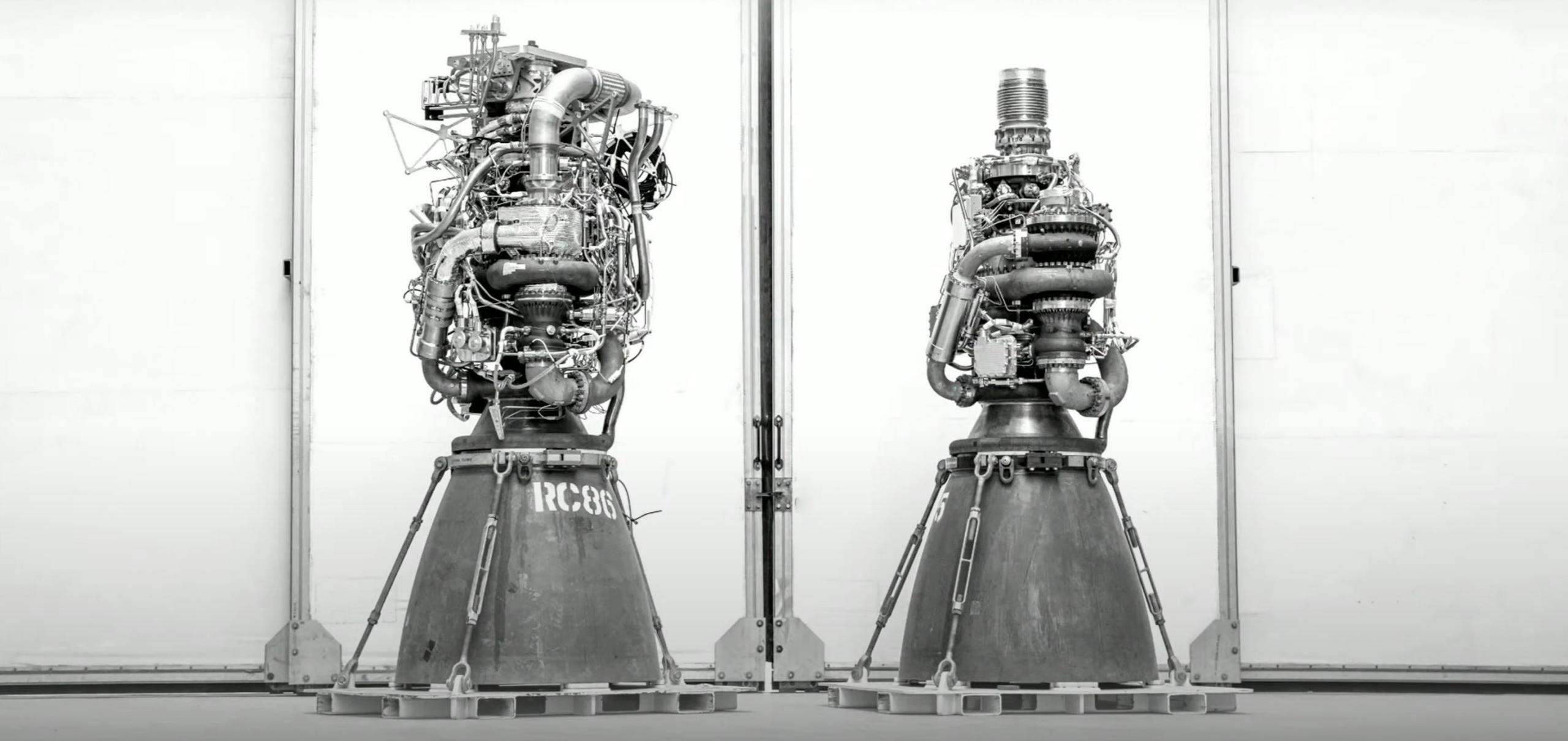
I have a link to a deep dive video into the Raptor 2 and how they've improved the Raptor 1 by simplifying and improving many parts. Musk refers to the Raptor 1 as looking like a Christmas tree compared to version 2:  “It’s not super easy to see but you can compare how much less there is if you just look at–just eyeball the fiddly bits level there versus the fiddly bits level there.”  Teslarati published this photo showing the two types side by side. 

One of the last Raptor 1s vs. one of the first Raptor 2s. (SpaceX photo)  Obviously fewer fiddly bits. 

From the start, Raptor 2’s purpose was to make future Raptors easier, faster, and cheaper to manufacture. The ultimate goal is to eventually reduce the cost of Raptor 2 production to $1000 per ton of thrust, or $230,000 at Raptor 2’s current target of 230 tons (~510,000 lbf) of thrust. As of mid-2019, Musk reported that each early Raptor 1 prototype cost “more” than $2 million for what would turn out to be 185 tons of thrust (~$11,000 per ton). It’s not clear if that ever appreciably changed.

SpaceX built a dedicated Raptor 2 facility and is currently producing Raptor 2 engines at a rate of one per day.  An engine per day is too slow for the rate SpaceX needs them.  There are 39 Raptors on a Starship/Super Heavy combination, so that's almost six weeks to outfit one vehicle.  Musk has stated before that they're “aiming [to build a Raptor] engine every 12 hours...”  It will be interesting to see that.  Raptor is already one of the fastest-produced orbital-class rocket engines in history, if not the outright fastest.  


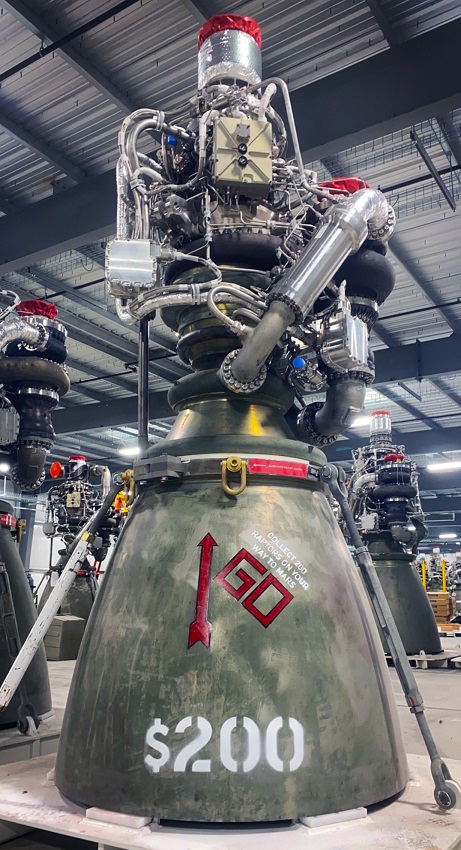
Note the joke painted on the engine bell, referencing the board game Monopoly. Jokes painted on engine bells seem pretty common at SpaceX.


Sunday, November 6, 2022

Rocket Lab at 0 for 2 on Helicopter Booster Recoveries

Friday evening, east coast USA time and 6:27 AM Saturday New Zealand time, Rocket Lab launched their second mission featuring an attempt to recover the booster with a helicopter.  As usual, they provided live video so we learned what was happening as the announcers learned.  You might recall their first attempt back in May on a mission called There and Back Again in which they actually snagged the booster but then the helicopter pilot dropped it citing unusual dynamics that didn't match their test or practice scenarios.  While they succeeded in catching the booster, the goal of catching the booster in mid-air and never having it plunge into saltwater remained elusive.

Friday's mission, called Catch Me If You Can, never hooked the booster and the company reported the helicopter left the area when controllers lost telemetry from the booster.   

But ground controllers lost contact with the 39-foot-long (11.9-meter) booster stage during descent. As a safety precaution, the Sikorsky S-92 recovery helicopter flying over the Pacific Ocean to catch the booster moved out of the capture zone, “per standard safety procedure,” Rocket Lab said.

The booster splashed down under a parachute, and a recovery ship moved alongside the rocket to pull it from the sea and return it to Rocket Lab’s development and manufacturing facility in Auckland, the company said in a post-launch statement.

Rocket Lab is committed to booster re-use but the Electron booster isn't big enough to have some of the margin for extra fuel that the Falcon 9 has.  The Electron is a much smaller launch vehicle at 59 feet tall vs. 230 feet for the F9.  To use helicopter recovery vs. slowing with engines and landing on a drone ship makes sense. 

The downside to that, of course, is that booster becomes a ballistic projectile with very little control.  The booster continues upward (as the Falcon 9 booster does) slowing down before going into a free fall.  It is calculated to reach a a top speed of 5,150 mph (8,300 kilometers per hour) before aerodynamic drag starts stripping some of that velocity and turning it into heat.  The trade is that external temperatures build up to 4,350 degrees Fahrenheit (2,400 degrees Celsius).  That's hot enough to generate some plasma around the vehicle which could interfere with radio links; which must be expected.  The booster has a heat shield, which (if memory serves) was added specifically to improve the chances of recovering the booster.   

“Rocket telemetry dropped out (it happens a bit during re-entry) but we did not regain a solid link in time,” tweeted Peter Beck, Rocket Lab’s founder and CEO. “Without that link, it’s just not safe to put the helicopter into the recovery zone, so we stood it off. The great thing about recovery is you get it back to see what happened.” 

Rocket Lab will tell you that all of this is a sideshow to getting important payloads into space (for paying customers, of course).  The mission was to deliver a Swedish scientific satellite called MATS, for Mesospheric Airglow/Aerosol Tomography and Spectroscopy, into polar orbit.  The MATS mission is funded by the Swedish National Space Agency, and is designed to study waves in Earth’s atmosphere.  MATS is the first Swedish science satellite to launch in more than 20 years.

The satellite was built by OHB Sweden, and carries an instrument to image variation in light emitted by oxygen molecules in the upper atmosphere, as well as noctilucent clouds that form about 50 miles (80 kilometers) above Earth’s surface. OHB Sweden said in a post-launch press release that ground controllers established communications with the MATS satellite, confirming it to be in good health following deployment in orbit.

A satellite in good health and the right orbit is what it's all about.

The Saturday morning (in New Zealand) launch of the Catch Me If You Can mission.  Rocket Lab photo. 


Saturday, November 5, 2022

Tower Repair Finale

The tower is repaired and back up.  It's even more or less vertical and I didn't have to tear up the work I've done already to get it into place.  I just had to walk back and forth between the east side of the house and the shop on the west side about a million and six times for that one size wrench, socket, or drill bit that I didn't have, or that thing I didn't even think I might need.  

Those of you in the southeast US watching the tropics know that there's a broad area from just north of Puerto Rico and Hispaniola (the island containing the Dominican Republic/Haiti), stretching north up over and east of the Bahamas up to around Cape Canaveral.  Even farther north as you go farther offshore. The NHC says there's a good chance that will develop into either a tropical storm or a non-tropical cyclone, all of which means there's a chance that it goes from a rainy/messy week to a storm that forces me to crank over the tower again.  More on that later.

But first, here's the leg that was broken and mangled repaired with the tube up inside the leg, held in place by two 1/4-20 stainless bolts at 90 degrees to each other and offset center-to-center by one inch.  

Anybody here a mechanical engineer?  The strength in bending is proportional to the moment of inertia of the tube.  The existing 1.50" OD tube has a polar MOI of 0.068 in^4.  The tube sticking out of the bottom of that tube has an MOI of 0.097 in^4.  Smaller OD but thicker walls.

The angle aluminum is new for general purposes; the old piece had undergone some corrosion and it seemed prudent to replace it.  The angle is held by another 1/4-20 stainless bolt and locking hardware.  In the slab itself is a 3/8" bolt with a stainless nut on it which had also suffered some corrosion but running a threading die over that cleaned up the threads and made it so the nut threads all the way down to surface of the concrete slab.  

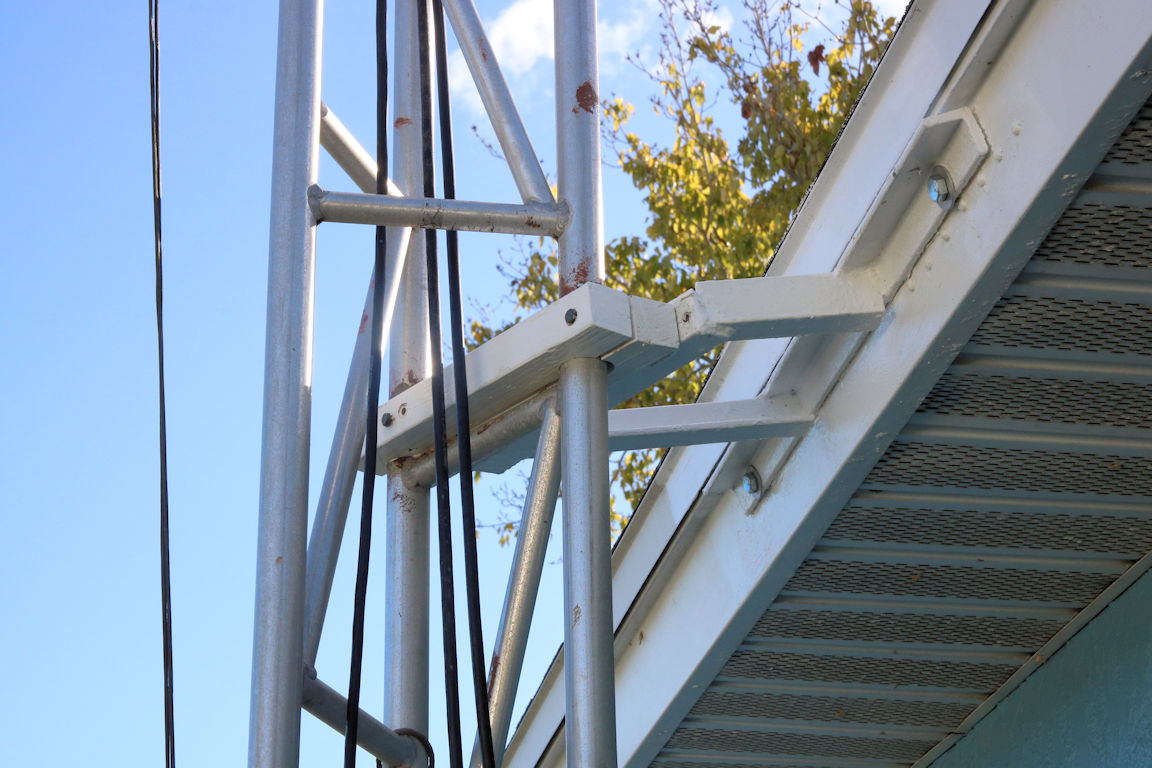
This is that area with the tower cranked up and bolted in place to the house bracket. The two holes that get bolts through them are drilled with the "loose clearance" size recommended on standard threading charts, about 1/64 of an inch larger in diameter than the bolt size.  By loosening the 1/4-20 bolt on the tower leg, it easily allowed me to lower the tower into place. 

The house bracket and the 2x4 that clamps the tower to that bracket was fussy and made me walk back and forth for different hardware the most.  

I think this needs to be replaced and I've been telling myself for years to make an alternative out of aluminum bar stock in the shop.  I end up replacing the wood 2x4 every couple of years, and it's annoying.  In the big picture, as has been talked about here often, I don't want to use a house bracket and I'm seriously studying how to emulate mounting pole concept that Aluma (the tower manufacturer) uses.

Finally; an overview.

By the time I finished this up yesterday, it was too late to spend any time looking at the antennas, so I did that today.  It turns out the antenna I repaired, the bigger one on the bottom in this view, was at least as good as before the elements snapped off, but the smaller antenna visible above it was markedly worse.  Ironically, I never swept that antenna when the tower was cranked over because it looked fine.  For those who understand this, the swept VSWR went from 1.1 or 1.2:1 up to over 5:1.  It's rather strange.  

The short version of the story, though, might well be that with the messy weather coming up that might turn uglier, maybe the answer is to crank the tower back over so I can access the back end of the antenna.  When I put that antenna up last January , I worked on it by turning the antennas to point south which puts the connector closest to the ground.  In this picture, it's pointed north.

I don't see anything about cranking it back over again for another week that would be negative. Thanks again to the people who suggested fixes and approaches that helped me converge on a way to get this done.


Friday, November 4, 2022

Meanwhile, Further Up The Chain

For those not keeping score, Tuesday's Falcon Heavy launch contained three Falcon 9 boosters, and the person narrating their coverage said it was their 150th and 151st successful booster landings.  The Heavy's core was not recovered because it needed all the energy the core could deliver to achieve the geosynchronous transfer orbit that the heavy payload needed.  Yesterday morning's Falcon 9 launch of the Eutelsat Hotbird 13G satellite was Falcon 9's 50th launch of 2022 and 152nd booster landing.  

Before those launches, somebody or some team had to build everything they launched.  Yesterday, November 3rd, SpaceX's factory in Hawthorne, California celebrated the completion of the 200th Falcon 9 upper stage and Merlin Vacuum (MVAC) engine.  While booster reuse has dramatically reduced the number of first stages they need to produce, every flight requires an upper stage and MVAC engine.  Yes, there is mass production of rockets and engines.  SpaceX Hawthorne is probably the foremost in the world.

Since Falcon 9’s surprising inaugural success, SpaceX’s Falcon 9 and Falcon Heavy rockets have launched another 187 times for a total of 188 launches and 189 assembled rockets. Every one of those launches has required a new second stage, and all but one (Crew Dragon’s In-Flight Abort test) required a new Merlin Vacuum engine. 

SpaceX photo from this Tweet.

There's a fun fact lying here that isn't very obvious but that's a total of 188 launches with 200 second stages being built.  Over how long?  The first Falcon 9 test flight was in June of 2010.  SpaceX announced the production of its 100th second stage and MVAC in April of 2020.  The fun fact is that  means the production of the first 100 engines took 130 months.  The second 100 engines took 30 months.  Read it and weep, all you "old space" companies.  

Here's another one.  Last night's Falcon 9 launch was the 50th of the year, but in the last 365 days, Falcon rockets have completed 59 successful orbital launches, or around one launch every 6.2 days.  At that rate the 200th second stage, pictured above, 12 serial numbers away will fly in around 10-1/2 weeks, which will be in the second week of January.   

Final words to Eric Ralph of Teslarati.

After Falcon 9’s successful November 3rd, 2022 launch of the Eutelsat Hotbird 13G communications satellite, SpaceX’s Falcon rocket family has completed 160 launches without failure, arguably making it the most reliable rocket family in history. To achieve that feat with its partially-reusable Falcon 9 and Falcon Heavy rockets, SpaceX has had to master reusable and expendable orbital rockets to a degree that only a few other companies or space agencies in history can claim to have matched or exceeded, and that none have achieved simultaneously.


Thursday, November 3, 2022

Artemis Rolls to Pad 39B and Second BE-4 Shipped to ULA

Everything seems to be properly prepared for the Artemis/SLS/Orion stack to rollout to pad 39B again for what will be the third attempt to launch the SLS rocket on its debut flight.  First motion is targeted for 12:01 AM EDT or 0401 UTC and will be streamed live by some YouTube sources like NASA Spaceflight.com.  On the other hand, the crawler transporter should be at the launch complex by dawn and many of you won't see this until after the live streams have stopped.  Those of you in the western US or points farther west may get a look at it in motion.  At an average speed of under 1 mph, it's not exactly dramatic, but drama is probably the last word they want associated with transporting a billion dollar baby to the launch pad.

The program office continues to target a launch date no earlier than Nov. 14 at 12:07 a.m. EDT.  

During discussions of the previous scrubs and rolling the stack back to the VAB, it was mentioned that the Artemis/SLS and Orion capsule have been stacked for 11 months and there were real concerns about any degradation of the systems that come from that.  Earlier today, NASA officials held a teleconference with space reporters to go over all those lingering questions.  Eric Berger from Ars Technica was one of the space reporters who was allowed to attend and publishes some important points from it in this week's Rocket Report.  (When it's published online, this will be the site it's most easily found.)

One of the big questions about the rocket concerns the lifetime of its massive solid rocket boosters, which have now been stacked for nearly two years. NASA's Cliff Lanham, who oversees ground systems, said NASA's initial analysis found that the rocket boosters provided by Northrop Grumman had a lifetime of one year. However, a subsequent analysis of their health cleared one through Dec. 9 2022, the other through Dec. 14.  [BOLD Added: SiG]

Two boosters, built around the same time; one is good until 12/9 and the other to 12/14.  Really?  Since those dates are five days apart, someone has already asked, "and then what?"  The source quotes Jim Free, who leads exploration systems development for NASA, saying NASA could probably extend their life further with additional analysis. But this will be a source of concern if the Artemis I mission has to be delayed again.  

Allow me to indulge in some pure speculation.  Given the precision that I think those dates can be known to, both of those days fall in last launch window of '22 and if asked if they can get "a few more" days out of those boosters, I'll bet they'd go as far as December 22nd, the last launch day of this year.  If Artemis can't be launched by then, something big and nasty is going to hit the fan. I don't know that they can replace those solid rocket boosters without major problems, and there are other concerns like the whole stack perhaps not being rated for more trips to and from the launch pad.


(As a refresher:  Red days are no go - they violate Orion spacecraft criteria; dark green days are longer duration missions, 38-42 days; light green days are shorter missions, 26-28 days.  Gray days are times when the required alignments of moon, Earth and whatever preclude launches at all.  There are additional constraints as well.)


On Halloween Monday, Blue Origin reported they've completed delivery of the two necessary BE-4 engines for the first flight of United Launch Alliance's Vulcan rocket. 

“We’re excited to see ULA’s Vulcan fly,” said Bob Smith, CEO, Blue Origin. “The BE-4 is a great engine, and we’re proud of Team Blue for achieving this milestone as part of ULA’s team. It’s been a wonderful partnership, and this shipset is the first of many more to come.”

“We are very pleased to receive the first two engines for Vulcan’s inaugural flight,” said Tory Bruno, ULA president and CEO. “Development of this new engine is complete, and the performance of the engine is outstanding. It has been a great team effort working together with our partners at Blue Origin and we can’t wait to see Vulcan fly.”

It has certainly been a long and frustrating development process, dating back to 2014 when ULA contracted with Blue to deliver the BE-4s by 2017.  Lots of text has been generated on why these engines are pretty much five years late, but they seem to be meeting their hype now.  ULA and a long list of customers waiting for these engines have been getting into trouble; having the first production engines delivered may well keep that from becoming deep, deep trouble. 


Wednesday, November 2, 2022

Time to Watch for a Falling Chinese Rocket Stage Again

This Monday, The China Manned Space Agency (CSMA) launched what's being reported as the third and final module for their Tiangong space station.  Like other modules, this one was launched atop their Long March 5 rocket.  As with the previous launches, the upper stage of the rocket is now in decaying orbit and is going to crash back to earth uncontrolled, with no attempt to steer the rocket into a ocean splashdown in TMFN - The Middle of Nowhere (you can figure out what the F stands for yourself). 

You may well remember the previous incidents. 

In July, between 5.5 tons to 9.9 tons (5 to 9 metric tons) of another Long March 5B crashed into the Indian Ocean after surviving the fall through Earth's atmosphere. Another Long March 5B fell into the Indian Ocean in April 2021 after China's space agency did not perform a controlled deorbit. And in 2020, after the rocket's debut launch, pieces of the vehicle's core stage reportedly hit the ground in Ivory Coast

In my opinion Eric Berger at Ars Technica gives a better explanation of the story than that first link to Space.com.

Typically during a launch, a rocket's large first stage will provide the majority of thrust during the first minutes of launch and then drop away before reaching an orbital velocity, falling back into an ocean harmlessly. A smaller second stage then takes over and pushes the rocket's payload into orbit. However, the modified version of the Long March 5B has no upper stage. Rather, it consists of a core stage with four strap-on boosters.

The boosters power the rocket off the pad, but then the core stage, with its two YF-77 main engines, pushes the space station modules to low-Earth orbit. At that point, the core stage lacks the capability to restart its main engines and make a controlled entry into Earth's atmosphere. Typically, rocket upper stages and other used space hardware is disposed of by aiming for the remote Point Nemo, in the Pacific Ocean, but that will not happen in this case.

Not all space hardware needs to be disposed of in such a manner. Vehicles such as the Russian Progress spacecraft are small enough to burn up in the atmosphere. But that's not the case with the core stage of the Long March 5B rocket, which has a mass of more than 20 metric tons. Large pieces of metal will make it to the surface of the Earth.

Even Eric, though, kind of let an important piece of info go unemphasized.  Where he says, "the core stage lacks the capability to restart its main engines..." that's the reason they can't aim for Point Nemo. Why don't they design a system that can restart?  China apparently just doesn't care.  They have, after all, dropped boosters in populated areas of their own country.  

Still, the odds of anyone in particular being affected by a falling rocket upper stage are staggeringly small.  Ted Muelhaupt, a consultant with The Aerospace Corporation's Corporate Chief Engineer’s Office, was quick to point out that "nobody has to alter their lives because of this," but also pointed out that "88% of the world's population is at risk, and so 7 billion people are at risk" from the Chinese space debris falling on them.  The surface of the Earth is mostly water, of which most is ocean water and most of the 7 billion people live in concentrated cities.  Muelhaupt added, "the risk to an individual is six per 10 trillion. That's a really small number."  Small number?  That's about a million times less likely than winning the Lotto.  

Where he gets the "88% of world's population" number is from the amount of the Earth's surface under the Long March 5B's orbit, shown here in blue and yellow.

Aerospace Corporation is saying they'll provide data and refine predictions as newer data becomes available.  Earlier this evening, they tweeted:

Our latest prediction for #CZ5B rocket body reentry is: 04 Nov 2022 23:17 UTC ± 10 hours Reentry will be along one of the ground tracks shown here. It is still too early to determine a meaningful debris footprint.

That's 7:17 PM on Friday - plus or minus 10 hours.  If you don't care to use Twitter, it will be on Aerospace's website.  Expect that time to change before Friday. 


Tuesday, November 1, 2022

Falcon Heavy Returns to Flight

Falcon Heavy is the world's most powerful rocket by a factor of two and hasn't flown since June of  2019.  Turns out that's not a problem for a group that knows how to launch the world's most launched booster on a routine basis, and the performance of the mission to carry payloads directly to geosynchronous orbit had the customer, the US Space Force, saying it was “simply outstanding.”  Flying satellites directly to 22,400 miles altitude for the geosynchronous orbit puts Falcon Heavy into a very small class of rockets worldwide

The success of the US Space Force’s USSF-44 mission means that SpaceX’s Falcon Heavy rocket is now one of just a handful of operational rockets in the world that has demonstrated the ability to launch satellites directly to geosynchronous orbit. More importantly, it’s one of just three US rockets with that established capability. The other two rockets – ULA’s Atlas V and Delta IV – will cease to be available for US military missions by the end of 2023, meaning that Falcon Heavy may briefly become the only rocket in the world able to launch certain US military missions until ULA’s next-generation Vulcan rocket is ready to prove itself.

I think it's well-known that this mission has been delayed several times due to issues with the payload, but that couldn't be known when the mission was first scheduled for late 2021 or early this year.  That means SpaceX had the hardware required for today's launch – mainly three new first-stage boosters – fully built, the qualification testing completed, and sitting here on the Cape since mid-2021.  It's my understanding there are more sets reserved for Falcon Heavy here now as well.

Here on the Space Coast, as the tourist development agencies call it, the weather was fine but on Cape Canaveral itself, there was uncharacteristic fog.  It was hard to see the actual launch and visibility continuously improved as the rocket's altitude increased.  I have no idea where to get actual data on this, but I don't think I remember there ever being a fog around here in October.  December through the end of January are much more likely to have foggy mornings, in my experience.  

This morning's launch from my backyard around 30 seconds before Booster Engine Cutoff and staging.  Canon EOS T6i, Sigma 70-300mm zoom at 300mm.   Since that's a small sensor, it's more like a 500mm lens on a full-frame sensor.

A visual "trademark" of Falcon Heavy launches is when the boosters return to SpaceX landing zones one and two on Cape Canaveral Space Force Station.  The returns and landings seem choreographed to occur seconds apart.  They seemed to be set up to land five seconds apart today.  While we've heard sonic booms here from boosters returning to CCSFS before, we didn't hear them today,  You should watch the SpaceX video over on YouTube.  The video linked is time tagged to start up at T-15 seconds, but you can watch the whole thing simply by moving the slider on screen back to the beginning, or wherever you choose to watch it.  

With Artemis/SLS preparing to roll back to Launch Pad 39B no earlier than 12:01 AM on Friday, Nov. 4, it seems to me the debate over which rocket will be the new most powerful rocket in the world, SLS or Starship, is settled and SLS will own that title.  Until Starship flies.  Probably within a few months, and possibly this month. 


Monday, October 31, 2022

Happy Halloween 2022

I'm not big on Halloween and never really have been.  Yeah, I went trick or treating as kid, maybe up to age 12, when Mom used to say, "have fun and be back by 9" instead of coming with us.  It's gotten even less involved since the kids are long out of the house and PGD (Precious Grand Daughter) is over a thousand miles away.  We don't even buy candy for the neighborhood munchkins because there's always leftovers that neither one of us would eat and I don't have the convenient "I'll leave the rest near the coffee pots at work" backup I used when I was working. 

That said, there are some aspects of the holiday that I like. 

When I think Halloween, I think Jon Neill, the professional artist who has become famous for carving pumpkins.  This guy has "mad skilz" as they say.


Meet Slushy the Cyclops.  Like most of Jon's work, Slushy is apparently done with your average, grocery store pumpkin, but another pic from his website appears to show a carving made from an entry in one of those biggest pumpkin contests we hear about this time of year; in this case something called the Fair Oaks Farms Cowtoberfest.  This particular pumpkin was in Cowtoberfest '19.  No mention of how big it was.

While these are impressive, I think it's more impressive to carve recognizable faces out of a pumpkin.  I looked at a couple from his website, two musicians: Guns 'n Roses guitarist Slash and Alice Cooper.  Of the two, I think Alice Cooper is a more impressive carving.  His carving of Slash has less details because of large sunglasses Slash wears.
 

Go look around on his website.  The guy has some serious talent.

And Happy Halloween!  I know most people will see this on November 1st: All Saints Day or All Hallows' Day.


Sunday, October 30, 2022

One of Those Days

I got nothing.  So a little distraction with a couple of things I've come across online.

Has the look of the Babylon Bee but I'm not sure.

The first time I saw the basic meme, it was Trump and Tucker Carlson.  Then Ron DeSantis got added.  Now Catturd has joined the scene. 

Starship landing on Mars.  Found this on Twitter. Don't know who created it. Pretty cool conceptual rendering, though.

Finally, one of my favorites:

Because it's a clever pun.  They always say if you have to explain the jokes, they're not good enough.


Saturday, October 29, 2022

NASA's Mars InSight Lander Detects Large Meteorite Impact

Remember the InSight lander on Mars since November of 2018?  It isn't in the news much, but an item came out in the last several days telling the story of the probe detecting a quake which was traced to a meteorite impact.  That was followed by determining its exact location on Mars.  Actual detection of the impact site was by another satellite, the Mars Reconnaissance Orbiter - the MRO.  

NASA’s InSight lander recorded a magnitude 4 marsquake last Dec. 24, but scientists learned only later the cause of that quake: a meteoroid strike estimated to be one of the biggest seen on Mars since NASA began exploring the cosmos. What’s more, the meteoroid excavated boulder-size chunks of ice buried closer to the Martian equator than ever found before – a discovery with implications for NASA’s future plans to send astronauts to the Red Planet.

Scientists determined the quake resulted from a meteoroid impact when they looked at before-and-after images from NASA’s Mars Reconnaissance Orbiter (MRO) and spotted a new, yawning crater. Offering a rare opportunity to see how a large impact shook the ground on Mars, the event and its effects are detailed in two papers published Thursday, Oct. 27, in the journal Science.

Those two paragraphs are from the NASA/JPL website for the program linked in the first paragraph.  What the JPL site doesn't discuss is how they knew approximately where to look on MRO's photos to see if there was evidence of impacts.  For that, the coverage is on Ars Technica.  

Here on earth, we have seismographs all around the globe.  It's fair to say we have them everywhere.  This allows the users to triangulate the location of a quake by the time differences of arrival at various locations.  On, Mars, though there's only the InSight lander, so how can they figure out how far away the quake was?  Seismologists have named different types of seismic waves and determined different speeds for them, giving them different times of arrival.  That gives an expected distance from the lander to search for new impact craters.

The cameras on the Mars Reconnaissance Orbiter (MRO) have been observing Mars for 16 years. Before 2021, they had not observed any impacts that formed a crater over 130 meters across. In 2021, it spotted two. One of them was not especially useful. MRO imaging didn't capture exactly when the impact occurred, and it was far enough from the site of the InSight lander that direct seismic waves ran into the planet's core, which meant that only indirect seismic energy reached the instruments on InSight.
...

Knowing that these two impacts generated events allowed for a direct comparison between the estimates and the impact location. And it turns out the estimates are quite good. One event was estimated at 3,530 ± 360 km away, and it turned out to be 3,460 km from the lander, a difference of just 70 km. The second was at 7,591 ± 1,240 km away, and that estimate was off by only 130 km. In both cases, the actual error was far smaller than the estimated error.

The MRO before (left panel) and after photos that isolated the bigger impact.  Not much doubt about the change there: 

NASA, Mars MRO photo.  NASA/JPL-Caltech/MSSS all get credit.

Color photos of the fresh crater taken later show white specs that are described as water ice boulders - and the closest to the equator water ice has ever been found. 

All in all, an excellent geek story.  To be extremely geeky, NASA released a 57 second video of the sounds that InSight recorded.  That's posted on CNN, of all places.  You can actually hear the sounds of a meteorite impact on another planet.  Considering I've never heard a meteorite impact here on Earth, that's saying something.  Lots more geeky details at Ars Technica, NASA's mission website, and CNN.

Unfortunately, InSight's solar panels have been covered in dust by Martian storms according to Bruce Banerdt, the InSight principal investigator.  The probe isn't expected to survive much longer. Still, the mission has survived twice as long as its intended mission. 

“For the last four years we’ve gone well beyond the intended lifetime of the mission, which was two years,” Banerdt said. ” And even now as we’re winding down, we’re still getting these amazing new results.”


Friday, October 28, 2022

Maybe It's Just Me

Now that Elon Musk has finalized his takeover of Twitter, maybe it's time to open an account.  I've quoted from Twitter or posted screen captures of tweets innumerable times, but I've never felt the need to open an account.  How they treat us visitors is only moderately annoying.  Depending on things I don't know about, sometimes I can read screen after screen of tweets and sometimes the screen freezes and I get a "sign up to see more" message.  I've avoided social media for a few years since I shut down my Facebook account, and, yeah, I know blogging is considered social media by some, but when things like this happen, story on Twitchy, it's tempting. 

The mere fact that a random person who calls himself ‘Catturd’ can talk to the richest person on the planet is mind-boggling. It’s also possibly the biggest reason the Twitter platform has become the force it has.

One side effect of that openness is that self-important media elitists appear to be just a bit jealous when people who are actually doing important things pass them over.

We’re looking at you, Keith Olbermann. Seriously, if you had the choice between reading something Catturd said or something Keith Olbermann said, who wouldn’t choose Catturd?

Look at this masterpiece by Olbermann. If we’re parsing his tweet correctly, Keith is willingly tweeting from the ashes of urine-soaked dumpster fire. You could just leave, Olby?

Catturd had this to say in reply.

I have URLs bookmarked for a few Twitter accounts; Elon Musk, SpaceX, and a couple of others.  About all I can see is the most recent couple of posts.  I've got to assume that having an account would allow more.  Plus, I've got to like someone who uses this as their title to the world. 

EDIT TO ADD at 10:45AM on 10/29:  Judging by the first bunch of comments, I didn't emphasize my reasoning well enough.  The point of starting a Twitter account isn't to follow Olbermann (not in a billion years), or even Catturd (who I usually find funny).  The point is to get more access to twitter feeds that I'd find useful, like SpaceX, Musk himself, NASA Spaceflight and lots more without giving credit to the previous stack of morons and liars who were in charge.  It's also to reinforce that selling to Musk was a good move to get more people involved with Twitter.  If a bunch of people who have stayed on the sidelines out of a desire to not support Twitter now sign up, financial analysts will say it was a good move.  


Thursday, October 27, 2022

Small Space Story Roundup

There's actually a Canadian space race going on.  Who knew?  From this week's Rocket Report at Ars Technica (as usual, sent as an email before it hits the website here)  

Tracking the Canadian rocket race. Much, and more, has been written in this newsletter about commercial launch development in the United States, China, Europe, and India. But what about Canada? It turns out there are at least five Canada-based companies working to develop a native commercial launch capability. These companies are summarized in a new article in spaceQ which is (unfortunately) behind a paywall. Most of the companies are working toward the goal of launching from Spaceport Nova Scotia, which remains under development.

Big ideas, small payloads ... The five companies are based in Calgary (AVRO Aerospace), Toronto (C6 Launch Systems, Nordspace, and SpaceRyde), and Montreal (Reaction Dynamics). All are planning some variation on a small-satellite launch vehicle, with some ideas more radical than others—SpaceRyde's balloon-based launch concept, for example. I'm not well enough informed to comment on the viability of any of these companies, but small launch is a difficult business. However if the Canadian Space Agency were to start offering and awarding contracts, that would help us discern who is legitimate, and who is not.

Yeah, I tried their link and it says for subscribers only.  Any of you Canadian readers have any input here?  Anybody know anything about the companies? 


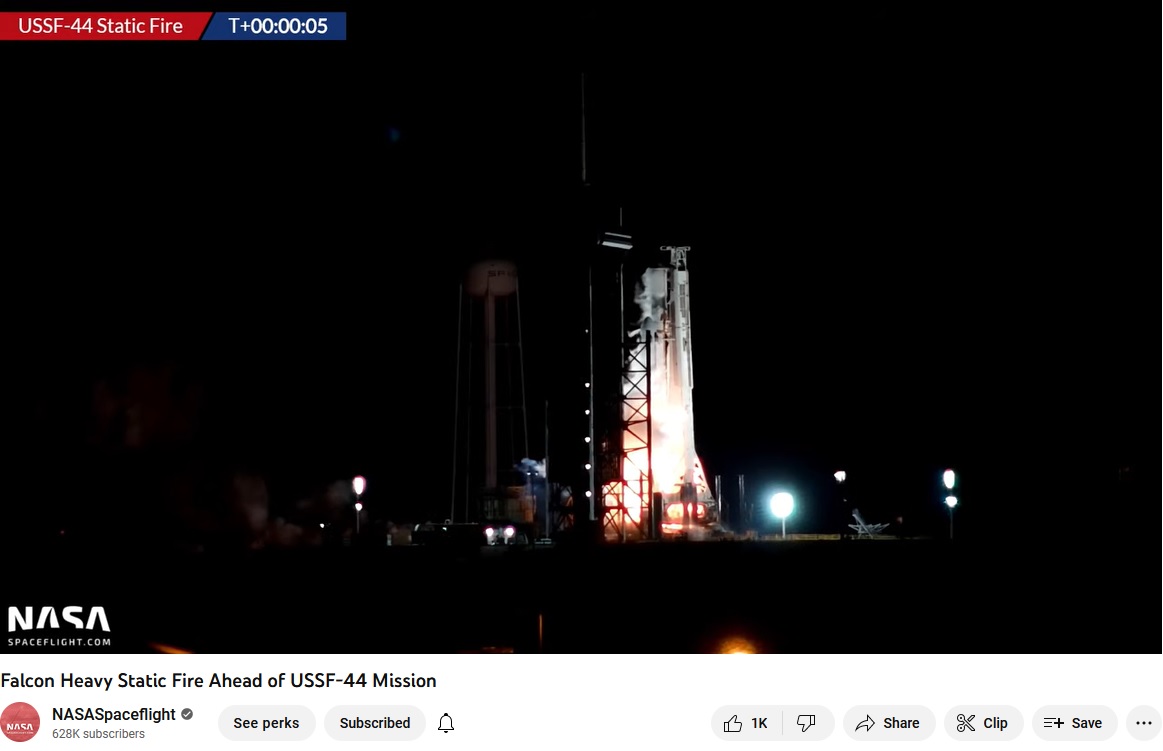
SpaceX static fired the Falcon Heavy for next week's USSF-44 mission tonight at 8PM EDT.  It was livestreamed by NASASpaceflight.com.  The video should start at about T-20 seconds.  Like most static fire tests, it was a WDR (Wet Dress Rehearsal) followed by about seven seconds of firing. 

Screen capture at around the peak brightness.  The US Space Force payload is not yet stacked, so the vehicle will be rolled back to the hanger, the payload and fairing stacked, and then rolled back to the pad.  

The two websites I linked to for launch times on Monday have diverged with one saying the launch will be Monday and the other saying Tuesday.  The commentators on the video talk about Tuesday as well.


In keeping with yesterday's post about SpaceX becoming NASA's largest contractor, they're also becoming more important to the European agencies.  On October 20th, European Space Agency (ESA) director Josef Aschbacher announced that the ESA will contract with SpaceX to launch two important science probes, the Euclid telescope and Hera, a multi-spacecraft mission to a near-Earth asteroid, after all domestic alternatives fell through. The move was due to delays in qualifying the Ariane 6 booster.  

Euclid is a small near-infrared space telescope that has been in development since the early 20-teens.  It is to be launched to the same Earth-Sun Lagrange point as the James Webb Space Telescope, L2.  The Webb is a much broader spectrum instrument from near infrared out to far infrared wavelengths, so they're not competitors; more like extra capability out at L2 for the near-infrared spectrum.  

The other mission, Hera, is considerably more ambitious.  Hera’s mission is to orbit around the near-Earth asteroid Didymos and study the impact crater on its smaller partner, Dimorphos, created last month by the DART mission. Hera has a short, 17-day launch window in October of 2024.  It had been intended to fly on Ariane and was scheduled to be one of the first payloads launched by an Ariane 64 rocket with a new Astris kick stage under development at Arianespace.  Missing that October window could stretch out its mission from two years to more than five years.  Where do you go to find a booster capable of lifting that on short notice?  Exactly.  The same rocket that launched the DART mission.

Hera, left and Euclid renderings.  ESA image


Wednesday, October 26, 2022

Too Hard to Categorize

Interesting - but more of a business story than a space exploration story.  Perhaps even a story that shows even the Fed.gov sometimes does something right.  A Tweet by Aviation Week reporter Irene Klotz shows that SpaceX has moved ahead of every other major aerospace company in the US to become NASA’s largest for-profit vendor.  In particular, between FY '21 and '22, SpaceX leapfrogged past Boeing.  While business with Boeing grew from 1.681 to $1.718 billion, 2.2% growth, SpaceX's business grew from 1.629 to $2.044 billion, 25.5%.  Over 11 times more growth.

As you can see from her data, only the California Institute of Technology and its Jet Propulsion Laboratory gathered more funding.  Their increase was around midway between Boeing's and SpaceX's at 12.3%.  The JPL runs the majority of NASA's deep space missions, like the Mars rovers, satellites around Jupiter, Saturn, and many of those other famous probes you know of.  

The main reason for SpaceX's growth, of course, has been their success with Crew Dragon bringing manned spaceflight back to the US, Cargo Dragon for carrying supplies the Space Station, and the failure of Boeing's Starliner to achieve operational status.  When NASA awarded the contracts to both SpaceX and Boeing back in 2014 - with Boeing getting around 60% more money - to develop manned flight to the ISS, the conventional beltway wisdom was that Boeing would be the provider and the brash startup that talked about reusing boosters would fail.  You know the rest of that story. 

Eric Berger at Ars Technica points out:

Much of the funding increase for SpaceX in 2022, an increase of about $400 million over the previous year, appears to be driven by contracts for the Human Landing System as part of the Artemis Moon Program and the purchase of additional Crew Dragon missions to the space station.

That last part about purchasing additional Crew Dragon missions, which means more Crew Dragon and less Starliner, is a direct transfer of NASA money to SpaceX that would have gone to Boeing if Starliner delivered more bang for the buck.   


Tuesday, October 25, 2022

Relativity Space is Aiming to Join SpaceX

I think it's pretty clear that no company has disrupted the launch business like SpaceX.  They're running a launch cadence unmatched by any other company in the world; their work to achieve booster recovery and reuse was done without risk to customers by doing experiments with boosters after they were thrown away (after staging), not to mention moving modern, hi-tech industry development methods into what had been a separate and distinct industry that supposedly made the most reliable, best products in the world. 

Most likely before the end year, we'll see an attempt to disrupt the launch industry yet again; this time by a company founded by people that admire SpaceX and Elon Musk.  People that want to further disrupt things and speed up the goal of putting people on Mars ASAP.  A company that wants to join SpaceX as an industry disruptor. 

Just three months ago, I ran a column on that company, Relativity Space and their plans.  To briefly recap, Relativity Space might best be considered an additive manufacturing company.  Their rocket bodies, engine parts and much of the vehicles parts are 3D printed (14 second time lapse record in this video).  Their first launch vehicle, the Terran 1, is proceeding to its first launch, but while making orbit is important, it isn't really what the launch is about.  The launch is about verifying that the 3D printed components of Terran 1 survive the worst of the launch profile, the maximum dynamic pressures the vehicle will feel and called max q, an important demonstration of the technology.  

Like most engineering, they say they've tested the system to levels worse than max q but there's no test quite as convincing as doing it In Real Life - and in front of customers.

Terran 1 is complex for a rocket in its size class - one ton to low Earth orbit - because while this is a test vehicle, their real goal is something more like a Falcon 9 and called Terran R - "R" for reusable.  To simulate the needed parts better, for example, the smaller rocket will have nine engines including all the hardware required to manage those.  Those are methane/oxygen engines, more like Starship than Falcon 9, with new technology igniters.  The mission could probably be more likely to succeed with fewer, simpler engines.  By mass, 85% of the Terran 1 is 3D printed.  

CEO Tim Ellis is very aware that no privately funded company has achieved orbit on their first attempt but thinks the mission might be "graded on a curve."  That is, if they don't make orbit, customers might decide if it was "close enough."

"While the rocket-loving engineer in me wants to say it's really orbit or nothing for the first flight, I think the business leader part of me knows that customers are going to tell us what enough looks like for the first flight."

Stage one of the Terran 1 rocket undergoing testing at Launch Complex-16 on Cape Canaveral Space Force Station.  Relativity Space photo by Trevor Mahlmann.  While the photo is undated, the background reminds me of this test on August 22nd.  (Link to a self-starting video on Twitter)

Not long after this test, stage one was rolled back to their hanger where the second stage is currently being added.  It's expected that in a few weeks (mid-November) the completed vehicle will be rolled out to LC16 again, for more testing, Wet Dress Rehearsals and eventually static firing.

"We’ve bitten off a lot more upfront on the Terran 1 learning so that we can roll it into the Terran R, and get there faster," Ellis said. "That’s some insight into why customers are so excited about Terran R, because when they visit the launch site and look at Terran 1, a lot of their reaction is, 'Wow, this looks more like a miniature Falcon 9 than it does a cubesat launch vehicle.'"

In a few months, probably after the Terran 1 launch, Ellis plans to provide a "comprehensive" update on Terran R to talk about plans for reusability. However, initially, the vehicle will fly in an expendable mode to meet the demands of customers who want a medium-lift rocket, sooner. Much as SpaceX experimented with reusing the first stage, Relativity will practice water landings as well. Second stage reuse will also be folded in over time.

But rest assured, Ellis said that full reuse is coming. It's the future of Relativity Space and, he believes, the industry, as SpaceX develops Starship and other companies have revealed plans for such vehicles.

“They can’t be the only one disruptive medium- to heavy-lift launch company," he said. "Relativity is certainly playing to win."

Sometime recently, I read someone quip that Relativity Space has more money than God.  Maybe not, but funding doesn't appear to be an issue.  In their last fundraising round in 2021, Relativity raised $1.3 billion.  The company currently has nearly 1,000 employees, and a majority of them are working on Terran R, with the goal of completing the full-scale Aeon R engine test about 12 months from now and launching in two years. Likewise, they have a lot of obligations.  Relativity has sold $1.2 billion worth of launches on Terran R and has a "few hundred" million more dollars' worth of contracts under negotiation with customers.

"New Space" is being pretty darned interesting! 


Monday, October 24, 2022

Falcon Heavy Preparing for Next Monday

Sunday evening, SpaceX Tweeted the following picture with a minimal explanation (much larger version of this picture can be downloaded from that link). 

That, of course, is the "business end" of a Falcon Heavy, in the integration facility connected to pad 39A.  Essentially three Falcon 9s - 27 Merlin 1D engines - running at the same time.  Teslarati goes into some details on what has to happen next, updated through this morning when they published.

Thanks to the nature of Falcon Heavy and Pad 39A’s infrastructure, what happens next is more or less guaranteed. During normal Falcon 9 operations, 39A’s integration hangar is large enough for two or three unrelated Falcon boosters to remain while the (Transporter / Erector) T/E rolls inside to pick up a full Falcon 9. More importantly, Falcon 9’s booster and upper stage can technically be integrated off to the side and craned onto the T/E when ready. But with Falcon Heavy, which has a first stage akin to three Falcon 9 boosters sitting side by side, there isn’t enough room inside the hangar to integrate the rocket with the T/E inside.

For Falcon Heavy, the T/E can thus only roll back into the hangar once the rocket’s three boosters and upper stage have been fully assembled and are suspended in mid-air. SpaceX’s October 23rd photo shows that three of the four cranes required for that lift appear to already be in position, further confirming that T/E rollback is imminent. Once the T/E rolls back to the hangar and Falcon Heavy is attached, the rocket will eventually be transported to the pad and brought vertical for wet dress rehearsal (WDR) and static fire testing.

Update: SpaceX began rolling the T/E to Pad 39A’s integration hangar around 1 am EDT, October 24th.

At this point, launch sites (such as this and this) are reporting the launch to be No Earlier Than 9:44 AM on Monday, October 31.  Teslarati's Eric Ralph sounds like he's reluctant to believe that's really going to happen, and adds this:

The US Space Force’s USSF-44 payload – a mysterious pair of satellites that are more than two years behind schedule – will almost certainly not be installed on Falcon Heavy during prelaunch testing, so the rocket will need to roll back to the hangar at least one more time after testing to have its payload fairing attached.

I can only add that "No Earlier Than" means just that.  The soonest someone thought they could be ready to launch was that 9:44 AM on Monday launch.  Launching by next Friday, November 4th, or Thanksgiving (to be absurd) are both NET next Monday. 

This is the vehicle from the last Falcon Heavy mission in June of 2019 being transferred from the horizontal hanger where it's assembled up the ramps to the launch pad.  SpaceX photo.

There's another thing noteworthy about this picture.  This was posted right here on September 10, 2021.  Thirteen months ago.  The story at that time concerned preparations for the USSF-44 mission, NET October 9th.  Today, that mission that looks to be NET October 31, 2022.