Tuesday, June 11, 2024

Wait... What Time is it?

Sorry, everyone.  The day got away from me. Bizarrely busy with a problem with my ham station upgrade (last post, I think), an aborted grocery run across town in the heaviest rain we've had this season, and more.  

So, as usual in times like this, some "funnin' around." 


Monday, June 10, 2024

NASA and Boeing Extend Starliner's Mission

When Starliner docked at the ISS on last Thursday, June 6, they expected to spend a week there, departing on June 13. NASA and Boeing have joined in extending their mission to NET (No Earlier Than) next Tuesday, June 18th.

"...The additional time in orbit will allow the crew to perform a spacewalk on Thursday, June 13, while engineers complete #Starliner systems checkouts," NASA ISS officials said on Sunday (June 9) via X.

It took a long time for Starliner to get to this mission, with two unmanned missions instead of one and then numerous problems with the spacecraft that had to be addressed before it was deemed ready to fly. The mission has not been problem-free, with additional small helium leaks and a few misbehaving thrusters, such that the first attempt to dock failed and it took an additional hour or so before they successfully docked at the ISS. Mission planners and crew consider these problems to be minor, and say they've been dealt with successfully so far. 

Among their first tasks after coming aboard the station was to bring a new urine processing pump for a replacement, NASA officials said. The urine processor was a late addition to Starliner's cargo manifest after the unit on the space station failed earlier this month.

If all goes well, Starliner will be certified to fly six-month astronaut missions to and from the ISS for NASA, as SpaceX currently does with Crew Dragon. The majority of the crew on the station is the Crew 8 mission, launched by SpaceX in March

The seven Expedition 71 crew members gather with the two Crew Flight Test members for a team portrait aboard the space station. In the front from left are, Suni Williams, Oleg Kononenko, and Butch Wilmore. Second row from left are, Alexander Grebenkin, Tracy C. Dyson, and Mike Barratt. In the back are, Nikolai Chub, Jeanette Epps, and Matthew Dominick. Credit: NASA TV


Sunday, June 9, 2024

Didja Know That's Not Miss Alabama?

You know that picture that has been in about a zillion places since about Thursday? This one:


I was surprised to find out that this is wrong.  She's not Miss Alabama.  According to a story on PJ Media, although she's clearly called Miss Alabama on that (sash?) she's wearing, she's not what we all thought. 

See, we think Miss Alabama is the woman going to represent Alabama in the Miss America or Miss USA pageant. This woman, Sara Milliken, is the winner of the National American Miss Alabama pageant, which took place in late May. This is a different pageant and not the one that feeds into those others. To borrow the explanation:

National American Miss is a different sort of pageant, to say the least. The About page of the pageant’s website informs us that “NAM is a program based on the foundational principle of fostering positive self-image by enhancing natural beauty within.” It adds that the “program [is] centered around helping young ladies grow and expand their ideas about who they are and what they want to achieve. We want every girl to realize that she truly can take hold of her dreams and make them real!”

Which is fine; whatever floats their boats. It strikes me as what we used to call "special education" and now seems to be called "the short bus" but in a different domain. It's wonderful that the National American Miss folks aren't pushing chopping off body parts or doing the "add-a-dick-to-me" surgery (as Rush used to say).

For the record, this is the "real" Miss Alabama who will be going to the Miss America pageant, Diane Westhoven. 

Like the PJ Media author, Chris Queen, I'm hesitant to criticize Libs of TikTok who has done a fantastic job of showing just how loony the Libs on TikTok are by re-posting their content word for word. Likewise, I don't want to criticize all the people who jumped on the train because it honestly does look like something we'd expect in this overly Woke-infected time we're living in. I had no idea there were multiple pageants like this, and I'd bet the vast majority of the people who jumped on the bandwagon of making fun of the first picture also thought she was going to the Miss America pageant, rather than being the short bus equivalent of a pageant.

Just seeing the first post does kinda feed the outrage machine. We expect stupid stories like some group thinking a woman the size of a Florida manatee should represent some state in a nationwide beauty contest. My reaction when I saw the first story was my usual, "what planet is this and how'd we get here?" I never thought it was different pageant. Which suggests we should try to be more careful consumers of news. Make sure it's what we think it is before we go open loop (geek talk for "out of control"). 

As for all the comments that Miss Milliken needs to stay away from food, I think it would be better if the National American Miss folks would address her blindingly obvious need for help with her metabolic disease and not just help her feel better about herself. A startlingly small percentage of people can get to be her size without a metabolic illness and those people can't lose that weight by following "eat less and move more." The backing for that statement could take hours.


Saturday, June 8, 2024

A Couple of Short Stories

First, the cool story

SpaceX Releases New Video from IFT-4

SpaceX released a new video today, showing the final moments of the Super Heavy booster's mission, slowing to nearly zero, vertical over the Gulf, then touching down, shutting down the last running engines and tipping over. 

This video from The Launch Pad isn't narrated but shows the landing. If you want some narration, a much longer version is offered by TheSpaceBucket

Now, the rougher story

Apollo 8 LM pilot dies in plane crash

Apollo 8 astronaut William Anders, 90, died in a firey plane crash over Puget Sound, Washington on Friday.

At the time of the airplane crash, Anders was piloting his vintage Beechcraft T-34 Mentor – a single-engine, propeller-driven aircraft primarily used for flight training during the 1950s by the United States Air Force and U.S. Navy.

The details of the crash were confirmed by his son, Greg Anders. 

"The family is devastated," said Greg Anders. "He was a great pilot. He will be missed."

"He traveled to the threshold of the moon and helped all of us see something else: ourselves. He embodied the lessons and the purpose of exploration. We will miss him," said NASA Administrator Bill Nelson in a statement.

Anders was a member of the astronaut corps selected in 1963, and while he trained for and was a backup crew member to a Gemini mission, alongside Neil Armstrong on the backup crew for Gemini 11, his first flight was Apollo 8 a particularly noteworthy mission. It was the first Saturn V mission, it was the program's (and America's) first mission to orbit the moon.  Which made the crew of Apollo 8: Jim Lovell, Frank Borman and Bill Anders the first humans to ever see the far side of the moon - at all, let alone up close. 

Anders graduated from the U.S. Naval Academy in Annapolis with a Bachelor of Science degree in electrical engineering in 1955. He was then commissioned as a second lieutenant in the U.S. Air Force, where he underwent flight training, in part, on the T-34 Mentor. He earned his wings in 1956 and served as a fighter pilot with the 84th Fighter-Interceptor Squadron at Hamilton Air Force Base in California and the 57th Fighter-Interceptor Squadron in Iceland.
...
Feeling his chances of walking the moon were low, Anders left NASA in 1969 to become the executive secretary of the National Aeronautics and Space Council. In 1973, he was appointed to the five-member Atomic Energy Commission, where he led all nuclear and non-nuclear power research and development. He was also named the U.S. chairman of the technology exchange program for nuclear fission and fusion power with the Soviet Union.

With the loss of Frank Borman last November, and Bill Anders now, Jim Lovell is the only surviving member of the Apollo 8 crew.

Bill Anders 1964 photo, holding models of the Gemini capsule and the Agena target vehicle that the Gemini crews would eventually use to learn the docking skills necessary for the Apollo program. NASA photo.


Friday, June 7, 2024

News to Me - Russian ISS Module Still Leaking

I recall hearing that there were air leaks in the Russian Zvezda module on the ISS, but I can't find a link to my original story, and that's not important anyway in the overall picture. The news today is that despite several attempts to deal with the leak, they've been unsuccessful - and I assume that means they don't really know where the leak is or what's actually leaking. 

The microscopic structural cracks are located inside the small PrK module on the Russian segment of the space station, which lies between a Progress spacecraft airlock and the Zvezda module. After the leak rate doubled early this year during a two-week period, the Russians experimented with keeping the hatch leading to the PrK module closed intermittently and performed other investigations. But none of these measures taken during the spring worked.

"Following leak troubleshooting activities in April of 2024, Roscosmos has elected to keep the hatch between Zvezda and Progress closed when it is not needed for cargo operations," a NASA spokesperson told Ars. "Roscosmos continues to limit operations in the area and, when required for use, implements measures to minimize the risk to the International Space Station."

Since they've been dealing with it for over a month, I'm inclined to think that the leak is small and can be accommodated. If they closed that hatch to the PrK module completely, it seems like the worst case is they'd have to deal with their cargo shipments differently - a scheduling issue. 

However, there appears to be rising concern in the ISS program at NASA's Johnson Space Center in Houston. The space agency often uses a 5x5 "risk matrix" to classify the likelihood and consequence of risks to spaceflight activities, and the Russian leaks are now classified as a "5" both in terms of high likelihood and high consequence. Their potential for "catastrophic failure" is discussed in meetings.

In reality, there are two difficult, if not insurmountable obstacles here. First is that Roscosmos is a low priority expenditure for Russia. If anything, Roscosmos is likely to face diminishing abilities to get resources for repairs, no matter how much some people in the agency might want to support the ISS. 

The second one is that every last cubic inch in the ISS is aging out, not just Zvezda. The Zvezda module rode to space in July of 2000. Don't look now, but that's 1 year short of a quarter century. The leakage issue first appeared in 2019 and has continued to worsen since then. Its cause is unknown. 

"They have repaired multiple leak locations, but additional leak locations remain," the NASA spokesperson said. "Roscosmos has yet to identify the cracks’ root cause, making it challenging to analyze or predict future crack formation and growth." 

We regularly read or hear of the expected 2030 retirement of the ISS along with plans to cause it to reenter and otherwise get it retired and out of the way. The problem with projected dates like 2030 is that the hardware has the last word. It doesn't matter what fancy, involved calculations you did to get that 2030 date if the hardware isn't exactly what it was modeled as. Models are an aid. Reality gets the decision.

The Zvezda Service Module provides living quarters and performs some life-support system functions. Docking adapter for the Progress cargo ships on the right. Image credit: NASA


Thursday, June 6, 2024

Wow... Just Wow...

Starship test flight 4. I'm finding it difficult to think of how it could have been much better, given what they intended to test. 

The quote they use all the time is, "the payload for this flight is data;" the whole purpose is to examine changes made since the last test with a handful of milestones in mind. They're fond of saying that no matter what they try, only excitement is guaranteed. That said, there were two main objectives for this mission. 

For the Super Heavy booster, the objective was to return toward Boca Chica and come to a vertical position above the Gulf of Mexico before splashing down into the gulf. For Starship, the objective was to come through reentry with full attitude control, intact, operational, and do the same sort of landing in the Indian Ocean off the NW coast of Australia. If you remember the first tests with prototype ships launching vertically up to altitudes above commercial air traffic, then falling belly first until a few hundred feet above the ground when the ship would ignite its engines, flip from horizontal to vertical and land. That's what was envisioned for the Starship today.

While I have yet to see video perhaps taken by an aircraft in the targeted area, it looks like both objectives were accomplished. 

The only obvious issue in the booster was that one of the 33 Raptor engines shutdown within the first few seconds of flight, unlike Test 3. In the last moments before touching the water in the Gulf, another one of the engines appeared to blow up or RUD (Rapid Unscheduled Disassembly), but the booster appeared to come to zero velocity right at the water surface, although we'll have to wait for SpaceX to tell us if it met all their targets. 

A lot of people went gaga over the videos from Starship in IFT-3 and today's were far better. First, the spurious rolling motion and consequent movement of the flaps on the ship were gone. Instead we got what looked like a studio picture on a sound stage - except instead of pink lights shining on the heat tiles, it was plasma at 2500 to 3000 degrees. 

Plasma pours over the tiles and control flaps of Starship during reentry high over the Indian Ocean. SpaceX screen capture.

That control flap sticking almost vertically in the frame is at the nose of the ship. Both the white glow close to the flap and the orange-ish glow to its right are plasma. This was the view for minutes, very little movement of the flaps was seen. 

As the ship moved into denser parts of the atmosphere and started slowing down more dramatically, they switched cameras pointed at the flap, and we could literally see metal melting off the flap and flying away. It ended up looking more battle-scarred than this view.

Visible damage to one of the flaps on the Starship during reentry. SpaceX screen capture.

Amazingly, with chunks of the stainless steel flap melting and breaking off, the ship maintained its position and continued to fly. Within seconds, the flying molten metal made it difficult to impossible to even see this level of details.

Still a screen capture of a SpaceX video, but relayed by Scott Manley on YouTube

Before this week's test flight, Musk said Starship could fail during reentry with the loss of a single tile in some areas on the vehicle. It wasn't clear where tiles fell away from Starship on Thursday, but Musk posted after the test flight that the favorable outcome "speaks to the incredible resilience of stainless steel at temperature."

With the flaps melting away and showing large holes in them, it's completely reasonable to expect the flap to break off and have Starship lose attitude control. Instead, the control system took the inputs, calculated how to change things to achieve the flip and came to a stop vertically in the Indian Ocean. Before falling over, as it was supposed to.

It's truly some slick engineering. I've come to expect nothing less from this crew.

It's something we've said before, but the next test flight might be rather soon. SpaceX has already test-fired the ship for the next test flight, and the booster could be static fired soon. The FAA might issue a license faster based on the improvements seen in this flight. The mishap investigations were because SpaceX didn't reach their planned destinations. That doesn't apply this time. 

"I think we should try to catch the booster with the mechazilla arms next flight!" Musk posted on X, referring to SpaceX's plan to snare a hovering booster with catch arms on the launch pad tower.


Wednesday, June 5, 2024

Quote of the Day on Starliner CFT

Starliner lifted off this morning on time 10:52 AM EDT - and after tracking it for over a month, I missed the launch time, setting my mental reminder to last week's time of 12:25 PM. Instead of going outside to watch it, we didn't even hear a respectable rumble to remind us it was too late to watch. It wasn't until after noon and I went looking for the live coverage to watch that it hit me. 

It was during the post-launch, self-congratulatory news conference that NASA Administrator Bill Nelson gave us our QoTD by saying Astronauts Butch Wilmore and Suni Williams are "going to test this thing from izzard to gizzard, and they're going to certify it for a rotational basis to send crew to the International Space Station." Excuse me? "From izzard to gizzard?" 

While Bill Nelson is from around here and it sounds vaguely like it should be Southern, I don't think I've ever heard "from izzard to gizzard" before, the Merriam-Webster dictionary says izzard is another way of pronouncing the letter "Z", like how some people say "zed" and some say "zee" (short e vs. long e). Somehow saying "from z to gizzard" doesn't make any more sense. Maybe he should have said, "from gizzard to izzard" so more like "from G to Z"?  I'm at a loss. 

Boeing's Starliner spacecraft launches atop a United Launch Alliance Atlas V rocket on June 5, 2024 from Cape Canaveral Space Force Station in Florida. Image credit: Joe Raedle/Getty Images 

The QoTD out of the way, the emphasis of the press conference is they're going to test as many things as they can on the Starliner, and don't expect perfection. It's not expected to be perfect, it's expected to be flyable and manageable. Yes, it has been a long tough road to get here, but that's behind us now. Space is hard, orbit is harder, doing it right is the hardest part. 

"I know it's really easy to lose patience as you're waiting for launches to happen," Ken Bowersox, associate administrator for NASA's Space Operations Mission Directorate, said during today's press conference. "But, as I said before, good things are worth waiting for."

The Starliner is expected to reach the Space Station midday Eastern time. From the NASA TV web site and presumably subject to change:

12:15 p.m. —Docking coverage of the Boeing Starliner spacecraft to the International Space Station. Hatch opening and welcoming remarks with NASA astronauts Butch Wilmore and Suni Williams and the ISS Expedition 71 Crew to take place approx. 2 p.m. Stream on NASA+

3:30 p.m.—NASA’s Boeing Starliner Crew Flight Test post-docking news conference. Stream on NASA+

Meanwhile, as I type, it's a bit over 10 hours since liftoff and a bit under 11 hours to tomorrow morning's launch of Starship IFT-4.  

"The FAA has approved a license authorization for SpaceX Starship Flight 4," the agency said in a statement. "SpaceX met all safety and other licensing requirements for this test flight."

Shortly after the FAA announced the launch license, SpaceX confirmed plans to launch the fourth test flight of the world's largest rocket at 7:00 am CDT (12:00 UTC) Thursday. The launch window runs for two hours.

After this morning, I'll set an alarm to remind me it's getting close to launch. 


Tuesday, June 4, 2024

Entering the Era of Lunar Infrastructure

There's a saying that the Apollo era was all about “flags and footprints on the moon,” and that's no longer what's driving nations. Now, we're moving into the era of construction projects for infrastructure; first on the moon and then on Mars. We learned in early 2023 that Blue Origin had been working on infrastructure-related programs since 2021 in a program called Blue Alchemist that was intended to the take the lunar regolith and manufacture things on site; including making working (if rather small) photoelectric generator cells. 

Today, Payload tells us of a startup infrastructure company called Ethos Space Resources working on ways to turn the regolith into something like poured concrete in its versatility and the ability to work with it. They see this as the key to entering the phase of “launch pads and gas pumps.” The idea is to melt the regolith, separate out the oxygen bound in it for other uses, separate out useful metals and other components, eventually using the remainder to cast much like concrete for launch pads, roads and ramps.

Two of the company’s three founders were early SpaceX alums who helped build the launch giant’s earliest pads and vehicles. 

Ethos founders:

  • Ross Centers (CEO): A Colorado School of Mines alum specializing in space resources.
  • Jeff Overbeek (COO): A 12-year SpaceX veteran who founded the company’s launch reliability group and helped build Falcon 9 launch sites.
  • Brogan BamBrogan (VP of customer ops & integration): BamBrogan was employee #23 at SpaceX, where he helped develop Falcon and Dragon.

...

“We are starting with the very first infrastructure on the Moon, which is a landing pad, making round trip access to the Moon reliable and affordable,” Centers told Payload. “We will build the pad and liquid oxygen from the lunar regolith to provide a place to land.”

Liquid oxygen from rocks? It helps to know that analysis has shown that oxygen makes up 45% of lunar rocks by weight. The regolith is melted using electrical power, after the oxygen and other materials are separated out, it forms a strong material that can be used for a landing/launch pad.

Ethos has successfully produced the concrete-like rock in a $2M simulated lunar environment, and has tested the material at its facility under the fiery power of a rocket’s breath. “We were surprised how well it held up. We knew from lab testing that our material was stronger than concrete, but we didn’t know how it would hold up under a hot, violent rocket flame,” Centers said. 

The company said that unlike concrete–-which can fracture and throw off big chunks of material—a rocket plume melts the glass and self-heals any fractures.

Ethos provides this image of their concept of operation in very high level overview.

The need for the generation of liquid oxygen for fuel and the poured regolith launch/landing pads all come down to the Moon being a Harsh Mistress, if I can borrow that. Perhaps I should say Spaceflight is a Harsh Mistress. To get back from the moon, a ship needs to carry the weight of that fuel all the way  to the moon, and its launch vehicle has to be big enough to launch that fuel - or else there needs to be a fleet of tankers carrying fuel to orbit to fuel the ships going the next step to the moon. Making the fuel for the return on the moon vastly simplifies that situation.

Imagine a robotic, instrument-laden version of this melting/refining tank that could get to a preferred landing location on the moon, and create a large landing pad that the Starship or other lander could then just land on. Just having a level surface to land on instead of the slope of a crater most likely would have kept both SLIM and Odysseus IM-1 from tipping over when they landed. Think of this system being able to create LOX and keep it in liquid state for the lander for when it's needed. 

“Mass to the Moon is almost prohibitively expensive right now,” said Centers. “When you’re doing a round trip mass, that’s even more expensive because you have to bring all the fuel to get back to Earth afterward.” 

“It is orders of magnitude cheaper to build infrastructure on the Moon using local resources.”

While two of the founders mentioned above are former SpaceX guys, they see their ideas as being useful to everyone.

Ethos has partnered with Astrolab, a recent awardee of NASA’s lunar terrain contract, to facilitate lunar operations and the mobility needed to build a large pad.

How to build a pad on the Moon:

  • Astrolab’s FLEX rover will deploy several power cargo boxes, measuring 1.5 meters by 2 meters, at various locations around the designated lunar pad construction site.
  • The rover will tow a heating trailer that melts lunar regolith behind it, harnessing the energy from the deployed power units.

The byproduct is a hardened, concrete-like pad. 

As first-movers on lunar infrastructure, the company sees its future offerings expanding into other resource domains like metals, power, and water.

With luck, it might look like this in around 10 years. Image credit Ethos Space Resources


Monday, June 3, 2024

Slight Rescramble of the Week's Big Launches

The headline launches this week are Starliner and Starship. As of the end of last week, both were scheduled for Wednesday, June 5, with Starship from Texas at 8:00 AM EDT and Starliner at 10:52 AM EDT. Starship has now been moved to Thursday morning at the same time.  

Along the way I saw a headline today that made me think, how bad is the public perception of Starliner anyway, when you see a headline like this from a guy who isn't a regular space writer? In this case, the political commentator: Stephen Greene at PJ Media AKA VodkaPundit:

Starliner: Is This Thing Cursed?

He actually covers the situation well. He goes back to 2011 and the end of the Shuttle program, how NASA put aside some money for the brash Commercial Crew Program, then brings the story forward to the present. 

After the competitive bidding process ended in 2014 — for a fixed-price contract, if you can believe that — SpaceX eventually received $2.6 billion to develop Dragon Crew, and Boeing won $4.2 billion for Starliner. Jeff Bezos's Blue Origin was shut out, but that was probably for the best, as I might get into in a future column.

Dragon Crew flew its first manned mission to ISS in 2020 and has since delivered astronauts there (and back!) about half a dozen times. ...

Thanks to that fixed-price contract, Boeing has lost an estimated $1.4 billion on the company's manned spaceship that has yet to fly a man, woman, or Other into space. As a result of the endless delays, Boeing seems unlikely to earn back their losses. Starliner will get at most six ISS missions while Dragon Crew has been awarded 14. That's what happens when your spaceship won't fly.

The free market answer here, that he doesn't go near, is that SpaceX beat Boeing thoroughly and completely. They practically “crushed their enemies, saw them driven away, and heard the lamentation of their women!” to quote Conan. They got a contract for 62% of what Boeing got, delivered just over four years ahead of Boeing (the flight was May 30, 2020), and while SpaceX very likely profited at 62% of what Boeing got, Boeing still hasn't flown after spending over twice what SpaceX initially flew on. 

While I'll be watching for Starliner and praying for the crew, the real excitement to me is Starship. 

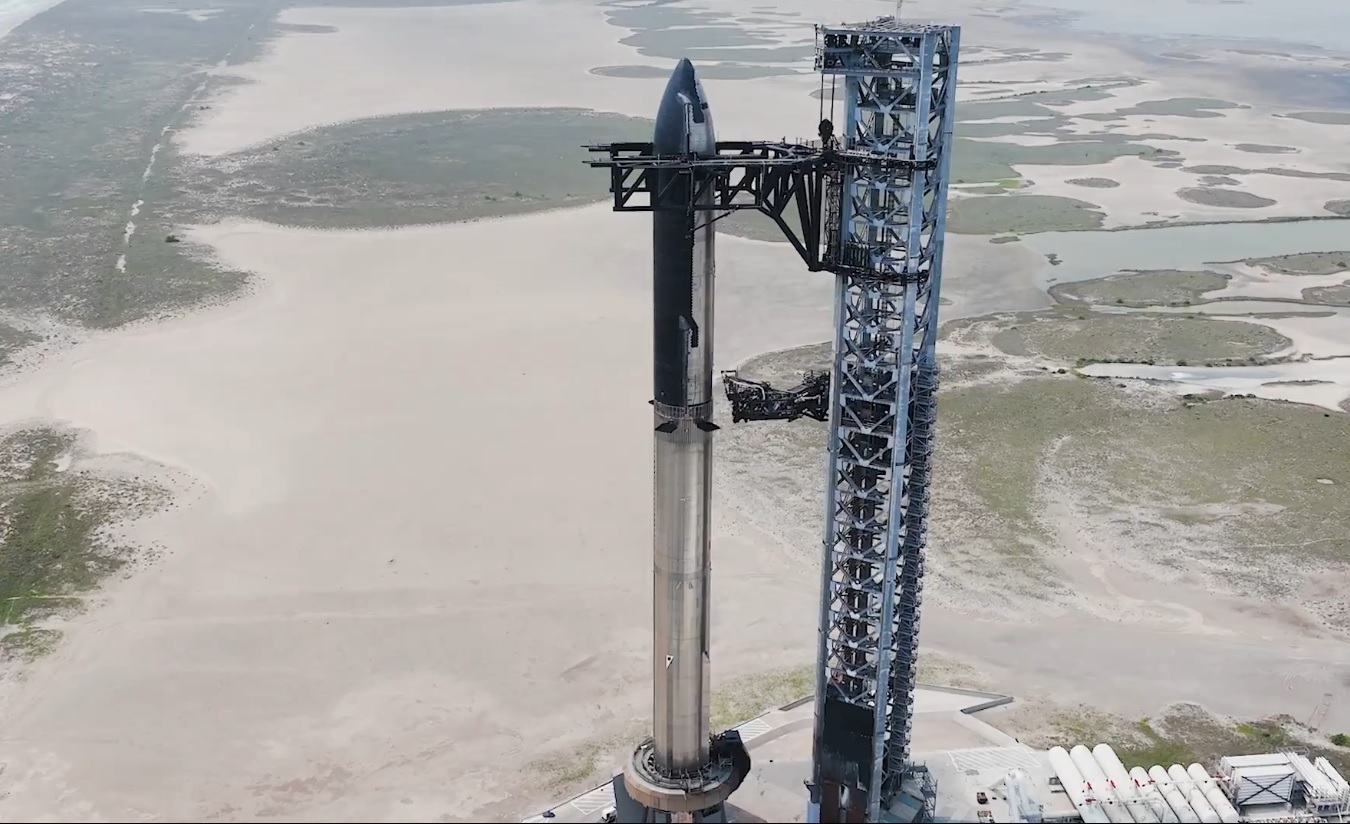
Starship 29 and Super Heavy B11 ready to fly! Image credit to Elon Musk at X. Posted at 1:24AM today, June 3. Might have been taken yesterday morning, but it's not stated.

There just isn't much left to be said about this vehicle or this flight other than "go, baby, go!"


Sunday, June 2, 2024

Small Space News Story Roundup 37

A couple of short stories that caught my eye

Redesigned Vega C motor passes static-fire test

The European Space Agency had a bit of good news this past week. Twice, really, but the bigger and better news was that Avio, the prime contractor for the second stage engine on the Vega C, conducted a successful static fire test of the Zefiro-40 engine on May 28th at the company's facility in Italy. The static firing was 94 seconds, as expected, and pronounced successful.

The Zefiro-40 was implicated in the failure of the second Vega C launch in December 2022, which an investigation blamed on faulty carbon-carbon material used in the motor’s nozzle. Avio found a new supplier for that material, but the nozzle failed in a static-fire test in June 2023, leading to a redesign of the nozzle itself.

“Initial post-test review indicates that the new nozzle assembly performed as expected throughout the scheduled 94 seconds burning time of the test, simulating a nominal in-flight performance,” Avio said in a statement.

ESA Director General Josef Aschbacher commented that the engine's thrust curve matched the predicted, theoretical performance expected of the engine.

A second test firing is planned for October to confirm the performance of the motor, but Ashcbacher called this test “the most important milestone” in returning the vehicle to flight. “The one today confirms that the redesign of the nozzle with the new carbon-carbon inserts is good.”

Their plan is to return the Vega C to flight before the end of this year. 

Their second good news was the launch of their EarthCARE satellite on the same day, although that was done under contract by SpaceX as the ESA is currently without launch capabilities. This is a good step along the way to resuming flight.

As for their other, larger launch vehicle, Ariane 6, they're close to naming a date for the first flight but haven't gotten more specific than, "the first two weeks of July." It has been stacked and otherwise worked on and tested since April.

The Japanese billionaire behind the Starship tourist flyby of the moon has cancelled the mission

Back in October of 2022, the story arose that SpaceX had begun accepting bids for a second tourist flight around the moon in their Starship. This was to be in addition to one that had already been on the books since 2018. That first mission was a well-publicized plan to send a space tourist on a lunar orbital mission by 2023.  The tourist is Japanese billionaire Yusaku Maezawa who planned to take a small crew of artists with him.

In a June 1 message, Yusaku Maezawa announced he was canceling his “dearMoon” mission, which was to fly him and eight artists around the moon on a Starship vehicle. He cited ongoing delays in the mission and uncertainty when it would launch.

“Arrangements were being made with SpaceX to target the launch by the end of 2023,” the dearMoon project said in a statement posted on its website. “Unfortunately, however, launch within 2023 became unfeasible, and without clear schedule certainty in the near-term, it is with a heavy heart that Maezawa made the unavoidable decision to cancel the project.”

“I signed the contract in 2018 based on the assumption that dearMoon would launch by the end of 2023,” Maezawa posted on social media June 1. “I can’t plan my future in this situation, and I feel terrible making the crew members wait longer, hence the difficult decision to cancel at this point in time.”

In December of '22, Maezawa announced his selection of the crew to accompany him. 

The crew included: Tim Dodd, creator of the YouTube channel Everyday Astronaut; D.J. and electronic music producer Steve Aoki; artist and choreographer Yemi A.D.; photographer Karim Iliya; filmmaker Brendan Hall; Indian TV actor Dev Joshi; and South Korean rapper T.O.P. Two backup crewmembers, dancer Miyu and snowboarder Kaitlyn Farrington, were also selected.  

Japanese entrepreneur Yusaku Maezawa (center), and the dearMoon project selectees with two backup crew members. (Image credit: dearMoon)

The second tourist flight, the one being arranged starting in October of '22 is apparently unaffected. That's the mission that gets most of the column space in my post. 

Dennis Tito, the first commercial space tourist to visit the ISS in 2001, announced that he and his wife would fly on a Starship mission around the moon along with up to 10 other people. Neither he nor SpaceX announced a date for the mission then or provided updates on its status since then.

There are more private missions in the queue. The first crewed orbital Starship flight is currently being referred to as a Polaris Program mission, led by billionaire Jared Isaacman, which also aims to fly the first private spacewalk on a SpaceX Dragon capsule, currently "penciled in" as No Earlier Than July. 

Without a doubt, part of the reason for this is that Starship is behind schedule and has yet to fly successfully and reliably. While there are plenty of places to point fingers, I think that it comes down to how radically different Starship/Super Heavy are compared to every other rocket ever. These aren't "have to work really well once and then we throw it away." They want to launch them pretty much as often and reliably as good aircraft. When you work on things no one has ever done before, you have to solve problems that nobody has ever solved before. 


EDIT June 3, 2024 1040 AM ET: Thanks to the first comment from Anonymous at 10:16 AM, for pointing out a frankly hilarious "write-o-graphical" error about the date in the first paragraph of the second story.


Saturday, June 1, 2024

Still Sittin' Around, Waitin' For the Big Story

I'm sure that everybody following the Starliner launch knows that when they came out of a programmed countdown hold at T minus 4:00 minutes, the system went into an automatic hold within 10 seconds. The time remaining of 3:50 remaining frozen on the clock.

Screen capture from NASA Spaceflight's coverage. Notice in the lower left part of the control bar that the video's timer is 4:00:40 into their coverage if you want to watch it.

NASA provided a terse little summary late in the day today, saying that they're not sure that the hold and scrub for the day was really necessary, but they'll know more by tomorrow morning. 

NASA, Boeing, and ULA (United Launch Alliance) are forgoing a Crew Flight Test launch attempt Sunday, June 2, to give the team additional time to assess a ground support equipment issue at Cape Canaveral Space Force Station’s Space Launch Complex-41 in Florida.

Saturday’s launch was to carry NASA astronauts Butch Wilmore and Suni Williams to and from the International Space Station scrubbed due to an observation of a ground launch sequencer. The system was unsuccessful in verifying the sequencer’s necessary redundancy.

ULA will assess the ground support equipment overnight, and NASA will provide an update June 2 on next steps for the flight. The next available launch opportunities are Wednesday, June 5, and Thursday, June 6.

Space.com adds a little needed context here that NASA's statement doesn't address

ULA CEO Tory Bruno told reporters in the post-scrub briefing that engineers suspect the abort may have been caused by a faulty computer card in ground launch sequencer system housed in a building at the base of at Starliner's launch pad, Space Launch Complex 41, at Cape Canaveral Space Force Station. But checking that card would require ground teams to wait several hours until it was safe to approach the pad. "The system was unsuccessful in verifying the sequencer's necessary redundancy," NASA officials said of the sequencer glitch.

"We can't get in there until we're done defueling a rocket, which is followed by making sure there's no stray hydrogen inside that building, so that it's safe for people to be there. Then we'll go in and troubleshoot it, Bruno said. "And if it's as simple as replacing a card, we have spares for everything, and we would do that. We would test it, which is required, and then be in a position for a recycle tomorrow."

That interview was before NASA's announcement saying they're forgoing an attempt tomorrow. 

While I was interested in the Space Shuttle program before the first flight, I don't remember much about things like this that happened while building up to the STS-1 mission, launched on April 12, 1981. I didn't live near the KSC until just over a year later. That first flight was originally scheduled for March of 1979 as a suborbital flight, which got turned into a thorough test on orbit for a couple of days. You have to go that far back to find a man-rated spacecraft being tested with a crew for the first time to compare this to. Well, you have to go back to 1981 to find a man-rated spacecraft that isn't named Dragon. The Orion capsule on Artemis has only flown unmanned missions since its first flight in December of 2014.

Something I swear I remember hearing about STS-1 is a quip from one of the crew members, either John Young or Bob Crippen, something like if the delays kept up instead of being Young and Crippen, they'd be old and crippled. I can't find any evidence of that being real. Anybody else remember that?


Friday, May 31, 2024

Just Sittin' Around, Waitin' Around, For the Big Story

You know. Starliner's test tomorrow afternoon. There are some other stories around, but not much. 

Surprisingly, at least to me, the Federal Communications Commission, the agency that regulates and licenses radio, TV, and thousands of services that use them, is proposing new rules to cover the risk of debris-generating accidental explosions in space. To the best of my knowledge, radio isn't involved in any of that, so why is it their field to regulate? Sure satellites in space use radios, but so do taxis and I don't know of them regulating ways that keep taxis from getting into collisions.

The new rules would require applicants to assess and limit the probability of accidental explosions to less than one in a thousand for each satellite they submit for approval.

The probability metric is derived from NASA’s standard and would apply during and after the completion of mission operations.

Less than a 1 in 1000 probability of explosion? When we're looking at constellations with tens of thousands of satellites in them, doesn't that seem like too many explosions?

Oh, well. It doesn't have to make sense. Power grabbing expands exponentially. 

I read that JAXA was unable to contact SLIM (Smart Lander for Investigating Moon) as nightfall was approaching the lander, which has had a remarkable record of success in surviving the brutally cold lunar nights. Nobody really expected the lander to survive its first night on the moon after its January landing.

The Japanese Aerospace Exploration Agency (JAXA) attempted to send signals to SLIM on Friday and Saturday (May 24 and May 25), but was met with no response. A final attempt to reestablish contact was made on Monday evening (May 27) to no avail, marking a close to this month’s operations, the space agency announced on SLIM’s official X account.

SLIM, designed to demonstrate accurate lunar landing techniques, touched down on the moon’s surface on Jan. 20. Until now, JAXA has had successful monthly check-ins with the lander in February, March, and April — the probe managed to survive a shocking three frigid lunar nights. Usually, spacecraft can't even survive one of these two-week periods of cold isolation. Still, the space agency plans to try contacting SLIM again next month when the sun returns to the landing site, in hopes that the lander will reboot with sufficient solar power, the Japan Times reported.

Has the moon finally dealt the deathblow to SLIM? We'll have to wait about another two weeks until the sun rises again. 

An image JAXA released the first time SLIM woke up after a night on the moon back in January. For reasons known only to the mission planners, they've chosen to name the labeled rocks after dog breeds they estimate as being similar in size to that rock. 


Thursday, May 30, 2024

How Lucky Can You Get?

When I first ran across this story a couple of days ago, the emphasis was that some space debris fell near a hiking trail in North Carolina and they thought it was from a SpaceX Dragon capsule. This left me confused for a little while because "everyone knows" that Dragons are reusable. The same handful of Cargo and Crew dragons have been flying for years, with refurbishment between missions. 

Then it occurred to me that both kind of Dragons (Crew and Cargo) also have the equivalent of the old Apollo era service modules, aptly renamed as a trunk. Could it be? 

Today, Space.com carried a story about the wreckage with several photos and lots of explanation.  The story was based on going to see the piece because the author lives close to where it came down; near Canton, NC — just outside of the city of Asheville, NC, where he lives.

The piece of debris at the head of the trail on which it was found. Image credit: Future/Brett Tingley

On May 22, groundskeeper Justin Clontz and his father were performing maintenance on a trail at the scenic Glamping Collective, a 160-acre luxury camping property offering private dome-style cabins on a mountaintop with panoramic views of the surrounding Pisgah and Cherokee National Forests. 

Coming around a bend in the trail that day, Clontz and his father stumbled upon an odd piece of junk lying on the ground, not far from the path at all. Roughly 3 feet by 3 feet (1 meter by 1 meter), the debris consisted of shredded carbon fiber composite and scorched metal, with exposed metal bolts and plates poking out of it. It had a faint smell, similar to ozone.

"It landed directly in the middle of the trail," Clontz told Space.com. "It was just wild. It was crazy-looking. I really didn't know what to think."

They go on to point out that there was no visible damage to trees or anything that they could identify. It was as if someone had carried the piece up to the trail and gently placed it there for everyone to see, but there were no obvious signs people had been there. 

At first they thought it might be from some military aircraft, but the lack of a crash site didn't support that. Astrophysicist Jonathon McDowell looked at the location, looked for some possible sources and didn't take long to conclude that it could well have come from the trunk module of the Crew Dragon that took the Crew 7 mission up and back down.  The actual Tweet allows you to see that map of the reentry path in better detail and it does look to be right over Canton, NC.

The Trunk (AKA Service Module) carries cargo or small satellites and is fitted with solar panels that supply power to Dragon when the vessel is in flight or docked to the ISS. It has fins for aerodynamic control during emergency aborts. While the Dragon itself has a heat shield across its bottom and is slowed to splashdown by parachutes, the trunk is jettisoned before the reentry really gets going, and burns up on reentry. Apparently not completely.

Why do I consider this lucky? Just finding it on the trail is incredibly lucky. Not getting hit by debris from a reentry is really quite the normal result. The surface area of the Earth is 197,000,000 square miles. Of that, the oceans, take up 139,600,000 sq. mi. or about 70% and, of course, stuff that falls into the overwhelming majority of the ocean is lost for good. The area that a person presents is "a couple" of square feet. To turn that 197 million square miles into square feet, multiply it by 27.828 million square feet in a square mile.  The piece of debris needs to hit a target of "a couple" of square feet in 5,492 trillion square feet.  The Aerospace Corporation has estimated the odds of being hit by a piece of space debris is less than a one in one trillion. I think it's quite a bit less than that.

The Glamping Collective plans to build a display case for the debris along the trail where it was found.


Wednesday, May 29, 2024

Starliner is "Go" For June 1

The flight readiness review for Saturday's launch of the Starliner Crewed Flight Test was held today as scheduled and mentioned in Saturday's summary. That source stated that if the review declared it was acceptable to launch, the Atlas V and Starliner stack will be rolled to the launch facility tomorrow. According to the statement published on NASA's Commercial Crew website:

NASA and Boeing teams polled “go” to proceed with plans to launch the agency’s Boeing Crew Flight Test to the International Space Station at 12:25 p.m. EDT Saturday, June 1. During a Delta-Agency Flight Test Readiness Review Wednesday at NASA’s Kennedy Space Center in Florida, leaders from NASA, Boeing, and ULA (United Launch Alliance) verified launch readiness, including all systems, facilities, and teams supporting the test flight.

A backup launch opportunity is available on Sunday, June 2, with additional launch windows on Wednesday, June 5, and Thursday, June 6.

Also as stated, astronauts Butch Wilmore and Suni Williams returned to the Kennedy Space Center yesterday. They will stay in quarantine at the Neil A. Armstrong Operations and Checkout (O&C) Building until Saturday’s launch. 

NASA leaders with Boeing and ULA partners, will hold a prelaunch news conference at 1 p.m. EDT Friday, May 31, at Kennedy’s press auditorium. 

NASA astronauts Butch Wilmore and Suni Williams arrive back at the Launch and Landing Facility at the agency’s Kennedy Space Center in Florida on Tuesday, May 28, 2024, ahead of NASA’s Boeing Crew Flight Test. Photo credit: NASA/Cory S. Huston

Like the previous crew demo flights, the Starliner will dock to the Space Station, and the two astronauts will spend about a week aboard before returning to Earth in the Starliner capsule. Unlike the Crew Dragon capsules, Starliner is designed to land in White Sands, New Mexico with a set of parachutes and an airbag for cushioning. While that's all the sources say, I'm assuming it's the White Sands Missile Range - it's where the previous Starliner Demo 1 and 2 missions landed.


Tuesday, May 28, 2024

Slow Day - So Only Two SpaceX Launches

I'm being slightly facetious; two launches in one day - even from opposite coasts of the US - isn't really slow, it's just not among the busiest days they've had.  Which is also to say that today's schedule was more than most other launch providers do in a month and more than some do in a year. 

The first launch of the day was this morning at around 10:24 AM ET from Cape Canaveral Space Force Station SLC-40. That was a launch of the Starlink 6-60 mission, 23 more satellites for the Starlink constellation. As luck would have it, I ended up being out of the house and missed it - by the time the sound from the launch gets here, the first stage has been dropped and it's hard to see anything. The booster for this mission was flying its 10th mission so we can't really call it a rookie, it's just nowhere near the fleet leader at 21 missions. Maybe the right word is that it's a Journeyman? (Remember when flying 10 times was unheard of?) The booster landed on A Shortfall of Gravitas in the Atlantic 8:15 after liftoff.

If you want to watch a video replay, SpaceX has it here. The coverage starts seven minutes before liftoff, so feel free to position the slider wherever you want it. 

The second mission of the day was for a paying customer, the European Space Agency, and is an Earth Observing Satellite called EarthCARE or the Earth Cloud Aerosol and Radiation Explorer. EarthCARE is a joint project of the ESA and the Japanese Aerospace Exploration Agency (or JAXA) and was launched from Vandenberg Space Force Base SLC-4E  at 6:20 PM ET. This booster was flying its seventh mission and returned to land beside the launch complex at 8:07 after liftoff. 

It's an interesting sounding mission to someone like this old radar designer, and the only difference between "light detection and ranging" and "radio detection and ranging" is the frequency they transmit and receive - which dramatically affects the things they can observe. From the ESA mission web page:

EarthCARE will employ high-performance lidar and radar technology that has never been flown in space before, with the objective to deliver unprecedented datasets to allow scientists to study the relationship of clouds, aerosols and radiation at accuracy levels that will significantly improve our understanding of these highly variable parameters.

There's a bit more succinct and easy to follow description at Space.com's coverage:

The mission will operate at an orbit similar in altitude to that of the ISS (250 miles, or 400 kilometers), but on a different plane: Instead of the more equatorial-focused ISS, EarthCARE will fly a sun-synchronous polar orbit that crosses the equator at local early afternoon, when sunlight is strongest in the region.

The mission will gaze down at particles of clouds and molecules of aerosols, or suspended particles in the atmosphere, to see how they interact with precipitation and how quickly they fall to our planet. EarthCARE will also "register the distribution of water droplets and ice crystals and how they are transported in clouds."

"This essential data will improve the accuracy of both cloud development models and their behavior, composition and interaction with aerosols, as well as improve future climate models and support numerical weather prediction," ESA officials added.

EarthCARE booster's landing at Vandenberg SFB. Screen capture from the SpaceX video of the launch

You may be aware that one of my main gripes about the climate catastrophists is how God-awful crappy their simulations are. "Wake me up when you can get clouds right" is my regular challenge. This looks like it could, potentially, get moving in that direction.


Monday, May 27, 2024

Same Old, Same Old

Holiday aside, it's a typical last week of May. It has been pretty much fully summer for a week or two, although our pattern of afternoon thunderstorms much of the week hasn't developed yet. A couple of days ago, the National Weather Service forecast site for central Florida posted warnings of heat indices to around 105 or more but it didn't seem to materialize. This afternoon, the nearby Melbourne airport said it was 93 with a "feels like" temperature of 102. I tend to dismiss those, thinking that's what 93 feels like here, but those warnings seem most appropriate for people visiting or spending their first summer here. 

Gee summer already? Only four months left to late September.

The same day as the heat warnings, the Weather Underground posted this UV warning. I want to direct your attention to the text at the bottom. I didn't select the skin type, that's the way it was displayed by default so I didn't think to see if it said something different for other colors.

This is the UV warning I generally refer to as "Fatal within 15 minutes" but it really says 18 minutes. No more than 8 to 18 minutes exposure to the sun? Is that total sun for a full day or 8 -18 minutes at a time? Doesn't seem like it could be the second one because then they should instruct us about how many 18 minute exposures we can get and how long we need to hide inside between them.

A regular part of my life since about the time I turned 17 has been inhalant allergies. I was in high school and I'm pretty sure I remember seeing my parents' doctor in the fall of my senior year.  He prescribed an antihistamine called Teldrin, which was good for 12 hours and helped me through the allergies, which tended to be all day things when the grass fields by our house or everglades were burning. By the time I was in my mid-20s and working for a living, I decided to see an allergist. 

If you've never gone through this exorbitant ritual, the "gold standard" treatment is they first find out what you're allergic to, and then desensitize you to it with a series of injections. The test is done by injecting a tiny amount of the allergen under your skin and judging your degree of sensitivity by how big of a welt you get. 

I'll never forget this. I was tested for 60 different allergens - 60 different pin prick shots - and I was allergic to all 60. On a scale of 1 to 4 ++, I only scored less less than 3 on two things: newsprint and "common skin bacteria." My usual summary is "I'm allergic to everything that is now, or once was, alive."

I'll cut the story short and not give thousands of details, but in the 53 years since I first saw that doctor when I was 17, I've had four allergists, had the 60 (or 120) injections test done at each of those doctors, had a nose surgery that one quack, um, doctor swore by and did nothing I could tell, I've been put on the latest, most modern, "non-drowsy" antihistamines that last 24 hours, more eye drops for (maddeningly itchy eyes), glucocorticoid nose sprays and every modern alternative.  

53 years later, I still get maddeningly itchy eyes, runny nose, sneezing and everything else. I've switched from prescription antihistamines - that have gone to being nonprescription - to an old four hour OTC drug called chlorpheniramine maleate, which happens to be the exact same drug as the Teldrin I was taking 53 years ago; it's just that Teldrin was designed to be slow release so it lasted 12 hours. Do I have allergy problems less often? I don't know how to know that. In the last week, I've taken the antihistamine tablets a few times, not continually, but I live in a different part of the state and I'm sure there are different plants and allergens here. 53 years of the state of the art care and taking exactly what I took at the start. The only progress is that it doesn't require a prescription and is a penny or two per pill.


Sunday, May 26, 2024

Memorial Day 2024

These days I tend to wonder how many more of any holiday that our republic will survive to see, but this one is the hardest to come to grips with. Memorial Day is the day to honor those who fell fighting to preserve the republic and if Memorial Day falls, that's dishonoring every one of them. Every one of them gave themselves, their lives, their futures, for something bigger than themselves.

It's not just "the greatest generation" that saved the west in the all out war of WWII; it's all of them, from those we know of fighting in the first battles of the Revolution on April 19, 1775, (commemorated as Patriots' Day but some states shift the date to get a Monday Holiday) to those who were lost in Bumbling Biden's disastrous abandonment of Afghanistan, and those lost since then. We include losses from training accidents as well as actual enemy action.

For most people, Memorial Day is the semi-official Start of Summer, and it's a rare year indeed that it doesn't feel fully like summer by Memorial Day around here. The day tends to be marked by barbecues, trips out on the boat, or other outdoors activities. Let me join the chorus of folks saying that while you're enjoying your day, take a moment to remember or think of and thank those who gave their all in service to us. The ones who don't get to mark the holiday with us.

I say that in the belief that those who made that sacrifice wouldn't hold it against us to have a little fun on their day. 

Credit to Al Goodwyn at Creators Syndicate


Saturday, May 25, 2024

Small Space News Story Roundup 37

Because it can be hard to find much on the weekend...

NASA and Boeing Find Deeper Problems with Starliner 

Not that they seem willing to put the launch off because of them. 

Senior managers have said they intend to launch Starliner's Crewed Flight Test on June 1 at 12:25 PM EDT, as noted in the addendum to Wednesday the 22nd's post. Since the first scrubbed attempt to launch Starliner, there has been weeks of detailed analysis of a helium leak and a "design vulnerability" with the ship's propulsion system. 

Extensive data reviews over the last two-and-a-half weeks settled on a likely cause of the leak, which officials described as small and stable. During these reviews, engineers also built confidence that even if the leak worsened, it would not add any unacceptable risk for the Starliner test flight to the International Space Station, officials said.

But engineers also found that an unlikely mix of technical failures in Starliner's propulsion system—representing 0.77 percent of all possible failure modes, according to Boeing's program manager—could prevent the spacecraft from conducting a deorbit burn at the end of the mission.

"As we studied the helium leak, we also looked across the rest of the propulsion system, just to make sure we didn't have any other things that we should be concerned about," said Steve Stich, manager of NASA's commercial crew program, which awarded a $4.2 billion contract to Boeing in 2014 for development of the Starliner spacecraft.

I love precision like "0.77% of all possible failure modes"! Such confidence! Such respect for significant digits! 

Question for any of you with lots of "probability and statistics" course work: how many trials would be needed to have high confidence it's more like 1% chance instead of a 5% chance? How many to determine it's more like 1% than a 10% chance? I assume that if it's really a 5 or 10% chance given some large number of trials, the failure would happen more often than if it was a 1% chance. How many to distinguish a 0.77% chance from a 1% chance? I'm betting on the order of tens thousands of trials. From a system that's going to fly maybe 10 times. Maybe.

I found the entire article unsettling but while I'm not a "belt and suspenders" guy, I'm not a test pilot either. There's a Robert A Heinlein quote (I think it was RAH) about test pilots; something like they'd jump off a building with rubber soles if you gave them odds of surviving it. 

Butch Wilmore and Suni Williams, still in pre-flight medical quarantine, will return to Florida on Tuesday to resume final launch preparations. NASA officials will call a flight test readiness review Wednesday, and if they give the green light, ULA will roll the Atlas V rocket and Starliner spacecraft back to the launch pad on Thursday, May 30. 

Starship FT-4 Set for Wednesday, June 5 at 8:00 AM EDT

In a Friday announcement, SpaceX has set a June 5 launch date for its next Starship integrated test flight, with a focus on demonstrating the ability to bring both stages of the vehicle back intact. The mission details seem like what we covered on Tuesday, 5/21. 

“The fourth flight test turns our focus from achieving orbit to demonstrating the ability to return and reuse Starship and Super Heavy,” the company stated. “The primary objectives will be executing a landing burn and soft splashdown in the Gulf of Mexico with the Super Heavy booster, and achieving a controlled entry of Starship.”

The company has made several upgrades to both the Super Heavy booster and the Starship itself, based on their failure analysis of Flight Test 3. 

SpaceX said that Starship “began losing the ability to control its attitude” several minutes after engine shutdown, while coasting on a suborbital trajectory. Video of the flight showed the vehicle slowly rolling. That loss of attitude control led to an automated decision not to perform a planned engine relight.

“The lack of attitude control resulted in an off-nominal entry, with the ship seeing much larger than anticipated heating on both protected and unprotected areas,” SpaceX stated, with telemetry lost at an altitude of 65 kilometers.

The company believes the attitude control issue was caused by the clogging of valves in thrusters used for roll control. SpaceX has added more thrusters for redundancy while upgrading thruster hardware “for improved resilience to blockage.”

The booster fired 13 of its 33 Raptor engines after separation for a boostback burn, but six of the engines began shutting down, triggering an early termination of the boostback burn. Only two of 13 engines ignited for the final landing burn.

The engine failures, SpaceX concluded, were caused by filter blockage in liquid oxygen lines, keeping propellant from reaching the engines. SpaceX experienced similar problems on previous Starship launches and made changes to the engine design to try to prevent it. “Super Heavy boosters for Flight 4 and beyond will get additional hardware inside oxygen tanks to further improve propellant filtration capabilities,” SpaceX said, along with unspecified “additional hardware and software changes” to improve the reliability of Raptor engine startup.

Another interesting little change they've made is to jettison the interstage adapter they added to allow igniting the upper stage before the booster separates.  They will still have that adapter in place but the way I read that, they'll drop the interstage adapter once the booster separates.

Booster 11 and ship 29, the Flight Test 4 hardware, stacked for the May 15 WDR. Screen capture from SpaceX video posted on X.


Friday, May 24, 2024

Voyager 1 Returning Science Data Again

NASA's Voyager office posted on Wednesday, May 22, that Voyager 1 has started returning science data from its few working instruments for the first time since its November computer memory failure that crippled the probe - the man-made object farthest from Earth in history. 

Voyager 1 has resumed returning science data from two of its four instruments for the first time since a computer issue arose with the spacecraft in November 2023. The mission’s science instrument teams are now determining steps to recalibrate the remaining two instruments, which will likely occur in the coming weeks. The achievement marks significant progress toward restoring the spacecraft to normal operations.
...
The plasma wave subsystem and magnetometer instrument are now returning usable science data. As part of the effort to restore Voyager 1 to normal operations, the mission is continuing work on the cosmic ray subsystem and low energy charged particle instrument. (Six additional instruments aboard Voyager 1 are either no longer working or were turned off after the probe’s flyby of Saturn.)

Regular readers will recall that back in November, Voyager suddenly started acting like something was seriously wrong. I likened it to the probe having had a stroke, although that's too anthropomorphic. The probe seemed to take commands and respond, it still kept its position and kept the data link back to Earth running, it's just that the replies it sent back were more like incoherent ramblings. It's as if Voyager had said its uncle had been eaten by cannibals before the mission started, only less coherent than that.

It took until March before Voyager successfully responded to a command to send back the contents of its memory and the programmers understood how to work around it. 

Launched in August and September of 1977 and coming up on their 47th year in space, it should be clear that the time the two Voyagers have left may not be as long as we might like. The next time a component dies, it may have more dire effects that preclude a fix like this, simply by having the spacecraft lose its ability to point its antenna back to Earth. 

As the first man-made objects to leave the solar system, as relics of America's early space program, and as testaments to how robust even decades-old technology can be, the Voyagers have carved out the kind of legacy usually reserved for remarkable things lost to time. There seems to a widespread interest in and affection for the two deep space probes. Voyager 2 isn't as far away because it spent more time investigating our solar system. 

Project engineers report that no one on the team was particularly excited or depressed about the failure, always believing they could repair it.

"We're confident that we can get back to business as usual soon, but we also know that we're dealing with an aging spacecraft that is bound to have trouble again in the future. That's just a fact of life on this mission, so not worth getting worked up about."