Wednesday, January 13, 2016

But Obama Said the Economy is Great!

Spent most of today and some of yesterday planning things like which insurances I'm going to keep and which ones I'm going to drop.  Along the way, I spoke with a financial planner I've been working with and find he echoes the words you've seen in other places lately, like the RBS saying "sell everything and get into cash".  Bill Bonner posted this chart and explanation:
Typically, stocks are said to be in a bear market when they fall 20% or more from their 52-week (or year) high.

By that definition, the widely watched S&P 500 Index is still a long way from being in a bear market. It is down 10% from its 52-week high last May. But as you can see from today’s chart, the average stock in the small-cap S&P 600 is down 31% from its 52-week high. And the average stock in the mid-cap S&P 400 is down 27%. Even in the large-cap S&P 500, the average stock is down by more than 22% from its 52-week high.
About the same time, you may have seen Zerohedge's somewhat alarming headline that "Nothing Is Moving," Baltic Dry Crashes As Insiders Warn "Commerce Has Come To A Halt".  Which registers a solid 7 on the Richter Pucker scale.  Not to pile on, but Canada seems to be going into a currency collapse with the loonie dropping in exchange with the dollar to the lowest level since 2003, and no end in sight. 

It's stuff like this that makes retirement hard.  Not the sleeping in; that comes pretty easily.  Certainly not the lack of meetings.  Financial planning and setting life up when the world looks like this is the hard part.  But if you're working for a living and are seeing the possibility of layoffs coming in all of this, we're in the same boat.  

Offhand, it looks like the long anticipated snap back to the mean is starting.  Since I think the world's central banks don't have a single vertebrate working for them, I expect frenzied amounts of money to be created.  "We were only kidding about that quarter point rate increase!"  


Tuesday, January 12, 2016

Techy Tuesday - Go Up, Young Man

When real estate in a city is expensive, builders go up; instead of building large one story houses, they build multistory apartment buildings that go vertical.  While society has benefited tremendously from "Moore's Law" in personal electronics for the last half century, with continually shrinking part geometries leading to continually increasing performance, virtually all of the technology has been essentially 2-dimensional.  It's even called planar.  The latest trend in semiconductor memories is to go vertical.

A couple of very big companies in memory components are Intel and Micron Technology.  I'm sure you know Intel; their processors are still the leader in the desktop PC world.  Micron might not be as familiar to you, but has been one of the top few producers of what are called "Flash memories" for quite a while.  Flash memories are found in the familiar USB stick memory modules.

For a couple of years, now, they've been fighting the shrinking geometries required to increase the memory density offered by these parts.  The last generation of parts they used were "20 nanometer geometry"; parts in which features of the transistors are that size (20 nm is 787 billionths of an inch; or 0.787 millionths of an inch).  In one direction only, X or Y, the scale was 16 nm (0.63 millionths).  The new technology uses 32 vertical layers and as a bonus, allows the scale to relax a bit. 
"Our first generation is 32 layers in the vertical direction while relaxing the x-y design rules back several generations."

Prior to going 3D, Micron could only shrink each new generation in its x-y dimensions, but they hit the wall at 20-nanometers, only able to shrink in one direction—either x or y—at the 16-nanometer node. But by going 3D, Micron has been able to keep increasing chip capacity per package while relaxing the x-y scaling rules. Relaxing the x-y design rules improves the performance and reliability compared with sub-20nm planar NAND.
The process is still expensive compared to their conventional 2D process so it will be aimed at high end uses:
In its fabs in Singapore and Lehi, Utah (half-owned by Intel) Micron's first generation 3D NAND chips will be 32- and 48-gigabytes. With up to 16 layers in a single package super high density solid-state drives (SSDs) can be made for servers and data centers. For the future, Micron plans 2-terabyte 3D NAND packages, allowing an SSD using 16 of them to pack up to 32-terabytes.
So how does it work?  Why is nobody else doing it?
The idea is to put a material that increases its resistance whenever current is put through it in one direction, and reduces its resistance when current flows the opposite direction. Many such materials—called memristors by their inventor Chua—have been successfully tested in the lab, from exotics to plain-old silicon dioxide, but no one has been able to perfect the read/write process for mass production—until now.
That link to Wikipedia says memristors were conceptualized in about 1971, so it has taken this long to get them into a commercially viable product.  All of this so you can get more memory in the same size package, and more of the things people want in their smart devices.   
Micron's 3-D NAND die is small enough to boost solid-state SSDs the size of gum sticks to 3.5 terabytes. (Source: Micron)

Monday, January 11, 2016

Yes, I Saw Star Wars

I seem to be one of the few in my blog list not talking about the movie.  Saw it the week after Christmas, so almost two weeks ago.   

To be honest, both of us thought it was a good movie, a well done movie, with a lot of fun stuff in it, but neither of us walked out of it going, "Wow!  That was fun!".  We've done that on more than one of the Marvel Universe movies, so they've made more of an impression on us than Episode 7. 

It's not that there's really anything wrong with it.  The new kids are good, there were a few scenes that surprised me, and there were scenes that came across entirely different in the movie than the impressions I got from the several trailers ("Chewie; we're home" for one). 

I suppose, as others have pointed out, the fact that people aren't publicly complaining about it means it must have been pretty good, and it was pretty good.  If they had really barfed up the series, people would have been complaining like they did about Jar Jar Binks.  No such issues this time. 
But maybe the key reason is "Chewie; we're home".  We're at home in this universe.  The characters are familiar, the scenes are familiar - whether the wrecked Star Destroyers, Imperial Walkers or the Millennium Falcon - and we have a deep tie to the story line.  Those more inclined to think deep thoughts about movies than me commented that grandparents of my age could take our grandchildren to see the movie and pass on some of the sense of wonder and awe we felt when the opening credits receded off into the distance. 

There are reports Disney has big plans for the Star Wars universe, adding separately produced movies along the arc of the main universe we've just seen (the Episode 7, 8, 9 story arc) which are expected to be focusing on key characters.  There's said to be a movie per year until 2020 already in the production pipeline.  We'll be seeing much more of this universe. 


My Map

The irresistible meme.


Create Your Own Visited States Map


Sunday, January 10, 2016

Day of Bouncing Around

Unusual day for me, as I bounced around quite a bit between several little things, watching far more football and far less news than usual - a couple of hours in each game today. 

I was up at 6:30 to start smoking a beef brisket, the mainstay of Texas barbecue.  The smoker was ready to haul outdoors and get running quickly.  The brisket was small; around 5 pounds, and only the flat cut of a whole brisket, but it was also ready to go after being seasoned and resting in the fridge overnight.  The last time I did this, I put the meat in and then started heating.  Today, I preheated the smoker, then added the brisket, and finally added the wood chips to start the smoking. 

In barbecue, as opposed to grilling, the rule is "low and slow": low temperature, slow cooking.  Typical for a brisket is to set the smoker temperature to 250 until it's done.  "Done" is based on a combination of internal temperature of the meat (over 190) and the feel, but feel is more important than temperature.  The cooking started a little after 7 and I pulled it at 5:45, 10 1/2 hours, with an internal temp of 195.  That's actually a bit short for a Texas brisket where 16 hours seems typical, but longer than I thought it would take for the small size I was cooking.  After the mandatory "rest" of over a half hour, this what we had:
Up at 6:30 AM, eating at 6:30 PM.  Babysitting the smoker consists of adding fresh wood chips every hour or so, and just making sure the temperatures look like I expect.  There's no reason to look inside until 8 or 10 hours have gone by, and I looked after 8 hours. 

Around that, I worked on my big project, the CNC conversion of my Grizzly mill, by tweaking the G-Code files (the ones that tell the machine how to move to cut the metal) and verifying they seem good.  There are programs that will let you visualize the path the cutter will take, so verification doesn't need to be proof reading.  Add in a hard workout, and it's a day. 

So I haven't heard a word of politics, what any bozo said or did.  Apparently, no news item was so big that they felt the need to burst into the NFL playoffs, which is a good thing.  Being out of touch seems good for the soul every now and then.


Saturday, January 9, 2016

Can't Tell Your Commie Dictators Apart Without A Scorecard

That's our FCC Chairman Tom Wheeler and China's State Internet Office Chief Lu Wei, side by side, almost identical quotes.


Can't tell who said what without a scorecard.  The graphic is from a group called Protect Internet Freedom.  I don't know much about them, but looking around the website for the first time, they seem to be strongly on the side of more freedom and less regulation.  I heard about them when they started sending me emails asking for money. 


Friday, January 8, 2016

The Gutsiest Product of CES 2016

There's a lot of fun stuff going on CES; things like rollable LED TV screens, automatic bartenders, 3D candy printers, and a mood dress, but when it comes to gutsy innovation, I think the award has to go the Ehang 184 drone.  See, this isn't your average golden-age-of-narcissism-type drone that follows you and documents how awesome you are, this drone carries you and delivers your actual awesomeness somewhere else.  Specifically, somewhere else fairly close; it's rated to carry a person up to 264 pounds for up to 23 minutes.  
Ehang says its 142-horsepower electric motor is good for an average cruising speed of 62 mph. The Ehang 184 has a span of 18 feet when fully unfolded, weighs 440 lbs, and can carry a passenger weighing up to 264 pounds. Its maximum flying altitude is 11,480 feet, and the AAV can fly for as long as 23 minutes at sea level.

And—get this—the Ehang 184 can be controlled entirely through a mobile app. In fact, Ehang says passengers only have to execute two commands: “take off” and “land.” Once you’ve set your course, the Ehang 184 will take off vertically, and use real-time sensor data (and presumably GPS) to keep you on course.
Based on those numbers quoted in the first paragraph, I'd say its practical range would be on the order of 15 miles.  While it's tempting to say 23 miles is over a third of an hour, and with a speed of 62 mph, a third of an hour at 62 is over 20 miles each way, that leaves no contingency for needing extra power for anything, like accelerating to 62 for example.  Perhaps a lighter person could stretch that out farther.

The company itself, Ehang, is based in Guangzhou, China, and they see it the way the original hype on the Segway came across; "it's going to change everything!"  They envision it as changing commuting and transportation around the world.  Well maybe, in dense cities where commutes may be under that 15 mile limit.  It's not available yet, and this is where the troubles start.  Its service altitude means it can fly in controlled air space, and you really don't want to spend a lot of time at its 11,480 foot ceiling if you don't have oxygen available.  Legally, this puts it in danger of needing to be certified like any other small, privately owned aircraft.  Aside from having four struts carrying props, making it look more like a toy drone, how is it different from a small helicopter?  The FAA recognizes a class of experimental aircraft called ultralight, but the requirements say that the maximum empty weight has to be under 254 lbs; a far cry from that 440 lbs. cited above.  

That makes it sound like any other private aircraft to me, and I don't know that it meets the other requirements for a helicopter.  I see what looks to be a headlight, and the video at that PCWorld link seems to show the other required lights small aircraft are required to have.  What about a radio for communicating with the ground or other aircraft?  Aircraft that fly in controlled air space need to be equipped with a transponder, and other equipment.  None of that gets mentioned.  As with anything else in the extremely regulated world of aviation, the questions have little to do with the actual airframe and almost entirely come down to legal matters.  The company issued a statement saying:
“Because the 184 AAV represents an entirely new category of technology, there are regulations and agencies that are still catching up. We are in uncharted waters, and are working closely with government agencies across the planet to develop and regulate the future of transportation.” 
Price is estimated at around a quarter of a million dollars; 200 to $300,000, potentially available later in the year.  I don't think I'll hold my breath on this one, but it's as close to the Jetsons' flying cars that I see out there.  


Thursday, January 7, 2016

CES Is Going On, You Know

The Consumer Electronics Show is underway in Las Vegas through Saturday, although the little cable news I see hasn't had a single reference to it.  As I've said before, I've never been to a CES show because I've never worked in a business that valued the show and sent anyone (and they rarely send engineers anywhere).  I spent my career in industrial and military electronics, which is more concerned with absolute dependability than with low prices or "Wow factor".   It's still fun to read what's coming in gadgets and other home electronics, though, and I try to keep an eye on the show every year.

The little piece I've found the most interesting was a presentation by Toyota on autonomous cars and other fancy tech.
The emphasis of a presentation by Gill Pratt, director of the newly launched Toyota Research Institute (TRI), was that “We are a long way from… fully autonomous cars” that can do the “hard driving” in difficult and unpredictable circumstances that accounts for most of the  30,000 traffic deaths annually in the United States.
Pratt went on to explain something that all drivers who have been driving for 10 or 15 years know;  most driving is easy and boring.  I like to say we really just have a license to steer, because all you need to do is keep it between the lines and respect following distances.  Sometimes, though, driving gets hard and Pratt says,
“We need to solve driving when it’s difficult, and it’s that hard part that TRI intends to address.” The two top priorities for the new Toyota research facilities, funded with $1 billion and affiliated with the Stanford Research Park in California and Massachusetts Institute of Technology (MIT) are “teaching cars… to respond to unexpected events,” and being able to “audit the system” in a computer-intensive car when the vehicle itself behaves unexpectedly.
There's a saying which I think comes from aviation that I'll borrow here: "flying is hours and hours of boredom interrupted by moments of sheer terror".  I think that applies pretty well to driving and the “driving when it’s difficult” that he speaks of. 

It may not be at the top of your mind that Toyota is uniquely qualified to comment on not putting a system on the market with aspects that you don't fully understand.  They had that nasty problem with unexplained accelerations that hit the company with a $1.2 Billion settlement, a recall of millions of vehicles, and a black eye on their reputation that didn't go away. 


I was surprised to find reference to a company I know from the industrial sector; I didn't know they were in the consumer market space.  Some time ago, I got an advertisement for this industrial fan company when they decided to change their image.  Originally HVLS Fan Company, an acronym for High Volume Low Speed, the air flow the fans were designed for, they sold these enormous ceiling fans for barns, factories or auditoriums.  They moved astounding quantities of air.  After new customers kept asking if they were the company that made those "big ass fans" they saw everywhere, they officially changed their name to Big Ass Fans.  For this advertising, they hired William "The Refrigerator" Perry to be their spokesman.  I should say their big ass spokesman.

Big Ass Fans is showing off a new smart fan of theirs called the Haiku which is targeted at consumer and the so-called Internet of Things.  In particular, they're trying to do something to make the "smart home" worthy of its name.  CEO Carey Smith puts it this way:
"[The connected home] is in the very early stages," Smith says, "and when people ask why hasn't this caught on, well, what the hell is there to catch on? There's nothing there. I mean, taking something off of the wall and putting it on your telephone...it's a conceit to imagine that that's anything interesting or important. You aren't doing jack is what it comes down to." 
...
"Our view of what the consumer is actually asking for is a house where they can walk from their bedroom to their child's bedroom and there's not a 20-degree swing," he explains. "Where they walk into a dark room and it's automatically lit appropriately for the time of day, and with the minimum amount of light needed to do so, and therefore the minimum amount of energy. It's an anticipatory, responsive environment."
They plan to integrate HVAC (Heating, Ventilation and Air Conditioning) into their system, although that's not available, yet. And I'm somewhat disappointed to learn that they're adopting a more staid name for their consumer division, rather than staying with Big Ass Fans.  The consumer division is called Haiku.
The Haiku H series, 52" diameter, in polished aluminum.  That fan lists at almost $2100.  There are lower cost options. 


Wednesday, January 6, 2016

The President Should Be Issuing Orders to Control Himself

According to a Gallup Poll quoted by Reason.com, Americans are much more concerned about or afraid of the government than they are of guns.  Government/Congress/Politicians rates #1, while guns are down at #19.  Obama and Hillary have the problem that the people they're pitching to are too smart for the pitch they're making.  The people see the politicians as the problem.
Gallup reports that concern about gun control went as high as 7% (middle column) once or twice during the year.  I will make the assumption that the surges in gun sales, as measured by things like the NICS checks showing the biggest December on record,  says the concern most Americans have about guns is that they don't have one or don't have enough!  In general, the concern stayed near the 2% average in the first column.  You'll note that's about the same percent of peole who think our biggest problem is "lack of respect for each other" or the environment/pollution.  I assume that means "climate change".

Sounds like the ticket to getting elected is to promise to cut government.


Tuesday, January 5, 2016

In Honor of Bozo's "Reasonable Gun Laws"

A repost of my version of reasonable gun laws.  I've written on this topic before and part of this will come from two posts: here and here, along with some new thoughts.

Let's start here: any adult with normal rights can walk into a sporting goods store in most places and walk out with a shotgun or a rifle with no waiting period.  But if they wanted to buy an AR-15 or a Mossberg 500 from the factory or from a store in another city, why does it have to go through a local FFL's hands? Why can't anyone order a rifle or shotgun from an online gun store, their favorite Big Outdoor Store, or even an Amazon.com kind of "online superstore", and have the gun shipped to their house?  It was sold by an FFL that did the NICS check, so why does another one have to get involved?  It used to be that way, until the GCA of '68.  What advantage is there to society from shipping it to an FFL?  It's not like the second FFL prevents someone from stealing it in transit - that's on the shipping company.  It does nothing but give money to local FFL holders. All they can do is look at the buyer's ID - which can be done digitally with encryption when the purchase is made. 

We all know there's no such thing as a "gun show" loophole, and that you can't just order something online from a gun store. I say, "why the hell not?"  It's freaking 2016, for God's sake.  We have the technology.

This is the opposite of the current drive to make every sale of every used firearm go through an FFL, like Obama is pushing for in today's EOs.  I think the whole FFL system is obsolete, a remnant of the way things worked in the 1930s, and does nothing that couldn't be achieved in other ways.  All it does is keep FFLs and Fed.gov worker drones employed - which seems to be the point.  I want our side to push back on the whole system.  If FFLs and these gun laws mattered, they'd prosecute people for violating them! 

We should push for, at the Federal level, complete concealed carry reciprocity across the country.  Those places that still deny the human right to self defense need to be dragged, kicking and screaming into the modern age. I'd prefer reciprocity for both open and concealed carry, although you know that would be a hard sell to every Evil Party senator and representative.  Heck, we have a hard enough time getting it passed in Florida with the treacherous Stupid party politicos, who are nominally on our side. 

There's also a silly hodgepodge of waiting periods for a handgun.  In some places it's 3 days, in others, 5 days.  Here in Florida it's state law to eliminate the wait if you hold a concealed carry permit.  If there's a waiting period, why can't you order a pistol from Bud's (for example) and wait 3 or 4 days for UPS to deliver it? Again, you'd fill out the background check with the FFL who's shipping it, why does it need to go to another FFL?  With today's computer security, you could verify age, do a NICS check - anything the local shop can do - online. The whole idea of a wait was a "cooling off" period, so that a hothead doesn't go buy a gun in a moment of anger and then go kill someone, but I personally have a hard time believing there were large numbers of that sort of crime anyway.  It's an extension of the ban on Saturday Night Specials, which (as far as I can tell) only had the effect of removing cheap, reasonably functional guns from people who couldn't afford better ones, and caused some smaller arms companies to either fold or change their product line.  Another government penalty on the poor.  But, fine, we'll play your infantile waiting game -- now how does waiting 3 days to pick up a gun in your city differ from waiting 3 days to get it delivered by UPS or FedEx?

Why are silencers - glorified mufflers - regulated as if they were machine guns?  Why are we required to have a muffler on a car, motorcycle or lawn mower, but we're required to not have one on a gun?  This was originally to keep people from shooting the King's deer (poaching game), but I think the problem today is Hollywood.  They created this illusion that a silencer reduces the 155 to 160 dB of a gun shot down to a barely audible, and it just isn't so.  Silencers should be completely deregulated - not even the $5 "any other weapon" class - just over the counter at your local store.  Did you know that there's nothing like an 80% lower in the construction of a silencer; no stage that's legal?  If I have a lathe (like I do) and they find pieces that someone thinks could someday become a silencer, I've broken the law.  The ban is total. 

This one actually is for the children.  And for anyone who moves next door to gun ranges or clubs and gets disturbed by the sounds. 

We should eliminate postal restrictions against mailing of firearms. We can ship them via UPS, or FedEx, why not USPS?  Don't they need every penny of revenue they can get?

Get rid of the stupid “sporting purpose” tests for firearms. The Heller decision makes it very clear that the Second Amendment isn’t about duck hunting. This particularly affects imports.  No restrictions.  

Get rid of the stupid laws on short barreled rifles and shotguns.  The idea that a shotgun barrel 18.05" long is fine, but one that's 17.95" is some sort of killer monster weapon is just silly.  It's there simply to create law violators.  It's also one of their most enforced laws - probably because it's really easy to measure barrel length.

The last time I did some looking at John Lott's data, his studies had been peer reviewed 30 times and never refuted.  There was one author who said Lott couldn't prove "More Guns Equals Less Crime"; but neither could he (the reviewer) disprove it.  Lump this one under the rule for reading medical studies: correlation does not equal causation.  However, and this is important, there can't be causation without correlation.  When you look at global rates of gun ownership vs homicides, there's almost a perfect inverse relationship between the number of guns in private hands and murder rate, across the globe. 
While cross-cultural studies have their troubles, and some countries are only classed as countries in the loosest sense of the word, in most cases the countries with the most gun ownership had the least homicide. 


Monday, January 4, 2016

Follow Up on Last Month's SpaceX Launch and Reusing the Booster

Four days before Christmas, SpaceX launched a mission that seems to have swapped its primary and secondary missions!  The primary mission was to send a fleet of 11 satellites into space for a paying customer, but what everyone is talking about is the secondary mission: how they returned the Falcon9 booster from the edge of space, and landed it dead center on a landing pad a few miles from the launch site.

At the time, Elon Musk said that this one wouldn't be re-used, but studied.  In my opinion, that was the right answer.  Look it over carefully and make sure that there's nothing latent in that booster that would make a second flight much riskier than it should be.  Use it as an engineering test vehicle.  There's virtually no down side: if they find something that requires an engineering change to the booster, they'll improve its reliability and make it better.  If they take it apart and find nothing questionable at all, at the worst case, they've just written off a vehicle that could have not made the landing.
Ars Technica posts this picture - along with several more - of the booster in SpaceX's hanger, noting that the booster has a "sooty" look but is apparently undamaged.  Aside from soot, produced by the kerosene fuel used in the rocket's engines, the Falcon 9 booster appears to be fine.
That was the assessment of SpaceX founder Elon Musk, who tweeted, "No damage found, ready to fire again," on New Year's Eve. Musk has said the flown booster will undergo "static fire" testing on the launch pad, in which the rocket is restrained while its engines are fired. After testing, the rocket is expected to become a valued artifact, although Musk has not said where its final resting place will be.

During a conference call with reporters after the launch and successful recovery of the Falcon 9 rocket on December 21, Musk said he expects the company will attempt to refly a Falcon 9 rocket sometime in 2016.
They're going to have to start naming those rockets, like the shuttles were, or most every other ship.  She looks a bit like a used spaceship now.  That's only going to get worse with more reuse and more confusing if they have several in the process of being refurbished for reuse.  If it is just soot, essentially hydrocarbon ash, a good car wash could be all she needs.  A very big car wash.


Sunday, January 3, 2016

The Saudi Oil Plan Is On the Verge of Breaking Down

Back in October, I posted about an article I had read saying the Saudi oil ministry had a plan to bankrupt the US oil industry.  Essentially, Saudi Arabia is the only oil supplier that can make a good profit pumping oil at $30/bbl, but that would mortally wound the Kingdom's finances, which prefers closer to $80/bbl.  Believing that $70/bbl was the price of American fracked oil, they targeted $60 a barrel expecting the price would move around that number but feeling comfortable they could keep the price of oil under $70 until they shut down American production, when they'd raise prices again.

Oil has been under $40 since early December, and we've seen ominous stories of supertanker traffic jams at sea as the processing facilities in Houston and elsewhere around the globe just can't handle the oversupply.  Clearly, there's too much oil in the system, which cries out for production to be shut down.  The US industry has been hit hard, just as Saudi Arabia planned, with some industry investors saying that half the US energy industry will be bankrupt within six months. 

Today, in a trader's newsletter, I read that this pressure from low prices is causing troubles in OPEC and the Saudi plan is on the verge of breaking down.
In fact, several OPEC nations are now in open opposition to the Saudi policy, with Venezuela, Nigeria, Libya, Iran, and Ecuador leading the charge to make the production cuts that would ease the supply glut and send oil prices higher.

Economically, OPEC has painted itself into a corner, and the only way out now is through higher prices. Even the Saudis understand that.

That’s why Riyadh is now signaling to the likes of Russia and even the U.S. that they would support a joint move with non-OPEC producers to “stabilize” the international market.
To accompany these supply side pressures to cut production and raise prices, the demand side is forecast to grow, by an average of more than 1 million barrels a day annually, led by Asia.  That should cut the over supply as well.

Finally, consider the geopolitical possibilities.  I'm sure you saw that Saudi Arabia executed 47 "terrorists",including a Shiite (Iranian) cleric named Nimr al-Nimr, and Iranian protesters responded by raiding the Saudi embassy in Tehran.  This led Saudi Arabia to break diplomatic ties with Iran.  Officially, Iran condemned the attacks on the Saudi embassy, but it's hard to take that seriously.  The two countries are already essentially in a proxy war, fighting now in Yemen.  Could it spread to direct conflict between Saudi Arabia and Iran?  A wider proxy war? 

The combination of all of these things going on lead me to side with newsletter author Kent Moors.  I don't think it's reasonable to try to predict exact prices, but we might well have seen the lowest oil prices we're going to see, or we'll see them soon (already tonight, as Asian markets are open, oil is up moderately).  I expect oil to be up over the next six months, and up over that in the following six months.  We won't be at $100/bbl, but with today's price below $40, $60/bbl by the end of the year seems rather reasonable - it's only going back to prices from last summer - and $80/bbl doesn't seem that out of the question. 
Brent Crude, from Stockcharts.com. 


Saturday, January 2, 2016

Climate Absurdity Reaches a New Height

I'm tempted to call this the most absurd thing of the year, but being January 2nd, that doesn't mean much.  Let's just call it the most absurd thing in long time.

Some group of greenies taught Koko, the famous sign-language speaking gorilla, a script for climate change screed, urging humanity to stop destroying the planet.
In the 60-second video, the 44-year-old great ape, which has been learning sign language since she was one, said: ‘I am gorilla, I am flowers, animals. I am Nature. Koko love man. Earth Koko love.

‘But man stupid… stupid! Koko sorry, Koko cry. Time hurry. Fix Earth! Help Earth! Hurry! Protect Earth. Nature watches you. Thank you.’
I swear I'm not making this up.
I think the experiments they've done with Koko are cool and that she really does have language internalized - she has made up new words for new things she's shown that are based on things she knows.  That's real inventiveness.  Once, after being taught not to touch her used diapers because they were "dirty", proceeded to call her trainers "dirty" when she was mad at them.  Nobody taught her that.  She made the connections herself, thus proving the profanity is universally wired. 

But this advertisement  is clearly too much, too far.  Does an ape have the capability for abstract ideas like planet?  Ideas like Nature, Man as a species, and Earth?  I'd really, strongly suggest no.  Judging by the answers Mark Dice gets in his YouTube video surveys, I'd put down a small bet that many college freshman don't have these concepts, either, and the best I've heard is that Koko has the intellect of a child under 10.  (For those who don't recall the name, Mark is the guy who asks things like "should Hillary lower the standard of living for everyone?", "should Obama nuke North Korea?", and "should we confiscate all guns, including the police guns?" - for just a few).

According the article, the message was scripted by a group called NOE Conservation, based in France.  If any one believes that Koko the gorilla really said this on her own, they got one thing right, though:  man is stupid!  In particular, a man who buys that crap.


Friday, January 1, 2016

The Best Year in Review Posts

In my mind, the Best of the Year awards go to Hope 'n Change cartoons, now added to my blog list, and Dave Barry.  In no particular order. 

and


Thursday, December 31, 2015

Happy New Year - 2016

New Year's Eve is upon us, and I just want to wish all of you a happy New Year.  

I think 2016 may turn out to be pivotal year.  Many of us have the sense that we're sliding into some sort of really bad times, including probable civil disturbances and possibly widespread conflict.  By some measures, we're already in recession; certainly in a bear market.  A stock, stock market sector or the overall market is widely seen as being in a bear market when it falls 20% from its 52-week high.  Of course, we've not really recovered completely from the '08 crash.

This graphic from Bonner and Partners shows that the overall market is down 19.4%, awfully close to - but technically short of - that 20% number, while energy, materials, telecom, and consumer discretionary spending are all down over 20%.
Of course, we have the insanity of the elections going on, with the daily horse race capturing headlines and attention.  I've long thought that once we get past the holidays, the number of people paying attention will go up, and the level of "seriousness" those people devote to the primaries will go up.  That doesn't mean it will get any better. 

At best, we're in for difficult times.  Enjoy a day off.   As we stumble into 2016  remember to drink responsibly and I wish you all a happy, healthy, prosperous, safe and free New Year.


Wednesday, December 30, 2015

Maintenance Day

Guitar maintenance day, that is. 

One of the realities of owning and playing guitars is that sets of strings are disposable items.  Some performers replace strings for every show.  Many hobbyists, on the other hand, run a set of string far too long.  I guess I'm in the middle ground, replacing them when I start to see excessive gronk on the strings, discoloration or other signs of corrosion.  They'll start to sound different, too; less lively, which I think means the harmonics of the note get weaker.  I wipe them down after every use, but I suppose that's only surface, and isn't very good.  There are various products on the market for cleaning your strings regularly, and I've used some.  

The problem I have is that when you have a few guitars, it turns into a lot of work.  That was set aside for today.  Armed with sets of strings, pliers, an electronic tuner (I love these things!), and several other tools, I got to work around noon.  Last week, I got myself a little gift to make that easier - a power winder instead of using the manual kind.  That made a lot of difference, and was a great addition.  The first thing I did, though, was strip the strings off of my kit guitar and correct something I built wrong the first time - I put the tuners on backwards so that it tuned backwards from every guitar I own.  While she was apart, I polished her body, oiled her fretboard with lemon oil, and generally treated the guitar to a "spa day".  I adjusted the action a little on a couple of guitars.
My Gibson Les Paul, with all the tools on the bench.  The power peg winder is to the left of the neck, near the wooden block I rest the neck in while working.  The blue Snark tuner is just left of it.  Screwdriver and feeler gauges, for doing action setup work closer to the camera from that, and in the background, boxes of string sets.  On left is a box of Ernie Ball Super Slinky strings (pink on the box) and to its right, a box of regular Ernie Ball Slinkies (slightly larger diameters).  Just to the right of the neck support block, you can see a small white bottle; that's guitar polish safe for the nitrocellulose lacquer finish on this Gibson, and fine on the poly- finish everything else has.  Behind that, a pair of hook cutting fishing pliers, which make easy work of cutting guitar strings.  Elsewhere, you can make out calipers, canned air for blowing out dust and a small bottle of lemon oil for the fretboards. 

The last time I did this was on Sunday afternoon in early September, so you could say they were overdue for it.  I can tell the difference in the sound of the new strings vs. the ones I pulled.  I spent a few hours doing this, but it was enjoyable time.  I'm extremely blessed to be able to do it.


Tuesday, December 29, 2015

Techy Tuesday - Will Fuel Cell Cars Ever Be Practical?

Design News editor Charles Murray opined this week that for fuel cell vehicles to be successful, cost-cutting will be critical.  While I know that there's such a thing as a cost curve, and that the lower the cost of any new technology, the more adopters there will be, I'm not convinced that's a good answer.  I think the situation is more complex than that.  Murray writes:
Industry analysts who’ve studied the new breed of cars from Toyota, Honda, and Hyundai say that fuel cell stacks, even those built in-house by automakers, are still exorbitantly expensive. Outside suppliers are selling stacks for prices ranging from $90,000 to $150,000, and automakers’ in-house stacks are estimated to cost between $50,000 and $100,000, says Lux Research. For automakers, the bottom line on fuel cell cars is likely to be written in red ink until those costs go down. 
Then goes on to the real message, the real arrow through the heart of anyone with half a brain:
"The price of the cars can only be reasonable with a lot of government support,” Christopher Robinson, an energy storage analyst at Lux Research, told Design News. “And even then, the automakers are probably taking losses on every car they sell right now.”
And there you have it.  The market will never go for the costs of a fuel cell vehicle, only with the government buying some - or most - of the car will those cars ever sell in any kind of number.  The fed.gov is using your money and mine to do this right now.  Why?  I think the theory is that they'll boot the fuel cell industry volumes and get cells to a low enough cost that fuel cell car sales will take off on their own.  Did you get a voice in that decision?  I sure didn't.  Besides, look how well they did that with Solyndra and the other green companies they spent our money on.  Commenter patb2009 put it this way:
"Fuel Cell Cars $100K per, $2 Million dollar fueling station and a $40 fillup that takes you 120 miles, plus all the systems of an electric car anyways.

If the Feds throw $50K into each FCV they might sell for under $40K..."
But let's pretend that someone develops an unobtanium fuel cell, and they come closer to conventional car prices.  FC cars become attractive even without you buying them for people you don't even know.  Is the world likely to shift over to them?  That's when you need to consider the infrastructure costs and the basic technology itself.  Commenter Trenth has lots of data on that:
Hydrogen production is too inefficient, though I keep hearing rumors of better systems. Hydrogen storage is expensive, heavy and dangerous.  It is the super high pressure storage danger that dominates my negative view of hydrogen power.

The math for a hydrogen air explosion in the 11 lb tanks Toyota is talking about. Assume that about half the hydrogen is replaced with air, that is a nice explosive mixture at 10,000 psi! That's an energy of around 300 MJ! that's the equivalent of about 300 sticks of dynamite! nearly 80 lbs of TNT. Tanks over 11,000 MJ are being planned for trucks.
...
I'm pretty sure 10k psi leaks would cut through flesh like butter too. Wait till those hydrogen filling stations spring a leak on someone. It will fly around like a fire hose. Even shop air at 80psi has killed people by injecting gas into the blood stream.
...
10,000 PSI hydrogen will never be safe. Even the experts have explosions and deaths.
I don't think it's going to work out, regardless of the cost of the car.  There are too many fundamental obstacles. 
Honda Clarity, fuel cell vehicle.  I'm not suggesting that nobody works on these things, that's how big breakthroughs happen, I'm just suggesting the odds for that aren't very good and that those R&D projects should not get funded out of tax money.


Monday, December 28, 2015

Staring At the Computer Screen

With the exception of a run down to the Professional Bass to see if they had anything irresistible (they were out of pork rinds!  I'm shaken to my core!), I've spent the day putzing with converting my ham shack computer over to Ubuntu (14.04 for the cognoscenti).  This is the view at the bottom of the monitor. 
Left to right are some .223 rounds that are un-primed and empty, followed by brass from .223, .308. .30-30, and .30-06, followed by .45ACP, .40S&W, 9mm, .380ACP, .25ACP, .22Magnum and .22LR.  Which is pretty much every projectile shooter I have to my name. 

The computer needs to replace a few ham radio programs I've been using that are all built into one suite.  I found some programs to handle these tasks and I'm trying to get everything running.  To make this all work this requires low level knowledge of ports and how things are controlled.  It's painful to setup the first time in a familiar OS, and rather unpleasant (at the moment) in a new OS.  Everything is working at about the 50 to 75% level, just not completely.  

So I'll get back to it.

Sunday, December 27, 2015

Rechargeable Battery Basics

Energy is life.  It's really that simple.  Anyone who has shivered through a cold night without fuel for their heater knows that simple truth.  Whether it's wood or coal to burn or electricity for an electric heater, the outcome is the same: if it's cold enough with no energy for a heater, bad things happen.  In my mind, the difference between bare survival and comfort is energy, and energy storage is a big part of that equation.  Today, that often means batteries.

I think that houses with modern appliances have a range of storage batteries, from the standby lead-acid batteries (gel cell or the more modern AGM), Nickle-Cadmium (NiCd), Nickle Metal Hydride (NiMH) and Lithium Ion (Lithium Polymer or LiPo) batteries.  The problem with this range of batteries is that they all require different charging methods and strategies.  Even worse, it can even take a different charger depending on the size of the battery you're charging!  All rechargeable batteries discharge when they're just sitting there (called self-discharge); some are worse than others at this.  It means you need to pay attention to keeping batteries maintained so that they're working when you need them. 

There's a wealth of information at Battery University, in enough depth to allow engineers to design charging systems.  If you want a bachelors in batteries, head over there.  I just want to point out a couple of things.

The most common batteries are lead-acid.  It's one of the oldest chemistries for a battery in production and so there's more of them available surplus and at hamfests, typically as sealed lead acid and gel cells.  These are relatively easy to charge, but don't tolerate fast charging.  Slow and gentle is the key, although exactly what constitutes "gentle" is up to debate.  A charging voltage of 2.30 to 2.35V/cell gives the longest service life, but the capacity (in Amp-Hours) can go down with charging cycles due to sulfation.  Stepping the charge voltage up to 2.40 to 2.45V per cell results in better capacity, but may lead to corrosion and dry out the electrolyte.  This is easy to live with when the battery isn't sealed, but both of these types are, so it's wise to keep the charging voltage down closer to that 2.4V/cell (14.4V for a "12 Volt" battery).

Absorbent Glass Mat, or AGM batteries, suspend the electrolyte in a specially designed fiberglass mat which has the benefit of making the battery spill proof. This construction offers several advantages including faster charging and instant high load currents on demand, while offering good performance at deep discharge cycles.  I think of them as good, all-around batteries.  The down side is that, like all gelled and sealed units, AGM batteries are sensitive to overcharging.  These batteries can be charged to 2.40V/cell (and higher) without problem; however, the float charge should be reduced to between 2.25 and 2.30V/cell. 

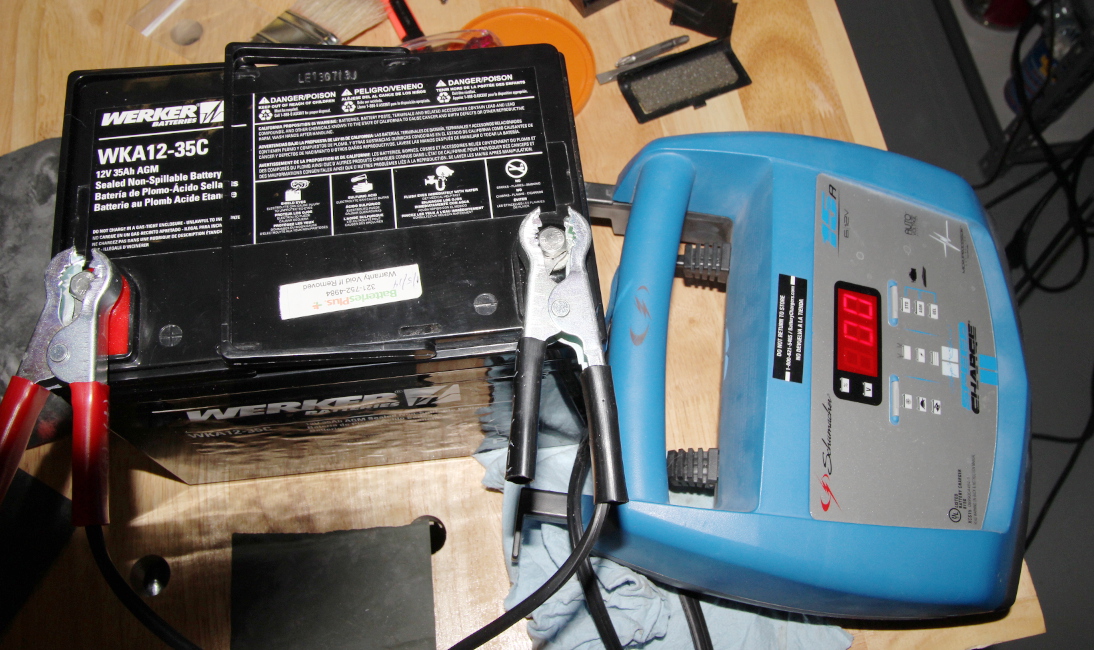
I have a dedicated "smart" charger for lead acid batteries, made by Schumacher, one of the big names in the field, and use it for conventional starting batteries, gel cells or AGM.  This is a beefy charger, and will deliver 15 Amps in the fast charge, Constant Voltage/Constant Current mode for charging a starting battery that's in need of a fast charge, but I prefer the slower charging cycle which is current limited at 2A.  This charger offers three charge rates, fast, regular and maintain.  It's intended to be hooked to your boat or RV and left over the winter, so it measures the battery charge state continually, and turns on the trickle charge when needed. 
After lead-acid batteries, NiCd batteries are probably the most common.  Both gel cells and NiCads are used in power tools, with most now moving to Lithium chemistries.  NiCad batteries were the backbone of portable radio and other electronics, but as the awareness of the potential toxicity of cadmium started to rise, the industry began looking for replacements, eventually developing profitable ways of producing Nickle Metal Hydride batteries.  NiMH has taken over the market segment from NiCd now, both of them filling the niche for batteries with lower capacity (in Amp-Hours) than lead acid; that require rapid charging, and can be dropped in place of a dry cell (alkaline battery) in most applications.

For example, a NiMH AA cell can replace a AA alkaline in almost any application, although the NiMH has a lower initial voltage, 1.2 vs. 1.5V in the alkaline.  In applications where that voltage is more critical, perhaps in a series string of batteries, where the lower cell voltage adds up to a substantially lower voltage than a string of alkalines, it may not be a good substitution.  On the other hand, the NiMH battery is rechargeable 500 or 600 times (many variables affect that), so while it costs more than the alkaline, your total cost may not be bad.  Another area where the NiMH isn't a good choice is in something sits around, standing by "forever" and not getting used.   NiMH's higher self-discharge rate than alkaline will empty the battery within several months, while alkalines can sit for years.  Consider a flashlight that you want to work that one time you need it; use alkalines, not NiMH.  

In terms of capacity, the two chemistries are very similar, but capacity is funny number.  You've undoubtedly seen batteries rated at some number of Amp Hours; perhaps 2500 milliamp hours (mAH) in the case of these AA size batteries.  This is at a specific charge discharge rate; specifically 1/10 of the capacity.  In the case of this 2500 mAH, for instance, that's only if you discharge the battery at 2500/10 or 250mA.  If you setup the battery circuit to draw 250 mA, you should discharge the battery in 10 hours.  Higher current normally leads to shorter battery life and it's not a simple relationship; that is, if you take twice as much current, the battery might not last half as long.  There's a useful chart of this here.  Take the second line, a Duracell "CopperTop" AA.  At a 100 mA discharge current, it showed a 2200 mAH capacity (shown as 2.2 AH); at a 1 Amp discharge, it showed 830 mAH, 1/3 of the capacity at 100 mA drain.  The bottom line of the table is a Powerstream 2000 mAH NiMH battery; at the 100 mA current, it showed less capacity than the alkaline, that 2000 mAH vs 2500 in the Duracell.  At higher current, though, of 2 Amps, its capacity dropped much less than the Duracell, only to 1940 mAH, 97% of the 0.1 A rate.  Further, at a 5 amp discharge rate, its capacity was actually greater - 2110 mAH (although its terminal voltage was lower).   

The simplest way to charge a NiCd is to current limit the charge to 0.1C, leave the charger voltage greater than the battery's voltage, and pull the battery off after 15 or 16 hours.  Don't leave it on the charger.  Fast charging needs a smart charger that either measures small changes in the charge rate or the temperature of the pack.  The battery will stay cool (charging room temperature) until just before it's full, when it will go up.

NiCd, NiMH and lead chemistries have a tendency to develop increasing internal resistance, and if they aren't discharged fairly deeply (how deep depends on the battery), will act as though they have much less capacity than they should.  Many smart chargers offer programmable discharge functions, although the Schumacher pictured above doesn't.  To discharge that 35 AH AGM battery, pictured above, I use a 12V inverter to produce 120VAC and turn on a light bulb (incandescent).  I can let it run until the inverter shuts off, or until I measure the desired voltage across the battery to decide when the battery is deeply enough discharged and then turn it off manually.

This photo shows a multi-chemistry smart charger that has a strange story behind it.  I had ordered a similar but different brand/different features charger from Amazon, but fulfilled by someone else.  Within a day or two, they notified me they were out of that charger, couldn't get more, and offered me this one that they had started selling in the store for the same use.  This charger has separate routines for NiCd, NiMH, LiPo, LiFe (lithium iron), Lithium Ion and Lead chemistries, and came with a handful of connectors/adapters for common RC model connectors.   I think this is roughly equivalent - maybe somewhat more capable. 
The battery, as you can read, is an Icom 9.6V 2800 mAH battery pack.  You can read in the display that I've set the charger to 0.6 A, which is roughly the C/5 rate (0.2C), and it had a terminal voltage of 12.05V (on a 9.6V battery).  The number in the lower right, 1281, was how many mAH it had delivered at the time of the photo.  After a few charge/discharge cycles, I returned this to the 0.1C rate, 300 mA (0.3A) and ran it until it was full.  This charger won't just run for 15 hours; it shuts off after 300 minutes (5 hours), so I needed to run it until it timed out, start it again and run it until it timed out again, then start it and run it until it said it's fully charged.  Somewhat of a pain in the rear.  This is an old battery, though, and didn't handle 0.2 or 0.3C charge or discharge well.  It would take the gentle 0.1C charge and take close to its 2800 mAH rating. 

Lithium Polymer is a coverall term that embraces several different chemistries, so lithium batteries are a complex subject on their own.  Li-polymer systems include Li-cobalt, Li-phosphate and Li-manganese.  Most so-called Li-polymer packs are for the consumer market and are based on Li-cobalt.  As far as the user is concerned, lithium polymer is essentially the same as lithium-ion. Both systems use identical cathode and anode material and contain a similar amount of electrolyte.  

I'm not really that up on Lithium batteries as everything I have with one has a dedicated charge controller in it.  If you have a phone or tablet or other device with a LiPo battery in it, I'll bet there's a dedicated smart charger IC in the device that manages it.  There's a lot intelligence built into things we take for granted, and it might be that if you sat down to design a charger for lithium batteries, you'd find it pretty hard to do.  I came across a very complete web site with a ton of details on Lithium polymer batteries to consider.  It goes into a refresher on battery terminology and enough details to geek out over for days.

I think if you don't have something like these chargers and you have storage batteries in your plan, you should consider getting something.  My dream system would handle any chemistry, do a programmed discharge and programmed charge, and not limit the charge time, just keep charging.  The TAZR charger pictured will only discharge up 1A, which is a bit low, even for that 2.8 AH NiCd pictured, let alone the AGM battery at the top. 


Thursday, December 24, 2015

Merry Christmas!

It's sort of annual tradition on my part to put up this post, or at least the essence of it, since I revise it regularly.
 
On this night 47 years ago, Christmas eve of 1968, Apollo 8 was on the world's first mission to the moon. Like sailors sailing out of sight of land for the first time, man was leaving the safety of shore for the first time. We were becoming a space-faring population.  Here on the ground, 1968 had been a tumultuous year but we were united in watching the Apollo 8 mission in a way few things have united Americans.  

I'll never forget that message they sent down, that Christmas eve.  Especially after roughly 1:20 into this video.

Churches, like all groups, have personalities, and in the one I attend, it would be remarkable to toss a wadded up paper ball and not hit an engineer, nurse, doctor, or a tech professional.  It's not news to this bunch that Jesus was probably born in the spring or fall rather than in the dead of winter, nor is it news that the December 25th date comes from adapting to the Roman Saturnalia or other pagan holidays; nor would they be shocked if you told them Christmas has more secular than holy traditions associated with it and many things that are totally ingrained in the holiday traditions started out as advertising gimmicks.  There was no little drummer boy when the events we portray as the nativity happened; in fact, the scene we call the nativity is a conglomeration of bits and pieces from multiple Gospels, and certainly did not happen within the first couple of days of Jesus' life.  Nobody knows how many magi ("wise men") came to visit the child; we say three because of the three gifts listed, but it could have been almost any number.  Furthermore, it wasn't at his birth; it was when Jesus was closer to two years old. 

A friend sent me this contribution on the question of the exact date.
The truth is we simply don’t know the exact date of our Savior’s birth. In fact, we don’t even know for sure the year in which He was born. Scholars believe it was somewhere between 6 B.C. and 4 B.C. One thing is clear: if God felt it was important for us to know the exact date of the Savior’s birth, He certainly would have told us in His Word. The Gospel of Luke gives very specific details about the event, even down to what the baby was wearing – “swaddling clothes”—and where he slept—“in a manger” (Luke 2:12). These details are important because they speak of His nature and character, meek and lowly. But the exact date of His birth has no significance whatsoever, which may be why God chose not to mention it.
I've heard another explanation for why December 25th was chosen.  It's close to the solstice, the longest night of the year - which made it the darkest night of the year in those days. Jesus was the light of the world, and the symbolism of bringing light when things are at their darkest fits perfectly with the story.  If someone came out with a convincing line of evidence that Jesus really was born on December 25th, I'd be surprised... but not very.  We use a different calendar today than was used in those days, and I'm not sure today's December 25th is the same day as that era's December 25th.  Again, paraphrasing that previous quote, not that it matters. 

"And the Grinch, with his Grinch-feet ice cold in the snow, stood puzzling and puzzling, how could it be so? It came without ribbons. It came without tags. It came without packages, boxes or bags. And he puzzled and puzzled 'till his puzzler was sore. Then the Grinch thought of something he hadn't before. What if Christmas, he thought, doesn't come from a store. What if Christmas, perhaps, means a little bit more." -- Dr. Seuss

Hold close the ones you love.  If we're very lucky, this will be the worst Christmas of our lives and everything in life gets better year by year for the rest of our lives.  And if things get worse, we'll remember this as the "good old days".  Either way, hold tight.  And do it "before you dot another 'i' or cross another 't', Bob Cratchit!"

It's one my of my blessings that a group of really great folks stop by here to share my blather - Google says about a thousand of you every day, which blows my mind.  Thanks.

So however you mark this day, enjoy it well.  Spend time with family or friends or both.  Remember the good service members deployed far from home.  If you're Military, LEO, or fire; EMT, Nurse or MD, and are one who must work while the rest of us rest, thank you.


Wednesday, December 23, 2015

My Favorite Christmas Song - A Repost

Regulars here know that I'm somewhat of a blues fan.  I've introduced the outrageously talented Joanne Shaw Taylor,  country blues master (and songwriting partner to Eric Clapton) JJ Cale, and even mentioned my own meager study of the art.

So it might not come as a surprise that my favorite Christmas song is the bluesy, melancholy, "Have Yourself A Merry Little Christmas".   The song dates from 1944, written by Hugh Martin and Ralph Blaine for Judy Garland's 1944 movie, Meet Me in St. Louis.  The sad tone is understandable; Christmas of 1944 was three years into World War II, and many people had undergone the hardship of losing family members. The war was wearing on the national psyche; the death toll was the highest seen since the Civil War.  They were dark days. 

In a 1989 NPR program, the authors spoke of having written the first drafts of the song and Judy Garland objected to the lyrics, saying they were too sad.  According to Hugh Martin's book:
Some of the original lyrics ... were rejected before filming began. They were: "Have yourself a merry little Christmas / It may be your last/ Next year we may all be living in the past / Have yourself a merry little Christmas / Pop that champagne cork / Next year we may all be living in New York."
Martin revised the lyrics getting approvals from Judy and the rest of the production staff.  Eventually, Judy Garland made this recording:


You'll note that at the crescendo of the song, the line isn't "hang a shining star upon the highest bough", it's the more morose "until then, we'll have to muddle through somehow".  Much more fitting to a sadder song written during WWII.   That change (which seems to be the last) was prompted by Frank Sinatra in 1957.  According to Entertainment Weekly,
Among the never-recorded couplets — which [Martin] he now describes as ''hysterically lugubrious'' — were lines like: ''Have yourself a merry little Christmas/It may be your last.... Faithful friends who were dear to us/Will be near to us no more.''
...
Then, in 1957, Frank Sinatra — who'd already cut a lovely version with the movie's bittersweet lyrics in 1947 — came to Martin with a request for yet another pick-me-up. ''He called to ask if I would rewrite the 'muddle through somehow' line,'' says the songwriter. ''He said, 'The name of my album is A Jolly Christmas. Do you think you could jolly up that line for me?'''
That request led to the line we hear most often.  "Have Yourself a Merry Little Christmas" has become one of the most popular songs year after year.  EW says it's second only to "The Christmas Song" (which most people think is called "Chestnuts Roasting on an Open Fire).  It has been covered by a gamut of artists from Sinatra to Connie Stephens, to James Taylor (who sings something closer to the '40s, Judy Garland version) to '80s metal band Twisted Sister".  I think I'll go see if I can work up a jazz tone and play it a bit right now.


Tuesday, December 22, 2015

Techy Tuesday - SpaceX Raises Their Bar

Seems like only a month ago, we were talking about Jeff Bezos' company Blue Origin landing a rocket on land for reuse.  Oh wait... it was just under a month ago, November 23. 

At the time, I posted that SpaceX had done it already and was trying to land their first stage booster on a ship at sea. 
... I think the Engadget article headline, "Jeff Bezos beats Elon Musk's SpaceX in the reusable rocket race" is not just misleading, it's wrong.  SpaceX made a landing of a suborbital rocket on ground over a year ago, and did it with their Grasshopper technology demonstrator in 2012.  SpaceX has failed so far to land a Falcon 9 booster on small, moving ship at sea, dropping from a greater height.
Last night, December 21, SpaceX had a return to flight mission that included an upgraded Falcon 9 rocket and landing on a concrete pad on the Cape Canaveral Air Force Station.   This was an operational mission, with the Falcon 9 carrying 11 satellites for Orbcomm - Generation 2. 
SpaceX argues that reusability is the key to reducing the cost of flight and getting more people into space.  It was the original argument behind NASA's Space Shuttles, although I they never made their cost goals.  As time went by and it got progressively cheaper to build throwaway rockets, the gap widened again.  This is where companies like SpaceX and Blue Origin can make their name.  
We're all familiar with these time exposures showing rockets leaving for space and leaving a glowing trail image.  But this isn't two launches, and even if it was, what's that third arc, top-center of the frame?  The shorter arcs are two separate burns of the first stage for the return landing.

We went out in the yard to watch the launch last night, but came in to watch the landing on video.  We're far enough from the landing area that it's below our horizon, not to mention behind/below trees, houses and all. All we'd possibly see is the sky lit up from the rockets. 


Monday, December 21, 2015

Not Quite With It Tonight

Although last Friday was my last day of work, I had a dentist appointment looming today that felt like the last thing I needed to go through to be Done.  To be honest, I've been dreading this.  Removal of an old filling.   Along with the knowledge that if it doesn't go exactly right, it's time for a root canal. 

My dentist uses the CEREC system by Sirona for doing the crown there in his office.  He takes laser profiles of the area and then models the crown in a 3D CAD program until he gets all the details right.  Once he's done, he sends the file to a small, water-cooled, CNC mill which carves a porcelain crown with diamond cutting tools, a process that only takes about 20 minutes.  Once the size is confirmed, they treat the porcelain with a glaze-like compound that brings it to the proper hardness.  With all this technology, the procedure is done in one visit, as opposed to sending off an impression to get the crown made and wearing a temporary crown for a week or two.  I was in the chair by 9 AM and done around 12:30. 

Getting it done in one day doesn't make it any more pleasant, though, and I'm a hurtin' puppy tonight.  He took at least a half hour to carve away the old filling and then carve much of the tooth away to function as a post to hold the crown.  Too many moments, like shoving the laser dimensioning probe into my mouth, felt like this classic Far Side cartoon. 

More content tomorrow.


Sunday, December 20, 2015

OK, This Just Doesn't Fit

I saw a report this weekend that Bruce Dickenson, the front man for the metal band Iron Maiden, is going to fly the band around for their next tour - in the captain's seat of a 747.
When heavy metal pioneers Iron Maiden set out on their world tour in 2016, lead singer Bruce Dickenson will pull double duty as pilot of the massive Boeing 747-400 that will take the band to concerts in 35 different countries.
That surprised me, but I don't particularly follow metal bands or Iron Maiden.  The article goes on to say that on their last world tour, Dickenson flew them in a 757, a smaller aircraft with much less capability.  The name "Ed Force One" comes from the name of their iconic, sneering "mascot" (zombie? ... or something) Eddie. 
Dickenson issued a statement saying,
“When the opportunity arose from my friends at Air Atlanta Icelandic to lease a 747 for The Book of Souls World Tour, of course we jumped at the chance, who wouldn’t? The greatest benefit of travelling in a 747 is that because of its colossal size and freight capacity we can carry our stage production and all our stage equipment and desks in the cargo hold without having to make any of the immense structural modifications needed to do this on the previous 757, the extent of which fans will have noted on the Flight 666 DVD. Although in reality we cannot carry much more gear the savings in complexity, time and cost make using the 747 even more practical. All we will need to do is “paint” it and move a few seats around, with the added advantage that there is much more room for band and crew – our Krew can almost get a row of seats each to catch up on sleep on the flights! Furthermore, it is marginally faster 0.85 MACH and the range of around 7000NM (13,000 km) is much greater which means we will not have to make the refueling stops we needed to with the 757.”
He goes on to say that he's not certified in the 747 yet, so the tour doesn't begin until he gets his captain's rating. 

I don't know about you, but a heavy metal band singer flying a 747 for their tour is a new one on me.  


Now This Is Knife Making!

I have a Pinterest account, which I mentioned here when I first started playing around with it.  To be honest, I don't quite know what Pinterest is good for, except maybe sharing recipes or something, but occasionally I do stumble across something cool.
The original links to a post on DeviantArt by Raudan Valmistus, where you'll need to go to really see this image at the right size.  The post follows his project from mining the local iron ore from the bottom of a lake, through refining that ore, and finally to a steel knife.  Steel?  He writes:
Analysis was made for another blade I made at same time, from same iron. Its carbon content is about 0,531%
The American Iron and Steel Institute defines carbon steel as having a carbon content of 0.12 to 2.0 %.  The carbon in this process seems to be absorbed from the charcoal used to work the iron.  It's one of the most profound and serendipitous "accidents" of the way the universe is put together that the way to make elemental iron more useful is add the element most likely to be added by the simplest ways of melting it: a wood or charcoal fire.  It guarantees that steel, arguably the backbone of civilization, would be discovered as soon as man learned how to control fire, blow air across it to make it hotter and allow us to melt elemental iron. 

But that sounds like the universe was intelligently designed and didn't just happen from an un-namable number of random interactions, and we know intelligent people can't hold that idea, right?