Monday, May 7, 2012

The Dark Night of Fascism

There's an old wag saying that goes (with variations) "the dark night of fascism is always descending on America, but landing first on Europe".  While it has happened before, it's a bit premature to assume it will always be that way.

This weekend, the modern Greek version of the Nazi party, The Golden Dawn, advanced in their power, claiming 21 seats in the Greek parliament.  A marginal party before the collapse began, they managed to get 0.29% of the vote in the 2009 election.  Some reports are putting their portion at over 10% of the vote - over 30 times bigger in 3 years.
“Nobody can stop 100,000 members of Golden Dawn,” he said, “and if they bring tanks, they should know they (the Greek military) will be with us.” As for the election results, he said the party actually won 10 percent, not 7. Then he predicted: “The 7 percent will become 17 percent, which will become 27 percent, and then the country will pass into our hands.”

Read more here: http://www.miamiherald.com/2012/05/07/2788484_p2/neo-nazi-party-plots-rise-as-first.html#storylink=cpy
Actually, when you roll up all of the Greek minor parties, like most of Europe, they are essentially different flavors of vanilla - where vanilla is Monster Government.  There's a variety of collectivists in there, but as with that jar of mixed nuts you buy, when you get down it, they're all nuts.  These particular folks are adamantly against the reforms and financial austerity imposed on Greece.  In other words, there is no such thing as real money, real worth, real trade, just keep giving us our benefits.  
(the Golden Dawn flag.  Not too derivative...)

Speaking of mixed nuts, another case in point is "socialist" Francoise Hollande who just won the presidency in France.  I think you and I would call him a communist, but in his context over there, he's a bit less extreme.  He has already declared his answers to be "tax the rich" (gee, where have I heard that before...) and I've heard the number "75% rate" going around.  Ambrose Evans Pritchard (UK Telegraph's Business editor) quotes: 
“They absolutely must cut public spending and control the debt,” said Marc Touati from Global Equities in Paris. “It will soon be clear that we are in deep recession. If they don’t act fast, interest rates will shoot up and we will have a catastrophe by September,” he said.
If you're a free market thinker, you're probably saying "75%?  That will kill their economy - knock it into severe recession".  At least, I'm thinking that.  If confiscatory taxing kills their economy, and they're one of the two remaining sticks holding the Eurozone together, the whole Eurozone collapses.

The Financial Times posts "The Analysts React" but the bottom line is that they probably don't have anybody who knows what's going to happen.  Still, let me drop a quote or two, from Kit Juckes at Societe Generale, if you can't read that piece.
The economics team have published a roadmap for the first hundred days of the Hollande Presidency. All assume he will open the debate with Merkel about slowing the austerity drive, most assume his policy bite won’t be as bad as his electioneering bark. Personally, I think we need to distinguish between the direction of policy and the macro impact of policy. What bothers many about French fiscal policy is the sheer size of the government in the economy overall. But the structural need to nurture the private sector and limit the power of the state isn’t at all the same as needing permanent austerity and economic misery. This is only important now because to argue for more austerity in Europe is just plain silly – the sort of silliness that could bring the whole thing crashing down. (emphasis in original - SiG)

The Greek result was no more of a surprise than the French one but is is a wilder card event. At the moment, it looks as though a coalition can be formed, but how long a new government could survive isn’t clear. The Greek people have spoken, but only to say they are disillusioned and angry. My bet for today is that the US, having sold risk off after payrolls that were soft but not soft to change anything, will bounce. If that happens, we will have an edgy day in which ranges hold. The catalyst for a decisive move lower by the euro remains absent, though the move is inevitable eventually.

Gang, we are talking about the collapse of the Euro.  While there is some encouraging talk to be found that says a growing number of Europeans see the EU as a disastrous mistake and want it gone before they all go down the tubes, there are still many billions of dollars/euros at stake and powerful interests who would gladly inflict incredible suffering on the people to get their way - which is to say, to get their money and power.  And in case you missed it, Peter Schiff, who's good enough at this stuff to do it for a living, says the US is not far behind and the dollar is headed for collapse, too.  The collapse of the Euro, or another Fed disaster like "The Mistake of 1937" could hasten the demise of the dollar. As CA at WSRA points out, even taken with a grain of salt, this article paints a pretty interesting picture incorporating these pieces. 

Saturday, May 5, 2012

My Two Cents

Borepatch and Aretae both posted a couple of perceptive looks at the coming election.  I respect both of these guys very much.  Many others have chimed in - and I have as well, though not as directly.   Random Acts of Patriotism - among many others - have used this image (although I think the first place I saw it was Kevin's):
Any old Trekkie will tell you that the Kobayashi Maru is a test given to graduating cadets, to see how they handle the "no-win" situation.  Kirk's claim to fame was that he hacked the computer the night before, thus winning the impossible-to-win test.  The point is, this election is a no-win situation, and we might benefit by trying to brainstorm up a Kirk-like approach to this test.

Borepatch starts with:
Let me start my cheerfully admitting that a second Obama term - unfettered by the need for re-election and likely facing a Congress entirely controlled by the GOP - will be a disaster of faculty lounge inspired radicalism.  It will be EPA killing oil production and the ATF arming the Iranian Mullahs.  He will moot card carrying communists for the Supreme Court, as well as for every open Federal Bench seat.  Nobody can constrain his radicalism now, and it will be much, much worse come January.
I would have made that a "a disaster of Biblical proportion carried out by faculty lounge radicals".  I'll see your EPA and ATF predictions and raise you "Supreme Court Justice Eric Holder", and U.N. Arms Trade Treaty.  I'll throw in the Chicago Mafia, the Muslim Brotherhood, an Iranian attack, and a bunch more.  The problem is not just the Marxism, it's the thugocracy: it's a regulator who feels congress and laws are obsolete, a congress that won't pass a budget, a president that doesn't meet with a cabinet but rules by executive fiat.  But a more fundamental question is: what makes you think we even have four more years?  As Kevin said in this comment
The foundation of your "Let Obama Win" recommendation is "We can still save the Republic!"

I'm not so sanguine.

I think we've passed the point of no return and we're augering in. The only difference we can effect now is "how hard will we hit?"
Can we really stand four years under the NDAA, and the rest (source)?

Aretae suggests that if your aim is to try to straighten out the stupid party, as Borepatch seems to want, simply vote for the Libertarian candidate.  They largely draw their support from conservatives anyway, and perhaps it would be noticed more.  If you simply vote for the Evil party, I don't think the election numbers they see contain that information. 

A longtime friend's wife is an insider with the Stupid Party of Florida, and has been on the Romney bus for months.  He and I were discussing possible bumper stickers for Romney.  The obvious one is "Romney: at least he's not a communist".  I'm kind of fond of another idea I had: "Romney: he just may destroy the country, but it won't be deliberate".

See, we can bitch and moan all we want about Romney, but the fact is he won the nomination by getting more primary voters.  Say what you want about "he was pre-destined", or "it's his turn" or any other put down you want, but he won.  The party chose him.  Yes, he got more money donated to him by the "too big to fail" banks than any other candidate, and, yes, he ran a nasty, negative campaign.  Notice how, as soon as he dropped out, all of the "sexual harassment" charges against Herman Cain dissipated like fog?  Notice how any other candidate talked seriously about the real problems and the real need to cut spending, they were ripped apart by the press - and even my fellow bloggers - for being crazy?  I'm talking specifically about Michelle Bachmann and Rick Santorum, as well as Ron Paul, who talked about the seriously bad times that are coming.  The only person who has gotten away with talking about cutting spending is Paul Ryan, whose plan falls so laughably short of being useful it's pathetic.  That probably means he's not considered a threat.

So what's the answer?  Romney?  Obama?  Gary Johnson (L)?  Frankly, they all make me sick and this really is the no-win situation.  Unless we can pull off a James T. Kirk and figure out a way to win the no-win, we get what we've got.  Seems like the other day I said,
The difference between Romney and Obama is pretty much like the difference between getting run through the abdomen with a machete and left to bleed out, or a double tap through the aorta.  The end result is pretty much going to be the same, it's just a matter of speed.  In a way, your choice of candidate may be determined by whether you're the kind of person who likes to pull the band-aid off all at once, or prolong the pain at lower levels. 

Friday, May 4, 2012

The Least You Should Know - DC Motors 1

I didn't really explain why a motor spins in the piece on AC motors.  Remember how magnets have north and south poles, and while opposites attract, two norths or two souths will repel each other?  In an AC motor, the rotor has magnets on the shaft, and the magnetic field from the current running in the coils of wire on the stator create an opposing force that pushes on the rotor.  Picture a straight wire running in front of you.  Connect it to a battery on both ends so that current flows.  If you were to take your right hand and grab the wire, with your thumb pointing in the direction of current flow, your fingers would point in the direction of the magnetic field caused by that current - and, yes, the field wraps around the wire in closed lines.  This is one of several "right hand rules" that student engineers and technicians have to remember.
With the AC from the wall outlet connected to it, the direction of that current, and the fields, would change every time the current changes direction, every half cycle (50 Hz in much of the world, 60 Hz in the US).  By clever arrangement of the magnets and coils, the motor can be designed so that there's always a force moving the motor regardless of the polarity of the magnetic field at that instant.  It never seizes up.

Did you ever have a slot car?  Remember how they had a hand controller that let you change the speed of the car?  These are probably the most familiar examples of a DC motor, and illustrates one big advantage, that the speed of rotation can be controlled by changing the voltage.  The controller was just a variable resistor. Because the resistor varies the current through the windings, and the strength of the magnetism depends on the current, that changes the speed of rotation.

In a conventional DC motor, the wires are on the rotor, not the stator, and there's an asymmetrical arrangement of coils and magnets. In a small motor like you find in a slot car, there are two magnets and three coils so that they can't line up and lock up (this figure only shows one loop of wire in one coil).  Since the coils are rotating, the contacts go through conductive brushes (braided wire or formed carbon) and rings on the rotor shaft connected to the coil wires. (source)

DC motors come in a wide range of powers, with many more magnets and coils, and in other sorts of configurations.  A very common variation today is the brushless DC motor.  The brushless design is wired much like the AC motor, with the rotating shaft holding the magnets and the coils along the stator.  The trick in these motors is that they have an internal electronic circuit that converts the applied DC to AC to drive the coils.  The electronics adds some cost, but getting rid of brushes that make the DC electrical contact produces a more reliable motor.  High reliability motors like floppy disk drives are often brushless DC motors. The added electronics are pretty cheap for those guys. 

DC motors usually have excellent torque vs. speed curves, with the best torque at low speed.  Internal combustion engines tend to have low torque when barely turning, and reach their optimum at thousands of RPM.  I've seen small 4 cylinders (Toyotas and Hondas are notorious for this) that don't reach their maximum torque until they've been rev'ed up to over 4 or 5000 RPM; better towing vehicles have their best torque at lower RPM.  An electric motor frequently has its most torque at stall speed (that is when it's at 0 RPM).  It's something that makes DC motors attractive for cars.  And although I haven't talked about generators at all, a generator and a motor are virtually the same arrangement of parts looked at from different ways.  What this means in practice to the electric car is that with some switching, when you no longer want to drive power into the motors (that is, when you're stopping), you can get voltage out them and dump it back into the batteries.  This is called regenerative braking

By sales volume, it could be that the most common motor today is the stepper motor, the topic for next time. 

Thursday, May 3, 2012

The Bigger Picture

Steve Breen at Townhall.com

This pretty much sums up my reaction to the story about the rampant waste at the GSA.  The iceberg rolled into a different position and the sunlight caught this little piece of FWA (I think everybody who has ever worked for a government contractor knows about Fraud Waste and Abuse).  When you see this kind of crap, just know there's 10 times as much under the surface.
(confidential to the GSA twits: you should go ahead and quit your day job... please ... I just wouldn't call Simon Cowell quite yet)

Wednesday, May 2, 2012

The Least You Should Know - AC Motors

You thought the last topics were big, so I'm going to narrow it down a bit.

I like to think of the electrical world as being composed of a few "continents".  One continent is certainly electronics: computers, calculators, TV, radios, audio amplifiers, electronic music, and the many electrical toys we're surrounded by.  Another continent, certainly a very important one, is power: generation and transmission.  For the most part, these continents don't touch - except where your electronic device connects into the power generation and transmission system.  There are not many components that these two continents share. I can think of only a handful: wires and connectors, sure, but also motors.  From the giant electric motors in diesel electric locomotives to the tiny "vibrator" in your cellphone - the silent ringer - motors occupy big places in both continents.

The basic reason motors work is because electricity and magnetism are one and the same thing - electromagnetism.  This stuff gets mathematically complicated: if there's one area that the vast majority of other engineers I've known hated in school, or had a wicked hard time with, it was electromagnetics.  I'll leave out the math, but just know that an electric field creates a magnetic field, and likewise, that magnetic field will create another electric field. 

The most basic motors, the ones in widest use for the last hundred years or so, are AC induction motors.  AC motors, like all motors, are built from a combination of coils of wire (which we know are inductors) and magnets.  They have a rotating piece (not very useful without that!) called the rotor and a piece that's not moving (stationary) called the stator.  Something like this (source -and more in depth tutorial than this):
These motors ordinarily rotate at a speed related to the AC frequency.  60 Hz AC (60 cycles per second) is 3600 in a minute, and motors rated at 3600 RPM or 1800 RPM are very common.  Under load, that frequency tends to go down from an effect called slip.  The dependence on the AC frequency to set the motor speed in RPMs makes them hard to use if you need variable speeds.  A variable frequency drive is needed (generally created by electronics). These motors are available in a very wide range of torque and power, from small fractions of a horsepower (1/4HP electric drills used to be very common) up to behemoths you won't have in your house or on your farm.

Electric motors are capable of very high efficiency, over 90%, one the reason they're attractive to "alternative energy" folks.  As you might expect, weighing against this advantage are some disadvantages. One is that being connected across the power line lets AC motors draw high peak currents, as much as seven to 10 times normal operating currents, at start up. This is one of the reasons for the starting capacitor many motors have, and large motors (like central air conditioners) will sometimes have a "soft start" kit.  Obviously, these current surges can affect other devices on the same circuit. 

Much of the power loss in an AC motor is in the rotor, which typically relies on air for cooling, as shown. The act of moving air through the motor housing for cooling leads to power loss overcoming air resistance. Other losses  include resistance in the copper wire as current flows through the stator winding, magnetic losses through stray magnetic paths, and magnetic losses in the motor iron.

AC motors are the workhorse of the shop.  Chances are you have several around your house right now: in power tools, an air conditioner, fans and other things.  They are very limited, though, by the dependence on line frequency.  Many more motor applications are available for motors that can rotate at variable speeds, or that can move a fixed number of turns, or simply move an accurate portion of a revolution.  Those are DC motors of various kinds, and that's the topic for next time. 

Tuesday, May 1, 2012

Happy Occupy Day!

The crazy anarchist/communist kids of Occupy Whatever long ago declared they'd follow the long standing communist practice of making May 1st a day to get out and get active, and so they have.

Kevin has the absolute best summary of Victims of Communism Day, and you should definitely read the whole thing.
J. Rummel, Professor Emeritus of Political Science at the University of Hawaii, has calculated that the total number of victims of Communism - that is, the domestic victims of their own governments - in the USSR, China, Vietnam, North Korea and Cambodia is 98.4 million people.  For all Communist governments during the 20th Century, he puts the estimate at approximately 110 million.  And this wasn't in warfare against other nations, this was what these governments did to their own people - "breaking eggs" to make their utopian omelet.
and I shamelessly steal a graphic Kevin has used before.
Maybe it's that old, weird, engineer side, but for the life of me, I can't understand why the idea is so attractive to anyone but psychopaths today.  We can forgive the first ones, the Russians and maybe the National Socialists (Nazis); they had no history to look at.  The people who let it happen didn't know that there would be nearly 50 million of their neighbors killed by the government.  But even by the '60s, when Bill Ayers, Bernadine Dorn, and the Weather Underground wanted to force communism in place here, they not only knew it would lead to millions killed, they apparently wanted to do the killing.   An FBI informant tells of them openly talking about "eliminating" 25 million hard core Americans who wouldn't go along with their little utopia.  I guess the gulag's not such a bad place as long as you're the one doing the killing.

In contrast to the guys who want to start the killings, the useful occupy idiots seem unaware of any history or the reality of communism - it's all magic unicorn farts and rainbows.  Famines and death camps?  Not so much.  Remember the morons in the Occupy last fall who told someone who grew up in the USSR that North Korea was an ideal place, compared to south Korea?  North Koreans get paid fairly for their work, while south Korea was an oppressive place?  Someone should tell the horribly scarred torture survivor Shin Dong-hyuk, who watched his parents executed and escaped over the burning body of a friend, stuck on the electrified barbed wire, as he escaped from the forced labor camp he was born and grew up in.  

I've been saying since last fall that Occupy was going to return once the weather up north got pleasant enough for them, and are not going to stop until they provoke bloody riots and more killings.  They say so themselves in a slightly more roundabout way.  In the mid-60s, around the Watts Riots (Frances Fox Piven's inspirational event), they used to say, "it's going to be a long, hot summer".  Word up. 

Monday, April 30, 2012

The Stupidest Political Ad Ever

(from Steve Breen at Town Hall)

The stupidest political ad in history has to be the Obama campaign ad that implies making the decision to take out Osama bin Laden was some sort of brave, visionary, tough decision.

This was without a doubt the easiest decision in history. 

There was absolutely no down side to making the call and no up side to not making it.  If the raid failed, there would be some backlash from some circles, but I'd bet the vast majority of Americans would forgive the president quickly because, "at least he was trying".  The Pakistanis capturing our guys would have been the worst possible outcome, but DEVGRU against anyone in the area, with the ability to call in backup and air strikes?  There isn't a gambler in Vegas that wouldn't take that bet. 

On the other hand, if Obama didn't decide to get him, that would get out, like "hot" classified information usually does (I assume you've heard the tape of Bill Clinton talking about how he passed on taking bin Laden during his presidency - that's what I mean).  And then Obama would be demonized and hated by over 80% of the US.  It would be an automatic lifetime ban from political office.  "Dogcatcher?  The guy who didn't want to risk taking bin Laden out?"  Any president who didn't go after OBL would get the same.

Sparklies meant to distract us from the wholesale destruction going on.  That's all.

Sunday, April 29, 2012

A Project Finished, A Weekend Class

I was finally able to cut the screwdriver slot in the threaded standoff for my Savage 64F that I talked about last weekend.  Broke an end mill by feeding too fast, which means the fix cost even more, but got it cut on the second try. 
I put it in the rifle with a dab of red Loctite, and put the rifle back together.  Fits fine.  Shoots exactly as before.  A successful fix.

I realize I'm probably one of only a handful of people in America who shoots regularly that had never shot a Ruger 10/22, but I fixed that problem this weekend.  All I can say is: anybody want a Savage 64F?  Only a slight exaggeration, but that was like an entirely different class of machine; like comparing a really nice car to an econo-box.  Cadillac to Corolla?

Today, Mrs. Graybeard and I attended a Civilian Trauma Medicine first aid class.  I used to have a Red Cross first aid card - 40 years ago.  I even worked as an emergency room orderly at that time, helping the doctors with suturing, casting, even doing CPR on the hospital's "code team".  But wars always advance trauma medicine, and my (partially-recalled) knowledge has gone obsolete in places.  The combination of Gulf Wars I and II, plus Afghanistan, and the things Israel has learned from years of suicide attacks have changed some things.  With small unit tactics, maybe four to six guys, the number one rule is to win the fight and then attend to each other.  You might have to do first aid on yourself to keep fighting, or lean on your buddies groin to put pressure on his femoral artery, so that he doesn't bleed out and die while you're getting out of the mess.

I think our instructor is uniquely qualified to teach this, being a trauma specialist RN, as well as former special forces, an NRA instructor, and having worked security for the State department in Iraq, Haiti and other - shall we say, unpleasant - places.  He says the class is not for the squeamish, and it was as advertised, with plenty of pictures of IED wounds and other damage from Iraq, plus other (mostly deceased) cases from back home.  The highlight, though, was shooting a couple of pork roasts with 9mm hollowpoints and allowing us to examine, and then bandage the wound channels.  Not something I've seen in person.  BTW - what's the current recommendation for treating a gunshot?  Plug it with a tampon.  Quickclot was over used in theater and has fallen out of favor.  Last resort only.

But... tomorrow is Monday, so back to the mundane. 

Saturday, April 28, 2012

A Deep Concealment BUG

At the risk of igniting caliber wars, let me show you our BAG day booty.  Our BAG was a BUG, the North American Arms 22 Magnum with holster grip.  As you can see in this shot, this gun is about the same overall size (when folded up) as my iPhone 4.   
Let me admit I've been attracted to these little guns since before we got our CC permits in '09.  The little NAA revolver (SA only) shoots .22 Magnum (WMR), and the one we got included a second cylinder that handles .22LR. 

Took it to the range today and this little thing is hoot.  Loved it.  Mrs. Graybeard loved it.  Both of us remarked it was more fun to shoot than we thought it would be.  The .22 magnum makes a pleasingly louder bang than plain .22LR, although she prefers .357 Magnum (which is in a class of its own).  Easy to shoot one hand or off hand.  We shot at 10' or so, and it took a cylinder or two to get a feel for how it aims (there's no notch in the back to put the front blade in), but we were good with it after that.  This is not the kind of gun you're going to use for IDPA or rapid fire.  It takes a minute or so to reload.  See that pin sticking out below the barrel?  You push in on that while grasping the knurled part, and pull out the rod.  The cylinder pretty much falls out into your hand which you then unload and reload.  Once it's loaded, you rock the cylinder gently back into place and put the pin back. 
This was bought specifically as a back up gun, or for deep concealment in a place where you really have a hard time concealing.  I could carry it in a pocket of my (almost omni-present) cargo pants without anyone ever knowing.  It fits in a purse or the smallest of fanny packs. 

.22 Magnum?  Srsly?  How good are the ballistics?  They're actually pretty good.  This video from Hornady shows 11 to 12" penetration in standard gel, with the hollow point unfolding well.  This video from Brass Fetcher was with this model gun and the same round we're shooting here.   Let's face it: it's not a major caliber, but it penetrates about as well as .380ACP, one of the most popular calibers.  To paraphrase Michael Bane, though, it would be much more effective than harsh language.  Nobody likes to leak.  Get a couple of holes into them and the typical street toad might change his plans for the day. 
This is summer in Florida, when you have to dress lightly or die.  It would fit in perfectly in my cargo shorts and tee shirt summer wear, and anything Mrs. Graybeard would wear or carry, too. 

Friday, April 27, 2012

NC Blogger Facing Jail Time

In one of the most ridiculous stories in weeks, a blogger from North Carolina was threatened with up to 120 days in jail for telling people about how changing his diet helped him control his diabetes and loose weight.  According to Reason Magazine (h/t to The Blaze):
[When] Steve Cooksey...was hospitalized with diabetes in February 2009, he decided to avoid the fate of his grandmother, who eventually died of the disease. He embraced the low-carb, high-protein Paleo diet, also known as the “caveman” or “hunter-gatherer” diet. The diet, he said, made him drug- and insulin-free within 30 days. By May of that year, he had lost 45 pounds and decided to start a blog about his success.

But this past January the state diatetics and nutrition board decided Cooksey’s blog — Diabetes-Warrior.net — violated state law. The nutritional advice Cooksey provides on the site amounts to “practicing nutrition,” the board’s director says, and in North Carolina that’s something you need a license to do.
It's probably a safe assumption that most people don't pay much attention to diabetes issues unless they have it.  The only reason I pay attention is because I'm the only one in my family blood line that doesn't have type II diabetes - and I'm closer than I'd like to be.  If you don't follow it closely, you won't know there is a massive schism between people who proactively attack their diabetes in an attempt to escape the complications (virtually all amputations in the US are due to diabetes) and the dietary recommendations of the American Diabetes Association.  The ADA recommends a diet high in carbohydrate in the form of "healthy whole grains", but the folks who attack the problem have (seems to me) all learned the best treatment is a low (or even zero) carbohydrate diet - the opposite of the ADA's approach.  While the ADA recently published a magazine article saying, in essence, "shut up, take your medicine and do what we say", the people following the alternate theory end up getting off medications and even off insulin, like Cooksey.  Seems to me that has to be safer.

So Cooksey's crime was to contradict the ADA advice - even though he has a disclaimer on every page of his blog saying:
I am not a doctor, dietitian nor nutritionist… in fact I have no medical training of any kind. If I can figure this out so should they… if it wasn’t for their …
A) Intellectual Laziness
B) Willful ignorance
C) Greed
D) All of the Above :)
(Copied from the bottom of his webpage).

Bouncing back to the original Reason article:
Charla Burill, the board’s director, told Carolina Journal she could not discuss the details of Cooksey’s case because his website is still under investigation, but agreed to talk about the law in the hypothetical....

Burill said [Cooksey's] disclaimer may not protect a nutrition blogger from the law.

“If I’ve given you reason to not worry that I don’t have a license because I have all these other reasons I’m an expert, you could still harm the public,” she said. “At least you’re not trying to mislead the public, but you’re trying to get the public to trust you.”....

Burill said if Cooksey refuses to come into compliance with the law, the board could file for an injunction.
If you only knew the power of the Dark Side!  Oops, sorry.  Did I say that out loud?

Since Mr. Cooksey isn't made of money and is just an average blogger (like most of us), he has done just enough to comply with the North Carolina officials.  Between you and me, I don't think there's much of a line between an opinionated blogger (I repeat myself) and a friend telling you they lost weight, feel great, and here's how they did it. Is the next step to monitor conversations and make people not talk unless it's approved by the board?  What about the dozens of magazines on the newstand every month doing the same thing?  What about Michelle Obama's nagging about "eating right"?  What's the difference? 


Thursday, April 26, 2012

The Administration's Attacks on Ted Nugent

We all saw the video of Ted Nugent's statement at the NRA convention.  Personally, I understood it to mean that Ted felt that if president Obama is re-elected, the DOJ will come up with some pretense to take him out - not that Ted would threaten the president in any way. It's not like the DOJ hasn't demonstrated that they can accept tons of bodies to get what they want; what does Fast and Furious prove, after all, if not that they'd accept hundreds of dead Mexicans (not to mention a few of their own co-workers/employees!) to get their way on the anti-gun agenda?

Watch this carefully!  You or I could be next.

Agent John Loughlin of California Fish and Wildlife, leading a pre-dawn, guns-drawn raid on friends of Ted Nugent, holding up a pair of brass knuckles he found, and telling the gunsmith homeowner, "Help us get Nugent and these felony brass knuckles will go away".

Note how they emphasize felony convictions, so they can keep Ted from owning a gun ever again, and keep this gunsmith from working in his chosen career.  Remember the argument that every day everyone of us violates three federal laws?  That Mens Rea is no longer being used to decide prosecution?

According to Nuge, they have been hounding him essentially for the entire Obama administration.  It doesn't surprise me that he would figure that if the regime stays in power, they'll come up with ways to take him down for good.  It's the Chicago mafia's way.

Oh, this interview also explains his run in with the Michigan DNR that led to him putting down his own pigs, and equally insane events on his game ranch in Texas.
Every normal man must be tempted, at times, to spit upon his hands, hoist the black flag, and begin slitting throats.  - H.L. Mencken

Wednesday, April 25, 2012

Continuing the Solar Panel Project - Building It

The main advantage of drawing up the solar panel project in CAD like I did is that I can get dimensioned drawings and then know the list of materials I need to get in order to build it. 
As you can see, the sides are about 36" long, the top and bottom pieces just under 20", and the uprights about 30".  No dimensions are critical - they'll be cut to final length later.

But what to build it out of?  It's certainly possible to use wood or whatever you're used to, but I'm leaning toward the elegant system sold by 80/20 Inc. "The Industrial Erector Set".  80/20 specializes in aluminum extrusions, but it is a system, not just parts, and they have everything you need to do just about anything with their extrusions.  They sell parts to make easy right angle joints, and other ways to join pieces.  They also give away a little piece of software that will help you determine whether your design is strong enough.  In my case, simple 1" square extrusion, their 1010 series, is plenty strong enough. It looks like this:
If they don't have a handy distributor that will sell to you, they run an eBay store where they sell "garage sale" items. 

No connection, no kickbacks, I couldn't care less if you did it this way, yada, yada, yada.  See my disclaimer on the right sidebar.

Tuesday, April 24, 2012

A New Permalink

I've spent most of my useful time tonight pulling together all my previous posts on post-SHTF communication, and that also includes after the shutdown of the Internet.  Over in my pages list on the right column. 

Better yet, click-y here.

Monday, April 23, 2012

Maybe Not Cowboys

A friend at work sent me this kind of old article (Feb.'08) from Wired magazine: "High Tech Cowboys of the Deep Seas", the story of salvage companies who save ships in incredibly difficult troubles.  The article (a bit long) covers the rescue of the Cougar Ace, a ship loaded with Mazdas headed for the US, when this happened:
The story is centered on Titan Salvage out of Pompano, Florida - just north of Ft. Lauderdale, and a place I know well.  Used to go through it every day on the way to and from work. 

They reminded me not so much of cowboys, but of Red Adair, Boots and Coots, and the other companies that put out the Kuwaiti oil fires.  Extremely competent, hard working, and ready to take on life threatening work that few people could possibly do.

Maybe not cowboys.  Maybe just Texans. 

Must Watch Video

Courtesy of SnarkyBytes

Not much I can add to that.

Sunday, April 22, 2012

Best Laid Plans

Didn't get as much time to work on my threaded stand off today, but I tapped the 12-32 NEF internal thread and then relieved it 1/10 inch at the top, as the original is.  That sort of stuff takes a few minutes.  I didn't cut the slot, which is a 1/16" wide slot that appears to be for driving it with a large screwdriver.  This top picture has the screw that it will work in most of the way in place. 
The slot is probably one pass on the mill (I need to look at that and see how deep the cut is to be sure).  It will definitely take more time to set up the cut than to make it.  I just ran out of time to get it done today. 

Saturday, April 21, 2012

A Typical Gunsmithing Problem

About a 18 months ago, I bought a couple of Savage 64F, semiauto .22 rifles.  They're fine, modern rifles, and similar to the same price class ($150-ish retail) rifles from other sellers. 
Like many other rifles in its class, the stock has to be removed to clean it, and some disassembly is required.  This is where the problem starts.  This picture shows the barrel, trigger assembly, magazine holder - pretty much everything besides the stock, upside down in a gun vise:
To the left of the magazine holder (sticking up with a "keystone" shape opening) is a screw with lockwasher, and an open hole to its left.  What goes in that hole is a round piece of steel: one end of this is an external threaded stud to screw into that hole, and a tapped hole on the other.  The internal threaded hole receives a screw that holds on the stock - there are two screws and the other one goes in that tall hex-nut on the right.  Somehow, that threaded hole on the left in the rifle got barfed up.  

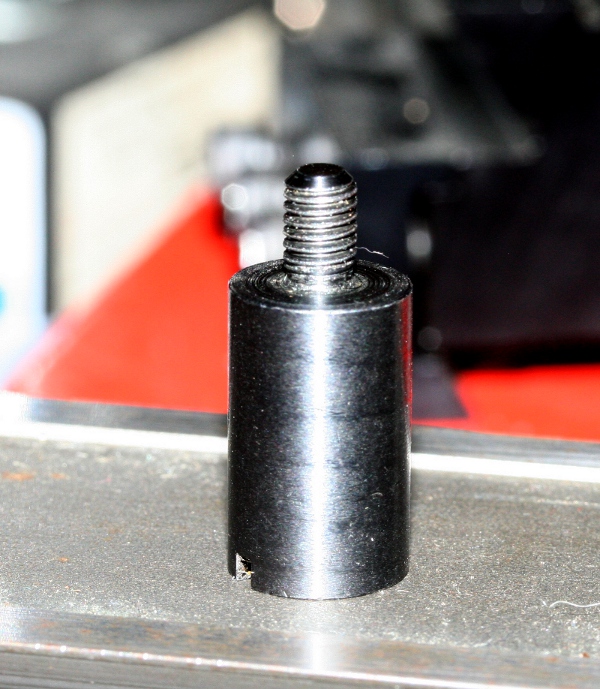
This is the piece that goes in that hole.  It's about 3/4 inch long and .450 diameter (the round part).  It doesn't appear to be any sort of high-zoot alloy, and is finished in "something black".  I was able to get a replacement from Savage, but that didn't solve my problem (I didn't know threads in the rifle upper were damaged until I got this).  The threaded stud on the top of the piece is 10-32.  The internal thread is an odd one: #12-32. 

When the threads in a hole get barfed, there's not much you can do except tap it for a larger hole or weld some filler into it and try to drill and tap it again.  Since I don't have welding stuff, adding filler is out.

On the other hand, I do have a micro lathe, so I decided to make another one of these threaded pieces, and make the 10-32 stud into 12-32 as well.  Then I'll tap the rifle for 12-32 and see if I can get it back together.  My local Grainger didn't have any 12-32 taps, but Midway did.  If 12-32 doesn't hold, I either will go to 1/4", or it's time to scrap it. 

And that's how I spent my Saturday.  I have a few feet of steel bar - 12L14 a general purpose alloy that machines easily.   First, I cut a long enough bar to machine what you see there, then turned the large and small diameters.  Next, I cut the threads on the stud portion with single point threading on the lathe.  I used the replacement from Savage to test the 12-32 threads I cut - they thread together fine (I don't have any other 12-32 hardware, and it's always reassuring to check threads you've cut).  The only things left to do in the morning are thread the internal hole in the steel with the Midway tap, and put a screw driver slot in it (visible bottom left in that picture).  I'll have more info tomorrow. 

Friday, April 20, 2012

Friday Night Odds and Ends

To begin with, if you are even remotely interested in astronomy and things going on in the sky, you might want to find someplace or some way to observe the coming transit of Venus.  A planetary transit like this is when the planet crosses the disk of the sun as seen from Earth.  In North America, where most of my readers are, at least some portions of the transit will be visible on the evening of Tuesday, June 5th.  Alaska, Hawaii, and the pacific west of there will see the entire transit, with the transit occuring at sunrise over Europe, east Africa, the Indian subcontinent and the Mideast.
This is an extremely rare event!  I believe there have been seven observed since the invention of the telescope.  Due to the angles between Earth's and Venus' orbits, you get a pair of Venus transits eight years apart (we had one in '04), and then not again for a long time.  The next one will be in 2117 - not only is this the last chance of our lives to see one, but the last of our children's lives and likely our grandchildren's lives.  Our newly arrived granddaughter will have to live to 105 to see one.

This being Florida, we were clouded out of the 2004 transit.  I would like to see this one - with my own eyes.  Yes, I have a solar filter that allows use of a telescope.  If need be, I'll watch it online.  More details here.

I've mentioned before that I don't particularly believe in the concept of peak oil, at least as most commentators use it.  In an even remotely working market, as the price of one fuel rises, research into alternatives picks up (all without the fed.gov getting involved) as inventors jockey to be the next godzillionaire, and we transition between fuels.  Energy Efficiency and Technology magazine editor Leland Tesch writes on the subject this month
To understand this viewpoint, one has to go back to the originator of the peak oil theory, the geologist M. King Hubbert. Hubbert’s theory argues that world oil output is currently at or near the highest level it will ever reach, and that about half the world’s oil resources have already been produced. Hubbert devised his peak theory in 1956. He claimed U.S. oil production would likely peak somewhere between 1965 and 1970 -- reaching a point that became known as Hubbert’s Peak -- and then precipitously decline.
The problem with Hubbert's idea is that he used a simple statistical model and never accounted for the greater incentive to get more oil (or anything) as it becomes more valuable.
For example, only about 40% of the typical oil field’s production comes through traditional methods. New technology gets more production out of existing fields. And this is why a declining discovery rate for new oil fields is not a trend to worry about, says Yergin. Most of the world’s supply is not the result of new discoveries, but comes from additions to existing reserves. One study by the U.S. Geological Survey found that 86% of oil reserves in the U.S. arise not from estimates at the time the field was discovered, but from revisions and additions that come to light as the field is developed.
The end result is that fields reach a plateau and taper off slowly.  It's one reason why our known oil reserves are greater now than 10 years ago.  

Is there a limited amount of oil on Earth?  Of course, Earth itself is finite, so that's not even the question.  I just don't believe anyone knows how much.  There is evidence old, abandoned oil wells refill from below, and there's a competing (abiotic) theory to oil formation that says oil is component of planets when they form, not just  fossil organic matter as most people think. 
Production at the oil field, deep in the Gulf of Mexico off the coast of Louisiana, was supposed to have declined years ago. And for a while, it behaved like any normal field: Following its 1973 discovery, Eugene Island 330's output peaked at about 15,000 barrels a day. By 1989, production had slowed to about 4,000 barrels a day.

Then suddenly—some say almost inexplicably—Eugene Island's fortunes reversed. The field, operated by PennzEnergy Co., is now producing 13,000 barrels a day, and probable reserves have rocketed to more than 400 million barrels from 60 million. Stranger still, scientists studying the field say the crude coming out of the pipe is of a geological age quite different from the oil that gushed 10 years ago.
Insert my usual rant that if the government and other toxic do-gooders would just leave the darned economy alone,  things would work themselves out just fine.

Finally, I think everyone knows how businesses act like they're actors in porn films; banks in particular check into sleazy hotels and merge repeatedly with every other bank in the world.  "Hey big fella, show me your CDOs".

Two days ago, an unsolicited replacement for one of my Mastercards came in the mail.  I had gotten it from Southeast Bank decades ago.  Over the decades, a list of big banks owned the account and reissued the card: Southeast, First Union, Wachovia, Washington Mutual and now Wells Fargo.  The new card, two days ago, was another reissue, this time by Bank of America

Coincidentally, today it's being widely reported in the gun blogs that BoA dropped McMillan USA as a customer because they are "more of a firearms manufacturer than a supplier of accessories".

Sure looks like it's time to call BoA and tell them I don't want to be a customer of any company that doesn't believe in civil rights.

Thursday, April 19, 2012

Shooting Pigs in Michigan

It's the same old story:  big business gets the state legislature to change the definition of feral from "wild" to "not belonging to Big Agra".   All of a sudden anyone who isn't an approved "only one who can farm" gets their pigs killed - or sent to jail. 

John Robb has the story.  You are reading John, right?

Wednesday, April 18, 2012

Ben Bernanke on Friday 13th

Turns out Friday the 13th was a big day this year.

First: the government moved to  choke off the booming US natural gas market, with the Orwellian-named, “Supporting Safe and Responsible Development of Unconventional Domestic Natural Gas Resources” executive order (h/t RegT).  The rule is designed to add lots of overhead costs by adding oversight from at least a dozen departments and agencies of the fed.gov hydra.  Keeping costs high will help Obama maintain his policy to make energy prices "necessarily skyrocket".

Second: Federal Reserve Chairman Ben Bernanke ("The Bernank") gave a memorable talk on the topic of "Rethinking Finance" - and the Fed definitely needs to rethink what they're doing.  The speech is entitled, "Some Reflections on the Crisis and the Policy Response", and the whole, mind-numblingly boring collection of Fed Doublespeak is here.  It leaves you with the impression that Bernanke and all the central bankers live in a different world than we do. 

Gary North, financial commentator at Lew Rockwell, posts a pretty witty fisking of the speech, "Ben Bernanke's Judy Garland Impersonation". Let's start here:
He [Bernanke] ended his speech with this:
The financial crisis of 2007-09 was difficult to anticipate for two reasons: First, financial panics, being to a significant extent self-fulfilling crises of confidence, are inherently difficult to foresee.
This is wrong on two counts. First, in a free market, there are no self-fulfilling prophecies. That is because of the widespread distribution of knowledge. A self-fulfilling prophecy is said to take place because lots of people expect it to happen. But why would lots of people expect it to happen? Because (1) there is something fundamental taking place and (2) people share the same economic theory.
Self-fulfilling crises?  How could that happen?  That's saying markets don't work.  But seriously, Ben, just about everyone knew there was a housing bubble; you'd have to be an intellectual or central banker to not see something so obvious.  And bubbles depend on monetary policy to inflate them.
FIAT MONEY PRODUCES BAD INFORMATION
Ludwig von Mises asked this question: Why do so many entrepreneurs make the same mistakes at the same time? His answer: there must have been misinformation conveyed to almost all market participants. But how? Because of central bank tampering with the money supply. Money is the common commodity. It conveys information to most participants. To find why people make the same mistakes at the same time, he said, look at monetary policy of the central bank and fractional reserve commercial banks.
The whole thing is worth reading.  Just the dated quotes of Bernanke saying completely wrong things are worth your time. 

They way I see things, Bernanke has been on a Public Relations push to keep the "end the Fed" folks from gaining an upper hand and forcing him to resort to open attacks ("You wouldn't like me when I'm angry").  And I think from a historical standpoint, if when the economy goes south, guys like Ben might end up on light poles.  It wouldn't be the first time.  The problem is, when they try to convince you nobody knew the '08 collapse was coming, that's a bad lie.  Too many people know it was predicted, and a lot of Austrian economists predicted it; here's a nice partial listing.
Last week, Pimco's El-Erian threatened to deplete their supply of adjectives based on "sustainable" when he said,
"In the last three plus years, central banks have had little choice but to do the unsustainable in order to sustain the unsustainable until others do the sustainable to restore sustainability!"
The short version of this is that the banks are running against marginal utility limits.  They've created so much worthless "money" that each new unit has even less value than the one before it.  It's becoming worth less of the worthless money.  This can only go on so long.  It's going to end, and it's not going to be pretty. 
Somewhere over the rainbow
Way up high,
There's a land that I heard of
Once in a lullaby.

Somewhere over the rainbow
Skies are blue,
And the dreams that you dare to dream
Really do come true.

Someday I'll wish upon a star
And wake up where the clouds are far
Behind me.
Where troubles melt like lemon drops
Away above the chimney tops
That's where you'll find me.

Somewhere over the rainbow
Bluebirds fly.
Birds fly over the rainbow.
Why then, oh why can't I?

If happy little bluebirds fly
Beyond the rainbow
Why, oh why can't I?