Monday, February 3, 2014

Captain's Log - I'm Tired, So Tired

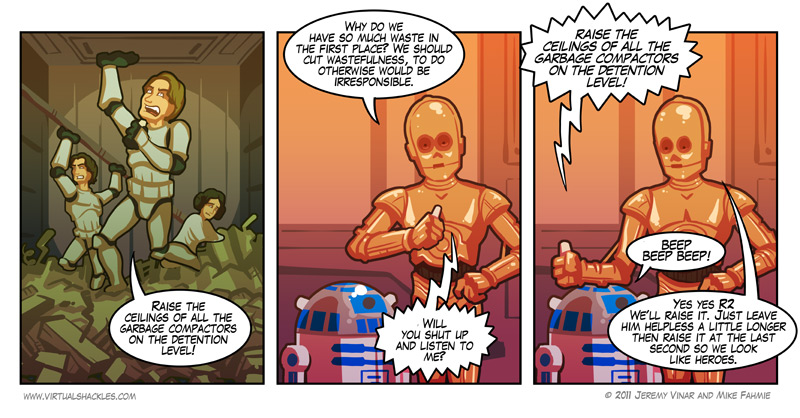
So we're getting ready to hit the debt ceiling again?  I'm so tired of the talk that hitting the debt ceiling is default.  IT IS NOT.  I say this every few months, but default would be not being able to meet interest payments, and we have enough tax income to pay interest.  It's not default, it's just not spending like a drug addict.  Like I said last summer, the whole debt ceiling debacle is just theater.  You know they're going to raise it because we don't have  a debt ceiling in any real sense.  They may delay for a few weeks, but it always gets raised.  And if they make it nice and dramatic, they get to claim to be heroes. 
(source is clearly VirtualShackles.com)

The other thing I'm tired of is the "raise the minimum wage" argument.  I'm tired of that subject, and I'll bet that you are, too, but the WSJ ran an article last week that "Almost Everything You Have Been Told About the Minimum Wage is Wrong".  Elizabeth Warren (Princess Fauxcahontas) has argued that to keep up with worker productivity increases, minimum wage should be $22/hour.  There's a few problems with that, but the biggest is that she's lying.  Let's be charitable a minute: she's as wrong as first grader doing fractions.  She's comparing the productivity of other workers, not workers on minimum wage.
Taking a longer view, from 1987 to 2012 the same BLS data show that worker productivity in the food service sector rose by an average of 0.6 percent per year. In limited service restaurants, the gains were slightly lower, only averaging 0.5 percent per year. Meanwhile, unit labor costs have risen by an average of 3.6 percent. Over this period the minimum wage has risen from $3.35 to $7.25 per hour which is an average annual increase of 3.1 percent. In other words, at least in food service, the minimum wage has risen at a rate five or six times as fast as justified by the gains in worker productivity. [Emphasis added - SiG]
That says the fast food worker on minimum wage is overpaid now.  Or, as the WSJ says,
These numbers reveal not just the selective statistics employed by the proponents of raising the minimum wage, but also that the debate has little to do with helping the poor. Instead, this is really a debate about income redistribution. Raising the minimum wage is actually just an attempt by liberals to punish a subset of business owners by redistributing a share of their supposed wealth to their employees. It is just another attempt at class warfare.
Wait... it's not about helping the workers, it's about income redistribution?  And the people who eat at fast food restaurants and are therefore going to be hurt by the inevitable price increases are frequently the people who work at minimum wage jobs?  It's just about political power and agendas?

What's next?  You going to tell me to expect the sun to rise tomorrow?


Sunday, February 2, 2014

Gibson Salutes Fed.Gov - Middle Finger Style

Courtesy of Robb at Sharp as a Marble, we find that Gibson has raised a middle finger to the fed.gov in memory of the politically motivated raid on the company.  That rant on the initial raid remains one of my most-read posts.  More background and the resolution. 

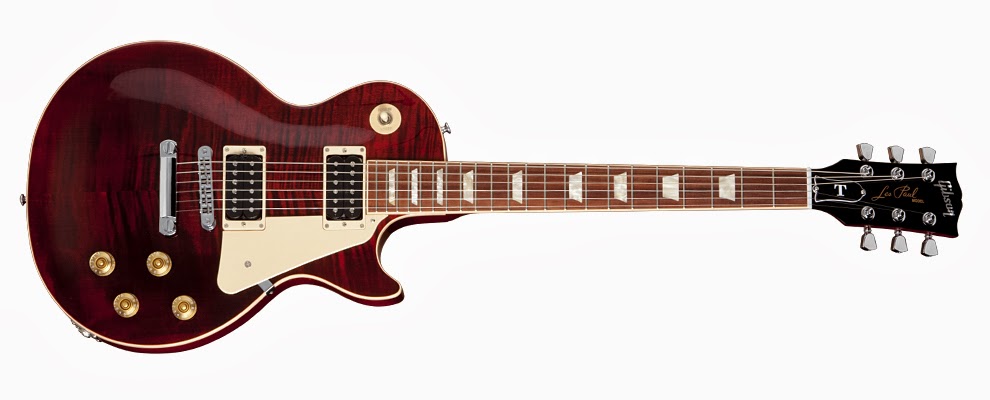
Introducing the Gibson Government Series Les Paul:
From the ad copy:
Great Gibson electric guitars have long been a means of fighting the establishment, so when the powers that be confiscated stocks of tonewoods from the Gibson factory in Nashville—only to return them once there was a resolution and the investigation ended—it was an event worth celebrating. Introducing the Government Series II Les Paul, a striking new guitar from Gibson USA for 2014 that suitably marks this infamous time in Gibson’s history.

From its solid mahogany body with modern weight relief for enhance resonance and playing comfort, to its carved maple top, the Government Series II Les Paul follows the tradition of the great Les Paul Standards—but also makes a superb statement with its unique appointments. A distinctive vintage-gloss Government Tan finish, complemented by black-chrome hardware and black plastics and trim, is topped by a pickguard that’s hot-stamped in gold with the Government Series graphic—a bald eagle hoisting a Gibson guitar neck. Each Government Series II Les Paul also includes a genuine piece of Gibson USA history in its solid rosewood fingerboard, which is made from wood returned to Gibson by the US government after the resolution. [emphasis added - SiG]
Note that while Gibson refers to it as "Government Tan", I think that most of us would call that "desert tan".  Or coyote.  But probably not flat dark earth.  It would be easier if they posed it with a selection of guns so we could compare - it's not like those colors are well defined.

I checked the big online dealers and none list it, so while I'm sure that the price is likely going to be less than that MSRP, I couldn't tell you how much.  It appears to be a lower-end Les Paul, though, and based on others in the series, I'd expect it to be about a $600-ish guitar. 

The truth is that I just bought a Les Paul back before Christmas, and a far prettier one, or I'd get one of these.  Our year end bonuses at work were generous, and I'd been tempted by one of those Min-eTune system guitars since last summer.  Sort of my way of sticking a finger in Eric Holder's eye.  So I treated myself to a made-in-Nashville Gibson.  This is a catalog picture, but it looks a lot like this one:


Friday, January 31, 2014

"May You Live in Interesting Times"

For all my life I've heard that saying is a Chinese curse.  Not knowing any Chinese, I couldn't tell you for sure, but we sure live in interesting times, don't we?

The DJIA is down about 5 1/2% from the start of the year, but bear in mind there was a real run up to the end of the year, as you can see in this chart.  The DJIA is really about where it was in mid November, around two and a half months ago.  In terms of purchasing power, it's where it was around 1996. 
The question, as always, is where do we go now?  Was this just a mild correction, blowing off some steam from the holiday run up, or is it the start of something much bigger and deeper?

I subscribe to two economics/finance newsletters, Bill Bonner's free newsletter and the Stocktiming.com letter.  Stocktiming is essentially pure technical analysis: plots of dozens of things, updated on a regular basis, and comes out weekdays.  The letter doesn't push any particular agenda - other than getting you to subscribe to their paid version - and is a Dragnet-style "just the facts" approach.  Bill Bonner's "Diary of A Rogue Economist" has more of a philosophical air to it and he's more like a Peter Schiff/Ron Paul and other "sound money" economist.  His comes out on most weekdays, but will skip some.

The point of the previous paragraph is to point out how two authors in the financial realm can approach the analysis from decidedly different view points, yet they both have been singing the same tune.  Get Out of the Stock Market.  Bad Things Are Coming.

Yesterday's stocktiming newsletter was completely unique.  I've been getting it for a lot of years, maybe since the mid '00s, and he has never said what he said this time (copied in red to make it look as much like his email as I can):
ALERT, ALERT, ALERT ... We had 3 SELLS at the close yesterday.
The Risk levels are very high and the market is sitting on the edge, and I am not sure the Fed can pull off a save.   If you weren't around in 1987, this is about as close as you can come to a possible crashing environment ... a spectacular crash is even possible ... IF the Fed. doesn't get this one right. This is the WRONG time for them to pull back on money injections. The BIG IF here centers around what the Fed can do, and actually does ... and nobody knows what that will be.  
(The remark about 3 sells is from a setup of three complex decision matrices he maintains).  This alert is from the staid, quiet, technical analyst.  Bonner, for his part, has been saying the market run up is entirely fueled by the Fed's QE to infinity, and it's going to correct.  That's not unique to Bonner, dozens of honest commentators are saying this and if you come here regularly, you'll know I've been saying this, too.  Bonner says the Fed is going to continue with the taper for a while but ultimately will have to resume QE.  The test will be as the market continues to contract.
The Fed will continue attending its Counterfeiters Anonymous meetings – until the market really cracks. Then it will roll up its sleeves and get out the paper and ink. Janet Yellen will not want to preside over a crashing market any more than Ben Bernanke did.

Yes, the Fed has broken the US economy and its markets. Now, it owns them. It can no longer permit the stock market (and bond market, for that matter) to do what comes naturally to them – correct their mistakes.

And that means the mistakes will get worse.
Analyst Toby Connor of GoldScents says the scariest chart in the world is the S&P 500.  When this bubble goes, it's going to make 2008 look good, and it's coming soon.  He presents this chart going back to 1996; that means it shows the bubbles in the late '90s and the mid '00s. Note how much higher the price is than both of the previous bubbles.  It has been said the current bubble, which he describes as the "currencies and sovereign debt bubble" is going to be the final bubble.  After this, no one will ever trust a central bank again. 
Yesterday, Bayou Renaissance Man ran a piece summing up conditions and wondering if we have reached the tipping point.  With the recent problems in emerging markets, the banks limiting cash withdrawals, the major international financial groups (IMF, World Bank...) arguing for confiscating portions of taxing your savings and other goings on, I'd say to prepare for a rough year.  To use the sailing analogy, batten down the hatches and prepare for rough weather.  Prepare for water breaking over the deck.  Put on your PFD and prepare to end up in the water. 


Thursday, January 30, 2014

The Cause of the Problem

Gunslinger's Journal links to one of the most profound things I've read in a while, an article called "The Destruction of the People" in a journal called Theden, devoted to reconnecting with our tribes.

The article is dated December 26, 2013, and is the text of an address given by Manfred Kleine-Hartage, a sociologist, on the occasion of what appears to be a German Memorial Day; People's Mourning Day.  Kleine-Hartage is credited as the author of The Jihad System: How Islam Functions, Defend Europe, Why I am No Longer a Leftist, and The Liberal Society and Its End—On the Suicide of a System.  It centers on the multicultural immigration problems Germany faces and the death of nations; the deaths of groups of peoples, and the rise of the super states, like the EU. 
The 7500 Germans since 1990 who have become victims of immigrant violence are victims of a policy daring enough to destroy society: out of ideological blindness; out of greed for cheap, easily exploitable labor, whose situation is precarious at the same time, for the welfare state will collapse at the point of exhaustion (this one also a quite desirable result of mass immigration for certain circles); out of hatred for his own people, those damn Germans they want nothing to do with; and—not the least—out of lust for power. There is a reason why there are elites in all Western countries who carry out the destruction of peoples and their transformation into mere splintered “populations”: peoples are in fact solidarities that can also kick their rulers out. The battle cry with which the rule of the SED [the Soviet-installed Socialist ruling party of East Germany] was overthrown 23 years ago did not read “We are the population.” It read: “We are the people!” A mere population, consisting of dozens of warring ethnicities, will never overthrow the ruler. They cannot. A democracy needs its demos. A despotism on the other hand, a dictatorship, a totalitarian regime—yes, such a thing needs a population.

The destruction of the people is one side of the same coin, to which the other side is the transfer of their rights to supranational institutions: to the EU, the WTO, the IWF, the NATO, the UN and dozens else—all institutions that cannot be controlled from below, but that determine our lives: that dictate to us the rules by which we live, and dictate to us which foods we should eat, which people we have to live together with in our country, against whom we must go to war, and into what inscrutable bank-conglomerate our tax dollars disappear.
He displays a few rhetorical flourishes, "Are the enemy young immigrants, who lead their private jihad against the people?" and "Might the enemy sit in the Muslim Brotherhood, or in the Turkish Government, or in the Millî Görüş?", before concluding. 
The war which has taken the victims we mourn today is a war of those in power, a tiny elite, against the rest; it is a war of the rulers against the people.

This parliament, this political class, so concerned with the political affairs of the rich and powerful, this political class has no right to grieve German dead—because they are not their dead! They have not the right to host a People’s Mourning Day, because they have broken away from their people, cheated them, betrayed them, sold them out, and now are working on their destruction!
The root of the problem should be apparent to anyone who thinks about it a bit: big, socialistic governments coupled with the meager birth rates of Western societies, virtually all of which would be below self-replacement rates without immigration.  "Demographics are destiny", and countries with massive social programs need growing populations with increasing tax revenues to keep the candy flowing (they need infinitely growing populations, which is obviously impossible, but work with me a minute).   Germany and most of the Eurozone has imported Muslims from North Africa.  The US imports Mexicans and Asians.  The other elephant in the room is abortion: countries that abort a significant portion of the next generation need to import even more immigrants.  

I've written on this before.  The solution to a socialist state that is collapsing due to inability to make the payments it promised is to import immigrants to tax in order to pay for the payments it has promised, except that the immigrants will tear the country apart and destroy it as surely as the economic collapse they seek to prevent.

Go read.   And if you don't "got tribe", for God's sake, go get tribe! My tribe...
(Reference)


Wednesday, January 29, 2014

SoTU: Lies and Grand Larceny

The Bamster's SoTU last night was so hideous I couldn't watch.  Call me a chicken.  Besides, you know it's going to be autopsied a million ways by the morning anyway. 

Being the leader of a Banana Republic who does things by decree executive order instead of by actual, you know, legislation, he has taken the first giant step in the process of confiscation of our 401k accounts, at least according to commentators who have been watching this story over the last several years, like Simon Black.  The MyRA program has been birthed.  Much as Godzilla doesn't look very terrifying the moment he breaks out of his egg, the program doesn't look like much.  The new plans
...will be structured like Roth IRAs; they’ll rely on a new kind of Treasury savings bond that guarantees them against losses; and they’ll have a $15,000 maximum account balance, according to details disclosed by the administration today.
In my first post to this blog in 2010 (after a "Hello World" test post), I talked about this possibility coming, even describing the way they might do it. 
The stock market crash of ’08, with the concomitant collapse of many 401k plans, has given the .gov an excuse. There is talk of nationalizing our 401k plans – in not so few words – so that we can replace those “risky” plans with a gubmint guaranteed (but teeny tiny) yield. ... There's a good reason to think this is coming; our unsustainable debt has to be financed by selling bonds. Now that the sales of bonds are failing internationally, the .gov can sell them by forcing them into our 401k accounts!
In another 2010 post, I suggested they'd do something like the Treasury TIPS bonds.  The MyRA is "A new kind of savings bond" with a "return [that] isn’t exactly world-beating ... 1.47% in 2012, with an average annual return of 3.61% from 2003 through 2012. But the value of the account would never go down."  These sound like the kind of program I've been describing.

The big difference is that getting into the MyRA program isn't mandatory.  Let me just say "not mandatory yet".  This has been discussed in the "halls of power" since before the '08 collapse.  The spending addicts in congress can't resist that pile of money that has been saved. As one commenter over at WRSA said, "but if you think the govt wont take everything you own to keep itself running; you were born last night."

The lies about growing income inequality - as if he was some sort of space alien visiting in DC and not responsible for the crony capitalism that feeds into that - make me gag.  The lie that women make less than men is so common that I scarcely hear it any more.  It's like saying that day care workers don't make as much as oil field roughnecks, so it's due to their sex and not the particular job they're doing.  That idea will never work. 

The pay differences between men and women is studied every year in the trade magazines.  In technical fields, for one area I'm very familiar with, women with comparable experience and seniority earn virtually the same pay as men with the same job title.  The only thing that makes it look like women earn less is that women in engineering tend to be younger, and have less experience in their job title.  In some amount of time - 20 years? - that won't be true any longer.  As of now, there aren't many women in the field comparable in age and experience to us old graybeards and none where I work.


Tuesday, January 28, 2014

Techy Tuesday - From Microwave Ovens to Cancer Treatment

In the current issue of advertising emails from semiconductor manufacturer NXP (the current iteration of a very established, even storied company - Philips) they make reference to a new breed of RF heating devices they're developing the technology for.  In this video, they show a fish cooked in an RF oven while embedded in a block of ice. 
Other potential uses include industrial applications such as ovens and furnaces e.g. for drying materials such as ceramics or wood. In medical applications it’s opening up new possibilities such as the safe rapid defrosting of human organs and blood or hyperthermia therapy for cancer treatment. All these require a very high degree of temperature control, achieved via coordinated RF energy irradiation from one or several channels.

Another key area for RF energy is the excitation of plasmas. Innovative RF plasma lamps can deliver unbelievably bright light at 140 lumens per watt, or RF energy can fire a gas discharge to drive powerful industrial laser cutting tools. Then there is the RF spark-plug for automotive ignition systems, which can provide significant savings in fuel consumption and CO2 emissions.
Today's microwave ovens are not substantially different from the ones that came out in the late 1960s.  A microwave power amplifier device (almost always a vacuum tube called a Magnetron or "Maggie") generates hundreds of watts of power at around 2500 MHz and dumps it into a box where the food sits.  I know a lot of people think 2500 was chosen because it was a "resonant frequency" for water and cookware doesn't have water, but it's not resonance.  This is just dielectric heating caused by the polar molecules moving in response to the energy dumped into them and 2500 MHz was chosen because it was in the ISM (Industrial, Scientific and Medical uses) frequency band allocated by the FCC.  Any frequency in that part of the spectrum would be just as good. 

To be able to cook the fish in a block of ice and not melt the ice (much - the hot fish will melt some of it) shows very precise control of where the strongest fields are, and I assume it's being done with power beams formed by antennas.  NXP makes power transistors and a showcase for their products would be a number of amplifiers (16?  speculating here) each driving a separate antenna and the beam being shaped by changing the phase - the exact timing, down to the picosecond - of the RF signal between the individual antennas.  This is a phased array antenna system in the oven. 

The same technology could be used for other things depicted in that video - hyperthermic treatment for cancers, flash thawing of blood and frozen organs for transplants without overheating parts of the target.  Lots of power with pinpoint control.  Sounds like a great solution. 
(Electromagnetic simulation of the temperature gradients induced during treatment.  Specific absorption rate of different tissues creates temperature differences, too - a field being intensely studied.  The temperatures being targeted are not very high - 43C or 109F.  A very specifically targeted fever.  If the affected part were a hand or foot, you wouldn't think twice about going to 120, unless it was very raw tissue, right?)


Monday, January 27, 2014

Computers Are A PITA

Yeah, we all know that deep down inside.  Or maybe not that deep.  Last night, I opened iTunes to update some apps, and it offered me an update to iTunes.  Installed on my Win7 machine and it never worked again.  MSVCR80.dll is gone.  Apple Mobile Device driver doesn't work.  You don't have privileges to install that on this machine...  Uninstall.  Reinstall.  No joy.  Uninstall.  Uninstall everything else in a specific order from some web page.  Reinstall.  No joy.  Uninstall again in that specific order from that web page.  Shut the computer off.  Turn it on.  Reinstall.  No joy. 

So for bearing with that whine....
I've had this so long, I don't remember where I stole got it.   If it's yours, I'll post credit. 


Sunday, January 26, 2014

Living in a Constitution-Free Zone

In case you missed it, in a rare New Years' Day ruling, Federal Judge Edward Korman declared that the "Constitution-Free Zone", 100 miles from any border of the US, including the oceans and gulf, was legal.  Combining the two linked articles, with the first paragraph by syndicated radio host Kim Komando:
He had a case before him involving a U.S. citizen – a Ph.D. student at McGill University in Montreal – who had his computer confiscated while returning to the States. The judge ruled, sweepingly, that, yes, the federal government had a right to confiscate laptops at the border without probable cause.
...
The ACLU originally challenged the administration's policy, which can be applied anywhere within 100 miles of the border, after U.S. Customs agents stopped student Pascal Abidor on a train traveling from Canada to New York. After noticing Abidor had two passports -- not uncommon for journalists and those with dual citizenship -- agents asked to see his laptop. Since Abidor was a student of Middle Eastern affairs, his computer contained photos of political rallies held by Hamas and Hezbollah, known terrorist groups.

"I explained to the immigration officer that the reason I had these photos was this was my research," said Abidor, a U.S. citizen. "I determined they looked at my personal photos and personal chats with my girlfriend. I knew I needed help."
This is a remarkable case in that it joins together the incredibly liberal ACLU with the strong libertarian right, and a milestone ruling in the favor of liberty comes from the 9th circus court.  In other words, everyone except the doctrinaire tyrants, like judge Korman, thinks discarding the fourth amendment - already bleeding out from the TSA and so many other infringements - is a bad idea.  The constitution is essentially dead.  I haven't heard of anyone having soldiers quartered in their houses, but I can't say I'd be surprised to hear that today.
But in March, a panel of three judges in the 9th Circuit Court of Appeals in California said the government needs "reasonable suspicion" to search a traveler's personal electronic device. When two federal courts interpret a law differently, the U.S. Supreme Court often resolves the conflict.
The ACLU says nearly 2/3 of the US population lives within the constitution-free zone.  I certainly do, along with every person in Florida.  All of the major urban centers of the country: New York, Chicago, El Lay, San Francisco, Seattle, DC, Tucson... virtually every major city, virtually everyone is inside this zone.  I can't call it WROL because it's fully legal - in the same sense that everything the Nazis did was fully legal under their legal system.

Kim Komando hosts a syndicated radio program of computer tips and advice, so you can expect she'll have a deeply personal, gut reaction to the issue of searching digital information.  Her article is powerfully written, almost poetic about the shear violation of having your laptop or cellphone taken and examined, and you should go RTWT.  To pull a couple of paragraphs:
The taking of a laptop today is a striking act of confiscation almost without an equivalent 25 years ago. Back then, it would have taken a team of FBI agents days if not weeks to so comprehensively vacuum up a single American's health, business, financial and personal information, not to mention that of so many of his or her friends, family members, and business associates.

Today, Nosy McPatterson, your local TSA staffer, or Roscoe the border agent who got up on the wrong side of the bed that morning, can accomplish the same feat, and in an instant. They can paw through your photos and email during their lunch hour. And anyone present with a 13-year-old's understanding of computing can easily and unnoticeably make a quick copy of it onto a device that slips easily into a pants pocket.
As I always say, it's not that bad - it's worse.  In addition to the 100 mile constitution free zone, police are routinely grabbing cellphones during traffic stops for anything, and searching the content on the phone (often with automated cracking devices) without a warrant.  The supreme court has decided to review two cases related to this, but it continues unabated.  According to this lawyer, in United States v. Zavala, 541 F.3d 562, 577 (5th Cir. 2008), the court ruled that this was just “general rummaging in order to discover incriminating evidence.” and that rummaging was forbidden.  Other courts have ruled the other way.  The original police justification for starting to look at phones was that they had hands free cellphone laws, so they had the right to look at the time of your last call to determine if you used it while driving - admitting to breaking the law. 

Cellebrite, the maker of those "Forensic Extraction Devices", brags they can suck your history out of a phone, iPad, Tom Tom GPS, and more.  It cracks password protected devices, so don't expect that to help you much.  With phones and tablets merging into "phablets", and both replacing laptops, it's effectively performing the same data collection that started the case which ended on Judge Korman's bench.  It has the effect of making the entire country a constitution-free zone.  All you need to do is be stopped in traffic - seat belt check? sobriety check? - and have a something electronic with you.  After that it's simply a question of whether they want to charge you with something.   With the average person committing three felonies every day, chances are they can find something in your history they don't like. 


Saturday, January 25, 2014

Reloading Bleg

I've decided I need to make a dedicated reloading area, so I'm looking for some advice on setting up a really nice reloading area.  I have two presses, a single stage and a progressive: I think I'd like to leave both set up at opposite ends of a single bench.  How are you guys set up? Got any links to pictures? 

My reloading adventures so far have been in cluttered spaces - to say the least.  I've safely reloaded a few times, with the single stage Rock Chucker Press I started out with, but I've just barely gotten my RCBS progressive set up.  Part of what I've been doing for the last couple of months is cleaning out an area in the garage that will be the new reloading center.  Right now, I store my powder at the opposite end of the house, in compliance with things I've read from the manufacturers and online (example), keeping powders and primers far from each other, and powder bottles separated from each other by barriers, but I don't have a powder cabinet.  That will change.

I've looked at many pictures online, and I have some ideas, I just thought I'd see what those of you who drop by regularly are doing.  To a degree, it's overwhelming.  Way too many choices.  I don't have unlimited room, but I'm aiming for a corner in the garage where I can spread out about.  Maybe 4'x4' to as much as 6'x6'.  Bigger is preferred, of course.

I don't have any real pictures of the clutter, because I've always done my best not to include the clutter in the pictures.  Look behind the press in this picture, though.  This is also my electronics workbench.  To the right is a gray-cased DVM, behind that a black box with blue Dymo labels - that's a 30 year old power supply.  There's freeze spray, dusting spray, and more.  There are two bins full of electronics parts (junk box), another voltmeter on the left, a long coil wound with red magnet wire that was the heart of an experiment.  There's a spool of orange wire on the right, and solder almost under the press.  Just too much junk.  Everyone knows it can not only be distracting during reloading, it can be dangerous.  I need to get that mess straightened out.  It's why I haven't done much reloading.

(Note to non-Floridians:  it's pretty much universal everywhere I've been in the state that your house comes with a garage, and you leave your cars in the driveway.  A Florida garage is more like northerner's basements).


Friday, January 24, 2014

How Much Digging Would You Do For $40 Million?

One of those unusual stories caught my eye this week, an announcement from Petra Diamonds of South Africa that the legendary Cullinan mine produced an "Exceptional 29.6 carat blue diamond".  Stones of the quality that this piece of diamond crystal appears to be have sold for over $2 million dollars per carat.  My headline is based on a 20 carat finished stone.
The mine, owned by the firm since 2008, was also where the Cullinan Diamond was found in 1905 - described as the largest rough gem diamond ever recovered and weighing 3,106 carats.

Other notable diamonds found in the mine include a 25.5 carat Cullinan blue diamond, found in 2013 and sold for $16.9 million, and a diamond found in 2008, known as the Star of Josephine, which was sold for $9.49 million.
As someone who's a bit of a rockhound/rock collector, and at least known some people around the gem trade, I have some observations that I hope are worthwhile. 

First, it will be impossible to explain the allure of a stone like this to some people.  Some people appreciate gems, some don't, and of the ones who do, some don't think much of diamonds.  You will have to recognize, though, that it will an extremely rare, beautiful thing.  It won't just be the only one on earth, it will be the only one in the history of earth.  Someone will value that rare, beautiful thing enough to pay that $2 Million per carat for it.  That someone will likely be an oil sheik, or perhaps a Russian oligarch, maybe even a Chinese billionaire. 

Second, many people will say that with synthetic, gem quality diamonds entering the market, the price is overdue to collapse.  I will simply point out that rubies have been synthesized since the late 1800s, and have been available in any quantity you want since then, but that really hasn't affected the price of rubies out of the ground.  The highest quality synthetic rubies are hundreds of dollars per gram; the bulk synthetics - like the kind class rings are made from (Verneuil process) - are under a dollar per gram (eBay link).  A high quality natural ruby can hit ten thousand dollars per carat (five carats in one gram).   

Third, look at the role that final weight plays in the value of the stone.  Faceting, even of diamonds, is a process of grinding away portions of the stone to create the flat facets that shape the stone.  I find that many people are aware that diamonds can be cleaved, and just think that's how the facets are put on a stone.  Nope, they're ground on.  A common rule of thumb would be that a faceter will recover about 20-25% of the weight of the rough.  A well-shaped diamond crystal, a natural octahedron, can give 50% recovered weight, but this sure isn't an octahedron.  There will be study of the optimum way to cleave the crystal into smaller stones (very little stone is lost during cleaving) and then only very experienced diamond cutters will touch it.  They will want one stone as big as they can get good optical performance from, and settle for a group of smaller stones.  I think.   

I can hardly imagine the pressure to get that decision right.  Literally millions of dollars riding on grinding away just the right amount of stone.  A carat is 1/5 of a gram; that can be ground away fairly quickly. $2 Million turned into diamond dust worth essentially nothing.

There's a saying that "diamonds are where you find them".  How much would you spend to find a single stone worth $40 or $50 Million? 


Thursday, January 23, 2014

DiveMedic Goes Silent

As I do a few times every week, I clicked on "Confessions of a Street Pharmacist" to catch up on his blog but this time received the message that the blog is gone.  I first discovered DiveMedic on a link via Borepatch quite some time ago and have been a regular reader.  I know we're both Floridians, and by the areas he posted about, I assume he's located in the Orlando area.  That's pretty much an hour and change drive from here - depending on exactly where you're driving to. 

As a fellow gunnie and former scuba diver (currently without gear), we had more than a few perspectives in common.  I have to say I learned a few really astounding things from him about how badly paramedics are treated in this area.  And I learned a few neighborhoods in Orlando that I really don't want to drive through!

A story I've never told on this blog is that when I was just out of high school a hundred years ago, I worked as an emergency room orderly and nurse's aide.  As a first year college student, I helped with suturing, setting bones, and was on the hospital "code" team - going around the hospital doing (essentially) CPR on people in cardiac arrest.  In many ways it was the most satisfying job I ever had: people would come in bloody, messy, bleeding, and in my limited way I helped clean them, sew them up, and send them home looking and feeling better than when they came in.  I worked with a lot of paramedics, and was certified in first aid, but most of what I did was after the first aid was rendered and the person was in the hospital. 

The last month has been pretty rough for him, and being a guy, I didn't have much I could say that seemed useful.

Sorry to see you gone, DM.  You're always welcome around here.


Wednesday, January 22, 2014

I... Never Thought That

Zimbio has one of those silly quizzes up: Which 'Star Wars' Character Are You?  Having a few minutes at work to screw off take a coffee break, I took the quiz.  It tells me:
I never thought of myself as a princess, but maybe I'm hung up on gender stereotypes or something.  Fight the patriarchy!

Actually, when I tried it at work it said I was Chewbacca, which I also wouldn't have thought of, but I didn't save the image.  I figured I'd try it again tonight.  I like Chewie because of the "no better friend, no worse enemy" way he seems to be.  Obviously, this is a very precisely designed test. 


Tuesday, January 21, 2014

Techy Tuesday - Hexapods, Octopods and RoboSpiders

If you haven't run across these things on YouTube, you might be entertained with what experimenters are doing getting robots to emulate walking critters.

This critter is apparently called Atrax, and its claim to fame is the ability to emulate several different multi-legged gaits.  Atrax also does a pretty good impression of an Australian funnel web spider!

Atrax is cool, but the PhantomX hexapod almost skitters across the floor in this video.  The PhantomX is a commercial product - kind of pricey in my view - but you could play with one of these if you wanted to.  There are other kits out there to play with, like the T8X RoboSpider sold by Robugtix.

Why would you want a robotic spider?  Backing up a bit, why so much interest in hexapods and other designs like these?   The most common purpose is all terrain walking; more legs are better than two, and a walking robot can go places a wheeled cart can't - witness the big budget Boston Dynamics robots you've seen before, like the somewhat creepy (IMO) "Big Dog".  A less talked about use that looks really promising to me is CNC cutting! Imagine needing to do work on a big thing: a building, a car, a truck, or something with CNC precision.  How about a CNC milling machine (or router) that walks up to the work and does the job? 


Monday, January 20, 2014

What's All This Gold Stuff, Anyway? Who Cares?

A commenter dropped by to say a few words that I think could lead to a long, long discussion:
Never understood the fascination with gold. You can't eat. You can't use it. You have to convert it back to fiat to spend it. Not easy or quick to do either, you've got to ship it to a dealer, wait for your check (weeks), then cash it at a bank. Gold is simply useless for the average person, it's not even a good store of value since you must "time" it's purchase and sale quite right or you'll loose money. And then you've got that ridiculous hassle to convert it back into fiat in order to actually use it.

Who cares what the prices of gold is? It's fabricated, manipulated and subject to all sorts of intervention, including confiscation. Gold bugs just don't get it. It's useless for all practical purposes for the average Joe. Sells at junk jewelery prices too in a collapsed economy. It's not "worth" anywhere near what everybody claims. It's a pain in the ass.
You can't eat it?  Check (more or less).  Can't use it?  Check (again, more or less)  You have to convert it back to fiat to spend it?  Not by a long shot.  There are many places around the country where you can spend gold or silver today (example).  Yeah, you'll probably have to bargain and not just plunk down whatever the price tag says, but... so?  Not easy or quick to do either, you've got to ship it to a dealer, wait for your check (weeks), then cash it at a bank?  Again, nope.   Talk about timing your purchases for yield and converting it back to fiat are all based on treating gold as if it were an investment, like stocks.  It sounds like the weekend, cable news, stock market shows. 

And we diverge more from here.

Look, I would never suggest that people buy gold and ignore other aspects of their "preps", but I do think gold has its place.  The biggest drawback I see to gold is how dense in value it is.  You can easily carry around $10,000 in one hand.  The bad side of that is: so could anyone who robs you.  With a one ounce coin being worth $1500 today, you'd have to shave off grams of it to spend it, but to call it "useless for all practical purposes for the average Joe", is just plain wrong and ignores not just lots of history but also current events.  The gold producers have responded to the need for grams of gold by producing "cards" of five or 10 one gram pieces scored for easy separation (here, for example). 

As recently as back in 2009, they said folks in Zimbabwe were buying their food with gold.  The rate in that link was that 1 gram of gold would buy 10 loaves of bread.  When Argentina had their currency collapse, Ferfal reports that even junky gold jewelry was still usable as barter material.  When something has been a dependable fact for 2500 years, it's not crazy to think it will continue, so I think gold will still make good barter material. 
It has been said that an ounce of gold buys today about what it did at any point in the past.  Stephen Harmston, former economist at Bannock Consulting, wrote that “across 2,500 years, gold has retained its purchasing power, relative to bread at least” which is seemingly proved when one considers that “It is said that an ounce of gold bought 350 loaves of bread in the time of Nebuchadnezzar, king of Babylon, who died in 562 BC” which is roughly what it buys today, a stretch of 2,500 years.  Likewise, you'll hear that an ounce of gold would buy a good toga and sandals in pre-Christian Rome, and buys a well-tailored suit and shoes today, or you'll hear that a $20 gold piece bought an 1851 Colt Single Action Army revolver, and today buys a good grade gun.
"Who cares what the prices of gold is? It's fabricated, manipulated and subject to all sorts of intervention, including confiscation."  That's true of any commodity.  You don't think fuel prices are manipulated - as best as the traders can?  You don't think food prices are manipulated and food isn't subject to confiscation?  There are tons of prepper horror stories about the Feds raiding homes to seize food for redistribution. 

It's hard to care less than I do about whether you choose to buy gold or not.  I don't particularly "care" about having gold at all, I just think something with thousands of years of history of being valued is a likely to be valued in various future scenarios.  I think commodities that people recognize are what will be used for barter and trade.  That includes pre-1964, American 90% silver coins, in the easily recognizable dimes and quarters, and other silver pieces that people recognize.  People are likely to hear the price of silver regularly and will know American Silver Eagles are money.  A commemorative silver round from a silver caster that only insiders know is less likely to be recognized.  You will likely have to bargain over every silver dime you spend to determine what they're worth. 


Sunday, January 19, 2014

I've Got Nothing

Have to add me to the list of bloggers with nothing to say.  Busy weekend.  Down to help in the final cleaning out of mom's place.  At home, had a hot water faucet go from starting to drip on Friday night to "can't turn it off at all" last night.  Couldn't find the exact stem, and the guy at Home Despot gave us a completely wrong replacement, so I need to find the right one soon.  At least I have hot water in the bathroom, even though the handle turns the wrong way and goes 180 degrees instead of 90.  We can limp along this way for a while.

Went to see Lone Survivor today.  Since I read the book when it first came out, and I've seen quite a bit of Marcus Luttrel by being a subscriber to Beck's network, I already felt like I know the group of four on the mountain.  It was rough to watch, even though you know it's only a movie: "puppets and stew meat" (in the words of Ren and Stimpy), because of that feeling that I knew the guys.

So a little humor...
Jerry Holbert at Townhall.com 


Friday, January 17, 2014

Do You Wonder Where the Yellow (Metal) Went?*

A couple of weeks ago, I looked into the story behind Germany's attempt to repatriate their gold reserves.  In light of the Fed telling them they can't have it, and instead sending it to Germany in small installments over seven years, it seems obvious that it can't really all be in a convenient vault, as promised.  Most people have a picture in their mind of row upon row of gold bars, like this scene from Goldfinger (1964):
In reality, when Germany can't have the Fed officials just wheel a cart over to their gold and bring it to them, we have to wonder where the gold is.  One commenter quoted at GATA said, "you can't just load 300 tons of gold on an A380 and fly it back to Germany!", to which I say, "Like hell you can't!"  Do you really care if it takes more than one flight?  Do you really care if it takes a couple of weeks instead of seven years?

Over the life of this blog, I've often repeated a factoid I heard a few years ago that "China isn't buying gold; they're buying gold mines."  Today, I read an article on the precious metals markets "Is Now the Time to 'Back Up The Truck'" by Peter Degraaf which made this amazing statement:
This chart courtesy @KoosJansen shows the amount of physical gold withdrawn from the Shanghai Exchange (red bars), compared to the total amount of gold produced worldwide (yellow background). During a number of months in 2013 the Chinese bought every ounce that the mines of the world were producing.
You read that right.  They bought every ounce of gold produced in the world.  Linked to this report, which shows world gold production in yellow, and SGE physical delivery in red.  They bought more whenever the red bar is taller than the yellow.  
 
And that's almost an aside to the rest of the article, which focuses on technical analysis that says that it appears Gold has made its bottom in this current retrenchment phase, but the bull market is healthy and has years to run.  In the weeks since mid-December, gold has put up a couple of strong bullish signs: first, it hit a floor which it tested and never went below, and second, since September, it has been in a decreasing price channel, with lower lows and lower highs.  In mid-December, it broke out to the high side and has not returned to the channel.   These combine to give a positive forecast.  For the silver fans among us, the outlook is similar for the white metal.   

The societal factors that combine to make the future look inflationary (at best) also stand to benefit gold.  As I'm sure you've read lately, the number of people not in the US labor force has reached an all-time high of 91.8 million.  This will keep the pressure up for more transfer payments and more monetary stimulus.  More dollars bidding for every real asset: food, oil, copper, or steel, will inflate the prices.  Expect the precious metals to follow. 

Degraaf's article is full of technical analysis and impressive charts, and you should read the whole thing, but perhaps the most ominous chart in it is one of COMEX (Commodity Exchange) gold holdings.  Since the end of 2009, it has spent most of its time in the range of 1.8 to 3.0 million ounces of gold.  That supply has been dwindling since last spring and the last value reported in 2013 is just north of 416,000 ounces.  As he points out, "When this number nears zero, the COMEX will declare ‘force majeure’, and a number of traders who thought they owned gold bullion will have to settle for pieces of paper."  These people will not be happy. 

“But then, finally, the masses wake up.  They become suddenly aware of the fact that inflation is a deliberate policy and will go on endlessly. A breakdown occurs. The Crack- Up-Boom appears. Everybody is anxious to swap their money against "real" goods, whether he needs them or not, no matter how much money he has to pay for them. Within a very short time, within a few weeks or even days, the things which were used as money are no longer used as media of exchange. They become scrap paper. Nobody wants to give away anything against them.”   ….…Ludwig von Mises. 


*Everyone over a certain age, perhaps 50, certainly over 55, will remember that phrase! 


Thursday, January 16, 2014

OK, Then - I Hope They Didn't Pay Too Much For This Study

The earth shattering news coming out of the UK this week is that people who regularly attend a place of worship are less likely to get involved in low level crime and delinquency.  Note that it doesn't specify any particular religion, it just correlates visits to religious places and lower crime figures, especially in relation to shoplifting, drug use and music piracy.
Researchers believe this is because religion not only teaches people about 'moral and behavioural norms', but also spending time with like-minded people makes it less likely they'll get mixed up with the 'wrong crowd'.
Researchers didn't investigate more serious crimes, as they were too rare for the small group they had, but studied connection to eight varying types of delinquency including littering, skipping school or work, using illegal drugs, fare dodging, shoplifting, music piracy, property damage and violence against the person.

Gee, it's almost as if being in a place where people are urged to be at their best has a tendency to make people try be their best. 

It's not even remotely the first time this sort of result has been found.  A review article in 2011 looked at the results of 273 studies published between 1944 and 2010.  He found that 90% of the studies “report an inverse or beneficial relationship between religion and some measure of crime or delinquency.”  Less than 1% reported an opposite relationship. 
Professor Byron began his article by noting that if the studies generally showed the opposite—that religion or church-going contributed to crime and delinquency—the press would be all over the story, and a Federal commission would doubtless be established to make sure Americans were officially notified that religious practice is deleterious to your social health.
I've heard it said that religion is a false morality, and any morality based on fear of punishment is inferior to a "real", positive morality coming from concern for others.  That might be true, but it's apparently not a completely ineffective way to run a society. 


Tuesday, January 14, 2014

Techy Tuesday - Plastic Engine Parts?

I know that engineering plastics have found their way into previously unexpected places, but the intake manifold on a car engine? 
New Ford Duratec 3.5-liter and 3.7-liter V6 engines will be equipped with an injection-molded cross-over coolant component made of Zytel HTN, replacing the previous overmolded brazed metal tubing, a DuPont spokesperson told Design News. The component allows engine coolant to bypass the manifold as it circulates through the engine.
The combination saves 1 pound in weight and $1 in cost per engine, and while those numbers seem small, multiply them by the number of engines they make, and assume it's pure bottom line profit for Ford.  It's possible the innovation saves them more in other ways: perhaps some "fleet use of plastics" requirement from our insect overlords in the fed.gov, or perhaps saving some time in the assembly.  The innovation led to the design team, a collaboration among DuPont, Ford, and Illinois Tool Works, being named team finalists for the Most Innovative Use of Plastics Award, Process/Assembly/Enabling Technology category, of the SPE's 2013 Automotive Innovation Awards (pdf warning). (SPE = the Society of Plastics Engineers)
In truth, despite some failures that make you wonder WTF they were thinking, like Mercedes' use of biodegradable plastics in engine wiring harness insulation, plastics have been encroaching into the engine compartment for quite a while now (that Mercedes story is from a 1995 car!).  DuPont and ElringKlinger made two injection-molded oil pans for large, heavy-duty truck engines manufactured by Mercedes-Benz from Zytel HTN. Zytel HTN has also appeared in the in-wheel motor bobbins of the SIM-WIL EV from Kawasaki, Japan-based SIM-Drive Corp..  These, especially the oil pans, appear to be successes. 

But commenters say Ford has done this experiment before.  Mid-90s Fords had plastic intake manifolds with fins in them to help swirl the fuel-air mixture, but the fins would break off and get sucked into the cylinders.  They had a plastic intake manifold on '96 to 2000 V8s, and those had a tendency to catastrophically split, dumping the coolant on the engine and into the alternator.  This caused damage to the alternator and led to engine overheating.  Ford ended up buying a lot of those after the warranty expired. 

The engine compartment is a rough environment.  It's not climate conditioned in any way, so when the car is started, it can be any temperature where a car might be parked, from well over 100F in a Florida summer parking lot, to -40F or lower last week in Minnesota.  Once the car is running, thermal stresses can be severe until operating temperature is reached, and that's always above the normal boiling point of water.  Then there's vibration, which is present on the best of roads. 

So here's my view:  Ford, I'll gladly pay you $1 more for a metal intake manifold that won't come apart.  Go put a few million miles on those Zytel HTN parts - not just 100,000 miles on 100 cars, have a sample of cars that go half a million miles - and get back to me with how they compare to cast metal. 


Sunday, January 12, 2014

A Little Diversion

Busy day today and a busy weekend.  Today we washed and waxed the cars, cleaned them inside and out.  A big job, that has always left me with body soreness for a few days, regardless of how much I was working out before doing it. Yesterday, I replaced some missing boards in the fence, reinforced some areas that will need replacement within a year or two, and replaced an old smoke detector that no longer detected.  (You do know that's how the Chinese get rid of their nuclear waste, right?  In the slightly radioactive smoke detectors.  Just sayin'...)  I also spent a little time with this new toy. 
Pictured is a Seagull acoustic guitar, somewhat awkwardly named the Mini Jumbo.  Long time readers around here know that I've been studying guitar since about 2010, (returned to it after a long time away) completing one course and moving into a "Guitar 201" class in blues.  The Yamaha acoustic I've been playing is a nice instrument, but like most in its price class has a plywood body.  The only solid wood is the top - the sounding board.  It has a really nice tone, but guitarists talk in glowing terms about solid wood acoustic guitars. 

About a year ago, I started casting furtive looks at solid wood guitars.  Unless you want to get into well-over-one-thousand dollar instruments, there are only a few available and they all tend to cluster around the $800 range.  That's $800 after the pretty uniform discount from MSRP you'll find in the music e-tailers.  There are the Epiphone Masterbilt series, some made by Blueridge Guitars, some made by Yamaha (A Series) and this one: the Maritime SWS - Solid Wood Series - made by Seagull, a Canadian company.  This guitar has a solid mahogany body, a solid spruce top, and a mahogany neck topped with rosewood.  

Last Saturday, the first after New Years, I was minding my own business when I got an email from Musician's Friend, one of the e-tailers I've bought from.  The special sale included deep cuts on used instruments in stock.  This guitar was rated in their second tier, not the "mint condition" but "gently used", and was available for half of its normal price.  At half price, it came in well under the price of my Yamaha.  As always, I thought about it long and hard, even giving myself an enforced few hours of not looking at it.  In the end, I bought it and it was here Wednesday. 

I was shocked at how new it looked.  The only thing they documented as being wrong with it were some marks on the headstock and those are so minor I had to look hard to find them.  The only thing I didn't like were the factory issue strings, so I put a new set of Ernie Ball Slinkies on it yesterday.  It now feels great and sounds great.  It does sound different from the Yamaha.  I don't have words for the difference, but to me it's quite noticeable, and I don't think I have the most well-developed hearing in the world.  (I told a friend, "I've got tin ears"... he looked at me and said, "I only see two.  Where you keep the other eight?!")
 

Saturday, January 11, 2014

All Hail Chief Yellen

Unless you've been avoiding the news (and, btw, how's life under that rock?), you'll know that Janet Yellen has been confirmed as the new chair of the federal reserve, and likely will be the one who rides the economy into the ground.  She might well be the last chief the federal reserve has, if the financial system collapses in the next few years, as I expect it to. 

Let me begin by saying I don't think Yellen, the detestable Bernanke or the truly execrable Greenspan, really want to destroy the country, they just find themselves in charge during horrific times and they are not intellectually capable of seeing that what they're doing does not and can not fix things.  They have been so indoctrinated in their Keynesian economics that they can't think outside of the paradigm to see how it's failing.  Yes, they can dump money into the economy, and yes it will have an effect.  To some degree, it has to, but you can't grow the economy as a whole by writing yourself checks with your left hand (the fed) so you can write checks with your right hand (fed.gov).  As the Mogambo says (pdf alert)
Remember: It is one thing for Congress to vote to spend lavish sums of cash, but unless the Federal Reserve creates the currency and credit to absorb all this new government borrowing, the only other place the government can get spending cash is raising taxes! How many re-elections do you think Congresspersons could win, and how many Fed chairmen would be re-appointed?
While the fed has threatened to "taper" the amount of money they create from thin air, the real game is the nearly zero interest rates.  That's free money, and the more free money the financial sector can get, the more they can leverage.  The trillion dollars per year the fed is creating (QE3) can't really be absorbed in that many places; I mean, there just aren't many places to spend a trillion dollars.  Going to go to Walmart?  It virtually has to be the stock market, so stock prices are going to keep going up until they can't any longer. 
And this is exactly the point of the Treasury exercising its powers under the Exchange Stabilization Fund to cheat and lie: To keep the stock and bond markets up, which must be done because everyone has every one of their dollars, in one way or another, in those markets. Even your stinking checking account sweeps all your cash out of the bank every night, into the Treasury market or banking system debt! 
The way I see it, the whole purpose of the QE to infinity of the last five years has been to inflate the stock market indices and the housing prices.  If the houses have a mortgage in some number of dollars, the banks need to be paid back that number of dollars, even if the new dollars are only worth half of what they used to be worth when the mortgage was written.  In many parts of the country, housing prices are back to 2008 (peak bubble) levels.  A second purpose has been to suppress the price of precious metals, so that low or negative growth of their prices discourages banks from buying gold.  With the court ruling that the Gold Exchange Act of 1934 allows the government to use its Exchange Stabilization Fund to interfere in any market any time it chooses to, the realization that there is no such thing as a free market, only manipulations, should make your blood run cold.
 
The way I see it, with the full power of the world's central banks working to suppress the prices of metals, they will be a bargain for the foreseeable future.  That will probably end violently with little advanced notice.