Showing posts sorted by relevance for query ars technica. Sort by date Show all posts

Monday, June 28, 2021

Russia Preparing Their Largest Module Ever for ISS ... But, Why?

According to Ars Technica today, the Russian space corporation Roscosmos released photos on earlier today showing the much-anticipated Nauka space station module being assembled at their facility in the Baikonur Cosmodrone in Kazakhstan.  

This will be Russia's first significant addition to the International Space Station in more than a decade, and it will provide the Russians with their first module dedicated primarily to research. "Nauka" means science in Russian.

This is a sizable module, including crew quarters, an airlock for scientific experiments, and much more. With a mass of about 24 metric tons, it is about 20 percent larger than the biggest Russian segment of the station, the Zvezda service module.

The module is tentatively scheduled to be launched on Russia's Proton rocket No Earlier Than July 15th, which deserves a little elaboration.  First, the Nauka module is more than a dozen years late due to a lack of budget for the project on top of technical issues.  The fact they pressed on to complete the program and get Nauka ready to launch can be interpreted as they saw the need for it and they intend to keep it crewed.  The second point is, the Russians have said they may pull out of the program in 2025 and build a brand-new station. The third point is, well, over to Ars:

So why launch a new module just a few years before exiting the station? One possibility is that the Russians are simply posturing. Some NASA officials have speculated privately that this may be an angle to obtain new funds from the United States. With the success of SpaceX's Crew Dragon vehicle and nearing availability of Boeing's Starliner, NASA is no longer annually sending hundreds of millions of dollars to Roscosmos to purchase Soyuz seats for access to the station. This was an important source of funding for Russia's space program.

However, NASA would like to keep the station flying for another decade, and for this it needs the Russians. The first elements of the International Space Station were launched in 1998, and it was designed such that the US and Russian segments were dependent upon one another for attitude control, power, and other critical resources. The NASA officials suspect Russia may seek "maintenance" funding from the United States in return for keeping its part of the space station going.

Up close, it looks like an oversized Soyuz capsule.  Both photos from Roscomos, via Ars Technica. 

Ars Technica's space correspondent, Eric Berger, points out that Nauka's launch is an important symbolic win for Russia's space program, in that it is increasingly rare for Roscosmos to develop and fly new hardware. Mostly, the program maintains and launches decades-old spacecraft such as the Soyuz vehicle and the Proton rocket.


Wednesday, August 25, 2021

Blue Origin Rolls Out a Stainless Tank To Test, Too

A friend here near the Space Center emailed a link to Ars Technica with a story that at launch complex 36 on the Cape Canaveral Space Force Station, Blue Origin has rolled out a stainless steel test tank as part of what they're calling Project Jarvis.  Any similarity between this and Tony Stark's J.A.R.V.I.S. AI that he talks to through all the Iron Man movies is purely coincidental and unintentional.  At least on my part.  

On Tuesday, Blue Origin used a modular transport to roll its first stainless steel test tank to Launch Complex 36 at Cape Canaveral Space Force Station in Florida. This tank is part of the company's efforts—under the codename "Project Jarvis"—to develop a fully reusable upper stage for Blue Origin's New Glenn rocket.

Ars revealed the existence of this effort last month, and we are now publishing the first photos of the tank prototype. A source at Blue Origin said this tank could start to undergo a series of tests to determine its strength and ability to hold pressurized propellants as soon as next month.

Long time Texas tank watchers will see a lot in this picture that's familiar.  


Photo credit: Trevor Mahlmann for Ars Technica

Stainless steel tank, like SpaceX has gone to for Starship and Super Heavy?  Yup.  Rapid build, test, break, build again, test again?  You got it. 

Project Jarvis encompasses the tank program, which is intended to rapidly prototype a propellant tank to withstand the rigors of multiple launches and re-entries. The company's engineers are studying the use of stainless steel as a material for these tanks, as SpaceX has chosen to do with its Starship booster and upper stage. Stainless steel is cheaper and better able to withstand atmospheric heating during re-entry, but it's about five times heavier than composites.

In an effort to move quickly and test whether SpaceX's iterative design philosophy can be mimicked, Blue Origin founder Jeff Bezos has empowered the engineers leading Project Jarvis to innovate in an environment unfettered by rigorous management and paperwork processes. This has led to the rapid development of the tank rolled to Launch Complex 36 on Tuesday.

Ars Technica's space correspondent, Eric Berger, says that his sources inside the company said the construction of this test tank has proceeded much more rapidly than other programs at Blue Origin, which may validate Bezos' experiment with rapid, iterative development.  They say it's an effort to live up their motto.  

"Jeff wants to heavily emphasize the ferociter in our motto now," one source said of Blue Origin's Gradatim Ferociter motto, which means step by step, ferociously.

For the last several years, I don't think anyone would argue that ferociter was even a tiny part of Blue's character.  


EDIT 8/26/21 9:20 AM EDT to add:  About the time I was posting this, SpaceX was wrapping up testing their Ground Support Equipment test tank.  It appeared successful, nothing popped, but they haven't officially commented.  As usual. 

Unless something has changed radically, we will only know about Blue Origin's tests in some sort of statement as there is no way to watch the tests like we can watch SpaceX's tests.


Monday, December 27, 2021

Some Possible Launch Milestones for 2022

Eric Berger at Ars Technica has an article up that hints at four major, big rockets that may get their first flights in '22 - and then shows his own predictions are either for '23 or farther out.  Since this tends to be a slow news week (although work was ongoing at SpaceX Boca Chica today), and most of that news seems to be either "2021 in review" or "predictions for next year," it seems like a good article to direct you to.  

The big one, the one we've been tracking the most, is Starship.  Starship will get it's first trial for orbit this year to virtually absolute certainty.  It could be as early as January.  

Super Heavy

Capacity to LEO: 150 tons

Current official launch date: "January or February" 2022

Our previous estimated launch date: N/A

Our current estimated launch date: Q2 2022

Confidence: Medium

Here I move up a bit from Berger and think that February is still possible.  Q2, as he predicts, starts in April, and I feel rather sure that they will make Q1, barring some sort of spectacularly bad failure.   They have backup hardware already: Booster 5 is complete and in the shipyard, while they have started assembling the next booster, (called B7 and not B6 for some reason).  There's at least one other Starship, 21, in the shipyard, too. 

Booster 4 completing its journey from the high bay to the launch area.  Photo by Starship Gazer on Twitter with H/T to Teslarati.

The next most likely to fly after Starship (in my opinion, of course) is NASA's Space Launch System (SLS)

Space Launch System

Capacity to LEO: 95 tons

Current official launch date: March-April 2022

Our previous estimated launch date: Q2 2021

Our current estimated launch date: Summer 2022

Confidence: Medium

Around early December, NASA announced a problem with the SLS engine controller computer on one of the four main engines that power the rocket. Have they used up its lifetime preparing it for its (less than) ten minutes of life?  The only other explanation is that they damaged it during test, and neither of those options is particularly attractive.  Prior to this, the schedule had called for a rollout of the rocket to the launch pad at the end of December, and now that will not happen.

As the above bullet points say, the official date is March through April but Eric Berger is saying nope.  More likely to him is summer '22.  If I may quote myself, “If NASA and Boeing are lucky and there are no more failures that eat months at a time, Artemis-1 might fly by the fall of 2022.”  My reasoning was simple.  The schedule to launch before the end of this year was never changed after their time at Stennis delayed completion of their Green Run test by nine months.  I just added nine months to the announced "before the end of '21" date.  

The launch vehicle stage adapter for NASA’s Space Launch System rocket is integrated with the core stage in June.  NASA Photo from Ars Technica.

Vulcan

Capacity to LEO: 27 tons

Current official launch date: Mid-2022

Our previous estimated launch date: Q1 2022

Our current estimated launch date: Q1 2023

Confidence: Medium

This is ULA's lifeboat.  Since they've stopped selling Atlas V launches, their only key to survival is they need to get Vulcan flying.  To do that, they need flight-certified BE-4 engines from Blue Origin and that keeps slipping out in time.  To borrow from my December 17 posting:

Blue Origin had been saying since last summer that they would deliver flight-ready BE-4 engines for the ULA Vulcan by "the end of the year."  That's pretty much right now and a couple of insider sources have told Ars Technica that the delivery isn't going to happen. 

Blue Origin is unlikely to deliver two flight-ready versions of the BE-4 rocket engine to United Launch Alliance (ULA) before at least the second quarter of 2022, two sources say. This increases the possibility that the debut flight of ULA's much-anticipated new rocket, Vulcan, could slip into 2023.

A "relatively small" production issue was blamed for the delay, but the bottom line is the delay.  A reasonable "no-earlier-than" date for the engines' to get to ULA's manufacturing facility is now April 2022, and this assumes a smooth final production and testing phase. 

I'd have to agree with Ars and Eric Berger here and say I don't think they'll deliver those flight-ready (certified) engines until after mid-'22. That makes first launch in Q1 of '23 look reasonable.  If they do deliver the BE-4 engines on time, I'll go with a Q3 2022 launch prediction. 

A slightly smaller rocket with almost identical outlook is from the European Space Agency

Ariane 6

Capacity to LEO: 22 tons

Current official launch date: Second half of 2022

Our previous estimated launch date: Q4 2020

Our current estimated launch date: Q1 2023

Confidence: Medium to low

The ESA is a bit opaque from where I'm sitting.  I get very little information on ESA projects, possibly due to their being (in so many words) a European Union jobs program.  Because of that, I have no particular comments other than to defer to Eric Berger's judgment.  

Speaking of which, the only other heavy lift rocket that's "officially" listed as likely to fly in '22 is ...

New Glenn

Capacity to LEO: 45 tons

Current official launch date: End of 2022

Our previous estimated launch date: Q2 2021

Our current estimated launch date: Q3 2024

Confidence: Low

Yes, Blue Origin's New Glenn.  Blue is unique in this array of rocket companies in never having achieved orbit and that seems like it must mean something.  Their plans for New Glenn are ambitious, and they may well get there, eventually, but their biggest handicap appears to be no hardware to launch.  The engines they're (apparently) desperately trying to build for ULA's Vulcan will also power the New Glenn.  

Berger points out "Blue Origin tends to move at a methodical pace" and slow but methodical beats fast but haphazard any day.  Especially in the launch business. So they have that going for them.  If they can't deliver those flight-certified BE-4 engines to ULA, Blue is pretty much toast and ULA will be hard hit, too. 

An artist's rendering of a New Glenn rocket in flight.  From Blue Origin.

Eric Berger says that while Blue is aiming to launch by the end of this year, late in '24 seems more likely.  All I can say is that there's a better chance I'll fly by flapping my arms than Blue Origin will fly a New Glenn in '22.


Sunday, May 3, 2020

NASA to Pay Staggering $146 Million Per SLS Booster Engine

I've written a lot about the Space Launch System (SLS) over the years; it's that perpetually late, perpetually over budget system that NASA has been overseeing for about a decade.  The SLS was originally supposed to launch in 2017; right now it looks to be no earlier than 2021.  Interestingly, just the cost of schedule delays is in the vicinity of $8 Billion.  According to ARS Technica in 2018, for just the cost of the delays (for 3 years from 2017 until this year)
NASA could have bought by purchasing Falcon Heavy rockets from SpaceX in 2018, 2019, and 2020. That $7.8 billion equates to 86 launches of the reusable Falcon Heavy or 52 of the expendable version.  
The hits just keep on coming for SLS.  According to Ars Technica on Friday, NASA had recently announced a contract to Aerojet Rocketdyne for 18 additional space shuttle main engines for the SLS rocket. That was at a paltry $100 Million per engine; but as the infomercial guys say, “Wait!  There's more!” 
However, this is not the true price of these engines. NASA has previously given more than $1 billion to Aerojet to "restart" production of the space shuttle-era engines and a contract for six new ones. So, according to the space agency, NASA has spent $3.5 billion for a total of 24 rocket engines. That comes to $146 million per engine. 
Now the Space Shuttle Main Engines (SSME or RS-25s) are really awesome engines.  Always feared to be the weak spot in the shuttle program, they went on to have a flawless history.  
It is true that the shuttle main engine, or RS-25, is the Ferrari of rocket engines. NASA designed these brilliant engines in the 1970s for the space shuttle program, during which they each flew multiple launches. A total of 46 engines were built for the shuttle at an estimated cost of $40 million per engine. But now these formerly reusable engines will be flown a single time on the SLS rocket and then dropped into the ocean.
At the risk of beating the obvious dead horse, $146 million is 3.65 times the cost of the engines when they were being built to be reusable.  Aerojet Rocketdyne is asking that for a use-once-and-throw-away engine.  To borrow a line, "that just don't seem right." 
There are a lot of things one could buy in the aerospace industry for $146 million. One might, for example, buy at least six RD-180 engines from Russia. These engines have more than twice the thrust of a space shuttle main engine. Or, one might go to United Launch Alliance's Rocket Builder website and purchase two basic Atlas V rocket launches. You could buy three "flight-proven" Falcon 9 launches. One might even buy a Falcon Heavy launch, which has two-thirds the lift capacity of the Space Launch System at one-twentieth the price, and you'd still have enough money left over to buy several hundred actual Ferrari sports cars. [Bold added - SiG]
It's hard to come up with more pointed example than this final one from Eric Berger at Ars Technica
Speaking of engines, SpaceX is building the Raptor rocket engine to power its Super Heavy rocket and Starship upper stage. The Raptor has slightly more power at sea level than the RS-25 and is designed for dozens of uses. According to SpaceX founder Elon Musk, it costs less than $1 million to build a Raptor engine. The company has already built a couple dozen of them on its own dime. So there's that.
SpaceX has set a goal for the next version of the Raptor engine of $250 thousand.  The published thrust in a vacuum of the SSME is 512,000 lbs.  The stated thrust of the Raptor v2 is  250 tons, or 500,000 lbs.  I'll go out on a limb and say those ratings could well be the same. 


The SLS core currently at Stennis Space Center in Mississippi awaiting fueling and testing.  The testing was put on hold due to the COVID-19 shutdowns back in March.  The SSMEs, with red protective covers over them, are visible at the bottom.


Sunday, February 5, 2023

Update on ULA's Vulcan First Flight

With United Launch Alliance's first Vulcan Centaur on the Cape Canaveral Space Force Station for two weeks,  it's pretty easy to wonder when the first mission will take place.  The mission, called Certification-1, has been known for quite some time and the major pieces have been moving toward launch for years.  It's intended to deliver two demonstration satellites for Amazon's Project Kuiper internet constellation into low Earth orbit.  It will also place the Astrobotic Peregrine commercial lunar lander in a highly elliptical orbit more than 225,000 miles (360,000 km) above Earth to intercept the Moon, and carry a Celestis Memorial Spaceflight Payload beyond the Earth-Moon system to orbit the Sun forever.  Ars Technica did an exploration into flight readiness this past Friday, and is rather more pessimistic than my "No Earlier Than mid-March" idea I've voiced a couple of times. 

One of the issues is the Peregrine commercial lunar lander.  

Last week, Astrobotic announced that its Peregrine lander had successfully completed its entire flight acceptance campaign. "Peregrine is now ready to be shipped to Cape Canaveral, Florida when Astrobotic’s rocket provider, United Launch Alliance, gives the green light to receive it," the company stated. This was important news—except it didn't quite tell the whole story.

This release made it sound like Astrobotic simply needed to ship the lander from Pittsburgh to the launch site, where it would be installed on the rocket. However, the lander's engines, which have been undergoing extensive testing in White Sands, New Mexico, are still not ready for flight and are not yet attached to the lander. The company plans to complete the integration of the engines onto the lander at the launch site in Florida.

Since those engines are pretty much "do or die" to a lander's mission, suffice it to say Peregrine isn't going anywhere until those engines are certified and installed on the lander.  

To add to that, the day before the Ars Technica article NASA changed Peregrine's landing site to one considered more scientifically interesting.  

NASA announced Feb. 2 the Astrobotic’s Peregrine mission, flying payloads for the agency’s Commercial Lunar Payload Services (CLPS) program and other customers, will now attempt a landing near a region called the Gruithuisen Domes on the northeast edge of Oceanus Procellarum, or Ocean of Storms, on the western part of the moon’s near side.

Let's assume that the change of destination only has either a minor impact or no impact on a probe this far along in design.  Other than any delay that change might introduce to choice of launch times, or changes to the payload processing, it should have no effect on the Vulcan Centaur itself.  That doesn't remove any other problems/obstacles to getting that mission accomplished. 

There are other timing constraints as well. United Launch Alliance has a very important upcoming launch for NASA and Boeing. About a week ago, NASA confirmed that the first crewed flight on Boeing's Starliner spacecraft will launch on an Atlas V rocket in April. Because United Launch Alliance's Atlas V and Vulcan rockets will share a launch pad at Cape Canaveral, Space Launch Complex-41, this critical human spaceflight will probably take place before Vulcan.

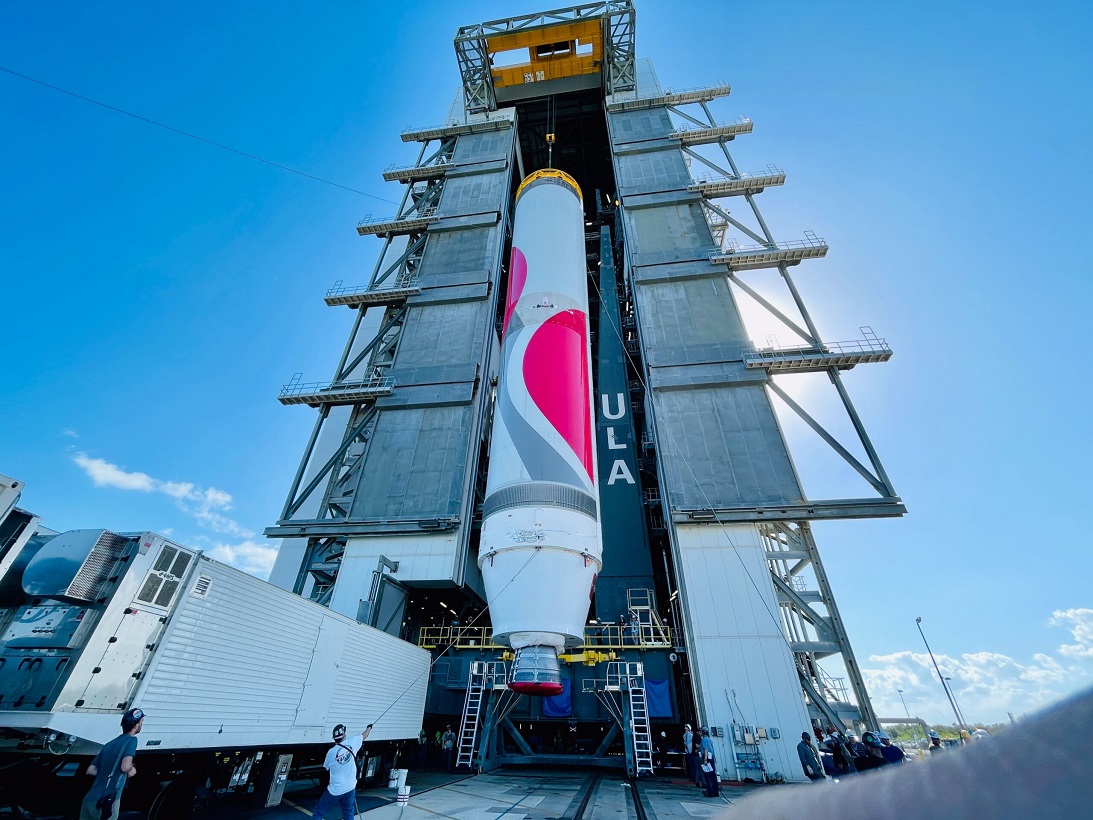
Vulcan's core stage is lifted into a processing facility at Cape Canaveral, Fla., in January.  Image credit United Launch Alliance.

With all of this put together, assuming the Boeing Starliner does get priority over Certification-1, it seems safe to assume that the Vulcan mission will be no earlier than mid to late April.  Eric Berger at Ars Technica says NET May.  The readiness of Peregrine, Starfire, the Vulcan itself, and everything else can push that farther than May.


Tuesday, January 6, 2026

The 10 Biggest Rocket Companies Lists

The annual lists are starting to show up; at least the one at Ars Technica. 

In other years, I've started off with "we know who #1 is; let's look at the rest." That still applies, but if you'll remember New Year's day's post about SpaceX setting yet another world record for successful launches in a year, you might appreciate a little extra. I get the independent daily newsletter Payload, and they included a year by year graphic showing orbital launches for the world since '22. It's on their website. I added a little detail for 2025 that I'm pretty sure is larger in numbers than in prior years, but similar in overall look. I added lines for SpaceX's portion of US launches and a total for China and the rest of the world. 

So let's look at the rest. Ars Technica / Eric Berger Rank them this way:

  1. SpaceX
  2. Blue Origin
  3. Rocket Lab
  4. ULA
  5. Northrop Grumman
  6. Firefly 
  7. Stoke Space 
  8. Relativity Space 
  9. Astra
  10. Phantom Space and Vaya Space 

The source piece also shows their status vs. last year. For example, Blue Origin is up two, switching places with ULA. Instead of just copying what Eric Berger thought, I'm going to inject my own opinions. After all, Top 10 ratings of anything are nothing but an opinion topic.

Rocket Lab (higher than Ars)

My first disagreement with Berger is I make Rocket Lab #2 instead of Blue,  Rocket lab seems to me to have had a better year, with the only drawback to them compared to Blue is that their Electron rocket is for smaller payloads than New Glenn.  Bigger is fine, but New Glenn had two flights and Rocket Lab had 18 missions that were completely successful. Not quite "every other week" (26) but better than New Glenn.  

Rocket Lab has now gone nearly three dozen launches without a failure. The company also continued to make progress on its medium-lift Neutron vehicle, although its debut was ultimately delayed to mid-2026, at least.

Additionally, Rocket Lab continued its ascendance as a spacecraft company. It played a key role in supporting Firefly’s Blue Ghost lander at the beginning of this year, and in November, its two ESCAPADE vehicles were safely switched on after launch, beginning their journey to Mars.

Blue Origin (same as Ars)

Blue Origin had a very good year. They finally got New Glenn off the ground with two successful test flights. Suddenly making the list of "contenders" that they've never been on. The bigger success is probably the second flight that not only successfully made orbit, like the first, but recovered the booster on their recovery drone ship. 

This section would not be complete without copying the joke that Eric Berger stuck in his first paragraph:

This is the biggest mover on the list, leaping from No. 4 on the list to No. 2, and this is, of course, because Jeff Bezos’ company sent Katy Perry into space. (They could have achieved No. 1 had they not brought her back). 

Northrop Grumman (higher than Ars)

This puts Northrop Grumman higher than ULA in my rankings because I think they had a better year. 

Only one other US company had a successful orbital launch in 2025, and it was Northrop Grumman. In April, the company’s Minotaur IV rocket carried a payload into orbit for the National Reconnaissance Office. 

The ding against them is that they're still depending on SpaceX for launches of their Cygnus cargo missions to the ISS because although they're committed to and working on their Antares 330 rocket, it's behind schedule.  Meanwhile, they increased the size of the Cygnus to what they're calling Cygnus XL. 

As an interesting side note, Northrop also provides solid rocket boosters for ULA’s Vulcan rocket and NASA’s Space Launch System (SLS) vehicle.

United Launch Alliance (lower than Ars)

I think that ULA had a disappointing year. They were saying they'd get up to 10 Vulcan missions and had one. 

In late 2024, the company’s CEO, Tory Bruno, told reporters that ULA aimed to launch as many as 20 missions in 2025, with roughly an even split between the legacy Atlas V launcher and Vulcan. Now, it’s likely that ULA will close out 2025 with six flights—five with the Atlas V and just one with the Vulcan rocket that the company is so eager to accelerate into service.

On the one Vulcan flight there was a problem with a solid rocket booster. There's persistent speculation that investigation is what grounded the Vulcan.  

Firefly (same as Ars)

Firefly had a wonderful start to the year. 

The year 2025 started out with a bang—a good one—for Firefly. In January, the company’s Blue Ghost lander launched on a Falcon 9 rocket and subsequently landed on the Moon. This was an extremely impressive achievement, as Firefly became the first private company to complete a fully successful soft landing on the Moon. 

Unfortunately that was their end of success in 2025. They have been working on their Alpha rocket and had one launch that failed to put its payload in orbit. That was in April. In September they were working toward a second launch when the vehicle blew up on the launch pad. Perhaps the fact that Firefly is the contractor working on the Antares 330 launch vehicle for Northrop Grumman is why that vehicle is late.

In the next few places, we're dealing with companies that have no history that I'm familiar with so I'll just leave this section to Eric Berger at Ars. 

Stoke Space 

All I really know about Stoke is some things published about their concepts of a launch vehicle and some neat pictures. They seem well-funded and will probably have a real launch within a year or two.

Relativity Space 

All I really know about them has probably been superceded by now. They were bought by former Google CEO Eric Schmidt and it seemed he was intent on building power stations in space to run AI systems in space.

Astra

They're said to be working on a rocket in the payload range of Rocket Lab's electron, 600kg to LEO.

Phantom Space and Vaya Space 

Unlike the previous two, I've never heard of either one of these. Eric said they're here for only two minor reasons: To do a "Top 10" list, he needed two more, and the two of them are sharing a launch complex, SLC-13, at Cape Canaveral Space Force Station.

Hey, if it's good enough for the big guys in the business, it's good enough for us.

Stoke Space's novel rocket engines for steering thrust without gimballing engines. More info here. Image credit: Stoke Space


Thursday, January 20, 2022

New Rocket Company Aiming for a Holy Grail of Spaceflight

A Washington State company that had been working under the radar and in relative anonymity has decided to go public and announce they're working in pursuit of one of the holy grails of spaceflight: a Single Stage To Orbit (SSTO) space plane.     

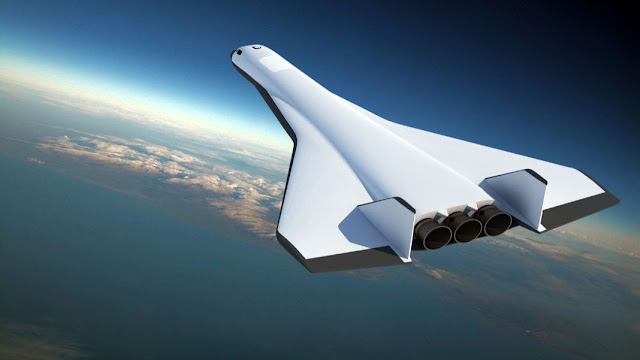
Radian Aerospace concept rendering. 

Radian Aerospace said it is deep into the design of an airplane-like vehicle that could take off from a runway, ignite its rocket engines, spend time in orbit, and then return to Earth and land on a runway.

"We all understand how difficult this is," said Livingston Holder, Radian’s co-founder, chief technology officer, and former head of the Future Space Transportation and X-33 program at Boeing.

If the X-33 program isn't familiar to you, that was a NASA program in the late 1990s that was short lived and never actually flew.  It was envisioned to take off "like a rocket" and land like an airplane, a big difference from Radian's goal.  The X-33 seemed to conceptually be a child of the McDonnell Douglass DC-X, or Delta Clipper- Experimental, a vehicle that achieved flight a few times between 1993 and 1996.  What flew was a 1/3 size scale model and didn't fly to orbit, but did launch, translate (move sideways) and land under power, said to be the first rocket ever to achieve that goal.  Today, the DC-X is referred to as The Rocket That Beat SpaceX by 20 Years - at least there at Amusing Planet. 

Radian's announcement came as the company revealed they had just secured $27.5 million in funding to help them get started, but that won't get anything flying.  Ars Technica reports the company has raised $32 million but didn't specifically say "not including this $27.5" so I'm going to assume it does include it.  The company has 18 employees is Renton, WA.  

During an interview with Ars, Holder and Radian CEO Richard Humphrey explained that they realized it would require significantly more funding to build such an ambitious orbital space plane. Funding will pace their development efforts. For that reason, Humphrey said he was not comfortable putting a date on the company's first test flights but said that Radian was aiming to have an operational capability well before the end of the 2020s.

The current design of Radian One calls for taking up to five people and 5,000 pounds of cargo into orbit. The vehicle would have a down-mass capability of about 10,000 pounds and be powered by three liquid-fueled engines. The idea would be to get as close to airline operations as possible, by flying, landing, re-fueling, and flying again.

It's almost a cliche to say "space is hard" or "orbit is hard."  Neither of those adequately addresses how much harder SSTO is.  The "three liquid-fueled engines" they mention in that second paragraph are reported to exist and I assume that's as at least one full scale prototype, which is claimed to produce 200,000 pounds of thrust.  By comparison, SpaceX's Raptor 2 engine seems to be emerging into production at closer to 500,000 lbs of thrust.  We have heard of individual engines producing 540,000 lbs of thrust during tests. 

The question has come up of whether Starship and its six Raptor engines could achieve orbit without the Super Heavy booster several times on the Lab Padre comment sections.  It has been said the answer is "just barely" but not with enough cargo capability to be worthwhile (and I read "profitable" for that word).   

The article at Ars is worth reading.  All of the principal people at Radian say they understand the difficulties of the road ahead and the backgrounds they list add some believability to the claim.  As I was saying before, the $32 million they've raised so far isn't going to fund a program this ambitious until "well before the end of the 2020s."  I doubt that's a tenth of what they'll need; multiply that $32 million by 30 or more.  Final words to Eric Berger at Ars Technica.

"A long time has passed since the last true attempt at this," Holder said. "The technology has moved forward, and people are willing to fund projects like this."

If Radian can succeed technologically, large markets would likely open. A vehicle like Radian One would be well suited to fly people to commercial space stations in low Earth orbit, which NASA seeks to foster development of by 2030. These planes could also perform Earth observation work and play a role in bringing back space-manufactured goods. There is also the potential for point-to-point travel on Earth.


Tuesday, August 31, 2021

NASA's Space Launch System Slipping Into '22

While not something tied to an explicit announcement, Ars Technica's Eric Berger reports that the first SLS mission has slipped into 2022.  A source told Ars the best-case scenario for launching the Artemis 1 mission is spring of '22, with summer being the more realistic target for a test flight of the heavy lift rocket and Orion spacecraft.  If I may quote myself, “If NASA and Boeing are lucky and there are no more failures that eat months at a time, Artemis-1 might fly by the fall of 2022.”  My reasoning was simple.  The schedule to launch before the end of this year was never changed after their time at Stennis delayed completion of their Green Run test by nine months.  I just added nine months to the announced "before the end of '21" date. 

Publicly, NASA is still saying before the end of '21.  They're also acknowledging the schedule is slipping and the Covid problems are a factor. 

NASA's Kathryn Hambleton acknowledged that the space agency has seen schedule slips. "The agency continues to monitor the rise of COVID cases in the Kennedy area, which, combined with other factors such as weather and first time operations, is impacting our schedule of operations," she said. "Moving step by step, we are progressing toward launch while keeping our team as safe as possible."

There are still many hoops to jump through between where they are now and being able to launch.  For example, earlier this summer, when the vehicle was stacked on the cape, instead of adding the Orion spacecraft, a mass simulator was added.  The mass simulator is for vibration testing of the assembled rocket to ensure they understand the difference between the natural vibrations of the full stack versus those caused by external forces.  Berger adds:

NASA originally hoped to complete this work in July, but Hambleton confirmed to Ars that this vibration, or "modal" testing, is ongoing in the Vehicle Assembly Building at Kennedy Space Center.

"Complete in July" has turned into September - if they can even meet that.  Eric Berger goes into details on several of the tests that need to be completed before launch, so by all means read over there if you're interested.  He also goes into a refresher on the history of the program.

My view is that the program was created as a giveaway to companies that lost their income streams when the Shuttle program was canceled, and since its start I'm not aware of a single milestone they've met and a single budget they haven't overspent.   What NASA needs to get SLS launched before next September is for schedule items to be moving left on the schedules - earlier in time.  Not only have things like this vibration testing slipped right, I don't think in the entire history of the SLS program that anything has moved left on the schedules. 

The launch vehicle stage adapter for NASA’s Space Launch System rocket is integrated with the core stage in June.  NASA Photo from Ars Technica

One of the early proponents of SLS was (of course) Florida Senator Bill Nelson - who is now NASA administrator.  The legislation starting the program was passed in 2010 and SLS was supposed to have flown by 2016.  Nelson said, 

"This rocket is coming in at the cost of what not only what we estimated in the NASA Authorization act, but less,” Nelson said at the time. “The cost of the rocket over a five- to six-year period in the NASA authorization bill was to be no more than $11.5 billion.” Later, he went further, saying, "If we can't do a rocket for $11.5 billion, we ought to close up shop."

Over a decade later, that $11.5 billion has ballooned to over $20 billion and 2016 has transformed to very likely '22.  They can't do a rocket for $11.5 billion and the shop is still open.


Saturday, December 30, 2023

The Top 10 US Launch Companies of '23 - Who Are the Other Nine?

Since this is the time of year when everyone does their take on the best of the previous year, I'll do it again this year.  Last year's piece was on January 2nd, so just after the start of '23, and I'm a little earlier than last year because the piece I'll reference from Ars Technica's Eric Berger was posted earlier than last year's. 

As always, there's more than a little opinion and gut feel here rather than just data, and like last year, chances are everyone would agree the leader by any measure is SpaceX.  Also like last year, for reference and as a common starting point, let me list the other nine in his order.  In the column he devotes a paragraph or two to each of them explaining why he chose them.  To save space, I'll list them here by the ranking and say to go read the original.

2: Rocket Lab
3: ULA
4: Firefly
5: Northrop Grumman
6: Blue Origin
7: Relativity Space
8: ABL Space
9: Stoke Space
10: Virgin Galactic

2:  Rocket Lab 

The rating is the same as I had last year, and I think they had a good year.  They set a new record (10) for launches in a calendar year, and would have had more except for losing the ninth launch of the year and stopping to understand the failure and take whatever corrective actions came up.  They also had some other notable firsts, including opening their first US-based launch site at Wallops Island in Virginia, launching their first hypersonic mission, HASTE, and re-flying a Rutherford rocket engine for the first time as they work toward reusability.

3: Firefly 

Here's my first difference with Ars.  They rank ULA here, while I rank ULA lower.  In September, the Alpha rocket made its first fully successful launch, performing a rapid-response liftoff for US Space Systems Command with the "Victus Nox" mission. That payload was integrated and launched within 27 hours of receiving the launch order.  Eight days ago, Dec. 22, they launched the Fly The Lightning mission for Lockheed Martin, but the second stage failed on its second burn to circularize its orbit.  Still, this is good progress for a launch company.  They're also working with Northrop Grumman to provide engines for Grumman's replacement of their Antares launch vehicle.   

4: Northrop Grumman 

Speaking of Northrop Grumman, the large government contractor launched just a single rocket in 2023—its final Antares 230+ vehicle in August.  While they're working on the Antares 330, they're going to launch their Cygnus cargo containers to the ISS on Falcon 9s through 2024.  At least. 

5:  ULA  

So why do I drop ULA from 3 to 5 compared to Ars Technica?  It's the old axiom of "so what have you done for me lately?"  While they're within two weeks of launching the first Vulcan Centaur, we've heard that before - or something like it.  People used to think "they're expensive, but they're good;" to me, that stops after just the first two words.  Yes, their Atlas V has had a good record over the 20 years it has been flying, but it's a low flight cadence and designed by a different company than the one that's flying them now. To paraphrase Dean Vernon Wormer, "chronically late and over budget is no way to go through life, son." 

6:  Relativity Space 

Relativity, had one launch this year, and like Firefly, the second stage failed.  We can chalk it up to the quote everyone loves to hate, but can't dispute: "space is hard, orbit is harder."  They shelved that Terran 1 rocket and have gone full bore on developing the Terran R, with goals of reusability and more payload to orbit than the Falcon 9.

7: ABL Space

ABL is a hard choice here; they had one launch last January but its flight ended just seconds later after the cutoff of its main engines. This caused the vehicle to crash back onto the launch pad in Alaska.  They have continued work and numerous upgrades have been made to the launch equipment and the first and second stages. Much of the equipment has already been shipped to Alaska for launch.  It's possible we'll see them try again in the first half of the year. 

8:  Blue Origin 

Eric Berger at Ars ranked Blue at #6, so why do I rate Blue below the previous two, who haven't had a successful launch?  Simply because a failure of the second stage in launch is farther along than not having launched at all.  They haven't launched any tourist suborbital flights in over a year, since they had booster failure, but successfully launched that platform with no people on board earlier this month.  Do I have to specifically say they haven't yet launched a New Glenn and that's probably looking like '25.

9: Stoke Space

Now we're soundly in the range of not really a launch company - but they have tested their radically different engines in a test reminiscent of the SpaceX's early Starship hops.  Overall they're doing some interesting things but there's a very challenging road ahead of them.  

10: Virgin Galactic

Last year, Virgin Orbit was the end of the list, but they went bankrupt and then out of business last year.  Virgin Galactic flew their VSS Unity "Space Plane" on suborbital hops six times this year and then said they were going to reduce their launch cadence and focus on development of a successor vehicle.  The next generation spacecraft are due to begin test flights as early as 2025 and theoretically can fly twice per week, with six customers, instead of the three or four passengers Unity is able to carry.  We'll have to see.

Launch of a GPS III Satellite in January of 2023 aboard a Falcon 9  Trevor Mahlmann photo.


Tuesday, July 27, 2021

It Looks Like Bezos Is Going to Try...

Try what?  Last Wednesday, the day after Jeff Bezos' suborbital flight, Eric Berger at Ars Technica wondered aloud if Bezos was still "all-in" on the company's mission and going to try to turn it around,  

So after he returned from his spaceflight on Tuesday, what I most wanted to know is whether Jeff Bezos is all-in on space. He has the vision. He has the money. But at the age of 57, does he have enough years or willingness to ensure Blue Origin’s success? Or will he leave Blue Origin to flounder and instead mostly retire to his half-billion-dollar yacht after a suborbital joyride?

This week, it's (at least) starting to look like he's going to try to save Blue Origin.   

Jeff Bezos published an open letter to NASA Administrator Bill Nelson on Monday morning and offered to pay more than $2 billion to get the agency's Human Landing System program "back on track." In effect, the founder of Blue Origin and world's richest person says he will self-invest in a lunar lander because NASA does not have the money to do so.

NASA's Artemis program aspires to land humans on the Moon by 2024 and establish a sustainable settlement on the surface. As part of this project, the agency is seeking reusable, affordable transportation to the Moon and back. It conducted a competition for a human lander (HLS) and announced in April that it would move forward with SpaceX and its Starship proposal. NASA had wanted two providers for such a lander, but due to low appropriations from Congress, it could afford only one.

At the end of April '20, NASA selected three contractors to begin initial development of lunar landing systems to take astronauts back to the surface of the Moon by 2024.  The three teams and their contracts were the Blue Origin "National Team" of big names in aerospace with a $579 million dollar contract, Dynetics with a $253 million contract, and SpaceX with a $135 million contract. This April, NASA downselected from three to just SpaceX as sole provider of the lunar landing system. They had previously said they were going to select two providers but congress had cut their budget too much.

For the current fiscal year, NASA said it needed $3.3 billion in funding to meet the goal of landing humans on the Moon by 2024. Congress provided just $850 million, and as a result, NASA acknowledged that 2024 was no longer a realistic target.

Within two weeks of that announcement, Blue Origin filed a protest of the contract award to SpaceX; BO described the award as "flawed," adding that NASA "moved the goalposts at the last minute."  We covered here in late May that BO's next tactic was to lobby their local (Washington) US senator, Maria Cantwell  to add $10 billion to NASA's budget to pay for BO's lander.  That almost worked.  The Senate passed the addition, but the House said no, and that tactic seems to have died.  

Eric Berger at Ars Technica points this out:

Blue Origin put together an all-star team for the lander competition, partnering with Lockheed Martin, Northrop Grumman, and Draper. This "National Team" then proposed a three-stage lander that met NASA's specifications for the Artemis program. The problem is that this proposal was expensive and sought about twice as much money as the $2.9 billion award SpaceX received.

In this proposal, Bezos made a critical error. NASA wanted to see companies self-invest in their hardware. The space agency wanted to be a customer for these landers, but not the only customer. "I think they realized it's why they lost," one politically connected source told Ars. "Meaning they did not invest properly." So Bezos' letter offers a mea culpa. [BOLD added: SiG]

The point that nobody mentions when they say, "SpaceX got almost $3 billion from NASA" is that SpaceX told NASA they were investing $6 billion of their own money to get Starship working.  That means that when NASA selected SpaceX they were getting twice as much for their investment, 2 to 1 on their money.  BO's National Team wasn't putting up any of their own money that we know of, so NASA was getting nothing for their money other than what was on the contracts.  

I can't help but think that NASA was thinking of the National Team as the standard "old space" businesses that are running the perennially late and over budget Space Launch System, and went with "New Space" that has time after time been doing things that "they say couldn't be done" at speeds observers are constantly surprised by.  I'd go so far as to say SpaceX gave the impression that the contract was a nice way to develop a version of Starship they intended to develop anyway and, in turn, they'd get some of the knowledge NASA has acquired over the years.  Otherwise they're funding Starship themselves.  

Eric Berger points out that the letter may be more addressed to the in-house readers at BO itself; Bezos is telling them he's back and taking charge.

Multiple sources told Ars that Bezos was really disconnected from Blue Origin in 2020, and that hurt the company. For one thing, the approval rating of Blue Origin Chief Executive Bob Smith is a painfully low 18 percent on Glassdoor.

With this letter, Bezos appears to be acknowledging that it was a mistake not to self-invest in the Human Landing System contract. Moreover, he is taking steps to rectify that mistake. If nothing else, that has to send a positive message to his employees.


Jeff Bezos in blue flight suit and white cowboy hat walks with CEO Bob Smith in the black ball cap after last week's suborbital flight. Joe Raedle/Getty Images 


Sunday, April 9, 2023

About That Centaur Engine Anomaly

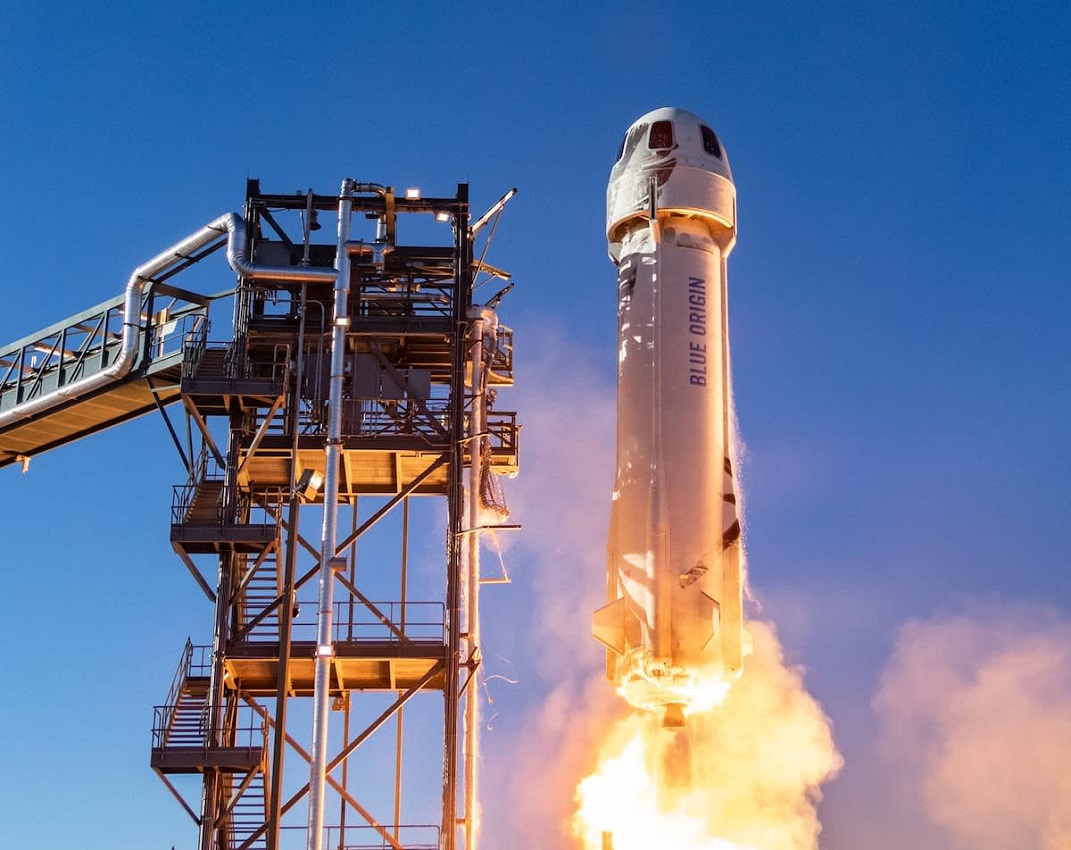
Back on March 31st in one of my small story roundups, I relayed that ULA CEO Tory Bruno had Tweeted that the Vulcan's upper stage suffered "an anomaly" without specifically saying what happened.  In the last couple of days, some interesting things have surfaced.  Perhaps the most interesting is a photograph tweeted by Eric Berger, the space correspondent for Ars Technica, but this is his personal twitter account. This is said to be the "anomaly" but most of us would call that an explosion. Orange cloud to the left.

This picture and a little more information is used in a video from a YouTube channel that I look at a few times a week, Starbase Pink.  When I first ran across the channel, they had a different name (I think it was SpaceX Pink) and used a synthetic female voice.  When they changed to the current format, they dropped the synthesized voice, going to (I assume) the original channel owner.   

Berger originally says the photo shows the anomaly—a fireball of hydrogen igniting—to the left of Blue Origin's rocket engine test stand, but hydrogen is well-known for having a nearly invisible flame.  Flames of that orange-yellow color are associated with coming from organic chemical bonds with higher radiated heat than hydrogen gives. To me, the fact that the fireball is clearly visible looking toward the sun implies that isn't hydrogen, but I'll say it could be from burning something else that was in the vehicle.

Berger and Ars Technica, to their credit, published a more in-depth coverage of all that's known, and that contains things that don't make sense to me as stated.  

"A column of burning, clear hydrogen shot up into a mushroom cloud that dwarfed the test stand," one source said. "Their test article is definitely more than just 'damaged.'"

...

A Blue Origin source confirmed that a mushroom cloud formed from the anomaly. Afterward, United Launch Alliance asked Blue Origin to delete the explosive video footage from the company's computers, which Blue Origin agreed to do.

(Note: After publication of this article, when asked about the video deletion, Bruno tweeted that this "didn't happen." However, two sources told Ars that after the incident, United Launch Alliance asked Blue Origin to "secure" the video for its investigation. Blue Origin did so, but also removed the video from its own internal servers, reserving access only for a few officials at the company).

The whole story is a bit hard to process.  Upper stages called Centaur have been flying since the '60s, but this one is apparently a new version.  Which answers one of the first questions: why are they testing a Centaur -  unless something major has changed (bearing in mind that "because we feel like it" or "we do this on every other engine" are perfectly valid answers).  Bruno has recently said an upper stage called Centaur V would be able to operate for 40 percent longer in flight and has two-and-a-half times more energy than the Centaur upper stage ULA currently flies, but nobody referred to this engine by that name.  Is this a new Blue Origin engine other than the BE-4s powering the first stage of the Vulcan?  Exactly how big an impact is this for the first Vulcan Centaur mission?  Is it using an older, better known engine?

To this observer, it looks like the plans for two launches this year, including one that would lead to US Space Force certification, are either done for the year or hanging on by a thread.


Friday, May 21, 2021

Blue Origin Auctioning First Seat on New Shepard

Recently, Blue Origin announced that they were going to auction off the first seat on their new program of rides for hire that would take passengers to 100 km, above the Kármán line and officially into space, and experience a period of weightlessness.  The current high bid in the auction for the first passenger seat on the New Shepard suborbital mission is $2.8 million.  Two days ago, it had just broke $2 million. 

That's for one seat, out of the six seats on the New Shepard.  That first launch is tentatively set for July 20.  Blue Origin has not said if any of the seats are already assigned, or if Jeff Bezos will be riding with the lucky bidders.  Ars Technica reports:

The unsealed online auction for this seat will continue until June 10. Then, on June 12, the company will hold a live online auction among verified bidders to finally sell the seat. The company said the winning bid amount will be donated to Blue Origin’s foundation, Club for the Future, to inspire future generations to pursue careers in STEM and help invent the future of life in space.

Beyond this auction, Blue Origin has not released pricing for New Shepard flights—either for individual tickets or for an entire mission. However, a well-placed source told Ars that the per-seat price would be "well north" of $500,000 and much closer to $1 million for the first several flights.

To be honest, when I saw they were going to auction seats, I assumed they didn't really know what to charge and did an auction to get an idea of what the first few were willing to pay.  To borrow a term from sales critters, so they don't "leave any money on the table."  I have no idea what those flights cost, so no idea of what the break even cost for a seat would be.   

The current bid above $2 million speaks to the demand for suborbital spaceflight — passengers on New Shepard will experience the thrill of a rocket launch and several minutes of weightlessness—as well as the cachet of flying early in the program.

With New Shepard, Blue Origin will be charging well above the original price, $250,000, that competitor Virgin Galactic charged for seats on its suborbital space plane. This may be partly because New Shepard will go above the Kármán line of 100 km, compared to about 80 km for Virgin Galactic.

It may also be partly because Virgin Galactic's Unity spacecraft isn't flying.  Another article on Ars Technica says Virgin Galactic is troubleshooting an EMI problem (Electromagnetic Interference) that caused the control computers to halt ignition of the engines on their last test flight.  A test flight is currently scheduled for tomorrow, May 22, pending weather and the usual stuff.  It's not likely Virgin Galactic will be flying paying customers until 2022. 


Meanwhile, since the flight of SN15 and talk about re-flying it "soon," operations at SpaceX Boca Chica have been focused on building infrastructure, and building the cranes that will build that infrastructure.  A structure called the Orbital Launch Integration Tower has been the emphasis.  It is currently one tower-like structure on a large concrete base.  A second section was brought to the launch pad area today to stack on top of section one, and there are at least two more sections over near the High Bay. 


The two big cranes have been built and the second (on the right - called Kong by the Lab Padre nerds) was cranked up to that position for the first time today. 


Friday, August 21, 2020

Should NASA Send a SpaceX Dragon Capsule to the Moon?

That's not quite the title of a very worthwhile read from Ars Technica's Eric Berger this week.  His article is, “Could a Dragon spacecraft fly humans to the Moon? It’s complicated” and it's a long piece for Ars Technica but thoroughly worth the time to read.  

Think back three weeks to 8/2 as the Crew Dragon's Demo 2 mission is completing; this is where Berger begins.  

The landing came as NASA, at the direction of Vice President Mike Pence, is working urgently to return humans to the Moon by 2024. This is a herculean task for the agency’s administrator, Jim Bridenstine, who is balancing politics, funding, and technical hurdles to push NASA and its contractors forward.

Immediately after the splashdown and meeting the crew, Bridenstine plugged for the Artemis program, saying, “We have to make sure that another generation doesn’t miss this opportunity. Today was a great victory, but it was just a beginning. The Artemis Program is our sustainable return to the Moon.”  Bridenstine, under the direction of Vice President Pence, is driving toward a hard deadline of returning to the moon “to stay” by 2024 - or the end of the potential second Trump administration.  That's clearly part of the reasons for attacking this as a hard deadline; Moon or Bust.

The short answer to Eric Berger's question is that Crew Dragon could take a crew of three back to the moon with little modification, but it wasn't designed for that mission.  The emphasis appears to come from an op-ed published in the Washington Post on June 22nd, written by Robert Zubrin, founder of the Mars Society and president of Pioneer Astronautics, along with Homer Hickam, author of “Rocket Boys” (became the movie “October Sky,”) a retired NASA astronaut trainer, and spacecraft engineer.  Zubrin and Hickam argue essentially, why wait on the more expensive government vehicles when commercial solutions are already at hand?  They also come across as not being confident the Space Launch System and Orion capsule will be available in time for a 2024 mission.  I have to admit to leaning the same way. 

We recognize the hard work that NASA and its contractors have put forth on Orion/SLS, but they have simply been left behind by more nimble commercial companies. Dragon is not just cheaper than Orion; it is much better, because it is much lighter. The Dragon has a mass of 9.5 tons, compared to Orion’s 26.5 tons. Orion could have been designed lighter, but NASA has received so many conflicting directives from successive administrations — Orion was once required to fly to the asteroid belt! — it ended up with an elephant, not the racehorse it needed.

There are two big advantages to “running with what we got” - probably the biggest two advantages there can be:  money and time.  

The cost comparisons are extraordinary. According to an independent assessment by The Planetary Society, NASA has spent a total of $23.7 billion on development of the Orion spacecraft, which is designed to take up to four astronauts into deep space for 21 days. By comparison, through the Commercial Crew Program, NASA invested just $1.7 billion in Crew Dragon, which has now proven itself.

Then there are the launch vehicles. NASA is approaching a total investment of $20 billion in the Space Launch System rocket, which likely is still 18 months or longer from its first test flight. After this, the rocket is expected to cost at least $2 billion per launch. By contrast, SpaceX paid for the entirety of the Falcon Heavy’s development, and it would likely cost NASA between $150 and $200 million for lunar launch.

The Crew Dragon can carry four astronauts now - the next mission to the ISS will carry a crew of four.  The only issue is that the flight to the moon is longer than the uphill climb to the ISS - and it might be a bit crowded.  Additional storage space for consumables and other necessities (and probably some more elbowroom) are the changes that would have to be made for a version of the Dragon that could go to the moon.  According to an interview in the Ars article, SpaceX actually considered the design of alternate versions of the Dragon spacecraft: Gray Dragon and Red Dragon; both are named for the color of the world they would go to.  The plans might well exist now.

The Falcon Heavy might require tweaks to become man-rated as a booster, but NASA could workaround this by launching the Dragon on a Falcon 9, like they've just done and will do again soon, and rendezvous in space with a much heavier "other half" launched by the Falcon Heavy. 

Certainly, the politics of getting NASA to switch from the SLS/Orion to SpaceX/Dragon is a big deal, too.  Someone referred to the SLS as the Senate Launch System, in reference to Senator Richard Shelby (R) of Alabama and the Huntsville Space Center.  Senator Shelby has pretty much declared that humans must launch to the Moon inside the Orion spacecraft, on top of a Space Launch System rocket.  It's feasible that situations may overwhelm his control. 

Finally, there is the reality that the United States is borrowing heavily to dig itself out of the coronavirus crisis. At some point, belts will have to be tightened. If NASA could have a deep-space exploration program for $4 billion less a year by slashing Orion and the Space Launch System, some politicians may find that appealing.


I believe the vehicles they're comparing to here are the SLS Block 1B Crew and Block 2 Crew.

SpaceX does not have a lunar lander, at least not that I know of.  If they had one, they would have every part of a flight to land a couple of men on the moon Right Now.  I believe if they wanted to do it, they could land on the moon before 2024. 


Saturday, April 30, 2016

SpaceX Has Been Preparing for Mars

It turns out that SpaceX's recent success in sticking the landing of a Falcon 9 on a floating barge is far from the most important R&D they've been doing.  ARS Technica brings an interesting story about how SpaceX has been experimenting with technologies needed for a Mars landing, and been doing it for years. 
In September, 2014, a Falcon 9 rocket blasted off from Florida carrying a Dragon spacecraft bound for the International Space Station. The capsule carried some notable cargo, including the first 3D printer to be tested in space as well as 20 mousetronauts to study muscle loss. Yet the most far-reaching part of that mission came after the Falcon 9 deployed its upper stage and began falling back to Earth.
...
That's because during that launch—and about 10 others since late 2013—SpaceX has quietly been conducting the first flight tests of a technology known as supersonic retro-propulsion—in Mars-like conditions. It did so by firing the Falcon 9's engines at an altitude of 70km down through 40km, which just happens to be where the Earth's thin upper atmosphere can act as a stand-in for the tenuous Martian atmosphere. Therefore, as the Falcon thundered toward Earth through the atmosphere at supersonic speeds and its engines fired in the opposite direction, the company might as well have been trying to land on Mars.

These test flights were classic SpaceX—flying a primary mission, such as delivering cargo to the International Space Station, but also piggybacking other technology demonstration missions on top of it. 
SpaceX was operating in a regime that NASA has virtually no experience in: firing retro rockets to slow a vehicle while it's traveling at supersonic speeds in an atmosphere, thin as that atmosphere may be.  While lots of people have modeled this in CFD (Computational Fluid Dynamics) and run models in wind tunnel simulators, actual experience has been virtually nonexistent.  SpaceX actually started testing this on an early Falcon 9 rocket in 2013.  A year later, they had attracted attention from NASA, who sent a space agency WB-57 airplane and a Navy NP-3D Orion to trail the spacecraft and capture images and thermal data.
Among those eagerly watching the flight tests was Bobby Braun, an aerospace engineer at Georgia Institute of Technology, who has led a joint research effort with SpaceX and NASA to study supersonic retro-propulsion. "I have access to all of that data, and I’ll tell you that it's worked like a charm every time," he told Ars. "The stability was manageable, and while there are still some issues, there are no showstoppers."
Falcon 9 during a supersonic retro-propulsion burn.  From ARS Technica.
Just three months after that September 2014 test flight with government planes collecting data, NASA had seen enough, too. It signed a Space Act Agreement with SpaceX, saying it would provide assistance with deep-space navigation and communications if the company would share its flight data. If NASA were to try to conduct that kind of test on its own, the cost would probably exceed $2.5 billion or $3 billion, Braun said. "It’s a great deal for NASA, in my opinion, and it’s a great deal for SpaceX."
This week SpaceX announced plans to land a Dragon spacecraft on Mars by 2018.  Even if they don't make their two year goal, this would be a monumental achievement for NASA or any other national space agency, let alone a single company, considering the 6,000kg Dragon is nearly an order of magnitude (10x) more massive than anything previously landed on the red planet.  The Dragon capsule's SuperDraco thrusters, part of the launch abort system, are the key to this approach and show another difference between SpaceX and NASA.  Abort systems are something that NASA has ordinarily put on a vehicle and thrown away after a couple of minutes; using it for arguably the most critical part of the mission is another sign of classic SpaceX.   


Saturday, October 27, 2018

It's Looking Like Falcon Heavy Was A Successful Product Launch

Since it was so visible from my backyard, I naturally covered the maiden flight of the Falcon Heavy launch vehicle.  A couple of weeks later, I covered a review of the "heavy lift landscape" on Ars Technica that became one of my top 10 most popular posts. 

I say this so newcomers to the blog know I've been on the story for a while.

This week, ARS Technica reports that the Falcon Heavy seems to have caught on well with its intended customer base.  Part of that, I'm sure, is because (as ARS put it), "The Falcon Heavy is an absurdly low-cost heavy lift rocket". The other part seems to have something to do with the flamboyance of America's Favorite Huckster, Elon Musk, and the first mission which famously flung a Tesla roadster into solar orbit.

It's easy to forget that when the rocket first launched, the critics were saying that the company's Falcon 9 rocket had become powerful enough that it could satisfy the needs of most commercial customers, and that, "The Falcon Heavy is just a vanity project for Elon Musk."  It's as if the critics never expected customers to sign up for the big rocket.
At the time, the rocket only had a couple of launches on its manifest, including the six-ton Arabsat 6A satellite for Arabsat of Saudi Arabia and the Space Test Program-2 mission for the US Air Force. However, since that time SpaceX has seen the rocket certified for national security missions by the US military and has signed several additional launch contracts.

Last week, the Swedish satellite company Ovzon signed a deal for a Falcon Heavy launch as early as late 2020 for a geostationary satellite mission. And just on Thursday, ViaSat announced that it, too, had chosen the Falcon Heavy to launch one of its future ViaSat-3 satellite missions in the 2020 to 2022 timeframe.
Both Ovzon and ViaSat cited the ability of the Falcon Heavy to deliver heavy payloads "direct" - or almost directly - to geostationary orbit.  The Heavy's ability to do that direct-to-geostationary-orbit profile was the hidden meaning of the test flight.  The thing is, it didn't have to be the red Tesla, glitzy launch it became.  NASA was offered a more or less "free" launch if it wanted something delivered into deep space, but they had to follow the mission profile itself, which was a test flight.  That first test flight could have launched another mission for NASA and not the red Tesla/Starman publicity stunt. 
On the day before launch, SpaceX founder Elon Musk explained that the rocket would demonstrate the capability to send payloads directly to geostationary orbit by firing its second stage after a prolonged shutdown during which the rocket would coast. “The six-hour coast is needed for a lot of the big Air Force intel missions for direct injections to GEO,” Musk said. 
The ability to do the six hour coast, about twice as long as the longest coasts the Falcon 9 rocket has ever made, was absolutely not lost on the satellite industry.  It was watched closely, as you'd expect it would be; we are talking millions of dollars in cost impact to these companies, after all.
This turns out to have been a shrewd move. The demonstration flight of the Falcon Heavy apparently convinced not only the military of the rocket's direct-to-geo capability but satellite fleet operators as well. The Falcon Heavy rocket now seems nicely positioned to offer satellite companies relatively low-cost access to orbits they desire, with a minimum of time spent getting there in space.