Wednesday, October 6, 2021

As Starliner Remains Bogged Down, NASA Moves Pair to Crew Dragon

It was rumor yesterday when Ars Technica's space reporter Eric Berger said his sources were telling him the agency was probably going to move crews, who had been dedicated to studying Starliner and working with Boeing, over to SpaceX's Crew Dragon capsule.  

NASA will not make an official announcement for weeks or months, but two sources say the space agency is moving several astronauts from Boeing's Starliner spacecraft onto SpaceX's Crew Dragon vehicle for upcoming missions to the International Space Station.
...
The most likely scenario is that Nicole Mann, Josh Cassada, and Jeanette Epps will now fly on the SpaceX Crew-5 mission, targeted for launch no earlier than August 2022 on a Falcon 9 rocket. They are likely to be joined by an international partner astronaut, probably Japan's Koichi Wakata, for the mission. 

From what I'm able to glean from what was published as rumors, Mann, Cassada and Epps worked as liaisons to Boeing much like Bob Behnken and Doug Hurley worked on Crew Dragon for a couple of years before their historic flight on the flight called Demo2 in May of '20.  Eric Berger notes that Mann has been assigned to the Crew Flight Test for Starliner since August 2018.  

What was rumor yesterday was confirmed by NASA today.  

NASA has reassigned astronauts Nicole Mann and Josh Cassada to the agency’s SpaceX Crew-5 mission to the International Space Station as part of the Commercial Crew Program.

Mann and Cassada will serve as spacecraft commander and pilot, respectively, for the Crew-5 mission. Additional crew members will be announced later.

Crew-5 is expected to launch no earlier than fall 2022 on a Falcon 9 rocket from Launch Complex 39A at NASA’s Kennedy Space Center in Florida. The duo and their crewmates will join an expedition crew aboard station for a long duration stay to conduct science activities for the benefit of humanity and exploration.
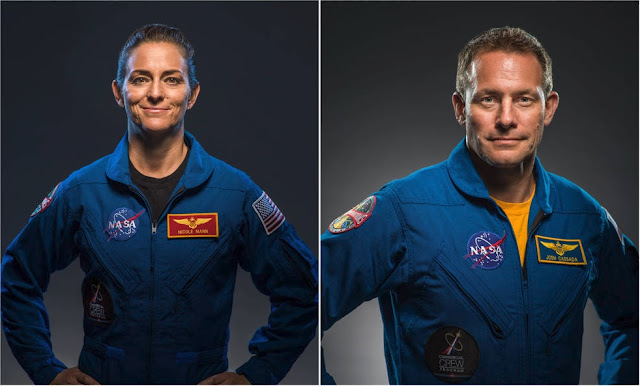
NASA photo.

My first reaction to the announcement was to wonder if this was NASA quietly throwing Starliner out, but I don't quite get to that level.  Boeing, after all is under contract to deliver launch services although they're paying for this repeat of their awful test flight out of their own corporate pockets.  Plus, NASA and the Commercial Crew program have always said they want more than one contractor to fly.  

Instead, it appears that NASA wants to get these rookie astronauts their first chance to fly.  Back to Eric Berger at Ars:

[S]ources suggested to Ars that NASA feels it can no longer wait to get its rookie astronauts—Epps is from the class of 2009, and Mann and Cassada are from the class of 2013—some spaceflight experience.

At the time of her assignment in 2018, Mann's flight was targeted to occur as early as 2019. Since then, however, the Starliner program has suffered a series of setbacks. An initial uncrewed test flight, OFT-1, finally got off the ground in December 2019. However, due to software errors, this vehicle was nearly lost, both shortly after launch and then shortly before reentry into Earth's atmosphere. Because of the vehicle's problems in flight, NASA did not clear Starliner to attempt to dock at the International Space Station, a key objective for the test flight.

The only thing that Eric's sources got wrong was the reference to Jeanette Epps.  She isn't mentioned in that press release from NASA.  That's not to say there isn't something else to get her a first flight sooner than waiting for Starliner to be announced in the future or that there won't be a similar press release within the next week or two.


Tuesday, October 5, 2021

Another Space News Roundup

We don't get a Falcon Heavy launch this month. 

Back in early September, we heard there was to be a Falcon Heavy launch No Earlier Than (NET) October 9th.   

After the Inspiration4 mission, SpaceX needs to reconfigure the pad for a the first Falcon Heavy launch since 2019, carrying the classified USSF-44 mission NET October 9th.  The liftoff time is apparently not publicly available yet.  This mission was initially scheduled for a late-2020 target, gradually slipping to Q1, Q2, Q3, and finally Q4 (October) of 2021.  These were all due to delays from the payload, not the rocket.

The often-delayed payload has been delayed again, and the mission currently doesn't have a declared date, but will be in "early 2022."  Hey, it's only a six month window of uncertainty.  I'd been looking forward to this one but noticed a launch date wasn't appearing in any of the usual places I look.

(Source)

The delay is going to have quite an impact on SpaceX operations at the Kennedy Space Center.  Falcon Heavy launches use Launch Complex 39A.  Regular Falcon 9 missions can use their other pad, LC-40, but they have several missions for LC-39A.  

USSF-44’s latest delay means that SpaceX is now likely to go a full 30 months between Falcon Heavy flights after completing the rocket’s third and most recent launch in June 2019. The slip to “early 2022” also leaves the company with an extremely ambitious launch manifest in the first half of 2022. Barring one or several significant delays, which now seems like the most plausible outcome, SpaceX has four major Falcon Heavy missions – USSF-44, USSF-52, ViaSat-3, and NASA’s Psyche probe – scheduled to launch by August, with three of the four scheduled in H1 2022. A fifth mission – USSF-67 – is scheduled to launch in Q4 2022 and likely on another Falcon Heavy rocket, though the US military has yet to specify the Falcon variant.

Further, requiring the use of the same Kennedy Space Center (KSC) LC-39A pad, SpaceX also has at least six Crew and Cargo Dragon launches scheduled in February (Ax-1), April (Crew-4), May (CRS-25), Q3 (Ax-2), September (CRS-26), and October 2022 (Crew-5). In other words, in Dragon and Falcon Heavy missions alone, SpaceX already has 10-11 launches scheduled in 2022 – all of which require the use of Pad 39A. If SpaceX manages to pull that off on top of a myriad of other commercial and Starlink launches scheduled next year, it will be a feat to remember.


SpaceX Awarded a Contract to launch Italian satellite after Arianespace Vega rocket failed twice in three attempts.   

Over the years of blogging, certain stories tend to lodge in my brain and certain quotes become part of me.  In this case, the story is from July of '18, mainly about how the US launch companies - and SpaceX in particular - were dominating the rest of the world.  The essence of the money quote there was the European Space Agency was a make-work program.  They didn't want to make reusable rockets because it would mean they made fewer jobs. 

Truthfully, if Europe ever did develop a reusable rocket, one that could fly all the missions in a year, this would be unhelpful politically. What would the engine and booster factories sprinkled across Europe do if they built one rocket and then had 11 months off? The member states value the jobs too much. This is one difference between rocket-by-government and rocket-by-billionaire programs.

As I said at the time, "rocket by billionaire"?  How about rocket by private sector that's driven to optimize service for all customers?  But that quote makes it completely understandable why those countries in Europe were not allowed to go to SpaceX for launch services.  Under EU agreements those nations are required to launch domestic satellites and spacecraft on the Ariane 5, Ariane 6, and Italian Vega rockets, "if at all possible."  In this case, it's the Italian Vega rocket that was set to launch the Italian satellite, the COSMO SkyMed CSG-2 Earth observation satellite.  

Weighing around 2.2 tons (~4900 lb), SkyMed CSG-2 is the second of four synthetic aperture radar (SAR) satellites designed to “[observe] Earth from space, meter by meter, day and night, in any weather conditions, to help predict landslides and floods, coordinate relief efforts in case of earthquakes or fires, [and] check crisis areas.” Primarily focused on the Mediterranean, the nature of sun-synchronous orbits (SSOs) nevertheless give SkyMed satellites views of most of the Earth’s surface every day.

In this case, the group responsible for the satellite argued that the delays caused by the rocket problems was going to impact their planned mission and they were allowed to contract with SpaceX.  No launch date has been set. 


Finally, a little story worth noting is that Starship prototype S20 underwent some tests of its flaps late Sunday night/early Monday morning.  While not unusual for Starships, it marks another test for the S20 Booster B4 combination in the move toward the first orbital flight, hopefully before the end of the calendar year.  

(Image source, Mary @bocachicagal for NASA Spaceflight.com)

Cameron County's road closure web site is saying the next road closure is Thursday, October 7, from 5 PM to midnight (CDT) with a beach closure.  While too early to tell, the long closure in the evening hours could conceivably be a static fire of S20.  The cryogenic tests last week were declared successful by Elon Musk on Twitter, so a static fire isn't out of the question and may even be the next step. 


Monday, October 4, 2021

A Deeper Look at That Poll Everyone is Talking About

In the last few days, several of my everyday reads talked about a University of Virginia Center for Politics poll that has been quoted from widely.  This is the poll that gets the national press with the pull quote that conservatives feel it's time for a "national divorce."  Some places just outright say that conservatives want civil war (John Wilder presents two images taken from the Daily Mail and Atlantic magazine).  That's not what the poll says, at least as I read it.

Before I can really talk about what it says, I need to go into how the poll is structured and the answers displayed.  From the UVA site:

From July 22 to Aug. 4, 2021, Project Home Fire worked with InnovateMR, an industry-leading top 20 marketing research data collection firm, to capture online responses to more than 300 questions spanning social, political, and psychological topics from 1,001 Donald Trump presidential election voters and 1,011 Joe Biden voters (N=2,012), with a margin of error of +/- 2.2 percentage points.

Scoring the responses is a bit involved.  The description of how the participants scored their reactions to the questions is here (also from the poll website):

For the statements listed in [this document - edit by SiG], respondents were asked how much they agreed or disagreed with the statement on a 0-100 point scale (0 was categorized as disagreeing completely, 1-25 means strongly disagreeing, 26-50 was disagreeing somewhat, 51-75 was agreeing somewhat, 76-99 was strongly agreeing, and 100 was agreeing completely). So the percentage of people who at least somewhat agreed with the statement selected 51 or above on the scale for the given statement, and the percentage of those who at least strongly agreed selected 76 or above. 

The way the results are shown, then, is there are three tables which they group by their perspectives of how the questions go together.   For example they take the statement “I have come to view elected officials from the [OPPOSITION PARTY] party as presenting a clear and present danger to American democracy.”  is in the left column of the table.  Then the answers are presented as “somewhat agree / strongly agree” with Biden voters in the middle column and Trump voters on the end.  In this example the answers were:  Biden voters said 80% / 51% while Trump voters said 84% / 57%.  

Note that the first (somewhat agree) percentages are 4 points apart.  Those should both be read as + 2.2%.  The high side of 80% with that, 82.2% overlaps with the low side of 84 at 81.8%  Both of their stated numbers are consistent with a result of 82%, which says that we really can't know those numbers are different.  They both could be 82%.  The "strongly agree" numbers (51% Biden vs. 57% Trump) are a bit farther apart, but not too far from both being 54% + 2.2%.  The difference is we can tell those results are different.  Both parties are strongly agreeing that the other guys are “a clear and present danger to American democracy.”

Table 1 concerns items in the big Infrastructure Spending bill we hear about endlessly.

There are some items with large differences, but what struck me was how large the Somewhat Support numbers for Trump voters were on all of them.  Over 80% of responses were somewhat supporting improvements to the electric grid, "modernizing" drinking water, wastewater and storm water systems and then "hard infrastructure" of roads, rail lines, ports, bridges and such.  A big government program of "universal pre-Kindergarten" got virtually 60% support.  There was 74% support for funding rural broadband internet.   All of these Trump voters had some support for these big-government, Democrat programs. 

While it's true Biden voters strongly supported all of these more than Trump voters, these Trump voters don't seem to be fiscal conservatives at all.  They're only slightly closer to ambivalent on "tax the rich" ideas.  The only ideas they don't support are "free" (taxpayer funded) community college and allowing unions to ban right-to-work laws.

Table 2 is an attempt to measure fear and distrust of the other guys.

Some of this was also surprising to me.  While we see tons of leftists on Twitter or other social media acting like they want to kill off all Trump supporters, Trump voters view the elected Democrat officials as more of a clear and present danger to the Republic than the way Biden voters view elected Republicans.  Then again, the way the elected Republicans vote, for the most part, says Biden voters are probably right thinking that the Republicans are not a threat. 

Finally, Table 3 contains the line everyone's talking about.  It's supposed to be determining the commitment to democracy of both groups. 

Both sides think the other side is "radical, immoral" with Trump supporters thinking that more strongly, and both sides think it's the duty of "every true citizen to help eliminate the evil" afflicting the US.  Again, Trump voters more strongly agree. 

The next two surprised and disappointed me. Both groups said we should have a stronger President, both sides had 45% "somewhat support" of the idea that it would be better if the president could do more without having to deal with congress or the courts.  That's another example of both groups being almost identical. 

82% of Trump voters somewhat support a stronger president.  That got 62% of Biden voters' somewhat support.  Both this and the previous question imply changing or getting rid of the constitutional balance of powers . 

Finally, the one everyone is jumping on, only 25% of Trump voters strongly support the Red/Blue states seceding from the union, which isn't much, but a smaller percentage of Biden voters say the same thing.  Because it's more than 50%, the somewhat support number of Trump voters caught everyone's attention, but "somewhat" supporting secession is a long way from working for it to happen.  It's the difference between saying, "someone ought to do something" and stepping up to do it yourself.

If it's not clear, I see this poll as showing the two groups as more similar than different. 


Sunday, October 3, 2021

Do You Need Proof They're Following Modern Monetary Theory?

Thanks to Francis Porretto at Liberty's Torch, there's no need to speculate that the Evil Party has fallen completely for Modern Monetary Theory.  Francis links to Breitbart, with this summary:

On Thursday’s broadcast of CNN’s “OutFront,” House Budget Committee Chairman John Yarmuth (D-KY) said that $3.5 trillion in spending under the reconciliation bill “is pretty inconsequential when you consider all the benefits to the American people,” and “The federal government can afford anything that it feels it needs to do.”

Yarmuth said Sen. Joe Manchin (D-WV) “has no understanding of how the federal government monetary system works. When he compared it yesterday to his household income, that has no relevance to what we can do. It’s not a question of what we can afford. The federal government can afford anything that it feels it needs to do. And right now, that’s what we ought to be focused on.”

Francis also includes a 32 second long video that you might want to watch (either at his place or here) but that's the complete transcript of what the congress critter said. 

The words to focus on the are the two sentences before the last one: “It’s not a question of what we can afford. The federal government can afford anything that it feels it needs to do.”  [Bold added: SiG]  That's almost the definition of MMT.  In the very first post I wrote on MMT, back in January of '19, I borrowed a quote that later turned out to be a common MMT refrain.  The quote was that football referees can't run out of points, with the implication that therefore the government can't run out of money.  No, they never really explained the connection.  MMT theorists say: 

Because the first three of those statements refer to things that aren't real, the hidden message is that dollars aren't real.  To me, this tweet raises the perpetual question of, "are they really that stupid or do they just think we are?"

  • The carpenter can run out of inches of wood, or inches of anything that is used to create real things.  The word "inches" means nothing without adding inches, "of what."
  • Stadiums don't give out points.  Teams get them from following rules.  The stadium can run out of seats, food, and anything real they sell.  If a stadium put points on the scoreboards the teams didn't score, they'd be sued out of business.  No team would want to play there and no league would allow it.
  • The airline can run out of Frequent Flier miles that they can redeem: they can run out of seats to put passengers in. 
  • The US can run out of dollars if we want them to be worth something. 

Bill Mitchell, an Australian economist, is supposed to be the creator of MMT, but the name we see in the most in the US is that Dr. Stephanie Kelton, who was Bernie Sanders' senior economic advisor in the '19 presidential campaign.  She argues the government can create all the money it wants.  

Sometimes I think Dr. Kelton really came up with a good scam.  There must be books out there, public appearances for her and the other MMT acolytes so they can rack in the wheelbarrows full of money from the Democrat apparatchiks and do something with it before it becomes worthless.  Down through history, there has always been profit in telling the king he can do whatever he wants; Dr. Kelton is simply this year’s royal advisor.  Does she really believe it or is she simply telling people what they want to hear?  I have no way of knowing. 

The answer to Rep Yarmoth, as many people have said, is why do you tax us, then?  If you can create the money to do anything you want, then deficits don't matter, so why collect taxes?  Why not just make up every penny you spend rather than just what the unbelievers call the "deficit spending"?  Saying you need to collect some tax but can create the rest out of thin air implies you don’t really believe “The federal government can afford anything that it feels it needs to do.”   You're not a True Believer in MMT, you're a heretic.

Maybe there's hope for you.


Saturday, October 2, 2021

This Week's Update on the 1 by 1 - part 9

My last update on the 1 by 1 was September 12th, Sunday, the day before I tore the end off my right index finger.  Personally, I've always puzzled over why Friday the 13th is considered the bad luck day in a society that regularly does jokes about how badly Mondays suck while Fridays are the wonderful day.  Yeah, I know about the Friday the 13th superstition dating back to before the modern work week, but I figured by now somebody would propose Monday the 13th as being worse.  It will be for me.  

I had the stitches taken out yesterday (10/1) and have been working toward setting up to resume work on the crankshaft since last week.  I'd say the finger looks butt ugly, but that's an insult to butts everywhere.  I've never seen a butt that ugly.  It's more numb than painful, and I'm re-learning to type on it as I type this up.

Last week, I mentioned trying to come up with a way to cut what I called the Terry Thomas cutter - one with a gap in the middle - by ordering a smaller carbide bit and using diamond files to cut the slot.  I found and ordered a couple of smaller bits.  Very fortuitously, I received an email out of the blue recommending a video by machinist Joe Pieczynski.  It's a 18 minute video, so only machinists need watch it, but he makes a cutting bit with a wider gap in the middle, not a slot but a rounded area.  Since I didn't think to ask for permission, I won't use the emailer's name, but if you're still reading, thanks again!  That video is how the cutter was born.  

It looks a little raggedy-ass, but all that matters is the two cutting edges are smaller and I get the benefit of the Terry Thomas cutter.  The relieved area was made using a Dremel-type handheld grinder (actually a Foredom Flex Shaft cutter) and a diamond dentist's bit. 

After this, I positioned it in a tool holder so that it was touching the metal at the same machine settings as the other tools I was going to use. 

I used Joe Joe Pieczynski's method, using my parting tool to remove deep cuts in the stock, which leaves ribs between the channels the parting tool makes, and then use the cutter I modified to sweep back and forth reducing those to the desired constant diameter.  This screen capture from Joe's video shows what it looks like after using the parting tool.

After the cleanup with the relieved cutter, all I needed to do was some final sizing on the length and  diameter of that round piece of the bar you see.

And after a two week interruption, this step is just about finished.  The width is right (0.438) but the diameter is about .002 over - intentionally.  I'll put down some paper under the part to catch any grit and run a strip of sand paper over that.  It should be "Done" done tomorrow.  

Everything I've been doing so far is to make the bottom piece in this view of the crankshaft.  The next step is that most of the upper half of the rectangular bar (in the photo above) gets cut off.  That area that I've been working on  will end up 1.113" wide.  I'll use the bandsaw to cut away most of the bar. 


Friday, October 1, 2021

Senate Confirms Domestic Terrorist to Head BLM

That's the BLM that stands for the Bureau of Land Management, part of the US Department of the Interior, not the protesters from Burn, Loot, Murder.  

By a vote of 50-45 the Senate confirmed Tracy Stone-Manning to be the new director of the Bureau of Land Management.  Tracy Stone-Manning was a declared sympathizer and member of the radical eco-terrorist group Earth First! and admitted to retyping and sending a letter warning the U.S. Forest Service of a tree spiking in Idaho.

According to a 2002 FBI document

Disaffected environmentalists, in 1980, formed a radical group called "Earth First!" and engaged in a series of protests and civil disobedience events. In 1984, however, members introduced "tree spiking" (insertion of metal or ceramic spikes in trees in an effort to damage saws) as a tactic to thwart logging.

The purpose of tree spiking isn't to save trees by its own action but to strike fear and terror in the hearts of loggers and the companies that hire them.  When a large chain saw hits the metal or ceramic spike (to avoid metal detectors) the chain saw could conceivably kill the lumberjack.  At the time of the tree spiking, Stone-Manning was an active member of Earth First! and was described as “extremely anti-government.”  Is it ironic she's now in charge of the organization overseeing what she was protesting?  Or is it just switching to a more effective way to get what she wants?  

PJ Media links to AZ Central: for this part of the story:

Former Forest Service Special Agent Michael Merkley, the lead agent on the tree-spiking case, wrote to members of the U.S. Senate Energy and Natural Resources Committee informing them that Stone-Manning was not only “an active member of the original group that planned the spiking to the Post Office Timber Sale Trees,” but that she was “vulgar, antagonistic, and extremely anti-government,” only choosing to cooperate after she was informed that she could face charges if she did not comply with the orders of a federal grand jury.

Stone-Manning also lied during her confirmation hearing, according to GOP Senator John Barrasso.

“This investigator has confirmed what I have been saying,” said Barrasso. “Tracy Stone-Manning collaborated with eco-terrorists who had booby trapped trees with metal spikes. She mailed the threatening letter for them and she was part of the cover up. She did not cooperate with investigators until she was caught.

“Tracy Stone-Manning lied to the Senate Energy and Natural Resources Committee by claiming the tree spiking was ‘alleged’ and that she was never investigated. Now, we have confirmation that neither of those things are true. President Biden must withdraw her nomination.”

The radical 95% of the Biden administration gets a favor and the groups who helped get the election defrauded Biden elected get payback.  Her nomination was opposed by two past BLM directors, including Barack Obama’s BLM chief Bob Abbey, and George W Bush's BLM head, Jim Caswell.

PJ Media author Rick Moran sums it up this way:

With questionable integrity, radical views (she said the U.S. would do well to follow Communist China’s population control measures), and a dismissive attitude toward other points of view, what is Tracy Stone-Manning doing anywhere near an office of any federal agency?

You know the answer.  This is the way the swamp works, the way the Ruling Class rubs their power in our faces. 

Tracy Stone-Manning AP Photo/Alex Brandon 


Confidential to Florida Men: Don't Try This at Home

A Florida Man story that Mrs. Graybeard shared with me this morning. 

It worked out well, but as you see, the "professionals" are pretty adamant about not trying this at home.  He did it all wrong.  The fact that it worked out doesn't matter.

I think the common version is, "if it seems stupid but it works, it isn't stupid." I just don't think I'd be trying this.


Thursday, September 30, 2021

Blue Origin's "Toxic" Work Culture

This week's Rocket Report from Ars Technica includes a shocking story about Blue Origin.  In the wake of BO's lawsuits against SpaceX and NASA for having the gall to award a contract to someone besides Blue, Alexandra Abrams, Former Head of Blue Origin Employee Communications, and 20 other current and former employees signed on to a document about the company's culture, citing safety concerns, sexist attitudes, and a "lack of commitment to the planet's future."  

The statement is published on a website called Lioness.co and shows as a nine minute read.  It's called "Bezos wants to create a better future in space.  His company Blue Origin is stuck in a Toxic Past.

"In our experience, Blue Origin’s culture sits on a foundation that ignores the plight of our planet, turns a blind eye to sexism, is not sufficiently attuned to safety concerns, and silences those who seek to correct wrongs," the essay authors write. "That’s not the world we should be creating here on Earth, and certainly not as our springboard to a better one."

The only employee willing to publicly link their name to it is Alexandra Abrams.  Ms. Abrams led employee communications for the company until she was terminated in 2019.  The other employees are bit harder to summarize and I see no indication of a breakdown of the numbers between current and former employees.  

The article has all the subtlety of a punch in the face.  In one place, they say:

Former and current employees have had experiences they could only describe as dehumanizing, and are terrified of the potential consequences for speaking out against the wealthiest man on the planet. Others have experienced periods of suicidal thoughts after having their passion for space manipulated in such a toxic environment. One senior program leader with decades in the aerospace and defense industry said working at Blue Origin was the worst experience of her life. 

Many of the essay's authors said they would not feel safe flying on a Blue Origin vehicle. And the anecdotes of sexism and an unhealthy work culture are vivid.  

While I'm sympathetic to the complaints, parts of this don't sit well with me.  The two areas they talk about the most are sexism and environmentalism.  They focus a lot on Blue not doing enough to "save the planet" now and have the air of "with all of Bezos' money, why doesn't he spend that money to be greener?"  For example,

...The company proclaims it will build a better world because we’re well on our way to ruining this one, yet none of us has seen Blue Origin establish any concrete plans to become carbon neutral or significantly reduce its large environmental footprint.

Jeff Bezos has made splashy announcements and donations to climate justice groups, but “benefiting Earth” starts in one’s own backyard. In our experience, environmental concerns have never been a priority at Blue Origin. Time and again we saw new capabilities added to the Kent factory, but not until the machinery showed up did the company begin to consider the environmental impact, including whether a permit was needed to manage the waste products.

For years employees have raised environmental concerns at company town halls, but these have been largely left unaddressed. The company headquarters that opened in 2020 is not a LEED-certified building and was built on wetlands that were drained for construction. Eventually the surrounding roads had to be elevated to mitigate the severe flooding that ensued. We did not see sustainability, climate change, or climate justice influencing Blue Origin’s decision-making process or company culture.

I'm going to ignore the "carbon neutral" matador's cape (don't get me started...), but that last paragraph may have merit, and I agree completely that "benefiting Earth begins in one's own backyard." 

The 35,000 foot view is that there are always going to be people who aren't happy where they work, and we are talking about 21 people signing onto this out of 3600 employees.  From the outside, and without extensive interviews, how can we know how widespread this dissatisfaction is?  This is where Eric Berger, writing at Ars, has the advantage of having insider sources who work there that he can talk with; as sort of a sanity check.  

Although it is clear the essay was a product of disgruntled workers, these sources agreed that there were elements of truth in the essay. For these sources, the withering criticism of Blue Origin founder Jeff Bezos, and his hand-picked chief executive, Bob Smith, rang especially true.

Mrs. Graybeard spent her entire career being the "First Woman Whatever" wherever she worked; from working on power supplies at an electronics manufacturer to working on the Space Shuttles.  Suffice it to say I've heard stories similar to the ones they cite in the Lioness article many times.  Yes, it's a shame the work environment isn't perfect, but expecting perfection will always lead to disappointment.  

After publication, Blue Origin sent a statement to Lioness that appears at the end of the piece. 

Ms. Abrams was dismissed for cause two years ago after repeated warnings for issues involving federal export control regulations. Blue Origin has no tolerance for discrimination or harassment of any kind. We provide numerous avenues for employees, including a 24/7 anonymous hotline, and will promptly investigate any new claims of misconduct. We stand by our safety record and believe that New Shepard is the safest space vehicle ever designed or built.

Eric Berger asked for her response to the response.

Abrams told Ars that she never received any warnings, verbal or written, from management regarding issues involving federal export control regulations. She has long weighed going public with this letter, she said, knowing it would open her up to expansive litigation. "They can come after me for as much money as they deem appropriate," she said.

The most likely result of this is that it's going to tarnish Blue Origin's reputation just a bit more.  The company has developed a reputation for being a bit too lawsuit happy in the wake of suing NASA.  CEO Bob Smith is already not well-regarded, but is still in his office.  He's probably not going to get in trouble due to this piece.  Ultimately, if anyone is to care enough to try to fix this, the corporate culture change has to come down from the top.  It's Bezos' baby to fix.


Wednesday, September 29, 2021

SpaceX Starlink Satellites and Unintended Consequences

A second unintended consequence.  The first was that they interfere with a lot of astrophotography by being high enough to be illuminated in the first and last hour or so of night on the surface and therefore bright enough to show up as streaks in pictures taken of the night sky.  

This unintended consequence is that they can be used as an approximation to the Global Positioning System satellites, allowing position determination to within about 8m (26 feet).  For contrast, GPS accuracy is generally between 0.3 and 5m.  The story is about a couple of researchers from Ohio State University and published in the OSU News.  I got the tip via Ars Technica who printed a bit more details.   

This technology won't replace your smartphone's map application any time soon, and this initial experiment apparently required 13 minutes of tracking six Starlink satellites to pinpoint a location on Earth. But researchers were able to achieve the locational feat without any help from SpaceX, and they say the test proves the method could be used for navigation.

"The researchers did not need assistance from SpaceX to use the satellite signals, and they emphasized that they had no access to the actual data being sent through the satellites—only to information related to the satellite's location and movement," an Ohio State News article said.

"We eavesdropped on the signal, and then we designed sophisticated algorithms to pinpoint our location, and we showed that it works with great accuracy," Zak Kassas, the director of CARMEN (Center for Automated Vehicle Research with Multimodal AssurEd Navigation), a US Department of Transportation-funded center at Ohio State University, said in the article. "And even though Starlink wasn't designed for navigation purposes, we showed that it was possible to learn parts of the system well enough to use it for navigation."

The main reason this isn't going to replace your smartphones' app is that the Starlink satellites don't transmit in or even near the same frequency band as the GPS satellites.  GPS uses a couple of frequencies near 1.5GHz, specifically 1227.6 and 1575.42 MHz, both of which are close to 1700 and 1900 MHz where a couple of very heavily-used cellphone bands are located.  Starlink uses a band quite a bit higher in frequency, called Ku ("Kay-you") band.  The serendipity of having been able to add GPS reception relatively easily won't extend to adding Ku band and Starlink.  

During the experiment, "a stationary National Instruments (NI) universal software radio peripheral (USRP) 2945R was equipped with a consumer-grade Ku antenna and low-noise block downconverter (LNB) to receive Starlink signals in the Ku-band," they wrote. "The sampling bandwidth was set to 2.5 MHz and the carrier frequency was set to 11.325 GHz, which is one of the Starlink downlink frequencies."

The researchers recorded Starlink signals for 800 seconds, or about 13.3 minutes. "During this period, a total of six Starlink SVs transmitting at 11.325 GHz passed over the receiver, one at a time," they wrote. Researchers stored samples of the Ku signals "for off-line processing."

The Big Idea here is what's called Signals of Opportunity, in which any signals from known sources can be used for navigation.  SpaceX has launched over 1700 satellites but has talked about putting up over 40,000.  Far, far more than the GPS constellation. By then there will always be Starlink satellites available and the algorithms should get improved accuracy,

..."Signals from LEO Space Vehicles are received with higher power compared to medium Earth orbit (MEO) where GNSS [Global Navigation Satellite System] SVs reside. Moreover, LEO SVs are more abundant than GNSS SVs to make up for the reduced footprint, and their signals are spatially and spectrally diverse."

Another advantage of LEO satellites is that "they do not require additional, costly services or infrastructure from the broadband provider."...


Conceptual illustration of a small portion of the Starlink constellation.  Illustration from Getty Images

The work was done as a collaboration between Ohio State and University of California at Irvine, and was funded by grants from the US Office of Naval Research, the National Science Foundation, and the Department of Transportation.  Their paper is titled The First Carrier Phase Tracking and Positioning Results with Starlink LEO Satellite Signals and was published last week in the journal IEEE Transactions on Aerospace and Electronic Systems.   There's much more at Ars Technica.


Tuesday, September 28, 2021

Starship 20 Gets First Cryo Tests, Loses Some Tiles

Last night, Starship S20 had its first ever cryogenic testing, seemingly passing except for the loss of some Thermal Protection System (TPS) tiles around the cold gas Reaction Control System (RCS) thrusters and the header tank in the nose area.  It was the first time S20 has been put through any of the common tests done to other Starships.  

Effectively SpaceX’s first Starship or Super Heavy test of any kind in more than two months, it thankfully didn’t take long for things to get interesting. Before the pad had even been cleared of the last few remaining workers, Starship S20 violently shed a good dozen or so fragile heat shield tiles. CEO Elon Musk quickly confirmed speculation that Starship S20 had effectively jetted the tiles off its nose during a brief test of high-pressure cold gas maneuvering thrusters, coincidentally around the same time as SpaceX began to pressurize the rocket for its first tests.

A view later into the test, venting supercold gas from a vent which looks to be on the Liquid Oxygen (LOX) tank.  (Image from @bocachicagal, NASASpaceflight.com)  It was still daylight at the start of the test was when the TPS tiles fell off.

(Image credit to Nic Ansuini via Twitter.  Some photo processing to increase brightness and add the red circles where tiles are missing by me, SiG)

If you remember the loss of space shuttle Columbia with all of the crew on board, losing tiles might make you twitch a bit.  Losing TPS tiles can be serious, but it wasn't at all unexpected.  There have been only two vehicles to date that used non-ablative heat shields in the form of ceramic of tiles: the Space Shuttles and the Russian/Soviet Buran. You can essentially see in Nic Ansuini's picture that a large majority of the tiles on S20 are the same size hexagons.  The only exception seems to be on flaps/wings, the edge of one is visible in the bottom middle of the vehicle picture.  The tiles on a Shuttle were generally different sizes and different shapes, glued into place.  It was a much more "one of a kind" approach to creating a space vehicle rather than the vision for Starship of producing hundreds or thousands of identical vehicles. 

Going into what was believed to be Starship S20’s first ambient-temperature pressure test and cryogenic proof test, the loss of some heat shield tiles was almost universally expected. In a structure as large as Starship, even just the thermal contraction of steel at supercool temperatures (and expansion as it warms back up) could change the rocket’s diameter an inch or so, potentially causing tiles to scrape or press against each other. About the size of a dinner plate and the thickness of an average paperback book, Starship’s ceramic heat shield tiles have proven to be very fragile, with dozens routinely chipping, cracking, and shattering during and after installation on Ship 20.

One unique (and no less unproven) aspect of Starship is SpaceX’s decision to mount its heat shield directly to the thin steel propellant tanks and skin that make up the rocket’s entire airframe. SpaceX’s first stab at the problem involves studs/pins welded – by robot – directly to the exterior of Starship’s tanks and skin. By embedding small metal plates inside each cast tile, they can be easily installed by aligning the tile and pressing it against each set of three barb-like pins, which then irreversibly lock in place. Over most of Starship’s hull, SpaceX then tacks on blankets of off-the-shelf ceramic wool insulation before tiles are installed on top of that steel and blanket sandwich. Compared to the Space Shuttle and Russia’s Buran, ... Starship’s thermal protection system (TPS) is incredibly simple. Of course, the challenges imposed on heat shields by mechanical stresses during launch/landing, orbital reentry, and a need for rapid reusability are anything but simple.

The roads in Boca Chica were closed briefly tonight (so far).  Although they reserved road closures from 3 PM to midnight tonight, the road was closed at 5:30 PM and reopened at 6:38 PM.  Without a clear message from SpaceX that last night's test was successful, we can't be sure if that was the case or if they decided to rebuild something (or things) and test again.   


Monday, September 27, 2021

You Keep Using That Word...

Everybody can complete the Princess Bride meme, right?  "But I don't think it means what you think it means."  

In this case, it's the Evil Party line that their so-called $3.5 trillion spending plan (people who have analyzed it say it's more like $5 trillion) will really cost zero dollars.

(From Forbes on Twitter)

As if to underline for emphasis, the president tweeted the claim that “My Build Back Better Agenda costs zero dollars”  by saying, 

Instead of wasting money on tax breaks, loopholes, and tax evasion for big corporations and the wealthy, we can make a once-in-a-generation investment in working America.

And it adds zero dollars to the national debt.

Sorry, pudding-for-brains, but the term for paying for programs by taxing everyone is "revenue neutral" not "costs zero dollars."  Have you been listening to those Modern Monetary Theory idiots again? 

Of course, when they start a propaganda campaign, they push the same message everywhere possible, and within a little while Congress Critter Pramila Jayapal said that “This is a zero-dollar bill because it's all going to be paid for with taxes on the wealthiest corporations and the wealthiest individuals.”  Brad Polumbo from FEE responded this way

I would just add that what they're saying about only the most wealthy people paying for these programs is proven to be impossible.  When they tax corporations, those taxes will paid by two groups of people: (1) the people who buy their products and (2) the employees.  This has been studied literally more times than I can count.  Corporations don't have any revenues except for what they sell.  They can cover the expected tax expense by either adding that expense to the cost of their products or by cutting expenses in the company.  This has been shown to usually result in lower pay and benefits for employees.  In other words, corporations don't pay tax, they collect tax and send it in.    

As for taxing the wealthiest, I've written volumes on this but it comes down to a couple of things.  Most importantly, this bill is going to cost $3.5 trillion and if they confiscated, not taxed, the entire net worth of the 20 richest billionaires in America, they'd get $ 1.077 trillion.  There's not enough billionaires below that number to add up to what they need.

Like I say, over the years I've written not just inches of text on this subject, but yards of text.  One of my favorite ideas to show how absurd the socialists are was to point out that they view the rich as Scrooge McDuck swimming in his pool of gold coins.  It's a cartoon, OK?  There are no pools of gold coins.  The vast majority of the wealth of these people is in properties they own, like Jeff Bezos' Amazon stock or Mark Zuckerberg's Facebook stock, and I'm sure their advisors have diversified them, like Bill Gates advisors have by buying up land.  All of these are things that would collapse in value if they flooded the market with it to sell in order to pay a new tax bill. 

Years ago, David Stockman, who of course was Reagan's budget chief, said,

The income tax has been slashed so many times since 1981 that it’s no longer a broad based societal tax; it’s a kind of luxury tax on upper income salary earners and the small share of households which garner most of the capital income from dividends, interest payments and capital gains…

The only conclusion that stands up to reason is that if they really want to pass something this big that's revenue neutral, the taxes have to extend all the way down the income ladder.  Yes, they'll get more tax money from the wealthy, just like they do now.  I haven't seen any accurate numbers on this for a while, but a few years ago, I pointed out things like the lowest 50% of incomes pay 3% of all tax revenue, and the top 3% of U.S. taxpayers paid practically 90% of all taxes.  The top 1 percent paid a greater share of individual income taxes (37.3 percent) than the bottom 90 percent combined (30.5 percent).  The numbers of taxpayers paying most of the income tax become shockingly small. The top 0.1% of income tax payers, who paid more than the bottom 70% of the population combined, is just 1409 taxpayers.  Those 1409 people paid more than 98.7 million other taxpayers. 

If you know people who think that taxing corporations is a good idea, remind them they'll be paying those taxes themselves.  At the (probably) bogus $3.5 trillion cost, that works out to $24,000 per taxpayer.  If it's really the $5 trillion analyzed that bumps it up to $38,000 per taxpayer.  Like all tax and spend programs, it's going to hurt everyone, and some will be hurt more than others.  


Sunday, September 26, 2021

Trending Back Toward Normal

Or at least as normal as I get.  

A followup to my missed time last week due to my finger injury.  On Friday, I had an appointment with the hand surgeon, and while she didn't take out the stitches (I have another appointment next Friday), she said it was healing well and cleared me to start resuming more normal life. No more instructions to keep it dry, showering without my finger in a plastic bag is fine, just don't immerse it in water and leave it there. The pain is much better, and I think the last time I took even a Tylenol was last Wednesday night.  Yeah, it hurts if I bump it on something, but that's a little less true every day or even every hour.

Last night, I picked up a guitar for the first time since the injury.  All I really need my right index finger for is holding the pick and I found the pick drifted to my middle finger and thumb with no conscious thought at all.  I almost wondered if I usually played that way.  This morning, I took my first bike ride.  Until Friday, my orders were to keep it dry and when I asked her about riding, she said something like, "how about just walking for a week?"  Sure, I can do that.

Friday after the appointment, I spent a little time getting the lathe set up to resume working.  I set up three tools and, yes, I ran the lathe a little.  In a discussion on a machinist's forum about making a crankshaft like this, a guy posted pictures of his lathe with a crankshaft in the process of being made and an interesting looking tool he created to do most of the difficult stock removal.  Since I don't have permission to post his photo, let me show you a similar tool I was using on my lathe.

This is a square nose cutter like the one he started with, but there are a few differences between mine and his.  First, mine is 3/8" wide and his is 1/4" wide.  The gap that the cutter goes into is going to be 0.438, and the advantage of the smaller cutter is that it can be swept side to side easier than the bigger one.  Something he did that he said made a difference was to put a gap in the middle of the square cutting edge.  His theory is that it reduces any tendency to cut differently across the front of the tool.  

I've taken to calling this a Terry Thomas cutter, but maybe that only works for those of us old enough to remember the British Comedian from various movies and TV shows in the 1960s. 

He ground his tool out of steel, while this one is carbide, and relieved the sides a little to be doubly sure the sides of the tool don't cut the sides of that gap.  I considered trying to grind a tool, but there's the matter of having somewhat less than 10 fully functioning fingers and if I'm going to do something that requires intricate dexterity, that might not be the best choice in the world - at least not now.  My knowledge of grinding cutting tools is very limited.  I know that it's something people do and I've taken a few baby steps at trying to learn how to do that, but I really don't feel like it's something I can easily do.

What I thought I'd do is try to find a 1/4" carbide cutter like the 3/8 one I have and use the diamond files I have to give it the Terry Thomas gap in the middle. 


Saturday, September 25, 2021

SpaceX Installs "Mechazilla Claw" On Launch Tower

A couple of months ago, as Starship and Super Heavy began to come together, the company let on that there had been some changes in their approach to the design.  The essence of the decision is that in the quantities they're going to build these in, considering their goal to transport people and cargo to Mars in sufficient quantity to bootstrap a civilization there, it's always better to move infrastructure to the ground support and off the ships. 

Every Starship prototype we've seen fly has been fueled through its base, and you probably have seen concept drawings of Starships refueling on orbit, attached butt to butt (base to base if you prefer).  Within the last few months, the drawings showed the two Starships switched to belly to belly orientation, and the fueling port moved to the lower side of Starship.  

Later on, in an interview and tweets, it became clear that the move away from longstanding ship-to-booster umbilical plans was part of CEO Elon Musk’s latest crusade: moving parts and complexity from Starship and Super Heavy to the launch pad at any cost. As a result, rather than adding a little extra weight to Super Heavy and likely reducing total payload to orbit by a percent or two for an extremely simple, protecting umbilical solution, SpaceX would instead have to implement a massive swinging arm that would reach out from Starship’s launch tower to connect it to pad systems.

The start of adding the capability of fueling the Starships was the addition of the base of the quick disconnect (QD) arm that was added at the end of August.  The next part of the build out of the QD arm was added to the Orbital Launch Integration Tower (OLIT) this week with the road closures we talked about. 

Photo credit to Starship Gazer on Twitter.  More pictures at that link.

This is being said to not be complete; there's no obvious panel to mate with a Quick Disconnect panel on the Starships.  The claw-like appendages that extend farthest forward and look to be on the lowest part of the QD arm are said to be like the Strongback SpaceX uses on Falcon 9 launches that help hold the booster and which is retracted in the last minutes of the countdown (T - 4:30 in the video I watched).

Final words to Eric Ralph at Teslarati:

Of course, the quick disconnect arm is just one of – and the most minor of – three massive ‘Mechazilla’ arms destined for the launch tower. Just a few hundred feet to the west, SpaceX is hard at work fabricating and assembling two far larger tower ‘catch’ arms and the cradle-like frame they’ll eventually attach to. While they will also give SpaceX far more flexibility to stack and manipulate Super Heavy and Starship in high winds and less than optimal weather conditions, the ultimate purpose of those arms is to catch Super Heavy boosters (and, maybe one day, Starships). According to a new contributor to NASASpaceflight forums, those Mechazilla catch arms could be installed as early as “this weekend or next week.”


Friday, September 24, 2021

The Fight for $15 ... um $26 is a Fight for Poverty

The so-called Fight for $15 (new federal minimum wage) has been going on for many years; I've been posting about it since at least this time in 2013 - eight years ago.  The talk about $26/hr for minimum wage is quite a bit newer, I first heard about it from Divemedic at Area Ocho at the end of last month, but perhaps that was just from avoiding the political screaming a bit too much.  Don't follow the link from his post; at best it's a waste of time; at worst it might cause a cerebral hemorrhage.  I don't want to be responsible if your head explodes. 

One of the things to bear in mind about these arguments is that even economist Paul Krugman, the guy who is almost the laboratory standard for being wrong about everything, recognizes that minimum wage laws are ultimately self-defeating.  They always hurt most the people they claim to want to be helping.

Imagine my surprise when I found they had a quote from legendary liberal economist Paul Krugman and he was right!  More at the story itself, "5 Reasons Raising the Minimum Wage is Bad Policy".

As Paul Krugman explained, "So what are the effects of increasing minimum wages? Any Econ 101 student can tell you the answer: The higher wage reduces the quantity of labor demanded, and hence leads to unemployment."
At first, I wasn't sure if I could handle the brutal unfamiliarity of being in a universe where Krugman is occasionally right.  For years I've reflexively known that if he suggested we do something the safest bet is to do the opposite.  

In this case Krugman is simply demonstrating the truth of the saying, "even a blind pig finds a few acorns."  In that article from back in '13, I came up with an analogy for creating money out of thin air, like defining a min wage, that I liked enough to re-use and embellish over the years.

Let's pretend it would be legal to do everything I'm about to propose.  We just have to follow the consequences to logical conclusions.  Since we're talking about almost doubling minimum wage, here's the experiment.  Take every bill out of your wallet, pocket or money clip and double the denomination.  I mean, if you have $1 bills, mark them $2.  Take $5 bills and mark them $10, $10 bills and mark them $20, $20 and mark them $40 (yeah, I know there's no such thing, just work with me here).   I'm going to assume if you're worried about minimum wage, you don't have any $50 or $100 bills, but do the same with them if you have them.  Congratulations, you now have twice the money you had a few minutes ago.

The kicker is that everyone else in America gets to do the same thing.  Are you further ahead in life because we've doubled the numbers on the money you have?  Or is the guy that you worry about all the time, the guy who used to make twice what you make still making twice what you make?  What if the price of everything doubled, too?  Wouldn't you be exactly where you started from? 

The most insidious aspect of that analogy it is that it's still more kind than the actual effects of a min wage law.  In reality, the prices of everything go up and the people who are working for min wage are asked to do more, or work fewer hours (or both) to help the company stay competitive.  

The problem is that the majority of people have what's called the "money illusion;" they confuse the amount of money they have with wealth.  It's an easy mistake to make, but money isn't wealth, it's a measure of wealth.  The easiest visualization to make the point is perhaps the pictures of  people from Wiemar Germany during their hyperinflation in the 1920s, carrying wheelbarrows full of paper money. That money could buy almost nothing then, but the year before that picture a single bill off that cart could have bought lunch.  Money as a measure of wealth was collapsing so having any amount of money couldn't guarantee that the holder could buy anything they needed to stay alive.  

Source: RareHistoricalPhotos

Real hyperinflation is different from the inflation of redefining many of the wages in a country by increasing the minimum wage.  Hyperinflation is a monetary collapse, something the central banks fear almost as much as they fear a deflationary collapse. The Central Banks fear inflationary collapse less because they think they can control that.  As if. 

In the end, all that will be accomplished by arbitrarily increasing everyone's pay in relation to a new minimum wage, whether $15 or $26/hr, is inflation.  Workers make more nominal dollars (that is, they make a bigger number of dollars) but they haven't increased their wealth in any way.  They haven't advanced with respect to any other workers.  They haven't made themselves more valuable in any way, so their relative value compared to other workers still leaves them on the bottom of incomes.  It's still minimum wage, after all.  All they've done is crank another inflation source into the economy and that hurts them more than anyone else.


Wednesday, September 22, 2021

Boeing Starliner Update

It has been 5-1/2 weeks since I posted that Boeing had grounded their Starliner capsule while they continued to troubleshoot the valve failures they had before they aborted the re-test mission at the start of August.  

On Tuesday, NASA's chief of human spaceflight operations, Kathy Lueders, said teams of engineers and technicians from Boeing and NASA are continuing to assess the issue with sticky valves. "I think the team's making great progress on further troubleshooting," she said.

The original information I had gotten about problem the week before said there were 13 valves and that seven of the 13 were operating normally by then.  In today's article in Ars Technica, that gets made a bit less clear.

Just hours before launch, Boeing had to scrub the much-anticipated uncrewed test flight of the Starliner spacecraft in early August after 13 valves that control the flow of dinitrogen tetroxide oxidizer through the service module of the spacecraft malfunctioned. There are 24 oxidizer valves in the propulsion system, which is critical both for in-space travel as well as launch emergency escapes. During investigations on the launch pad, technicians were able to open some but not all of the valves.

Since returning Starliner to Boeing's Commercial Crew and Cargo Processing Facility in Florida, engineers have been able to gather data about the "dry" side of the valves, but they may need to remove the valves from the spacecraft to assess the "wet" side, Lueders said. This would be a cumbersome process.

The 13 valves that are the issue are apparently all on the dinitrogen tetroxide oxidizer side.  That makes it sound like the problem is in 13 out of 24 valves.  There's no mention of seven of them being OK.

Boeing and NASA have agreed to decide "within the next few weeks" if they're going to try to take this service module apart to remove the valves and conduct deeper failure analysis.   If they decide to remove those valves, Boeing would likely swap to a service module intended for a future crewed flight and use it for the uncrewed Orbital Flight Test-2 mission.  I would hope that they've already checked that service module to see if its valves have the same problems.  

A new date for this OFT-2 mission has yet to be set, and Lueders indicated one may not be set any time soon. She suggested the mission probably will slip to 2022. "My gut is that it would probably be more likely to be next year, but we're still working through that timeline," she said.

Scheduling this mission is trickier than just launching Starliner into Low Earth Orbit and testing the systems because part of the test is for it autonomously dock to the International Space Station. To do that, the ISS has to have a docking port available.  Ars correspondent Eric Berger has looked into the schedules and concludes the timing doesn't look good.  There are two time windows when the ISS has an open docking port remaining in this year: the entire month of October, and from November 12 to December 1.  

October is next week, and it doesn't seem likely that Starliner could be made operational for early October.  The rest of the month doesn't look good either.  It turns out that Starliner's Atlas V has a conflict with another mission, a probe (called Lucy) to Jupiter's Trojan asteroids that will use the same launch pad.  Lucy's launch is No Earlier Than October 16 and turning the pad around is a two week operation.  It doesn't seem very likely its Atlas V booster can be made ready to go for either of those launch windows, although the second one might be more likely.  

If they can't conduct their unmanned test flight by around the middle of November, the next available window at the ISS is January 3rd to February 22nd.  That seems like the safer bet.    

For those who don't remember, SpaceX's Demo-1 mission, their version of this Starliner Orbital Test was conducted in March of '19.  That puts them roughly three years ahead of Boeing, who the Beltway Bandit crowd thought was the safe bet to provide these launch services. 

The Boeing Starliner capsule on its Atlas V; last July before the test that resulted in the scrub.  Trevor Mahlmann photo at Ars Technica.


Tuesday, September 21, 2021

Angelo Codevilla - R.I.P.

Angelo Codevilla, brilliant observer, great thinker, and gifted writer, passed away last night.  Ace of Spades reported today as news started to break:

He was walking when he was struck by a drunk driver. He died of his injuries at the hospital.

Codevilla had just recovered from covid. And then a drunk driver killed him.

I got the link from Mike at Cold Fury, stumbling across it by accident.  

I know I've written about Angelo Codevilla before, around the time that one of his articles set the blogosphere on fire with its coherent and well-expressed recognition that America had devolved into an oligarchy with a Ruling Class who considers itself better than the rest of us, the Country Class.  A ruling class different from and so much better than the Country Class that the rulers believe it's not worth trying to explain it to us.  We should therefore just bow to our betters and allow them to do whatever they want. 

Ace of Spades runs a few paragraphs from that 2010 article.

Never has there been so little diversity within America's upper crust. Always, in America as elsewhere, some people have been wealthier and more powerful than others. But until our own time America's upper crust was a mixture of people who had gained prominence in a variety of ways, who drew their money and status from different sources and were not predictably of one mind on any given matter. The Boston Brahmins, the New York financiers, the land barons of California, Texas, and Florida, the industrialists of Pittsburgh, the Southern aristocracy, and the hardscrabble politicians who made it big in Chicago or Memphis had little contact with one another. Few had much contact with government, and "bureaucrat" was a dirty word for all. So was "social engineering." Nor had the schools and universities that formed yesterday's upper crust imposed a single orthodoxy about the origins of man, about American history, and about how America should be governed. All that has changed.

Today's ruling class, from Boston to San Diego, was formed by an educational system that exposed them to the same ideas and gave them remarkably uniform guidance, as well as tastes and habits. These amount to a social canon of judgments about good and evil, complete with secular sacred history, sins (against minorities and the environment), and saints. Using the right words and avoiding the wrong ones when referring to such matters -- speaking the "in" language -- serves as a badge of identity. Regardless of what business or profession they are in, their road up included government channels and government money because, as government has grown, its boundary with the rest of American life has become indistinct. Many began their careers in government and leveraged their way into the private sector. Some, e.g., Secretary of the Treasury Timothy Geithner, never held a non-government job. Hence whether formally in government, out of it, or halfway, America's ruling class speaks the language and has the tastes, habits, and tools of bureaucrats. It rules uneasily over the majority of Americans not oriented to government.

The two classes have less in common culturally, dislike each other more, and embody ways of life more different from one another than did the 19th century's Northerners and Southerners -- nearly all of whom, as Lincoln reminded them, "prayed to the same God." By contrast, while most Americans pray to the God "who created and doth sustain us," our ruling class prays to itself as "saviors of the planet" and improvers of humanity. Our classes' clash is over "whose country" America is, over what way of life will prevail, over who is to defer to whom about what. The gravity of such divisions points us, as it did Lincoln, to Mark's Gospel: "if a house be divided against itself, that house cannot stand."

It's a wonderful piece, still necessary reading 11 years after the original post.  I don't see others mentioning his 2016 follow up piece, "After the Republic," a look at the collapse of the Constitutional Republic of America and the likely following Empire.  

Over the past half century, the Reagan years notwithstanding, our ruling class’s changing preferences and habits have transformed public and private life in America. As John Marini shows in his essay, “Donald Trump and the American Crisis,” this has resulted in citizens morphing into either this class’s “stakeholders” or its subjects. And, as Publius Decius Mus argues, “America and the West” now are so firmly “on a trajectory toward something very bad” that it is no longer reasonable to hope that “all human outcomes are still possible,” by which he means restoration of the public and private practices that made the American republic. In fact, the 2016 election is sealing the United States’s transition from that republic to some kind of empire.

Electing either Hillary Clinton or Donald Trump cannot change that trajectory. Because each candidate represents constituencies hostile to republicanism, each in its own way, these individuals are not what this election is about. This election is about whether the Democratic Party, the ruling class’s enforcer, will impose its tastes more strongly and arbitrarily than ever, or whether constituencies opposed to that rule will get some ill-defined chance to strike back. Regardless of the election’s outcome, the republic established by America’s Founders is probably gone. But since the Democratic Party’s constituencies differ radically from their opponents’, and since the character of imperial governance depends inherently on the emperor, the election’s result will make a big difference in our lives.

The loss of Dr. Codevilla is a big loss.  He will be missed. From his bio at the Claremont Review of Books.

Angelo M. Codevilla (1943-2021) was a senior fellow of the Claremont Institute and professor emeritus of International Relations at Boston University.

He received his B.A. from Rutgers University, an M.A. from Notre Dame University, and his Ph.D. in Security Studies, U.S. Foreign Policy, and Political Theory from the Claremont Graduate School.