Tuesday, January 4, 2022

The Good News Continues to Roll In

Good space news, that is.  

The James Webb Space Telescope has fully deployed their solar shield, that tennis court-sized, kite-shaped sandwich of layers of Mylar that has been pictured here before.  NASA's Webb Telescope Twitter account noted:

This is it: we’ve just wrapped up one of the most challenging steps of our journey to #UnfoldTheUniverse.

With all five layers of sunshield tensioning complete, about 75% of our 344 single-point failures have been retired!

I have to admit this has given me heartburn since I first heard of it.  It's great to hear that Webb is now 75% of the way to working.  Only 86 possible single point failures left. 
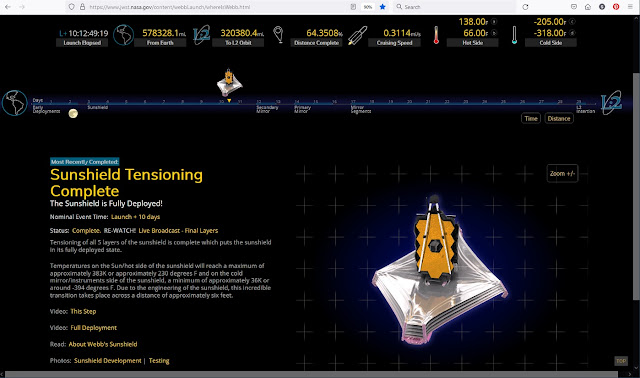
You will notice that the temperature on the hot side of the sunshield peaks at 138 F while the coldest spot on the cold side is 456 degrees cooler at -318 F.  A pretty dramatic sun shielding. 

Today is Launch +10 days; according to that graphic, the next steps are to deploy the secondary mirror (after a day of preparation), and then start to deploy the main mirror.  Once that's done, the next eleven days will be getting the primary mirror segments in the right places.  To within a small fraction (1/10?) of the wavelength of the infrared light they're working with.


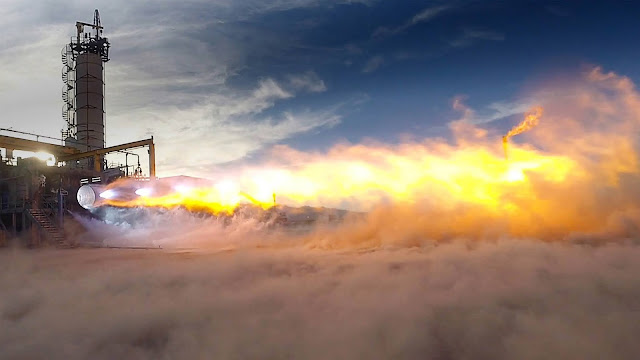
Another piece of good news comes from SpaceX, where Elon Musk spent some time on Twitter and mentioned that the Raptor 2 engines are coming along well. 

Raptor 2 now operates routinely at 300 bar main chamber pressure. 

If you'll recall the story from early December when Musk floated the idea that bankruptcy could be a concern, the main issue was Raptor engines.  The backstory and details of the Raptor engine history that get the full picture across are over on Teslarati and are worth a look.  Just a month short of three years ago, February 10, 2019, in the first days that SpaceX started testing the first full-scale Raptor prototype (now called a Raptor 1), the engine briefly reached a main combustion chamber pressure just shy of 269 bar (3900 psi). That narrowly beat records set by Russia’s RD-270 and RD-180 engines.  The RD-270 never went into production, while the RD-180 is a well-established, good engine.  It's used on ULA’s Atlas V and the fact it's a Russian engine is the reason Atlas V flights are no longer being sold.  

18 months later, Musk revealed that one Raptor prototype was able to maintain that 300 bar pressure for over one solid minute.  The same engine briefly hit 330 bar (~4800 psi), producing 225 tons (~500,000 lb) of thrust at that point.  Over the last several months, their emphasis has moved onto the Raptor 2 engine which is reported to feature much a cleaner design; in both plumbing and wiring. 

On October 24th, Musk subtly live-tweeted one of the first Raptor 2 static fires, revealing that the engine reached a chamber pressure of 321 bar (~4650 psi) and briefly produced around 245 tons (~540,000 lbf) of thrust before destroying itself. Now, a little over two months later, Musk says that Raptor 2 prototypes are routinely operating at 300 bar without major issues, meaning that they can ignite and safely shut down after burning for several minutes at those pressures. In theory, given that 300 bar is Raptor 2’s targeted chamber pressure at max thrust, that means that the engine is now “routinely” operating at the level SpaceX wants and needs to take Starship to the next level.

The Texas Tank Watchers are debating whether Booster 4 and Starship 20 will ever launch or be scrapped to switch over to the Raptor 2 engines, since the Raptor 1 or 1.5 are dead end products.  I can see launching B4S20 or not launching.  Production quantity Raptor 2 engines don't exist right now so if they feel they need to launch, they have to use B4 or its kin.  The question is what they can learn by launching B4 that they can't learn another way.  Costs of the mission to get the benefits of what they learn.
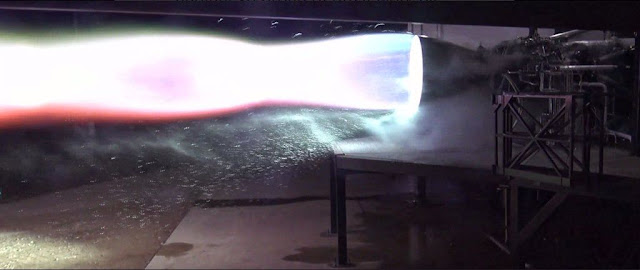
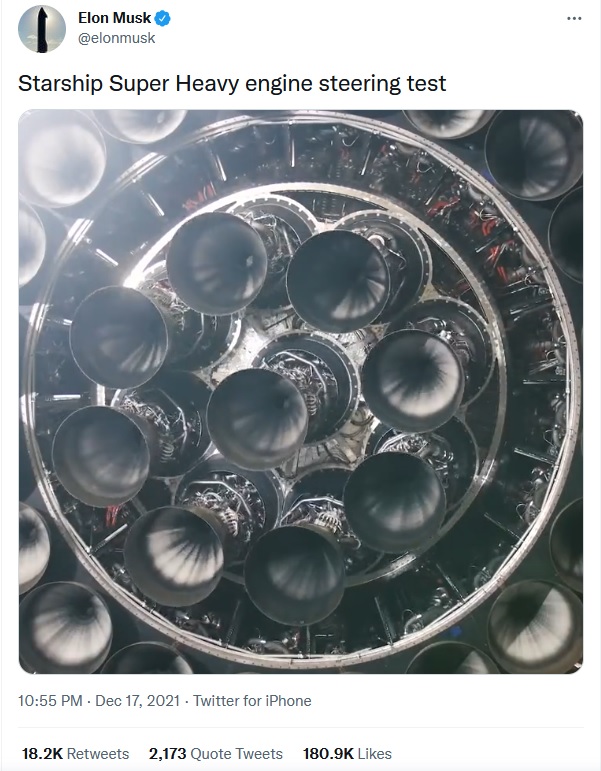
Test firing of a Raptor 2 engine.  Elon Musk/Twitter.


Monday, January 3, 2022

First Week of the Year; First Launch of the Year

It took until today, with the sources I read the most often back at work, to learn recovery drone ship A Shortfall Of Gravitas (ASOG) left Saturday - New Year's Day - for a trip down to NE of the Bahamas in support of SpaceX's first launch of the year.  That mission will launch No Earlier Than Thursday January 6 at 4:49 PM EST.  The launch is the next batch of Starlink satellites called Group 4-5.

This is a rare launch for us here south of the Cape.  The trajectory out of the Cape will be toward the southeast while the vast majority have been toward the northeast.  We might get a better look at this one.  Twitter user Raul74CZ posts:

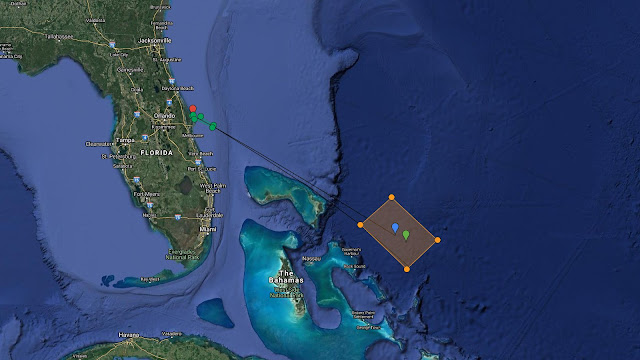
LHA map for #Starlink Group 4-5 from KSC LC-39A NET 06 Jan, altern. 07 to 10 Jan based on issued NOTMAR/NOTAMs. Estimated groundtrack, booster landing ~637km downrange, fairing recovery ~673km downrange. S2 reentry during second orbit in South Atlantic. bit.do/LHA16

The LHA is the Launch Hazard Area, and the map looks like this.  The blue marker is where the booster will land while green is where the fairings will splash down. 

The Twitter Link also includes an estimate of where the second stage will reenter.  That will be the second orbit, so less than three hours after launch, and the area where it will splash into the south Atlantic stretches from just offshore Uruguay in the southern reaches of South America over across Africa into the Indian Ocean far south of the southern tip of Africa, extending farther east than Madagascar and still far south of it.

As we pointed out last Thursday, unofficial but usually-accurate estimates of the year's launch manifest for SpaceX is 40 launches not including all Starlink launches.  They could easily be looking at adding another 10 or 12 Starlink launches this year totaling out to one launch per week.  


Sunday, January 2, 2022

A Ham Radio Series 29 – Directional Antennas Part 2

Last month, I concluded part 1 by saying I was going to replace my roughly 15 year old 6m log periodic dipole array with a five element yagi.  It will give me almost exactly 3 dB more gain – half an S-unit – so a good step up from the current performance.  

The antenna I chose is from a company I hadn’t heard of before but which was talked about as being a good supplier on one of the radio forums I read, Directive Systems & Engineering, and the antenna is their model DSEJX5-50 (pdf datasheet).   It’s currently in the box it was shipped in, in my shop.  That’s the next big project; all of my antenna projects begin with the words, “when it cools off” and while it has been near record heat for the past week, it still beats anything from about April through October. 

Since gain is the entire purpose of this sort of antenna, I thought a little discussion of how they’re designed and talked about would be worthwhile.  You may see the gain referred to as dBd or dBi, and since the units are different, can you compare two different antennas?   You may see gain patterns; are they directly comparable?  

What do those dB abbreviations mean?  The first one, dBd, is gain compared to a dipole, a half-wave antenna driven at the center and ordinarily considered to be in free space; that is, not affected by its surroundings.  A dipole is a real antenna that you can build.  The second, dBi, is gain compared to a theoretical antenna called an isotropic radiator.  That word means the radiation is “the same in all directions” which gives you the hint that it’s theoretical and no such antenna can be built.  A dipole has gain compared to an isotropic radiator, because its pattern is more donut-shaped than perfectly spherical, like the isotropic antenna, 2.15 dB more gain than the isotropic antenna to be exact, so we say 2.15 dBi.  If two antennas are specified in the same units, just compare the two numbers and the bigger number means more gain.  If one is in dBd and the other in dBi, subtract 2.15 from the dBi to convert to dBd.  The gains in any particular direction are directly comparable, as are the beamwidths, and the front to back ratio.

Think about that from another direction for a second.  If you compare any other kind of antenna to an isotropic, the numbers for gain in dBi are going to be bigger than if you compared it to a dipole and got the gain in dBd.  That tells you that antenna gain will almost always be talked about in dBi instead of dBd.  Bigger numbers sell better than smaller numbers.  

Measuring antenna gain in the real world is difficult, especially the larger HF and low frequency VHF ones.  A measuring receiver with a standardized antenna is mounted at some distance from the test antenna, and the amount of signal received from the test antenna is measured.  Calibration is difficult without good laboratory equipment and standards.  Due to the sizes involved this usually has to be done outdoors, with the test and receiving antennas mounted high above ground.  By comparison, microwave antennas are easy; they’re typically measured indoors where the environment is easier to control, in rooms covered with absorptive foam to keep reflected signals from messing up the measurements.  Standard antennas to help calibrate the measurement setup are much easier at microwave frequencies.  

Most antenna gain values you’re going to come across will be from simulations in one of the various NEC programs (EZNEC, 4NEC, etc.)  NEC is the Numerical Electromagnetics Code simulation approach developed by the US Lawrence Liverwurst National Lab.  This code works by solving reduced electromagnetics equations, modeling the antenna as a collection of wire segments specified by their positions in space.  

An interesting thing shows up in modeling that seems to be numerical “funny business” but is real.  An antenna simulated over ground usually shows more gain than one in free space!  What's happening is that the portion of the gain “balloon” that goes toward the ground in front of the antenna is reflected up to the main lobe and adds to it, actually adding gain. 

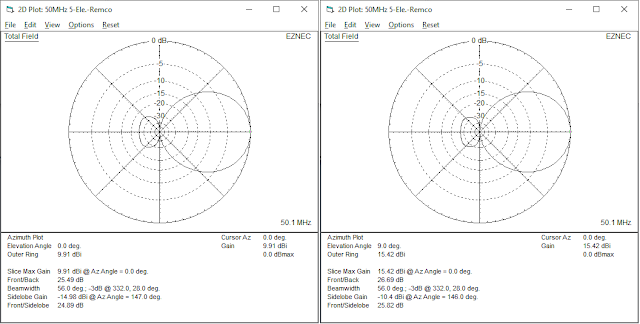
This plot is a simulation of an antenna much like the one I’m putting up: a five element, six meter yagi, but not exactly the same one as I’m putting up.  It’s modeled as being 30 feet above ground.  The plot on the left is the free space pattern and gain, peaking at 9.91 dBi while on the right is the plot over a real ground available in the NEC simulator; note the gain is 15.42 dBi; that’s 5.51 dB greater gain in that one direction.  Purely from the ground reflection.

This can be seen in real operation, and is something that beginners at moonbounce communications try to use to their advantage by experimenting when the moon is just clearing the horizon.  In the plot above, note the elevation angle (how high above ground maximum gain occurs) is 9.0 degrees.  When the moon is 9 degrees above the horizon and if a good reflective ground is below the signal path for several wavelengths in its direction, that extra 5.5 dB gain can increase their station’s performance enough to enable contacts.  You'll get better results over water - river, canal, bay, etc. - than over land.  Here's where the real world conspires to make your life difficult (physics is such a bitch).  Maybe instead of 5.5 dB improvement, you get one or two dB.  It's still improvement.

I should point out that these NEC programs, (as you can see in the upper right, the program I used was EZNEC, which is about to go completely free by the end of the month) are analysis programs, not design or optimization programs.  They can really help you with both design and analysis but won't give you designs; they'll just point out what the antenna can do.   You can waste a lot of time trying things without some guidance.  While I haven't worked with them, I've heard good things about a piece of software called Yagi Optimizer and another called YagiCAD. 


Friday, December 31, 2021

Saying Goodbye and Hello

Janus, of course, was the Roman god with two faces, one to look backward and one to look forward.  The name January is from his name and it's common for folks to look backward over the previous year and forward to the next year.  I'll do the same.  


At the end of 2021, American freedom is - at best - on the ropes. No matter where you look, you see the appearance of an emerging police state.  From the shutdowns and vax passports in places like NYC, to Federal "jab or job" mandates, to the feds blaming every problem on the unvaccinated.  At best, it's pitting groups of citizens against each other.  

There is apparently an all-out effort to turn groups against each other based on trivial characteristics like race (think of the 1619 Project).  Those of us who lived through the "Civil Rights Act" period of the 1960s thought the problem was solved 50 years ago.  I guess there was no money for the race hustler industry when people get along.  Take a look around my small southern city, in the churches or other gathering places and you'll find mixed race couples don't even get a second glance; it's just common, ordinary, normal life.  With the incessant talk of white supremacy, I had to think long and hard to try to remember if I'd ever met anyone who showed clear racial hatred.  Can't think of one.  Living just short of 68 years in various small cities in the south (or suburbs to bigger cities) I can't recall anyone openly talking hatred to blacks or any other group.

Will 2022 be much better?  Maybe in some areas; people are becoming aware of, and voicing opposition to Critical Race Theory (a way of teaching, not a subject) and things like the 1619 Project.  Economically, I don't see much chance of things getting better.  Judging by the number of email offers I've gotten saying prices are going up after the first, it looks like there's going to be another surge in inflation.  Potentially to numbers worse than any time in our history.  The inflation caused by the massive creation of money by the Fed is being made worse by the genuine supply/demand imbalances caused by supply chain issues you've read about everywhere along with economic damages from the Covid lockdowns.  No, Liz Warren; no, Brandon, it's not being caused by "greedy stores." 

Inflation is caused by Keynesian Federal Reserve economic policies that push creating money from nothing. As I say, this is complicated/worsened by other things that would have pushed up prices due to actual shortages (supply/demand imbalances).  The only way this gets fixed is by a Paul Volker-like head at the Fed winding that money back in with very high interest rates, but high enough rates might not be possible.  It might be more years of painful interest rates.  

Is 2022 the year the western economy collapse?  Could be.  Is 2022 the year the open shooting starts?  Same answer.

Should you believe me?  Heck, no!  I'm just some dood on the Intertubes with a blog.  Much of this post is a redo of my New Year's Eve post from 2010, with some changes to make it look more relevant.  The conclusion is word for word the same (except for the year).  I was wrong about that in 2011 and I'm probably wrong now.  Happy New Year!!  Thanks for stopping by.


Thursday, December 30, 2021

SpaceX Almost Lost the Booster From Last Week's CRS Mission

Word got out yesterday that SpaceX almost lost new booster B1069 after last week's Cargo Resupply Services mission, CRS-24.  The news was mostly on Twitter, but was summarized for non-twits today by Teslarati.  

As luck would have it, the only picture from this launch that I posted was the booster after landing on recovery drone Just Read The Instructions.  As you can see from that picture, the booster looks to have landed on the X-ring in the middle of the deck and appears to be in perfect condition.  This picture after the booster's arrival back at Port Canaveral tells a very different story.  

Photo by Richard Angle for Teslarati.

The first thing you might notice is the guard rail and fence on the deck of JRTI is bent out of position, apparently just barely keeping the booster from going overboard.  That bright yellow rail probably kept you from noticing the bells of the three Merlin engines that you can see are all heavily banged up.  The booster is tilted on the deck, and the landing leg closest to the camera appears damaged.  It's barely visible between the collapsing tubing extension and that brass colored fixture behind it, between the tubing and the left edge of that leg.  ("left edge" looking from this perspective)

This was said to have been caused by rough seas.  They also say the Octagrabber robot on JRTI was damaged.  

Teslarati's Eric Ralph notes:

From the ragged nature of the damage to those nozzles, it appears that B1069 somehow fell on top of the drone ship’s Octagrabber robot during or after its recovery attempt, as the creases would be far cleaner if the booster had merely landed hard and pressed its M1D nozzles against the deck. But a very short fall onto Octagrabber still doesn’t quite explain the apparent damage to one of the booster’s landing legs or the fact that it’s sitting lower to the deck than usual – both potentially indicative of a hard landing.

What is clear, though, is that SpaceX struggled to secure the rocket shortly after its first landing. Per the CRS-24 webcast, B1069 landed just shy of dead center. Likely as a result of poor sea conditions, SpaceX was unable to quickly grab the booster with Octagrabber, which uses giant clamps and its own weight to hold Falcon first stages in place. B1069 then clearly slid around drone ship JRTI’s deck at the whim of the ocean. Before SpaceX could secure it, the booster slammed into the side of the drone ship hard enough to partially flatten a steel safety barrier that runs along its port and starboard beams – a barrier specifically put in place to prevent wayward boosters from sliding off the deck.

An incident like this is where the economics of reusability really slaps you in the face.  Despite what looks like a large scale repair, the costs of utilizing the recovery drone ships, as well as the costs to repair JRTI,  it still looks like repairing this vehicle will be cheaper than dumping it in the Atlantic and building a fresh booster.  Published sources imply that replacing even all nine of the Merlin 1D engines will cost SpaceX in the vicinity of $10 million and it probably won't need all nine replaced (yeah, my guess).  My guess is it will total out under the price of a new Falcon 9 booster, which I've seen estimated at $25 million. 

The bigger problem might be that they're going to need this booster flying.  Their launch manifest for next year has (unofficially) been predicted to be 40 launches, a 29% increase over last year's record 31.  Five of those are Falcon Heavy launches (!) leaving 35 Falcon 9 boosters and 15 Falcon Heavy equivalents for a total of 50 Falcon 9s - a 61% increase over last year.  While the difference between the two F9s used as the side boosters of a Heavy is apparently cosmetic, putting a nose cone where the payload adapter goes on orbital boosters, they've historically kept them separated.  

Oh, by the way.  That 40 launch total doesn't include any Starlink missions.  Until Starship and Super Heavy are operational, Falcon 9 is the only way.  That could conceivably add as many as 20 launches to the manifest, for a total of 60.  More than one/week, with certainly some number from Vandenberg, but most from the Cape.

On its own, Falcon 9 launched six times more than the entire country of Russia last year and is by wide margins the most launched rocket in the world. 


Wednesday, December 29, 2021

Mr. Sun is Mad at You

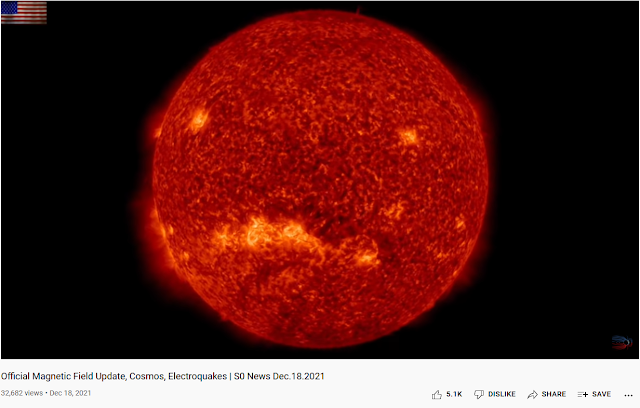
An image of the sun in Helium II at 304 Ã… (Angstroms) on December 18th.  

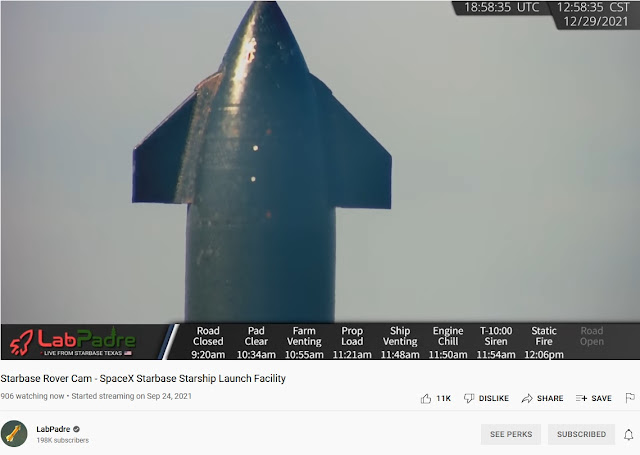
The day kind of got away from me because I spent most of it watching the Lab Padre cameras as SpaceX Boca Chica did another static fire test of SN20.  Except it turned into almost the whole day as it appeared they were going to do a second test, then that was aborted, then it looked like they were going to try again, then that one didn't happen.  

The most interesting image out of the tests isn't the Starship firing its engines; it's the picture after the test where we can see that only two tiles are missing (the two white spots). 

Clearly better than the first few times they ran these tests, when 15 or 20 tiles would pop off their mounts. 


Tuesday, December 28, 2021

Annnnd ... Add Two More Months Before Starship's First Launch

Just last night I was saying I thought a Starship launch in February was still possible.  Now read the headline like this common meme:

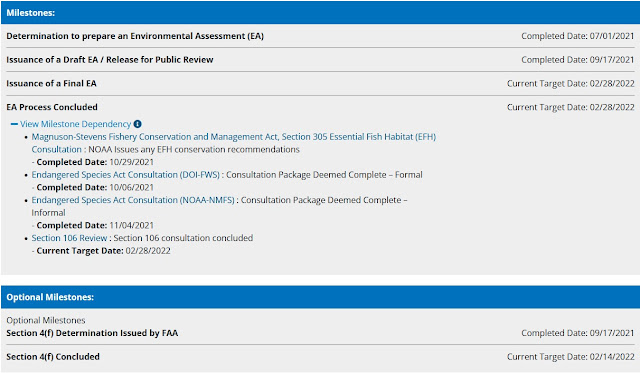
Back in mid-November, the FAA had said that their Environmental Assessment of SpaceX’s orbital Starship launch site would be issued by this Friday, December 31st, 2021.  This morning, they changed that date.     

While watching the Lab Padre cameras' coverage of tests during today's road closure, word was being thrown around that the release has been delayed until February 28th.  I checked their "Permitting Dashboard" and found it confirmed that story.  


There's a version of this dashboard I screen captured in that November blog post that's identical to this one except for the dates that moved out to February.   That means that the "No Earlier Than" date for the first orbital Starship mission has to be pushed out to at least March 1st.      

Within a few hours of that discussion on Lab Padre (comments on one of the video streams), Teslarati picked up the story.  

Somewhat insultingly, in its official statement on the delay, the FAA appears to attempt to implicate the review of “over 18,000 public comments” received during a comment period as a source of those delays. That six-week comment period ended on November 1st, weeks before the FAA published its first December 31st target date. In other words, for comment reviews to be responsible for any of the new delays, the FAA’s environmental compliance group would have had to underestimate the amount of work required to complete that process by at least 100% – not all that encouraging for an agency in which precision and accuracy are of the utmost importance.
...

The real delays, which the FAA acknowledges in much less detail, are likely the result of “continuing consultation and coordination with other agencies at the local, State, and Federal level [sic].” In the FAA’s defense, some of those delays may technically be out of its control if slow responses from other agencies are partly to blame. ...

The only test today apparently was of the igniters on Booster 4 or perhaps just some of them, I haven't found anyone with a clear explanation.  Lab Padre just said, "More Booster 4 igniter tests, 4th occurred at 12:38:41 pm."  The road was closed for maybe three or four hours and the "pad cleared" flag was in place for maybe one hour out of that.  I don't know if that was the only intended test, but there's another road closure scheduled for tomorrow and Thursday in the same 10AM to 6PM window.

Another reason to move everything to Cape Canaveral, Elon.  The fact that there have been orbital launches for 60 years means the environment has been impacted as much as it's going to be. 


Monday, December 27, 2021

Some Possible Launch Milestones for 2022

Eric Berger at Ars Technica has an article up that hints at four major, big rockets that may get their first flights in '22 - and then shows his own predictions are either for '23 or farther out.  Since this tends to be a slow news week (although work was ongoing at SpaceX Boca Chica today), and most of that news seems to be either "2021 in review" or "predictions for next year," it seems like a good article to direct you to.  

The big one, the one we've been tracking the most, is Starship.  Starship will get it's first trial for orbit this year to virtually absolute certainty.  It could be as early as January.  

Super Heavy

Capacity to LEO: 150 tons

Current official launch date: "January or February" 2022

Our previous estimated launch date: N/A

Our current estimated launch date: Q2 2022

Confidence: Medium

Here I move up a bit from Berger and think that February is still possible.  Q2, as he predicts, starts in April, and I feel rather sure that they will make Q1, barring some sort of spectacularly bad failure.   They have backup hardware already: Booster 5 is complete and in the shipyard, while they have started assembling the next booster, (called B7 and not B6 for some reason).  There's at least one other Starship, 21, in the shipyard, too. 

Booster 4 completing its journey from the high bay to the launch area.  Photo by Starship Gazer on Twitter with H/T to Teslarati.

The next most likely to fly after Starship (in my opinion, of course) is NASA's Space Launch System (SLS)

Space Launch System

Capacity to LEO: 95 tons

Current official launch date: March-April 2022

Our previous estimated launch date: Q2 2021

Our current estimated launch date: Summer 2022

Confidence: Medium

Around early December, NASA announced a problem with the SLS engine controller computer on one of the four main engines that power the rocket. Have they used up its lifetime preparing it for its (less than) ten minutes of life?  The only other explanation is that they damaged it during test, and neither of those options is particularly attractive.  Prior to this, the schedule had called for a rollout of the rocket to the launch pad at the end of December, and now that will not happen.

As the above bullet points say, the official date is March through April but Eric Berger is saying nope.  More likely to him is summer '22.  If I may quote myself, “If NASA and Boeing are lucky and there are no more failures that eat months at a time, Artemis-1 might fly by the fall of 2022.”  My reasoning was simple.  The schedule to launch before the end of this year was never changed after their time at Stennis delayed completion of their Green Run test by nine months.  I just added nine months to the announced "before the end of '21" date.  

The launch vehicle stage adapter for NASA’s Space Launch System rocket is integrated with the core stage in June.  NASA Photo from Ars Technica.

Vulcan

Capacity to LEO: 27 tons

Current official launch date: Mid-2022

Our previous estimated launch date: Q1 2022

Our current estimated launch date: Q1 2023

Confidence: Medium

This is ULA's lifeboat.  Since they've stopped selling Atlas V launches, their only key to survival is they need to get Vulcan flying.  To do that, they need flight-certified BE-4 engines from Blue Origin and that keeps slipping out in time.  To borrow from my December 17 posting:

Blue Origin had been saying since last summer that they would deliver flight-ready BE-4 engines for the ULA Vulcan by "the end of the year."  That's pretty much right now and a couple of insider sources have told Ars Technica that the delivery isn't going to happen. 

Blue Origin is unlikely to deliver two flight-ready versions of the BE-4 rocket engine to United Launch Alliance (ULA) before at least the second quarter of 2022, two sources say. This increases the possibility that the debut flight of ULA's much-anticipated new rocket, Vulcan, could slip into 2023.

A "relatively small" production issue was blamed for the delay, but the bottom line is the delay.  A reasonable "no-earlier-than" date for the engines' to get to ULA's manufacturing facility is now April 2022, and this assumes a smooth final production and testing phase. 

I'd have to agree with Ars and Eric Berger here and say I don't think they'll deliver those flight-ready (certified) engines until after mid-'22. That makes first launch in Q1 of '23 look reasonable.  If they do deliver the BE-4 engines on time, I'll go with a Q3 2022 launch prediction. 

A slightly smaller rocket with almost identical outlook is from the European Space Agency

Ariane 6

Capacity to LEO: 22 tons

Current official launch date: Second half of 2022

Our previous estimated launch date: Q4 2020

Our current estimated launch date: Q1 2023

Confidence: Medium to low

The ESA is a bit opaque from where I'm sitting.  I get very little information on ESA projects, possibly due to their being (in so many words) a European Union jobs program.  Because of that, I have no particular comments other than to defer to Eric Berger's judgment.  

Speaking of which, the only other heavy lift rocket that's "officially" listed as likely to fly in '22 is ...

New Glenn

Capacity to LEO: 45 tons

Current official launch date: End of 2022

Our previous estimated launch date: Q2 2021

Our current estimated launch date: Q3 2024

Confidence: Low

Yes, Blue Origin's New Glenn.  Blue is unique in this array of rocket companies in never having achieved orbit and that seems like it must mean something.  Their plans for New Glenn are ambitious, and they may well get there, eventually, but their biggest handicap appears to be no hardware to launch.  The engines they're (apparently) desperately trying to build for ULA's Vulcan will also power the New Glenn.  

Berger points out "Blue Origin tends to move at a methodical pace" and slow but methodical beats fast but haphazard any day.  Especially in the launch business. So they have that going for them.  If they can't deliver those flight-certified BE-4 engines to ULA, Blue is pretty much toast and ULA will be hard hit, too. 

An artist's rendering of a New Glenn rocket in flight.  From Blue Origin.

Eric Berger says that while Blue is aiming to launch by the end of this year, late in '24 seems more likely.  All I can say is that there's a better chance I'll fly by flapping my arms than Blue Origin will fly a New Glenn in '22.


Because 'tis the Season

At least 'tis the season for another few days. 

My coffee mug these days, a gift from a Christmas party exchange at some time in the past. I refer to this as drinking out of the skulls of my enemies.  Snowmen are not my enemies.  I've never seen or touched one IRL.


Sunday, December 26, 2021

James Webb Space Telescope On Its Way

Yesterday morning at 12:20 UTC, 7:20AM EST, the Ariane 5 carrying the JWST lifted off precisely on schedule.  

The video is from SciNews YouTube channel and was chosen somewhat randomly.  The official video they use is from NASA / ESA and is probably on many channels. 

The status of JWST at any moment can be checked at the Where is Webb? website by NASA.  The satellite is just 30 hours into its mission as I type and will take 30 days to reach it's orbit at the Earth-Moon L2 Lagrange point.  The satellite is currently around half the distance to the moon, and will pass our satellite tomorrow.  The high gain, Gimbaled Antenna Assembly (GAA), necessary for proper data rate transmissions back to Earth was deployed earlier today, and the next scheduled event is tomorrow - an early course correction engine burn.  

The Where is Webb? site includes a few big milestones in the deployment sequence as a time line, and the next big step after tomorrow's engine burn is the sun shield deployment on mission day three, our Tuesday.  An exact time for these events isn't given. 

This view, moments after Webb was separated from the Ariane upper stage, isn't the exact last view of the satellite, but will be among the last views. 


Friday, December 24, 2021

Merry Christmas to All!

It's sort of an annual tradition on my part to put up this post, or at least the essence of it, since I revise it pretty much every year.

Borepatch has an interesting article up on why we celebrate Christmas on December 25th.  It might well be true.  It sure has a lot of details that make sense.

Aurelian introduced his cult on December 25, 274 AD and it became really the first Empire-wide holiday.   He succeeded in founding a common belief across the Empire, perhaps succeeded more than even he hoped.  Because the idea stuck: Emperor Constantine didn't just introduce Christianity. It's from him that we get the word Sunday, since he decreed that across the Empire the weekly day of rest would be the day of rest - the dies Solis.

I always say that in the church I go to, it's not news that most people say we have no real idea when Jesus was born and that the December 25th date comes from wanting similarity to the Roman Saturnalia or other pagan holidays; nor would they be shocked if you told them Christmas has more secular than holy traditions associated with it and many things that are totally ingrained in the holiday traditions started out as advertising gimmicks.  There was no little drummer boy when the events we portray as the nativity happened; in fact, the entire scene we call the nativity is a conglomeration of bits and pieces from multiple Gospels, and certainly did not happen within the first couple of days of Jesus' life.  Nobody knows how many magi ("wise men") came to visit the child; we say three because of the three gifts listed, but it could have been almost any number.  Perhaps the most widely quoted line associated with the birth of Jesus is Luke 2:14 with the angels saying, "Peace on Earth, goodwill toward men."  There are dozens of translations into English and that one doesn't seem to be the most common, it just seems to be popular (I count it in 4 out of 60 at that link so that's approximate).

Furthermore, the nativity display we see setup wasn't at his birth; it was when Jesus was closer to two years old, not lying in the manger on the night he was born.

Churches, like all groups, have personalities, and in the one I attend, it would be remarkable to toss a wadded up paper ball and not hit an engineer, nurse, doctor, or a tech professional.  

Years ago. a friend sent me this contribution on the question of the exact date from a place dedicated to answering biblical questions.

The truth is we simply don’t know the exact date of our Savior’s birth. In fact, we don’t even know for sure the year in which He was born. Scholars believe it was somewhere between 6 B.C. and 4 B.C.  One thing is clear: if God felt it was important for us to know the exact date of the Savior’s birth, He certainly would have told us in His Word. The Gospel of Luke gives very specific details about the event, even down to what the baby was wearing – “swaddling clothes”—and where he slept—“in a manger” (Luke 2:12). These details are important because they speak of His nature and character, meek and lowly. But the exact date of His birth has no significance whatsoever, which may be why God chose not to mention it.

I've heard another explanation for why December 25th was chosen.  It's close to the solstice, the longest night of the year - which made it the darkest night of the year in those days. Jesus was the light of the world, and the symbolism of bringing light when things are at their darkest fits perfectly with the story.  If someone came out with a convincing line of evidence that Jesus really was born on December 25th, I'd be surprised... but not terribly shocked.  Reread the last line of that quote just above: it doesn't matter.  

While going through my mom's things after she passed away back in '13, we found this picture that I still get a smile out of.  This is my big brother (on the right) and me visiting Santa.  He looks a bit more skeptical than me, but he is my older (and wiser) brother.  I have no idea what I was thinking.  While I'm not sure of the date, my best guess is it would have been around 1960, plus or minus a year or two.  If it was Christmas of 1960, I would have been six.  

Let me wish each and every one of you who stop by here a very Merry Christmas.  Hold close the ones you love.  Spend time with family or friends or both.  Remember the good service members deployed far from home.  If you're Military, LEO, or fire; EMT, Nurse or MD, and are one who must work while the rest of us celebrate, thank you.


Thursday, December 23, 2021

Space News Roundup

The long awaited launch of the James Webb Space Telescope has slipped another day to Christmas morning.  The launch window opens at 7:20 AM EST, 12:20PM UTC.  There are no kids around the house to be anxiously awake on the big day, so I guess I'll have to set an alarm.  

As we are all eagerly anticipating launch, you might be wondering how to watch the launch and what to expect. Good news! NASA and its partners are planning a launch broadcast celebration that will be viewable in several different ways. Live countdown commentary and launch broadcast will begin at 6 a.m. EST (11:00 UTC) on Dec. 25 and air on NASA Television and the agency’s website, as well as YouTube, Twitter, Facebook, LinkedIn, Twitch, Daily Motion, Theta.TV, and NASA’s App. You can also join the Facebook event to watch the launch live and interact with others watching the launch. The launch broadcast will continue until approximately one hour past launch, to follow the first several critical milestones post-launch. The actual launch window opens at 7:20 a.m. EST (12:20 UTC) and lasts for 31 minutes – we can launch at any point during that window.

—Amber Straughn, Webb deputy project scientist for communications, NASA’s Goddard Space Flight Center.

As a reminder, this launch is by the European Space Agency and is taking place in Kouro, French Guyana, which is important to me because I can't go outside to watch it.  This is a scary-complex mission and I did more of an overview of the program in early September, but once launched there's on the order of 300 steps that have to operate as intended if the telescope is to be successful.  

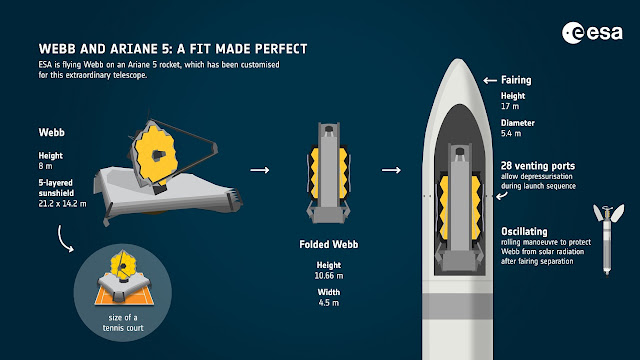
The telescope primary mirror is made of hexagonal mirror tiles and is hinged to be made small enough to fit into the Ariane 5 launch vehicle.  Those need to be unfolded and locked into final position to fractions of a wavelength of light in order for the telescope to work.  It's an exceptionally sensitive infrared telescope that will be in orbit around the sun, not the Earth, at the L2 LaGrange Point (graphic of the LaGrange points) over 932,000 miles from Earth.  That means there's nothing to shade that exceptionally sensitive heat detector from the sun - unless they build it onto the telescope.  The folded telescope is on a sun shield base roughly the length and width of a tennis court - 69.5ft long by 46.5 feet long.  That will need to unfold for the telescope to be shielded from the sun.  To borrow from my September post.

Unfurling the 21-meter-long telescope in deep space requires 50 major deployments and 178 major release mechanisms. All of these systems must work or the instrument will fail. There is no easy means of servicing the telescope at its location near a Sun-Earth LaGrange point 1.5 million km from Earth, or four times the distance to the Moon. 

This is a high stakes gamble - of your money, if you're an American taxpayer.  Most of you will remember that the Hubble Telescope had a poorly made primary mirror that had to be fixed with corrective optics before it could focus properly.  That kind of error would end this mission.  

If you've been watching the activities at Boca Chica, you've seen Booster 4 (B4) get at least two cyrogenic tests; a partial test last Saturday, and a more complete set of tests Tuesday. 

On December 17th, SpaceX subjected Super Heavy B4 to a cryogenic proof test about twice as ambitious as B3’s, filling the booster maybe a sixth of the way with a few hundred tons of liquid nitrogen (LN2). What isn’t clear is if that test also raised the booster’s propellant tanks to flight pressures (6-8 bar or 90-115 psi). If Booster 4 did reach those pressures, the test is even more significant – partially proving that the rocket is ready for flight. On December 21st, SpaceX performed a similar series of cryogenic tests, again partially filling Booster 4 with about the same amount of liquid nitrogen but doing so two or three times in a row. Again, the Super Heavy survived the several-hour ordeal without any obvious issues. Still, a number of additional tests – some even more important – are still in front of SpaceX and Super Heavy B4.

The obvious tests are to fuel B4 completely.  It's possible they'd use liquid nitrogen (LN2) instead of the actual liquid oxygen (LOx) and methane (LCH4) Super Heavy is designed to fly with for an early test.  LN2 is denser than both LOx and LCH4, so partial tank loads of LN2 could get B4 up to full lift off weight, if that's a valuable test. 

There are many steps to go before the first launch of a Starship and Super Heavy mission.  They have yet to do a static firing of 29 engines and my guess is they'll probably start with a small number and add more engines gradually until the full 29 get tested.  I can see a lot of WDRs (Wet Dress Rehearsals) happening in the next several weeks.  It would be crazy to try to peg a date for the first flight, but I think the chances of a launch in the first week of January are about zero.  Perhaps by the end of the month.  


Wednesday, December 22, 2021

And Now For Something Completely Different

Different in not being related to the Christmas season or the space activities I cover.  

If you've been a reader for a while, you know I like movies that aren't serious human drama.  I had enough Shakespeare in school and enough real drama years ago.  No typical, Hallmark-channel, romantic comedies, and not much in the way of dramas that don't involve sci fi, whether that means a super hero movie or some programmed super soldier like a Jason Bourne.  As a general rule, I've liked comic book movies, although I've liked the Marvel Cinematic Universe (MCU) more than the DC movies.  

After the end of what was called Phase 3, Avengers: End Game, the MCU went more or less into a holding pattern, and part of that was due to the nightmare of the world shutting down through 2020.  A couple of movies came out in 2019; Captain Marvel was needed as setup for End Game, and the second Spider-Man (Far From Home) included some references to End Game events.  

The only movie they've released that I'm pretty sure marks Phase 4 is Eternals, which we saw a couple of months ago.  I thought it was messy in having far too much detail in it, such that I kept thinking "what was that all about?" or "why are they telling us this?" You got the feeling they were setting up some epic story line but it was distracting.  The only other movie we saw was Black Widow, and I don't think that fits in either Phase 3 or 4; it's set in the time between the events of Infinity War and End Game, so Phase 3, but it seemed it was there to introduce the actress, Florence Pugh, who's going to replace Scarlett Johansson in the MCU in Phase 4 (since her character is killed off in End Game). 

With that setup, this past weekend was the opening of the latest Spider-man movie, No Way Home from the MCU - opening on Thursday (as usual).  We went to see it yesterday, Tuesday, at a noon matinee.  I had heard that this was a return to the lighthearted, fun movies we've come to expect from the MCU without any evident "woke" stuck in it.  That was absolutely right.  

I've said many times that I thought Thor: Ragnarok was my favorite MCU movie, for being just tons of lighthearted fun.  Along with its combination of silliness with good characters and good onscreen "chemistry" between those characters.  Ragnarok was unique in being a superhero movie where you heard people all around the theater laughing throughout the movie.  

There was constant laughter in in No Way Home yesterday, too.  It was easily the most upbeat, most entertaining Marvel movie since Thor: Ragnarok.  

In the big picture, No Way Home is a setup for the next big movie they're working on, Dr. Strange in The Multiverse of Madness.  The essence of the story starts off immediately after the events of Far From Home, in which Spider-Man unintentionally gets a bunch of innocent bystanders killed, and the bad guy in that movie reveals Spider-Man's secret identity to the world.  The movie begins with Spider-Man and his small circle of close friends suddenly having their lives badly upset by the notoriety. 

Desperate, he goes to Dr. Strange to ask him to change the timeline so that nobody knows he (Peter Parker) is Spider-Man.  As Dr. Strange is working up his magic spell, Peter keeps saying he wants certain people to know him - that's OK.  In the end, the spell ends up bringing every major villain from every other Spider-Man movie in the last 20 years, as well as the two actors who previously played Spider-Man (Tobey Maguire and Andrew Garfield).  They're all from different universes with different timelines and differences between the characters. 

It's a wild romp, with this idea of a bunch of parallel universes.  Laughter from the audience a lot of the time.

The kid who plays Spider-Man, Tom Holland, has a good screen presence.  Very believable as an anguished teen who finds himself with his super powers.  His girlfriend (MJ), is played by the one-named actress Zendaya and she has also improved a lot as an actress.  I recall someone saying in their Dune review that she was good at smoldering looks but not much else.  Maybe the parts they gave her to play before weren't as well-written?  Maybe she couldn't pull off the required nuance?  I don't know.  She was good in this movie.  All of the characters were fun to watch.

Since the two previous Spider-Man series never made it past three films and this is his third, I have to wonder if this is Tom Holland's last time in the role.  He'd better watch it.  He's 25 and looking more like an adult than an 18 year old kid, just out of high school. 


Tuesday, December 21, 2021

A Special Day In Different Ways

To begin with, it's winter solstice.  Solstice comes from words meaning "sun" and "standing still" and marks the time when the sun's position stops moving south (today) or north (the June summer solstice).  To be precise, the moment of the solstice was this morning at 1559 Universal Time  which was 10:59 AM here on EST.  It's the shortest day of the year but neither the latest sunrise or the earliest sunset.  The earliest sunset was in early December; the latest sunrise will be in early January.  

For me, what both the summer and winter solstices have in common is that I'm hoping for cooler weather.

The motion of the sun north and south over the course of the year traces out a curve called an analemma, which you usually see printed on globes.  You can photograph one of these yourself if you care to dedicate a camera to doing nothing else for a year.  One of my favorite analemma photographs is this one from Romanian photographer István Mátis who captured the view from a window in his apartment.


Technically, this isn't hard.  You point a camera so that the winter sunrise is at the bottom right of the frame and it helps to have an idea of how big a field you need to capture and choose the right lens.  It doesn't need to be the moment of sunrise, just the same time every day.  A special aspect about today's solstice is that it's the last 21st day of a month in 2021, the 21st year in the 21st century. 

Another special part of the day was this morning's SpaceX launch of Cargo Resupply Service (CRS) 24 mission to the Space Station.  I would have bet money that they wouldn't launch the mission this morning - and lost.  There was a 70% chance of rain in the Cape Canaveral forecast - and it was raining - but they launched right on time anyway.  Rain is really only useful in telling you something about the air mass the rocket is going to go through; hail, cross winds or wind shear are what matter in terms of damaging the vehicle.  

Since the weather was either going to scrub the mission or was going to make it too cloudy to see anything, we didn't get out of bed and found the video to watch when we got up.  This was the last Falcon 9 launch of the year, the 31st launch for the year (last year was 26), and just under nine minutes after liftoff, the 100th time they successfully landed the booster.  To add just a little more coolness, today was exactly six years since the first successful landing of a Falcon booster was achieved on December 21, 2015. That was a landing on land, not a drone ship, which didn't happen for another four months: April 8, 2016.

In the six years since December 2015, Falcon booster landings have become not just routine but expected.  The factory in California that builds Falcon 9s almost builds nothing but second stages.  Four boosters have launched nine or more missions.  In addition to those 100 landings, there have been only four other Falcon boosters that have not been recovered: one was intentionally ditched because it was carrying a payload so heavy that to get it to orbit required all the fuel used for the landing, and three were lost due to hardware failures. 

I still get a kick out of watching it.  I practically have a deck of cards to score the landing like an Olympic gymnastics judge.  When any other launch vehicle takes off from the "Rocket Ranch Up The Road" I'll watch it, but it's just a let down to not come in and watch them land the booster. 

And I got a kick out of this video, going back to that first booster recovery of that Dec. 21, 2015 mission.  The pure emotion is awesome to see. 


Monday, December 20, 2021

About That Elon Musk/Elizabeth Warren Tift

I'm sure you heard the story.  Elizabeth Warren tweeted, “Let’s change the rigged tax code so The Person of the Year will actually pay taxes and stop freeloading off everyone else,” Warren tweeted. 


 Later, Musk famously called her "Senator Karen" and made fun of her. 

What he's talking about is that this transpired at almost at the same moment stories were breaking that he was about to pay more in taxes than anyone in history. We get some numbers from John Miltimore at The Foundation for Economic Education, FEE. 

Is the claim true? Only the IRS knows for certain who the largest taxpayer in US history is, but Forbes says Musk appears to be right.

“The eccentric billionaire (and the world’s richest person) likely owes the federal government at least $8.3 billion for 2021,” Forbes reports.

Business Insider projects Musk’s tax bill is even higher when state taxes are included.

“Taxes on his stock, nearly a billion in Net Investment Income Tax, and the billions he likely owes California could add up to about $12 billion in total,” report Jason Lalljee and Andy Kiersz.

CNBC, meanwhile, figured Musk’s total tax bill was even higher—$15 billion.

The bulk of Musk’s tax bill stems from the nearly $13 billion in Tesla stock sold as of December 13, which is even larger than the record $10.2 billion worth of Amazon stock Jeff Bezos sold last year.

Personally, I think it's everybody's moral duty to pay the legal minimum they owe in taxes and it doesn't bother me how much he pays this year or any year.  Think of the Milton Friedman quote, “If you put the federal government in charge of the Sahara Desert, in 5 years there'd be a shortage of sand.”  Paying more tax than the legally required minimum can be thought of as encouraging that behavior.  Look at those last few paragraphs, though.  If he sold $13 billion in Tesla stock, and is looking at 12 to $15 billion in taxes, they're implying a tax rate that's over 100%. 

But reading Musk's Twitter thread is eye-popping.  It's amazing how many people think they're entitled to other people's money, and his in particular.  The more you read, the more you sense that the problem here isn't someone's taxes, it's envy.  One of the original seven deadly sins identified by Pope Gregory 1 around the year 600 AD, those are commonly listed as pride, greed, wrath, envy, lust, gluttony and sloth although the order seems to vary.  Note the definitive list is not one Bible verse but that these are scattered throughout Proverbs and other books.

Envy is considered one of the Seven Deadly Sins, and for good reason. It’s a corrosive disposition that harms both individuals and societies. The celebrated philosopher Immanuel Kant described envy as,

“…a propensity to view the well-being of others with distress, even though it does not detract from one’s own. [It is] a reluctance to see our own well-being overshadowed by another’s because the standard we use to see how well off we are is not the intrinsic worth of our own well-being but how it compares with that of others. [It] aims, at least in terms of one’s wishes, at destroying others’ good fortune.”

The pre-Socratic philosopher Democritus (c. 460 BC – c. 370 BC)—in a wonderfully libertarian quote—once warned of the danger of envy and purpose of the law.

“[Just] laws would not prevent each man from living according to his inclination, unless individuals harmed each other; for envy creates the beginning of strife,” he wrote.

Being envious of someone is like being angry at them; it gives them control over your emotions.  Envy makes sense for Elizabeth Warren, as a well-established socialist.  After all, to borrow from Winston Churchill, “Socialism is the philosophy of failure, the creed of ignorance, and the gospel of envy.”  Envy is being preached at Warren's church. 

. 


Sunday, December 19, 2021

Weekly Update on the 1 by 1 - part 19

This week, I increased the bore of the cylinder from just over 9/16" last week to 0.950", or close to that.  Since the target for the bore is 1.000", I can enlarge that pretty easily, but I wanted to check for any bad taper in the cylinder.  

Taper in a part cut on a lathe can come from a handful of places.  The most common are that the lathe can be twisted over its length (usually called being out of level) or from the center of headstock not being exactly on line with the tailstock.  It can come from wear over time, errors in manufacturing, or could come from errors installing it in your shop.  In a discussion I was reading, one guy made reference to a video on YouTube channel BlondiHacks, which I watched and got some good ideas from. 

What got me thinking about this is that the lathe started shaking while taking off the corners of the square bar to get where I ended up last week.  I noticed the two handwheels (which I wasn't using or touching) were vibrating and moving off their settings.  I don't know if the cutter was really moving, or would have moved given enough shaking, but I came up with a cheap and dirty fix. 

That's right.  Blue painter's tape.  It certainly kept the knobs from moving, I just don't really know if it did any good for me.

The tape seemed to work but I wanted to try to measure taper in the cylinder.  I've been stuck here a few days.  To be fair, the fact that it seemed to be the week of "peak busy" enters into the lack of progress, too. 

To measure the internal diameter, I use a tool called a telescoping gauge.  It's a clever device that's a Tee-shaped handle with a spring-loaded, cylinder on one side of its head and a fixed cylinder on the other side.  The two ends have a slight dome to them that helps center the tool across a diameter while removing errors from a corner of one of those cylinders touching the wall you're trying to measure.  Here's a picture of one in use measuring the ID of a ball bearing set. 

Photo credit

Not visible in this picture is that at the end in the user's hand is small screw that locks the movable cylinder smaller than the diameter you want to measure.  In use, you squeeze the Tee head to make it small enough to fit in the cylinder, lock that screw down, then push it down into the cylinder to the spot where you're going to measure the diameter, then unscrew that locking screw.  That snaps the Tee to full size, contacting the diameter.  It seems to help to jiggle it around to ensure the Tee is fully expanded and not hung up in any way.  Then you tighten the screw tightly, tilt the handle slightly and pull it out of the cylinder.  Once out of the cylinder, you measure across the Tee and that tells you the inside diameter  In a measurement like I'm trying to make, I'll use a micrometer, but I know of no places where it's easier to measure an inside dimension than an outside one.

I'm not convinced I'm measuring the far end of the cylinder properly.  I ran 20 measurements on both ends, and the standard deviation for the far end is three to four times bigger than the near end.  I think that's telling me that I'm not getting the gauge properly set up when it's 2" deep in the cylinder. 


Saturday, December 18, 2021

An Interesting Couple of Days

Yesterday, during the first road closure for last week, there was a Cryo test of Booster 4 on the Orbital Launch Mount where it was moved Monday.  These tests aren't much to look at, but they're absolutely essential.  It turns out that around that time, another test was apparently going on that's a quite a bit more interesting to watch.  You get to watch six seconds of all of these Raptor engines being steered around a circle. 

Later overnight, 4:41 AM PST, the last batch of Starlink satellites to launch this year rode into orbit on a record-setting mission; this was the 11th flight of booster B1051 along with a successful landing on drone ship Of Course I Still Love You, marking the first time that they've pushed past their original  10 flight goal for boosters.  No orbital booster known has ever flown 11 times.  

The launch is at the 16 minute mark (16:00) of this video, and there's just a brief, grainy view of B1051 standing on the deck of OCISLY at the 25:00 minute mark.  If I was doing a Siskell and Ebert-type review for this coverage, I wouldn't rate it as highly as some others.  Night launches are tough to cover, though.

Tonight at 10:58 PM EST, another Falcon 9 will launch Turksat 5B for that country from Cape Canaveral Space Force Base, launch complex 40.  Weather looks to be giving a high chance of launch and with the full moon, it should be pretty.  

Finally, on Tuesday the 21st at 5:02 AM EST, we expect the last Falcon 9 launch of the year,  CRS 24, from pad 39A on the Cape.  The Falcon 9 will launch a Dragon 2 spacecraft on its fourth cargo resupply mission to the International Space Station.  I see the weather as being more iffy for that launch.  The long range forecasts have been calling for a frontal passage around Monday night/Tuesday morning and the rain chances are peaking close to that launch time.  I wouldn't be surprised to see them slip that mission out a day or even two - because while rain chances go down, winds go up through Wednesday. 


Friday, December 17, 2021

Delay, Delay, Delay

A trio of delays in the space news this week.  

The James Webb Space Telescope's December 18th launch, which was delayed until the 22nd, and has been delayed again, this time until the 24th.  The little blurb at that link refers to “... a communication issue between the observatory and the launch vehicle system.”  I've seen a rumor that it's a bad cable, for whatever that's worth.  The one good thing about this mission is that launching to the L2 Lagrange point which they're targeting is not like launching to Mars where the conditions are best for a few weeks every two years.  Delays aren't likely to kill the mission.  

Considering that when the program was started in 1996, the expected launch date was 2007, let's just say that launch delays are not unusual with this program.  This is not to say that this is an absurdly easy program that has been mismanaged time after time, but it was definitely "biting off more than anyone could chew."  


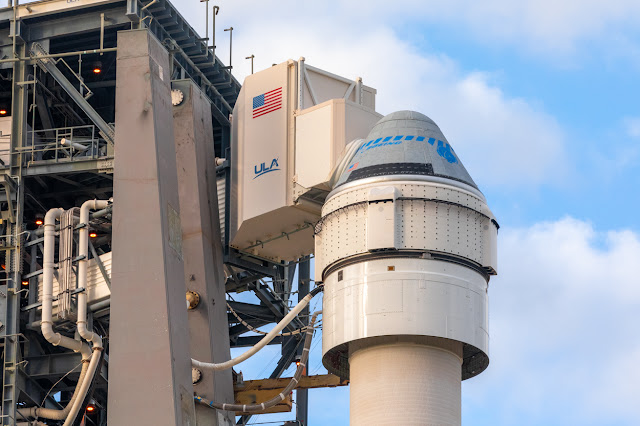
Boeing's Starliner has been delayed again.  Earlier this week, NASA and Boeing announced that the "Orbital Flight-2" or OFT mission will be no earlier than May of '22.  It felt strange when I read that Starliner's first test flight was almost exactly two years ago, December 20, 2019.  As that linked post from that date shows, the mission was in dire trouble from the moment the capsule achieved orbit.  By February, it was evident they were exceptionally lucky to have gotten the capsule back in one piece.

Starliner in December of '19 - Boeing photo.

To accommodate this launch date for the "Orbital Flight-2" or OFT mission, Boeing will swap out a faulty service module—which provides power and propulsion to the Starliner capsule in flight—with a new one.

NASA and Boeing did not hold a media event to announce their findings, and unfortunately some key questions remain. For example, it appears that Boeing has not yet fully identified the root cause of the valve failure, which was believed to be related to high humidity at the Florida launch site, which caused corrosion.

"Ongoing investigation efforts continue to validate the most probable cause to be related to oxidizer and moisture interactions," the news release states. "NASA and Boeing will continue the analysis and testing of the initial service module on which the issue was identified."


Blue Origin had been saying since last summer that they would deliver flight-ready BE-4 engines for the ULA Vulcan by "the end of the year."  That's pretty much right now and a couple of insider sources have told Ars Technica that the delivery isn't going to happen. 

Blue Origin is unlikely to deliver two flight-ready versions of the BE-4 rocket engine to United Launch Alliance (ULA) before at least the second quarter of 2022, two sources say. This increases the possibility that the debut flight of ULA's much-anticipated new rocket, Vulcan, could slip into 2023.

A "relatively small" production issue was blamed for the delay, but the bottom line is the delay.  A reasonable "no-earlier-than" date for the engines' to get to ULA's manufacturing facility is now April 2022, and this assumes a smooth final production and testing phase. 

ULA declined to comment on specifics about the production issue. However, the company said it was disappointed that it did not receive these two flight engines in 2021 as anticipated.

"We are disappointed that we will not be receiving Vulcan flight engines from Blue Origin by the end of the year, but they will be arriving early next year," the company said in a statement. "The certification program is moving along very well, and the production engines are being manufactured. We look forward to Vulcan’s first launch in 2022."

I think that given recent history, that last sentence could be laughably optimistic, but would be happy to be proven wrong.  Vulcan succeeding is a Big Freakin' Deal since Vulcan will replace both the Atlas and Delta launch vehicles that were ULA's bread and butter.  The US military is counting on Vulcan to lift about 60 percent of the nation's national security payloads into space from 2022 to 2027.

If those BE-4 engines are delivered by April, that leaves ULA eight months to make a launch in '22.  It's not out of the question, but it doesn't look like a solid way to bet, either. 

BE-4 test fire on the stand in Texas.  Blue Origin photo. 


So how about some good news?

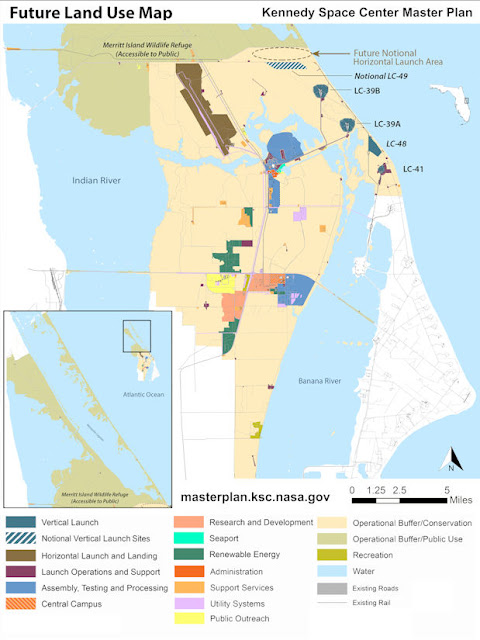
In response to an inquiry from SpaceX, NASA is preparing to conduct environmental assessments to develop a proposed new launch site, Launch Complex 49, at the agency’s Kennedy Space Center in Florida.

The 175-acre site, located north of Launch Complex 39B within the center’s security perimeter, would support the launch and landing of the company’s Starship and Super Heavy launch vehicle. NASA and SpaceX are moving forward with the initial environmental analysis before concluding a potential agreement to develop the property.

“LC-49 has been a part of Kennedy’s master plan for several years,” said Tom Engler, Kennedy’s director of Center Planning and Development. “The Notice of Availability was updated in 2014.”

That means SpaceX is seeking approvals to build a second Starship launch pad and all of its necessary infrastructure.  That means - eventually - twice as many Starship launches are possible.

(NASA map - larger version at the link) 

SpaceX said its proposed expansion at Kennedy Space Center, which include the LC-49 launch site and expansion of the Roberts Road site, would provide redundancy and allow for an increased flight rate of Starship while minimizing disruptions to Falcon 9, Falcon Heavy, and Dragon missions.

EDIT Dec. 18, 2021 at 9:27 PM EST:  Link to James Webb Telescope project page at NASA (second link in post, at the top) was broken.