Saturday, May 7, 2016

On the Shuttering of PJTV

I don't think I'm going to be the one who breaks this news to you, but PJTV.com is going dark on 5/11.  Gone from regular viewing will be Alfonzo Rachel, Andrew Klavan and the one person I see posted more than any other on the liberty-oriented blogs I read, Bill Whittle.

I first encountered Bill through the pages of his original blog, Eject! Eject! Eject! in just a masterfully written look at history called "The Workshops of Identity" - that version is at Breitbart, and I'm thankful it's still out there.  I saved a copy to my own computer.  Read it, if you haven't.  A teaser:
Consider modern history, which many consider the time since the end of World War II. At the end of 1945, the only military force of any real substance remaining in the world was that of the Soviet Union, and while they had large numbers of troops and tanks, they had no navy and no strategic air force to speak of. The United States possessed, intact, the most awe-inspiring, battle-hardened navy the world had ever seen. It possessed sky-darkening clouds of B-29 strategic bombers. And it possessed, alone, the atomic bomb and the will to use it.

The United States of America could have planted its flag anywhere it wanted and no one would have been able to do a thing about it.

And what did we do with this arsenal? We scrapped the ships, drove steel bars through the wings of the priceless bombers, and began the largest de-militarization in the history of the world.
I've said before, in several places, Bill is the only commentator/pundit that I ever encounter who rises to the level of being a national treasure.

So here's an ad.  Bill has long had his own little business at BillWhittle.com.  Now that PJTV is shutting down, Bill's partners from there, including Scott Ott and Steve Green, are moving to Bill's place.  PJTV's former "Trifecta" series is being reborn at Bill's channel as Right Angle.   While I registered at PJTV, I never actually subscribed.  In contrast, I have subscribed to BillWhittle.com.

Of course, I have no way of knowing how well this venture will work, and since I started out with a one year subscription, it's possible I could end up being out some of that.  Bill still has his YouTube channel, and most of the content they generate will go up there a few days after the members only showings.  There is members' only content, but little will stay that way (as far as I know).  At this point, to me it's worth subscribing to keep these guys going. 


Friday, May 6, 2016

SpaceX Nails Second Landing at Sea

It's unusual for me to write two pieces on SpaceX in a week, but they nailed another landing at sea this morning, this time pretty much centering the Falcon 9 booster in the middle of the landing bulls eye on their drone barge, "Of Course I Still Love You".  Having the luxury of being retired, we decided to get up a little after 1 this morning.  Went outside to watch the launch; night launches are always pretty, and we were able to follow it until it was well into the second stage burn.  Then we came in to see the coverage of the attempted booster landing on the SpaceX website.
For their part, SpaceX tried to downplay expectations.  Landing rockets autonomously on unpiloted drone barges at sea isn't exactly something that has been done enough times to be boring routine.  The mission was to put a satellite into a geosynchronous transfer orbit, which they said made recovering the booster harder.
"Given this mission's GTO destination, the first stage will be subject to extreme velocities and re-entry heating, making a successful landing unlikely," SpaceX representatives wrote in a description of the JCSAT-14 mission.
When the booster made it to the barge, the video cameras couldn't handle the brightness of the rocket flames and the screen went white for a second or two.  The crowd apparently thought the brightness meant the booster had crashed into the ship and you could hear cries and moans of disappointment.  Moments later, the video recovered and the booster could be clearly seen sitting right where it was supposed to be, residual fuel still burning.  The crowd erupted in cheers, transitioning to chanting, "USA!  USA!  USA!".  Video here. 
A few hours later, once the sun had risen, SpaceX released this photo.  In the past, SpaceX has said that to ensure the booster isn't toppled by weather or sea conditions, that once the vehicle is safe (and I don't know all that means), they will weld steel "shoes" over the booster's feet to help ensure it stays put. 


Boaty McBoatface is Gone - Boaty, We Hardly Knew Ye

As was hinted about in last week's piece, while the British people voted overwhelmingly to call their new research vessel Boaty McBoatface, the Science Ministry was not amused.  Boaty McBoatface is gone as a name. 

The name was scrapped and the ship will be called RRS Sir David Attenborough. 
Showing at least a little bit of political savvy, Jo Johnson didn't completely discard the people's choice: RRS Sir David Attenborough will be outfitted with a number of remotely operated underwater vehicles (see gallery above), and one of those will be called Boaty McBoatface. Hopefully they'll paint a dorky face on the front of its torpedo-like frame.
You know they couldn't just go with a name like this.  Science!!! is too serious for such a juvenile name.
 To borrow a comment exchange from the article:
Vorador wrote:
While it was somewhat obvious that a name like that wasn't gonna fly, i still find ironic that the government ask for your opinion but when it doesn't like said opinion, they do whatever they want.
The outcome of pretty much every government consultation ever, right there.

Thursday, May 5, 2016

My Toilet's Trimmed With Chrome

Wait... not my toilet.  I guess there's "some splainin' to do".  

I'm an old guy, of course.  I mean, what's the name of this blog?  Further, regulars will probably recall I've been working on teaching myself guitar since right around the end of 2010.  So what's an old guy who's learning to play going to play?  Right: old songs. 

One of my favorite songs from my callow youth is the way Chicago adapted "I'm a Man", originally done by the Spencer Davis Group. This was back when Chicago was Chicago Transit Authority and a different band from the mellow group that did songs like "Saturday in the Park" and "If You Leave Me Now", fired by Terry Kath, the lead guitarist who could shred as well anyone (all interested guitarists have heard the story that Jimi Hendrix said Kath was a better player than he was).  That video (song title link) is an excellent look at Kath playing his Gibson SG and getting amazing sounds out of it. 

Slightly off topic, you may also know that Terry Kath was also a bit of gun enthusiast and apparently accidentally shot himself.  A common telling of the story is here, where it comes across as just stupid.  I've read a few reports of this, some making it sound like a deliberate game of Russian roulette, and some making it sound like stupid horseplay.  If nothing else, this version makes it sound like a cross between the two options. 

The other night, I thought of the song and thought I'd try to play it.  Off to YouTube and look up a couple of videos.  I watched both Chicago and the original version by the Spencer Davis Group, featuring a young Steve Winwood. One of things that struck me was that Chicago didn't just cover I'm A Man, they almost rewrote it!  The dropped the key a full tone, changing the song's signature descending four tone chromatic chord sequence from F - E7 - D# - Dm  to D# - D - C# - Cm.  They also changed the lyrics, which is where this post title finally comes in.  They changed several lines in the song, but the one I'm referring to made me do a double take when I came across it in a Tab format reader. 

Chicago's last verse is:
You think that I'm not human
And my heart is made of stone
But I never had no problems
'Cause my body's pretty strong
While Spencer Davis Group's last verse is:
Who imagine I'm not human
And my heart is made of stone
I never had no problems
And my toilet's trimmed with chrome
Mrs. Graybeard found somebody's interpretation (which I won't link to) that tried to explain the lyrics as being all about drugs.  Seriously.  It was something like the chrome trim indicated it was poor man's drugs, or else it would have been gold trim.  In my mind, I just see a couple of kids sitting around, trying to come up with lyrics.  They'd just written "who imagine I'm not human, and my heart is made of stone" and they're trying to come up with something that sounds decent.  "Oh my God, man!  What rhymes with stone?"  "No, it doesn't". 

Like many of the songs of those days, I had never known all the lyrics (there are websites full of misunderstood lyrics after all), so I watched that video of SDG doing a live performance back in '66.  Sure enough, that's what Winwood is singing.  I had never been able to understand the couplet at the start of the second verse; in particular, the last word.
Well, if I had my choice of matter
I would rather be with cats
I was relieved to find that the sentiment is shared by both Chicago and SDG.  

So it's not my toilet that's trimmed with chrome.  It's Steve Winwood's.  Or Spencer Davis.  Both are listed as the composers of the song.  Or maybe nobody's - it was just a goofy rhyme.  And that's what I can't get out of my head for a week, now. 

(like it says - Pearls Before Swine by Stephan Pastis)

Wednesday, May 4, 2016

Life in Our Modern USSA

I saw this fun fact at Irish's place:
and it made me think of something.
As I pass through my incarnations in every age and race,
I make my proper prostrations to the Gods of the Market Place.
Peering through reverent fingers I watch them flourish and fall,
And the Gods of the Copybook Headings, I notice, outlast them all.

We were living in trees when they met us. They showed us each in turn
That Water would certainly wet us, as Fire would certainly burn:
But we found them lacking in Uplift, Vision and Breadth of Mind,
So we left them to teach the Gorillas while we followed the March of Mankind.

We moved as the Spirit listed. They never altered their pace,
Being neither cloud nor wind-borne like the Gods of the Market Place,
But they always caught up with our progress, and presently word would come
That a tribe had been wiped off its icefield, or the lights had gone out in Rome.

With the Hopes that our World is built on they were utterly out of touch,
They denied that the Moon was Stilton; they denied she was even Dutch;
They denied that Wishes were Horses; they denied that a Pig had Wings;
So we worshipped the Gods of the Market Who promised these beautiful things.

When the Cambrian measures were forming, They promised perpetual peace.
They swore, if we gave them our weapons, that the wars of the tribes would cease.
But when we disarmed They sold us and delivered us bound to our foe,
And the Gods of the Copybook Headings said: "Stick to the Devil you know."

On the first Feminian Sandstones we were promised the Fuller Life
(Which started by loving our neighbour and ended by loving his wife)
Till our women had no more children and the men lost reason and faith,
And the Gods of the Copybook Headings said: "The Wages of Sin is Death."

In the Carboniferous Epoch we were promised abundance for all,
By robbing selected Peter to pay for collective Paul;
But, though we had plenty of money, there was nothing our money could buy,
And the Gods of the Copybook Headings said: "If you don't work you die."

Then the Gods of the Market tumbled, and their smooth-tongued wizards withdrew
And the hearts of the meanest were humbled and began to believe it was true
That All is not Gold that Glitters, and Two and Two make Four
And the Gods of the Copybook Headings limped up to explain it once more.

As it will be in the future, it was at the birth of Man
There are only four things certain since Social Progress began.
That the Dog returns to his Vomit and the Sow returns to her Mire,
And the burnt Fool's bandaged finger goes wabbling back to the Fire;

And that after this is accomplished, and the brave new world begins
When all men are paid for existing and no man must pay for his sins,
As surely as Water will wet us, as surely as Fire will burn,
The Gods of the Copybook Headings with terror and slaughter return!
Of course, that's The Gods of the Copy Book Headings by Rudyard Kipling.  I think they're preparing to return.  If Gods need to stretch and warmup before starting to slaughter, I figure that's what they're doing now. 


Tuesday, May 3, 2016

Techy Tuesday - Pratt & Whitney's New Geared Turbofan Jet Engine

Despite getting four newsletters every day covering developments in electronics, radio and computers, I almost came up with nothing to write about tonight.  Instead, thanks (again) to the Arts Mechanical for a story on the Pratt and Whitney PW100G engine.  It's the industry's first high bypass jet engine with a turbofan (those big blades visible in the front of a jet engine) that spins slower than the "engine" that drives it.  It does this by using a gearbox connected to the shaft that gets driven by the combustion taking place closer to the rear of the engine.  The engine was first called the GTF - the Geared Turbo Fan - and probably most surprising to readers used to living on "internet time"; work on it began in 1988.   Almost 30 years and $10 billion dollars. 
To people outside the aircraft business, what may be most remarkable about the engines is that they took almost 30 years to develop. That’s about 15 times as long as the gestation period of an elephant and unimaginably longer than it takes to pop out a smartphone app. Could Pratt have gotten the hardware out faster? Probably. But industrial innovation on the scale of a commercial jet engine is inevitably and invariably a slog—one part inspiration to 99 parts perspiration.

In Pratt’s case, it required the cooperation of hundreds of engineers across the company, a $10 billion investment commitment from management, and, above all, the buy-in of aircraft makers and airlines, which had to be convinced that the engine would be both safe and durable. “It’s the antithesis of a Silicon Valley innovation,” says Alan Epstein, a retired MIT professor who is the company’s vice president for technology and the environment. “The Silicon Valley guys seem to have the attention span of 3-year-olds.”

The PurePower GTF began to take shape in 1988, when Pratt staffers in East Hartford, Conn., including a 28-year-old engineer named Michael McCune, started developing a gizmo to slow the fan—the big rotating blades at the front of the engine that provide most of a jetliner’s propulsion. For planes flying at typical speeds, a slow fan that moves large volumes of air at a moderate velocity is more efficient than a fast-spinning fan that accelerates a smaller volume of air. (The slow fan’s also quieter.)
The conditions for extracting the most efficiency out of the jet engine force vary from front to back (right to left in this picture).  The fan is more efficient moving large volumes of air at slow speeds.  The compressor and combustion are more efficient when moving faster.  The reward for making the engine this way, what they spent 30 years and $10 B chasing, was an engine with 10 to 15% better fuel efficiency but up to 75% quieter.  Quiet matters to aircraft operators (and with them, the entire "food chain" of suppliers) because jet engine noise became a big issue in the early '70s, causing municipalities to charge airlines for the amount of noise they make, and even making the airlines fly different routes to reduce their noise footprint. 

The challenge for McCune and the design team was to make opposite ends of the same shaft move at different rates.  Of course you assume the answer involves a gearbox, but the straitjacket of requirements for this gear box was exceptionally tight.  Gearing hadn’t been tried at the scale of a commercial jetliner because the conventional wisdom was that it would be too heavy and wear out too quickly.  Jet engines, lest you forget, are subject to bird strikes and are tested by throwing chickens (not frozen!) into the engines to ensure they survive. 
The biggest challenge in scaling up was how to keep the gearbox, which is about 20 inches in diameter and weighs about 250 pounds, from being torn apart if there was a shock that wrenched the fan in one direction and the shaft in another. Adding steel for stiffness would make the engine too heavy. To put some give into the system, McCune’s team attached the gearbox rigidly to the fan but somewhat loosely, with bendable metal baffles, to the compressor/turbine shaft and the engine case.
All in all, it's a pretty cool story.  Having just retired from that world, a lot of the things they devote column space to are old hat to me but would probably surprise people from other fields.  I heartily recommend you click through to Arts Mechanical for the long version of the story, including several embedded videos.
 I note that the Wiki article says:
[The engine is] currently selected as the exclusive engine for the Bombardier CSeries, Mitsubishi Regional Jet (MRJ), and Embraer's second generation E-Jets, and as an option on the Irkut MC-21 and Airbus A320neo.
I have personally worked on systems for all of those aircraft except the Irkut MC-21.  


Monday, May 2, 2016

Twit, er, Tweet of The Day

From bouncing around the 'net like a ping pong ball in a clothes dryer, found here, on a link from The Arts Mechanical.  
Now I'm going to bet I've spent just as much time on a dairy farm as these girls have, which is to say either zero, or maybe a few hours on an elementary school field trip.  I am far from an expert.  Plus,  I'm guessing I'm about 40 years older than they are, meaning that elementary school trip is much farther in the past for me than for them.  But even I know cows are not killed on dairy farms.  As the original Tweeter says, "you only have to fondle them".  Cows are more like coddled than harassed.  And the cows need to be milked or else very unpleasant things happen to them.  Commenter JK Brown noted:
"Ironically, on modern dairy farms, the cows can select when they are milked and just take their turn at the robot."
You have to go far down the road to crazy town to come up with a way for "I want to live" to apply to dairy cattle. 


Sunday, May 1, 2016

Sunday Odds and Ends

I've been reading an interesting book on economics, particularly a new way of looking at money and central banks.  The book is called "The Scandal of Money" by George Gilder.  The Subtitle is "Why Wall Street Recovers But the Economy Never Does", and with a subtitle like that, how can you resist?

Gilder advocates an information theory of money and wealth.  His example was like a slap in the face that stuck with me.  Take an obviously valuable piece of property like a luxury car.  A car is good example because creating the car creates wealth for the people who design and make the car.  Now smash that car into a wall at a high rate of speed.  Every single molecule that was present before the crash is present after the crash; what's missing is the ordered information that arranged those molecules into the luxury car.  That's saying that the real wealth; the real worth of the car is the information.  Creating the car consisted of imposing new information on raw materials.  That was the creation of wealth.

Put another way, the Neanderthals had every natural resource we have.  What they didn't have is the results of billions of experiments that generated information on how to create wealth out of those resources. 

Why a new way of looking at all this?  New ways are called for when the old ways no longer work.  It's hard to argue free markets don't work, but many liberal writers (Paul Krugman, Larry Summers and others) are saying markets won't work like they did in the 20th century.  They're saying we're entering a period of global stagnation because all of the important inventions have already been made, and the period from the late 1800s through 1970 can never be repeated.  They point to the drop in GDP growth in the US that started around 1971 and say the growth is going to be slower from then forward.  GDP growth on 0.1 or 0.2% per year, instead of 2 or 3% or more.  But there's no single, crucial invention you can point to around then that suddenly "completed the world" and made us not need to invent anything ever again.  The only thing that coincides to that time period was Nixon closing the gold window and the rise to nearly total control by the central banks.  
“Inflaming the global economic doldrums is a forced transfer of wealth from Main Street to Wall Street so gigantic that it sharply skewed global measures of the distribution of wealth and income, bringing to a halt 50 years of miraculous and broad-based advance in global living standards. At the root of the catastrophes was a drastic abuse and debauch of money and banking led by U.S. and European megabanks.”
Being a decidedly techy blog, we've talked about Shannon's Information Theory here before.  One way of describing Information Theory is that if I tell you something you already know, I haven't given you any information.  (This is the principle that leads to modems sounding like noise - if you're old enough to remember dial-up!)  The same principle shows up again in Gilder's book:
"Surprise is the beginning of wisdom." ~ David Gelernter
Where "surprise" is information you've never had before.  Gilder describes the eight principles of the information theory of money and capitalism:
1. The economy is not chiefly an incentive system, but an information system. Greed has nothing to do with it, but justice— a system that rewards truth and filters out falsehood— is crucial.
2. Creativity always comes as a surprise. If it didn’t, socialism would work. Information is defined as surprise. [emphasis added]
3. Information is the opposite of order. Capitalist economies are not equilibrium systems but lively arenas of entrepreneurial experiment.
4. Money should be a standard of measure for the outcomes of entrepreneurial experiments.
5. Interference between the conduit and the contents of a communications system is called noise. Noise in the currency makes it impossible to differentiate the signal from the channel.
6. A volatile market shrinks the time horizons of the economy. Gyrating currencies and grasping governments are deadly to the commitments of long-term enterprise.
7. Analogous to entropy, profit or loss represents surprising or unexpected outcomes. Analogous to average temperature in thermodynamics, the real interest rate represents the average returns.
8. The velocity or turnover of money is not a constant. Therefore it’s not the central bank that controls the effective money supply but the free decisions of individuals as they accumulate knowledge and decide whether to spend or save their output.

Gilder, George (2016-03-28). The Scandal of Money: Why Wall Street Recovers but the Economy Never Does (Kindle Locations 464-479). Regnery Publishing. Kindle Edition.
Seen this way, the problems with Central Banks is that they ruin the information systems that are at the heart of the economy.  They distort the flow of information and feedback signals everywhere, depriving the parties that require information of it.  Central banks not only deny free enterprise, they impugn democracy. Of course, it's worse than that.  Central banks are also the agents of the wealth transfer to the crony banks and businesses, while systematically causing the oft-reported pension problems and starving anyone who is living off savings.

With the book's technical approach: analogies to thermodynamics, calling on information theory, and tying together things from gold to bitcoin, you'd probably imagine I'd like this book.  I'm only in the third chapter, but so far it's definitely intriguing.  I have to say some of it doesn't seem quite like he's quite got it right, or else he's not getting his ideas across.  Take number 7: Analogous to entropy, profit or loss represents surprising or unexpected outcomes. In my mind, entropy doesn't imply surprising or unexpected outcomes.  I can see that profit or loss could.  I think he picked the wrong word.  


Finally, under the "every part is a puzzle" observation I made a few days ago about making parts for my CNC conversion project, I thought about how to make this part for about three days, including asking a frequent commenter here what he thought was a good way to cut the 45 degree chamfers on the corners of top end of the part.  I finally figured out a way to clamp the part so that I could cut the 45 degree chamfers with straight cuts in X and Y.
This is just roughing out the shape.  It gets a nearly 1.4" diameter hole in the wide section of the part, along with a eight drilled and tapped holes of different sizes.


Podcast Is Up

Gun Blog Variety Podcast episode 89 is released. 

Show notes are here. 

Direct MP3 download is here:

Remember, if you have any techy questions, on just about anything, drop me an email (address in the right sidebar).  You can even comment here.  Worst case, I don't know anything about what you're asking! 


Saturday, April 30, 2016

SpaceX Has Been Preparing for Mars

It turns out that SpaceX's recent success in sticking the landing of a Falcon 9 on a floating barge is far from the most important R&D they've been doing.  ARS Technica brings an interesting story about how SpaceX has been experimenting with technologies needed for a Mars landing, and been doing it for years. 
In September, 2014, a Falcon 9 rocket blasted off from Florida carrying a Dragon spacecraft bound for the International Space Station. The capsule carried some notable cargo, including the first 3D printer to be tested in space as well as 20 mousetronauts to study muscle loss. Yet the most far-reaching part of that mission came after the Falcon 9 deployed its upper stage and began falling back to Earth.
...
That's because during that launch—and about 10 others since late 2013—SpaceX has quietly been conducting the first flight tests of a technology known as supersonic retro-propulsion—in Mars-like conditions. It did so by firing the Falcon 9's engines at an altitude of 70km down through 40km, which just happens to be where the Earth's thin upper atmosphere can act as a stand-in for the tenuous Martian atmosphere. Therefore, as the Falcon thundered toward Earth through the atmosphere at supersonic speeds and its engines fired in the opposite direction, the company might as well have been trying to land on Mars.

These test flights were classic SpaceX—flying a primary mission, such as delivering cargo to the International Space Station, but also piggybacking other technology demonstration missions on top of it. 
SpaceX was operating in a regime that NASA has virtually no experience in: firing retro rockets to slow a vehicle while it's traveling at supersonic speeds in an atmosphere, thin as that atmosphere may be.  While lots of people have modeled this in CFD (Computational Fluid Dynamics) and run models in wind tunnel simulators, actual experience has been virtually nonexistent.  SpaceX actually started testing this on an early Falcon 9 rocket in 2013.  A year later, they had attracted attention from NASA, who sent a space agency WB-57 airplane and a Navy NP-3D Orion to trail the spacecraft and capture images and thermal data.
Among those eagerly watching the flight tests was Bobby Braun, an aerospace engineer at Georgia Institute of Technology, who has led a joint research effort with SpaceX and NASA to study supersonic retro-propulsion. "I have access to all of that data, and I’ll tell you that it's worked like a charm every time," he told Ars. "The stability was manageable, and while there are still some issues, there are no showstoppers."
Falcon 9 during a supersonic retro-propulsion burn.  From ARS Technica.
Just three months after that September 2014 test flight with government planes collecting data, NASA had seen enough, too. It signed a Space Act Agreement with SpaceX, saying it would provide assistance with deep-space navigation and communications if the company would share its flight data. If NASA were to try to conduct that kind of test on its own, the cost would probably exceed $2.5 billion or $3 billion, Braun said. "It’s a great deal for NASA, in my opinion, and it’s a great deal for SpaceX."
This week SpaceX announced plans to land a Dragon spacecraft on Mars by 2018.  Even if they don't make their two year goal, this would be a monumental achievement for NASA or any other national space agency, let alone a single company, considering the 6,000kg Dragon is nearly an order of magnitude (10x) more massive than anything previously landed on the red planet.  The Dragon capsule's SuperDraco thrusters, part of the launch abort system, are the key to this approach and show another difference between SpaceX and NASA.  Abort systems are something that NASA has ordinarily put on a vehicle and thrown away after a couple of minutes; using it for arguably the most critical part of the mission is another sign of classic SpaceX.   


Friday, April 29, 2016

Echoing Lots of Other People When I Say

Fuck cancer.  Seriously. 

I lost a friend this week to Non-Hodgkin's Lymphoma, a blood cancer.  Because one of the main treatments for this is a bone marrow transplant, and I had helped Mrs. Graybeard through a similar treatment, we had talked about treatment details and I tried to help him out as much as I could.  He was diagnosed approximately a year ago, and passed away last Saturday at 48.  Far, far, too young; with kids still in school (one of four in college).  I met him when I started at my last job 20 years ago.  That means he was 28, and already a young star.  A brilliant young man.  We worked together on a first-of-its-kind design job for the company from about '03 to '08.  I did the analog/radio portion and he did the digital design, so we had to work together quite a lot. 

Back in 1997, when Mrs. Graybeard was going through her cancer treatment (I've told this story before), she had a stem cell transplant.  I go into a lot of details about that sort of treatment at that link.  It's relevant here because of the similarity between the treatment my friend was to get and the treatment my wife got.  In the case of the treatment for his Lymphoma, the main difference is that the patient's marrow is considered contaminated because the disease is a cancer of the immune system.  That means the transplant has to come from a donor, and that brings potential problems that aren't there when it's your own stem cells being put back, like my wife had.  Briefly, my friend couldn't complete the transplant.  I don't know the medical details.  There was talk about another "new, miracle" treatment but he didn't make it to that, either.
It's almost a cliche' to say the world has suffered a loss when someone passes, but in this case it's true.  If you fly, your flights are safer because of this guy. 


Thursday, April 28, 2016

The Strange Story of Boaty McBoatface

Every so often you come across a story that just kinda tickles some neurons, or something.  I find it hard to forget.

So a few months ago, the UK Natural Environment Research Council opened a contest to name a new research vessel.  The rest, as they say, is history.  Weird history, yes, but history nevertheless.
Just a day after the NERC launched its poll to name the £200m vessel – which will first head to Antarctica in 2019 – the clear favourite was RRS Boaty McBoatface, with well over 18,000 votes. The RRS stands for royal research ship.
It was quite the competition until it closed on March 16,
Some undoubtedly were, with its website, which kept crashing on Sunday under the weight of traffic, showing dozens of serious suggestions connected to inspiring figures such as Sir David Attenborough, or names such as Polar Dream.

But the bulk of entries were distinctly less sober. Aside from the leading contender, ideas included Its Bloody Cold Here, What Iceberg, Captain Haddock, Big Shipinnit, Science!!! and Big Metal Floaty Thingy-thing.
Seriously, my UK friends: I love you.  

Anyway, the NERC has always said that they were going to view the winning name as a suggestion rather than swearing they'd use it, lest they find themselves sailing, as the Guardian put it, "...in a vessel that sounds like it was christened by a five-year-old who has drunk three cartons of Capri-Sun."
The RRS Insert Name Here.  Courtesy of the Guardian.

The Guardian waxes poetic over the name, reaching truly epic levels of tongue-in-cheekiness in anguish that the NERC will not use Boaty McBoatface as the vessel's name.  You should go RTWT.  
Boaty McBoatface was too beautiful to live. He was a rare and precious flower, simply not cut out for these ugly times. We created Boaty McBoatface. We created him after our own image, in a rush of optimism, deluding ourselves that he was ever worth a damn. Boaty McBoatface was a perfect idea in an imperfect world. He was all that we were not. He was strong. He was resolute. Truly, he was Boaty McBoatface.

Boaty McBoatface is dead. The government killed him.

Actually, that’s an exaggeration. The government has strongly hinted that it’s about to kill Boaty McBoatface, for it understands that vanquished hope is a more powerful tool than relentless despair. Present the people with an idol, then smash it before their eyes. Soon they will learn that resistance is futile, and the state’s power is absolute.
To be technical, the RRS Insert Name Here isn't a boat, she's a ship.  Ships are big enough to carry boats, which she will; boats don't carry ships.  We can't just change the name to Shippy McShipface, though, first because of the inevitable mispronunciations that will follow, but also because the people chose the name Boaty McBoatface.  She deserves to be Boaty McBoatface whether or not the other research ships laugh at her behind her back. 


Wednesday, April 27, 2016

Still Making Chips

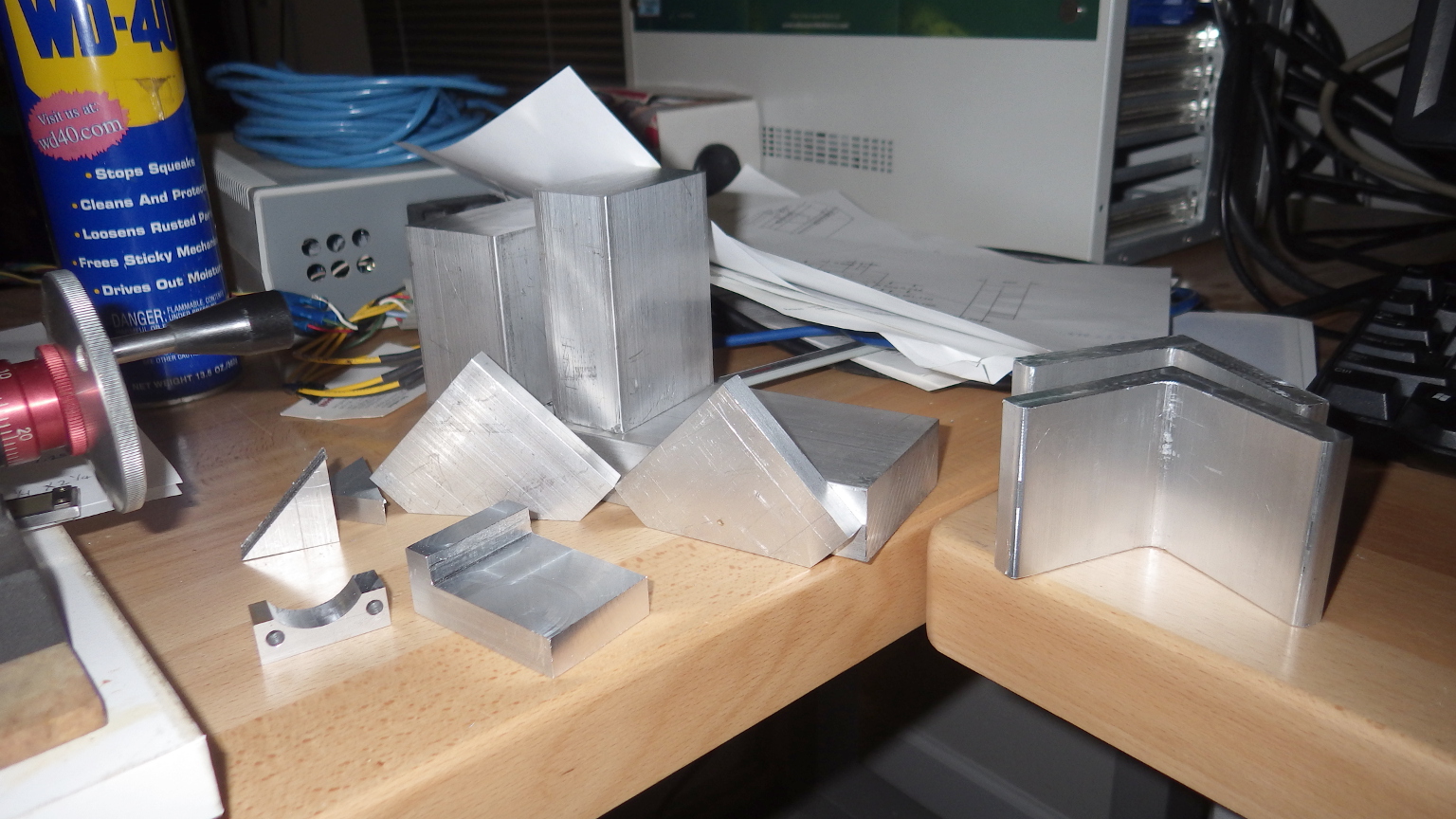
I'm still cutting aluminum for the CNC conversion project, I just don't have any finished pieces to show off.  Not since the weekend.  I've just been rough cutting and rough shaping all the pieces to minimize the cutting time on the small CNC mill.  Here's all the stock. 
The two pieces of angle aluminum on the right are the X and Y motor standoffs, cut to final size but not drilled and tapped.  That shouldn't take long.  The two pieces on the left that are kinda pentagons (but really squares with one corner triangle cut off) are the motor mounts these will mount to.  They're the right overall size but need all the holes drilled and bored.  In front of those is a rectangular piece with a lot milled away - you can see one end has an edge that's about half an inch wide and standing not quite a half inch above the rest of it: that's the Y-axis ballnut mount.  It's a little oversized and ready to drill and bore its holes, then thinned to final size.  The little piece to it's left is the X-axis ballnut mount I showed on Friday.  The two scrap triangles are behind that.

Behind all those pieces are the Z-axis ballnut mount and Y axis spacer (thicker chunk) standing vertically on top of the X-axis endplate.  None of those are rough shaped at all, other than being cut from longer pieces of bar stock. 

Not shown are the couple of cubic inches of aluminum chips and sawdust I've put in the Shop Vac.  All of the rough shaping has been done on the big mill because it can take such big cuts compared to my CNC mill.  I have a carbide square facing end mill like this one that's simply awesome to use, coming from my light duty Sherline hybrid.  I can take a 1/16" deep cut across the entire top of a 1 3/8" wide, 2.3" long aluminum chunk and it doesn't even sound like it's working.

By the way, I puzzled for a long time over how to take off the triangle on those (pentagonal) motor mounts.  I don't have any 45 degree blocks to set up the cut.  On the other hand, I have some V blocks with a 90 degree included angle (like these) and I realized I could set up the V block so that the edges are parallel to X and Y on the mill table.  That made the geometry perfect for a straight cut to remove the unwanted piece.  The corner of the square fit tight in the 90 degree V, leaving the piece to be cut off just hanging out there.  Simple straight cut on the Y axis (away from the camera toward the accordion-pleat Z-axis screw cover in the distance).  
As I've said before, I'm not a real machinist.  I don't already know how to pick up a print and do all this, I'm just trying to learn to make stuff.  At this point, every piece is a puzzle and I'm learning more doing this than I thought I would.  And every so often I get some cut or finish looking really good and when I think of being able to do this, I channel my inner flounder. 


Tuesday, April 26, 2016

Techy Tuesday - Serendipity and Lithium Ion Batteries

Rechargeable lithium batteries are close to the ideal battery for many applications.  They have excellent charge density in a lightweight battery.  They require more care in charging than the old lead acid batteries that are everywhere, or even nickle metal hydride batteries, but they pay you back with better capacity per unit weight compared to lead acid. 

There are, of course, no ideal solutions, and the companies who make lithium batteries are always trying to improve them.  Monday, EE Times published an article about a discovery out of the University of California at Irvine that offers the possibility of a massive increases in the number of charge cycles you can get out of a battery.  There's even the potential for a rechargeable battery that never wears out - which has never been available.  As an aside, I just replaced the 2 1/2 year old lithium battery in my iPhone 5.  It had been discharge-charge cycled around 700 times and was showing signs of wearing out.  A battery that shows no changes in performance after many thousands of cycles sounds pretty darned cool to me!

Chemists at UCI, research leader Reginald Penner and doctoral candidate Mya Le Thai, published in the American Chemical Society’s Energy Letters.  The discovery centers on charge-storage structures based on nanowires.
[T]he 'wires' in question are deposited structures (wires only the sense they are long, thin conductors). In the work reported, the wires are gold, and they are coated or sheathed in manganese dioxide (MnO2). The device is essentially a capacitor, with the charge-storing capacitance being formed between interleaved arrays of the wires, all suspended in an electrolyte medium.

The use of nanowires is known to offer higher charge storage than films of identical materials. Thousands of times thinner than a human hair, they’re highly conductive and feature a large surface area for the storage and transfer of electrons. The gold wires (laid down on glass) are 240 nm across and 35 nm thick; various shell thicknesses between 143 and 300 nm were evaluated. Prior work has found that these filaments are extremely fragile and don’t hold up well to repeated discharging and recharging, or cycling. In a typical lithium-ion battery, they expand and grow brittle, which leads to cracking.

UCI researchers have solved this problem by coating a gold nanowire in a manganese dioxide shell and encasing the assembly in an electrolyte made of a Plexiglas-like gel: a gel of poly-methyl-methacrylate and LiClO4 (lithium perchlorate, source of the lithium ions to form a lithium ion battery). The combination is reliable and resistant to failure.
According to Dr. Penner, Ms. Le Thai was actually "playing" with various treatments when she tried the new method.  She cycled the test electrode 200,000 times over three months without detecting any loss of capacity or power and without fracturing any nanowires. 
“Mya was playing around, and she coated this whole thing with a very thin gel layer and started to cycle it,” said Penner, chair of UCI’s chemistry department. “She discovered that just by using this gel, she could cycle it hundreds of thousands of times without losing any capacity.”

“That was crazy,” he added, “because these things typically die in dramatic fashion after 5,000 or 6,000 or 7,000 cycles at most.” The structure used by the UCI workers intentionally employed nanowires of high aspect ratio (very long relative to their width) in order to reveal or amplify the effects of any failures: none were seen.
You might say the new treatment extended the life of the wires by as much as 40 times.  It's actually quite a bit more, since she didn't find any failures in her 200,000 cycles, so they don't really know how long the batteries can last.  Since no failures were found, this raises the tantalizing prospect of a rechargeable battery that never wears out.  Let's not say "never"; because never is a long time.  The universe will apparently wear out at some point in the future, and any batteries around at that time will die with it, so let's just say they don't know how long these batteries may last, but it's far longer than any technology tried so far. 

Spacecraft designers, undersea or underground systems designers; literally everyone who works on systems that are extremely difficult to work on are all quietly excited right now.  The batteries are not on the market, yet, but “This research proves that a nanowire-based battery electrode can have a long lifetime and that we can make these kinds of batteries a reality.”
UC-Irvine doctoral candidate Mya Le Thai holds up a nanowire-based technology that allows lithium-ion batteries to be recharged hundreds of thousands of times. Photo: Steve Zylius/UC Irvine


Monday, April 25, 2016

That's Not Good

The velocity of money has crashed to the lowest level in 57 years.
The velocity of money is the rate at which it changes hands.  You can see from the chart that through the tech bubble of the 90s, the velocity was the highest value on this chart (which goes back to 1960).  Around the 9/11 attacks it dropped back toward the previous levels, but the interest rate cuts and other activities of the Federal reserve helped it pick back up, until the real estate bubble they created blew creating the crash of '08.  After '08, despite all the money printing quantitative easing and ZIRP from the Fed, they never were able to get the number back into its historic range.

The velocity of money reduces to a simple algebraic equation.  Vt*M=nT
where
Vt   is the velocity of money for all transactions.
M   is the total amount of money in circulation on average in the economy (see “Money supply” for details).
nT  is the nominal value of aggregate transactions.
The idea here is that if the Fed printed a quadrillion dollars and put them in a safe, they wouldn't be inflationary because their velocity is zero. The problem is that this theoretical boundary case tells us nothing.  I mean, if a bank holding those imaginary dollars really needed them, like to stave off bankruptcy, do you doubt they'd use them?

So what does this collapse mean?  For one, there sure is no sign of an economic recovery going on, nor has there been one.  You've heard, I'm sure, the "great recession" ended in '09?  Not by this chart.  I figure the next "little while" (year? two? we're extrapolating off the end of that curve) is going to look more like the last eight years than a healthy economy.   


Sunday, April 24, 2016

It's Official - America is Out of Problems

Years ago, the insightful Mrs. Graybeard came up with an interesting theory behind the epidemic of gang violence in this country.  Perhaps it was born from talking with a friend's high-school age daughter who had just returned from a year long mission trip to Uganda, and told us of how earnestly and seriously those kids go to school.  How they'll do anything to get an education; compared to her peers in an American high school the previous year who acted like studying was doing their parents or "society" a favor.  Perhaps it was an NPR story, similar in tone, about Indian children who work in factories putting the flammable heads on matches and desperate actions to get them into schools.

The conclusion was that Americans have it too easy.  It led Mrs. Graybeard to theorize that instead of having to "hunt and gather", meals are provided at school or EBT cards are handed out to vast numbers (almost 50 million).  With the time on their hands that might have been spent hunting, they turn to hunting each other, giving their predatory instincts an expression.  Dominance posturing that might have been done with mock fights, like some animals, or by collecting shiny baubles like Bowerbirds, turn into death matches over gang turf.  Same instinct, more malignant in expression. 

I don't know if that's really true or not, and I'm not advocating for a return to child labor.  What's more, I don't even know how to test the idea, but columnist Derek Hall of Townhall.com writes a piece with a similar theme, saying "We're Out of Problems".
It’s 2016, right? I hope so because that’s the year I put on my check when I paid my taxes.

That’s means we’re at around 6,000 years or so of recorded human history, right? Add to that that thousands of years unrecorded before that, and you realize people have been around here for a while. Yet, in the year 2016, we find ourselves in a heated debate over what is or isn’t a man or a woman.
Seriously, he says, we must be out of problems.  That's not to say that individual people don't have problems, but that Western society - especially American society - is out of problems.
Since we are out of problems – we have food, shelter, medicine, etc. – we’ve decided not to celebrate but rather to create problems out of thin air.  
For example, the left rambles incessantly about "income inequality".  Of course incomes aren't equal, that's meaningless.  But no one stole income from someone else.  To think so is laughably juvenile.  The left always seems to believe the economic pie is so limited in size that if one person has a larger slice, it must mean they took pie from someone else.  Conservatives always believe we can make more pies, and we're surrounded with proof of that idea.  Derek Hall talks about Mark Zuckerburg from the "Book of Faces".  While I dislike the company and don't have an account, Hall is 100% right when he says,
Mark Zuckerberg is not worth $35 billion because you aren’t, or because anyone else isn’t. He didn’t take $35 from a billion people. His wealth was created, not taken. Earned – a concept we used to understand and celebrate, but now go out of our way to scorn.
It's worth repeating that the poor in this country have more material wealth than much of the world.  Certainly they have more material possessions than were common even a generation ago.
Many of our nation’s poor are fat, lazy and satisfied. They have flat screen TVs and cable, microwaves and Internet, and all the food they need. Even our homeless have cellphones. Because we don’t have to wake every day to forage for food and hope some simple scrape won’t lead to an infection that kills us, we’re afforded the luxury of feeling cheated by someone having more. 
It's a good piece and worth a read.  Last words to Hall:
Just imagine how bad things would be if we had real problems…
(Indian children working in a match factory - Getty Images)


Saturday, April 23, 2016

Google's Crony Relationship With the Obama Administration

According to the site Protect Internet Freedom, and their newsletter "The Intercept", Google has been the most frequent visitor to the White House and there has been a revolving door between Google and the Administration, with nearly 250 people leaving Google to work in the White House or leaving the White House to work at the tech giant.  Between January 2009 and October 2015, Google staffers gathered at the White House on 427 separate occasions.  The White House official visited most often by Google is Todd Park, the U.S. chief technology officer from 2012 to 2014. In that short period, Park met with Google officials at the White House 22 times. Park’s replacement, current Chief Technology Officer Megan Smith, was a former Google vice president. She had five White House meetings as a Google representative, then 10 Google meetings as a White House representative.
No other public company approaches this degree of intimacy with government. According to an analysis of White House data, the Google lobbyist with the most White House visits, Johanna Shelton, visited 128 times, far more often than lead representatives of the other top-lobbying companies — and more than twice as often, for instance, as Microsoft’s Fred Humphries or Comcast’s David Cohen. (The accompanying chart reflects 94 Shelton visits; it excludes large gatherings such as state dinners and White House tours.)
Google, of course, claims innocence. In a company blog post, they attacked the WSJ for daring to question them. They were just there to help fix the steaming pile of fail called Healthcare.gov, and to talk about STEM education, internet censorship, cloud computing, trade and investment, and smart contact lenses. No, it had nothing to do with the several antitrust lawsuits against Google!  How dare you suggest such a thing! 
Google’s dramatic rise as a lobbying force has not gone unnoticed. The company paid almost no attention to the Washington influence game prior to 2007, but ramped up steeply thereafter. It spent $16.7 million in lobbying in 2015, according to the Center for Responsive Politics, and has been at or near the top of public companies in lobbying expenses since 2012.

But direct expenditures on lobbying represent only one part of the larger influence-peddling game. Google’s lobbying strategy also includes throwing lavish D.C. parties; making grants to trade groups, advocacy organizations, and think tanks; offering free services and training to campaigns, congressional offices, and journalists; and using academics as validators for the company’s public policy positions. Eric Schmidt, executive chairman of Alphabet, Google’s parent company, was an enthusiastic supporter of both of Obama’s presidential campaigns and has been a major Democratic donor.
...
Google doesn't just lobby the White House for favors, but collaborates with officials, effectively serving as a sort of corporate extension of government operations in the digital era.
It can perhaps be argued that in an increasingly technical world, that the fed.gov should hire the best guns from the private sector to help them out.  The question becomes, can the feds be trusted to regulate Google (or Silicon Valley in the larger sense) when they've spent so much time in bed on the sofa together.  This is saying Google is the personal "IT help desk" to the White House staff.  Shouldn't that be up for public bidding, like any other government contract?  I can imagine several companies would like to have that position.  And there is no doubt that Google’s rise in Washington has coincided with public policy that is friendlier to the company.
In 2012, staff at the Federal Trade Commission recommended filing antitrust charges after determining that Google was engaging in anti-competitive tactics and abusing its monopoly. A staff report that was later leaked said Google’s conduct “has resulted — and will result — in real harm to consumers and to innovation in the online search and advertising markets.”

The Wall Street Journal noted that Google’s White House visits increased right around that time. And in 2013, the presidentially appointed commissioners of the FTC overrode their staff, voting unanimously not to file any charges.
I suppose there are probably naive folks who think search engines are impartial things, and return results based on some objective measures of popularity.  Sorry, but that just isn't the case.  Google (and their competitors) go through proprietary algorithms that change fairly quickly.  As a fellow gunnie, I'm sure you recall that they completely blocked out gun and ammo searches back in 2012, a practice that has shown up back as far as 2002.  It's not hard to imagine Google returning only unfavorable search results on White House political enemies, is it?  Can you see them influencing the election process, if only by restricting the information that can be found online?   

The article contains a couple of very information-dense graphics that chart the 427 meetings between WH and Google representatives, and that chart the revolving door between the WH and Google.  The second chart reveals 55 cases of individuals moving from positions at Google into the federal government, and 197 individuals moving from positions inside the government to jobs at Google.  This isn't a new thing; the revolving door between the big banks and brokerages and their regulatory agencies is another example.  But wouldn't it be better all the way around for less corporate cronyism  to be the rule?  Unless you're one of the cronies, then it would suck.  
(source)

Friday, April 22, 2016

And It Looks Like This

Rather than prattle on about Earth Day, here's a picture of how that piece turned out.  I found a way to code the circle cutting routine in G-Code that created a semicircle.  I need to program in the start and end points of the arc (doesn't have to be a 180 degree arc), and the radius.  No need to go to the center or anything.  When I cut that, it was a 180 degree arc, and I cut off the longer "bat ears" on the left and right ends with a cutoff saw. 
It's a bit off center, but it seems to do what it's supposed to do. Here it is in place. 
There's a pair of 10-32 screws going through the ballnut (big piece with slanted edges) into the mounting piece in the front.  There's a bit of a question of what goes in those holes in the mount.  The drawings I'm working to say to put a pin in there that's 0.216 diameter.  The hole in ballnut, though, is .208, so that ain't happening.  I suppose I just turn it down to a smaller diameter, but I'm not sure. 

Remember, in honor of earth day, you should go burn some coal (hey, it comes from the earth, right?).  Better yet, burn some artisanal firewood.  Just be sure it's enough to be visible from Alpha Centauri.


Wednesday, April 20, 2016

Back In the Shop

My recovery from my nasty week has progressed enough that I can walk or stand around without pain, so I spent most of the day trying to figure out just how to hold the stock and make a small part.  It's not done yet. 
For scale, that's a half inch thick piece of aluminum that's 1 3/8" long by a half inch tall.  The raw stock I'm cutting it is taller than that; around 0.9 inches (toward the top in this view).  The part that's slowing me is cutting out that sector of a circle.  I have two small clamps holding this piece down to the table, pretty much at each of those holes.  The circle diameter is 1.11" which puts the center of the circular cutout just barely still on the metal. 

I started out thinking the way to do this is the way I cut the circular cutouts in my previous pieces, but the exact lines of code I used that time would be inefficient here.  That time, I cut circular holes in the solid metal.  This time, I only have a part of a circle to cut. If I used the previous routines, I'd spend about half the time with the cutter in mid-air.  It's true that there are worse ways to spend my time, but I also think it's worthwhile to figure out how to do it the most efficient way possible. 

The next part is going to be a bit harder, too, but in a different way. Pictured here, it's a replacement for an existing end cap on the long (X) axis of the G0704's table. 
This part is roughly 7.1 x 2.2", and most of it is thinned down from a 1" thick piece of plate to 1/2" thick.  I ran this through my CAM program, and it tells me I'm looking at roughly 18 hours of machining time.  I'm not comfortable with thinking that everything can run that long without issues.  The only alternative I can see is to use the big mill, since it's all still fully usable.  It just has to be done manually.  The G0704 can take take off much more per cut than the Sherline/A2ZCNC mill can - which is why I bought it in the first place!


Tuesday, April 19, 2016

Techy Tuesday - Do Intel's Layoffs Signal the Death of the Desktop?

It's one of the stories being bandied about.  EE Times newsletter is saying that Intel announced the layoff of 12,000 workers today, about 11% of their work force.  What's eerie are details of the layoffs.
Good night to the PC as an icon and driver of the semiconductor industry. Intel Corp., its head cheerleader and advocate officially cut it loose today announcing a cut of 12,000 employees, 11% of its staff amid a sequential decline in quarterly revenues and profits.
Essentially, the layoffs are coming from their PC products division.
In the reorganized company, Intel’s client computing group still makes up 55% of its revenues. Its growth engines include its data center group which now makes up 29% of revenues. Its newly reformed Internet of Things Group combines what has been a thriving embedded division with an emerging IoT business.
...
As some analysts anticipated, Intel is leading with its strong foot – a data center market its Xeon chips dominate and an embedded market where it is gaining increasing sway.  “We are evolving from a PC company to one that powers the cloud and billions of smart, connected computing devices,” said Krzanich in a press statement announcing the quarterly results.
People have been predicting the death of the desktop for quite a while, although the frequency of those reports goes up and down - like here, for example.  An unintended consequence of Moore's Law is that the constant increase in the density of parts, and increase in level of integration combine to mean that companies can only grow if the market for their parts is expanding, not even staying static.  For the last few years, smartphones and tablets have been the growing markets that fueled semiconductor sales.  Those numbers are tailing off as the number of smartphones approaches "one for everyone on the planet who could use one".  That's one reason for the hype over the Internet of Things: the hype could grow the IoT market and the number of parts the semiconductor makers can produce. 

Think about the single board computers like the Raspberry Pi: these use Smartphone parts and allow a sub-$40 retail computer that can do as much as many people really need.  It raises the question of whether anyone should buy a new desktop.  There's really nothing a modern tablet lacks compared to a desktop; except for the larger screen of the desktop's monitor.  In addition, the trend is for online apps to replace software installed locally into your machine's "Program Files" folder.  It's simply the case that most users don't need or want to work that way anymore.  While I had Microsoft Office '03 until a few years ago, in order to keep growing the program (to keep sales going), they keep adding features.  From what I've seen I'll bet not one user in ten thousand needs all the features that they put in Office.  Today, I use Open Office, but even that is more than most need and a bit anachronistic.  When I work on the Gun Blog Variety Show podcasts, we all use the online Google Docs program.  Nothing lives on my machine; it's all in Google's cloud.  We can all simultaneously edit the same document.  We don't need to be editing the same section that another user is editing, but that's virtually always the case.  It was the case at Major Avionics Corporation, where we used more arcane tools but could edit different sections of the same document stored on a shared drive. 

Part of me says "you ought to grab a last-generation desktop", but there probably won't be such a thing for a while.  Do you need to get one?  If you have a desktop that's under (I'm guessing) four years old, you probably won't buy much by upgrading to a new desktop.  With Intel closing off that division, I have to wonder if Intel based desktops will be available much longer.  Still, unless you're the rare "power user" who puts large demands on a system (and, increasingly, "power user" equals "video gamer")  look at whether or not you could live with a tablet.  A tablet with a keyboard replaces tapping a glass touch screen to type, making it just as easy to use as a laptop, and just as powerful as a desktop. 
(Source with details here)