Saturday, February 11, 2017

Will Private Property Disappear in Our Lifetimes?

That's the provocative title of posting of Bill Bonner's Diary yesterday.

It's not Bill's prediction; it's a question posed by Doug Casey of Casey Research at a conference they both were attending on South Miami Beach.

No private property?  Even in the old Soviet Union and Mao's China, people kept some personal property.  Trinkets from ancestors, little things they collected.  The state, of course took real estate, financial assets and anything else that wasn't protected, hidden or buried.  The Soviet Union collapsed, of course, but the most valuable thing it stole was the belief in peoples' hearts and minds that they could control their own futures and their own lives, so that when the foot was taken off their necks, most didn't know what to do.  A few became the rich oligarchs that run everything now.

Still, when you consider the abject failure of communism in the Soviet Union, Castro's Cuba, Venezuela, and anyplace it has been tried, it would be tempting to think that nobody would be foolish enough to think it would work now.  Unlike mathematics or engineering, where ideas that don't work are discarded, politicians recycle old failed ideas all the time.  Perhaps, charitably, the older generation who learned what doesn't work retires or "moves on" and the idiotic ideas like communism and socialism keep coming back.  Just look at the Bernie supporters or just about any of the rioters we see on the news since Trump took office.

Consider Bonner's analogy for the machinations of the central banks.  He uses the familiar example of a parking garage.
“You leave your car at a parking garage. You get a claim ticket. That is a form of money. It is not real wealth, but it represents real wealth – your car.

“Now, imagine that the parking lot prints up extra claim tickets. It increases the ‘money supply.’ It may even have a temporary boost to the economy, as people think they are richer and better able to spend. Now, several people may think they own your car.

“Of course, there’s only one car there. But the people in the financial industry who print the claim tickets can use them to take your car away from you.”

And they can use the same system to take your house… your stocks… and your bonds. This would be a hidden revolution. Private property would largely disappear. It would become the property of the Deep State elite who control the system.
Do you own your home?  In the sense that it's paid off and you're not making a mortgage payment?  If not, your mortgage may have been sliced and diced into one of those collateralized debt obligations, CDOs, like the ones that caused the last financial crisis.  These things get sold and traded among the big banks regularly.  They were considered low risk, very secure investment vehicles until it became apparent there were too many subprime mortgages added to them.
And the cronies in the finance sector may already have a claim on your house. But most houses are bought with mortgage financing. Banks lend you the same fake money that the Fed uses to buy stocks.

They create deposits out of thin air when they make a loan, using nothing more than keystrokes on a computer.

They never earned the money. But you have to borrow it from the bank… buy the house… and then pay back the bank. And if you don’t pay, the bank takes the house and sells it to someone else.

Years ago, people would celebrate when they paid off their mortgages. At last, they owned the house free and clear. Now they are taught to “manage” their credit… and refinance.

And with mortgage rates so low, why not?

Most homeowners never own their homes. They simply rent them from banks… paying all their lives for the roof over their heads and the flat screen in the rec room.

But wait. They also pay property taxes. In Baltimore, we now pay as much in property taxes as we paid in rent a few years ago.

Even our automobiles are now often leased or financed. We talk about “our” cars and houses. But many are no more ours than a rented bicycle.

They, too, belong to the banks – the finance arm of the Deep State.
From the purely practical standpoint, even if you have paid off your house, you still have to pay property taxes.  If you don't pay those property taxes, your house will be seized by the local government where you live and you'll lose your private property.  Anyplace you can live is subject to these taxes.  From that standpoint, perhaps it's fair to say there are no privately owned homes anymore; we think we owe them but pay a form of rent to the taxing authority.  

Rough estimates are that by running essentially zero interest rates since 2008, the Federal Reserve has transferred $8 Trillion from American savers into these banks.  That's the amount of interest that savers should have earned if real, market-determined interest rates had been paid to savers.  That money will never be gotten back.  It's part of the system that makes the Deep State able to own everything.

Friday, February 10, 2017

Our Annual Trip to the Land of the Mouse

Orlando is best known as home to Walt Disney World and a host of other theme parks, but no mice, killer whales, or movie characters were involved.  Today was our annual visit to the Orlando Hamcation, which we have been doing without missing a year since 1982.
Despite the 35 years of attendance, today was a first: the first Friday we've ever attended.  I've been retired for 14 months now, and while I could have attended on Friday last year, it honestly never occurred to me to do so.  Today made it abundantly clear it's a good day to go.  We got better parking than we have for years, crowds were much easier to navigate than they have been for years, and the whole experience was better than it has been for many years.

What was familiar: essentially everything.  There was the usual collection of old radios, some in use for over half a century, along with radios from every decade since then.  If anything, a larger number of dealers were selling the various brands of Chinese VHF/HF handie talkies like Baofeng, Wouxun and others I haven't heard of yet.  Speaking as a guy who puts a lot of time on a smoker, the folks who do the barbecue there put up a fine lunch.  $8 for a stuffed brisket or pulled pork sandwich is really in line with what you pay in a sit-down restaurant, and it's good barbecue. 

On the other hand: they played with the layout, moving some buildings and club functions around.  In the spot where the hosting club has always had their Welcome booth, featured supplier Heil Audio was showing and selling.  The club's booth was moved to a lower tier building.  

What was missing was that there didn't appear to be any big product announcements going on.  I also noticed there seemed to be fewer of the more leading-edge things, like the FreeDV digital voice group that was there last year.  I noticed that with all the folks selling the Chinese radios, I didn't see anyone selling the HF radio I talked about here in late '15.  I saw fewer Arduino project kits than last year, and given that I've probably seen a dozen web-based projects that made a CNC-driven laser wood burner out of a DVD burner LED, I expected to see something like that.  Nope.

The weather was nearly ideal with beautiful blue skies and a high of about 70.  The crowd was loving it.  The Hamcation's website says that they are now the number 2 hamfest in the country, behind Dayton, which will be in Xenia, Ohio, this year and won't be in Dayton for the foreseeable future.  The hamfest world seems to be shifting to be more of a Friday/Saturday event than a Saturday/Sunday event.  It's the case in Dayton, it's the case in Orlando and it's even pushing into our little town.  If someone is taking a vacation to go to a very out of town hamfest, it makes sense that putting the event on Friday isn't a big change in plans.  Sundays have been marginal at best at hamfests for as far back as I can recall, and Saturday still seems to be the busiest day. 


Wednesday, February 8, 2017

Tweaking And Verifying the Mill

As said last week when I said the main construction phase on my CNC mill was complete, it was time to move from construction to optimizing, and that's what I've spent the last several days doing.

The first thing to go after was backlash.  I duplicated the measurements and started with backlash of .012 on X, .010 on Y and .004 on Z.  Going after the big one is the obvious way to do this, but there's another reason that's more practical: the X-axis has an exposed end that I can put a hand wheel on to crank.  That allows me to easily feel the movement of the wheel before the table moves and it allows me to hold the ballscrew motionless while tightening some nuts against the AC bearings.  The problem I had was that I didn't have anything that fit the shaft.  The shaft is 5/16" and I had a 1/4" handwheel from my micro mill.  I was going to make an adapter that fit over the 5/16" shaft and inside the 1/4", but realized there was an easier way.  I had the original handwheels from the mill and just needed to make a collar to take up the gap between the 5/16 shaft (.313) and the handwheel (.393).  The shaft has a flat, so I drilled and tapped it for a setscrew and put the handle on it.
This large handwheel (about 4" diameter) allowed me to get a good measurement of the backlash.  I took photographs of the wheel before starting to crank back in the direction it came from and then as soon as I saw some motion on the dial indicator.  I tried to maintain the same camera position, getting two very similar pictures, then imported them into Rhino3D.  Drew lines on the wheels and then measured the angle between the lines.  Worked out to be 13 degrees.  To how much precision?  No idea. There's clearly parallax in the picture so the camera wasn't positioned exactly the same.  
So what does that mean?  13 degrees is 13/360 of a circle or .03611.  If my program is counting the number of steps its going to apply (which is what they do) those steps are not going to move the system and I'll lose 0.3611 turn times 0.197 inch/turn or 0071 inch.

Despite my misgivings at having to take everything apart, I tore down the X axis and spent an hour or so trying to get it so that there was no wasted motion.  I cut my backlash down to .006" on X.

I repeated this as much as I could on Y, but while there's no place to put that handwheel, I could turn the stepper motor with the 1/4" shaft coming out the back of the motor.  This one moved less, and I could adjust Y down to .006 as well.  Strange how they match.

I didn't do anything to Z.  I think I can live with .004. 

Now I have to confess that I don't really know why zero backlash is pursued so exhaustively while other sources of errors are seemingly ignored.  I'd like it to be a better, but I don't really know what to fix now, and all the CNC controller software includes backlash compensation.  If I spent another week and reduced it to .002, would that really make a difference?  It all depends on what I'm going to be doing, of course, and I can't answer that exactly.  

For casual readers, backlash is lost motion in your system.  Many of us have tuned the knob in a radio and noticed the knob slipped backwards when we let go of it.  That's a form of backlash.  When you're running a machine manually, you can watch the dial or Digital Readouts (DROs) or even feel that it's not cutting until you crank out the backlash. Say you have the .006 backlash I have; you watch the DRO and when the machine starts moving, you can see the position changing.  When I encountered my first CNC backlash problem I was trying to engrave text on a cylinder and the machine had to go back and forth along the X axis hundreds of times.  If I recall correctly, I was going to engrave every degree around a cylinder, 360 passes (might have been more).  The effect of losing a few thousandths every cut over 360 passes was for the text to spiral along the long axis of the piece. (360* .006 is 2.16"!)  Once I put backlash compensation in place, it was fine.  I first got the CNC Sherline going because I wanted to carve waxes for lost wax casting.  I carved at least a dozen waxes to make rings out of (not that I ever cast one) with backlash compensation on the Sherline and they always looked fine. 

So for this sort of work, backlash was never a problem as long as I used the backlash compensation in the software.  On the other hand, I've heard from guys who are "real machinists" who say that if the backlash on their system gets about .0005", they can see the surface finish get worse.  I was not super critical of surface finish on the waxes I was carving because that step gets followed by more work that changes the surface anyway. 

After fighting the backlash, I started going after something that was more of a puzzle than anything.  During the setup of the LinuxCNC system, I had to tell the program some parameters of my system so that it can calculate how many steps it needs to go a required distance.  This could really get down in the weeds, so let me try to give the short version.  It asked for the number of turns per inch on the ballscrews, and a quick inspection said it was around 5 turns per inch (TPI).  Once it was running, when I commanded the system to go an inch, it went much, much farther.  I could scale that number back to make the distance what I commanded, but now the number for TPI was about 1/4 of 5!  In fact, it's 1/4 of the metric pitch, 1.27 TPI.  It turns out there's a property of the motor drivers that can make a screw act that way.  The motor drivers, all four of them, act like they're stuck set to one mode and the switch that's supposed to change it has no effect.

I've been trying to troubleshoot this for a few days, now, and I'm currently waiting to hear back from the hardware supplier I used, Automation Technologies.  This doesn't keep me from doing anything in particular, and it's not a big problem, but it's one of those things that just doesn't work like I think it should.

Finally, I commented in that piece last week that I didn't think I was getting the same rapid movements that Hoss gets on his DVD.  As part of troubleshooting that last problem, I resurrected one of my old Mach3 computers today and got it to run the Griz.  There's no problem with rapid movements.  I can move all three axes reliably at 260 inches per minute.  In most of what I've done on my Sherline, the Z-axis is the holdup because it can only go 15 IPM.  X and Y can go 40 ipm.  Being able to move everything at 260 IPM brings a massive improvement over that system. 


Tuesday, February 7, 2017

Tab Clearing

Item of the first:  the Florida Fish and Wildlife Conservation Commission (FWC) has ruined my joke.

Back in January, the FWC released information that they were hiring Irula snake hunters from India to help hunt down the Burmese pythons in the Everglades.  
Irula natives from India accompanied by hunting dogs and Everglades Park officials have caught 13 pythons in eight days, including a female snake measuring 16 feet long.

“Since the Irula have been so successful in their homeland at removing pythons, we are hoping they can teach Floridians some of these skills,” explained Kristen Sommers, leader of the FWC’s Wildlife Impact Management Section.
Lame joke:
“The FWC has hired Irula python hunters from India to go out in the 'glades and hunt pythons."

“So?”

“A spokespython today delivered the message, "The Indians were delicious. Please send more" ”
On a more serious note, the problem with Burmese pythons in the state is big and serious.  The state has had bounty hunts and other things to try to encourage eliminating the species, but the pythons seem entrenched and are even expanding their area.  In November, one was found more than a mile offshore in Miami's Biscayne Bay.  It looks like the pythons have won.  Another few non-winters like this one has been, and they'll probably be well-established up here in Central Florida.  They've already been verified north of here near Georgia's Okefenokee swamp.  Which has nothing to do with this story

Item of the second:  Want to predict the odds on which of Trump's appointees the Democrats will fight the most?  John Lott of the Crime Prevention Research Center says his research shows it will be the ones who are most persuasive and might corrupt the liberals around them.
Tracking federal judge appointments over the past four decades, I have found that confirmations took much longer for graduates of top-10 law schools who served on their school’s law reviews. In fact, it took 65 percent longer compared with graduates who neither went to top law schools nor did particularly well there. Among nominations from the Carter through the George W. Bush administrations, confirmations took about 160 percent longer for the top students at top law schools who further distinguished themselves with clerkships on the Supreme Court.

We find the same phenomenon in jury selection, where lawyers often disfavor intelligent candidates or ones who make a living by persuading others. The concern is that these people will have a strong influence on their fellow jurors.
...
Likewise, Democratic senators don’t want a conservative Supreme Court Justice, even one who is somewhat closer to their views, who will be effective at persuading his colleagues.

Justices or lower-court federal judges can also exert influence by writing powerfully-worded decisions that are more likely to be cited in future rulings. Here, the evidence of “dumbing down” is striking. According to my analysis, federal judges faced 60 percent longer confirmation processes if their opinions once they are confirmed were cited 20 percent more often than those of their peers. Senators turn out to be very good at predicting how influential judges will be, and looking directly at citations is an even better measure of influence than where someone went to law school. . . .
So the fight over Gorsuch isn't that they don't like him and it isn't that he's going to change the court - the seat was held by Antonin Scalia.  The fight is that they think he might be effective in balancing the court toward his originalist views.

Item of the third:  credit where credit is might be due. 

I've groused here about the Taurus Millennium recall a few times, most recently in December, and how I've been without my PT145 since August of '15.   This may be premature congratulations, but last Wednesday as I was having a lunchtime cup of tea, the phone rang and Caller ID said Taurus International.  The nice young lady verified who I was and informed me a new replacement for my pistol is in the works, and I should have it "in 2-3 weeks".  I was given a choice of a few models, and settled for a PT111.  She said they did not have a .45 pistol to offer, and my choice was essentially this one in 9mm or a PT140 in 40S&W.  While I have both calibers, I've been listening to Michael Bane long enough to hear him say .40S&W is in decline as a caliber and likely to become a niche round. 

While it ain't over until till I have metal in my hands, for the first time since around the end of 2015, I'm thinking I might get something back for the gun I sent to Taurus.  I'll let you know.
A map of areas in the US with climate similar enough the Burmese Python's native range to allow the species to get established.  I was rather surprised at how far north it goes on both coasts.  Apparently tracks back to a San Francisco Chronicle article, but I found it here.

Monday, February 6, 2017

Harvard Claims to Have Produced Solid Metallic Hydrogen

A group of scientists at Harvard have claimed and offered evidence that they have produced metallic hydrogen.  The critics are skeptical.

Hydrogen, of course, is the lightest element and generally only observed as a gas.  It has been liquefied for use in rocket fuel, but that's a rare thing.  It boils out of the liquid state at 20.27 K or −423.18 °F.   While hydrogen is known as a low density gas and considered by most as a non-metal, it has the electron structure of the entire first column of the periodic table, 1 S orbital electron, which are all metals - the alkali metals.  As far back as high school chemistry, I was told that while no one had seen it in the metallic state, that under the proper conditions it should act like those alkali metals.

Solidifying metallic hydrogen has been attempted in the past, which is why the news is being regarded with healthy skepticism.  Theoreticians originally said it should turn metallic at pressures of 25 Gigapascals; instead, Harvard reports they needed to achieve 495 Gigapascals (4.89 Million atmospheres or 71.8 million PSI), almost 20 times more pressure.

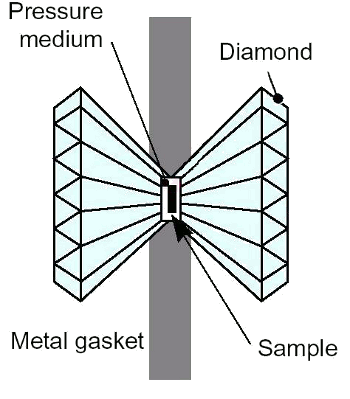
How can anyone generate that kind of pressure?  The high pressure physics community has been using diamond anvil cells for a while now.  DACs put two single crystal diamonds in a holder and apply force to them.  The combination of the small size of the culet (bottom-most pointy part) of a faceted diamond (around 100 to 200 microns diameter) coupled with the almost incompressible hardness of diamonds, can achieve enormous pressures. Pressure is force divided by area, so tiny areas require less force than larger areas.
The researchers said that as the pressure was increasing, they were able to observe - and photograph - the changes in the hydrogen in the cell. Ars Technica has this summary:
After loading the sample and cranking up the pressure (literally—they turned a handcrank), they witnessed hydrogen's breakdown at high pressure, which converted it from a clear sample to a black substance, as had been described previously. But then, somewhere between 465 and 495 GigaPascals, the sample turned reflective, a key feature of metals.
Starting as a transparent gas, the sample begins to darken at 2 gigapascals as it transitions into a semiconductor. At 495 gigapascals, it appears to become a light-reflective metal. (Courtesy of Physics.org) (Source of caption)

In a way, what comes next is the hardest part. Now that they've created metallic hydrogen, what do they do with it?  They left it in the pressure cell.  There are tests that they would love the answers to, such as whether or not it remains as an observable metal when the pressure is released.  If it does, there are theoretical reasons to think it will be a superconductor at room temperature.  That could be quite interesting.  Again, back to Ars Technica
The authors have no way of telling whether the metallic substance is a solid or liquid. They expect solid based on theoretical considerations, but all they know for sure is that it's 15 times denser than hydrogen chilled to 15K, which is what they put into the diamond anvil.

One result they do have is that there was no change in appearance even as they allowed the sample to warm up to 83K. That's intriguing, because some theoretical work has suggested that metallic hydrogen could be metastable, meaning it will remain metallic even as the pressure and temperature that forced it there is released. That will definitely be something worth checking into in more detail. Other calculations suggest it will be superconducting, but that hasn't been looked at yet at all.
The skeptics, rightly, say that they'd like to see more data and suggested what they want to see.  Entirely reasonable thing to do when many scientists have tread this path before and been wrong.


Sunday, February 5, 2017

A Man With Two Watches Never Knows What Time It Is

That's one of my favorite modern proverbs, one with which almost everyone can identify - at least if you remember depending on a watch without instant access to "atomic time" through your cellphone connection  (most of the great, older proverbs come from the Bible's book of Proverbs).

That's prompted by something that happened today.  I was up an hour before sunrise to get a pork butt into the smoker.  No, it has nothing to do with the Super Bowl, it was just time to do some experiments with my smoking setup.  The smoker was preheated and the butt went into the smoker by 7:00 AM.  I put two temperature probes into it, the built in temperature probe and my new remote reading thermometer.   That's where the problem showed up.
The pork butt was rubbed and left in the refrigerator overnight, as always, so it was cold.  The built in probe (on the left side of the meat) said 37, the remote probe (on the right) said 29.  That puzzled me.  It was out of the freezer long enough that we thought it was thawed before it got rubbed and put in the fridge.  I thought it might really just be a cold spot, so I'd keep an eye on it.  As the morning went by, the two thermometers diverged.  By 10:00 they were getting to be 70 degrees apart, almost 40 and 110, an enormous thermal gradient for probes a few inches apart.  What's going on here?  Is either one right? 

Well, what would you do?  In this case, I have other ways of measuring the temperature as long as I don't leave them in the smoker (where the chamber temperature is about 240).  A quick check showed the "independent" thermometer pretty much agreed with the other two.  There really was that big a temperature gradient.  In the intervening hour and a half, the difference has gone down.  It's now 147 and 134.  I suspect that by the time we reach pulling temperature late in the day that difference between thermometers will go down to a couple of degrees.  

Now the real purpose of this experiment was to investigate that little chamber on the right, an external smoke generator that I first talked about New Year's Eve.  As I said in that little piece, one of my main reasons for getting this was that they claim it can produce smoke for "up to 6 hours", which would make an overnight smoke for something like a big beef brisket much more bearable.  My experience on New Year's Eve was that it only ran for perhaps two hours, and I found that the wood chips would stick in the chute inside the smoke generator requiring a poke with a long screwdriver to get them to drop onto the heater.  So far, it seems to be doing the same thing.  I had to poke at the chips around 1-1/2 hours into the smoke, and I did it again at around 3. In retrospect, I should have let it sit longer to see if the smoking then stopped, or just became thinner. 

And while I'm on the topic of that cold smoking attachment, we tried the cold smoked cheese on Friday as a "birthday treat".  That was just slightly over a month since we smoked, vacuum sealed, and put it in the refrigerator.  It was fantastic.  There's one block of cheddar we smoked and haven't opened.  Some of the guys on the forum I read say they won't touch it for a year.   I don't think I could make that.


Saturday, February 4, 2017

Obama Issued Regulations Costing Nearly $900 Billion

According to an American Action Forum report, the 8 years of the Obama administration issued regulations costing the US $890 Billion.  In terms of major regulations, Obama is in a class by himself.   President Obama will average at least 83 major rules annually, 18 percent more than President Clinton and 33 percent more than President Bush. The Obama Administration also set a single-year record for the number of major rules issued in 2010 (100) and then broke their own record in 2016 (with 104).
With a last-minute flourish of $24 billion in final regulatory costs in the last three weeks, the Obama Administration passed $890 billion in cumulative burdens. The record-breaking regulatory output of 2016, which imposed the most major rules in history, capped perhaps the most aggressive regulatory record in history. From the available data on the American Action Forum’s (AAF) RegRodeo.com, the Bush Administration averaged $42 billion in annual final rule costs. The Obama Administration more than doubled that figure, with $111 billion in annual final burdens.
Of course, the problem here is that these regulations are abrasive in the metaphorical gears of the American economy's machine.  They slow down industries, reduce hiring, reduce employment, and reduce pay.  These cost burdens break down as:
  • Total Costs: $890 billion
  • Annual Costs: $139 billion
  • Annual Paperwork: 549 million hours
  • Rules Costing More than $1 billion: 113
The end result, though, is that somebody has to bear that $890 billion in costs, and that someone is the American people.

For perspective, during the last four years of the Bush Administration, it imposed more than $159 billion in burdens; President Obama and his regulators published more than that in 2016 alone, $164 billion, which is nothing compared to Obama's total of $218 billion in 2012!

Who are the big offenders?   I bet I don't have to tell you the most expensive regulations came from the EPA.  Breitbart summarized it as follows:
The Environmental Protection Agency (EPA) issued $344 billion worth of regulations during the Obama administration, and implemented the most expensive regulations out of all government agencies, according to the study.

The Department of Energy came in second, issuing $194 billion in regulations over the last eight years.

The Department of Health and Human Services (HHS) issued $104 billion in regulations as it worked to roll out Obamacare provisions.

The Department of Transportation’s regulations totaled $58 billion, while the Department of Labor issued $56 billion worth of rules during Obama’s time in office.
In tabular format:
The AAF report slices and dices these numbers in all sorts of ways, for the truly interested. 


Thursday, February 2, 2017

“Now, Witness the Power of This Fully Operational Death Star.”

Not really.  It's just that, “Now, witness the power of this fully operational CNC Mill.” didn't sound anywhere near as sexy.

As you might have gathered from yesterday's post being called “Preview”, I was potentially minutes from having it completely assembled and operational.  There have been a lot of days in this project where a task I thought was “a few minutes” turned into a few days, so I didn't want to say I'd show this today.  Those minutes were accomplished uneventfully this morning so that by noon, it was a fully operational death star CNC mill.

It's not Done done, but I think it's fully usable.  As I say in the video description, I now move from construction to optimization.  I've run all three axes for only a few minutes, and haven't cut any metal yet, but I think I could.  I debated doing some engraving or something today to record, but instead just recorded about five minutes of a machine warmup routine I wrote.  Even I found that too boring to watch, so I cut it down to about a minute and a half.  Heck, just watch the last 30 seconds. 

On the plus side, I checked accuracy this afternoon, at least on the small scale.  When I tell the mill to move 0.100", it goes .100.  When I tell it to go 0.500, it goes 0.500.  Well, I can see what the QC guys call “ballscrew drunkenness” - a tendency for each turn to not be exactly the same length.  Mechanical engineering classes teach that a screw is an inclined plane, so think of it as lumpiness in that inclined plane.  Being accurate over half an inch means I swagged the scale for the machine sufficiently accurately for it to be OK for things smaller than an inch.  I will recheck that with a longer scale by using 6" calipers. 
The mill's corner of the shop.

On the negative side, it has too much backlash.  The whole purpose of changing from the leadscrews in the mill to ballscrews was to reduce backlash to the smallest amounts I could get.  I measured over .010 on X and Y, with Z coming in at a more respectable .004.  I was hoping for .001 or .002 on all three.  Frankly, I'm kinda pissed at that.  I'm not exactly sure where to start looking for the cause.  It has the potential of making me pull things apart again.  (Do your best Sam Kinison voice and scream, “No!, NO!!, NOOOOOOO!!!!”).  Also on the negative side, I don't think I'm getting rapids as fast as Hoss says he gets.  Rapid movements aren't terribly important because you can't do any cutting at those speeds, but they cut your production time if you need to go back and forth a lot to make something.  The last moves in that video are done with a feed rate of 100 IPM, and while the LinuxCNC software interpolation partitions that speed between all the axes somehow, it's quite a bit faster than anything I can get on the Sherline. 

Of course, in the total sense this is far from done.  The advantage is that for everything I do from now on, I have the big mill for help if I need to make parts and not just my micro mill.  Things to work on are to hook up the oiling harness (I have everything except the oil), the enclosure and the cooling system.  I had been considering flood coolant all along for this, but need to consider misting or other alternatives, before I go buy parts. 

As for now, I'm just going to enjoy completing a long, long project.  Tomorrow's my birthday, so it's good day to celebrate. 


Wednesday, February 1, 2017

A Preview

I had a heck of a time getting to this point:


The X-axis would bind and wouldn't move, even when I tried by hand with a hand wheel on the motor.  Those are 570 in-oz motors, which is quite powerful for this size NEMA23, but even that wouldn't budge it.  I spent most of yesterday trying to resolve this.

This morning, I took it apart for the Nth time and rebuilt it step by step until it stopped moving easily.  It was one of two jam nuts on the right end of the ballscrew digging into the motor mount I made several months ago.  I had to cut it back a little (about .015 or .020 - don't recall).  Then it worked fine.

I need to take it out my machinist's pay.


Tuesday, January 31, 2017

Info Bleg for Precision Shooters Who Read Here

I know of two online sources for information:  Accurate Shooter and Precision Rifle Blog.  Of the two, Accurate Shooter, which includes 6mmBR.com and The 6.5 Guys, seems the more active and with more information.  I'm also aware of Sniper's Hide, but I get the feeling it's all by subscription.  I've barely scratched the surface on any of those. 

If you wanted to learn long range shooing, where's a good place to dive in and read?  What sources am I missing? 

My goal is to stretch out my shooting to our club's 300/600 yard range.  As is often the case, I want to shoot with what I have before I think about going for a full, new kit.  I think the demands for shooting 300 or 600 yards are not as great as shooting 1000 or more, and I expect many common hunting or predator rifles will be good at 600. 

I have two bolt guns, a .308 Savage Scout rifle and a Remington 700 in .30-06.  I wouldn't be surprised if the Scout would be fine at those distances, except for the forward mounted scope.  I understand that .30-06 used to be a common long range cartridge, but neither of those is considered a precision long range round by today's standards. 

My early model Savage Scout rifle. 


Monday, January 30, 2017

Had To Adult Today

More than usual.  Is there a world out there?   What's going on besides the Muslim immigration ban that really isn't a Muslim immigration ban?

The latest attack on freedom that's getting virtually no publicity is a ban on free soda refills enacted in France.
Published in the government's Journal Officiel website on Thursday and in force since Friday, the ban applies to all soft drinks or soda "fountains" in areas open to the public, including restaurants, fast food-chains, schools and holiday camps.

Out of bounds are unlimited "flavoured fizzy and non-fizzy drinks, concentrated drinks like fruit syrups, drinks based on water, milk, cereal, vegetables or fruit", but also "sports and energy drinks, fruit nectar, vegetable nectar and similar products".
Despite the book promising, "French Women Don't Get Fat", France claims to be in the same obesity epidemic as the rest of the western world, and is responding by attacking sugar.  The article in the Telegraph (UK) offers this cringe-inducing paragraph:
A recent health study suggested that half of French adults are now overweight. However; only 15 are technically obese.
(The cringe comes from the quote that only 15 French adults are technically obese; I'd be willing to bet that was supposed to read 15%.  If there really are only 15 obese adults in France, the government should be flogged for enacting this rule; if it's really 15%, the author of the Telegraph article should be flogged.)

Let me be clear here: I think the French Health Minister is largely correct in assigning too much sugar as the likely root cause of "the spreading obesity problem".  Not in the sense usually offered, that it provides "empty calories" that lead to weight gain, but that sugar messes with the body's hormonal systems, primarily insulin, and obesity is a metabolic disease caused by improper hormone responses.  I notice that the ban includes fruit juices and other sources of "natural sugars" that are just as dangerous, as well as sports or energy drinks that are also high sugar, but the ban doesn't seem to specifically exclude artificially sweetened "diet soda".  That makes much less sense to me.  

Despite that, I completely disagree with the government's actions.  I'm all about personal responsibility, and it should be peoples' choice to take advantage of more soda for free if it's offered.  Like Bloomberg's New York City soda ban, the state never seems to think that people can simply buy another soda.  The state never seems to think that people might drink less soda if they weren't forced to buy a certain size.  The state never thinks that perhaps someone might feel like just a little more soda, perhaps they feel like they need another mouthful or two, but don't want and won't drink an entire next cup.  The state never thinks. 

This is the sort of thing that happens when a socialized health system is in place.  People can't say, "but it's a bargain!  I get more soda for the same price" because it suddenly becomes the state's business if the population gets fatter.  Every Aspect of Everyone's Lives suddenly becomes state business.  Line up in front of the monitors for your daily exercises.  We're sorry to tell you, but you are not allowed to get your arthritic hip replaced because you're obese by our standards. 

Glenn Beck's producer, Stu Burguiere, links the reduction of choice at the soda fountain to the FCC's "Net Neutrality" also denying benefits to consumers that businesses want to provide. 
Net neutrality technically would ban what I think T-Mobile has done, which is give you free streaming of Hulu and Netflix and Amazon Video and all these things. A great benefit to the consumer.

However, net neutrality says, “Well, you’re not treating all companies equally when it comes to data, so you can’t do that.”

And the activists have fought to try to get that overturned, so far unsuccessfully.

But, I mean, these are benefits. These are making your life better. You’re getting more for your money, and yet government wants to come out and take these things away from you.
Do you have one of these in a restaurant you go to?  A place where you buy a cup and take as much soda as you want?  These are illegal in France as of this week. 

Final words to Stu Burguiere:
“They’ve taken something that a business has done to help their customer have a better experience, and because they think the customer is using it incorrectly . . . they're taking it away”
Typical stupid, progressive, nanny-state government.


Sunday, January 29, 2017

The Clearance Problem Has Been Cleared Up

A couple of days ago, I wrote about putting the table back on my G0704 mill and finding a problem with clearance around the oil tube to the Y-axis ballnut.  I concluded by saying, "Will the thinner tube lie lower and flatter in the cutout and be less susceptible to damage?  We'll find out."  The answer is it didn't.  The next morning, I could see that the tube had relaxed to the point where the table was hitting it.

The root cause is that the vertical edge on that part of the table goes over the oil fitting. The tubing is almost completely under the slide.  It's easy to see when the tube is off. 

I pulled the new bent tube and made another one out of a longer piece so I'd have more tube to play with.  After I heated the tube and flared it so it fits the oil fitting, I stuck the plastic tube from a spray can of air in it, held it over a heat gun and bent it a little past a right angle (plastic tube to emulate something like putting sand in a metal tube before you bend it - to keep the walls from collapsing/kinking). This was definitely a lower profile bend. I put that in place, but a straight edge sliding over it still rubbed on the tube. If I held the tube down with a finger tip, it seemed to clear, so I put a spot of RTV there and then taped it down with duct tape. It was still too high, so I stacked about 15 pounds of weights on top of it to clamp it as low as it gets. The tube said RTV takes a full 24 hours to cure, but after about 18, I took off the weights and tape to look at it.
That worked. You can see the gap between the tube and slide in this picture. The white thing is a scrap of business card that I measure at .010".  A .012 feeler gage slipped in there, but a .015 wouldn't.  Is that good enough?  My bet was that if I could be sure that it never went below .005, I'd feel good with it, but I didn't know. 

So I decided to machine away the part of the table that crosses and could rub on the tube. The idea is to cut away the underside of the table at about a 45 degree angle - 45 degrees at "eyeball accuracy" is good enough.  The table is about 28 inches long, so you see it requires cutting away a fairly large amount of cast iron.  I had thought of doing this before but concluded I'd need a mill at least the size of the G0704 to do it. A friend suggested an angle grinder. I simply hadn't thought of that because I just don't have experience with using a grinder. I bought one months ago for this project and then used my Sherline mill to do the cutting the grinder was intended for.
So I pulled the table off and rolled it outside on a dolly (it weighs more than 50, maybe 60 to 70 pounds).  I marked a line about 2/10 of an inch from the edge of the table along the full length of this edge and ground it to look smooth.  This gives you an idea of what the last few inches of the table looked like after cutting. 

It ended up going very quickly and came out remarkably smooth. Now I have plenty of clearance over that tube.  

You know the old saying, "when the only tool you have is a milling machine, every problem looks like a machining problem"  (or something approximately like that involving hammers and nails)?   When I thought about cutting back that edge at a 45 degree angle or so, I though of using a 45 degree cutter in a milling machine, or a straight cutter with the table on a fixture of some sort.  I simply never thought of the angle grinder.  Mind you, as I've said about knife making, after a few dozen silversmithing projects, I've come to believe I can do just about anything with a few hand files.  I could have done this with hand files and taken a week of labor or a few minutes with an angle grinder.  The angle grinder is the way to go!


Saturday, January 28, 2017

Gun Show Today

This weekend, there's a Military Expo and Gun Show going on just to the south of us in Vero Beach.  We've gone to that gunshow before but haven't been on one of these weekends when they do the Military Expo.

We didn't see as much of the Expo side of this as we might have, but there was a lot of military surplus for sale, dating back to the "usual" turn of the 20th century-vintage rifles like '03 Springfields and '98 Mausers.  Between the outdoors surplus sales and the indoor gun show, I saw more M1 carbines and M1 Garands than I've seen in one place before (I obviously haven't been to the CMP).  This included a Garand chambered in .308 and rebuilt on a garish laminated stock.

On the unexpected side I saw and got to play with ("coon finger" to use Tam's evocative phrase) a Ruger Precision Rifle, which I've been wanting to see for at least 18 months.  In fact, there were two of them there, one in .308 and one in 6.5 Creedmoor.  It really is an impressive rifle.  The one I played with was the 6.5 Creedmoor and was brand new, being offered by a dealer.  I didn't mess up the adjustments, at least not much, but was interested in the hardware and general fit and finish.  Excellent, as expected, with a great feel.  The quick release hardware was like those used on bikes, which I haven't seen on a gun before.  To be honest, I was a little surprised at its weight, although they do list it as a 10.7 lb rifle.  Guess that didn't work its way into my subconscious.  It was comfortably (25%) under MSRP, which was nice to see, but no, I didn't give it a new home.

I'd like to see comparisons between the RPR and the Savage BA Stealth, which appears to be designed as head-to-head competition with it. 

Those who follow Michael Bane's shows and especially his podcast know that he believes that PCCs (as he calls Pistol Caliber Carbines) are the next big thing.  We only saw one there (as three rifles at two sellers), and they were Hi-Point 9mm carbines.  Neither one of us has ever handled one of those before and Mrs. Graybeard surprised us both by really liking the feel of it.  Now Hi-Point, bless their hearts, doesn't exactly have the most sterling reputation, but we determined to go track down actual user feedback.  Our almost-neighbors up the road have very well known PCC, and they need to be considered as well.  On that subject, Bane writes:
The venerable Kel-Tec SUB-2000, available in 9mm or .40 S&W with magazines for multiple platforms and a low-ball price of $500, remains the first choice for a first pistol caliber carbine — if you can find one! GunBroker is your best bet.
Things I probably almost definitely would have bought if I found one: A decent 1911 for under $500; mostly to use as a model when I finally get to machine one.  A Savage Mark II in 22LR, especially if it was that model or on a good wood stock without the thumb hole stock.  A Ruger American Predator Rifle in 6mm Creedmoor.  None were found.  6mm Creedmoor?  When it was introduced, the RPR was available in .308, 6.5 Creedmoor and .243.  This year, they've dropped the .243 in favor of the slightly smaller 6mm.  If I look at this article, 6.5 and 6 are virtually identical, with a "perfect shoot" just 1% better with the 6.0.  The article says the 6mm Creedmoor does that with much less recoil, but at the cost of slightly less barrel life.  I could see going with 6 in a long distance rifle as long as I'm not trying to humanely hunt at those distances.

Feedback from those of you who actually shoot these combinations, or anything I've speculated on is always, always welcome.

 The Ruger Precision Rifle (RPR)


Friday, January 27, 2017

We Begin NASA's Worst Week

It's a peculiar coincidence that all NASA missions that ended in the crew being killed and vehicle destroyed occurred in the same calendar week, although separated by decades.

Today, January 27th, is the 50th anniversary of 1967's hellish demise of Apollo 1 and her crew, Gus Grissom, Roger Chaffee and Ed White during a pad test, not a flight.  In that article, Ars Technica interviews key men associated with the mission and provides, for the first time I've seen, the audio of the test.  In the early days of the space program, one of the larger than life names we came to all recognize was Chris Kraft, who had directed all of the Mercury flights and many of the Gemini missions and was widely recognized for this masterful control.
Half a century later, the painful memories remain. “I was on console the day it burned,” he explained, sitting in his second-floor den, just a few miles from the control center that now bears his name at Johnson Space Center.

“I heard their screaming voices in the cockpit of the spacecraft,” Kraft recounted. “I heard them scream that they were on fire. I heard them scream get me out of here. And then there was dead silence on the pad. Within minutes we knew they were dead, and we were in deep, serious trouble. Nobody really said anything for 15 minutes, until they got the hatch open. We were sitting there, waiting for them to say what we knew they were going to say.”
....
There was plenty of blame to go around—for North American, for flight control in Houston, for technicians at Cape Canaveral, for Washington DC and its political pressure on the schedule and its increasingly bureaucratic approach to spaceflight. The reality is that the spacecraft was not flyable. It had too many faults. Had the Apollo 1 fire not occurred, it’s likely that additional problems would have delayed the launch.

“Unless the fire had happened, I think it’s very doubtful that we would have ever landed on the Moon,” Kraft said. “And I know damned well we wouldn’t have gotten there during the 1960s. There were just too many things wrong. Too many management problems, too many people problems, and too many hardware problems across the whole program.”
The ARS article is worth your time to read. 

Tomorrow, is the anniversary of the Space Shuttle Challenger disaster.  Shuttle Challenger was destroyed on January 28, 1986 a mere 73 seconds into mission 51-L, as a flaw in the starboard solid rocket booster allowed a secondary flame to burn through supports and cause the external tank to explode.  It was the kind of cold day that we haven't had here in some years.  It has been reported that it was between 20 and 26 around the area on the morning of the launch and the O-rings used to seal the segments of the stackable solid rocket boosters were too cold to seal.  Launch wasn't until nearly noon and it had warmed somewhat, but the shuttle had never been launched at temperatures below 40 before this.  Richard Feynman famously demonstrated that cold was likely the cause during the televised Rogers Commission meetings, dropping a section of O ring compressed by a C-clamp into his iced water and noting that it had lost its resilience at that temperature.

There's plenty of evidence that the crew of Challenger survived the explosion.  The crew cabin was specifically designed to be used as an escape pod, but after most of the design work, NASA decided to drop the other requirements to save weight.  The recovered cabin had clear evidence of activity: oxygen bottles being turned on, switches that require a few steps to activate being flipped.  It's doubtful they survived the impact with the ocean and some believe they passed out due to hypoxia before that. 

Finally, at the end of this worst week, Shuttle Columbia, the oldest surviving shuttle flying as mission STS-107, broke up on re-entry on February 1, 2003 scattering wreckage over the central southern tier of the country with most debris along the Texas/Louisiana line.  As details emerged about the flight, it turns out that Columbia and everyone on board had been sentenced to death at launch - they just didn't know it.  A chunk of foam had broken off the external tank during liftoff and hit the left wing's carbon composite leading edge, punching a hole in it.  There was no way a shuttle could reenter without exposing that wing to conditions that would destroy it.  They were either going to die on reentry or sit up there and run out of food, water and air.   During reentry, hot plasma worked its way into that hole, through the structure of the wing, burning through piece after piece, sensor after sensor, until the wing tore off the shuttle and tore the vehicle apart.  Local lore on this one is that the original foam recipe was changed due to environmental regulations, causing them to switch to a foam that didn't adhere to the tank or stand up to abuse as well. 

There's film from inside Columbia until the moment the vehicle is ripped apart by the aerodynamic forces.  I suspect the forces ripped apart their bodies just as fast.  

January 27 to February 1 is 6 days.  Not quite a full week.

On a personal note, I remember them all.  I was a kid living in Miami when Apollo 1 burned.  I was living here and watched Challenger live on satellite TV at work.  Instead of going outside to watch it as I always did, I watched it on NASA Select.  Mrs. Graybeard was working on the unmanned side on the Cape, next door to the facility that refurbished the SRB's between flights, and was outside watching the launch.  It took quite a while for the shock to ease up.  I saw those spreading contrails everywhere for a long time.  Columbia happened when it was feeling routine again.  Mom had fallen and was in the hospital; we were preparing to go down to South Florida to visit and I was watching the TV waiting to hear the double sonic booms shake the house as they always did.  

When this blog started, one of my regular reads was Dr. Sanity, a flight surgeon for NASA and board-certified psychiatrist.  She was Crew Surgeon for Challenger and has left posted a haunting recollection of the mission although her blog hasn't been updated in over four years.  I conclude with a quote from that post:
I remember the Challenger and her crew frequently and with love. They are a part of me now. All of them represent the best within the American spirit, and always will. Since that day in 1986, I have come to see NASA as one of the greatest impediments to the Dream of space exploration; but I have never given up the Dream itself. Nor have I forgotten any of the pioneers who have died in the service of that Dream. Some day we humans will leave this small planet and joyfully play in all the corners of the cosmos.

I eagerly look forward to it.
The failure reports and investigations of all three of these disasters center on the same things: the problems with NASA's way of doing things.  Tending to rely on "well, it worked last time" when dealing with dangerous situations, or leaning too much toward, "schedule is king"; gambling that someone else would be the one blamed for delaying a mission.  Spaceflight is inherently very risky, so some risk taking is inevitable, but NASA had taken stupid risks too often.  People playing Russian Roulette can say, "well, it worked last time", but that doesn't mean playing has reduced their odds of losing. 

"I have come to see NASA as one of the greatest impediments to the Dream of space exploration; but I have never given up the Dream itself."  We're in complete agreement. 


Wednesday, January 25, 2017

Small Steps Forward...

Small steps forward are better than small steps backward or standing still. 

The work on my CNC conversion continues.  After getting the Z-axis moving, I went to look at how to get the oil fittings hooked up and found to my horror that I had installed the ballnut pointing the wrong way.  There's a hole in the top of the Z-column that allows feeding in the oil tube, and it was on the opposite side from the fitting.  That meant zero chance of getting a tube onto the fitting through the hole, or doing it without taking the column apart.  After some agonizing over that, I took the motor and mount back off, then pulled the ballscrew and nut, finally putting the oil fitting into the place it goes.  That was a step backward.  It doesn't fit. 
This looks fine, right? I mean except for the white fitting being overexposed. If you look in the holes in the ballnut facing you, you'll see metal, not the threaded holes that they are supposed to line up with.  If I rotate the ballnut to get them to line up, the fitting hits the side wall of the casting it's in. 

I'm still researching ways to get around that.  I really want to minimize the amount of doing everything several times that I'm trapped in, and I'm especially concerned about anything that would make me pull the ballnut off its screw and involve a potential second Ballnut Removal Tool fiasco.  So while I think about this problem, I moved on to build the oil distribution system for the XY table, so that I can put that back together.  This required some tubing adapters and some 1/4" OD tubing.  I had to order the adapters, but the tubing itself was available in town.  It took a couple of days to get everything here and then minutes to finish the distribution system. 

In this view, the upper right is a Tee connector.  The hose from the oil pump will go into another Tee before this one: one of its outputs will go to the Tee visible here while the other output will go up the Z column to oil that and to another Tee up there.   
Getting the tubing completed means there's nothing to prevent me putting the table back on and getting both X and Y moving under CNC control.  The table is the heaviest of the pieces I've been slinging around and getting it into the chip tray definitely made a few body parts complain, but nothing seems injured.  While I was playing with the table, it just didn't feel right.  Investigation led to me discover another step backward.
The table was sitting on the 1/4" tubing, rocking back and forth.  I could bend the tube closer to the fitting, but examination after pulling the tubing off showed that the edge of that vertical wall is over the middle of the fitting.  Maybe that part of my table is wider than in earlier models, but I haven't heard of this problem before.  I think that with the table sticking that far over the fitting, the table is always going to rub on the tube.  Which will probably lead to failure "sooner rather than later".  After thinking about this for a while, I decided to see if I could heat the smaller diameter tubing I have and stretch it to fit over the fitting.  It worked.  The smaller tube bends closer to the fitting and pulls out of the way easier. 

With that at least temporarily resolved, I could slide the table around, put the non-motorized (left) side's end cap back on, and then look at putting the motor on.  Will the thinner tube lie lower and flatter in the cutout and be less susceptible to damage?  We'll find out.
In the middle front,you see the black motor, followed by the blue angle stock motor bracket and the rectangular blue Y axis extension, then the cross slide with the X table on it.  Along with a mess of tools and stuff.  This is the first time the base has had the table and cross slide both mounted on it in I-don't-know-how-long. 

With some luck, I should be able to get the X-axis motor mounted tomorrow and then see if I can get this whole thing to move under CNC control.  It should. 


Tuesday, January 24, 2017

Samsung: It Wasn't Our Design, It Was the Batteries

Since I wrote two weeks ago about an independent consulting group's report laying the blame for the burning Samsung Galaxy Note 7 phones on Samsung's mechanical design, I feel that fair reporting says I should let Samsung tell their side of the story.  Samsung held a press conference Monday, the results of which were published today in EE Times, and while they say it was the batteries fault, their argument is reminiscent of the conclusions of the independent consultant Instrumental covered two weeks ago.  
...Samsung investigators uncovered two separate faults with the two batteries.

Samsung pinpointed the handset design caused overheating of “Battery A,” which was used in the Note 7 model first recalled. “Battery B,” deployed in the second recalled Note 7 model, is now identified with a manufacturing defect.

Although the Korean giant refrained from naming the battery suppliers, it is known that Battery A was manufactured by Samsung affiliate SDI. China’s Amperex Technology, a subsidiary of Japan’s TDK, provided Battery B for the Note 7.  [Bold added:  SiG]
In the case of battery A, Samsung says the battery didn't fit properly in its enclosure and admitted to a design problem here, causing the internal plates in the "jelly roll" design to short.  This, in turn led to causing the devices to overheat and catch fire.
This seems to me hard to blame on the battery vendor.  If Samsung forced the battery in to a corner that was too rounded, either the corner was designed incorrectly or built and used incorrectly.

In the case of Battery B, Samsung points out problems internal to the battery pack.  This is clearly the battery vendor's (Amperex's) problem.
Samsung ruled out any other problems with the phone.  Speculation at the time was that processor-controlled charging might have been the cause, since they were putting a larger capacity battery in the phone and attempting to charge it faster.
Samsung said that the company has implemented a broad range of internal quality and safety processes to “further enhance product safety including additional protocols such as the multi-layer safety measures and 8-Point Battery Safety Check.” The company has also formed “a Battery Advisory Group of external advisers, academic and research experts to ensure it maintains a clear and objective perspective on battery safety and innovation.”

However, the company made no reference to Samsung’s corporate culture. Reputedly, Samsung engineers cope constantly with a high demand environment, pressured to meet such overambitious goals as larger battery capacity and faster charging speed. Many industry observers noted last fall that Samsung’s high-pressure corporate culture prompted the hurried release, and subsequent recall of the replacement Galaxy Note 7 devices.
This was a large press conference in Seoul on Monday, complete with Koh Dong-jin, president of Samsung’s mobile communications business, bowing and apologizing for the fiasco.  Samsung made a big point out of saying they had hired external experts, the Underwriter's Laboratory and Exponent, to help.  From my standpoint, I don't know how helpful either one of those would be but apparently Samsung respects them.  The only time I ever worked in a place that got UL approvals, their only concern was the AC powerline until it went into the low voltage supplies.  I don't know how good they are at Li-ion battery problems.  I never worked around Exponent, but they don't have the long history and name recognition that UL has. 

Samsung's report doesn't address the thickness issue that Instrumental addressed in their report, covered two weeks ago.  Samsung does address the lack of space around the battery's edges and seems to implicate lack of space in the corner, but Instrumental's observation that their two-month old unit had no space above the battery at all seems to indicate a need for a thicker phone (or less battery capacity).  It's worth pointing out that when a company contracts for a battery it isn't like the way you or I walk into a store and buy one; the buyer creates a procurement specification and then is responsible for verifying what they bought actually meets the specification.  It's a mind-boggling understatement for me to say that a lot of effort goes into this.  It usually entails a lot a meetings, and to qualify a new product, entails extensive face-to-face meetings and testing.  Samsung said it did not plan to take legal action and that it accepted responsibility for asking the suppliers to meet certain specifications.


Monday, January 23, 2017

NHTSA Lets Tesla Off the Hook

We've written in this space before about a Tesla "autonomous" car that mistook a truck for the sky and got its driver killed last May.  The National Highway Traffic Safety Administration released the results of its investigation into the accident last Thursday (1/19) (pdf warning) finding no defects in Tesla’s Automatic Emergency Braking (AEB) and Autopilot systems.  To quote from that EE Times piece by correspondent Junko Yoshida:
Definitely, Tesla is exonerated.

Did NHTSA let Tesla off the hook too easily? Absolutely.

What lessons or guidance, if any, did NHTSA’s findings offer to the rest of the automotive industry? Very little.
For technical analysis, Yoshida went to Mike Demler of the Linley Group, a  technology analysis and consulting company in the electronics industry.  Demler had a lot to say, and none of it terribly flattering.  He said NHTSA essentially had already decided the case by other decisions they've made along the way to this.
“The critical issue here is that the Tesla fatality involved the combination of AEB and Autopilot,” said Demler. As the report shows, NHTSA “already accepts that AEB reduces accidents, and that the Tesla AEB performed according to the current state-of-the-art,” he explained. “But what happens when you combine AEB with Autopilot?”

He noted, “It would be different if Autopilot just added lane-centering to Adaptive Cruise Control (ACC) and AEB. [If that’s the case], Autopilot’s primary function isn’t safety, but it’s convenience.”
But it didn't just involve the routine lane-centering of Autopilot, which is like cruise control for steering: "keep it between the dashed lines".  This accident involved a truck turning left in front of the car and the Tesla's inability to tell a truck from the sky.  I argue that once a child learns the words for truck and sky, age 3?, no child is going to make that mistake, but the car's decision cost the life of the Tesla's owner/driver.  Furthermore, NHTSA's investigation said that truck should have been "observable" for 7 full seconds before the crash, time in which the driver should have been able to apply brakes and take control away from the car - if he knew he had to.  NHTSA says:
ODI (the Office of Defects Investigation)’s analysis of Tesla’s AEB system finds that 1) the system is designed to avoid or mitigate rear-end collisions; 2) the system’s capabilities are in-line with industry state of the art for AEB performance through MY 2016; and 3) braking for crossing path collisions, such as that present in the Florida fatal crash, are outside the expected performance capabilities of the system.
The question is whether or not the driver knew to not let the system drive in that circumstance, and if the car tried to notify him at some point.

There really is a lot to this story and it's worth your time.  Realize that in absolving Tesla of responsibility in this accident, NHTSA is implicitly encouraging more use of systems like this that are vulnerable in the event of a crossing vehicle.  NHTSA is saying Tesla can't be held liable in a lawsuit; the problem was the driver.  In saying NHTSA “already accepts that AEB reduces accidents, and that the Tesla AEB performed according to the current state-of-the-art,” they're committing to more cars with AEB systems.  Furthermore, since we all know agencies like NHTSA work at a snail's pace, Tesla was able to end-run around them by updating the software in the car "over the air" before they completed their investigation and NHTSA apparently took Tesla's story uncritically. 

Closing words to Mike Demler quoted in EE Times:
“NHTSA was obviously careful to apply a very narrow focus to this investigation,” Demler observed. “I’d say it was about 90% AEB, and only 10% Autopilot.”

NHTSA “could have dug into Autopilot more, at least as a warning to other manufacturers building similar systems,” he noted. In summary what they said was “we accept Tesla’s descriptions of how Autopilot works, the warnings they provide, and the fix they implemented.”

That’s pretty weak, Demler added.

The Florida Highway Patrol accident report on the May fatality.

Sunday, January 22, 2017

Oh, The Humanity!

No wieners were harmed in the accident, that I can tell.  This was on December 15th, although the location is gone from my notes. 

Strange as it may be to see the Oscar Mayer wienermobile here, we actually saw it in person once.  It was in May of '06 at Carlsbad Caverns in New Mexico.  Here's the wiener in happier, or at least warmer, days. 

Saturday, January 21, 2017

Silencers, Sound Levels, Decibels, and How to Know

A few days ago, I posted a little on the Hearing Protection Act.  If you've paid attention to the SHOT show coverage, you've seen people talking about not assuming it's going to pass this year but we're likely to get it in the not-too-distant future.

Coincidentally, a friend who doesn't follow my blog sent me a link to the National Institute of Occupational Safety and Health, NIOSH, telling about a free iPhone app they provide that will use your phone's microphone to measure noise levels in the standard dBA format.  Naturally I went to the iTunes store and grabbed a copy to play with.
(NIOSH photo)  The app is called NIOSH SLM (sound level meter) and is intended for checking sound levels in an occupational setting - this is NIOSH's domain, after all - so they intend for folks to survey their work area and then get more accurate readings if needed.

SLM runs only on the iPhone and they say there's no android version in development.  Android discrimination?  There's a very logical reason for them to go to iPhones, even if they are going to add android later.  The iPhone is one product with known standards for how the microphone works, the levels it responds to and all the nitty gritty details that are necessary to do this.  Android is actually an open source platform and there are several phones or tablets out at any time.  Different manufacturers use different hardware that may or may not respond the same way.  If Apple changes the hardware in the phone, it's going to comply with the same specifications as earlier phones, as long as they want to keep backwards compatibility.

NIOSH claims that with an external microphone and calibration it will meet the accuracy of higher end instruments, but as it comes with the iPhone it's accurate to "within +/- 2 dB "of a type 1 sound level meter", defined as "Precision" for use in the field or laboratory.  That's pretty amazing.  Like many (not all) audio measurements, the results are expressed as dBA, where A is frequency response curve, sometimes called "A weighting".  The A weighting is supposed to match the response of the human ear to audio frequencies and there are several weighting curves.  A site with a lot of handy information is Noise Help, who provides this handy chart
As a guide for when hearing protection is needed you can combine that table with one that the NIOSH website provides.  This is the permissible exposure to sound powers that are considered damaging to hearing.  As a rule of thumb, 85 dBA is around where most people feel the need to raise their voice in a conversation.  If you spend your day having to raise your voice to be heard over something that's running, you probably need to be wearing hearing protection. 
Time-Weighted Average (TWA)Time to reach 100% noise dose
85 dB(A) 8 hours
88 dB(A) 4 hours
91 dB(A) 2 hours
94 dB(A) 60 minutes
97 dB(A) 30 minutes
100 dB(A) 15 minutes
Notice that for a 3 dB increase or decrease in the dBA level the time halves or doubles respectively.  If you look at the right column, you'll see a table saw comes in at 105 dBA.  The chart stops at 100, so what's safe?  103 dBA would cut that to 7-1/2 minutes and 106 dBa would cut it to 3-3/4 minutes (3:45).  You shouldn't run a table saw for more than that in a day without hearing protection.

Impulse noise, like that from a gun, is different and seems to affect hearing differently, causing a loss of high frequency hearing faster than continuous noise does.   Since noise levels for everything past a .22 rifle (130 dBA) is in the 150 to 155 range, hearing protection is absolutely required - but you knew that.  If putting a suppressor on a gun drops 155 to below 130, by everything I can read, you should still wear hearing pro. I'm unable to find anything that says that suppressors do anything more for hearing than simply changing the dBA level of the shot; that is, I see nothing that shows that modifying the shape of the noise impulse helps.  You will read that some Fed.gov agency said that if the crack of the gunshot impulse noise is less than 140 dBA that hearing protection is not needed. 

How does the App work?  You can simply open it up, and there are help screens accessed by tapping on "?" on the page.  Sitting here typing, with the phone's microphone pointed at my keyboard, typing puts the sound levels into the mid 50s to over 60dBA, which is pretty quiet.  When I stop typing, the noise level drops to the around 40.  When the air conditioner starts, that goes up by 3 dB.  Proximity to the microphone is important, so they say the SLM is accurate when it's a meter away (call it one yard) from the source.  The display responds to things like hitting one key on the keyboard, but whether it will give accurate readings on gunshots is a question that has to wait.