Tuesday, March 18, 2014

Techy Tuesday - Ultra Large Capacitors Find Important Niche

Techies, electronics hobbyists, electric vehicle enthusiasts and even just folks who read my old "The Least You Should Know Series", are all familiar with capacitors; they're one of the fundamental building blocks of electronics.  Capacitors have many roles in circuits, but one of the biggest is energy storage. 

A capacitor is physically two metal plates separated by an insulator, and the basic unit is the Farad.  In radio work, where I'm from, I use values that go from under 1 trillionth of a farad or < 1 picofarad to a few millionths of a farad, say 10 or 20 microfarads.  If you look in old radio gear (or TVs) from the 1960s and before, the biggest capacitors you'll find are probably around a couple of hundred microfarads, and back in the early '70s capacitors didn't get much bigger than that - at least by my memory.  In the late 70s to early 80s, very large value "computer electrolytics" became available, for filtering computer power supplies.  In the early 80s, the first 1 Farad capacitors I had ever seen hit the market as a replacement for memory backup batteries. 

As an aside, it's not uncommon for new students studying electronics for the first time to confuse capacitors with batteries because they're so similar in structure: two metal plates with something between them which are used for energy storage.  The key difference is that the metal plates of a battery are different metals and the "something" is an electrolyte; a conductive liquid or paste that allows electrons  to move between the two metals, while in a capacitor, the "something" is an insulator.  (Electrolytics do have a paste in there, but it forms an insulating layer on one or both terminals).  The voltage on a battery depends on the electrochemistry of the materials and while they provide lots of electrons, allowing you to get much more out of them than you can store in a capacitor, the electrodes are used up in the process.  Rechargeable batteries rebuild the electrodes. 

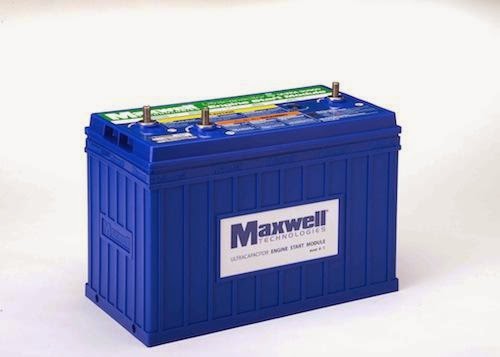
Maxwell Technologies has been advancing the Farad-sized ultracapacitors in capabilities and recently introduced an engine start module that replaces a starting battery with 36,000 Farads of capacitor, as a dozen 3000 Farad capacitors in parallel. 
If you drive trucks for a living, or work around them, you know that the stop/start cycle that delivery trucks need to support is a hardship on them.  Drivers used to leave the truck running to preserve their batteries, but nanny-staters have gathered to outlaw idling in many places.  The Maxwell ESM is intended for Class 3 to Class 6 trucks, which are typically those used for deliveries around cities. The product can replace one of the truck's batteries to provide the energy for its starting function.  These trucks typically carry three or four batteries, and the capacitor bank can replace one.  The product video on Maxwell's website says the module can provide "over one Million engine cranks at -40 to +65C". 
 
Capacitors don't get used up like battery electrodes do, so I would expect much more life out of one of these than any battery and they do claim a four year warranty.  Perhaps the life cycle degrades them, but I have smaller value electrolytics that have been working fine for decades.  The ESM is really cool tech to me, but maybe the ultracapacitors just don't have the lifetime of older technology capacitors. 

(H/T to Design News, where opinions are divided, as always)

Monday, March 17, 2014

Money And Politics

(yeah, I know.  I don't do enough controversial topics around here)

A friend I used to work with sent me a link to this TED Talk on NPR: Has Money Taken Over American Politics?  Like many of you, and some of the commenters, I thought "when has money not been in control?"  I can rattle off quotes all day, and I bet you know them, too.  Everyone knows it's a problem.  But if I had a problem to go after this wouldn't be number one.  Maybe not even number two. 

The guy who gives the talk has a program he's trying to get people to join in on.  It's not a bad talk, in typical TED style, but I think he's focusing in the wrong direction.  Contributors pay big bucks to buy government offices for a simple reason: it's an easy way to make money.  The day that buying an official to pass laws or make rules that hurt your competitor became a more cost effective than improving your company was the day we started sliding down the slippery slope to where we are. 

I've said before that I don't think money is as important as the general wisdom says.  I think the reasons everyone tries to raise bundles of many are mostly self-deception.  First off, it's easy to quantify.  The campaign manager can say, "look at how much I collected for you!".  Second, if the campaign loses, it's easier for a campaign manager to say "they spent more than we did" than to say "our advisers sucked", and way easier than saying "my campaign work sucked", or "face it - you suck".  Last week, a nobody with no experience in elected office beat Alex Sink in a House race over in Tampa area.  Sink was the evil party's candidate for governor last time - she just barely lost.  Sink and the various Democratic groups outspent the stupid party candidate by 3:1 and still lost.    In Texas, the same basic story was Ted Cruz in 2012 - Cruz was outspent 3:1 in his primary campaign.  Money is not everything.   

The number one problem on my list is that our system has devolved into a ruling class vs. the general population, and that's largely because the government is too big.  It's a permanent ruling class because once someone is elected, they stand a better than 80% chance of never being voted out.  They don't have to answer to voters or constituents, so they treat us like crap.  The only thing they're afraid of is having the big money run someone else against them in the primaries.  Obviously lobbyist money affects that, but it's crony politics all the way down.  While I like the idea of term limits, they're not without drawbacks.  Once a politico is in their last term they don't even have a reason to pretend they're not in it only for themselves.

When I think about it, it seems people have been talking about campaign finance reform for as as far back as I can recall and a law was passed in the 1970s, as well as more recently.  Really worked well, hasn't it?  We already have restrictions on spending, and they get around that with all these non-candidate groups.  "This message was paid for by Americans Loving Fuzzy Kittens".  Besides, why isn't telling someone they can't spend money to put a message on air a violation of their 1st Amendment free speech protections?  Yeah, I know.  Because the Supremes said so.  
(Eric Allie on Townhall.  Reference.)


Sunday, March 16, 2014

A Change of Perspective

Putting my post together Wednesday on how the DJIA has actually lost value since 2000 started a mental thread running on some background processor in my head and it keeps spitting out ideas at me.  These, in turn, are mind-bending.  Enough so that I thought I'd share some of them.  This is going to be a stream of conciousness kind of post.  And it's going to be on economics, the gold standard, fiat currency, and bunch of other things that merge in this thought stream.

Like any other topic that touches on politics, people argue about who's really responsible, but Nixon was the idiot in the White House who actually took the US off the gold standard.  But Nixon was backed into a corner and had almost no choice.  He might have stayed on the gold standard and had to weather a financial storm, but remember this was just a few years after the country was erupting in riots and cities were burning over the war, or anything.  The dollar was being squeezed by other countries concerned that US deficit spending was out of control, that LBJ's "guns and butter" policies had caused a surge in US borrowing and since the dollar was redeemable for gold, France and other countries started to demand payment in gold bars.  LBJ is remembered for his profligate spending on the Great Society programs, but also for stepping up the war in Vietnam.  So much for those who say deficit spending can't happen on a gold standard.  It can.  It just usually doesn't get to the levels we see today because nobody will buy the bonds.  Our recent governments make LBJ and his congress look like rank amateurs.

OK, that's a done deal.  We've been without a standard for over 42 years.  At that moment, gold was $35/ounce.  Today's price was $1382/ounce.  What does that mean?  It simply means that people with gold were willing to accept 1382 slips of paper and ink for it.  Tomorrow, they could decide there is no number of slips of paper they'd trade an ounce of gold for; or they could decide to accept a $20 bill for a one ounce "$20" coin.  Very probably neither one of those will happen.  Right now, the world is clinging to stability.  Financial talking heads will say "but gold doesn't pay dividends" and "gold doesn't grow".  The problem is that the dollar isn't growing in value, either.  The value of the dollar is shrinking. This inflation effects everything.  Everything.  Let's start with gold itself.  This chart, from 2011, shows the price of gold corrected to 1971 dollars.  Gold was around $1600 when this chart was made, but corrected for the persistent inflation the Federal Reserve cranks into the economy, you can see it's nowhere near its all time high from the 1980s (and I believe that's somewhat an artifact of the whole post-gold world starting so close to 1980).

The trick here is to turn your thinking upside down.  If this is a standard, what's really happening is that gold is worth what it's worth, and that people who hold gold are willing to accept a certain number of slips of paper for it.  Today, people are accepting paper that's worth a tiny fraction of what that paper was worth in 1971, so they want a lot more of those slips of toilet paper.   

Real growth is unusual; at least in large amounts.  Even without knowing your personal situation, it's a safe claim that virtually everything you have that you think has grown in value is just seeing the effect of inflation.  And without getting too personal, I'll show some examples from my life.  When I bought this house in 1984, gold was $350/oz. (this chart says that's about average for the year) so the house cost about 157 ounces of gold.  Today, 157 ounces are worth $217,000.  While I don't know what the house's market value is today, it sure isn't that.  I'd guess it's about 60% of that, meaning it has lost 40% of its value compared to gold.  If you talk in terms of dollar prices, though, it has more than doubled.  As another example, as I showed on that post Wednesday, a share of the DJIA was 43 ounces of gold in 2000 but only 11.9 ounces this week.  If you think your Indexed Stock Fund is worth more than what it was 14 years ago, you're mistaken; it's down about 72% (43-11.9 or 31.1/43).  If you haven't made more than 72%, not counting anything you've contributed, you've lost money!  How do you prepare for retirement in the face of the DJIA losing that much of its value?  Other than saying that's not the place to put your money, I don't know.   

Has my pay grown?  Using gold as the standard, my first job as an engineer was typical new-grad pay, and in those days it was about 66 ounces of gold per year.  In the intervening 30-some years, my pay has gone up in terms of gold; but, regrettably, I'm not paid in terms of my weight in gold.   

In my mind, these two facts make sense.  In real terms, although we've done work on the house and improved it considerably, it is a 33 year old house.  Compared to a new house, more is likely to go wrong with it.  And in my mind (at least) I've become more valuable to my employers due to an increase in knowledge, and a tendency to make fewer mistakes.  That's what economists used to call "increased productivity".

It has always puzzled me that people expect their houses to automatically be more valuable every year.  Remember the great fuss about the numbers of people who are "underwater" on their loans - as if that somehow absolves them from a contract they signed?  I think everyone, even the greenest kid, knows when they buy a new car it's worth less than the loan the minute they drive off the lot; why is a house more valuable the minute you sign the contract?  It's what I alluded to in Wednesday's post: we've become so accustomed to the "persistent, benign" inflation that the central banks strive for that we think it's the order of the universe.  But it hasn't been for almost all of history.  Look at this plot of inflation through the last century before the Federal Reserve:
Sure there were periods of inflation and deflation in that 113 years, but the important thing is that it's centered around zero.  The expenditures for the civil war were obviously rough, but after the war we took our lumps to pay off war bonds essentially until the end of the century.  As a result of that, the Consumer Price Index was relatively constant until the birth of the Federal Reserve.  The dollar is now worth about 4% of what it was during the time this chart shows.  

The "price" for going on a commodity standard, be it gold, silver, palladium or big stone rings, is that money can't be made up out of nothing.  Politicians don't like it because it reduces their ability to get involved in foreign adventures and it reduces their ability to buy votes.  Banks don't like it because it makes them need to be more careful.  Their profitability isn't guaranteed.  You wouldn't have tricks like the Federal Reserve giving banks the money to pay the Fed back the money that they borrowed from the Fed.  (yes, I'm afraid you read that correctly).  It very likely means that your wages won't necessarily go up every year - but neither will food or energy prices.  Prices will more likely effect real market forces, like shortages or surpluses, and that goes for the price of labor.  Since your pay really isn't going up in dollar amounts, if your mortgage is a tight payment now, it's likely to stay one, unless you get paid more for being worth more, or get more experience, or somehow become more valuable.  And you're probably not going to be able to get a second mortgage to buy more stuff anyway, unless your house truly does become more valuable.  (Maybe you live near an oil boom, or your location becomes popular for some reason.)  It's a different life. 

In other words, the powerful and politically connected won't like it.  They have to be more honest and ethical.  They love the power to mess with something as critically important as money.  So what if those dollar bills are worth less than they should be, as long as they end up with more than other people? 

I've said many times, there's nothing inherent in a fiat currency that means it can't work, it just never does.  Politicians have to be mature adults, they have to spend within their means, and they have to not debase the currency.  They have to treat it with the same deference they'd treat gold or silver or anything else that's valued and limited in availability.  That's why it never works. To be fair, though, rulers have messed with commodity standards down through history, too, and made them fail.  Neither is unbreakable.  Neither is without disadvantage. 

Why is this important?  When you hear about the loss of the middle class standard of living, this is one of the central causes.  The manipulations created by the central banks, the decrease in the value of the dollar to a few percent of what it was in 1913; this is the root cause.  It would be a very different world without the central banks, but their role has morphed from protecting the monetary supply to corrupting it in the service of the governments and fellow bankers.  Small inflation is good for them, but a "persistent benign deflation" would destroy them.  In contrast, I think I'd like the possibility of paying a bit less for energy, food or other necessities every year.  That possibility used to exist before the central banks. 

A world with a gold standard would require a very different perspective.  Could you get used to not making more every year, if everything you bought cost the same, or less?  To some degree, people value the illusion of wealth they get from seeing their home price go up in dollars, and they feel wealthy when they see their 401k worth 50% more than it was in 2000.  They've never even asked if they've really made money or lost money.  But if everything inflated at the same rate: consumer prices, wages and stock prices, no one would have made or lost a cent.  Everyone would be exactly as well off as they started.  It would be like everyone in the country re-marking every bill in their wallets with a new value twice what it used to be.  Everyone would have twice as much money but since everything costs twice as much they'd have exactly the same wealth.  Nobody ever asks these questions.  


Saturday, March 15, 2014

If I Had This When I Was a Kid

I would have never left the house:

I clearly remember taking one of mom and dad's chairs, laying the back on the floor and pretending I was in a Gemini capsule. But LEDs hadn't even been invented in those days, and I sure wasn't capable of doing any of this stuff. 

My nominee for Dad of the Year.


Friday, March 14, 2014

American Universities: Inmates Running the Asylum

Just a small example, one of thousands.  Student activists at the University of Michigan are attempting to get the university to inflict institute requirements for "race and ethnicity" studies on the University's Engineering school.
A proposal, drafted by members of the Central Student Government, aims to reform the requirement that all students in the College of Literature, Science and the Arts study race and ethnicity before graduation. Moving forward, all students–even those in the Colleges of Engineering and Business — would be forced to take a class with a racial component, if the proposal were approved by faculty.
Enter Black Student Union senior Shayla Scales
She and members of her coalition have met with deans from multiple colleges, including the Ross School of Business and the College of Engineering.
No, seriously.  Everything has to be looked at through the distorted prism of racism.  Aggrieved minority studies are just what engineering students need!  I wonder what the sky looks like on their planet?

Coincidentally, Borepatch ran a post today about a book from Captain Capitalist called "Worthless" .  In the post, Borepatch adds:
Some degrees are not worthless, they're actually less than worthless - they make it harder for degree holders to get a job than if they had no degree at all.  In other words, after the time and expense of getting the degree, it adds negative value to the career trajectory.  The "grievance" studies (Women's Studies, Minority Studies, etc) are a red flag to many potential employers that this person is a professionally trained troublemaker, with a well honed skill for searching out problems where they likely don't exist and creating a disruptive work environment.  Other than government agencies and groups like the SPLC, it's hard to see who would want to hire this skill set.
And that's the real drawback here.  Instead of, as Ms. Scales says, “I truly believe innovation lies in the crevices of diversity,” leading to great, new things, it will be a waste of time.  See, Ms. Scales, the universe doesn't give one flying wit about you, or what you think, what color you are, or anything else you deem important.  If you build that bridge, or that car, that plane, house, or circuit in a way that conflicts with what ironclad laws of physics say, it will fail.  You can bet your life, because you're probably betting someone else' life, too.  While it's hard to overstate how much I value creativity in engineering, as physicist Richard Feynman once said, "Scientific creativity is imagination in a strait jacket".  Imagination is imperative, but what we imagine has to fit with what we already know.  Diversity doesn't mean anything except diversity. 

I don't really have a dog in this fight, except that I want tomorrow's engineers to be damned good.  The demands on the field are always getting progressively tougher. As it is, bachelor's degrees in engineering are typically taking the student longer than your classic "four year" degree.  Four and a half to five years is pretty typical.  Adding more classes doesn't help.  It was extremely common back then for engineering students to gripe about having to take the humanities classes they had to take and I'm sure they still complain.  The cliche answer: it makes you a more well-rounded person.  In reality, it provided paychecks for the teachers in those other departments.  The scent of government student loans in the air led to every department trying to get a piece of the action.  (The other reality: take that English Composition class.  I spend more time trying to write intelligibly than I do in engineering analysis by probably 10:1) 

But here's a simple fact: an engineering student is much more likely to be able to pass any class they put up than for Ms. Scales or members of her group to pass the calculus and physics classes that engineers are required to pass (Cue Chris Matthews: the words calculus and physics must now be racist code words like golf or angry or constitution).  How about if diversity works the other way for a change?  Let's get the racial diversity crowd into the engineering classes so they can understand how the engineers see the world, instead of the other way around? 
(source)


Thursday, March 13, 2014

Florida's Pop Tart Bill Clears First Hurdle

It's really, really a shame that the state has to introduce laws to try to inject some sense into school systems, but House Bill 7029 was introduced into the Florida House to keep teachers and administrators for suspending little kids who make their fingers look gun shaped, or nibble a pop tart into something that looks remotely like a gun.  It successfully passed out of committee this week.
Nate Beeler at TownHall.com 

The school droids say that the zero tolerance laws leave them no choice.  I say if you really think a pop tart or a finger is a dangerous weapon, or if you think a 2nd amendment shirt is somehow dangerous, you need a rubber room and some serious medication.  This should never have gotten to the point where laws are needed.    

That said, there is an alternative view that this stupidity isn't a bug, it's a feature.  It's yet another sign of the leftist elite take over of the institution; make guns seem so terrible, so socially unacceptable that kids will be scared to death of them.  Isn't that the gist of what Eric Holder said?  Like the 5 year old who was questioned so long and so hard about a cap gun that he wet his pants.  You have to wonder if that kid could ever not be terrified of guns.   So it seems we need the laws to reign in the idiots doing this.


Wednesday, March 12, 2014

Today's Fun Fact

I've written very often about how inflation is mistaken for real economic growth, especially in the stock market.  I believe the entire point of the Quantitative Easing programs have been to inflate the price of housing back to the bubble levels of the last decade and keep the DJIA high.  This is for a very simple reason.

When a bank writes a mortgage, they write it for a specific number of dollars to be repaid.  It doesn't matter if those dollars are worth less than when the loan was written.  In fact, over a 30 year mortgage, it's guaranteed that the money paid at the end of that mortgage is worth about half of what it was - in terms of real buying power - as when the owner started paying.  Likewise, the numbers most people seem to look at to gauge their worth are house prices and the "stock market"; most news sources report the DJIA, S&P 500 and NASDAQ as a daily horse race.  If people feel their house is increasing in price, that they're not underwater, and they feel their 401k is worth more every year, they feel less inclined to take to the streets with pitchforks, torches and sisal neckties - or scoped deer rifles. 

For the banks, the "persistent benign inflation" the Federal Reserve aims for, 2%, is only really noticeable over long periods.  If they could hold a constant 2% rate, prices would take 35 years to double.  Of course, they don't keep tight total control over inflation because they can't.  Shadowstats shows the Consumer Price Index, if calculated according to the "classic" method, has shown inflation running around 9% for a couple of years, now.  Inflation of 9% doubles prices in only 8 years.  (Cheap and easy way to figure this doubling period: divide 72 by the rate - 72/9 = 8.  It's an approximation, but so is the data going in). 

If you're like me, and many of us, you might wonder what these prices really mean, since they're changing all the time.  If we pretend we have a gold standard that's worth something constant, and dollars go up and down with respect to that, we can calculate the Dow/Gold ratio.  With Today's 4 PM numbers, one "share" of the DJIA would cost 11.9 ounces of gold.  So what?  Some historical numbers might be helpful.  In January of 2000 this ratio hit its peak, and a share of the DJIA cost 43 ounces of gold.  So while today's close of 16320 is much bigger number than the 10000 prices of early 2000, and looking at that would lead you to think the value has gone up considerably, Today's Fun Fact is that the value of the DJIA has actually gone down by more than 50% since Y2K.  Just because I bet someone's wondering, the DJIA in 1929, before the big crash, was 389 or 19 ounces of gold.  (Gold wouldn't reach the $35/oz. level until later).
Chart from Fred's Intelligent Bear site.  There are some interesting charts to bear (ha!) in mind in a piece I did over two years ago, "Could the US Return to a Gold Standard?"


Tuesday, March 11, 2014

Techy Tuesday - Potshots on Transformers

By now, everyone has heard the story about what certainly appears to have been an attack on power stations in the Silicon Valley area of California last year.  This week, Lou Frenzel, currently an editor for Electronic Design magazine addressed it in an online editor's blog. 
The main components in our power grid distribution system are transformers.  They step up the generated voltage to a higher level for more efficient transport over very long lines.  Then they step the voltage back down in several stages for final consumption.  These transformers are located at the power plants and thousands of substations.  They are big and right out in the open.  Weather does not bother them, but bullets do.  They are the weak links in our power grid.

Last year someone decided to shoot out the transformers at PG&E’s Metcalf substation in Silicon Valley taking the substation out of service.  Luckily, PG&E was able to reroute the power to prevent a total blackout.  But it took months to get replacement transformers and restore service.

This is a major wake up call to the utilities.   Terrorists, or disgruntled customers, can easily take down a substation with a rifle at long range and get away with it.  The transformers are defenseless as they are not covered or protected in any way.  Furthermore, replacement transformers are hard to come by.
Lou Frenzel is a relatively sane old graybeard, and fairly well known as a technical author; he sees this as a problem the power company engineers need to address.  No calls for gun control or massive government programs.  What bothers me about this is the reaction of ED readers whom I have to see as my fellow engineers.  Yeah, I'm sure some are not, some are students, some are probably loosely affiliated with the profession, but the reactions are bothersome.  The first half dozen comments included censorship - that ED shouldn't have even mentioned this was possible; that the story is paranoid conspiracy theory (?); and that the real reason transformers are vulnerable to rifle shots and few spares are held is "electric utilities must afford despite paying their "non-profit" CEO's millions of dollars in a system allowed to break continually so they can maintain artificially large budgets despite tax-payers being broke."

When I was "but a larval engineer", a graybeard told me "you can't out think someone who isn't thinking".  It's a truism that has stuck with me ever since.   

The problems with spare transformers are (1) these transformers are expensive, so the companies and their regulators probably consider having warehouses full of spares as poor use of capital, and (2) they are enormous - and that means problems storing them - those warehouses have to be enormous (read that "expensive", too). Add to those issues that it appears there is very little standardization of these designs, and very few companies who make them.  Frenzel says there are seven companies in America that know how to make them.  And without someone shooting them, these transformers have a very long life.  With reasonable maintenance, they might last virtually forever.  There are no moving parts.  Needing to keep spares to deal with an attack like this is a major change in how utilities figure replacement costs

As a bunch of gunnies, you and I know that there's no reasonable way to prevent a determined individual with a big bore rifle from getting at them, if the transformers are found in the open as they usually are.  It's really a pretty simple operation, after all.

As a bunch of engineers, the other readers and I should be thinking about increasing the survivability of the transformers.  Hardening the targets.  Perhaps steel or Kevlar curtains.  Where possible, perhaps they could be put under ground, or recessed below where they're very visible.  How about in the bottom of an empty concrete "swimming pool"?  The idea being to obscure the visibility, making seeing the target harder, and then to absorb the energy of the shot.  Perhaps transformers that can run without cooling oil, by reducing losses. 

Obviously, like personal vests, we can't make them "bulletproof" to every level of attack, but this was too easy.  Although we all know how badly reporters get these facts, I read the shell casings found were 7.62x39 (of course they just called them AK-47 cases).  If Bubba or Abdul can take out a substation with just a .30, they need to be hardened.  If we can make an installation that would survive impact from .50 BMG, that's got to be as good as they're likely to get, short of an RPG. 

Compared to hardening against EMP, hardening against bullets is a cinch.


Monday, March 10, 2014

MH370 - This One is Puzzling

Puzzling, upsetting, bizarre, and other terms.  Of course, MH370 is the missing Air Malaysia Boeing 777. 

Donald Sensing at Sense of Events raises an idea that is undoubtedly going around, that the flight was hijacked and landed somewhere "out of the way". 
I am reminded of a novel I read a few months ago by either Tom Clancy or Frederick Forsyth, can't recall which. It opened with the hijacking and disappearance of an airliner in Africa, run by a large charter company. The craft was repainted and reconfigured to pass for a scheduled-airline plane with the goal of using it as a kamikaze weapon against an American target. Of course the good guys won, but it makes me think: what could account for the instantaneous disappearance of a Boeing 777 that leaves no trace at all?
The Gormogons refute this idea and most others in their piece: 
Ghettoputer, the Czar assumes, is blaming alien capture. Mandarin, for his part, is checking to see if he made something dimensional happen and the plane is now happily flying over prehistoric Long Island.

Believe it or not, those two explanations do a better job at lining up with the evidence [than do] pilot error, plane crash, or terrorism.
Since I work in avionics, I thought I might be able to fill in some gaps in your knowledge about the sophistication of these aircraft, but I sure can't provide a definitive answer of what happened.  I'm just as blown away as anyone.  Much has been made of the aircraft disappearing off radar.  When you see an Air Traffic radar display in a movie or somewhere, you see numbers next to the radar returns.  These are sent by a box called a transponder on the aircraft.  By sensing the amplitude of a pair of pulses sent by the radar, it decides whether it's in the main search beam of the radar or an antenna sidelobe.  If it's in the main beam, the transponder replies.  Using a data transmission mode, (slow and primitive compared to your phone's data transmission) the aircraft replies with an identification number.  When they talk about being off the radar, they probably mean that the transponder is not responding, not that the radar return blip is gone.  Transponders have other modes of communication I'm skipping over.

Commercial aircraft like this will also have a TCAS, a Traffic Collision Avoidance System.  TCAS systems act like the ground based transponders, with each plane in turn interrogating the others to see who responds.  Through a complex system of reducing transmitter power to a minimum output and then raising it in calibrated steps, the system builds a 3D model of the aircraft around it in shells complete with heading and speed so that it can find any that might be on a collision course.  That means any other aircraft in the area at the time would have heard MH370.  The operating range for TCAS is usually concerned with aircraft within 40 miles so it isn't a very long distance.  Both TCAS and transponders are redundant systems, with two of each on board, in case one fails. 

Of course, these airplanes have voice communications radios; typically three VHF comm.s for the air traffic control network, two HF radios for when they're over the ocean, and very probably satellite systems, too.  

The plane's engines run generators which power all electronics on board, and Boeing adds a last ditch power system called a RAT - a Ram Air Turbine - that drops into the airstream if all other power is lost.  If MH370 had lost all other power, the RAT would have given it enough power to radio for help and keep the aircraft gliding under control until it ditched in the water or on land.  If it had lost all power at 35,000 feet, it could have glided for a hundred miles; maybe more.  (As a side note, the RAT on a Boeing 767 is an unlikely hero of the Gimli Glider incident, the coolest cautionary story about metric conversions you'll ever read). 

The spooky part of this story is how MH370 just suddenly ceased being there.  No radio calls, no transponder replies, nothing.  An aircraft in the water would have an ELT (Emergency Locator Transmitter) which is monitored by satellites.  It would have had the power to run these things.  If it had disintegrated or crashed, there should be enough evidence to find.  These things have a take off weigh of over half a million pounds; that's a lot of scrap foam, aluminum, cloth and lots of things to float or litter the side of a cliff.  We have satellites, aircraft, ships and all sorts of other search facilities at work.  Either they are in a completely wrong place or ... perhaps the Gormogons are right: MH370 few into a black hole or dimensional warp.  If only such things existed. 

EDIT 03/11/14 1735 EDT:  I got the link for the Gimli Glider story wrong and didn't notice last night. 

Sunday, March 9, 2014

Sunday Range Day

It was a really beautiful day here today, the kind that screams "get out and stay out!".  More like "get out while you still can".  It's full up spring today, with morning just under 60 and a high in the mid-70s.  It should stay that way this week.  With luck, this can last until May around here.  Time to get tomatoes in the ground and other plants going. 

With the time change, I found myself sleeping to almost 9:30 this morning, and we headed down to our gun club range to play with 10-22s.  Late for us: it was 1:30 by the time we got there.  Stayed till virtually 5:00.  Ran a magazine of .380 through the carry gun on the way out, too, on a "just because" basis.  A really sweet day. 


Saturday, March 8, 2014

A New Gun Show In Town

The silicon swamp covers a large swath of Florida; even more depending on whom you're listening to.  I've even seen the name applied to Louisiana.  30 years ago, I heard the term used to describe the electronics industry in South Florida - there are many electronics companies down there.  I use it to describe this portion of central Florida that most of the PR people call the Space Coast, because the Space Center originally anchored the community.  There are a couple of major electronics manufacturers here, many smaller manufacturers and "IP shops", who come up with ideas and get the products built by contract manufacturers. 

The biggest gun show in the Swamp is in the Melbourne Auditorium, held about once a month.  A new gun show producer decided to join the fray, and put on a show in the city bordering on the south of Melbourne.  This same producer puts on a show in Vero Beach, a half hour farther south, a few times a year.

Naturally we had to go check it out.  It was considerably bigger than I expected, although still smaller than the Melbourne Auditorium show.  It was also pretty busy, perhaps showing the area can support two gun shows.  Most of the sellers were FFLs selling the usual Glocken/Smithen/Tauren/whatever-en.  New guns in box.  There were also some surplus and used guns from individuals, along with a metric buttload of knifes, pepper spray, and all the non-gun items I see everywhere.  Ammo seemed pricey.  Forget the 500 round .22 bricks at $65, 9mm 115gr FMJ was over $20 for 50, and everything else seemed to tag along from there.  I specifically looked for .458 Socom, 6.8 SPC, and 6.5 Grendel; I only saw a couple of boxes of 6.8 for $38/box (of 20).  I was not motivated by anyone's ammo prices.
(To accurately reflect what I can find, we can shop out the picture of the cartridge on the right, leaving only the description - and the 5.56 round)

I saw a holster I thought was interesting for the pocket .380: a holster with a couple of big gaps.  The biggest drawback to a semiautomatic pistol, of course, is that it can be pushed out of battery by pushing the slide back only a little way - a sixteenth of an inch seems like it would do it.  This holster keeps anything from touching the slide - unlike my DeSantis rubberized holster.  I hate to think about pulling the gun in the DeSantis, trying to shoot it and having the slide out of battery.  This little holster is called a "shoot through" - as if it's designed for that.  It also has a rather large opening right where trigger protection ought to be.  Sort of essential if you're going to shoot without removing it from the holster, but my first thought was something in a pocket getting stuck in there and pulling the trigger while emptying pockets.  These pocket pistols have a mile long, eight pound pull on the trigger, so I suppose that would be enough warning. Anybody use these and like them?   

In fact, all I got was a book I've kind of been interested in for a while. Guess I just like the title. 
 

Friday, March 7, 2014

Keep Your Daughters Out of Massachusetts

I say to keep your daughters out because I'm assuming all of the adult women already know how to behave properly in this situation.
So since the Massachusetts High Court ruled that you have "no reasonable expectation of privacy" while out in public in the state, and that the state's laws prohibiting peeping Tom voyeurism doesn't cover taking those "upskirt" photos.
The Massachusetts Supreme Judicial Court ruled the practice does not violate the law — a so-called “peeping Tom” law written 10 years ago — because the women who were photographed while riding Boston public transportation were not nude or partially nude.

The current state law prohibits photographing an unsuspecting nude or partially nude person “is concerned with proscribing peeping Tom voyeurism of people who are completely or partially undressed and, in particular, such voyeurism enhanced by electronic devices,” the court ruled.
"not nude or partially nude"?   Isn't everyone nude or partially nude under their clothes? 

So what do I mean about adults knowing the right way to behave?  I personally think the right response to someone swiping a camera under your skirt would be a 2x4 or a couple pounds of steel up side the cretin's head.  Something that would induce a coma.  While a couple of JHPs to the center of mass wouldn't seem like too much of an overreaction to me if it was my daughter, in The Peoples' Republic of Massachusetts that would probably be considered antisocial and get you put away for a long time in a small cage.  Like New York, it's a place where self defense is considered criminal. 


Wednesday, March 5, 2014

Anybody Running .300 Blackout?

Actually, I was going to title this, "Anybody playing with 300 Blackout", but we're serious gunnies, right?  This isn't play, this is training.  Yea...no.  I'm playing. 

But to the point, ARs are like potato chips: you can't stop at one.  Y'all know I have my home made AR, in 5.56 - everybody's favorite poodle-shooter cartridge, right?  The biggest advantage of .300 Blackout, from what I've read, is that it's 30 caliber and the whole idea was a compromise intended to get 30 caliber into the M-4/M-16 platform with minimal changes.  Well, I have a DPMS .308 AR-10 clone, a .308 Scout rifle, plus a pair of M1 Garands and a Remington 700 BDL in .30-06.  Not to mention Mrs. Graybeard's .30-30 Marlin.  I think we have that 30 caliber niche pretty much filled in. 

So, while I've been noticing the .300 Blackout thing going on around me, I haven't entered the game.  I suspect it's not worth it for me, and I should go for something else in the AR platform for my next project.  What's it going to be used for?  Punching cardboard for fun.  I have a 200 yard range anytime.  Longer is possible, but 600 is moderately inconvenient and 1000 yards much more so. 

I'm thinking it's either .458 Socom, or one of the slightly bigger calibers like 6.8 SPC or something.  
(Left to right: 223/5.56 NATO, 6.5 Grendel, 6.8 SPC, .458 SOCOM, and .50 Beowulf) (source page)

Opinions appreciated.  Other than "your gun sucks and you're holding it wrong". 


Tuesday, March 4, 2014

Techy Tuesday - DARPA Investigating Nanoparticles to Fight Disease

It really shouldn't come as a surprise that DARPA - the Defense Advanced Research Projects Agency - is very interested in ways to reduce the war fighter's susceptibility to disease.  Armies down through history have been hobbled in battle by diseases - everything from malaria, typhus, pneumonia and a host of other infections to trench foot (seriously gross pictures, BTW).  But an announcement in the "new contracts" section of one of the microwave engineering trade magazines I get caught my eye last week.  It was that a biomedical company in Pittsburgh was awarded a contract in the area of "In Vivo Nanoplatforms" (IVN):
DARPA’s In Vivo Nanoplatforms (IVN) program seeks to develop new classes of adaptable nanoparticles for persistent, distributed, unobtrusive physiologic and environmental sensing as well as the treatment of physiologic abnormalities, illness, and infectious disease.
The Latin translation of "In Vivo" is "in the living", and here means "in living people".  Medical research is often broadly classified as being either in vivo or in vitro - in glass: test tubes, Petri dishes, tissue cultures, anything outside living critters.  "Persistent, distributed, unobtrusive" sound (to me) like the idea is to inject these nanoparticles into soldiers' general circulation (blood stream) so that the particles are there when needed.  Perhaps more would be injected for a faster treatment of an acute condition?  It's possible nobody knows how all this would work, yet. 
DARPA linked to this image from Northwestern University of what appears to represent a gold nanoparticle with strands of RNA on its surface.  On a second page, DARPA says:
While the medical community has been using small-molecule therapeutics to treat diseases for years, traditional drugs are often effective against only one disease, are associated with significant side effects and are very expensive to develop. “Doctors have been waiting for a flexible platform that could help them treat a variety of problematic diseases,” said Timothy Broderick, physician and DARPA program manager. “DARPA seeks to do just that by advancing revolutionary technologies such as nanoparticles coated with small interfering RNA (siRNA). RNA plays an active role in all biological processes, and by targeting RNA in specific cells we may be able to stop the processes that cause diseases of all types—from contagious, difficult-to-treat bacteria such as MRSA to traumatic brain injury.”  (emphasis added - SiG - it explains the image)
The program is divided into Diagnostic and Theraputic sides. 
The IVN Therapeutics (IVN:Tx) program effort seeks unobtrusive nanoplatforms for rapidly treating disease in warfighters. This program aims to develop nanotherapeutics that:
  • Increase safety and minimize the dose required for clinically relevant efficacy
  • Limit off-target effects
  • Limit immunogenicity
  • Increase effectiveness by targeting delivery to specific tissues and/or uptake by cells of interest
  • Increase bioavailability
  • Knock down medically relevant molecular target(s)
  • Increase resistance to degradation
Successful nanotherapeutic platforms should enable treatment of military-relevant diseases such as infections caused by multi-drug resistant organisms and conditions due to traumatic brain injury.
In my mind, this is way cool.  DARPA specializes in things that are beyond the usual budgets and approval cycles; a bit riskier, but with potentially big payoffs.  Anything that can knock down "multi-drug resistant organisms" (MRSA) sounds like a good thing in my book, and it goes without saying that anything that can prevent the horrible damages from traumatic brain injury would benefit the whole world.  

Monday, March 3, 2014

A Little Solar Update

I've been posting updates on the solar cycle roughly every six months for a while, with my last one in early January.  In that post, I suggested we might be seeing a second peak in this cycle, just like the previous cycle (23), but that it was too early to really know.  It is still looking like we'll have a double peak.

The sun let loose an X5 class flare last week to close out February (actually X4.9), and the last month has been the most active of the current cycle.  Both sunspot number (here) and the 10.7 cm Solar Flux reached their cycle highs at the end of February. 
An X5 flare is noteworthy, and under precisely the right conditions might be able to cause damage to things on earth.  Fortunately, this flare was directed almost 90 degrees to our direction and while we got some effects from it, they were of the type you need instruments to see. 

Anthony Watts at Watts Up With That, one of the big name blogs concerned with the truth about climate change, has a series of interesting plots and text comparing this cycle to past cycles, including the Dalton Minimum in cycle 5 around 1800.  It's a rather interesting set of plots. This one, for example, shows how the current cycle is the lowest peak in about 100 years (green arrow marking "End of the Little Ice Age")
While we here in Florida have had a mild winter, at least in terms of dramatic weather events, it seems much of the country is having a much snowier and colder winter than in quite some time, with the Great Lakes looking to exceed the percentage of ice cover they had in 1994, and it looks like the all time record ice cover from the 1970s is in the realm of possibility.    


Sunday, March 2, 2014

I'd Have A Grumpy Going On

... if it weren't for the highlight of the day.  Got the smoker running later than usual, after 9:30, but we only had a 5 pound pork butt and a couple of chickens to smoke, so I knew it wouldn't take too long. 
The view at 5 this afternoon.  The Masterbuilt electric smoker holds temperature very well, and allows better control of the temperature in the pork butt than I ever got with my wood-fired smoker and yet still gets a good bark on the pork. 

If a good barbecue doesn't make you feel better about life in general, than you and I can no longer be friends, m'kay? 


Ramirez = Genius

(Source)  Quite deliberate, of course.  As the posters say, we have two classes of people: those who work for a living and those who vote for a living, and the intent is to transfer as much wealth as possible to the second group.

When you hear the line that our military will be decreased in numbers to pre-WWII levels, bear in mind that the long logistics tail of today's military is quite a bit longer than 70 years ago.  In other words, there are fewer rifle barrels on the front lines for any given number of people in the Army. 

From what I'm able to determine, of course.  AM, you drop by on occasion, or other military voices who stop by, please let me know if I'm wrong!


Saturday, March 1, 2014

Money Printing Leads to Problems, So Let's Print More to Fix It

Mish Shedlock has been warning of coming deflationary economic collapse, as opposed to inflationary collapse, since at least the end of January.  I've always leaned toward an inflationary collapse because of the QE to infinity being pushed out by the Federal Reserve, European Central Bank, Bank of Japan, and - to be honest - every freaking central bank on earth.

But Mish is looking right, at least for now, as Reuters reports that lending is shutting down in the EU. 
Lending to households and firms in the euro zone fell again in January and money supply growth remained subdued, adding to pressure on the European Central Bank to take action next week to support the economy.

The ECB has cut interest rates to a record low, pumped extra liquidity into the banking system and announced a fresh government bond purchase program, but the measures have so far not managed to unclog lending to the real economy.

Euro zone inflation is also running at only 0.8 percent - far below the ECB's target of just under 2 percent.
So despite creating trillions in new currency, in an attempt to whip up demand, lending is going down.  Of course the monetarists will say they need to create even more currency to get out of this, despite the utter failure of what they've done so far.  It's all they know.  Ambrose Evans-Pritchard, who occasionally writes some reasonable economics articles, is already advocating for more QE!
Pritchard ignores the fact that equity prices are back in bubble land. He ignores the fact that QE did not bring inflation to Japan. He ignores the fact that consumers desperately need falling prices. He ignores the fact that falling consumer prices do not stop consumers from buying anything.

Pritchard clings to the centrally bad idea that falling consumer prices will cause consumers to perpetually delay purchases.

In the real world, people have to eat. They have to buy gasoline for their cars. They have to buy clothes when they wear out. They have to heat their homes.

Those are relatively inelastic demands.
Earth to central bankers!  Earth to central bankers!!  If consumers are maxed out on their ability to pay back what they borrow, they won't borrow no matter how much money is put out in front of their faces, regardless if the interest rates are zero.  If folks can't afford to borrow, they won't.  If Janet Yellen got her wish of charging you interest to save, people would take their money out of the banks, and put the cash in their mattress or buried in the back yard. 

I've said it a million times: inflation is good for banks but kills average people.  The central bankers have created all this money in order to inflate the stock and real estate markets, and they've succeeded at it.  Yet we've been living under this idea of "persistent benign inflation" for so long, people have come to expect it.  People expect their house to be worth more next year than this year, but why?  If anything, an older house should be worth less every year as more and more of it breaks or wears out and has to be replaced.  The only reason it should be worth more in a real marketplace is that demand increases, presumably because people favor where the house is built as a place to move to.  The only thing that makes it seem to be worth more is the same persistent inflation that has destroyed the savings of anyone able to put dollars away.
 

Friday, February 28, 2014

We're Like All Brothers, Man!

Sorry, my inner hippie - long thought to have withered away and died - had to say that.  Don't worry.  I punched myself. 

Inner hippie was awakened by this interesting story in Der Spiegel, H/T to Small Dead Animals.  The Crow Tribe allowed DNA testing to be done on the body of a young boy, said to be two years old at death, and a special ancestor to the tribe.  Artifacts found with the body trace him to the Clovis people, among the first peoples to inhabit North America,
The characteristic fluting of the stone weapons serve as archeological evidence that the boy, who died some 12,600 years ago, came from the Clovis culture. It was one of the earliest New World groups, disappearing mysteriously a few centuries after the child's burial in present day Montana. From the summit of a hill towering over the burial site near the Yellowstone River, the boy's Ice Age contemporaries could monitor their hunting grounds for mammoth and bison.
Danish geneticist Eske Willerslev did the analysis and was surprised at what he found about the ancestors and descendents of the boy.
(Willerslev) discovered that he descends from a Siberian tribe with roots tracing back to Europe. Some of the boy's ancestors are likely even to have lived in present-day Germany. 
A two year old certainly didn't have descendents of his own, but they find his DNA in virtually all modern American populations. 
Their findings go even further: More than 80 percent of all native peoples in the Americas -- from the Alaska's Aleuts to the Maya of Yucatan to the Aymaras along the Andes -- are descended from Montana boy's lineage.
The Clovis people are associated with a particular type of arrow or spear point made by breaking flint in a particular way. (Clovis points from the Smithsonian)
There's somewhat of a resurgence of making this sort of stone knife/cutting tool, called flint knapping and they say that modern flint knappers consider this a particularly hard technique to do.  I've watched people do this at a rock show and it's pretty neat to watch; I've never tried it myself, though.  One of the factoids bandied around is that a knapped obsidian stone's edge is the sharpest edge known, and some surgeons are using obsidian scalpels to minimize scarring. 

But getting back to the original story, the genetic linking of the Clovis people to Europeans was a surprise to me; not so much the link to Siberia.  It adds credence to the argument that we are one race, the human race, and apparent differences are more from local populations interbreeding than from deep biological differences.  This is what one would expect if all humanity came from one place and spread out around the globe; whether they be Zinjanthropus at Olduvai or Adam and Eve in Eden.  Among humans studied, most genetic variation is within, not between, "races."  Just as a great dane and a poodle are both the same species; the differences in appearances were originally different populations breeding with each other.  A short dive into the comments of that Der Spiegel piece will remind you that this is a minority view, and people love to cling to their group identity, so that they can feel aggrieved and hurt by others.


Thursday, February 27, 2014

Alex Sinks

Former CFO for Florida, Alex Sink, stuck her foot in her mouth yesterday with a quote worthy of Joe Biden.  Campaigning for the House of Representatives from a district that includes Tampa, Sink said,
"We have a lot of employers over on the beaches that rely upon workers, and especially in this high-growth environment, where are you going to get people to work to clean out hotel rooms or do our landscaping?"
When I first read that she had said that, I assumed it had to be either out of context or a very unguarded moment; perhaps a hot mike was on while she was having lunch with power donors.  But no... she said it in political debate in front of cameras she knew were on in answer to a question about immigration and amnesty. 
 
Predictably, the reliably leftist major papers, like the Miami Herald are rushing to her defense, saying her answer was "right but dumb" and those of us opposed to the defacto slave class she just endorsed are expressing "phony outrage".   The same basic wording shows up on the reliably left wing web sites. And there's a good reason they think they need to defend her quickly and vocally: the Tampa/St. Petersburg area has had a large Hispanic population as long as people have been living there.  I think everyone in Florida has heard of Ybor City, for example.

This is a special election to replace a representative who died, and the election is soon. 


Wednesday, February 26, 2014

Is This Where Sniping In the III Community Comes From?

While at Harvard in 2008, before becoming Obama's Regulatory Czar, Cass Sunstein co-authored a paper on how the government should handle conspiracy theories.  He suggested government agents or their allies "cognitively infiltrate" conspiracy theorist groups by joining "chat rooms, online social networks or even real-space groups" and influencing the conversation.  They went so far as to suggest the government "formally hire credible private parties to engage in counterspeech."  The Chinese government does this today, with the "50-cent party", so-named because of the fee they get for each positive, pro-party/government posting they make.  Hey, any good communist policy is a natural for the Obamanoids, right?

How this would work in practice would be that these government employees would be paid to find people who spout "conspiracy theories", and they would comment there.  Consider blogs in the liberty sphere; there's no doubt that a Big Government guy like Sunstein would believe that anyone who values personal liberty is a conspiracy theorist and potential terrorist who should be targeted (I don't think I'm going out on much of a limb here is attributing this belief to Sunstein).  They could post blog comments disagreeing with aspects of the stories on the blog, trying to break the credibility of the reports, and the trustworthiness of the story. 

It can now be confirmed that this is actually going on.  At least in the UK, in documents leaked by Edward Snowden, and reported by Glen Greenwald, formerly of the Guardian and now with FirstLook.org.   I urge everyone to read that piece, and see the formerly very classified documents detailing how the UK's GCHQ has given life to Cass Sunstein's wet dream of making disagreement with the government go away by "nudging"  everyone's behavior.  (And does it seem just a little too convenient that Bamster put Sunstein in charge of the oversight committee looking at whether or not the NSA has been "doing us wrong"? )
Over the last several weeks, I worked with NBC News to publish a series of articles about “dirty trick” tactics used by GCHQ’s previously secret unit, JTRIG (Joint Threat Research Intelligence Group). These were based on four  classified  GCHQ  documents presented to the NSA and the other three partners in the English-speaking  “Five Eyes” alliance. Today, we at the Intercept are publishing another new JTRIG document, in full, entitled “The Art of Deception: Training for Online Covert Operations.”  

By publishing these stories one by one, our NBC reporting highlighted some of the key, discrete revelations: the monitoring of YouTube and Blogger, the targeting of Anonymous with the very same DDoS attacks they accuse “hacktivists” of using, the use of “honey traps” (luring people into compromising situations using sex) and destructive viruses. But, here, I want to focus and elaborate on the overarching point revealed by all of these documents: namely, that these agencies are attempting to control, infiltrate, manipulate, and warp online discourse, and in doing so, are compromising the integrity of the internet itself.

Among the core self-identified purposes of JTRIG are two tactics: (1) to inject all sorts of false material onto the internet in order to destroy the reputation of its targets; and (2) to use social sciences and other techniques to manipulate online discourse and activism to generate outcomes it considers desirable. To see how extremist these programs are, just consider the tactics they boast of using to achieve those ends: “false flag operations” (posting material to the internet and falsely attributing it to someone else), fake victim blog posts (pretending to be a victim of the individual whose reputation they want to destroy), and posting “negative information” on various forums.
Now that we know for sure it's going on (as if we doubted), perhaps some of the bickering in the III-per community needs to be looked at as tactics being used against us.  I'm sure I'm way too small potatoes for them to care about dropping by here, but think of the big guys.  I personally think I've seen this sort of thing happening on some big commercial sites, like the Blaze or PJ Media.  Have you ever noticed how quickly comments about anything veer from the subject at hand to straight political diatribe, or ad hominem attacks on the people involved?   

(Cass Sunstein) 
I'm not suggesting there aren't real and legitimate disagreements between members of the Liberty / III-per movement, and I don't want to imply any dissent indicates the commenter is a stooge.  These things always happen.  But we have a government regulator who has admitted in open press that he wants to do this, even going as far as false flag operations, and now it turns out to be verified that it is actively going on.  It would be silly to think it can't be happening here, too.  Plus, having an argument with a troll has a whole new meaning when the troll is getting paid to argue with you, doesn't it?


Tuesday, February 25, 2014

Techy Tuesday - Great Balls of Fire! Batteries and Burning Teslas

Let me start out by saying that I don't own an electric car.  I've been pretty hostile to the Volt, but to be completely honest, if I had the nearly $90,000 it takes to buy a Tesla Model S I probably would.  Electric motors tend to have maximum torque down to stall (zero) speed (some have max torque only at stall), and while a Model S doesn't look the part, it delivers more torque to pull a boat up the ramp than my '09 V-6 Explorer.  Yo, Elon!  Why don't you guys make an electric SUV? Oh, of course!  The demographic that would spend that much on a car to feel good about themselves wouldn't want their friends or complete strangers in traffic to think they were driving an eebil SUV.

You don't have to look too far to find references to the Tesla having a problem with catching fire.   Is it true?  It's difficult to determine how bad the problem really is, but estimates are that Tesla has sold around 20,000 of these cars and perhaps five have caught fire (these three don't include the second link above).  That's one in around 4000; compare that to gasoline cars where approximately one in 1350 conventional cars burns (derived in this pdf).  One source I ran into said 17 gasoline powered cars burn every hour.  Balance those little facts with this: Teslas are new - the company just hasn't been in production very long.  The 20,000 can't be more than a couple of years old; are the conventional cars that are burning two years old, or older cars, possibly with less than stellar maintenance. Whether or not you view the one in 4000 risk of fire as too great is your personal choice for the moment, but you might be interested to know that GM just recalled 370,000 of their GMC Sierra pickups for a software fix that had caused eight fires, or 1 in 46,250.

The Tesla design uses lithium ion batteries and they're mounted low to the ground in the car's frame.  Low-mounted batteries may be subject to impact damage from road debris, and at least one fire was attributed to road debris.  Lithium, as an alkali metal, is extremely reactive.  Crack the battery and expose lithium to oxygen from the air and you have an instant problem. Put in a little water and you have a fire. See a good chemistry text or even Wikipedia for details.  But the fact remains that gasoline stores far more energy in a tank: it's one of the reasons electric cars don't have the useful range of gasoline cars. 

That said, like the writers at Design News, I believe Tesla will resolve these issues.
But if there is a change, it will be a tweak. It won’t be a huge fix. Nor will it be a sign that EV batteries are inherently unsafe. Remember, gasoline is far more energetic than lithium-ion chemistry, as is jet fuel. Yet every day, engineers successfully design safe cars that burn gasoline. They design safe planes that burn jet fuel. They design safe machines that burn coal, hydrogen, and even uranium. In all cases, they take a package of energy, figure out how to use it in a productive way, and then build in safeguards.
Take Boeing's 787 Dreamliner.  Last January, Boeing grounded their fleet of 787s after some lithium battery packs caught fire.  Unlike a Tesla, if your airplane catches fire, you can't pull off to the side of the sky and get out.  You need to put it on the ground in a very controlled way, and that complicates things. (Obligatory old aviation joke: commercial aviation has a perfect record - after nearly a century flying we've never left a single plane up there).  Boeing and their battery supplier redesigned the battery pack and got the fleet back in service in a couple of months.  The new design doesn't make the battery pack absolutely fire proof, but it's designed to prevent cell failure, and then prevent propagation of a fault, so that only one cell in battery pack would fail.  Indications are that the approach worked. 

Last fall, an Ethiopian Airlines 787 caught fire on the ground at Heathrow Airport, burning a hole in the carbon fiber fuselage of the plane, just in front of the vertical stabilizer (tail) and the "scuttlebutt on the street" was that it was the 787 battery pack failing.  In fact, it was the batteries in an Emergency Locator Transmitter, a small box that transmits the aircraft's position to satellites in low earth orbit in case of a crash.  The ELT, an option to increase flight safety, took out the airplane and led to a worldwide check of that company's ELTs (thereby illustrating the first law of reliability engineering: adding parts never improves reliability). 
(source)
Bottom line: a battery is like a gas tank; it's an energy storage facility.  Storing energy anyplace automatically stores the risk that the energy gets released in an uncontrolled way.  Even relatively small batteries can produce stunning amounts of current when short circuited and the heat can ignite sensitive materials.   A NiMH AA battery, for example, can put out over 50 Amps for a little while, enough to weld light metals.  You don't want to short out something the size of a car starting battery, let alone the massive batteries in Tesla.


Monday, February 24, 2014

To Obama, We're Living in Times of Austerity

No, really.  It's being reported that Obama is submitting a 2015 budget which he's calling an "end to austerity". 
With the 2015 budget request, Obama will call for an end to the era of austerity that has dogged much of his presidency and to his efforts to find common ground with Republicans. Instead, the president will focus on pumping new cash into job training, early-childhood education and other programs aimed at bolstering the middle class, providing Democrats with a policy blueprint heading into the midterm elections.
Austerity?  Austerity??  As the meme goes, "You keep using that word; I don't think it means what you think it means".  Nick Gillespie at the Reason.com picks it up:
The Democratic logic behind increasing spending runs something like this: Because we no longer regularly post $1 trillion deficits, we've got no reason not to spend more and more every year. Don't you know that deficit spending helps expand the GDP (which registers virtually all government spending as adding to GDP)? If the government will spend enough, we'll lick this recession/slow-growth phase, just wait and see once slack demand gets taut again. Then we'll slow down spending...and everything will be fine. Just like we did, er, don't look at the chart about spending...
Personally, I can't figure out what austerity they're talking about.  While it's true deficits have been declining, mostly due to tax increases, we're still running some of the biggest deficits in history.  I hope they don't think that a spending cut as small as the dreaded sequester, which amounted to 1 or 2% of spending, was austerity.

How big is the new spending going to be?  Ed Morrisey from Hot Air chimes in:
Outlays for FY2014 authorized in the recent budget deal are still a bit ambiguous in the reams of data from both Congress and the White House, but CBO estimates it at $3.54 trillion. At that level, we are spending 9.3% more in FY2014 than in FY2008, the last budget signed by George W. Bush (Democrats stalled the FY2009 budget with continuing resolutions until Obama signed an omnibus bill in March 2009 to complete that budget).  If the new budget ends “austerity” by returning to Obama’s original top-line outlay demand of last year’s budget request, that will mean an additional increase of federal spending of 6.7% in just one year. If it’s just $56 billion more than the actual FY2014 outlays, then the notion that this ends “austerity” is doubly laughable.
If you hear Evil Party talking points, you'll hear them brag about the CBO showing deficits going down and they're the party of fiscal sanity.  But the CBO shows deficits going up again by 2016, the line labelled "Total Deficit" in this spreadsheet, and then rising forever. And that was before this coming "end of austerity" was leaked to the press.
Nick Gillespie has a good quote to close with:
Fear of persistent deficits and increasing national debt isn't an accounting fetish. It's rooted in the universally accepted notion that once debt gets too big, it can swallow whole economies and often does. Everyone knows that current entitlement spending - especially on Medicare - is unsustainable and a mortal threat to the federal budget (you can toss in Social Security and Obamacare, too, neither of which is paying its own way). With notable individual exceptions, nobody in either party is seriously engaging this problem, which is frustrating as hell.