I'd guess that as long as cheap digital calipers have been available around that most people who play around in the shop (wood, metal, or more kinds) have a pair. A while ago, I saw the calipers on the top in this picture on sale at Rockler's and bought one.
As you can see, they're labeled General, a long established tool importer and seller. You can also see the main feature for these: they read out in fractions of an inch, down to 1/64. 1/64 is a bit critical for most woodworking, but they work just fine in the metal shop. Except for the fact that they're made of a plastic or glass-filled plastic and are therefore not as hard (in the scratch or dent resistant sense) as steel calipers would be. They also read out in decimal inches or decimal millimeters at the touch of a button.
Yeah, I have fraction-to-decimal charts around, and yeah, I have memorized lots of fractions in decimal format, but it's really convenient for things that aren't close to a multiple of 1/8, or a few others that are lodged in my brain. Plus, it's nice to measure something and know that if I measure .143, which isn't in my memory stack, it's "close enough" to 9/64. They're handy.
Unfortunately, they also act weird sometimes. They reset too often and that includes resetting zero or mode.
Enter the calipers on the bottom. A few weeks ago, Little Machine Shop listed them as a weekly special, and since they're made of hardened steel, that overcomes one of my objections to the plastic ones. Plus, I hoped the weird resetting was EMI and that more metal on the back of the electronics might help.
This is where the implementation issue shows up. I had to go through 3 sets to find one that works. The first one was fine when I turned it on for a first look, but then I put it aside because lots of other things were going on (it was a week before Christmas). When I tried to use them, they were dead. I opened the battery compartment and found corrosion fuzz inside. I cleaned that out and replaced the battery and found they were random number generators. They reset constantly, resetting mode and zero constantly. I wrote LMS to ask for an exchange, and while I was sitting here at the computer not even touching them, they would turn on by themselves, and choose random modes. It doesn't get much flakier than that.
The second pair arrived the Friday before Christmas and wouldn't turn on. The battery compartment in these was even worse; so full of fuzz it was almost pressing the plastic open. I wrote LMS and politely said if they would go through their stock and find me a set that worked, I'm interested, if not, send me a refund. LMS is known for good customer service and they quickly sent me a third set. These work much better than the other two. I've had them reset on me a few times, but it seems to come from sliding them open too fast. They will turn on just by moving the slide, which is different from all my other calipers, and I can't tell you if that's by design or not.
So do I recommend? When they work, they're pretty convenient, and I tend to keep mine with me, but that 33% success rate bothers me. I'd be more inclined to recommend them if you could visit someplace selling them and check them out, maybe pick out a pair yourself. I see a similar caliper at Horrible Freight and I'd bet that one or two companies in China Incorporated make them all. If you must order by mail, I don't like the odds of going through three to get one good set. I'll leave that up to you.
In the World of the High Tech Redneck, the Graybeard is the old guy who earned his gray by making all the mistakes, and tries to keep the young 'uns from repeating them. Silicon Graybeard is my term for an old hardware engineer; a circuit designer. The focus of this blog is on doing things, from radio to home machine shops and making all kinds of things, along with comments from a retired radio engineer, that run from tech, science or space news to economics; from firearms to world events.
Thursday, January 12, 2017
Wednesday, January 11, 2017
Remember the Samsung Galaxy Note 7 Fires?
It's looking like it was Samsung's fault and not the battery suppliers. Samsung mishandled the battery. In retrospect, it has looked like Samsung's fault since fairly early on, when the first units that got battery replacements started to catch fire, too. The data since then clarifies the picture.
In the January edition of Electronic Design magazine (which is not at that website, yet), Technical Editor Maria Guerra links to this interesting take down by an independent Quality Engineering consultancy called Instrumental. They place the blame squarely on Samsung's aggressive design and failure to allow sufficient room around the battery. One of the key pieces of information is in a footnote to the first paragraph concerning lack of room around the battery.
When you add in that the Lithium ion battery is the common, layered ("jelly roll") design, a failure mechanism starts to emerge. The battery consists of a positive layer made of lithium cobalt oxide, a negative layer made of graphite, and two electrolyte-soaked spacer layers made of polymer. The spacers allow ions (and energy) to flow between the positive and negative layers, without allowing those layers to touch. If the positive and negative layers ever touch, the energy flowing goes directly into the electrolyte, heating it, which causes more energy to flow and more heat -- it typically results in an explosion. Given that the battery is already on the border of being compressed by design, add in any pressure on the case, perhaps being held in a back pocket while sitting, and the possibility increases that the pressure allows the electrodes to touch.
Now stop and think of the root cause here. Instrumental says the battery should have had 0.5mm, or about .020", more clearance. The phone was pushed into unsafe territory because someone wouldn't allow the phone to get .020" thicker. That's a bit thicker than most business cards, but does it really matter that much to put a phone on the market that's 20 thousandths thicker, at the risk of $5 billion, lawsuits, and injuries - not to mention the loss of brand prestige?
In the January edition of Electronic Design magazine (which is not at that website, yet), Technical Editor Maria Guerra links to this interesting take down by an independent Quality Engineering consultancy called Instrumental. They place the blame squarely on Samsung's aggressive design and failure to allow sufficient room around the battery. One of the key pieces of information is in a footnote to the first paragraph concerning lack of room around the battery.
When batteries are charged and discharged, chemical processes cause the lithium to migrate and the battery will mechanically swell. Any battery engineer will tell you that it’s necessary to leave some percentage of ceiling above the battery, 10% is a rough rule-of-thumb, and over time the battery will expand into that space. Our two-month old unit had no ceiling: the battery and adhesive was 5.2 mm thick, resting in a 5.2 mm deep pocket. There should have been a 0.5 mm ceiling. This is what mechanical engineers call line-to-line -- and since it breaks such a basic rule, it must have been intentional. It is even possible that our unit was under pressure when we opened it.
When you add in that the Lithium ion battery is the common, layered ("jelly roll") design, a failure mechanism starts to emerge. The battery consists of a positive layer made of lithium cobalt oxide, a negative layer made of graphite, and two electrolyte-soaked spacer layers made of polymer. The spacers allow ions (and energy) to flow between the positive and negative layers, without allowing those layers to touch. If the positive and negative layers ever touch, the energy flowing goes directly into the electrolyte, heating it, which causes more energy to flow and more heat -- it typically results in an explosion. Given that the battery is already on the border of being compressed by design, add in any pressure on the case, perhaps being held in a back pocket while sitting, and the possibility increases that the pressure allows the electrodes to touch.
What’s interesting is that there is evidence in the design of an intellectual tension between safety and pushing the boundaries. Samsung engineers designed out all of the margin in the thickness of the battery, which is the direction where you get the most capacity gain for each unit of volume. But, the battery also sits within a CNC-machined pocket -- a costly choice likely made to protect it from being poked by other internal components. Looking at the design, Samsung engineers were clearly trying to balance the risk of a super-aggressive manufacturing process to maximize capacity, while attempting to protect it internally.Instrumental's Anna Shedletsky continues:
While we were doing the teardown, Sam wondered, “Samsung engineers are smart. Why would they design it like this?” The answer isn’t a mystery: innovation means pushing the boundaries. For something that is innovative and new, you design the best tests that you can think of, and validate that the design is okay through that testing. Battery testing takes a notoriously long time (as long as a year for certain tests), and thousands of batteries need to be tested to get significant results. It’s possible that Samsung’s innovative battery manufacturing process was changing throughout development, and that the newest versions of the batteries weren’t tested with the same rigor as the first samples.In the magazine column linking to the Instrumental piece, Tech Editor Guerra ponders if more laws are required. Once Samsung faced up to the reality that they had pushed the envelope too hard and pulled the product off the market, they estimated the losses from the product would total $5 Billion by this March and $5B is a much larger fine than they'd get from any new laws. It's true that the corporate profits did alright and Samsung didn't lose money for the year, but that's because other products did well enough to cover the $3 to $4B of the Note 7 problems. Not many companies can lose $4B and be just fine; obviously their financial picture would be very different without the Note 7 debacle.
If the Galaxy Note 7 wasn’t recalled for exploding batteries, Sam and I believe that a few years down the road these phones would be slowly pushed apart by mechanical battery swell. A smaller battery using standard manufacturing parameters would have solved the explosion issue and the swell issue. But, a smaller battery would have reduced the system’s battery life below the level of its predecessor, the Note 5, as well as its biggest competitor, the iPhone 7 Plus. Either way, it’s now clear to us that there was no competitive salvageable design.
The design and validation process for a new product is challenging for everyone. In this case, Samsung took a deliberate step towards danger, and their existing test infrastructure and design validation process failed them. They shipped a dangerous product. That this is possible at one of the top consumer electronic companies in the world is humbling -- and demonstrates the need for better tools. Instrumental is building them.
Now stop and think of the root cause here. Instrumental says the battery should have had 0.5mm, or about .020", more clearance. The phone was pushed into unsafe territory because someone wouldn't allow the phone to get .020" thicker. That's a bit thicker than most business cards, but does it really matter that much to put a phone on the market that's 20 thousandths thicker, at the risk of $5 billion, lawsuits, and injuries - not to mention the loss of brand prestige?
Tuesday, January 10, 2017
Tales From the Over Regulated State # 23 - Watch What You Eat
No, that doesn't mean, "You should watch what you eat" it's "They watch what you eat".
Perhaps we can get a break this time with the Trumpening, but new regulations from the FDA on restaurant food labeling take effect this May, and restaurants are struggling to comply. Any restaurant with 20 or more locations as well as supermarket and convenience stores must post the calorie counts of their prepared food. In case you were wondering, the evidence is that the requirement to post calorie counts affects restaurants and raises prices but consumers don't care.
To begin with, what they're asking isn't easy. Yes, the restaurants can add up the calorie content of every food in a recipe and divide by the number of portions, but even that is tricky. What about different suppliers? Consider a pizza shop that buys their "special, secret sauce" from a few suppliers and they might use different ingredients with different calorie counts. The FDA's answer? Just use the largest number you can find. In other words, just lie to make it sound worse.
Let's go back to the hypothetical pizza (I saw them in concert with Ultimate Spinach in 1968). How many calories in a slice of pizza? That depends, doesn't it? The best guess anyone can come up with is to find the caloric content of everything in the pizza, add it up, and divide by the number of slices, even though every slice will be different. What about what's called a "party pie", where a rectangular pizza is cut into rectangular pieces? Same concept, right? Silly person! You're trying to be logical, and this is the Federal Government we're talking about!
Side note. Although I don't talk about it anywhere near as much as Denninger, I follow a similar low carb lifestyle as he does. I've also read virtually everything I can find on the topic and listened to hundreds of hours of conference talks, presentations for the Obesity Medicine Association (formerly the American Society of Bariatric Physicians) and other MD practitioners. The idea that weight control is as simple as calories in vs. calories out was almost discarded in the 1930s, and only survived because the preeminent obesity researchers were gone in the postwar years. Today's successful physicians find (1) no one approach is universal but (2) for the patients who are getting fatter on the currently recommended food pyramid, their problem is hormonal and not caloric. In other words: they don't get fat because they overeat; they overeat because they're getting fat. Not enough space to get into this here, but the best overall book is this.
These regulations are a flaming waste of time and resources for the restaurants and will present costs that inevitably will get passed on to their customers who don't care about the information. The only group that is made happy in any way is the idiots at the FDA. The FDA is not only wasting time and consumer's money, they're doing the wrong things. What they're requiring will have not have an effect on "the obesity problem". It's probably too much to hope for, but I'm hoping some sanity in the coming Trumpening will stop these regulations before they waste too much more money.
Stock hypothetical pizza photo from PJMedia.
Perhaps we can get a break this time with the Trumpening, but new regulations from the FDA on restaurant food labeling take effect this May, and restaurants are struggling to comply. Any restaurant with 20 or more locations as well as supermarket and convenience stores must post the calorie counts of their prepared food. In case you were wondering, the evidence is that the requirement to post calorie counts affects restaurants and raises prices but consumers don't care.
To begin with, what they're asking isn't easy. Yes, the restaurants can add up the calorie content of every food in a recipe and divide by the number of portions, but even that is tricky. What about different suppliers? Consider a pizza shop that buys their "special, secret sauce" from a few suppliers and they might use different ingredients with different calorie counts. The FDA's answer? Just use the largest number you can find. In other words, just lie to make it sound worse.
Some restaurants get their ingredients from multiple suppliers. How would the calorie discrepancies figure into the total calorie count? The FDA has an answer for that: count the fattiest version. “You would not be penalized for over-declaring calories versus under-declaring,” the agency responded.This could get out of hand fast and shows how out of touch the FDA is with the industry. This might work for industrial producers with everything being made by machines, but most restaurants still use a lot of hand work and a lot of places for differences to creep in between the stated counts and the real counts.
Let's go back to the hypothetical pizza (I saw them in concert with Ultimate Spinach in 1968). How many calories in a slice of pizza? That depends, doesn't it? The best guess anyone can come up with is to find the caloric content of everything in the pizza, add it up, and divide by the number of slices, even though every slice will be different. What about what's called a "party pie", where a rectangular pizza is cut into rectangular pieces? Same concept, right? Silly person! You're trying to be logical, and this is the Federal Government we're talking about!
Initially, the FDA told a Chicago-based pizza chain it would need to declare calories for the entire pizza, if the pieces weren’t uniform. But Marla Topliff, president of Rosati’s Pizza, said the agency subsequently agreed to allow the chain to post calories for an average piece in a party-cut pie. Topliff said having to list calories for an entire pie would be unfair to party-cut pies, if traditionally cut pies were listed per slice.I don't know if you caught that, but the FDA originally said to count the calories for the entire pizza for every slice. That's insane! But let's go back to that question again. How many calories in a slice of pizza? Who cares? Let's be honest here; nobody going out for a pizza really cares about that. Let me rephrase that: anybody going out for pizza who cares about it already has a pretty good idea of how many calories to expect. Maybe they believe in having a treat meal once a week/month/year/whatever and this is it. Why does the FDA insist on thinking that whatever restaurant meal someone has is their regular, everyday diet?
Side note. Although I don't talk about it anywhere near as much as Denninger, I follow a similar low carb lifestyle as he does. I've also read virtually everything I can find on the topic and listened to hundreds of hours of conference talks, presentations for the Obesity Medicine Association (formerly the American Society of Bariatric Physicians) and other MD practitioners. The idea that weight control is as simple as calories in vs. calories out was almost discarded in the 1930s, and only survived because the preeminent obesity researchers were gone in the postwar years. Today's successful physicians find (1) no one approach is universal but (2) for the patients who are getting fatter on the currently recommended food pyramid, their problem is hormonal and not caloric. In other words: they don't get fat because they overeat; they overeat because they're getting fat. Not enough space to get into this here, but the best overall book is this.
These regulations are a flaming waste of time and resources for the restaurants and will present costs that inevitably will get passed on to their customers who don't care about the information. The only group that is made happy in any way is the idiots at the FDA. The FDA is not only wasting time and consumer's money, they're doing the wrong things. What they're requiring will have not have an effect on "the obesity problem". It's probably too much to hope for, but I'm hoping some sanity in the coming Trumpening will stop these regulations before they waste too much more money.
Stock hypothetical pizza photo from PJMedia.
Monday, January 9, 2017
A Handy Guide to CNC Machining, Mold Making, and Resin Casting
I had one of those unexpected repair/upkeep jobs pop up today that kept me from thinking too much about blogging, but as luck would have it, I also ran across a website called "Guerrilla guide to CNC machining, mold making, and resin casting", subtitled "Home manufacturing tutorial for robot builders, model makers, and other hobbyists". Since "making all kinds of stuff" is in my masthead, I consider this my beat (as the news guys say) and that my readers will probably be interested in it.
Regular readers will know that I'm rather familiar with this material, but there's a lot here I have never needed to study and therefore don't know. Because the main goal is here is building robots and other models, there's a good section on creating gears. I haven't done any gears yet, although I've read some about it.
So if you're interested in how you get to something like this, go poke around and read as you'd like.
A linked image of the kind of stuff the author of that page does. Note the tiny gears in the planetary gear systems, cast from plastic resins. Cool stuff!
Regular readers will know that I'm rather familiar with this material, but there's a lot here I have never needed to study and therefore don't know. Because the main goal is here is building robots and other models, there's a good section on creating gears. I haven't done any gears yet, although I've read some about it.
So if you're interested in how you get to something like this, go poke around and read as you'd like.
A linked image of the kind of stuff the author of that page does. Note the tiny gears in the planetary gear systems, cast from plastic resins. Cool stuff!
Sunday, January 8, 2017
Precisely Speaking
For much of my career, I lived by the saying that if you ask the wrong question you'll get the wrong answer. By that I mean that it won't be the answer you're really looking for. More often than not, the difference between the right and the wrong questions was describing precisely what you wanted to know and defining the terms. Systems engineers (which I wasn't) are famous for looking at long paragraphs of technical specifications and asking, "just what does that mean?"
Where am I going with this? In the building noise pile surrounding "repeal and replace Obamacare", I keep hearing terms thrown around that are being used incorrectly. If they keep asking the wrong questions, they'll never get it right.
Shall we begin?
Medical insurance is not medical care. This is the simplest one. How many times have you heard these terms used interchangeably? I heard Chuckie Schumer doing it this week. Getting someone insurance is not the same thing as getting them health care. As a thought experiment, imagine having insurance and there are no doctors at all. Insurance doesn't get you much care, does it? In much of America, if you have Medicare (insurance) and need a new doctor, you might well be in that situation right now. If the diminishing returns of Obamacare push doctors into alternative careers or specialty practices, that situation will worsen.
Medical insurance for routine care. Shall we think about how insurance works? The original purpose of insurance was risk mitigation. An easy example is fire insurance. If your home or business were to burn down, it would be a tremendous financial (as well as personal!) catastrophe. Insurance companies realized that they could sell a policy to a population based on the statistical chances of fires and the statistical average amounts they would have to pay out. Pulling some numbers from the air, let's assume that there's one fire per year per thousand households, and that would require paying out $500,000. That means they could charge each of the 1000 households $500 per year, and have enough money in reserve to pay $500,000 once per year. Add some margin onto the $500,000 required to cover statistical uncertainty and a few percent of profit and that $500/year goes up. It's important to note that if you had the money saved up to pay for your damages, you would save what you contribute to their profit and to paying for their uncertainty. It might take you a lifetime or two to save up enough to recover from a fire, though, and if you have the fire next year you're completely wiped out, so you buy insurance against the risk of that fire.
This is where routine care comes in. People want their annual exams to be paid for. They could put that money in savings (HSA) and pay out of that, but seem to prefer to pay the insurance company's overhead so they can say "they paid for my visit", or "my checkup was free". No, you payed for your visit, and you paid 20 or 30% overhead to the insurance company. A significant issue here is obvious to anyone who has ever read an Explanation of Benefits statement. The medical sector is so screwed up about prices that everything has a billed price and a price the health insurance company and doctor agreed to. The insurance company pays some percentage of that agreed upon price (often 80%). If we had a functioning free market, it could be better.
Insurance for a preexisting condition. The same argument holds for an existing condition (sorry, preexisting is horrific English). If you know you have to pay for something, that's not insurance. That's not risk management. If you have an existing condition that requires 5 to $10,000 a year to treat and you're not paying that 5 or $10,000 plus your regular risk reduction insurance, you're "diluting" your expense in the general population. Now, if you have a group insurance plan at work and they allow you to spread that risk over everyone they cover; fine. If your employer is a private company that elects to subsidize that care as a benefit to you, no problems. But it wouldn't surprise me if the expenses of covering these conditions is at least partially what's driving the tremendous rate increases and insurance companies getting out of Obamacare.
What Obamacare and the social engineers behind it are doing is redefining medical insurance to be a general fund that everyone puts money into for generalized redistribution. This is because, since they've never thought about it, most people want "someone else" to pay for everything. As with all income redistribution systems, it's doomed to fail. Just this week, the British NHS, long held up as model for us, was declared to be in "humanitarian crisis" requiring help from the International Red Cross.
Rand Paul said this week that he was going to oppose the Republican budget that repeals Obamacare because it's a bad budget. That got him onto Tucker Carlson's show Tonight for a great interview.
Just about 5 minutes, and the smartest line belongs to Tucker, at about the 1:45 mark. Worth watching, though.
One could write books about what's wrong with our healthcare system, but the vast majority of it is from destroying the free market and government intervention that was (allegedly) supposed to help. Steps to make the medical markets more free only have to help. After all, the free market works everywhere it's ever allowed to. There's no reason to think that consumers who choose everything else in their lives aren't smart enough to choose health insurance policies.
EDIT 01/08 1304 EST - video had gone missing. Replaced with another copy
Where am I going with this? In the building noise pile surrounding "repeal and replace Obamacare", I keep hearing terms thrown around that are being used incorrectly. If they keep asking the wrong questions, they'll never get it right.
Shall we begin?
Medical insurance is not medical care. This is the simplest one. How many times have you heard these terms used interchangeably? I heard Chuckie Schumer doing it this week. Getting someone insurance is not the same thing as getting them health care. As a thought experiment, imagine having insurance and there are no doctors at all. Insurance doesn't get you much care, does it? In much of America, if you have Medicare (insurance) and need a new doctor, you might well be in that situation right now. If the diminishing returns of Obamacare push doctors into alternative careers or specialty practices, that situation will worsen.
Medical insurance for routine care. Shall we think about how insurance works? The original purpose of insurance was risk mitigation. An easy example is fire insurance. If your home or business were to burn down, it would be a tremendous financial (as well as personal!) catastrophe. Insurance companies realized that they could sell a policy to a population based on the statistical chances of fires and the statistical average amounts they would have to pay out. Pulling some numbers from the air, let's assume that there's one fire per year per thousand households, and that would require paying out $500,000. That means they could charge each of the 1000 households $500 per year, and have enough money in reserve to pay $500,000 once per year. Add some margin onto the $500,000 required to cover statistical uncertainty and a few percent of profit and that $500/year goes up. It's important to note that if you had the money saved up to pay for your damages, you would save what you contribute to their profit and to paying for their uncertainty. It might take you a lifetime or two to save up enough to recover from a fire, though, and if you have the fire next year you're completely wiped out, so you buy insurance against the risk of that fire.
This is where routine care comes in. People want their annual exams to be paid for. They could put that money in savings (HSA) and pay out of that, but seem to prefer to pay the insurance company's overhead so they can say "they paid for my visit", or "my checkup was free". No, you payed for your visit, and you paid 20 or 30% overhead to the insurance company. A significant issue here is obvious to anyone who has ever read an Explanation of Benefits statement. The medical sector is so screwed up about prices that everything has a billed price and a price the health insurance company and doctor agreed to. The insurance company pays some percentage of that agreed upon price (often 80%). If we had a functioning free market, it could be better.
Insurance for a preexisting condition. The same argument holds for an existing condition (sorry, preexisting is horrific English). If you know you have to pay for something, that's not insurance. That's not risk management. If you have an existing condition that requires 5 to $10,000 a year to treat and you're not paying that 5 or $10,000 plus your regular risk reduction insurance, you're "diluting" your expense in the general population. Now, if you have a group insurance plan at work and they allow you to spread that risk over everyone they cover; fine. If your employer is a private company that elects to subsidize that care as a benefit to you, no problems. But it wouldn't surprise me if the expenses of covering these conditions is at least partially what's driving the tremendous rate increases and insurance companies getting out of Obamacare.
What Obamacare and the social engineers behind it are doing is redefining medical insurance to be a general fund that everyone puts money into for generalized redistribution. This is because, since they've never thought about it, most people want "someone else" to pay for everything. As with all income redistribution systems, it's doomed to fail. Just this week, the British NHS, long held up as model for us, was declared to be in "humanitarian crisis" requiring help from the International Red Cross.
Rand Paul said this week that he was going to oppose the Republican budget that repeals Obamacare because it's a bad budget. That got him onto Tucker Carlson's show Tonight for a great interview.
Just about 5 minutes, and the smartest line belongs to Tucker, at about the 1:45 mark. Worth watching, though.
One could write books about what's wrong with our healthcare system, but the vast majority of it is from destroying the free market and government intervention that was (allegedly) supposed to help. Steps to make the medical markets more free only have to help. After all, the free market works everywhere it's ever allowed to. There's no reason to think that consumers who choose everything else in their lives aren't smart enough to choose health insurance policies.
EDIT 01/08 1304 EST - video had gone missing. Replaced with another copy
Saturday, January 7, 2017
Odds and Ends
Is it too soon to talk about Rogue One? We went to see that last week, and really enjoyed it. I notice nobody is talking about a couple of big spoilers in it, so I won't. At least not yet. Before we caught it, it had been out for a couple of weeks, and a common reaction was that they got a good fit into the the Star Wars universe without the screwup that Disney critics seem to have lived in fear of since Lucas sold the rights to Disney. A good story, the cast is good, and a solid, fun movie.
Yesterday, we caught Passengers. Fran Porretto over at Liberty's Torch had talked about seeing it and enjoying it. I had seen the trailer a few weeks ago and thought it looked interesting, but wasn't sure I'd go catch it. I'm glad we did. As Fran points out, it's essentially a love story in a science fiction setting. It's unique in that the cast is essentially three people, although a fourth has about a five minute cameo. Those three are the two stars, Jennifer Lawrence and Chris Pratt, and someone I had never noticed before, Michael Sheen, who plays an android bartender named Arthur.
Passengers is sort of a generational travel space story. Pratt, Lawrence and over 5000 others are in "suspended animation" for the 120 year journey to another planet for colonization. The part "over 5000" is the crew - nobody is awake and tending the ship; it's all driven by computers. After an accident in space, Pratt's sleep chamber malfunctions and wakes him up. Is it accidental that a mechanical engineer who can fix things is the one awakened? That's never addressed. It takes him a few days to realize he's alone and find he's 30 years into a 120 year trip. He must come to grips with the facts that there's no hope of a rescue, no chance to go back into the long sleep, and that awakening early is a form of death sentence in solitary confinement. Over a year later, after Jennifer Lawrence is awakened, the two fall in love and to put a coarse summary on it, it does kind of follow the Hollywood template of Boy Meets Girl, Boy Wins Girl, Boy Loses Girl, Boy Wins Girl Back. Along the way, he has to fix lots of things on the ship and eventually save all 5260 lives. All that said, the sets are beautiful, the CGI ship and other effects are magnificent. It's hard to tell which parts of some sets are real and which are CGI, which is as it should be. Oh, and there's a really big plot element I'm not telling you.
All that aside, and shifting subjects bad enough to give us both whiplash, I've spent my shop time trying to re-pack my ballnut with ball bearings (last story). It's harder than it looks online. This video gives me hope of being able to re-pack the balls without needing a BRT. My problem is that I need the BRT for about 5 minutes. If I rebuild the nut on the screw, like most videos show, I need a fancy BRT to remove it from the ballscrew. But it's already off the screw. If I could rebuild the ballnut on something simpler like a piece of doweling or something to hold the balls in place, then put the ballnut onto the screw, I'd be better off.
Avalon, the ship in Passengers. That bright "flame" at the right (forward end) drives shields that protect the ship going at half the speed of light.
Yesterday, we caught Passengers. Fran Porretto over at Liberty's Torch had talked about seeing it and enjoying it. I had seen the trailer a few weeks ago and thought it looked interesting, but wasn't sure I'd go catch it. I'm glad we did. As Fran points out, it's essentially a love story in a science fiction setting. It's unique in that the cast is essentially three people, although a fourth has about a five minute cameo. Those three are the two stars, Jennifer Lawrence and Chris Pratt, and someone I had never noticed before, Michael Sheen, who plays an android bartender named Arthur.
Passengers is sort of a generational travel space story. Pratt, Lawrence and over 5000 others are in "suspended animation" for the 120 year journey to another planet for colonization. The part "over 5000" is the crew - nobody is awake and tending the ship; it's all driven by computers. After an accident in space, Pratt's sleep chamber malfunctions and wakes him up. Is it accidental that a mechanical engineer who can fix things is the one awakened? That's never addressed. It takes him a few days to realize he's alone and find he's 30 years into a 120 year trip. He must come to grips with the facts that there's no hope of a rescue, no chance to go back into the long sleep, and that awakening early is a form of death sentence in solitary confinement. Over a year later, after Jennifer Lawrence is awakened, the two fall in love and to put a coarse summary on it, it does kind of follow the Hollywood template of Boy Meets Girl, Boy Wins Girl, Boy Loses Girl, Boy Wins Girl Back. Along the way, he has to fix lots of things on the ship and eventually save all 5260 lives. All that said, the sets are beautiful, the CGI ship and other effects are magnificent. It's hard to tell which parts of some sets are real and which are CGI, which is as it should be. Oh, and there's a really big plot element I'm not telling you.
All that aside, and shifting subjects bad enough to give us both whiplash, I've spent my shop time trying to re-pack my ballnut with ball bearings (last story). It's harder than it looks online. This video gives me hope of being able to re-pack the balls without needing a BRT. My problem is that I need the BRT for about 5 minutes. If I rebuild the nut on the screw, like most videos show, I need a fancy BRT to remove it from the ballscrew. But it's already off the screw. If I could rebuild the ballnut on something simpler like a piece of doweling or something to hold the balls in place, then put the ballnut onto the screw, I'd be better off.
Avalon, the ship in Passengers. That bright "flame" at the right (forward end) drives shields that protect the ship going at half the speed of light.
Friday, January 6, 2017
Obama Leaving Traps for Trump
In the roundabout way of getting there, Irish linked to Instapundit who linked to the Washington Examiner. The unnamed author writes:
keeping people from accessing protecting some Utah wilderness?
Before moving into the White House, President-elect Trump needs to double check the Oval Office for trip wires. His predecessor has spent the last month setting traps to ensnare the new administration.Surprised? Why? For his inspiration, Obama has to look no further than the final days of the Clinton administration laying traps for the unwary Bush 43 administration.
...
Obama has prepared what looks like a classic episode from Mad Magazine: Executive vs. Executive. Instead of delivering on his own agenda, Trump will be forced to deal with the aftermath of his predecessor's final binge. They could consume a notable portion of Trump's first 100 days, but if left unaddressed it would stain his administration long term.
Just days before President George W. Bush's inauguration, Clinton weaponized EPA regulations to set a trap for the new administration. Despite complaints from rural communities about crippling compliance costs and a lack of a scientific consensus, Clinton adopted aggressive arsenic standards for drinking water. When Bush eased the mandate, it unleashed a torrent of criticism that had been long planned, most notably from Sen. Hillary Clinton of New York.Remember this? It's the simplest thing in the world to do: tell the EPA to lower the standard for arsenic in drinking water, no matter what it costs. It inevitably will be seen as good by environmental groups and any action to consider the cost/benefit curve for not using the most aggressive levels will be seen as "killing the children!" and that will be screamed by the press. This year's equivalent? How about
Despite calling for studies based on "sound science," Bush couldn't shake accusations that he wanted to poison children. The attacks found their mark, and Bush later remembered the experience as one of the worst mistakes of his young administration.
With a stroke of his pen Wednesday, Obama declared 1.65 million acres of Utah's vast wilderness a national monument. The area, called Bears Ear, is certainly beautiful, but that is no reason for the feds to remove it from local control. Indian tribes, Gov. Gary Herbert and Utah's entire congressional delegation want the state to handle preservation.Add to this the example of closing areas off shore the US to oil exploration forever. Go watch the news video referenced in the previous paragraph: at the Salt Lake Tribune. As is the case with essentially everything, the country divides itself along essentially partisan lines, with one group in favor of anything Obama does and another group opposed to it. Trump would be wise to condemn Obama's weaponization of the government agencies and the weaponization of executive action (by any name) itself. There's a line between saying he should do this and him ending up sounding too much like Obama blaming everything on Bush until, oh, a few minutes ago. Unfortunately, I don't know how where to place that balance.
Most of Utah opposes the land grab and have already called on Trump to reverse the move. He should do so, but should also tread carefully. The pitfall is deep and the barbs at the bottom are sharp. Trump will certainly be branded an enemy of the environment if he overturns Obama's high-handed expropriation.
Thursday, January 5, 2017
Obama's Fundamental Transformation of Israel and the Mideast
Much has been said and much ink has been spilled about the US not preventing UN resolution 2334 condemning Israel from passing 10 days ago. There has been much less talk about the way the resolution fundamentally transforms the region by overturning almost 50 years of established law.
Caroline Glick, deputy managing editor of The Jerusalem Post, has a different perspective that makes for an interesting read. It was a featured column at Townhall last Saturday, New Year's Eve. While it's a bit long, I would recommend anyone with interest in the area read and understand it. Essentially, 2234 is the fundamental transformation of Israel. Resolution 2334 doesn't stop with an attack on Israel, it undoes much of the legal basis for Israel's internal decisions since the Six Day War in 1967. It undoes UN Resolutions 242, 338, and the Oslo Accords at a minimum. A little background according to Glick:
I should point out that Glick believes there's more afoot here. She maintains that before he leaves office Obama will put forward (or not prevent the passage of) another resolution in the UN.
Caroline Glick, deputy managing editor of The Jerusalem Post, has a different perspective that makes for an interesting read. It was a featured column at Townhall last Saturday, New Year's Eve. While it's a bit long, I would recommend anyone with interest in the area read and understand it. Essentially, 2234 is the fundamental transformation of Israel. Resolution 2334 doesn't stop with an attack on Israel, it undoes much of the legal basis for Israel's internal decisions since the Six Day War in 1967. It undoes UN Resolutions 242, 338, and the Oslo Accords at a minimum. A little background according to Glick:
Resolution 242 anchored the ceasefire between Israel and its neighbors at the end of the Six Day War. It stipulated that in exchange for Arab recognition of Israel’s right to exist in secure and defensible borders, Israel would cede some of the territories it took control over during the war. 242 assumed that Israel has a right to hold these areas and that an Israeli decision to cede some of them to its neighbors in exchange for peace would constitute a major concession.A rather interesting interpretation, and one I'm especially interested in (compared to all the others) because it seems to ask the question you never hear politicians talk about: "and then what?" Politicians and political hack writers almost never talk about unintended consequences of laws (or in this case, resolutions) that are passed. Caroline Glick's column is about the unintended consequences. You'll recall Secretary of State Horse Face talking about the two state solution and "land for peace" last week; the unintended consequence that he's unaware of is that by passing 2334, the UN effectively killed the entire "peace process" - if Caroline Glick is right.
242 is deliberately phrased to ensure that Israel would not be expected to cede all of the lands it took control over in the Six Day War. The resolution speaks of “territories,” rather than “the territories” or “all the territories” that Israel took control over during the war.
Resolution 2334 rejects 242’s founding assumptions. 2334 asserts that Israel has no right to any of the lands it took control over during the war. From the Western Wall to Shiloh from Hebron to Ariel, 2334 says all Israeli presence in the areas beyond the 1949 armistice lines is crime.
Given that Israel has no right to hold territory under 2334, it naturally follows that the Palestinians have no incentive to give Israel peace. So they won’t. The peace process, like the two-state solution ended last Friday night to the raucous applause of all Security Council members.
As for the boycott campaign against Israel, contrary to what has been widely argued, 2334 does not strengthen the boycott of “settlements.” 2334 gives a strategic boost to the boycott of Israel as a whole.
2334 calls on states “to distinguish in their relevant dealings, between the territory of the State of Israel and the territories occupied since 1967.” Since no Israeli firms make that distinction, all Israeli economic activity is now threatened with boycott. [Bold added - SiG]
I should point out that Glick believes there's more afoot here. She maintains that before he leaves office Obama will put forward (or not prevent the passage of) another resolution in the UN.
Finally, sometime between January 17 and 19, Obama intends for the Security Council to reconvene and follow the gang at the Paris conference by adopting Kerry’s positions as a new Security Council resolution. That follow-on resolution may also recognize “Palestine” and grant it full membership in the UN.Then what? With no recognition of the right to hold territory it took in the six-day war, Israel's entire relationship with the PLO and her other neighbors changes.
As for the Palestinians, resolution 2334 obligates Israel to reconsider its recognition of the PLO. Since 1993, Israel has recognized the PLO despite its deep and continuous engagement in terrorism. Israel legitimized the PLO because the terror group was ostensibly its partner in peace.This second paragraph is an important point. Hamas' charter calls for the destruction of Israel as do the symbols (flags, etc.) of both groups. Now that they've succeeded in killing the peace process by convincing the Security Council to destroy it's basis in international law (UNSC Res. 242), is there any reason to believe the PLO and Hamas will do anything other than try to destroy Israel? It could be argued that in taking away the "buffer" that Israel surrounded itself with in 1967, the UN is encouraging another war to re-establish safety zones; perhaps bigger, perhaps different safety zones. At the least, Israel should decide how to handle matters in its own borders with its own best interest in mind.
Now, after the PLO successfully killed the peace process by getting the Security Council to abrogate 242, Israel’s continued recognition of the PLO makes little sense. Neither PLO chief Mahmoud Abbas nor his deputies in Fatah – convicted, imprisoned mass murderer and terror master Marwan Barghouti and Jibril Rajoub who said he wishes he had a nuclear bomb so he could drop it on Israel and tried to get Israel expelled from FIFA — have any interest in recognizing Israel, let alone making peace with it. The same of course can be said for the PLO’s coalition partner Hamas.
Finally, there are the territories themselves. For 50 years, Israel has used the land for peace paradigm as a way not to decide what to do with Judea and Samaria. Now that 242 has been effectively abrogated, Israel has to decide what it wants. The no brainer is to allow Jews to build wherever they have the legal right to build. If the UN says Israel has no rights to Jerusalem, then Israel has no reason to distinguish between Jerusalem and Elon Moreh. [Bold added - SiG; Elon Moreh is a settlement on the West Bank (Samaria) apparently used as a way of saying this settlement is just like old city in Jerusalem to the UN]The western or Wailing Wall, a Jewish holy site in the old city of Jerusalem. My photo. UNSC 2334 doesn't recognize this site or the Jewish quarter of the old city as belonging to Israel. It has been continuously occupied by a Jewish population for centuries, except for the brief interval between the formation of Israel in 1948 and the 1967 war that recaptured it.
Wednesday, January 4, 2017
Off To A Busy Start for Florida Gun Legislation
Courtesy of our friends at Florida Carry, we learn that the first bills of the new legislative session have already been filed. The one that is possibly the most important bill, Senate Bill 140, is coming to committee on January 10th, next Tuesday. SB 140 is being talked about as the Open Carry law, but it also includes Campus Carry, and enlarges areas where carry is permitted. The Panty Wetters are predictably getting all concerned about it.
The second extension is to include meetings of state and local government. Even at the state capitol, licensees are allowed to carry in the halls and offices of the Legislature, but are forbidden from walking through a door into a Legislative meeting. Once again, law enforcement officers, who are statistically six times more likely to commit a crime than a Florida CWFL holder, are welcome.
While Florida is more red than blue, there are sections that are as deeply blue as New York City, New Jersey or San Francisco. The anti-gun forces in Ft. Lauderdale, Miami, Tampa, Orlando or elsewhere are not going to let a session go by without trying to restrict our rights farther. Florida Carry refers to Senate Bill 142 on Storage of Firearms, introduced by a senator from deepest blue Broward County (which had the highest Hillary vote percentage in the state). The bill has apparently had language stricken from it already (pdf warning) and appears to simply echo existing law. I don't expect it will get out of committee. Next, Sen. Oscar Braynon II of Miami Gardens (where I grew up), never one to see patterns of mass shootings, wants to expand gun free zones. Sen. Braynon's SB 170 bill would add performing arts centers and "legitimate theaters" to the prohibited places list. Because we know nothing bad ever happens in a theater.
It's early in the session, yet, so expect more to be introduced. If you're in Florida and want to keep up with what's going on, you can subscribe to the newsletters from Florida Carry, or better yet, join for $25/year. They're good folks doing a big job.
If you're inclined topester write your legislators, they include the complete list of committee members along with a sample, polite letter to email them.
The bill includes two other extensions. First, it enlarges the areas where concealed carry is lawful in airports. I'm familiar with Orlando International Airport, a place where Florida Carry tells us 633 violent crimes were committed last year, and the way the airport is laid out, one can drive up to the baggage pickup area to wait for someone they're meeting, and be in compliance, but if they were to get out of their temporarily parked car and go a few feet toward the baggage area, they're in violation of the airport's passenger terminal. 44 states allow carry in the passenger terminal. The passenger terminal area does not include anywhere past the TSA screening area, or the TSA area itself.The first, and arguably the most important pro Second Amendment rights bill of the 2017 legislative session is about to be heard by the Senate Judiciary Committee on January 10th at 2pm.Florida Carry urges you to contact committee members to tell them you want their support for this crucial bill.Senator Steube's bill regains some of the ground lost since shall-issue became lawful in 1987.Open Carry - The legislature took this away in 1987, after the fear-mongering of Janet Reno and a complicit media whined loud enough. In a special session called for budgetary issues, without debate or public discussion, the legislature replaced the Right to bear arms with a license to conceal handguns and other non-firearm defensive weapons. The right to choose the appropriate method of carry was taken from you. This has resulted in the arrest of scores of law-abiding licensees, whose only crime was their handgun became visible. Law enforcement presumes any visible firearm is unlawful, and regardless of those exceptions in FS 790.25(3), can and has arrested licensees, sometimes so forcefully that permanent injury has been sustained by the carrier. An exception for "brief exposure" added in 2011 has been ineffective at stopping the harassment, arrest, and prosecution of gun owners. Even hiking in the predator-filled Everglades with a visible firearm has been used as grounds for arrest and prosecution. Open carry is lawful in 45 states, 30 of which respect the Right to Bear Arms by not requiring a license. NONE of the suggested carnage of the anti-Second Amendment lobby has occurred on those states. [Bold added - SiG]
...
Campus Carry - The bill removes the prohibition against licensee carry at schools, including K-12, Career Center, and College education facilities. (a "Career Center" is commonly know as a Technical College or Trade School) Even mere seconds awaiting armed response potentially means lives lost. In the overwhelming number of cases, school attackers have immediately surrendered or committed suicide upon the arrival of armed opposition. To date, no school shooting attack has been committed by a licensed student or parent in any state.
The second extension is to include meetings of state and local government. Even at the state capitol, licensees are allowed to carry in the halls and offices of the Legislature, but are forbidden from walking through a door into a Legislative meeting. Once again, law enforcement officers, who are statistically six times more likely to commit a crime than a Florida CWFL holder, are welcome.
While Florida is more red than blue, there are sections that are as deeply blue as New York City, New Jersey or San Francisco. The anti-gun forces in Ft. Lauderdale, Miami, Tampa, Orlando or elsewhere are not going to let a session go by without trying to restrict our rights farther. Florida Carry refers to Senate Bill 142 on Storage of Firearms, introduced by a senator from deepest blue Broward County (which had the highest Hillary vote percentage in the state). The bill has apparently had language stricken from it already (pdf warning) and appears to simply echo existing law. I don't expect it will get out of committee. Next, Sen. Oscar Braynon II of Miami Gardens (where I grew up), never one to see patterns of mass shootings, wants to expand gun free zones. Sen. Braynon's SB 170 bill would add performing arts centers and "legitimate theaters" to the prohibited places list. Because we know nothing bad ever happens in a theater.
It's early in the session, yet, so expect more to be introduced. If you're in Florida and want to keep up with what's going on, you can subscribe to the newsletters from Florida Carry, or better yet, join for $25/year. They're good folks doing a big job.
If you're inclined to
Tuesday, January 3, 2017
The Oil Fittings Are Fitting
As a followup to my post from Thursday about plumbing the oiling system for my G0704, there was a discussion about getting a good tap locally. Reader and frequent contributor Mark Matis pointed out in a comment that Ace Hardware had a 1/8-27 NPT tap listed online. The "check your store" feature said to call the stores to check status and my closest/most convenient Ace Hardware had one in stock. It just doesn't get better than that. I tested it on one hole, found it made a tremendous improvement over my Horrible Freight tap and then the holiday weekend happened with the other things I wrote about.
Today, I finished getting all the holes in the slide tapped and the fittings mounted. Here's three out of four:
There's another right angle fitting on the far side of the slide, which is probably not worth posting a separate picture of. The main oil distribution is on this side, and I'm using three-way "Tee" fittings to split the oil lines in different directions. There are two different-style fittings on the ball nuts that will stick up from the two openings in the cross slide, so six different hoses will end up on this side. There will be a hose that sends oil up the Z-axis to the mill's headstock, which will have a two way split to dribble oil on both of the Z-axis dovetail ways.
Eventually, the tubing and oil distribution will look something like this:
This portion of the modification is on Hoss's open web site, not on the copyrighted DVD that I bought, so I assume I can link to it. You can see this picture is a screen capture from a YouTube video here. I anticipate people searching for information on the Grizzly G0704 CNC conversion, the G0704 oiling system and so on might (will?) find this page. I should bundle up links to everything I ever wrote on this project and make it a separate page, like my AR from an 80% lower page.
Now I really have to figure out how to get the ball bearings back into the ball nut and get back on track with completing the base. Before I take off the Z-axis and headstock and modify all that. Aw, gee... guess who has a video on doing it?
Today, I finished getting all the holes in the slide tapped and the fittings mounted. Here's three out of four:
There's another right angle fitting on the far side of the slide, which is probably not worth posting a separate picture of. The main oil distribution is on this side, and I'm using three-way "Tee" fittings to split the oil lines in different directions. There are two different-style fittings on the ball nuts that will stick up from the two openings in the cross slide, so six different hoses will end up on this side. There will be a hose that sends oil up the Z-axis to the mill's headstock, which will have a two way split to dribble oil on both of the Z-axis dovetail ways.
Eventually, the tubing and oil distribution will look something like this:
This portion of the modification is on Hoss's open web site, not on the copyrighted DVD that I bought, so I assume I can link to it. You can see this picture is a screen capture from a YouTube video here. I anticipate people searching for information on the Grizzly G0704 CNC conversion, the G0704 oiling system and so on might (will?) find this page. I should bundle up links to everything I ever wrote on this project and make it a separate page, like my AR from an 80% lower page.
Now I really have to figure out how to get the ball bearings back into the ball nut and get back on track with completing the base. Before I take off the Z-axis and headstock and modify all that. Aw, gee... guess who has a video on doing it?
Monday, January 2, 2017
I Was Thinking About Substitute Teaching
Thinking about it. I mean, before retirement I looked at spending the day doing math modeling as "they pay me for this?" But public school? I'd want to do algebra or above, and with the typical kids you get in the 14-18 age group, it would end up like this.
Saturday Morning Breakfast Cereal
Sorry for light content. Long day doing odd things.
Saturday Morning Breakfast Cereal
Sorry for light content. Long day doing odd things.
Sunday, January 1, 2017
New Year, New Changes
Happy New Year, everyone. I hope your New Year's Eve went as well as you wanted, and you've had a good day.
Things obviously look different here than they did last night. If you were here reading during the day, it might have looked even weirder from time to time.
It's really not quite how I want it to look. That background is a sunrise scene I grabbed from a Sebastian Inlet State Park Webcam in October of '14, and if I use the blogger "Preview" feature, it fills the background. My desktop is 1920x1080, and if I look at it on my screen, it completely fills the background of the browser. When I make it permanent, saving it for the blog, it turns that into four tiles of smaller versions of the image.
I'm working through "support" (online help forums), to see if I can make Preview be a Preview. I have found out that if the PC's display (in Win 7) is set to "medium size icons - 125% normal", the display works as I want it to. I just thought that Blogger was cross-platform and they would make it look the same on any machine. So there might be some changes yet to come.
You'll also note my reading list has expanded with folks I read regularly via links off other blogs: The Feral Irishman (Irish), The Lonely Libertarian (Angel), and The Vulgar Curmudgeon (Phil). I should have done this long ago, so welcome but sorry it took so long, y'all. (I know Irish and Phil have left comments here, but I don't recall Angel ever commenting here). I dropped Black Rifle Builders who hadn't updated since July.
Things obviously look different here than they did last night. If you were here reading during the day, it might have looked even weirder from time to time.
It's really not quite how I want it to look. That background is a sunrise scene I grabbed from a Sebastian Inlet State Park Webcam in October of '14, and if I use the blogger "Preview" feature, it fills the background. My desktop is 1920x1080, and if I look at it on my screen, it completely fills the background of the browser. When I make it permanent, saving it for the blog, it turns that into four tiles of smaller versions of the image.
I'm working through "support" (online help forums), to see if I can make Preview be a Preview. I have found out that if the PC's display (in Win 7) is set to "medium size icons - 125% normal", the display works as I want it to. I just thought that Blogger was cross-platform and they would make it look the same on any machine. So there might be some changes yet to come.
You'll also note my reading list has expanded with folks I read regularly via links off other blogs: The Feral Irishman (Irish), The Lonely Libertarian (Angel), and The Vulgar Curmudgeon (Phil). I should have done this long ago, so welcome but sorry it took so long, y'all. (I know Irish and Phil have left comments here, but I don't recall Angel ever commenting here). I dropped Black Rifle Builders who hadn't updated since July.
Saturday, December 31, 2016
New Year's Eve 2017
It was a busy day here as we had a house repair that had to be done, and something we wanted to get done. Since it's a holiday, I'll emphasize the "want to do".
Regulars here know I'm a barbecue guy. I currently own three smokers: two electric and one wood-fired. For the last year, I've been using this one exclusively. The wood-fired version, called a Char-Griller with a side box, is also capable of grilling, and can handle lots of food at once. Something I've never done is the specialty called cold smoking. This is the kind of smoking that used to be done with a separate smokehouse that sausages, whole hams, and other meats or fish would hang in while smoke from a separate building would be piped into the smoke house.
Cold smoking, as the you'd think, is done with foods kept cold. Two common examples are smoked cheeses and lox (different from regular, hot-smoked salmon), but people also add smoke flavoring to salt, crackers and other things this way. All of the electric and wood fired smokers are hot smokers and the electric smokers typically produce smoke best when their chamber temperature is 200 or over. A block of cheese would melt into a puddle at that temperature.
So for Christmas, Mrs. Graybeard and I got ourselves an attachment for our electric smoker to allow us to experiment with cold smoking. It's not apparent from the main picture at that Amazon ad that it's sized to fit right next to the digitally controlled smoker and plug right into its wood chip tray as you can see here. Today was my day to try it out.
That's the 30" digital smoker with the side cold smoking attachment. (Yes, that's a Weber grill behind it. What can I say?) When you cold smoke cheese, my project for the first half of the day, the big electric is turned off, and the side box generates the smoke. Since the smoke itself is going to be warm, it's common practice to put ice in the smoker under the cheese to keep it cold.
Folks up north talk about cold smoking when the smoker is covered in snow, so I'm sure their chamber temperatures are lower than what I could get here. With the smoke going, the temperature probe (hanging from top right) registered 65 to 70 degrees (70 F, not C). The rule of thumb on this recipe is to smoke it for 2 hours and then let it rest for a few weeks in the refrigerator. Many people vacuum pack the cheese or wax coat it (just kidding) and won't touch it for a year. Since it's our first batch, we'll probably try some in a month.
My other thing to try with the side smoker is some smoked salmon; hot-smoked, not cold-smoked lox. This is done by brining the fish overnight before smoking it. As you might imagine, that means soaking them in a saltwater solution. While the cheese was in the smoker, I prepared the salmon, rinsing off the brine and then letting it dry in the room temperature air. It went into the smoker and the electric smoker was set to a chamber temp of 100 for an hour and then 150 for another couple of hours until it finished (internal temperature of the salmon at 145). So why not use the digital smoker itself? While it can generate temperatures as low as 100, it won't generate smoke when the heating element is that low. The only way to get enough smoke to flavor the salmon is to run the side smoker box to generate the smoke and just use the digital smoker as a low temperature oven.
The three slabs of salmon fillets weighed a pound all together, and turned out great.
I learned a bit about using the side smoker box today. Another feature I'm hoping it can bring us is the ability to smoke long periods without as much baby sitting as the digital smoker requires. One drawback to the digital smoker is that the chip load it can handle is small, and chips need to be replenished every 45 minutes to an hour. The side box is supposed to be able to smoke for up six hours, which would be much more handy for a long duration smoke, like 16 hours for a Texas brisket. To have brisket for dinner at 6PM means starting it at about midnight the night before and running the smoke until around 4 the next afternoon. I hope to get this to work well enough to do that soon.
Regulars here know I'm a barbecue guy. I currently own three smokers: two electric and one wood-fired. For the last year, I've been using this one exclusively. The wood-fired version, called a Char-Griller with a side box, is also capable of grilling, and can handle lots of food at once. Something I've never done is the specialty called cold smoking. This is the kind of smoking that used to be done with a separate smokehouse that sausages, whole hams, and other meats or fish would hang in while smoke from a separate building would be piped into the smoke house.
Cold smoking, as the you'd think, is done with foods kept cold. Two common examples are smoked cheeses and lox (different from regular, hot-smoked salmon), but people also add smoke flavoring to salt, crackers and other things this way. All of the electric and wood fired smokers are hot smokers and the electric smokers typically produce smoke best when their chamber temperature is 200 or over. A block of cheese would melt into a puddle at that temperature.
So for Christmas, Mrs. Graybeard and I got ourselves an attachment for our electric smoker to allow us to experiment with cold smoking. It's not apparent from the main picture at that Amazon ad that it's sized to fit right next to the digitally controlled smoker and plug right into its wood chip tray as you can see here. Today was my day to try it out.
That's the 30" digital smoker with the side cold smoking attachment. (Yes, that's a Weber grill behind it. What can I say?) When you cold smoke cheese, my project for the first half of the day, the big electric is turned off, and the side box generates the smoke. Since the smoke itself is going to be warm, it's common practice to put ice in the smoker under the cheese to keep it cold.
Folks up north talk about cold smoking when the smoker is covered in snow, so I'm sure their chamber temperatures are lower than what I could get here. With the smoke going, the temperature probe (hanging from top right) registered 65 to 70 degrees (70 F, not C). The rule of thumb on this recipe is to smoke it for 2 hours and then let it rest for a few weeks in the refrigerator. Many people vacuum pack the cheese or wax coat it (just kidding) and won't touch it for a year. Since it's our first batch, we'll probably try some in a month.
My other thing to try with the side smoker is some smoked salmon; hot-smoked, not cold-smoked lox. This is done by brining the fish overnight before smoking it. As you might imagine, that means soaking them in a saltwater solution. While the cheese was in the smoker, I prepared the salmon, rinsing off the brine and then letting it dry in the room temperature air. It went into the smoker and the electric smoker was set to a chamber temp of 100 for an hour and then 150 for another couple of hours until it finished (internal temperature of the salmon at 145). So why not use the digital smoker itself? While it can generate temperatures as low as 100, it won't generate smoke when the heating element is that low. The only way to get enough smoke to flavor the salmon is to run the side smoker box to generate the smoke and just use the digital smoker as a low temperature oven.
The three slabs of salmon fillets weighed a pound all together, and turned out great.
I learned a bit about using the side smoker box today. Another feature I'm hoping it can bring us is the ability to smoke long periods without as much baby sitting as the digital smoker requires. One drawback to the digital smoker is that the chip load it can handle is small, and chips need to be replenished every 45 minutes to an hour. The side box is supposed to be able to smoke for up six hours, which would be much more handy for a long duration smoke, like 16 hours for a Texas brisket. To have brisket for dinner at 6PM means starting it at about midnight the night before and running the smoke until around 4 the next afternoon. I hope to get this to work well enough to do that soon.
Friday, December 30, 2016
Are These The Thinnest Wires Physically Possible?
That's what the folks at the Stanford Linear Accelerator Center (SLAC) are saying. This week's EE Times picks up the story.
The paper is published in Nature Materials (paywall for worthwhile content) and focuses on the self-assembling properties that combine these small pieces of conductor, each bound to an insulating particle of diamond (pure carbon). The conducting portion is copper sulfur atoms, shown here as sulfur in yellow and copper in reddish brown. The gray scaffolding is the carbon atoms - the diamond.
The key here is literally finding the right ingredients. Then they're put in a vessel on the desktop and the experimenter just sits and watches as the wires self-assemble.
The diamondoids themselves are found naturally occurring in certain petroleum products, making the process relatively inexpensive to execute. Stanford researchers have already found other uses for the diamanoids in improving electron microscope images and in the construction of tiny electronic devices. Sulfur and copper are both abundant, cheap components, so this looks like it could be an economical way to manufacture wires for even smaller semiconductors than are currently in development. The team has already fabricated similar nanowires using cadmium for optoelectronics applications, zinc nanowires for solar applications and piezoelectric materials for energy harvesters.
SLAC has demonstrated what it claims are the thinnest possible nanowires — just three-atoms thin. SLAC's process uses the smallest possible fragment of a diamond — called a diamondoid — as an insulating shell into which the copper/sulfur atoms self-assemble. The world's smallest diamondoid — an adamantane with just a 10-atom circumference — allows a three atom conductive core to self-assemble to any length.Seems tough to imagine they can get much thinner than three atoms, with a 10-atom insulating sheath on it. I'm sort of surprised that with only three atoms across the nanowires exhibit the macroscopic properties of ordinary insulated wire, and not bizarre quantum superposition of properties. You're not going to be using your Stripmasters on these anytime soon.
The paper is published in Nature Materials (paywall for worthwhile content) and focuses on the self-assembling properties that combine these small pieces of conductor, each bound to an insulating particle of diamond (pure carbon). The conducting portion is copper sulfur atoms, shown here as sulfur in yellow and copper in reddish brown. The gray scaffolding is the carbon atoms - the diamond.
The key here is literally finding the right ingredients. Then they're put in a vessel on the desktop and the experimenter just sits and watches as the wires self-assemble.
The simple "beaker" process used to form the nanowires, created by the SLAC researchers, merely involves putting the correct materials in solution with the diamondoids and within a half-hour, the nanowires begin self-assembling as long as the materials last.The nanowires even help the experimenters out after the "watch the magic" phase. They diamondoids have a high attraction to each other and so it's easy to gather them.
The diamondoids themselves are found naturally occurring in certain petroleum products, making the process relatively inexpensive to execute. Stanford researchers have already found other uses for the diamanoids in improving electron microscope images and in the construction of tiny electronic devices. Sulfur and copper are both abundant, cheap components, so this looks like it could be an economical way to manufacture wires for even smaller semiconductors than are currently in development. The team has already fabricated similar nanowires using cadmium for optoelectronics applications, zinc nanowires for solar applications and piezoelectric materials for energy harvesters.
Thursday, December 29, 2016
Plumbing Proceeds Apace
As long as that pace includes zero. (Ever notice I like to use alliteration if I can find one?)
When I last talked about the big CNC conversion project (aside from the Great Ball Nut Removal Tool Fiasco), I had completed the long hole down the cross slide to bring oil to the middle of the slide from a fitting that will go in on the right end. The two eighth inch holes crossed. Since then I've been drilling the rest of the oil holes and am finally getting ready to start tapping holes and connecting oil fittings. The right end of the slide looks like this now.
The long hole is visible in the upper right. It's going to get tapped for a straight oil fitting that sends the oil pumped down that hole to the 1/8" channel and to the surface. The big hole you see is from an "R" drill bit (0.339") and goes in a couple of inches. The 1/8" hole extends from there. In the middle of this picture you'll see another large hole approximately centered between and below the two cap screws. This is the same size hole and will be tapped for another one of those fittings. That large hole is connected to another 1/8" hole to drain a little oil in that line down onto the ways that it's sitting on. There's a matching pair of holes like that on the opposite end of the slide so that both "Y" ways get oiled. The big R holes each get a screw-in, 1/8"-27 NPT fitting.
The front required a little "shuckin' and jivin'" - making it up on the fly.
Hard to see in this picture, but there are two threaded holes in the middle of the front of the slide. Their sole purpose in life is to hold a plastic indicator that marks the centerline of the slide so that when they're cranking the table by hand, an operator can read a scale that shows how far off center the table is. I had to drill a hole between them, and just used a number Hoss rattled off. Hoss put his in too high and the tap broke the surface above it, in front of the oil groove. He had to grind his oil fixture flush with the surface of the way and make sure it was flat and won't mess up his X axis. So he said to knock that hole down to about 0.3" from the surface allow the fitting to not break the surface, and it would do that. Unfortunately, the big hole I drilled overlapped the existing top screw hole and I'll have to patch that with Bond-o or something. There's a hole visible in the middle of the oil groove right above that tubing fixture and a vertical 1/8" hole that allows oil to pump up into this oil groove.
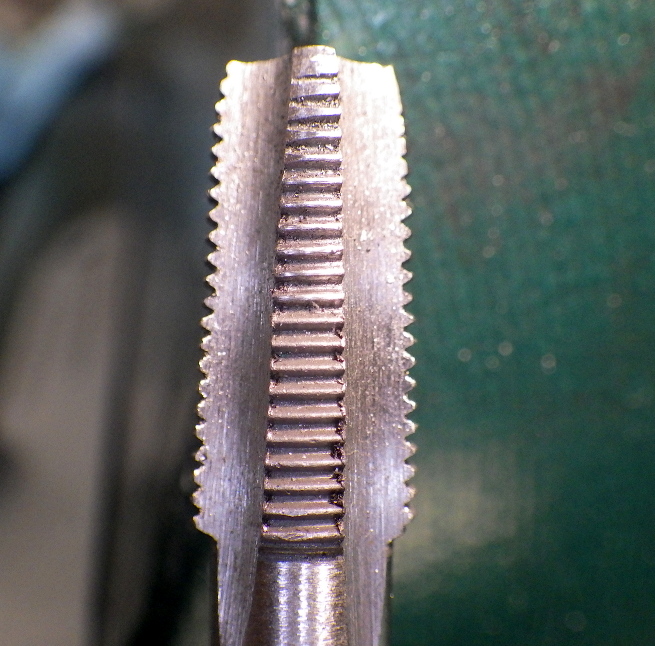
Unfortunately, this is as far as I get for a few days. My 1/8-27 tap is a piece 'o crap and barely cuts the cast iron. The cast iron wore away as much of the tap as the tap cut cast iron. I need a better tap.
Gosh, this tap was in a Horrible Freight Tap and die set - this one, I think. The fact that the "40 piece set" cost less than half of what some of the "real" taps I'm looking at cost should be a clue. And some of the good taps would buy about 20 of those sets. I'm actually surprised all the other taps in the set worked as well as they have, but to be honest, I think they've always been used in aluminum.
The best case is that a new tap gets delivered Monday or Tuesday; the local Grainger doesn't have one in stock. Time to study some more on how this whole thing goes back together. Maybe the Orange or Blue Borg has one.
When I last talked about the big CNC conversion project (aside from the Great Ball Nut Removal Tool Fiasco), I had completed the long hole down the cross slide to bring oil to the middle of the slide from a fitting that will go in on the right end. The two eighth inch holes crossed. Since then I've been drilling the rest of the oil holes and am finally getting ready to start tapping holes and connecting oil fittings. The right end of the slide looks like this now.
The long hole is visible in the upper right. It's going to get tapped for a straight oil fitting that sends the oil pumped down that hole to the 1/8" channel and to the surface. The big hole you see is from an "R" drill bit (0.339") and goes in a couple of inches. The 1/8" hole extends from there. In the middle of this picture you'll see another large hole approximately centered between and below the two cap screws. This is the same size hole and will be tapped for another one of those fittings. That large hole is connected to another 1/8" hole to drain a little oil in that line down onto the ways that it's sitting on. There's a matching pair of holes like that on the opposite end of the slide so that both "Y" ways get oiled. The big R holes each get a screw-in, 1/8"-27 NPT fitting.
The front required a little "shuckin' and jivin'" - making it up on the fly.
Hard to see in this picture, but there are two threaded holes in the middle of the front of the slide. Their sole purpose in life is to hold a plastic indicator that marks the centerline of the slide so that when they're cranking the table by hand, an operator can read a scale that shows how far off center the table is. I had to drill a hole between them, and just used a number Hoss rattled off. Hoss put his in too high and the tap broke the surface above it, in front of the oil groove. He had to grind his oil fixture flush with the surface of the way and make sure it was flat and won't mess up his X axis. So he said to knock that hole down to about 0.3" from the surface allow the fitting to not break the surface, and it would do that. Unfortunately, the big hole I drilled overlapped the existing top screw hole and I'll have to patch that with Bond-o or something. There's a hole visible in the middle of the oil groove right above that tubing fixture and a vertical 1/8" hole that allows oil to pump up into this oil groove.
Unfortunately, this is as far as I get for a few days. My 1/8-27 tap is a piece 'o crap and barely cuts the cast iron. The cast iron wore away as much of the tap as the tap cut cast iron. I need a better tap.
Gosh, this tap was in a Horrible Freight Tap and die set - this one, I think. The fact that the "40 piece set" cost less than half of what some of the "real" taps I'm looking at cost should be a clue. And some of the good taps would buy about 20 of those sets. I'm actually surprised all the other taps in the set worked as well as they have, but to be honest, I think they've always been used in aluminum.
The best case is that a new tap gets delivered Monday or Tuesday; the local Grainger doesn't have one in stock. Time to study some more on how this whole thing goes back together. Maybe the Orange or Blue Borg has one.
Wednesday, December 28, 2016
Have The Tea Party's Killers Hit the Gunnies, Too?
Last August, I wrote a piece on how the Tea Party was killed off. In brief, they were killed off by professional fund raisers and political activists: the very thing the Tea Party got started to kill off.
NAGR Affiliates.
NAGR bills itself as the "No-Compromise Gun Rights Group" and attacks the NRA. But compromise itself isn't a bad thing. The bad thing is continually backing up in compromise and saying, "this is as far as we go" only to contradict yourself in a year or two. Compromise on the attack is what the other side has been doing for a century and I don't think anyone would say it hasn't worked for them. Every few years they push and push and get as far as they can. Once they've moved the bar, (or the Overton Window if you prefer) they start from farther along "next time". If the R2KBA side went in to this legislative session with the argument "nullify the 1934 NFA" and in September we found the best we could do was the compromise, "OK, we agree the prohibition on short barreled rifles and shotguns is silly so we'll remove that, and we'll make silencers a $5 tax, but we will not deregulate full auto weapons and we're keeping the AOW class", who wouldn't take that compromise? Would you turn that down because it's not perfect, total victory?
Look, it's your money; give it to whom you want. I think it's a waste to give to these Rothfeld organizations like NAGR because I see the parallels to the destruction of the Tea Party movement. If Rothfeld's groups suck up all the funding and spends it all on themselves, like all those groups that killed off the Tea Party, could they kill off the Pro-2A side?
Republicans inside the Beltway reacted to the burgeoning Tea Party with glee but uncertainty about how to channel the grass-roots energy usually reserved for the left. A small group of supposedly conservative lawyers and consultants saw something different: dollar signs. The PACs found anger at the Republican Party sells very well. The campaigns they ran would be headlined “Boot John Boehner," or “Drop a Truth Bomb on Kevin McCarthy.” And after Boehner was in fact booted and McCarthy bombed in his bid to succeed him, it was naturally time to “Fire Paul Ryan." The selling is always urgent: “Stop what you’re doing” “This can’t wait.” One active solicitor is the Tea Party Leadership Fund, which received $6.7 million from 2013 to mid-2015, overwhelmingly from small donors. A typical solicitation from the TPLF read: “Your immediate contribution could be the most important financial investment you will make to help return America to greatness.” But, according to an investigation by POLITICO, 87 percent of that “investment” went to overhead; only $910,000 of the $6.7 million raised was used to support political candidates.Miguel at Gun Free Zone posted a piece today about the National Association for Gun Rights, NAGR, and I find the parallels striking. Miguel, in turn, links to an old article on the Blaze, that's sill relevant.
As it turns out, NAGR is just one of a pack of ankle-biter groups, all of which trace back to Mike Rothfeld. Among this web of Rothfeld groups are Campaign for Liberty, Foundation for Applied Conservative Leadership, and Council for Freedom and Enterprise. Nice names. What they all share is the Rothfeld secret sauce — best described by the wizard himself:I've mentioned before that I've been a member of NAGR before and became displeased with them for a couple of reasons. The biggest is the never ending stream of emails like the previously mentioned "stop what you're doing!", urgent response required type. The legend of the "boy who cried wolf" that we learn while we're growing up is a good one to keep in mind. Perhaps a better idea to keep in mind is that when someone is urgently demanding your money now, now, now, experience says the chances are good you're being hustled. They want you to donate the money now and not think about it. As the author of that original Blaze piece put it
“I am a professional junk mailer. I am a professional telemarketer. I’m a professional spammer — like, a hundred million pieces of emails a month. And I’m a professional negative campaigner. And I’m damn proud of all four.”While most of us abhor negative campaigning, we can at least understand it as an effort to induce people to choose Option A over Option B. But that isn’t the game Rothfeld and Dudley Brown are playing.
Riddell’s article recounted one instance in which an NAGR Mississippi e-mail blast solicited funds to help them fight against an ammunition registration bill. The only problem was that the bill had died in committee a month before the e-mail was sent.Similarly, I recall a NAGR mailing from "Dudley Brown" railing against a piece of legislation in the Florida Senate that wasn't there anymore. Rothfeld may be "damn proud" of being a spammer and telemarketer, but apparently complete truthfulness isn't one of the things the organizations are "damn proud" of.
NAGR has branded itself as the conservative alternative to the NRA, one not beholden to Washington insiders. But some Second Amendment advocates think the group’s main claim to fame is stoking the fears of the less-informed for-profit.
NAGR Affiliates.
NAGR bills itself as the "No-Compromise Gun Rights Group" and attacks the NRA. But compromise itself isn't a bad thing. The bad thing is continually backing up in compromise and saying, "this is as far as we go" only to contradict yourself in a year or two. Compromise on the attack is what the other side has been doing for a century and I don't think anyone would say it hasn't worked for them. Every few years they push and push and get as far as they can. Once they've moved the bar, (or the Overton Window if you prefer) they start from farther along "next time". If the R2KBA side went in to this legislative session with the argument "nullify the 1934 NFA" and in September we found the best we could do was the compromise, "OK, we agree the prohibition on short barreled rifles and shotguns is silly so we'll remove that, and we'll make silencers a $5 tax, but we will not deregulate full auto weapons and we're keeping the AOW class", who wouldn't take that compromise? Would you turn that down because it's not perfect, total victory?
Look, it's your money; give it to whom you want. I think it's a waste to give to these Rothfeld organizations like NAGR because I see the parallels to the destruction of the Tea Party movement. If Rothfeld's groups suck up all the funding and spends it all on themselves, like all those groups that killed off the Tea Party, could they kill off the Pro-2A side?
Carrie Fisher
What is it about movies and the entertainment world that makes you feel like you know someone, like you're connected to them, just because you see them on screen a few times? I'm about as committed as anyone to the "Shut Up and Sing" side of not caring about these folks' opinions on anything, but I'm not immune to feeling like I know them and didn't just watch them on the big screen.
When the news broke about Carrie Fisher's heart attack while flying on Friday, it felt like I got news about someone I know. When she passed away, it felt too much like someone I know or worked with. Not a close friend, not a family member, but someone I know. Possibly because we had just gotten home from Rogue One and just seen the CGI young princess Leia so the image was fresh in my mind.
And I'm going shamelessly post a piece of fan art I stole from Borepatch.
When the news broke about Carrie Fisher's heart attack while flying on Friday, it felt like I got news about someone I know. When she passed away, it felt too much like someone I know or worked with. Not a close friend, not a family member, but someone I know. Possibly because we had just gotten home from Rogue One and just seen the CGI young princess Leia so the image was fresh in my mind.
And I'm going shamelessly post a piece of fan art I stole from Borepatch.
Tuesday, December 27, 2016
Sharyl Attkisson on "Fake News"
Within in the last several days, Sharyl Attkisson was interviewed for the WND News on the emergence of the hype over "fake news".
For those whom the name is unfamiliar, Sharyl is a highly respected investigative reporter, formerly with CBS News, and now doing a show called Full Measure with Sharyl Attkisson for the Sinclair Broadcast Group. Attkisson won five Emmy Awards and an Edward R. Murrow Award for investigative reporting during her stint as the top correspondent for CBS News from 1993 to 2014. Before joining CBS, she was an anchor and correspondent for CNN from 1990 to 1993. A few years ago, when insiders leaked details of the Fast and Furious gun trafficking scandal to new media journalists David Codrea of The War Against Guns and Mike Vanderboegh of the Sipsey Street Irregulars (now deceased), Attkisson started covering the story in reports on CBS. This marked the only time the broad public was exposed to this story of the US administration running guns to the Mexican drug cartels in order to smear American gun owners, and attack second amendment rights. After CBS stonewalled, delayed and threatened her over her coverage, she resigned from the position she held 20 years.
WND pours praise on Attkisson, repeatedly calling her a superstar reporter, and while she uses a lot of the space to tease her coming book, at heart she is the kind of old school journalist we grew up thinking they are, or should be.
(Source)
For those whom the name is unfamiliar, Sharyl is a highly respected investigative reporter, formerly with CBS News, and now doing a show called Full Measure with Sharyl Attkisson for the Sinclair Broadcast Group. Attkisson won five Emmy Awards and an Edward R. Murrow Award for investigative reporting during her stint as the top correspondent for CBS News from 1993 to 2014. Before joining CBS, she was an anchor and correspondent for CNN from 1990 to 1993. A few years ago, when insiders leaked details of the Fast and Furious gun trafficking scandal to new media journalists David Codrea of The War Against Guns and Mike Vanderboegh of the Sipsey Street Irregulars (now deceased), Attkisson started covering the story in reports on CBS. This marked the only time the broad public was exposed to this story of the US administration running guns to the Mexican drug cartels in order to smear American gun owners, and attack second amendment rights. After CBS stonewalled, delayed and threatened her over her coverage, she resigned from the position she held 20 years.
Years ago, Attkisson noticed the emergence of what is now called fake news, only she called such stories by their traditional name: a smear. The reporter began researching the topic in earnest, and the result is her new book, coming out on May 22, 2017, titled “The Smear: How Shady Political Operatives Control What You See, What You Think, and How You Vote,” .For example, she noted early on the development of a narrative story that swept the news media alleging "white nationalist" ties to the Trump campaign. “The white nationalist stuff came up through a pro-Hillary Clinton group run by David Brock (founder of the liberal group Media Matters) called Blue Nation Review. And they wrote like six articles in five days that were all about alt-right, white nationalists, racists, stuff like that.” she says.
She described how, on Aug. 15, the “collective David Brock propaganda groups begin a theme and meme of Trump and his supporters as ‘white nationalists.'”Attkisson is quick to point out that there are many sources trying to manipulate what gets on the news: not just the two major parties but groups like Media Matters, corporations, public relations firms, think tanks, nonprofits; a whole cottage industry that’s built up around manipulating the media. Anyone who can throw a press release on a letterhead and find the contact information for the major news outlets is suspect; which is to say anyone that can buy a mid-grade computer and - maybe - a fax machine.
“And,” she relayed, “Brock’s Blue Nation Review pummeled Trump in six days with smear articles titled”:
- “Trump shakes up staff, embraces white nationalism”
- “Trump’s Purity Test for Immigrants Is More Evidence of His White Nationalist Plans”
- “Trump Is Seeking a White Nationalist Awakening NOT the White House”
- “NEW VIDEO: Trump Is Now Leading a White Nationalist ‘Awakening'”
- “Is Trump’s New ‘America First’ App Designed to Connect White Nationalists?”
- “Trump Delivers Anti-Black Rant: ‘You’re Living in Poverty, Your Schools Are No Good'”
WND pours praise on Attkisson, repeatedly calling her a superstar reporter, and while she uses a lot of the space to tease her coming book, at heart she is the kind of old school journalist we grew up thinking they are, or should be.
“I was always told in journalism school that if someone hands you a press release, whether it’s from the government or a corporation, it’s almost never news. It may be a starting point for something to look into, but in itself it’s not a story. That’s what they want you to think. And it’s your job to figure out the truth, and not to be used just report something that someone’s trying to slip on your plate.”Attkisson's perspective is that this whole "fake news" meme, itself a product of the industry that manipulates the news media, is an attempt at censorship and to further centralize control.
...
“Me? I look for stuff that other people try to keep me from seeing. I seek that stuff online. Because that’s where I find some stories. And, occasionally, I do find truth in these places where they don’t want you to look. Or where they are trying to marginalize stories and make them controversial.”
“One last little thing,” Attkisson added.
“Part of the directive on how to find out if something is fake news, is a narrative is that if it’s not in the Washington Post or New York Times, or Snopes says it’s a myth, you know not to believe it.
“Well, all those sources, in my view, can be suspect. And Snopes especially has been incorrect, factually incorrect, on a number of topics. So the very places some people have directed us to, to get the truth, are the very places where I think I wouldn’t necessarily look for it.
“And I think that’s a danger.”
Attkisson observed, “These people who consult with political operatives or corporate interests, they are going to be the ones to censor our news? And tell us what truth is? And even when that truth is more a matter of opinion or not even fully known?”It's an interesting interview with an interesting journalist. A bit long, but worth it.
“I’m really nervous about someone saying we’ll decide the truth,” the seasoned reporter flatly stated.
“You know, they used to say cigarettes couldn’t cause lung cancer. So, theoretically, a story or study that said otherwise wouldn’t show up on your Google search today, because that had been determined at the time not to be true.”
(Source)
Monday, December 26, 2016
A Good Rule of Thumb for Old Graybeards and Young Shavers
Always keep this in the back of your mind: "everything you know is wrong". Once you say that, know that it's an overstatement that's just easier to say than "in all probability, some of the things you know that you hold most dear are wrong". Always keep an open mind. Realize you've probably been misled or lied to about some things, and never stop questioning. Always ask yourself, "how do I know what I think I know?"
Where does tonight's emphasis come from? It was Dilbert that introduced me to the idea that web surfing was equivalent to bouncing around like a ping pong ball in a clothes drier. Today, the ping pong ball of my mind ended up at a blog I've never visited before called Stonekettle Station. Obviously rather liberal viewpoints. I ended up there by way of a blog I've visited a few times and that seemed moderately (occasionally) coherent called Just an Earth-Bound Misfit, I, which I bounced to from The Vulgar Curmudgeon. (Whew! Got that?)
In a post called "Blind Spot", Stonekettle Station starts with the provocative question, "Have you ever questioned the nature of your reality?". In general, most of us go through that by about 18 or 20, usually aided by some substances that alter mental states - except for those of us who go on and read quantum physics, and then reality gets even stranger. Despite the juvenile opening, he drifts to this being a central theme of the new Westworld series, then goes into some better writing about how on rare occasions things that are well known by masses of people turn out to be completely untrue. For an example, he writes about the McMartin Preschool Trial in the 1980s. For those who don't remember, this was a sensational trial essentially conducted in the press in which a lone suspicious mother; a mentally-ill, alcoholic mother (diagnosed as such, this isn't slander on my part) started what turned into almost a Salem Witchcraft trial of our age.
Gosh, there are idiots online! Stop the presses! Shut down the Internet! There are idiots out there! Who would have ever thought there are idiots in the general population? I mean, besides everyone.
From there, it gets worse. He goes down the road that the only people stupid enough to believe conspiracy theories like these are a ... certain subset of the population
I doubt you'll ever end up here, Mr Stonekettle, but repeat after me: "everything you know is wrong". Once you say that, know that it's an overstatement that's just easier to say than "in all probability, some of the things you know that you hold most dear are wrong". Always keep an open mind. Realize you've probably been misled or lied to about some things, and never stop questioning. Always ask yourself, "how do I know what I think I know?"
Where does tonight's emphasis come from? It was Dilbert that introduced me to the idea that web surfing was equivalent to bouncing around like a ping pong ball in a clothes drier. Today, the ping pong ball of my mind ended up at a blog I've never visited before called Stonekettle Station. Obviously rather liberal viewpoints. I ended up there by way of a blog I've visited a few times and that seemed moderately (occasionally) coherent called Just an Earth-Bound Misfit, I, which I bounced to from The Vulgar Curmudgeon. (Whew! Got that?)
In a post called "Blind Spot", Stonekettle Station starts with the provocative question, "Have you ever questioned the nature of your reality?". In general, most of us go through that by about 18 or 20, usually aided by some substances that alter mental states - except for those of us who go on and read quantum physics, and then reality gets even stranger. Despite the juvenile opening, he drifts to this being a central theme of the new Westworld series, then goes into some better writing about how on rare occasions things that are well known by masses of people turn out to be completely untrue. For an example, he writes about the McMartin Preschool Trial in the 1980s. For those who don't remember, this was a sensational trial essentially conducted in the press in which a lone suspicious mother; a mentally-ill, alcoholic mother (diagnosed as such, this isn't slander on my part) started what turned into almost a Salem Witchcraft trial of our age.
By the time it was over, more than 321 individual criminal complaints had been brought against seven people detailing an unbelievable tale of horrific crimesFor sure, the McMartin Trial was a terrible thing, and an example of some sort of mass, media driven, temporary insanity. From there, he goes into pizzagate and immediately takes the side that not only is there nothing to it, but that everyone associated with pizzagate is innocent and everything being linked to the story in any way is false. From my standpoint, I don't have enough evidence in front of me to know in either way. Frankly, I don't think it's true or real, but as I said the one time I even got close to the subject, these are serious allegations, and "If a quarter of what's alleged in this thread on Reddit is true, the entire Clinton Foundation and everyone in that circle needs to be burned to the ground". I'll note that Stonekettle doesn't present any evidence that he's right, nor did he provide a link to any point-by-point refutation, nor anything else solid, just that he baited some people online and received hostile response that he took to show those people are idiots.
But in the end all of those charges, all of them, were dismissed for lack of evidence.
Every single one.
Gosh, there are idiots online! Stop the presses! Shut down the Internet! There are idiots out there! Who would have ever thought there are idiots in the general population? I mean, besides everyone.
From there, it gets worse. He goes down the road that the only people stupid enough to believe conspiracy theories like these are a ... certain subset of the population
You see, that segment of the population is, after 30 years of being habituated to fear by talk radio and TV pundits, fake news, false narratives, an endless diet of conspiracy theories from bottomless cesspools such as Infowars, conditioned by their religion of suspicion and intolerance and a political party of paranoia, that population, is now uniquely vulnerable to this kind of manipulation.The astute will realize that "habituated to fear by talk radio" means Rush Limbaugh, so I'll cut to the chase: it's the conservatives that are the only ones stupid enough to fall for a conspiracy theory. There are no liberal conspiracy theories after all. I mean besides the ones that two seconds with a search engine turn up. Frankly, there's nothing worthwhile in the column after this. The rest of it is just attacks on the Trump administration for not following his model of thinking, which the previous paragraphs show that he isn't following himself. Another smug self-impressed liberal; nothing new here.
I doubt you'll ever end up here, Mr Stonekettle, but repeat after me: "everything you know is wrong". Once you say that, know that it's an overstatement that's just easier to say than "in all probability, some of the things you know that you hold most dear are wrong". Always keep an open mind. Realize you've probably been misled or lied to about some things, and never stop questioning. Always ask yourself, "how do I know what I think I know?"
Subscribe to:
Posts (Atom)