Saturday, February 19, 2022

A Sort of Followup

Just under a year ago, I posted an entry in my Ham Radio Series;  #22 on using a major contest for your fun and edification.   

Since I spent today playing in and around a similar radio contest, I wanted to post a followup to that.  Let me do a brief recap first. 

Let's start with the big one: why on earth should anyone care?  Assuming you have no desire to enter the contest and try to run up a score, I see two reasons.  First and foremost is to have fun.  DX contests bring stations from all over the world onto the air to compete to be the best in the different classes or (less formally) best in their country.  They also bring a ton of guys with smaller stations who are there to work more countries for their own interest or entertainment.  For people who don't strive to work other countries, there's a persistent image of straining to hear weak stations and the farther away they are the weaker.  While it does happen, I can't begin to tell you how many times I've heard people surprised at how loud and easy many of their DX contacts are. 

A more pragmatic reason is that it's good training for operating in bad, crowded conditions.  Much like disaster communications, there's a few standardized messages and you have a pretty good idea what you're going to hear - except for the important details.  

The major difference between today's contest and the one I wrote about in that article is that this one is for CW - Morse Code - operation only.  That means the CW is going to be fast.  I didn't tune around endlessly looking for stations to contact, but I'd guess the slowest sender I heard was in the range of 15 to 18 WPM. (The so-called WARC bands of 30, 17 and 12 meters are excluded from the contest, and I heard folks at lower speeds in those bands.)  Obviously, you need to know code well enough that you can use this for practice, but it doesn't hurt to listen to code that's faster than you're comfortable with.  A good thing about a contest as code practice is you can leave the radio on a guy that's sending too fast for you and know he's going to repeat his call again soon.  He'll repeat the whole exchange over and over. 

I should add that if you're trying to learn Morse code for the first time, you should be learning by sound, listening to letters that are sent too fast for you to count the dits and dahs, but spaced farther apart.  To learn five word per minute code (WPM) for a license test, for example, you'd use 15 WPM letters spaced far enough apart to make five WPM.  Whatever you do, don't do anything like the graphic meme I wrote about back in '16 when I first saw it.    

This is the description of the contest, an overview of the rules and requirements from the WA7BNM Contest Calendar (8-Day Calendar View) that shows what you need to know to play in this contest.

Just like the voice (SSB) version of the contest last March, the contest exchange is simple.  You'll give each other a signal report (it's really unusual to hear or send anything other than "599" - usually sent as "5NN") and either your state or province (if you're in Canada) or the operating power if you're in another country.  Let me modify the exchange I used last year for CW:

A contest exchange might be as short as this:
CQ CQ TEST, P42A
P42A DE W7CW BK
W7CW DE P42A 5NN KW BK
R R 5NN MT BK
W7CW QSL 73 DE P42A QRZ?

The abbreviation BK is sent as one continuous sound (dahdidididahdidah) interpreted as either "BREAK" or "BACK (to you)." The Q signals were referenced last year, too.  Need a refresher (pdf)?

I figure there might be two of you out there who would find this interesting, so there you go: a post on actually operating in a CW contest.


Friday, February 18, 2022

European Space Agency to Start a Manned Space Program?

This past Wednesday (Feb. 16), the European Space Agency held a space summit conference in Toulouse, France, to discuss its long range plans for topics such as space exploration and addressing climate change.  

Before the summit began, a group of European astronauts who have flown into space on vehicles from other countries issued a manifesto (.pdf) calling for the agency to develop its own capability for manned spaceflight rather than depending on Russian or US rockets and capsules.  The first German astronaut was Sigmund Jähn back in 1978, who flew aboard a Soyuz spacecraft to the Salyut 6 space station for a week.  More relevantly, two Europeans flew on both the Crew-2 and Crew-3 missions to the International Space Station: Matthias Maurer on Crew-3 and Thomas Pesquet on Crew-2.  Relevant because both praised the Crew Dragon vehicle's smooth spaceflight as well as the reusable nature of the rocket and both were involved in the manifesto.  

Released publicly on Wednesday, the document says that European leaders must soon decide whether the continent will accelerate its efforts to remain in the "leading ranks" of spacefaring nations.

"While Europe is still at the forefront of many space endeavors, such as Earth observation, navigation, and space science, it is lagging in the increasingly strategic domains of space transportation and exploration," the manifesto states. "Europe’s Gross Domestic Product is comparable to that of the United States’, but its joint investment in space exploration does not reach even one tenth of NASA’s.  

As of now, Russia has the Soyuz crew vehicle, China has the Shenzhou spacecraft, and NASA has SpaceX's Crew Dragon. In the coming two years, India is planning to demonstrate a manned launch system to low Earth orbit.  In principle, in addition to the Crew Dragon, NASA also has Boeing's Starliner capsule - currently scheduled to fly No Earlier Than this May.  We can also add the Orion capsule that tops the Space Launch System, which is currently expected to conduct its first test flight this summer, as well.  The US could potentially have four manned launch vehicles within two years, counting Starship. 

The manifesto continues:

"If we miss this unique chance to challenge the status quo, we will have to continue procuring human space transportation from other actors, with no guarantees that our needs and values will be a priority," the manifesto states. "We will be paying customers in a position of weakness, repeating the mistakes of the past in other strategic domains, which left us dependent on external players for our energy requirements or Information Technology development. Our inaction would further impact European industrial competitiveness: European taxpayers’ money would be used to advance industrial competitors from abroad."

They picked a good time to bring this forward.  The ESA has a new new director-general, Josef Aschbacher, and he's pushing for more ambitious programs.  Since those astronauts behind the manifesto technically work for him, it's entirely possible he's using them as the great PR assets astronauts tend to be and this is all his idea. 

As always, the arguments against doing this come down to "what's in it for me" among the different member states.  Developing a manned system is expensive and time consuming; is it really the smartest use of funds?  What launch vehicle would they use?  The Ariane 6, something else already in the fleet, or do they need to develop something new?  Who would develop the capsule itself?  How long in development are we talking?  Five years?  Ten?  

The Crew-3 launch vehicle and Crew Dragon capsule a few days before the launch.  SpaceX photo.  The launcher and capsule were designed separately, not as a launcher/capsule system; neither took 10 years.   


Thursday, February 17, 2022

Update on SpaceX KSC Progress

Yesterday and today, SpaceX's Starbase at Boca Chica did cryogenic tests on Starship SN20.  I would assume that since the ship has been tested a few times, including a static fire with all six engines, that the ship wasn't the emphasis of the tests, but rather the hundreds of yards of cryogenic fuel and oxidizer lines that have been installed or moved in the last few months.  As best as we can tell without a formal announcement from SpaceX or Musk, both tests went without a hitch.  

Meanwhile, skipping over the entire Gulf of Mexico and going to the east coast of Florida, the second Starship launch facility being built onto the property around Pad 39A is progressing.  The story of the Florida Starbase actually goes back to 2019, when work was begun.  There was progress on building an early version of an Orbital Launch Mount, but around the end of '19 (bottom half of that piece) is when Starship operations shifted entirely to Texas and the facility in Cocoa (on the mainland across from the KSC) was shut down.  

The area has been difficult to observe, since it's not as open to outsiders as the area around Boca Chica. 

Since then, save for occasional long-distance aerial views, it’s been almost impossible to document progress but views from SpaceX webcasts of Falcon 9 launches out of Pad 39A have shown that the company is mostly focused on preparing foundations. However, in early February 2022, a flyover of a different SpaceX KSC facility revealed the first clear signs of preparation for pad hardware assembly.

The facility that refers to is a SpaceX property on Roberts Road, along the northern limits of the Kennedy Space Center.  

As Marcus House is a photographer who sells his work via Twitter, I'm reluctant to copy his photographs for use here, but between Marcus and Zack Golden (@CSI_Starbase) you can look at far more photographs on Twitter than I could include here.  

Another interesting place to look is at Harry Stranger on Twitter.  He reports:

SpaceX has submitted plans for Roberts Road West that includes a 320,000 sq ft (29,728  sq m) proposed building, with a 192,000 sq ft (17,837 sq m) future proposed building expansion.

Also included are two 20.4k sq ft (1895 sq m) proposed buildings.

That's 512,000 square feet - not including the two smaller buildings.  The article on Teslarati concludes with this hopeful, optimistic view:

In the last week, satellite imagery indicates that SpaceX has begun to level the unfinished portion of Roberts Road, likely paving the way for the start of foundation work in the near future. All things considered, it remains to be seen if SpaceX will truly replicate Starbase, Boca Chica at Kennedy Space Center or – much like how the company systematically upgrades its rockets – if the new Starship factory will represent a block upgrade with a wide range of improvements and refinements. Regardless, it won’t be long before Starbase East and the first of several East Coast Starship launch towers begin to take shape. 

Several East Coast Starship launch towers?   Like these?  Towers as in plural?  I can hardly wait. 

As the photo says, source is NASASpaceflight.com and photo by BocaChicaGal.  


Wednesday, February 16, 2022

Another Day Got By Me

An odd mix of overcoming some hurdles getting my NanoVNA working properly with its various supporting software pieces, and fixing some junk around the house, and the next thing I know, it's too late to come up with a topic.  So... some lame attempts at humor:

I didn't get this one for several seconds:


Something I've never seen put into quite these words, but is brilliant.

From our department of Things That Don't Make Any Sense, they'll put that magic word (Keto) on anything to try to sell it.


Tuesday, February 15, 2022

I Think They Call This a Slow News Day

Slow if you're not following the political drama.  Last week, the SpaceX facility at Boca Chica stacked booster B4 and Starship S20 for the third time, long enough for Elon Musk's talk with the dramatically huge stack ("largest rocket ever built") behind him.  This screen capture is from the next morning.

Yesterday, they de-stacked them again, moving S20 down onto one of their vehicle carriers. (Video version here). 

As we always do, observers started speculating that SpaceX is finally getting ready to static fire B4, perhaps firing up all 29 engines at once rather than starting with a smaller number.  Fueling that speculation (pun intended) was that over the last few days, SpaceX has had multiple liquid methane deliveries to their storage tank farm for the first time.  That article, from yesterday, includes a link to a six week old Twitter thread by a guy who claims to have oil and gas industry experience who simply blasts the way SpaceX built their tank farms.  They seem to have fixed many of the things he pointed out as bad or forbidden practices in the industry.  The Twitter thread (by Zack Golden) is worth at least skimming if you're interested in the details. 

A road closure had been scheduled for 10AM to 10PM local (CST) time today, so I opened a tab in the background to see if I could see anything.  That road closure was cancelled during the afternoon, so no tests today.  I expect them to roll S20 away from that position before they'd light B4.  It's not as close as it looks, that's the camera forcing perspective, but it's still kind of close. Road closures are scheduled Wednesday through Friday; the first two are also 10A to 10P, while Friday's backup closure is 6A to 4P.

There has been no announcement of an expected test or set of tests or when the first might be attempted.  Having said that, it's still possible some sort of new tests could start this week.

After seeing several reports that the FAA is delaying their approval, I went to the FAA Environmental Assessment Permitting Dashboard and can verify the earliest date for the release of approval for SpaceX to launch from Boca Chica is now March 28, slipped one more month from February 28th.

I don't think the first Starship orbital launch is likely to be immediately after March 28th, but before July seems possible. 


Monday, February 14, 2022

Private Manned Spaceflight Taking A More Serious Turn

If you talk to most people, the concept out there of private citizens in space is pretty much "billionaires flaunting their money and showing off."  That's the impression of the Blue Origin New Shepard suborbital flights, and I've seen at least a dozen cartoons from different artists riffing on that idea. 

On the other side, there wasn't much said about the Inspiration4 mission last fall and I've seen nobody making fun of it or even acknowledging it. This was largely a philanthropic mission, raising a quarter of a billion dollars for St. Jude Children’s Hospital and their fight against childhood cancer. That mission was largely funded by Jared Isaacman, a 38-year-old billionaire entrepreneur and CEO of Shift4, an  integrated payment processing company.  

Today, Isaacman and SpaceX announced a partnership to do this sort of thing over again; the Polaris Program.  Combined with an already-announced partnership with Axiom Space, they currently represent six manned Crew Dragon missions with the first launch No Earlier Than the fourth quarter of this year.  That mission has been named Polaris Dawn and is a Jared Isaccman-led crew. 

[T]he mission will be Crew Dragon’s second free-flyer mission after Inspiration4, meaning that the spacecraft will fly on its own for the full five-day duration. That gives SpaceX and the Polaris team far more freedom, freedom that they plan to take advantage of.

SpaceX aspires for Polaris Dawn to be the highest Earth orbit humans have traveled to since the 1960s and the furthest humans have been from the planet since the 1970s. NASA’s Apollo missions, which sent humans to the Moon, hold the all-time record, which Polaris Dawn will barely scratch the surface of. But in Earth orbit, the record – 1368 kilometers (850 mi) – was set by Gemini XI in September 1966.

The mission is to be a combination of medical research and doing new things that either just aren't done or haven't been done in decades.  One those is to test an EVA-rated spacesuit developed by SpaceX by taking a spacewalk in one. 

At approximately 500 kilometers above the Earth, the crew will attempt the first-ever commercial extravehicular activity (EVA) with SpaceX-designed extravehicular activity (EVA) spacesuits, upgraded from the current intravehicular (IVA) suit. Building a base on the Moon and a city on Mars will require thousands of spacesuits; the development of this suit and the execution of the EVA will be important steps toward a scalable design for spacesuits on future long-duration missions.

I remembered reading about SpaceX saying they'd do alternate spacesuits last summer, but I didn't remember the money quote.  

NASA had been working to develop a new EVA suit since 2007 and "With $420M spent and another $625M expected, suits won't be "ready for flight until April 2025 at the earliest." 

2007 to 2025?  Eighteen years and over a billion dollars to develop a suit?  SpaceX's design will be ready for that "first-ever commercial EVA" by the fourth quarter when Polaris Dawn launches. 

Polaris Dawn crew, (L-R) Anna Menon, Mission Specialist & Medical Officer; Scott “Kidd” Poteet, Pilot;  Jared “Rook” Isaacman; Sarah Gillis, Mission Specialist.  Isaccman and Poteet are both executives at Shift4 as well as extremely qualified pilots; Gillis and Menon are both engineers with SpaceX on the manned spaceflight side.  More detailed biographies on the four at the bottom of the mission page


Sunday, February 13, 2022

It's Apparently Not a Falcon 9 That's Going to Hit The Moon

About three weeks ago, a report surfaced that a large chunk of space debris had been predicted to hit the moon in March, and that piece of junk had been identified as the upper stage of a Falcon 9, tracked to a mission in 2015, called DSCOVR, NOAA's Deep Space Climate Observatory.  

For a variety of reasons (I think) the press went gonzo over this story.  As Eric Berger at Ars Technica writes:

This story set off a firestorm of media activity. Much of this coverage criticized SpaceX for failing to properly dispose of the second stage of its Falcon 9 rocket after the launch of NOAA's Deep Space Climate Observatory mission, or DSCOVR, in 2015. The British tabloids, in particular, had a field day. Even the genteel European Space Agency tut-tutted, noting that it takes care to preserve enough fuel to put spent rocket stages into stable orbits around the Sun.

Why did they jump on the story?  In no particular order, the idea that a man-made object, a rocket upper stage in particular, is going to hit the moon and it will "gain one more crater" (as the European Space Agency put it) is dramatic, headline material.  On top of that, it's being considered at least to be a screw-up, and if not that at least "uncool," to have not put the upper stage into an escape orbit so it can't add that crater.  Then there's the matter that it's a SpaceX screw-up, the company in the news regularly, who just happens to be headed by not just one of those yucky, awful, billionaires, but the richest and most famous of them all.  If you're the typical, borderline communist, industrial news media, kind of person (but I repeat myself), this is a story you just can't resist.  

Along the way of the intervening weeks, science worked as it's supposed to.  The guy who made the initial observations, and originally concluded it was that Falcon 9 upper stage, had invited any of the community of astronomers who like to track such things to check his work.  He's Bill Gray at Project Pluto.  Out in the audience was an engineer from JPL named Jon Giorgini, who saw it and thought the ultimately most important thought in all of science research: "that's funny."  Now JPL doesn't track space junk, but they do track objects like the DSCOVR satellite.  He was able to look at its orbit and thought there's no way a rocket putting that satellite into that orbit should leave the rocket where this is being reported.

He wrote to Gray on Saturday morning explaining that the DSCOVR spacecraft's trajectory did not go particularly close to the Moon, and that it would therefore be a little strange if the second stage strayed close enough to strike it. This prompted Gray to dig back into his data, and identify other potential candidates. 

Gray thinks he's found what it really is now, and has posted a correction.  He has concluded it's a Chinese Long March 3C upper stage from the Chang'e 5-T1 mission launched earlier than DSCOVR: in October 2014.  

Bear in mind, this is just as much a case built on "circumstantial evidence" as thinking it was that Falcon 9 stage, but Gray says that based on his work, as well the work of the other people who supplied information, he's more comfortable with this identification than the SpaceX upper stage. 

Whichever it is, it's going to hit the far side of the moon on Mar 4 at 12:25 UTC.  Because of it being on the far side, it won't be visible from Earth, and while there are satellites on the moon that can measure seismic events like that impact, I haven't read of anyone claiming they'll be able to get pictures of video of it.  Gray points out it will be local noon when the object crashes, so it's a pity nothing is there to get good resolution pictures of it.  He posts this image of the location of impact on the far side.  At the green X. 

He also adds this entertaining note (emphasis added):

Quite a bit of data came in between 2022 Feb 5 and 9, as the object came back close to the earth and passed over the earth's night side. As expected, the object was not entirely on the predicted trajectory; as seen in the sky, the difference was roughly the size of a golf ball seen a mile away. However, it was enough to revise the prediction to land a few kilometers east and a few seconds before the above prediction, and a pixel or two to the right of the green 'X' on the map below.

I wonder if the corporate press will jump over to the story most likely being a Chinese Long March upper stage as quickly as they did when they thought it was a SpaceX rocket. 


Saturday, February 12, 2022

Still Looking at the Sunspot Cycle Data

Since the last solar cycle update I posted a month ago, interesting data continues to come in. The questions aren't being resolved, but the best thing I can say about it is that these guys are practicing real science.  They post their predictions and their data, essentially saying, "show me where I'm wrong" and try to improve their methods.  It's a sure sign there's no money it, compared to climate science or the Covid policy bosses.  

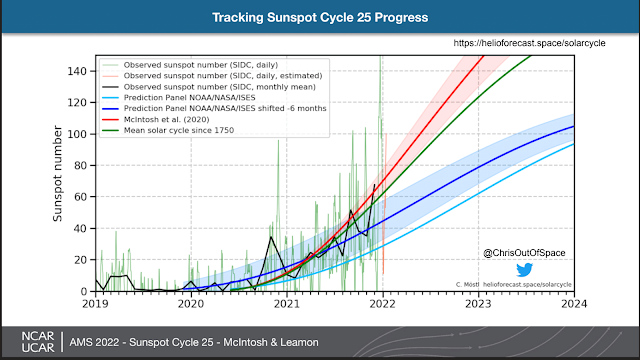
In that post (among others), I've mentioned Dr. Scott McIntosh, the leader of a group that has been predicting cycle 25 will be rather active.  I came across this plot two weeks later, around the end of January.  You'll note he's one of the authors of the talk this plot comes from.

It's a busy graph but the first the key feature to note is the black zigzag line, which is the observed monthly mean sunspot number.  It's based on the rather light green very jiggly line - the raw daily sunspot numbers.  After that, note the light blue band with the dark blue line it; the band is the NOAA - NASA prediction for cycle 25.  The median of the predictions in that band and shifted earlier in time six months is the dark blue line.  The red lines/band are McIntosh's.  The dark green line is the mean of every solar cycle since 1750.  It appears the observed cycle 25 sunspot numbers are looking more like the upper end of the NOAA/NASA predictions or maybe into McIntosh's.  The last few months' peak to peak variation of the black curve looks like it's quite a bit higher than the blue band.  Cycle 25 is looking pretty good.

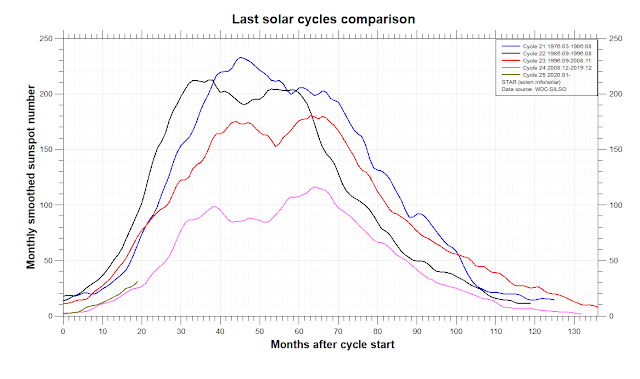
A few days later, I ran into this plot which has a very different feel to it.  This is from Space Weather News, a site affiliated with the Suspicious 0bservers channel we talked about last week.

I jokingly refer to this as my "ham radio autobiography" because these are smoothed sunspot plots of every solar cycle since 1976, the year I got my first ham license.  You'll note that almost without exception every data point of every cycle is lower than its predecessor since 1976. 

Now look closely at the bottom left corner.  See that light gray line that's just barely above the light purple line?  It's not above it all the time; sometimes it's the same level.  That gray line is cycle 25 and the purple line is 24, the previous cycle, known to be the weakest cycle in a hundred years. 

Cycle 25 isn't looking so hot is it?  Yes, it's looking a teeny bit better than the last cycle, but that's just not saying much.  It's the second weakest cycle since 1976 and is far less active than '76's cycle 21. Remember, cycle 24 wasn't just weaker than cycles 21-23, it was the weakest since 1913. 

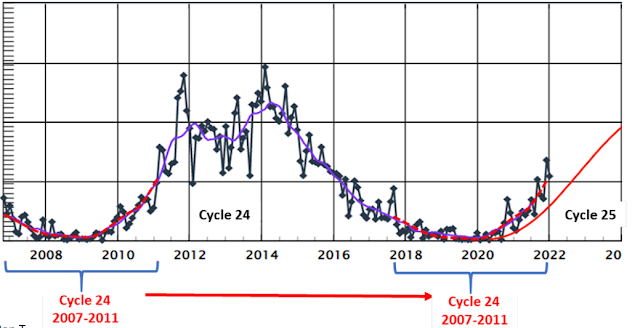
Finally, an interesting story in the American Radio Relay League's weekly propagation report by Tad Cook, K7RA, dated February 7th.  Tad covers a comment by Dr. Ron Turner of ANSER Research Institute in Virginia, via Spaceweather.com. Dr. Turner thinks it may be too early to expect a strong Solar Cycle 25 based on the early the measurements we have so far.

"Solar Cycle 25 is doing something interesting. It is mimicking old Solar Cycle 24 (SC24).

"I took sunspot numbers from the early years of SC24 (the red dashed line) and overlaid them on SC25," says Turner. "They're an almost perfect match."

"This is significant because Solar Cycle 24 went on to become the weakest solar cycle in a century. Its hot start did not lead to a strong maximum. Turner isn't saying that Solar Cycle 25 will likewise be a dud. But, rather, "these early sunspot numbers are not enough to guarantee a strong cycle."

What's it going to be?  Clearly nobody knows.  Scott McIntosh's group's prediction is still the outlier with virtually all the other predictions closer to saying 25 will be most similar to 24, not one of the strongest, and solar activity well below the mean of every sunspot cycle since 1750.  

I'd like to see the solar activity higher than 24, and that simply doesn't seem to be asking much.  "It doesn't have to equal the strongest, just be stronger than the weakest cycle in a hundred years." 


Friday, February 11, 2022

Our Annual Pilgrimage to Orlando

I guess I shouldn't call it an annual pilgrimage since it wasn't held last year; but that was because of 'rona, like 99% of everything else cancelled last year.  This weekend is the annual Orlando hamfest.  It was our 40th annual visit to the hamfest, and like every year since I retired, we went over today rather than the most crowded day (Saturdays).  It has been cool here, but warmed into the mid '70s as the day went by; I wore a short-sleeved fishing shirt and was comfortable all day.  By the time the temperature got into that "the sun is not your friend" range, clouds came along and kept it comfortable.

As I've said before the Orlando HamCation (real name) is now commonly referred to as the second largest in the world only behind Dayton's Hamvention (which is only Dayton in name - it's held in Xenia, Ohio).  Dayton tends to be the one where major products are announced.  Dayton, though, was cancelled both in '21 and '20, so while they're expecting to hold the Hamvention this year, they're out of practice. 

We were out of practice, too.  The last time we went to Orlando, we bought our tickets by mail.  In the past, we'd get an email that the show was coming and the way to get tickets was to send an SASE (Self-Addressed Stamped Envelope) and a check.  We'd send it around the Christmas-New Year's week and the tickets would be here within two weeks.  This year, we went looking for the email around Christmas and it wasn't there.  A check of the website showed that there was a new procedure.  We had to order the tickets online and pick them up at a special office at the east end of the property where the 'fest was held.

I admit to being uncomfortable with the routine, but it went well.  Parking is always packed at the HamCation and we were directed to a place just about as far from that office we needed to get to as one could be and still be on the property.  Thankfully, they had guys with oversized golf carts giving people lifts everywhere and one of them gave us a lift to that office.  They had our tickets and everything went without a hitch.  

Think of this as a stock photo, except I took it a few years ago. That's the north room of the Central Florida Fairgrounds where most of the smaller businesses and individuals rent tables, and the most obvious feature is the table full of used laptops.  The tables full of used laptops were back (although in different places). 

As I've said about other years, these are turning into uninteresting things, and that's a bit sad to say.   I rush to add that my interests in radio tend toward the unconventional, so it's not really surprising that I'd find the same 40 or 50 (or more) year old radios that I see every year not particularly interesting.  If you have a shopping list of things you need, they can be great places to get that special part.  

I did pick up one thing; there's a rather popular piece of test equipment called a NanoVNA**, a clever way of making a Vector Network Analyzer at previously impossibly low prices.  A VNA was always pretty much the most essential piece of test equipment I worked with since the first time I saw one, in about '86.  I've mentioned many times before that I frequently use an antenna analyzer for working on my antennas.  There are two issues with the one I have, neither of which has been insurmountable but were leading me to think of alternatives.  First is that my analyzer is obsolete and no longer available. Software updates have continued for it, but chances are pretty good that if anything happens to it, it's irreplaceable.  Second is that it only goes to the 2 meter ham band (well slightly higher - 160 MHz, I think).  An antenna analyzer is a one-port VNA; the NanoVNA is a two-port which means you can align or test filters or other circuits with an input and output connector.  Oh, and it's rated to around 10 times the frequency of the one port.  At the moment, the new NanoVNA overcomes both drawbacks of my AIM4170 and looks like a good path forward.

Other than that little purchase, running into friends and catching up with people whom we see yearly or less often ends up being what the hamfest is mostly about.  

02-23-22 at 1115 AM EST Edit to add this:

**  A comment from AndrewG says that the asterisked link is not official, and the official website is here at NanoVNA V2 Official Site.  I will note that the analyzer I bought does not look exactly like either VNA published on that second site, the connector position is very different, so I don't even know if it applies to what I bought.  Mine looks like the one on the site originally published above. 

Since I have nothing to conclusively show me that one site is more official than the other, I've added AndrewG's link here.  This may be relevant only to NanoVNAs claiming to be Version 2 (V2), which mine doesn't claim to be.  As always, and doubly always when dealing with Chinese clones, "caveat emptor" - buyer beware.


Thursday, February 10, 2022

Astra's First Florida Launch Fails

It wasn't visible from the ground, but I missed it anyway (forgot it was at 3:00 PM and went grocery shopping - d'oh!).  

The online magazine Techcrunch has the story that other sites don't have yet.    

According to the company, the rocket encountered an issue during flight that meant it didn’t get a chance to deliver any of its payloads to their target destination. That means NASA’s four CubeSats on board will be lost. Astra was awarded this contract under NASA’s Launch Services Program, and it was intended to show the efficacy of a low-cost alternative light load rocket delivery to space for small payloads.

While I missed it in real time, I later watched the launch on NASA Spaceflight's video feed (note: that video starts almost an hour before launch - you can literally grab the slider and skip the first 59 minutes of the video).   When the first stage cut out, the video downlink was two screens and one looked like it shook but didn't do what it was supposed to.  Within a couple of seconds the video changed and the announcer said the stage separation and fairing jettison went on schedule.  It still didn't look right and they lost the video slightly thereafter. 

That's about all the details available right now.

Image source:  Astra / John Kraus

As we've all said many times: space is hard; orbit is harder.  Astra has made orbit once. 


Wednesday, February 9, 2022

Why Did Last Week's Solar Storm Take out SpaceX's Batch of Starlink Satellites?

By now, the story has gotten around that last Thursday's Starlink mission was struck by a geomagnetic or solar storm on Friday and 40 of the 49 satellites (at last update) were lost as result.  Most coverage focuses on what happened, which is fine.  To me, a better question is why did it happen.

Let me recap the what.  Yesterday's updates on the update sub-page to SpaceX's launches page has the best summary of what happened.  The essence goes like this;

Thursday's launch put the satellites into the desired orbit, with the perigee (lowest point) of approximately 210 kilometers above Earth (130 miles), and each satellite achieved controlled flight. This approach is risky for SpaceX; the satellites are there just long enough to be checked out, but they feel it's better for everyone sharing orbital space to do it this way.  Satellites that pass the checkout fire their onboard ion thrusters to raise their orbit to the desired altitude.  Any that fail their checkout are allowed to re-enter the atmosphere, burning up completely.  The unexpected part was that on Friday, the solar storm stuck. 

The storm heated the upper atmosphere, causing it to expand upward, which then caused the drag on the satellites to increase.  SpaceX reported that their onboard GPS suggested the storm caused atmospheric drag to increase up to 50 percent higher than during previous launches.  The Starlink team commanded the satellites into a safe-mode where they would fly edge-on (like a sheet of paper) to minimize drag—to effectively “take cover from the storm”—and continued to work closely with the Space Force’s 18th Space Control Squadron and LeoLabs to provide updates on the satellites based on ground radars. 

The thing is, this was not a strong solar storm.  There are several ways solar storms like this are monitored, two of the most common and widely available are called the A and K indices (pdf).  They're both measurements of geomagnetic activity, taken differently and so they have different scales.  A very common way to track activity is what's referred to as the Planetary K index, abbreviated Kp. I was able to find the relevant chart in a video that I have more to say about, but first the chart:


The storm that disabled the satellites is marked by the two red bars toward the right on February 4th.  The bars are three hours wide, which helps you visualize the storm's duration.  You'll note an almost identical storm the day before, roughly 0900 to 1200 UTC on the third, which was the night before and morning of the launch. 

The point to emphasize here is that Kp for the storm maxed out at five.  The scale is 0 to 9, but solar storms that raise Kp to five are roughly once a week to once every few weeks events.  During sunspot peaks, I recall days with the Kp at eight or nine for longer periods and in that red (> 4)  color for 24 hours or more.  Further, in the video that graph is from, the narrator says he knows SpaceX has launched into storms this strong before without this kind of trouble.  Which brings us back to the question of why.  

The video is from a YouTube channel that puts together some interesting stuff under the name Suspicious 0bservers (note the zero, not "O"), run by a guy named Ben Davidson.  He's frankly hard to describe, but I think the term he'd use is that he's a catastrophist; he sees evidence for periodic or cyclic catastrophes that appear in history over and over.  Sort of the geological/astronomical equivalent of the people who see history as Kondratiev Waves, Elliot Waves or First through Fourth Turnings. 

One of the topics he talks about often is the wandering magnetic poles we're seeing and our weakening magnetic field.  That's his explanation for why this mission was affected more than others.  I have a hard time with that because while it's well established that there has been a lot of pole movement in the last 20 years, and our magnetic field has weakened, why didn't other missions have the same problem?  If similar solar storms in the last couple of years didn't lead to loss of the satellites, what (if anything) does that say about how much weaker the field has become?   Is it half as strong? 90% as strong?  Down to 1/10 as strong? 

My disappointing conclusion is that I can't answer why.  There have been roughly three dozen launches of Starlink satellites and roughly 1,900 in orbit now.  Granted the last four years have been pretty low in solar activity, but if Davidson is right about them launching in similar solar storms on prior missions, something different happened this time.  Maybe it was some perfectly wrong flicker of the magnetic field or the solar storm that hasn't been documented.  Not knowing what caused it is bound to cause heartburn in the folks deciding if they'll launch under these conditions. 


Tuesday, February 8, 2022

Why SpaceX's New Contract to Launch 3 Satellites Might Be A Very Big Deal

I saw a headline in my morning scanning that SpaceX had signed a contract to launch three satellites for a little company called Launcher Space and didn't think much of it.  When I first found out that the launches are to be on their dedicated rideshare launches like the Transporter 1 through 3 missions, I started to think of it as more of a "that's nice, but NBD" (No Big Deal).   When I started looking a little farther I began to see that this could really be a game changer for orbital access.  It'll take a few paragraphs to explain.

Let's start here: the single biggest impediment to doing anything or going anywhere in space is the cost to orbit.  That's where Starship and SuperHeavy are supposed to be the big game changers; unfortunately, they have yet to go to orbit and the Fed.gov in the embodiment of the FAA seems to be slow-rolling approval to launch.  Given that, and the fact that it will a few years before Starship is fully developed, let's look at the current world and the prices to orbit in the current fleets.  

Most importantly, thanks to the unprecedented affordability of its Falcon 9 rocket, SpaceX has allowed rideshare customers to reap a great deal of the benefits by charging just $1M per 200-kilogram (440 lb) ‘slot’ and a flat $5,000 for each additional kilogram. [NOTE: $1M for 200 kg is exactly $5,000/kg - SiG]  To anyone unfamiliar with the cost of spaceflight, that might seem obscene, but it’s extraordinarily affordable and far cheaper than every advertised alternative. Astra Space, the cheapest dedicated smallsat launch provider, sells a Rocket 3 vehicle capable of launching about 50 kilograms (110 lb) to a similar orbit for ~$3.5M – equivalent to $70,000 per kilogram. Rocket 3 has only completed one successful launch, however. Rocket Lab’s more accessible Electron rocket costs at least $7.5M for ~200 kilograms to sun-synchronous orbit (SSO) – a price of $37,500/kg.

Editor's note:  Astra Space's last two attempts to launch Rocket 3 ended in aborts, both Saturday and Monday.  I would consider the $70,000/kg number to be "aspirational" because I think we don't know exactly what their final configuration will be.  My guess would be that number might not go up much but it almost certainly won't go down.  Electron is at clear disadvantage at over 7x the price per pound as a Falcon 9, so Astra's 14x the price has got to be a real handicap. (I have seen no numbers on how Rocket Lab's new Neutron booster may affect costs.)

Before I leave that topic, the cost to orbit for Starship and SuperHeavy has been calculated to be $35 per kilogram.  That's 0.7% of the best cost we have here on the page of $5,000/kg.  Game changer? 

This being essentially nothing but physics, there's bound to be a "gotcha" and in this case it's that all rideshare missions go to essentially the same orbit but not all customers will want their satellite to go to that same orbit.  There's a couple of solutions to that, the easiest being if customers can be grouped by the orbit they want to go to, they can be grouped into one mission and the costs should stay in that $5,000/kg area.  But let's assume that there will always be satellites that want to go somewhere else.  

The answer would be a small, efficient little power pack that could go into the rideshare launch and modify the satellites orbit with its own thrusters.  It turns out that is exactly the business that Launcher Space, the company that signed to contract to fly three satellites on the Falcon 9 rideshare launches, is in. 

Rendering of the Launcher Orbiter releasing a pair of Cubesats.  From Launcher Space. 

Meet Launcher Space's product Orbiter.  Orbiter will use pressure-fed, 3D-printed, thrusters fed by ethane and nitrous oxide stored in 3D-printed tanks. The company has already begun printing and hot-fire testing multiple thrusters, photos here and video here.  They've received the first set of avionics, solar panels, and seem to be making solid progress.  I can see a synergistic relationship here, with SpaceX providing a lift into a preliminary orbit and Launcher Space providing the lift into the desired final orbit.  The next couple of Transporter missions are full already, and it appears the first Launcher ride will be No Earlier Than October, the first of the three they've signed for.  

Again, because it's physics and there ain't no such thing as a free lunch (TANSTAAFL) the people who want to use the combination will pay more than just the cost of launching their satellites because they have to pay the per-kilogram price for the Launcher Orbiter, too.  Eric Ralph at Teslarati dove into this a bit. 

Additionally, Launcher is actually publicizing pricing for the stage. Bought outright, each Orbiter will cost about $400,000. Using its full 400 kg (880 lb) payload margin, a Falcon 9 launch with Orbiter – enabling precise orbital targeting – would cost a prospective customer about $3.5M – less than $9,000/kg. For a 200 kg (440 lb) payload, a Falcon 9 + Orbiter launch might cost less than $7,000/kg (~$2.5M). For Orbiter rideshare missions, Launcher will charge between $8,000 and $25,000 per kilogram – multiple times cheaper than alternatives at the low end and still competitive at the high end.

I don't see whether it's possible to rideshare on the Orbiter as well as on the Falcon 9.  In the event two satellite owners want to go to the same orbit, it seems a natural.  Oh, by the way.  Launcher Space's webpage shows they're headquartered in Hawthorne, California, which just happens to be where SpaceX is headquartered.  Just like the other hi-tech startups north of them in the Silicon Valley all over again.


Monday, February 7, 2022

Adventures in Learning my new CAD System

I'm going to skip calling this an update on the 1 by 1 engine because its only relationship to the engine is to use the CAD to create the drawings of parts that go into the engine.  

As I said last time, I've been plunging into the new CAD program, Alibre Atom.  The program comes with links to handful of exercises and lessons, but nothing that really says "do this, then this."  So I dove into a 196-page tutorial that creates an assembly out of four parts.  Along the way, I kept stumbling over some issues I couldn't find a way around; not terribly big issues, but ones that affect usability. 

The bigger of the two issues was that the mouse didn't behave how the tutorial says it should in a couple of important areas: panning the model around on screen to allow better looks at some areas, and zooming in and out.  Like most (all?) modern software there are multiple ways to get the job done and I was able to use those, but it was always a puzzle why the mouse didn't behave like the tutorial said.  

The second issue was using the "UNDO" command, or CTRL+Z, as pretty much all standard Windoze apps do.  Sometimes it did nothing while other times it did what it was supposed to.  

I ignored those issue and pressed on through the tutorial, completing it last Friday.  The final thing you do in the tutorial is something my current CAD program can't do.  I grabbed a video of my computer screen doing it.   

What's happening here is that I "grab" the end of the dark blue handle and move it around the screen as if I was turning the handle myself.  The model moves exactly as the model should move in real life.  The advantage is that it allows you look for clearances where parts might bump into each other - with the disadvantage that it can't change the feel of the mouse so you're still looking for places where part images overlap by tiny amounts. 

This is something Rhino could never do.  It would allow me to move one part, or one group of parts, but the members of the groups were fixed in relation to each other and there was no such concept as an assembly drawing.  

After this, I asked for help over on an owner's forum and found that there's a way to configure the mouse if you want it to behave differently from the documentation.  I had never changed it but taking it off "Preset 1" and setting it to "Alibre Classic" fixed the mouse issues.  

The Undo/Redo problems are due to the structure of the program.  In the middle of that video, the three Cartesian planes are defined (XY, XZ, YZ).  To create a 3D part, you first start out on one of those planes in a 2D drafting subprogram.  You end up switching back and forth between 2D and 3D modes as you build up the parts and the Undo stack is forgotten when you change in either direction.  If I go into the 2D drafting, change some aspect, go back to 3D and find I made a mistake in my change, Undo from that 2D change isn't available in the 3D drafting side.  Confusing?  Yeah.  It will take some getting used to. 

Now that I'm not totally at zero on the skills-o-meter, I might be ready to try to import that first part, the connecting rod that I showed last time. 

The conventional wisdom is that with such a simple part, I should just create it from scratch myself.  I might try that.  Alibre has an option for tracing lines in a drawing, which should make it easier than drawing from basic shapes.  If I can get the drawing imported. 


Sunday, February 6, 2022

The Splintering of Society Gathers Steam

If there's any company in the country that best embodies the concept of "we don't depend on the government, we help each other when need be," it would be - or it should have been - GoFundMe or GFM (nope,  no linkies from me.)  By now, just about everybody has heard the story of how they decided, apparently based on rumors from one or two sources, that they were going to confiscate all the donations from everyone who had donated to the Canadian truck drivers and give that money to places people never intended it to go.  If you haven't seen it, there's a good summary with a ton of comments on Irish's blog.  

It was a fast changing story and continues to be.  It's rumored their legal department quickly told the asshole who made that pronouncement that they couldn't do that - it violates many laws.  Within hours it turned into, "donors who want a refund should request one" and then apparently turned into, "we'll just refund everyone's donations."  As of 2PM this afternoon, Florida's Attorney General Ashley Moody announced her office has begun criminal investigation into GFM, as have the Attorneys General of Georgia, Missouri, Texas, West Virginia and Louisiana.  So far.  I bet by Monday afternoon it will be a majority of the states, not just the "Red states."  

Like most people, I've donated through GFM several times, most recently to help Mike of Cold Fury.  I won't go back to GFM until I see some sort of statement, as close to ironclad as can be, to never, ever change donations over to something other than pledged.  And then only if I believe it.  

As I see it, GFM is responsible for this whole thing, so they should return their 2.9% handling fee and reimburse card holders for any expenses from their credit card companies.  They should refund any expenses donors incurred.

If the government of Canada wanted to outlaw people giving the truckers money, I don't see how that could be legal - what's the difference between sending a guy $20 via PayPal instead of handing him a $20 bill? - but IANAL and that's especially true for Canadian law.   Even if Canada somehow forbade the donations, there shouldn't be a nanosecond of GFM giving anything to Black Lives Matter or anyone else.  The payment should be refused, the donation page should be shut down and they shouldn't get remotely near the corner they've painted themselves into.

Meanwhile, the free market does what it does best: there are alternatives to GoFundMe.  The group or groups that are requesting the funds seem to have moved to GiveSendGo, which calls itself the #1 free Christian crowdfunding site in the top banner on the page.  I know nothing about them.  There's absolutely no reason for anyone in the crowdfunding business to encourage or prefer donations in any political direction.  It would be like them saying, "we can't host your fundraiser to help your grandmother battle cancer unless she swears she never votes Republican."  No sane person should ever think or say that, but GFM has obviously violated it.  


Saturday, February 5, 2022

Biden Nominates Yet Another Radical Leftie

Another month another couple of leftists nominated for critical jobs. Back in early November when a public rising began against Biden's nominee for Comptroller of the Currency, Saule Omarova, I passed on the word.  

I've started to hear about another couple of nominees and names to pass on.  Biden has nominated two women to the Federal Reserve Bank, each with their own stories, and the corporate media is already laying the tracks to attack anyone who opposes them as sexist, racist and all the usual chatter.  As always. 

The one I want to focus on as possibly being the more radical and more damaging is Dr. Lisa Cook, a professor of international relations and economics at Michigan State University.  Dr. Cook has an extensive history of supporting “race-specific” financial compensation “because the injury was race-specific,” Fox Business reported. Cook was nominated on Jan. 14 to serve on the Board of Governors of the Federal Reserve System.  

In case you missed it, “race-specific financial compensation” is code for reparations.  While there are no numbers that I can trace to her, the estimates for reparations run from half of the US GDP for one year up to our complete GDP for 150 years.  

  • William Darity Jr., an economist at Duke University, estimates that reparations would cost the U.S. government roughly $12 trillion.  (US Debt Clock shows the US GDP at just under $24 trillion). 
  • While the mayors didn't address the cost, one study by a small group of college professors has suggested it could reach $6.2 quadrillion. For those people who aren't familiar with the word: a quadrillion is a thousand trillions or a million billions, so that's $6,200 trillion.
    ...
    It's worth noting that's quite a bit more than "all the money on earth." Wikipedia tells us that the Gross Domestic Product of the world for 2019 was about $88 trillion, making the reparations about 70 years worth of all the money in the world, assuming zero growth in world GDP and 100% of the world GDP going to the American descendants of slaves. Of course, there have been no slaves in the US since the 1860s unlike today's middle east or lots of other countries. The US produces 2/3 of the world's GDP, so since we'd be the only country paying this, it consumes our entire GDP for 105 years.

Dr. Cook, of course, doesn't address how any number would be arrived at, obtained or distributed.  She obviously is historically illiterate enough to believe that only black people were slaves, only in the US and only from the nation's founding until slavery was outlawed. 

My main objection to Cook, surprisingly, isn't this.  It's that she has never published one single paper on any of the critical fiscal policy issues that would constitute her day-to-day job.  She's completely, categorically, unqualified.   She's being criticized in the committee for being a loud-mouthed, liberal loonie, eager to engage in partisan political fights.  I expect that, although maybe she is worse than usual.  I expect her to blame everything in the world on the Stupid Party while supporting "defund the police."  Her lack of a single qualifying skill for the job that she has been appointed to bothers me more.  

If you go searching for "Biden Fed nominees" expect to find less about Dr. Cook than another appointee, Dr. Sarah Bloom Raskin.  Dr. Raskin is a Distinguished Professor of Law at Duke University.   Unlike Dr. Cook, Raskin has actually been on the Board of Governors of the Fed and in the Treasury department, so she is actually qualified.  Her only issue is the loonie left agenda she backs.

If you've heard of financial companies trying to enforce climate change regulation through methods that are outside of written law, though, this is her emphasis.  Called ESG scores for Environmental, Social Justice and Governance categories, it's a way for banks (and the Federal Reserve is nothing if not the biggest private bank in the country) to force companies to do things without having to pass laws.  If mutual funds and other stock-buying companies are required to meet certain ESG scores, they can demand no end of goofy regulations.  This is how Exxon ended up getting people on their board of directors dedicated to getting them out of the petroleum business.  

Raskin is said to be wanting to emphasize this to force oil and natural gas companies to work to the green agenda.  

Raskin's opponents have particularly keyed on to a May 2020 article in which she opposed the Fed's emergency pandemic lending facilities supporting the oil, gas and coal industries.

Until the (very recent) introduction of ESG scores, companies had an incentive to please their customers (and stockholders if they're publicly traded).  Yes, they had to manage their credit and be a good customer to the banks, but customers were first.  With ESG scores, the incentive moves over to pleasing the government and the woke mob because bad ESG scores can  financially cripple a company.  

Dr. Cooke - Screenshot/YouTube/Minneapolis Fed - from the Daily Caller


Friday, February 4, 2022

From the Department of Not Really News

The rollout and first launch of NASA's Space Launch System (SLS) and its maiden (unmanned) flight have slipped again.  Pretty much as expected.   

Until this week, NASA had been publicly targeting a February 15 rollout date, when a mobile tower would ferry the SLS rocket from the Vehicle Assembly Building to its launch site at Kennedy Space Center in Florida. Tom Whitmeyer, deputy associate administrator for exploration systems development at NASA Headquarters, said the agency is now targeting "mid-March" for the rollout, but he did not want to set a specific date.

As recently as last October, NASA had expected to complete the wet dress rehearsal in December, now over a month ago.  That's when I wrote:

A launch date will be set after the completion of a wet dress rehearsal currently scheduled for December.  February '22 is likely to be the earliest the SLS could launch.

Now it's looking like the earliest rollout date is around March 15th.  A full, wet dress rehearsal (WDR) is nothing to take lightly, it's a tremendous accomplishment in the journey from early design sketches to operational rocket, as it tests all of the flight and ground systems short of actually lighting the engines.  As a general concept, it's not unheard of for the WDR on a new system to find unknown problems.  

Just by adding the few months late that they already are, if the WDR is late March instead of late December, add those three months to "the February of '22" earliest SLS launch date I speculated on and it's late May.  Eric Berger at Ars Technica continues to predict a summer launch date for SLS.  

In reality, NASA has held to virtually no published schedule since the SLS program began 11 years ago, with an initial launch target of 2016. So there is no reason to expect that situation to change. Assuming a relatively smooth wet dress procedure, therefore, NASA would feel pretty good about targeting a launch window from May 7 to May 21. But if there are issues that need to be addressed after the wet dress test on the launch pad, which seems likely, a summer launch of the Space Launch System is probably in the cards.


SpaceX's Starlink launch yesterday put a couple of interesting touches on the performance we've been seeing.  Unless I missed the count somewhere along the way, I count 11 launches since December 1st, or more than one/week. Eric Berger at Ars Technica writes that the Falcon 9 may now be the safest rocket ever launched.  

As of yesterday, there have been 140 Falcon 9 launches.  Of those, one mission failed, the launch of an International Space Station cargo supply mission for NASA, in June 2015. Not included in this launch tally is the pre-flight failure of a Falcon 9 rocket and its Amos-6 satellite during a static fire test in September 2016; it's not included because it wasn't a launch.  The only in-flight incidents, where the flight didn't go as desired, were some failures to land the first stage, but those didn't affect the satellites delivered to orbit.  The recovery of the booster was always emphasized as something they wanted to do, but that wouldn't come at the customer's expense.  

Last month, the number of Falcon 9 launches exceeded the number of Space Shuttle launches; there were 135 of those, out of which 133 were successful.  In 2020, the Falcon 9 took the title of most experienced booster in the US inventory away from the Atlas V.  Since the Amos-6 satellite static firing failure, there has been a continuous run of 112 successful missions.  

[Russia's] Soyuz-U had a run of 100 successful launches from 1983 to 1986. This happens to be the exact same number of consecutive successes by the Delta II rocket, originally designed and built by McDonnell Douglas and later flown by Boeing and United Launch Alliance. Overall the Delta II rocket launched 155 times, with two failures. Its final flight, in 2018, was the rocket's 100th consecutive successful mission.

So the Falcon 9 has now exceeded both the Soyuz-U and Delta II rockets for consecutive mission successes, and apparently its low flight insurance costs reflect this.

As all SpaceX watchers have undoubtedly heard, Falcon 9 might well be superseded by Starship in the coming years, if all the design goals work out.  Starship and Super Heavy will revolutionize the space industry.  Even at a generous one flight/week, that's only 52 flights a year, so it will take long time to equal the total number of launches of some vehicles, notably Soyuz.  Across the dozen versions of the Soyuz, it has amassed over 1900 launches going back to 1957.  That milestone is probably not going to be reached.  

Falcon 9 will fly for the foreseeable future, though.  To borrow a closing line from Eric Berger at Ars:

That is because it now provides the only means for US astronauts to get into space. And while NASA's deep-space Orion vehicle and Boeing's Starliner spacecraft should come online within the next couple of years, the Falcon 9 rocket and Crew Dragon spacecraft will very likely remain the lowest risk, and lowest cost, means of putting humans into orbit for at least the next decade.


The launch of the Crew-3 mission on the morning of November 12th, last year.  That's a Crew Dragon Capsule on a Falcon 9.  NASA has come to see the numbers from booster re-use and accepted experienced boosters for even manned flight.  As a result, this was the ninth mission for this booster, and the mission went without a hitch.  The booster landed on recovery drone Just Read The Instructions NE of the Cape.


Thursday, February 3, 2022

The Day Got By Me Again

Thursdays tend to be busy for us and today ended up being more so than usual.  So, as I always try to do, I'll post something that struck me funny.  A poll with an obvious Canadian angle from the usually thought-provoking Vlad Tepes Blog.  In particular, this entry that was on the first page this morning.

I'm not one of the 83 votes, but I would have voted for the Bee, too. 


Wednesday, February 2, 2022

A New National Debt Milestone

I wasn't watching closely enough to tell you day, hour and minute this happened, but within the last month, the national debt of the US exceeded $30 trillion for the first time.  The number as I write is the upper left box in the biggest font; for those who think seeing all the numbers conveys the size better than just saying "the T word." From our friends at US Debt Clock.

When I saw the headline, I thought, "Gee, didn't I post on the debt going over $20 trillion in the blog?"  Yes, I did and quite a bit more recently than I thought: it was in September of 2017.  That feels recent to me because it's since I retired, on last working day of 2015.  We went from $20 to $30 trillion in around four years and four months.  Another way of looking at that is it took from the founding of the country in 1789 until 2017 - 228 years - to build up $20 trillion in debt and only four years and four months to build up 50% more debt.  

Does that seem overwhelming?  We hit $15 trillion on November 17, 2011, which says the first $15 trillion in debt took 222 years and the second $15 trillion took 11 years.  Yeah, I'm leaving out details on the months here.  I don't know about you but that makes me feel worse, not better. 

Getting back to the current $30 trillion number, The Peter G. Peterson Foundation points out that the total debt is bigger than the economies of China, Japan, Germany and the United Kingdom added together.  When people talk about the Chinese funding our national debt, there's a little bit of truth there; I mean they have some amount of US bonds but no nation can buy more debt than their own entire GDP, they can only buy a few percent of it as bonds.  In fact, China, Japan and the European Union are the biggest holders of our treasury bonds except for one buyer.  

The biggest buyer of the bonds to fund our government is ... us.  More precisely, the Federal Reserve Bank, which creates the money to finance our debt out of (thin air, unicorn farts, whatever words you'd like).  This would be like you writing yourself a check to double your pay and putting it in your checking account every payday.  Except for the part about that one you wrote would bounce to the moon and you'd end up in deep trouble.  And if you listen to the economic geniuses running the country, like AOC or Dr. Stephanie Kelton, it's perfectly fine for a government to print all the money it wants. 

Listen, I've posted on this topic many, many times, and I'm as tired of writing about it as I'm sure most people are of hearing about it.  Let me just put some brief highlights here:

  • Yes, deficits and debts as commitments matter.  We borrowed real money from real people both here and in foreign countries, and we promised to pay it back.  They expect and deserve to be paid back with real money that's worth something.  If the Fed inflates the dollar to worthlessness, don't you think the Chinese, Japanese and the rest of the world would be mad at us?  Perhaps they'll abandon use of the dollar?  Perhaps they'll just never buy another US bond?  What if they demand something of value for their worthless currency, like maybe a national park?
  • The government can't tax their way out of this.  To heck with taxing the "richest 1%", if they confiscated, not taxed, the entire net worth of the 20 richest billionaires in America, they'd get $1.08 trillion.  With spending at $6.9 trillion, the money would be gone in less than two months.  In my opinion, the talk about "taxing the rich" they float is just to inflame class hatred and envy. 
  • Hauser's Law may be a really counter-intuitive thing, but it has been true for a long time.  No matter what tax rates are, the tax revenues are roughly 19% of GDP.  We just can't spend more than that consistently. 
  • No country with a Debt to GDP ratio much beyond ours has ever survived it as anything other than a walking corpse.  Most have undergone economic collapse.  
  • If we truly intend to reduce that national debt, we not only need to cut out deficit spending, we need to run surpluses as far as the eye can see.  Our great-grandchildren can think about deficit spending.
  • No one in government has proposed spending cuts like we really need.  Candidates in primaries have: Ron Paul proposed shutting down whole departments of the fed.gov hydra.  Candidate Rick Perry proposed capping spending at Hauser's Law, which is more definitive about cutting spending.   
  • It truly is the spending. 

Most people don't understand exponentials.  We are in a phase that is exploding toward infinity.  It simply can't continue, that's mathematically impossible.  Worse yet, large segments of society howl like they're being fed into a wood chipper if the fed.gov simply doesn't give them more every year, let alone actually cutting their free sh*t. 

And this is why I think an economic collapse is inescapable. 


Tuesday, February 1, 2022

A Little Space News Roundup

Just a few little items that caught my eye - once my searches for them turned up answers.  

First, the Falcon 9 Starlink 4-7 mission that had been originally scheduled for today has a launch date.  This has been scheduled for a week as being "the day after " yesterday's COSMO-SkyMed 2nd Generation mission.  Practically, that means every delay of that mission delayed this one.  I had today's launch time in last night's post until the final proofing when I found it had yet another delay.  

The launch time as of this afternoon is Wednesday afternoon, February 2nd, at 4:51 PM EST or 2151 UTC.   These Starlink launches all seem to have an instantaneous launch window, meaning it either goes on time or it goes another day.  That's roughly 90 minutes after the Falcon 9 launch of NROL 87 from Vandenberg Space Force Base at 3:18 PM EST or 2018 UTC (12:18 PM PST).  In fact, at 93 minutes after the Vandenberg launch, it's fastest SpaceX has ever launched another mission. 


The launch I've been trying to pin down all year is the first Astra Rocket 3 launch from Cape Canaveral.  The last I heard was on January 22nd that they had a successful static firing (video).  That was followed by a statement that they'd release the launch date once the launch had been approved.  

The Astra launch is currently scheduled for Saturday, February 5th, a 1:00 PM EST (1800 UTC) with a three hour window (1:00 to 4:00).  The payloads include the BAMA 1 CubeSat, the Ionospheric Neutron Content Analyzer, QubeSat, and a mission called R5-S1. The CubeSats were selected for launch by NASA through the agency’s Venture Class Launch Services program; it's a NASA mission.  


Finally, a story that made me laugh.  I'm just going to quote the paragraph directly from Ars Technica's Rocket Report that came out last Thursday.  It concerns a pending acquisition of Aerojet Rocketdyne by industry giant Lockheed Martin - known far and wide across the "Space Coast" as Lock-Mart, your 24 hour defense shopping superstore.  Flashing blue light special now on cruise missiles!

FTC sues to block defense merger. The Federal Trade Commission on Tuesday filed an antitrust lawsuit that seeks to block Lockheed Martin's planned $4.4 billion purchase of Aerojet Rocketdyne, The Wall Street Journal reports. The federal agency argued that the deal would harm rival defense contractors and lead to unacceptable consolidation in markets critical to national security and defense. "Without competitive pressure, Lockheed can jack up the price the US government has to pay, while delivering lower quality and less innovation," said Holly Vedova, director of the FTC's bureau of competition.  [Bold added: SiG]

"Lockheed can jack up the price... while delivering lower quality and less innovation??"  Are you serious, Holly?  I thought that was Lock-Mart's whole business model!!  I know they aren't particularly involved with SLS but I'm not sure I can think of a better example of "jack up the price while delivering less innovation" than SLS, and its engines are already Aerojet Rocketdyne's RS-25 engines.  Those are also known as the Space Shuttle Main Engines or SSMEs.  These are the engines that NASA is paying $146 million/each for as part of SLS.  They're a good design, but it's an engine designed to be reusable for the shuttle program that will now be disposed of after every use.  

Oh, yeah.  I know it's difficult to say this with inflation and all, but when the Shuttles were flying, the SSMEs cost $40 million each as reusable engines.  Now that we're "dropping 'em in the drink" they're over 3-1/2 times the cost.  

An RS-25 (SSME) from SLS in 10/19.  Note the name on the yellow lifting machine, top right.