Friday, January 14, 2022

Weekly Space News Roundup

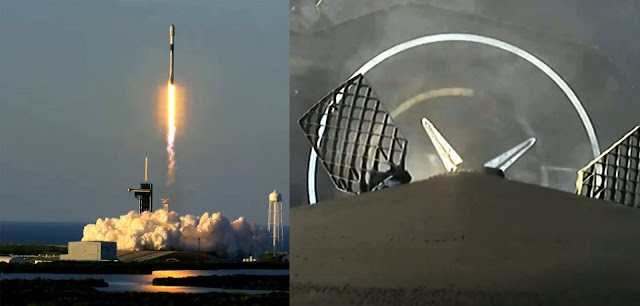
Author's privilege is that I get to boast about going out to my side yard and watching rocket launches.  Yesterday's launch was positioned perfectly for those of us south of the Cape Canaveral Space Force Station - perfection rivaled only by the weather giving us the ability to see it.  The first stage cutoff appeared to be almost due east of us; maybe a bit south but the elevation angle was so high that it was hard to tell.  We could see the cold gas thrusters firing little white puffs to turn the vehicle over and around so that it started falling to the north, back to CCSFS.  About this time the sound front reached us and we had a long listen to the rocket engines.  When the first stage fired up for the first burn on the way to landing, the entry burn, it was plainly visible.  With booster landings on one of the ships 400 miles away, we don't see that.  I think this is only the third time we've seen this, and I can see it's the second time I've photographed it.
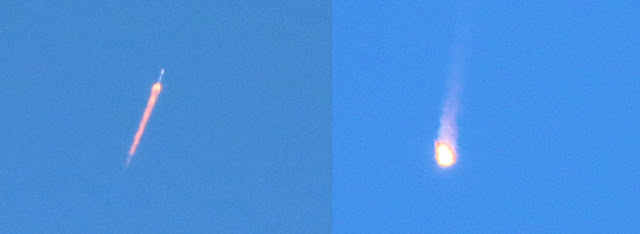
"What goes up must come down," as they say.  The Falcon 9 on the way up on the left and on the way down a few minutes later.  We're not looking directly up the booster's skirt, it's actually pointed away from us (as I understand the geometry) but the plume gets pushed up around the booster by the atmospheric drag.  About a minute later we were treated to this view on the mission feed.
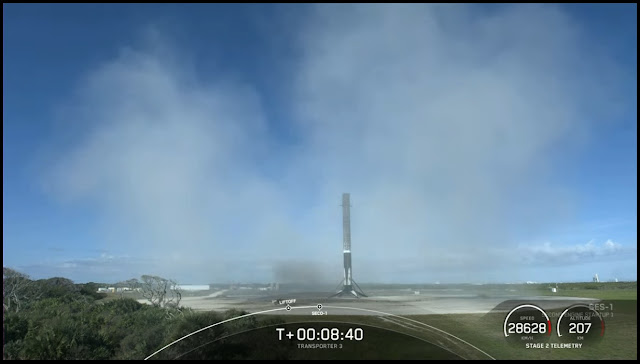
And a minute or so after that heard the sonic booms of the booster slowing down below the speed of sound.

Eric Berger at Ars Technica found a couple of fun facts about this mission and booster 1058 that I hadn't seen elsewhere. 

Remarkably, this single Falcon 9 rocket first stage has now launched 550 satellites into orbit, as well as one Cargo Dragon and one Crew Dragon. It has flown, on average, every two months since its first launch. It would seem that rocket re-use is more than a fad.

No, rocket re-use changes everything.  B1058 is the third Falcon 9 to cross the 10 flight milestone.

Notably, this booster, number 1058, reached this 10-flight milestone in 594 days. The previous 10-flight rockets required 1,100 and 799 days, respectively. So SpaceX continues to bring down the time needed between reuse of each first stage, as Booster 1058 has only required about two months between flights.


Russia's Roscosmos is saying they're planning 30 rocket launches for 2022

On Thursday, Roscosmos released remarks from its director general, Dmitry Rogozin, about space activities in 2021 and looking ahead to 2022. Counting a Europeanized version of the Soyuz rocket, Roscosmos completed 25 orbital launches in 2021. Of these, 14 took place from the Baikonur Cosmodrome, five from Vostochny, five from Plesetsk, and one from the Guiana Space Center in French Guiana.

Taking "great risks" ... For this year, Rogozin said, "We are planning about 30 launches of space rockets, with more than 10 of them commercial ones."

Gee, Russia,  who used to dominate world rocket launches, won't launch as many rockets as one American company did last year, or as many as China?  Ch-ch-ch-changes...


The good news continues to roll in on the James Webb Space Telescope.  While still nine days away from its destination at Lagrange point 2, and weeks away from being operational, you've probably heard that all the critical unfolding and other deployments have been successful.  This week we learned that due to the performance of the Ariane 5 launch vehicle, the telescope's life expectancy may well have doubled from 10 to 20 years. 

NASA's Mission Systems Engineer for the Webb telescope, Mike Menzel, said the agency had completed its analysis of how much "extra" fuel remained on board the telescope. Roughly speaking, Menzel said, Webb has enough propellant on board for 20 years of life.

This is twice the conservative pre-launch estimate for Webb's lifetime of a decade, and it largely comes down to the performance of the European Ariane 5 rocket that launched Webb on a precise trajectory on Christmas Day.


As a preliminary report estimated, next Tuesday, January 18th, has been announced as the launch date for the next orbital mission of the Astra Rocket 3. The launch will be from SLC-46 on the CCSFS, No Earlier Than 1:00 PM EST with a window extending to 4:00 PM. Astra achieved orbit for the first time in mid-November last year, with a launch from Kodiak, Alaska.  The company had long said they wanted to be able to launch from a variety of places around the world, into a variety of orbits.  This latitude should be easier to reach orbit from than Kodiak's latitude!


Wednesday, January 12, 2022

Second Week of the Year; Second Launch of the Year

To echo last week's title, and admitting this title format could get old, the second Falcon 9 launch of the year is set for tomorrow, January 13th, with a 29 minute long launch window opening at 10:25 AM EST, or 15:25 UTC from Space Launch Complex 40 (SLC-40) at Cape Canaveral Space Force Station.  Unlike last Thursday's launch, this is a rideshare mission called Transporter 3.  These rideshare missions remain a very low cost option for small satellites to orbit.  

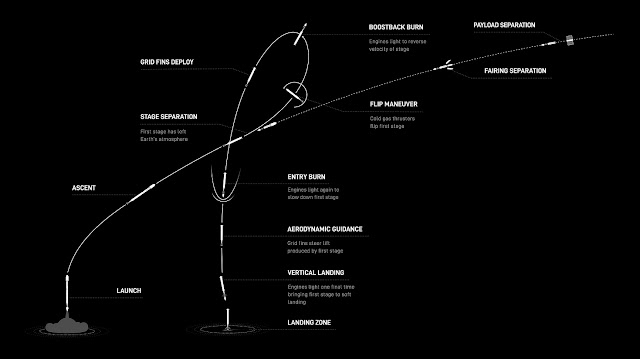
SpaceX has confirmed that the booster for this mission will be flying its 10th mission; B1058 previously launched Crew Demo-2, ANASIS-II, CRS-21, Transporter-1, and five Starlink missions, the last mission was on November 13th, making this a two month turnaround for the booster. Following stage separation, SpaceX will land Falcon 9’s first stage on Landing Zone 1 (LZ-1) at Cape Canaveral Space Force Station.  It's a different trajectory than landing at sea and ought to be covered well by the onboard cameras.

SpaceX graphic from their "Launches" website.  This will be gone from the website within a few days when the next launch gets close and replaced with the equivalent diagram for that mission.

Transporter 3 will be carrying 105 spacecraft (including CubeSats, microsats, PocketQubes, and orbital transfer vehicles) into a polar orbit, with a path that sounds similar to that flown by SpaceX for the SAOCOM-1B launch in August of '20.   That launch was ideal viewing for us; it flew almost overhead on the way south and the booster came back along the same path, allowing us to see the entire entry burn (the first burn) almost overhead.  

As a side note, booster B1062 from last week's mission returned to Port Canaveral yesterday or last night, and showed no apparent damage, unlike the booster from the last mission of '21 in December.  B1069 had all four landing legs damaged as well as several of its Merlin engines.  All four legs of B1062 looked like they were undamaged and folded neatly into preflight position. 

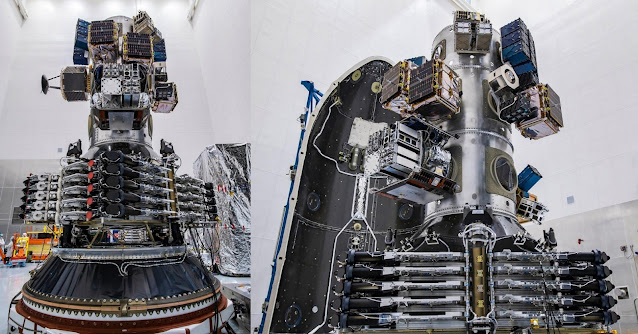
The Transporter 3 upper stage just prior to closing the fairings around all 143 satellites.  SpaceX photo.


Tuesday, January 11, 2022

Solar Cycle 25 Update #4

Going through previous posts, to see if I put numbers on Cycle 25 updates, I found that I posted about the first spots of the cycle being identified two years ago - to the day - January 12, 2020.  The way these cycles work is that the first spots appear at higher latitudes, that is, closer to the poles, and as the cycle progresses, they move toward the solar equator, a pattern often called a Butterfly pattern.  There's generally a period of overlap when spots from both cycles can be observed at the same time (determined by the magnetic polarity of the spots) and that happened at least until April of 2020, when Cycle 24 spots hadn't been seen in a while.  These folks say the first cycle 25 sunspot was seen in December of 2016.

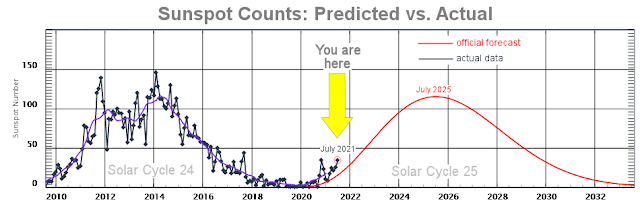
As the new cycle started, it began to look to be rather more active than the official models were predicting.  I posted this diagram last August showing the progression of sunspot number being noticeably above the official predictions. 

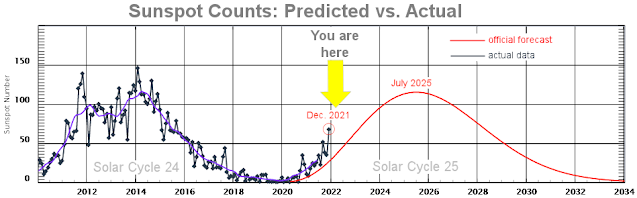
This appeared August 4th on SpaceWeather.com.  The plot has been updated for the last five months, and posted at Spaceweather.com again.  The divergence between reality and the official forecast is even stronger. At this point, it looks like the cycle could go higher than predicted or the peak could be sooner.  Or both.

All of the conventional experts had been predicting this solar cycle would like the previous one - which was the weakest in a hundred years.  In these plots, the "official forecast" plot is the one NOAA (and by extension the US) has as its forecast.  In August of '20, I go into more details on some of these issues as I introduce a prediction by a new group that was very different from the official forecasts.  These guys were saying 25 could be in the top couple of strongest sunspot cycles ever.  

To be blunt, we see someone making a prediction like "this is going to be as strong as cycle 19" (the strongest cycle on record, peaking in 1957) virtually every cycle.  I've come to ignore them.  I'll note the prediction and see what really happens.  As I said along the way:

It's an interesting prediction, but when a new group comes along with a whole new way of looking at a problem that has been studied for years, they either suddenly revolutionize the field or fail and go away.  We'll see what happens with this prediction.

In the last few months, I came across a video by the leader of that prediction group, Dr. Scott McIntosh, that was made in early September of '21.  It's a half hour long video (32:11) and he both explains their model and updates it.  All of their prediction depends on predicting and identifying so-called 'termination' events:  landmarks marking the start and end of sunspot and magnetic activity cycles.  Some of their early predictions hadn't happened yet as of that date, and as a result, he lowered their prediction to put cycle 25 "in the top 10 strongest cycles" while saying we should know more in the next couple of months (next few solar rotations).  

Since we're now in the couple of solar rotations time period since the video, I'd like to see an update to their predictions.  The progress of the cycle, though, seems to make them look good.  Cycle 25 has been consistently stronger than the official forecast since activity started going up.


Monday, January 10, 2022

A Week of Serious Testing of the Chopsticks

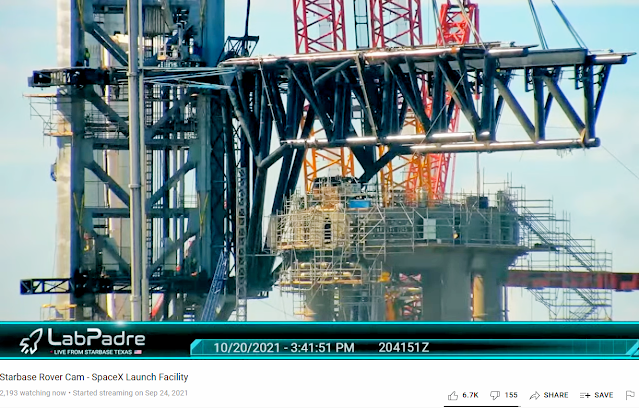
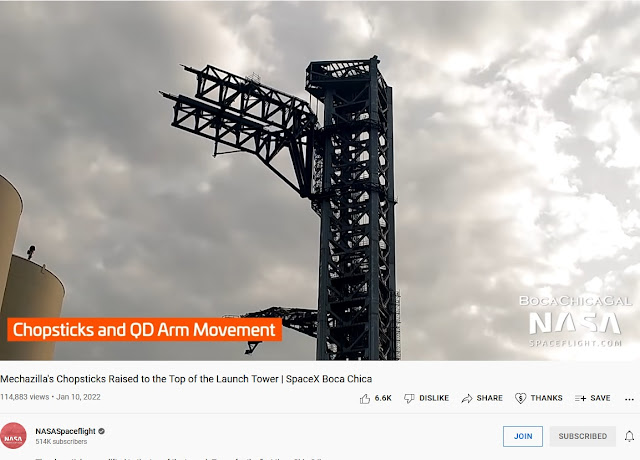
As mentioned last Friday, SpaceX Boca Chica has started doing tests of the giant metal "chopsticks" that are on the Orbital Launch Integration Tower (OLIT), expanding the testing envelope a little at a time through today.  The combination of the functional chopsticks and the OLIT is referred to as Mechazilla, in case you forgot.  They're pictured here on October 20, and details have since changed, but look roughly like this:

As Eric Ralph at Teslarati points out, the testing started out on January 4th with simple movements where the chopsticks were sitting - just over the launch mount (much like the above picture).  

Four days later, SpaceX performed a variation on the first round of tests, again slowly lifting the assembly up the side of the launch tower and opening and closing the arms. The most notable difference was the addition of several tandem swing tests, which hinted at more applied tests that were soon to come. SpaceX also performed some basic tests with a third Starship fueling arm higher up on the tower, very slowly swinging it towards where Starship would be standing.

On Sunday afternoon, a third major round of testing kicked off. This set of tests was considerably more focused than the prior two, suggesting that it was more of a simulation of the main purpose of the arms.

Sunday, the chopsticks were raised up the OLIT as high as they're required to go and several of the required motions were tested.  At this height, the Chopsticks can place a Starship on top of the Super Heavy booster. 

There are animations of what this could look like on Twitter, but nothing that has any endorsements from Elon Musk.  This one seems realistic and complete.  

Ultimately, the tower seemed to complete the simulation without any showstopping issues. Up next, it’s possible that SpaceX will add weights to the simulator bar to fully simulate the 100-200 ton masses of Starship and Super Heavy. Eventually, SpaceX may also use Starship S20 and Super Heavy B4 to fully qualify the arms by actually lifting, stacking, and removing both stages.

Remember: it was almost exactly a year ago that we first heard that SpaceX was, at least metaphorically, saying it's too easy to land an orbital class booster on a figurative postage stamp 400 miles from any landmark so they were going to fly the boosters back to the launch site and snatch them out of mid-air.  There are good reasons to want to do this; the biggest are that it saves weight on vehicle which translates to bigger payloads, and it saves the expense of sending drone ships and infrastructure down range.  Super Heavy has an advantage over Falcon 9 (at least, theoretically) in that Falcon 9 can't hover.  It's so light at landing that a single engine can't throttle back far enough to hover, which means the flight computers have to get the descent velocity down to zero just as the booster touches down. A Super Heavy will be able to hover.  I suspect we'll see that in the early tests. 


Sunday, January 9, 2022

Annnnd It's Done

The new antenna is up and fully operational.  

The slowdown in the work I talked about yesterday all focused on a simple enough part of the tower build, the house bracket.  Makers of consumer radio towers generally insist on a house bracket because it reduces the amount of torque applied at the base trying to collapse the tower.  Virtually every TV antenna mast uses a house bracket so the simple ones are big box hardware store items.  This one is more than a bit different and totally custom.

Back in '16 while I was working on replacing the rusting out pole, I made a fairly accurate model of the tower and antennas to help me nail down the geometry and treat it as mechanical design statics problem.  Along the way, I made a model of the house bracket and how the tower is secured. 

The view is as if you were on roof looking down onto the bracket, which is in white.  The house is transparent but the side of the bracket facing the house mounts to the house eaves and is lag bolted into the roof trusses.  All of that bracket is 1" angle iron, and those corners were welded for me by a friend long before I started doing any metal working as hobby (and I still don't have a welder).   The red rectangle is a 2x4, split lengthwise, that clamps around the tower legs as you can see.   The inner half (bracket side) of the 2x4 is held to the bracket with a pair of 5/16"-18 bolts through the vertical portion you can barely see, and the outer half clamps to the inner with a pair of lag bolts.   I ordinarily make those from a chunk of pressure treated 2x4 but last time I used plain wood because I didn't have any PT on hand.

It's barely visible in this drawing, but the house bracket actually tilts down a few degrees because it's mounted to the house eaves.  That means the left piece of is downhill and that piece of angle iron accumulates water.  Water means rust and it was worse than expected.  It was time to re-wire brush, and re-apply rust treating primer.  I did that yesterday and painted over the black primer with the white trim paint today.  While taking the 2x4 off yesterday, so I could wire brush and prime the outside face of that piece of angle iron, a piece broke off the 2x4.  Which suddenly meant it was time to remake that, and I had no end of little problems making that piece.  I should probably paint 2x4, too, although that's less urgent.

Pretty much all of the painting was done by 1 PM and I searched for anything else to redo while the antennas were accessible.  Late in the day, it was time to crank the tower back up and make sure everything went together as it should.  Happily, it did.

This is the house bracket assembled  - the tower bears the "scars" of earlier trim paint.  I should really clean that off, one of these days.  It's just inconvenient enough to reach that I don't get to it. 

Finally, I re-swept the antenna and the data was almost identical to what I got yesterday with it pointed up.  After the test data looked good, I turned on the station and verified the radio was happy with it, and it was.  It was almost ecstatic.  For a radio.

Finally, the completed installation.  The new antenna (Directive Systems Engineering DSEJX5-50) is the one at the top, the lower antenna is my HF log periodic (LPDA) array, a Tennadyne T6.  The way that the two antennas are mounted on opposite sides of the vertical mast adds some oddness to this perspective, which is pretty odd anyway.

For some time, I've been pondering replacing that house bracket with one made from aluminum to avoid the rust.  Eventually that rust I fight every couple of years is going to force my hand and that bracket will have to be remade.  I've thought it would be be better to perhaps machine the interface so that I don't need the 2x4 clamp, something that could maybe slip over the bracket and the tower cross bar (visible just below the 2x4 in that middle picture) and not even require hardware.  Maybe just held in place by gravity.  And maybe that's hoping for too much.  Either way, it's not something that needs to be done immediately and can be thought about.  All my antenna projects tend to start with the phrase "when it cools off" - maybe it's a next year project. 


Saturday, January 8, 2022

Busy Day So Pardon Me

I was well into getting the new antenna mounted and put into operation today when the job suddenly got bigger and stretched into tomorrow.  

By way of summary, my tower installation is a bit unusual.  As in I've only seen one sort of like it and that was one a friend of mine (N4RFC from the blog list) helped me design and put up back in the late '70s.  I've described this system a couple of times, mostly back in February of '16 when I was doing a major repair and upgrade to it, but it's a 20 foot aluminum tower that cranks over from its base so I can remove antennas in the event of hurricane or otherwise work on them.  

In the last week, I built the antenna I've talked about having ordered, and yesterday I cranked the tower over, removed the previous antenna along with all of its coax (some of it just about 40 years old).  It was time to mount the antenna on the tower leaning over in the yard, and I did that mid-afternoon yesterday.  Ordinarily, I do this with my antennas pointing north.  That's because when I crank the tower over, the feed points are close enough to ground to sit on a small seat and work on them.  Yesterday, I mounted the new antenna facing south, which is pointed up (well, 15 to 20 degrees off the vertical).  This allowed me to verify the antenna is performing as it should; at least in terms of its match (SWR).  

I haven't had the tower over since the aftermath of our lightning strike in August of '19, replacing a couple of damaged cables, so while today's main job was finishing the antenna installation, I thought I should really check the rest of the installation and found some rot and rust that needed to be tended to.  That ended up taking the rest of the daylight, so the antenna won't be operational until tomorrow.  I'll hedge my bets and say late in the day.

That said, I actually wore an N95 mask today.  And rubber gloves.  Not Covid; I was spraying paint that I'd rather not inhale with the wind swirling it around me. 


Friday, January 7, 2022

Space New Roundup

A handful of stories in no particular order.  

More rockets made orbital launch attempts during 2021 than in any previous year in history, breaking a record that dates back to the space race.  How many?  Eric Berger at Ars Technica has this:

There are no official records of such matters, but several good online resources provide a compendium of data that includes both orbital launch attempts and successes. Based on this information, a total of 144 orbital launches were attempted in 2021, of which 133 were successful. This total does not include two unannounced launch attempts by Iran's Simorgh vehicle.

Last year's numbers surpass the total orbital launch attempts in 1967 (122 successes out of 139 launch attempts) and a previous record for successes in 1976 (125 successes out of 131 attempts).

The busy year comes after a decade of continuous increases in the numbers of launches.  From 2000 to 2010, the government and commercial operators launched, on average, fewer than 70 orbital rockets a year.  The big differences are China and SpaceX.  When we're talking about relatively small numbers like 144 launches and 133 successes, small operators like Rocket Lab - with six launches in 2021 - are important, too.  Before 2010, China averaged fewer than 10 rocket launches a year.  Last year, the Chinese government and a handful of private Chinese operators launched 56 rockets in 2021, of which there were 53 successes.  SpaceX, as we reported last month, had 31 launches all of which were successes.  


Yesterday's first SpaceX launch of the year went as routinely as can be.  The liftoff was exactly on time and the booster landed in excellent shape on A Shortfall Of Gravitas nine minutes later.  


Teslarati edit of SpaceX photos:

Right on schedule, thrice-flown Falcon 9 booster B1062 lifted off on its fourth orbital class mission at 4:49 pm EST, precluding the need for a backup window scheduled a few hours later. Carrying a fully-fueled Falcon upper stage and 49 Starlink V1.5 satellites, together weighing around 130 metric tons (~285,000 lb), the booster separated approximately 68 kilometers (42 mi) above the ground while traveling 2.2 kilometers per second (~1.4 mi/s or Mach 6.4) – about 30% of the way to orbital velocity.

Six minutes later, after peaking at 132 km (82 mi; significantly higher than Blue Origin’s suborbital New Shepard vehicle) and reentering Earth’s atmosphere, Falcon 9 booster B1062 safely landed around 640 km (~400 mi) downrange aboard drone ship A Shortfall Of Gravitas (ASOG).

Note that when Eric Ralph wrote "Six minutes later," he was referring to six minutes after the booster engine cutoff, when the booster is jettisoned.  It's just a few seconds short of 9:00 on the mission timer.

As last month's near loss of Booster 1069 made clear, B1062 isn't out of the woods until it's safely secured by ASOG’s ‘Octagrabber’ robot. Before the Octagrabbers were introduced, a crew would board the drone ship from another ship kept at a safe distance, once the vehicle had passed some number of "safing" steps, and then weld the landing legs to the deck of the drone ship. 

Teslarati also reports being told by the Cape Canaveral Space Force Base that SpaceX has five launches on their schedule in January.  That's more than one/week.  The Space Force spokesman also said there would be two other launches this month.  I see one Atlas V launch on Jan. 21, but that's all so far.


Over at Boca Chica, while there hasn't been a 29-engine static fire or anything truly epic like that, they have continued working on a wide variety of things, including making the "chopsticks" that will catch boosters move several times.  See the last few minutes of this 16 minute video (it should start at 13:44).


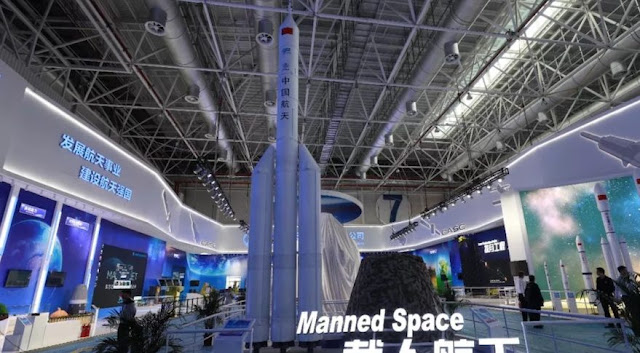
China seems to be planning a manned lunar mission within the decade.  A new Chinese heavy lift rocket, based upon three cores like the Delta IV Heavy or Falcon Heavy rockets, could be ready for a debut flight by as early as 2026, Space News reports.  Long Lehao, a senior space industry figure and one of the Long March launch vehicle designers, said the kerosene-liquid oxygen rocket could be used to put Chinese astronauts on the Moon. The new-generation crewed launch vehicle first emerged as a concept at a 2018 airshow.   

A concept model for a new-generation launch vehicle for launching crew to the moon, on display in Zhuhai in November 2018. Credit: CASC

With NASA's Artemis program slipping "beyond 2025" and relying on the Space Launch System (which seems to be slipping again), it might be a safe bet to say China will get there first.  The country is working on all of the pieces required to make it happen.  In addition to this heavy lift booster, Space News reports:

China tested a prototype new-generation crew capsule for missions beyond low Earth orbit in May 2020. The country is also known to be working on a lunar lander.

An even larger rocket, the Long March 9, is also being developed. Its role will be for launching large infrastructure such as elements of the planned ILRS. That launcher is currently slated for a first launch in 2028, with previous reports stating 2030.

China has committed to developing a joint China-Russia International Lunar Research Station that will first be a robotic base but aims to establish habitats for humans in the 2030s.


Thursday, January 6, 2022

J6 in Retrospect

Last January 6th, Mrs. Graybeard and I were watching some of the news stories coming out of DC and I distinctly remember saying, "this smells like a false flag operation."  There were those videos of what appeared to be cops waving groups into the capital building.  What she said to me was the essence of this tweet that Irish posted that day. 

As well as wondering why there was no shatterproof glass in "one of the most secure buildings in the world."  The whole thing brought this to mind from a couple of months earlier (and also from Irish).

In the year since, it has only seemed more like a false flag operation.  As Dinesh D'Souza says, this is the only insurrection in history in which there were no insurrectionists.  We can say that positively because nobody has been charged with insurrection.  The person who seems to have been an insurrectionist, because they have him on recordings saying they need to go into the capital, Ray Epps, has had no charges whatsoever and (as far as I can tell) is living peacefully at home.  Meanwhile, people charged with much more minor things have been held without bail in solitary confinement long enough for it to be considered torture under human rights laws and beaten badly enough to break bones.  

There's another famous FBI job in the news, the one where a group of FBI agents talked some rubes into going along with their plot to kidnap Michigan Governor Whitmer.  January 6th is making that bunch look like consummate professionalism.  

Meanwhile, this goes here:

(clearly the Babylon Bee's work)


Wednesday, January 5, 2022

The I-95 Traffic Jam and Electric Cars

As I'm sure you've noticed, this week's news has featured a traffic mess outside DC on I-95 where people were stuck for up to almost 24 hours in snow and cold.  People survived by running their engine intermittently to keep the vehicles warm.  People who are in the habit of keeping some blankets in their cars along with water and maybe food were better set to survive and there are stories of some of them sharing their supplies.

An article headline on Watts Up With That got me thinking about how Brandon's Build Back Better Bill has as a policy goal to get Internal Combustion Engines off the road.  If everyone had been driving a battery-powered Electric Vehicle, would this have been a mass casualty event?  Everyone knows that battery electric cars get a double whammy when it’s cold.  The heater runs on the batteries, which reduces the range, and the batteries lose capacity when it’s below freezing, further reducing the charge life.  Anyone in that traffic mess would have had to run the heat intermittently.  

Something that has been a mental irritant has been the thought of how all those electric cars could be charged, but I’ve never seen numbers.  The energy to charge the batteries has to come from somewhere.  I just know I’ve read of both Elon Musk of Tesla and Akio Toyoda of Toyota Motors have said the power grid wouldn't support an all electric car fleet without serious upgrades.  A comment to that article had numbers I could use.  They said there are 289 Million cars on the roads in America and 1% are EVs, 2.89 million.  Let's put some numbers on this.  We need to know how big the battery is to determine how much it takes to charge it, and every car is different.  Time for some search engine research. 

I found a spreadsheet of EVs and the median battery is 69 kWh (kilowatt*hrs).  There are other such spreadsheets, but I didn't find all the data that first linked spreadsheet had.  Because there are so many different sized batteries, exactly how big an impact on the grid there would be is “guesses all the way down” - rather than turtles.

Let’s start with 300 million total vehicles.  How often do they need to charge?  Depends on range.  That spreadsheet included range on a charge, and the median value is 259 miles.  That says the typical driver won’t recharge every day.  Some people will put that on in a week, some in a couple of days, some in more than a week.  For convenience, I’ll guess once every five days and say 300 million/5 days says 60 million cars will need charging every day.  60 million times 69 kWh is a 4,140 gigawatt increase (4.14 terawatts) on the grid.  How much is the grid delivering now?

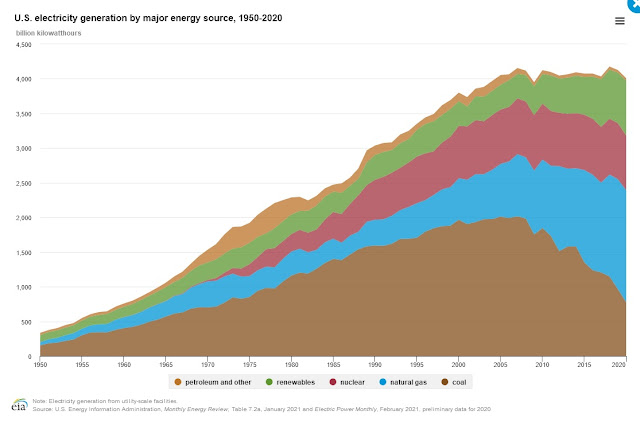
The US Energy Information Agency says the 2020 US power grid produced a little less than that 4.14 terawatts; they say 4 terawatts, but there’s enough uncertainty in everything that goes into my calculation that it’s safe to say we would need to double the size of the power grid if every car was electric. 

But wait, it’s worse.  That number inherently assumes (1) the batteries really are good for the kWh they’re rated, and (2) the charging is 100% of that number; that is, a battery rated for 100kWh really requires 100kWh to charge it - which implies there’s no inefficiency anywhere.  I think having both of those is impossible.  “In the old days,” a NiCd, NiMH or Lead-Acid battery was often charged at 1/10 of its capacity (10 hour discharge rate) for 16 hours – that’s 160% of its rating.  The spreadsheet I found has a column for the “promised” max power to charge the battery and another for the measured max power used.  There are batteries where the measured max power is less than the battery’s ratings which implies the battery doesn’t meet its ratings.  It’s trivial to find what percentage the max measured charging power is of the rated power. 

The median measured max power is 1.80 times the rated kWh.  Multiplying that 69 kWh above by 1.8 says the power grid would need to deliver 7.452 terawatts.  Using the US EIA numbers again, that essentially says the generation capacity of the US power grid would have to be tripled.

Again, this is playing guessing games with spreadsheets and calculators.  I've got zero growth in the number of cars on the road, and that's probably ridiculous.  It might grow and I can imagine scenarios where it shrinks, but staying the same for years and years doesn't sound possible.  If more EVs are on the road, the power grid could go beyond needing to be tripled and need to be quadrupled.  

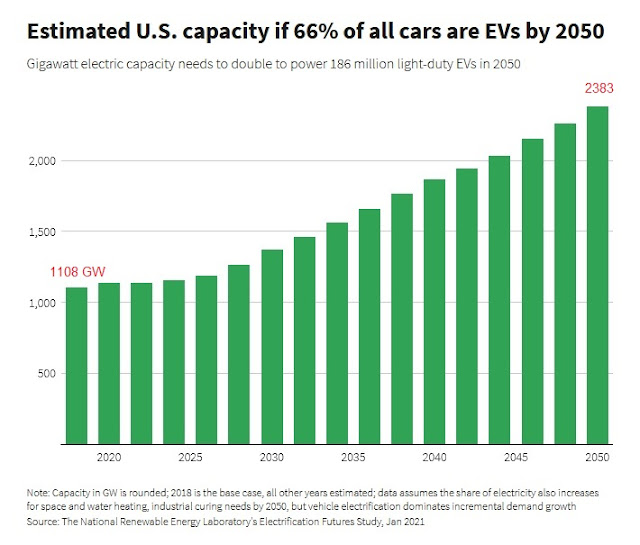
While sanity checking my answers, I found an article on Reuters that talked about having 2/3 of the cars on the road being fully electric by 2050, a much lower bar than having no IC engine cars by then.  Their calculations said that the power grid would need to be doubled.  They provided a link to this graphic - I added the numbers in red.

Their number for the total capacity for the grid starts much lower than the US Energy Information Agency's number, but for two thirds of the percentage of cars I calculate, they get a doubling instead of a tripling.  That sounds like it more or less agrees with my numbers.

So tell me: have you heard anyone saying they want to triple the power generation capabilities of the US?  Triple the power generation in Europe or the developed world?  Anywhere? 


Tuesday, January 4, 2022

The Good News Continues to Roll In

Good space news, that is.  

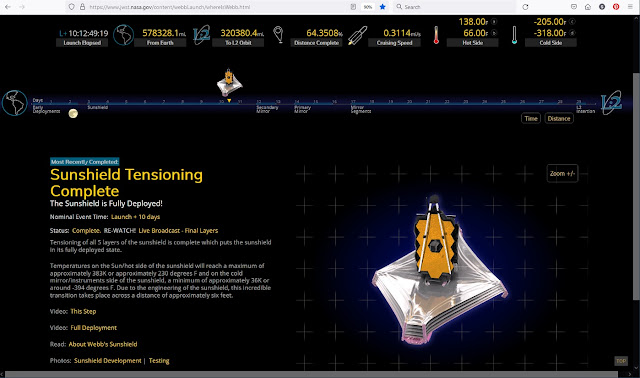
The James Webb Space Telescope has fully deployed their solar shield, that tennis court-sized, kite-shaped sandwich of layers of Mylar that has been pictured here before.  NASA's Webb Telescope Twitter account noted:

This is it: we’ve just wrapped up one of the most challenging steps of our journey to #UnfoldTheUniverse.

With all five layers of sunshield tensioning complete, about 75% of our 344 single-point failures have been retired!

I have to admit this has given me heartburn since I first heard of it.  It's great to hear that Webb is now 75% of the way to working.  Only 86 possible single point failures left. 

You will notice that the temperature on the hot side of the sunshield peaks at 138 F while the coldest spot on the cold side is 456 degrees cooler at -318 F.  A pretty dramatic sun shielding. 

Today is Launch +10 days; according to that graphic, the next steps are to deploy the secondary mirror (after a day of preparation), and then start to deploy the main mirror.  Once that's done, the next eleven days will be getting the primary mirror segments in the right places.  To within a small fraction (1/10?) of the wavelength of the infrared light they're working with.


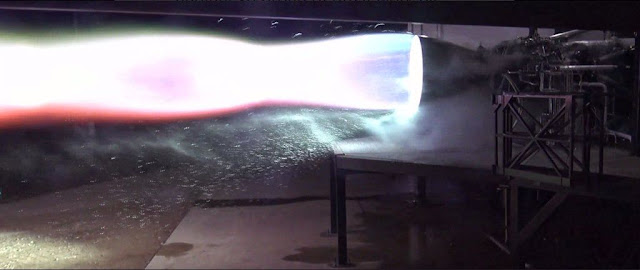
Another piece of good news comes from SpaceX, where Elon Musk spent some time on Twitter and mentioned that the Raptor 2 engines are coming along well. 

Raptor 2 now operates routinely at 300 bar main chamber pressure. 

If you'll recall the story from early December when Musk floated the idea that bankruptcy could be a concern, the main issue was Raptor engines.  The backstory and details of the Raptor engine history that get the full picture across are over on Teslarati and are worth a look.  Just a month short of three years ago, February 10, 2019, in the first days that SpaceX started testing the first full-scale Raptor prototype (now called a Raptor 1), the engine briefly reached a main combustion chamber pressure just shy of 269 bar (3900 psi). That narrowly beat records set by Russia’s RD-270 and RD-180 engines.  The RD-270 never went into production, while the RD-180 is a well-established, good engine.  It's used on ULA’s Atlas V and the fact it's a Russian engine is the reason Atlas V flights are no longer being sold.  

18 months later, Musk revealed that one Raptor prototype was able to maintain that 300 bar pressure for over one solid minute.  The same engine briefly hit 330 bar (~4800 psi), producing 225 tons (~500,000 lb) of thrust at that point.  Over the last several months, their emphasis has moved onto the Raptor 2 engine which is reported to feature much a cleaner design; in both plumbing and wiring. 

On October 24th, Musk subtly live-tweeted one of the first Raptor 2 static fires, revealing that the engine reached a chamber pressure of 321 bar (~4650 psi) and briefly produced around 245 tons (~540,000 lbf) of thrust before destroying itself. Now, a little over two months later, Musk says that Raptor 2 prototypes are routinely operating at 300 bar without major issues, meaning that they can ignite and safely shut down after burning for several minutes at those pressures. In theory, given that 300 bar is Raptor 2’s targeted chamber pressure at max thrust, that means that the engine is now “routinely” operating at the level SpaceX wants and needs to take Starship to the next level.

The Texas Tank Watchers are debating whether Booster 4 and Starship 20 will ever launch or be scrapped to switch over to the Raptor 2 engines, since the Raptor 1 or 1.5 are dead end products.  I can see launching B4S20 or not launching.  Production quantity Raptor 2 engines don't exist right now so if they feel they need to launch, they have to use B4 or its kin.  The question is what they can learn by launching B4 that they can't learn another way.  Costs of the mission to get the benefits of what they learn.

Test firing of a Raptor 2 engine.  Elon Musk/Twitter.


Monday, January 3, 2022

First Week of the Year; First Launch of the Year

It took until today, with the sources I read the most often back at work, to learn recovery drone ship A Shortfall Of Gravitas (ASOG) left Saturday - New Year's Day - for a trip down to NE of the Bahamas in support of SpaceX's first launch of the year.  That mission will launch No Earlier Than Thursday January 6 at 4:49 PM EST.  The launch is the next batch of Starlink satellites called Group 4-5.

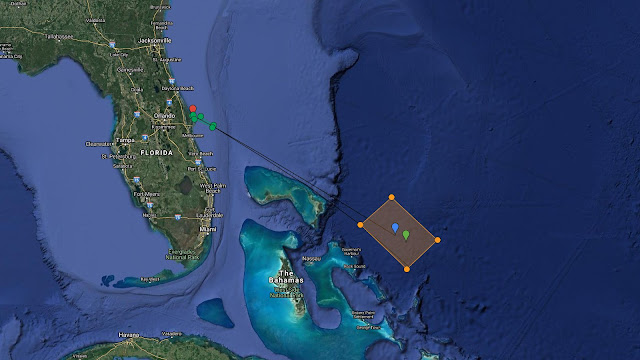
This is a rare launch for us here south of the Cape.  The trajectory out of the Cape will be toward the southeast while the vast majority have been toward the northeast.  We might get a better look at this one.  Twitter user Raul74CZ posts:

LHA map for #Starlink Group 4-5 from KSC LC-39A NET 06 Jan, altern. 07 to 10 Jan based on issued NOTMAR/NOTAMs. Estimated groundtrack, booster landing ~637km downrange, fairing recovery ~673km downrange. S2 reentry during second orbit in South Atlantic. bit.do/LHA16

The LHA is the Launch Hazard Area, and the map looks like this.  The blue marker is where the booster will land while green is where the fairings will splash down. 

The Twitter Link also includes an estimate of where the second stage will reenter.  That will be the second orbit, so less than three hours after launch, and the area where it will splash into the south Atlantic stretches from just offshore Uruguay in the southern reaches of South America over across Africa into the Indian Ocean far south of the southern tip of Africa, extending farther east than Madagascar and still far south of it.

As we pointed out last Thursday, unofficial but usually-accurate estimates of the year's launch manifest for SpaceX is 40 launches not including all Starlink launches.  They could easily be looking at adding another 10 or 12 Starlink launches this year totaling out to one launch per week.  


Sunday, January 2, 2022

A Ham Radio Series 29 – Directional Antennas Part 2

Last month, I concluded part 1 by saying I was going to replace my roughly 15 year old 6m log periodic dipole array with a five element yagi.  It will give me almost exactly 3 dB more gain – half an S-unit – so a good step up from the current performance.  

The antenna I chose is from a company I hadn’t heard of before but which was talked about as being a good supplier on one of the radio forums I read, Directive Systems & Engineering, and the antenna is their model DSEJX5-50 (pdf datasheet).   It’s currently in the box it was shipped in, in my shop.  That’s the next big project; all of my antenna projects begin with the words, “when it cools off” and while it has been near record heat for the past week, it still beats anything from about April through October. 

Since gain is the entire purpose of this sort of antenna, I thought a little discussion of how they’re designed and talked about would be worthwhile.  You may see the gain referred to as dBd or dBi, and since the units are different, can you compare two different antennas?   You may see gain patterns; are they directly comparable?  

What do those dB abbreviations mean?  The first one, dBd, is gain compared to a dipole, a half-wave antenna driven at the center and ordinarily considered to be in free space; that is, not affected by its surroundings.  A dipole is a real antenna that you can build.  The second, dBi, is gain compared to a theoretical antenna called an isotropic radiator.  That word means the radiation is “the same in all directions” which gives you the hint that it’s theoretical and no such antenna can be built.  A dipole has gain compared to an isotropic radiator, because its pattern is more donut-shaped than perfectly spherical, like the isotropic antenna, 2.15 dB more gain than the isotropic antenna to be exact, so we say 2.15 dBi.  If two antennas are specified in the same units, just compare the two numbers and the bigger number means more gain.  If one is in dBd and the other in dBi, subtract 2.15 from the dBi to convert to dBd.  The gains in any particular direction are directly comparable, as are the beamwidths, and the front to back ratio.

Think about that from another direction for a second.  If you compare any other kind of antenna to an isotropic, the numbers for gain in dBi are going to be bigger than if you compared it to a dipole and got the gain in dBd.  That tells you that antenna gain will almost always be talked about in dBi instead of dBd.  Bigger numbers sell better than smaller numbers.  

Measuring antenna gain in the real world is difficult, especially the larger HF and low frequency VHF ones.  A measuring receiver with a standardized antenna is mounted at some distance from the test antenna, and the amount of signal received from the test antenna is measured.  Calibration is difficult without good laboratory equipment and standards.  Due to the sizes involved this usually has to be done outdoors, with the test and receiving antennas mounted high above ground.  By comparison, microwave antennas are easy; they’re typically measured indoors where the environment is easier to control, in rooms covered with absorptive foam to keep reflected signals from messing up the measurements.  Standard antennas to help calibrate the measurement setup are much easier at microwave frequencies.  

Most antenna gain values you’re going to come across will be from simulations in one of the various NEC programs (EZNEC, 4NEC, etc.)  NEC is the Numerical Electromagnetics Code simulation approach developed by the US Lawrence Liverwurst National Lab.  This code works by solving reduced electromagnetics equations, modeling the antenna as a collection of wire segments specified by their positions in space.  

An interesting thing shows up in modeling that seems to be numerical “funny business” but is real.  An antenna simulated over ground usually shows more gain than one in free space!  What's happening is that the portion of the gain “balloon” that goes toward the ground in front of the antenna is reflected up to the main lobe and adds to it, actually adding gain. 

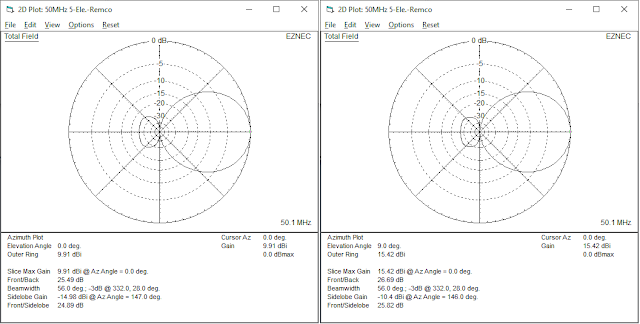
This plot is a simulation of an antenna much like the one I’m putting up: a five element, six meter yagi, but not exactly the same one as I’m putting up.  It’s modeled as being 30 feet above ground.  The plot on the left is the free space pattern and gain, peaking at 9.91 dBi while on the right is the plot over a real ground available in the NEC simulator; note the gain is 15.42 dBi; that’s 5.51 dB greater gain in that one direction.  Purely from the ground reflection.

This can be seen in real operation, and is something that beginners at moonbounce communications try to use to their advantage by experimenting when the moon is just clearing the horizon.  In the plot above, note the elevation angle (how high above ground maximum gain occurs) is 9.0 degrees.  When the moon is 9 degrees above the horizon and if a good reflective ground is below the signal path for several wavelengths in its direction, that extra 5.5 dB gain can increase their station’s performance enough to enable contacts.  You'll get better results over water - river, canal, bay, etc. - than over land.  Here's where the real world conspires to make your life difficult (physics is such a bitch).  Maybe instead of 5.5 dB improvement, you get one or two dB.  It's still improvement.

I should point out that these NEC programs, (as you can see in the upper right, the program I used was EZNEC, which is about to go completely free by the end of the month) are analysis programs, not design or optimization programs.  They can really help you with both design and analysis but won't give you designs; they'll just point out what the antenna can do.   You can waste a lot of time trying things without some guidance.  While I haven't worked with them, I've heard good things about a piece of software called Yagi Optimizer and another called YagiCAD. 


Friday, December 31, 2021

Saying Goodbye and Hello

Janus, of course, was the Roman god with two faces, one to look backward and one to look forward.  The name January is from his name and it's common for folks to look backward over the previous year and forward to the next year.  I'll do the same.  


At the end of 2021, American freedom is - at best - on the ropes. No matter where you look, you see the appearance of an emerging police state.  From the shutdowns and vax passports in places like NYC, to Federal "jab or job" mandates, to the feds blaming every problem on the unvaccinated.  At best, it's pitting groups of citizens against each other.  

There is apparently an all-out effort to turn groups against each other based on trivial characteristics like race (think of the 1619 Project).  Those of us who lived through the "Civil Rights Act" period of the 1960s thought the problem was solved 50 years ago.  I guess there was no money for the race hustler industry when people get along.  Take a look around my small southern city, in the churches or other gathering places and you'll find mixed race couples don't even get a second glance; it's just common, ordinary, normal life.  With the incessant talk of white supremacy, I had to think long and hard to try to remember if I'd ever met anyone who showed clear racial hatred.  Can't think of one.  Living just short of 68 years in various small cities in the south (or suburbs to bigger cities) I can't recall anyone openly talking hatred to blacks or any other group.

Will 2022 be much better?  Maybe in some areas; people are becoming aware of, and voicing opposition to Critical Race Theory (a way of teaching, not a subject) and things like the 1619 Project.  Economically, I don't see much chance of things getting better.  Judging by the number of email offers I've gotten saying prices are going up after the first, it looks like there's going to be another surge in inflation.  Potentially to numbers worse than any time in our history.  The inflation caused by the massive creation of money by the Fed is being made worse by the genuine supply/demand imbalances caused by supply chain issues you've read about everywhere along with economic damages from the Covid lockdowns.  No, Liz Warren; no, Brandon, it's not being caused by "greedy stores." 

Inflation is caused by Keynesian Federal Reserve economic policies that push creating money from nothing. As I say, this is complicated/worsened by other things that would have pushed up prices due to actual shortages (supply/demand imbalances).  The only way this gets fixed is by a Paul Volker-like head at the Fed winding that money back in with very high interest rates, but high enough rates might not be possible.  It might be more years of painful interest rates.  

Is 2022 the year the western economy collapse?  Could be.  Is 2022 the year the open shooting starts?  Same answer.

Should you believe me?  Heck, no!  I'm just some dood on the Intertubes with a blog.  Much of this post is a redo of my New Year's Eve post from 2010, with some changes to make it look more relevant.  The conclusion is word for word the same (except for the year).  I was wrong about that in 2011 and I'm probably wrong now.  Happy New Year!!  Thanks for stopping by.


Thursday, December 30, 2021

SpaceX Almost Lost the Booster From Last Week's CRS Mission

Word got out yesterday that SpaceX almost lost new booster B1069 after last week's Cargo Resupply Services mission, CRS-24.  The news was mostly on Twitter, but was summarized for non-twits today by Teslarati.  

As luck would have it, the only picture from this launch that I posted was the booster after landing on recovery drone Just Read The Instructions.  As you can see from that picture, the booster looks to have landed on the X-ring in the middle of the deck and appears to be in perfect condition.  This picture after the booster's arrival back at Port Canaveral tells a very different story.  

Photo by Richard Angle for Teslarati.

The first thing you might notice is the guard rail and fence on the deck of JRTI is bent out of position, apparently just barely keeping the booster from going overboard.  That bright yellow rail probably kept you from noticing the bells of the three Merlin engines that you can see are all heavily banged up.  The booster is tilted on the deck, and the landing leg closest to the camera appears damaged.  It's barely visible between the collapsing tubing extension and that brass colored fixture behind it, between the tubing and the left edge of that leg.  ("left edge" looking from this perspective)

This was said to have been caused by rough seas.  They also say the Octagrabber robot on JRTI was damaged.  

Teslarati's Eric Ralph notes:

From the ragged nature of the damage to those nozzles, it appears that B1069 somehow fell on top of the drone ship’s Octagrabber robot during or after its recovery attempt, as the creases would be far cleaner if the booster had merely landed hard and pressed its M1D nozzles against the deck. But a very short fall onto Octagrabber still doesn’t quite explain the apparent damage to one of the booster’s landing legs or the fact that it’s sitting lower to the deck than usual – both potentially indicative of a hard landing.

What is clear, though, is that SpaceX struggled to secure the rocket shortly after its first landing. Per the CRS-24 webcast, B1069 landed just shy of dead center. Likely as a result of poor sea conditions, SpaceX was unable to quickly grab the booster with Octagrabber, which uses giant clamps and its own weight to hold Falcon first stages in place. B1069 then clearly slid around drone ship JRTI’s deck at the whim of the ocean. Before SpaceX could secure it, the booster slammed into the side of the drone ship hard enough to partially flatten a steel safety barrier that runs along its port and starboard beams – a barrier specifically put in place to prevent wayward boosters from sliding off the deck.

An incident like this is where the economics of reusability really slaps you in the face.  Despite what looks like a large scale repair, the costs of utilizing the recovery drone ships, as well as the costs to repair JRTI,  it still looks like repairing this vehicle will be cheaper than dumping it in the Atlantic and building a fresh booster.  Published sources imply that replacing even all nine of the Merlin 1D engines will cost SpaceX in the vicinity of $10 million and it probably won't need all nine replaced (yeah, my guess).  My guess is it will total out under the price of a new Falcon 9 booster, which I've seen estimated at $25 million. 

The bigger problem might be that they're going to need this booster flying.  Their launch manifest for next year has (unofficially) been predicted to be 40 launches, a 29% increase over last year's record 31.  Five of those are Falcon Heavy launches (!) leaving 35 Falcon 9 boosters and 15 Falcon Heavy equivalents for a total of 50 Falcon 9s - a 61% increase over last year.  While the difference between the two F9s used as the side boosters of a Heavy is apparently cosmetic, putting a nose cone where the payload adapter goes on orbital boosters, they've historically kept them separated.  

Oh, by the way.  That 40 launch total doesn't include any Starlink missions.  Until Starship and Super Heavy are operational, Falcon 9 is the only way.  That could conceivably add as many as 20 launches to the manifest, for a total of 60.  More than one/week, with certainly some number from Vandenberg, but most from the Cape.

On its own, Falcon 9 launched six times more than the entire country of Russia last year and is by wide margins the most launched rocket in the world. 


Wednesday, December 29, 2021

Mr. Sun is Mad at You

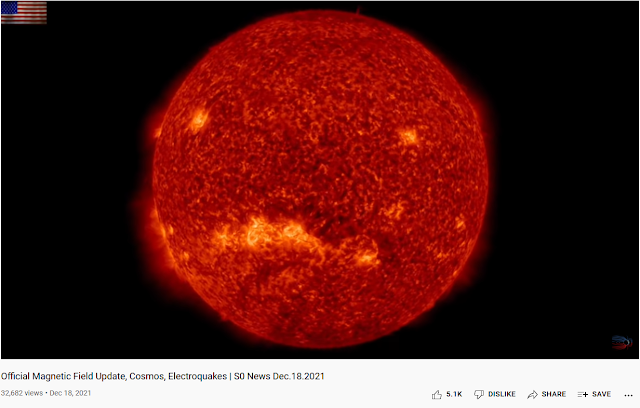
An image of the sun in Helium II at 304 Ã… (Angstroms) on December 18th.  

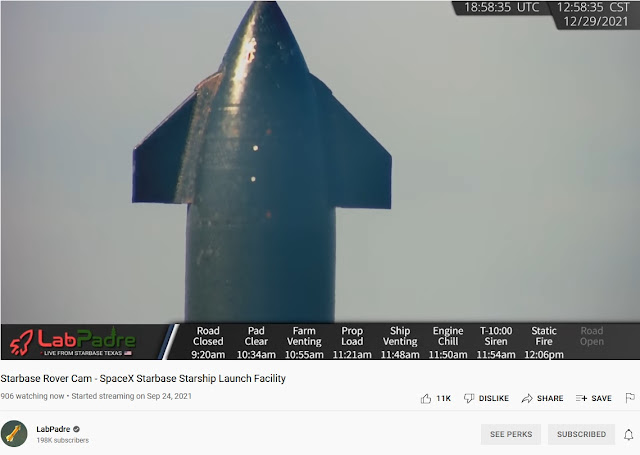
The day kind of got away from me because I spent most of it watching the Lab Padre cameras as SpaceX Boca Chica did another static fire test of SN20.  Except it turned into almost the whole day as it appeared they were going to do a second test, then that was aborted, then it looked like they were going to try again, then that one didn't happen.  

The most interesting image out of the tests isn't the Starship firing its engines; it's the picture after the test where we can see that only two tiles are missing (the two white spots). 

Clearly better than the first few times they ran these tests, when 15 or 20 tiles would pop off their mounts. 


Tuesday, December 28, 2021

Annnnd ... Add Two More Months Before Starship's First Launch

Just last night I was saying I thought a Starship launch in February was still possible.  Now read the headline like this common meme:

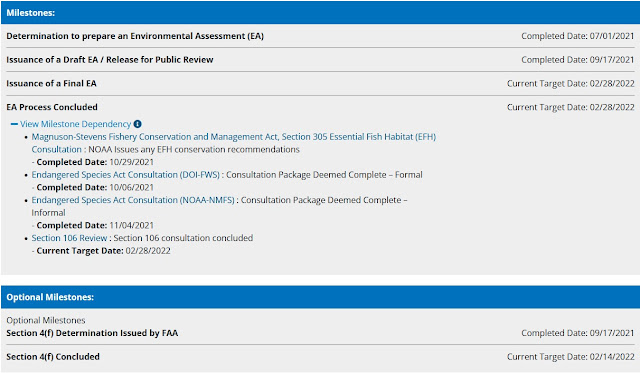
Back in mid-November, the FAA had said that their Environmental Assessment of SpaceX’s orbital Starship launch site would be issued by this Friday, December 31st, 2021.  This morning, they changed that date.     

While watching the Lab Padre cameras' coverage of tests during today's road closure, word was being thrown around that the release has been delayed until February 28th.  I checked their "Permitting Dashboard" and found it confirmed that story.  


There's a version of this dashboard I screen captured in that November blog post that's identical to this one except for the dates that moved out to February.   That means that the "No Earlier Than" date for the first orbital Starship mission has to be pushed out to at least March 1st.      

Within a few hours of that discussion on Lab Padre (comments on one of the video streams), Teslarati picked up the story.  

Somewhat insultingly, in its official statement on the delay, the FAA appears to attempt to implicate the review of “over 18,000 public comments” received during a comment period as a source of those delays. That six-week comment period ended on November 1st, weeks before the FAA published its first December 31st target date. In other words, for comment reviews to be responsible for any of the new delays, the FAA’s environmental compliance group would have had to underestimate the amount of work required to complete that process by at least 100% – not all that encouraging for an agency in which precision and accuracy are of the utmost importance.
...

The real delays, which the FAA acknowledges in much less detail, are likely the result of “continuing consultation and coordination with other agencies at the local, State, and Federal level [sic].” In the FAA’s defense, some of those delays may technically be out of its control if slow responses from other agencies are partly to blame. ...

The only test today apparently was of the igniters on Booster 4 or perhaps just some of them, I haven't found anyone with a clear explanation.  Lab Padre just said, "More Booster 4 igniter tests, 4th occurred at 12:38:41 pm."  The road was closed for maybe three or four hours and the "pad cleared" flag was in place for maybe one hour out of that.  I don't know if that was the only intended test, but there's another road closure scheduled for tomorrow and Thursday in the same 10AM to 6PM window.

Another reason to move everything to Cape Canaveral, Elon.  The fact that there have been orbital launches for 60 years means the environment has been impacted as much as it's going to be. 


Monday, December 27, 2021

Some Possible Launch Milestones for 2022

Eric Berger at Ars Technica has an article up that hints at four major, big rockets that may get their first flights in '22 - and then shows his own predictions are either for '23 or farther out.  Since this tends to be a slow news week (although work was ongoing at SpaceX Boca Chica today), and most of that news seems to be either "2021 in review" or "predictions for next year," it seems like a good article to direct you to.  

The big one, the one we've been tracking the most, is Starship.  Starship will get it's first trial for orbit this year to virtually absolute certainty.  It could be as early as January.  

Super Heavy

Capacity to LEO: 150 tons

Current official launch date: "January or February" 2022

Our previous estimated launch date: N/A

Our current estimated launch date: Q2 2022

Confidence: Medium

Here I move up a bit from Berger and think that February is still possible.  Q2, as he predicts, starts in April, and I feel rather sure that they will make Q1, barring some sort of spectacularly bad failure.   They have backup hardware already: Booster 5 is complete and in the shipyard, while they have started assembling the next booster, (called B7 and not B6 for some reason).  There's at least one other Starship, 21, in the shipyard, too. 

Booster 4 completing its journey from the high bay to the launch area.  Photo by Starship Gazer on Twitter with H/T to Teslarati.

The next most likely to fly after Starship (in my opinion, of course) is NASA's Space Launch System (SLS)

Space Launch System

Capacity to LEO: 95 tons

Current official launch date: March-April 2022

Our previous estimated launch date: Q2 2021

Our current estimated launch date: Summer 2022

Confidence: Medium

Around early December, NASA announced a problem with the SLS engine controller computer on one of the four main engines that power the rocket. Have they used up its lifetime preparing it for its (less than) ten minutes of life?  The only other explanation is that they damaged it during test, and neither of those options is particularly attractive.  Prior to this, the schedule had called for a rollout of the rocket to the launch pad at the end of December, and now that will not happen.

As the above bullet points say, the official date is March through April but Eric Berger is saying nope.  More likely to him is summer '22.  If I may quote myself, “If NASA and Boeing are lucky and there are no more failures that eat months at a time, Artemis-1 might fly by the fall of 2022.”  My reasoning was simple.  The schedule to launch before the end of this year was never changed after their time at Stennis delayed completion of their Green Run test by nine months.  I just added nine months to the announced "before the end of '21" date.  

The launch vehicle stage adapter for NASA’s Space Launch System rocket is integrated with the core stage in June.  NASA Photo from Ars Technica.

Vulcan

Capacity to LEO: 27 tons

Current official launch date: Mid-2022

Our previous estimated launch date: Q1 2022

Our current estimated launch date: Q1 2023

Confidence: Medium

This is ULA's lifeboat.  Since they've stopped selling Atlas V launches, their only key to survival is they need to get Vulcan flying.  To do that, they need flight-certified BE-4 engines from Blue Origin and that keeps slipping out in time.  To borrow from my December 17 posting:

Blue Origin had been saying since last summer that they would deliver flight-ready BE-4 engines for the ULA Vulcan by "the end of the year."  That's pretty much right now and a couple of insider sources have told Ars Technica that the delivery isn't going to happen. 

Blue Origin is unlikely to deliver two flight-ready versions of the BE-4 rocket engine to United Launch Alliance (ULA) before at least the second quarter of 2022, two sources say. This increases the possibility that the debut flight of ULA's much-anticipated new rocket, Vulcan, could slip into 2023.

A "relatively small" production issue was blamed for the delay, but the bottom line is the delay.  A reasonable "no-earlier-than" date for the engines' to get to ULA's manufacturing facility is now April 2022, and this assumes a smooth final production and testing phase. 

I'd have to agree with Ars and Eric Berger here and say I don't think they'll deliver those flight-ready (certified) engines until after mid-'22. That makes first launch in Q1 of '23 look reasonable.  If they do deliver the BE-4 engines on time, I'll go with a Q3 2022 launch prediction. 

A slightly smaller rocket with almost identical outlook is from the European Space Agency

Ariane 6

Capacity to LEO: 22 tons

Current official launch date: Second half of 2022

Our previous estimated launch date: Q4 2020

Our current estimated launch date: Q1 2023

Confidence: Medium to low

The ESA is a bit opaque from where I'm sitting.  I get very little information on ESA projects, possibly due to their being (in so many words) a European Union jobs program.  Because of that, I have no particular comments other than to defer to Eric Berger's judgment.  

Speaking of which, the only other heavy lift rocket that's "officially" listed as likely to fly in '22 is ...

New Glenn

Capacity to LEO: 45 tons

Current official launch date: End of 2022

Our previous estimated launch date: Q2 2021

Our current estimated launch date: Q3 2024

Confidence: Low

Yes, Blue Origin's New Glenn.  Blue is unique in this array of rocket companies in never having achieved orbit and that seems like it must mean something.  Their plans for New Glenn are ambitious, and they may well get there, eventually, but their biggest handicap appears to be no hardware to launch.  The engines they're (apparently) desperately trying to build for ULA's Vulcan will also power the New Glenn.  

Berger points out "Blue Origin tends to move at a methodical pace" and slow but methodical beats fast but haphazard any day.  Especially in the launch business. So they have that going for them.  If they can't deliver those flight-certified BE-4 engines to ULA, Blue is pretty much toast and ULA will be hard hit, too. 

An artist's rendering of a New Glenn rocket in flight.  From Blue Origin.

Eric Berger says that while Blue is aiming to launch by the end of this year, late in '24 seems more likely.  All I can say is that there's a better chance I'll fly by flapping my arms than Blue Origin will fly a New Glenn in '22.