Showing posts sorted by relevance for query richest 1%. Sort by date Show all posts

Thursday, July 28, 2016

Raging Against the Wrong Machine

I have to admit to not having the stomach to watch the DNC coverage - much as I didn't watch the RNC coverage.  In the case of the Evil party this week, I just had my gall bladder taken out; my system just isn't used to that much bile.  Besides, as I've said many times, I hate day to day politics.  Paying attention to politicians is like cleaning the cat box.   It's a disgusting, revolting task that exposes you to all sorts of dirty, filthy things you'd rather never see, but if you don't do it, the job just gets even more disgusting and revolting.

I have seen or heard bits and pieces; I've heard the crowd in the convention chanting "Lock Her Up" about the Hildebeest, which was the chant heard during the RNC that instantly and automagically became hate speech.  I've seen the idealistic communist Bernie supporters, and I'm going to rant against them for a minute.

There's a quote attributed to Friedrich Hayek that goes, "if socialists understood economics, they wouldn't be socialists", and it's obvious how right he was when you read what those kids are saying.  They show complete ignorance of what they really want and what socialism really means.  Take these two signs:  “End Capitalism Before It Ends Us (And the Planet),” and “Human Needs Over Corporate Greed.” These are dirt-common democratic beliefs; homilies for the spiritual brothers if you will.  To quote from The Scandal of Money.
Most Democrats see robotics and other advancing computer technologies as job killers rather than job creators, as if more workers would be employed if they were less productive. They see energy production as chiefly a source of pollution, to be suppressed by the Environmental Protection Agency (EPA). They are transforming the Internet into a sterile and litigious public utility regulated by the Federal Communications Commission. They are making the banks into a protectorate of the Federal Reserve Board, which they are turning into a fourth branch of government. All these Democratic extensions of government thwart entrepreneurial job creation. They are the chief threats to the middle-class family’s economic well-being.
In the case of the first slogan, it has been shown time and again, that when a company makes more of something, it costs less: 20 to 30% less for every doubling of quantity sold.  Pay attention Bernie lovers: that means the more they make, the more efficient they are, which means less waste and less harm.  In the second, case, capitalism isn't about greed, it's about filling people's needs.  If a company doesn't fill their customers' needs, they go out of business regardless of how greedy the owner is or isn't.  Furthermore, no system in history has lifted more people out of poverty than free markets have.  Free market principles have lifted almost 3/4 billion people out of extreme poverty in China alone, since the introduction of market reforms in the early 1980s.
Between 1981 and 2010 it lifted a stunning 680m people out poverty—more than the entire current population of Latin America. This cut its poverty rate from 84% in 1980 to about 10% now. China alone accounts for around three quarters of the world’s total decline in extreme poverty over the past 30 years.
The situation has improved so much since free market reforms in India that they have the same upward mobility as Americans do.  Comparing the year intervals of 2004-05 and 2009-10, about 40% of poor households moved above the poverty line between the intervals. Similarly about 11% of poor and vulnerable moved into the middle class during the same period.  

The kids don't know what they're protesting nor do they understand what they want to replace it with.  Take this quote from a protester named Michaela Bennett:
Bennett, who was a history major, noted that in countries such as Russia and China it hadn’t worked “when they’re tried to implement communist or socialist policies.”
This is the classic argument!  It has never worked before, they killed over 100 million of their own citizens, it has always ended in misery and suffering, but This Time It Will Be Different because they just didn't have the Right People in charge.  No thought to the fact that those previous times, those people thought they had the Right People in charge.  One wonders just how there could be advocates for such a system in 2016, despite well over a hundred years of experience with it. They misunderstand the system completely!  It's not going to work no matter who's in charge.  The same person, asked if her beliefs were socialist, says
“The idea of the community working together and supporting each other, that idea I do support,” Bennett, who lives in Bend, Oregon, remarked. “So if that’s socialism, I guess so.”
No.  No, it's not.  Not the way you put it.  What you describe is being a community and being a good neighbor.  At the most, it's contributing to local charities.  Socialism is when you get the government to train guns on everyone, take their money and use it to help communities they're not part of.  

When they rage against the "top 1/10 of 1%", they've got it all backwards.  They're raging against the wrong machine.  They're raging against people who are generally not doing anything illegal.  Sure, they're beneficiaries of a rigged system and a few probably helped set it up, but not all of them.  Why not try to fix the system so that it really can't benefit one segment of society, if the goal is really to "end injustice".  If they don't want to fix the system, their argument comes down to, "let me benefit from corruption".   The bad system is our phony money from the central banks.  If we had real money and not the central banks' imaginary numbers, there would be nothing to take advantage of.

When they talk about money as being wealth, they have it backwards.  Dollars aren't wealth, they're only a yardstick to measure wealth by.  By analogy, a clock measures time, but it isn't time itself.  And wealth can't be created by creating more dollars any more than you can create more time by painting more numbers on your clock.  It's a good analogy because if you repainted your clock to 36 hours, you'd decrease the "worth" of each hour - from 1/24th of a day down to 1/36th of a day but a day would still be a day just as the value of each dollar goes down in proportion to the number they create.  You'd have more hours but the same amount of time just as every time the Fed creates more money, you have more dollars but the same amount of wealth (if any) thanks to the fetid central banks.

So when they rage about the top 1/10 of 1% having gained so many more dollars, it's meaningless.  The real effect of the central banks is that everyone has more dollars compared to 10 or 20 years ago, but the buying power of those dollars has been diluted by the numbers of dollars they've created.  Adjusted for inflation, using numbers more like measured data in The Chapwood Index or the 1980s method used at Shadowstats than official CPI numbers, the majority of people haven't had an increase in buying power since all power was given to the central banks and the "gold window" closed in 1971, destroying real money.  The only things that allow most of us to survive are the improvements technology has brought us (including farming technologies) and the work of wealth creation, such as the price decrease that comes with every doubling of quantities manufactured.  The incredible price decreases in electronics have increased the standard of living for billions of people.  Did you know that the cost of lighting an area; your home or whatever, has decreased one hundred-thousandfold if you go back to the middle ages?  That's in terms of the hours of labor per lumen-hour of light.  (See Gilder, The Scandal of Money, Kindle location 445)  Stretched out over long periods of time, that's the improvement that markets and technology have given us. It's the main reason anyone feels like we're not sliding backwards in buying power.  As we slide backwards in buying power. 

But Bernie supporters will probably never argue to get rid of the Fed and restore real money.  The Fed, while technically not a government agency, is Big Government personified.  It's complete central control on a par with the old Soviet Politburo.  Bernie supporters seem to long for an all-protective Big Brother (to borrow a phrase) to provide for them, rather than to face the world.  Although some of them might go with BitCoin over the Fed if we didn't tell them it wasn't government controlled...
Bernie supporters, if your argument is "let me benefit from corruption" instead of fixing the system, you're part of the problem.  If you want a surrogate parent, who really doesn't care the slightest bit about your best interest and will crush you with the slightest wrong move, push for a bigger government.  Go ahead and get that pepper spray in your face.  If you really want justice, try getting on board with the moves to get rid of central control of money, so that it's fair again.  Real money depends on justice above all else.  Your enemy isn't the "richest 1%", it's the Federal Reserve Bank.


Friday, July 27, 2018

Confidential to Ms. Occasional-Cortex: Socialism in Action

The news cycle continues to focus on New York City Socialist Twit of the Year, Alexandria Ocasio-Cortez.  I could never hope to top the fantastic, almost-poetic, snark-fest, hatchet job that Raconteur Report did on her.  A post highlighted by coming up with a different name for her at every mention: Evita Guevara-Castro one time, Ocarina-Piñata the next, Obrador Chavez-Maduro another, and more.  I could go on, but I shouldn't.  If you haven't read it, go read.  I'll wait.

Part of the hubbub has been a (likely staged) confrontation between Joy Behar and Megan McCain on the Spew and interviews with her socialist twit supporters with no relevant knowledge and even less ability to explain how the socialist policies could be paid for.  Behar annoys me by lying about "tax cuts for the wealthy", and McCain annoyed me for not correcting the lie.  I never watch the Spew. 

I think Ms. Obrador Chavez-Maduro and those who advocate socialism should be sent to the land of the real Chavez and Maduro: Venezuela for a while, although I wonder if even living in real socialism could teach them anything.  Reuters reports that Venezuela is going to "remove five zeroes" from their currency, turning 500,000 Bolivar notes into 5 Bolivar notes as they attempt to deal with the expectation of one million percent inflation this year.
Venezuela will remove five zeroes from the bolivar currency rather than the three zeroes originally planned, President Nicolas Maduro said on Wednesday, in an effort to keep up with inflation projected to reach 1 million percent this year.
They report inflation is currently at 46,000 %.  With that current inflation, the "minimum wage" in Venezuela comes out to one US dollar per month.  Venezuelans simply can't buy food or necessities.   The predicted 1 million % inflation will put Venezuela's collapse in a league with the (also communist) Zimbabwe collapse of the 2000s and the 1920s Weimar Germany hyperinflation.

Maduro, Venezuela's leader, refuses to accept any blame for even a part of  the failure of their economic system.  Instead, it's due to other countries being mean to them.
The government has said it is the victim of an “economic war” led by opposition leaders with the help of Washington, which last year levied several rounds of sanctions against Maduro’s administration and a group of top officials.
The Blaze points out:
The U.S. has imposed sanctions on the Venezuelan government in order to restrict “the regime’s ability to liquidate state assets at fire-sale prices at the expense of the Venezuelan people.” President Barack Obama had also issued sanctions against some Venezuelan government officials.
Maduro's reaction is, of course, just trying to preserve his power.  Economic sanctions against the country and specific political leaders have been an effect of, not the cause of, their economic mess.  The country is in economic free fall and people are getting out any way they can.  There's a full blown refugee crisis in Columbia, Peru, Guyana; neighboring islands like Curacao and Aruba; with some applying for refugee status in the US and others going farther south in South America.  I'm sure everyone has probably seen (or knows of) the video of a group of Venezuelans finding a cow that had gotten separated from others in a pasture and killing it for food. I've seen reports that there are no more stray dogs or cats in Venezuela.


(500 and 100 Bolivar Notes - the old ones about to be replaced, but still usable as toilet paper. Getty Images).

This is socialism, Ms. Guevara-Castro.  This is what happens, time after time.  The so-called successful European socialist states aren't really that.  They're liberal democracies with high tax rates, and a rich uncle (us - the USA) who pays for some of their bills (defense).  If you took every single penny of income from the richest 1% in America, you couldn't run the government we have now for more than a few months - and you have no right to take all of anyone's income.  There isn't enough money do what you want to do.  It's not that "it works in a homogeneous society", as you'll hear.  It just causes misery, pain and suffering wherever it's used.   

And please, God, please, don't give me the "socialism has failed because we haven't had the right people in charge" crap.  If it has never worked once in human history, what makes you think you're the one in 10 billion that can do it?  You sure don't have anything in your background or apparent IQ to recommend you for the job, Ms. Ocarina-Piñata. 


Friday, October 26, 2018

I'm About Sick of Politcians Talking About Income Inequality

"Income inequality" is just one of those terms that doesn't seem to have any formally-agreed upon meaning, and is primarily used to inflame class envy.  The term seems to have a poorly-concealed core belief that all income should properly be given to the Glorious Motherland to distribute equally.  Once they take their cut off the top, of course.  The Motherland always gets their cut.

Pretty much every Democratic party candidate I can see is running on some version of claiming they'll do something about income inequality, like our Dem Soc gubernatorial candidate Telehassle Mayor Gillum.  

Well there are definitions of inequality, they just don't mean anything.  They don't give us any tools we use to answer the big questions:  (1) is it a real problem?  (2) is it something that can be fixed?  (3) is the cost to "fix" the problem worse than the problem?  

For example, Investopedia says:
Income inequality is the unequal distribution of household or individual income across the various participants in an economy. It is often presented as the percentage of income related to a percentage of the population. For example, a statistic may indicate that 70% of a country's income is controlled by 20% of that country's residents.
My response to that might well be, "So what?  How do I know those percentages aren't right?  What should they be?"  I might even say, "I should hope there's income inequality; why should I expect a daycare worker, plumber or taxi driver to make as much as a surgeon?" 

Here's the big problem.  Since income inequality isn't defined precisely, it's easy to manipulate methods to get whatever results the person complaining about inequality wants.   For example, how many times have you heard that the only growth in the economy has gone to the wealthy?  This is an argument exemplified by Thomas Piketty, Emmanuel Saez, and Gabriel Zucman, in the Quarterly Journal of Economics, December 2016.  Russ Roberts takes on this subject in the online magazine Medium.
They write, “Looking first at income before taxes and transfers, income stagnated for bottom 50% earners: for this group, average pre-tax income was $16,000 in 1980 — expressed in 2014 dollars, using the national income deflator — and still is $16,200 in 2014.”¹ Piketty, Saez, and Zucman also found that incomes of the top 1% tripled over the same time period.
What that statement implies is that we're looking at the same group of people 34 years later, and they're both working the same jobs and making the current pay rates.  It's comparing a snapshot of the pay rate for people in that income slice in 2014 from one in 1980.  In 34 years, lots of things will have changed, including both people dying and no longer being in the sample, and jobs being obsoleted.  More importantly, after 34 years, it's highly likely the 1984 workers have children that are now in the income distribution.  The important part is that these samples are not the same people. Their statistical method is just looking at pay rates and ignores upward mobility.
Studies that use panel data — data that is generated from following the same people over time — consistently find that the largest gains over time accrue to the poorest workers and that the richest workers get very little of the gains. This is true in survey data. It is true in data gathered from tax returns. [Bold added: SiG]
...
This first study, from the Pew Charitable Trusts, conducted by Leonard Lopoo and Thomas DeLeire uses the Panel Study of Income Dynamics (PSID) and compares the family incomes of children to the income of their parents.⁴ Parents income is taken from a series of years in the 1960s. Children’s income is taken from a series of years in the early 2000s. As shown in Figure 1, 84% earned more than their parents, corrected for inflation. But 93% of the children in the poorest households, the bottom 20% surpassed their parents. Only 70% of those raised in the top quintile exceeded their parent’s income.
In another study,  children from the poorest families ended up twice as well-off as their parents when they became adults. The children from the poorest families had the largest absolute gains as well. Children raised in the top quintile did no better or worse than their parents once those children became adults. 

When looked at as tracking people and not comparing "classes" in society, the results are completely different than the first paper.  We find that the bottom quintile of incomes is the most upwardly mobile; much like the old saying about "when you're down and out the only way is up".  What's going on here?
One explanation of these findings is there is regression to the mean — if your parents are particularly unlucky, they may find themselves at the bottom of the economy. You, on the other hand, can expect to have average luck and will find it easier to do better than your parents. At the other end of the income distribution, one reason you might have very rich parents is that they have especially good luck. You are unlikely to repeat their good fortune, so you will struggle to do better than they did.

But that doesn’t change what actually happened in the last three decades of the 20th century in the Isaacs study: the children from the poorest families added more to their income than children from the richest families. That reality isn’t consistent with the standard pessimistic story that only the richest Americans have benefited from economic growth over the last 30–40 years. Or that only the richest Americans have gotten raises. The pessimistic story based on comparing snapshots of the economy at two different points in time misses the underlying dynamism of the American economy and does not accurately measure how workers at different places in the income distribution are doing over time.
Part of the false view we get of income inequality comes from simple arithmetic.  If you measure inequality by comparing the number of dollars it takes to land at a certain income percentile, with a hard floor on the low end ($0 per year in wages) but no ceiling on the top end, any growth in the economy combined with simple arithmetic demand that incomes at the top will pull away from incomes at the bottom, for the same reason that any point on the surface of a balloon will get farther and farther away from an imaginary fixed point at its center as the balloon is inflated. 

I get that it's a political season, and if you honestly could ask one of these candidates what Income Inequality means you wouldn't get an honest answer.  Or a worthwhile or meaningful answer.  Final words to Russ Roberts:
There’s a lot more to study and understand. But what the studies above show is that the economic growth of the last 30–40 years has been shared much more widely than is generally found in the cross-section studies that compare snapshots at two different times, following quintiles rather than people. No one of these studies is decisive. They each make different assumptions about income (see the footnotes below), which people to include, how to handle inflation. Together they suggest the glass isn’t as empty as we’ve been led to believe. It’s at least half-full.

This does not mean that everything is fine in the American economy. There are special privileges reserved for the rich that help them reduce their risk of downward mobility — financial bailouts are the most egregious example. There are too many barriers like occupational licensing and the minimum wage that handicap the disadvantaged desperately trying to succeed in the workplace. And the American public school system is an utter failure for too many children who need to acquire the skills needed for the 21stcentury. But the glass is at least half-full. If we want to give all Americans a chance to thrive, we should understand that the standard story is more complicated than we’ve been hearing. Economic growth doesn’t just help the richest Americans.


Friday, December 29, 2017

I Wonder How The New Tax Law Affects This?

Interstate population migration.  A while back, I found this graphic from Business Insider:
While other factors are involved, it's pretty clear that states with high tax rates like New York, Illinois, and New Jersey for instance were subject to a lot of movement into states with lower tax rates like Florida (no income tax, at least), Tennessee, Arizona and South Carolina, but there's other stuff going on here as well.  The entire Midwest had net outward migration, but so did New Mexico and the old deep south: Louisiana, Mississippi, and Alabama.  California only losing 2.8 people per thousand residents (PPT) surprised me. 

This map was only for the period of July 1, '15 to July 1, '16, though.  Virginia lost 3 PPT but after Virginia (and the DC suburbs) already had become one of the richest areas in the country and before the Trumpening so probably not related to government.  North Dakota lost 8.27 PPT, which is a lot, but late 2015 was the time of the North Dakota oil bust.  In the broader sense the pattern of tracking highest tax rate states holds, though.  Between July 1, 2016, and July 1, 2017, nearly 450,000 people moved out of New York, Illinois and California.  That said, Oregon, Nevada, Colorado and and a few others surprise me.  Perhaps it's Californians moving someplace more like home than others, but

Hearing talk about the new Trump Tax Plan has gotten me thinking if we're likely to see more movement between states to reflect capping the tax deduction for state and local taxes at $10,000.  The lower cap will have the effect of making it mean more to middle income than high income taxpayers.  Obviously, if a family's SALT (State And Local Taxes) are under that limit, they have less incentive to move to escape the burden than a family that might owe quite a bit more than $20,000 in SALT.

Of course, something you'll never hear Chuckie Schumer, Nancy Peloski, Andrew Cujo or any other politician from a high tax state is that the rest of the country's taxpayers are subsidizing their spending by paying for the SALT deductions.  Florida and Texas taxpayers are paying for the mortgage interest deductions of people living in $750,000 dollar homes in California counties where that's the median house price.  We're all paying each other's taxes and not just our own.  There's no better argument for a flat tax/fair tax approach.

I have yet to come across anything of sufficient detail on the new Tax Cuts and Jobs Act that I feel comfortable commenting on it.  I've seen several apparently-trustworthy pieces that list "typical families' tax situations", but those are hard to digest.   See the Tax Foundation's analysis and another version from the Heritage Foundation.  It seems to me that cutting taxes while not creating "tax cuts for the rich", which is going to be the cry no matter the reality, is a tough needle to thread.  It seems like they did a pretty decent job of threading that needle.  Let's face it, the lowest 50% of incomes pay about 3% of federal income tax.  The rich pay the lion’s share of the tax burden, so they will see the largest dollar value in benefits.   I think the Heritage Foundation has a pretty good look at the truth in a piece on 5 Myths About Tax Reform and Why They're Wrong:
Myth 1: This is just a tax cut for the rich, and it will actually raise taxes for everyone else.

The truth is in fact the opposite. The Senate tax bill increases the amount of taxes paid by the rich and, according to the liberal Tax Policy Center, 93 percent of taxpayers would see a tax cut or no change in 2019. They found similar results for the House bill.

Both tax bills would actually increase the progressivity of the U.S. tax code. That means fewer people at the bottom will pay income taxes, and people at the top will see their share of taxes paid increase.

The Cato Institute’s Chris Edwards notes that the Senate tax bill cuts income taxes for people making $40,000 to $75,000 a year by about 37 percent. People making over a million dollars see a cut of only 6 percent.

In two recent Daily Signal pieces, we calculated how 12 different taxpayers would fare under each of the tax plans. The results show that almost everyone will see a tax cut, and only the wealthiest families are at risk of their taxes going up.

Under the current tax code, the top 10 percent of income earners earn about 45 percent of all income and pay 70 percent of all federal income taxes. The U.S. tax code is already highly progressive, and these tax reforms will only increase the trend of the wealthy paying more than their share of income earned.
It seems to me this will lead to some movement across state lines, but it's hard to know if it will have the effect of making mass movements.  There could be an uptick in housing sales because of this law, though.


Monday, October 3, 2011

Maybe I Was Too Easy on the Occupy Wall St. Idiots


It appears I may have been too easy on the motley crowd of rent-a-protesters, anarchists, communists, and socialists who are protesting in New York.  (Wait.  Anarchists and communists?  How do they protest together?  One wants no state at all and the other wants an oppressive, choking, omnipotent state?)   It's easy to dismiss a crowd complaining about "corporatism" who camp out and surround themselves with it.  Bottled water, McDonalds coffee, Vaio laptops and MacBooks,  Skippy Peanut Butter and Nutri-Grain bars.  Oh, and be sure to donate some vegan food for them, would ya? 

The Occupy Wall Street Crowd/Days of Rage crowd is spreading to other cities around the country (Tulsa?  Really?).  The numbers of useful idiots are increasing because the high-fame useful idiots (Michael Moore, Susan Saranwrap, and others) are showing up and making it the place "all the cool kids hang out", especially to a generation that values fame above all else. 

Look, these folks haven't been shy about what they're up to; they simply want to collapse "the system".  Steven Lerner, a VP of SEIU (before "plausible deniability") was caught on tape calling for this last March.  Just today, in this video, one of the self-declared organizers said, ‘This Is Revolution Not Reform’ — (and) We Are Anarchists and Revolutionaries,‘This Is the Beginning of a Revolution in This Country’.  They published a rambling, barely-coherent manifesto that bounces from:
  • They have held students hostage with tens of thousands of dollars of debt on education, which is itself a human right.
to
  • They have sold our privacy as a commodity.
The thing is - they're talking about bankers and not Facebook!  To these idiots, Facebook founder Mark Zuckerberg, worth about $17.5 billion, is somehow not one of the richest 1%, despite being among the top few people in world by net worth.  Just as they suck up to entertainers worth hundreds of millions of dollars, who are somehow not the top 1%. 

And for the record, education may well be a human right, but going to college is not.  You can educate yourself just fine with a library card, or better yet, your Internet connection.  Where did the idea start that if you went to college you were guaranteed a high paying job right out of school?  Didn't anyone tell them they need to have a marketable skill?  Maybe they should think about such things before they take on that large debt, do you think? 

Elsewhere, I've seen the demand for a $20 minimum wage.  As long as we're pulling numbers out of our butts, why stop there?  Why not $100?  Why not $1000?  Obviously, Fine Arts majors don't have a real fine grasp of "cause and effect".

These spoiled kids; these well-schooled but oh-so-ignorant protesters are classic examples of what Marx called "useful idiots".  The society they are wishing for will crush them like they've never imagined being crushed.  College students?  Ask the survivors of the Cultural Revolution in China, Fidel Castro's revolution, or the killing fields of Cambodia: the intellectuals are the first ones to be exterminated.  

If you haven't read Sultan Knish's take on this, it may be the best word.

Monday, May 14, 2012

Get Ready - LOST is Coming

No, not that Lost - the Law of the Sea Treaty.  That second link, to a summary on the Heritage Foundation, gives a short overview of the LOST. 

The Law of the Sea Treaty has been around a long time: 30 years.  It was first conceived of by the United Nations in 1982.  In 1985, President Reagan refused to sign it, arguing it would take away US sovereignty.  In the '90s, Bill Clinton signed the US up to the (then) current version, but the Senate never ratified it, so the provisional acceptance of the treaty expired in 1998.

Much like the awful Kyoto treaty on global warming, LOST pretends to be saving the world from the perils of advanced civilizations while actually transferring vast amounts of power and wealth from the 1st world to the third world (which raises the question of whether we could benefit from it as we get driven further toward third world status as a nation). For example:
... the Treaty [is based on] the Principle of the "Common Heritage of Mankind," which dictates that oceanic resources should be shared among all mankind and cannot be claimed by any one nation or people. In order to achieve this goal, the Treaty creates the International Seabed Authority ("Authority") to regulate and exploit mineral resources. It requires a company to submit an application fee of $500,000 (now $250,000), as well as a bonus site for the Authority to utilize for its own mining efforts. Additionally, the corporation must pay an annual fee of $1 million, as well as a percentage of its profits (increasing annually up to 7%), and must agree to share mining and navigational technology--thereby ensuring that opportunities aren't restricted to more technologically advanced countries. The decision to grant or to withhold mining permits is decided by the Authority, which consists disproportionately of underdeveloped countries. [emphasis added - GB]
It appears to be coming back for a Senate vote on ratification.  It was reported that well known RINO Senator Dick Lugar wanted to bring it back for ratification, but didn't want to bring it up during the campaign, should it hurt his re-election chances.  Now that he's been dumped (oh frabjous day!) there's nothing to lose and the LOST is coming back like a vampire.

This is a complicated mess.  The US Navy has endorsed it - I don't understand why, but maybe it's part of that "Global Force for Good" ad campaign.  I'm sure I don't need to tell you that a trans-nationalist like Obama wants it, too.  Frank Gaffney, founder of the Center for Security Policy, says to beware that they are selling this thing under a false flag operation.
Amazingly, they are doing so under what intelligence professionals would dub a "false flag" operation - an initiative that presents itself as one thing, in this case "The American Sovereignty Campaign", when it is actually exactly the opposite. If ever there were an anti-sovereignty treaty it is LOST. It speaks volumes about the lengths to which this accord's proponents have to go to conceal that reality that they are masquerading as advocates of U.S. sovereignty, not what they really are: champions of an effort greatly to reduce it.
The campaign is being run by former Stupid party senator Trent Lott, a guy who opposed LOST as a senator, but is now a lobbyist for Shell Oil who apparently thinks they get more benefit than it costs. Personally, it reminds me too much of redistribution of US wealth to the rest of the world.  Remember, anyone in the US who earns over about $40,000 is in the richest 1% of the world, and it's a lot easier to take us down than make the rest of the world wealthy. When you add in that the treaty creates (Gaffney, again):

Of particular concern is the fact that LOST creates an international taxation regime. It does so by empowering the International Seabed Authority (ISA) to tax Americans for the purposes of meeting its own administrative costs and of globally redistributing revenue derived from the exploitation of seabed resources.
This one appears all bad to me, but I'm puzzled why the Navy would endorse it.  Maybe some aspect makes their mission easier.  If you need more information to decide, read those three articles I link to.  It's not "Agenda 21" level of bad, but it doesn't look positive for us in any way, either.   

When an international treaty is signed by the president and ratified by the senate, it acquires a level of permanency beyond mere federal laws.  It can't be cancelled by a future senate.  It stays until the treaty goes away, making it even less touchable than the constitution, which can be amended.  In my book, that's all the more reason to vote against it. 

Saturday, July 1, 2017

Have I Ever Said That Warren Buffet is a Stinkin' Hypocrite?

Oh, yeah.  Turns out I have. 

So what prompts the notice today, almost six years later?  Whenever I read about something he has done or said, it always turns out to be that he's either being self-serving, corrupt or just plain wrong, like this time.  There's this piece in Newsweek where Buffet says "Rich People Have Too Much Money".  Newsweek goes on to say Buffet is the second richest man on Earth.  Warren, if you're guilty about having too much money, you could start spreading your money voluntarily.  I understand he does some charitable giving.  So what's he up to?

Buffet complains about something I've also written about here, the stagnation of middle class wages since the early '70s (or before).  Specifically, if wages for working people have been stagnant that long and the uppermost incomes have expanded, you get this:
“If you go to 1982, when Forbes put on their first 400 list, those people had $93 billion. Now they have $2.4 trillion, [a multiple of] 25 for one. This has been a prosperity that’s been disproportionately rewarding to the people on top.”
...
“The economy is doing well, but all Americans aren’t doing well,” Buffett added. “But we have got $57,000 or $58,000 of [gross domestic product] per person. That is a lot of stuff.”
Newsweek chimes in with their own spin:
Since the 1980s, the richest 1 percent of Americans have seen their share of total income roughly double, to 20 percent. Meanwhile, the bottom 50 percent have seen their share decline in a big way, to 12 percent from 20 percent. Inequality in America is now even more pronounced than in China.
Neither Buffet nor Newsweek nor CNBC (the link about China) ever mention the central reason (pun intended) for the widening separations between the top and bottom earners: the central banks.  In the US, the Federal Reserve has deliberately and very actively worked to raise stock and housing prices.  In an honest stock market, a process called "price discovery" takes place: buyers and sellers determine the true price of assets.  That died in the 2008 recovery measures.  They may have believed they were helping and not hurting, but the results are the same: they've broken the information pathways in the economy.  (It's illegal, by the way, to manipulate securities prices, but nobody screamed as the Fed goosed up stock and bond prices, boosting total capitalization of both assets by as much as $20 trillion.  Well, nobody screamed except those of us who believe in real money and are opposed to Keynesian, centrally planned economies.)

In an honest market, the decision to invest your money is a big decision.  Stock buyers want to make sure the company is well managed and going to pay a return on investment.  As long as there's a firehouse-supply of money available, it becomes a momentum game.  Buying causes more buying.  Excitement causes more excitement.  Millisecond trading algorithms and "Flash Boys" trade on nothing else; they don't know or care if the company is going to be returning dividends in six months, they just care if the price is higher later.  When the bubble is expanding and money is free, it's easy to believe.  If someone had a little bit of money years ago and could take advantage of the low cost money to buy equities with, they made more.  If every bit of money went to groceries, things for the kids, keeping the lights on and all the other problems the rest of us face, well, we didn't make more in the markets. 

This frenzied trading is part of the hypertrophy of finance I talked about last May; the situation created by the central banks in which the GDP of the US is traded every three days; $600 Million per second.  This is where the wealth transfer "from main street to Wall Street" (God, I hate that term) is taking place.  When you can show that since 2007 trade in physical goods and services increased 36 % while currency trading increased 160 %, it's easy to see which sector is making money. 

The reason I hate the term "transfer of wealth from main street to Wall Street" is that it hides what's really going on.  It implies Wall Street is taking money from the people on Main street.  To begin with, Wall Street isn't benefiting from this at all, if "Wall Street" is used in the sense of the stock markets.  A handful of very big banks are benefiting from this, and it's all being carried out by the central banks at the behest of the governments.  If those banks are traded on Wall Street, their share price may go up because of this, but aside from brokerage fees, higher bank share prices are the only benefit Wall Street gets.  Calling those big banks "Banksters" - a cross between bankers and gangsters - also misses the point.  Everything they're doing is not only completely legal, it's completely pushed by the governments.  When the root cause of your problem is big government and central banks, blaming your problems on Wall Street, or "the rich", as Warren Buffet is doing, is only helping to perpetuate the problem and going to get innocent people hurt.

It's insane to be opposed to the problems caused by big government and ask for more government to fix them.  That's Bernie Sanders and virtually every name I hear on the left in one sentence.     

End the Fed, go back to real money, and the "income inequality" problems will fix themselves.

Wednesday, February 2, 2022

A New National Debt Milestone

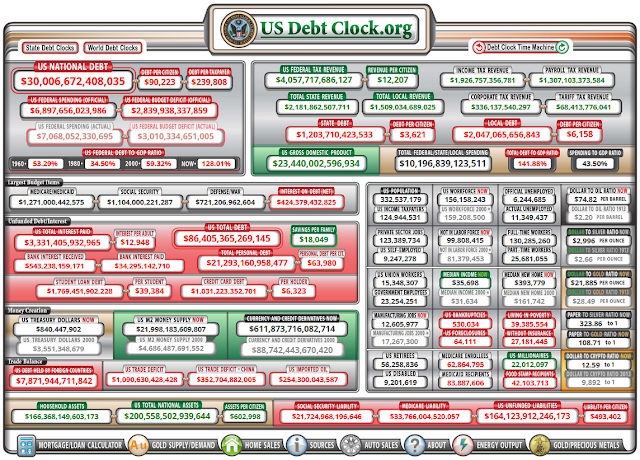
I wasn't watching closely enough to tell you day, hour and minute this happened, but within the last month, the national debt of the US exceeded $30 trillion for the first time.  The number as I write is the upper left box in the biggest font; for those who think seeing all the numbers conveys the size better than just saying "the T word." From our friends at US Debt Clock.

When I saw the headline, I thought, "Gee, didn't I post on the debt going over $20 trillion in the blog?"  Yes, I did and quite a bit more recently than I thought: it was in September of 2017.  That feels recent to me because it's since I retired, on last working day of 2015.  We went from $20 to $30 trillion in around four years and four months.  Another way of looking at that is it took from the founding of the country in 1789 until 2017 - 228 years - to build up $20 trillion in debt and only four years and four months to build up 50% more debt.  

Does that seem overwhelming?  We hit $15 trillion on November 17, 2011, which says the first $15 trillion in debt took 222 years and the second $15 trillion took 11 years.  Yeah, I'm leaving out details on the months here.  I don't know about you but that makes me feel worse, not better. 

Getting back to the current $30 trillion number, The Peter G. Peterson Foundation points out that the total debt is bigger than the economies of China, Japan, Germany and the United Kingdom added together.  When people talk about the Chinese funding our national debt, there's a little bit of truth there; I mean they have some amount of US bonds but no nation can buy more debt than their own entire GDP, they can only buy a few percent of it as bonds.  In fact, China, Japan and the European Union are the biggest holders of our treasury bonds except for one buyer.  

The biggest buyer of the bonds to fund our government is ... us.  More precisely, the Federal Reserve Bank, which creates the money to finance our debt out of (thin air, unicorn farts, whatever words you'd like).  This would be like you writing yourself a check to double your pay and putting it in your checking account every payday.  Except for the part about that one you wrote would bounce to the moon and you'd end up in deep trouble.  And if you listen to the economic geniuses running the country, like AOC or Dr. Stephanie Kelton, it's perfectly fine for a government to print all the money it wants. 

Listen, I've posted on this topic many, many times, and I'm as tired of writing about it as I'm sure most people are of hearing about it.  Let me just put some brief highlights here:

  • Yes, deficits and debts as commitments matter.  We borrowed real money from real people both here and in foreign countries, and we promised to pay it back.  They expect and deserve to be paid back with real money that's worth something.  If the Fed inflates the dollar to worthlessness, don't you think the Chinese, Japanese and the rest of the world would be mad at us?  Perhaps they'll abandon use of the dollar?  Perhaps they'll just never buy another US bond?  What if they demand something of value for their worthless currency, like maybe a national park?
  • The government can't tax their way out of this.  To heck with taxing the "richest 1%", if they confiscated, not taxed, the entire net worth of the 20 richest billionaires in America, they'd get $1.08 trillion.  With spending at $6.9 trillion, the money would be gone in less than two months.  In my opinion, the talk about "taxing the rich" they float is just to inflame class hatred and envy. 
  • Hauser's Law may be a really counter-intuitive thing, but it has been true for a long time.  No matter what tax rates are, the tax revenues are roughly 19% of GDP.  We just can't spend more than that consistently. 
  • No country with a Debt to GDP ratio much beyond ours has ever survived it as anything other than a walking corpse.  Most have undergone economic collapse.  
  • If we truly intend to reduce that national debt, we not only need to cut out deficit spending, we need to run surpluses as far as the eye can see.  Our great-grandchildren can think about deficit spending.
  • No one in government has proposed spending cuts like we really need.  Candidates in primaries have: Ron Paul proposed shutting down whole departments of the fed.gov hydra.  Candidate Rick Perry proposed capping spending at Hauser's Law, which is more definitive about cutting spending.   
  • It truly is the spending. 

Most people don't understand exponentials.  We are in a phase that is exploding toward infinity.  It simply can't continue, that's mathematically impossible.  Worse yet, large segments of society howl like they're being fed into a wood chipper if the fed.gov simply doesn't give them more every year, let alone actually cutting their free sh*t. 

And this is why I think an economic collapse is inescapable. 


Tuesday, October 8, 2019

The Crisis in Nutritional Science

I've mentioned John P.A. Ioannidis on my pages many times before (the first, I think).  He's the author of what’s widely quoted as one of the most downloaded papers in history, “Why Most Published Research Findings are False 2”, in which he presents data that as much as 70% of published science is wrong.

Last year, he extended his purview to probably the richest source of bad science, nutritional epidemiology, in an article in the Journal of the American Medical Association.  Bottom line, this field has got to be fixed because it is just so far from good science that it’s dangerous. Not only is it endangering peoples’ health, it’s ruining confidence in science as a way of finding out how the world works. You can read and download the paper (2 page pdf) here.  The unusual part of getting to this article is that I bounced there from Watts Up With That, a post by frequent guest author Kip Hansen, "Epidemiology, Diet Soda, and Climate Science".  You should RTWT. 

As I always do, some quotes to get you to read it.
In recent updated meta-analyses of prospective cohort studies, almost all foods revealed statistically significant associations with mortality risk.  Substantial deficiencies of key nutrients (e.g., vitamins), extreme over consumption of food, and obesity from excessive calories may indeed increase mortality risk.  However, can small intake differences of specific nutrients, foods, or diet patterns with similar calories causally, markedly, and almost ubiquitously affect survival?
Ioannidis' clear thinking comes across very clearly here.  He's saying that when they looked at epidemiological nutrition studies, almost every food item looked at had “statistically significant associations with mortality risk” or in other words, everything we eat is killing us faster and sooner, or making us live longer, and he asks if that's even possible.  Everything?  Nothing is neutral or has no effect?

Perhaps my favorite paragraph from the whole article (emphasis added):
Assuming the meta-analyzed evidence from cohort studies represents life span–long causal associations, for a baseline life expectancy of 80 years, eating 12 hazelnuts daily (1 oz) would prolong life by 12 years (i.e., 1 year per hazelnut), drinking 3 cups of coffee daily would achieve a similar gain of 12 extra years, and eating a single mandarin orange daily (80 g) would add 5 years of life.  Conversely, consuming 1 egg daily would reduce life expectancy by 6 years, and eating 2 slices of bacon (30 g) daily would shorten life by a decade, an effect worse than smoking.  Could these results possibly be true?
Before you order your yearly 23 pounds of hazelnuts, hold on a minute.  It stretches credulity to think all of those could be true.  One year of extra life for every hazelnut eaten daily?  Or 6 years less life for one egg eaten daily? What happens if you have one hazelnut and and one egg daily?  Do the effects cancel?  Does only one year cancel, so you only die 5 years sooner?  These answer are the result of the way these meta-analyses work; they find spurious correlations.  You might recall an article I did on the King of Junk Food Science (where the adjective "junk" modifies science, not food) and a link to a FiveThirtyEight column where they post funny spurious correlations they found.  In these nutritional studies, they frequently study "all-cause mortality", but the top causes of mortality include accidents (#3) and medical mistakes (usually left out of the rankings, but numerically could be more than accidents, taking #3).  How could they be improving mortality dramatically without affecting those to some degree? 
Individuals consume thousands of chemicals in millions of possible daily combinations. For instance, there are more than 250 000 different foods and even more potentially edible items, with 300 000 edible plants alone. Seemingly similar foods vary in exact chemical signatures (e.g., more than 500 different polyphenols). Much of the literature silently assumes disease risk is modulated by the most abundant substances; for example, carbohydrates or fats. However, relatively uncommon chemicals within food, circumstantial contaminants, serendipitous toxicants, or components that appear only under specific conditions or food preparation methods (e.g., red meat cooking)may be influential. Risk-conferring nutritional combinations may vary by an individual’s genetic background, metabolic profile, age, or environmental exposures. Disentangling the potential influence on health outcomes of a single dietary component from these other variables is challenging, if not impossible.
Dr. Ioannidis concludes nutritional epidemiology is intrinsically unreliable.  It produces results that cannot be considered causal.  I hope/trust that's enough to get you interested in reading the article because I can't do it much justice without well exceeding the limits of TL:DR.  I recommend the version on WUWT rather than the original JAMA paper, if you're only going to read one.  Author Kip Hansen shows the mess that is nutritional epidemiology and then compares the field to climate science, another field with an incredible number of variables that may or may not interact with each other.
Similarly, for climate science, the object of study, the Earth’s climate system is not only exceptionally complex, but also chaotic.  First, we have to understand that, as we see in nutrition science, climate is comprised of hundreds of interacting components, each changing on time scales ranging from seconds to centuries, each being integral influencing and causal factors for the others — all correlated in ways we often (almost always) do not fully understand.  And, as in nutrition science, almost all climate variables are correlated with one another; thus, if one variable is found to be correlated to some weather/climate  outcome, many other variables will also yield significant associations in the huge present-time and historical data sets relating to Earth’s weather and climate.

Thus we find the situation, unacknowledged by most of the climate science field, that [paraphrasing Ioannidis] “Disentangling the potential influence on medium to long range climate outcomes of a single climatic factor, such as atmospheric GHG concentrations,  from these myriad other variables is challenging, if not impossible” based simply on the complexity of the climate itself.

John Ioannidis - Stanford University photo


Sunday, June 17, 2012

Americans Are Waking Up to the Deficit Time Bomb

This morning, Business Insider carried a summary of a Pew Research Center study which shows Americans are waking up to the financial disaster looming ahead.  In the last few years the percentage of people calling the budget deficit the biggest problem facing us has grown from 53% to 69%, a healthy increase.  Perhaps unsurprisingly, Republicans were much more concerned than Democrats, with 84% of Republicans saying this compared to 66% of Democrats - which is still a pretty healthy percentage.  Source data is here at the Pew Center.

Let me point out something a little subtle here.  Their table said 84% of R, 66% of D and 62% of Independents said the budget deficit is the largest problem facing us.  If there were equal numbers of the three views in their sample, the percentage "of Americans" quoted in the opening (69%) would be the mean of those or 70.6%.  The fact they say 69% indicates that their sample was weighted away from Republicans. The Pew center has a reputation for being a left-leaning organization and the selection of the sample group they chose, and the text of that article lead to that conclusion, too.

That aside, the problem is that there is no consensus on what to do about reducing the deficit, and neither side in Congress offers leadership.  The general public seems to say that they're concerned about it, but have no idea how big the deficit is and how dire the situation is. The Simpson-Bowles commission, which reported on the problem and potential fixes in 2010 is a good example.  The Pew center pollsters asked their sample group to react to proposals in the Simpson-Bowles report. 
If we look at the acceptable to moderately unacceptable options, you can see a definite "let the other guy pay for it" outlook.  It was "totally unacceptable" to raise gas taxes and reduce federal funding to the states - things that everyone would pay for.  No, raise taxes on "high income earners"; raise Social Security contribution cap for "affluent earners", and create a national sales tax (rich people buy more, so they pay more). 

Sorry, this isn't going to work.  You could take every penny from "the richest 1%" and not be able to run the US at current spending levels for a whole year - let alone continually increase spending as we've been doing.  We're all going to hurt.  We can't put this off on someone else - there will be pain for everyone. 

Bill Whittle says it well in this video.  There will not be an American Economy in 15 years if the CBO is right.  It's not just that the Republicans won't be able to provide the awesome benefits you're expecting; nobody will.  There is literally not enough money in the world. 

The discussion that must happen is how to stop us from following the Eurozone into the abyss.  Most importantly, it needs to be an honest discussion, as free of distractions ("eat the rich!") as it can be. The people may need to lead their leaders.  At least people are beginning to wake up to the problem.  Andrew Kohut, director of the Pew Center put it this way:
In my years of polling, there has never been an issue such as the deficit on which there has been such a consensus among the public about its importance – and such a lack of agreement about acceptable solutions.

Monday, November 19, 2012

Paul Krugman Missing 48 Hours With No Trace

We here at The Silicon Graybeard have an exclusive story to report.  We have been informed Paul Krugman, Nobel Prize winner in Economics and Opinion Page writer for the New York Times went missing for almost 48 hours.  He was first reported missing Saturday, after submitting an editorial to the times calling for the return of the 91% tax bracket, implying that the extreme rate was responsible for the prosperity of the 1950s and early 1960s. 

NYPD investigators located Dr. Krugman, who somehow became trapped in a large brown paper grocery bag in his apartment and was unable to analyze a way out of the bag.  Authorities suggest that a few more hours of being unable to think his way out of a paper bag would have proven fatal to Krugman, 59. 

Over the top?  I don't think so.  Krugman is the poster child for more Keynesian spending and completely opposite my way of thinking, but this one ought to be about as hard as finding your way out of a paper bag.  The US was preeminent in the post WWII years despite those tax rates, not because of them.  The reason we had sustained economic growth is that Japan and Europe had been bombed back to the stone age and not only couldn't compete with us, they depended on our factories producing the goods to keep them alive and restore their infrastructure.  The rest of the world (rural China, the rest of Asia, South America and Africa) were either heavily damaged by WWII or didn't have enough infrastructure to compete with us.  The US grew to superpower size and status because we didn't fight any of WWII on the mainland, and precious little on "home turf" at all!  If we had a 91% top rate in today's competitive world, we'd be collapsed and gone in within a year.  Perhaps that's his goal. 

Obviously Krugman has never seen this graph which shows that since 1980, as the tax bracket on the richest 1% has gone down, the larger the share of the national tax burden they've paid.  It's not like this is secret information, though. 
Nor has he seen Hauser's work, which demonstrates that tax revenue - as a percent of GDP - remains remarkably constant regardless of tax rates.  This data goes back to the 1950s and shows the 91% rate he pines for.  The revenue was the same; all that the high rate did was punish those people who were paying it and keep GDP from growing. 

But it turns out Krugman isn't the only big name idiot out and about today.  Turbo Timmy Geithner says we should eliminate debt ceilings.  It seems Timmy, bless his pointy little ears, is not real good on hard data and facts.  Fact is we have never not raised the debt ceiling, so he already has his way.  Then he comes up with this knee slapper:
"We've had 100 years of experience with it, and I think only once--last summer--did people decide to use it to threaten default on the American credit for the first time in history as a tool for political advantage"
As I said at the time, not raising the debt ceiling is not default, it simply means we can't borrow more money.  Default means not paying the interest on the debt and we were never at risk of that. 
And quoting John Lott from that July '11 post:
Time after time, congress and the president have failed to agree on a debt ceiling increase and still there has been no default. Examples include: December 1973, March 1979, November 1983, December 1985, August 1987, November 1995, December 1995 to January 1996, and September 2007.
I gotta tell you, I'm not used to this much prime idiocy in one day's headlines.  It sure has been a bumper crop of bull crap this year!


Saturday, December 5, 2020

Student Debt Cancellation - Is This The Worst Policy Idea in History?

Since the first rumblings of the potential Biden administration, the idea of "forgiving" student loans has gotten talked about a lot; whether from Elizabeth Warren or AOC, we keep hearing "progressives" clamoring for the handout.  Clearly the loans can't be forgiven; money is owed to some bank, (which is to say some one) and the Feds can't wave their hands and make the banks take that loss, so that will mean taking money from some taxpayers to pay other taxpayers.  It takes a study from someone relatively neutral to show just how fair that is. 

The top 20% of income earners will get $192 billion in tax money; the bottom 20% will get $29 billion.  The richest income earners will get over 6-1/2 times the money as the bottom 20%.  Since the lowest quintile of income earners pays almost no tax and gets more in benefits than they pay, they are essentially getting a bigger tax break.  The middle class and higher will pay for this program.  Our tax system is highly progressive, meaning the more one earns the more tax they pay.  The last numbers I can find having blogged about (using 2016 data) is that:
  • The top 1 percent paid a greater share of individual income taxes (39.5 percent) than the bottom 90 percent combined (29.1 percent).
  • The top 1 percent of taxpayers paid a 27.1 percent individual income tax rate, which is more than seven times higher than taxpayers in the bottom 50 percent (3.5 percent).
This idea is a highly regressive tax policy in that the richer they are, the more tax payout they get.  The reason for the massive "payout to the rich" is pretty simple.  The concept of student debt is deceptive; it implies that the amount of debt is somehow evenly distributed.  That's beyond wrong, it's insanely simple-minded.  The average student debt for an associates degree holder from a state community college is tiny, the average debt for a state college bachelor's degree is a fraction of that from a private college, while the biggest piles of debt of all are held by graduate and professional degree holders.  While some graduate degrees don't gather enormous paychecks, Medical Doctors, Osteopaths, Lawyers and plenty of others gather pretty good pay.  If they didn't get that advanced degree, it's likely they wouldn't be in the top quintile.  Dollar wise, cancelling student debt is primarily going toward cancelling the debt in highest income quintile.

This study was from the University of Chicago (pdf) so not a conservative bastion, and studies from other dedicated liberal groups, like the Urban Institute, reach the same conclusion.


Lots of things about this idea have bothered me from the start.  The first problem I have is how unfair it is to so many people.  Think of the people who paid off their loans.  They took out a loan to pay for their college, paid it back, and now they're going to pay off the loans of people who didn't pay theirs off.  Or parents who paid for the kids' college with bank loans and will pay off other people's loans.  What about the people who thought the return on investment for a four year degree wasn't worth the expense and then went to a trade school.  Let's say they're welders making close to six figures.  Now they'll have the privilege of paying for someone else's Master's degree in "Feminist Poetry, 1912 to 1918" who's working as a barista at Starbuck's. 

Without exception, if you played by the rules, played it smart, managed your finances, and lived prudently, you're a sucker.  A chump.  You avoided student loans, or went through school with minimal loans?  Congratulations - you get to pay for those who didn't.  This is guaranteed to create enormous amounts of resentment. 

The second thing is that the root cause for the problem is federal government itself.  There are only so many seats for so many butts in all the colleges in America.  Demand for the seats exceeds supply, leading to the prices wanting to go up, but with student loans the price increases don't reduce demand.  The colleges raise fees to whatever they want knowing that the free market is prohibited there.  No matter how much it costs, the feds will back the loans so that they can fill all those seats.  It has been said before that if you really want to solve these problems, stop giving unlimited student loans. 

This is quite possibly the worst idea for public policy in history, although the competition for that award is pretty intense.  It's so close to the Free College idea it's hard to tell them apart, but it's retroactive free college.  It's completely opposite the real way to reduce student debt, if indeed that's the purpose. 


Thursday, November 17, 2011

$15 Trillion

Yesterday, the US National Debt crossed the $15 Trillion dollar mark; more specifically, $15.0048 at the moment. The debt to GDP ratio is 100% as accurately as I believe such things can be known; the Debt Clock currently has it at 99.861%.  By rough calculation, that will cross 100% before Thanksgiving.  A more depressing and ominous piece of news is that the Federal Reserve has become the largest holder of US Bonds.  In other words, we are creating money out of thin air (well, out of thin bits) so that we can loan the money to ourselves.  Money that is backed by absolutely nothing and is worth exactly that - nothing.

In addition to that depressing number, add in $116.5 Trillion in unfunded liabilities.  Unfunded means just that; it's money that has been promised out (Medicare, Social Security, Medicare Prescription Drug coverage...), but that has no funding behind it.  Money is going to magically appear out of thin air, right when it's needed.  Just like the magic Skittles. 
I have posted on this topic many, many times, and I'm as tired of writing about as I'm sure most people are of hearing about it.  It's hard to talk with those who are not good at math because they invariably say "why is it different now?  You just hate Obama, you racist pig".  So some highlights in brief:
  • Yes, deficits matter.  We borrowed real money from real people both here and in foreign countries, and we promised to pay it back.  They expect and deserve to be paid back with real money.  So the rest of the world should just forget our debts, like the #OWS crowd thinks about student loans?  Do you really think that?  If so, can I borrow a few hundred thousand dollars till next week?  If you inflate the dollar to worthlessness, don't you think the Chinese, Japanese and the rest of the world would be mad at us?
  • The government can't tax their way out of this.  To heck with taxing the "richest 1%", if the government took every single penny from every billionaire, every millionaire and from every single person with an income of over $250,000, the money would be gone in under 200 days.  In my opinion, the talk about "taxing the rich" they float is just to inflame class hatred and envy. 
  • Hauser's Law may be a really counter-intuitive thing, but it has been true for a long time.  No matter what tax rates are, the tax revenues are roughly 19% of GDP.  We just can't spend more than that consistently. 
  • No country with a Debt to GDP ratio much beyond ours has ever survived it as anything other than a walking corpse.  Most have undergone economic collapse.  
  • We borrow roughly 43 cents of every federal dollar we spend.  If we truly intend to reduce that national debt, we not only need to cut out that 43 cents of spending, we need to run surpluses as far as the eye can see.  Our great-grandchildren can think about deficit spending.
  • No one in government has proposed spending cuts like we really need.  Ron Paul (as candidate, not Representative) has proposed shutting down whole departments of the fed.gov hydra.  Rick Perry has proposed capping spending at Hauser's Law, which is more definitive about cutting spending.   
  • It truly is the spending. 
Most people don't understand exponentials.  We are in a phase that is exploding toward infinity.  It simply can't continue, that's mathematically impossible.  Worse yet, large segments of society howl like they're being fed into a wood chipper if the fed.gov simply doesn't give them more every year, let alone actually cutting their free sh*t. 

And this is why I think an economic collapse is inescapable.  Right now, I'm leaning toward next summer, although all the pieces are in place such that it could happen any minute. 


Thursday, September 28, 2017

Since Tax Reform is in the News

I posted this back in June, but it really stuck with me and became one of those quotes I can't forget.  It's from David Stockman, Reagan's budget chief, who said,
The income tax has been slashed so many times since 1981 that it’s no longer a broad based societal tax; it’s a kind of luxury tax on upper income salary earners and the small share of households which garner most of the capital income from dividends, interest payments and capital gains…
Stockman went on to point out that 60% of tax filers accounted for 5% of tax revenue.  In addition, 35% of tax filers – more than 52 million filers at the bottom and middle of the income ladder – didn’t pay a single dime of taxes after deductions, exemptions and credits.  I think Stockman was sloppy with his wording in saying, "the income tax has been slashed so many times".  Tax rates go up and down regularly.  I think he means the number of people paying income tax has been slashed. 

Look at what he's saying.  The top 40% of incomes pay 95% of tax revenues, and the bottom 35% don't pay a dime once all of the deductions, and all other systemic ways to avoid paying tax.  The top 1% of earners pay 39.5% of all collected taxes.

From what I'm able to see, this isn't really a conservative plan it's more a populist plan.  From a populist president and party that aren't conservative, so what a surprise, right?   I hear the president insisted on leaving the highest tax bracket for the highest income earners where it is, at 39.6% so there's no "trickle down" aspect to this.  Supposedly Trump said that people in the highest bracket can afford that 39.6% rate, and he insisted it stay there.  Maybe that's his way of fighting the Evil party screaming that it's a "tax cut for the rich!!"  Maybe he honestly thinks a 39.6% rate is a good thing.

So if the lowest half of the income range doesn't pay taxes, and the top rate stays the same, who's getting what changes?  That's what the arguments are about.  From what I hear, the big proposal is a return to three brackets, 12%, 28%, and that 39.6%.  Exactly where those three brackets change will make all the difference in "who pays what".  The simplification part of the plan (they still keep using the "fill out your taxes on a postcard" meme) raises the standard deductions so the lowest income people are expected to pay even less than now, while the highest grade may benefit a little.

The big deal is dropping the corporate tax rate from 35% to 20%.  That will make investing in the US look much better to companies looking to build new facilities.  Lower corporate taxes help everyone but this will have its greatest impact on small businesses and business start ups.  Since it uses the word "corporate", you can be sure the core Evil party hates that part.  Since they can't argue it's a tax cut for the richest, they'll fight that corporations are getting a break.  Corporations pass on their taxes to their customers, so their customers pay them.  Before this all started, Paul Ryan actually said something intelligent, when he said,
"We are actually unique in the world in the way we discourage capital from coming back to America and how we incentivize off-shoring jobs," ... "This is not the kind of exceptionalism we should aspire to ..." 
The overall progressive structure of the tax code doesn't change.  We still penalize success.  We have "sin taxes" on booze and tobacco to discourage their use.  And we have our highest tax rate on our highest earners to discourage success. 
Income and federal income tax, by standing in the income distribution, 2014 bar chart.  The leftmost pair of bars is the bottom 50% of wages.  The blue indicates 11.27% of total adjusted gross income (AGI) was paid to this group and they paid 2.75% of income tax.  The % of AGI is always greater than the percent of the tax burden until you reach the rightmost two.  The uppermost 5% to 1% of incomes group is the first one where the red bar is taller than the blue.  This group earned 15.38% of AGI and paid 20.48% of income taxes.  The top 1% earned 20.58% of AGI but paid 39.48% of income tax. 


Thursday, January 2, 2014

All The Money In The World

It's a recurring idea in the protests against "the 1%" that we have enough money in America; it's just in the wrong hands.  "Wrong" meaning "not the government's".  I found it interesting this morning to see that Bloomberg News reports that last year the combined net worth of all the billionaires in the world grew to only $3.7 Trillion.  This is due to their equity holdings increasing in value, which is of course due to the Fed's money pumping. 
The richest people on the planet got even richer in 2013, adding $524 billion to their collective net worth, according to the Bloomberg Billionaires Index, a daily ranking of the world’s 300 wealthiest individuals.

The aggregate net worth of the world’s top billionaires stood at $3.7 trillion at the market close on Dec. 31, according to the ranking.
Again: that's their net worth, not income, so taxable income would be less and that's all of them in the world, not just the Americans.  If the aim is to raise tax revenue, you don't get out of trouble by raising their income taxes.

While $3.7 trillion would more than pay for our yearly federal deficit, it's not even 1/4 of the accumulated debt of $17.2 Trillion.  Not to mention the approximately $130 Trillion in unfunded liabilities.  While it might be remotely possible for the Fed.gov to nationalize the assets of an American billionaire like Bill Gates or Sara Blakely, they wouldn't get very far with the Mexicans, Chinese, Saudi or other nations' billionaires. 

It's just another sign of how deep our fiscal hole is and how bad the situation is.  There is no "let the rich pay for it" and there is certainly no "let someone else pay for it".  There is no paying for it.  Things that can't go on forever won't, and math is unforgiving.  As I always say, infinity is a handy concept in math, but a rotten way to run an economy.  We simply can't continue to expand our monetary supply and deficit spend the way we have.  There is simply no way that the government's financial obligations will be paid.  Either foreign investors lose confidence in the dollar and it collapses or the dollar inflates to meaningless.  Either way, the math will have its reckoning. 

Wednesday, June 23, 2021

A Couple of SpaceX Stories - One Routine, One Not

The routine story is that we have another Falcon 9 launch Friday afternoon.  That's June 25th at 2:56 pm EDT or 18:56 UTC, if you prefer.  The mission itself isn't very routine: it's called Transporter 2 and will be a rideshare flight to a sun-synchronous orbit with numerous small microsatellites and nanosatellites for commercial and government customers.  We don't know quite how big the payload will be.  Transporter 1, launched in January of this year, carried 143 small satellites, setting a record for the number of spacecraft flown on a single rocket.  

A Sun-synchronous (heliosynchronous)  orbit is a polar orbit (or near polar) in which the satellite passes over any given point of the planet's surface at the same local mean solar time.  That means the lighting angle is the same every day, and the orbit precesses through the year so that the lighting angle remains the same.  This greatly simplifies monitoring places on the globe remotely because across long parts of the year, or multiple years, photos can just be put beside each other.  Because these payloads are going into Sun-synchronous orbits, it's safe to assume they're imaging or reconnaissance satellites, whether commercial or government.  

Artist's concept of the satellites being deployed, but it's probably not exactly what the payloads look like. 

The booster is B1060 and this will be the eighth flight for that booster.  There are reports B1060 will fly a rare return-to-launch-site (RTLS) landing on the cape, implying that its payloads may be substantially lighter than Transporter 1. 


The "not so routine" story is about Elon Musk himself.  As CEO of both Tesla and SpaceX, Musk puts on a lot of miles in a year.  Musk has mentioned that he now lives in a ~$50K house at Starbase, Texas when he needs to stay in Boca Chica for a while.  RGV Aerial Photography (who does weekly or more frequent flyovers of the facility and posts them to YouTube) provides this portion of one of their photos.  The red arrow marks his little (400 sq. ft.), prefab house.

Teslarati recently received a tip noting that Elon Musk’s housing unit in Starbase, Texas is a Boxabl Casita, a foldable, prefabricated home designed for quick installations and maximum affordability. A 20×20 unit such as the one that Elon Musk reportedly owns is priced at only $50,000, less than the cost of a Model Y Long Range Dual Motor AWD. The Boxabl Casita is durable, too, being made of concrete panels and steel. It could be installed very quickly and transported easily, as well, with the home being light enough to be pulled by a vehicle like a Model X. 
...
The Boxabl Casita is designed to be customizable with different finishes and configurations. Yet a look at Elon Musk’s apparent housing unit in Starbase shows that the CEO only opted for a base unit. Musk did mention that he has installed improvements to the home that would probably make it worth about $69,000 today, but even such an amount is less than the cost of a base Tesla Model S. The Casita is classic Elon Musk in the way that it’s different and practical, though the idea that the 20×20 unit may be home to the world’s third-richest person is very compelling. People with a net worth of $172 billion, after all, typically live in lavish properties.

I thought this was a neat story and rather unexpected.  The area to the right in the RGV photo is called the RV Park (as it shows), where a group of Airstream mobile homes are stationed.  From what I've read, those Airstreams are there for the exactly the same reason as Elon's Boxabl Casita: they're for workers who have to spend some time there at Boca Chica in a temporary assignment.  I suspect those Airstreams, even though smaller, are more expensive than the Casita.  

Increasingly, I think the major difference between Musk and many engineers I've met and worked with is that he can buy that $50,000 Boxabl Casita out of pocket, while the rest of us would have to finance it.