Tuesday, May 10, 2022

Goodnight Ingenuity?

Back in March of '21, when the Ingenuity helicopter on Mars started getting talked about, it was as a minor side mission to the Perseverance rover.  I even did a piece on Ingenuity in May of 2018.  “All told, five flights are planned, with a maximum altitude in the area of five meters.  A month has been set aside for the flights, with extensive checkouts of the system between each.”  

Fast forward a year and Ingenuity has blown all expectations out of the water. 

The achievement of powered flight on another world is one of the great spaceflight feats of the last decade. Since its first brief hop on April 19, 2021, the Mars Ingenuity helicopter has subsequently made an additional 27 flights, traveling nearly 7 km across the surface of the red planet and scouting ahead of NASA's Perseverance rover. It has wildly exceeded the expectations and hopes of its scientists and engineers.

The little drone, designed for use on a planet with a tiny fraction of the atmospheric density Earth has,  the surface atmospheric density on Mars is like being at 100,000 feet here, has been nothing but a record breaker.  

We might be, however, looking at sunset for the experimental helicopter.  Winter is approaching on the Red Planet, and like all vehicles reliant on solar panels, Ingenuity has had difficulty getting an adequate charge on its batteries.   A week ago, May 3rd, controllers at the JPL lost contact with the probe.  This is something mission planners consider and plan for.  

They had been closely monitoring the health of their tiny spacecraft, particularly the charge state of its batteries. After losing contact, the engineers figured that the Ingenuity's field-programmable gate array—essentially, its flight computer—entered into shutdown mode due to a lack of power. In such a situation, virtually all of the helicopter's on-board electronics turned off to protect them from the cold nighttime temperatures, more than 100° Fahrenheit below freezing. This included the internal clock.

For all its flying around on Mars, Ingenuity has stayed in contact with its Perseverance mother ship, over a low power radio link.  Engineers expected that when the Sun rose and Ingenuity's batteries started to charge, it would try to communicate with the nearby rover.  The problem was that because its internal clock had reset, when Ingenuity tried to call Perseverance, the rover wouldn't be listening.  The immediate, easy answer, was to tell the rover to do nothing but sit there all day and listen for that call.  

The significance of this decision is that the helicopter was initially viewed as an add-on technology demonstration. Some of the rover's leadership team did not even want the added risk of bringing Ingenuity along. The helicopter was supposed to make five experimental flights in 30 days and then be set aside. Now, the entire Mars mission was being put on hold, nearly 13 months after Ingenuity's first flight, in the hopes of saving the small vehicle.

There's a happy ending to this story:  Ingenuity did phone home the next day. The link was stable, and they were able to determine that the solar array managed to charge the little drone's batteries to 41 percent. The engineers say they hope to resume Ingenuity's flight campaign within the next several days if they can bring the helicopter's batteries to a full charge.

Still, it's still a couple of months from the deepest, darkest part of the Martian winter.  Some scary choices are being made and the little helicopter may not make it.

The NASA engineers have had to take some fairly drastic steps to preserve Ingenuity's battery charge. For example, they have now commanded the helicopter's heaters to come on only when the battery's temperature falls to -40°, far colder than the previous point of 5° Fahrenheit. It is not known how many of the off-the-shelf components on the vehicle will fare without this additional heating during the cold Martian nights.


Ingenuity before its first flight, 2021.  NASA photo.

Here's where I wish I was a meme wizard and could whip out a "Brace Yourselves.  Winter Is Coming" from Game of Thrones but featuring Ingenuity.  


Monday, May 9, 2022

Starbase Texas Resumes Testing Booster 7

As I write, starting around 7:30 PM ET, cryogenic testing is completing on Booster 7 at Starbase Boca Chica, Texas, after repair and return to the test area last week.  

Naturally, we don't get updates on how the tests went unless either SpaceX's corporate account announces it (very rare) or Elon Musk does (much more common).  Just as before, when the first issues showed up with Booster 7 (B7), we were scraping for information on what happened to the booster.  Eric Ralph at Teslarati has compiled what he was able to find out in a post today.  

The stand SpaceX modified specifically for Super Heavy B7 was outfitted with 13 hydraulic rams to simulate the full thrust of the booster’s central Raptor V2 engines – up to almost 3000 tons (~6.6M lbf) compared to Booster 4’s ~1700 tons (~3.7M lbf) with a smaller cluster of nine engines.

After a few false starts and minor tests on the stand, Booster 7 finally managed some significant testing on April 14th. Judging by the rhythmic shattering of ice that built up on Super Heavy’s tanks, the test stand was able to simulate the thrust of Raptors to some degree and subject the booster to major mechanical stress that was felt from tip to tail. Within a few days, Booster 7 was removed from the test stand and returned to the high bay on April 18th. Around April 21st or 22nd, an image was leaked showing extensive damage inside Booster 7, confirming that the Super Heavy’s test campaign had been forced to end prematurely.

My problem with this image of the extensive damage is that I don't have an equivalent "before" picture to compare it to.  All I know is that other tubes called "downcomers" are cylindrical with flat reinforcing (?) rings on then.  This one could have been different but probably wasn't.  Looking at the top of the picture where the deformed tube with strange shapes welded to it reaches a flange, it looks like the tube was originally round and collapsed into this shape ripping out of that flange at about 10 to 12 o'clock on the flange (a gaping, black opening).

Right away, the damage shown in the photo hinted at an operational failure, meaning that mistakes made by the rocket’s operators may have been more to blame than a possible design flaw. The photo shows a short portion of B7’s liquid methane (LCH4) transfer tube that runs through the booster’s new liquid oxygen (LOx) header tank, which itself sits inside Super Heavy’s main LOx tank at the aft end of the rocket – a tube inside a small tank inside a large tank, in other words. Super Heavy’s LCH4 transfer tube generally does what it says, allowing methane to safely fly down through the main LOx tank and fuel up to 33 Raptor engines. At full thrust, that tube would need to supply around 20 tons (~45,000 lb) of methane per second.

However, on top of merely transferring methane through the oxygen tank, Booster 7 introduced a design change that allows some or all of that tube to change functions and become a header tank mid-flight. That would require a system of valves that could seal off the main LCH4 tank once it was emptied, turning the transfer tube into a sort of giant steel straw filled with enough LCH4 to fuel Super Heavy’s boost-back and landing burns.

Amateur analysts naturally combed over the image and whatever they could find, including one guy who posted an impressive 18 minute video which convincingly pinpointed the moment Booster 7’s transfer tube collapsed. (He goes over other topics, too, but the failure analysis is roughly between the six and 14 minute marks.)  Simultaneously, because it showed that the transfer tube likely imploded during detanking, the analysis more or less confirmed the view that the failure had been caused by either an operator error or poor test design - or both.

Shades of Starship prototype SN3 in April of '20.  

Could have been hardware, software, or operator error, but the important part is that when B7 reached the high bay and this photo was leaked, SpaceX decided it was reasonable to fix the damage.  After having been in repair since April 18th, B7 rolled back out to the test area on Friday, May 6th.  Today's cryogenic testing is completed, and the backup day for a road closure tomorrow has been cancelled.  More often than the other way, "alternate" road closures cancelled after the first day of a test has been because the test passed, not that it failed.


Sunday, May 8, 2022

About Those Two First Prototype BE-4 Engines at ULA

Word has been going around that ULA has taken delivery of the first two BE-4 engines from Blue Origin.  You might have seen a picture that looked like this (maybe from a different angle).  The first time I saw something on the subject was weeks ago, around the end of March/early April; after this story.  ULA's Tory Bruno was said to be the source, but I never saw the original source so I didn't go with it.

There's an obvious problem with those two engines: they're not engines.  They're the engine bell nozzles, far short of anything flyable, shipped for measurement and fit checks.  A flight ready BE-4 looks more like this.  The right half of this picture is missing in the above picture. 

Blue Origin photo.  The first of a series of May 2nd tweets about progress with the BE-4 testing.  It's as if suddenly, out of nowhere, Blue Origin has decided to put their name out as making progress. 

Teslarati SpaceX correspondent Eric Ralph points out the rather large differences between the BE-4 development and Raptor 2 development.  What they have in common is that both engines are methane/oxygen (also called methalox), are similar in size, and have similar sea level thrust numbers with BE-4 a few percent more powerful (BE-4: ~550,000 lbf, while Raptor: ~510,000 lbf).  Where they get very different is how the companies treat them.  

Earlier this year, Blue Origin itself revealed that it was testing BE-4 engines "about three times a week" at its Texas facilities...Aside from being far more compact, SpaceX has also built and tested magnitude more Raptor prototypes despite starting full-scale testing a year and a half after BE-4. Compared to Blue's "three a week," SpaceX completed eight Raptor static fires in one day on May 3rd [last week], racking up almost eight minutes of burn time during the site's 14-hour test window. According to one SpaceX employee, the company delivered 24 Raptor V2 engines in a single month earlier this year. In April, CEO Elon Musk shared an image of around 18 qualified Raptor V2 engines that had already arrived at SpaceX's Starbase facilities and were waiting for a rocket to be tested on.

The phrase that comes to mind when I look at comparisons between the way SpaceX is approaching development vs. the way Blue does is the concept of being hardware rich vs. hardware poor - a concept I got from an article about Blue Origin. Hiring in John Vilja as Senior Vice President of Engines did have the effect of making them more hardware rich, but they're still light years behind SpaceX.  Development of both engines appears to have started around the same time frame, 2009-2010.  In 2014, ULA contracted with Blue to deliver the BE-4s by 2017.  While not a single BE-4 has flown, SpaceX has already flown 19 Raptors in various Starship prototype flights.  

Six of those engines were recovered intact, giving SpaceX actual flight-proven engines to examine well before Raptor could be considered fully operational. SpaceX also appears to have built and tested more than 150 different Raptors since February 2019. SpaceX has also explicitly tempered design targets and maturity with near-term goals. For example, it's unlikely that current engines are easily or rapidly reusable - pursuing the optimizations needed for rapid/cheap reuse simply wouldn't make sense when Starship itself could be years from needing that capability. Blue Origin, on the other hand, says that individual BE-4 engines have completed 5000+ seconds of testing, an extremely impressive achievement but one that demonstrates a polar-opposite approach to development. Vulcan needs to work almost perfectly on its first launch. Starship does not.

This is an actual Tweet from Blue Origin, dated 5th of June, 2015, although this copy isn't from them but from a Twitter user who saved it.  It hasn't aged well. 

As I sit here trying to draw a conclusion from the roads I went down while piecing this together, I come to conclusion that it seems Blue might be on the verge of shipping the first two real, operating BE-4 engines to ULA.  Perhaps before July. 


Saturday, May 7, 2022

Weekly Update on the 1 by 1 - Part 26

And... it's done.  By the time I was done with last week's post on the version 1 connecting rod, I had decided to do a second one, using the technique I had used on the Webster's rod.  By Monday, I had found a sacrificial piece to screw the second blank to, made the initial screw holes in that blank (to hold it down to the "fixture" and got it zeroed in the Mill's coordinate system.  That looked like this:


My plan was to cut a wider rough contour cut - that's the kind that just cuts the outline of the part - leaving 1/8" more metal at every point around the part instead of .025" like I did on the first version.  Then I'd cut the circular bosses and finally cut the finish contour taking away the extra 1/8" of aluminum.  

The rough cut went perfectly, but when I went to cut the circular features, Mach3 wouldn't run the G-code, so I called it a day and thought I'd double check code later.  This is code I wrote (manually) so some sort of dumb mistake is almost guaranteed.  Sure enough, it turned out that I had left off a minus sign on one semicircle I was cutting.  With that fixed and running, I cut to depth around the circular features, taking away the 1/16" of depth on the rod between the circles. By Thursday, that side was done. 

The second side took more time to fixture than to cut and was done Friday. Since it looked almost exactly like that previous picture when finished, I'll leave that picture out.  

The next steps were done today.  I took the rod off that little piece of scrap, stood it on the small end, making sure the extended sides were vertical with a machinist's square.  That took several operations: I had to re-zero the part's coordinates to use the mill as a precise drill press.  For two holes, each of which gets five operations.  First, they get spotted with a center drill, then drilled through, tapped for screws, drilled halfway vertically with a bigger bit to clear that screw's threads, and finally, touched with a 1/4" end mill to make sure there's a flat spot where the screw cap sits.  After all that, it looks like this:

You might notice a couple of horizontal grooves on either side of the circular boss; I had the idea that I'd make scratches to lower the slitting saw blade down to and align it visually.  After I cut those grooves I decided that wasn't a good way to do it - parallax and other visual errors because the saw blade can't be right next to the engraved scratch, and set the depth of the cut by making the top of the part Z=0 and lowering the bottom of the blade to a depth I could get from the drawing.

All this to prepare for cutting the cap off.  Which has to be done before that small hole you see can be replaced with a drilled and reamed 3/8" hole for the crankshaft.  Which required yet another setup and another set of coordinates.  Now it looks like this:

So there it is, another part to go in the "Done" box.  I see it's almost a month to the day ago that I posted about getting ready to start and how I wanted to do it.  I don't know how many parts are left to do, and I don't really want to know.  If I make one part per month I'll be working on this engine for years.  When I started the cylinder (in December!) I figured the next parts would be the matching piston because it gets sized to the cylinder, which means I need this connecting rod and the pin that holds it in the piston (called a wrist pin).  Those are lathe parts so the adventures in CNC milling are over for the moment. 


Friday, May 6, 2022

Woke Up Early to a Visual Treat

This morning was an early morning for us; up about 5:20 for a 5:42 launch of this week's Falcon 9 Starlink launch, Starlink 5-14 from Pad 39A at the Kennedy Space Center.   Without a doubt, if you're going to come to this area - or go to Vandenberg Space Force Base, or any of the other handful of places on Earth where launches can be seen, you want to go for a launch that's about an hour before sunrise or an hour after sunset.  There's a window in those pre-sunrise or post-sunset launches where you get to see a phenomenon often called a Space Jellyfish.  We got a good one this morning.  

This morning's Jellyfish - although from a different perspective than we had because it was taken from far away from here.   As you can see by the lower right corner, photo by Fox channel 13, taken by Ryan French.  This Fox affiliate is in the Tampa area, and they include pictures people sent in from the area. 

What's happening here is that for the beginning of the flight, the rocket is in the night sky but it's also heading more easterly as it's heading upward, and the farther east it gets, the closer it gets to where the sun is above the horizon.  Sunrise here in the Silicon Swamp (most importantly, on the ground) was 6:38, four minutes short of an hour after the launch.  When the first stage was dropped, it still wasn't high enough or far enough east for the sun to be up, but within seconds, it popped into daylight.  

Most of what you're seeing in that picture is the rocket contrail from the second stage.  The brightest point in the cloud, on the left about a third of the way up, is the second stage engine.  We're looking up its exhaust plume.  At the lowest point in the cloud, there's a bright spot with what looks like a comet's tail: that's the first stage.  We could see the cold nitrogen thrusters in the first stage firing, letting out expanding circular clouds (probably spherical but we just see the outline).  I'm not sure what that object above and to the left of the booster is; it's possible it's a star or planet that was just in the line of sight.  It's possible it could have been one of the payload fairings.  From our yard, we saw the initial entry burn of about 20-30 seconds, but by that time, it was too low in the sky to keep seeing. 

I think the first time we saw one of these was just short of two years ago to the day, June 13, 2020, and I wrote about it.  That launch was 5:21 EDT and sunrise was 6:26, so the similarity of the geometry is remarkable.  

If you look around, you'll see photos of Space Jellyfish from hundreds of miles away from the launch site.  At the TV station's site, there are pictures taken from Tampa.  I saw one from Savannah, Georgia.  Which might have been closer to it than I was.


Thursday, May 5, 2022

A Couple of Space News Clips

Virgin Galactic has announced a delay to the start of their commercial flight business from the fourth quarter of this year until the first of '23.  The problem?  The supply chain.  

“We are executing on our plans to scale the business by developing our future fleet, investing in digital manufacturing technologies, and building out our commercial strategy to deliver a consumer experience like no other,” said Michael Colglazier, Chief Executive Officer of Virgin Galactic. “Against a backdrop of escalating supply chain and labor constraints, our teams are containing the majority of these issues to minimize impact on schedules. We look forward to returning to space in the fourth quarter and launching commercial service in the first quarter of next year.”

Virgin Galactic says their financial picture is secure, going into lots of details.  What jumps out to me is their saying they have “Approximately 800 Future Astronaut Reservations” and that demand for tickets remains strong.   I think their Unity spacecraft carries four, so that's 200 flights.  Sounds like they need more spacecraft and more reusability. 


The current target for Artemis/SLS to be rolled back out to pad 39B for the next attempt at a Wet Dress Rehearsal (WDR) is "before the end of May," and the next attempt at the WDR will be in "early or mid-June."

The last time they rolled the SLS stack out to the pad it was two weeks before the WDR started; the rollout started on March 17th and the test started April 1st.  The test took far longer than the estimated 2-3 days, before being cancelled on the 16th and rolled back to the VAB on the night of the 25/26th. 

Remember the stuck check valve?  One thing in the description of results to date caught my eye (emphasis added):

Among the fixes made in recent weeks has been the replacement of a "check valve" in the rocket's upper stage, which had been forced open by a small piece of rubber. How that piece of debris got into the valve remains under investigation.

That doesn't fill me with optimism.  

As before, after a successful test NASA will still need to roll the rocket back to the Vehicle Assembly Building to arm the flight termination system, and then roll it back to the pad again before the rocket can be launched. NASA is currently looking at launching no earlier than August, but it must work around the planned liftoff of its Psyche asteroid mission on a Falcon Heavy. The Psyche spacecraft arrived at the KSC for testing and integration this week. 

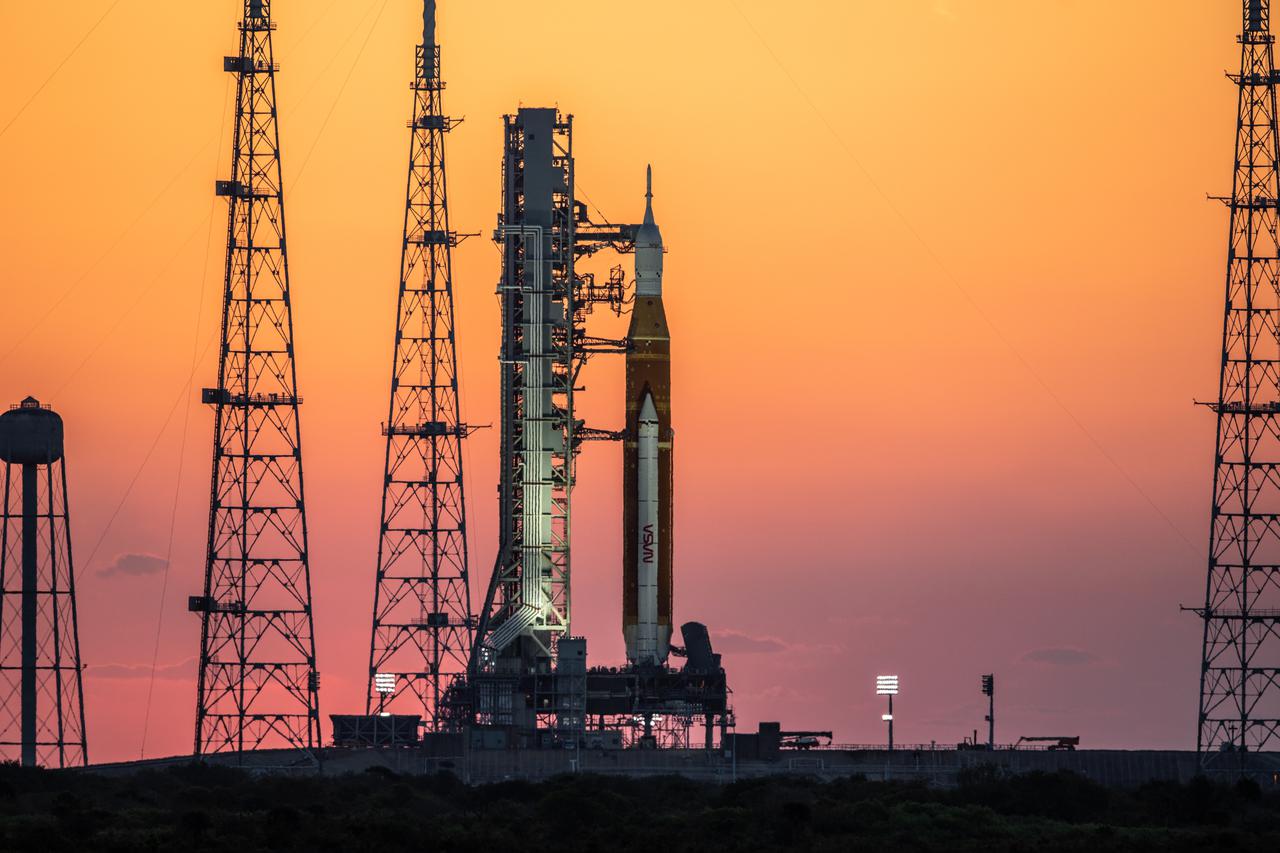
SLS on Pad 39B at the start of preparations for the Wet Dress Rehearsal tests.  NASA photo. 


Wednesday, May 4, 2022

Boeing Getting Set to Try Starliner Again

It's probably too optimistic to mark your calendars yet, but Boeing is in the final stages of preparation to try their Starliner capsule's uncrewed flight test on May 19th - no time has been given.  

It has been nine months since the end of last July when a routine test of the capsule in preparation for launch found troubles with valves on board.  Eventually, investigators determined that 13 of 24 oxidizer valves within Starliner's propulsion system were stuck.  It took months with the capsule atop its Atlas V launcher at the pad, then back in a hanger for Starliner, then with even more capability needed, to determine the root cause of the valve failures.  The cause was diagnosed as being that dinitrogen tetroxide oxidizer that had been loaded onto the spacecraft 46 days prior to launch had combined with ambient humidity to create nitric acid, which had started the process of corrosion inside the valve's aluminum housing. Who would have expected humidity on an Atlantic beach in July - in Florida, where humidity remains one of our biggest exports? 

It's worth mentioning without dwelling on the story that this was, again, July of 2021, a year and seven months of troubleshooting systems on spacecraft after their nearly disastrous first attempt at an orbital test in December of 2019.  The bigger picture is that they've really been working on Starliner much longer than that

The company has been working on the vehicle since at least 2010, when it was called Crew Space Transportation-100, or CST-100. Starliner made its debut flight in December 2019, but problems cropped up just minutes after liftoff, when the spacecraft captured the wrong "mission elapsed time" from its Atlas V launch vehicle. It also had difficulty communicating with ground stations. Flight controllers at NASA and Boeing were able to restore communications with Starliner and help it reach orbit. However, because of the propellant spent during these activities, Starliner was unable to complete its primary objective, demonstrating a safe docking with the International Space Station.

The whole flight was a disaster in slow motion, with the vehicle almost being lost more than once.  It was practically a miracle they got the capsule safely down.  In particular, there was a catastrophic software bug that would have fired the capsule's thrusters to fire incorrectly.  Luckily, it was found in time to fix the bug before the craft was lost.  

These problems led NASA to declare the first Starliner test flight a "high visibility close call" and set off a years-long investigation and deep dive into Starliner's software problems. Boeing agreed to pay for a second test flight at a cost of $410 million and eventually readied the Orbital Flight Test-2 mission that reached the pad in the summer of 2021. Then, the vehicle had its sticky valve issue. Finally, after all of that, the company has Starliner back on the pad, ready for a do-over of the do-over launch.

NASA, of course, has SpaceX and Crew Dragon to ferry crews to and from the Space Station.  It's prudent, however, to have a backup system should some disaster happen and the fleet need to be grounded.  The intent of the commercial crew program itself was always to have two vehicles.  That desire for a backup is only given more urgency with the Russian threats of abandoning the ISS.   

The flight Starliner capsule being prepared for rollout to the launch pad.  Boeing photo. 

That underlines that there's intense interest in this mission throughout the manned spaceflight offices.  In April of '20, four months after the disastrous Starliner flight, Boeing was removed from further contract award consideration by NASA's acting chief of human spaceflight, Ken Bowersox.  I don't know how long such policies last or if it's in effect now, but I can imagine it being re-instituted or made permanent if they fail at this mission, too. 


Tuesday, May 3, 2022

NASA Still Doesn't Get How Big A Deal Starship Is

That's an exaggeration.  I'm sure - I know that parts of NASA are seriously looking into Starship - the groups that want to do exploration of the outer planets for one. It's just that this story revolves about a conversation between an engineer from Johnson Spaceflight Center in Texas, the home base of the astronaut corps, and a SpaceX program manager.  The conversation took place last week at the ASCENDxTexas space conference in Houston and is reported by Eric Berger of Ars Technica.  The conversation was between Jeff Michel, an engineer at Johnson Space Center, and Aarti Matthews, Starship Human Landing System program manager for SpaceX.

The story starts simply enough, to quote from the article:

He (Michel) works in the area of in-situ resource utilization, the processing and use of local materials known more colloquially as "living off the land." What role, he asked, should NASA’s technical workforce play in developing these technologies?

In answering the question, Matthews urged Michel and his colleagues and NASA to think bigger about what they could do on the surface of the Moon with a vehicle as capable as Starship. This would be wholly different from any capability NASA has ever had before.

A little over a year ago, NASA announced they had selected SpaceX Starship for the Human Landing System.  I've been reporting on this since before the contract award, and somehow these little mind-blowing facts hadn't imprinted on my memory.  

  1.  NASA's contract was to deliver 865 kg to the moon's surface. 
  2.  Starship can deliver 100 metric tons.  Since 865 kg isn't even 1.0 metric ton, Starship can deliver over 100 times what NASA asked for.  More precisely, 116 times what NASA asked for.   

It's hard to put that concept into easily envisioned things.  As Aarti Matthews said, “And it’s really hard to think about what that means in a tangible way. One hundred tons is four fire trucks. It’s 100 Moon rovers. My favorite way to explain this to my kids is that it's the weight of more than 11 elephants.”  Clearly, nobody wants to put 11 elephants on the moon, nor does anybody think sticking fire trucks or more than a couple of rovers on the moon are a good idea but the number is completely out of proportion to everything NASA has struggled with since the early days.  Back in the Apollo days, there was talk about a cargo-only version of the Lunar Excursion Module.  With the Saturn V lifting it, the most powerful rocket on Earth, that LEM would put about five tons on the moon.  Less than one twentieth of Starship.

Matthews again:

"NASA specified a high-level need, but we, industry, are taking away one of your biggest constraints that you have in designing your payloads and your systems," she said. "It’s significantly higher mass. It’s essentially infinite volume for the purposes of this conversation. And the cost is an order of magnitude lower. I think that our NASA community, our payload community, should really think about this new capability that’s coming online."
...
"We all need to be thinking bigger and better and really inspirationally about what we can do," Matthews said. "Anyone who has worked on hardware design for space application knows you’re fighting for kilograms, and sometimes you’re fighting for grams, and that takes up so much time and energy. It really limits ultimately what your system can do. That’s gone away entirely."

And it gets even more mind-blowing.  According to estimates on Casey Handmer's blog, an expendable Starship, which lands on the Moon and stays, could bring more than 200 tons to the Moon. Twice as much as the option Ms. Matthews was referring to.  

For some reason, this world-changing aspect to Starship and Super Heavy hasn't really sunk in to lots of minds.  Nobody has seen a spacecraft like this.  It's bigger and more powerful than the Saturn V, yet is not just completely reusable but intended for rapid turnaround re-use, even point to point passenger service on Earth.  Yeah, there's that unfortunate fact that it still hasn't flown and isn't fully developed yet.  The problems continue to be worked on as they show up.  Starship/Super Heavy appears closer to flying successfully than being a dead end that'll never fly.

It's more like the beginning of a new age than business-as-usual, just-another-rocket.

A SpaceX montage from my February '21 post reporting that SpaceX had prototyped the elevator shown on the right. You'll note the Starship on the right isn't painted and has fins - more like the prototypes we were seeing back around then than the painted ship on the left. 


Monday, May 2, 2022

Rocket Lab Succeeds With Helicopter Recovery of Booster

The Rocket Lab guys carried out their mission "There And Back Again" with an abundance of caution, waiting for weather to get as good as it was going to get for their first attempt to recover a booster from an orbital launch.  That caution led to it being delayed from last Wednesday evening (US Eastern Time) until today, May 2nd at 2249 UTC (6:49 ET).  During the launch coverage, the Electron booster was snagged by their Sikorsky S-92 recovery helicopter as captured by a camera on the helicopter.  

This image is a few seconds before the cable (yellow, hanging down from top left) grabbed the parachute, which managed to be out of the frame at the big moment.  As it says in the upper left, this is a replay from earlier in the video stream.  The narrator reported that they successfully caught the booster, but the helicopter's pilot said this didn't feel like any of the practice missions, so the booster was dropped next to a recovery ship to ferry the booster back to land instead of flying it there.   Again, out of an abundance of caution.

As SpaceX has always done, Rocket Lab's streaming host emphasized the real purpose for the mission is delivering customers' satellites to the desired orbits.  Recovering the booster for reuse is secondary to that mission and doesn't mean anything if they don't deliver those satellites.  The argument for recovering boosters is that if they simply use every booster twice, they've doubled the amount of launches they can do with their current factory production levels.  I suspect they'll lower their price, too.  

I think this is a big step for Rocket Lab, so congratulations to everyone involved in making it happen.  Unless I'm having a memory issue, this makes them the only other company launching orbital class rockets that's recovering their boosters.  The Electron is a much smaller launch vehicle than a Falcon 9, at 59 feet tall vs. 230 feet for the F9.  It doesn't have the margin in propellants to use some for landing, with 660 lb to LEO vs. over 50,000 lbs.  To use helicopter recovery vs. slowing with engines and landing on a drone ship is a good solution.  Better than dumping boosters at sea by far.


Sunday, May 1, 2022

It's May Day - Also Called Victims of Communism Day

A quick check of the history of the blog shows that I've really devoted very little space to covering May 1st and the last one I can find is actually from the "Occupy Whatever" protests in 2012.  Things are different this year, since we seem to be well into an attempt at communist takeover of the country.  

For all of my adult life, whenever people feel comfortable talking about such things, there's an alarming tendency for people who have grown up in the freedom and plenty of the 20th century United States to advocate communism.  If any of us would say something like, "but that never works; it has been tried over and over and it has never worked even once," that's when they give the most sorry cliche' answer in all of history and say whatever country we bring up, "just never did it right," "that's not real communism," or something just as lame.  These days, if the question comes up I say, "so what makes you think these people are the smartest and best in all of human history that can make something work that nobody else ever could?"  I've yet to get an answer to that.  They just leave. 

It's hard for me to understand that argument because I grew up Miami in the '60s.  My brother (older than me) had a close friend whose family escaped Cuba just before the communists came to power and began their genocide of the Cuban people.  Since we were all within a few years of each other, I knew this friend as well.  His friend's father was an architect, so while he had to start over in Miami, he didn't have to bring lots of things with him.  As the years went by, I had several friends who were Cuban refugees and had lots of exposures to the stories of how bad it was there. Of course, the news regularly carried stories of refugees putting together anything that might float long enough to make it to the US to escape the tyranny. 

For the life of me, I can't understand why the idea is attractive to anyone but psychopaths and the deliberately blind today.  In a way, it's easier to forgive the first ones, the 1917 Russians and maybe the National Socialists (Nazis); after all, they had no history to look at.  The people who let it happen didn't know that there would be nearly 50 million of their neighbors killed by the government.  But even by the '60s, when Bill Ayers, Bernadine Dorn, and the Weather Underground wanted to force communism in place here, they not only knew it would lead to millions killed, they apparently wanted to do the killing.   An FBI informant told of them openly talking about "eliminating" 25 million hard core Americans who wouldn't go along with their little utopia.  I guess the gulag's not such a bad place as long as you're the one doing the killing.  

Today, with communism blamed for the death of over 100 million people, it's harder to understand how it could be so attractive.  In contrast to the guys who want to start the killings, today's useful idiots seem unaware of any history or the reality of communism - it's all magic unicorn farts and rainbows.  Famines and death camps?  Not so much.  It's as if they don't know the first things about Venezuela, Cuba, or China, and their horrific treatment of people. 


Originally lifted from The Smallest Minority, a decade ago.

There are none so blind as those who will not see.


Saturday, April 30, 2022

Update on the 1 by 1 - Part 25

I ended up the last update saying I had poured epoxy into the finished side of the chunk of aluminum I've been working with.  I concluded with a picture of the epoxy-filled side after it had cured a while and said it would sit overnight.  

Based on the experiences with the first side, I was going to do four passes: two rough and two fine, but very different from what I had done on the first side.  Essentially, I broke the one rough pass from the previous side into two.  There are two similar algorithms that my CAM program use to create tool paths, called waterline and contour.  The major difference is that waterline takes a series of layered cuts down the vertical extent of the part while contour makes one single path around the part.  For waterline, we (the user) defines how thick those layers are and how close they're allowed to get to exact size of the part.  For contour, we have some control over how deep that one path around the part is - and we also set how close the cutting tool gets to the exact size of the part.   

I chose to do a contour cut around the part and then do a waterline just deep enough to ensure the top of the connecting rod was the proper distance (1/16" - .062') below the raised, circular bosses. 

Cutting a single slot, the depth of the part can be a problem because it can be hard for cooling fluids to get into the slot.  In the case of aluminum (which this part is) that can cause the stock to melt onto the cutter.  In addition, on one side of the slot, the action of the cutter is to pull itself into the stock while on the other side, it can push itself out of the stock.  This can set up a vibration in the cutter and the mill, depending on how rigid the machine is.  

As usual, there's a possible trick to get around this: cut several thin layers and not one pass to full depth.  It turns out it's simple to change the single pass file using a plain old ASCII text editor.  Simply change the depth of the pass from full depth to what you want (in this case it was change a single 0.220" deep cut to seven consecutive .031" passes) using block copy and paste in the tool path file, then editing every block's line where the cutter drops vertically to the right new depth. 

It turned out even doing those thinner cuts I had a vibration and resonance issue that caused my machine to vibrate so badly that a motor fuse shook loose and shut the spindle motor off.  It didn't mess up the position badly, though, and using cutting oil instead of water mist helped.  

Both rough passes: contour on the left and the waterline for three layers on the right.  For the fine paths, I went back to one contour pass at full depth, just trimming away the margin around the part. That made the cut in the stock a little wider and had no vibration.  For the waterline file, I just trimmed the margin around the part.

This went smoothly and by Tuesday the second side was done.  Time to soak the epoxy in my shop toaster oven.  It broke apart easily.

Those yellow chunks in the front left are the epoxy, and the leftover, machined metal is in the back. The first side machined is facing you.  The dimensions I've checked are all within a reasonable tolerance of the intended size (.005" or less), and while a long way from done, if not for the machine screw-up on the first pass, it would be usable. The machine screw up is visible in this photo, at the lower right end.

Another view from the second (back) side.  It's about .075 extra cut away along that one (top) edge.

I've done only one other piston connecting rod; the one on my Webster engine.  I did that one a bit differently - more conventionally.  I held the blank rod onto a tooling plate with two #10-32 screws and ran contour cuts around the rod.  Then, to cut the equivalent to the circular bosses on the 1 by 1's conn rod, I cut circles around the ends with a few lines of G-code I wrote.  For grins, here are the two rods, side by side, Webster in white.

Looking at the whole process of cutting this practice connecting rod, I'm not sure that doing the epoxy trick really bought me anything.  I'm thinking of going back to the approach I used on the Webster's rod.  The advantage to doing it with the epoxy method is I've already debugged the tool paths.  That should speed things up considerably.   No matter what else, there are a couple of fiddly little operations that need to be done on the rod after all this so those will be done the first time on the real one.


Friday, April 29, 2022

Proof Again, SpaceX Succeeds Wildly When They're Allowed To

This afternoon's successful Starlink launch marked a successful close to a busy month, and to the start of a busy year.  This was the 6th launch in April and the 17th launch of the year in the 17th week of the year.  To make it more impressive, the booster, B1062, beat SpaceX's previous turnaround record time by over 20%.  

The existing record was also held by Falcon 9 and set in early 2021 when booster B1060 launched a Turkish communications satellite and a batch of Starlink spacecraft just 27 days and 4 hours apart. Now, just under 15 months later, a new Falcon 9 booster has decisively taken the crown.
...
Just 21 days and 6 hours prior, booster B1062 completed an almost identical launch with an identical payload of 53 Starlink satellites, smashing Falcon 9’s existing 27-day record by almost 25%. As is the case with SpaceX’s two 27-day turnaround records, the new 21-day record is made even more impressive by the fact that it took four and a half days just to tow B0162 almost 700 kilometers (~430 miles) back to port before it could begin preparing for Starlink 4-16. In theory, that means that SpaceX could have likely turned B1062 around in just 16.5 days if the booster had been able to land back at Cape Canaveral after Starlink 4-14.

According to my arithmetic, the difference there between 27 days 4 hours and 21 days 6 hours (carry the 24) is 5 days 22 hours.  As a fraction of the longer time, that's 21.8%.  That's total time from one mission to the next.  

Here's the real mind-blower: SpaceX says the actual time to refurbish B1062 was nine days.  

It's difficult to compare the reuse times to Space Shuttles because the vehicles are so very different.  The Shuttle was enormously more complex and while Falcon 9s beat the shuttle records long ago, I consider it to be like the cliche of comparing apples and oranges; comparing two completely different things.  Furthermore, we really have no other reusable, orbital class vehicles in the world to compare it to.  Eric Ralph at Teslarati notes, though, 

Blue Origin’s New Shepard booster may be a better comparison in some regards but it’s almost an order of magnitude lighter and smaller and is part of a strictly suborbital launch vehicle. Six and a half years after its first successful landing, New Shepard’s booster turnaround record is 59 days.

Today's launch. Photo credit: Richard Angle for Teslrati.


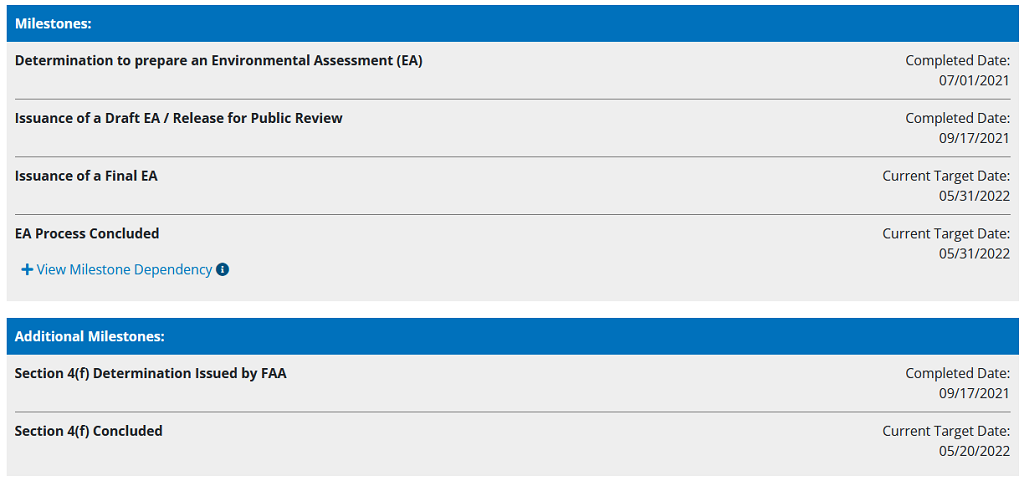
For the last couple of days, I had been getting the feeling that the FAA must be ready to release their Environmental Assessment (EA) for SpaceX Boca Chica.  I was thinking that because it was due today and the previous times they rescheduled it were earlier than on the last day.  So I spent some hours with one browser tab open to one of the Lab Padre cameras expecting word to break there early on.  Nothing yesterday.  Started again today before leaving for the afternoon, and still nothing.  I checked the FAA website, too, and still nothing through this morning.

Finally this evening, after that launch, when I checked in on those sites everyone was saying the release was postponed again.  Target date 5/31/22.  Considering the original schedule, they're now approaching 50% schedule slip.  They have years to go before they're as bad as all of the SLS program's schedule slips, but don't encourage them. 

Left to their own, SpaceX still probably wouldn't be flying Starships, but I'm 100% sure they'll do better without the FAA. 


Finally, my afternoon trip today was to meet fellow blogger (and one of my inspirations to start blogging) Borepatch.  Borepatch, lovely wife QoTW, and faithful hound Wolfgang all came over to the East Coast, Titusville, from their home over on the West side of the state to watch the launch.  Titusville is directly west of the Vehicle Assembly Building, and around as close as anyone without a proper pass can get to see a launch.  Mrs. Graybeard and I drove up to where they were staying to say hi in person and get to visit for a while.  It was a very enjoyable couple of hours getting to know each other in person and a break from our regular routines.  


Wednesday, April 27, 2022

Crew-4: On-Time Launch, On-Time Docking, Crew's On ISS

The Crew-4 mission has gone very smoothly, from a flawless launch into orbit to docking at the ISS  ahead of schedule.  At the time of launch, docking was expected at 8:15 pm ET on Wednesday (00:15 UTC Thursday); the actual time of docking was 7:37 ET on Wednesday, 23:37 UTC.  Booster B1067 appeared to hit the middle of the X ring, landing successfully for the fourth time 9-1/2 minutes after liftoff.  We watched the docking and stayed with it until the ISS crew and the new crew greeted each other.

This is SpaceX's seventh manned mission in the last 23 months, including the independent flights of Ax-1 and Inspiration4, carrying 28 people into orbit.  Of course, with that Ax-1 mission that just concluded, it's their second manned mission this month.  With the Ax-1 mission, SpaceX exceeded the total number of people launched into space by China in the 19 years the country has been doing manned spaceflight.  Frankly, that fact blows my mind. 

Screen captures from the video stream:  the full Falcon 9 with Dragon Freedom atop early in the flight on the top and B1067 on drone ship A Shortfall Of Gravitas after its landing.

A side note that's not particularly relevant to Crew-4, just the "big picture" at NASA:  the Artemis SLS Orion rocket was rolled back to the VAB over the night of April 25th/26th arriving Tuesday morning at 6AM.  It will probably take a week to prepare the structures in the VAB to allow access to the areas that need service.  There's the faulty upper stage check valve and the leak within the tail service mast umbilical ground plate housing.  Once those things have been repaired, I'm sure there will be additional checks before returning to the launch pad for the next wet dress rehearsal attempt.  I would guess that would be well into the month of May, possibly the end of the month.


Tuesday, April 26, 2022

Crew-4 Still Go for Very Pre-Dawn Launch

At the time of this writing, the Crew-4 mission to the ISS is still go for an early Wednesday morning (3:52 AM local time) launch from the Kennedy Space Center's Pad 39A.  The last report was the forecast had a 90% chance of acceptable weather.  A liftoff at 3:52 AM is early enough that some of those "weird and wonderful" visuals we've seen an hour or so before sunrise aren't likely, but night launches are generally pretty to watch.  

On Saturday, with the schedule understood but before the Ax-1 mission had left the Space Station, NASA's Kathy Lueders had said that the 39 hours between the end of the Ax-1 mission and the scheduled liftoff time should be enough to review the data and determine if there's anything that needed to be addressed before Crew-4.  Apparently, she was right. 

Half a day after Axiom-1’s safe splashdown, NASA, SpaceX, and other involved parties completed the final launch readiness review (LRR) for the agency’s fourth operational Crew Dragon astronaut transport mission. Emphasizing just how well-oiled that ‘machine’ has become after less than two years of crewed launch operations, Crew-4 is scheduled to launch ... less than 40 hours after Axiom-1’s return to Earth.  

Crew-4 will carry three NASA astronauts: Commander Kjell Lindgren, Pilot Bob Hines, and Mission Specialist Jessica Watkins, and European Space Agency Mission Specialist Samantha Cristoforetti to the station.  They're riding Crew Dragon Freedom for their trip into space, and will dock with the ISS within a day.  There will be the normal change of shift (crew) briefings between Crew-3 and 4, and the Crew-3 team is expected to depart the ISS after five days.  Crew-3 has been on the ISS since early November.   

Ars Technica provided a little perspective I haven't seen anywhere else. 

SpaceX now has a fleet of four Crew Dragon vehicles: Endeavour, Resilience, Endurance, and Freedom. Company officials have said that, for now, SpaceX does not intend to build any more Crew Dragons. On Monday, the company's director of human spaceflight programs, Benji Reed, said he thinks SpaceX can presently support as many as six human spaceflights a year. This is a likely breakdown of those missions:

  • Two NASA flights to the International Space Station (until Boeing's Starliner vehicle becomes operational, and then this number would be one)
  • Two private astronaut missions to the International Space Station, backed by Axiom Space or other private companies
  • Two free-flying missions, such as the Inspiration4 and Polaris flights

[Jessica] Jensen, [vice president of customer operations and integration at SpaceX], said SpaceX is determined to continue flying humans into space safely despite the rapid turnaround. "As exciting as this is, and as busy as everyone has been talking about, I just want to reiterate that safety is still and always the top priority," she said.

Crew-4: l-r NASA's Jessica Watkins, Bob Hines and Kjell Lindgren and Samantha Cristoforetti of the European Space Agency. SpaceX image from Space.com


Monday, April 25, 2022

Axiom 1 Crew Doubled Their Time on Orbit

Lucky stiffs.  

On Friday April 8th, the Ax-1 mission lifted off from the Kennedy Space Center bound for the International Space Station on a mission expected to last 10 days.  Instead, they undocked last night, Sunday the 24th and splashed down in the Atlantic east of Jacksonville, this afternoon.  Seventeen days in orbit, with all but about 24 to 36 hours divided between the ride up and the ride down spent as the first all civilian mission on board the ISS.

Between the splashdown of the Dragon capsule Endeavour and the much slower splash of the four parachutes.  Screen capture of the SpaceX feed. 

In the process, capsule C206 (Endeavour) became the first Crew Dragon to successfully transport astronauts to the International Space Station and back to Earth three times. SpaceX and NASA have already certified each Crew Dragon capsule for five flights – a number that will likely need to expanded within just a year or two. SpaceX is currently scheduled to launch Crew-4 no earlier than (NET) April 27th, Axiom-2 NET Q3 2022, Crew-5 NET October 2022, and Polaris Dawn NET late 2022.

At liftoff, NASA had Ax-1 scheduled to depart the space station on April 19th. On April 19th, NASA, SpaceX, and Axiom decided to waive off the first departure attempt due to weather issues that were apparently impacting all seven of Crew Dragon’s nominal recovery zones – four in the Gulf of Mexico and three in the Atlantic Ocean. On April 20th, the next undocking attempt was pushed to no earlier than April 23rd.  On April 23rd, the teams again called off the departure.  From my perspective, south of the southernmost Atlantic recovery zone, today was the first day in over a week with winds less that 15 to 20, but we still had small craft warnings for well offshore this morning. 

SpaceX's video coverage emphasized that the crew's second week on the ISS wasn't wasted, and they plenty of things arranged to do for just such a contingency, but I have to think there was a certain amount of "party time" attitude in not having to leave.  After all, the people that ride a New Shepard to suborbital heights that someone considers space get mere minutes up there.  They were getting more than 15 days. 

As of the last time I checked, the Crew-4 mission is still set for Wednesday April 27th at 3:52 AM ET.  It's possible the delay of Ax-1's return could affect that, but hasn't yet.  There won't be a full 48 hours between the splashdown of Ax-1 and the launch of Crew-4. 

Kathy Lueders is NASA's Associate Administrator of the Space Operations Mission Directorate.  Before this, she was in charge of the private space initiatives that led to SpaceX doing these things.  

That aside, this could be a big few days for SpaceX.  Crew-4 is on Pad 39A and will (most likely) launch either on time or no later than Thursday, April 28th.  Three miles slightly east of south on Pad 40, SpaceX is preparing to launch another batch of Starlink satellites as early as April 29th. If both missions avoid delays, Starlink 4-16 will be the company’s sixth launch in April and 17th launch this year.


Sunday, April 24, 2022

Odds and Ends

I've basically got nothing.  So some odds and ends and mind wanderings.

Last Thanksgiving, at our annual get together at my brother's house in south Florida, conversation wandered onto artificial sweeteners and how the one that bro' had was labelled, "plant based".  From there it went on to how so many foods now make a big deal about saying they're "plant based."  After all, if you go far enough back, everything is solar energy based.  Plants are solar energy based.  The animals who eat them are plant based.  It's completely valid to call your rib-eye steak plant based because the cattle eat plants and turn it into beef.  

Reining in the story a bit, I joked, "has anyone ever seen an animal-based sweetener?"  Hah hah, right?  My sister-in-law's cousin (who must be some unnamed relative of mine) said, "beaver anal glands."  That shut me up right away.  I think I might have blinked erratically.

I did some research.  She was kind of right, close to right, but not a sweetener.  It's an FDA approved replacement for vanilla flavoring. 

I wonder how they would have known what vanilla beans tasted or smelled like.  I don't think vanilla beans and beavers grow in the same areas.

Speaking of plant based food, I saw this one, but I bet I didn't think what you did. 

I was surprised that not only did that almond have an udder, but that it had apparently mastered antigravity and levitation.  It's just floating there in the air.  Clearly a previously overlooked terrestrial intelligence to come up with antigravity.

That aside, this is probably the definitive almond milk video. 


Saturday, April 23, 2022

Update on the 1 by 1 - Part 24

I'm not going to call these "Weekly" updates until they are again.  

The best summary of things since update 23 two weeks ago is that old saying, "the best laid plans of mice and men oft go astray."  At the time, I had hoped to complete the test piece of the epoxy-embedding method I was going to try within a week.  I had decided to do two separate operations; a rough pass with 1/4" ball end cutter followed by a fine pass with a 1/4" square end cutter.  Ordinarily, the rough is done with a square end and the fine with a ball nose.  My mistake.  For the rough cut, I told the CAM program to leave .025 margin everywhere.  The tool paths look like this in the visualization program I use (GWizard Editor).

The process of cutting down the rough pass took about 90 minutes but I ran into troubles with something I've had trouble with before - the cutter getting pushed up into its holder as the cut progressed.  

Take a look at the bottom center of the picture and you can see a group of parallel lines running diagonally between the circular stack of lines on the left and the complex shape on the right; that's a perspective view of the layers.  This is where the cutter is taking off layers in 0.025"deep cuts as I told it to do. When it started clearing out the large flat areas, like from the bottom or upper left corners over to that complex shape on the right, the CAM program told the mill to plunge the cutter to full depth all at once.  Once you're used to seeing the part in this way, it's easy to see it doesn't do the large flat areas in 0.025" at a time passes; there's just one layer at full depth.  Instead of lowering the cutter 0.025", it plunges it a full 0.200".  It should have cut down to 0.220" but the program wouldn't do that because 0.220 isn't an integer multiple of 0.025" so it stopped at the closest multiple.  The problem is that during those deep plunges the cutter can get driven up into its holder which totally messes up the depth of cut.  The first pass looked like this (the picture was shot while it was still cutting). 


After a few tries at repositioning the cutter in the collet that holds it, I switched to a purpose made "end mill holder" that has a setscrew.  This meant switching to the square end cutter because the other didn't have a flat spot on its side for a setscrew.  That held the cutter in place, but then I got hit by another problem, this time one I've never seen before.  The CNC controller program, Mach3, stopped moving the mill giving me an indication that the Emergency Stop button had been hit.  I was straightening up in the shop, so maybe it's possible I brushed into the E-Stop button, but if I did, I didn't press it far enough to lock off.  I don't know if that's even possible.  My guess is it was a power glitch, which we've had issues with before.  When I resumed the program, it was cutting too deep and the computer's coordinates for where it was didn't match where it actually was.   It cut off one of the major design features of the part.  At that point, the part became scrap but I kept going because this is a learning experience and I have more material to make the real one. 

It took days to get over this hump and start cutting the fine pass.  The results of the first fine pass cut looked like this:

Those "stair step" artifacts on the edges of the tapered rod between the two round features (and everywhere you look) are apparent on the simulations of the tool path but I was rather disgusted with this result and started trying to figure out how to improve my results.  The fix was to do yet a third pass with a different method than the other two tool paths. I ended up doing a third and fourth pass.

The rough path uses what's called waterline.  It cuts layers around the design, with fixed distances between the layers and between the cutter and the part.  Both X and Y change constantly.  The fine path leaves no clearance around the part, but cuts in in X motion, back and forth, left to right then right to left.  The only time Y moves is to move the work for the next purely X-axis cut.  All that I control is how close the tool paths are to each other and how far along the path the cutter moves at a time.  That was what caused the stair steps.  The cure to this is what's called a "contour" path, which is cutting along the edge of the part at a set distance - a waterline path at full depth of cut.  I ran two different contour paths; the first getting no closer to the final shape than .004" and the second allowing it to touch the outline.  That gave me this dramatic improvement.

The sides of the shaft are much better.  A nice bonus to cleaning it up is that the first pass took 1-1/2 minutes and the second (with finer steps) took 1-3/4 minutes.  The drawback is it took me until Thursday to get this result.  Compare that to the 90 minutes on the rough pass and re-cutting parts of it several times, and about the same 90 minutes for the initial fine pass.

Since the part is scrap, I went ahead and figured out how embed it in epoxy, which is hardening now.  

The second side should take far less time.  The guy I'm copying says he let the epoxy cure "several hours" and it was fine, but it's a different epoxy than I have.  I'll let it cure overnight.  


Friday, April 22, 2022

A Few Small Space News Items - A Week of Delays

The first delay is that the Ax-1 mission crew visiting on the ISS has been unable to leave the station due to unfavorable landing zone weather across the SE.  It's crowded up there, with the docking ports taken up by the Crew Dragons for Ax-1 and Crew-3.  It turns out there's a shortage of docking ports on the ISS. 

In a twist of fate that can be partially blamed on SpaceX, the ISS only has two docking ports (parking spots) capable of receiving Crew Dragon. NASA technically contracted Boeing to build three such ports but the first was destroyed when Falcon 9 failed catastrophically while attempting to launch Cargo Dragon’s CRS-7 space station resupply mission in June 2015. For unknown reasons, close to seven years later, NASA still hasn’t so much as attempted to build or launch a replacement docking adapter. As a result, most NASA cargo or crew missions have become more sensitive to the delays of other spacecraft and missions as NASA and its providers attempt to juggle a packed manifest with just two parking spots.

Because the Ax-1 mission can't leave, SpaceX can't launch the Crew-4 mission and because Crew-4 isn't there, Crew-3 can't return.   Currently, SpaceX, Axiom Space, and NASA are targeting no earlier than (NET) Saturday, April 23 at 6:30 p.m. ET (22:30 UTC) for Dragon and the Ax-1 astronauts to depart from the International Space Station.  Splashdown is likely to be 1:46 p.m. ET on Sunday, April 24.  Crew-4, which had been scheduled for today, has been reassigned to NET Tuesday April 26 at 0815 GMT (4:15 a.m. EDT).  I see no preliminary date for Crew-3 to leave the station, but the ordinary way of doing these switches is that both crews overlap for "a few days or a week" to ensure all the loose ends are transferred. 


It's getting to seem pretty routine, but another Falcon 9 booster had its 12th successful flight yesterday, landing on drone ship Just Read The Instructions after the launch experienced a roughly two hour weather delay.  Booster 1060 joined fleet leader B1051 less than two years after its June 30th, 2020 launch debut.  

With its 12th mission complete, B1060 has launched an average of once every 55 days over the last 22 months. B1060 also set SpaceX’s current Falcon 9 booster turnaround record of 27 days between launches – fully halving the far more complex Space Shuttle orbiter’s 54-day record. Altogether, out of a total of 21 total flight-proven Falcon 9 Block 5 stages, SpaceX’s four most productive Block 5 boosters have completed 45 orbital-class launches in the last three and a half years – more than half of all Falcon 9 launches conducted in the same period.


Another delay has been Rocket Lab's first attempt to snatch one of their Electron boosters out of mid-air with a helicopter, as we covered back on April 7.  Their mission “There And Back Again” originally scheduled for this past Tuesday, April 19, was delayed for unknown reasons.  They currently have a launch window of 2235-0040 GMT on 27th/28th (6:35-8:40 p.m. EDT on Wednesday the 27th).  

And because I'm still at the stage where a rocket landing on its tail on a metaphorical postage stamp hundreds of miles out into the Atlantic hasn't gotten old...


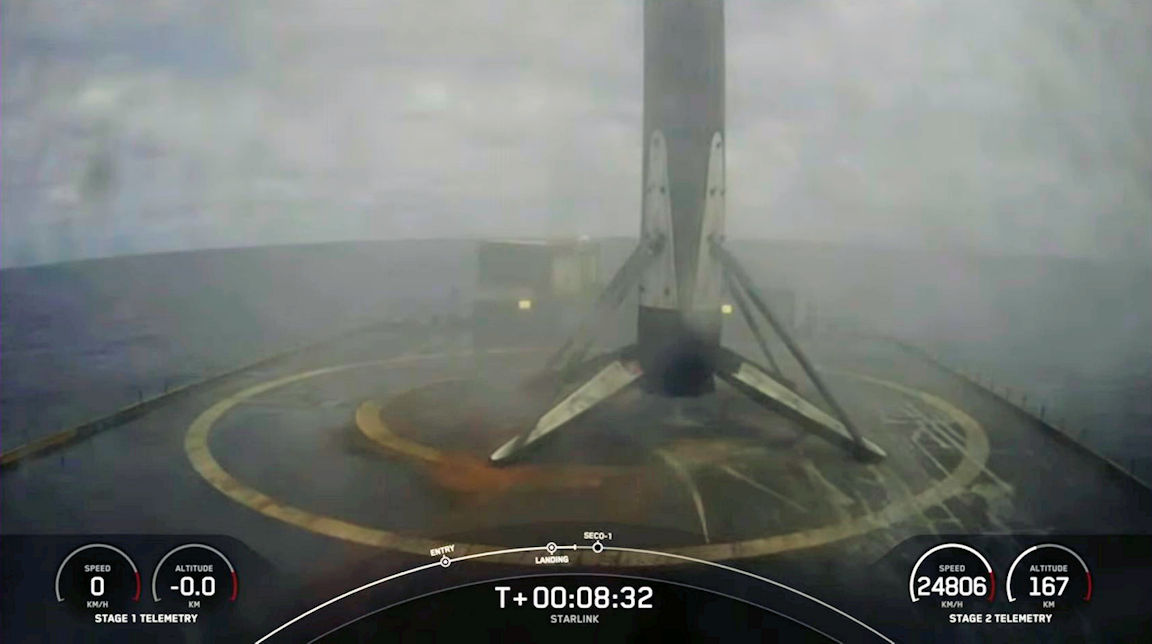
B1060 just as the single landing engine shut off.