Showing posts sorted by relevance for query 1911. Sort by date Show all posts

Saturday, February 6, 2016

Fun Show Day

It was Fun Show day here in the Silicon Swamp.  First show of the New Year so we had to drop by. 

It was packed.  It looked like peak days all over again, in keeping with the fact that NICS checks just keep setting record after record.  As always, folks were polite to each other and it was possible to make your way around the auditorium.   Well, it was slow to get around. 

No, didn't get anything.  I'm looking for a few things that are hard to find.  First, I want to get my hands on a Ruger Precision Rifle, but still haven't seen one.  I've heard they're almost vaporware and selling as fast as faster than Ruger can make them.  There are stories of being on back order and taking months to get.  I'd also like to find a 1911 that was used, even if it's in rough shape - doesn't even really have to be working - so that I can take it apart and use it as model for building one.  Strangely, I saw that Tam wrote about doing almost exactly the same thing a couple of days ago.    I started out saying that, and Mrs. Graybeard said, "If you're going to buy one, why buy junk?  Just get a good one."  Hard to argue with that, but I didn't find that mythical 1911 that was exactly right.  I could see getting one of these little guys, for one, but I also like these.  There was one of the Springfields at the show, but in 9mm, and if I'm going to get one, it's got to be in God's own caliber.  (Note to 9mm advocates: that's a joke based on J M Browning being referred to as a God of firearms design, and since he designed the original 1911 and the 45 ACP round for it, it must be...)
The Sig 1911.  It is a compact, so there would be that difference. 


Wednesday, September 4, 2013

A Long Answer About Machine Tools

In response to last night's post on a machine that is both 3D printer and light duty CNC Mill,  commenter Kerodin asked:
I'd love if you ever have the time to explore the concept of buying a hobby-level machine capable of turning out a functional 1911 or AR - even if it taxes the CNC and takes a week to mill the frame. When Miller started III Arms he entered with a Tormach - an "Entry level" machine in the world of real CNC - but I'd love to know if you think there is an answer out there for the Patriot who wants the ability to load some pre-constructed code, add steel blocks, and end up with a defensive tool.
The answer is that they probably are all capable.  It's not falling off a log easy, and some operations might be a bit scary, but I think there are tons of people using CNC-modified Grizzly and Harbor Freight mills and lathes to do this.  I would love to have a nice Tormach machine, but they are serious money for a hobbyist.   As a runner up, the Chinese company Sieg produces the majority of the cheaper imported machine tools, with differing capabilities, sizes and costs.  I've mentioned this one before and with the exception of not having the room in my garage, I probably would have bought one of these by now.  Seig makes this one, as well as the machines you see sold by various tool companies like Grizzly, Harbor Freight, and others.  My machines are currently all Sherline, with options by A2Z CNC.  Both the Sherline parts and the A2Z CNC add-ons are made in the US.  While the Sherline's standard work envelope is small, they are more accurate out of the box than pretty much anything else you can buy until you hit that Tormach, to the best of my knowledge.  A2Z has made their own versions of the Sherline machines which are capable of machining bigger things.  See their website.

As you say, with a smaller or less rigid machine, you can make more shallow cuts than on a bigger machine, and you take longer.  CNC is ideal for this; it never gets tired, never miscounts turns on the hand wheels. 

Of course, I've got a permanent post on how I built an AR-15 from an 80% lower (my rifle and the machine I made it on, below).  I haven't mentioned it, but thanks to The Redneck Engineer, I have some "0%" lowers (forgings) that I intend to machine all the way.  With the personal issues that have complicated life this year, I haven't been able to get to it, but I always thought of it as a "round tuit" project.  Judging by "The Book", I think this task is possible with my Sherline tools, but would be easier with a bigger capacity lathe.  This guy has a pretty thorough look at the process - on big machines.

A whole 'nother level is to machine a lower from solid blocks of aluminum.   Consider this advanced level.  And watch the videos on YouTube.

Of course, the AR platform, while a fine rifle, isn't the be all and end all of guns.  You might want a 1911.  There are 80% 1911 forgings to complete on your mill.  KT Ordnance of Dillon, Montana, is a prominent source.  This gets around the potentially nasty problem of cutting out the magazine well, which is a long reach for an unsupported cutting tool.  KT says the BATFE has ruled what constitutes an 80% lower, and you'll need some special cutters, which they'll sell you.  This guy has a decent write up.  KT sells an 80% Ruger Mark 1, .22LR pistol!

You will need information and places to hang out and just read.  Of course, AR15.com is a go to site for all things AR.  But don't miss The Weapons Guild or CNC Guns.  There are many forums devoted to particular machine tools where you can learn the ins and outs of your particular machines Yahoo! Groups has several. YouTube has many videos of small milling machines converted to CNC, and there are commercial options, too.  The advantage of going with one that was sold as a complete system, like the Little Machine Shop tools mentioned above, is you have one seller to go to for support.  When you put it all together yourself, you can have problems isolating problems and getting it all running; with one of these, you may need to clean it up to remove protective grease, but it should work when you power it up.

Hope that answers it.  If not, let me know!


Sunday, May 24, 2015

Did I Mention I Like Clever Ideas?

While talking about the Stealth Arms 1911 jig, I mentioned I'm a big fan of clever, and switching from metalworking to woodworking, we find a piece of (Patent applied for) clever that makes creating drawers a one step operation.

The invention is a specially shaped cutter that enables you to make four cuts in a piece of plywood, fold it up, glue it up, clamp it up, and voila: you have a drawer.  Looking a little closer, it requires a table saw with a dado blade set and this new blade. 

H/T to IMAO, of all places.  I shouldn't say that.  Frank usually gets some cool videos over there.

And by the way, if you didn't read the comments on that post about the Phantom Jig, YouTube user MosinVirus posts results of running the Phantom Jig on a steel 1911 rather than aluminum.  While it took some additional hand work, the result was a fully functional 1911. 


Wednesday, May 20, 2015

Clever Fixturing For an 80% 1911

Thanks to Wirecutter at  Knuckledraggin' My Life Away, we find a link to a new way of making a 1911 from an 80% frame without a milling machine.  Designed at Stealth Arms, the new fixture, called a Phantom Jig, guides your cutting of the necessary features by hand.  The operations required to complete their version of the 80% frame are to drill a couple of holes, cut the slide rails and the barrel seat.  The Phantom Jig performs the cutting operations that would usually be done on a milling machine.
The jig with a frame in place - when you buy the jig, they include one frame.  Note the long black handle: in operation, you use this like a woodworking plane.  The cutter is lowered into cutting position by the black knob with finger grooves located next to the handle, and the handle is then used to push the cutter forward through the metal taking off - ? - "several thousandths".  The rest of the jig needs to be held in a sturdy vise to handle the forces you're going to generate on it.  Once you make a cut, you advance the cutter 1/10 of a turn of that knob and cut another pass through the frame.

Wirecutter embeds this video, but I didn't watch all of.  It's 45 minutes long - and the video author said it took 40 minutes to finish his frame.  Stealth Arms has a video on the Phantom jig's page showing how this all works. 

I post this because I like clever, and this approach just exudes clever.  If you have even a table top drill press, you can drill the two holes you need to drill.  (Seriously - get a drill press if you don't have one.)  Then all you need is this fixture, a bench vise, an hour, and some good old fashioned elbow grease.  I think I should warn that this fixture isn't going to get you there if you're trying to complete a steel frame.  I think that requires more shear force than you can generate.  Stealth Arms' frames are made of 7000 series aluminum, which is heat treated to a higher hardness than the more-common 6061-T6 "aircraft aluminum".  7075, for example, is used in high-end mountain bikes.

Making a 1911 is pretty high on my list of projects right now, and I'm keeping an eye out for a steel frame.  Since I have a milling machine, and making one without the jig is cheaper, chances are that's the way I'll go. 


Friday, August 24, 2018

Shopify, Banks and the Rising Threat to Legal Commerce in Firearms

I'm sure that by now you've heard that the online commerce service for business, Shopify, suddenly started shutting down any businesses that have anything to do with guns.  That article focuses on Spike's Tactical and Rare Breed Firearms.  The same thing has happened to Defense Distributed and a host of other companies as well.  Cody Wilson's Def Dist has been particularly hard hit. Def Dist is a non-profit and with the money they've spent on Shopify now thrown away because Shopify suddenly changed policies, they've created an online fundraiser on their own servers to try to raise funds for the legal battles ahead.  Cody Wilson intends to sue Shopify to get that money back.

We need to think about this in wider terms.  David French, writing at National Review, presents arguments that this is a coordinated attack by all the usual anti-gun forces.  He doesn't mention the Parkland shooting, but you will recall that in the immediate aftermath the NRA was blamed for everything, and a "Ban All the Things!" cry was everywhere.  French argues that the anti-gun forces realize they can't win politically so the next best thing is bullying businesses, especially banks and financial institutions, to cut the businesses off.

After all, he begins, from the standpoint of government restrictions on Second Amendment rights, the future looks bright.  The elevation of Brett Kavanaugh to the Supreme Court (not a done deal, but a very strong bet) may well represent the death knell for draconian forms of gun control — including bans on so-called “assault weapons”, and standard-capacity magazines in semi-automatic pistols and rifles.  Moreover, meaningful federal gun control has been blocked for a generation, ever since the "red wave" after the Clinton AWB, and red-state legislatures are generally moving to liberalize state gun laws - Florida's gun control madness after Parkland a counter example.  On the other hand, consider the steady spread of “constitutional carry” and “shall issue” across the country.
But another threat looms, one that can stretch across the entire American landscape, is immune to the filibuster, and is largely sheltered from judicial review. It’s a threat that can choke off financing for the gun industry, stifle speech about guns, and lock the gun-rights community into offline (and small online) ghettos that restrict their ability to communicate.

So, what’s happening? Titans of American banking and communication are taking steps to restrict the use of their funds or platforms by gun makers, gun-rights advocates, and others. The threat is just now emerging, but it may be as great a danger to gun rights as it is to the culture of free speech in this nation, and indeed the two are linked.
French then goes on to recount the stories of Citibank and Bank of America, from March and April respectively.  I think most of you recall this - many of you whom I read said you were cutting up cards from those companies.  This latter one immediately puzzled me because BoA is the company behind Bass Pro Shops MasterCard.  In terms of sheer dollar volume, Bass Pro / Cabela's is undoubtedly one of the largest gun sellers in America.  BoA said they were going to not lend money to manufacturers of AR-15s, are they going to draw the distinction that they won't lend to manufacture them but they'll lend to sell them?   This week, I got a more clear picture.  I have a Bass Pro/BoA card (they gave me a big discount on some boat work) and I received a letter from them saying BoA will no longer issue the Bass Pro Card.  Capital One will issue us all new cards which go into effect in October.

French then talks about other movements against guns that make life for gun owners harder but don't involve the government.
Facebook has recently restricted any links to a website called codeisfreespeech.com, which contains downloadable plans for a number of entirely legal firearms, including the 3D-printable firearms at the heart of the lingering Obama-era case against Cody Wilson. The site includes plans for weapons such as the Colt 1911, a weapon so common and so basic that its plans date back to, well, 1911 (actually before). You can even buy the plans on a t-shirt.

YouTube has its own restrictions on speech about firearms and prohibits any content that “intends to sell” firearms or provides instructions on “manufacturing a firearm.”
...
Reddit has banned certain gun forums and updated its policies to forbid using Reddit to “solicit or facilitate” (extremely broad terms) transactions or gifts involving firearms.
...
Amazon Web Services has reportedly removed codeisfreespeech.com from its web servers, and Shopify just updated its free-speech policies to deny space for “the kind of products intended to harm.” It also placed on its “restricted items list” all semi-automatic weapons packaged with detachable magazines “capable of accepting more than 10 rounds.”
Think of New York governor Cuomo's attacks on the gun industry and the NRA, aimed at getting the financial companies headquartered in NYC to financially isolate them, as part of this bigger picture. 

Washington Free Beacon reporter Stephen Gutowski, whom French calls "perhaps the Internet’s best one-stop journalistic shop not just for technical expertise on firearms but also for national trends in gun control" has been diligently covering the recent trend of increasing corporate restrictions.  He noted that the corporate actions have been “more aggressive than what we’ve seen with Alex Jones,” with a fraction of the attention.
Simply put, that has to change. Few American communities (including the pro-life community) are better organized and more mobilizable than the gun-rights community, and it’s time to shine at least as bright a spotlight on corporate gun control as the one that illuminates governmental gun restrictions, the more traditional focus of the NRA. But not even the mighty NRA can generally force corporations to change course in the absence of government intervention. Corporations are entities that possess their own constitutional rights. Yet the NRA can seek to inform and persuade. Gun-rights proponents can invest in alternative platforms. Young conservatives can and should seek career paths in tech and other key industries to break up the monoculture.

In other words, while doing our best to make arguments in the here and now, it’s imperative for gun-rights proponents to play the corporate long game, just as they did in their remarkably successful 30-year campaign to liberalize gun laws. The ability to preserve a functioning gun industry and the free flow of information about firearms may well depend on it. Corporations have entered the fight, and gun-rights supporters are mainly on the outside, looking in.
This is not stopping at guns.  We've all heard the stories of conservatives being "shadow banned" on Twitter and having their content shut off on YouTube, Facebook and the other media.  This week David Horowitz' conservative think tank, the Freedom Center, was shut off by both Visa and MasterCard so that it becomes impossible to donate to them other than by mailing a check.  Why? The Southern Poverty Law Center convinced those banks the Freedom Center is an extremist group.  The SPLC is probably the biggest hate group in the country, with hundreds of millions of dollars in offshore accounts! 

We are just this side (I think) of mortgage companies asking on an application for a house buyer whether they have guns or if they're a member of the NRA.  If they do, their mortgage is denied.  All sorts of nasty possibilities arise if the pressure can convince employers to listen to the most outraged "offended class" in their companies. 


Time to take matters into our own hands.  Like Gab, full30 and the other companies that have sprung up to fight gun censorship, some banks and financial institutions are needed. 

Sunday, November 21, 2010

BATFE Is At It Again

There's a joke poster I've seen at work that says, "I got one good nerve left, and you just got on it".  That's the BATFE.

If this isn't your first visit, you'll know I just built an AR-15 from an 80% lower.  This whole market exists because when you get a bunch of butthead lawyers together they have to decide where to draw lines, like the three reindeer law I talked about last night.  In the BATFE's case, what's a gun?  What specific part makes a gun into a gun?  Years ago, they decided the part that houses the trigger assembly, usually called the receiver, is the gun (Tam added in the first comment, "Usually.  Some notable exceptions would be the FAL and the various roller-locking HK long guns and their clones.").  If you own a typical pistol, like an XD, a Glock, a 1911, or whatever, you can buy a trigger, or a barrel or pretty much any piece in there as a replacement part, but you can't buy the lower receiver that houses all those "springs and things" without going to a Federal Firearms License holder.  If you have a lower receiver that's ready to have parts installed, even though none of those parts are there, it's a gun.  Clearly, if you had a huge steel plate, 2 inches thick, and had the correct machines and skill, it could be made into a gun, so they had to decide how much work was needed on a chunk of metal to make it usable as a gun. 

For example, I got an advert from AR15.com for a ready-to-assemble lower.  If you buy this, you have to have it sent to an FFL, go through an NCIS check, and all that junk, the same as if you were buying a fully built, fully functioning AR-15 from Colt (or whomever).
but if you buy this one from Colfax Tactical, it's not a gun, and no FFL is required:


Enter KT Ordnance of Dillon, Montana (a lovely place - passed through there once).  KT sells parts that can go into a gun, and parts that can be made into a gun, like incomplete lowers, but they don't sell guns (as far as I can tell).  By coincidence, I had been looking for partial lowers for handguns as a follow on project to my AR, and found their 60% lower for a 1911 just this week.  According to David Codrea and Mike, from Sipsey Street, KT has just come under harassment by the BATFE for no apparent reason.  As David says at the Gun Rights Examiner,
Here’s the thing: IF Celata (edit: owner of KT) is doing what the government accuses him of, since when do they give out warnings and advise people to get a license?  Can you imagine the DEA finding you formulating and selling Oxycontin and responding by hand-delivering a letter telling you to stop and not resume activities until you become a legally-authorized pharmacist? 
Remember, this the BATFE, the folks who seem like equal partners of the jack-booted Waffen SS, the agency where even the women stomp kittens to death if they don't find whatever imagined contraband they just raided you for.  Can you imagine them not raiding the place with fully automatic, 2-ounce-triggered M-16s raised if they really thought KT was doing something wrong?

No, they are clearly just harassing Mr. Celata.  Why?  Probably simply because they can.

Edit 10/22 1727 EST, to incorporate a correction from the comments where everyone can see it.  Not everyone reads them.

Friday, November 7, 2014

Getting Started With An 80% Lower Just Got Easier

I'll bet that a lot of you probably get the Sportsman's Guide ads all the time like I do.  They're undeniably a big player in surplus sporting goods sales, and when you combine that with their Truck Monkey truck accessory business, and 365 Outer Wear clothing business, they seem to be a pretty big retailer.  I've been one of their club members off and on a few times, but I just don't buy more than a thing or two from them yearly. 

I noticed something in today's email that I've never seen before.  An 80% lower for a 1911.  It's aluminum rather than steel, so consider that, but 80% pistol lowers are hard to find.  I know of only one source, KT Ordnance of Montana.  
A little farther down the page, they have a listing for a lower receiver jig kit, and you need to read its page closely to see that it includes the lower receiver as well.  To complete either, you need to drill a couple of holes and cut the frame where the slide rides.  It seems a little harder than an AR lower, but that just may be because I don't quite know how to do it yet. 

AR Lowers?  Yeah, they have those, too.  Including a kit with the jig and even the necessary drill bits.  I think this could be done completely on a drill press. 

I've been thinking of doing a 1911 just to get the experience of building one from a pile of parts.  Could be a fun project for the summer when you don't really want to be outside around here.  (For my friends in Hoosieropolis and points north, think winter project). 

I don't want to take away from the guys at Colfax Tactical (aka Redmond Black Rifles), where I bought my one 80% lower.  I think they're great guys to work with.  Likewise the guys at Ares Armor,  or Advanced Rifles.   All of them are The Good Guys who have put up their own money to create businesses producing these parts.  On the other hand, I'd bet just about anything that Sportsman's Guide isn't manufacturing these lowers.  They just bought some and they're trying to sell them.  Somebody else made them, maybe one of the above.   Sportsman's Guide just has the means to get these parts in front of more people than the manufacturer, thanks to their fat retail channel. 


Sunday, May 7, 2017

A Little GB-22 Update

Let me lead with the conclusion: I'm not done yet.   

On the other hand, I'm very close to making the last piece, the frame itself.  All of the other pieces are cut and ready, mistakes have been left in place, and recovered from as best as can be.  The frame is to be cut from a piece of 3/16" thick steel and looks like the brownish piece here:
The turquoise colored piece is there to take up room, so that when I tell my CAM program to make tool paths to cut that frame out, it doesn't waste time cutting away that area.  My plan is to cut the main outline out with a 3/8 square nose cutter (End Mill) and leave a bit of a skin on it - about 25mils thick.  This cuts away the majority of the frame, cuts away most of the metal inside the trigger guard and that large open area in the top of the frame, where the slide goes.  This gets followed by another machining operation with a smaller cutter, 1/4", that gets everything except for the area around the trigger and that small gap extending to the left.  The small slot between the trigger and the frame will get cut with a special cutter bought just for that.  

I hold this on the machine to cut with those screw holes in the handle: 10-32 screws threaded into a plate that holds it for the cutting.  Up in the frame picture, around where the barrel mounts, you'll see four 1/8" holes.  Those line up with matching holes in the barrel holder and 1/8" spring pins make the mechanical connection.  Since 1/8 is in that awkward range that's too large for a #4 and too small for a #6 screw, I'm undecided on how to firmly attach those holes to my tool plate.  Today, I did a test cut to ensure the system could hold a piece of sheet metal down, withstand a generous cut (in aluminum), and come out the right size.  Because the piece of 1/16" aluminum I had was too small to cut the entire outline, only one of those four was available, so I added two special tooling holes to hold the plate in place and used the spring pins as fasteners.  It was all rock solid.  Those extra holes are visible in this picture on the left side of the frame and just in from the right edge of the frame, below and to the right of the real pin hole. 
This is the result of the test cut and came out as expected.  My next move is to go to on to the steel plate. 

I showed the barrel and holder a month ago; here are the three parts of the slide, the sides and the shorter middle piece.  Note the fancy cuts on the left edge of the short piece.  That had to be done by the CNC and tested out to make sure it worked.  The two long pieces, BTW, are not supposed to be beveled on the end facing the camera.  Oops.  Purely cosmetic, so "no harm, no foul".  Since I don't have metal white-out, these will stay that way. 
I'm pretty bad at estimating how long it's going to take to finish this, but I'd hope to get the first rounds through it this week.  I had no idea what to use for the spring that drops the firing pin onto the round (the firing pin is just visible as a nub above the centerline on the right hand piece).  I found a few bad ballpoint pens around here and grabbed the strongest spring to try.  I need some grips.  In the CAD world, I took a pair of 1911 grips and modified the hole spacing to fit the handle, since 1911 drawings are widely available.  Scaling the whole grip to make up for the hole spacing being different made them too narrow, though, so I need to start over.

How do you test a pistol you've made?  How do you fire the first round?  I'd like to go to my club range when nobody's around and try a few different things.  Maybe the typical "long string"?  I have some subsonic .22, and that might be quiet enough to use inside the shop.  Just to make sure the spring is strong enough.  A subsonic 22 shouldn't be any louder than a nail gun or a hammer, right? 

Some of you may be unaware that Mark came up with a closed bolt version of the GB-22.  I haven't heard anything about plans being available, but I signed up for the mailing list, so I'd hope they'd let those of us who bought the originals know about that.  Along another interesting path, the ECCO Machine video channel upgraded the pistol to a .380 centerfire, the GB-380.  People are having fun with the basic idea of the GB-22; this guy answers my basic "how do you test it?" question by firing a blank in his shop. 


Thursday, November 7, 2013

A Stunt, But Still: A 3D-Printed, All Metal Gun

A contract manufacturing company from Austin, Texas, Solid Concepts, has 3D printed the first real metal 1911.  An almost completely stainless steel printed gun.
Before we go any further, they don't say how much this cost, but this is not a low cost home printer.  The technology they used is called "Direct Metal Laser Sintering", and, yes, a laser is used in the machine.  A video on that web page shows how the technology works, but in overview, the machine contains a tub of a specially formulated powdered metal, and the laser heat is used to fuse particles of the powder into solid metal. The tub is lowered a small increment (.001"?) and the powder re-leveled, allowing the laser to sinter the next layer.  Layer by layer the part is built up until the final shape is there.  Post-processing - clean up, heat treating, and finishing - is required.

Again, don't think of this as a home printer technique, think of it more as an alternative manufacturing technology.  Sintered metal parts aren't a new thing, but printing them as DMLS is.  I know sintered metal has a bad reputation among many in the firearms communities, undoubtedly due to premature introductions of the parts in many companies.  The tech gets continually better, though. 
Solid Concepts is a world leader of 3D Printing services, and our ability to 3D Print the world’s first metal gun solidifies our standing. The gun is a classic 1911, a model that is at once timeless and public domain. It functions beautifully: Our resident gun expert has fired 50 successful rounds and hit a few bull’s eyes at over 30 yards. The gun is composed of 30+ 3D Printed components with 17-4 Stainless Steel and Inconel 625 materials. We completed it with a Selective Laser Sintered (SLS) 3D Printed hand grip, because we’re kind of crazy about 3D Printing.
The gun doesn't come off the machine ready to use (neither did the Liberator), but the parts are made and then assembled.  The barrel was rifled but the rifling was grown into the barrel as it was made, layer by layer, in the machine.  As they say,
This gun has NOT BEEN MACHINED. We used hand tools for some post processing (our finishers are wonderful), but we did not machine this gun. It’s born this way.
H/T to commenter bogbeagle at WRSA.


Friday, August 12, 2011

A Heartwarming Story of a Stolen 1911

Somehow, my web surfing ended up here today, at the Southern Oregon Mail Tribune, with a heart warming story about a guy who bought a 1911 at auction, and doing some research, found it had been owned by a Medal of Honor winner.  He found it had been stolen from the MOH owner and he was in possession of stolen property.  He did the right thing and not only tracked down the owner, he returned it to the owner. 

There's a law of the Universe that every religion talks about, and it's one of a tiny number (2?) of social laws that are as inescapable as gravity.  Eastern religions call it karma; Christians say "you reap as you sow".  Before that, Jews said, "Do unto others as you would have them do unto you"*.  As the gentlemen who returned the gun said, 
"Concern yourself with what is right and you'll never second-guess that decision".
It's a great story.  Go read.  I should point out that the website apparently will use cookies to make sure you're not reading the old articles too many times in a month, so read it once and smile.  (I always heard that news in the morning was bird cage liner by that evening.  I guess they're holding onto everything they can.)

Photo from the paper (obviously)...

* I know: same author.  I'm tryin' to wax poetic here!

Monday, December 16, 2013

Projects Are Born From Lesser Ideas

Hat tip to Robb at Sharp as Marble for linking to Sebastian who, in turn, led me down the rabbit hole to a home CNC-made 19-by-God-11, made by a reader named Jason.  Very picture rich post here. 
There are two novel, even inspirational things about this 1911.  First, it's made of aluminum instead of steel.  I'm sure that has been done in the world of 1911s, but doing it makes the home machining easier (it might be possible to use an alloy that can be heat treated and hardened after cutting it).  But the real inspiration is that Jason started with MILSPEC plans for the 1911 and split them down the middle, so that two halves are bolted together to complete the gun.  The one set of cuts I couldn't figure how to make with my micro mill was to hollow out the magazine well.  Cutting it in half fixes that.  Going in through the grip, the well is deep, and deep cuts with light duty machines are risky propositions to start with.  The other problem is that even with the most rigid, big machines, cutting with a long bit is likely to have problems with the cutting bit bending over its length.  When cutting out large amounts of metal like a mag well, the best tool to use is your drill press.  It's the cheapest, most effective way to remove cubic inches.  You just need to be careful because drill bits wander a lot, long thin bits are the worst, so leave a thick margin to clean up with your milling machine.

The barrels, slides, and all the other parts aren't hard to find - I think Brownells has virtually an entire catalog of them.  He had to do some fitting and filing to get the gun to fire, but fire and cycle it does, nicely. 

As a bonus for those it will matter to, this appears to be a Taig mill, another micro mill of similar size and capabilities to what I have. As CNC mills go, they are not all that outrageously priced and capable. 


Wednesday, June 24, 2015

When Evil Strikes, Blame the Thing, Not the Person

"Blame the thing, not the person" is like the motto of the Brain Dead.  Shooting?  Blame the gun!  (Unless you're in Canada or another place with strict controls, in which case "it's just an outlier").

In this case, it goes: Racism?  Blame the flag!  Hat tip to Irish who points out that all racism ended yesterday.
Well, it is official and in case you have not heard, an inanimate object is to blame for the nations racial strife! Once again libtards and rinos are tripping over themselves in an effort to banish forever from the halls of history, state house lawns and Confederate Memorials the Confederate Battle Flag. From South Carolina to Mississippi "do gooders" are calling for the flags removal! Hell, even WalMart has got in on the act announcing they are pulling merchandise that bears the dreaded "Stars and Bars".  I wish there was some way I could apologize for that social misfit-drugged-zombie-killer being under the "spell" of the flag and shooting those people in their Bible class, but I cannot. Neither can I blame the 1911 .45 a.c.p. handgun. I would love to ask these politically correct wannabes this question; Once the flags are gone and the division of the races fails to disappear, who or what will be to blame? Shame on all of these politicians and the pundits who have turned this tragic event into a media circus and are using it to promote their agendas.
I don't know what they'll blame the next time some psycho goes off.  Whatever object that happens to be around, I suppose.  Since people are incapable of controlling themselves, it must be some object around them that makes them do evil things. 

Although I've lived in the South since I was 3 (so almost a hundred years), the history of the flag and the dark times of the First Civil War have never held much interest to me.  It's only in my later adulthood that I've become more interested in history as a broad subject.  I've had it explained to me, though, that after the War, the Yankees took so much from the south that many felt that the flag was all they had left. I'm sure many of you could teach me a thing or three here.

All that out of the way, it's just remarkable how quickly the media swooped down onto this topic.  It's like they had a stack of possible battle plans and just picked the appropriate one.  Nobody was talking about the confederate battle flag 10 days ago.  Today, a week after the mass murder, other states are rushing to drop the flag and stores are racing to show just how politically correct they are, too.  Amazon is dropping them, although Nazi items are still cool to sell.   Walmart is dropping them, but still sells products featuring mass murderer Che. 

For some perspective it really hasn't been that long since we saw these:
and even less time since we saw this one:
I really hate the bitter smell of hypocrisy.   (source of both pics)


Saturday, November 8, 2014

Belated BAG Day

On Tuesday, election day, adopted as Buy A Gun day in the gunnie blogosphere, I wrote a little piece on the 2013 sales bubble, concluding with, "We have a new gun show within a half hour drive this weekend.  Maybe we'll  have a belated BAG day." 

And we did.  Meet the new occupant in the safe:
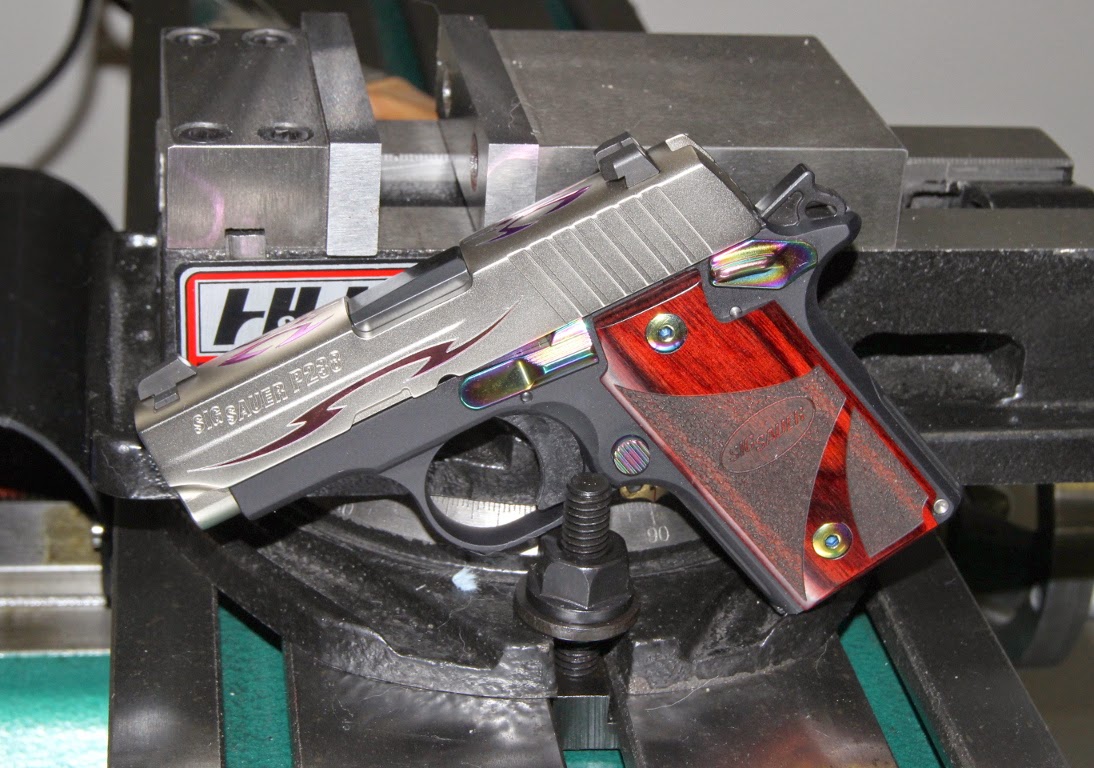
This, of course is a Sig Sauer P238, a mini (micro?) 1911 in 380ACP.  Sig Sauer calls the finish and model Rosewood Tribal.  The safety, slide latch and a couple of other pieces have an anodized titanium look.  The stainless slide has purple graphics on the side and top.  The grips are rosewood, or perhaps cocobolo, also called rosewood.

For no particular reason, other than that the P238 has been calling me since before I bought my Taurus TCP  2 1/2 years ago.  And a guy who calls himself SiG ought to at least try one Sig. 


Sunday, January 29, 2012

My Five

The latest meme is what five guns would you get if price were no object.  While we've done this before, I think that one was more bounded by reality. 

1.  Barret M82A1 Yeah, I said last time that there isn't a range over 600 yards that in the state that I know of.  But if price is no object, .50BMG semi auto?  Don't even have to think twice.

2.  Wilson Combat Classic 1911 This was in my list last time.  Still love it.

3.  A Palma Rifle.  Here I'm not sure what to go for, but thousand yard shooting with .308 sounds like fun to me.  I'm sure custom is the way to go, but I don't know who to go to.  I'd try this Savage 18532 at least to get me started.

4.  A full-auto Uzi SMG.  Only shot one once, but it was fun. 

5.  A Winchester Model 1894, but not a new one - I'd like one as antique as possible, but I think it needs to be 30-30.   
Let me confess some dumbness - I only became aware of Palma competitions a couple of months ago, when someone posted a link to Anette Wachter, the 30 Cal Gal, and I saw that extremely high-zoot rifle of hers.  So I went and read up on it, and it sounds like a good hard challenge.  Let's face it - if we wanted simple hobbies, we'd collect stamps, right?  No stress, no chance of things blowing up in your face, no chance of someone else's ND punching a hole in you: just buy stamp, put in book.

Tuesday, December 1, 2015

Techy Tuesday - 3D Printing is Growing Up

3D Printers have been riding high on the Gartner Hype Cycle for a while.  At least once a month, the engineering trade magazines have an update on The Latest Thing in the field.  Gartner themselves posted that 3D printing hit the hype cycle peak in 2012.  That puts the technology today closer to the "Trough of Disillusionment" than the Peak of Inflated Expectations today.

Of course this is a bit misleading.  3D printing is in day-to-day use in industry and has been for a quite a while.  As a field, the term 3D printing can be applied to the Stratasys printers that produced the first 3D printed, all metal 1911, the giant machines used to print concrete houses, or it can be applied to small desktop printers. The field is growing and new approaches are coming online regularly.

Design News presents a feature on some new technologies coming into this growing field, with 10 new printers to look through.  They feature a way to print silicone like Room Temperature Vulcanizing (RTV) compounds, new UV cured resins, filled plastics, ceramics and more.  One printer, the Cybot 330 Pro 3D printer from Vancouver-based Cybot 3D can print 95% of filament types available, such as PETG (polyethyelene terephthalate glycol-modified), carbon fiber PLA (polylactic acid), NinjaFlex, PC-ABS (polycarbonate-acrylonitrile butadiene styrene), wood fill, copper fill, aluminum PLA, and stainless-steel PLA. Another printer head produces material with properties that vary around the print area.

A far out-there development that you probably won't see on the market any time soon, the Wyss Institute designed a new multimaterial printhead based on active, rather than passive, microfluidic mixing of a wide variety of materials to produce gradient architectures. Materials like silicone rubber can be printed in gradient architectures composed of soft and rigid regions. The team has also demonstrated the ability to mix and print reactive materials, such as two-part epoxies, with this printhead and to mix conductive and resistive inks on demand for embedding electrical circuitry inside 3D-printed objects.  (The Wyss Institute for Biologically Inspired Engineering is part of Harvard University aimed at creating materials and devices to solve critical medical problems).

Not quite as far out is the four printhead printer from Cultivate3D with a print volume large enough to print a toddler.  It's more like the conventional home printer, only really big.

(The Beast from Cultivate3D).

Friday, July 13, 2018

107 Year Old Einstein Prediction Proven

According to this week's Machine Design newsletters, a 107 year old prediction by Albert Einstein was verified recently at Oak Ridge National Laboratory.
“We saw evidence for what Einstein first proposed in 1911—that heat energy hops randomly from atom to atom in thermal insulators,” said Lucas Lindsay, materials theorist at ORNL. “The hopping is in addition to the normal heat flow through the collective vibration of atoms.”

The random energy hopping is not noticeable in materials that conduct heat well, like copper on the bottom of saucepans during cooking, but may be detectable in solids that are less able to transmit heat.
The researchers needed to study the heat flow in a material that's really poor at conducting heat, and chose a compound based on the element thallium, a rather uncommon metal, wedged between mercury and lead in the periodic table.  Researchers said the crystal they used, “has one of the lowest thermal conductivities of any crystal.”  It sounds as if they weren't deliberately trying to prove or disprove this prediction, but that they were trying to make sure they could predict the heat flow with a computer model.   
Lindsay and his colleagues used sophisticated vibration-sensing tools to detect the motion of atoms and supercomputers to simulate the journey of heat through a simple thallium-based crystal. Their analysis revealed that the atomic vibrations in the crystal lattice were too sluggish to transmit much heat.
The predicted heat flow from the computer simulations was about half of the heat flow observed in the experiments.  This is what led them to conclude another, additional heat transfer mechanism was at work. 
“Much of the vibrating energy is confined to single atoms, and the energy then hops randomly through the crystal.”
...
Many useful materials, such as silicon, have a chemically bonded latticework of atoms. Heat is usually carried through this lattice by atomic vibrations, or sound waves. These heat-bearing waves bump into each other, which slows the transfer of heat.
This is the dawn of trying to use this phenomenon in the engineering toolbox, like all other known heat transfer mechanisms.
“Both the sound waves and the heat-hopping mechanism first theorized by Einstein characterize a two-channel model, and not only in this material, but in several other materials that also demonstrate ultralow conductivity,” said ORNL materials scientist David Parker.

For now, heat-hopping may only be detectable in excellent thermal insulators. “However, this heat-hopping channel may well be present in other crystalline solids, creating a new lever for managing heat,” he said.
First comes detecting it, then comes trying to benefit from it, and finally attempts at controlling it.  Without control, it's just a phenomenon. 


(New research about the transfer of heat—fundamental to all materials—suggests that in thermal insulators, heat is conveyed by atomic vibrations and by random hopping of energy from atom to atom.  Here the vibrational coupling is shown as the light blue springs and thermal hopping as the yellow arcs. - ORNL)


Thursday, March 2, 2017

Possible Breakthrough in 3D Metal Printing?

Design News headlined this story as, "Teen Invents Liquid-Metal 3D Printer With Potential to Transform Manufacturing", and while it's technically true, he was a 19 year old college student. I probably would have worded that as "College Freshman Invents ..." but that's probably quibbling.

It's important enough as it is.

Regular readers will recall that I did a story on the first 3D printed metal 1911 from Solid Concepts back in November '13 when that story broke, and I've been following developments with printing metal since then.  That printer was a rather expensive industrial level printer based on the concept of Direct Metal Laser Sintering, which uses a bed of powdered metal and then uses a laser to very precisely heat and fuse the powder into usable metal.  The motion of the laser creates solid metal in the powder and grows the part layer by layer.  Even with that cost barrier to adoption, metal printing has grown to have a big impact, particularly in aerospace.

The story here is an entirely new way of 3D metal printing, printing molten metal itself, in the form of precisely controlled droplets of molten metal that solidify as the metal is laid down.

Five years ago, Zachary Vader was a 19 year old student at the University at Buffalo (NY).  Realizing that the really fun and interesting parts of engineering school wouldn't come until his fourth year, he worked on other projects.  He designed a micro-gas turbine generator and soon came to the conclusion that it would be too expensive to produce.  That led him to decide to that 3D Metal Printing was the key to getting costs down.  Zach had a resource that it's arguable nobody else would have: his father, Scott.  Scott happened to be a pioneer in 3D printing fiberglass and was familiar with how 3D printers work.  Scott had the idea of using molten metal and controlling the droplets much like an inkjet printer.  The metal would be controlled by magnetic fields, a field known as Magneto Hydro Dynamics, or MHD.  Zach and Scott formed Vader Systems, basically a family company. 

From Design News:
The breakthrough in Zachary’s invention came when he thought to expose molten metal in a confined chamber with an orifice to a pulsed magnetic field, the Vaders said. The transient field induces a pressure with the metal that ejects a droplet, which was the key to making droplets of liquid metal eject from a nozzle.

Now Vader Systems is producing and marketing the machine Zachary invented, with the younger Vader serving as CTO of the company. Scott Vader is CEO while Zachary’s mother, Pat Roche, is the company controller.

The machine represents a major leap forward in the ability to print 3D objects in metal, according to University at Buffalo engineers. While other metal printers exist, most use a process of laying down powered metal and melting it with a laser or electron beam. This process is flawed because some particles of the powder do not get melted, creating weakened spots.

In the Vader Systems machine, called the Mk1, an electrically pulsed magnetic field permeates liquid metal in an ejection chamber and creates circulating electrical currents that interact with the magnetic field to produce a pressure that squeezes a droplet out of the ejector nozzle.
Vader Systems is promoting their "Mark I" version, saying "Production in 2018", so it's still under development.  The prints look like they could stand quite a bit of finishing, but I'm not sure that's their emphasis.  Still, they quote some impressive stats that they say it will make. The fact that they can print one pound of aluminum per hour at a "90% cost reduction" compared to laser sintering is the kind of quantum leap 3D metal printing needs.
Build envelope
12” x 12” x 12”
(300 mm x 300 mm x 300 mm)

Material Capability
Aluminum and its alloys
(4043, 6061, 7075)

Droplet Range
200 to 500 micron

Build Rate
1 lb per hour based on 500 micron droplet size

Speed vs Powder Bed Fusion
2x Faster

Part cost vs Powder Bed Fusion
90% Reduction

Vader Systems seems to be a mix of the startup and University at Buffalo researchers, which will very likely get them to market faster than just the father and son team could make it.
The Vaders have secured UB engineering faculty and students to work closely with them. Scott Vader reached out to the university after he and Zachary already were working on the invention in the basement of their home. Now the company has three faculty advisors and have won grants from UB’s Center for Industrial Effectiveness and Center for Advanced Biomedical and Bioengineering Technology, as well as and a National Grid grant through UB to further develop and promote their technology.

Vader Systems also has hired several engineers based on its connections to UB, is looking to hire more, and is currently setting up its production facility and business infrastructure in Getzville, N.Y., near Buffalo, Vader said. “Additionally, we’re establishing strategic partnerships and working with our early customers to deliver our first systems,” he said. 


The current  home printers that work in plastics are said to be quite a bit higher quality than the early printers from ten or even five years ago.  I suspect we're going to see metal printing go through a similar improvement ramp in the next few years.


Tuesday, July 31, 2018

Breaking - Federal Judge Block Release of CAD Files for "Printed Guns"

As the deadline of August 1st approaches, where there are to be no more restrictions on the release of these CAD files, a Seattle-based federal judge has blocked the release of the files.
The restraining order from U.S. District Judge Robert Lasnik puts that plan on hold for now.

"There is a possibility of irreparable harm because of the way these guns can be made," he said.
If you want a copy of the files, Gun Free Zone has hosted one (as I'm sure tons of other people are doing).  Help yourself - I got mine.  They've only been available since about 2013, after all. 

The pearl clutching going on over this ruling has reached levels that might possibly exceed Trump Derangement Syndrome.  I guarantee that these prints being available will lead to just as much blood in the streets as concealed carry has always been accused of: none whatsoever.  Miguel and J. Kb at Gun Free Zone have done yeoman's work at pointing out the stupid, but the base meme is that (to quote "actress" Alyssa Milano)
Imagine this: the convicted domestic abuser next door tries to buy a gun. He’s turned down because he fails his background check. When he gets home, he opens up his browser, and in half an hour he’s printing out his own undetectable, fully functional plastic gun, with no background check and no record of his purchase.
Half an hour?  Not bloody likely.  Half a week is more like it.

Milano shows a picture of a solid metal 1911 (you remember that one, right?) which is an absurd example undoubtedly used just to create fear.  Last time I looked, that's a half million dollar printer.  Your average gang banger or terrorist or whatever they're arguing just isn't going to drop half a million on a printer and spend the months required to get good results out of it. 

The second meme is that these will be undetectable, plastic guns.  The pistol at the heart of this is the Liberator 2, which is printed ABS plastic.  Even a relatively high end home printer ($1500 class) is going to take a few days to print this.  According to his book Wilson left a metal firing pin in the gun specifically because of laws about undetectable guns brought about by the first use of a Glock in a movie.  Besides, in some places (like a barrel) strength can be gained by using a larger part.  Much like aluminum parts have to be bigger to perform like steel, plastic can work for the barrel if it's much thicker.  But there's not enough room in a handgun to make a firing pin out of plastic.  It would be bigger than the round!  The firing pins will show up on X-Rays. 

Never one to be the second most stupid person in the room, Senator Richard Blumenthal (D - Uranus) takes the idiocy to 11 saying there will be fully plastic AR-15s taken onto airplanes and no one will ever know until someone shoots up the airplane. H/T for the meme to Gun Free Zone.


The serious side here is that Democrats are pressing the president to decree releasing the CAD files to be illegal and I have less than 20% confidence in the president's tendency to do the right thing.  This is the guy who walked around saying "ban bump stocks" a couple of months ago, and is breaking just about any conservative principle there is in this trade/tariff thing (bailing out farmers?).  In the last couple of days, I saw a video of him in what looked like a cabinet meeting, but with Jeff Sessions and some LEOs, threatening to destroy someone who's opposed to civil asset forfeiture, and it almost made me throw up.

EDIT: 080118 at 0710 EDT - Added photo that Blogger wouldn't let me add before original posting.  Reworded slightly around that.


Saturday, January 28, 2017

Gun Show Today

This weekend, there's a Military Expo and Gun Show going on just to the south of us in Vero Beach.  We've gone to that gunshow before but haven't been on one of these weekends when they do the Military Expo.

We didn't see as much of the Expo side of this as we might have, but there was a lot of military surplus for sale, dating back to the "usual" turn of the 20th century-vintage rifles like '03 Springfields and '98 Mausers.  Between the outdoors surplus sales and the indoor gun show, I saw more M1 carbines and M1 Garands than I've seen in one place before (I obviously haven't been to the CMP).  This included a Garand chambered in .308 and rebuilt on a garish laminated stock.

On the unexpected side I saw and got to play with ("coon finger" to use Tam's evocative phrase) a Ruger Precision Rifle, which I've been wanting to see for at least 18 months.  In fact, there were two of them there, one in .308 and one in 6.5 Creedmoor.  It really is an impressive rifle.  The one I played with was the 6.5 Creedmoor and was brand new, being offered by a dealer.  I didn't mess up the adjustments, at least not much, but was interested in the hardware and general fit and finish.  Excellent, as expected, with a great feel.  The quick release hardware was like those used on bikes, which I haven't seen on a gun before.  To be honest, I was a little surprised at its weight, although they do list it as a 10.7 lb rifle.  Guess that didn't work its way into my subconscious.  It was comfortably (25%) under MSRP, which was nice to see, but no, I didn't give it a new home.

I'd like to see comparisons between the RPR and the Savage BA Stealth, which appears to be designed as head-to-head competition with it. 

Those who follow Michael Bane's shows and especially his podcast know that he believes that PCCs (as he calls Pistol Caliber Carbines) are the next big thing.  We only saw one there (as three rifles at two sellers), and they were Hi-Point 9mm carbines.  Neither one of us has ever handled one of those before and Mrs. Graybeard surprised us both by really liking the feel of it.  Now Hi-Point, bless their hearts, doesn't exactly have the most sterling reputation, but we determined to go track down actual user feedback.  Our almost-neighbors up the road have very well known PCC, and they need to be considered as well.  On that subject, Bane writes:
The venerable Kel-Tec SUB-2000, available in 9mm or .40 S&W with magazines for multiple platforms and a low-ball price of $500, remains the first choice for a first pistol caliber carbine — if you can find one! GunBroker is your best bet.
Things I probably almost definitely would have bought if I found one: A decent 1911 for under $500; mostly to use as a model when I finally get to machine one.  A Savage Mark II in 22LR, especially if it was that model or on a good wood stock without the thumb hole stock.  A Ruger American Predator Rifle in 6mm Creedmoor.  None were found.  6mm Creedmoor?  When it was introduced, the RPR was available in .308, 6.5 Creedmoor and .243.  This year, they've dropped the .243 in favor of the slightly smaller 6mm.  If I look at this article, 6.5 and 6 are virtually identical, with a "perfect shoot" just 1% better with the 6.0.  The article says the 6mm Creedmoor does that with much less recoil, but at the cost of slightly less barrel life.  I could see going with 6 in a long distance rifle as long as I'm not trying to humanely hunt at those distances.

Feedback from those of you who actually shoot these combinations, or anything I've speculated on is always, always welcome.

 The Ruger Precision Rifle (RPR)


Thursday, July 12, 2018

Possibly the Farthest Reaching News This Week

Something getting coverage around my blog list, but not much elsewhere, is the US Department of Justice essentially surrendering on its five-year-old case against Cody Wilson and Defense Distributed.   From the SAF press release:
BELLEVUE, WA – The Department of Justice and Second Amendment Foundation have reached a settlement in SAF’s lawsuit on behalf of Cody Wilson and Defense Distributed over free speech issues related to 3-D files and other information that may be used to manufacture lawful firearms.

SAF and Defense Distributed had filed suit against the State Department under the Obama administration, challenging a May 2013 attempt to control public speech as an export under the International Traffic in Arms Regulations (ITAR), a Cold War-era law intended to control exports of military articles.

Under terms of the settlement, the government has agreed to waive its prior restraint against the plaintiffs, allowing them to freely publish the 3-D files and other information at issue. The government has also agreed to pay a significant portion of the plaintiffs’ attorney’s fees, and to return $10,000 in State Department registration dues paid by Defense Distributed as a result of the prior restraint.
The case against DD was that they violated ITAR (International Trade in Arms Regulations).  DD argued they weren't exporting guns, they were publishing software describing something and publishing software has been recognized as free speech.  As part of the settlement, the DOJ has promised to eliminate ITAR control over the technical information DD had put online and transfer regulatory control to the Department of Commerce. 

This is an outcome I never would have guessed at, but perhaps with a Trump DOJ instead of the Obama version and the very likely addition of a more pro-2A Supreme Court Justice, they felt they wouldn't win in the long run.

The biggest item might be this little gem:
Significantly, the government expressly acknowledges that non-automatic firearms up to .50-caliber – including modern semi-auto sporting rifles such as the popular AR-15 and similar firearms – are not inherently military. 
This is the Department of Justice saying AR-15s, AR-10s and similar semi-autos are not "weapons of war", as has been the anti-gun talking point/sound bite since, oh, forever.  In particular, it has been the war cry of the Hogg and the Parkland kids since day 1, as well as the reliably pro gun confiscation groups like the Mommies and Space Cadet.  I can't see how the DOJ could enforce a ban on ARs now, since they just established the precedent that they aren't military arms.

Defense Distributed is promising a new beginning to downloadable guns on August 1st, putting all of their files on a site they're opening called defcad.  Cody Wilson describes defcad as, "a GitHub for guns".  (Github is a software developers hangout and code repository - tons of open source projects are there).


While metal printers are on the market, they're too expensive for the home market.  Plastic printers are available at a wide range of price points.  DD's Ghostgunner is apparently not available at the moment, but this dedicated CNC milling machine is supposed to be able to automatically find the critical points on an 80% AR lower (15 or 10) or an 80% 1911 and produce a finished receiver with minimal user input.  "At the click of a mouse" - which implies it comes with all the software needed.