Wednesday, November 10, 2021

Biden Nominates Yet Another Commie

In what must be just the wildest of coincidences, the administration has nominated another questionable nominee, this time Yet Another Commie (YAC) to high federal office.  This time the office is Comptroller of the Currency, the nation's highest banking official, and the nominee is Saule Omarova.  

Ms. Omarova isn't the typical leftist YAC kid from the US who went to a big lefty school in the US and was indoctrinated in how wonderful communism is; she was actually born in Kazakhstan, part of the former Soviet Union. 

Omarova graduated from the Soviet Union’s Moscow State University in 1989 on the Lenin Personal Academic Scholarship, according to the Wall Street Journal. As recently as 2019, she was still praising the USSR’s economic system as in some ways superior to our own. “Say what you will about old USSR, there was no gender pay gap there. Market doesn’t always ‘know best.'”

One report that I heard said that she was in the US during the tumultuous period when the USSR collapsed.  She spoke some English but certainly wasn't fluent in it, and still has a dense accent.  Nevertheless, she apparently applied to be allowed to stay and was granted the privilege.  Unlike any other former Soviet or refugee from any communist country that I've ever seen or hear speak, she apparently liked the the old country's way of doing things and thinks more government control is a good thing.  You might gather that from the last sentence quoted above. 

Among the first things she has said is that she wants to destroy all the banks in America.  Not just your big, national-name and "too big to fail" banks; she wants all banks to go away.  From what I can see everything from your neighborhood small bank or local credit union to the big national banks like Chase, Citicorp, Wells Fargo and so on.  All banking will be done through the Federal Reserve Bank so if your local bank survives at all, it will be as some sort of office of the Federal Reserve. 

Omarova’s goal is the eventual elimination of private banking and the establishment of the Federal Reserve as the nation’s only bank.

In her own words:

“The core idea here is simply to allow all U.S. citizens and lawful residents, local governments, non-banking firms and non-business entities to open transactional accounts directly with the Federal Reserve, thus bypassing private depository institutions,” she wrote. “In this sense, it is a variation on the familiar FedAccounts — or FedCoin, ‘digital dollar wallets,’ etc. — theme. In principle, FedAccounts can be made available as an alternative to bank deposit accounts, upon a person’s request.”

For those who have never learned this, or let this fact evaporate, the Federal Reserve isn't a government agency; it's a private corporation that enjoys a special tight relationship with the Fed.gov.  "Tight" might not be strong enough.  Perhaps incestuous is a better word.  There's a word for a merger of big corporations and governments.  Benito Mussolini was a big advocate of the idea; it's called fascism.  

Omarova herself wrote that her proposal is “deliberately radical in scope and substance.”   As Kristin Tate wrote for The Hill on Wednesday:

Taken to its extreme, this would mean that the Federal Reserve, acting on behalf of Washington, could become the only place citizens could deposit their money. Such a massive transformation would be accomplished by replacing consumer deposits into a new digital dollar, held by the Fed.

And just like that, the end of the dollar and replacement of paper money with a digital currency would happen.  It would be replaced not by Bitcoin, Doge coin or any of the existing Cryptocurrencies, but a new one that has been called Fedcoin.  No need for dollars, and buying things for cash would probably be outlawed.  Since everything will be done through the Federal Reserve Bank, there's no need to pass that law that they monitor everything you buy over the course of a year that adds up to over $600, $10,000 or any other arbitrary number.  They will know every penny (or whatever they call it) that you spend.  They would literally hold your checkbook in their computers, just like my bank (a local credit union) now has records of my checking account back over the years.  

Omarova is far beyond "just" wanting to get rid of banks like Goldman Sachs.  A big deal is being made yesterday and today about a Twitter video someone found in which she calls matter-of-factly for the destruction of the oil, gas, and coal industries. To save the planet, of course.  

In the clip, Omarova, who was born in the Soviet Union and is not a native English speaker, is seen discussing “troubled industries and firms that are in transitioning.” She continues: “And here what I’m thinking about is primarily coal industry and oil and gas industry. A lot of the smaller players in that industry are, uh, going to probably, uh, go bankrupt in, in, in short order, at least we want them to go bankrupt if we want to tackle climate change, right?”
...
This radical and destructive rhetoric was to be expected from Omarova, who, as Stephen Green pointed out, “graduated from the Soviet Union’s Moscow State University in 1989 on the Lenin Personal Academic Scholarship.” Omarova was apparently such a convinced Marxist in the late 1980s that she wrote her thesis on Karl Marx’s thought, and tellingly has refused to release that thesis now.

The opposition to other appointees has risen to the point where some nominees, like Chipman, have had their nomination blocked.  We really need to do it on this one, too.  Same process in that she will have to go through the senate confirmation process.  None of the three articles I read and linked to here give a date for the hearings, or said that the hearings are imminent. 


Tuesday, November 9, 2021

NASA Hosts Teleconference on Getting Back to Work on HLS

This afternoon, NASA held a teleconference to talk about getting back to work on the Human Landing System (HLS) contract now that a Federal judge has ruled in the agency's favor in the lawsuit by Blue Origin and Dynetics against awarding the contract exclusively to SpaceX.  

The teleconference, full video at the first link, was just over an hour long.  

... NASA administrator Bill Nelson says that it will take the space agency some time to fully determine what and how much damage Blue Origin has caused. In the briefing, Nelson and associate administrators Kathy Lueders and Jim Free confirmed that Dynetics’ protest and Blue Origin’s protest and lawsuit have delayed SpaceX’s first crewed Starship Moon landing to no earlier than (NET) 2025.

As Eric Ralph from Teslarati put it in a Twitter exchange with Marcia Smith of Space Policy Online:

The article discusses a lot of details about the conference and they throw some information around that honestly surprised me.  It's worth reading, as is Marcia Smith's page of tweets while the conference was happening.  Bill "SLS" Nelson is still in love with his namesake program, and still ignorant of the world going on around him.  

Namely, exemplifying just how broken and deceptive NASA’s cost “transparency” is when it comes to SLS and Orion, the space agency used the briefing to announce its first updated Orion cost projections in more than half a decade. All the way back in September 2015, NASA announced major Orion delays and revealed that it had already spent $4.7B on the spacecraft and was committing another $6.7B through its first crewed launch – then scheduled no earlier than 2023.

That’s likely where NASA is getting its magically diminished Orion cost estimate. In reality, including Bush-era Constellation Program development that began in 2006, Orion will have cost NASA and the US taxpayer almost $22 billion by the end of 2021 and before a single full-up launch. Effectively doing the bare minimum to acknowledge a sanitized version of reality, NASA now says that Orion will cost at least $9.3 billion to its first crewed launch, which has been delayed to NET May 2024. It’s entirely unclear how NASA is calculating that deflated figure but in the six years since the space agency’s 2015 announcement that it would spend another $6.7B before Orion’s first crewed launch, it’s actually spent at least $8.4B and will have blown past the latest $9.3B target by mid-2022. Barring drastic funding cuts, Orion development will actually cost the US about $12.6B from 2016 to Artemis II and ~$25.8B since 2006 (not including inflation).

The worst of it, though, was that Nelson and Associate Administrator Jim Free seem to know little about what the HLS they've contracted for can actually do, and even less about contractor SpaceX. 

In an even starker demonstration of cognitive dissonance, when a New York Times reporter asked a hard question about the possibility of sidestepping Orion and SLS to get astronauts onto SpaceX’s Starship lunar lander, Administrator Nelson – having just repeatedly discussed Starship – fell back on an old boilerplate statement that “there’s only one rocket capable of doing this” – “this” being launching humans to the Moon and returning them to Earth and that “one rocket” being SLS. Association admin Jim Free also exhibited similar confusion, stating that “the architecture…just wouldn’t work.”

In reality, as currently contracted with NASA, SpaceX’s Starship Moon lander is a highly capable crewed spacecraft that will be refueled in Earth orbit before propelling itself to lunar orbit, where an SLS-launched Orion spacecraft would join it and transfer over three astronauts. Starship would then use its own propulsion to change orbits, land on the Moon, and eventually boost back into lunar orbit to transfer that crew back to Orion for the return to Earth. Nothing short of sheer ignorance – willful or not – could prevent competent spaceflight engineers or managers from understanding the possibilities such an architecture raises.

For her part, Associate Administrator Kathy Leuders, who was instrumental in the private launch programs that brought manned launches back to the US through SpaceX, seemed to understand the situation much better.  She remarked, "SpaceX has continued to make progress on HLS.  Working to fully understand that and make sure we can align milestones to safely return humans to the Moon." 

SpaceX illustration.  


Monday, November 8, 2021

Sandia Demonstrates New Molten Sodium Batteries

The news is just now getting picked up in the engineering trade magazines, but in July, Sandia National Laboratories announced some impressive improvements in molten sodium batteries.   

The niche that molten sodium batteries are targeted for is power grid level energy backup.  It's a specialized niche, but the combination of safer, easier to live with and cheaper like the one they've developed is always a winner.  

Molten sodium batteries have been used for many years to store energy from renewable sources, such as solar panels and wind turbines. However, commercially available molten sodium batteries, called sodium-sulfur batteries, typically operate at 520-660 degrees Fahrenheit or 270-350 degrees Celsius. Sandia’s new molten sodium battery operates at a much cooler 230 degrees Fahrenheit or 110 degrees Celsius instead.

“We’ve been working to bring the operating temperature of molten sodium batteries down as low as physically possible,” said Leo Small, the lead researcher on the project. “There’s a whole cascading cost savings that comes along with lowering the battery temperature. You can use less expensive materials. The batteries need less insulation and the wiring that connects all the batteries can be a lot thinner.”

The challenge was that they needed to develop a new chemistry for this.  Consider an analogy to a lead-acid battery.  These batteries use a lead plate and a lead dioxide plate separated by a sulfuric acid electrolyte. 

In the new molten sodium battery, the lead plate is replaced by liquid sodium metal and the lead dioxide plate is replaced by a liquid mixture of sodium iodide and a small amount of gallium chloride. Because both sides of the battery are liquid, there are no issues with materials undergoing complex phase changes. This gives them a longer life than conventional batteries.

To create electricity in the new battery, the sodium metal produces sodium ions and electrons. On the other side of a ceramic separator which only lets sodium ions move through it, sodium ions react with the iodide ions to form molten sodium iodide salt.

In any battery, the electrons needed to do work are produced when those electrons have someplace to go.  In a car battery, the lead plate reacts with sulfuric acid to form lead sulfate and electrons. These electrons leave the battery, start the car, and return to the other side of the battery, where the lead dioxide plate uses the electrons and sulfuric acid to form lead sulfate and water. In the molten sodium battery, the sodium metal produces sodium ions and electrons, after those electrons do their work and return to the other side, the electrons turn iodine into iodide ions. The sodium ions move across a special ceramic separator to the other side where they react with the iodide ions, to form molten sodium iodide salt. Instead of a sulfuric acid electrolyte, the middle of the battery is a special ceramic separator that allows only sodium ions to move from side to side, nothing else.

Now 230 degree F molten sodium doesn't seem particularly safe to be around; it's a potent positive ion that will injure you, possibly worse than the temperature will burn you.  The currently available commercial molten sodium batteries have lifetimes of 10-15 years, significantly longer than standard lead-acid batteries or lithium ion batteries. 

Sandia’s small, lab-scale sodium iodide battery was tested for eight months inside an oven. Martha Gross, a postdoctoral researcher who has worked on the laboratory tests for the past two years, conducted experiments charging and discharging the battery more than 400 times over those eight months.

Because of the COVID-19 pandemic, they had to pause the experiment for a month and let the molten sodium and the catholyte cool down to room temperature and freeze, she said. Martha was pleased that after warming the battery up, it still worked.

Dr. Gross points out that they fully expected the battery to work after it was heated up again, but it's always better to have beliefs verified by experiment.  This capacity alone means that in the case of a power plant going down and the batteries freezing, they'll work when the power (and heat) comes back. 

Leo Small (back right) and Erik Spoerke (back left) observe as Martha Gross (front) works in an argon glovebox on their lab-scale sodium iodide battery.  Sandia National Laboratories photo.

The group claims that the battery is safer than lithium ion batteries, which almost routinely seem to make headlines with some sort of fires, because of their entirely different construction.  

Erik said, “A lithium ion battery catches on fire when there is a failure inside the battery, leading to runaway overheating of the battery. We’ve proven that cannot happen with our battery chemistry. Our battery, if you were to take the ceramic separator out, and allow the sodium metal to mix with the salts, nothing happens. Certainly, the battery stops working, but there’s no violent chemical reaction or fire.”

By coincidence the open cell voltage of their battery is 3.6V, right in line with common lithium ion batteries but 40% higher cell voltage of the existing molten sodium batteries.   

The team has set their next goal to reduce the cost by addressing the chemistry a bit.  The "small amount of gallium chloride" the batteries use is very expensive, quoted at 100 times the price of table salt.  The team is also working on engineering tweaks to get the battery to charge and discharge faster and more fully, Erik added.  One previously identified modification to speed up the battery charging was to coat the molten sodium side of the ceramic separator with a thin layer of tin.  Given all of what they're looking at, they expect five to 10 years before these batteries are commercialized.  The team believes most of the work is in the commercialization side, learning how to produce them in quantity, not the technical side. 


Sunday, November 7, 2021

Weekly Update on the 1 by 1 - part 13

All I really did this week was to tune up my lathe a bit, like I said I would, and decided what part to make next.  The engine has a mounting plate that looks like a good, quick job for the mill.  Depending on how pretty I want to make it.  

This is a rendering of the CAD model I made from the drawings that the designer sells.  The long dimension is 6.00 inches, the short side is 2.00 and the height is 1.00. I've rough cut a piece of 6" wide by 1" thick plate that will be my starting point. 

You might not have noticed at first glance that it's not symmetrical left to right.  That big hole is not centered 3.00" inches from either side.  It's a little farther to the right than on the centerline (3.057").  Since what the designer is selling is the information needed to make these, I think it violates fair use to show detailed drawings, but just like I wiped most of the dimensions off the drawings of the crankshaft, I've wiped most of them off this part. 

Just as the overall part is left/right asymmetric, that means those two angled top faces aren't the same angles on the left and the right.  The right side in this view is about 0.5 degree steeper than the left.  

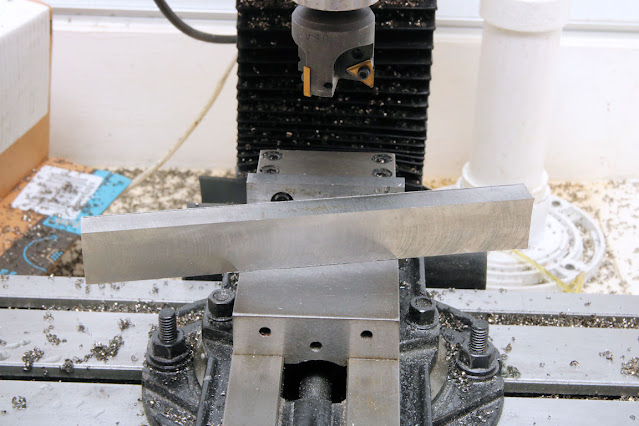
I could run that through my CAM program to make tool paths to cut it and I'm sure it would do that, but those flat faces would be full of stair steps.  If I was doing this manually, I think I'd put the raw stock on a sine bar so that I just cut the part sticking up away.  Since I don't have a sine bar, I used the concept behind the sine bar while doing the CNC conversion to my mill and showed the setup here. 

This piece has a smaller square that had one side cut off already screwed to it, but note the bigger rectangle that the square piece is attached to.  With that piece tilted 16 degrees up, the blue Sharpie mark on the right is parallel to the table, and "all you gotta do" is make a straight cut along that line to cut the back piece to the angle.  In this case, the mill was fully manual and I just turned the X-axis crank to cut it.  I cut most of the rough stock off on the bandsaw, leaving the mill just to get the final surface. 

I could put this blank at an angle like that, one side on the table (or on a spacer as in the photo) the other clamped in the vise, and just enter CNC moves of the X axis.

In addition to those two angled faces, there's a recessed area on the bottom of the drawing (see the dimensioned drawing).  Those things are the puzzles in this part.  The marked radius on the recessed portion, 0.313" is 5/16", which means it gets cut with something that has diameter of twice 5/16 or 5/8".  I don't have a way to cut a 2" deep hole that's 5/8" diameter.  I could get a ball end cutter and cut this on the bottom of the piece along the 2" dimension, but without checking, I'm betting a 5/8" diameter ball end mill is more $$ than I would prefer to spend.  On the other hand, it's not an important surface; it's never seen during use.  This is a place where stair steps on a cut approximated by the CAM program wouldn't bother me.  Much.  Probably.


Saturday, November 6, 2021

Hubble Space Telescope is Offline Again

You might remember that the Hubble Space Telescope (HST) went into shutdown in June and was inoperable until mid-July before being revived on backup hardware.  The problem was ultimately tracked to a power supply problem in the primary computer and switching to the backup resolved that.

NASA announced Monday that HST's science instruments went down at the end of October and the telescope has been unusable since then.  

The instrument package on the Hubble uses an internal synchronization signal to ensure that everything registers at the same time, allowing instruments to respond to commands in the proper order. On October 23, one of these synchronization signals failed to register, causing all the scientific instruments to enter safe mode. A simple reset of the instruments got everything working again.

But on October 25, the scientific instruments registered the loss of multiple synchronization signals, and all of them re-entered safe mode. Given the repeat and apparent escalating nature of the problem, NASA has left the instruments in that state since.

The HST's own web site contains a little more information, just adding a few details.   

Over the weekend of Oct. 30, the team prepared to turn on parts of the Near Infrared Camera and Multi Object Spectrometer (NICMOS) instrument to collect data on this issue, allowing the team to determine how frequently this problem occurs. Installed in 1997, NICMOS has been inactive since 2010, when the Wide Field Camera 3 became operational. NICMOS allowed the team to use an instrument to collect information on these lost messages while keeping the active instruments off as a safety precaution. Since NICMOS was recovered on Nov. 1, no additional synchronization messages have been lost.

The team is now taking steps to recover Hubble’s Advanced Camera for Surveys (ACS) instrument from safe mode and start collecting science with that instrument at the beginning of next week. The team will make the decision on Sunday after analyzing the latest data. If a lost message is seen before then, the decision to activate ACS will also be revisited. The team is proceeding cautiously to ensure the safety of the instruments and avoid additional stresses on the hardware. Therefore, only ACS will be used in this capacity next week. ACS was selected as the first instrument to recover as it faces the fewest complications should a lost message occur.

That appears to be the extent of what's known at this time.  The Hubblesite.org website contains a link to a NASA site, which links back to the same article on Hubblesite.  

Let's be honest.  I'm just guessing, but Hubble has been in space 31 years and all electronic components are going to age and eventually stop working.  It gets a bit worse because space is such a hostile environment.  Components on spacecraft need to be rated for the radiation they're exposed to in orbit and radiation degrades some types of parts more and more quickly than others.  


Friday, November 5, 2021

Space News Roundup - Little Pieces

After a schedule slip from early Halloween morning due to weather down range, the crew rotation Crew-3 flight to the International Space Station was rescheduled for Wednesday night, November 3rd.  Before Wednesday, though, the mission was delayed again due to a "minor medical issue" (unspecified) with one of the crew.  The mission was rescheduled on Saturday, Nov 6, for Saturday night, Nov 6th, at 11:36 PM EDT.  Monday night Nov. 8 at 9:51 p.m. EST (0251 GMT on 9th).
SpaceX live coverage will start about 4 hours earlier.  


SpaceX has won a contract to launch the (regrettably-named) Skynet military satellites for the United Kingdom.  

Instead of a self-aware, apocalyptic AI, though, “Skynet” refers to the United Kingdom’s planned Skynet 6A spacecraft – part of a family of military communications satellites that far predate their science fiction namesake. It will be the 15th such satellite launched since 1969 when Falcon 9 carries it to a geostationary transfer orbit as early as 2025, beginning a ~$700 million transition to a new network architecture with upgraded ground systems and a different satellite contractor.

On a more serious note as you saw there, the Skynet satellites have been a UK Military program since 1969.  Although they could have come back from the future to plant that story so we don't get upset from the use of the same name in the documentary on Skynet.  The part of this announcement that caught my eye was that it contained an endorsement of SpaceX by a part of the European Space Agency. [BOLD Added: SiG]

UK @DefenceHQ's Skynet 6A satellite will be launched into GEO orbit in 2025 by a @SpaceXFalcon 9 rocket, UK MoD said at @SMi_Group @GlobalMilSatCom. Decision based on value for money & schedule credibility, prime contractor @AirbusSpace said. pic.twitter.com/NJtwISsKit

Based on value for the money and schedule credibility?  I assume that decision involved pitting SpaceX vs. an Ariane booster.  Hmmm.


The next SpaceX launch from Vandenberg Air Force Base will be carrying a NASA Satellite called DART, Double Asteroid Redirect Test.  This is an interesting mission for the science geeks, not to mention anyone who enjoyed the documentaries about teams redirecting space rocks bound for Earth.  Documentaries like Armageddon or Deep Impact.

DART will crash into a small asteroid 6.5 million miles from Earth and measure the effect on its motion. Tune in: https://t.co/gtbo67VJIz pic.twitter.com/daxLGhGAVR— NASA (@NASA) November 3, 2021

The mission is currently scheduled for 10:20 pm PST, Nov 23 (05:20 UTC, Weds., Nov 24), which is the day before Thanksgiving.  The mission will launch on Falcon 9 Booster 1063 on its third mission; while it's very possible that with the small size of the DART satellite that B1063 could do a Return To Launch Site (RTLS) landing on Vandenberg, the current plans are for it to land on the drone ship Of Course I Still Love You.  DART will be the first interplanetary NASA payload launched on a flight-proven commercial rocket and Falcon 9’s first interplanetary launch.  


The work at Boca Chica is nonstop, but road closures this week were all postponed so no testing was done.  The next closures are set for Monday, 11/8, with backup days of  11/9 and 11/10, followed by a second set with Primary on 11/11 with backups of 11/12 and 11/15 (Monday).  

They are filling the fuel storage tanks at the Launch complex and signs continue to point toward static firing and other rocket tests soon. 

EDIT Nov. 6, 2021 at 1615 EDT: to update launch schedule of Crew-3 mission, bottom of the first paragraph.


Thursday, November 4, 2021

Federal Court Agrees With NASA, Tosses Blue Origin Suit

Word got out today that the US Court of Federal Claims backed NASA's previous judgement that they violated no laws or requirements by awarding the Human Landing System (HLS) contract to SpaceX and only choosing one contractor instead of two.  

The decision wording is rather terse and Eric Ralph at Teslarati voices the opinion that it will probably be a few weeks before more details come out, but Jeff Foust (first link, above) posts the document as of this morning. 

Ralph adds:

The ruling ends almost seven months of delays explicitly caused by protests and lawsuits filed by competitors Dynetics and Blue Origin. Protests were first filed with the US Government Accountability Office (GAO) about a week after NASA announced in April 2021 that SpaceX would build the Human Landing System. Both protests were denied in July but Blue Origin ultimately chose to double down and filed a lawsuit against NASA and SpaceX in August, kicking off a process guaranteed to cause several more months of delays.

Not just “guaranteed to cause several more months,” it already had stopped work on the HLS system for the Artemis program.  They responded today on twitter that they're going to resume as soon as possible. 

The biggest surprise in this whole episode is that Jeff Bezos tweeted a couple of hours later:

Not the decision we wanted, but we respect the court’s judgment, and wish full success for NASA and SpaceX on the contract.

There's an implication there that the lawsuits are ending and maybe NASA and SpaceX can get on with their spacecraft development.  The Artemis program's mission statement (my name, not theirs), “With #Artemis, @NASA will land the first woman and first person of color on the Moon.”  makes me cringe, but it's time to cut the bullshit and get back to designing and testing vehicles. 


Wednesday, November 3, 2021

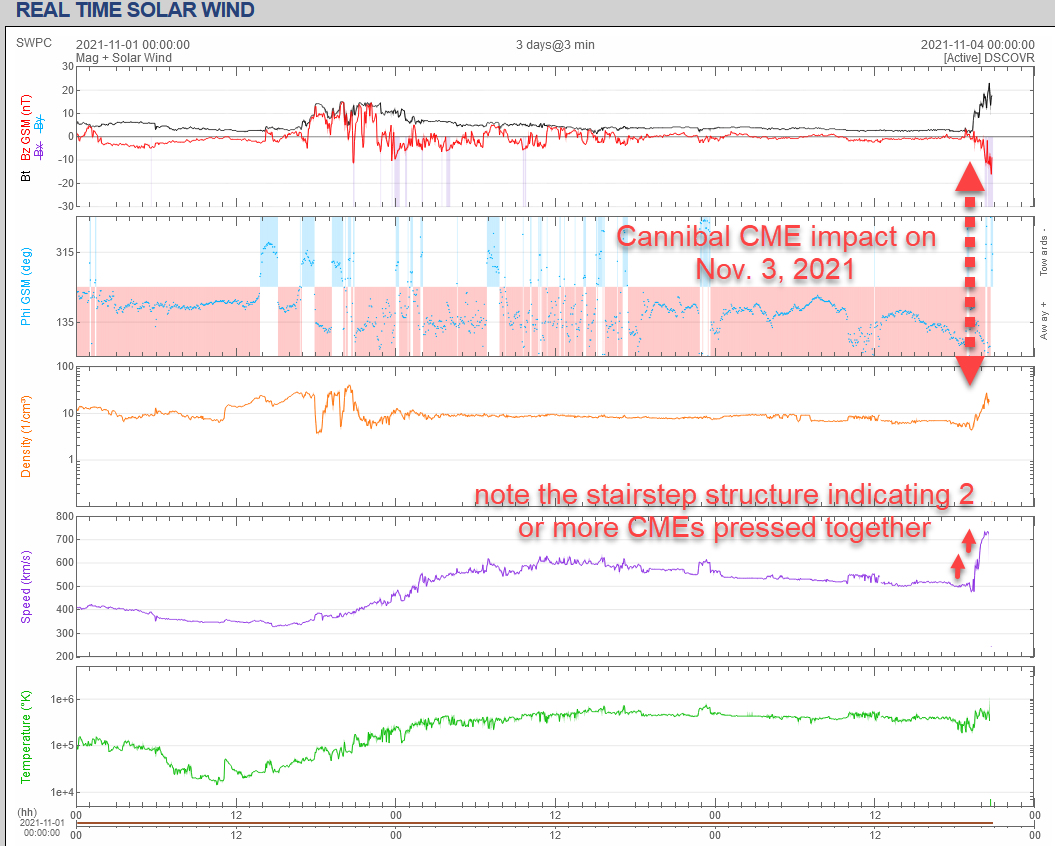
We're Having a "Cannibal CME" Solar Storm

I've been aware of and watching solar Coronal Mass Ejections for years, but something I've never heard of, called a "Cannibal CME," arrived late on November 3rd Coordinated Universal Time (UTC) according to SpaceWeather.com.  20:00 hours UTC is 4:00 PM EDT.  It kicked off a geomagnetic storm.

CME IMPACT SPARKS STRONG GEOMAGNETIC STORM: A cannibal CME, described below, hit Earth's magnetic field on Nov. 3rd at approximately 20:00 UT. Solar wind data from the DSCOVR spacecraft show a stairstep structure indicative of two or more CMEs pressed together. A strong G3-class geomagnetic storm is underway now.

The clue to what exactly a cannibal CME is can be found in that line about the DSCOVR spacecraft.  A cannibal CME is the second CME after a first ejection that travels faster than the first and slams into it, enlarging the mass in the ejection.  The resulting mix of CMEs contains tangled magnetic fields and compressed plasmas that can do a good job sparking geomagnetic storms.  The graph they're referring to in that paragraph is this:

Cycle 25 has been off to a faster and stronger start than predicted, and activity is above the predicted levels, which can be seen here. 

The current (21:00 EDT November 3rd; also called 0100 UTC November 4th) solar-terrestrial indices are Solar Flux Index 94.  A index 21 and K index 7.  The sunspot number is 42.  The A and K indices show that a solar storm is taking place, and it's rated at G3.  That's not a particularly dangerous storm down here on the surface of the planet, although it can affect satellites.  Solar Flares are rated by an alphabetical scale, with the lowest intensity flares rated A1 and the as intensity goes up, they go through A2 to A10 before becoming B1 flares.  The pattern repeats through B, and then C before progressing to M level flares.  Finally, as M is used up, we get to X class flares.  The flare behind this CME was a low M class flare: M1.7. 

These solar flares and mass ejections are not very intense and only people who are playing in the HF radio spectrum (or using it professionally) are likely to notice anything.  The auroral oval hasn't come far south in the country.  Once or twice in a strong solar cycle, a flare might happen that will cause aurora displays as far south as Florida.  To get auroras into the deep south requires X9 flares or stronger and they have to point directly at the planet.  That's a rare combination and I'm aware of only once in my life that auroras were visible into Florida.  

The wild card in that assessment of impact is that Earth's magnetic field is going through some changes.  The magnetic field protects us from some of the energetic particles a mass ejection throws into space.  If the field is weakening, that will affect what gets through.  

The bright spot almost exactly in the middle of the sun is the November 2nd CME that started this. 


Tuesday, November 2, 2021

From Better Than Average to the Worst Tax Rate - Thanks, Brandon

Yesterday, the Tax Foundation published an analysis of personal tax rates under the latest Democratic plan.  The US goes from the low-middle of the group, better than average, to the worst income tax rate in the world. 

Under the latest iteration of the House Build Back Better Act (BBBA), the average top tax rate on personal income would reach 57.4 percent, giving the U.S. the highest rate in the Organisation for Economic Co-operation and Development (OECD). All 50 states plus the District of Colombia would have top tax rates on personal income exceeding 50 percent.

They publish this list of maximum income tax rates in OECD.  The US would go from 16th lowest (best) to the worst income tax rate. 


They explain:

High-income taxpayers would face a surcharge on modified adjusted gross income (MAGI), defined as adjusted gross income less investment interest expense. The surcharge would equal 5 percent on MAGI in excess of $10 million plus 3 percent on MAGI above $25 million, for a total surcharge of 8 percent. The plan would also redefine the tax base to which the 3.8 percent net investment income tax (NIIT) applies to include the “active” part of pass-through income—all taxable income above $400,000 (single filer) or $500,000 (joint filer) would be subject to tax of 3.8 percent due to the combination of NIIT and Medicare taxes. Under current law, the top marginal tax rate on ordinary income is scheduled to increase from 37 percent to 39.6 percent starting in 2026. Overall, the top marginal tax rate on personal income at the federal level would rise to 51.4 percent.

Their cited top tax rate of 57.4% includes Federal, State and Local income taxes.  In the states that have income taxes, the average top marginal state-local tax rate is 6.0 %.  That 6% is added to 51.4% they quote in the above paragraph giving that 57.4 % percent.  There are eight states that don't have an income tax, and the top income tax in our states would be that 51.4%.  Feel good if you want, but it's still higher than all but the 10 worst tax rates in the civilized world.

This assumes the deduction for state and local taxes remains capped.  If that cap were to be removed, the top income tax rate would fall to 54%. 


You might have heard about the US pushing on the rest of the world to establish a minimum tax on businesses.  The reason for that move is that they intend to push those taxes in the US and they don't want US businesses to move to other countries for the lower tax rates.  I can hardly think of an easier sell than telling a bunch of other countries, "let's all raise taxes."  If another country wants to lure American businesses there, I'm sure there are plenty of other incentives they can dangle. 

Further, this analysis doesn't include the worst tax I've heard of, the "wealth tax" that would charge taxes on income that hasn't been paid.  Since we don't have text of a passed bill, I'm not going to look up the details that might change.  Plus, since it's not actually income and hasn't been earned or paid, it's doubtful that such a tax is constitutional.  That said, the idea is that most of the on-paper wealth of the billionaires they detest so much (but whose money they want so much) is in stocks they own.  The tax will be based on their stock shares having gone up in value, even if the owner hasn't sold any shares and made no income.  Details like how the value of those unsold stocks is to be determined - or (most likely, IMO) on what date the stock value will be assessed - aren't available.  Nor has anyone said if the stocks go down in value if those billionaires will be reimbursed. 

This last one reeks of the absurdly childish view the Stupid Party voices all the time that billionaires are Scrooge McDuck, swimming and playing in vast piles of gold coins, gems, and other material wealth.


Monday, November 1, 2021

Weekly Update on the 1 by 1 - Part 12

As I mentioned yesterday, I've completed the crankshaft for the 1 by 1.  A little "pose for pictures" time.

Those counterweights, the first pieces I made, are just sitting where they'll be mounted.  I don't have any #5-40 hardware to mount them, but I do have a tap that I bought while building my Duclos flame eater engine so I tapped the holes as designed.  A smaller #4-40 screw goes into the hole, showing they line up.

Before this, I had to turn both sides to the proper diameter (rough turning here), cut to length and trim the rectangular sections of the crank to proper size (0.500 by 1.000).  I've come to call those rectangular pieces the crankshaft cheeks although they say the word can be webs, cheeks or arms.  Cutting to diameter and length were fiddly operations done slowly and gingerly, and then it was time to try to cut the major remaining feature, a keyway exactly on the top of the long side (left in the above shot).  

The tricky part was how to support the work and hold it so that it would take the cutting forces, while being perfectly parallel to the mill's table.  I first thought of just putting mill parallels (something like this) under the shaft while putting the base of the left crankshaft cheek on the reference surface of the vise.

That was a dopey idea.  The parallels don't hold position well enough and there's nothing resisting movement to the side from cutting forces.  After some thought, I decided to make a fixture that uses the exact dimensions of the cheek that would hold the shaft the same distance off the vise base as the one highlighted here.  This was an hour or so of work on a piece of scrap aluminum I had.  

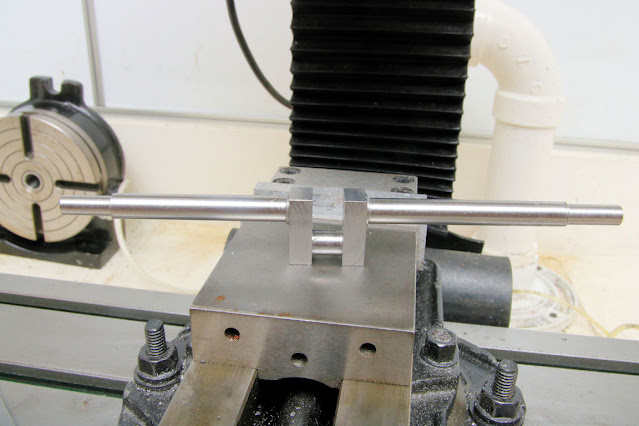
The tool is on the left, and I made it so that the shaft either slides in from the end or snaps into place.  The setup was to put the new fixture on the left base of the vise and the left cheek on the right base.  Then I verify X, Y and Z are zeroed properly, and cut left to right.  I used a 1/16" wide end mill spinning as fast as my mill can spin it (~2200 RPM), but still only cutting at 1 Inch Per Minute (IPM) in three .018" deep passes. The keyway, though, needs to be 3/32 wide, which is 1/32 wider than 1/16, or 1/64 (.0156") on each side of the keyway.  So I moved the mill table 1/64 on both sides and cut two full vertical depth, .0156 off-the-side passes.  That didn't quite fit a 3/32 drill bit that I tried, so I moved both edges out another .0005" (.001" total width change) and that fit fine. 

The keyway is more visible in this view than the top picture. 

Once that was cut, it was pretty routine to tap the two #5-40 holes you can see, and it's done.  Actually, it's not quite done.  There's still some epoxy on the bearing surface that the piston rides on, from when I epoxied a piece into the gap opposite the journal bearing, between the crankshaft cheeks.  That's to keep the pressure from the lathe centering points from bending the shaft.  I think I can soak that in acetone for a while and then peel it off.

The crankshaft is bound for the finished parts box.  Lots of new things learned, one damaged (but recovering well) finger, and surprisingly little (zero) scrap.  There are 47 pdf files in the document package and it seems that that I've completed four of them.  By ordering a raw flywheel casting made of cast iron, I've eliminated at least one drawing but added things I'll need to either figure out separately, resurrect out of that eliminated drawing, or something.  

First, though, I need to give my big lathe a tuneup.  A few times while working this part, it seemed like it wasn't quite right at a few things.

Speaking of the damaged finger, I saw the surgeon today for a followup and she discharged me.  No followup needed - it's coming along as best as could be hoped for.  She said something like, "if you want, drop by in about a year and show us how it ended up."


Sunday, October 31, 2021

Post #4000

Over the course of the last week, some of you may have noticed a number at the bottom of every post.  I've put that there not so much for you but to remind me of the countdown to post 4000. 

This is it, and I don't have much to say except thank you to my regular readers and to everyone who stops by.  Since Blogger tells us the number of the post, I've known this has been coming for quite a while, and back over the summer I estimated it would be around now.  You regular readers will have noticed I tend to put up one post a day, so a thousand posts takes about three years.  By that, 4000 takes about 12 years, and my 12th blogiversary will be in February, so I'm ahead of schedule. 

Last Sunday, I said I thought I'd finish the crankshaft for my 1 by 1 engine.  I ended up finishing that today.  After slowly trimming both sides to their proper lengths, I had to make a single purpose tool to help stabilize it for the last operation, and that added a few hours.  That's a story for another day. 

For now...

4000

Make that 

Yeah, that's trying to make it outrageous.


Saturday, October 30, 2021

It's Starting to Look Like More Testing Coming in Boca Chica

If you've been watching the daily or 24/7 feeds and news reports from SpaceX Starbase at Boca Chica, you'll have heard some of this.  Bottom line, like the headline, it's starting to look like the emphasis at Boca Chica is going to get back to testing their orbital Starship and Super Heavy.  It's looking like it could be starting this week.  

One of the bigger items in the news feeds this week is that the giant crane on lease for the last few months, the one the Lab Padre people nicknamed Kong, is apparently being decommissioned and returned to whomever they leased it from.  That's another signal that the major heavy lifting to complete the launch complex is over.  My first mention of Kong appears to have been May 21 of '21.

Teslarati's Eric Ralph talks about the various things that have been going on with both Booster 4 and Starship 20 while the work around the launch complex dominated the schedules.

B4 has had several Raptors removed and replaced.  Of course, we don't know why.  

Aside from removing around a third to half of Super Heavy’s 29 Raptors, SpaceX also began slowly but surely installing parts of a steel heatshield designed to protect those engines during ground testing, ascent, and reentry. Newer Raptors have also been trickling from Starbase’s build site to the launch pad for installation on the booster and more engines will likely be (re)installed as heatshield installation progresses.

Perhaps the most unusual part of recent Super Heavy B4 work is the apparent application of some kind of foam around several racks of pressure vessels (COPVs), hydraulic manifolds, and umbilical connections installed around the booster’s base. Those racks will eventually be enclosed inside steel ‘aerocovers’ already staged beside Super Heavy. A number of Twitter users believe that the foam being selectively applied is for acoustic deadening – meant to protect sensitive electronics, valves, and computers from the brutal environment Super Heavy itself will produce at liftoff and during ground testing.

The booster aerocovers are highlighted in the red rectangle at left.  For scale comparison, notice the two concrete mixer trucks just to the left of the top of B4 in this view looking down, from RGV Aerial Photography.

Starship S20 has had less going on than Booster B4; it appears that since the recent static fire tests, they've gone back to the full complement of three sea-level Raptor Center (RC) engines and three Raptor vacuum (Rvac) engines.  

Barely a full day after that successful back-to-back static fire test, SpaceX rolled two more sea-level Raptors to the suborbital pad and installed them on Ship 20. Another unusual week of downtime later and, on October 28th, SpaceX has rolled two more Raptor Vacuum engines from the build site to the launch pad and staged them beside Starship. Once installed, Starship S20 will, for the second time, be fully outfitted with six Raptors. Having already fired up two of those engines without needing either replaced, though, there’s a decent chance that all six will actually be used before Ship 20’s next bout of engine removal/installation deja vu.

Base of S20 back in August, the first time it had all six engines installed.  Elon Musk photo.

There are things to be tested here that have never been tested before.  For openers, no Starship has been tested with all six engines.  In real life, they aren't used together since the Rvacs are optimized for operation in a vacuum (or close) while the Rc engines are optimized for nearly sea level.  The Rvacs will be used when the booster drops away and the upper stage is working toward orbit; the Rc engines will be used for the Starship's landing.  They can test all six, though, since they're ensuring all the plumbing, valves and all that hardware is actually working.   

Beyond that, the booster will have 29 Rc engines.  They've never lit that many engines at one time.  SpaceX hasn't even performed a full Super Heavy wet dress rehearsal (WDR; filling the booster's tanks and performing a launch countdown) or fire up more than three Raptors on a booster or ship prototype. 

Right now, the only road closure scheduled on the Cameron County website is for most of the day Monday.  I think that's probably to move Kong the crane back to the shipyard area.  When they issue an over pressure notice, that's when there's a good chance it's going to get interesting. 


3999

Friday, October 29, 2021

NASA: Cut SLS Costs by 50% and We'll Use It 'Till 2050

According to a document found by Ars Technica, NASA has asked the industry for ideas on how to go about "maximizing the long-term efficiency and sustainability" of the Space Launch System (SLS) - both the rocket and its ground systems.  This was not directed just at prime contractor Boeing, but at any company in the industry.

The request, which appears on the SAM.gov website in the form of a Request For Information (RFI), opens with the following explanation. 

The National Aeronautics and Space Administration (NASA) invites industry to submit responses to this Request for Information (RFI) to assist NASA in maximizing the long term efficiency and sustainability of the Exploration Systems Development (ESD) programs, including the Space Launch System (SLS),  Exploration Ground Systems (EGS) and Cross-Program Systems Integration (CSI) office by minimizing production, operations, and maintenance costs.  NASA will use the information received from this RFI on a non-attribution basis for informing future acquisition(s) to address this challenge.

NASA says it sees itself as the "anchor tenant" of the system, and says they see themselves procuring one manned flight per year, which doesn't strike me as much of a pace of operations.  They then say industry will "market" the large launch vehicle to other customers, including the science community and other government and non-government entities.  

NASA says it wants to transition ownership of rocket production and ground services to the private industry. In return, this private contractor should build and launch the SLS at a substantial savings of 50 percent or more off of the current industry "baseline per flight cost."

The problem for us observers is that NASA has never published what that baseline cost is.  We have seen some figures that imply that the cost would have to be over $1 billion per launch and possibly well over.  In May of 2020, we found out that the first stage engines would cost $146 million per engine, so nearly $600 million ($584 m) for just the four engines of the booster core.  That doesn't count the solid rocket boosters, the upper stage(s) or anything else.  I don't think they could put the rest together for under $1 billion.

Ars asked the NASA communications office on Tuesday for this figure, but as of Wednesday morning there has been no response. In 2019, the White House Office of Management and Budget estimated the cost of one SLS launch a year at "over $2 billion." Subsequently NASA did not deny that figure, but it has not been transparent with taxpayers about the rocket's expected costs.

There's an ironic story here.  The SLS was first started as a make-work program in 2011 for companies from the Shuttle era, partly architected and pushed by Florida Senator (at the time) Bill Nelson.  He proudly announced the SLS would be delivered on time and under budget.

“This rocket is coming in at the cost of... not only what we estimated in the NASA Authorization act, but less,” Nelson said at the time. “The cost of the rocket over a five- to six-year period in the NASA authorization bill was to be no more than $11.5 billion. This costs $10 billion for the rocket.” Later, he went further, saying, "If we can't do a rocket for $11.5 billion, we ought to close up shop."

As most of you know, a decade latter Bill Nelson is the NASA administrator, he's still pushing the SLS, the rocket still hasn't flown, its first flight has slipped yet again to 2022, and while they've gotten farther in the last year than at any time before now, the cost is over $30 billion so far.  If not being able to "do a rocket for $11.5 billion" is a clue for being time to close up shop, not being able to do it for $30 billion should lead to the doors being nailed shut and the shop razed.

It's arguable that the SLS is a relic of the Apollo age; put it all up in one giant stack.  It makes me wonder about the prospects of using SLS until 2050 as parts go obsolete and impossible to get.  Virtually all of the new space companies are moving in the direction of reusability.  SpaceX has obviously led this effort, but other launch companies, including Blue Origin, United Launch Alliance, Rocket Lab, Relativity Space, and others, are all working on reusable hardware. The European, Chinese, Japanese, and Russian space industries are as well. After reusable boosters come refuelable upper stages, tug "boats" in space, and in-space assembly.  All of those can be launched into orbit on smaller and more affordable rockets.  

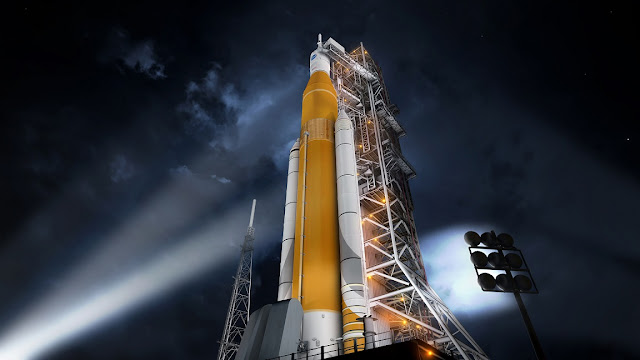
NASA Artist's Concept of SLS.

NASA will hold a virtual "industry day" on its SLS request on November 10 and desires responses from industry by January 27, 2022.


3998

Wednesday, October 27, 2021

The New Competitors in the Private Space Station Sector

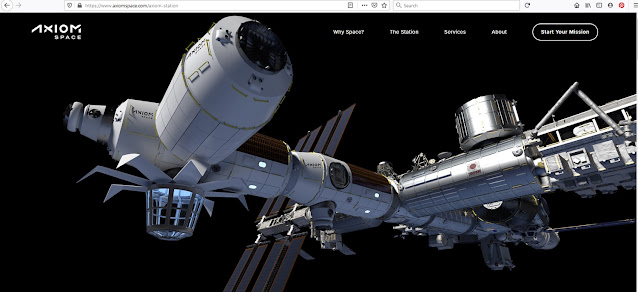
Over the course of this blog, I've run a few pieces on a small company with big dreams.  The company is Axiom Space and their dream is a privately funded and operated space station.  The plans to get to that goal include sending private crews to the ISS as part of training, with the launch services provided and vehicles under contract from SpaceX.   That mission, Axiom 1 or AX-1, is currently "penciled in" on the Spaceflight Now Launch Schedule for February 21, 2022.  That's less than four months from now.

Axiom's vision of their own space station.  Older articles talk about them launching a lab that can be docked to the ISS and provide facilities for the private astronauts they want to put up there.  The current website implies that "Axiom Hub One" (crew quarters, + research and manufacturing capability) appears to be what they want to launch first to get their own station started.  

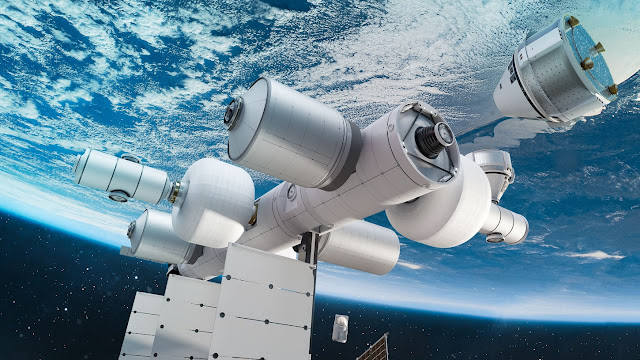
This week, the competitive field grew with an announcement from Blue Origin about an effort in cooperation with a group of other companies and academic experts to put up a private space station for business and travel, research and tourism, with a goal of starting operation in the second half of this decade.  

Blue Origin and Sierra Space today announced plans for Orbital Reef, a commercially developed, owned, and operated space station to be built in low Earth orbit. The station will open the next chapter of human space exploration and development by facilitating the growth of a vibrant ecosystem and business model for the future. Orbital Reef is backed by space industry leaders and teammates including Boeing, Redwire Space, Genesis Engineering Solutions, and Arizona State University.

Designed to open multiple new markets in space, Orbital Reef will provide anyone with the opportunity to establish their own address on orbit. This unique destination will offer research, industrial, international, and commercial customers the cost competitive end-to-end services they need including space transportation and logistics, space habitation, equipment accommodation, and operations including onboard crew. The station will start operating in the second half of this decade.

Sierra Space is an offshoot of Sierra Nevada Corporation, one of the companies vying for the Human Landing System contract, but not then partnered with Blue Origin.  Redwire Space is a bit tough to summarize.  Officially, they're a young company; according to that source, they were formed in June of '20, and they just went public with a stock Initial Public Offering in September, but their website shows they've already worked on the recently-launched probe to the Jovian Lagrange points, Lucy, and a wide variety of other important satellites that required that work as much as nearly 30 years ago.  Genesis Engineering Solutions appears to be a solid player in the satellite contract engineering area.  Boeing is ... unfortunately, at this point in time ... Boeing, the company that can't get a much simpler space capsule than this space station running properly.

Blue Origin's Concept Sketch of the Orbital Reef Space Station. 

I have to say when I first heard of this, I thought, "Yeah. Right - the rocket company that can't make orbit is going to build a space station." That was before I looked up the web page for the project and Blue's announcement.  Blue Origin and Boeing getting together and agreeing to put up a private space station means the company that can't get a rocket (New Glenn) into orbit and the company that can't get a capsule working right (Starfire) or a different rocket into orbit (SLS) are working together.  

Blue and Boeing together saying they're going to do something like this isn't much more of an indicator of future success than any dozen of us blog readers getting together and saying that we'll put up a space station.  Except for their billions of dollars of funding, fresh from between the sofa cushions in Jeff Bezos' house.

Is that harsh?  Sorry.  Space is a harsh place.  Boeing used to know how to do this stuff.  The justification used to be, "yeah, Boeing will charge more than some others, but their stuff will work."  I think it's possible to get that back, but they need to really step up their game.   


3997

Tuesday, October 26, 2021

Early Halloween Morning Launch Coming

Early Halloween morning for the Eastern and Central time zones, Saturday night for points west, SpaceX will launch the next manned Crew Dragon capsule for NASA.   

Known as Crew-3, the mission – SpaceX and NASA’s third operational astronaut launch and second ‘crew rotation’ – is scheduled to launch as early as 2:21 am EDT (06:21 UTC) on Halloween (Sunday, October 31st) after a minor one-day delay.

The capsule will be carrying a crew of four: Thomas Marshburn (NASA), Raja Chari (NASA), Kayla Barron (NASA), and Matthias Maurer (ESA).  The Crew-3 mission astronauts will relieve the Crew-2 astronauts Shane Kimbrough, Megan McArthur, Akihiko Hoshide, and Thomas Pesquet, allowing them to return to Earth after some six and a half months in orbit.  After some time together on the ISS.  

Their Crew Dragon capsule, named Endurance for this mission by the crew, arrived at launch complex 39A on the Kennedy Space Center on the 24th and a Flight Readiness Review was held Monday the 25th. 

In a media briefing following a successful October 25th flight readiness review (FRR), SpaceX and NASA officials revealed that the only ‘open item’ (the only issue left unsolved) for Crew-3 was the qualification of a change… to Crew Dragon’s toilet. During SpaceX’s highly successful Inspiration4 mission in September 2021, Dragon performed flawlessly except for a small issue discovered with its last-resort toilet. According to the briefing, in less than a month and incurring what amounts to zero delays to Crew-3, SpaceX analyzed the Inspiration4 spacecraft, determined the fault (a leaky storage tank), redesigned said tank, and replaced the new spacecraft’s faulty toilet with the fixed design.

It's considered an open item because SpaceX and NASA are still finalizing the studies and documentation needed to qualify the design change.  Anyone who has worked in this industry is probably wincing at the idea.  Neither of the two seems to think it's anything that would delay the mission. 

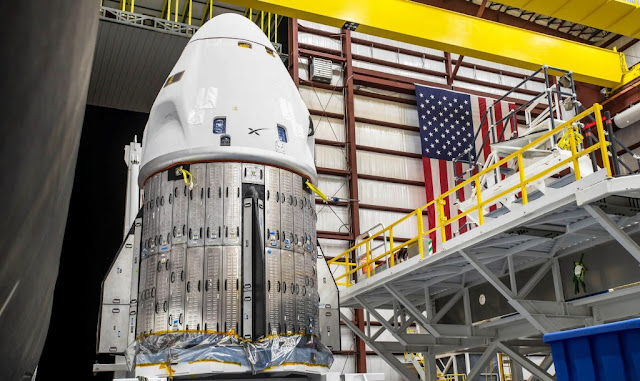
The capsule at the Pad 39A test area.

SpaceX photo. 

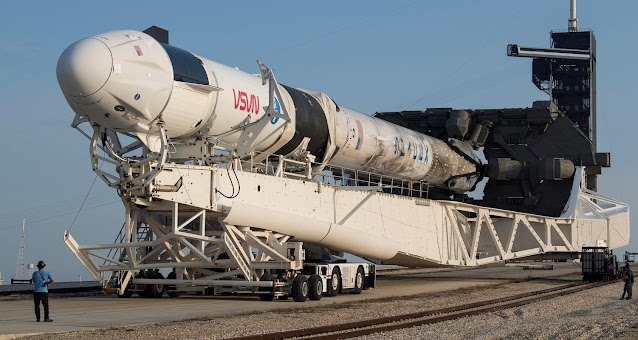
There are lots of tests to be done before the launch, and one of the first steps will be to roll the vehicle to the launch pad; something that's done with the vehicle horizontal on the transporter, like this photo of the Crew-2 mission's capsule last April. That will probably happen tomorrow.  They will do a dress rehearsal countdown with a firing of the first stage engines, and many tests that can't be seen from a distance.

Photo credit: NASA/Aubrey Gemignani

An interesting little aspect of this mission is that Crew-3 will be Falcon 9 booster B1067’s second Dragon launch and second launch overall after a successful Cargo Dragon launch debut in June 2021.  I don't think it's a reach to say this is the only booster to fly both manned and unmanned spacecraft to the ISS. 


3996

Monday, October 25, 2021

Dune

Yeah.  Me, too.  

Mrs. Graybeard and I went to see the new version of Dune today at the local 10-plex.  As is usually the case, it was a Monday matinee and there were six of us in the theater.  The movie essentially set the hook in me within the first few minutes.  Visually stunning, excellent CGI and sets; it's getting so hard to know where one stops and the other starts these days.  I don't throw around the word masterpiece everyday, and I hesitate to use it here, but the book's story arc is epic and the screen does it justice.

Let me stop for a minute to talk about the books.  I read the first three-book series around 1979 to '80, so an early to mid-20s guy learning about working for a living.  A friend recommended them as an allegory for the middle east, with oil being replaced by the spice melange, "the most valuable substance in the galaxy," and the Fremen on Dune replacing the problems with militant Islamists starting to show up for the first time.  I read the second three books a bit later and I'm hazier on the dates.  I think it was around 1990 or the early '90s. To better understand the second three, I reread the first three as well.  To some degree.  I simply don't remember enough of the details. 

I also saw the 1984 version of the movie, with Kyle MacLachlan as Paul Atreides, Sean Young as Chani the Fremen girl, Patrick Stewart and Sting.  I thought it did a reasonably good portrayal of the book story arc, but it's such a big arc. 

Because of how long it has been since I've read the books, I can't tell you much about how faithfully this new version follows the story arc; all I can tell you is I recognized virtually every scene in the movie from the book and knew what the scene was about.  All of the characters that are mentioned I can recall from the books, even those that have minor roles in the books.

This version is the mental offspring of director Denis Villeneuve, and while he has a long list of work there on IMDB, the only one I'm sure I've seen was Blade Runner 2049, from back in '17, and I find I wrote about that possibly being the most visually stunning movie I'd ever seen.  The movie includes many familiar faces from other movies I've seen and it was fun to see them play different roles.  Chani is played by actress Zendaya, who I've seen in the Marvel Universe in the most recent Spiderman movies; The Beast Rabban Harkonnan is played by Dave Bautista of the Guardians of the Galaxy movies; Duncan Idaho (one of my favorite characters in the books) is played by Jason Mamoa of the Aquaman movies; Duke Leto Atreides is played by Oscar Issac from the last three Star Wars movies; and finally Baron Vladimir Harkonnen is played by Stellan SkarsgÃ¥rd from the first three Thor movies.  I shouldn't say "finally" - there are more.

The title screen said, "part one" and IMDB is telling me that part two is in "pre-production."  Unless they did lots more shooting while they had everyone on location, I read that to think the theatrical release would have to be more than a year out.  

Left to right, Duncan Idaho (Jason Mamoa), Gurney Halleck (Josh Brolin), Duke Leto Atreides (Oscar Issac), Paul Atreides (Timothe'e Chalamet), Lady Jessica Atreides (Rebecca Ferguson), Stilgar (Javier Bardem), and Chani (Zendaya). 

It's a two and half hour movie, and that's setup for at least one more movie, possibly two. 


3995

Sunday, October 24, 2021

Weekly Update on the 1 by 1 - Part 11

I really told myself not to post this until I was sure the crankshaft was done, but since I want to be an Alec Baldwin-free zone and I'm not aware of any space news today, writing about the crankshaft is about all I've got.  

The biggest milestone is that I'm through with turning between centers, the lathe dog and all that.  The final sizes for the sides of the counterweight holders are done.  The remaining operations are to cut the keyway on the long shaft side, cut both sides to finished length, and drill and tap holes for the mounting screws that hold the crankshaft counterweights in place. 

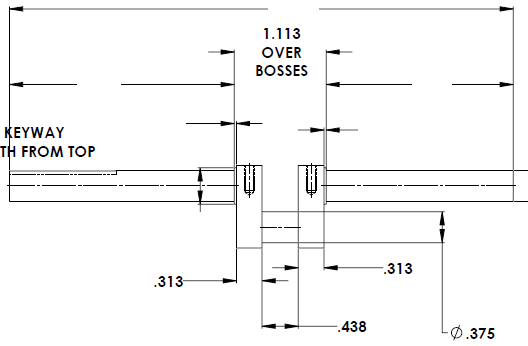
I probably was too zealous in editing out dimensions in this graphic from a few weeks ago.  But the long side (left) is 2.73" and the short side is 2.27".  The keyway (side view on the left) is 3/32 wide and 1.25 long.  The screw holes are visible at the top middle of each side as hidden line.  The print calls out #5-40 screws, but since I don't have any of those while I have a parts cabinet drawer full of #4-40, chances are that's what they'll get. 

I started here:

(Ackchyually ... I started from a 1-1/4 in diameter round bar and threw away more weight in chips than I kept.  This was after cutting it into a slightly oversized rectangular bar).

Today, it looks like this.

The smaller diameter ends on both sides going to get cut away - they're way beyond the amount that ends up in the part.  They were put on to help position the lathe cutters better than when the bar is constant diameter along the whole length. 

As always, I expect to be able to finish it real soon. 


3994