Tuesday, February 21, 2017

Clues From Deep in the Earth Found in Ancient Pottery

In what appears to be a neat example of detective work, activity in the Earth's magnetic field has been measured with unprecedented accuracy in time, by measuring magnetic particles embedded in nearly 3000 year old pottery.  The paper appears in the Proceedings of the National Academy of Sciences, often known as PNAS, from a team of researchers the majority of whom are at Tel Aviv University in Israel.  A friend sent me this link from NPR, although the story has been picked up fairly widely.
About 3,000 years ago, a potter near Jerusalem made a big jar. It was meant to hold olive oil or wine or something else valuable enough to send to the king as a tax payment. The jar's handles were stamped with a royal seal, and the pot went into the kiln.

Over the next 600 years, despite wars destructive enough to raze cities, potters in the area kept making ceramic tax jars, each one stamped with whatever seal represented the ruler du jour.
So what do ceramic tax jars have to do with knowing the magnetic field?
All those years ago, as potters continued to throw clay, the molten iron that was rotating [in the core] deep below them tugged at tiny bits of magnetic minerals embedded in the potters' clay. As the jars were heated in the kiln and then subsequently cooled, those minerals swiveled and froze into place like tiny compasses, responding to the direction and strength of the Earth's magnetic field at that very moment.  [text added - SiG]
...
Political instability provided another handy recording, because the royal seals stamped onto the jars changed often enough to allow the researchers to narrow down the timing of those magnetic records to windows of about 30 years.

"Instability — or even better, wars and destruction — are the best for us," says Ben-Yosef. (Peaceful transitions are nearly impossible to spot in sedimentary layers, but something like a burned city makes a clearly visible dark line. And the Assyrians had a knack for destroying cities.)
Interesting results come from this research.  To begin with, it correlates with other measurements, since the invention of the magnetometer by the great Carl Friedrich Gauss in 1832, showing that the magnetic field is getting weaker.  The usual estimate is that the field is 10% weaker today than "normal", but this research shows that fluctuations over fairly short periods were seen 3000 years ago.  
When Ben-Yosef and his colleagues studied 67 jar handles spanning from the late 8th century B.C. to the late 2nd century B.C., they found that the Earth's magnetic activity has been a lot choppier than people expected.

For example, the jars indicate that in the late 8th century B.C., the core went a little crazy. The intensity of the magnetic field spiked to about double what it is today.

"It was the strongest it's been, at least in the last 100,000 years, but maybe ever. We call this phenomenon the Iron Age spike," Ben-Yosef says.

Then, it weakened quickly after 732 B.C.E., losing about 30 percent of its intensity in just 30 years.
Importantly, the spike in magnetic activity has been verified elsewhere.  Geologist Steven Forman of Baylor University has also found evidence of a magnetic spike about 3,000 years ago, based on his study of Hall's Cave in Texas.  In Forman's work, though, there were no handy dates stamped on things, and his estimate of "3000 years ago" is less precise than the paper in PNAS.  They probably measure the same event, but without precise measurements in Texas, or some other scale, I don't know how they'd know.

As I wrote last August,
All of our lives, most of us have heard that the Earth is "due" for a North-South magnetic pole reversal with the experts saying the poles have flipped many times and it has been too long since the last flip.  The story I recall hearing was that it took a long time to happen; more like centuries than decades, and certainly outside typical lifespans.  Nowadays, there seems to be some belief that it could happen very quickly; on human timescales.
It's a bit of our gallows humor, but Mrs. Graybeard and I regularly joke that at our ages any membership could be a lifetime membership and any subscription could be a lifetime subscription, so when I see an article saying the poles could reverse "within our lifetimes", I'd like them to be a bit more precise.   Still, it could well be that the process has already started, and might even have been going on throughout our entire lifetimes.  Earth will probably go through a period of magnetic chaos before the poles reach their (more or less) permanent positions and that could well be within the life of people reading this blog.  It's possible there could be more than one of each pole for some time so that a compass would point to two different "norths", making navigation by compass impossible.  Birds and other critters that use magnetic particles in their bodies for navigation will have a hard time, and migratory patterns would be seriously disrupted.

For one view, I'll go back to the original article.
It's counterintuitive, but massive fluctuations like the Iron Age spike, Ben-Yosef says, indicate there's nothing to worry about when it comes to today's weakening magnetic fields. Fluctuation, he says, must be the norm for our planet's magnetic field, not a harbinger of apocalypse.
For counterpoint, I'll slightly modify what I wrote last August
No one alive has ever seen this happen, so everything they think they know comes from looking at old rocks and computer models.  None of these are verified by comparison to an actual, witnessed event.  Whether the TEOTWAKI situations that you'll read about would really happen or not is just as hard to say.  There don't appear to be mass extinctions associated with previous reversals, so it appears life muddled on through somehow.   A technological civilization might require more than just "muddling on somehow", though.  

I'm hoping that with a weakened geomagnetic field, auroras may become visible farther south.  I seriously want to see auroras some day.
 
A jar handle bearing the tax stamp of one of the ancient kingdoms (photo from NPR - image courtesy of Oded Lipschits).  

Monday, February 20, 2017

A Little Diversionary Swing

In double four time.

I've often thought that the big musical instrument manufacturers may make musical instruments, but what they sell are dreams.  I've written sparingly here about my own dive back into guitar, the resumption of an interest interrupted for 20 years.  When I started again in 2010, it had been longer since I played than all the time that I played put together.  While I'm sure I know much more of what I'm doing, the realistic fact is that everyone in my age group is faced with declining abilities in the pure physical aspects of playing, and guitar is an instrument with a lot of physical requirements.  Any of the musicians of our youth will tell you that.  This simply not the time in life to look for new speed and flexibility, although that's no reason not to try.

The companies find themselves in the position of marketing to the dreams of younger players; 20-somethings or teens who have the hunger to play for other people and the drive to ... perhaps ... make something of a mark in that business.  On the other hand, guitar makers sell the most expensive models in their lines to people who play as a hobby, all sorts of professionals who work a daytime job and are doing alright; they just maybe get together with friends once a week.  I'd bet they sell hundreds of "entry level" guitars for every top end model.

What prompts this is an emailed article that I got from Fender.  As an owner of a couple of low end Fender products, they regularly try to tempt me with more.  Today it was centered on one of my favorite musicians, Mark Knopfler, and Dire Straits great first hit, "Sultans of Swing".  Specifically that what made Sultans into the monster song it became was their Stratocaster guitar.
The fingerstyle master originally wrote it on a National Steel guitar in an open tuning, he once explained to Guitar World.

“I thought it was dull, but as soon as I bought my first Strat in 1977, the whole thing changed, though the lyrics remained the same,” he said. “It just came alive as soon as I played it on that ’61 Strat—which remained my main guitar for many years and was basically the only thing I played on the first album—and the new chord changes just presented themselves and fell into place.”

“Sultans of Swing” was initially recorded as a demo in 1977 and soon got some play at BBC Radio. A bidding war amongst record labels ensued, and Dire Straits signed a deal with Phonogram Records, who had them re-record it for their eponymous debut 1978 debut album. “Sultans of Swing” was officially released internationally as a single in January of 1979.


Of course, they're trying to imply that if you, yes you, get a Strat and work hard at it, you can sound like Mark Knopfler.  Chances are, you can't.  But there is a real chance there's some kid out there who is rabidly playing all evening instead of doing his homework that might be "the next Mark Knopfler".  As Mark Knopfler himself said in a BBC interview I saw (but can't remember enough to give you a link) that before Mark Knopfler became Mark Knopfler there were "lots of nights falling asleep with the guitar on my lap".

So now that I've whet your appetite for the real thing, while not the "album version", going almost 11 minutes vs. not quite six, they call this the most famous of the live performances captured on video.


This video has a mere 86 Million views on YouTube. 

Enjoy.


Sunday, February 19, 2017

Bill Gates: Tax the Robots

A quiet little story that ran across the headlines this weekend is Bill Gates saying that robots that take humans' jobs should be taxed.
Right now, the human worker who does, say, $50,000 worth of work in a factory, that income is taxed and you get income tax, social security tax, all those things. If a robot comes in to do the same thing, you’d think that we’d tax the robot at a similar level.

And what the world wants is to take this opportunity to make all the goods and services we have today, and free up labor, let us do a better job of reaching out to the elderly, having smaller class sizes, helping kids with special needs. You know, all of those are things where human empathy and understanding are still very, very unique. And we still deal with an immense shortage of people to help out there.
Now Gates, bless his heart, seems not to understand that social security tax isn't supposed to be part of the general revenue stream (not that congress seems to understand that either), but the idea seems to be a bit of "outside the box" thinking about how we get from where we are to the Star Trek future.  It's rather big-government in its thrust, in the sense that he recognizes it's not really the purview of corporations to worry about the societal disruption of replacing employees with machines. 

A fundamental principle of sane economics is that if you want less of something, you tax it; hence we tax cigarettes, liquor, and people working for a living.  (Wait.. whut?)  Technology has been advancing at an increasing rate all of my life, and now fairly sane people are saying that robots will be taking over just about all jobs in the next 25 years or so.  Raising taxes on robots would undoubtedly dramatically slow down that shift, if not completely shut it down.  Gates doesn't give a mechanism, such as whether it would be a one time tax at purchase or somehow structured to look more like income tax.  Since robots don't earn income (one of the reasons they're attractive), there's no income to tax.  The only income would be a marginal increase in profits the companies might get, if any.  Is he suggesting a corporate tax?  Corporations don't pay tax: they add it to overhead portion of the price they charge.  That's something he should know.

To his credit, Gates seems to be aware that taxing robots would be a disincentive to the expansion of robotics.   
“You ought to be willing to raise the tax level and even slow down the speed” of automation, Gates argues. That’s because the technology and business cases for replacing humans in a wide range of jobs are arriving simultaneously, and it’s important to be able to manage that displacement. “You cross the threshold of job replacement of certain activities all sort of at once,” Gates says, citing warehouse work and driving as some of the job categories that in the next 20 years will have robots doing them.  [Bold added - SiG]
We could get into a reasonable discussion of just what a robot is. For example, I think of my CNC machines as robots in the sense that I program them to do things I might be doing manually, and CNC machining centers have been the mainstay of production machine shops for decades.  They aren't robots in the cute anthropomorphic sense, like we see in the movies or on TV.  It begs the question of what Gates wants to tax.  Pick and place machines that have been building electronics assemblies for 30 years?  The robots car manufacturers have been using since, oh, forever?  What about household appliances, like a washing machine or dishwasher?  There used to be people in society who did laundry by hand, and they were replaced by the home washing machine. 

As I wrote in December, the historical trend of robots vs. employment isn't what most people think.  In general, the number of jobs has gone up with the number of robots, not gone down.  In general, more automation has been a good thing.  My perspective on the much-cited idea that robots will soon be doing everything is that if the math doesn't work, it's not going to happen.  Gates seems to be forcing the world to comply with what he thinks it ought to look like, and I don't think it will work. 
(Asa Mathat at Recode)


Saturday, February 18, 2017

Surprisingly Involved

I've spent pretty much all of yesterday and today modeling the enclosure for my CNC mill in my 3D CAD program, Rhino3D.  There was other work interspersed with it, but not as much as I'd like.

The problem is that the design isn't really documented on the DVD I bought.  There are glimpses here and there and some descriptions, but most of the information is spread between online forums and YouTube videos.  I got the material list from one of the forums and bought the hardware, but other than some rough guidelines, didn't have dimensions to cut anything to.  So it came down to drawing it up and counting hardware.  (There are things in this image besides the mill and enclosure.  It's just like leaving stuff lying on the floor in real life.)
I had the drawing for the wooden chip tray that has been shown here before, and was able to get a CAD model for the extrusion from the place I bought it, Misumi.  After that, it was a lot of calculator work, and design on the fly.

Then it was time to try to find sources for things like the plastic panels.  When I found I couldn't get the corrugated plastic I wanted for the original design with three panels, I changed it over to four panels today. The back panels and two of the side panels, seen in yellow here, will be white plastic.  The smokey/translucent panels will be clear plexiglass.  The four panels on the front are hinged on the ends and in the first seams, which are doubles of the extrusion.  The double extrusion in the middle is where the doors open and close. 

There's still lots to figure out, probably as I'm building it.  The upper rim of the back and sides will have some LED strip lights like these to get some light into the work area.  It's not very well lit in that corner of the shop, so the more light the better.  I'm not quite sure how to hook that up, either, if I want to be able to disconnect them to take off a side panel or something. 

Oh, yeah.  I hear the president was in town today.  Missed seeing or hearing Air Force One, and if I had been sitting in line all day, this would be very different. We were outside waiting for the SpaceX launch when they scrubbed.


Friday, February 17, 2017

Consumer Safety Groups Start to Look at 3D Printers

Ran across an interesting little piece on the user forums for Rhino3D, a link to a story in the American Chemical Society Journal Environmental Science & Technology which looked at emissions from desktop 3D printers.  The story on the Rhino forums was linked by Facto Design.
Anyone who uses a 3-D printer at work or home knows the tell-tale scent of the machine at work, a slightly burnt chemical odor that fades over time. If you're like me, you've long wondered whether you should worry about it. Now, a team of scientists from have published a study proving that yes—there are hazards in 3-D printing in enclosed spaces, especially with certain materials. But there are ways to mitigate it, so don't panic.
The author on this one is a bit over the top to me; I can't say that whenever I smell something like " a slightly burnt chemical odor" that I wonder if I should be worrying, but I know there are folks like that.

3D printing is a vast subject and even low cost, home-market printers print in a few different materials.  The article looks at a few of them.  Of most concern is whether the vapors emitted, the Volatile Organic Compounds (VOC), or the ultra-fine particles (UFP) they emit are potentially toxic or carcinogenic.  The most common material appears to be PLA, and it got the best results.
What they found was that the level of harmful particles and fumes depended mostly on the filament material, not the maker of the printer. For example, ABS emitted styrene, a type of chemical that's toxic and carcinogenic. Other materials based on nylon emitted caprolactam, a chemical linked to a laundry list of health problems. Meanwhile, the PLA filament emitted lactide, which is actually pretty benign. All told, the levels of ultrafine particles reached concentrations 10 times as high as a normal office or lab.
The test setup was simplicity itself.  The researchers put the printer in a sealed enclosure and vented it into a precision instrument for measuring such things.  Each of the five printers tested (FlashForge Creator, Dremel 3D Idea Builder, XYZprinting da Vinci 1.0, MakerBot Replicator 2X, and LulzBot Mini) spent between two and four hours printing out the same sample object. A particle counter tallied the number of ultrafine particles each test was spewing into the airtight room, while also sampling air quality for VOCs following the EPA's standards. They also tested more than a dozen materials, ranging from ABS and PLA to wood and clear polycarbonate.
The important question, of course is if this is a serious threat and printers like this are dangerous to be around.  It turns out that the answers aren't extremely clear, and it requires some careful reading.  Some materials are better than others.  Clearly, they're not extremely toxic - no one drops dead after sitting near a printer - but they aren't so benign that you should disregard them.  You can bet that NIOSH and some other agencies are either reading this or preparing to replicate the results and propose regulations.  The conclusion section of the original ES&T journal article is several paragraphs long and so too long to excerpt here, but let me grab a few points that seem relevant.
Measurements of UFP and individual VOC emission rates presented here have important implications for human exposure and health effects. For example, styrene, which is classified as a possible human carcinogen by the International Agency for Research on Cancer (IARC classification group 2B),(23) was emitted in large amounts by all ABS filaments and the one HIPS filament. Caprolactam was also emitted in large amounts by four of the filaments: nylon, PCTPE, laybrick, and laywood.  Although caprolactam is classified as probably not carcinogenic to humans,(24) the California Office of Environmental Health Hazard Assessment (OEHHA) maintains acute, 8-h, and chronic reference exposure levels (RELs) of only 50, 7, and 2.2 μg/m3, respectively.(25) We are not aware of any relevant information regarding the inhalation toxicity of lactide, the primary individual VOC emitted from PLA filaments.
...
The predicted styrene concentration in this configuration (150 μg/m3) would be approximately 20 times higher than the highest styrene concentration measured in commercial buildings in the U.S. EPA BASE study(31) and more than 20 times higher than the average concentration in U.S. residences.(32) There are also reports that suggest exposure to styrene at these concentrations could be problematic for human health.
...
Although we are not aware of any regulatory limits for indoor UFP concentrations, an increase in UFP concentrations to ∼58 000 cm–3 would be approximately 10 times higher than what we typically observe in indoor air in our office and laboratory environments and what has been reported as a typical 8-h average indoor concentration in schools.(35) However, it would only be moderately higher than typical time-averaged concentrations in homes(36) but lower than what is often observed in other microenvironments.(37)
The paper's conclusion ends with a recommendation for printer makers to develop safer printing fibers, at a time when the emphasis appears to be on developing more useful fibers, and it seems to me that the Iron Law of the Perversity of Inanimate Objects dictates that those will be opposites.  They also recommend that printer makers endeavor to make safer products, stating, "manufacturers should work to evaluate the effectiveness of sealed enclosures on both UFP and VOC emissions or to introduce combined gas and particle filtration systems".  Until now, printer makers have been driving to cut costs and have put out many open frame printers, which have the more immediate hazard of burning oneself on the table.   Putting printers in a sealed enclosure that filters the air it exhausts will put 3D printing into the realm of industrial machines that don't really belong in a house.  That's a whole 'nother level of big, difficult to make, and expensive. 

Of course if you have a printer and are concerned about exposure, one obvious answer is to vent it to the outside.  Perhaps use the printer under a stove's exhaust hood, if it really exhausts to the outside.  If you have babies or young children, keep them out of a room where a printer is running ABS plastics, because styrene vapors in low concentrations have been associated with a higher risk of lung infections in infants.  The short version I see is to treat a 3D printer like spray painting.  A booth vented to the outside would be great to have.  It's not unreasonable to consider putting the printer outdoors, if conditions allow. 
Studica's DaVinci jr. printer.  Being enclosed is a good start, but it's not going to be air tight and won't be filtering the air. 


Thursday, February 16, 2017

But Why Would You Want One?

If I ever mention to friends that I built a large CNC metal working machine, and that it's actually the third CNC piece I own, I inevitably get a question like that title.  What would you want one of those for?

While I'm not particularly interested in doing this, one guy from the Sherline CNC Yahoo Group posted a summary of a major project that's just a lot of fun to look at.  It's a model replica of a Terminator T800 arm and hand.
Lots of details the website, including more articles full of details on how he built it.

Not your cup of tea?  How about an Orrery?
As you can see, that's a screen capture from a 7-1/2 minute video by Ken Toons of his construction of an orrery of the planets known to the ancients - just out to Saturn.  Turn the handle and watch their relative motions. 

I've talked about using the machine to work on some 1911s or other guns, but it's not very financially smart to build a $2500 or $3000 machine to make one $1000 gun.  Perhaps more than that because parts seem to be expensive when bought this way.  But this is really more my speed.
Not sure where I got that.  It was just a picture on Pinterest.  Actually, I'd like to know where to get the fixture or plans to make one!

Of course, these things are pretty cool to me, too.  I posted this video back in 2015:


I call those "external combustion engines" because the flame is outside the cylinder and it just operates by inhaling hot air and letting it cool.   One of those might be happening.


Wednesday, February 15, 2017

The Deep State Hit Job On Lt. Gen. Michael Flynn

It has been interesting to watch the news unfolding today detailing what appears to be nothing short of a hit job, a political career assassination, against Lt. General Michael Flynn by members of the Deep State.

The story several people seem to be quoting is the Washington Free Beacon's Adam Credo's article, alleging that the classified information was leaked to the press by Obama appointees in the CIA determined to preserve the Iran nuclear giveaway program deal.
The abrupt resignation Monday evening of White House national security adviser Michael Flynn is the culmination of a secret, months-long campaign by former Obama administration confidantes to handicap President Donald Trump's national security apparatus and preserve the nuclear deal with Iran, according to multiple sources in and out of the White House who described to the Washington Free Beacon a behind-the-scenes effort by these officials to plant a series of damaging stories about Flynn in the national media.

The effort, said to include former Obama administration adviser Ben Rhodes—the architect of a separate White House effort to create what he described as a pro-Iran echo chamber—included a small task force of Obama loyalists who deluged media outlets with stories aimed at eroding Flynn's credibility, multiple sources revealed.
A "secret, months-long campaign" means these agencies have been plotting to take him down since well before the inauguration.  Gen. Flynn was known as a critic of the Iran deal, and of the CIA for so badly bungling the management of the Mideast in the wake of the wind down in Iraq.  The Blaze adds:
Flynn was one of the most vociferous critics of the Iran Deal and ridding him from Trump’s administration helps the cause to keep the agreement in place, despite repeated statements by Trump that he would dismantle what he called, “the worst deal ever negotiated.”
The whole thing seems to go back to secret aspects of the Iranian deal, and the Deep State's desire to keep them secret.  They were scared Flynn was going to somehow let those secrets out.
A third source who serves as a congressional adviser and was involved in the 2015 fight over the Iran deal told the Free Beacon that the Obama administration feared that Flynn would expose the secret agreements with Iran.

"The Obama administration knew that Flynn was going to release the secret documents around the Iran deal, which would blow up their myth that it was a good deal that rolled back Iran," the source said. "So in December the Obama NSC started going to work with their favorite reporters, selectively leaking damaging and incomplete information about Flynn."
The laughable New York Times, living up to my version of their motto; "all the news we feel fit to make up",  tried to imply that the leak of information was to let the media know that Trump was colluding with the Russians during the election (yawn) but even the intelligence report put down that lie. The Times left out this important sentence.
The officials interviewed in recent weeks said that, so far, they had seen no evidence of such cooperation.
The most in-depth coverage seems to be from Patrick Poole at PJ Media (whom I've already quoted), and specifically gets into the legalities of what these "intelligence community" people did.  
House Intel Committee Chairman Devin Nunes is demanding to know why Flynn's conversations were being wiretapped. As one of the congressional "Big 8," if there were a covert program targeting Flynn, he would be one of the few to know:
“Any intelligence agency cannot listen to Americans’ phone calls,” Nunes told reporters Tuesday night. “If there’s inadvertent collection that you know is overseas there’s a whole process in place for that.”
...
“So in this case it would be General Flynn and then how did that happen. Then if they did that, then how does all that get out to the public which is another leak of classified information,” Nunes added. “I’m pretty sure the FBI didn’t have a warrant on Michael Flynn.” [bold in the original - SiG]
and
Here's Eli Lake at Bloomberg:

There is another component to this story as well -- as Trump himself just tweeted. It's very rare that reporters are ever told about government-monitored communications of U.S. citizens, let alone senior U.S. officials. The last story like this to hit Washington was in 2009 when Jeff Stein, then of CQ, reported on intercepted phone calls between a senior Aipac lobbyist and Jane Harman, who at the time was a Democratic member of Congress.

Normally intercepts of U.S. officials and citizens are some of the most tightly held government secrets. This is for good reason. Selectively disclosing details of private conversations monitored by the FBI or NSA gives the permanent state the power to destroy reputations from the cloak of anonymity. This is what police states do.
Trump famously said he intended to drain the swamp.  This swamp is filled with 12' long gators and they're fighting back.  The intelligence agencies and other political hacks are putting on a shameful display of insider politics at its worst.  While most commentators have talked about this for what it is, I heard Jason Buttrill on the Blaze, a former member of the intelligence community, talking like they just did the country a tremendous favor, but it sure doesn't sound that way to me.  It sounds like the intelligence community is trying to destroy the administration as John Robb talked about two months ago.  Apparently, it all centers on Obama appointees to the agencies trying to maintain what they view as their legacy.  Ben Rhodes, Deputy National Security Adviser for the Obama administration at the time, said that they viewed the Iran Deal as the Obamacare of his second term, meaning it was just as important to his presidential legacy.
Lt. Gen. Michael Flynn testifies during a hearing before the House Intelligence Committee. (Alex Wong/Getty Images)


Tuesday, February 14, 2017

Interesting DARPA VLF Program

DARPA, as you probably know, is the Defense Advanced Research Projects Agency and they have a respectable record of success in programs that are high risk but high payoff.

So it's with some interest that I hear they're working on a program to miniaturize Very Low Frequency antennas.  Actually, miniaturize is too weak a word.  See, antennas work best when they're a significant portion of a wavelength long (the wavelength times the frequency is always the speed of light: c = f*l).  As a rule of thumb, most amateur antennas are longer than 1/8 wavelength, and some are several or many wavelengths long.

For example, a relationship lots of hams know is that the length (in feet) to start working on a 1/4 wavelength antenna is 234/f where f is in MHz.  That says an AM radio antenna 1/4 wavelength long at 1.000 MHz (near the middle of the AM broadcast band) is 234 ft long.  DARPA wants to miniaturize that antenna to fit in a teacup, with room to spare.  They want antennas 1/10,000 of a wave long.  That turns the 234 foot tall antenna into 1.12 inches tall.
“At these frequencies, free‐space electromagnetic (EM) field wavelengths are measured in tens of kilometers, resulting in very large transmitter structures when employing conventional antenna approaches. Electrically‐small antennas are defined as having dimensions much smaller than the EM wavelength, with examples in the literature of antenna‐sizes as small as 1/10th of the EM wavelength. DARPA is seeking innovation to bring that size below 1/10,000 of the EM wavelength or by at least a factor of 103 smaller than the current state of the art (SOA).”

Such a tremendous reduction in size is impossible to achieve through traditional antenna design so DARPA said it is looking to gather information “in the areas of materials, mechanical actuation, and overall transmitter architectures to address impedance matching, power handling, signal modulation, scalability, and other system level considerations.”
Unlike the world that car commercial writers live in, nobody can “break the laws of physics”, so nobody is going to come up with a way to treat those antennas to make them behave just like a full-sized antenna.  The laws of physics not can't be broken, nor are they up for negotiation.  On the other hand. they can be dealt with.  There may ..may ... be tricks that can be done to make a system work effectively with antennas that small.

The main problem is going to be the impedances required.  An electrically tiny antenna is barely distinguishable from an open circuit; they're a very, very high impedance.  Full sized antennas have much lower impedances, and most transmitter and receiver systems are designed around a 50 ohm standard impedance.  If you go buy virtually any amateur HF base station radio made in the last 50 years, that's what they'll be designed for.  Your cheap, Chinese VHF/UHF radio will be designed around a similar value.  (Cable TV systems, which don't transmit, are designed around 75 ohms for their cable ports rather than 50 ohms; car radio antennas are electrically quite small for AM radio, but not DARPA 1/10,000 wave "quite small", and they're high impedance). 

Half and quarter wave antennas are the impedance they are because of the physics.  They can be thought of as matching the impedance of the transmitter to the impedance of free space which is just under 377 ohms and any antenna has to match its impedance to 377 ohms.   The output impedance of the power device in the transmitter isn't 50 ohms just because the antenna is 50 ohms, and impedance matching is one of the very basic skills of an RF designer (impedance matching been berry berry good to me!).  The impedance of the output stage depends on the circuit configuration and device.  A convenient way to approximate the output impedance is the voltage squared over 2 times the power output ((Vcc^2)/(2*Po))  That means the higher the voltage and the lower the output power, the higher the output impedance. 

In a transmitter, low output power is rarely something desirable (I never, ever, had anyone ask me or anyone else I was ever around for less transmitter power).  Modern power transistors can run at hundreds of volts, but it seems to me that we'd be looking at even higher voltages to get the impedances they're looking for.  High voltage brings its own problems: notably arcing and corona, but high voltage is handled in the business. 

The biggest problems here are the antenna efficiencies.  An open circuit can only be tuned so far to look like an antenna.  It may require so many parts or be so narrowband that it becomes a useless antenna.  Component quality is going to be a big concern; it will likely require huge, heavily silver-plated coils and capacitors with vacuum dielectrics.  I don't know that the antenna can work.  It may turn out that the combination of extremely inefficient antennas, forcing higher powers to be used, forcing ever higher voltages into the circuits is simply insurmountable. 

I always used to say that the company that can turn the land requirements for an AM broadcaster from "many acres" down to "a store in a strip mall" will never run out of money.  The typical AM broadcaster uses three quarter wave tall monopoles (verticals), spaced around a quarter wave from each other, because they need to carefully recreate an antenna pattern they're authorized to use, so they'd need three of these magic antennas.  Once the radio waves leave that antenna, it's still a full-sized EM wave.  I just don't see how they can do it, but that's what DARPA is for.
The "Trideco" antenna tower array at the US Navy's Naval Radio Station Cutler in Cutler, Maine, USA. The central mast is the radiating element, while the star-shaped horizontal wire array is the capacitive top load. About 1.2 miles in diameter, it communicates with submerged submarines at 24 kHz at a power of 1.8 megawatts, the most powerful radio station in the world.  If scaled the way DARPA is targeting, that 979.5 foot tall tower becomes 11.75 inches.  It's currently 1/10 wave long; 11.75 inches reflects shrinking it by 1/1000.


Monday, February 13, 2017

Tweaking And Verifying the Mill - Part 2

It has been an interesting few days of continuing to try to improve my G0704.  The biggest improvement is that I reduced the Y-axis backlash to .001", which is better by far than anything else I have. 

In that process, I first put a handwheel on the Y-axis stepper motor, with the power off, of course, and found I could count the clicks of the stepper until motion started.  It started moving at six, which corresponds very closely to the .006" backlash I had.  (If my clicks are exactly 1/200 of revolution of the ballscrew, that's 5.91 thousandths).  I took apart the Y-axis drive chain and got into the familiar position of not being able to check the backlash because of the way the bearings work.  If I rotate the screw in one direction, I drive the table; if I unscrew it the other direction, the screw and all its bearings start coming out of the block they're sitting in.  I can push the parts back into place, but I need something like the motor mount to hold the bearings fixed in place.  So I made a tool.
This is just a piece of 1/8" scrap aluminum I had lying around after making the fret rocker.  It resembles the actual piece that goes there, except for being 1/8 instead of 3/8" thick, and other than the hole pattern being random size and shape.  Of course, I only put the holes in it that were needed.  Once I did this, I couldn't feel any backlash at all with a handwheel on the Y ballscrew.  Once I rebuilt the drive parts, I could measure the backlash at .001". 

Today, I tried to duplicate that fix on the X-axis but it flopped.  No improvement, so the backlash is still .006".  I need to think about this some more, and maybe try it again, but my gut feel is that it has to do with the order in which I did things on Y vs. the X, and pushing the ballscrew and bearings hard into their position and taking out all the slack there.  I might try that again.

The other issue I mentioned last week has also been resolved.  The issue was that I was getting 1/4 of the scale to movements I thought I should be getting.  One of the things that seemed to be coming from was the motor's microstep setting.  It can step in either 1/2 or 1/8 microsteps.  (Microstepping gives users the impression that they turn their 200 step motors into 400 or 1600 step motors.  It sort of does, but nobody guarantees the position accuracy of a microstepping controller.  It's done to smooth out the motion.)  There's a DIP switch along the top of the motor driver that allows setting some driver parameters, and the manual makes it seem like all we need to do is flip SW4 to change that from 1/2 to 1/8 and back.  Actually doing that made no difference. I have four motor drivers and not one of them changed when the switch was flipped. 

In the end, I sent the vendor, Automation Technology, Inc., a support email.  It apparently got lost because I had to resend it after last night's posting. They actually answered me by 11PM Sunday night (!!) and after swapping a couple of emails, they told me the correct way to configure the motor.  The most important part: there's a switch (SW6) that must be changed that isn't mentioned in the data sheet at all.  My system is now stepping in 1/8 steps, 1600 steps per rotation of the ballscrew, or 8128 steps to the inch.  That number is tweaked a bit for each axis in the last digit until the command to go 1.000" truly goes 1.000".  It's affected by just how accurately the 5mm pitch of the ballscrew is made to 5mm. 

Finally, I decided that my control box was just looking too darned plain, and needed something on the front panel.  By now, many if not most of you have seen my AR-15 from an 80% lower with the goofy cat on it; the goofy cat was chosen for a specific reason: the original version of this AR had mostly DPMS parts and it was sort of a nod to them.  DPMS has the fearsome looking panther as their logo, so I figured I'd use a goofy looking cat instead.  Between Mrs. Graybeard and I, the goofy cat has become somewhat of an emblem or logo. 

Add a bit of techno-magic and you get this:
I'd like to claim it's my work, but in reality it was reader John who has become a friend.  The work was done on a vinyl cutter, and it's the kind of vinyl decal that can be bought in many places. 


Sunday, February 12, 2017

QoTD - An Excerpt From Come and Take It by Cody Wilson

Way back in October, I'd mentioned that I had gotten Cody Wilson's book, "Come and Take It".  I didn't find it terribly interesting or a particularly compelling read, but let me skip the book review and get right to the quote in question.  Of the roughly 300 pages, this exchange is the one that sticks with me.  It's about how the people who survived communism had something important destroyed in their souls. 

As setup, Cody is in various places in Europe working on raising funds to get Defense Distributed enough funding to complete the liberator pistol.  Shortly before leaving he has a late night talk with a former American, Mike, who has renounced his citizenship and left the States.
"These Slovaks," I said.  "I mean, it's a hideous race, isn't it?  You see it in how they walk,how they carry themselves.  Defeat is just bred into them."

"I think it's fair to say the legacy of State communism here today is with the people who are past middle age, generally fifty plus, if they're not part of the ruling elite.  They've learned a mentality that's beaten down, subservient.  No initiative, " Mike said.

His eyes searched around while he dragged on the cigarette he'd just lit with the butt of the first.  "But they've taught this to their children". 
Frankly, I find that heartbreaking.  More so than the other trials and problems Wilson went through in the book.  Millions of people, and millions yet to come have had something vital, something central to being human, sucked out of their souls by communism.  


Saturday, February 11, 2017

Will Private Property Disappear in Our Lifetimes?

That's the provocative title of posting of Bill Bonner's Diary yesterday.

It's not Bill's prediction; it's a question posed by Doug Casey of Casey Research at a conference they both were attending on South Miami Beach.

No private property?  Even in the old Soviet Union and Mao's China, people kept some personal property.  Trinkets from ancestors, little things they collected.  The state, of course took real estate, financial assets and anything else that wasn't protected, hidden or buried.  The Soviet Union collapsed, of course, but the most valuable thing it stole was the belief in peoples' hearts and minds that they could control their own futures and their own lives, so that when the foot was taken off their necks, most didn't know what to do.  A few became the rich oligarchs that run everything now.

Still, when you consider the abject failure of communism in the Soviet Union, Castro's Cuba, Venezuela, and anyplace it has been tried, it would be tempting to think that nobody would be foolish enough to think it would work now.  Unlike mathematics or engineering, where ideas that don't work are discarded, politicians recycle old failed ideas all the time.  Perhaps, charitably, the older generation who learned what doesn't work retires or "moves on" and the idiotic ideas like communism and socialism keep coming back.  Just look at the Bernie supporters or just about any of the rioters we see on the news since Trump took office.

Consider Bonner's analogy for the machinations of the central banks.  He uses the familiar example of a parking garage.
“You leave your car at a parking garage. You get a claim ticket. That is a form of money. It is not real wealth, but it represents real wealth – your car.

“Now, imagine that the parking lot prints up extra claim tickets. It increases the ‘money supply.’ It may even have a temporary boost to the economy, as people think they are richer and better able to spend. Now, several people may think they own your car.

“Of course, there’s only one car there. But the people in the financial industry who print the claim tickets can use them to take your car away from you.”

And they can use the same system to take your house… your stocks… and your bonds. This would be a hidden revolution. Private property would largely disappear. It would become the property of the Deep State elite who control the system.
Do you own your home?  In the sense that it's paid off and you're not making a mortgage payment?  If not, your mortgage may have been sliced and diced into one of those collateralized debt obligations, CDOs, like the ones that caused the last financial crisis.  These things get sold and traded among the big banks regularly.  They were considered low risk, very secure investment vehicles until it became apparent there were too many subprime mortgages added to them.
And the cronies in the finance sector may already have a claim on your house. But most houses are bought with mortgage financing. Banks lend you the same fake money that the Fed uses to buy stocks.

They create deposits out of thin air when they make a loan, using nothing more than keystrokes on a computer.

They never earned the money. But you have to borrow it from the bank… buy the house… and then pay back the bank. And if you don’t pay, the bank takes the house and sells it to someone else.

Years ago, people would celebrate when they paid off their mortgages. At last, they owned the house free and clear. Now they are taught to “manage” their credit… and refinance.

And with mortgage rates so low, why not?

Most homeowners never own their homes. They simply rent them from banks… paying all their lives for the roof over their heads and the flat screen in the rec room.

But wait. They also pay property taxes. In Baltimore, we now pay as much in property taxes as we paid in rent a few years ago.

Even our automobiles are now often leased or financed. We talk about “our” cars and houses. But many are no more ours than a rented bicycle.

They, too, belong to the banks – the finance arm of the Deep State.
From the purely practical standpoint, even if you have paid off your house, you still have to pay property taxes.  If you don't pay those property taxes, your house will be seized by the local government where you live and you'll lose your private property.  Anyplace you can live is subject to these taxes.  From that standpoint, perhaps it's fair to say there are no privately owned homes anymore; we think we owe them but pay a form of rent to the taxing authority.  

Rough estimates are that by running essentially zero interest rates since 2008, the Federal Reserve has transferred $8 Trillion from American savers into these banks.  That's the amount of interest that savers should have earned if real, market-determined interest rates had been paid to savers.  That money will never be gotten back.  It's part of the system that makes the Deep State able to own everything.

Friday, February 10, 2017

Our Annual Trip to the Land of the Mouse

Orlando is best known as home to Walt Disney World and a host of other theme parks, but no mice, killer whales, or movie characters were involved.  Today was our annual visit to the Orlando Hamcation, which we have been doing without missing a year since 1982.
Despite the 35 years of attendance, today was a first: the first Friday we've ever attended.  I've been retired for 14 months now, and while I could have attended on Friday last year, it honestly never occurred to me to do so.  Today made it abundantly clear it's a good day to go.  We got better parking than we have for years, crowds were much easier to navigate than they have been for years, and the whole experience was better than it has been for many years.

What was familiar: essentially everything.  There was the usual collection of old radios, some in use for over half a century, along with radios from every decade since then.  If anything, a larger number of dealers were selling the various brands of Chinese VHF/HF handie talkies like Baofeng, Wouxun and others I haven't heard of yet.  Speaking as a guy who puts a lot of time on a smoker, the folks who do the barbecue there put up a fine lunch.  $8 for a stuffed brisket or pulled pork sandwich is really in line with what you pay in a sit-down restaurant, and it's good barbecue. 

On the other hand: they played with the layout, moving some buildings and club functions around.  In the spot where the hosting club has always had their Welcome booth, featured supplier Heil Audio was showing and selling.  The club's booth was moved to a lower tier building.  

What was missing was that there didn't appear to be any big product announcements going on.  I also noticed there seemed to be fewer of the more leading-edge things, like the FreeDV digital voice group that was there last year.  I noticed that with all the folks selling the Chinese radios, I didn't see anyone selling the HF radio I talked about here in late '15.  I saw fewer Arduino project kits than last year, and given that I've probably seen a dozen web-based projects that made a CNC-driven laser wood burner out of a DVD burner LED, I expected to see something like that.  Nope.

The weather was nearly ideal with beautiful blue skies and a high of about 70.  The crowd was loving it.  The Hamcation's website says that they are now the number 2 hamfest in the country, behind Dayton, which will be in Xenia, Ohio, this year and won't be in Dayton for the foreseeable future.  The hamfest world seems to be shifting to be more of a Friday/Saturday event than a Saturday/Sunday event.  It's the case in Dayton, it's the case in Orlando and it's even pushing into our little town.  If someone is taking a vacation to go to a very out of town hamfest, it makes sense that putting the event on Friday isn't a big change in plans.  Sundays have been marginal at best at hamfests for as far back as I can recall, and Saturday still seems to be the busiest day. 


Wednesday, February 8, 2017

Tweaking And Verifying the Mill

As said last week when I said the main construction phase on my CNC mill was complete, it was time to move from construction to optimizing, and that's what I've spent the last several days doing.

The first thing to go after was backlash.  I duplicated the measurements and started with backlash of .012 on X, .010 on Y and .004 on Z.  Going after the big one is the obvious way to do this, but there's another reason that's more practical: the X-axis has an exposed end that I can put a hand wheel on to crank.  That allows me to easily feel the movement of the wheel before the table moves and it allows me to hold the ballscrew motionless while tightening some nuts against the AC bearings.  The problem I had was that I didn't have anything that fit the shaft.  The shaft is 5/16" and I had a 1/4" handwheel from my micro mill.  I was going to make an adapter that fit over the 5/16" shaft and inside the 1/4", but realized there was an easier way.  I had the original handwheels from the mill and just needed to make a collar to take up the gap between the 5/16 shaft (.313) and the handwheel (.393).  The shaft has a flat, so I drilled and tapped it for a setscrew and put the handle on it.
This large handwheel (about 4" diameter) allowed me to get a good measurement of the backlash.  I took photographs of the wheel before starting to crank back in the direction it came from and then as soon as I saw some motion on the dial indicator.  I tried to maintain the same camera position, getting two very similar pictures, then imported them into Rhino3D.  Drew lines on the wheels and then measured the angle between the lines.  Worked out to be 13 degrees.  To how much precision?  No idea. There's clearly parallax in the picture so the camera wasn't positioned exactly the same.  
So what does that mean?  13 degrees is 13/360 of a circle or .03611.  If my program is counting the number of steps its going to apply (which is what they do) those steps are not going to move the system and I'll lose 0.3611 turn times 0.197 inch/turn or 0071 inch.

Despite my misgivings at having to take everything apart, I tore down the X axis and spent an hour or so trying to get it so that there was no wasted motion.  I cut my backlash down to .006" on X.

I repeated this as much as I could on Y, but while there's no place to put that handwheel, I could turn the stepper motor with the 1/4" shaft coming out the back of the motor.  This one moved less, and I could adjust Y down to .006 as well.  Strange how they match.

I didn't do anything to Z.  I think I can live with .004. 

Now I have to confess that I don't really know why zero backlash is pursued so exhaustively while other sources of errors are seemingly ignored.  I'd like it to be a better, but I don't really know what to fix now, and all the CNC controller software includes backlash compensation.  If I spent another week and reduced it to .002, would that really make a difference?  It all depends on what I'm going to be doing, of course, and I can't answer that exactly.  

For casual readers, backlash is lost motion in your system.  Many of us have tuned the knob in a radio and noticed the knob slipped backwards when we let go of it.  That's a form of backlash.  When you're running a machine manually, you can watch the dial or Digital Readouts (DROs) or even feel that it's not cutting until you crank out the backlash. Say you have the .006 backlash I have; you watch the DRO and when the machine starts moving, you can see the position changing.  When I encountered my first CNC backlash problem I was trying to engrave text on a cylinder and the machine had to go back and forth along the X axis hundreds of times.  If I recall correctly, I was going to engrave every degree around a cylinder, 360 passes (might have been more).  The effect of losing a few thousandths every cut over 360 passes was for the text to spiral along the long axis of the piece. (360* .006 is 2.16"!)  Once I put backlash compensation in place, it was fine.  I first got the CNC Sherline going because I wanted to carve waxes for lost wax casting.  I carved at least a dozen waxes to make rings out of (not that I ever cast one) with backlash compensation on the Sherline and they always looked fine. 

So for this sort of work, backlash was never a problem as long as I used the backlash compensation in the software.  On the other hand, I've heard from guys who are "real machinists" who say that if the backlash on their system gets about .0005", they can see the surface finish get worse.  I was not super critical of surface finish on the waxes I was carving because that step gets followed by more work that changes the surface anyway. 

After fighting the backlash, I started going after something that was more of a puzzle than anything.  During the setup of the LinuxCNC system, I had to tell the program some parameters of my system so that it can calculate how many steps it needs to go a required distance.  This could really get down in the weeds, so let me try to give the short version.  It asked for the number of turns per inch on the ballscrews, and a quick inspection said it was around 5 turns per inch (TPI).  Once it was running, when I commanded the system to go an inch, it went much, much farther.  I could scale that number back to make the distance what I commanded, but now the number for TPI was about 1/4 of 5!  In fact, it's 1/4 of the metric pitch, 1.27 TPI.  It turns out there's a property of the motor drivers that can make a screw act that way.  The motor drivers, all four of them, act like they're stuck set to one mode and the switch that's supposed to change it has no effect.

I've been trying to troubleshoot this for a few days, now, and I'm currently waiting to hear back from the hardware supplier I used, Automation Technologies.  This doesn't keep me from doing anything in particular, and it's not a big problem, but it's one of those things that just doesn't work like I think it should.

Finally, I commented in that piece last week that I didn't think I was getting the same rapid movements that Hoss gets on his DVD.  As part of troubleshooting that last problem, I resurrected one of my old Mach3 computers today and got it to run the Griz.  There's no problem with rapid movements.  I can move all three axes reliably at 260 inches per minute.  In most of what I've done on my Sherline, the Z-axis is the holdup because it can only go 15 IPM.  X and Y can go 40 ipm.  Being able to move everything at 260 IPM brings a massive improvement over that system. 


Tuesday, February 7, 2017

Tab Clearing

Item of the first:  the Florida Fish and Wildlife Conservation Commission (FWC) has ruined my joke.

Back in January, the FWC released information that they were hiring Irula snake hunters from India to help hunt down the Burmese pythons in the Everglades.  
Irula natives from India accompanied by hunting dogs and Everglades Park officials have caught 13 pythons in eight days, including a female snake measuring 16 feet long.

“Since the Irula have been so successful in their homeland at removing pythons, we are hoping they can teach Floridians some of these skills,” explained Kristen Sommers, leader of the FWC’s Wildlife Impact Management Section.
Lame joke:
“The FWC has hired Irula python hunters from India to go out in the 'glades and hunt pythons."

“So?”

“A spokespython today delivered the message, "The Indians were delicious. Please send more" ”
On a more serious note, the problem with Burmese pythons in the state is big and serious.  The state has had bounty hunts and other things to try to encourage eliminating the species, but the pythons seem entrenched and are even expanding their area.  In November, one was found more than a mile offshore in Miami's Biscayne Bay.  It looks like the pythons have won.  Another few non-winters like this one has been, and they'll probably be well-established up here in Central Florida.  They've already been verified north of here near Georgia's Okefenokee swamp.  Which has nothing to do with this story. 

Item of the second:  Want to predict the odds on which of Trump's appointees the Democrats will fight the most?  John Lott of the Crime Prevention Research Center says his research shows it will be the ones who are most persuasive and might corrupt the liberals around them.
Tracking federal judge appointments over the past four decades, I have found that confirmations took much longer for graduates of top-10 law schools who served on their school’s law reviews. In fact, it took 65 percent longer compared with graduates who neither went to top law schools nor did particularly well there. Among nominations from the Carter through the George W. Bush administrations, confirmations took about 160 percent longer for the top students at top law schools who further distinguished themselves with clerkships on the Supreme Court.

We find the same phenomenon in jury selection, where lawyers often disfavor intelligent candidates or ones who make a living by persuading others. The concern is that these people will have a strong influence on their fellow jurors.
...
Likewise, Democratic senators don’t want a conservative Supreme Court Justice, even one who is somewhat closer to their views, who will be effective at persuading his colleagues.

Justices or lower-court federal judges can also exert influence by writing powerfully-worded decisions that are more likely to be cited in future rulings. Here, the evidence of “dumbing down” is striking. According to my analysis, federal judges faced 60 percent longer confirmation processes if their opinions once they are confirmed were cited 20 percent more often than those of their peers. Senators turn out to be very good at predicting how influential judges will be, and looking directly at citations is an even better measure of influence than where someone went to law school. . . .
So the fight over Gorsuch isn't that they don't like him and it isn't that he's going to change the court - the seat was held by Antonin Scalia.  The fight is that they think he might be effective in balancing the court toward his originalist views.

Item of the third:  credit where credit is might be due. 

I've groused here about the Taurus Millennium recall a few times, most recently in December, and how I've been without my PT145 since August of '15.   This may be premature congratulations, but last Wednesday as I was having a lunchtime cup of tea, the phone rang and Caller ID said Taurus International.  The nice young lady verified who I was and informed me a new replacement for my pistol is in the works, and I should have it "in 2-3 weeks".  I was given a choice of a few models, and settled for a PT111.  She said they did not have a .45 pistol to offer, and my choice was essentially this one in 9mm or a PT140 in 40S&W.  While I have both calibers, I've been listening to Michael Bane long enough to hear him say .40S&W is in decline as a caliber and likely to become a niche round. 

While it ain't over until till I have metal in my hands, for the first time since around the end of 2015, I'm thinking I might get something back for the gun I sent to Taurus.  I'll let you know.
A map of areas in the US with climate similar enough the Burmese Python's native range to allow the species to get established.  I was rather surprised at how far north it goes on both coasts.  Apparently tracks back to a San Francisco Chronicle article, but I found it here.

Monday, February 6, 2017

Harvard Claims to Have Produced Solid Metallic Hydrogen

A group of scientists at Harvard have claimed and offered evidence that they have produced metallic hydrogen.  The critics are skeptical.

Hydrogen, of course, is the lightest element and generally only observed as a gas.  It has been liquefied for use in rocket fuel, but that's a rare thing.  It boils out of the liquid state at 20.27 K or −423.18 °F.   While hydrogen is known as a low density gas and considered by most as a non-metal, it has the electron structure of the entire first column of the periodic table, 1 S orbital electron, which are all metals - the alkali metals.  As far back as high school chemistry, I was told that while no one had seen it in the metallic state, that under the proper conditions it should act like those alkali metals.

Solidifying metallic hydrogen has been attempted in the past, which is why the news is being regarded with healthy skepticism.  Theoreticians originally said it should turn metallic at pressures of 25 Gigapascals; instead, Harvard reports they needed to achieve 495 Gigapascals (4.89 Million atmospheres or 71.8 million PSI), almost 20 times more pressure.

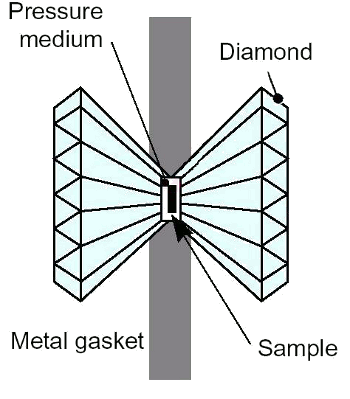
How can anyone generate that kind of pressure?  The high pressure physics community has been using diamond anvil cells for a while now.  DACs put two single crystal diamonds in a holder and apply force to them.  The combination of the small size of the culet (bottom-most pointy part) of a faceted diamond (around 100 to 200 microns diameter) coupled with the almost incompressible hardness of diamonds, can achieve enormous pressures. Pressure is force divided by area, so tiny areas require less force than larger areas.
The researchers said that as the pressure was increasing, they were able to observe - and photograph - the changes in the hydrogen in the cell. Ars Technica has this summary:
After loading the sample and cranking up the pressure (literally—they turned a handcrank), they witnessed hydrogen's breakdown at high pressure, which converted it from a clear sample to a black substance, as had been described previously. But then, somewhere between 465 and 495 GigaPascals, the sample turned reflective, a key feature of metals.
Starting as a transparent gas, the sample begins to darken at 2 gigapascals as it transitions into a semiconductor. At 495 gigapascals, it appears to become a light-reflective metal. (Courtesy of Physics.org) (Source of caption)

In a way, what comes next is the hardest part. Now that they've created metallic hydrogen, what do they do with it?  They left it in the pressure cell.  There are tests that they would love the answers to, such as whether or not it remains as an observable metal when the pressure is released.  If it does, there are theoretical reasons to think it will be a superconductor at room temperature.  That could be quite interesting.  Again, back to Ars Technica
The authors have no way of telling whether the metallic substance is a solid or liquid. They expect solid based on theoretical considerations, but all they know for sure is that it's 15 times denser than hydrogen chilled to 15K, which is what they put into the diamond anvil.

One result they do have is that there was no change in appearance even as they allowed the sample to warm up to 83K. That's intriguing, because some theoretical work has suggested that metallic hydrogen could be metastable, meaning it will remain metallic even as the pressure and temperature that forced it there is released. That will definitely be something worth checking into in more detail. Other calculations suggest it will be superconducting, but that hasn't been looked at yet at all.
The skeptics, rightly, say that they'd like to see more data and suggested what they want to see.  Entirely reasonable thing to do when many scientists have tread this path before and been wrong.


Sunday, February 5, 2017

A Man With Two Watches Never Knows What Time It Is

That's one of my favorite modern proverbs, one with which almost everyone can identify - at least if you remember depending on a watch without instant access to "atomic time" through your cellphone connection  (most of the great, older proverbs come from the Bible's book of Proverbs).

That's prompted by something that happened today.  I was up an hour before sunrise to get a pork butt into the smoker.  No, it has nothing to do with the Super Bowl, it was just time to do some experiments with my smoking setup.  The smoker was preheated and the butt went into the smoker by 7:00 AM.  I put two temperature probes into it, the built in temperature probe and my new remote reading thermometer.   That's where the problem showed up.
The pork butt was rubbed and left in the refrigerator overnight, as always, so it was cold.  The built in probe (on the left side of the meat) said 37, the remote probe (on the right) said 29.  That puzzled me.  It was out of the freezer long enough that we thought it was thawed before it got rubbed and put in the fridge.  I thought it might really just be a cold spot, so I'd keep an eye on it.  As the morning went by, the two thermometers diverged.  By 10:00 they were getting to be 70 degrees apart, almost 40 and 110, an enormous thermal gradient for probes a few inches apart.  What's going on here?  Is either one right? 

Well, what would you do?  In this case, I have other ways of measuring the temperature as long as I don't leave them in the smoker (where the chamber temperature is about 240).  A quick check showed the "independent" thermometer pretty much agreed with the other two.  There really was that big a temperature gradient.  In the intervening hour and a half, the difference has gone down.  It's now 147 and 134.  I suspect that by the time we reach pulling temperature late in the day that difference between thermometers will go down to a couple of degrees.  

Now the real purpose of this experiment was to investigate that little chamber on the right, an external smoke generator that I first talked about New Year's Eve.  As I said in that little piece, one of my main reasons for getting this was that they claim it can produce smoke for "up to 6 hours", which would make an overnight smoke for something like a big beef brisket much more bearable.  My experience on New Year's Eve was that it only ran for perhaps two hours, and I found that the wood chips would stick in the chute inside the smoke generator requiring a poke with a long screwdriver to get them to drop onto the heater.  So far, it seems to be doing the same thing.  I had to poke at the chips around 1-1/2 hours into the smoke, and I did it again at around 3. In retrospect, I should have let it sit longer to see if the smoking then stopped, or just became thinner. 

And while I'm on the topic of that cold smoking attachment, we tried the cold smoked cheese on Friday as a "birthday treat".  That was just slightly over a month since we smoked, vacuum sealed, and put it in the refrigerator.  It was fantastic.  There's one block of cheddar we smoked and haven't opened.  Some of the guys on the forum I read say they won't touch it for a year.   I don't think I could make that.


Saturday, February 4, 2017

Obama Issued Regulations Costing Nearly $900 Billion

According to an American Action Forum report, the 8 years of the Obama administration issued regulations costing the US $890 Billion.  In terms of major regulations, Obama is in a class by himself.   President Obama will average at least 83 major rules annually, 18 percent more than President Clinton and 33 percent more than President Bush. The Obama Administration also set a single-year record for the number of major rules issued in 2010 (100) and then broke their own record in 2016 (with 104).
With a last-minute flourish of $24 billion in final regulatory costs in the last three weeks, the Obama Administration passed $890 billion in cumulative burdens. The record-breaking regulatory output of 2016, which imposed the most major rules in history, capped perhaps the most aggressive regulatory record in history. From the available data on the American Action Forum’s (AAF) RegRodeo.com, the Bush Administration averaged $42 billion in annual final rule costs. The Obama Administration more than doubled that figure, with $111 billion in annual final burdens.
Of course, the problem here is that these regulations are abrasive in the metaphorical gears of the American economy's machine.  They slow down industries, reduce hiring, reduce employment, and reduce pay.  These cost burdens break down as:
  • Total Costs: $890 billion
  • Annual Costs: $139 billion
  • Annual Paperwork: 549 million hours
  • Rules Costing More than $1 billion: 113
The end result, though, is that somebody has to bear that $890 billion in costs, and that someone is the American people.

For perspective, during the last four years of the Bush Administration, it imposed more than $159 billion in burdens; President Obama and his regulators published more than that in 2016 alone, $164 billion, which is nothing compared to Obama's total of $218 billion in 2012!

Who are the big offenders?   I bet I don't have to tell you the most expensive regulations came from the EPA.  Breitbart summarized it as follows:
The Environmental Protection Agency (EPA) issued $344 billion worth of regulations during the Obama administration, and implemented the most expensive regulations out of all government agencies, according to the study.

The Department of Energy came in second, issuing $194 billion in regulations over the last eight years.

The Department of Health and Human Services (HHS) issued $104 billion in regulations as it worked to roll out Obamacare provisions.

The Department of Transportation’s regulations totaled $58 billion, while the Department of Labor issued $56 billion worth of rules during Obama’s time in office.
In tabular format:
The AAF report slices and dices these numbers in all sorts of ways, for the truly interested. 


Thursday, February 2, 2017

“Now, Witness the Power of This Fully Operational Death Star.”

Not really.  It's just that, “Now, witness the power of this fully operational CNC Mill.” didn't sound anywhere near as sexy.

As you might have gathered from yesterday's post being called “Preview”, I was potentially minutes from having it completely assembled and operational.  There have been a lot of days in this project where a task I thought was “a few minutes” turned into a few days, so I didn't want to say I'd show this today.  Those minutes were accomplished uneventfully this morning so that by noon, it was a fully operational death star CNC mill.

It's not Done done, but I think it's fully usable.  As I say in the video description, I now move from construction to optimization.  I've run all three axes for only a few minutes, and haven't cut any metal yet, but I think I could.  I debated doing some engraving or something today to record, but instead just recorded about five minutes of a machine warmup routine I wrote.  Even I found that too boring to watch, so I cut it down to about a minute and a half.  Heck, just watch the last 30 seconds. 

On the plus side, I checked accuracy this afternoon, at least on the small scale.  When I tell the mill to move 0.100", it goes .100.  When I tell it to go 0.500, it goes 0.500.  Well, I can see what the QC guys call “ballscrew drunkenness” - a tendency for each turn to not be exactly the same length.  Mechanical engineering classes teach that a screw is an inclined plane, so think of it as lumpiness in that inclined plane.  Being accurate over half an inch means I swagged the scale for the machine sufficiently accurately for it to be OK for things smaller than an inch.  I will recheck that with a longer scale by using 6" calipers. 
The mill's corner of the shop.

On the negative side, it has too much backlash.  The whole purpose of changing from the leadscrews in the mill to ballscrews was to reduce backlash to the smallest amounts I could get.  I measured over .010 on X and Y, with Z coming in at a more respectable .004.  I was hoping for .001 or .002 on all three.  Frankly, I'm kinda pissed at that.  I'm not exactly sure where to start looking for the cause.  It has the potential of making me pull things apart again.  (Do your best Sam Kinison voice and scream, “No!, NO!!, NOOOOOOO!!!!”).  Also on the negative side, I don't think I'm getting rapids as fast as Hoss says he gets.  Rapid movements aren't terribly important because you can't do any cutting at those speeds, but they cut your production time if you need to go back and forth a lot to make something.  The last moves in that video are done with a feed rate of 100 IPM, and while the LinuxCNC software interpolation partitions that speed between all the axes somehow, it's quite a bit faster than anything I can get on the Sherline. 

Of course, in the total sense this is far from done.  The advantage is that for everything I do from now on, I have the big mill for help if I need to make parts and not just my micro mill.  Things to work on are to hook up the oiling harness (I have everything except the oil), the enclosure and the cooling system.  I had been considering flood coolant all along for this, but need to consider misting or other alternatives, before I go buy parts. 

As for now, I'm just going to enjoy completing a long, long project.  Tomorrow's my birthday, so it's good day to celebrate. 


Wednesday, February 1, 2017

A Preview

I had a heck of a time getting to this point:


The X-axis would bind and wouldn't move, even when I tried by hand with a hand wheel on the motor.  Those are 570 in-oz motors, which is quite powerful for this size NEMA23, but even that wouldn't budge it.  I spent most of yesterday trying to resolve this.

This morning, I took it apart for the Nth time and rebuilt it step by step until it stopped moving easily.  It was one of two jam nuts on the right end of the ballscrew digging into the motor mount I made several months ago.  I had to cut it back a little (about .015 or .020 - don't recall).  Then it worked fine.

I need to take it out my machinist's pay.