Saturday, July 9, 2022

A Deep Dive on SpaceX Raptor 2 Engine

A month or so ago, Tim Dodd, the "Everyday Astronaut" on YouTube and the web, did a walk through of one of the buildings at Boca Chica with SpaceX CEO Elon Musk.  The focus of this video was a look at the Raptor 2 engine and what makes them special.   

It apparently took a lot of editing because the video was released today.  I'm guessing a lot of you haven't seen it yet. 

This isn't a new thing.  Last August, Dodd got to take a long tour of SpaceX Boca Chica, given a tour by Elon Musk, posting two hours and 21 minutes of video.  Just a few weeks ago in May he posted another, shorter video, on updates to Starship and Starbase itself, and back on June 12, he posted a different video on the Raptor 1 engine

There's a lot of rather interesting technical details in there.  I'm by no means an expert on engines but I found it easy to understand and follow.  There has been vast amounts of simplification of the Raptor 1 design, including getting rid of parts that many (like Dodd) would have considered impossible to get rid of.  

Screen capture from the video.  The engine with the red arrow pointed at it, saying "1" is a Raptor 1; everything else you see is a Raptor 2.  Yes, the tag on the Raptor 1 says, Merry Christmas, a reference to it having so much stuff on it, it's like a Christmas Tree.  The difference between #36, between Elon Musk and Tim Dodd, and the leftmost engine right behind Musk is that #36 has the hardware to be gimballed while the other doesn't. 

In the video, Elon Musk describes the Raptor 1 as a crazy Christmas tree and one even has a painting of a snowman on it.  “It’s not super easy to see but you can compare how much less there is if you just look at–just eyeball the fiddly bits level there versus the fiddly bits level there,” Elon Musk said as he pointed at the Raptors 1 and 2. 

In the video, Musk reiterates his Five Laws of Engineering that they follow religiously in development of the Raptor 2, and that were in Dodd's first video.  Definitely worth watching.  


Friday, July 8, 2022

Just A Small Point or Two

To begin with, H/T to Western Rifle Shooters for yesterday's post "Kinda SADS" (reference to the Sudden Adult Death Syndrome) and one little thing in the image posted.  This image. 

Which (I believe) was intended to be a collection of "health" articles that are explaining away why  younger/healthier people are suddenly dying at unprecedented rates. 

If you haven't been a longtime reader, you probably don't know that I have a special hate for junk science.  A deep, epic-level of ha-a-a-a-te.  These stories are epic examples of junk science.  

Let's start with the bottom right.

To begin with, we have to recognize that virtually all studies like this are studies of correlations.  For some reason, perhaps just looking for correlations, someone noticed something that they could possibly publish and did the arithmetic to write a paper.  Then they actually got published for saying a 1 degree C rise in the summer night temperature could increase the risk of cardiovascular disease (CVD) death by 3.1%.  That number by itself should get the editor to reject the paper.  A result that small may be "statistically significant" and still be completely wrong.  A relative risk increase of 1.031 isn't the kind of number we see from things that are truly dangerous.  Those are two or three times the risk. 

Incidentally, that's the second smallest percent increase in some health problem I've ever seen published.  The smallest was 1.2%.  I personally don't pay any attention to risk increases smaller than about 50% (1.5x).  Take a different experimental group and the risk will be different.  

The study just above that, saying "Solar Storms May Cause Up To 5500 Heart-Related Deaths In a Given Year."  There's just so much wrong with this, it's hard to know where to start, but let's start with "May Cause."  Does that also mean those storms may not cause them?  Second, how big is this affect?  To know that we need to know how many people die of Heart Disease in a year.  The CDC FastStats web page says 696,962 people died of heart disease in 2020, the last year for which totals are available.  A check of the New Scientist article says they're talking about the US so 5500 out of 696,962 is an increase of 0.79%, and it's probably abusing significant figures to use two decimal places because there are two figures in their estimate of 5500.  Whether you call it 0.79%, 0.8% or 1%, it's a pretty small risk increase again.  

The storms they talk about are correlated with sunspot cycle, meaning (1) they're more likely to occur in some years  (around the cycle peaks) than other years and (2) this is nothing new; we've had solar storms in solar cycles for all of human history.  Further, every animal on the planet advanced enough to have a cardiovascular system is exposed to these same storms.  Is there evidence that there are cyclic increases and decreases in heart disease deaths that track solar activity?  In humans or any animal?  They won't let me read the article without paying to subscribe. 

I'm going to skip the top left story because it seems to be saying when people open their inflated utility bills, those bills "may" (again) cause them to stroke out.  Seems pretty self-evident and also not very likely.  

The bottom left story isn't a story about gardening, "urgent warning to gardeners as soil, 'increases risk of killer heart disease';" it's a story about pollution and how pollution gets into everything and... and... the poor people and minorities will be hit the hardest.  Oh, and microplastics!!!  So wear a mask while you garden.  Seriously.

I'd make fun of it, too, but they don't list any numbers to shoot down.  


Thursday, July 7, 2022

A Nascent European Rocket Industry?

For as far back as I can recall, if we went to talk about a European rocket launch industry there has been only one name: the European Space Agency or ESA.  Likewise, when we spoke about European Rockets, we spoke about Ariane vehicles from the ArianeGroup in France.  In the last dozen years, an Italian company named AVIO started providing Vega boosters to the ESA, and now the Vega-C. (Why do I want to say "New and Improved!" here?)  Vega-C is set for its inaugural launch No Earlier Than July 13, and while the first Vega rocket flew in 2012, Vega-C increases performance from Vega’s 1.5 metric tons to about 2.2 tons to a reference 700 km polar orbit. 

The situation has become more crowded in the last few years.  Like everywhere else, it appears there's a rush of startup companies into the launch business in Europe.  As you might expect, there's a wide range of capabilities among those companies, as well as a range of funding they've been able to raise.  While there's a range of the mission capabilities they're pursuing, all of the newcomers are aimed at smaller payloads than the Vega-C - which is a much smaller payload than the Ariane 5 and coming Ariane 6. 

A website called European Spaceflight posts both a complete spreadsheet (complete with lots of numbers!) as well as a pretty cool graphic depicting all of these vehicles.  

When I say lots of numbers, I mean things like how much funding they've claimed to have and the payload to a low earth orbit.  Exactly what kind of LEO isn't declared for every launcher, and some companies don't even list a claimed payload for rockets they're designing.  If the vehicle is for suborbital flights, the vehicle name has (sub) appended after it.  

I was able to simply highlight the spreadsheet with my mouse and copy it into my LibreOffice Calc spreadsheet.  I won't bore those who don't care about it, but here's the first 12 rows to give a feel for the data.  European Spaceflight notes that funding figures are sourced from Crunchbase or other public sources. For reference, a Falcon 9 lists its payload to LEO as 22,800 kgs.  None of these vehicles are close to competing with it except the biggest version of the Ariane 6, called 64.

I was aware of a few of these startups but not even half of the batch; there are 29 companies in that spreadsheet. It looks like the small launch business is turning into a global growth market, and spaceflight is starting to turn into what the visionaries said it would be in their predictions 50 years ago.


Wednesday, July 6, 2022

Dumbest Headline of the ... Oh, Nevermind

In a time when at least once a week I say out loud, "what planet is this and how did we get here?" it's hard to say a headline is the dumbest ever, the dumbest of the week, or even the dumbest of the day.  I saw this one yesterday, but there was actually an important story yesterday, so I let this one sit.  Since the important story today is that yesterday's important story is resolved, I'll go back to the dumb shit headline.  

'Urgency is a White Supremacy Value' Says Oregon Health Bureaucrat 

from PJ Media, a story based on coverage from Reason.  A health bureaucrat, as in a state health department officer?  To be as exact in the quote as I can get:

...the Oregon Health Authority’s office for equity and inclusion delayed a meeting with a partner agency on the grounds that “urgency is a white supremacy value.”

Say that again: a HEALTH Authority person thinks urgency is just something those evil, white-privileged people care about?  I can tell at a glance that anybody in healthcare who thinks urgency is some sort of value reserved for white people is not someone actually working with patients at all, and most especially not working in an Emergency Room.  Which is to say they're not healthcare workers and never have been; they're simply bureaucrats.  Furthermore, they've lived such a blessed life that they've never been in a situation where they or a loved one was in need of urgent care in an ER or hospital.

In an email obtained by Reason, Regional Health Equity Coalition Program Manager Danielle Droppers informed the community that a scheduled conversation between OHA officials and relevant members of the public would not take place as planned.

"Thank you for your interest in attending the community conversation between Regional Health Equity Coalitions (RHECs) and Community Advisory Councils (CACs) to discuss the Community Investment Collaboratives (CICs)," wrote Droppers. "We recognize that urgency is a white supremacy value that can get in the way of more intentional and thoughtful work, and we want to attend to this dynamic. Therefore, we will reach out at a later date to reschedule."

Tell you what, Ms. Droppers, I propose an experiment.  I'll put duct tape over your mouth and caulk in your nose to get an airtight seal and see if you feel any urgency about being able to breathe within about, say, 15 seconds.  Or maybe we can induce a heart attack?  Not a cardiac arrest where it's just "lights out" and (if you're lucky) you barely even feel pain, but a racked with chest pain, desperately gasping for air, heart attack.  Think you'll feel any urgency to get help Right Frickin' Now?   

In my book, urgency is appropriate when the situations are urgent, like these two hypothetical conditions.  Urgency can be appropriate at other times, such as in the work world when missing deadlines has serious implications.  Droppers' derogatory use of the word urgency for putting off yet another meeting between bureaucrats is a crock.  Blaming it on white supremacy may agree with some book, but it's still brain dead.  

Image source on Twitter, linked by PJMedia.  


Tuesday, July 5, 2022

CAPSTONE Is In Trouble

Last week's CAPSTONE mission (Cislunar Autonomous Positioning System Technology Operations and Navigation Experiment) got off to an impressive start.  The Rocket Lab Electron booster functioned flawlessly and the Electron's Photon upper stage gently goosed the orbit a bit higher, firing seven times at key points to raise the orbit’s highest point to around 810,000 miles from Earth before releasing the CAPSTONE CubeSat on its ballistic lunar transfer trajectory to the Moon.  As we posted last Tuesday, it wasn't going to reach the desired orbit until early November, four months from now, so it has a long way to go.

Today, I started seeing rumors online that the capsule might be lost.  I checked the Artemis blog page for it, finding that as of mid-morning, it still had yesterday morning's post saying everything is proceeding normally.  

That was until about 12:30 ET today.  

Following successful deployment and start of spacecraft commissioning on July 4, the Cislunar Autonomous Positioning System Technology Operations and Navigation Experiment (CAPSTONE) spacecraft experienced communications issues while in contact with the Deep Space Network. The spacecraft team currently is working to understand the cause and re-establish contact. The team has good trajectory data for the spacecraft based on the first full and second partial ground station pass with the Deep Space Network. If needed, the mission has enough fuel to delay the initial post separation trajectory correction maneuver for several days. Additional updates will be provided as soon as possible.

Like the vast majority of spacecraft, there's no going out on a service call to fix it.  It's even tough to do the Universal Software Fix and turn it off and on again.  On the other hand, the teams that do this sort of mission for a living start thinking about what can go wrong and how to address it long before the satellite hardware is first built.  They often come up with ways around problems.  

Probably the champion example in this field is the nearly 45 year old Voyager 2 probe, now in its extended mission.  The "official" mission, the one that was sold to congress was a flyby of Jupiter and Saturn, and that ended 1981.  Voyager 2 launched in August of 1977.  The following April, not even one year into its mission, a capacitor failed in a frequency synthesizer.  It was the receiver's tracking loop, used to tune the receiver to remove Doppler shift effects from the relative motion of the earth rotating and the satellite receding.  The fix was to calculate what the frequency shift would be at the satellite, and then adjust the transmit signal frequency during transmissions to it.  Compensate it on the ground instead of in the satellite.  Voyager has been flying handicapped by not having that circuit since 1978.  Here's hoping they find a way around CAPSTONE's issue, too.

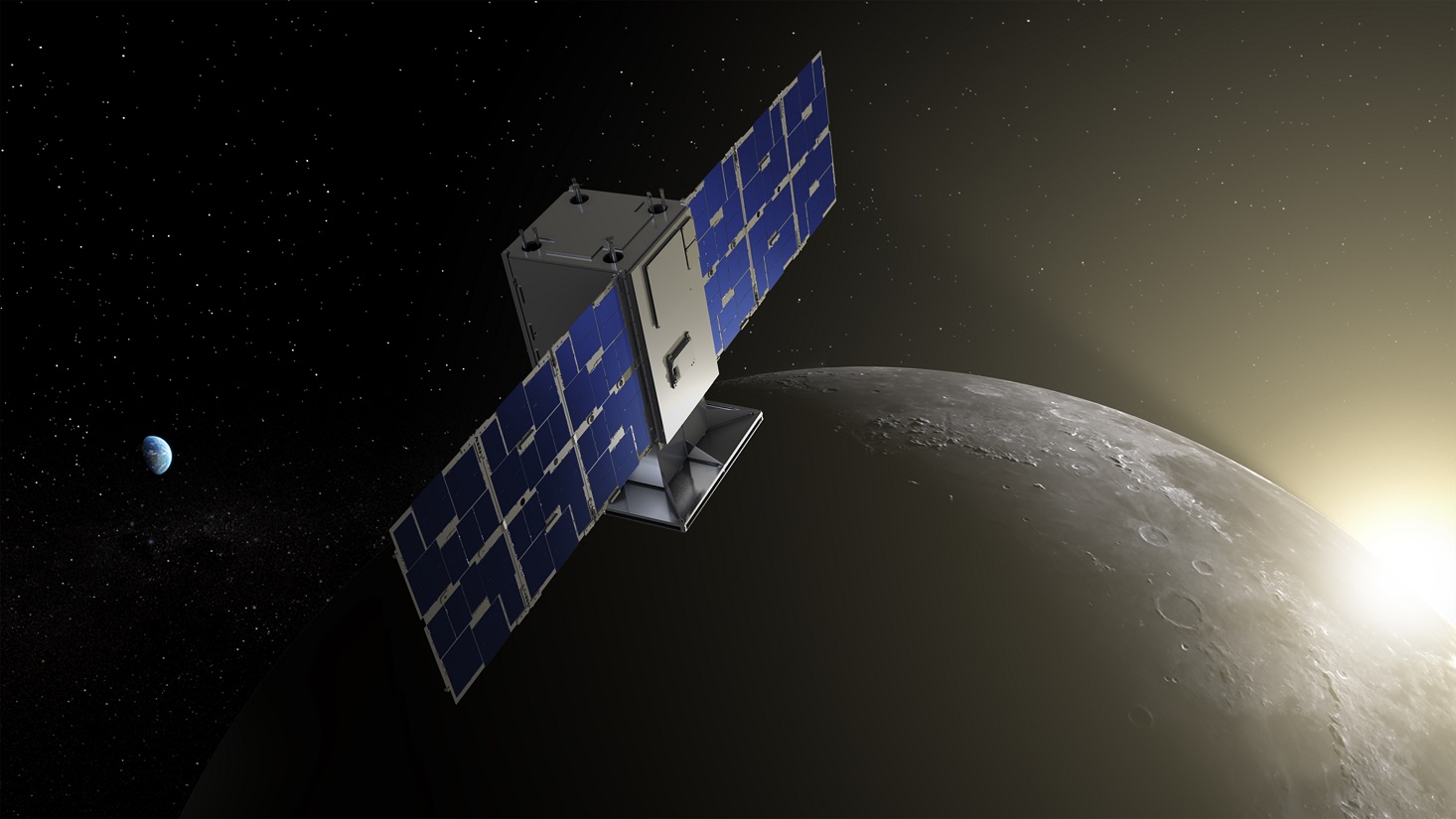
CAPSTONE revealed in lunar Sunrise: CAPSTONE will fly in cislunar space – the orbital space near and around the Moon. The mission will demonstrate an innovative spacecraft-to-spacecraft navigation solution at the Moon from a near rectilinear halo orbit slated for Artemis’ Gateway. Credits: Illustration by NASA/Daniel Rutter 

EDIT TO ADD:  Contact with CAPSTONE has been re-established as of an 11:30 AM, 7/6/22 update at that link.  Updated 5:15 PM - SiG.     


Monday, July 4, 2022

Another Intergesting Graphic to Ponder

Ran across this today.  

A single Raptor2 methane/oxygen engine can produce over half a million pounds of thrust.  They have done 540,000 pounds during ground tests in Texas.  That means a single engine can lift the weights of these things shown vertically - more thrust than weight.  Now imagine what 33 of them in a cluster all firing at once can lift.

Image and concept credits to "Galaxy Heroes" on Twitter.  

It has been a busy day around the house, with not much news on the space beat.  Possible road closures out at Starbase Boca Chica for Tuesday through Thursday, and then again Monday and Tuesday of next week  (7/11 and 12).  While Booster 7 has had some tests done, there are more to come before they think about lighting some of those Raptors.  Here's a good summary video from NASA Spaceflight.com.


Sunday, July 3, 2022

Happy Independence Day- 2022

I've run this post almost every July 4th in the 12 years I've been blogging.  There were only two years I didn't and both of those posts were about problems that must have seemed really big but that are still here (20122014).  My lesson is that while they were important, the big picture is to remind ourselves of the history, and enjoy the day with family and friends.  The problems will still be here on the fifth. 

IN CONGRESS, JULY 4, 1776

The Unanimous Declaration of the Thirteen United States of America 

When, in the course of human events, it becomes necessary for one people to dissolve the political bands which have connected them with another, and to assume among the powers of the earth, the separate and equal station to which the laws of nature and of nature's God entitle them, a decent respect to the opinions of mankind requires that they should declare the causes which impel them to the separation.

We hold these truths to be self-evident, that all men are created equal, that they are endowed by their Creator with certain unalienable rights, that among these are life, liberty and the pursuit of happiness. That to secure these rights, governments are instituted among men, deriving their just powers from the consent of the governed. That whenever any form of government becomes destructive to these ends, it is the right of the people to alter or to abolish it, and to institute new government, laying its foundation on such principles and organizing its powers in such form, as to them shall seem most likely to effect their safety and happiness. Prudence, indeed, will dictate that governments long established should not be changed for light and transient causes; and accordingly all experience hath shown that mankind are more disposed to suffer, while evils are sufferable, than to right themselves by abolishing the forms to which they are accustomed. But when a long train of abuses and usurpations, pursuing invariably the same object evinces a design to reduce them under absolute despotism, it is their right, it is their duty, to throw off such government, and to provide new guards for their future security. --Such has been the patient sufferance of these colonies; and such is now the necessity which constrains them to alter their former systems of government. The history of the present King of Great Britain is a history of repeated injuries and usurpations, all having in direct object the establishment of an absolute tyranny over these states. To prove this, let facts be submitted to a candid world.

He has refused his assent to laws, the most wholesome and necessary for the public good.

He has forbidden his governors to pass laws of immediate and pressing importance, unless suspended in their operation till his assent should be obtained; and when so suspended, he has utterly neglected to attend to them. 

He has refused to pass other laws for the accommodation of large districts of people, unless those people would relinquish the right of representation in the legislature, a right inestimable to them and formidable to tyrants only. 

He has called together legislative bodies at places unusual, uncomfortable, and distant from the depository of their public records, for the sole purpose of fatiguing them into compliance with his measures. 

He has dissolved representative houses repeatedly, for opposing with manly firmness his invasions on the rights of the people. 

He has refused for a long time, after such dissolutions, to cause others to be elected; whereby the legislative powers, incapable of annihilation, have returned to the people at large for their exercise; the state remaining in the meantime exposed to all the dangers of invasion from without, and convulsions within. 

He has endeavored to prevent the population of these states; for that purpose obstructing the laws for naturalization of foreigners; refusing to pass others to encourage their migration hither, and raising the conditions of new appropriations of lands. 

He has obstructed the administration of justice, by refusing his assent to laws for establishing judiciary powers. 

He has made judges dependent on his will alone, for the tenure of their offices, and the amount and payment of their salaries. 

He has erected a multitude of new offices, and sent hither swarms of officers to harass our people, and eat out their substance. 

He has kept among us, in times of peace, standing armies without the consent of our legislature. 

He has affected to render the military independent of and superior to civil power. 

He has combined with others to subject us to a jurisdiction foreign to our constitution, and unacknowledged by our laws; giving his assent to their acts of pretended legislation: 

For quartering large bodies of armed troops among us: 

For protecting them, by mock trial, from punishment for any murders which they should commit on the inhabitants of these states: 

For cutting off our trade with all parts of the world: 

For imposing taxes on us without our consent: 

For depriving us in many cases, of the benefits of trial by jury: 

For transporting us beyond seas to be tried for pretended offenses: 

For abolishing the free system of English laws in a neighboring province, establishing therein an arbitrary government, and enlarging its boundaries so as to render it at once an example and fit instrument for introducing the same absolute rule in these colonies: 

For taking away our charters, abolishing our most valuable laws, and altering fundamentally the forms of our governments: 

For suspending our own legislatures, and declaring themselves invested with power to legislate for us in all cases whatsoever. 

He has abdicated government here, by declaring us out of his protection and waging war against us. 

He has plundered our seas, ravaged our coasts, burned our towns, and destroyed the lives of our people. 

He is at this time transporting large armies of foreign mercenaries to complete the works of death, desolation and tyranny, already begun with circumstances of cruelty and perfidy scarcely paralleled in the most barbarous ages, and totally unworthy the head of a civilized nation. 

He has constrained our fellow citizens taken captive on the high seas to bear arms against their country, to become the executioners of their friends and brethren, or to fall themselves by their hands. 

He has excited domestic insurrections amongst us, and has endeavored to bring on the inhabitants of our frontiers, the merciless Indian savages, whose known rule of warfare, is undistinguished destruction of all ages, sexes and conditions. 

In every stage of these oppressions we have petitioned for redress in the most humble terms: our repeated petitions have been answered only by repeated injury. A prince, whose character is thus marked by every act which may define a tyrant, is unfit to be the ruler of a free people. 

Nor have we been wanting in attention to our British brethren. We have warned them from time to time of attempts by their legislature to extend an unwarrantable jurisdiction over us. We have reminded them of the circumstances of our emigration and settlement here. We have appealed to their native justice and magnanimity, and we have conjured them by the ties of our common kindred to disavow these usurpations, which, would inevitably interrupt our connections and correspondence. They too have been deaf to the voice of justice and of consanguinity. We must, therefore, acquiesce in the necessity, which denounces our separation, and hold them, as we hold the rest of mankind, enemies in war, in peace friends. 

We, therefore, the representatives of the United States of America, in General Congress, assembled, appealing to the Supreme Judge of the world for the rectitude of our intentions, do, in the name, and by the authority of the good people of these colonies, solemnly publish and declare, that these united colonies are, and of right ought to be free and independent states; that they are absolved from all allegiance to the British Crown, and that all political connection between them and the state of Great Britain, is and ought to be totally dissolved; and that as free and independent states, they have full power to levy war, conclude peace, contract alliances, establish commerce, and to do all other acts and things which independent states may of right do. And for the support of this declaration, with a firm reliance on the protection of Divine Providence, we mutually pledge to each other our lives, our fortunes and our sacred honor.

~~~~~~~~~~~~~~~~~~~~~~~~~~~~~~~~~~~~~~~~~~~~~~~~~~~~~~~~~~~~~~~~~~~

I would have highlighted portions that I think are particularly apt today, but the whole thing would be highlighted.  

Enjoy your day.  To those who serve - and have served - to provide this gift of liberty for us:  Thank You from the bottom of my heart. 


Saturday, July 2, 2022

Small, Short, Space Story Roundup Again

The Artemis vehicle, also known as the SLS rocket and Orion spacecraft, the SLS rocket and Orion spacecraft are back in the Vehicle Assembly Building as of this afternoon.  

The combination started the four-mile journey from launch pad 39B at 4:12 a.m. EDT this morning (July 2) and was fully secured in the VAB at approximately 2:30 PM.

Over the next several days, the team will extend work platforms to allow access to SLS and Orion. In the coming weeks, teams will replace a seal on the quick disconnect of the tail service mast umbilical and perform additional checkouts and activities before returning to the pad for launch.


Will ULA's Vulcan rocket launch this year?  US Space Force acquisition executive Frank Calvelli is giving that impression.  He says it's what he has been told, but I have to wonder if he has been told what they think he wants to hear.  Most of you will know instantly that the Vulcan has been held up by the difficulties that Blue Origin has had delivering the BE-4 methane/oxygen (methalox) engines for Vulcan.  The way I read the story is that Calvelli is making the trip to visit ULA and Blue in order to put some pressure on them to "get 'er done." 

Calvelli, who has been on the job for less than two months, told reporters at the Pentagon June 28 that he is aware of the delays in the development of Vulcan’s main engine, Blue Origin’s BE-4, and that is why he decided to put ULA and Blue Origin on this travel schedule sooner rather than later. 

“One of the first industry visits I want to make is down there to make sure they understand the importance of hitting their milestones with that engine delivery as well as with the launch,” Calvelli said.

It sounds to me like, “do you guys think you're working too much overtime now?  You're going to do 'whatever it takes' to get that launch off before the end of the year.”  ULA's Tory Bruno has said that the two flight certified engines will be delivered this summer and the first Vulcan launch will be before the end of the year, so that's where Calvelli is getting his information from.  

The story of the BE-4 not performing as they're supposed to has been covered here pretty thoroughly, as ULA's problems.  The Vulcan is to replace the Atlas V, not because the Atlas V is particularly bad, but because it's dependent on Russian RD-180 engines and congress has forbidden the purchase of Russian engines.  ULA has said they have enough inventory to finish their scheduled Atlas V launches but then has to move over to the Vulcan. Then we learned that ULA had won a big contract from Amazon to launch the Kuiper broadband constellation increasing the urgency for the company to start transitioning to Vulcan and flying on a domestically produced engine.

I'd say that Calvelli doesn't try to be too intimidating, but then he concluded with this:

At this point Calvelli said he has no specific concerns about the program but believes it’s important enough to merit a visit. “I just want them to recognize that there’s somebody new in town, and that this is really important to me.”

With all due respect, I think that saying it will launch before the end of the year isn't very realistic.  (Note: "with all due respect" is syntactically the same as "bless his heart" in Southern.)


That story ties in with the last one.  The US Space Force has its launch providers for national security payloads locked up through 2027: it previously selected ULA (United Launch Alliance) and SpaceX for that purpose.  Reports are starting to surface that the industry is starting to organize lobbying efforts for the next phase, Phase 3, of the National Security Space Launch program.  The Space Force plans to open bidding in fiscal year 2024, the publication says. 

ULA seeks to block the way...One of the biggest tensions concerns the extent to which the Space Force will seek to broaden the pool of potential applicants. Incumbent United Launch Alliance has drafted a letter, now signed by more than two dozen US House members, that encourages the Space Force to require launch providers to "meet all critical mission requirements." This would effectively limit the contest to those companies with large, “high energy” rockets. Other legislators are seeking to make the launch competition more accessible to new entrants.

ULA's view is obvious; their Vulcan Centaur is one of those “high energy” rockets.  SpaceX has the heavier-lift Falcon Heavy and the "even heavier lift than that" Starship coming on line.  I don't see SpaceX fighting this, although I may be wrong here.  The rocket industry is going through a rebirth like we've never seen with new vehicles and even new methods appearing regularly (two examples out of several).  If those new companies and platforms can lift important but smaller security payloads, why insist they go a on much bigger vehicle?  Especially if most of that vehicle gets thrown away.

Vulcan Centaur, rendering from the ULA Vulcan Page.


Friday, July 1, 2022

Did it Seem Hard to Finish Your Work on Wednesday the 29th?

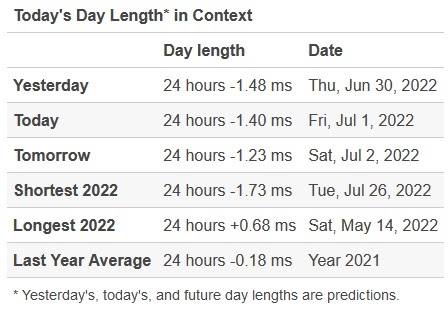
If so, you're very sensitive.  Wednesday actually was a shorter day, not in terms of the time from sunrise to sunset but the actual time for the Earth to rotate a full 360 degrees at the equator.  Looked at that way, it was 1.595 milliseconds shorter than 24 hours so the day was over that much before it "should have" been.  For the record, the title is a wisecrack.  Nobody would notice 1.6 milliseconds.  If you're in the US, your lights are flickering 10x slower than that: every 16.7 milliseconds.


Don't fall into the catastrophic thinking that this means we're headed for some sort of disaster.  The length of days varies all the time.  Since Wednesday, each day has been a little longer, but that trend won't hold indefinitely.  This graphic from the same site shows that the shortest day in '22 is coming July 26th, and will be around 130 microseconds shorter than today.

Predictions used for the future, of course.  The longest day for this year so far (and according to the predictions, should remain that) was Saturday, May 14, the day was 680 microseconds longer than it should have been.

You may recall leap seconds, like we had in 2015 on June 30th at midnight, where a second gets added to the clocks because the days had been consistently too long.  How this is done is the clock is held for one second, typically at the stroke of midnight.  When the clock is at 11:59:59 PM, it holds for one second before showing 12:00:00 AM. In this case, with days being short, they refer to it (somewhat clumsily, IMO) as adding a negative leap second.  Adding a negative is, of course, subtracting.  The clock would get to 11:59:58 PM and the next tick would be 12:00:00 AM.

There hasn't been a leap second added since December 31 of 2016, so while some days have been a bit longer and some have been a bit shorter, the overall years have been relatively close to the proper number of seconds.  If every day was 1.6 milliseconds too short, a second could be subtracted off the clock every 625 days.  That's not likely.  There has never been a negative leap second and there's genuine concern that millions of pieces of software in use were designed without thought of a subtracting a leap second.

Still, the typical day is too fast this year and has been for some years.  We might well be heading for the first negative leap second.  


Thursday, June 30, 2022

CRS25 (Cargo Resupply) Mission Bumped Later

SpaceX's CRS25 mission to the International Space Station was originally scheduled to be June 10th but was then delayed on the 7th by the discovery of a possible leak from one of the Cargo Dragon's Draco thrusters.  Dates moved around a bit but the last I heard was No Earlier Than (NET) July 11th. Word was released earlier in the week of a three day slip to NET July 14th.  

“The new target launch date supports ongoing Dragon spacecraft inspections as well as repair and replacement of any components that could have degraded by exposure to mono-methyl hydrazine (MMH) vapor found during testing in early June. In order to allow a more detailed off-vehicle inspection of the parachutes, the SpaceX team made the decision to replace the main parachutes on this spacecraft.

The new date also allows for launch of the uncrewed cargo mission for the earliest possible rendezvous opportunity with the International Space Station following the upcoming high-beta angle period when the sun angle with space station’s orbital plane causes problems with thermal and power generation at the microgravity laboratory in the planned docking attitude for visiting spacecraft.”


NASA.gov – June 28th, 2022

The reason for this latest delay is the last sentence in the first quoted paragraph: the possibility that the MMH leak may have damaged one of the Cargo Dragon's parachutes.  Rather than open the capsule and inspect the parachutes, SpaceX made the decision to replace them with new parachutes and inspect those in a better way.  The delay from July 11th to the 14th to replace 'chutes isn't that much time, and taking time to inspect the 'chutes and then replace them would most likely take more time than to just replace them.  

The Cargo Dragon from mission CRS-23 arriving at ISS and just off the docking visible at left.  Photo by ESA Astronaut Thomas Pesquet.  August 30, 2021.  

This is one of six Falcon 9 launches on the manifest for July; the first will be NET next Thursday, July 7, from SLC-40 at the Cape, followed by one from Vandenberg's SLC-4E on Friday, July 8. 


Wednesday, June 29, 2022

The JWST Team is Teasing Us

A check of the "Where is Webb" site shows that the James Webb Space Telescope hasn't been declared fully operational yet because the team is in the last stages of commissioning all of its instruments.  They are, however taking images and the people who have seen them are going gaga over them.  

Recounting his first encounter with data from Webb, [Thomas] Zurbuchen [who leads NASA's scientific programs] said he, too, was in awe of what the telescope had proven capable of. He said he almost cried when looking at the first photos taken by the new instrument.
...
NASA's deputy administrator, Pam Melroy, said she was blown away by the images Webb has produced so far. "What I have seen moved me, as a scientist, as an engineer, and as a human being," she said.  [EDIT: clarifications in square brackets added here - SiG]

Screen capture of "Where is Webb?" site at 8:30 PM June 29, '22. Note the temperature of the sun-facing side of the sunshield in that broad, tennis court-sized area is 122F (leftmost temperature next to the view of the JWST) while the cold, shaded side opposite at the back of the telescope is -384F, while specific instruments range from -390 to -449F.  (Absolute zero, 0 Kelvin, is -459.67F).  That shield works pretty well!

It has been six months since the Christmas Day launch of the JWST, aboard its Ariane 5 ride to its ultimate L2 point orbit over 900,000 miles from Earth.  The nerve-wracking deployment of the sunshield, the unfolding of the main telescope and meticulous alignment of the optical system are all in the rear view mirror now.  Remember the concern over the 344 single-point failures that could scuttle the mission?  All in the past.  For some of the principals on the design of the Webb, it has been two decades of work now going into its third - and the one they worked twenty years toward.  

Since the beginning of the mission, the milestones have said that the telescope will be completely commissioned and operational by July 12th.  That's two weeks from this Tuesday (yesterday as I write). 

NASA said it plans to release several images beginning at 10:30 am ET (14:30 UTC) on July 12, the result of Webb's "first light" observations. On Wednesday, space agency officials said the images and other data would include the deepest-field image of the universe ever taken—looking further into the cosmos than humans ever have before—as well as the spectrum of an atmosphere around an exoplanet. By looking in the infrared, Webb will be able to identify the fingerprints of small molecules, such as carbon dioxide and ozone, that will offer meaningful clues about the habitability of worlds around other stars.

Final words to Eric Berger of Ars Technica, starting this with a quote from Thomas Zurbuchen, mentioned in the first quote up above:

"It's really hard to not look at the universe in a new light and not just have a moment that is deeply personal," he said. "It's an emotional moment when you see nature suddenly releasing some of its secrets. and I would like you to imagine and look forward to that."

What a tease!

Unfortunately, we will have to wait nearly two full weeks to see the final products from Webb's first observations. NASA said it will not be releasing any images early, even on an embargoed basis. But we've waited 20 years for Webb to come online and offer a truly worthy successor to the Hubble Space Telescope. I suppose we can wait a little while longer.

If we must.


Tuesday, June 28, 2022

Small Space News Story Roundup

As I try to find something worth talking about when nothing big is going on...

The launch window for the Artemis I mission has (more or less) been announced as August 23 to September 6.  The August 22 date I mentioned was wrong.  

During a pair of news conferences last week, NASA officials declined to set a launch target for the mission. However, in an interview Tuesday with Ars, NASA's senior exploration official, Jim Free, said the agency is working toward a launch window of August 23 to September 6.

"That's the one we're targeting," Free said. "We'd be foolish not to target that right now. We made incredible progress last week."

Artemis I is an unmanned test flight which will test the Artemis/SLS system completely.  It will fly around the moon, although I haven't seen a detailed mission description.  The second flight called (imaginatively enough) Artemis II, will carry astronauts but will not land on the moon.  At the moment, that looks to be No Earlier Than (NET) 2024.  The lunar landing, Artemis III, looks to be 2025 at the best.  Considering the history of everything to this point, it's probably more like 2027.  


Rocket Lab successfully launched NASA's CAPSTONE mission (Cislunar Autonomous Positioning System Technology Operations and Navigation Experiment) this morning (EDT) (video of the launch here).  This mission uses a low power upper stage that isn't a part of the regularly-launched Rocket Lab Electron that launched the satellite, and which will raise the orbit slowly over the next few months until it achieves the desired orbit around the start of November. This is the first attempt to fly an NRHO, which NASA intends to use for the Artemis Lunar Gateway, arguably making this mission the first of the Artemis program.

The orbit, formally known as a near rectilinear halo orbit (NRHO), is significantly elongated. Its location at a precise balance point in the gravities of Earth and the Moon, offers stability for long-term missions like Gateway and requires minimal energy to maintain. CAPSTONE’s orbit also establishes a location that is an ideal staging area for missions to the Moon and beyond. The orbit will bring CAPSTONE within 1,000 miles of one lunar pole on its near pass and 43,500 miles from the other pole at its peak every seven days, requiring less propulsion capability for spacecraft flying to and from the Moon’s surface than other circular orbits.

The NRHO follows an interesting concept and there are some videos worth watching about them. The topic could be a long post by itself.  The video shows how the NRHO can be derived from a Lagrange point L2 orbit, and becomes essentially stable in a lunar polar orbit.  "Essentially stable" means it requires periodic corrections but not as hard to implement as other orbits. 

This graphic, from NASA's Ames Research Center, shows the CAPSTONE satellite approaching the moon (top left), the spacecraft's elongated polar orbit around the moon (top right) and the crown-shaped path that lunar polar orbit looks like as seen from the Earth (bottom).


Finally, a short item. If all goes as planned, tomorrow afternoon at NET 5:04 PM EDT, SpaceX will perform their 27th launch of the year, in week 26 of the year.  This year, SpaceX has averaged a launch every 6.7 days.

The mission is a C-band communications satellite for Europe dubbed SES-22.  

Built by Europe’s Thales Alenia Space alongside SES-23, SES-22 was originally meant to be a spare for SES-18, 19, 20, and 21, which are being manufactured by Northrop Grumman and were scheduled to launch in pairs in H2 2022. SOme of the Northrop Grumman-built satellites, however, have suffered significant delays. Strangely, while SpaceX’s SES-18/19 launch schedule has become indeterminate, SES-20/21 are reportedly on track to launch on a ULA Atlas V rocket as early as August. As a partial result, SES recently announced that SES-20 will replace SES-22 as an on-orbit spare, freeing up SES-22 to begin operating just a month or two after launch.
...
It will be the first SES satellite launch in response to the US Federal Communication Commission’s (FCC) C-band auction, which paid existing operators to clear a portion of the “C-band spectrum” (radio waves between 4-8 GHz) that is optimal for ground-based 5G networks.

This launch has two things going for it from my standpoint.  First, being late in the day there's usually a good cooling seabreeze, suppressing the heat of the day.  Second, the path goes slightly south of due east from the KSC, which is better viewing for me than those that go to the northeast (most Starlink launches).  


Monday, June 27, 2022

NASA's Psyche Asteroid Mission Scrubbed for the Year

I haven't mentioned the Psyche asteroid mission except in passing, but it's an interesting concept.  Formally named 16 Psyche, it's an asteroid believed to be entirely (or almost so) made of metal.  As the mission web page at Arizona State University teases,  “For the first time ever, we are exploring a world made not of rock or ice, but of metal.” From time to time, I come across speculation of someone finding an asteroid made of gold or platinum and how rich they could get.  Chances are Psyche isn't that, but might be the heavier metals found in planetary cores like iron, and nickel.  (Disclaimer: only my interpretation.)

The probe arrived at the KSC in early May for testing and integration with the Falcon Heavy that will carry it to the long transfer orbit to the asteroid.  By the middle of the month, it had become evident that something was wrong.  Not long after, the Psyche blog updated, saying 

NASA’s Psyche spacecraft is nearing the final stages of preparations for launch, and the mission team is working to confirm that all hardware and software systems are operating correctly. An issue is preventing confirmation that the software controlling the spacecraft is functioning as planned. The team is working to identify and correct the issue. To allow more time for this work, the launch period is being updated to no earlier than Sept. 20, 2022, pending range availability.

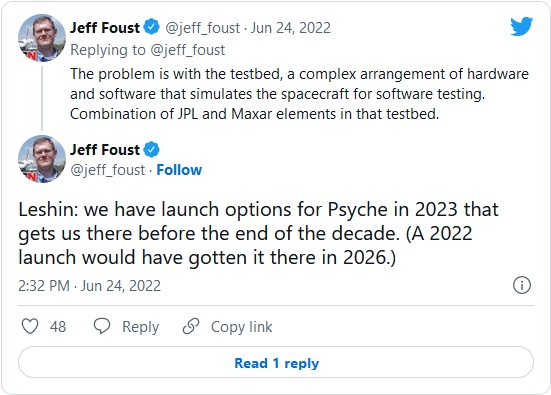
In the weeks since it has emerged that the issue is with the special testbed used to connect to the spacecraft to test it thoroughly. 

On Friday, NASA put out a press release explaining that the program has cancelled its launch for calendar 2022.  The launch window would have closed on October 11th, so they were running out of time. 

Due to the late delivery of the spacecraft’s flight software and testing equipment, NASA does not have sufficient time to complete the testing needed ahead of its remaining launch period this year, which ends on Oct. 11. The mission team needs more time to ensure that the software will function properly in flight.
...
“Flying to a distant metal-rich asteroid, using Mars for a gravity assist on the way there, takes incredible precision. We must get it right. Hundreds of people have put remarkable effort into Psyche during this pandemic, and the work will continue as the complex flight software is thoroughly tested and assessed,” said JPL Director Laurie Leshin. “The decision to delay the launch wasn’t easy, but it is the right one.”

The mission’s 2022 launch period, which ran from Aug. 1 through Oct. 11, would have allowed the spacecraft to arrive at the asteroid Psyche in 2026. There are possible launch periods in both 2023 and 2024, but the relative orbital positions of Psyche and Earth mean the spacecraft would not arrive at the asteroid until 2029 and 2030, respectively. The exact dates of these potential launch periods are yet to be determined.

It raises a peculiar problem for SpaceX.  They've had four Falcon Heavy launches on the manifest, potentially all for this year.  Every one of them is slipping because of problems with the payloads; the side boosters and the rest of the four Heavies are all waiting.  

“For unknown reasons, virtually every near-term Falcon Heavy payload has slipped significantly from its original launch target. Within the last few weeks, USSF-44 – meant to launch as early as June 2022 after years of delays – was “delayed indefinitely.” Delayed from Q3 2020, USSF-52 is now scheduled to launch in October 2022. ViaSat-3, once meant to launch on Falcon Heavy in 2020, is now NET September 2022. Jupiter-3, a record-breaking communications satellite that wasn’t actually confirmed to be a Falcon Heavy launch contract until a few weeks ago, recently slipped from 2021 and 2022 to early 2023.”

Teslarati.com – May 26th, 2022


Sunday, June 26, 2022

Stop Me If You've Heard This One Before

An important part of Artemis is late and over budget. 

It seems like it was only last year that we found out NASA spent almost a decade and a billion dollars on a mobile launch umbilical tower for Artemis.  In reality, it was two years ago in March.   

Except that the same thing is happening again right now.  Three years ago, NASA awarded a cost-plus contract to the engineering firm Bechtel for the design and construction of a second mobile launch tower that's bigger than the first one - it's a paltry six feet taller - but sufficiently different that Bechtel couldn't just copy the one that's holding Artemis today out at Pad 39B. 


When Bechtel won the contract for this mobile launcher, named ML-2, it was supposed to cost $383 million. But according to a scathing new report by NASA's inspector general, the project is already running years behind schedule, the launcher weighs too much, and the whole thing is hundreds of millions of dollars over budget. The new cost estimate for the project is $960 million.

NASA's Inspector General Paul Martin puts the blame largely on Bechtel but doesn't spare NASA for their part in screwing it up as well.  The agency awarded the contract before design requirements coming from the different upper stage visible in the right side above, called the Exploration Upper Stage, were settled enough to generate requirements for the launch tower.  If you go to the little search bar in the top left corner of this page and enter "Exploration Upper Stage" without the quotes, you'll find that I've dedicated more than a little "ink" to problems with this upper stage.  

It would be a comedy of errors if it was even a little funny. 

NASA's explanation for doing this is that it had no choice but to move forward with the tower's design and construction to meet a timeline for its lunar missions. The first three flights of the Artemis Program, culminating in a human lunar lander no earlier than 2025, are to fly on the initial variant of the Space Launch System rocket (which has its own, separate mobile launch tower). However, beginning with the Artemis IV mission, NASA wants to launch lunar missions on the more powerful, upgraded version of the SLS rocket, which will require the new mobile launch tower.

Nominally, this mission is planned for 2026, but realistically it will not fly before 2027 or 2028, due to delays in the earlier Artemis flights. Nevertheless, NASA pressed for the construction of this second mobile launch tower to be ready for 2026 and asked for design work to be done on the tower before the rocket's final requirements were known. This is likely to result in additional costs, pushing the price of the second mobile launch tower above $1 billion.

That first paragraph made my head hurt, saying that NASA had no choice but to move forward when the design wasn't known.  That means they went ahead working on things that they had good reason to believe would have to be taken apart and rebuilt differently.  Building things twice (or more!) is a deliberate waste of money. 

The job has gotten so bad that NASA has removed work from Bechtel's contract, while continuing to pay them as if they were on schedule.  Earlier this year, NASA and Bechtel agreed to take the development of the umbilical cables and hoses out of the contract.  NASA will choose a different contractor for those, with intent to deliver them to Bechtel when it's time to integrate those into the tower.  

Makes me wonder if the contractor (contractors?) for the umbilicals will also be given cost-plus or if they'll be fixed price.  Nothing about the launch tower seems so new and so different from other launch towers that they need cost-plus contracts.  Cost plus should be reserved for developing things for the first time, experimental things; the times when nobody really knows how it should be designed. 


Finally, while I'd seen many rumors that NASA has declared the WDR test on Artemis done, the Artemis program blog still hasn't said that.  While poking around and trying to find a second source to confirm one way or the other, I ran into a local TV station's news broadcast saying that in a teleconference Friday, NASA declared success and set a launch date for the first, unmanned, Artemis lunar flyby mission.  The launch date is August 22nd.  Sometime this week, I'd guess Friday, they'll roll the Artemis/SLS stack back to the VAB.  There are things from the WDR that need to be repaired or otherwise resolved, and the flight-graded batteries need to be swapped out onto the vehicle.


Saturday, June 25, 2022

Wake Me Up When the Crying Stops

We're going into the 36th hour of "Turbo Reeee" in the wake of Roe being returned to the states, as well as the 60th hour following the ruling in the  NYSRPA vs. New York's "may issue a permit if you make a big enough contribution" case.  I don't think I've seen one original thought expressed anywhere in any of the comments - comments that are coming at us as thick as Everglades mosquitoes.

On second thought, I've seen an original thought over at John Wilder's place in his piece, "Over 50 Thoughts About The Supreme Court’s Second Amendment Decision."  It's John's thought, though, not the self-anointed experts he gathered. 

The post by "Tad Ghostal" isn't in the least bit original, although it may well be the only proper response to the poster in the picture.  The same basic template has been done with "guns have more rights than women" and a couple of similar tropes.  The original part is John's line at the bottom.  As I told him over on his blog, I think when I was around 20 I might have paid to see an assault uterus.

Maybe I'm getting too jaded, but I've just seen these same, illogical, emotions-over-facts arguments too many times.  Every Single Time a state had voted to go shall issue, or open carry, or constitutional carry, someone drags out the "blood in the streets" argument.  Ten minutes with a search engine would show that it hasn't happened once.  

Governor Shit-For-Brains in New York even brought up the stupid, "the second amendment only applies to muskets" argument!  How many times do people have to show examples of guns that weren't muskets and were around when the 2A was written before it sinks in?  Naturally, I don't expect governor SFB to know about puckle guns or other early rapid firing, self-reloading guns that the founders would have known about (and maybe even used), but I do expect governor SFB to hire people who will look at her prepared talks and tell her when she's being an idiot.  Maybe someone who would tell her that the ruling specifically said that the amendment applies to weapons that weren't known at the time. 

As bad as that is, and I'm boring myself writing it, it pales next to the insanity over Roe.  We'll be issuing "Handmaid's Tale" outfits to all women who are capable of breeding.  Report next week.  That sort of argument.  Oh, it's not human until we decide it is.  Until then, it's a Buick.  Or a cucumber.  A tumor.  Anything other than a person.  

Nope.  Too much crap.  The only sane thing to do is ignore it if you can and ridicule it no matter what else. 


Friday, June 24, 2022

Missed in the Overnight Tests...

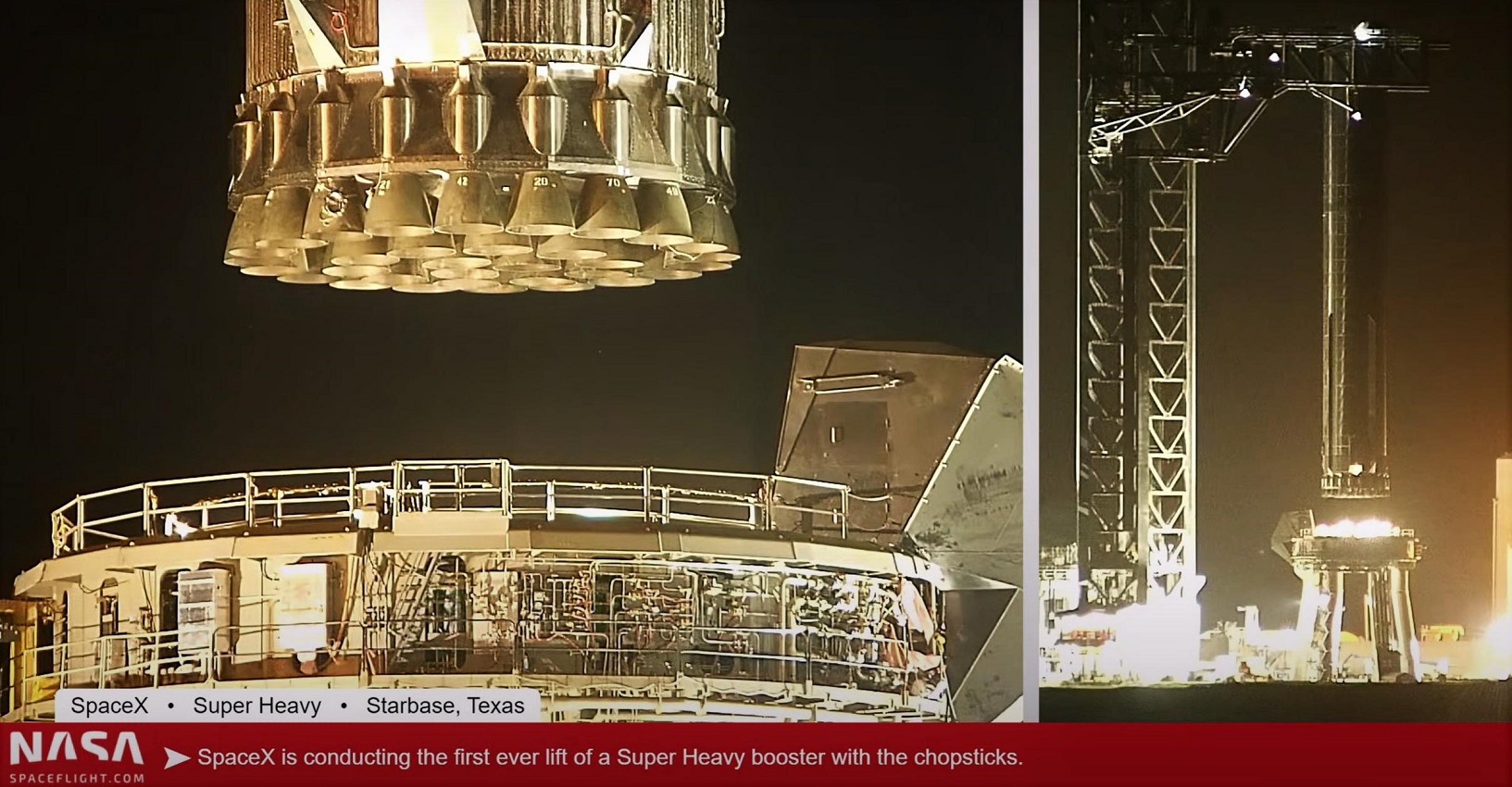
Starting last night and into the early morning hours (eastern time), SpaceX crossed another little milestone that needs to be crossed in the lead-up to the first orbital test flight of Starship/Super Heavy.  After rolling booster 7 (B7) to the launch area yesterday, the booster was picked up by the giant "chopsticks" (which Musk calls Mechagodzilla) and moved it onto the Orbital Launch Mount. 

A screen capture as B7 is being lowered into place.  NASA Spaceflight.com photo, used by Teslarati. They have a video of the operations that's already done as time lapse but it's 14 minutes long and can still be gone through faster. 

Moving B7 onto the OLM is being widely interpreted as the first step to serious testing of a booster with all 33 Raptor engines installed.  This must be done before any attempt at launching to orbit.

According to CEO Elon Musk, Booster 7 will start by igniting just one or a few Raptor engines. SpaceX has never ignited more than six Raptor V1 engines simultaneously and never tested more than three engines at a time on a Super Heavy booster. That plan could have easily changed, however. Either way, Super Heavy B7 will be treading significantly new ground. Even before actual static fires begin, Booster 7 will also need to complete one or more wet dress rehearsals (WDRs), a test that exactly simulates a launch but stops just before the moment of ignition.

If SpaceX attempts a full wet dress rehearsal, in which the booster would be filled with more than 3000 tons (~6.6M lb) of liquid oxygen (LOx) and liquid methane (LCH4), it would be a first for Super Heavy and just as big of a test of the orbital launch site. Booster 7 will also need to test out its autogenous pressurization, which replaces helium with hot oxygen and methane gas to pressurize the rocket’s propellant tanks.

According to the Cameron County, Texas, Road Closures website, 10AM to 10PM road closures are possible as soon as Monday with Tuesday and Wednesday as alternates.  Could they be ready to start trying cryo testing, or even go as far as a Wet Dress Rehearsal by Monday? 


Thursday, June 23, 2022

Movie Stars and Unforgettable Roles

Last week, Mrs. Graybeard and I went to see the new Top Gun:Maverick movie.  Yeah, we liked it.  Good, solid, entertaining, movie.  Minimal wokeness, a story about good people doing hard jobs the best they can and always challenging themselves to be "the best of the best."  I think you all know that.  It's not important. 

Today, I stumbled into a factoid that I couldn't resist posting. 

In any big budget movie like this, the people who are prominent on the screen are not newbies.  They're all going to have big resumes of increasingly important roles.  If you don't know particularly recognize them, that just doesn't mean much.  They're rising stars; you'll recognize them in their next movie.

Despite the minimal wokeness, movies today seem required to have (as humor columnist Dave Barry first said in the 1990s) a mandatorily diverse cast.  The fighter pilots in the movie fit that requirement, including a woman fighter pilot.  Yes, I know there have been some women driving fighters.  No, I don't know how many have been to the Top Gun school.  Furthermore, going into the climactic scenes, you can spot the characters with the most diversity points and tell yourself, "they're not killing off that one."  

The woman was actress Monica Barbaro, playing Lt. Natasha Trace, known by call sign Phoenix. 

Something happened today (which I honestly don't remember) that caused me to look up her bio on IMDB.  As expected, she has a long resume there, 34 credits covering over two screens full of roles big and small.  Expected because she has one of the biggest roles in the movie and plays it well.

Down toward the bottom of the list, in 2013, only her second year listed on IMDB, was a short called, "It's Not About the Nail."  I almost spilled my tea.  I vividly remembered watching that video back in '13 and have long thought this was one of the funniest concepts for a video I had ever seen.  I may not remember her as Phoenix in a year or two.  I think I'll always remember her in this video.


Wednesday, June 22, 2022

Falling for Misinformation

I don't think anyone will be surprised if I say we're surrounded by an incredible amount of misinformation.   It seems every aspect of life has become politicized and gets used to raise emotions on one side or the other.  

I learned earlier in the afternoon that I had been suckered by one of these.  I saw this Tweet posted as truth and just believed it without questioning.  

Unlike me, one of the rare, real reporters out there (this one from Reuters) fact checked it with The Atlantic.  A spokesperson said it was fake.

“I can verify that this is not a real article from The Atlantic, and is indeed fabricated,” said Anna Bross the Senior Vice President of Communications at The Atlantic.

It would be easy to ask why such a silly story would be so easy to believe, but the answer to that is so obvious it doesn't need to be asked.  The commercial media is so completely in the tank for Biden we expect this sort of nonsense.  

Besides, it's not like the anti-Biden side didn't milk an entire five days worth of news out of the story that he fell off a bike.  My reaction to the fake story was to think it was an absurdly low bar to praise Biden for and that anyone over the age of 10 has probably internalized the "pick yourself up, dust yourself off, start all over again" idea (to borrow a line from a song I grew up with).   Besides; I'm a roadie cyclist who rides with those pedals that lock your foot to them.  While learning how to ride those I fell so often that if falling and getting back up was "heroic," I should have gotten the Congressional Medal of Honor.


Speaking of this sort of reaction to a Tweet brings this one to mind.  

About a week ago, this caused a minor panic and I remember seeing that the Green Tip ammo had jumped in price right after the news broke.  

A couple of days later, GAT Daily did a story in a bit more depth.  It's a "Natzo fast, Guido" situation. 

The truth here is that Lake City, contractually under the control of Winchester, has been notified it will no longer sell M855/SS109 produced in excess of the military's needs to the public.  Get that?  They're being told that if they overproduce ammo made to that specification they can't sell it.  But they don't produce that - or, at least, not much of it.  The military has been phasing it out for over a decade.

The US Army started switching to the M855A1 version back in 2010.  In February 2011 it was reported M855A1 was being used more than legacy M855. The Marine Corps also started shooting it in 2010 with a purchase of 1.8 million rounds, adopting it officially in 2018, replacing its MK318.

The Military’s “need” for M855 is over.

The GAT Daily article speculates that the only M855 that Lake City may be producing is for export to allies.  

This policy is telling them they can't sell excess of something they're not even making.  It should have no impact at all.   

Now I have to admit I'm not as sure of this one being wrong as the Atlantic tweet, because this was written by one guy, the editor at GAT daily, and doesn't seem to be cross checked.  That said, it seems to be that overreaction to a news story is what's driving both of these stories.


Tuesday, June 21, 2022

SpaceX Eyeing Another Launch Pad on the Kennedy Space Center

The people at SpaceX are quick to start down a road to a desired goal, be it launch facilities or the vehicles they launch.  A consequence of that is instead of analyzing for long periods to be absolutely sure they don't waste time, they end up re-doing things, and they're very fast at fixing things and moving ahead.  

NASA raised a concern recently that started making it to the top of the "are we sure we're doing this right?" stack of questions; is the Starship Orbital Launch Mount (OLM) that they're building alongside Pad 39A too close to the pad?  In particular, if a Starship should do something undesirable, like blow up on the pad or just above it, will it destroy the infrastructure they need to launch Crew Dragon spacecraft?  That would leave NASA in the position of having no way to get crews to and from the space station.  Due to these concerns, NASA and SpaceX have started considering options to handle that risk.   

There's more at stake than crew missions to the station, though.  Pad 39A is the only pad in the world that handles the Falcon Heavy, which is emerging as a premier heavy lift vehicle for NASA and the US military.  Yesterday, I mentioned the Falcon Heavy will be lifting the Lunar Gateway to its desired orbit, and I've previously posted about it being the launch vehicle for the Europa Clipper mission (2024 schedule).  Both of those are farther out in time, but there are five Falcon Heavy missions slated for the next year.  They would have started already except for payload delays holding up the missions.  

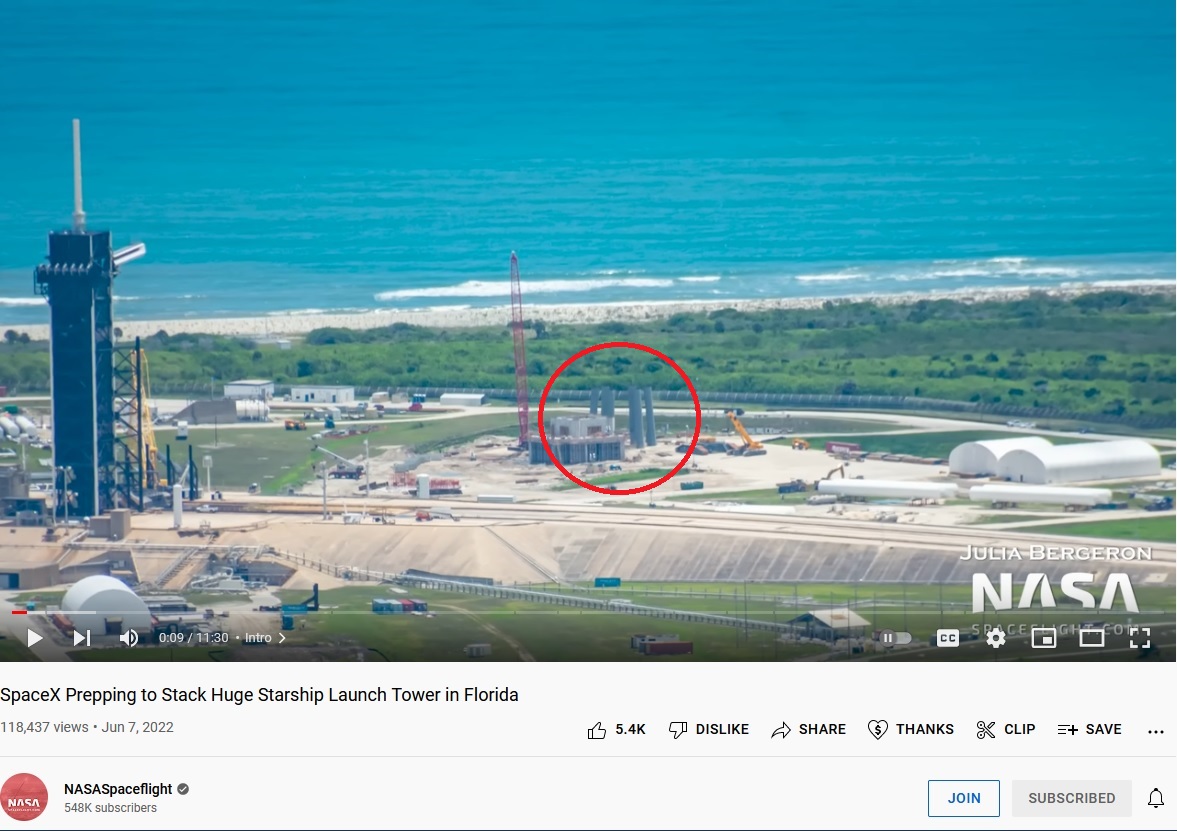
The most recent picture I can get of the OLM area at Pad 39A is in a video from NASASpaceflight (.com).  This is a screen grab of a shot that shows the launch tower on the left foreground and the six steel tubes (circled) that are the base of the OLM.  The concrete structure to the left and in front of the six tubes is the base of the Orbital Launch Integration Tower that will be built.

The new OLM will sit roughly 1000 feet (~300m) East of Pad 39A’s existing Falcon 9 launch facilities. It's also around 1600 feet (~500m) northeast of Pad 39A’s lone horizontal integration hangar.

The most direct solution would be to add the facilities to their other launch pad, SLC-40, if that could be done without taking it out of operation, and that's being studied. 

In response to NASA’s concern, NASA executive Kathy Lueders – in an interview with Reuters – says that SpaceX has begun working with the agency on plans to both “harden” Pad 39A and modify its Cape Canaveral Space Force Station (CCSFS) LC-40 pad to support Dragon launches. According to Reuters, however, receiving approval to put those plans into action “could take months.” Depending on how significant the facilities LC-40 would need are, there’s also a chance that SpaceX would need to complete a new FAA environmental review to construct a crew access tower.

An extreme alternative would be to lease or buy another unused pad on the Cape Canaveral Space Force Base side.  If any are available.  

In the big picture sense, these things need to be addressed but they're not urgent to the point of "drop everything else and fix this."  The Pad 39A Starship Orbital Launch Mount won't be ready to launch Starships for the next six to 12 months, depending on the progress at Boca Chica and if the first launches reveal needed changes as well.  


Monday, June 20, 2022

Artemis/SLS Had A Good Day

But despite the good day with a much improved test, Artemis/SLS is still a largely screwed up program. 

Since a Wet Dress Rehearsal is slow-paced test and prone to all sorts of delays, I wasn't here at the computer at 7:00 AM when it was scheduled to start, but as the day wore on past lunch time, I opened a tab with the NASA TV Live Feed and just listened to the audio in the background.  From then until around 4PM, the commentator would update when something big was happening.  It was easy to keep track of the test. 

The WDR went into a hold at T-29 seconds, so it certainly wasn't an unqualified success, but compared to attempts one through three back in April it was light years closer to success.  The originally-stated T zero was 2:40 PM, however that had turned into 4:28 PM by the time I had the tab open.  T minus 10 minutes had been set for 3:58 PM, to add a built in hold giving the teams an extra 20 minutes before the final 10 minutes started.  Time to go over any little issues they may have been tracking.  Key word: "little."

Problems with a hydrogen leak in the second stage began to show up in the mid-afternoon, and then a problem with the quick disconnect attachment (also liquid hydrogen) from the Launcher Umbilical Tower to the vehicle.   The 20 minute hold turned into a couple of hours as the teams did their best to modify their software to get as close to engine start as they could.  Engine start would probably have been with around 8-10 seconds left in the countdown  

The next several hours or even days will be going over data and determining whether they want to claim they achieved everything they needed to or if they start a fifth run of the WDR.  

Getting back to the concept in the very first sentence of this post, Artemis/SLS is a seriously screwed up program.  The root cause of all that is what we've talked about so many times: it's simply too expensive at $4.1 billion per launch.  That cost limits the number of launches and therefore what can be done.  Even the people in the administration who think we can make up money out of thin air and buy whatever we want blanche at printing that much.  OK, I made that last sentence up.  

Add to the cost that the rocket simply doesn't have the capacity to do what they want to do, giving rise to things like Lunar Gateway (a lunar space station) and it turns into NASA (we're looking at you, Bill Nelson) having to buy other rockets to get around having bought an overpriced, underspecified system. 

Back at the end of March, I ran a story that showed that Artemis/SLS was looking at launch rates of one per year - or less.  I pointed out that the Apollo program launched 11 missions in four years.  Artemis is looking at six missions in seven years.  The article included this graphic.

Today, we learn from Eric Berger at Ars Technica that NASA has been addressing these problems and trying to develop ways around them.  

At present NASA has its baseline plan for Artemis, which is shown below. But NASA has also developed at least two "in-guide" schedule options, which agency planners believe are achievable with anticipated budgets, the documents show. These revised schedules indicate that NASA planners do not believe the baseline plan will be achievable on time or within budget.

One of the internal schedules, labeled "cadence," prioritizes launching regularly. The other, labeled "content," prioritizes launching only when the most meaningful payloads are ready. Combined, they reveal that NASA is struggling to cram an ambitious exploration plan into a finite budget. The result is a slow-moving lunar program that, in large part, fails to deliver on the goals of the US National Space Policy.

Their revised schedule, and now extended until 2034, looks like this:

Note that Artemis III, (as NASA says) the first crewed mission to the moon, is out in 2025.  The problem with this is that NASA still doesn't have moon-rated space suits, and the two companies selected to design and make those suits don't even talk about testing prototypes until 2025

  • There are huge gaps between missions. To close one three-year gap, NASA is considering the creation of an "Artemis III.5" mission that would require the agency to procure a fourth interim upper stage and delay development of other key programs.
  • The slow progression in missions puts off development of a "base camp" on the Moon for years, with the earliest emplacement of a lunar surface habitat not coming until 2034.
  • NASA will spend the next 10 years focused on assembling a small space station in lunar orbit, rather than building up capabilities on the Moon's surface.

NASA has talked about building a permanent base camp on the moon. This included a new lunar rover, a "habitable mobility platform" that would enable crews to take trips across the Moon lasting up to 45 days, and a surface habitat for up to four crew members.  This looks to be 2034 in the second schedule.  There is no mention of Mars in this schedule. 

Notre Dame geologist, Clive Neal, a prominent scientist pushing for a lunar exploration program with a permanent base there, probably had the best observation.  "I don’t get it, I just really don’t get it," he said. "Has nobody at NASA read the space policy? It is really quite bizarre. There's nothing sustainable about the approach they're taking."  

Last words to Eric Berger of Ars Technica:

Given the near certainty that there will be more delays, the Artemis Program is probably at least 15 years from having a semi-permanent habitat on the surface of the Moon. That is just about long enough to be "never" in spaceflight terms, and it would push Mars exploration into the 2040s or 2050s.